Silvercorp Earned More Than Ever — and Still Booked a Loss, Because Its Own Stock Went Up
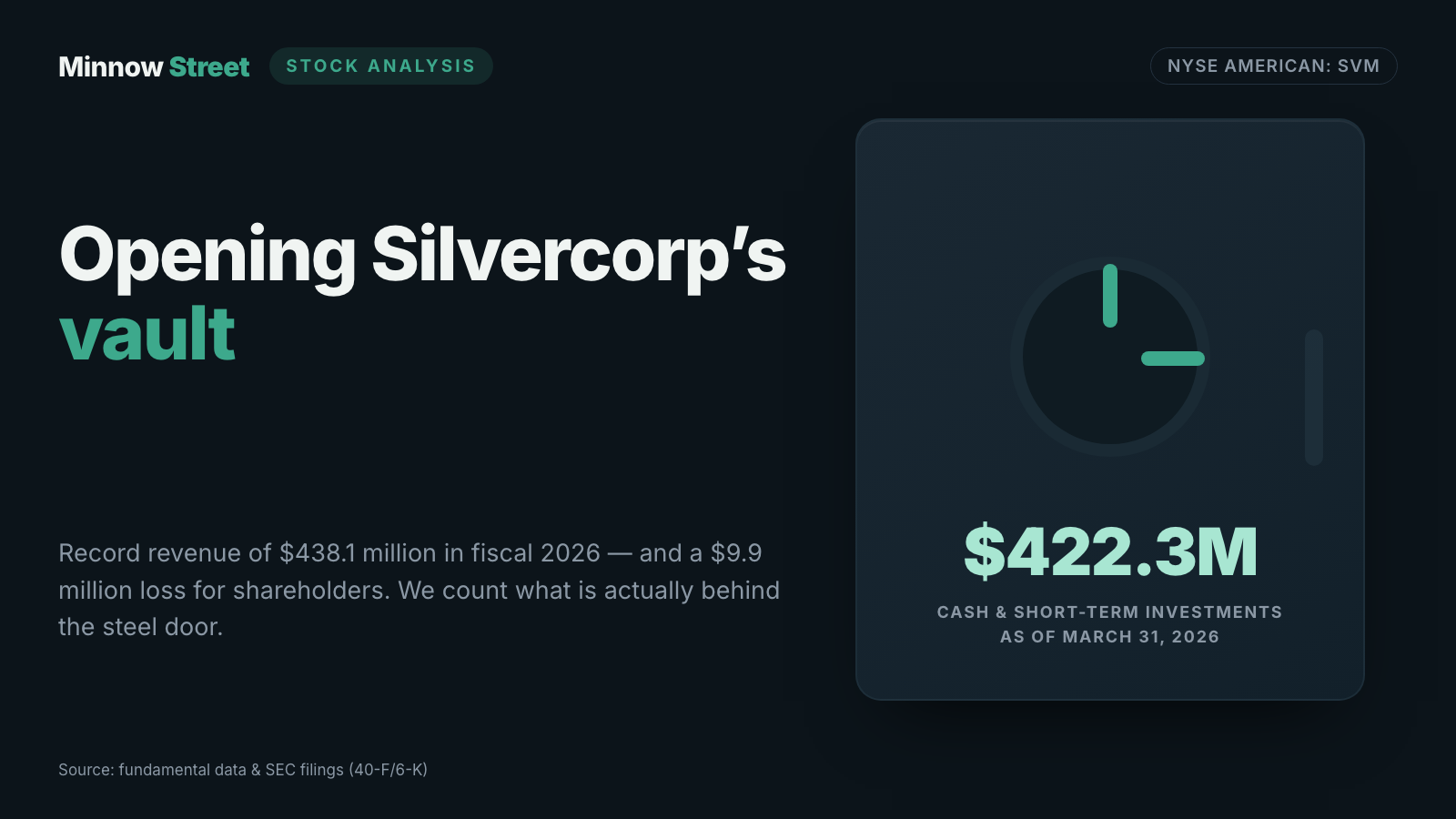
In fiscal 2026 Silvercorp Metals pulled $438.1 million of revenue out of two mines in China, more than in any year before. Income from mine operations came to $253.7 million, more than double the prior year. The bottom line for shareholders is still a loss of $9.9 million. The culprit is not a mine but a convertible note: a $178.5 million mark-to-market charge, triggered because the company's own share price climbed from $3.87 to $10.06 and made the holders' conversion right more valuable. Not one dollar of it left the building. Weeks before the year ended, a London hedge fund opened a brand-new position of 16.1 million shares. At the end there is no advice, just one question: how much of what comes out of the ground actually reaches you?
 Thomas Mücke
Founder & Publisher
Thomas Mücke
Founder & Publisher
Chart
Interactive price chart (TradingView).
Note: pure fact-based analysis, not investment advice and not a solicitation to buy or sell. All figures without guarantee.
There is a mistake almost every investor makes, and it has nothing to do with greed and everything to do with convenience — call it the bottom-line trap. It works like this: an income statement is long, crowded and full of jargon. So your eye jumps to the last line. A plus means a good year. A minus means a bad one. Done. At Silvercorp Metals Inc. (NYSE American: SVM; Toronto: SVM) that reflex misleads you in both directions for fiscal 2026 — which is exactly why the detour is worth taking. So let's make a deal: we read the lines above it. Not the headlines, not the press release, but what the company reported to the U.S. securities regulator, the SEC — the annual report on Form 40-F for fiscal 2026, filed June 30, 2026, together with its audited financial statements and management's discussion. A filing to the SEC is honest under penalty of law. And this one describes the best operating year in company history, a loss that exists because the company's own stock went up, two mines in a single country, and one signature in March that turned a cash debt into shares. What you make of it is your decision.
What Silvercorp actually does — two mines in China and a construction site in the Andes
Silvercorp is not an explorer drilling holes and hoping for investors. It is a working producer: it has been hauling ore out of the ground for years, grinding it, separating the metals and selling concentrate to smelters. The head office is in Vancouver and the listings are in New York and Toronto — but all current production sits in China. Two operations carry the business: the Ying Mining District in Henan province, a cluster of underground mines that produced $399.2 million of the $438.1 million in fiscal 2026 revenue, and the smaller GC Mine in Guangdong at $38.9 million. Together they processed 1,475,512 tonnes of ore and produced roughly 6.8 million ounces of silver, 8,723 ounces of gold, 60.4 million pounds of lead and 21.7 million pounds of zinc.
Now the point you have to grasp to read this company's cost numbers. Silver never comes out of the rock alone here — it sits in ore that also carries lead, zinc and a little gold. Those companion metals are sold too, and their proceeds are subtracted from the cost of the silver. The industry calls them by-product credits. Picture a baker selling rolls and coffee: if the coffee covers the entire rent, the rolls arithmetically cost nothing. That is literally what the report says — cash cost per ounce of silver in fiscal 2026 was negative $0.94, after negative $0.54 the year before. A negative number means lead, zinc and gold paid for the whole operation and left something over. Add sustaining capital spending and taxes and you get the more meaningful measure: all-in sustaining cost of $14.25 per ounce (prior year $12.12) — against a realized silver price in fiscal 2026 of $46.44 per ounce. The margin of this company lives between those two numbers.
On top of that sits a second leg, two years young. With the acquisition of Adventus Mining on July 31, 2024, Silvercorp picked up the El Domo copper-gold project and the Condor gold project in Ecuador; El Domo is targeted to start in July 2027 at an updated capital cost of $283.6 million. On January 27, 2026, it added the Chaarat ZAAV gold complex in the Kyrgyz Republic for $92 million in cash plus up to $70 million in contingent payments — $60 million of which fell due on May 13, 2026, when the government extended the mining license to July 25, 2062. And that sets the central tension of this analysis, which runs through every chapter below: Silvercorp's mining business has never run better — but so many other claimants now stand between the ore and the shareholder that nothing at all arrived at the bottom.
How this stock landed on our desk
This analysis does not begin with a hit in our in-house stock scanner. It begins with a form. On May 8, 2026, Helikon Investments Ltd of London filed its Form 13F-HR with the SEC for the quarter ended March 31, 2026 (accession 0001839497-26-000002). A 13F is the mandatory quarterly disclosure for large U.S. institutional managers: anyone running more than $100 million in U.S.-listed equities must show what they hold. Helikon's table lists 17 positions worth $2,648,555,113 — and inside it, brand new and absent before, 16,115,414 Silvercorp shares worth $173,079,547. At each of the three preceding quarter-ends (June 30, September 30 and December 31, 2025) the same fund reported zero shares.
Two numbers make that entry notable. First, the size in the portfolio: at 6.5 percent weight Silvercorp is the fifth-largest holding in a book that is more than half gold and silver miners — Skeena Resources, Allied Gold, Collective Mining, Solaris Resources, New Pacific Metals, Highlander Silver. Second, the size in the company: 16,115,414 shares is roughly 7.3 percent of the 220,910,911 shares outstanding on March 31, 2026. That is not a toe in the water. In the same quarter the fund also opened six other new positions and sold six holdings outright — a quarter of rebuilding, not of adding to what was already there.
Now the limit that belongs with every 13F, so a disclosure form does not turn into a legend. A 13F shows U.S.-listed long positions only, reported with a 35- to 45-day delay, with no short positions and no derivatives, and nothing that trades outside the United States. It is a rear-view mirror, not a road map. With Silvercorp that becomes unusually concrete: the reporting date is March 31, 2026 — the last day of the fiscal year whose numbers were not published until three months later. What the fund has done since, the form does not say. It says only what was in the book at quarter-end.
A word on the scanner, because honesty demands it. Silvercorp shows up in our filters with a mixed picture, data as of July 24, 2026. The Piotroski F-Score, a nine-point test for the health of the books, stands at 5 of 9 — mid-table; a genuinely healthy company sits at 8 or 9, and the points lost come mostly from earnings collapsing versus the prior year. The Altman Z-Score of 4.87 measures distance from insolvency; anything above 2.6 counts as safe, and 4.87 is comfortable. The equity ratio of 64.3 percent confirms that from the balance sheet. A price-to-earnings ratio simply cannot be formed, because there was no profit for shareholders but a loss — that is not a data gap, that is the subject of this article. A momentum or deep-value filter would not have pushed this stock to the front. That is precisely the gap a filing sometimes fills.
Why Silvercorp files no quarterly report — and what the fiscal year has to do with it
Before the numbers, two quirks you need to know, or you will compare apples with pears. First: there is no 10-K and no 10-Q from Silvercorp. The company is Canadian and uses the multijurisdictional disclosure system between Canada and the United States. Its annual report is Form 40-F, and at its core it consists of the Canadian originals: the Annual Information Form, management's discussion and analysis, and the audited consolidated financial statements. Interim numbers appear only as an exhibit to a Form 6-K — unaudited, without the detail of a U.S. quarterly report. Buy Silvercorp and you buy that too: for nine months of the year you know less than you would about a U.S. peer.
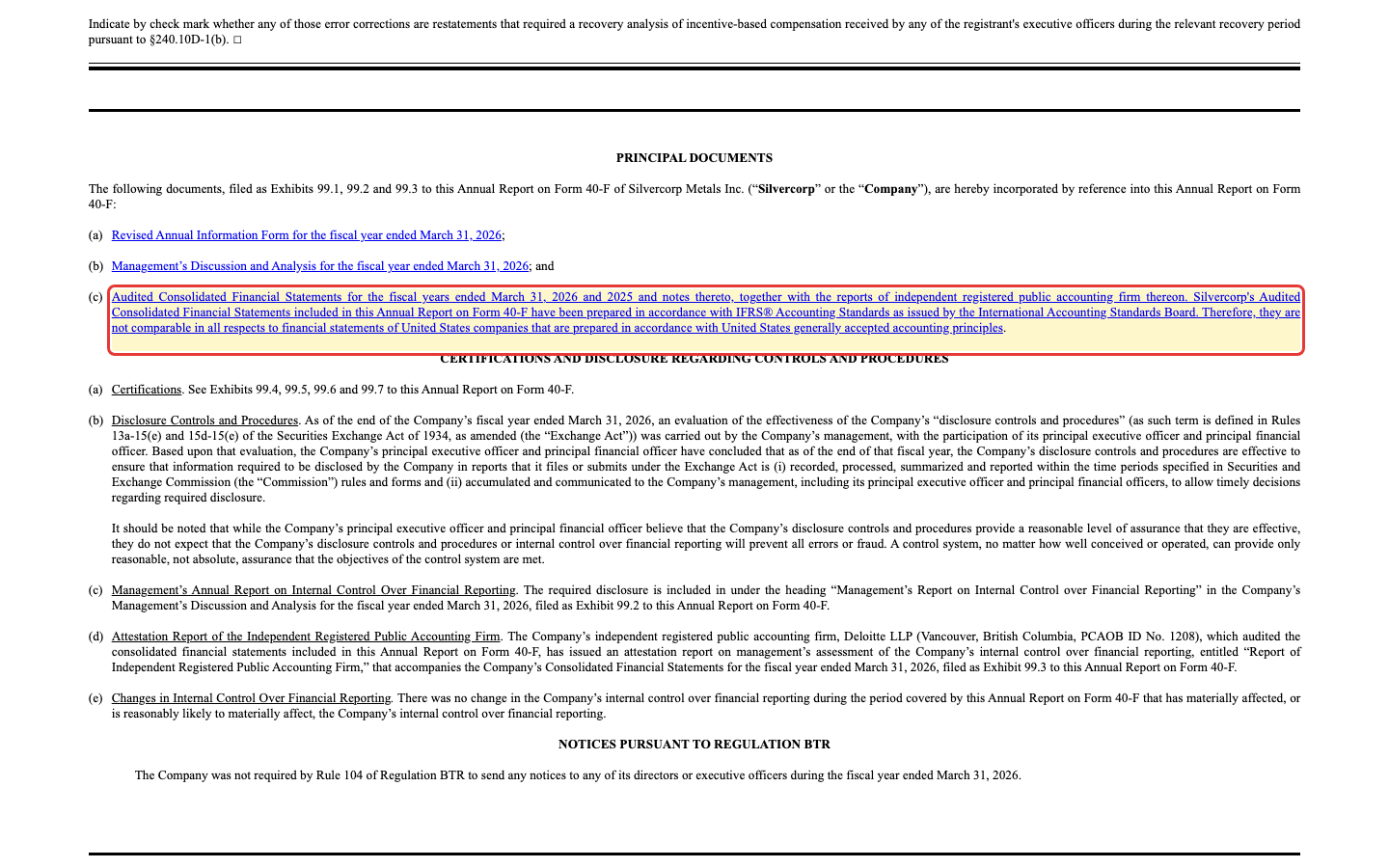
Second, Silvercorp keeps its books under different rules — and says so on the first page of the 40-F:
"Silvercorp's Audited Consolidated Financial Statements included in this Annual Report on Form 40-F have been prepared in accordance with IFRS® Accounting Standards as issued by the International Accounting Standards Board. Therefore, they are not comparable in all respects to financial statements of United States companies that are prepared in accordance with United States generally accepted accounting principles."
— Silvercorp Metals Inc., SEC annual report on Form 40-F for fiscal year 2026, "Principal Documents"
And third, the trap most investors fall into with this stock: the fiscal year ends March 31. At Silvercorp, "fiscal 2026" means April 1, 2025 through March 31, 2026 — essentially calendar 2025 plus one quarter. Compare those numbers with a calendar-year producer and you are comparing offset periods. Remember it this way: Silvercorp's fiscal year always runs one quarter ahead of the calendar year whose name it carries. Reporting is in U.S. dollars, incidentally, even though almost all revenue arrives in Chinese yuan — the functional currency of every Chinese subsidiary is the renminbi, and by its own statement the company does not hedge currency risk.
The numbers over the years — honestly appraised
First what genuinely impresses, and there is plenty. Revenue rose 47 percent in fiscal 2026 to $438.1 million — the highest in company history. Income from mine operations doubled from $123.6 million to $253.7 million, because costs barely moved ($184.4 million after $175.3 million) while the realized silver price climbed 72 percent. Operating cash flow jumped from $138.6 million to $310.6 million and free cash flow from $58.8 million to $181.3 million. The balance sheet as of March 31, 2026: $1,464.2 million in total assets, $941.0 million of equity attributable to shareholders, $422.3 million in cash and short-term investments, against $117.2 million of convertible notes as the only meaningful debt. And the mountain is not about to run dry: the technical report as of December 31, 2025 shows 19.08 million tonnes of proven and probable reserves at Ying grading 174 grams of silver per tonne — 106.5 million ounces of silver, enough for a mine plan running to 2042.
Now the curve this article is about — five fiscal years side by side:
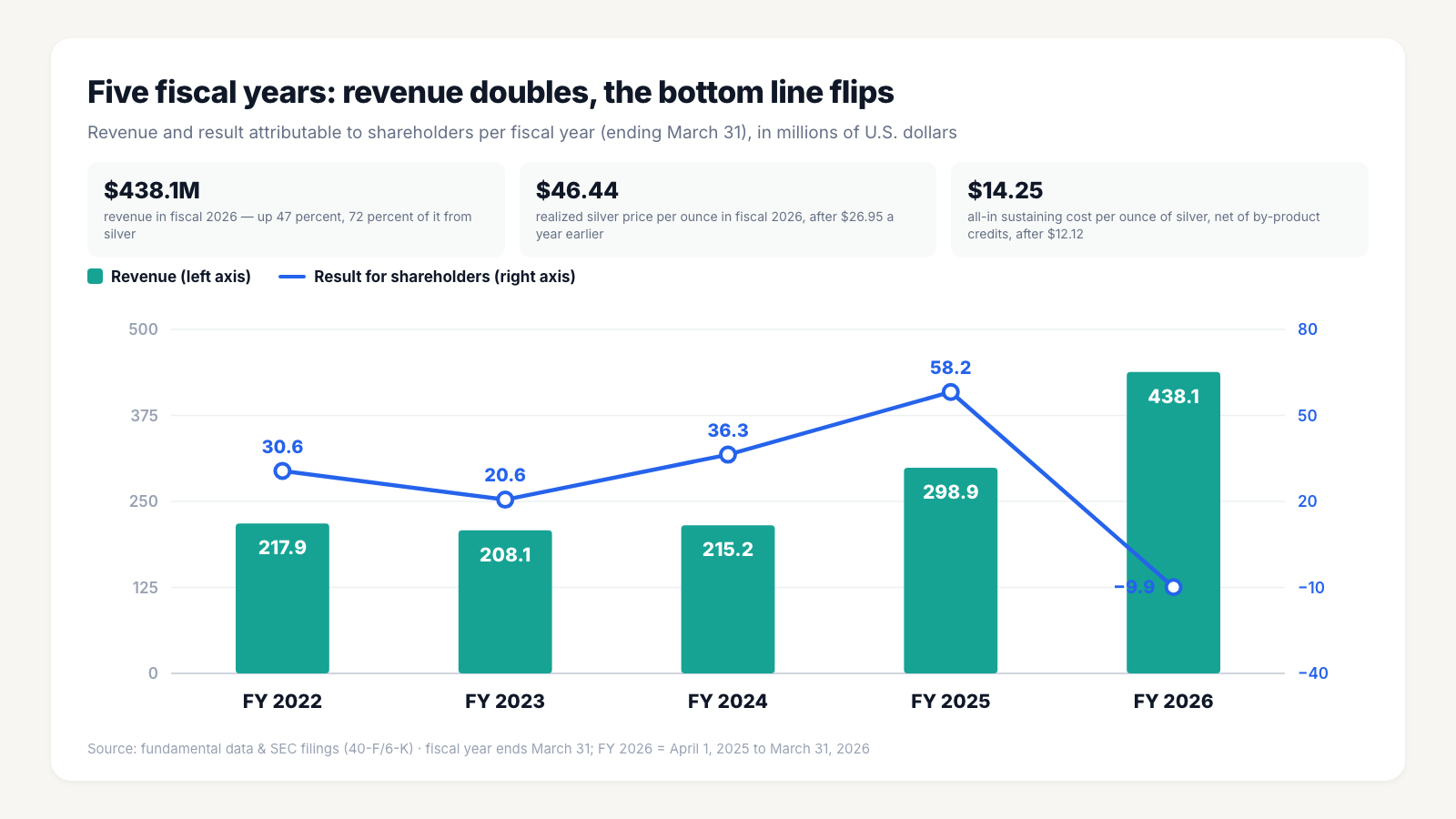
Fairness requires the explanation. The years through fiscal 2024 went sideways: $217.9 million of revenue (fiscal 2022), $208.1 million (2023), $215.2 million (2024). Momentum arrived with the silver price — $298.9 million (2025) and $438.1 million (2026). Volume barely moved: 6.9 million ounces of silver in fiscal 2025, 6.8 million in fiscal 2026, down 2 percent. Every bit of the revenue growth came from price, not from the mine. That is not a criticism — that is how mining works. But it means that buying Silvercorp is first of all a bet on the silver price, refined by a cost base among the lowest in the industry.
And here is the line that flips everything. How do you get from $253.7 million of income from mine operations to minus $9.9 million for shareholders? We broke it down:
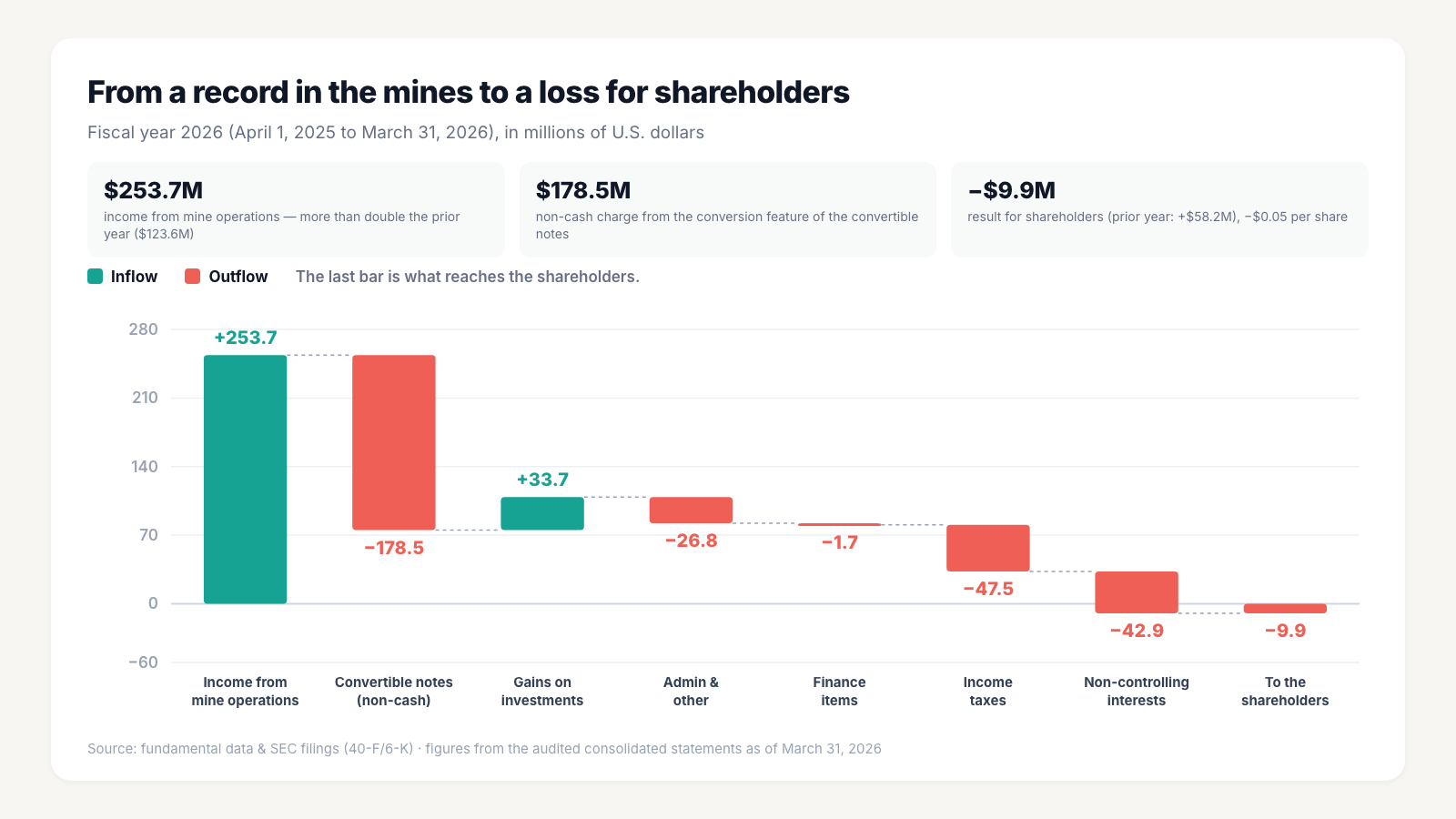
Two bars explain almost all of it: the $178.5 million for the convertible notes and the $42.9 million for non-controlling interests. Both get their own chapter now.
What the filings say — the uncomfortable truths
Uncomfortable truth no. 1: the loss happened because the stock went up
That sounds like a contradiction and is perfectly traceable. In November 2024 Silvercorp borrowed $150 million through convertible notes — a loan with a swap right: the lender takes 4.75 percent interest and may later exchange the debt for shares at a price fixed in advance, about $4.628 apiece. As long as Silvercorp itself could choose whether to hand over cash or shares on conversion, that swap right did not count as equity but as a standalone liability that must be revalued at every reporting date. And the value of a swap right rises when the stock rises. Which is what happened: the valuation table in the report shows a share price of $3.87 on March 31, 2025 and $10.06 on March 18, 2026. The carrying value of the swap right climbed in step — and the difference landed in the income statement as an expense. Management's discussion puts it like this:
"Net loss attributable to equity shareholders of $9.9 million, or $0.05 per share, mainly due to a $178.5 million non-cash charge on 'mark-to-market' of the fair value of the derivative liabilities primarily related to the convertible notes"
— Silvercorp Metals Inc., Management's Discussion and Analysis for fiscal year 2026, section 3 "Fiscal 2026 Highlights"
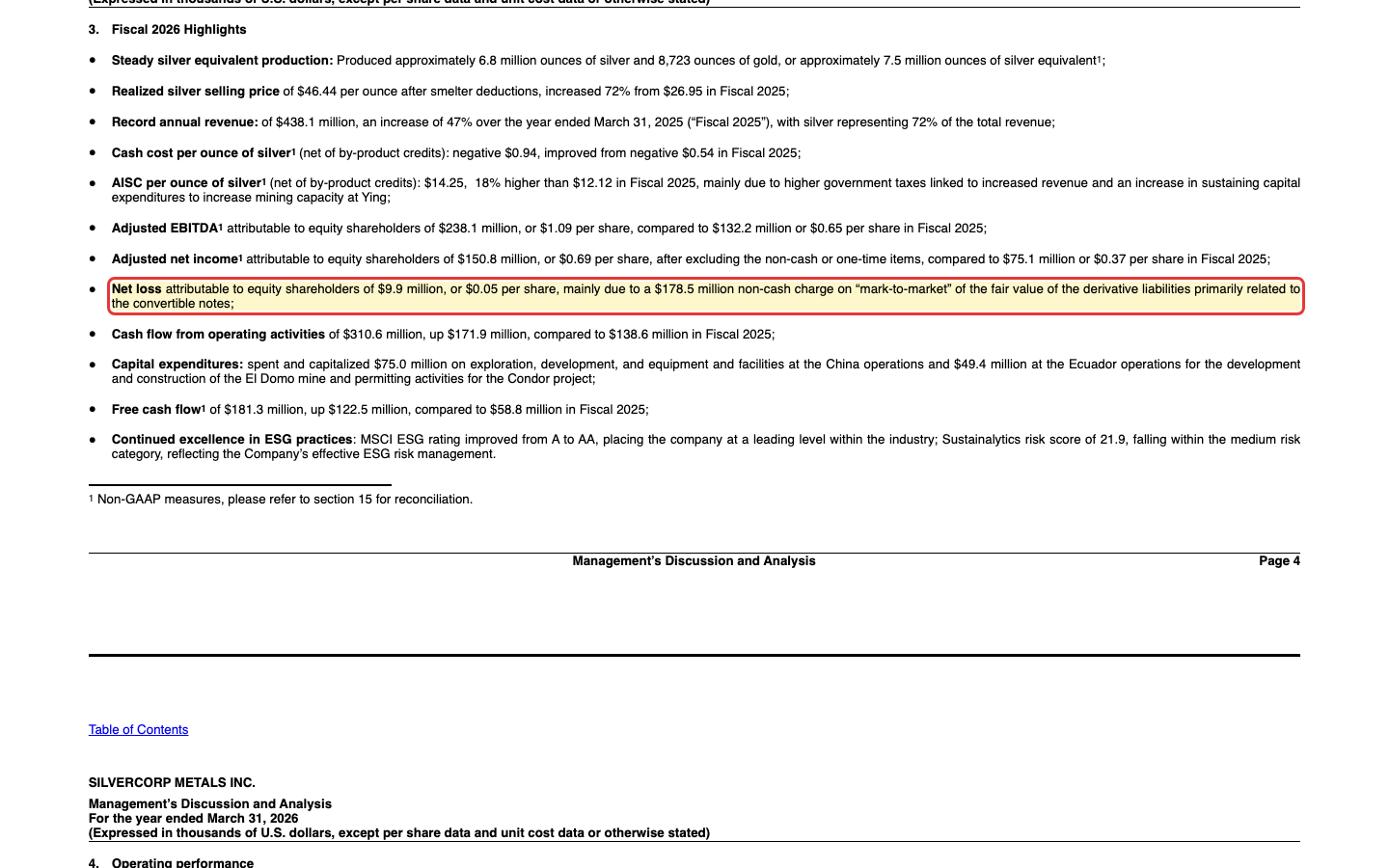
The important word is non-cash: not one dollar left the building because of this charge. It is a pure accounting entry, and paradoxically it signals strength rather than weakness — the stock had more than doubled since the prior year-end. Silvercorp therefore also reports adjusted net income of $150.8 million, or $0.69 per share (prior year $75.1 million and $0.37). Honesty requires the other half: adjusted numbers are not audited numbers, they are management's view. In this case, though, what is adjusted away is an item the company cannot steer at all. Remember the mechanism: with a convertible note that carries a settlement choice, a rising share price costs you money in the income statement that never existed.
Uncomfortable truth no. 2: since March 18, 2026 the debt is repaid in shares, not in cash
Here is the line that gets lost in the relief that the paper losses are over. Silvercorp solved the problem at the root — by giving up its own choice:
"The Company concluded that the removal of the cash settlement alternative now causes the conversion option to meet the 'fixed-for-fixed' condition under IAS 32, and thus the conversion feature is no longer accounted for as a derivative liability and instead meets the definition of equity."
— Silvercorp Metals Inc., Management's Discussion and Analysis for fiscal year 2026, section 10 "Convertible Notes"
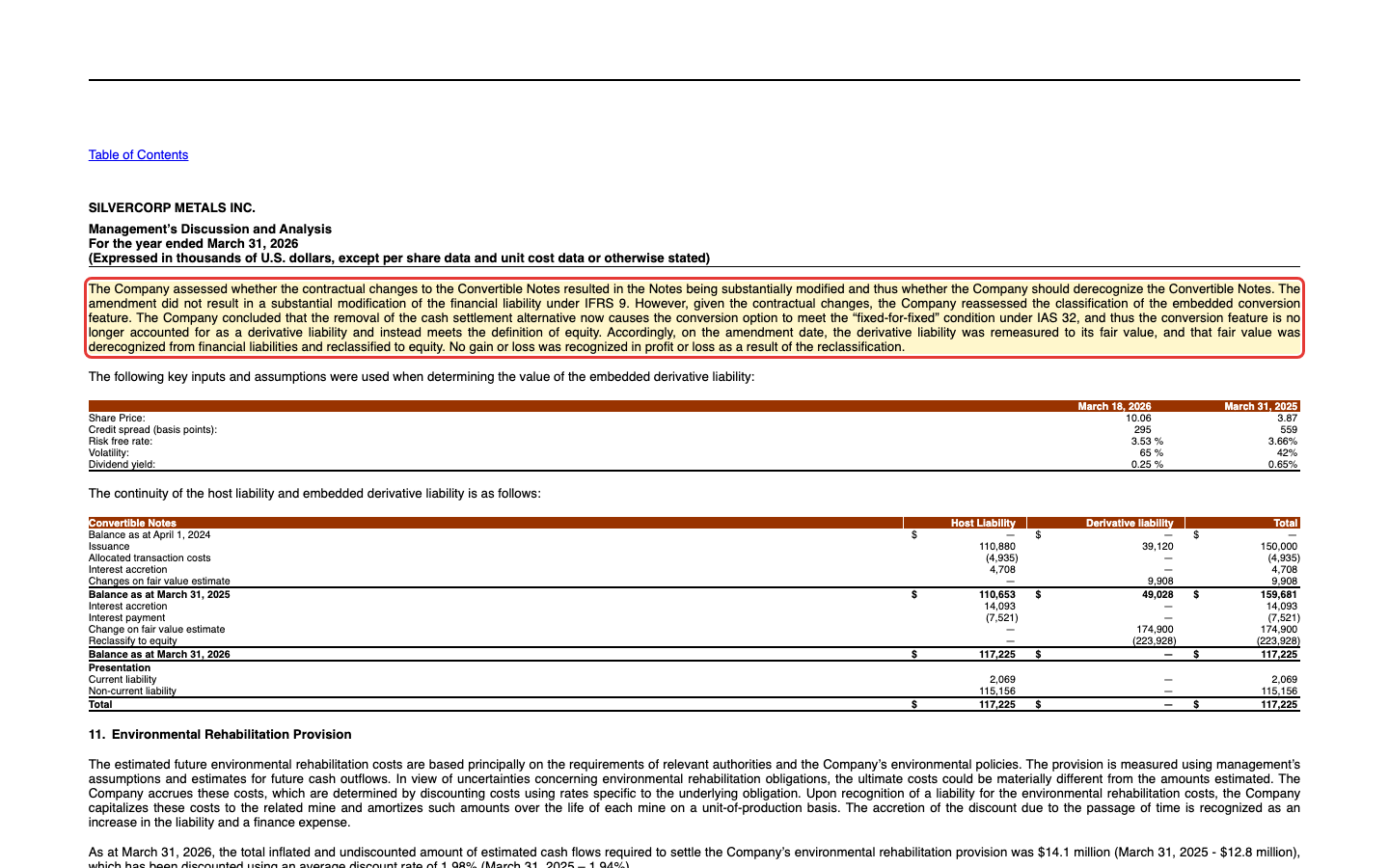
In plain English: Silvercorp may no longer pay cash on conversion. The principal is settled exclusively in new shares. Anyone can do the arithmetic: 150,000 notes of $1,000 each, times 216.0761 shares per note, equals 32,411,415 shares — 14.7 percent of the 220,910,911 shares outstanding on March 31, 2026. Picture dilution this way: your slice of the cake gets smaller because new slices are being cut, without the cake growing. Here it is already written down how many slices that will be.
One more detail worth knowing: those shares are not in the reported diluted count for fiscal 2026. It stands at 219,425,164 — exactly the basic figure, because when a loss is reported, potential conversions would shrink the loss per share and are therefore excluded under the accounting rules. If you want to see the dilution, you have to add it yourself. The company does keep one escape route: from December 20, 2027 it may redeem the notes for cash if the share price trades above 130 percent of the conversion price on 20 out of 30 trading days. With $422.3 million in the bank that is doable — it is simply not decided.
Uncomfortable truth no. 3: two mines, one country — and in June 2026 the ore stopped moving
Silvercorp's earning power hangs on two sites in a single country. How quickly that becomes a problem showed up right after the balance sheet date. In late May 2026 a serious accident struck a coal mine in Shanxi province. China's regulators govern coal and non-coal mining under one unified safety system — so the new requirements applied to everyone. Silvercorp reviewed itself and suspended both operations. The release of June 29, 2026, one day before the annual report was filed, gives the magnitude:
"Due to these major safety system improvement activities, production at the Ying Mining District is expected to be affected by 40% to 50% during the July-September quarter, while production at the GC mine is expected to be affected by approximately 50% over the same time period. For the current quarter, production is expected to be affected by 10 to 15%."
— Silvercorp Metals Inc., "Silvercorp Provides Updates on China Operations," news release dated June 29, 2026, furnished as exhibit 99.1 to a Form 6-K
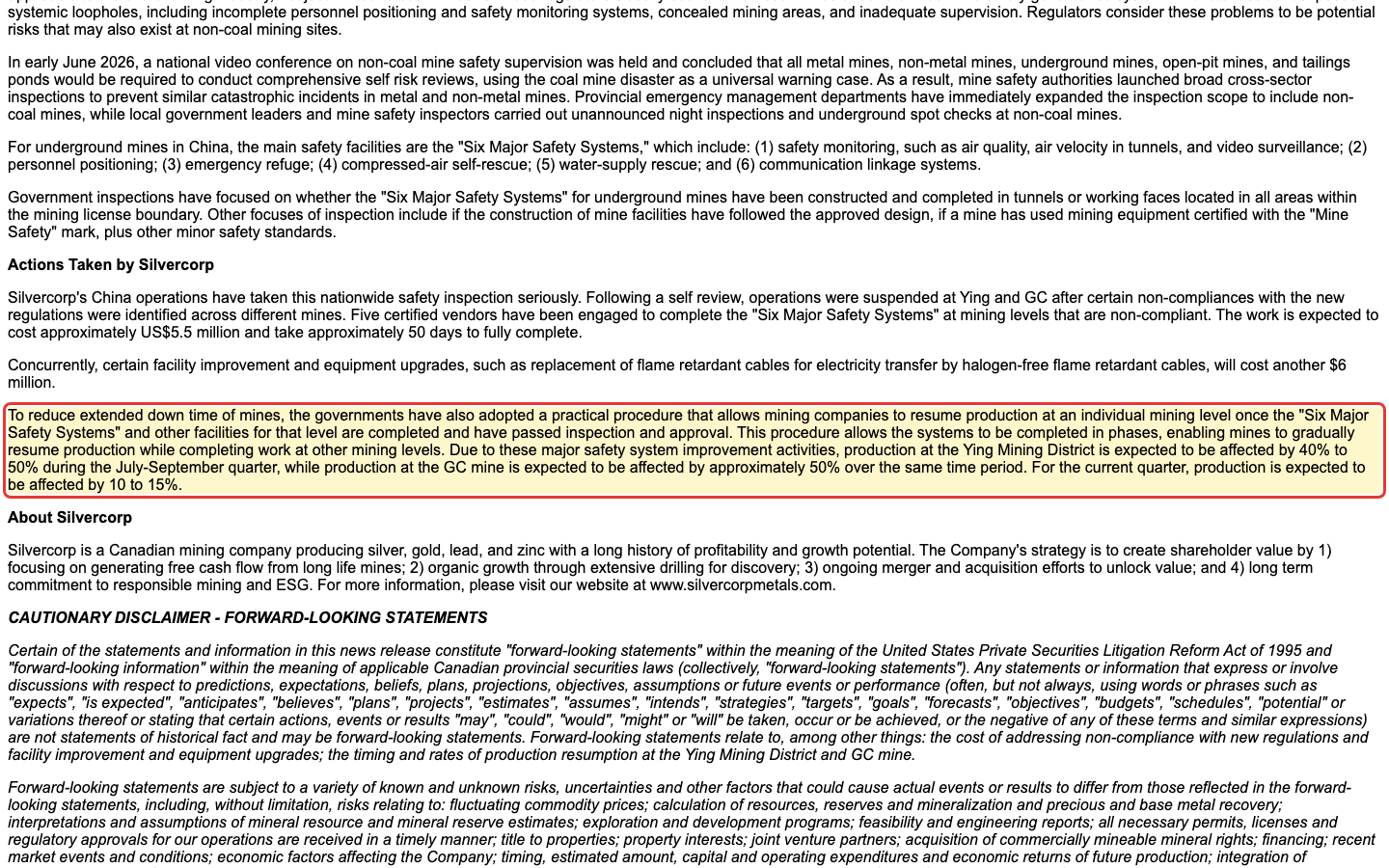
The cost of the retrofit is modest: about $5.5 million for the six mandated safety systems over roughly 50 days, plus about $6 million for facilities and halogen-free cabling. The lost tonnes are not. What that feels like showed in the production release of July 15, 2026 for the first quarter of fiscal 2027 (through June 30, 2026): revenue of $138.7 million, up 70 percent — but silver production of 1.5 million ounces, down 17 percent. Once again the price carried it, not the mine. The actual outage quarter, July through September 2026, still lay ahead of the company when this analysis was written; the first-quarter financials are on the calendar for August 10, 2026.
The concentration risk has a second floor, incidentally. It is not only production that is concentrated but sales: five customers accounted for $337.8 million, or 77 percent of fiscal 2026 revenue, the largest single one for 20 percent. A year earlier it was five customers at 83 percent. If a neighbor told you his business was booming but five buyers brought in three quarters of the revenue, would you swallow for a second? Then there is the legal setting: the report devotes a risk section to Chinese currency controls under a heading warning that China's policy on foreign currency conversion may affect "our ability to receive dividends out of China." How much the money shrinks on the way home shows in a small line in the tax note: of the $47.5 million tax expense in fiscal 2026, $8.4 million was withholding tax charged at 10 percent on dividends distributed out of China. If you want to see the risks of a China listing in their sharpest form, they are in our iQIYI analysis.
Uncomfortable truth no. 4: a large slice of the profit belongs to partners who are not you
Silvercorp does not own its Chinese mines outright. Henan Found, the operating company of the Ying district, is 77.5 percent owned by the group — the other 22.5 percent sits with local partners. The same pattern applies to Henan Huawei (20 percent outside), Yunxiang (30 percent) and Ecuador's Salazar Holdings (25 percent). These minorities are not silent partners: they are entitled to their share of the profit, and they receive it in cash.
The fiscal 2026 numbers turn that into an oddity you have to read twice. Group net income was $32.9 million. Of that, $42.9 million belonged to the non-controlling interests — more than the entire group profit. Which is why minus $9.9 million was left for Silvercorp shareholders. This is possible because the convertible-note charge lands entirely at the parent level while the mines kept earning: the Ying district alone generated $198.6 million of net income, $43.5 million of it for the minorities. Cash actually paid out to them in fiscal 2026 was $24.9 million, after $11.0 million a year earlier. For comparison: the dividend to all Silvercorp shareholders combined was $5.5 million, or $0.025 per share for the year. Remember the image: at a group with minority interests, the profit you read is not the profit you own.
A quiet line in the balance sheet: $53.5 million on the books, $212.9 million on the market
Not every surprise in the report is unpleasant. Silvercorp holds 27.84 percent of New Pacific Metals Corp. (Toronto: NUAG, NYSE American: NEWP), a silver developer in Bolivia — 51,426,988 shares as of March 31, 2026. Because that stake is large enough for significant influence, it is carried under the equity method: at cost carried forward, not at the market price. The report prints both — a carrying value of $53.5 million against a quoted market value of $212.9 million. The $159.4 million of hidden value equals 16.9 percent of the equity attributable to shareholders. A year earlier the two figures were close (carrying $45.3 million, market $51.6 million). A second, smaller instance of the same thing: the 29.15 percent stake in Tincorp Metals, carried at $1.1 million and worth $7.4 million.
Two things stand out. First, Silvercorp bought more in fiscal 2026 rather than selling: 3,083,536 shares for $7.8 million in an October 2025 bought deal, plus 1,435,751 shares in the open market. Second, the London fund from the top of this article also loaded up on New Pacific Metals in the same quarter — from 2,293,539 to 9,936,183 shares. Buy Silvercorp and you buy that silver project twice over. A hidden value, though, stays hidden exactly until somebody lifts it.
Valuation: what the market pays for the ounce
For an evergreen framing we need a dated anchor instead of a daily price — and once again the form from the opening provides it. Dividing $173,079,547 by 16,115,414 shares gives a calculated price of $10.74 per share as of March 31, 2026. Against the 220,910,911 shares outstanding on the same date, that is a market value on the order of $2.4 billion. Subtract net cash — $422.3 million of cash and short-term investments against $117.2 million of convertible notes — and the enterprise value is roughly $2.1 billion.
What does that mean? A price-to-earnings ratio cannot be formed, because the bottom line is a loss. Take the adjusted net income of $150.8 million and you land at about 16 times; measured against $438.1 million of revenue you get a price-to-sales ratio of about 5.4. For a producer that is no bargain — Freeport-McMoRan, the giant of copper, has traditionally traded lower, as our Freeport-McMoRan analysis shows; how a small gold producer compares is in our piece on TRX Gold. The premium the market grants Silvercorp has three visible components: the unusually low cost base, the $422.3 million in the bank and the option value of El Domo, Condor and the Kyrgyz gold complex. Against them stand the China concentration and the 14.7 percent of dilution sleeping inside the convertible notes. All valuation figures: data as of July 24, 2026; analyses are evergreen, daily prices are not a buy argument.
Opportunities and risks at a glance
What speaks for Silvercorp:
- An exceptionally low cost base: cash cost of negative $0.94 per ounce of silver in fiscal 2026 (companion metals covered the entire operation) and all-in sustaining cost of $14.25 against a realized silver price of $46.44 per ounce.
- A balance sheet without worry lines: $422.3 million in cash and short-term investments as of March 31, 2026, $941.0 million of equity attributable to shareholders against $1,464.2 million of total assets (a 64.3 percent equity ratio), and $117.2 million of convertible notes as the only meaningful debt, carrying no financial covenants.
- Real cash flows rather than promises: operating cash flow of $310.6 million (prior year $138.6 million), free cash flow of $181.3 million (prior year $58.8 million), plus a semi-annual dividend of $0.0125 per share.
- Reserves with a runway: 19.08 million tonnes of proven and probable reserves at Ying grading 174 grams of silver per tonne (106.5 million ounces of silver) as of December 31, 2025, with a mine plan to 2042; the GC Mine adds 6.19 million tonnes.
- Three growth sites and one quiet asset: El Domo in Ecuador (targeted for July 2027 at $283.6 million of capital cost), the Condor gold project, and the Kyrgyz Chaarat ZAAV complex — plus a stake in New Pacific Metals carried at $53.5 million that was worth $212.9 million.
What speaks against it:
- Everything hangs on China: all current production comes from two operations in Henan and Guangdong; after the Shanxi accident Silvercorp suspended both in June 2026. For July through September 2026 the company expects a 40 to 50 percent production hit at Ying and roughly 50 percent at the GC Mine.
- Pre-programmed dilution: since the supplemental indenture of March 18, 2026 the principal of the convertible notes is settled exclusively in shares — 32.4 million of them, or 14.7 percent of the 220,910,911 shares outstanding on March 31, 2026. The reported diluted count (219,425,164) does not contain them.
- A large slice of the profit belongs to others: $42.9 million of the $32.9 million group profit went to non-controlling interests in fiscal 2026, and $24.9 million was actually paid out to them in cash, while all Silvercorp shareholders together received $5.5 million in dividends.
- Customer and currency risk: five customers supplied 77 percent of revenue and the largest one 20 percent. Dividends out of China carried $8.4 million of withholding tax at 10 percent, the report devotes a risk section to Chinese currency controls, and currency exposure is not hedged.
- A thinner information base and a price that carries everything: as a Canadian issuer Silvercorp files no 10-K and no 10-Q, and interim numbers are unaudited 6-K exhibits. The 47 percent revenue gain came purely from the silver price — output fell 2 percent.
A human conclusion
Back to the bottom-line trap from the opening. Its core is not that the last line lies — it states the truth precisely. Its core is that it answers a different question than the one you asked. You ask: "Does this company make money?" The last line answers: "What was left for the parent after every accounting entry, every tax and every outside claim?" At Silvercorp those two answers came far apart in fiscal 2026. The mines delivered $253.7 million, more than ever; cash grew by $53.3 million; and still the line reads minus $9.9 million — because a note had to be marked higher once the company's own stock went up, and because a bigger slice went to partners who are not you. Look only at the bottom and you see a bad year. Read only the adjusted number and you see a fairy tale. Both are wrong.
So the honest question is not "was fiscal 2026 a good year?" but: are you willing to buy the silver price, complete with two mines in a country that simply stopped production in June 2026, complete with 14.7 percent of dilution already fixed by contract, and complete with partners who get paid from the profit before you do? If yes, you get one of the lowest cost bases in the industry, $422.3 million in the bank and three growth projects. If no, you at least understand how a record year can end in the red. The London fund that took 7.3 percent of the company in the first quarter of 2026 knew all of this or accepted it — its form says only that it bought, not why, and not whether it is still there. What you make of it is your decision. And that is exactly as it should be.
Sources
Every original document used in this analysis — for you to read yourself:
- Silvercorp Metals Inc. — SEC annual report on Form 40-F for fiscal year 2026 (filed June 30, 2026, accession 0001104659-26-079021)
- Silvercorp Metals Inc. — Annual Information Form as of March 31, 2026 (40-F exhibit 99.1), with reserves, resources and risk factors
- Silvercorp Metals Inc. — Management's Discussion and Analysis for fiscal year 2026 (40-F exhibit 99.2)
- Silvercorp Metals Inc. — Audited consolidated financial statements as of March 31, 2026 and 2025 (40-F exhibit 99.3)
- Silvercorp Metals Inc. — SEC annual report on Form 40-F for fiscal year 2025 (filed June 5, 2025)
- Silvercorp Metals Inc. — Update on China operations, news release dated June 29, 2026 (exhibit 99.1 to a Form 6-K furnished June 30, 2026)
- Silvercorp Metals Inc. — First-quarter fiscal 2027 production release dated July 15, 2026 (exhibit 99.1 to a Form 6-K furnished July 16, 2026)
- Full SEC filing history of Silvercorp Metals Inc.: EDGAR overview (sec.gov)
- Helikon Investments Ltd — Form 13F-HR as of March 31, 2026 (filed May 8, 2026, accession 0001839497-26-000002)
- Fundamental data (metrics, valuation; data as of July 24, 2026), reconciled with the SEC filings and the SEC XBRL series (CIK 1340677).
Transparency & disclaimer: this analysis is a journalistic contextualization of publicly available information. It is not investment advice, not a regulated financial analysis and not a solicitation to buy or sell securities. Equity investments carry substantial risks up to and including total loss. All information without warranty; the data cut-off is noted in the text. The author holds no position in Silvercorp shares at the time of publication.
Our Bottom Line at a Glance
- Cost position positive
- The companion metals lead, zinc and gold covered the entire operation in fiscal 2026: cash cost per ounce of silver was negative $0.94 (prior year negative $0.54). Even including sustaining capital and taxes, Silvercorp landed at $14.25 per ounce — against a realized silver price of $46.44. Income from mine operations doubled to $253.7 million and free cash flow rose to $181.3 million.
- Balance sheet positive
- As of March 31, 2026, $422.3 million of cash and short-term investments stood against $117.2 million of convertible notes as the only meaningful debt; equity attributable to shareholders was $941.0 million on $1,464.2 million of total assets, or 64.3 percent. The notes carry no financial covenants. The Altman Z-Score of 4.87 sits far above the safety threshold of 2.6 (variant Altman Z″; data as of July 24, 2026).
- Country and customer risk negative
- All current production comes from two operations in China. After the Shanxi accident Silvercorp suspended Ying and GC itself in June 2026; for July through September 2026 it expects a 40 to 50 percent production hit at Ying and roughly 50 percent at the GC Mine. Add five customers supplying 77 percent of revenue, $8.4 million of withholding tax on dividends out of China, and a dedicated risk section on Chinese currency controls.
- Capital structure and dilution negative
- Since the supplemental indenture of March 18, 2026 the principal of the convertible notes is settled exclusively in shares: 32,411,415 of them, or 14.7 percent of the 220,910,911 shares outstanding on March 31, 2026. They are not in the reported diluted count (219,425,164), because a loss was reported. On top of that, $42.9 million of the $32.9 million group profit belonged to the minority holders of the Chinese subsidiaries.
- Growth and information base neutral
- The 47 percent revenue gain came purely from the silver price — output fell 2 percent. Three growth sites are meant to change that: El Domo in Ecuador (targeted for July 2027 at $283.6 million), Condor, and the Kyrgyz Chaarat ZAAV complex ($92 million in cash plus up to $70 million contingent). Set against them are the terms of the Wheaton stream on El Domo and a thinner information base: no 10-K, no 10-Q, interim figures only as unaudited 6-K exhibits.
Silvercorp is the bottom-line trap in its purest form: fiscal 2026 (ended March 31, 2026) delivered the highest revenue in company history at $438.1 million and doubled income from mine operations to $253.7 million — and still a $9.9 million loss for shareholders, because the conversion feature of the notes had to be marked $178.5 million higher after the company's own stock rose from $3.87 to $10.06. That item is over as of March 18, 2026; in exchange the principal is now settled exclusively in shares (32.4 million of them, or 14.7 percent). Against that stand $422.3 million of cash, a cash cost of negative $0.94 per ounce — and two mines in a country that stopped production in June 2026. Not investment advice.
What Our Rating Means
Open questions
The business works in principle, but one material question is open. As long as it stays open, our findings do not carry a quality verdict.
Buy today and you are buying the silver price first of all, refined by one of the lowest cost bases in the industry and a balance sheet with $422.3 million of cash. The bet is that the safety-retrofit outage stays a one-quarter problem, that El Domo starts on schedule in July 2027, and that growth outruns the 14.7 percent of dilution sitting in the convertible notes. If you wait, check exactly three numbers in the coming releases: how deep was the production hit in the July-to-September 2026 quarter really? Does all-in sustaining cost stay near $14.25 per ounce after the retrofit? And where do the distributions to non-controlling interests go, which at $24.9 million were four times the dividend paid to shareholders? The decision is yours.
A journalistic assessment by our editorial team at the time of the deep dive, based on public sources — not investment advice and not a solicitation to buy or sell. Your personal circumstances (investment goals, risk capacity, taxes) cannot be taken into account. What our levels mean, how verdicts are formed, and what conflicts of interest exist →
Worth Noting
- Silvercorp did not reach our research list through a scanner hit but through the Form 13F-HR of Helikon Investments Ltd (London) as of March 31, 2026: 16,115,414 shares worth $173,079,547, a brand-new position and roughly 7.3 percent of the company. A 13F shows only U.S.-listed long positions with a 35- to 45-day delay, without shorts or derivatives — a rear-view mirror, not a road map.
- Silvercorp is a Canadian issuer under the multijurisdictional disclosure system with the United States: there is no 10-K and no 10-Q. Audited figures arrive once a year on Form 40-F (for fiscal 2026 filed June 30, 2026); interim numbers are furnished only as an unaudited exhibit to a Form 6-K. The books are kept under IFRS and reported in U.S. dollars. The fiscal year ends March 31, which is why every annual figure here is labeled with its fiscal year.
- A price-to-earnings ratio is deliberately not shown: fiscal 2026 closed with a $9.9 million loss attributable to shareholders. The calculated price of $10.74 per share comes from the 13F filing as of March 31, 2026 and serves as a dated order of magnitude, not as a daily price. Analyses are evergreen, daily prices are not a buy argument.
Frequently Asked Questions
Silvercorp Metals Inc. (NYSE American: SVM, headquartered in Vancouver) is a producing miner of silver, lead, zinc and some gold. All current output comes from China: the Ying Mining District in Henan ($399.2 million of fiscal 2026 revenue) and the GC Mine in Guangdong ($38.9 million). Development projects sit in Ecuador (El Domo, Condor) and in the Kyrgyz Republic (Chaarat ZAAV).
Because of an accounting entry, not because of the mines. The conversion feature of the $150 million convertible notes had to be revalued at every reporting date, and it became more expensive as the share price rose from $3.87 on March 31, 2025 to $10.06 on March 18, 2026. That produced a non-cash charge of $178.5 million. The result for shareholders fell to minus $9.9 million; on an adjusted basis Silvercorp reports $150.8 million.
On March 31. "Fiscal 2026" covers April 1, 2025 through March 31, 2026 and therefore maps to calendar 2025 plus one quarter. Compare those figures with a producer whose fiscal year follows the calendar and you are comparing offset periods. The first quarter of fiscal 2027 ended on June 30, 2026.
Because Silvercorp is a Canadian company using the multijurisdictional disclosure system between Canada and the United States. The annual report is filed on Form 40-F (for fiscal 2026 on June 30, 2026) and contains the Canadian original documents. Interim numbers are furnished only as an unaudited exhibit to a Form 6-K. The books are kept under IFRS and reported in U.S. dollars.
Arithmetically nothing. Because the companion metals lead, zinc and gold are deducted as by-product credits, the cash cost per ounce of silver in fiscal 2026 was negative $0.94 (prior year negative $0.54). The more meaningful all-in sustaining cost, which includes sustaining capital and taxes, was $14.25 per ounce after $12.12 a year earlier — against a realized silver price of $46.44.
After a serious coal mine accident in Shanxi in late May 2026, China tightened safety requirements across all mining. Silvercorp suspended Ying and GC itself in June 2026. The retrofit costs roughly $5.5 million plus about $6 million for facilities and cabling. For July through September 2026 the company expects a 40 to 50 percent production hit at Ying and about 50 percent at the GC Mine, and 10 to 15 percent in the quarter to June 30, 2026.
Since the supplemental indenture of March 18, 2026, Silvercorp can no longer settle the principal in cash on conversion, only in its own shares. At 150,000 notes of $1,000 each and a conversion rate of 216.0761 shares per note, that is 32,411,415 shares — 14.7 percent of the 220,910,911 shares outstanding on March 31, 2026. From December 20, 2027 the company may redeem the notes for cash under stated conditions.
A 13F is the mandatory quarterly disclosure of large U.S. institutional managers. Helikon Investments Ltd of London reported 16,115,414 Silvercorp shares worth $173,079,547 as of March 31, 2026, its first ever — roughly 7.3 percent of the company and 6.5 percent of a $2.65 billion portfolio. A 13F shows only U.S.-listed long positions with a 35- to 45-day delay, without shorts or derivatives: a rear-view mirror, not a road map.
Found an error?
Did you spot a factual error, an outdated number, or a typo in this deep dive? Let us know briefly — your report goes straight to the editorial team.