Freeport-McMoRan Stock: Record Copper Prices — and the Best Mine Runs at 60 Percent
Freeport-McMoRan (NYSE: FCX), the copper giant from Phoenix, ranks fifth in our in-house Terry Smith quality scanner (U.S. selection, as of July 18, 2026): $25.9 billion of 2025 revenue, record copper and gold prices, a Piotroski score of 8 of 9. We read the annual report (10-K) for 2025 and the quarterly report (10-Q) as of March 31, 2026 — and they also tell the other story: a mud rush that killed seven workers in the company's most important mine, a recovery that now stretches to mid-2027, a profit jump that partly consists of an insurance settlement — and a mine of which FCX owns just 48.76 percent. Not investment advice — just a measure of how much mountain lies between the quality seal and reality.
 Thomas Mücke
Founder & Publisher
Thomas Mücke
Founder & Publisher
Chart
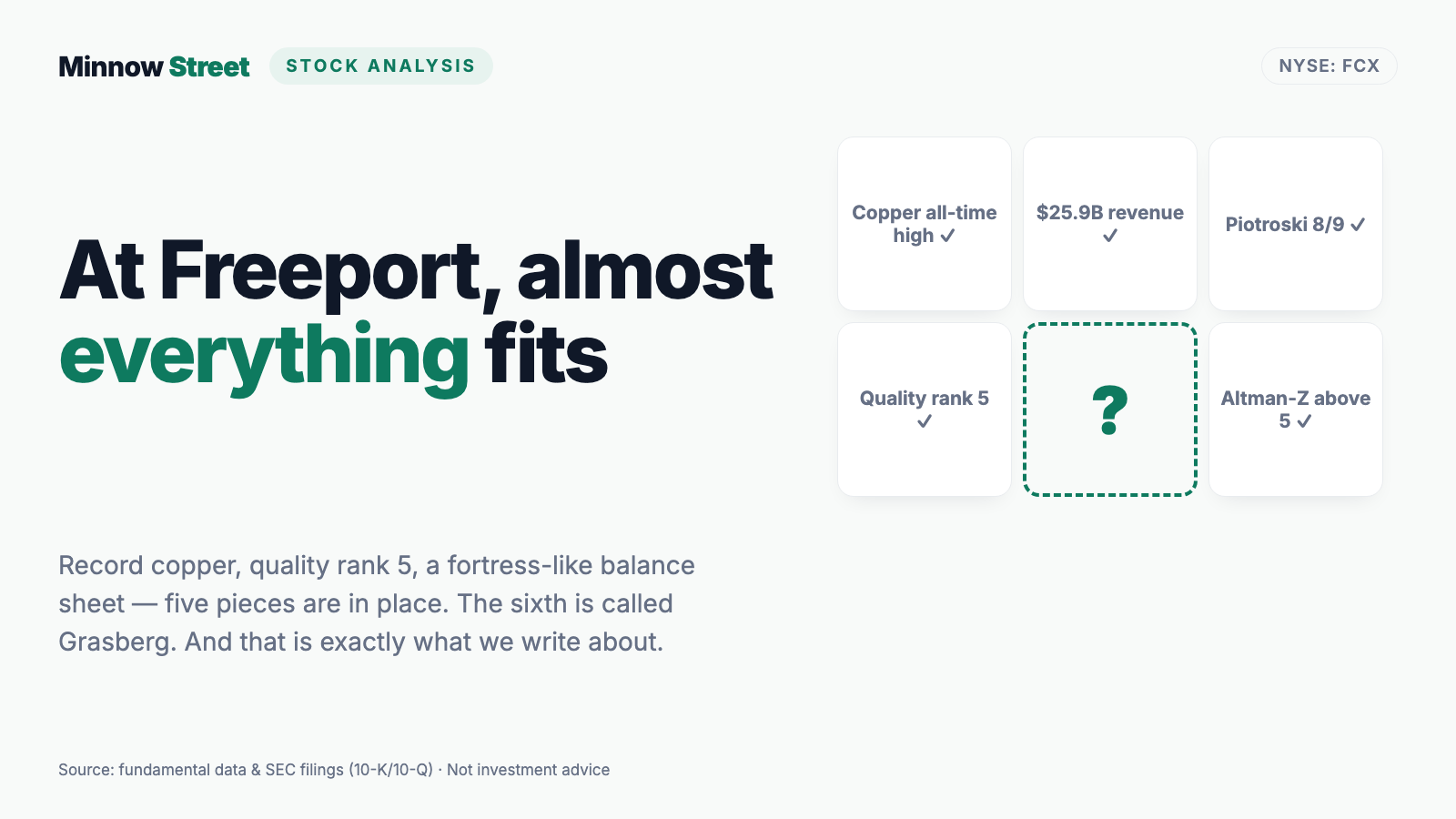
Interactive price chart (TradingView).
Note: pure fact-based analysis, not investment advice and not a solicitation to buy or sell. All figures without guarantee.
There is a story that almost always works on the stock market: the comeback. A great company, a disaster, a sell-off — and then the recovery, while the price of the product breaks records at the same time. The comeback reflex in our heads loves this dramaturgy so much that it skips the inspection: "The worst is behind them, copper is at an all-time high — what could go wrong now?" Exactly this movie is playing in the summer of 2026 at Freeport-McMoRan Inc. (NYSE: FCX), one of the world's largest publicly traded copper producers: rank 5 in our in-house Terry Smith quality scanner (U.S. selection, as of July 18, 2026), record prices for copper and gold, a 150 percent profit jump in the latest quarter. So let's make a deal: we let the movie be a movie and read together what Freeport-McMoRan itself reported, under penalty of law, to the U.S. securities regulator, the SEC — the annual report (10-K) for fiscal year 2025 and the quarterly report (10-Q) as of March 31, 2026. And besides the comeback story, those documents tell three others: about 800,000 metric tons of mud and seven deaths in the company's most important mine, about a profit that partly consists of an insurance payment — and about a mine the company does not even half own. In the end, you decide.
What Freeport-McMoRan actually does — and where the money comes from
Freeport-McMoRan mines the metal almost every electron travels through: copper sits in power grids, electric cars, wind turbines, air conditioners — and lately in the data centers of the AI boom, whose power and cooling needs devour enormous quantities of it. The company from Phoenix, Arizona runs three geographic pillars: the United States (Morenci in Arizona among others, plus the Henderson and Climax molybdenum mines), South America (Cerro Verde in Peru, El Abra in Chile) and Indonesia — the Grasberg district in the highlands of Central Papua, one of the world's largest copper and gold mines. Three mines (Morenci, Cerro Verde, Grasberg) together accounted for 70 percent of 2025 copper production. On top come two side businesses: gold, 98 percent of which is a by-product of Grasberg ore, and molybdenum, a steel alloy metal in which FCX ranks among the world's largest producers. In 2025 the company produced 3.4 billion pounds of copper, 1.0 million ounces of gold and 92 million pounds of molybdenum; proven and probable reserves of 112.3 billion pounds of copper stretch across decades. FCX employed roughly 29,000 people as of December 31, 2025.
To understand the numbers you only need one map in your head: the volume comes from the Americas, the margin came from Indonesia. The U.S. mines are big but old and comparatively expensive (low ore grades); Grasberg, thanks to high grades and the gold by-product, ranks among the cheapest copper sources in the world — at normal rates its underground mines deliver about 1.7 billion pounds of copper and 1.3 million ounces of gold per year. Which brings us to the central tension of this analysis, running through every chapter: the quality metrics sit in the books in Phoenix — but the company's fate hangs on a mountain in Papua that has been a disaster site since September 2025 and belongs to the company only to 48.76 percent.
Where the stock shows up in our scanner
Every day we run roughly 3,500 stocks through our scanners. Freeport-McMoRan reached the research list via the Terry Smith quality scanner — rank 5 of the U.S. selection, as of July 18, 2026. This filter looks for what British fund manager Terry Smith calls "good companies": high returns on capital, reliable cash generation, solid balance sheets. And FCX genuinely delivers to that grid: the net margin stood at 14.1 percent in the first quarter of 2026, the Piotroski F-Score — a nine-point health check of the books — at 8 of 9 (rock-solid starts right there), and the Altman-Z score — a distance-to-bankruptcy measure — above 5, where "fortress" already begins at 3. Our scanner also reports confluence: FCX appears simultaneously in the Peter Lynch PEG filter, the Altman-Z "balance-sheet fortress" filter and the Levermann scanner (all data as of July 18, 2026). Four hits, one pattern: the numbers of recent quarters are strong. For comparison: Fortinet, rank 2 of the same quality filter, also shines in the grid — and carries its biggest risks exactly where the filter never looks; the same is true of scanner heavyweight Apple. At Freeport it is the same story, only here the blind spot literally weighs a mountain.
Because a quality scanner computes with what is in the financial statements: margins, returns, debt ratios. It does not see whether a mine stands still after a disaster, who owns it, or what a government demands as the price of a license extension. Remember this sentence, it applies to every commodity stock: metrics measure the past of the books — mines live in the present of geology and politics. The cross-check sits in the filings themselves. So let's go.
The numbers over the years — honestly appraised
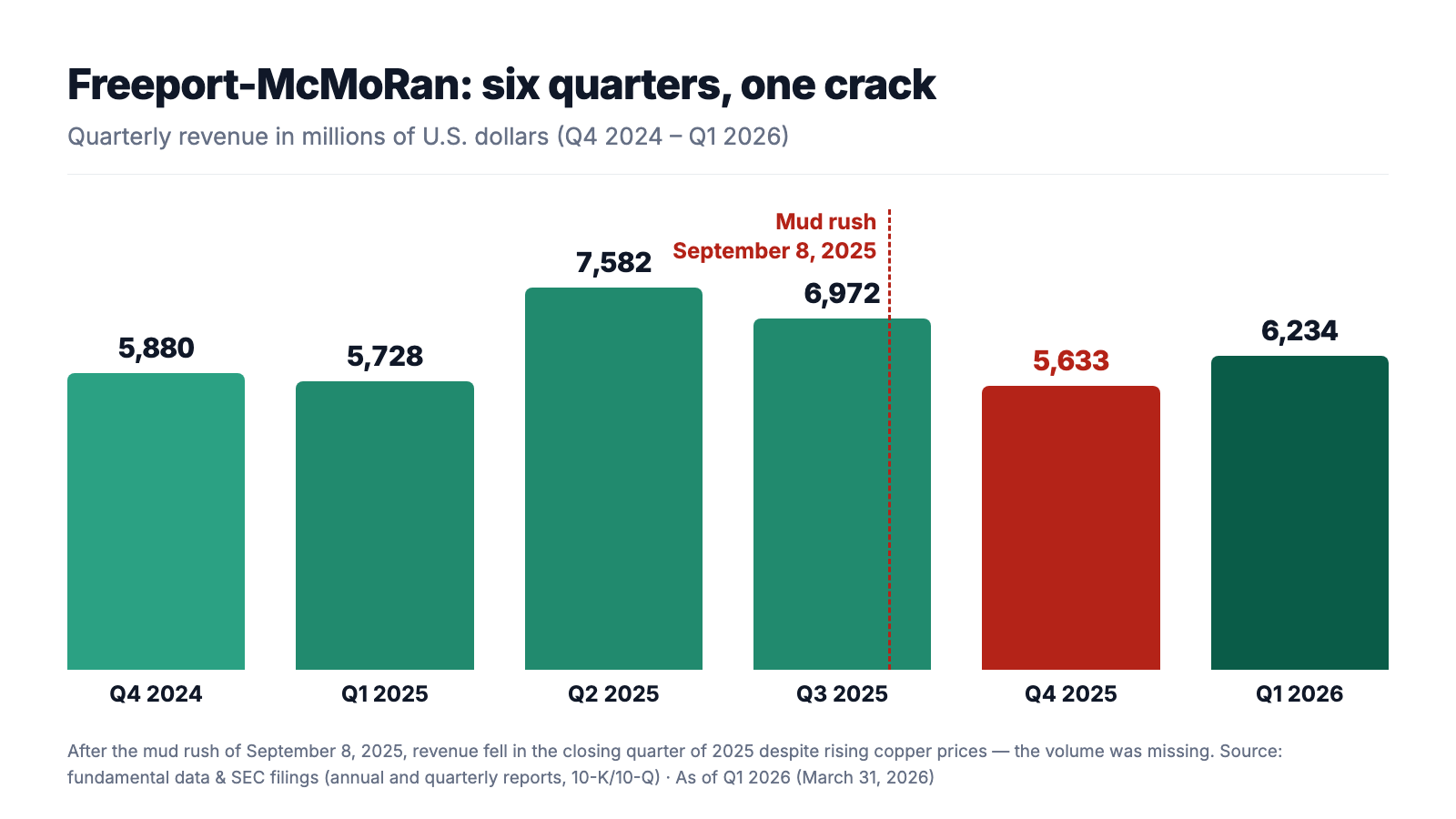
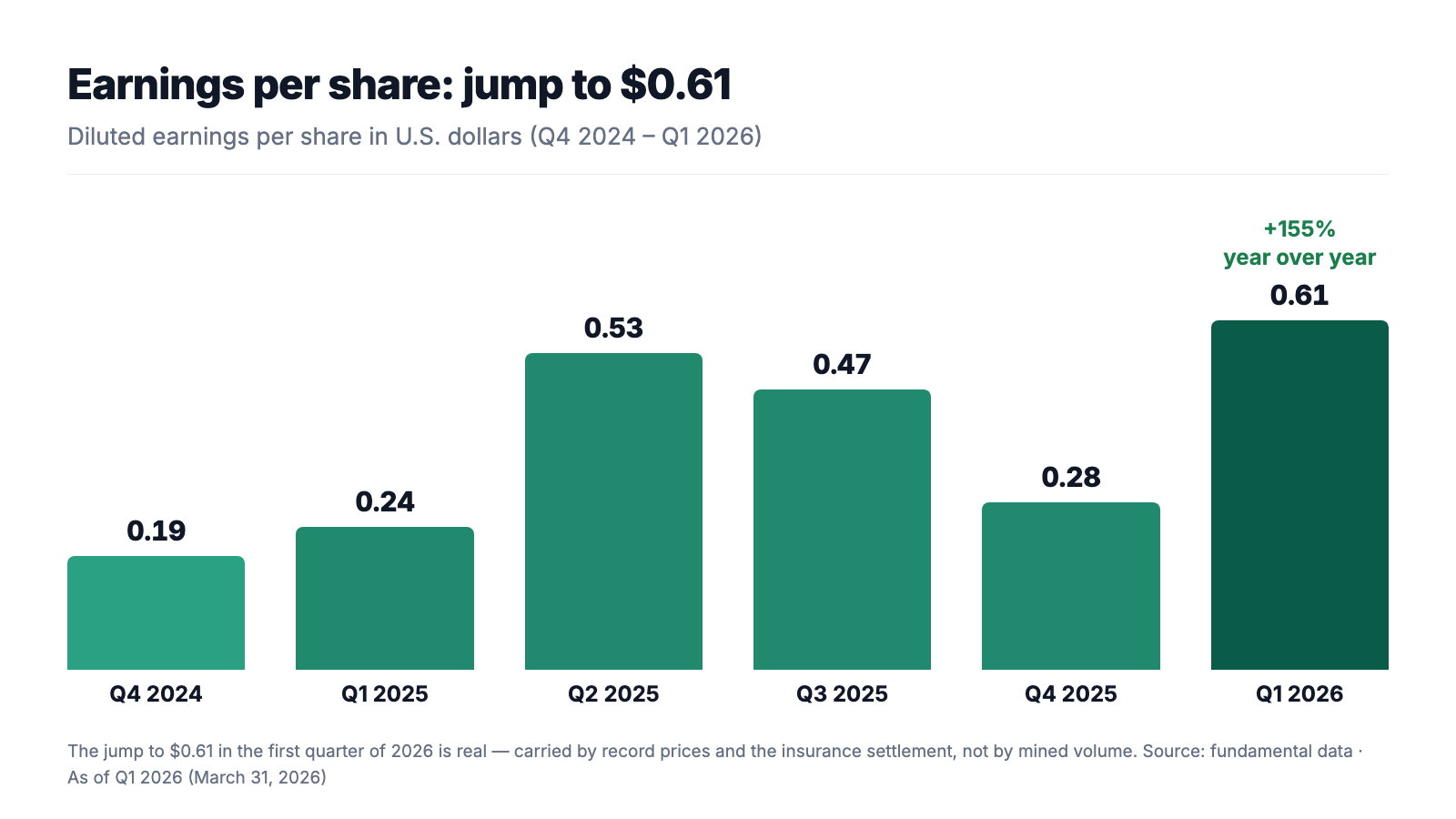
First, what genuinely impresses. Revenue rose to $25.9 billion in fiscal year 2025 (2024: $25.5 billion), and net income climbed from $1,889 million to $2,204 million ($1.52 diluted EPS) — even though the most important mine largely stood still from September 2025. Prices made it possible: FCX realized an average of $4.75 per pound of copper in 2025 (2024: $4.21) and $3,423 per ounce of gold (2024: $2,418). In January 2026, per the annual report, the copper benchmarks on the LME and COMEX metal exchanges closed at all-time highs of $6.28 and $6.18 per pound — carried by electrification, data centers and, as the report itself soberly notes, increased speculative buying. Add the cash: $5.6 billion of operating cash flow in 2025, net debt of just $2.3 billion (excluding the separately financed $3.2 billion for the Indonesian smelter and precious metals refinery) — and a payout framework of $0.60 per share per year in base and variable dividends. In the first quarter of 2026, revenue jumped to $6.2 billion (prior-year quarter: $5.7 billion) and profit to $881 million ($0.61 per share, after $0.24) — on paper, a dream start.
Honesty requires the second look, and it shows a crack: the record comes from price, not volume. Copper sales volumes fell to 657 million pounds in the first quarter of 2026 — a quarter less than the 872 million of the prior-year quarter. Gold production collapsed from 287,000 to 97,000 ounces, minus two thirds. The reason sits in the "uncomfortable truths" chapter: Grasberg. And one more thing belongs to the truth about the dream quarter — more on it shortly: inside the $881 million of profit sits an insurance payment of $0.7 billion. Hold that thought; the mountain comes first.
What the filings say — the uncomfortable truths
Uncomfortable truth no. 1: 800,000 metric tons of mud, seven deaths — and a recovery that keeps slipping
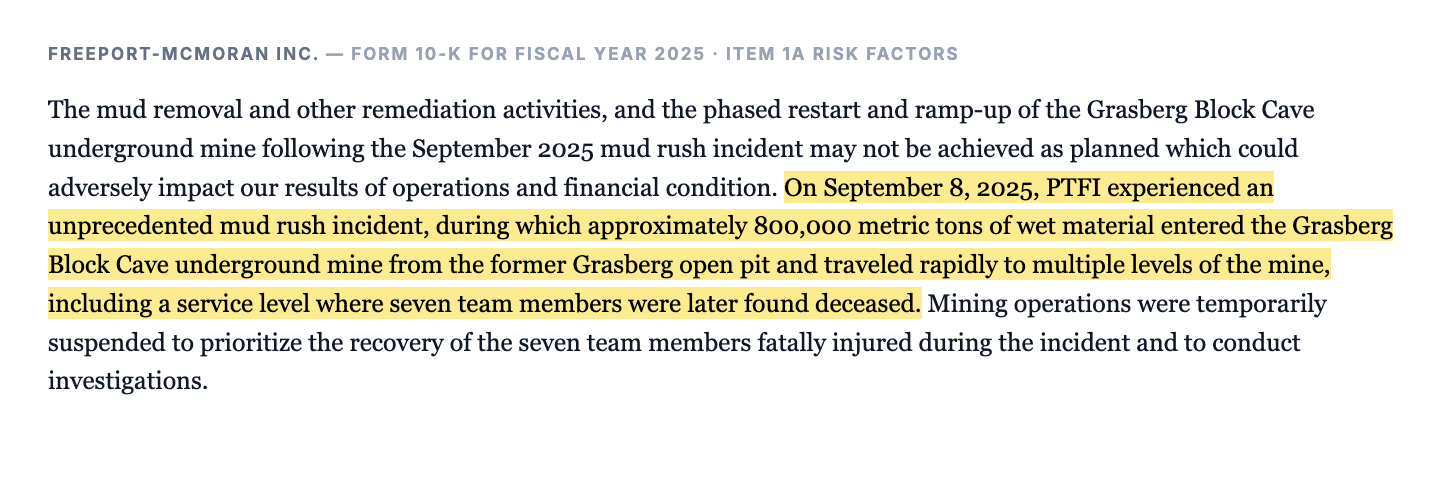
On September 8, 2025, the Grasberg Block Cave — the company's largest underground mine — experienced what the annual report calls an "unprecedented" event: from the decommissioned former open pit above, an enormous quantity of wet material broke into the mine. The report describes it like this:
"On September 8, 2025, PTFI experienced an unprecedented mud rush incident, during which approximately 800,000 metric tons of wet material entered the Grasberg Block Cave underground mine from the former Grasberg open pit and traveled rapidly to multiple levels of the mine, including a service level where seven team members were later found deceased."
— Freeport-McMoRan Inc., SEC annual report 10-K for fiscal year 2025, Item 1A "Risk Factors"
The consequences were immediate and massive: operations were suspended, and operator PTFI declared force majeure to commercial counterparties — the contractual emergency brake when a supplier cannot deliver through no fault of its own. Grasberg district production fell to 1.0 billion pounds of copper and 0.9 million ounces of gold in 2025 — after 1.8 billion pounds and 1.9 million ounces in 2024. Because the company's own smelter complex lacked concentrate, the new downstream facilities also stood still for a time. 2025 brought $625 million of idle facility and recovery costs, plus write-offs on destroyed equipment. And one sentence from the risk factors deserves particular attention: this was not the first fatal disaster in this district — in 2013, 28 people died when the rock structure above a Big Gossan training facility collapsed. Underground mining in a seismically active mountain range with about 200 inches of annual rainfall is among the riskiest things the industry knows. Which is exactly why the comeback question reaches further than the next quarter.
Uncomfortable truth no. 2: first "85 percent by late 2026" — then "60 percent of capacity until mid-2027"
How fast does Grasberg come back? The annual report from February 2026 set the route: restart of Production Blocks 2 and 3 in the second quarter of 2026, Block 1 potentially in 2027 — and then this sentence:
"Based on current estimates, PTFI expects approximately 85% of its total production at normal operating rates to be restored in the second half of 2026."
— Freeport-McMoRan Inc., SEC annual report 10-K for fiscal year 2025, Item 1 "Business"
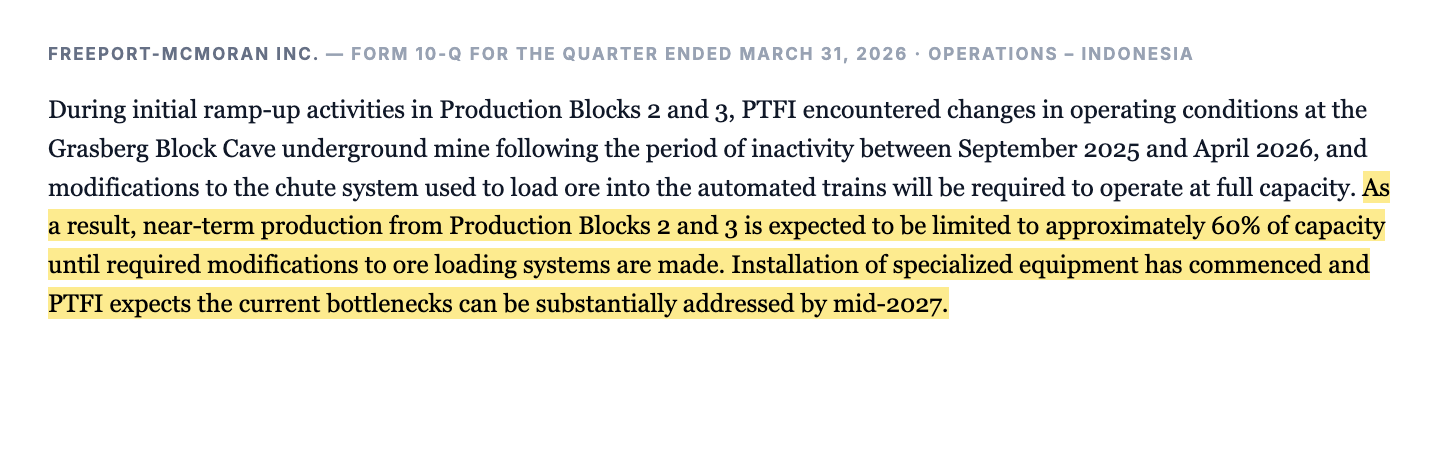
Three months later it sounded different. During the restart at the end of March 2026, PTFI found that the systems, flooded for months, need more rebuilding than planned — specifically the chutes that load ore into the automated trains:
"As a result, near-term production from Production Blocks 2 and 3 is expected to be limited to approximately 60% of capacity until required modifications to ore loading systems are made. Installation of specialized equipment has commenced and PTFI expects the current bottlenecks can be substantially addressed by mid-2027."
— Freeport-McMoRan Inc., SEC quarterly report 10-Q as of March 31, 2026, "Operations – Indonesia"
The number trail to go with it: between February and May 2026, the full-year 2026 guidance for copper sales volumes fell from 3.38 to 3.08 billion pounds, the gold guidance from 800,000 to 650,000 ounces. Idle facility and restoration costs are expected to reach about $0.9 billion in 2026. And the cost guidance per pound of copper rose from $1.75 to $1.95 — partly because diesel, sulfur and sulfuric acid have become significantly more expensive since the onset of the Middle East conflict in late February 2026. To be fair: none of this is hidden, the milestones are reported transparently, and a comeback remains the declared and plausible goal. But remember the pattern, it is almost a law of nature in restart stories: repair timetables know only one direction — backward. Whoever buys today buys the assumption that this time is different.
Uncomfortable truth no. 3: the profit jump is partly an insurance payment
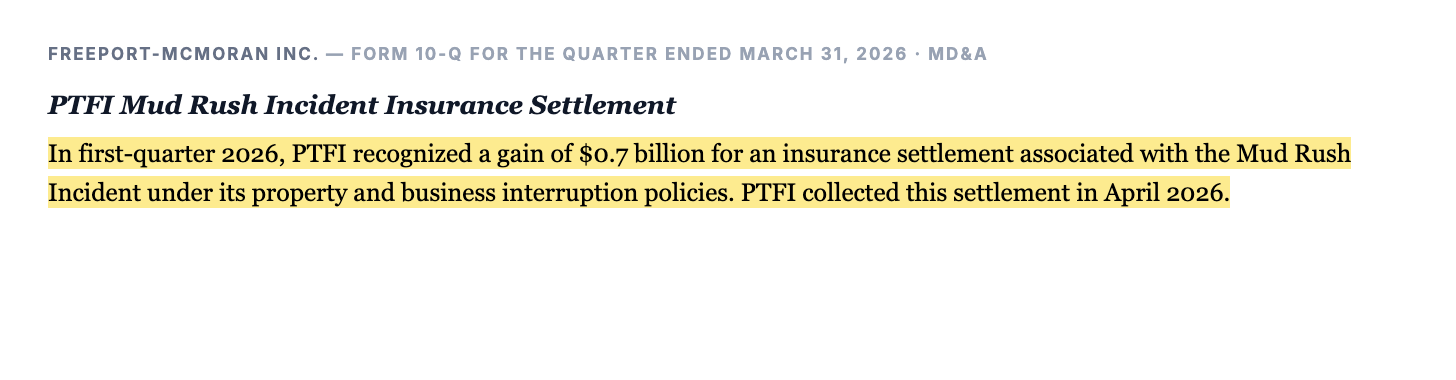
Back to the dream quarter: $881 million of profit in the first quarter of 2026, more than double the prior year. Part of that number, however, comes not from the mountain but from a settlement with the insurers:
"In first-quarter 2026, PTFI recognized a gain of $0.7 billion for an insurance settlement associated with the Mud Rush Incident under its property and business interruption policies. PTFI collected this settlement in April 2026."
— Freeport-McMoRan Inc., SEC quarterly report 10-Q as of March 31, 2026, "Operations – Indonesia"
Important for context: the insurance payment is legitimate — it compensates real damage and lost revenue, and $499 million of idle facility and restoration costs sat opposite it in the same quarter. Net, FCX puts the quarter's special items at a plus of just $51 million ($0.04 per share). But you should know the mechanics: without record prices and the insurance settlement, the quarter would not have been a triumph but a demonstration of the missing volume — a quarter less copper, two thirds less gold. Insurance pays once; a mine has to deliver every day. On top comes a new construction site away from the mountain: in April 2026, Indonesia's tax authorities issued assessments for the 2022 audit year — PTFI considers its payments correct and is entering the objection process. No drama, but a reminder of who holds the longer lever in Indonesia. Which brings us to the ownership question.
Uncomfortable truth no. 4: Freeport owns just 48.76 percent of its best mine — and from 2042 probably only 37
When you buy an FCX share, you do not even own half of Grasberg. Since the 2018 transaction, Indonesia's state — via the state holding MIND ID and a regional entity — has held 51.24 percent of operating company PT Freeport Indonesia (PTFI); FCX runs the operations and consolidates the numbers, but owns 48.76 percent. The mining rights (the IUPK license) run through 2031 and are extendable to 2041 under conditions. For the time after that — and current reserves are explicitly calculated only through 2041 — FCX is negotiating a long-term extension. The price is already in the annual report:
"We expect to maintain our ownership interest in PTFI of approximately 49% through 2041 and hold approximately 37% beginning in 2042, following the transfer of an additional interest to an Indonesia state-owned enterprise."
— Freeport-McMoRan Inc., SEC annual report 10-K for fiscal year 2025, Item 1 "Business"
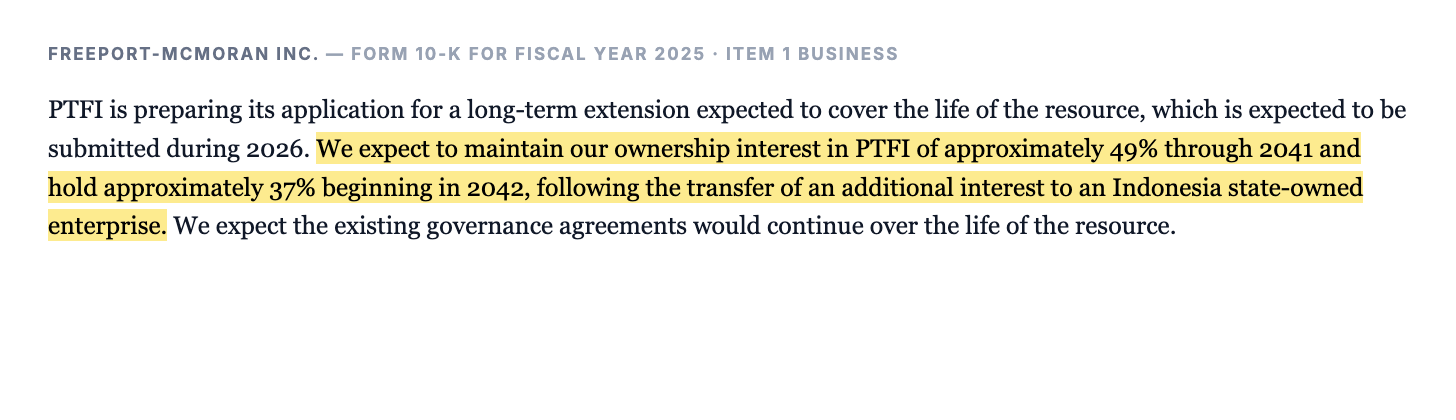
Translated into an everyday image: imagine your most valuable apartment building stands on leased land. The landlord already owns the majority of the building, the lease runs out in 2041 — and for the extension he demands another piece of the building. That is no scandal, but the transparently negotiated resource policy of a sovereign state, in the works for years; FCX expects to keep operating control, and the extension would be what unlocks the value of the reserves beyond 2041 in the first place. But for the valuation it means two things: of every Grasberg dollar, just under half belongs to FCX shareholders today — and from 2042, probably only a good third. Whoever buys FCX as "the Grasberg stock" should read the share certificate correctly: it is also an Indonesian state partnership with expiration clauses.
Valuation: about $85 billion of market value — you are paying for the comeback
What does all this cost? Based on fundamental data as of the first quarter of 2026, FCX weighed in at roughly $85 billion of market value. As an evergreen price anchor, the company itself serves best: in the first quarter of 2026, FCX bought back 1.7 million of its own shares at an average of $54.25 (per the quarterly report; the $5.0 billion repurchase program is only about $2.1 billion used). Measured against the earnings of the trailing four quarters ($1.89 per share, including the insurance effect), that buyback price equals a P/E around 29; on fundamental data as of July 18, 2026, the P/E stands around 33 and the price-to-sales ratio around 3.4. For perspective: in the years before the disaster, FCX mostly traded at clearly lower multiples — what is being paid here is the successful comeback and a permanently high copper price. The analyst consensus of 22 firms stands at an average rating around 1.2 (on a scale where 1 means "strong buy", data as of July 18, 2026) — a remarkably unanimous choir. Remember the comeback reflex: when everyone tells the same recovery story, it is usually already in the price.
Two special topics belong in every FCX valuation. First, U.S. tariff policy: since August 2025, a 50 percent tariff applies to semi-finished copper products — refined copper stayed exempt, but per the annual report the U.S. government will reassess by mid-2026 a refined copper tariff of 15 percent from 2027 (rising to 30 percent in 2028). The announcements alone pushed the U.S. benchmark COMEX an average of 7 percent above the world market price LME in 2025 — and FCX is the largest copper refiner in the United States: as a domestic producer, the company would be a structural tariff winner. Second, capital returns: $0.60 of dividends per share per year (half base, half variable), plus buybacks as cash allows — disciplined by a self-imposed net debt target of $3.0 to $4.0 billion, comfortably undercut at $2.4 billion as of March 31, 2026. For a mining company, the balance sheet really is a small fortress — it is just that none of these metrics measures what a mountain in Papua does next.
Opportunities and risks at a glance
What speaks for Freeport-McMoRan:
- Commodity tailwind with substance: realized 2025 prices of $4.75 per pound of copper and $3,423 per ounce of gold, copper all-time highs in January 2026 ($6.28 LME); demand carried by electrification, data centers and AI build-out (per the 10-K).
- Scale and reserve power: 3.4 billion pounds of copper production in 2025, reserves of 112.3 billion pounds of copper, 20.6 million ounces of gold and 3.5 billion pounds of molybdenum (December 31, 2025); growth options at Bagdad (Arizona) and El Abra (Chile).
- A solid balance sheet despite the disaster year: $5.6 billion of operating cash flow in 2025, net debt of just $2.4 billion as of March 31, 2026 (excluding $3.2 billion of separately financed smelter debt), a Piotroski F-Score of 8 of 9 and an Altman-Z above 5 (Q1 2026).
- Potential tariff winner: as the largest U.S. copper producer, FCX benefits from the COMEX premium (2025: on average +7 percent versus LME); a U.S. tariff on refined copper from 2027 would strengthen that position.
- The leaching lever: from old stockpiles, FCX extracted 214 million pounds of additional copper in 2025 with new leaching technology; the target is 300 million pounds per year from 2026 — copper without a new mine.
What speaks against it:
- Grasberg concentration: 98 percent of gold production and about 30 percent of copper come from a single district in Papua — which has produced at reduced rates since the disaster of September 8, 2025 (seven fatalities, force majeure).
- A delayed comeback: Blocks 2 and 3 at about 60 percent of capacity per the 10-Q until modifications are done "by mid-2027"; full-year 2026 guidance cut from 3.38 to 3.08 billion pounds of copper and from 800,000 to 650,000 ounces of gold; about $0.9 billion of idle facility costs expected in 2026.
- Ownership and license structure: only 48.76 percent of PTFI (the state: 51.24 percent), IUPK rights through 2031/2041, reserves calculated only through 2041; extension against a reduction to about 37 percent from 2042; plus Indonesian tax assessments (April 2026) under objection.
- Earnings quality in a transition year: Q1 2026 profit includes a $0.7 billion insurance settlement; copper volumes −25 percent, gold production −66 percent; costs per pound rising (guidance $1.95 instead of $1.75), also due to expensive energy and sulfuric acid since the Middle East conflict (February 2026).
- A valuation without a margin of safety: a P/E around 29 to 33 (depending on the anchor, data as of Q1/July 18, 2026) for a cyclical commodity stock largely prices in the comeback and high copper prices — if either tips, the cushion is missing.
A human conclusion
Back to the comeback reflex from the beginning. It does not lie as a rule — comebacks do happen, and the ingredients are all here: record prices, a world-class portfolio, a balance sheet close to a fortress, a management that reports milestones transparently and so far delivered what it promised (the restart of Blocks 2 and 3 began in March 2026, as announced). The reflex only gets expensive when it skips the fine print: that the recovery promise slid within three months from "85 percent by late 2026" to "60 percent of capacity until mid-2027", that the profit jump partly consists of a one-time insurance payment, that costs are rising — and that the mine everything hangs on belongs to the company only to 48.76 percent, and from 2042 probably only to 37. So the honest question for you is not "Does Grasberg come back?" — much speaks for it. It is: do you want to pay about 30 times earnings for a comeback bet whose timetable has just slipped for the first time and whose most important asset is majority-owned by a state? Whoever answers yes gets perhaps the best copper lever in the Western world in a phase of structural copper scarcity. Whoever hesitates can read along in the coming quarterly reports (10-Q): the volumes from Indonesia, the progress on the ore loading systems, the costs per pound and the IUPK extension application are the four measuring points where the story has to prove itself. What you make of it is your decision. And that is exactly as it should be.
Sources
All original documents used in this analysis — for your own reading:
- Freeport-McMoRan Inc. — SEC annual report 10-K for fiscal year 2025 (ended December 31, 2025; filed February 13, 2026)
- Freeport-McMoRan Inc. — SEC quarterly report 10-Q as of March 31, 2026 (filed May 8, 2026)
- Freeport-McMoRan Inc. — SEC annual report 10-K for fiscal year 2024 (ended December 31, 2024; filed February 14, 2025)
- Complete SEC filing history of Freeport-McMoRan Inc.: EDGAR overview (sec.gov)
- Fundamental data (metrics, quarterly series, valuation; data as of July 18, 2026 and Q1 2026), reconciled with the SEC filings.
- Screener and rating data: in-house stock scanner, Terry Smith quality scanner (U.S. selection), Peter Lynch PEG, Altman-Z and Levermann filters (data as of July 18, 2026).
Transparency & disclaimer: This analysis is a journalistic contextualization of publicly available information and is not investment advice, not a financial analysis in the regulatory sense and not a solicitation to buy or sell securities. Stock investments carry substantial risks up to and including total loss. All information without guarantee; the data cut-off is noted in the text. The author holds no position in Freeport-McMoRan shares at the time of publication.
Our Bottom Line at a Glance
- Prices & demand positive
- Realized 2025 prices: $4.75 per pound of copper and $3,423 per ounce of gold; copper all-time highs on LME and COMEX in January 2026 ($6.28/$6.18). Demand carried by electrification, data centers and AI build-out (10-K FY 2025, 10-Q as of March 31, 2026).
- Balance sheet & capital discipline positive
- Net debt of $2.4 billion (March 31, 2026, excluding separately financed smelter debt), target corridor $3–4 billion, Piotroski 8 of 9 and Altman-Z above 5 (Q1 2026); $0.60 dividend plus buybacks inside a rule-based payout framework (10-K, 10-Q).
- Grasberg concentration risk negative
- 98 percent of gold and about 30 percent of copper from one district that has run at reduced rates since the mud rush of September 8, 2025 (seven fatalities, force majeure): Blocks 2 and 3 at about 60 percent of capacity, bottlenecks "by mid-2027"; 2026 guidance cut (10-K; 10-Q as of March 31, 2026).
- Ownership & license Indonesia negative
- Only 48.76 percent of PTFI (Indonesia's state: 51.24 percent), mining rights through 2031/2041, reserves calculated only through 2041; extension per the 10-K against a reduction to about 37 percent from 2042; plus Indonesian tax assessments under objection (10-Q).
- Earnings quality & valuation neutral
- Q1 2026 profit of $881 million includes a $0.7 billion insurance settlement (net special items +$51 million); copper volumes −25 percent, gold −66 percent. A P/E around 29 to 33 (buyback price Q1 2026 and fundamental data July 18, 2026) largely prices in the comeback.
By its SEC filings, Freeport-McMoRan is a commodity company in top bookkeeping form: record copper and gold prices, $25.9 billion of 2025 revenue, a balance sheet close to a fortress and a rule-based payout framework. But no quality filter measures the three biggest risks: the best mine produces at reduced rates after a disaster that killed seven workers — the timetable slid within three months from "85 percent by late 2026" to "60 percent of capacity until mid-2027" —, the latest profit jump contains a one-time insurance payment, and the mine belongs to the company only to 48.76 percent, from 2042 probably only to about 37. Not investment advice.
What Our Rating Means
- If you don't own the stock
- As long as the question raised in the bottom line stays open, we see no basis for an entry.
- If you hold it in your portfolio
- Our findings offer no acute reason to sell — the checkpoints named remain decisive.
A journalistic assessment by our editorial team at the time of the deep dive, based on public sources — not investment advice and not a solicitation to buy or sell. Your personal circumstances (investment goals, risk capacity, taxes) cannot be taken into account. What our categories mean, how verdicts are formed, and what conflicts of interest exist →
Worth Noting
- FCX reached the research list via rank 5 in the in-house Terry Smith quality scanner (U.S. selection, as of July 18, 2026); additional hits in the Peter Lynch PEG, Altman-Z and Levermann filters. A quality scanner measures the books, not mine physics, ownership structures or resource politics — it never replaces the cross-check in the SEC filings.
- Valuation figures deliberately anchored evergreen: the price anchor is the average buyback price FCX itself reported in the 10-Q ($54.25 in Q1 2026); P/E and P/S computed from it with TTM figures as of March 31, 2026, supplemented by fundamental data as of July 18, 2026. Analyses are evergreen, daily prices are not a buy argument.
- Identity verified via EDGAR submissions (CIK 0000831259, Delaware, NYSE: FCX, domestic filer 10-K/10-Q, no Form 15, no FPI). Current name "Freeport-McMoRan Inc."; the former name "Freeport-McMoRan Copper & Gold Inc." applied only until July 2, 2014. Fiscal year ends December 31.
Frequently Asked Questions
Freeport-McMoRan Inc. (NYSE: FCX), headquartered in Phoenix, Arizona, is one of the world's largest publicly traded copper producers — with mines in the U.S. (Morenci among others), Peru (Cerro Verde), Chile (El Abra) and Indonesia (the Grasberg district). Gold (98 percent from Grasberg) and molybdenum come on top. In fiscal year 2025 (ended December 31, 2025) the company generated $25.9 billion in revenue, earned $2,204 million net and produced 3.4 billion pounds of copper, 1.0 million ounces of gold and 92 million pounds of molybdenum.
The filter looks for companies with high returns on capital, reliable cash generation and solid balance sheets — and the latest numbers deliver: a 14.1 percent net margin and a Piotroski F-Score of 8 of 9 in the first quarter of 2026, an Altman-Z above 5, net debt of just $2.4 billion (March 31, 2026). As of July 18, 2026 that makes rank 5 of the U.S. selection, with confluence in the Peter Lynch PEG, Altman-Z and Levermann filters. The scanner, however, only measures the books — not mining disasters, ownership structures or license politics.
On September 8, 2025, per the annual report (10-K), approximately 800,000 metric tons of wet material entered the Grasberg Block Cave underground mine from the former open pit; seven workers died. Operations were suspended, force majeure was declared to commercial counterparties, and the smelting operations also stood still for a time. District production fell to 1.0 billion pounds of copper and 0.9 million ounces of gold in 2025 (2024: 1.8 billion pounds and 1.9 million ounces). The restart of Blocks 2 and 3 began at the end of March 2026.
Considerably: 98 percent of gold production and about 30 percent of 2025 copper production come from the Grasberg district, one of the world's cheapest copper sources at normal rates. But operating company PT Freeport Indonesia belongs to FCX only to 48.76 percent — Indonesia's state holds 51.24 percent. The mining rights (IUPK) run through 2031 with an extension option to 2041; for an extension beyond that, FCX expects per the 10-K to hold only about 37 percent from 2042, after transferring a further interest to a state-owned enterprise.
Rather ambitiously: measured against the company's own average buyback price of $54.25 (Q1 2026, per the 10-Q) and trailing-four-quarter earnings of $1.89 per share (including the insurance effect), the P/E works out around 29; fundamental data as of July 18, 2026 shows a P/E around 33 and a price-to-sales ratio around 3.4 at roughly $85 billion of market value. That already prices in a successful Grasberg comeback and permanently high copper prices; the analyst consensus of 22 firms stands at a rating around 1.2 (July 18, 2026).
Yes: $0.60 per share per year (2025 as in 2024), half of it a base dividend and half a variable, performance-based dividend. A $5.0 billion share repurchase program runs alongside ($2.9 billion still available as of April 30, 2026; in Q1 2026 FCX bought 1.7 million shares at an average of $54.25). The framework: up to 50 percent of available cash flows go to shareholders, as long as net debt stays below the target of $3.0 to $4.0 billion (March 31, 2026: $2.4 billion).
Found an error?
Did you spot a factual error, an outdated number, or a typo in this deep dive? Let us know briefly — your report goes straight to the editorial team.