Ethos Technologies: $193 Million in the First Quarter — and the Company Itself Guides to $116 for the Second
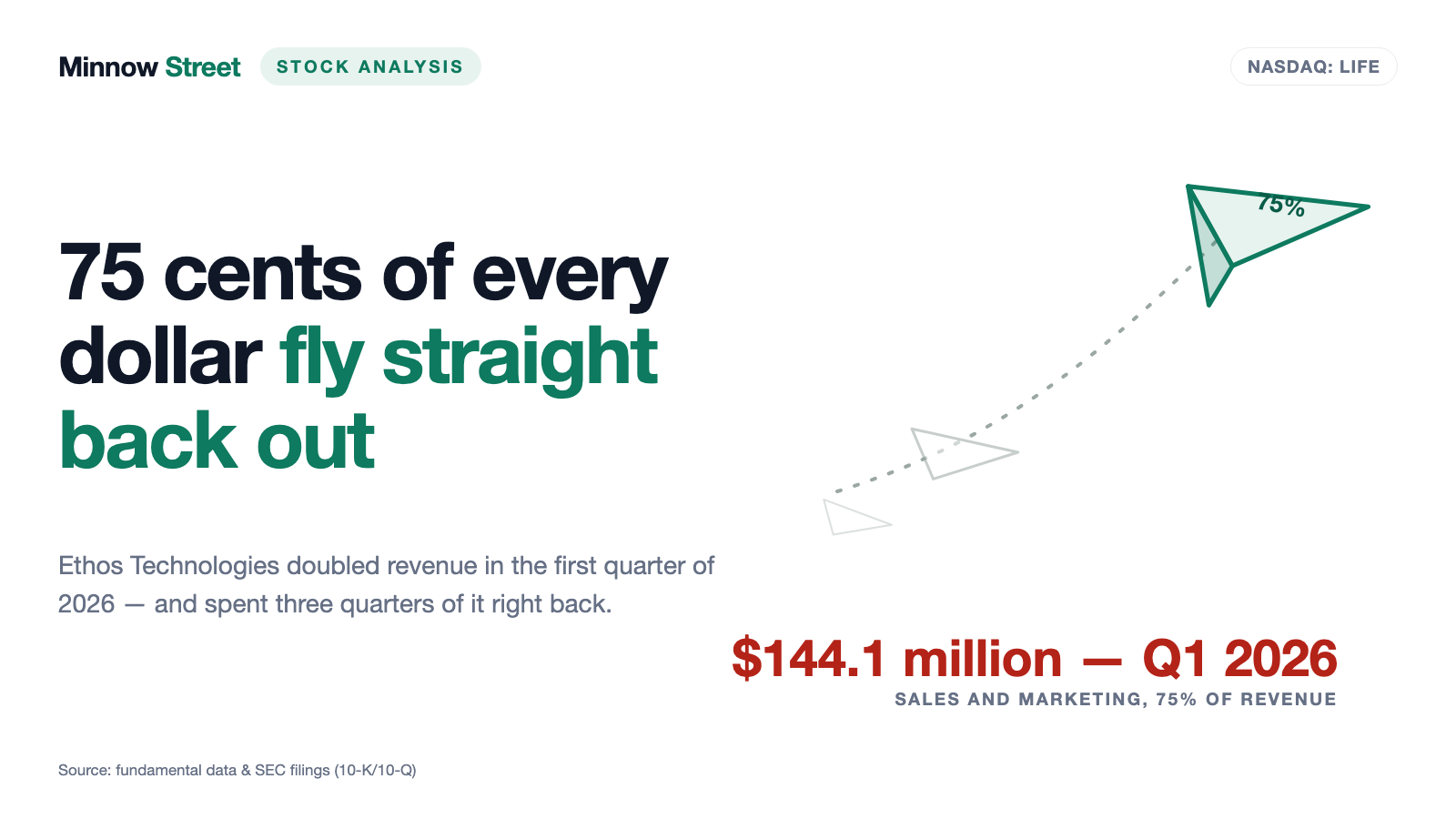
Ethos Technologies sells life insurance online, with no medical exam and a handful of health questions. Revenue doubled to $193.1 million in the first quarter of 2026 — the first set of numbers after the January 29, 2026 IPO. For the second quarter the company guides to just $114 million to $118 million. Its filings with the U.S. securities regulator, the SEC, explain why: the first quarter is seasonally the strongest, 88 percent of revenue comes from three carriers, and $291.4 million of the $619.4 million balance sheet is commission money that is meant to arrive over years. Valuing a young stock takes more than its first quarter.
 Thomas Mücke
Founder & Publisher
Thomas Mücke
Founder & Publisher
Chart
Interactive price chart (TradingView).
Note: pure fact-based analysis, not investment advice and not a solicitation to buy or sell. All figures without guarantee.
There is an investor trap that only springs on newly listed companies, and it is treacherous because it feels like diligence: the debutante trap. With a company that has been public for twenty years, you have eighty quarters to compare — you can tell a good quarter from a bad one. With a market debutante you have exactly one. And that single quarter becomes the yardstick in your head for everything that follows. Psychologists call it the anchoring effect: the first number we see colors every judgment afterward. Ethos Technologies Inc. (Nasdaq: LIFE) delivered its first set of numbers as a public company with $193.1 million in revenue — more than twice the year-earlier quarter. A magnificent anchor. Except that in the same breath the company said it expects $114 million to $118 million for the following quarter. So let us make a deal: before you multiply 193 by four, we read together what Ethos filed with the U.S. securities regulator, the SEC — the quarterly report (10-Q) for the period ended March 31, 2026, the annual report (10-K) for 2025, the earnings release of May 6, 2026, and the IPO prospectus of January 30, 2026. A filing to the SEC is honest under penalty of law. What you make of it is your decision.
What Ethos Technologies actually does — life insurance without the doctor's visit
Ethos sells term life insurance over the internet. Anyone seeking coverage answers a handful of health questions on the website instead of scheduling a blood draw and a physical; for almost all applicants the decision comes back within minutes. The company describes itself in the quarterly report as a "technology-driven, direct-to-consumer platform" and names three constituencies it serves at once: consumers (a fully digital application), agents (an "Agent OS" that independent insurance agents use to quote, submit applications and manage their payments) and carriers (which reach new customers and agents through Ethos).
And here sits the single most important sentence for understanding the balance sheet: Ethos is not an insurer. It carries no insurance risk — if a policyholder dies, the partner carrier pays, not Ethos. The quarterly report puts it plainly: "We do not assume balance sheet risk for the policies on our platform." Ethos earns money the way a broker does: through commissions paid by the carrier for each policy sold — the bulk in the first year, smaller amounts thereafter for as long as the customer keeps the contract. In everyday terms: Ethos is not the bank, it is the real estate agent — it does not carry the mortgage, it collects the fee.
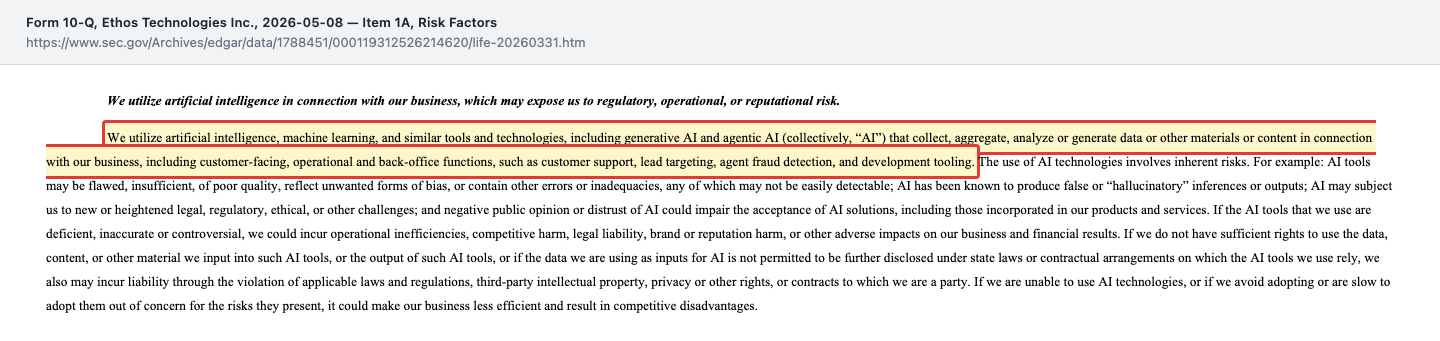
Where artificial intelligence fits into a business like this is something the company answers itself — and more soberly than the label "insurtech" suggests. The annual report describes the application process as running on a "full stack technology and predictive modeling platform," an in-house system that automates the underwriting decision. What AI in the narrower sense is used for sits in the risk factors:
"We utilize artificial intelligence, machine learning, and similar tools and technologies, including generative AI and agentic AI (collectively, “AI”) that collect, aggregate, analyze or generate data or other materials or content in connection with our business, including customer-facing, operational and back-office functions, such as customer support, lead targeting, agent fraud detection, and development tooling."
— Ethos Technologies Inc., Form 10-Q for the quarter ended March 31, 2026, Item 1A, "Risk Factors"
The company is a licensed insurance agent in 49 U.S. states and also serves as a third-party administrator for policies. As of December 31, 2025 it employed 614 full-time staff — headquarters in San Francisco, the engineering team in Bengaluru, India. More than 600,000 policies have been activated on the platform since inception; 88,373 came in the first quarter of 2026, up 84 percent year over year. That also sets the central tension of this analysis, and it runs through every chapter that follows: Ethos is growing fast and is profitable at its core — but a large share of reported revenue is an estimate of how long customers will keep their policies, and 88 percent of it depends on three carriers.
How the stock landed on our desk
Not through a price scanner. Ethos has been listed on Nasdaq only since January 29, 2026 — for most of the screens in our in-house stock scanner, which work with multi-year series and fifty-two-week windows, this stock simply has not existed long enough. What caught our attention was the mandatory SEC filings, specifically a conspicuous run of Form 4 insider filings in July 2026: a shareholder registered as a 10 percent owner was selling shares on almost every trading day. Following that trail requires no expensive data service — the filings sit in the SEC's EDGAR archive under company identifier CIK 0001788451.
Because conventional metrics mean little for a six-month-old listing, the same rule applies here as for other special situations — for instance the biotech company Equillium, whose cash pile looked large and whose share count the price feed captured only halfway: you do not measure with the price thermometer, you read the notes. That is what we do now.
The numbers over the years — honestly appraised
First, what genuinely impresses, and there is plenty. Ethos has more than doubled revenue in two years: from $159.8 million in fiscal 2023 to $254.9 million (2024) to $387.6 million (2025) — up 52 percent in the latest year, after 60 percent the year before. And unlike many young technology companies, this did not come with widening losses but with widening profits: $1.7 million net income (2023), $48.8 million (2024), $71.2 million (2025).
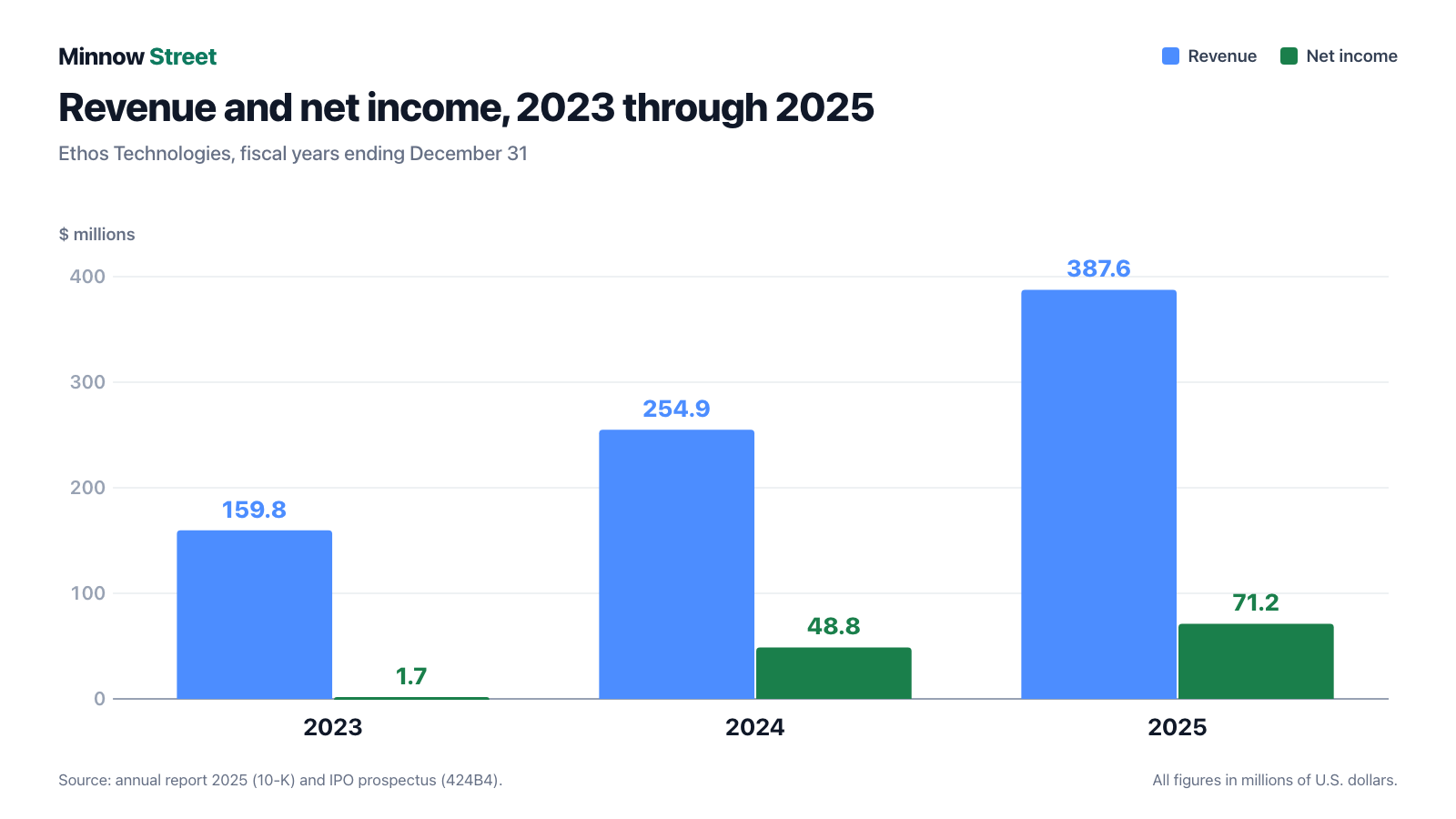
Behind it sits simply more business: 198,338 activated policies in 2025 against 127,619 in 2024, a 55 percent increase. Gross margin runs at 98 percent — hardly surprising, since Ethos buys no inventory and sells distribution. And the growth is not debt-financed: as of March 31, 2026 the balance sheet showed $107.9 million in cash plus $36.7 million in short-term and $79.2 million in long-term investments, roughly $223.8 million in total, against $178.0 million of total liabilities that contain no conventional bank debt.
The first quarter of 2026 reads splendidly as well: $193.1 million in revenue, up 104 percent. The direct channel — customers who come to the website themselves — grew 136 percent to $146.0 million, while the independent agent channel grew 42 percent to $47.1 million. Average revenue per policy rose 11 percent to $2,185. Operations produced $31.2 million of cash. By the company's own definition, it takes on average less than two months for the commissions on a newly written policy to repay the advertising and agent compensation spent to acquire it. Measured against what the insurance distribution business usually delivers, that is remarkably quick.
And yet the quarter closed with a net loss of $166.4 million. Before anyone panics: this is not a collapse in the business but accounting around the IPO. The chart below breaks the quarter down line by line.
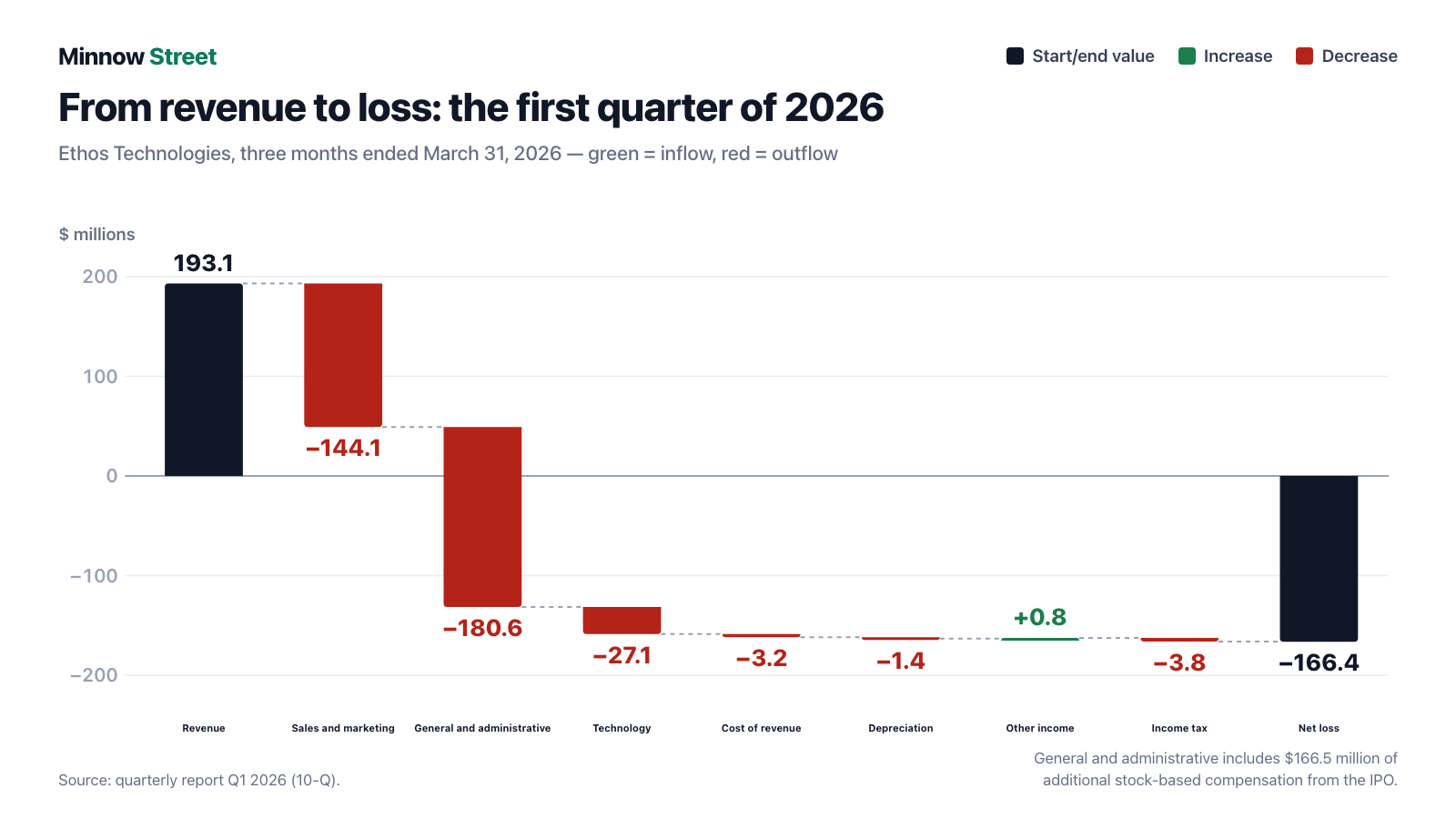
When the company went public, 5.7 million deferred stock units vested at once; for years they had been tied to exactly that event. That produced $181.7 million of expense — paper expense, because what went out were shares, not cash. Cash did leave, though: $49.1 million of taxes that Ethos withheld for employees and remitted to the authorities. Strip out stock-based compensation and the first quarter of 2026 shows adjusted earnings before interest, taxes, depreciation and amortization (adjusted EBITDA) of $33.6 million, up from $23.7 million a year earlier. That is the fair reading. Remember all the same: shares handed to employees are not cash — but they still cost existing owners something, namely their share of the company.
What the filings say — the uncomfortable truths
Uncomfortable truth no. 1: almost half the balance sheet is an estimate about the future
When Ethos places a policy, it books the revenue immediately — and not only the first-year commission but the expected renewal commissions of the years to come. Whether those actually arrive depends on how long the policyholder keeps the contract. The industry calls that persistency, and it is an estimate. The quarterly report says so with welcome candor:
"Our revenue for an activated policy includes both the first-year commission and renewal commissions, both of which require significant judgment in applying a persistency estimate."
— Ethos Technologies Inc., Form 10-Q for the quarter ended March 31, 2026, Item 2

What that means for the balance sheet shows up in a single number. As of March 31, 2026, commissions receivable stood at $26.4 million current and $265.0 million non-current, or $291.4 million in total, against total assets of $619.4 million. So 47 percent of the entire balance sheet is money Ethos has already recognized as revenue but that is supposed to arrive over years, provided customers keep their contracts. For comparison, cash and investments amount to $223.8 million.
None of this is improper, and none of it is unusual for an insurance distributor — but it is a different business model than the revenue line suggests at first glance. And it cuts both ways: when the estimates change, revenue from past periods changes retroactively. The filing calls these "in-period adjustments." What that looks like in practice is uncomfortable truth no. 3.
Uncomfortable truth no. 2: 88 percent of revenue comes from three carriers
Ethos places policies but does not issue them. For that it needs carriers — and a few of them matter enormously. The numbers sit in Note 2 of the quarterly report:
"For the three months ended March 31, 2026, three insurance carrier customers accounted for 45%, 33% and 10% of total revenue."
— Ethos Technologies Inc., Form 10-Q for the quarter ended March 31, 2026, Note 2, "Concentration of Credit Risk"

That is 88 percent combined. In the risk factors of the same document Ethos names all three: Ameritas, Banner Life (formerly Legal & General America) and TruStage. Nor is it a one-off: in fiscal 2025 the split was 38, 36 and 14 percent — 88 percent again. In fiscal 2024 it was 54, 25 and 19 percent, or 98 percent. To be fair, dependence on the single largest partner has fallen from 54 to 45 percent.
If your neighbor told you his business was booming but a single client provided 45 percent of his revenue, would you swallow hard? This is that situation. The receivables side sharpens it: as of March 31, 2026, three carriers accounted for 67, 13 and 12 percent of all outstanding receivables. Two thirds of the money Ethos is still waiting for sits with one counterparty. On the other side of the ledger, Ethos says it accounts for only a minority of those three carriers' life insurance premiums — meaning there is room to grow rather than a relationship already tapped out.
Uncomfortable truth no. 3: the record quarter is explicitly not the run rate
Now the number that dismantles the anchor from the opening. On the same day Ethos reported $193.1 million of revenue, it published its own outlook for the following quarter: $114 million to $118 million. Against the year-earlier quarter that is a 31 percent increase — against the quarter just reported it is a decline of roughly 40 percent. For the full year 2026 Ethos guides to $561 million to $565 million. Take out the first quarter and roughly $370 million remains for the three quarters that follow, or a little over $123 million each on average.
The reason is in the quarterly report: the first quarter is seasonally the strongest. After New Year people plan their finances, and digital advertising is cheaper than in the rest of the year — so Ethos buys customer leads on unusually good terms. Chief executive Peter Colis said it himself in the release of May 6, 2026: "Q1 is our seasonally strongest quarter."
A second effect weakens comparability further, and it is instructive because it looks paradoxical at first. Ethos revised its persistency estimates in the first quarter of 2026 because policies were holding up better than assumed. Good news? For revenue, yes. For costs, no: when fewer policies lapse, Ethos can claw back less of the advances it paid to agents. The result was a one-time, non-cash charge of $16.5 million in sales and marketing expense. Contribution margin — the share of revenue left after advertising and agent payments — fell from 43 percent a year earlier to 30 percent. Remember this sentence: when a metric rests on estimates, good news can land in the accounts as a cost.
Uncomfortable truth no. 4: 20 votes per share — and a steady rain of new stock
Anyone buying an Ethos share on Nasdaq acquires a Class A share with one vote. Alongside it sits Class B with twenty votes per share, which is not publicly traded. The risk factors spell out how power is distributed:
"As of March 31, 2026, stockholders who hold shares of Class B common stock, including our co-founders, entities affiliated with Accel, and entities affiliated with Sequoia Capital, together hold approximately 95.4% of the voting power of our outstanding capital stock."
— Ethos Technologies Inc., Form 10-Q for the quarter ended March 31, 2026, Item 1A, "Risk Factors"

The mechanism has a long life: only when Class B falls below 4.8 percent of all shares does it lose its voting majority under the charter; separately, it converts automatically into Class A once the co-founders hold less than 20 percent of their original position — or at the latest on the tenth anniversary of the IPO. Buy Class A today and you buy an economic interest, not a say. As a side effect, the dual-class structure keeps the stock out of certain indices, which shrinks the pool of institutional buyers.
Then there is dilution — your slice of the cake gets smaller when new slices keep being cut. At the IPO, Ethos adopted two new equity programs: 19.0 million shares reserved under the 2026 incentive plan and a further 1.3 million under the employee stock purchase plan, which tops itself up automatically by as much as 2.6 million shares each year starting January 1, 2027. Measured against the 62,994,262 shares of both classes outstanding as of April 30, 2026, the 19.0 million alone are roughly 30 percent. And the granting has begun: on July 8, 2026 chief executive Peter Colis and president Lingke Wang each received 900,000 restricted stock units, 1.8 million shares in total (Form 4 filings dated July 10, 2026). How quickly a rain of new stock can distort results is something our analysis of Hour Loop showed in a very different setting.
Valuation — order of magnitude instead of a daily price
Two warnings first. One: the listing is six months old. Between January 29, 2026 and July 30, 2026 the closing price ranged from $9.85 to $30.59 — the low on March 20, 2026, the high one day after the quarterly report on May 7, 2026. Deriving a "fair value" from that roller coaster pretends to more knowledge than the market has. Two: Ethos has two share classes. Price databases frequently count only the 30,914,997 listed Class A shares and miss the 32,079,265 Class B shares, which makes the market capitalization wrong. We therefore work explicitly with 62,994,262 shares (as of April 30, 2026, per the cover page of the quarterly report).
As a dated valuation anchor we take the closing price of $20.27 on July 30, 2026. That gives a market capitalization of roughly $1.28 billion. Translated into orders of magnitude: a price-to-sales ratio of roughly 3.3 on fiscal 2025 revenue ($387.6 million) and roughly 2.3 on the midpoint of the company's own 2026 guidance ($563 million). A price-to-earnings ratio of roughly 18 on 2025 net income ($71.2 million) — for full-year 2026 there will likely be no reported profit to measure against, because of the one-time stock-based compensation in the first quarter.
For a company that has grown revenue by more than half in two consecutive years that is not an expensive valuation — but it is no bargain either once you take the three-carrier concentration and the estimate-heavy revenue seriously. The professionals' view: the average analyst price target stood at roughly $27 as of July 30, 2026. That, too, needs framing — for an IPO six months old, a meaningful share of the research comes from the banks that underwrote the offering.
Opportunities and risks at a glance
What speaks for Ethos Technologies:
- Growth with real profit: revenue up 60 percent (2024) and 52 percent (2025), net income from $1.7 million to $71.2 million in two years.
- No insurance risk on the balance sheet — Ethos distributes, the partner carriers bear the mortality risk.
- Gross margin of 98 percent, positive operating cash flow ($31.2 million in the first quarter of 2026), no conventional bank debt.
- Customer acquisition that pays back in less than two months (as of March 31, 2026) — with 88,373 policies activated in the first quarter of 2026 alone.
- Equity of $441.3 million after the IPO (March 31, 2026, up from negative $24.1 million), cash and investments of $223.8 million.
What speaks against it:
- 88 percent of revenue from three carriers, 45 percent of it from a single one (first quarter of 2026); 67 percent of outstanding receivables with one partner.
- $291.4 million of the $619.4 million balance sheet is commissions receivable whose value depends on persistency estimates — revisions work retroactively on both revenue and costs.
- Seasonality: management states the first quarter is the strongest, and its own guidance for the second quarter of 2026 sits roughly 40 percent below it.
- 95.4 percent of the voting power with the founders, Accel and Sequoia Capital (March 31, 2026); Class A buyers have effectively no say.
- Dilution: 19.0 million shares reserved under the 2026 incentive plan plus an employee program that grows every year; 1.8 million units to the two co-founders alone on July 8, 2026.
- A very short trading history (first listed January 29, 2026) and a large shareholder that has been selling continuously since May 2026.
A human conclusion
Remember the debutante trap from the opening? At Ethos it has two sides, and both are worth saying out loud. The first: multiply $193.1 million by four and you land at $772 million of annual revenue — more than $200 million off, because the company itself guides to $561 million to $565 million. The second, less often considered: anyone who looked at the $9.85 close in March 2026 and concluded that this IPO had failed would have watched a quarter with doubled revenue arrive six weeks later. A single data point is worthless in either direction.
What remains is a company with a working business: fast growth, real profits before the one-time charge of the listing, money in the bank, no insurance risk on the balance sheet. And beside it three things you need to know before buying — that almost half the balance sheet consists of receivables whose size is an estimate; that 88 percent of revenue hangs on three partners; and that 95.4 percent of the votes sit with people who never have to ask you. The honest way to treat a market debutante is patience: four quarterly reports make a series, one makes a dot. The next report will show whether the guidance for the second quarter of 2026 held and where contribution margin goes after the one-time charge. What you make of it is your decision. And that is exactly as it should be.
Sources
- Ethos Technologies Inc., Form 10-Q for the quarter ended March 31, 2026, filed May 8, 2026 — balance sheet, statements of operations and cash flows, Note 2 (customer concentration), Note 9 (equity), Item 1A (risk factors), Item 2 (management's discussion)
- Ethos Technologies Inc., Form 10-K for 2025, filed March 17, 2026 — full-year figures for 2025 and 2024, headcount, customer concentration
- Ethos Technologies Inc., Form 8-K (Item 2.02) of May 6, 2026 with Exhibit 99.1 — first-quarter 2026 results and guidance for the quarter and the full year
- Ethos Technologies Inc., Form 8-K (Item 2.02) of February 25, 2026 with Exhibit 99.1 — fiscal 2025 results and the first 2026 guidance
- Ethos Technologies Inc., IPO prospectus (Form 424B4) of January 30, 2026 — offering price, allocation, fiscal 2023 figures, lock-up terms
- Ethos Technologies Inc., Form 8-K of February 2, 2026 — exchange agreements with the co-founders and with Accel and Sequoia Capital, amended certificate of incorporation
- Form 4 insider filings for Ethos Technologies in the SEC EDGAR archive — sales by GV/Alphabet Holdings from May 14, 2026, restricted stock units for the co-founders dated July 8, 2026
- Source: fundamental data & SEC filings (annual and quarterly reports, 10-K/10-Q) — metrics and daily closing prices, data as of July 30, 2026
Important notice: This article is journalistic commentary on publicly available company filings. It is not investment advice, not a recommendation to buy or sell, and not a solicitation to buy or sell securities. Stocks can lose substantial value, up to the total loss of the capital invested. All figures come from the sources named above and carry the reporting date stated there; they may change with new filings. The author holds no position in Ethos Technologies Inc. at the time of publication.
Our Bottom Line at a Glance
- Growth and earning power positive
- Revenue rose from $159.8 million (2023) to $254.9 million (2024) to $387.6 million (2025), then 104 percent to $193.1 million in the first quarter of 2026. Unlike many young technology companies, real profit came with it: $71.2 million of net income in 2025 and $31.2 million of operating cash flow in the first quarter of 2026.
- Business model and balance sheet risk positive
- Ethos carries no insurance risk — the quarterly report for the period ended March 31, 2026 states explicitly that the company does not assume balance sheet risk for the policies on its platform. Gross margin runs at 98 percent, there is no conventional bank debt, and by the company's own math customer acquisition pays back in less than two months.
- Revenue quality negative
- Commissions are booked up front including expected future years. As a result, commissions receivable of $291.4 million sit in a $619.4 million balance sheet as of March 31, 2026 — 47 percent. Revisions to persistency estimates work retroactively: one such revision cost $16.5 million in the first quarter of 2026 and pushed contribution margin from 43 to 30 percent.
- Customer concentration negative
- Three carriers accounted for 45, 33 and 10 percent of revenue in the first quarter of 2026 (88 percent combined) and for 98 percent in fiscal 2024. As of March 31, 2026 a single partner held 67 percent of outstanding receivables. On the positive side, the largest partner's share has fallen from 54 to 45 percent.
- Shareholder rights and dilution negative
- Class B shares carrying 20 votes give the founders, Accel and Sequoia Capital roughly 95.4 percent of the voting power (March 31, 2026). On top of that come 19.0 million shares under the 2026 incentive plan, an employee program that grows each year, and 900,000 restricted stock units to each co-founder on July 8, 2026 — substantial dilution measured against 62,994,262 shares outstanding.
- Guidance and seasonality neutral
- The company's own guidance of May 6, 2026 calls for revenue of just $114 million to $118 million in the second quarter of 2026 — roughly 40 percent below the first quarter, which management describes as seasonally the strongest. Full-year 2026 guidance was set at $561 million to $565 million, up from $510 million to $514 million in February. The raise therefore corresponds largely to the first quarter's beat.
Ethos Technologies is a fast-growing life insurance distributor that reported genuine profits up to its January 29, 2026 IPO: $387.6 million of revenue and $71.2 million of net income in fiscal 2025, plus $193.1 million of revenue in the first quarter of 2026 alone. The $166.4 million net loss in that quarter stems from stock-based compensation tied to the listing, not from operations. Three other points decide the case: $291.4 million of the $619.4 million balance sheet is commissions receivable resting on persistency estimates, 88 percent of revenue comes from three carriers, and 95.4 percent of the voting power sits with the founders and two venture firms. The company itself guides to $114 million to $118 million for the second quarter of 2026 — extrapolate the first quarter and you will be wrong. Not investment advice.
What Our Rating Means
Open questions
The business works in principle, but one material question is open. As long as it stays open, our findings do not carry a quality verdict.
Yellow rather than green: the business clearly carries itself — a 98 percent gross margin, positive operating cash flow, $441.3 million of equity and no conventional bank debt as of March 31, 2026. What remains open is a material operating question: almost half the balance sheet consists of commissions receivable whose value rests on persistency estimates, and 88 percent of revenue depends on three carriers. Yellow rather than red: there is no documented threat to the substance of the company — no going-concern qualification, no negative equity, no interest burden pressing on the business, and the first-quarter 2026 loss is cleanly explained as one-time stock-based compensation from the IPO. That the stock has traded for only six months and swings hard is a price argument and does not move the light. The decision is yours.
A journalistic assessment by our editorial team at the time of the deep dive, based on public sources — not investment advice and not a solicitation to buy or sell. Your personal circumstances (investment goals, risk capacity, taxes) cannot be taken into account. What our levels mean, how verdicts are formed, and what conflicts of interest exist →
Worth Noting
- Ethos Technologies reached our research list not through a price scanner but through a run of Form 4 insider filings in July 2026, in which a shareholder registered as a 10 percent owner sold shares on almost every trading day. The listing dates only from January 29, 2026 — screens built on multi-year series or fifty-two-week windows do not yet apply to this stock.
- A caution on market capitalization: Ethos has two share classes. Price databases frequently count only the 30,914,997 listed Class A shares and miss the 32,079,265 Class B shares. This analysis works with 62,994,262 shares (cover page of the quarterly report, as of April 30, 2026); the valuation anchor of roughly $1.28 billion rests on the closing price of July 30, 2026.
- The first-quarter 2026 net loss is an accounting event, not an operating one: 5.7 million deferred stock units vested with the IPO and produced $181.7 million of expense, of which $49.1 million left as cash in withheld taxes. Adjusted for stock-based compensation, earnings before interest, taxes, depreciation and amortization came to $33.6 million.
- Not to be confused: Ethos Technologies is a distributor and administrator, not an insurer — the mortality risk on the policies it places sits with the partner carriers. Insurance-sector metrics such as combined ratio or underwriting result do not apply here.
Frequently Asked Questions
Ethos Technologies Inc. (Nasdaq: LIFE), based in San Francisco, runs a digital platform for life insurance. Customers answer a few health questions online instead of attending a medical exam and usually receive a decision within minutes. The partner carriers bear the insurance risk, not Ethos; the company earns commissions on the policies it places. It is a licensed insurance agent in 49 U.S. states and employed 614 full-time staff as of December 31, 2025.
The $166.4 million net loss came from stock-based compensation around the IPO. At the January 29, 2026 listing, 5.7 million deferred stock units vested that had been tied to exactly that event, producing $181.7 million of expense. General and administrative expense alone carried an additional $166.5 million. Of that, $49.1 million left as cash in withheld taxes. Operations generated $31.2 million of cash during the quarter.
Very. In the first quarter of 2026, according to the quarterly report (10-Q, Note 2), three insurance carrier customers accounted for 45, 33 and 10 percent of revenue — 88 percent combined. In fiscal 2025 the split was 38, 36 and 14 percent; in fiscal 2024 it was 54, 25 and 19 percent. The risk factors name the three most important partners: Ameritas, Banner Life and TruStage. On receivables, a single carrier accounted for 67 percent as of March 31, 2026.
Persistency is the likelihood that a policyholder keeps a contract in force. When Ethos places a policy it immediately books not only the first-year commission but also the expected renewal commissions, based on a persistency estimate. That produces commissions receivable of $291.4 million as of March 31, 2026, roughly 47 percent of the $619.4 million balance sheet. When the estimates change, revenue and costs of earlier periods change retroactively.
In the release of May 6, 2026, Ethos guided to revenue of $114 million to $118 million for the second quarter of 2026 and adjusted earnings before interest, taxes, depreciation and amortization (adjusted EBITDA) of $20 million to $22 million. For the full year 2026 it guided to revenue of $561 million to $565 million and adjusted EBITDA of $103 million to $107 million. In February 2026 the full-year revenue guidance had been $510 million to $514 million.
Co-founders Peter Colis and Lingke Wang along with entities affiliated with Accel and Sequoia Capital. They hold Class B shares carrying 20 votes each, giving them roughly 95.4 percent of the voting power as of March 31, 2026. The Class A share traded on Nasdaq carries one vote. The dual-class structure ends only when Class B falls below 4.8 percent of all shares, when the founders hold less than 20 percent of their original position, or at the latest on the tenth anniversary of the IPO.
On January 29, 2026. Ethos placed 10.5 million Class A shares at $19.00 each, of which 5.1 million were newly issued and 5.4 million came from existing investors. The company received $97.4 million gross and $82.6 million net; it received nothing from the selling stockholders. As of April 30, 2026, 30,914,997 Class A shares and 32,079,265 Class B shares were outstanding.
At the IPO, roughly 19.0 million shares were reserved under the 2026 incentive plan, plus 1.3 million under the employee stock purchase plan, which grows by up to 2.6 million shares each year from January 1, 2027. Measured against the 62,994,262 shares of both classes outstanding as of April 30, 2026, the first figure alone is roughly 30 percent. On July 8, 2026 the two co-founders each received 900,000 restricted stock units, 55 percent of which vest on February 15, 2027.
Found an error?
Did you spot a factual error, an outdated number, or a typo in this deep dive? Let us know briefly — your report goes straight to the editorial team.