iQIYI Stock: $3.9 Billion in Revenue for a $1.1 Billion Price Tag — and Fine Print From the Cayman Islands
On Reddit, the ticker IQ is popping up again, and the math looks temptingly simple: China's streaming pioneer, $3.90 billion in annual revenue, on sale for barely more than a quarter of that. We read what iQIYI itself reported to the U.S. securities regulator — in the annual report for foreign private issuers (20-F) for 2025 and the interim reports (6-K) through July 2026: revenue that has been shrinking since 2023, a $1.7 billion hole in working capital, a debt wall in early 2028 with a built-in 30 percent premium — and a legal structure in which you do not buy a single share of the companies that run the business. Not investment advice — just the answer to what is actually inside the box on the bargain table.
 Thomas Mücke
Founder & Publisher
Thomas Mücke
Founder & Publisher
Chart
Interactive price chart (TradingView).
Note: pure fact-based analysis, not investment advice and not a solicitation to buy or sell. All figures without guarantee.
At the bargain table, the mind takes a short break. When a price tag was once higher, every price below it feels like a gift — psychologists call this the anchoring effect: the first number burns itself in, and everything after is measured against it instead of against what is in the box. Hardly any stock feeds that reflex in the summer of 2026 as well as iQIYI (NASDAQ: IQ), China's streaming pioneer: in early 2023 the company still sold fresh shares at $5.90 per ADS; today the market values the entire group at about $1.09 billion (as of July 15, 2026) — barely more than a quarter of its $3.90 billion in annual revenue. In our Reddit hype scanner, which counts every day which small U.S. tickers the forums are talking about, IQ surfaced on July 15, 2026 with 9 mentions within 24 hours (source: ApeWisdom) — not much, but enough to trip the bargain-table reflex: China's Netflix for a quarter of its revenue? Grab it! So let's make a deal: before you trust the anchor, we read together what iQIYI itself reported to the U.S. securities regulator, the SEC — honest under penalty of law. And because iQIYI is registered as a foreign private issuer, the documents here are not called 10-K and 10-Q but 20-F (the annual report for foreign private issuers, filed for 2025 on March 16, 2026) and 6-K (interim reports) — same penalty of law, different forms, looser rhythm: quarterly numbers arrive as voluntary attachments to a 6-K, not as an audited mandatory report. In the end, you decide for yourself.
What iQIYI actually does
iQIYI is what you get when you pack Netflix, YouTube-style advertising and a film studio into one Chinese app: founded in 2010 inside the search giant Baidu, listed on the Nasdaq since March 2018, the platform produces and licenses long-form content — drama series, films, variety shows, children's programming, increasingly short formats ("micro dramas") — and sells it four ways. First, the core business: subscriptions. Memberships (ad-reduced streaming in tiers for individuals and families) brought in RMB 16.81 billion ($2.40 billion) in 2025, about 62 percent of revenue. Second: advertising — RMB 5.19 billion ($742.6 million). Third: content distribution — iQIYI sells broadcasting rights to TV stations and other platforms, partly for cash, partly in barter: series swapped for series, no cash changes hands, but both sides book the market value as revenue (2025: RMB 449.8 million of the RMB 2.50 billion in distribution revenue). Fourth, the rest — and it is more colorful than you would think: online games, a talent agency — and, since February 8, 2026, the first company-built theme park, iQIYI LAND, with VR tours and recreated sets of popular series; two more are under development per the annual report. On top of that, the overseas business (led by Southeast Asia) is growing with record membership revenue in the first quarter of 2026, and with Nadou Pro iQIYI has been publicly testing its own AI agent for professional long-form video production since March 2026. The group employed 4,603 people at the end of 2025 — more than a third of them in research and development.
Note, right here, the central tension of this analysis: The business is real — billions in revenue, a leading market position, positive cash flow. But the packaging you buy on the Nasdaq is a Cayman Islands holding company that holds the China business only through contracts, whose short-term bills exceed current assets by $1.7 billion, and whose notes come knocking in early 2028. It runs through every chapter. How differently such special-form cases can look is shown by our analysis of the bitcoin miner Bitdeer — likewise a foreign private issuer with 20-F/6-K, only with the opposite problem: growth up front, cash outflow out back. At iQIYI it is the other way around.
Where the ticker comes from — and why our fundamental scanner does not know it
Honesty first: IQ appears in none of our fundamental stock scanners. That is no verdict, it is systematics — our in-house stock scanner works through the Russell 3000 universe, meaning U.S. companies; iQIYI is a Chinese company whose depositary shares trade in New York, and so it falls through the grid. The ticker landed on our desk through a different tool: our Reddit hype scanner, which evaluates daily which micro and small caps are suddenly the talk of the U.S. stock forums (data basis: ApeWisdom). On July 15, 2026 it counted 9 mentions within 24 hours for IQ — little noise for a billion-dollar group, but exactly the kind of quiet background hum out of which forum communities like to build "forgotten bargains." What forum dynamics can do to stocks is something we dissected using the platform itself: in our analysis of Virgin Galactic, the meme-stock veteran, you can watch a crowd trade a story long after the numbers stopped cooperating. For iQIYI the setup means: no scanner metrics as guardrails, no Piotroski score from the database — only the original documents. All the more important to actually read them.
The numbers over the years — honestly appraised
First, what genuinely has substance. iQIYI pulled off what many streaming services fail at: escaping permanent cash burn. In 2021 the group still lost RMB 4.48 billion at the operating level; in 2022 the operating result swung to plus RMB 1.31 billion, in 2023 to plus RMB 2.99 billion — carried by hit series and hard cost discipline. Operating cash flow was strongly positive in 2023 at RMB 3.35 billion, and even in the weak year 2025 the operating business still took in more money than it spent (RMB 105.8 million) — in the first quarter of 2026, RMB 186.4 million again. The overseas business reported record membership revenue in the first quarter of 2026, domestic membership revenue grew sequentially, and iQIYI sees itself in front in domestic viewership market share per the Q1 report (source: Enlightent). A company that spends RMB 15.45 billion ($2.21 billion) a year on content and still keeps its cash register at break-even is no zombie. But the direction is no longer right:
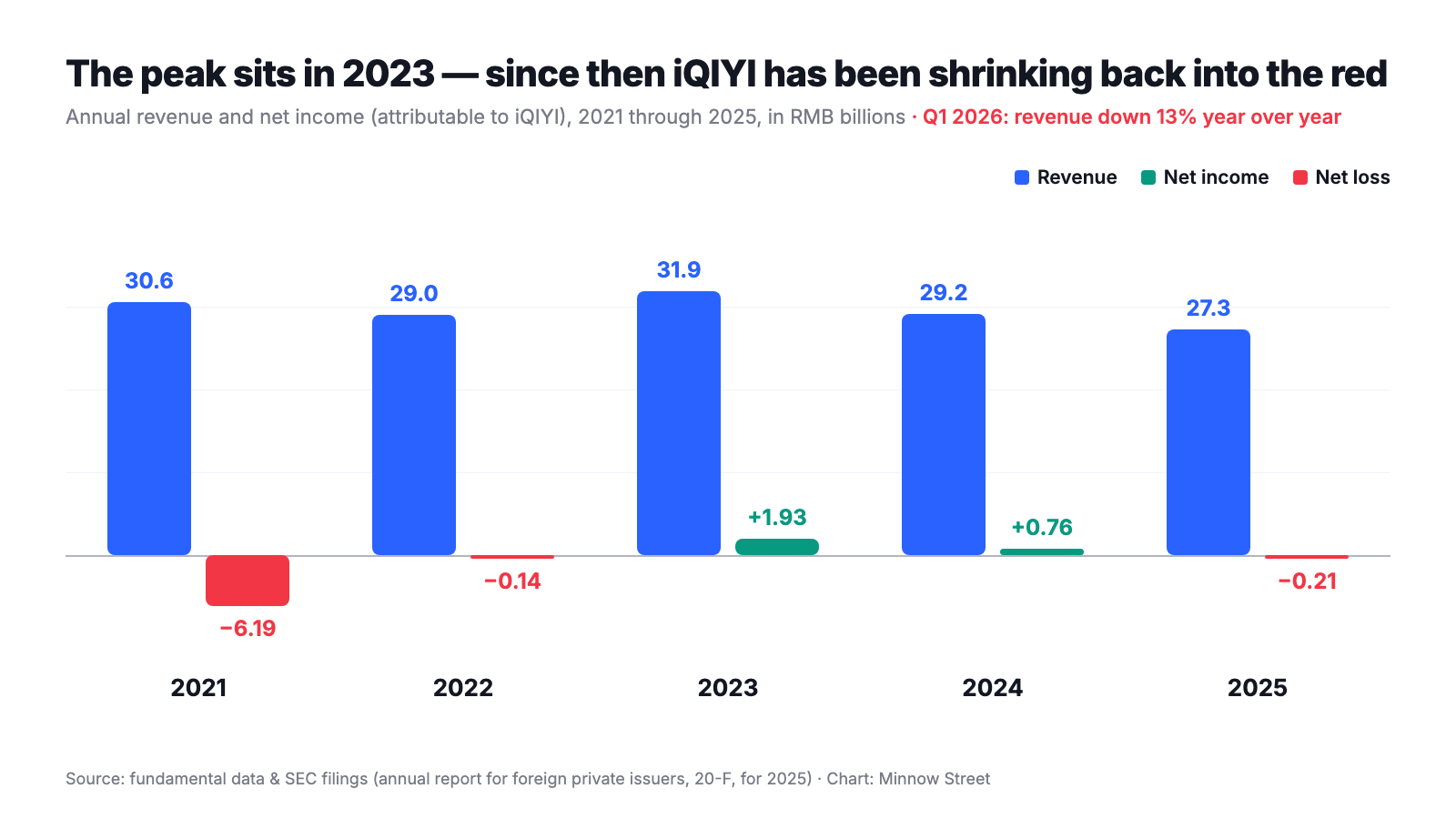
For since the 2023 peak (RMB 31.87 billion of revenue, RMB 1.93 billion of net income) it has been downstairs: revenue minus 7 percent in 2024, another minus 7 percent in 2025 to RMB 27.29 billion ($3.90 billion) — and in the first quarter of 2026 the decline accelerated to minus 13 percent (RMB 6.23 billion). All four revenue pillars shrank at once: subscriptions minus 5 percent (a lighter content slate), advertising minus 7 percent (budget cuts in a weak consumer climate), distribution minus 43 percent (fewer barter deals), other minus 49 percent. Out of RMB 341.9 million of operating profit in the prior-year quarter came an operating loss of RMB 228.4 million; the bottom line read minus RMB 294.6 million ($42.7 million). For full-year 2025, iQIYI reports a loss of RMB 206.3 million — after RMB 764.1 million of profit in 2024. And free cash flow for 2025 came to RMB 10.0 million — $1.4 million, a pinpoint landing on zero, after RMB 2.03 billion the year before. Remember this sentence: Cheap is a price. A bargain is a ratio — and a ratio always has two sides. The second side is in the filings.
What the filings say — the uncomfortable truths
Uncomfortable truth no. 1: you are not buying a share of the companies that run the business
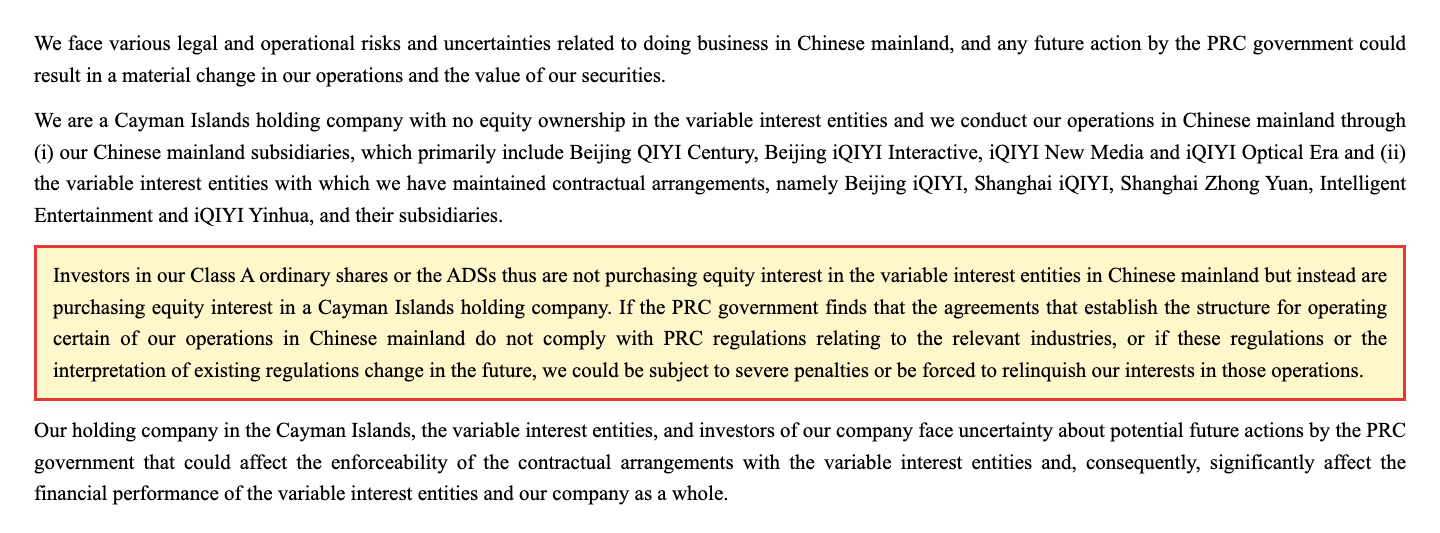
Chinese law prohibits or restricts foreign ownership of internet, video and media licenses. iQIYI solves this, like many Chinese tech groups, through a construction called VIE — variable interest entities: the license-holding companies (Beijing iQIYI, among others) belong to Chinese shareholders; the listed Cayman Islands holding merely has a bundle of private contracts with them — loan, option and service agreements — that is supposed to funnel profits and control its way. Translated: you are not buying the house, you are buying a stack of contracts with the resident who promises to pass the rent along. The annual report says it with disarming clarity:
"Investors in our Class A ordinary shares or the ADSs thus are not purchasing equity interest in the variable interest entities in Chinese mainland but instead are purchasing equity interest in a Cayman Islands holding company. If the PRC government finds that the agreements that establish the structure for operating certain of our operations in Chinese mainland do not comply with PRC regulations relating to the relevant industries, or if these regulations or the interpretation of existing regulations change in the future, we could be subject to severe penalties or be forced to relinquish our interests in those operations."
— iQIYI, Inc., SEC annual report 20-F for 2025, Item 3D "Risk Factors — Risks Related to Our Corporate Structure"
This construction has been the industry standard for two decades, it has carried Alibaba, Tencent stakes and Baidu itself, and Beijing has tolerated it so far. But tolerated is not guaranteed — and for the U.S. investor a second imponderable comes on top: under the Holding Foreign Companies Accountable Act (HFCAA), Chinese ADSs face a U.S. trading ban if the American audit watchdog PCAOB cannot inspect the auditors for two consecutive years. By its own account, iQIYI already stood on the SEC's list of affected companies in 2022; since the PCAOB gained access to inspections in China at the end of 2022, the danger has receded — as long as that access holds, as the annual report expressly qualifies. Exactly for this reason, iQIYI filed an application for a secondary listing in Hong Kong on March 30, 2026 (confidential, outcome open): a side entrance in case the New York door jams. Remember: whoever buys the shell must trust the chain — every single link.
Uncomfortable truth no. 2: a $1.7 billion hole gapes in working capital — and early 2028 gets tight
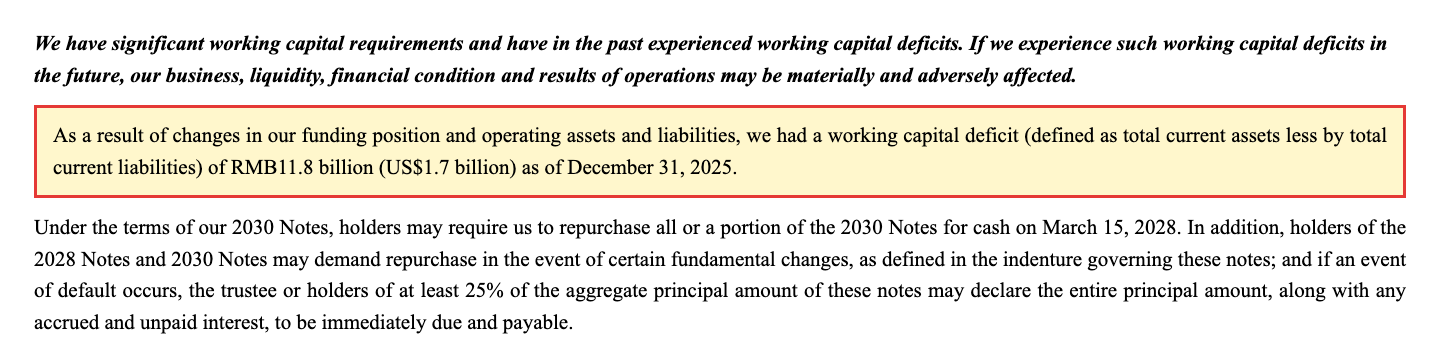
The second truth sits in the risk chapter, soberly quantified:
"As a result of changes in our funding position and operating assets and liabilities, we had a working capital deficit (defined as total current assets less by total current liabilities) of RMB11.8 billion (US$1.7 billion) as of December 31, 2025."
— iQIYI, Inc., SEC annual report 20-F for 2025, Item 3D "Risk Factors"
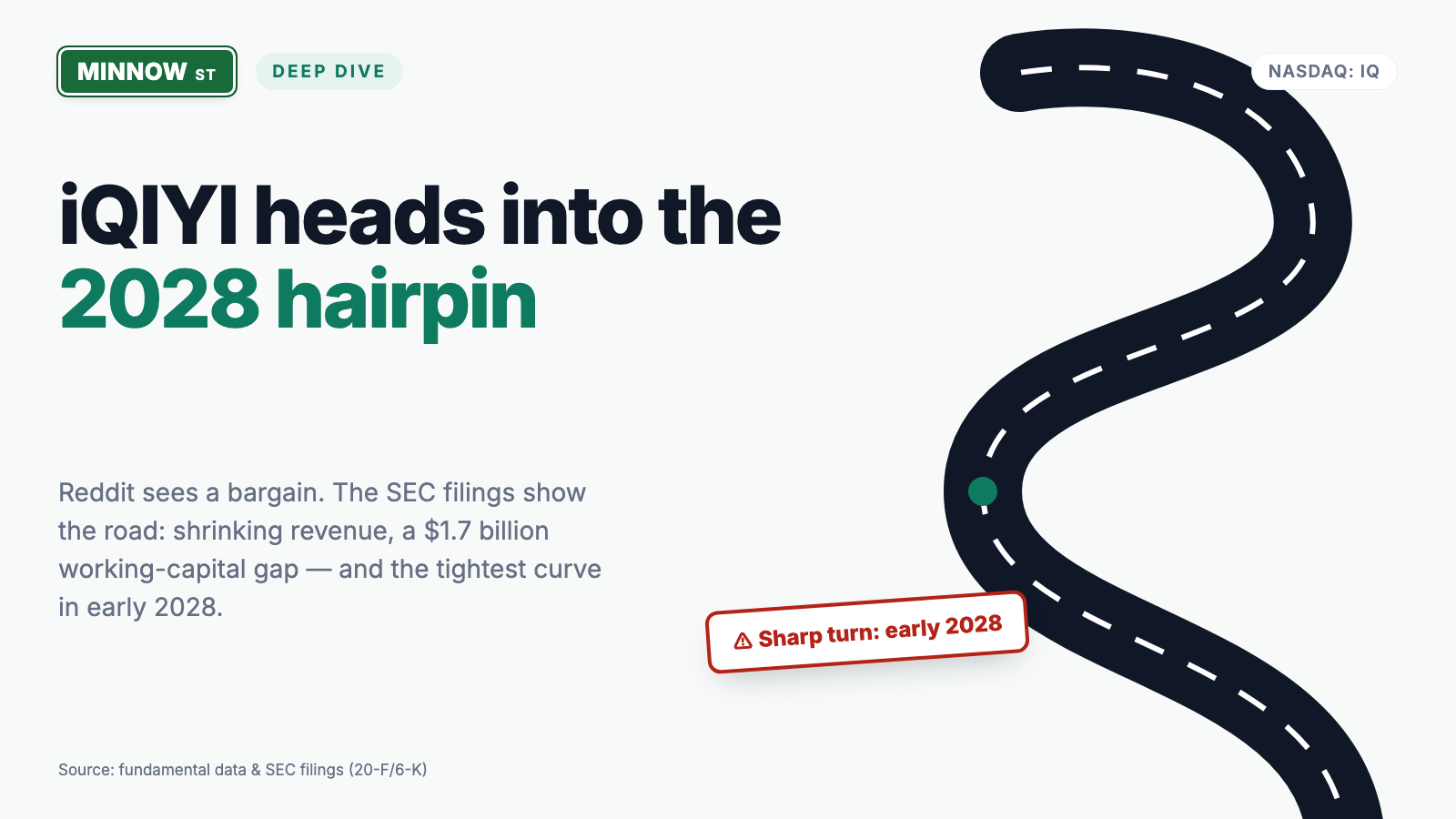
A working capital deficit, translated: everything that can come in as money within twelve months does not cover what must go out within twelve months — at iQIYI the arithmetic gap is bigger than what the whole company costs on the stock exchange. At a content group, part of that is business model (producers and licensors get paid later, subscriptions flow immediately), and the till still held RMB 3.99 billion ($578.4 million) as of March 31, 2026. But a date is sliding onto this permanent construction site: early 2028. On January 1, 2028, the PAG convertible notes mature — $522.5 million of principal, and the contract contains a clause you rarely see: a maturity premium of 30 percent on top, in addition to 6 percent of running interest. $522.5 million thus becomes $679.3 million. Ten weeks later, on March 15, 2028, the holders of the 2030 convertible notes ($350 million, 4.625 percent interest) may put their notes back for early repayment. A convertible note is a loan with a built-in right to swap into shares — but when the share price sits far below the conversion price, nobody swaps; then everybody wants to see money. In the worst case, then, roughly $1.03 billion is on the slip in early 2028:
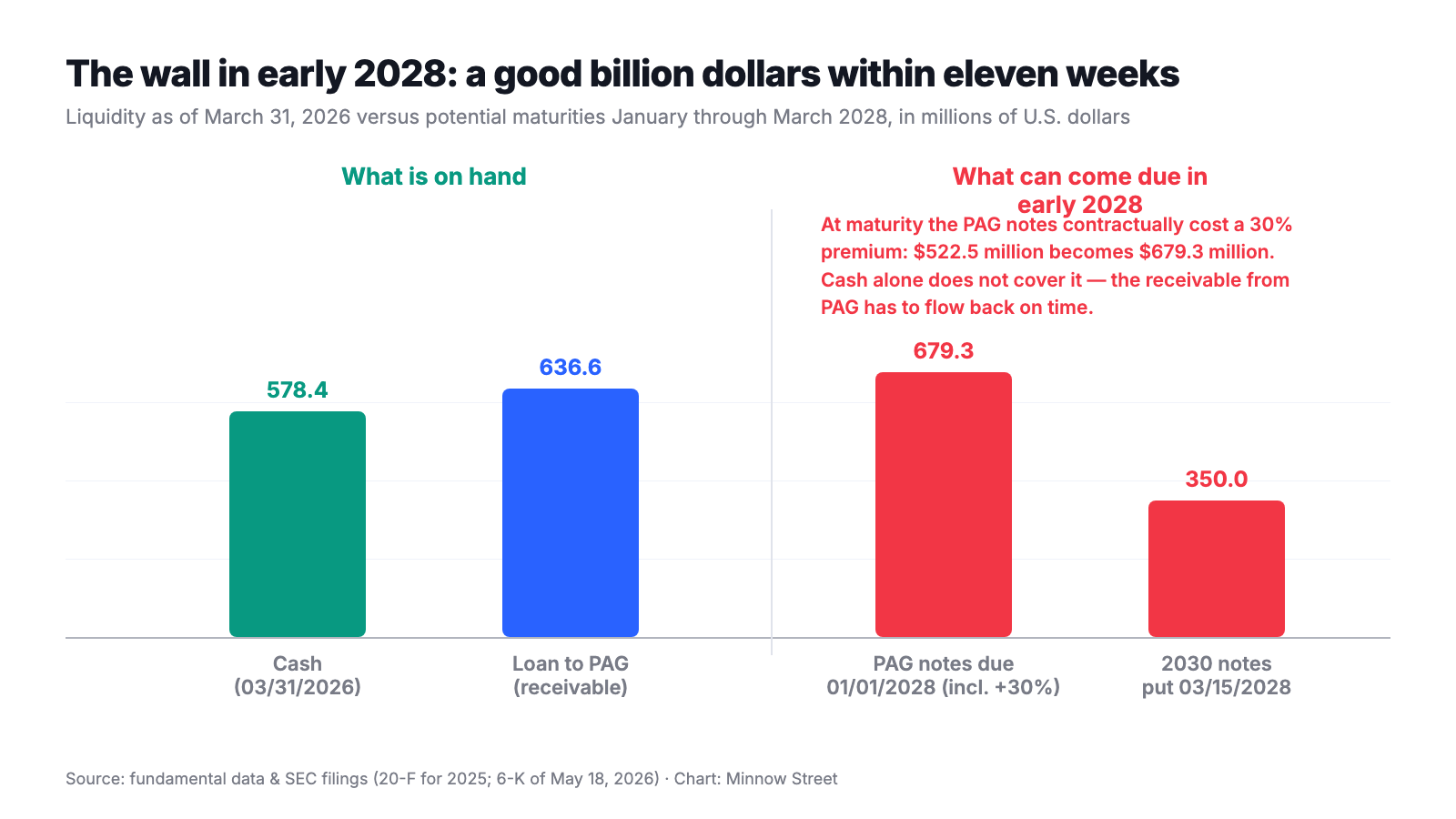
Honesty requires the context: iQIYI has already steered around such cliffs twice — the 2026 notes are paid down to $0.1 million, and of the $600 million of the 2028 series, only $0.3 million remained after buybacks and a repurchase offer in March 2026. The pattern: replace old debt with new (the 2030 notes brought in a fresh $350 million in February 2025) and negotiate with the big creditor. Which brings us to the strangest footnote of this balance sheet.
Uncomfortable truth no. 3: iQIYI has lent its own creditor $636.6 million — at worse terms than it pays itself
The investment firm PAG lent iQIYI $550 million in its hour of need in 2022/2023 — secured, at 6 percent interest and with the aforementioned 30 percent maturity premium. So far, so expensive. Then the direction reversed:
"In October 2025, iQIYI HK Limited entered into another facility agreement with PAGAC IV-4 (Cayman) Limited which provides PAG with an additional loan facility of US$114.1 million, carrying an interest rate of 4.5% per annum. In connection with this loan facility, PAG released all remaining collateral secured by our Company under the PAG Notes. As of December 31, 2025, we had a loan principal of US$636.6 million to PAG."
— iQIYI, Inc., SEC annual report 20-F for 2025, Item 5B "Liquidity and Capital Resources"
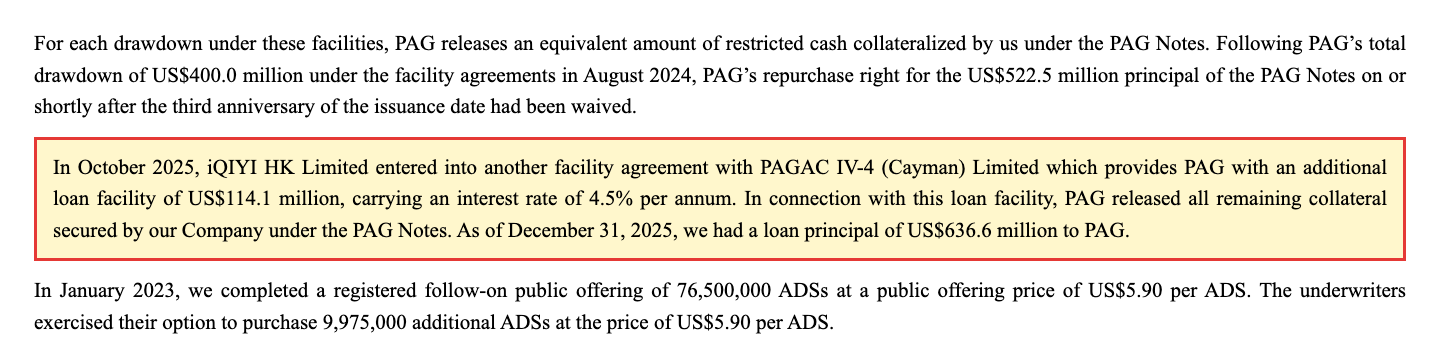
Since September 2023, then, iQIYI has been lending money back to its own noteholder — first up to $522.5 million at 6 percent, since October 2025 another $114.1 million at just 4.5 percent, together $636.6 million (as of December 31, 2025; confirmed unchanged as of March 31, 2026 by the interim reports). That is more than iQIYI itself holds in cash. What is it all for? The filings name the trade openly: with each drawdown, PAG released collateral and pledged the iQIYI notes it holds instead; after $400 million of drawdowns, PAG waived its right to put the notes back as early as their third anniversary — which would otherwise have cost cash around the turn of 2025/2026. iQIYI thus bought itself a deferral and paid for it by tying up the bulk of its liquidity as a receivable against exactly the address it must pay in early 2028. As long as both sides deliver, it is an elegant ring swap — the note is, economically, partly pre-funded. But it remains a concentration risk: would you sleep soundly if your emergency fund sat as a personal loan with the same acquaintance you owe the mortgage to in two years?
Uncomfortable truth no. 4: Baidu holds 89.1 percent of the votes — and since July 2026 supplies the CFO, too
Which leaves the question of who owns all this. Answer: practically, Baidu.
"As of February 28, 2026, Baidu held approximately 45.1% of our total issued and outstanding ordinary shares, representing 89.1% of our total voting power. Baidu has advised us that it does not anticipate disposing of its voting control in us in the near future."
— iQIYI, Inc., SEC annual report 20-F for 2025, Item 3D "Risk Factors"
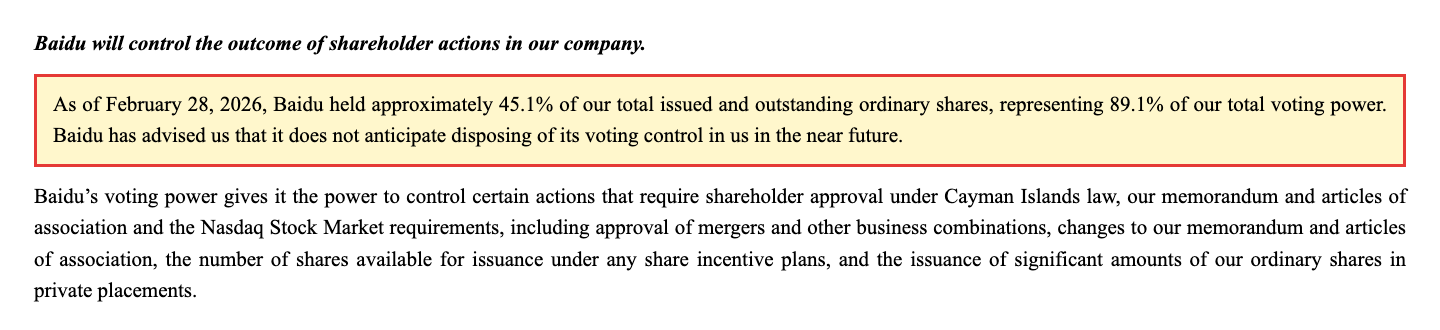
The lever behind it is Class B shares with ten votes apiece, almost all of which sit with Baidu — the same mechanics as at many tech groups, except that here it is not a founder-visionary holding the reins but another listed corporation with an agenda of its own. All ADS buyers together share the remaining 10.9 percent of voting weight. What that means in practice showed on July 2, 2026: iQIYI announced, in a mandatory filing, Ying Tian as its new chief financial officer — until June 2026 the CFO of Baidu AI Cloud; the interim CFO moved back into the second row. A corporation that controls the shareholder meeting now also staffs the treasury with one of its own. In fairness: the closeness to Baidu is an asset, too — the annual report names Baidu's AI technology as a foundation of iQIYI's own platform, and iQIYI's AI push (the video production agent Nadou Pro, in open commercial testing since March 30, 2026; AI-supported production planning that management says should cut production costs and accelerate cycles) would hardly be conceivable without the parent. Just don't confuse one thing: whoever has the votes profits from synergies. You do not have them.
Valuation: a quarter of revenue — the discount has reasons
Let's sum up the price question: about $1.09 billion of market value (as of July 15, 2026) stands against $3.90 billion of 2025 revenue — a price-to-sales ratio around 0.28. For comparison: Western streaming groups cost a multiple of their revenue. A meaningful price-to-earnings ratio does not exist — 2025 ended in a loss; on the basis of the adjusted (non-GAAP) annual profit of RMB 280.6 million ($40.1 million) the multiple would sit around 27, and that profit is currently crumbling quarter by quarter. Against the discount stand real assets: $578.4 million of cash plus the $636.6 million receivable from PAG (together more than the market value), a content library that carries billions in subscription revenue every year, the growing overseas business — and a buyback program of up to $100 million (through September 2027), of which, however, only $8.0 million had been used for about 6.5 million ADSs by May 18, 2026. On the other side of the scale: $2.11 billion of gross debt (December 31, 2025), the $1.7 billion working-capital hole, the 2028 wall, revenue in its second year of decline — and the fact that all of it sits inside a Cayman shell with VIE contracts in which 10.9 percent of residual voting weight is left for you. This is not an undiscovered bargain; it is a priced stack of risks. What you really acquire when you buy is a bet that the content cycle turns in 2026/2027, that the refinancing in early 2028 goes smoothly, and that Beijing and Washington keep tolerating the construction — three yeses for a quarter of revenue.
Opportunities and risks at a glance
What speaks for iQIYI:
- A real, large business: RMB 27.29 billion ($3.90 billion) of revenue in 2025, a leading position in Chinese long-form series (domestic viewership market leadership per the Q1 2026 report, source: Enlightent), 4,603 employees, more than a third of them in research and development (December 31, 2025).
- Operationally no cash burner: positive operating cash flow in every year since 2022 (2025: RMB 105.8 million; Q1 2026: RMB 186.4 million), $578.4 million of cash plus the $636.6 million receivable from PAG (March 31, 2026) — together more than the market value of July 15, 2026.
- Debt actively paid down: the 2026 and 2028 convertible notes bought back to residual amounts ($0.1 million and $0.3 million as of March 31, 2026), interest burden clearly lower in Q1 2026.
- Real options: an overseas business with record membership revenue (Q1 2026), the first iQIYI LAND theme park opened (February 8, 2026, two more under construction), the AI agent Nadou Pro in open commercial testing and AI-driven production cost cuts (6-K of March 30, 2026, Q1 report), a filed Hong Kong secondary listing plus a $100 million buyback program (March 30, 2026).
- Optically deep valuation: a price-to-sales ratio around 0.28 (market value about $1.09 billion, July 15, 2026) — any sustained return to the 2023 profit level (RMB 1.93 billion) would change the math drastically.
What speaks against it:
- Shrinking with gathering speed: revenue minus 7 percent in 2024, minus 7 percent in 2025, minus 13 percent in Q1 2026 — all four revenue pillars declining; RMB 1.93 billion of profit (2023) turned into a 2025 loss of RMB 206.3 million, minus RMB 294.6 million in Q1 2026.
- Balance-sheet hole and debt wall: a working capital deficit of RMB 11.8 billion ($1.7 billion, December 31, 2025), gross debt of $2.11 billion; in early 2028, roughly $1.03 billion can come due within eleven weeks (PAG notes of $522.5 million plus a 30 percent premium; the repurchase right of the 2030 notes over $350 million).
- PAG concentration risk: $636.6 million of the liquidity sits as a loan with the company's own noteholder — lent at 4.5 to 6 percent while iQIYI itself pays 6 percent plus the maturity premium; collateral was released.
- Structural risk: no equity in the operating VIE companies, only contracts; the annual report warns of "severe penalties" up to the loss of those claims, plus the HFCAA shadow (iQIYI already stood on the SEC list in 2022) — the Hong Kong listing is filed but not secured.
- Governance: Baidu controls 89.1 percent of the votes on 45.1 percent of the shares (February 28, 2026), and since July 2026 the CFO also comes straight from Baidu; free ADS buyers are left with 10.9 percent of the voting weight — and revenue contains shifting portions of cashless barter deals (2024: RMB 901.6 million) that optically distort growth rates.
A human conclusion
Back to the bargain table from the beginning. The anchoring effect does not lie about the price — iQIYI is cheap, measured against almost anything: against revenue, against its own history, against Western peers. It lies about the question that comes next: what exactly is in the box? At iQIYI, the box holds a real business with billions in revenue and a break-even till — wrapped in a Cayman shell with no equity in the operating companies, weighed down by a $1.7 billion hole in working capital, a debt wall in early 2028 complete with a 30 percent premium, and a majority owner who holds 89.1 percent of the votes and, lately, the CFO's office. The 9 Reddit mentions of July 15, 2026 will turn all of that into a simpler story; simple stories are the core business of forums and streaming services alike. Your task is the less comfortable one: cut the anchor and check the ratio — price and contents, both sides. If the content cycle turns, Hong Kong works out and the 2028 wall is refinanced cleanly, the bargain table really was a bargain. If not, the price tag of 2023 was just the first number that blinded you. Check the box before you believe the price tag. What you make of it is your decision. And that is exactly as it should be.
Sources
All original documents used in this analysis — to read for yourself. Note: iQIYI is registered as a "foreign private issuer" and therefore files the annual report for foreign private issuers (20-F) and interim reports (6-K) instead of the U.S. forms 10-K/10-Q:
- iQIYI, Inc. — SEC annual report 20-F for 2025 (filed March 16, 2026)
- iQIYI, Inc. — SEC annual report 20-F for 2024 (filed March 27, 2025)
- iQIYI, Inc. — SEC interim report 6-K of February 26, 2026: fourth-quarter and fiscal-year 2025 results (Exhibit 99.1)
- iQIYI, Inc. — SEC interim report 6-K of March 30, 2026: Hong Kong listing, buyback program, AI agent Nadou Pro (Exhibit 99.1)
- iQIYI, Inc. — SEC interim report 6-K of May 18, 2026: first-quarter 2026 results (Exhibit 99.1)
- iQIYI, Inc. — SEC interim report 6-K of July 2, 2026: change of chief financial officer (Exhibit 99.1)
- iQIYI's complete SEC filing history: EDGAR overview (sec.gov)
- Reddit mentions: in-house Reddit hype scanner based on ApeWisdom data (9 mentions in 24 hours, as of July 15, 2026); market value about $1.09 billion as of the same date.
- Fundamental data (metrics, valuation; data as of July 15, 2026), reconciled with the SEC filings.
Transparency & disclaimer: This analysis is a journalistic contextualization of publicly available information and is not investment advice, not a financial analysis in the regulatory sense, and not a solicitation to buy or sell securities. Stock investments — especially in foreign depositary shares with a VIE structure — carry substantial risks up to total loss. All information without guarantee; the data cut-off is noted in the text in each case. RMB/USD conversions follow the period-end rates stated in the respective filings. The author holds no position in iQIYI securities at the time of publication.
Our Bottom Line at a Glance
- Business model & market position neutral
- China's streaming pioneer with $3.90 billion of 2025 revenue, a leading position in long-form series (domestic viewership market leadership per the Q1 2026 report) and genuine side options: a growing overseas business, theme parks (iQIYI LAND since February 8, 2026), AI video production (Nadou Pro) — but the core business is shrinking for the second year.
- Trajectory of the numbers negative
- Revenue down 7 percent in both 2024 and 2025, down 13 percent in Q1 2026 — all four revenue pillars declining; RMB 1.93 billion of net income (2023) became a 2025 loss of RMB 206.3 million and minus RMB 294.6 million in Q1 2026; 2025 free cash flow just RMB 10.0 million (annual and interim reports).
- Cash, debt & the 2028 wall negative
- A working capital deficit of RMB 11.8 billion ($1.7 billion) as of December 31, 2025, gross debt of $2.11 billion; in early 2028, roughly $1.03 billion can come due within eleven weeks (PAG notes incl. the 30 percent premium, put of the 2030 notes) — against $578.4 million of cash, with $636.6 million tied up as a loan to creditor PAG (March 31, 2026).
- Legal structure (VIE, HFCAA) negative
- Per the annual report, buyers expressly acquire no equity in the operating VIE companies, only in a Cayman holding with contractual claims; regulatory shifts threaten "severe penalties" up to the loss of those claims. Add the HFCAA shadow (already on the SEC list in 2022); the filed Hong Kong secondary listing (March 30, 2026) is insurance, but not secured.
- Ownership & governance negative
- Baidu holds 45.1 percent of the shares but 89.1 percent of the votes (February 28, 2026) and, since July 2, 2026, also supplies the CFO in Ying Tian (previously CFO of Baidu AI Cloud); free ADS buyers hold 10.9 percent of the voting weight combined. The PAG entanglement ($636.6 million lent to the company's own creditor, collateral released) is an additional concentration risk.
- Capital measures & momentum positive
- Positive operating cash flow in every year since 2022, the 2026 and 2028 notes almost fully retired (residual $0.1 million and $0.3 million as of March 31, 2026), a buyback program of up to $100 million and record overseas membership revenue (Q1 2026) — the company acts instead of merely hoping.
iQIYI is no empty box: billions in revenue, market leadership in Chinese long-form series, positive operating cash flow and real options from Southeast Asia to the theme park. But the bargain-table price of about $1.09 billion (July 15, 2026) buys a Cayman shell with no equity in the operating companies, a $1.7 billion working-capital deficit, a debt wall in early 2028 with a contractual 30 percent premium, and a majority owner holding 89.1 percent of the votes. Cheap the stock undeniably is — a bargain only if the content cycle, the refinancing and two governments all cooperate at once. Not investment advice.
What Our Rating Means
- If you don't own the stock
- As long as the question raised in the bottom line stays open, we see no basis for an entry.
- If you hold it in your portfolio
- Our findings offer no acute reason to sell — the checkpoints named remain decisive.
A journalistic assessment by our editorial team at the time of the deep dive, based on public sources — not investment advice and not a solicitation to buy or sell. Your personal circumstances (investment goals, risk capacity, taxes) cannot be taken into account. What our categories mean, how verdicts are formed, and what conflicts of interest exist →
Worth Noting
- IQ landed on our research list through our Reddit hype scanner (ApeWisdom data): 9 mentions in 24 hours as of July 15, 2026. Forum mentions are sentiment signals, not quality signals. Our fundamental scanners (Russell 3000 universe) do not cover the Chinese ADR by design.
- iQIYI is registered as a foreign private issuer and files Forms 20-F (annual report, filed for 2025 on March 16, 2026) and 6-K (interim reports) instead of 10-K/10-Q; quarterly figures are unaudited attachments to 6-K filings.
- The market value figure is dated July 15, 2026 (about $1.09 billion); analyses are evergreen, daily prices are not a buy argument. RMB amounts follow the period-end rates stated in the filings (12/31/2025: 6.9931; 03/31/2026: 6.8980 RMB per USD).
Frequently Asked Questions
iQIYI (NASDAQ: IQ) of Beijing is China's streaming pioneer: the platform produces and licenses long-form series, films and shows and earns from subscriptions (2025: RMB 16.81 billion, about 62 percent of revenue), advertising, reselling broadcasting rights, plus games, a talent agency and the iQIYI LAND theme park opened in February 2026. Total 2025 revenue: RMB 27.29 billion ($3.90 billion), down 7 percent.
Effectively yes: as of February 28, 2026, Baidu held about 45.1 percent of the shares but, thanks to Class B shares with ten votes each, 89.1 percent of the voting power — and per the annual report does not intend to give up control. Since July 2, 2026, the CFO, Ying Tian, also comes straight from Baidu AI Cloud. All free ADS buyers together are left with 10.9 percent of the votes.
An American depositary share (ADS) representing seven Class A shares of iQIYI, Inc. — a holding company in the Cayman Islands. The license-restricted China business sits in variable interest entities (VIEs) in which the holding owns no equity, only contracts. The 20-F for 2025 itself warns: if Beijing strikes down the structure, severe penalties threaten, up to the loss of the claims to those parts of the business.
On the edge: iQIYI earned RMB 1.93 billion net in 2023 and RMB 764.1 million in 2024; 2025 ended with a loss of RMB 206.3 million ($29.5 million), and the first quarter of 2026 with minus RMB 294.6 million. Operating cash flow stayed positive throughout (2025: RMB 105.8 million; Q1 2026: RMB 186.4 million), and 2025 free cash flow landed at RMB 10.0 million — right on the zero line.
Roughly $1.03 billion can come due within eleven weeks: on January 1, 2028, the PAG convertible notes must be repaid — $522.5 million of principal plus a contractual 30 percent premium, $679.3 million in total — and from March 15, 2028, holders of the 2030 notes may put their $350 million back for early repayment. Against that stood, as of March 31, 2026, about $578.4 million of cash and a $636.6 million receivable from PAG.
As a trade: the investment firm PAG lent iQIYI $550 million in 2022/2023 (6 percent interest plus a 30 percent maturity premium). Since September 2023, iQIYI has been lending money back to PAG through loan facilities — $636.6 million in total as of December 31, 2025, at 4.5 to 6 percent. In return, PAG released collateral and waived its right to put the notes back as early as their third anniversary. iQIYI bought itself time but tied a large part of its liquidity to its own creditor.
On March 30, 2026, iQIYI confidentially filed for a secondary listing on the Hong Kong Stock Exchange. It is meant to broaden access to Asian capital — and doubles as insurance against the U.S. delisting risk from the Holding Foreign Companies Accountable Act, on whose SEC list iQIYI already stood once in 2022. Approvals from the exchange and China's CSRC are pending; whether and when the listing happens is open.
iQIYI uses AI in production and in the product: its own AI agent Nadou Pro for professional long-form video production has been in open commercial testing since March 30, 2026, tools like iQuickReel automatically build short-video collections out of series, and the assistant Taodou answers questions about content. Management's stated goal is to cut production costs and accelerate production cycles with AI (Q1 2026 report); the filings do not yet show a separate AI revenue line.
Found an error?
Did you spot a factual error, an outdated number, or a typo in this deep dive? Let us know briefly — your report goes straight to the editorial team.