Ivanhoe Electric: The Market Has Already Paid for the Copper Mine — It Has Not Been Built Yet
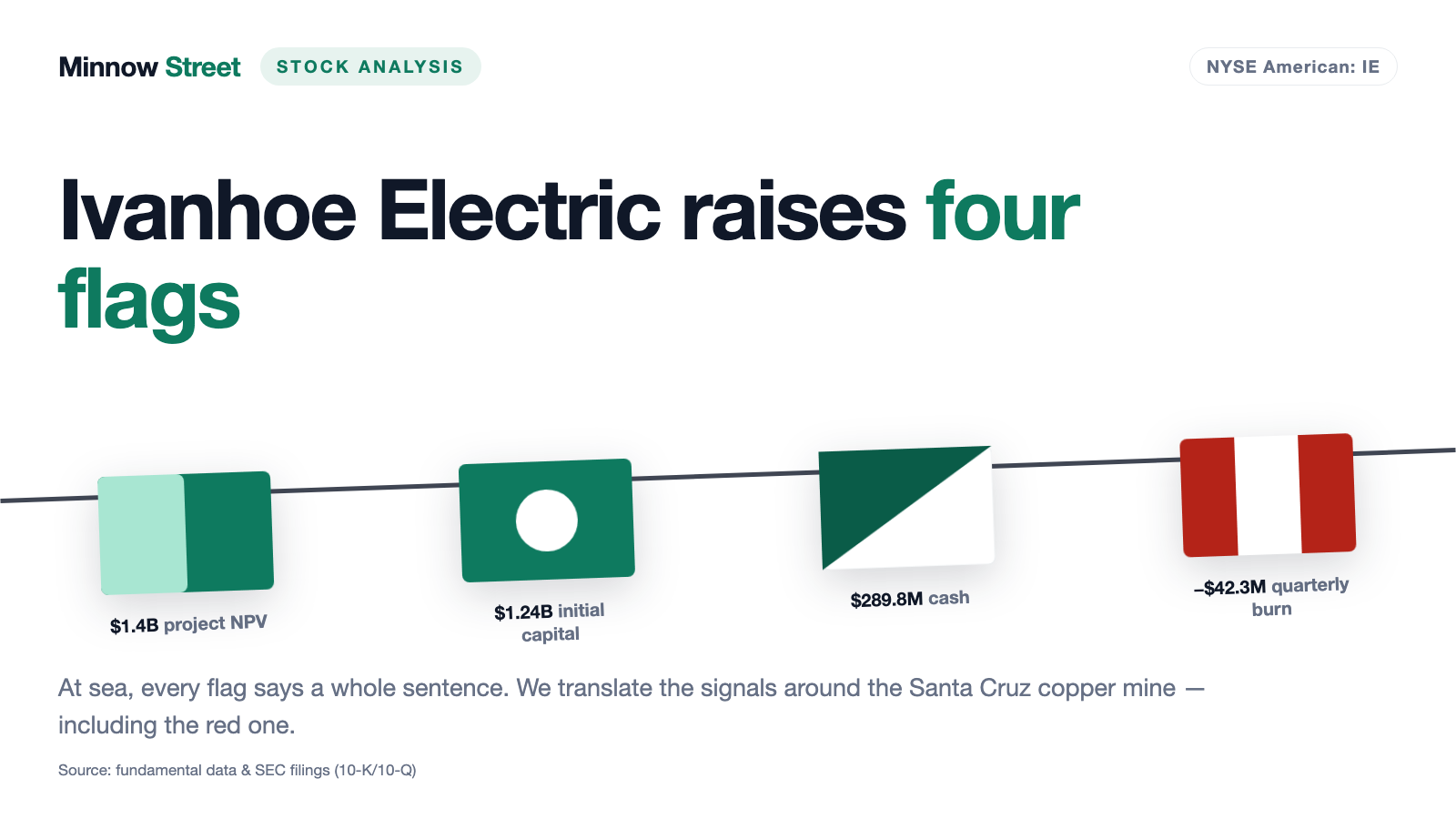
Ivanhoe Electric calculated an after-tax net present value of $1.4 billion for its Santa Cruz copper project in Arizona — and the market already pays roughly $1.5 billion for the company (data as of July 31, 2026). One problem: the mine does not exist. It requires $1.24 billion of initial capital, and the balance sheet showed exactly $289.8 million of cash on March 31, 2026. The only profit in company history came from selling a project, not from copper — and of that $81.4 million, $39.6 million never belonged to Ivanhoe Electric shareholders at all. We read the filings line by line: reserves, cash runway, dilution, fine print. Not investment advice — just the arithmetic that sits between the treasure map and the metal.
 Thomas Mücke
Founder & Publisher
Thomas Mücke
Founder & Publisher
Chart
Interactive price chart (TradingView).
Note: pure fact-based analysis, not investment advice and not a solicitation to buy or sell. All figures without guarantee.
There is an investor trap that springs precisely when you feel most diligent: the treasure map trap. It works like this. Someone lays a map on your table with a cross marked on it, and next to the cross sits a number — not "there is gold somewhere" but "$1.4 billion, discounted at 8 percent." The number has been reviewed, it comes from independent qualified persons, it sits in a filing with the U.S. securities regulator, the SEC. And because it is so precise, your mind quietly takes a step nobody authorized: it books the treasure as if it were already in the bank. What it edits out is the distance in between — the route, the ship, the crew, the money for the equipment.
Ivanhoe Electric (NYSE American: IE) of Tempe, Arizona is exactly that map. The company explores for and develops copper; its sole material project is the Santa Cruz copper mine south of Phoenix, and since June 23, 2025 that project has carried a preliminary feasibility study showing an after-tax net present value of $1.4 billion. The market values the company at roughly $1.5 billion (data as of July 31, 2026). Put differently: the treasure has already been paid for. It just has not been dug up. So let us make a deal. Before you set out on the map, we read together what Ivanhoe Electric itself filed with the SEC — the annual report (Form 10-K) for 2025 filed February 23, 2026, the quarterly report (Form 10-Q) as of March 31, 2026 filed May 7, 2026, and the five current reports (Form 8-K) submitted since. An SEC filing is honest under penalty of law. And this one describes a mine that needs $1.24 billion of initial capital, $289.8 million of cash on hand, a first profit that came from a sale — and 12.5 million new shares in a single quarter. What you make of it is up to you.
What Ivanhoe Electric actually does — four segments, one project
Ivanhoe Electric is a pre-production explorer. In everyday terms: it is a developer that has bought the land, surveyed it and has a finished set of plans in the drawer — but has not laid a stone and has no tenant. Incorporated in Delaware in July 2020, publicly traded since June 28, 2022, headquartered in Tempe, Arizona, with 286 full-time employees as of December 31, 2025. The Executive Chairman is Robert Friedland, a legend in the resource industry: he founded Ivanhoe Mines, which today operates one of the largest copper mines in the world in the Democratic Republic of the Congo. That history is part of the stock’s appeal — and it is not evidence that lightning strikes twice.
The company reports in four segments. First, the Santa Cruz Copper Project in Arizona — roughly 26 square kilometers of private land with associated water rights, rail, interstate and transmission access, carrying segment assets of $188.7 million as of March 31, 2026. Second, critical metals: the remaining exploration portfolio, plus a 50/50 joint venture with Saudi Arabian Mining Company (Maaden) covering roughly 50,000 square kilometers and an exploration alliance with BHP in Arizona, New Mexico and Utah (segment assets $347.4 million). Third, data processing: the 94.3 percent owned Computational Geosciences Inc. (CGI), which processes geophysical data and sells artificial intelligence tools to do it. And fourth, energy storage: the VRB Energy stake, which builds vanadium redox flow batteries.
Now comes the sentence that orders the whole picture — and with it the central tension of this analysis, which runs through every chapter: all of the company’s revenue comes from its smallest segment. In the first quarter of 2026 Ivanhoe Electric booked $858 thousand of revenue — $858 thousand from data processing and zero from mining. The segment that carries the company’s name has not earned a cent so far. Buying this stock is therefore not buying a business; it is buying a set of plans plus a bet that the construction money will come together. We have seen the same shape before in another resource company whose internally produced billion-dollar valuation carried the market story while revenue came from an entirely different business — see our analysis of Ramaco Resources.
How the stock reached our desk
Not through a price scanner, but through the routine review of new SEC filings. Between May 11 and July 10, 2026 Ivanhoe Electric filed five current reports (Form 8-K) and one conflict minerals report (Form SD) — busy paperwork for a company with no production. Those filings contained, among other things, the purchase agreement for a tunnel boring machine at $64,710,043 (May 28, 2026), the results of the annual meeting held June 4, 2026, and an amended and restated shareholders agreement with Maaden dated July 7, 2026. That is the hook: a company that mines nothing signs an eight-figure order for a machine. What sits behind it?
Before we open the filings, three figures from our in-house stock scanner, translated and judged (data as of July 31, 2026). First: a price-to-sales ratio of roughly 440. That is not a valuation, it is a warning sign — it merely says there is almost no revenue to measure the price against. Second: a price-to-book ratio of roughly 2.7, calculated from a book value of $3.41 per share ($540.3 million of equity attributable to common stockholders across 158.3 million shares as of March 31, 2026) against the closing price of July 30, 2026. In plain terms: for every dollar of carried equity you pay $2.70, and the premium is the price of the plans. Third: no price-to-earnings ratio, because there have been no earnings. Note this early: with this stock no conventional ratio measures anything useful. You have to read the filings.
The numbers over the years — given their due
Start with what genuinely impresses, because there is something. The balance sheet is exceptionally clean. As of March 31, 2026 total assets of $594.3 million stand against only $48.6 million of liabilities — an equity ratio of roughly 92 percent. Cash amounts to $289.8 million plus $2.0 million restricted; over the quarter the balance nearly doubled from $173.3 million at December 31, 2025. Interest-bearing debt is almost absent: $34.5 million from a convertible bond at subsidiary VRB Energy, and nothing else. Exploration properties are carried at $212.0 million. For an explorer that sells nothing, that is a remarkably stable starting position.
Cost discipline has improved as well: exploration expenses fell from $130.9 million (2024) to $63.3 million (2025), general and administrative expenses from $44.7 million to $39.2 million. Operating cash outflow halved from $162.1 million to $89.2 million. The company has wound down the search phase and concentrated on Santa Cruz — exactly what you want from an explorer that has found its project.
And now the chart that puts everything in proportion:
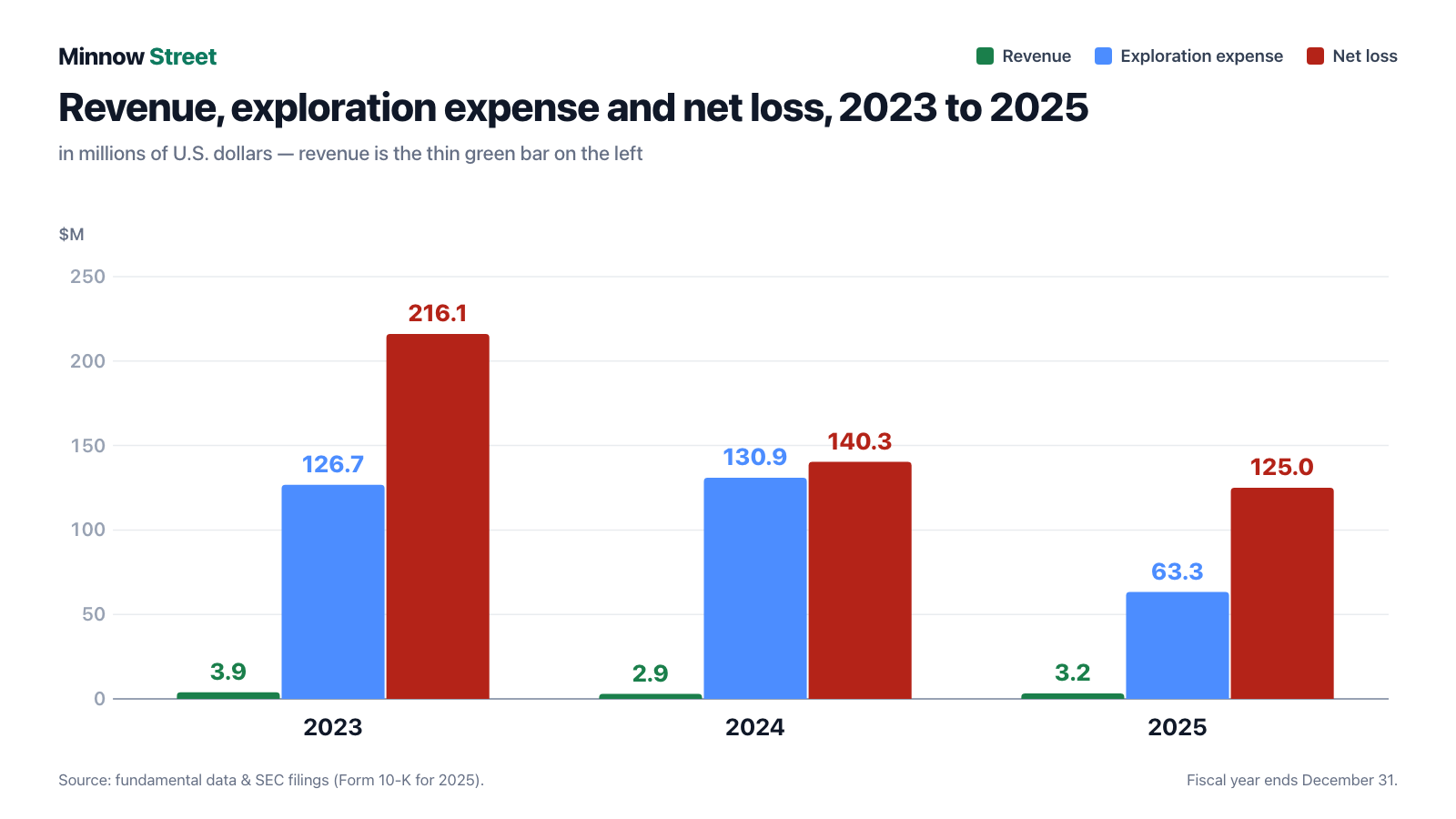
That chart is the most honest summary of the business. Revenue is not small — it is essentially absent. And the filing says so without decoration:
"We do not generate adequate cash from operations to cover our operating expenses and therefore rely on our financing activities to provide the cash resources to fund our operating and investing activities."
— Ivanhoe Electric Inc., Form 10-Q as of March 31, 2026, "Cash Flows"
That is not a distress signal; it is the normal condition of an explorer. What matters is that you know it: the money for the business does not come from the business. It comes from the capital market. Which brings us to the uncomfortable truths.
What the filings say — the uncomfortable truths
Uncomfortable truth no. 1: The first profit in company history came from a sale — and half of it belongs to others
In the first quarter of 2026 Ivanhoe Electric reported net income for the first time: $81.4 million. Read only the headline and it looks like a turning point. The income statement explains it in a single line: the result contains a gain on divestment of $124.7 million from the sale of the Colombian Alacran project by majority-owned subsidiary Cordoba Minerals. Without that item the quarter would have looked like every other one: a loss. Because operating activities consumed $42.3 million of cash in the same quarter (prior-year quarter: $25.5 million), while exploration expense rose from $15.8 million to $23.2 million.
And there is another layer. Of the $81.4 million of income, $39.6 million was attributable to non-controlling interests — Ivanhoe Electric shareholders were left with $41.7 million. The cash flow statement is blunter still: Cordoba paid $12.2 million of income taxes and distributed $40.1 million in cash to its non-controlling shareholders. In everyday terms: you and a partner sell a plot of land together, the closing agent wires the full amount to your account, and the next day nearly half of it goes to the partner and the tax authority. Your statement looked wonderful for exactly one day. Remember the pattern: a gain on a sale is substance changing hands, not income being created.
Uncomfortable truth no. 2: The mine costs $1.24 billion — roughly $490 million is covered
This is the heart of the story. The preliminary feasibility study dated June 23, 2025 sets out what Santa Cruz should deliver and what it costs. The annual report summarizes it in one paragraph:
"The PFS projects that the Santa Cruz Copper Project may produce 1.4 million tonnes of copper cathode over a 23-year mine life. With a base case copper price of $4.25/lb, the Santa Cruz Copper Project has an estimated after-tax net present value of $1.4 billion at an 8% discount rate and an estimated internal rate of return of 20%. The initial project capital estimated in the PFS is $1.24 billion."
— Ivanhoe Electric Inc., Form 10-K for 2025, Item 2 "Properties"

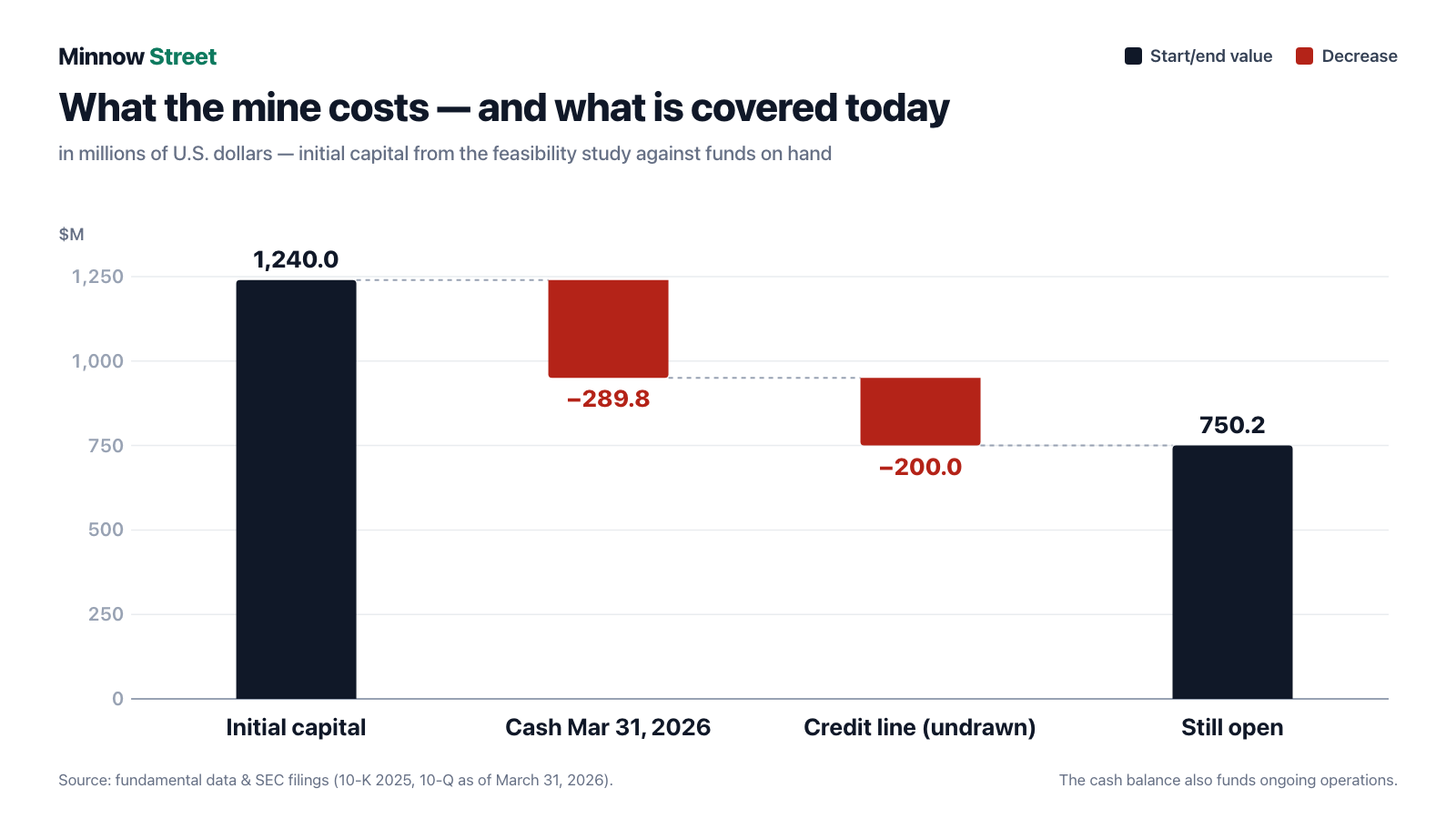
Now the counter-calculation. Against $1.24 billion of initial capital stood, as of March 31, 2026: cash of $289.8 million and a senior secured credit facility of $200.0 million, closed in December 2025 and undrawn at that date. Together roughly $490 million — and the cash must also carry the ongoing business, which consumes $42.3 million per quarter.
"But there is the Export-Import Bank," someone will object. True — on April 15, 2025 Ivanhoe Electric received a letter of interest from the Export-Import Bank of the United States (EXIM) outlining potential debt financing of up to $825 million with a 15-year repayment tenor. A letter of interest, however, is not a loan agreement, and the quarterly report says so with a bluntness you rarely read:
"Any final lending commitment will be dependent on meeting EXIM Bank's underwriting criteria, authorization process, and finalization and satisfaction of terms and conditions. … The construction of the Santa Cruz Copper Project will require additional capital beyond the amount that EXIM Bank may make available."
— Ivanhoe Electric Inc., Form 10-Q as of March 31, 2026, MD&A "Liquidity and Capital Resources"

The study also carries a second number that is rarely quoted: over the full life of the mine, capital costs total $2.36 billion — $1.24 billion of initial capital plus $1.28 billion of sustaining capital from 2029 onward. The $1.4 billion net present value is the figure after deducting all of that; the math is correct. But it describes a state of the world that begins in 2028, not today.
That Ivanhoe Electric is serious shows in the purchase agreement of May 28, 2026: subsidiary Mesa Cobre ordered a tunnel boring machine from The Robbins Company for $64,710,043 — 20 percent on signing, the rest in milestone payments tied to shipping (32.5 percent), delivery to the project site (20 percent) and assembly and commissioning (27.5 percent), with transportation reimbursed at cost plus 10 percent and tariffs on top. That is a bold forward commitment — and simultaneously roughly 22 percent of the cash balance for a single machine.
Uncomfortable truth no. 3: The reserve is "probable," not "proven" — and the valuation rests on a copper price
Mining uses two grades of certainty for ore that you have to keep apart. Proven reserves are the highest level of confidence; probable reserves sit one step below. As of December 31, 2025 Ivanhoe Electric reports for Santa Cruz and East Ridge combined 136.2 million tonnes of ore at 1.08 percent total copper, equal to roughly 1.47 million tonnes of contained copper — all of it classified as probable, not a single tonne as proven. For a project before construction that is not unusual and not an accusation. It simply means the tonnage underpinning the valuation carries the second level of confidence, not the first.
Then there is price. The $1.4 billion net present value rests on a base case copper price of $4.25 per pound; the reserve estimate itself uses $4.00. In everyday terms, this is the appraisal effect in a house sale. The appraiser writes down a value, but it only holds if the market on the day of sale looks like the market on the day of the appraisal. If copper falls durably below the assumption, the net present value falls disproportionately — and vice versa. The annual report adds a warning about the best-known disease of mine construction: capital cost estimates at mines under development may increase as construction progresses. Remember the sentence: a feasibility study is an estimate with a date, not a calculation with a result.
Uncomfortable truth no. 4: 12.5 million new shares in one quarter — and 700 million are authorized
Now to the point that hits every shareholder directly: dilution. The word sounds technical, the principle is simple — when a company issues new shares, your slice of the pie gets smaller even if you do nothing. At Ivanhoe Electric this has moved fast. At December 31, 2025, 145.5 million shares were outstanding; at March 31, 2026 it was 158.0 million, and the cover page of the quarterly report shows exactly 158,291,593 as of May 7, 2026. That is roughly 8.8 percent more shares in a little over four months.
The reason is pleasant and unpleasant at once: in January and February 2026 all 11.6 million outstanding warrants exercisable at $7.00 were exercised, bringing $81.5 million into the treasury. Pleasant, because the money arrived without a new placement. Unpleasant, because the shares came into existence all the same — and because the pattern is not new: in the first quarter of 2025 the company placed 11,794,872 units at $5.85 for net proceeds of $65.6 million. Year over year the weighted-average share count rose from 126.7 million to 152.2 million, more than 20 percent in twelve months. The balance sheet shows 700 million shares authorized — so the room for further issuance is large, and the funding gap from truth no. 2 has to be filled from somewhere.
Uncomfortable truth no. 5: Two numbers in the fine print — $34.5 million due, $225 million as a floor
Two details from the notes that no press release has ever mentioned. First: subsidiary VRB Energy issued a convertible bond in 2021 for $24.0 million at 8 percent interest with a five-year term. By March 31, 2026 principal and interest had grown to $34.5 million, reported as a current liability. The filing spells out the condition:
"If no equity financing or sale event occurs or other agreed restructuring of the convertible bond with its holder occurs, VRB Energy must repay the outstanding principal and interest on maturity in July 2026."
— Ivanhoe Electric Inc., Form 10-Q as of March 31, 2026, MD&A "Convertible bond"
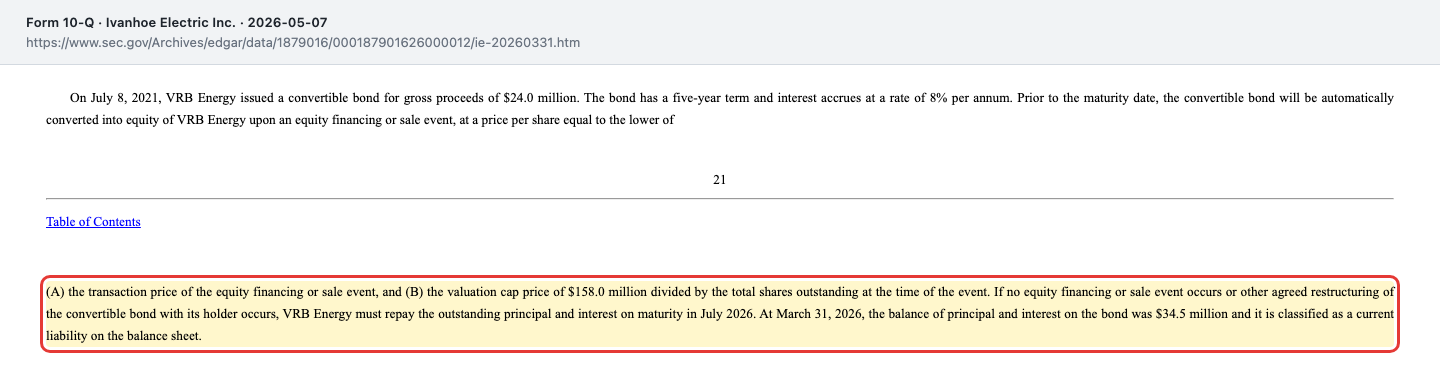
$34.5 million equals roughly 71 percent of all consolidated liabilities. Through the most recent filing before the data cutoff for this analysis — the conflict minerals report (Form SD) dated July 10, 2026 — Ivanhoe Electric has published no current report confirming repayment, conversion or extension. The next quarterly report will show it.
Second: the $200 million credit facility does not come free. Ivanhoe Electric guarantees the payment obligations of subsidiary Mesa Cobre and in doing so commits to a hard floor:
"Ivanhoe Electric guaranteed Mesa Cobre's payment obligations pursuant to a guaranty agreement whereby Ivanhoe Electric agrees to maintain at all times a tangible net worth of not less than $225.0 million."
— Ivanhoe Electric Inc., Form 10-Q as of March 31, 2026, MD&A "Bridge Facility – Mesa Cobre"

Today the distance is comfortable — equity attributable to common stockholders stood at $540.3 million as of March 31, 2026. But every loss-making quarter eats into the cushion, and once drawn the facility bears interest at the Secured Overnight Financing Rate plus 5.0 percentage points, with that margin stepping up by half a point after 6, 12 and 18 months. Remember the image: the credit facility is a life ring that gets heavier over time.
Valuation: the net present value is paid before the first stone is laid
How expensive is the stock? Conventional multiples do not help: there is no price-to-earnings ratio (the only profit was a gain on a sale), and a price-to-sales ratio of roughly 440 is not a metric but a signal that revenue is missing. Two anchors remain, both dated.
First, book value: $540.3 million of equity attributable to common stockholders across 158.3 million shares equals $3.41 per share (March 31, 2026). Measured against the closing price of July 30, 2026, the market pays roughly 2.7 times book. Second — and this is the more telling comparison — the project net present value: the market values Ivanhoe Electric at roughly $1.48 billion (data as of July 31, 2026), while the feasibility study puts the after-tax net present value of the sole material project at $1.376 billion. The market therefore already pays roughly 108 percent of what the project is supposed to be worth if everything goes right — implicitly treating every other asset (the Maaden joint venture, the BHP alliance, CGI, VRB, the remaining exploration projects) as a free option, while pricing the financing, construction and permitting risk at zero.
You do not have to read that as overpriced — you only have to know what you are buying. At this price you do not make money because Santa Cruz goes to plan. You make money only if more comes out than planned: higher copper prices, larger reserves, a second discovery in Saudi Arabia, a takeover bid. The plan itself is already in the price. We saw the same mechanism in a technology company whose purchase price consisted mostly of goodwill — the future was paid for before it happened, as described in our analysis of Corvex.
One word on cash runway: $289.8 million divided by $42.3 million of quarterly outflow gives arithmetically just under seven quarters — for operations only, without a single dollar of construction spending. Once construction starts, that calculation no longer applies.
Opportunities and risks at a glance
What speaks for Ivanhoe Electric:
- An exceptionally clean balance sheet for an explorer: $594.3 million of total assets against only $48.6 million of liabilities (March 31, 2026), an equity ratio of roughly 92 percent, and no going-concern language in the financial statements.
- A project with solid parameters in one of the safest mining jurisdictions in the world: 136.2 million tonnes of probable reserves at 1.08 percent copper on private land in Arizona, with water rights and rail, interstate and transmission access; after-tax net present value of $1.4 billion, a 20 percent internal rate of return and a 4.4-year payback (study dated June 23, 2025).
- Strong partners rather than a solo effort: a 50/50 joint venture with Saudi Arabian Mining Company (Maaden) covering roughly 50,000 square kilometers (amended and restated shareholders agreement dated July 7, 2026), an exploration alliance with BHP across three U.S. states with $15 million of initial funding from BHP, plus the EXIM letter of interest for up to $825 million.
- Cost discipline: exploration expense cut from $130.9 million to $63.3 million (2024 to 2025), operating cash outflow from $162.1 million to $89.2 million; non-core projects are being sold (Alacran, Pinaya).
- A proprietary technology base that actually earns revenue: the 94.3 percent owned subsidiary CGI sells artificial-intelligence-driven interpretation services and software licenses — $858 thousand in the first quarter of 2026, which is all of the group’s revenue.
What speaks against it:
- No business yet, only a plan: $3.2 million of revenue in 2025 against a $125.0 million net loss; the filing itself states the company relies on financing activities to fund operations and investment.
- A funding gap of roughly $750 million: $1.24 billion of initial capital against $289.8 million of cash plus a $200.0 million undrawn facility (March 31, 2026); the EXIM letter of interest is not a commitment, and even with it the filing says additional capital would be needed.
- Rapid dilution: 145.5 million to 158.3 million shares in a little over four months (up 8.8 percent), weighted-average share count up from 126.7 million to 152.2 million year over year (more than 20 percent), with 700 million shares authorized.
- The only profit was a sale: $81.4 million in the first quarter of 2026 came entirely from the $124.7 million Alacran gain, of which $39.6 million was attributable to non-controlling interests and $40.1 million was distributed to them in cash; operations consumed $42.3 million.
- Fine print with a clock on it: a $34.5 million convertible bond at subsidiary VRB Energy maturing in July 2026 (roughly 71 percent of all consolidated liabilities, with no filed resolution so far) and a covenant floor of $225.0 million of tangible net worth from the credit facility; the reserve is entirely probable, with not a single tonne classified as proven.
A human conclusion
Back to the treasure map trap. Its core is not that the map is forged — the feasibility study was prepared by independent qualified persons, the numbers sit in an SEC filing, the land belongs to the company, the copper is in the ground. Its core is that the precision of the number tempts your brain to skip the distance. And here the distance reads, in bare figures: $1.24 billion of initial capital, roughly $490 million of it covered, $750 million open — against $289.8 million of cash, $42.3 million of quarterly outflow and a share count that grew 8.8 percent in four months.
It can still be a good investment. Robert Friedland has already turned one map into one of the largest copper mines in the world, copper is needed for grids, data centers and electric vehicles, Arizona is a safe jurisdiction, and the balance sheet is cleaner than almost any explorer of this size. So the honest question is not "is the study right?" but: are you willing to pay the full net present value of a mine today — and to carry the dilution that will finance it for the next several years? If yes, you have a thesis, and you now know what to check in every quarterly report: share count, cash, drawings under the facility, construction progress. If no, you had a map. What you make of it is your decision. And that is exactly as it should be.
Sources
All original documents used in this analysis — to read for yourself:
- Ivanhoe Electric Inc. — Form 10-Q as of March 31, 2026 (filed May 7, 2026)
- Ivanhoe Electric Inc. — Form 10-K for 2025 (filed February 23, 2026)
- Ivanhoe Electric Inc. — Form 8-K dated May 11, 2026 (intention to acquire a tunnel boring machine)
- Ivanhoe Electric Inc. — Form 8-K dated May 29, 2026 (purchase agreement for $64,710,043)
- Ivanhoe Electric Inc. — Form 8-K dated June 4, 2026 (results of the 2026 annual meeting)
- Ivanhoe Electric Inc. — Form 8-K dated July 8, 2026 (amended and restated shareholders agreement with Maaden)
- Ivanhoe Electric Inc. — All SEC filings (EDGAR, CIK 0001879016)
Transparency & disclaimer: This analysis is journalistic commentary on publicly available information. It is not investment advice, not a financial analysis in the regulatory sense, and not a solicitation to buy or sell securities. Equity investments carry substantial risk up to and including total loss. All information without warranty; the as-of date of each figure is noted in the text. At the time of publication the author holds no position in Ivanhoe Electric shares.
Our Bottom Line at a Glance
- Balance sheet & leverage positive
- Exceptionally clean for an explorer: $594.3 million of total assets against only $48.6 million of liabilities (March 31, 2026), an equity ratio of roughly 92 percent, $289.8 million of cash plus an undrawn $200.0 million credit facility. No going-concern language; interest-bearing debt exists only in the form of the $34.5 million convertible bond at subsidiary VRB Energy.
- Business model & earning power negative
- There is no business yet: $3.2 million of revenue in 2025 against a $125.0 million net loss, and all of that revenue comes from the data interpretation subsidiary CGI rather than from mining. The filing states the company relies on financing activities to fund operations and investment. The $81.4 million of quarterly net income (Q1 2026) was a gain on a sale, not earnings.
- Santa Cruz project quality positive
- Solid parameters in a safe jurisdiction: 136.2 million tonnes of probable reserves at 1.08 percent copper across roughly 26.0 square kilometers of private land in Arizona, with water rights and rail, interstate and transmission access. The June 23, 2025 study shows an after-tax net present value of $1.376 billion, a 20.0 percent internal rate of return and a 4.4-year payback — independently prepared by BBA USA Inc. under the SEC standard S-K 1300.
- Construction funding negative
- Against $1.24 billion of initial capital stood roughly $490 million as of March 31, 2026 ($289.8 million of cash plus a $200.0 million undrawn facility) — leaving about $750 million open. The EXIM letter of interest for up to $825 million is not a commitment, and the quarterly report states construction will require capital beyond it. The facility also requires tangible net worth of $225.0 million at all times.
- Dilution negative
- Shares outstanding rose from 145.5 million (December 31, 2025) to 158,291,593 as of May 7, 2026, up 8.8 percent in a little over four months; year over year the weighted average grew from 126.7 million to 152.2 million. The company has 700 million shares authorized. Because the funding gap has to be closed, further dilution is the most likely route — it is the price existing holders pay for construction.
- Partners & governance neutral
- Strong partners: a 50/50 joint venture with Saudi Arabian Mining Company (Maaden) under an amended and restated shareholders agreement dated July 7, 2026, and an exploration alliance with BHP carrying $15 million of initial funding. At the annual meeting on June 4, 2026 all nine directors were elected and Deloitte LLP was ratified. At the same time the group buys its Typhoon transmitters from I-Pulse, whose chief executive and principal owner is its own Executive Chairman (six units for $12.4 million, four delivered as of December 31, 2025) — fully disclosed, but a proximity worth knowing about.
Ivanhoe Electric is the treasure map trap in its purest form: an independently prepared feasibility study puts the after-tax net present value of the Santa Cruz copper mine at $1.376 billion, and the market already pays roughly $1.48 billion for the company (data as of July 31, 2026) — for a mine that has not been built. Between map and metal sit $1.24 billion of initial capital, against which roughly $490 million of cash and undrawn credit stood on March 31, 2026. The only profit in company history ($81.4 million in the first quarter of 2026) was a gain on a sale, $39.6 million of which belonged to non-controlling interests, and all $3.2 million of 2025 revenue came from the artificial intelligence subsidiary CGI rather than from mining. The balance sheet, meanwhile, is cleaner than almost any explorer of this size. Not investment advice.
What Our Rating Means
Open questions
The business works in principle, but one material question is open. As long as it stays open, our findings do not carry a quality verdict.
Yellow rather than red: there is no documented threat to the substance of the business. As of March 31, 2026 the company held $289.8 million of cash and an undrawn $200.0 million credit facility against total liabilities of just $48.6 million and equity of $545.7 million; the $42.3 million quarterly outflow implies just under seven quarters of runway, there is no going-concern language, and the $225.0 million tangible net worth covenant is far away from $540.3 million of equity attributable to common stockholders. Yellow rather than green because there is no operating business yet: $3.2 million of revenue in 2025 against a $125.0 million net loss, not one dollar of mining income, and the entire company hangs on a single project whose $1.24 billion of initial capital is roughly $750 million short. Editorially — and this is deliberately not what colors the rating — the market capitalization of roughly $1.48 billion already equals about 108 percent of the whole project net present value: at this price you profit not from the plan working out, but only from more coming out than planned. The decision is yours.
A journalistic assessment by our editorial team at the time of the deep dive, based on public sources — not investment advice and not a solicitation to buy or sell. Your personal circumstances (investment goals, risk capacity, taxes) cannot be taken into account. What our levels mean, how verdicts are formed, and what conflicts of interest exist →
Worth Noting
- Ivanhoe Electric reached our research list through the routine review of new SEC filings: between May 11 and July 10, 2026 the company submitted five current reports (Form 8-K) and one conflict minerals report (Form SD), including a May 28, 2026 purchase agreement for a tunnel boring machine at $64,710,043. The most recent periodic report evaluated here is the quarterly report (Form 10-Q) as of March 31, 2026, filed May 7, 2026.
- Valuation figures are dated and evergreen: a market capitalization of roughly $1.48 billion and a price-to-book multiple of roughly 2.7 based on the closing price of July 30, 2026 and the share count of May 7, 2026 (158,291,593). No price-to-earnings ratio exists; the price-to-sales ratio of roughly 440 is a signal that revenue is missing rather than a valuation.
- Not to be confused: Ivanhoe Electric Inc. (NYSE American: IE, headquartered in Tempe, Arizona) is a separate U.S. company and is not the same as Ivanhoe Mines Ltd. of Canada or Ivanhoe Atlantic. The only thing they share is Robert Friedland. As of the data cutoff it remains open how the $34.5 million convertible bond at subsidiary VRB Energy, maturing in July 2026, was settled — no filing through July 10, 2026 addresses it.
Frequently Asked Questions
Ivanhoe Electric Inc. (NYSE American: IE) of Tempe, Arizona explores for and develops copper and other critical metals. Its sole material project is the Santa Cruz copper mine in Arizona, where nothing is being mined yet. Alongside it are a 50/50 joint venture with Saudi Arabian Mining Company (Maaden), an exploration alliance with BHP, the data interpretation subsidiary Computational Geosciences (94.3 percent) and the battery holding VRB Energy. The group had 286 full-time employees as of December 31, 2025.
Very little — and none of it from mining. Consolidated revenue was $3.2 million in 2025 ($2.9 million in 2024, $3.9 million in 2023) and $858 thousand in the first quarter of 2026. All of it comes from the data processing segment, meaning the artificial intelligence and interpretation services of subsidiary Computational Geosciences. Against that stood exploration expenses of $63.3 million and a net loss of $125.0 million in 2025.
The preliminary feasibility study dated June 23, 2025 estimates initial project capital of $1.24 billion; over the full life of the mine, capital costs total $2.36 billion. As of March 31, 2026 roughly $490 million of that was covered: $289.8 million of cash plus a then-undrawn credit facility of $200.0 million. A letter of interest from the Export-Import Bank of the United States for up to $825 million is explicitly not a lending commitment, and the quarterly report states that construction will require capital beyond that amount.
Because of a one-time sale. The reported net income of $81.4 million arose entirely from a $124.7 million gain on the divestment of the Alacran project held by majority-owned subsidiary Cordoba Minerals. Operating activities consumed $42.3 million of cash in the same quarter. Of the income, $39.6 million was attributable to non-controlling interests; Cordoba paid $12.2 million of income taxes and distributed $40.1 million in cash to those shareholders.
Substantially. Shares outstanding rose from 145.5 million (December 31, 2025) to 158,291,593 as of May 7, 2026 — up 8.8 percent in a little over four months. The main reason: in January and February 2026 all 11.6 million warrants exercisable at $7.00 were exercised, bringing in $81.5 million. Year over year the weighted-average share count rose from 126.7 million to 152.2 million. The balance sheet shows 700 million shares authorized.
As of March 31, 2026 the company held $289.8 million of cash plus $2.0 million of restricted cash. Operating activities consumed $42.3 million in the first quarter of 2026. On that basis the cash covers just under seven quarters — but only for ongoing operations, without construction spending. The tunnel boring machine ordered on May 28, 2026 alone costs $64,710,043, roughly 22 percent of the cash balance.
As of December 31, 2025 Ivanhoe Electric reports 136.2 million tonnes of ore at 1.08 percent total copper for Santa Cruz and East Ridge combined, equal to roughly 1.47 million tonnes of contained copper. All reserves are classified as probable, none as proven. They were independently prepared by BBA USA Inc. in accordance with the SEC standard S-K 1300. The reserve estimate uses a long-term copper price of $4.00 per pound; the economic analysis uses $4.25.
A price-to-earnings ratio cannot be formed, and a price-to-sales ratio of roughly 440 is a signal rather than a valuation. Two anchors are useful: book value per share was $3.41 as of March 31, 2026 ($540.3 million of equity across 158.3 million shares) — measured against the closing price of July 30, 2026 the market pays roughly 2.7 times book. And the market capitalization of roughly $1.48 billion equals about 108 percent of the $1.376 billion project net present value from the feasibility study.
Found an error?
Did you spot a factual error, an outdated number, or a typo in this deep dive? Let us know briefly — your report goes straight to the editorial team.