NextDecade: A $31 Billion Construction Site — and Shareholders Are Entitled to About 20.8 Percent
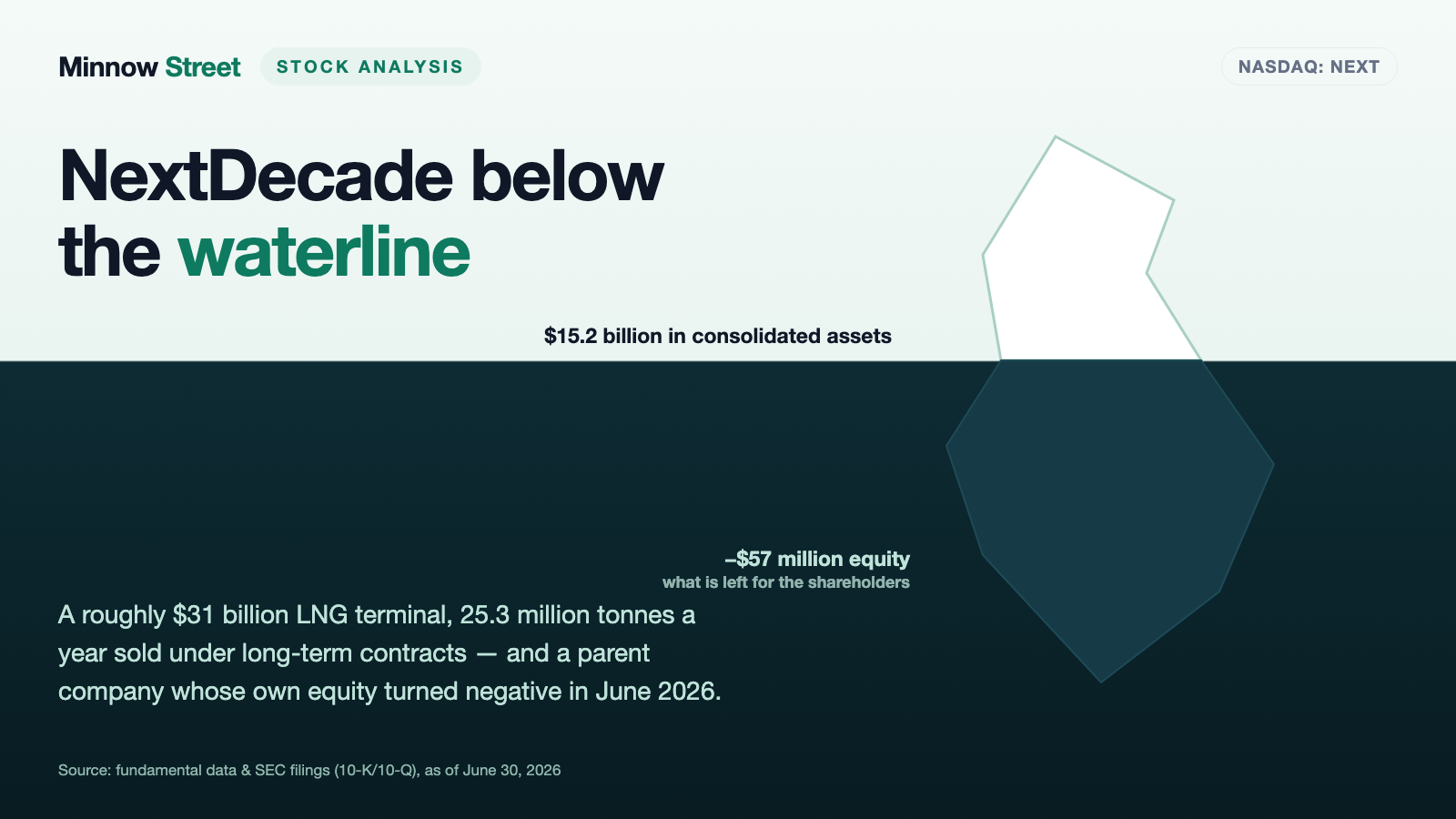
On the Brownsville Ship Channel in South Texas, roughly $31.4 billion is being turned into one of the largest construction sites in the United States: five liquefaction trains with a combined capacity of around 30 million tonnes a year, 25.3 million tonnes of it already sold to 14 buyers under contracts averaging 19.5 years. The build is running ahead of the guaranteed schedule, and first gas is due to flow into the plant in the second half of 2026. And yet the balance sheet as of June 30, 2026 carries a number you would never expect on a project like this: the equity attributable to NextDecade stockholders has fallen to minus $57.280 million. The cause is not an accounting scandal, it is a contract — the filings with the U.S. securities regulator, the SEC, put the shareholders' share of the cash distributions from Phase 1 at up to about 20.8 percent, and the majority of that is paid only after the financing partners have cleared their threshold. This analysis does the arithmetic on what actually reaches you out of a $15.2 billion balance sheet. Not investment advice — just the question of how wide your slice of that construction site really is.
 Thomas Mücke
Founder & Publisher
Thomas Mücke
Founder & Publisher
Chart
Interactive price chart (TradingView).
Note: pure fact-based analysis, not investment advice and not a solicitation to buy or sell. All figures without guarantee.
The trap: when the construction site is bigger than your slice
There is an investor trap that does not feel like gambling at all. It feels like concrete, steel and common sense — which is exactly why it catches so many people. Call it the construction-site trap. It goes like this: you read about a project worth $31.4 billion, you see cranes, tanks and a schedule, you read a company name above it all — and in one second your head turns that into a verdict: I am a co-owner of something huge.
The feeling is right about the build. It is wrong about the contract. The size of a project says nothing about the size of your slice of it — and even less about where you stand in line when money is eventually handed out. Those two questions are not answered by press releases. They are answered by footnotes.
NextDecade Corporation (Nasdaq: NEXT) of Houston, Texas is close to a textbook case. The company is building one of the largest industrial facilities currently going up in the United States, on the Brownsville Ship Channel in South Texas. As of June 30, 2026 the balance sheet shows roughly $15.2 billion of total assets. Revenue: zero — in every fiscal year since 2021 and in the first half of 2026 as well. And the equity attributable to its own stockholders fell during that half-year to minus $57.280 million.
So let's make a deal. We read together what NextDecade itself filed with the U.S. securities regulator, the SEC — the annual report (10-K) for 2025 of March 2, 2026, the quarterly report (10-Q) as of June 30, 2026 filed on July 30, 2026, and everything in between. A filing with the SEC is made under penalty of perjury, including where it turns uncomfortable. At the end you decide for yourself.

What NextDecade is actually building
NextDecade is neither a gas producer nor an energy trader. It is a project developer with exactly one project: the Rio Grande LNG Facility on roughly 1,000 acres of leased land on the Brownsville Ship Channel, with 15,000 feet of waterfront and room for up to ten liquefaction trains. The lease runs to July 12, 2053, with two ten-year renewal options. As of December 31, 2025 360 people worked there full-time, none of them under a collective bargaining agreement. Matthew Schatzman is both chief executive and chairman of the board; a permanent chief financial officer has been in place only since July 6, 2026 — John Zuklic, previously at Citgo Petroleum, replacing an interim officeholder.
What is being built there can be explained in one sentence: natural gas is chilled to minus 162 degrees Celsius until it turns liquid and shrinks to a fraction of its volume — at which point it fits into a ship and can be sold across an ocean. Under construction are Trains 1 through 5 with a combined 30 MTPA, meaning 30 million tonnes of liquefied natural gas a year, plus four tanks of 180,000 cubic meters each and two berths. The liquefaction technology comes from Honeywell (AP-C3MR).
NextDecade does not produce the gas itself — others do that, natural gas producers such as SandRidge Energy, who lift it out of the ground and feed it into the pipelines. NextDecade sits one step further down the chain and liquefies it. And one step beyond that waits the ocean transport: how capital-intensive and how owner-heavy that business is, our analysis of Teekay shows — a group that operates 34 tankers, of which its own shareholders own 30.7 percent. Remember that pattern. It comes back in a moment.
The builder is Bechtel Energy Inc., and it works under the most investor-friendly contract form there is: “fully wrapped, lump-sum turnkey” — fixed price, fixed date, guaranteed performance. Translated: if it gets more expensive or runs late, that is first of all Bechtel's problem, not yours. The costs are quantified accordingly: roughly $18.0 billion for Phase 1 (Trains 1 through 3) and roughly $6.7 billion each for Train 4 and Train 5 — together about $31.4 billion. The final investment decisions came on July 12, 2023 (Phase 1), September 9, 2025 (Train 4) and October 16, 2025 (Train 5). None has been taken since the annual report.
Most of the output is already sold, and sold for a very long time:
“We have entered into long-term LNG Sale and Purchase Agreements ("SPAs") with 14 creditworthy counterparties for aggregate volumes of approximately 25.3 MTPA of LNG from Trains 1 through 5 at the Rio Grande LNG Facility. The SPAs have a weighted average term of 19.5 years.”
— NextDecade Corporation, Form 10-K for 2025, Item 1
23.75 MTPA of that is linked to the U.S. gas price Henry Hub; the fixed fees expected from those contracts run to roughly $3.0 billion a year. The clever part: the fixed fee stays due even if a customer cancels a cargo. Five buyers are named in the report for 2025, each on a 20-year contract: Saudi Aramco (1.2 MTPA, Train 4), TotalEnergies (1.5 MTPA, Train 4), JERA (2.0 MTPA, Train 5), EQT (1.5 MTPA, Train 5) and ConocoPhillips (1.0 MTPA, Train 5). The older contracts sit inside the total of 14 counterparties and are not broken out individually.
On top of that comes a small side business before the real start: in early 2026 NextDecade sold more than 175 TBtu of early cargoes at an expected margin of over $3.00 per MMBtu — equal to 33 percent of the open volumes in the window from 2027 into early 2029. And something is already queued up for the future: Trains 6 through 8, together roughly 18 MTPA, belong 100 percent to NextDecade but are still in permitting and development. In May 2026 the formal application for Train 6 plus an additional berth went to the energy regulator FERC; in June 2026 came a reservation agreement with Baker Hughes for the main refrigerant compressors and an export application to the U.S. Department of Energy.
One detail on the side, because it shows how quickly narratives change: the carbon capture project, still mentioned in the report for 2025 as something under review (“exploring a potential carbon capture and storage ("CCS") project”), does not appear a single time in the quarterly report as of June 30, 2026 — neither as “carbon capture” nor as “CCS”. Gone, without replacement and without comment.
How this stock reached our desk
This analysis does not begin with a metric. NextDecade turned up in the Reddit hype watch run of our in-house stock scanner, cut-off date July 31, 2026 — the run that simply measures which U.S. stocks investor forums are talking about unusually often right now. That is all it is, and that is all we claim.
That needs framing: frequency of mentions is not a quality signal. A forum ranking says nothing about a balance sheet, a construction plan or a contract structure — it only says where a lot of people are currently looking. For us a signal like that is therefore purely a reason to read the original documents, never an argument.
The classic metric screens do not help here anyway, for a fundamental reason: there is no profit and no revenue for them to grip. A price-to-earnings ratio does not exist, a price-to-sales ratio does not exist, and a price-to-book ratio is meaningless because the shareholders' equity is negative. What the fundamental data still computes as of July 31, 2026 is instructive all the same — you just have to judge it rather than merely quote it:
- Piotroski score of 1 out of 9. That scale counts nine signs of balance sheet health, from earning power to leverage; a thoroughly sound company scores 8 or 9, and anything from 5 up is respectable. A score of 1 means eight of the nine criteria were missed. It is fair to note that the score was built for operating businesses and mechanically punishes a construction site without revenue — it would be unfair to wave it away on that basis. It correctly describes the fact that nothing is being earned here yet.
- Altman Z of minus 0.11. This metric estimates proximity to insolvency from balance sheet ratios; anything below 1.8 counts as the distress zone, and a negative reading is unusual even there. The same caveat applies: the model expects revenue and profit and finds neither. It remains a warning sign worth having seen.
- Equity ratio of 0.8 percent. On that basis, out of every $100 of total assets less than one dollar would be covered by shareholders' equity. At a solid industrial company 30 to 50 percent is normal. And even those 0.8 percent are the friendly reading: as of June 30, 2026 the underlying figure has slipped below zero.
Remember the principle: where no metric applies, you have to read the contract. That is exactly what we do now.
The numbers over the years — given their due
First, what genuinely impresses — and at NextDecade that is the pace of construction, measured in balance sheet figures. At the end of 2021 the company had total assets of $222.105 million; that is the scale of a mid-sized private business. At the end of 2023 it was $3.324 billion, at the end of 2024 $6.404 billion, at the end of 2025 $12.426 billion — and as of June 30, 2026 roughly $15.205 billion. Property, plant and equipment grew over the same period from $173.816 million to $13.514 billion, of which $13.076 billion alone sits in construction in progress. In four years an idea has turned into an industrial plant. That is no small thing, and it does not finance itself: in the first half of 2026 the group took in $2,123.890 million from financing activities, with TotalEnergies alone contributing roughly $377.5 million ($329.1 million of it in the second quarter).
And now the line above it that frames everything else. It reads the same in every single year:
“We are not expected to generate cash flow, or even obtain revenues, from our LNG liquefaction and export activities unless and until the Rio Grande LNG Facility is operational. Additionally, we do not expect to generate cash flow from any CCS projects until such projects are installed and operational. Accordingly, distributions to investors may be limited, delayed, or non-existent.”
— NextDecade Corporation, Form 10-K for 2025, Item 1A (Risk Factors)

So revenue reads zero for 2021, 2022, 2023, 2024 and 2025 — and for the first half of 2026 as well. Which makes every earnings line in this company pure cost accounting, seasoned with book gains and losses on interest rate hedges. That explains the strangest year in the series: 2024. The group reported net income of $277.447 million that year — the only profit in its corporate history. It came almost entirely from a $586.5 million book gain on derivatives (interest rate swaps). And it never reached the shareholders.
Here an everyday image helps with a term that shows up repeatedly in this article: non-controlling interests. Picture a workshop that is 20 percent yours but that you run. Under the accounting rules you have to take the whole workshop onto your books — machines, debts, revenue, all of it at 100 percent. Only right at the bottom of the statement is the portion belonging to the other owners deducted. That is exactly what happened in 2024: of the $277.447 million of net income, $339.198 million was allocated to the partners — more than the entire profit. What was left for NextDecade stockholders was a loss of $61.751 million. A consolidated profit that is a minus for you: that is the construction-site trap in numbers.
The rest of the series is more straightforward. The consolidated net loss was $22.039 million (2021), $60.071 million (2022), $221.640 million (2023) and — after the outlier year 2024 — $429.637 million (2025), of which $306.434 million fell on NextDecade stockholders. Loss per share went from minus $0.34 (2021) to minus $1.17 (2025). Operating expenses in 2025 came to $225.931 million, of which $202.285 million was administration and only $8.006 million development. The accumulated deficit reached $759.957 million as of December 31, 2025 — and $961.789 million as of June 30, 2026.
The first half of 2026 put a consolidated net loss of $255.223 million on the books, $201.832 million of it at NextDecade stockholders, or minus $0.76 per share on 264.976 million weighted shares. The second quarter looked almost friendly at minus $60.183 million — but only because a $116.075 million book gain on derivatives worked against it. Without that, the quarterly loss would be roughly $176 million. And when it comes to money that actually moves, there are no book gains: operating cash outflow in the first half of 2026 was $128.016 million, after $72.722 million in the prior-year period; for the full year 2025 it was $169.397 million.
Uncomfortable truth no. 1: about a fifth of the distributions — and at the back of the line
Now to the core. The $15.2 billion of total assets sits on NextDecade's books because the company controls the three joint ventures Phase 1 Holdings, Train 4 Holdings and Train 5 Holdings — it is the primary beneficiary of all three and consolidates them at 100 percent.
Consolidation is a pure accounting procedure, not a statement of ownership. Everyday image: if you run a shared apartment, you keep the whole household kitty — including your flatmates' money. That does not make it your money. It works exactly like that here: as of December 31, 2025, $12.127 billion of the $12.426 billion of total assets sat in those entities, along with $8.617 billion of the $10.125 billion of liabilities. NextDecade is not obliged to fund their losses, and there is no recourse to the parent for their debts. That is the advantage of the structure — the price for it is in the next paragraph.
“Pursuant to a joint venture agreement with equity partners for ownership of Phase 1 at the Rio Grande LNG Facility, we expect to receive up to approximately 20.8% of distributions of available cash generated from Phase 1 operations, provided that a majority of the cash distributions to which we are otherwise entitled will be paid for any distribution period only after our equity partners receive an agreed distribution threshold in respect of such distribution period and certain other deficit payments from prior distribution periods, if any, are made.”
— NextDecade Corporation, Form 10-K for 2025, Item 1

Read that sentence twice, because it contains two limitations, not one. First the size: up to about 20.8 percent — “up to”, not “at least”. Second the order: the majority of that already thin share is paid only once the partners have their threshold, including any deficit payments from earlier periods. Everyday image: you are entitled to a fifth of the cake — but the others cut first, and if there was too little for them last time, they cut twice this time.
The two younger trains look better, because NextDecade put more of its own money into them: at Train 4 the company is entitled to 40 percent of the distributions, rising to 60 percent once the partners have reached a specified return; at Train 5 it is 50 percent, rising to 70. The commitments behind that: Train 4 roughly $1.69 billion from the partners against roughly $1.13 billion from NextDecade, Train 5 roughly $1.29 billion against roughly $1.29 billion. For Phase 1 the equity commitments including NextDecade add up to roughly $6.2 billion.
Who the partners are does not make this smaller: Global Infrastructure Partners (part of BlackRock), GIC, Mubadala Investment Company and TotalEnergies. These are the kind of names that have contracts written for them rather than signing whatever is put in front of them. Control is split accordingly: every resolution at the joint ventures needs a majority of both classes of managers — Class A from NextDecade, Class B from the partners.
How lopsided the economics have become shows up in a single comparison from the balance sheet as of June 30, 2026: non-controlling interests stand at $2,873.882 million, total reported equity at $2,816.602 million. The partners' interests therefore make up 102 percent of equity. Everything in that line beyond it is a minus — and that minus belongs to the shareholders.
Uncomfortable truth no. 2: the shareholders' equity has tipped below zero
That brings us to the number that prompted this analysis. The equity attributable to NextDecade stockholders first grew over the years, then shrank — and in the first half of 2026 it fell below zero.
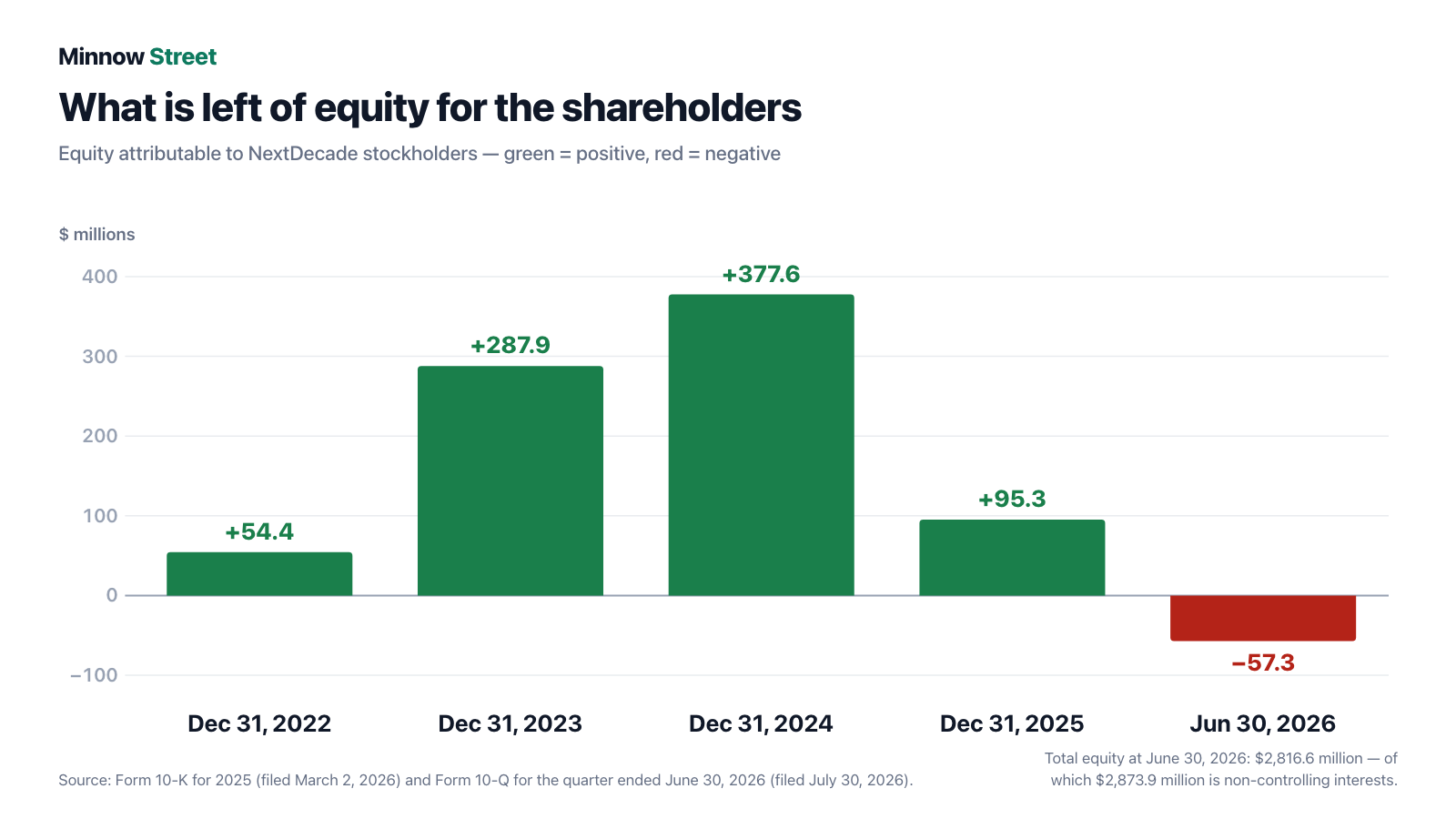
The series in numbers: $54.371 million (December 31, 2022), $287.923 million (2023), $377.641 million (2024), $95.338 million (2025) — and minus $57.280 million as of June 30, 2026. That equals a book value of roughly minus $0.22 per share. For contrast: total reported equity rose over the same period, from $2,301.087 million to $2,816.602 million — because the partners kept putting money in while the shareholder side absorbed losses.
What does that mean in practice? First: there is no price-to-book ratio any more. You cannot divide by a negative number and expect a meaningful answer. Second, and this is the honest counterpoint: negative equity is a legal alarm bell in some jurisdictions, but in a U.S. consolidated balance sheet it is first of all an arithmetic result. It does not mean creditors will knock on the door tomorrow — the project debt sits without recourse in the subsidiaries, no principal is due before 2030, and KPMG's audit opinion of February 27, 2026 carries no going-concern qualification. What it does mean is this: everything of substance in this balance sheet has already been allocated in the books — and allocated to somebody else.
The engine behind it is the accumulated deficit. It rose from $759.957 million (December 31, 2025) to $961.789 million (June 30, 2026). Put differently: in six months the shareholder side lost a good $200 million of book value without a single dollar of revenue on the other side of the ledger.
Uncomfortable truth no. 3: six of every ten interest dollars never reach the income statement
This truth is the most technical — and the most important one for understanding the numbers. When a company builds a facility, it may add the interest that accrues on the construction loans during the build to the carrying value of the asset instead of expensing it. That is called capitalized interest. Everyday image: you do not count the construction interest on your house as a cost of the year, you add it to the value of the house. The bank got the money either way.
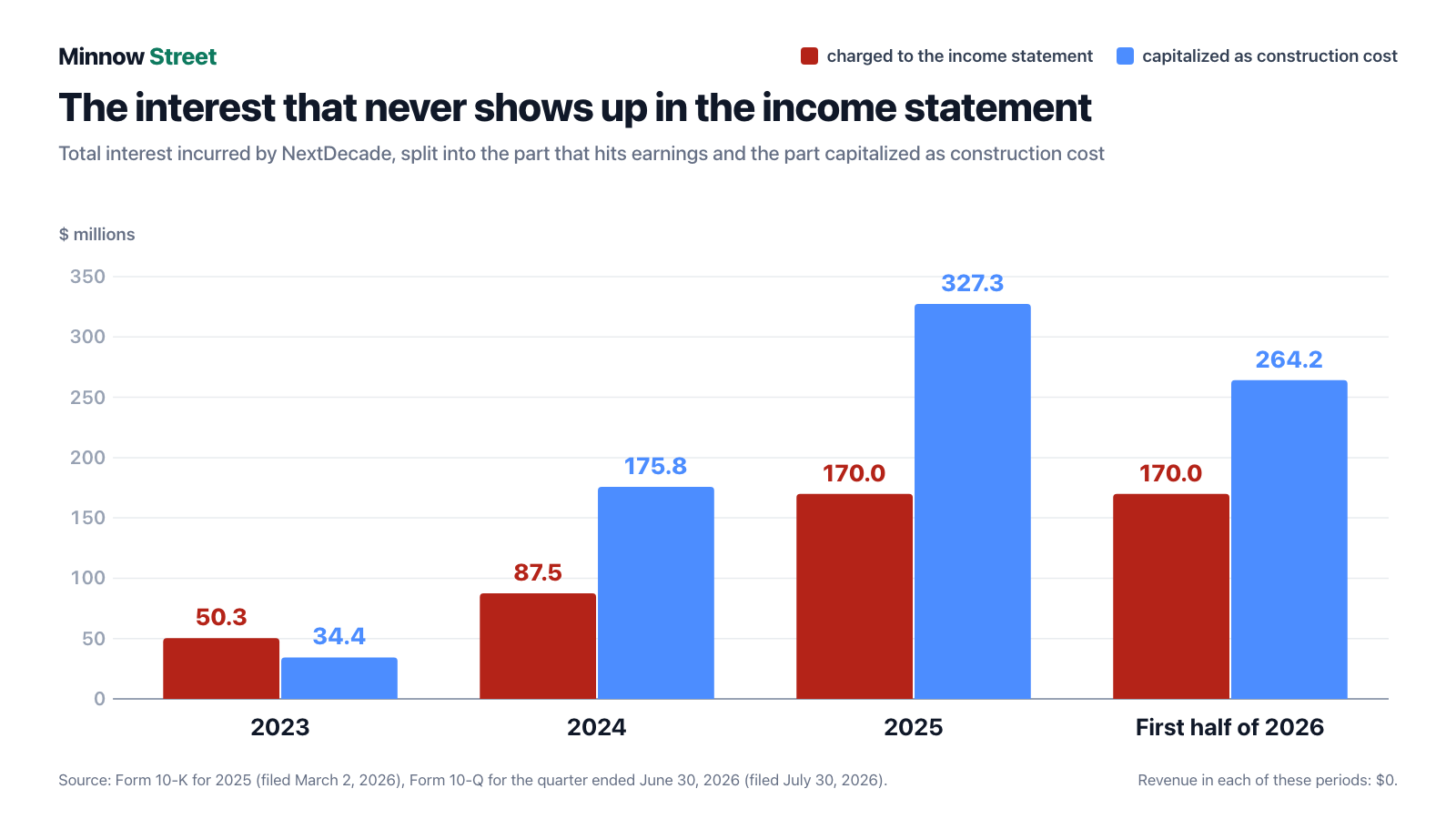
The figures are unambiguous. In the first half of 2026 a total of $434.244 million of interest was incurred (prior-year period: $192.615 million). Of that, $264.220 million was capitalized — 60.8 percent. Only $170.024 million landed in the income statement. Over the years it looks like this: 2023 total $84.658 million ($34.373 million capitalized, $50.285 million in the income statement), 2024 total $263.357 million ($175.818 million / $87.539 million), 2025 total $497.311 million ($327.300 million / $170.011 million).
Two conclusions follow, and both belong on the table.
First: anyone reading only the income statement underestimates this company's interest burden by more than half. Capitalizing is compliant and standard in the industry — but it makes the interest optically invisible and lets it reappear later as depreciation spread over decades. And against revenue of zero, even the visible half is crushing: interest coverage, the question of how many times a company earns its interest, has no positive value here; the fundamental data shows minus 1.33 as of July 31, 2026. A healthy reading starts at 3 or 4.
Second: a substantial part of that interest has not even been paid. Actually settled in cash in the first half of 2026 was only $47.250 million. Another $36.502 million was added to the debt in kind — so-called PIK interest, where the debt grows instead of the bank account shrinking. On the new $1.0 billion loan at 7.05 percent, taken on June 17/18, 2026 at a purpose-built level above the project company, that is precisely the default case: interest is added to the debt until after June 17, 2029 unless the borrower expressly elects to pay in cash. And the corporate Series B loan of $214.715 million at 13.50 percent must be serviced half in cash from March 31, 2027.
Remember the sentence: interest you cannot see and interest you do not pay is still tomorrow's debt.
Uncomfortable truth no. 4: the subsidiaries' money is contractually barred from the parent
Suppose everything goes to plan: the first LNG flows, the plant earns money. Then comes the next hurdle — and it sits in the credit agreements, not in the construction schedule.
“Under the terms of the Phase 1 LLC, Train 4 LLC, Train 5 LLC, FinCo LLC and Super FinCo LLC debt arrangements, the net assets of the respective subsidiaries are restricted from being distributed to NextDecade unless specific conditions are met, including the satisfaction of DSCR tests, completion of construction milestones, and absence of default.”
— NextDecade Corporation, Form 10-K for 2025, Note 6 “Debt”, section “Restricted Net Assets”

The key term in there is the debt service coverage ratio (DSCR in the original). It answers a simple question: how much does the plant earn relative to what it has to pay in interest and principal over the same period? Everyday image: your bank demands that your salary each month be at least 1.10 times your loan installment — and only once that is satisfied are you allowed to transfer anything to yourself. At NextDecade that threshold is at least 1.10 to 1, tested quarterly from the first principal payment; at the new HoldCo level it is 1.05 to 1 from 90 days after project completion. As of December 31, 2025 all covenants were met — which, in a construction phase with no amortization, is not an especially high bar.
How hard that lock bites shows in a footnote that is easy to skip. The annual report contains a separate set of accounts for the parent company alone — the so-called Schedule I. It is not there voluntarily but because a rule requires it as soon as the restricted net assets of the subsidiaries exceed 25 percent of consolidated net assets. And those accounts carry a figure you read twice at a group with more than twelve billion dollars of total assets: as of December 31, 2025 the parent company on its own held $0 of current assets.
So what is the parent supposed to pay its development and administrative costs with? The report says so itself: with the cash on hand, with “the services fee due in September 2026” and with the sale of further equity or debt securities — coupled with the express warning that such a sale may not succeed and, if it does, may be neither cheap nor free of dilution. That services fee is quantified: at the final investment decision for Train 4 the project company paid a total of $98 million to NextDecade LLC ($48 million of development fee plus $50 million of services fee); a further $50 million falls due in September 2026. At Train 5 it was $117 million ($17 million plus $100 million).
For scale: unrestricted cash as of June 30, 2026 was $83.678 million (December 31, 2025: $143.782 million), with another $415.891 million restricted ($563.306 million). Together that is $499.569 million after $707.088 million — liquidity has fallen by roughly 29 percent in six months. Which makes the $50 million services fee the largest predictable single item of group liquidity this year.
Uncomfortable truth no. 5: the permit is back in court
All material permits for the first five trains are in hand — both from the energy regulator FERC and the export authorizations from the U.S. Department of Energy. That is the good news. The uncomfortable part sits in a subordinate clause of the annual report.
The chronology is long and worth following, because it shows how grinding these proceedings are: in August 2024 the U.S. Court of Appeals for the D.C. Circuit ruled against the permit; in March 2025 it remanded the matter to FERC without vacating the authorization. A draft supplemental environmental review followed in March 2025 and the final one in July 2025; in August 2025 FERC reaffirmed its authorization. In September 2025 the intervenors filed a rehearing request, which was denied by operation of law on October 30, 2025. And then:
“In December 2025, the intervenors that filed a request for rehearing with FERC petitioned the D.C. Circuit Court to review the Remand Order, and their request remains pending.”
— NextDecade Corporation, Form 10-K for 2025, Item 1
So the case is pending again, with no decision date. The petitioners are not named in the report. Important for perspective, so that nobody panics here: a pending case is not a construction halt. Building continues, the permit remains in force, and in the entire quarterly report the legal proceedings section reads simply “None.” — there are no others. The risk factors, the company says, have not changed materially since the annual report for 2025 either.
But: since December 2025 a court case whose outcome and timing nobody knows has been hanging over the company's biggest construction site — a facility into which $13.076 billion had already flowed as construction in progress by June 30, 2026. That is no reason for hysteria, but it is not nothing either. Anyone investing here carries that risk without being able to influence it or put a date on it.
The other side of the ledger: what genuinely carries here
This analysis would be dishonest if it stopped here. Because what is being built in South Texas is real, it is sold, and it is on schedule — in parts even ahead of it.
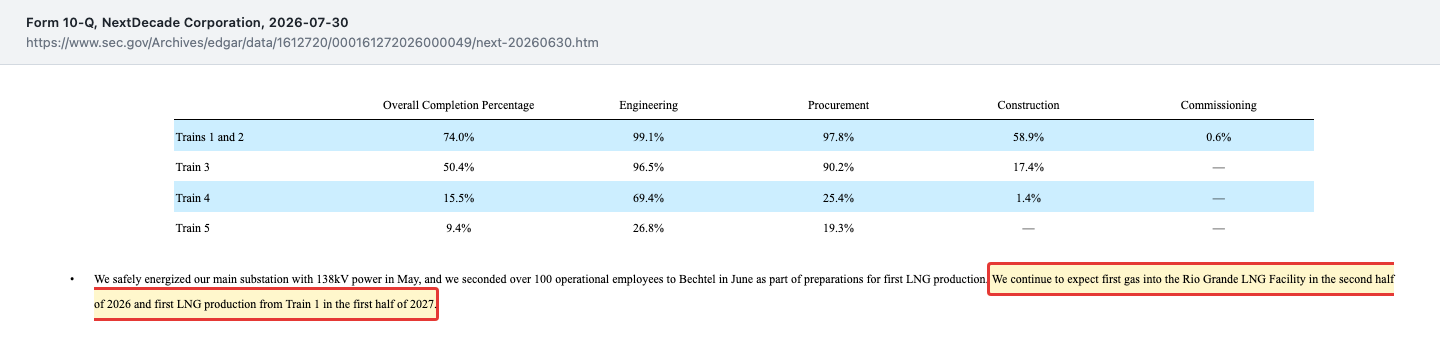
The completion percentages under the construction contracts speak for themselves: Trains 1 and 2 at 74.0 percent (December 2025: 64.5 percent), Train 3 at 50.4 percent (39.8), Train 4 at 15.5 percent (7.8) and Train 5 at 9.4 percent (3.3). Broken down, it becomes clear how far along the first two trains are: engineering 99.1 percent, procurement 97.8 percent, construction 58.9 percent — and commissioning only 0.6 percent. That is where the last mile sits. Phase 1 is ahead of the guaranteed schedule, Trains 4 and 5 are on schedule, and the timeline is unchanged from the prior quarter.
“We safely energized our main substation with 138kV power in May, and we seconded over 100 operational employees to Bechtel in June as part of preparations for first LNG production. We continue to expect first gas into the Rio Grande LNG Facility in the second half of 2026 and first LNG production from Train 1 in the first half of 2027.”
— NextDecade Corporation, Form 10-Q for the quarter ended June 30, 2026, Item 2 “Significant Recent Developments”
There is more tangible evidence of progress: dredging is substantially complete, the Bay Runner pipeline is “on track” for the third quarter of 2026, and commercial operations are scheduled under the guaranteed construction timetable from the end of 2027 (Train 1) into the first half of 2031 (Train 5).
The financing side is sturdier, too, than the negative equity suggests:
- No recourse to the parent. The project debt sits in the subsidiaries; NextDecade is not liable for it and does not have to fund their losses.
- No principal due before 2030. The maturity profile in the annual report shows not a single repayment from 2026 through 2029; roughly $4.49 billion comes due in 2030. By then the plant is meant to have been producing for years.
- A successful refinancing. On July 2, 2026 the company placed $3.5 billion of notes in four tranches ($1,000 million at 5.250 percent to 2031, $500 million at 5.500 percent to 2034, $1,250 million at 5.750 percent to 2036, $750 million at 6.150 percent to 2041). The proceeds repaid roughly $3.5 billion of bank loans — a refinancing, not additional debt. As of July 29, 2026 more than $6.4 billion of the original $11.1 billion of Phase 1 construction loans has been refinanced.
- The partners keep paying in. TotalEnergies alone transferred roughly $377.5 million in the first half of 2026 and simultaneously holds more than 10 percent of the stock. People who put billions of their own into a project rarely walk away casually.
- A clean audit opinion. KPMG LLP (Houston) signed off on the 2025 accounts on February 27, 2026 without qualification, and on internal control as well. There is no going-concern qualification.
- An order book most industrial companies do not have. 25.3 MTPA over a weighted 19.5 years, 23.75 MTPA of it Henry Hub-linked with expected fixed fees of roughly $3.0 billion a year — payable even if a customer cancels a cargo.
And the construction costs themselves? They sit with Bechtel under a fixed-price contract with guaranteed performance. That removes precisely the risk on which large projects most often founder — cost overruns. So anyone who takes a positive view of this stock has arguments drawn from the original documents, not merely from imagination.
What the market is charging for it
First the warning, because it is the most important statement in this chapter: the usual valuation metrics do not exist at NextDecade. No price-to-earnings ratio (there is no profit), no price-to-sales ratio (there is no revenue), no meaningful price-to-book ratio (the shareholders' equity is negative). Anyone quoting a number from a data feed here is quoting a division that measures nothing.
What is dependable is therefore only what is dated. The only price documented in a filing comes from the cover page of the registration statement S-3ASR of May 13, 2026: “On May 12, 2026, the last reported sale price of the Common Stock on the Nasdaq Capital Market was $8.50 per share.” — so $8.50 on May 12, 2026. Separately, the quarterly report cites an average price of $8.54 for May 2026 in connection with shares withheld. At the documented price the market value works out to roughly $2.26 billion. Per the fundamental data as of July 31, 2026 the price stood at $6.73, which on 266,185,433 shares gives roughly $1.79 billion — so the stock has lost roughly a quarter since May 12, 2026.
What do you buy for that kind of money? Soberly stated: the future share of distributions that do not yet exist — about 20.8 percent from Phase 1 (subordinated), 40 to 60 percent from Train 4, 50 to 70 percent from Train 5, plus the full rights to the as yet unpermitted Trains 6 through 8. It is a bet on a date and on a contractual running order, not on current earning power.
The professional view is thin: the fundamental data shows an average analyst rating of 3.5 from just two analysts as of July 31, 2026 (on this scale 5 is the best mark). Two opinions are not a consensus, they are two opinions — and 3.5 on that scale is a polite shrug. Institutional investors hold 45.0 percent, insiders 45.6 percent. Concentration is correspondingly high: HGC NEXT INV LLC, TotalEnergies SE and Ninteenth Investment Company together hold roughly 47 percent of the voting power (as of February 20, 2026), and three directors are affiliated with them. As of the same date there were only about 51 holders of record.
A word on dilution — the term for your slice of the cake shrinking because new slices are being handed out. The share count rose from 264,930,065 (February 20, 2026) via 264,992,987 (April 24, 2026) to 266,185,433 as of July 24, 2026. That is moderate. Alongside it, though, sit 9,204,426 warrants (at $7.15 and $9.30) and 10,526,316 exchange shares from convertible loans at an exchange price of $9.50; the two together — 19,730,742 shares — were registered on May 13, 2026 under the S-3ASR for resale by existing holders. Important for perspective: that is not a capital-raising shelf; NextDecade receives not a dollar from it. On July 30, 2026 another 5,000,000 shares were added for the employee plan (registration statement S-8, approved at the annual meeting of June 3, 2026) — roughly 1.88 percent of the shares outstanding, and already the ninth such filing for the same plan since 2017. Authorized capital totals 480,000,000 common shares; roughly 4.9 million sit in treasury.
Finally, a finding that is surprising for an energy project in 2026 — and that speaks explicitly in the company's favor. In every mandatory filing we reviewed — the annual reports for 2024 and 2025, the four most recent quarterly reports and the proxy statement — the terms “data center”, “hyperscale”, “electricity demand” and “power demand” do not appear a single time. NextDecade explains LNG demand the classic way: with gas prices, global liquefaction capacity, vessel availability, regulation and tariffs. Anyone buying this stock because AI data centers supposedly need gas is buying a narrative the company itself never tells.
Opportunities and risks at a glance
What speaks for NextDecade:
- An order book most industrial companies cannot show: 25.3 MTPA across 14 counterparties with a weighted 19.5 years remaining, 23.75 MTPA of it Henry Hub-linked with expected fixed fees of roughly $3.0 billion a year — payable even on cancelled cargoes.
- Building ahead of plan: Trains 1 and 2 were 74.0 percent complete as of June 30, 2026 (engineering 99.1, procurement 97.8, construction 58.9 percent), Train 3 50.4 percent; Phase 1 is ahead of the guaranteed schedule, Trains 4 and 5 are on plan, and the timeline is unchanged from the prior quarter.
- Fixed price with guaranteed performance: Bechtel Energy builds “fully wrapped, lump-sum turnkey” — the single biggest risk in large projects, the cost overrun, therefore sits first of all with the contractor.
- A non-recourse structure: the project debt sits in the subsidiaries and NextDecade is not liable for it; KPMG's audit opinion of February 27, 2026 is unqualified and carries no going-concern warning.
- Breathing room on repayment: not a single principal payment falls due from 2026 through 2029, and only roughly $4.49 billion in 2030. The refinancing is running: $3.5 billion of notes on July 2, 2026, with more than $6.4 billion of the original $11.1 billion of Phase 1 construction loans refinanced (as of July 29, 2026).
- Well-capitalized partners with their own stake: Global Infrastructure Partners (BlackRock), GIC, Mubadala and TotalEnergies keep paying in — TotalEnergies alone roughly $377.5 million in the first half of 2026.
- Growth reserve held outright: Trains 6 through 8, together roughly 18 MTPA, belong 100 percent to NextDecade; the FERC application for Train 6 has been on file since May 2026, alongside a reservation agreement with Baker Hughes for the main refrigerant compressors.
What speaks against it:
- The economic share is thin and subordinated: up to about 20.8 percent of the cash distributions from Phase 1, and the majority of that only after the partners' distribution threshold and any deficit payments from earlier periods. The balance sheet nevertheless consolidates 100 percent.
- Negative shareholders' equity: minus $57.280 million as of June 30, 2026 after plus $95.338 million half a year earlier, roughly minus $0.22 per share; non-controlling interests make up 102 percent of reported equity, and the accumulated deficit stands at $961.789 million.
- Interest burden without earnings: $434.244 million of interest in the first half of 2026, of which $264.220 million was capitalized as construction cost and only $170.024 million charged to the income statement — against zero revenue. Cash paid was $47.250 million, with another $36.502 million added to the debt.
- Persistently negative operating cash flow: minus $128.016 million in the first half of 2026 after minus $169.397 million in 2025; liquidity fell in six months from $707.088 million to $499.569 million, of which only $83.678 million is unrestricted.
- Locked-up money: the subsidiaries' net assets may only reach the parent after debt service coverage tests are passed, construction milestones are met and no default exists; the parent company on its own held zero current assets as of December 31, 2025.
- An open court case: since December 2025 the U.S. Court of Appeals for the D.C. Circuit has again been reviewing the remand order on the permit — pending, with no decision date.
- Concentrated ownership and special rights: three holders together account for roughly 47 percent of the voting power (February 20, 2026), three directors are affiliated with them, and on the same date there were only about 51 holders of record.
- One project, one site, one segment: there is no second business line that could absorb a setback.
A human conclusion
Back to the construction-site trap from the beginning. Its core is not that the site is fake — it is very real, it is 74 percent complete, and it has customers on contracts running nearly two decades. Its core is that our heads automatically translate the size of a project into the size of our share of it. And that is the mistake.
At NextDecade the answer is there in black and white in the company's own filings: up to about 20.8 percent of the distributions from Phase 1, the majority of it only after the partners; 40 to 60 percent from Train 4, 50 to 70 percent from Train 5. On top of that, shareholders' equity of minus $57.280 million, an interest bill of $434.244 million in a half-year, an operating cash outflow of $128.016 million — and a revenue line that has been empty since the company was founded.
None of that is an argument against this stock, and it is expressly not a claim that bankruptcy looms: the debt sits without recourse in the subsidiaries, no principal is due before 2030, the audit opinion is clean, and the partners keep paying in. It is an argument for asking the right question. That question is not “will the plant be finished?” — 74.0 percent completion, a fixed-price contract and a schedule that has held for quarters argue that it will. The question is: what is left of $3.0 billion of annual fixed fees once debt service is paid first, the partner threshold is met second, and only then your fifth is distributed — and how many years does that take?
Whoever has a reasoned answer to that has a thesis. Whoever only saw the billion-dollar number in the headline had a good feeling. The difference between the two is about twenty minutes of reading in a report anyone can download for free. What you make of it is your decision. And that is exactly as it should be.
Sources and disclaimer
Every original document used in this analysis, for you to read yourself:
- NextDecade Corporation — SEC annual report 10-K for 2025 (filed March 2, 2026)
- NextDecade Corporation — SEC quarterly report 10-Q as of June 30, 2026 (filed July 30, 2026)
- NextDecade Corporation — SEC quarterly report 10-Q as of March 31, 2026
- NextDecade Corporation — SEC registration statement S-3ASR of May 13, 2026 (price anchor $8.50 of May 12, 2026)
- NextDecade Corporation — SEC registration statement S-8 of July 30, 2026 (5,000,000 employee shares)
- NextDecade Corporation — SEC current report 8-K of July 2, 2026 ($3.5 billion notes offering)
- NextDecade Corporation — SEC current report 8-K of June 18, 2026 ($1.0 billion term loan at 7.05 percent)
- NextDecade Corporation — SEC current report 8-K of June 3, 2026 (annual meeting, Item 5.07, and chief financial officer)
- NextDecade Corporation — SEC current report 8-K of April 15, 2026 (executive agreement)
- NextDecade Corporation — SEC proxy statement DEF 14A of April 23, 2026
- General Atlantic / Atlantic Park — SEC ownership filing SCHEDULE 13D of June 10, 2026
- Complete SEC filing history of NextDecade Corporation (CIK 0001612720): EDGAR overview (sec.gov)
- Fundamental data (industry, price series, ownership, scores and analyst opinions; data as of July 30/31, 2026), reconciled against the SEC filings and the SEC's XBRL financial series.
- Hook: Reddit hype watch run of our in-house stock scanner, cut-off date July 31, 2026.
Transparency & disclaimer: This analysis is journalistic commentary on publicly available information. It is not investment advice, not a regulated financial analysis and not a solicitation to buy or sell securities. Equity investments carry substantial risks up to the total loss of capital — particularly so at a project developer with no revenue, negative shareholders' equity and a single large project. All information is provided without warranty; the as-of date for each figure is stated in the text. The author holds no position in NextDecade shares at the time of publication.
Our Bottom Line at a Glance
- Construction and order book positive
- As of June 30, 2026 Trains 1 and 2 were 74.0 percent complete (engineering 99.1, procurement 97.8, construction 58.9 percent), Train 3 50.4 percent, Train 4 15.5 percent and Train 5 9.4 percent. Phase 1 is ahead of the guaranteed schedule, Trains 4 and 5 are on plan, and the timeline is unchanged from the prior quarter: first gas in the second half of 2026, first LNG production from Train 1 in the first half of 2027. Sold are 25.3 MTPA across 14 counterparties with a weighted 19.5 years remaining; the expected fixed fees from the 23.75 MTPA of Henry Hub-linked contracts run to roughly $3.0 billion a year. Bechtel builds at a fixed price with guaranteed performance.
- Economic interest in the project negative
- The annual report (Form 10-K) for 2025 puts the entitlement at up to about 20.8 percent of the available cash distributions from Phase 1 — and makes clear in the same sentence that the majority of that share is paid only after the equity partners have received their agreed distribution threshold and any deficit payments from earlier periods. At Train 4 it is 40 percent (rising to 60), at Train 5 50 percent (rising to 70). The balance sheet nevertheless consolidates 100 percent: as of December 31, 2025, $12.127 billion of the $12.426 billion of total assets and $8.617 billion of the $10.125 billion of liabilities sat in the joint ventures. Every resolution there also requires a majority of both classes of managers.
- Balance sheet and equity negative
- Equity attributable to NextDecade stockholders fell from $377.641 million (December 31, 2024) via $95.338 million (December 31, 2025) to minus $57.280 million as of June 30, 2026, roughly minus $0.22 per share. The accumulated deficit rose in that same half-year from $759.957 million to $961.789 million. Non-controlling interests reached $2,873.882 million, or 102 percent of the entire reported equity of $2,816.602 million. A price-to-book ratio can no longer be formed from that.
- Interest burden and cash outflow negative
- In the first half of 2026 NextDecade incurred $434.244 million of interest (prior-year period $192.615 million); $264.220 million of it was capitalized as construction cost (60.8 percent) and only $170.024 million appeared in the income statement — against zero revenue. Just $47.250 million was paid in cash, and another $36.502 million was added to the debt in kind. Operating cash flow was minus $128.016 million after minus $169.397 million for all of 2025; liquidity fell from $707.088 million to $499.569 million, of which only $83.678 million is unrestricted.
- Financing and partners neutral
- The project debt sits without recourse to NextDecade in the subsidiaries; no principal falls due from 2026 through 2029, and only roughly $4.49 billion in 2030. The refinancing is running to plan: $3.5 billion of notes in four tranches on July 2, 2026, with more than $6.4 billion of the original $11.1 billion of Phase 1 construction loans refinanced (as of July 29, 2026). Global Infrastructure Partners (BlackRock), GIC, Mubadala and TotalEnergies keep paying in — TotalEnergies alone roughly $377.5 million in the first half of 2026. On the other side: the new $1.0 billion loan at 7.05 percent at a new level above the project company, with interest added to the debt by default until after June 17, 2029; the corporate Series B loan at 13.50 percent (mandatorily half in cash from March 31, 2027); and the net assets of the subsidiaries tied to conditions, while the parent company held zero current assets as of December 31, 2025.
- Permitting, schedule and data quality neutral
- All material permits for Trains 1 through 5 are in hand, and FERC reaffirmed them in August 2025. Since December 2025, however, the U.S. Court of Appeals for the D.C. Circuit has again been reviewing the remand order; the case is pending with no decision date, and the petitioners are not named in the report. The quarterly report (Form 10-Q) as of June 30, 2026 reports no other legal proceedings. On the data: as a project developer without revenue, NextDecade publishes no quarterly results releases (8-K, Item 2.02) — the only such filing in its corporate history dates from July 28, 2017. Metrics from data feeds come up empty for want of profit, revenue and positive equity.
NextDecade is building one of the largest LNG plants in the United States on the Brownsville Ship Channel for roughly $31.4 billion — as of June 30, 2026 Trains 1 and 2 are 74.0 percent complete, 25.3 million tonnes of annual capacity are sold for a weighted 19.5 years, and the schedule is holding. Almost all of it has been paid for with other people's money: the consolidated total assets of roughly $15.2 billion sit largely in joint ventures whose Phase 1 distributions entitle NextDecade to no more than about 20.8 percent — and the majority of that only after the financing partners. Equity attributable to its own shareholders tipped from $95.338 million to minus $57.280 million in the first half of 2026, interest reached $434.244 million in six months against zero revenue, and $128.016 million flowed out of operations. Anyone buying here is buying a subordinated share of distributions that cannot begin before 2027 at the earliest. Not investment advice.
What Our Rating Means
Substance risk
We found at least one documented issue that threatens the company itself — regardless of how the stock is currently valued.
Red, because several of the criteria for a documented risk to the substance of the company are met at once — each of them evidenced by its own filings. First, negative shareholders' equity: minus $57.280 million as of June 30, 2026, after plus $95.338 million half a year earlier. Second, interest coverage far below 1: in the first half of 2026 interest expense alone charged $170.024 million against the income statement while revenue was zero — and that is only the visible half, as $434.244 million was incurred in total. Third, persistently negative operating cash flow: minus $128.016 million in the first half of 2026 after minus $169.397 million for all of 2025. The counterargument belongs here too, and it carries weight: this is not an insolvency case. The project debt sits without recourse to NextDecade in the subsidiaries, KPMG's audit opinion for 2025 dated February 27, 2026 contains no going-concern qualification, no principal falls due from 2026 through 2029, and the financing partners keep paying in — TotalEnergies alone roughly $377.5 million in the first half of 2026. So red does not describe a looming inability to pay here; it describes the state of the substance attributable to shareholders: it has been consumed in the books, and the claim on future earnings is thin and subordinated at up to about 20.8 percent from Phase 1. Expressly not part of this color: the share price, the valuation level and the price trend — that the stock lost roughly a quarter between the documented anchor of $8.50 (May 12, 2026) and the data as of July 31, 2026 is a price argument and does not set the rating. The decision is yours.
A journalistic assessment by our editorial team at the time of the deep dive, based on public sources — not investment advice and not a solicitation to buy or sell. Your personal circumstances (investment goals, risk capacity, taxes) cannot be taken into account. What our levels mean, how verdicts are formed, and what conflicts of interest exist →
Worth Noting
- NEXT reached our research list through the Reddit hype watch run of our in-house stock scanner, cut-off date July 31, 2026 — that is, through the sheer frequency of mentions in investor forums. That is a reason to read the original documents, not a quality signal. Classic metric screens do not grip here anyway: no profit means no P/E, no revenue means no P/S, and without positive equity there is no meaningful P/B. The fundamental data shows a Piotroski score of 1 out of 9, an Altman Z of −0.11 and an equity ratio of 0.8 percent as of July 31, 2026.
- Recency gate: the most recent periodic report is the quarterly report (Form 10-Q) as of June 30, 2026, filed July 30, 2026; it has been evaluated. There is no same-day results release (8-K, Item 2.02) — and that is structural: NextDecade has filed exactly one 8-K carrying Item 2.02 in its entire corporate history, on July 28, 2017 in the course of the SPAC merger. As a project developer without revenue the company publishes no quarterly results releases through EDGAR. Also filed on July 30, 2026 and evaluated: the registration statement S-8 covering 5,000,000 employee shares. Every filing since the annual report was reviewed individually: 8-K of April 15, 2026, DEF 14A of April 23, 2026, S-3ASR of May 13, 2026, DEFA14A of May 19, 2026, 8-K of June 3, 2026, SCHEDULE 13D of June 10, 2026, 8-K of June 18, 2026, 8-K of July 2, 2026. No Form 25, no Form 15, no 424B*.
- Valuation figures are dated and evergreen: the only price documented in a filing is $8.50 of May 12, 2026 (cover page of the S-3ASR), giving a market value of roughly $2.26 billion; as of July 31, 2026 it is $6.73 and roughly $1.79 billion (266,185,433 x $6.73). The feed market value ($1.68 billion) uses the share count of May 8, 2026 and the prior close and deviates from the same arithmetic by less than one percent. Traps to avoid: the 2024 consolidated net income of $277.447 million was a loss of $61.751 million for shareholders, because $339.198 million was allocated to the partners; the $3.5 billion notes offering of July 2, 2026 is a refinancing and not additional debt; and the 19,730,742 shares registered on May 13, 2026 are a resale shelf for existing holders from which NextDecade receives not a dollar.
Frequently Asked Questions
Because the plant is still being built. NextDecade has been constructing the Rio Grande LNG Facility in South Texas since 2023 and sells nothing until it goes into service. The annual report (Form 10-K) for 2025 says so explicitly: cash flow, or even revenue, from liquefaction and export is not expected unless and until the facility is operational. That is why the years 2021 through 2025 and the first half of 2026 all show a zero.
The company expects first gas into the facility in the second half of 2026 and first LNG production from Train 1 in the first half of 2027. That statement appears in the quarterly report (Form 10-Q) as of June 30, 2026 and is unchanged from the prior quarter. Commercial operations are scheduled under the guaranteed construction timetable from the end of 2027 (Train 1) into the first half of 2031 (Train 5).
Economically far less than the balance sheet suggests. From Phase 1 NextDecade expects up to about 20.8 percent of the available cash distributions, and the majority of that only after the equity partners have received their agreed threshold. At Train 4 it is 40 percent rising to 60, at Train 5 50 percent rising to 70. The balance sheet, by contrast, carries 100 percent of the project, because NextDecade controls the joint ventures.
Because accumulated losses have eaten up the shareholders' contributions. Equity attributable to NextDecade stockholders fell from $377.641 million (end of 2024) via $95.338 million (end of 2025) to minus $57.280 million as of June 30, 2026, roughly minus $0.22 per share. The accumulated deficit stands at $961.789 million. Non-controlling interests make up 102 percent of reported equity.
In December 2025 the same intervenors whose rehearing request the energy regulator FERC denied by operation of law on October 30, 2025 went back to the U.S. Court of Appeals for the D.C. Circuit. The case is pending with no decision date; the permit remains in force and construction continues. The quarterly report (Form 10-Q) as of June 30, 2026 reports no other legal proceedings.
Interest incurred during construction may be added to the value of the asset instead of being expensed. In the first half of 2026 NextDecade incurred $434.244 million of interest; $264.220 million of it was capitalized (60.8 percent) and only $170.024 million appeared in the income statement. The interest burden is therefore optically smaller than it really is — $47.250 million was paid in cash and another $36.502 million was added to the debt.
Found an error?
Did you spot a factual error, an outdated number, or a typo in this deep dive? Let us know briefly — your report goes straight to the editorial team.