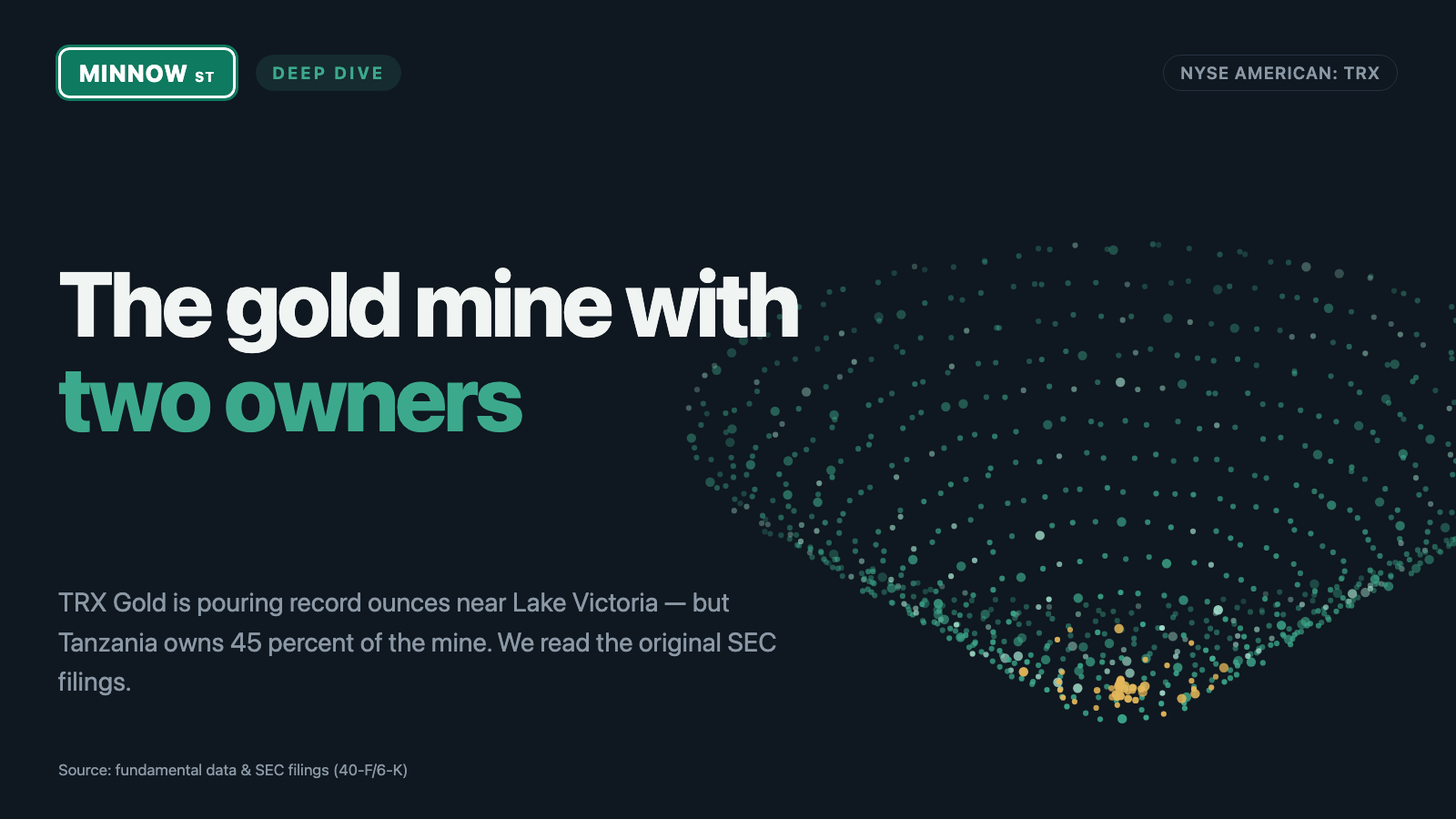
TRX Gold Stock: Records From One Mine in Tanzania — and 45 Percent of It Belongs to the State
Gold trades at record levels, and on Reddit a small ticker keeps surfacing: TRX. Behind it is TRX Gold, a Canadian producer with exactly one mine — Buckreef, south of Lake Victoria in Tanzania. The numbers in the SEC filings (40-F/6-K, fiscal year ending August 31) look like a dream at first glance: production up 58 percent, a 62 percent gross margin, one half-year bringing more revenue than the entire record year before it. At second glance, 45 percent of the mine belongs to the state-owned STAMICO, a warrant revaluation turned the record quarter into an IFRS loss, and the share count grew 14 percent in six months. Not investment advice — just the arithmetic of how much of the gold's shine actually reaches the shareholder.
 Thomas Mücke
Founder & Publisher
Thomas Mücke
Founder & Publisher
Chart
Interactive price chart (TradingView).
Note: pure fact-based analysis, not investment advice and not a solicitation to buy or sell. All figures without guarantee.
When gold writes records, an old reflex starts working: the halo effect. The shine of one big number â in the third fiscal quarter of 2026 an ounce cost, on average, about $4,731 (London PM fix, per the company release of June 5, 2026) â settles like a halo over everything that carries "gold" in its name. A gold mining stock for 80 cents? At that gold price it can only go up! With exactly this shine at its back, the ticker TRX surfaced in our Reddit hype scanner on July 15, 2026: 6 mentions in 24 hours (source: ApeWisdom) â no storm, more of a whisper, but whispers about gold stocks carry far when prices sit at records. Behind it stands TRX Gold Corporation, a producer with a market value of about $264 million (as of July 15, 2026) and exactly one mine: Buckreef in Tanzania. So let’s make a deal: before the halo decides for you, we read together what TRX Gold itself reported to the U.S. securities regulator, the SEC â honest under penalty of law. And because TRX is a Canadian company (incorporated in British Columbia, run from Toronto), the documents here are not called 10-K and 10-Q but 40-F (the annual report for Canadian issuers, filed for fiscal 2025 on December 1, 2025 â a wrapper around the Canadian annual report including financial statements and management’s discussion) and 6-K (interim reports). One more quirk up front so the year labels do not confuse you: the fiscal year ends on August 31 â "fiscal 2026" has thus been running since September 1, 2025, and the "third quarter of 2026" already ended on May 31, 2026. In the end, you decide for yourself.
What TRX Gold actually does
TRX Gold is the simplest kind of company the stock market has to offer â and precisely for that reason the close look pays off: the company digs rock out of an open pit, grinds it, and leaches the gold out. All of it happens in a single place: the Buckreef gold project in the Geita region south of Lake Victoria in Tanzania â about 40 kilometers southwest of the town of Geita, which in turn sits some 110 kilometers southwest of the city of Mwanza on the lake. There stand an open pit and a processing plant that most recently ran at record pace (Q3 2026: 1,833 tonnes of throughput per day, up 25 percent year over year). The company’s map is quickly drawn; its ownership chart is not: the project belongs to Buckreef Gold Company Limited, a joint venture dating from 2011 â 55 percent held by the TRX subsidiary TRX Gold Tanzania Limited, 45 percent by the State Mining Corporation (STAMICO), an agency of the Tanzanian state. On the license area (Special Mining License SML04/92, renewed through June 2032) rest, per the updated estimate of April 2025, 893,000 ounces of gold in the "measured" and "indicated" categories (10.8 million tonnes at 2.57 grams per tonne) plus 726,000 ounces "inferred" â miner’s language for: well documented, or merely first-drilled. A preliminary economic assessment (PEA) published in May 2025 sketches the expansion: an average of 62,000 ounces per year over 17.6 years. As of August 31, 2025, the company employed 241 full-time staff, plus 352 contract miners and project contractors and 173 part-time workers in Tanzania. And the history is longer than the fresh name suggests: in 2006 the company was called Tanzanian Royalty Exploration, from 2019 Tanzanian Gold, since May 2022 TRX Gold â almost two decades of Tanzania, most of them without profit.
Note, right here, the central tension of this analysis: The mine delivers real records — but shareholders own only 55 percent of it, its profit hangs on a gold price at all-time highs, and the same state that holds 45 percent also writes the royalties and the rules. It runs through every chapter of this analysis.
Where the ticker comes from — and why our fundamental scanner does not know it
Honesty first: TRX appears in none of our fundamental stock scanners. That is no verdict, it is systematics — our in-house stock scanner works through the Russell 3000 universe, meaning U.S. companies; TRX Gold is a Canadian corporation whose shares trade on the NYSE American and in Toronto, and so it falls through the grid. The ticker landed on our desk through a different tool: our Reddit hype scanner, which evaluates daily which micro and small caps are suddenly the talk of the U.S. stock forums (data basis: ApeWisdom). On July 15, 2026 it counted 6 mentions in 24 hours for TRX — little noise, but exactly the kind of quiet background hum out of which forums like to build "the overlooked gold stock" when gold prices sit at records. How far a forum crowd can carry a story after the numbers stop cooperating is something you can watch in our analysis of Virgin Galactic, the meme-stock veteran. For TRX the setup means: no scanner metrics as guardrails, no Piotroski score from the database — only the original documents. All the more important to actually read them.
The numbers over the years — honestly appraised
First, what genuinely impresses — and here that is quite a lot. TRX Gold earns money operationally, and has for three fiscal years in a row: $38.3 million of revenue and $7.0 million of net income in fiscal 2023, then $41.2 million of revenue ($3.5 million of net income) in 2024, then the leap: $57.6 million of revenue and $6.6 million of net income in the record year 2025, plus $16.3 million of operating cash flow. And 2026 adds a load you rarely see: the first half alone (through February 28, 2026) brought $59.2 million of revenue — more than the entire record year before it.
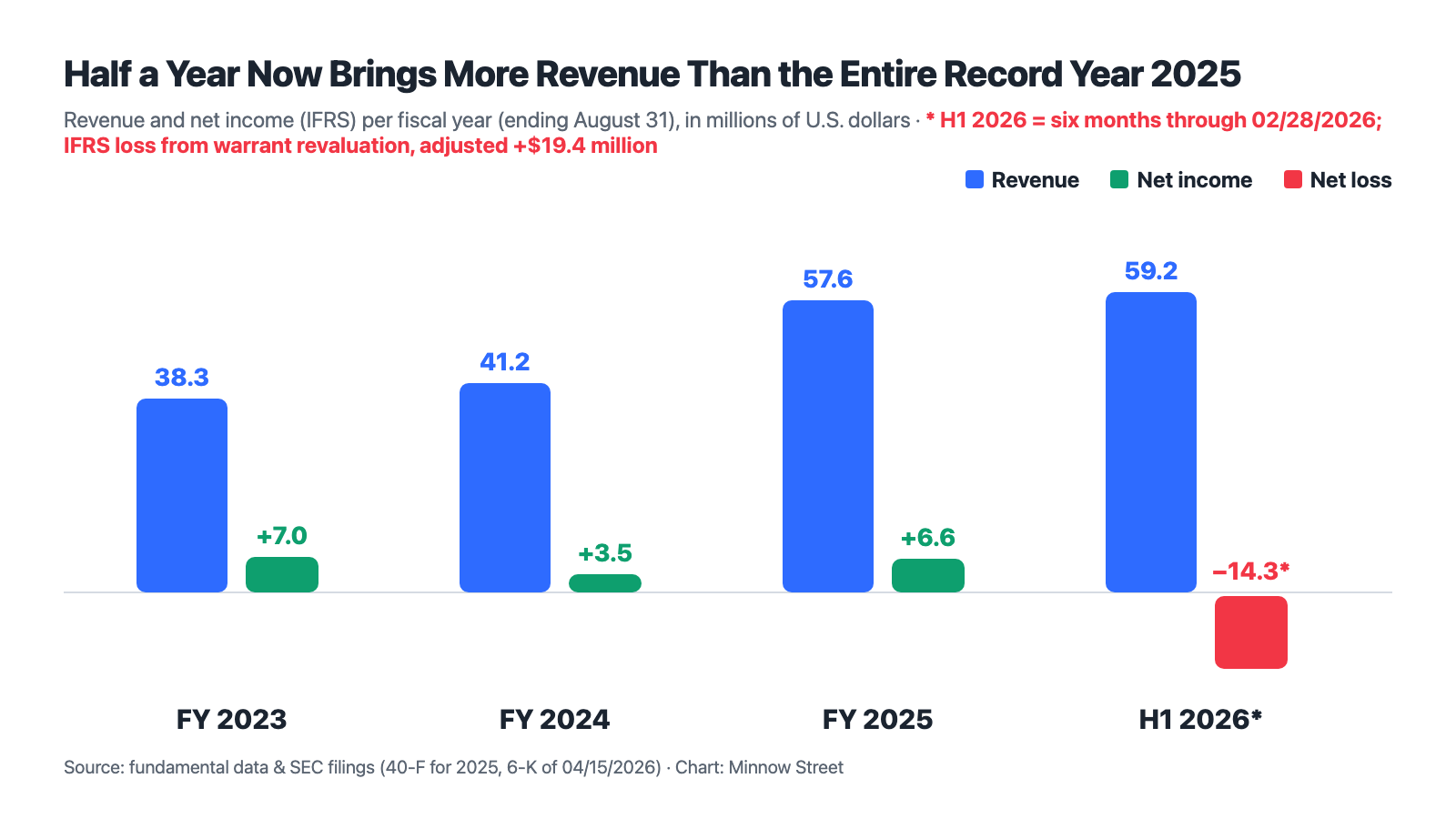
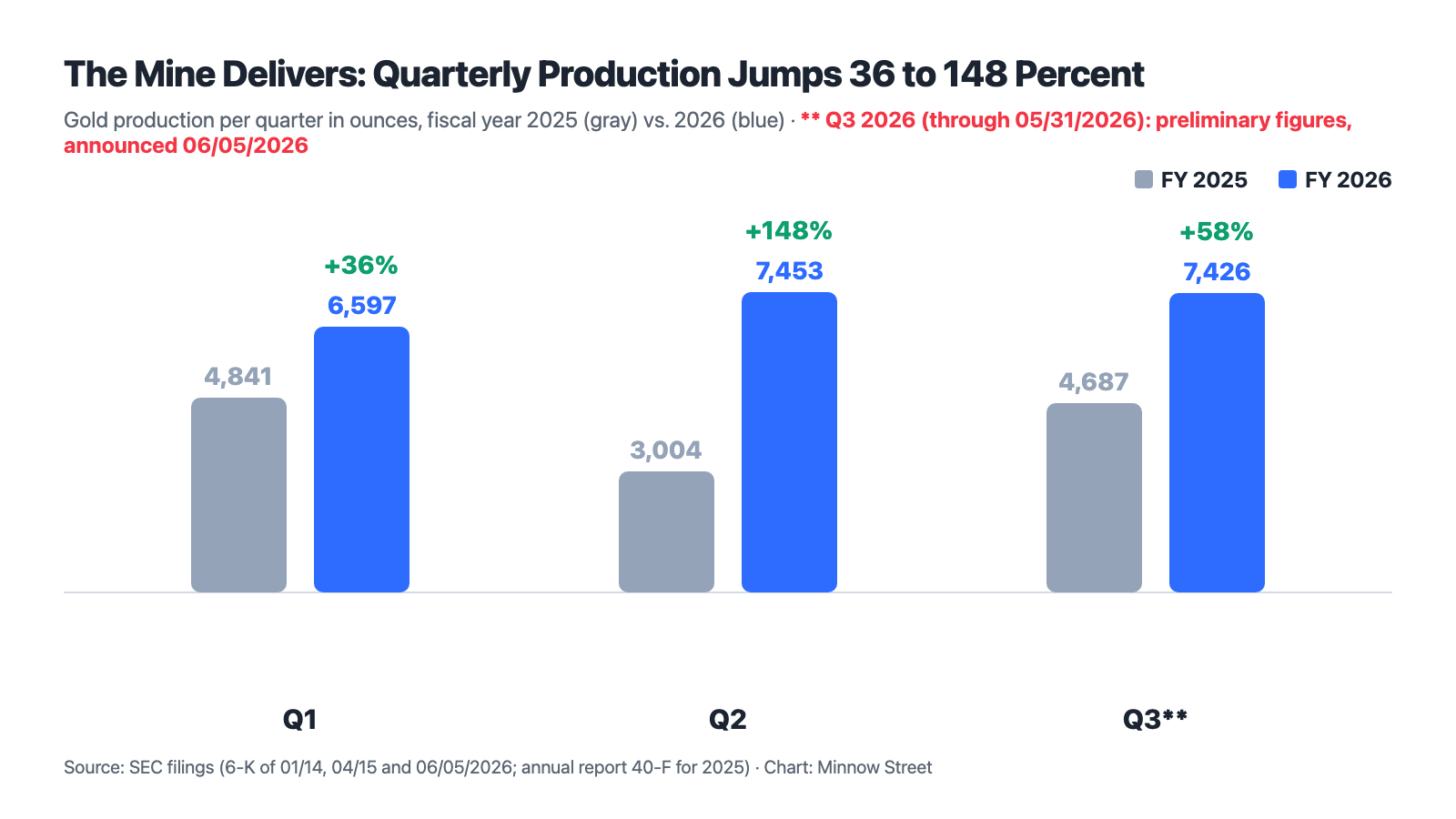
Where does the leap come from? From both levers at once. Lever one: the mine itself. After completing a large waste-stripping campaign in early 2025, Buckreef is reaching higher-grade ore, throughput rose to record levels, and gold recovery — the share of the gold in the rock that actually ends up in the bar — climbed from 67 percent in Q3 2025 to 84.6 percent in Q3 2026. The result in ounces, quarter by quarter:
Lever two: the gold price. In the second quarter of 2026, TRX realized on average $4,655 per ounce sold (Q2 2025: $2,739) â against production costs (cash cost, meaning production costs plus royalties per ounce) of $1,506. Translated: of every ounce, roughly two thirds remained as gross profit, the gross margin came to 62 percent, and the group earned an adjusted $11.7 million in a single quarter â more than in the entire record year 2025. But right here belongs the uncomfortable arithmetic that governs every mining income statement: a producer’s margin is the difference between two numbers, of which it controls only one. The cost per ounce (fiscal 2025: $1,530; target for 2026: $1,400 to $1,600) is set by the mine â the price is set by the world market. Between fiscal 2024 and Q2 2026, the realized price more than doubled; the same lever that is currently multiplying profits would work just as fast in the opposite direction if gold fell. Remember the sentence: a gold producer is a bet on the gold price with a built-in amplifier â in both directions.
What the filings say — the uncomfortable truths
Uncomfortable truth no. 1: 45 percent of the mine belongs to the state — which also writes the rules
The most important line of the whole file does not sit in the income statement but in the risk chapter of the annual report — and it is about ownership:
"Further, the operator of the Buckreef Gold Project is Buckreef Gold Corporation Limited, a joint venture that is 55% owned by one of the Company’s subsidiaries (TRX Gold Tanzania Limited), and 45% owned by STAMICO, a Governmental agency of Tanzania. Therefore, the Government of Tanzania has a substantial input into, and influence over, the Company’s operations at the Buckreef Gold Project."
— TRX Gold Corporation, SEC annual report 40-F for fiscal 2025, Exhibit 99.1 (Annual Information Form), Risk Factors
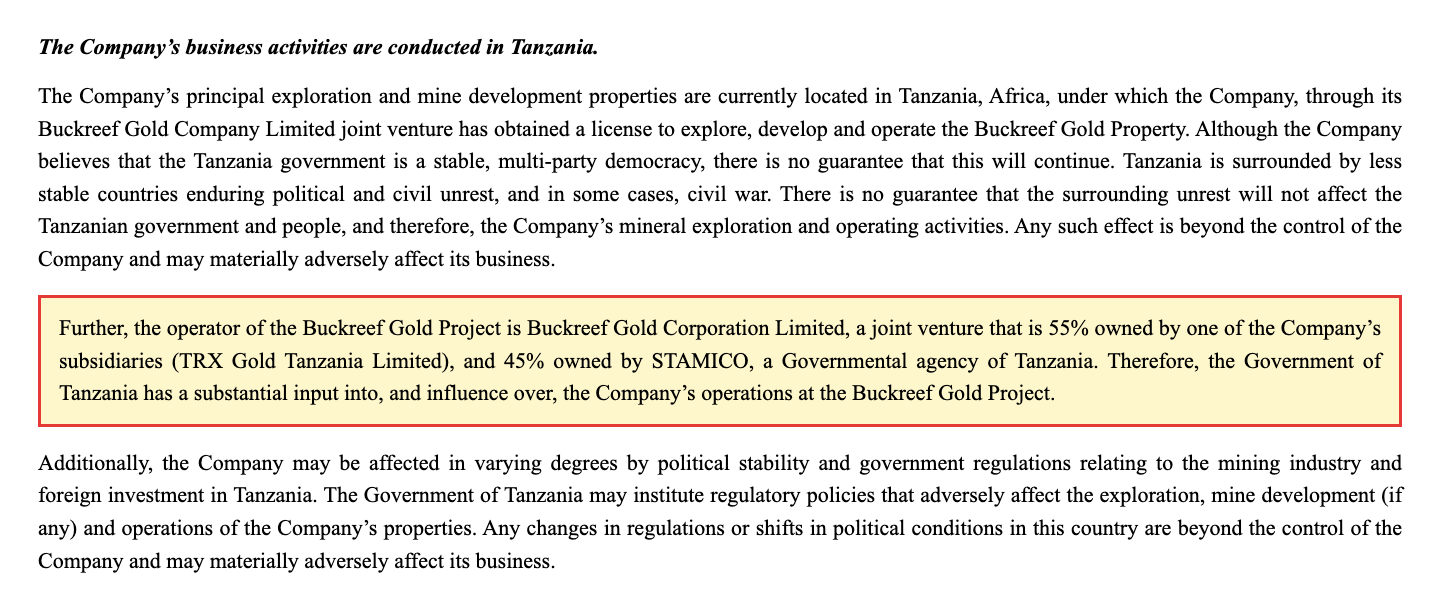
What does that mean in practice? Imagine buying an apartment building with a partner â you pay for the renovation, he contributes the land, and 45 percent belongs to him. Except that here your partner is simultaneously the building authority, the tax office and the legislature. The state of Tanzania earns from Buckreef on several levels at once: as a 45 percent shareholder through STAMICO (whose share of the joint venture’s equity â the "non-controlling interests" â grew from $17.0 to $27.3 million in the first half of 2026 alone), as royalty collector (a 7.35 percent royalty on exports, reduced to 4.35 percent for domestic sales) and as mandatory customer: since 2025, Buckreef â like all mining companies in the country â must set aside at least 20 percent of production for sale to the central bank. On the broader political weather, the annual report says soberly: "Although the Company believes that the Tanzania government is a stable, multi-party democracy, there is no guarantee that this will continue." In fairness: the partnership has functioned since 2011, and the company expressly cites its nearly two decades of presence in the Geita region as a local advantage â but whoever buys the stock should know that between them and the gold stands a co-owner with sovereign power.
Uncomfortable truth no. 2: since 2022 the state is entitled to 16 percent for free — and the 45 percent are being renegotiated right now
In 2022, Tanzania rewrote the rules on state participation in mining — and the annual report describes regulations an investor should read twice:
"[O]n September 23rd, 2022, the Tanzanian Government published the Mining (State Participation) Regulations 2022, which (i) entitle the Government to a 16% non-dilutable, free carried equity interest in any mining venture […] The Company is currently engaged in discussions with the Government to convert the 45% dilutable ownership interest held by the Government through STAMICO into a 16% non-dilutable ownership interest. The timing of reaching any resolution of these matters with the Government is uncertain and there can be no assurance that these discussions will be successfully concluded."
— TRX Gold Corporation, SEC annual report 40-F for fiscal 2025, Exhibit 99.1 (AIF), Risk Factors
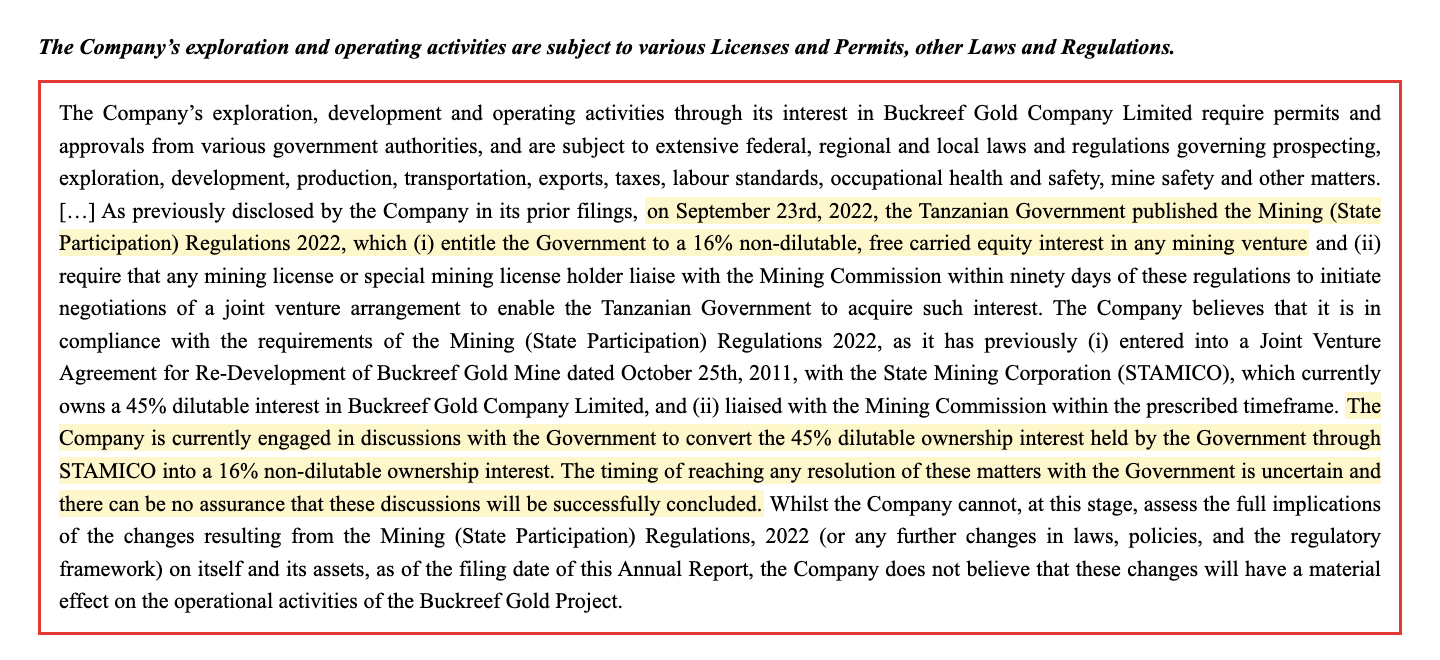
Both sides live in this passage â opportunity and risk, and both are bigger than they sound. The opportunity: if the conversion succeeded, the state’s share would fall from 45 to 16 percent â shareholders’ economic interest in the same mine would rise from 55 to 84 percent, more than half again as much profit entitlement, without a single new ounce. The risk: "non-dilutable, free carried" means the state never pays into capital raises and yet can never be diluted â and the very government TRX is negotiating with created these rules unilaterally by regulation in 2022. A negotiating partner who can write the rules of the game himself is not a normal counterparty. The annual report retreats to the formula that it does not expect a material effect on ongoing operations â which says nothing about how the talks end. Until then: every valuation of this stock contains a variable that is decided in Dodoma, not in Toronto.
Uncomfortable truth no. 3: the record quarter ended in an IFRS loss — and the share count grew 14 percent in six months
Whoever read only the "record quarter" headline in the spring of 2026 may have skipped the bottom line. It is worth the look:
"The Company reported a net loss for the three month period ended February 28, 2026, of $13.8 million ($20.4 million net loss attributable to shareholders, basic and diluted loss per share of $0.07) […] The higher net loss compared to the prior year comparative period is primarily due to a loss on change in fair value of derivative financial instruments due to market based assumptions used in the fair market valuation of the Company’s warrant liabilities as of the date of each respective warrant exercise or expiry."
— TRX Gold Corporation, SEC interim report 6-K of April 15, 2026, Exhibit 99.2 (MD&A for the second quarter of 2026)
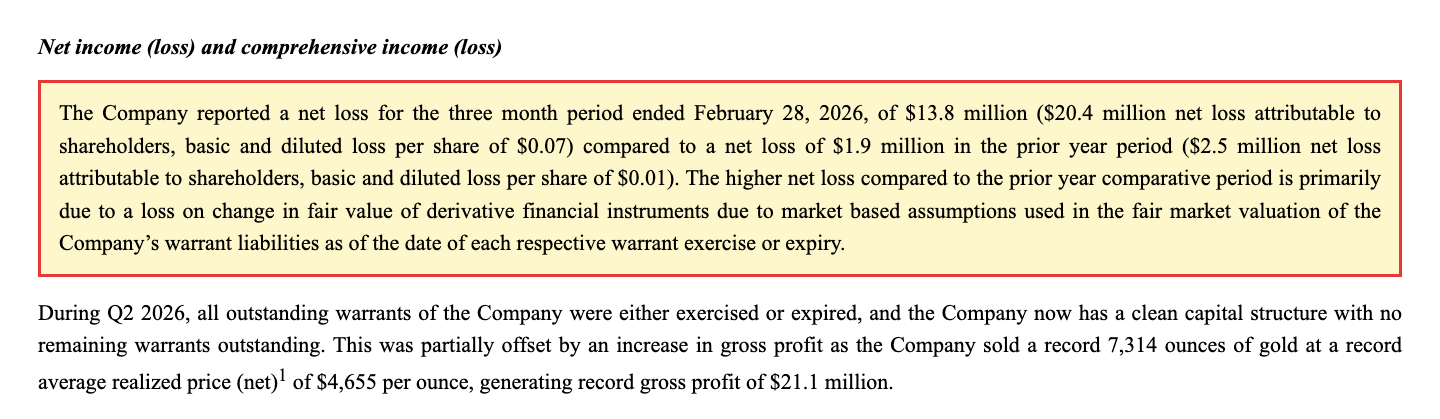
What happened there? A warrant is a subscription certificate: the right to buy new shares later at a fixed price. TRX had raised money in lean years and handed out such certificates as sweeteners. When the share price rises, the certificates become more valuable â and the accounting rules (IFRS) require booking that gain in value as a loss of the company, because the company now owes the certificate holders more valuable shares. So no money flowed out â on the contrary: the exercise of the warrants flushed $21.0 million into the till in Q2 2026, which afterwards held $26.0 million, and since then the company is, by its own account, warrant-free. But the book loss tells honestly who partly paid for the price rally: the existing shareholders. The share count rose from 284.9 million (August 31, 2025) to 325.7 million (February 28, 2026) â up 14 percent in six months; your slice of the cake gets smaller when new slices keep being cut. And that is the end of a long series: the accumulated deficit of the company’s history â two decades of exploration, three company names â stands at $145.8 million (February 28, 2026), financed mostly through ever new shares. On top of that come 5.9 million restricted share units (RSUs) and 12.7 million options from compensation programs, plus an at-the-market program (ATM) under which the company may sell up to $25 million of shares into the market at any time. Remember: growth paid for with fresh shares is never entirely free.
Uncomfortable truth no. 4: one mine, one country, one price — and the expansion still costs money first
TRX Gold has no second mine, no second country, no second product. If the power fails for longer in the Geita region, if rain floods the pit, if a permit jams — then it is not part of the business that stops, but the business. The same concentration applies to the price: the entire profit jump of 2026 rests on a gold price that in Q3 2026 sat 52 percent above the prior year. And the annual report — written in December 2025, when only $7.8 million sat in the till — names the consequence with a candor you have to credit:
"Although the Company had cash of approximately 7.8 million at August 31, 2025, such amounts may be insufficient for the Company’s development and exploration plans and operating expenses. […] Further, the raising of additional capital by the Company may dilute existing shareholders. No assurance can be given that the Company will be able to raise capital in the future."
— TRX Gold Corporation, SEC annual report 40-F for fiscal 2025, Exhibit 99.1 (AIF), Risk Factors
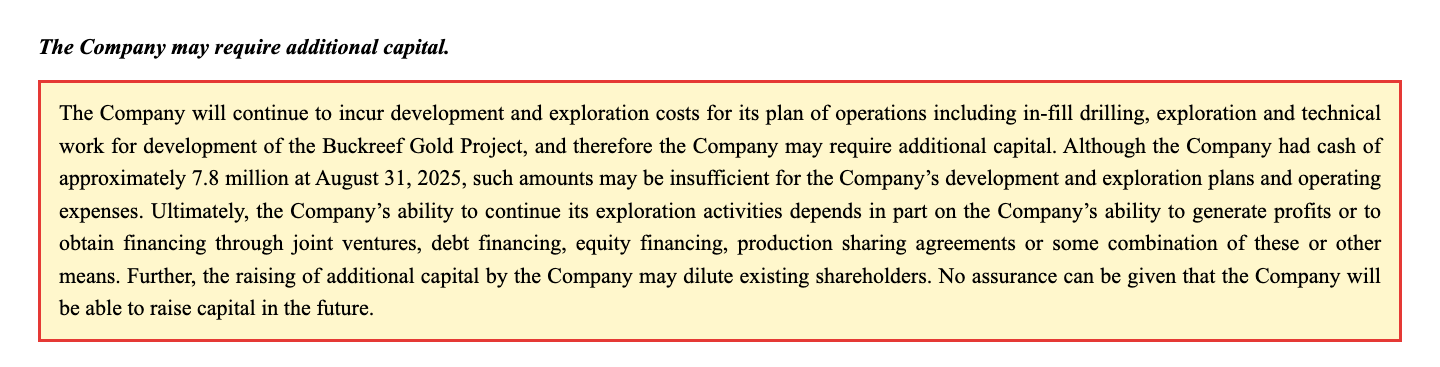
Since then the picture has visibly relaxed — $26.0 million of cash, current assets about 2.4 times current liabilities, plus a credit facility with Stanbic Bank Tanzania of about $9 million ($2.3 million drawn) and a revolving gold prepayment facility of $8.0 million (undrawn at the end of February 2026). But the reason for the capital hunger remains: TRX is expanding. A new mill line for 3,500 tonnes per day is out for tender, and the existing 2,000-tonne plant is being upgraded in parallel (among other things an oxygen plant, a new gold room, a pre-leach thickener) — together considerably more capacity than the May 2025 expansion study assumes. That study, however, is a PEA — a "preliminary economic assessment," the earliest and least binding stage of such calculations, which may even include merely first-drilled resources. Its headline values — $1.9 to $2.6 billion of pre-tax project value at gold prices of $4,000 to $5,000, $0.7 billion in the base case with consensus prices of roughly $2,300 to $2,700 — are paper values for the whole project, of which shareholders own 55 percent. Whether the expansion can be paid out of running cash flow is decided — once again — by the gold price.
Valuation: seven years of profit for the mine — if everything stays the way it never does
Let’s do the sober math. About $264 million of market value (July 15, 2026) stands against $59.2 million of revenue in the first half of fiscal 2026 alone â roughly 2.2 times revenue on an annualized basis. Measured against the adjusted half-year profit of $19.4 million, it would be, extrapolated, about seven times annual earnings â for a growing company with a 62 percent gross margin that sounds almost suspiciously cheap. The discount has addresses, and by now you know them all: first, 45 percent of the mine belongs to the state partner â of the equity growth in the first half, $10.3 million flowed arithmetically into its stake, and what belongs to the shareholders is correspondingly smaller than the consolidated figure. Second, the extrapolated profit hangs on a gold price that averaged about $4,731 in Q3 2026 â every calculation using that price simply extends the record into the future. Third, the expansion costs money before it delivers ounces, and the dilution tool lies within reach (an ATM program of up to $25 million). And fourth, the benchmark is merciless: whoever wants gold exposure without mine, country and dilution risk can simply buy gold â a gold mining stock has to earn its premium of risk with leverage. How quickly a gold story can turn into a standstill is shown by the contrast with the U.S. developer Hycroft â a billion-dollar treasure sits in that ground, but the mine has been idle since 2021. TRX is the counter-model: a small resource, but one that is actually being turned into money. That is exactly why this holds: the price of the stock is a bet on three things at once â gold price, expansion, state partner. If one of the three cards falls, the amplifier carries in the other direction.
Opportunities and risks at a glance
What speaks for TRX Gold:
- Operating records in series: quarterly production up 36 to 148 percent year over year (Q1 through Q3 2026), recovery improved from 67 to 84.6 percent, the full-year target of 25,000 to 30,000 ounces reaffirmed on June 5, 2026 — after 21,476 ounces in nine months.
- Highly profitable at current gold prices: a 62 percent gross margin in Q2 2026 ($4,655 realized per ounce against a $1,506 cash cost), an adjusted half-year profit of $19.4 million, $12.9 million of operating cash flow — and a third consecutive fiscal year of net income (2023: $7.0 million; 2024: $3.5 million; 2025: $6.6 million).
- A solid balance-sheet snapshot: $26.0 million of cash (February 28, 2026), current assets about 2.4 times current liabilities, no warrants outstanding anymore, only small credit facilities (Stanbic: $2.3 million drawn of about $9 million).
- A real growth path: expansion to 3,500+ tonnes of daily throughput out for tender, plant upgrades planned into late 2026, 893,000 ounces of well-documented resources plus 726,000 ounces in the potential category (April 2025) and exploration targets along new zones (Stamford Bridge).
- A possible structural value lever: if the negotiated conversion of the STAMICO stake from 45 to 16 percent succeeded, shareholders’ interest in the mine would rise from 55 to 84 percent â without a single additional ounce.
What speaks against it:
- The state at every lever: 45 percent of the joint venture with the agency STAMICO, a 7.35/4.35 percent royalty, a mandatory sale of at least 20 percent to the central bank, 16 percent free-carried-interest rules since 2022 — and conversion talks whose outcome the annual report itself calls uncertain.
- One-mine, one-country, one-price risk: no diversification; the 2026 profit jump rests on a gold price of at times about $4,731 per ounce (Q3 average) — at cash costs of $1,400 to $1,600 the lever works downward just as forcefully as upward.
- A history of dilution: the share count up 14 percent in six months (284.9 to 325.7 million), $145.8 million of accumulated losses from two decades, an ATM program of $25 million ready for use, plus 5.9 million RSUs and 12.7 million options (February 28, 2026).
- The optics of the reported numbers: despite record quarters, IFRS net losses in Q1 and Q2 2026 (a cumulative $14.3 million; $24.6 million attributable to shareholders) from the warrant revaluation — whoever reads only "adjusted" ignores whose stakes were diluted.
- Capital needs for the expansion: the annual report itself warns the funds may be insufficient and further capital raises may dilute; the PEA paper values ($0.7 to $2.6 billion pre-tax, depending on the gold price) are preliminary, apply to the whole project and thus belong to shareholders only at 55 percent.
A human conclusion
Back to the halo from the beginning. The halo effect does not lie about the metal — gold does stand at record levels, and TRX Gold measurably converts it into revenue, margin and cash; the records in the filings are real and backed by original documents. The halo lies about the question that follows: how much of this shine actually belongs to you? At TRX the honest answer is: 55 percent of a single mine, divided by a share count that most recently grew 14 percent in six months, dependent on a price nobody controls, and negotiated with a state that is co-owner, royalty collector, mandatory customer and legislator in one person. The 6 Reddit mentions of July 15, 2026 will turn all that into the simple story — "small gold stock, giant gold price." Your task is the less comfortable one: separating the shine from the appearance. If the gold price holds, the expansion succeeds and 45 percent one day becomes 16, this stock really was underestimated in the summer of 2026. If not, what remains is a small mine with a big partner and an open bill. Check who owns the shine before you pay for it. What you make of it is your decision. And that is exactly as it should be.
Sources
All original documents used in this analysis — to read for yourself. Note: TRX Gold is a Canadian issuer and files with the SEC, instead of the U.S. forms 10-K/10-Q, the annual report 40-F (with the Annual Information Form, financial statements and MD&A as exhibits) and interim reports 6-K; the fiscal year ends August 31:
- TRX Gold Corporation â SEC annual report 40-F for fiscal 2025 (filed December 1, 2025), with Exhibit 99.1: Annual Information Form, Exhibit 99.2: consolidated financial statements and Exhibit 99.3: management’s discussion and analysis (MD&A)
- TRX Gold Corporation — SEC annual report 40-F for fiscal 2024 (filed November 29, 2024)
- TRX Gold Corporation — SEC interim report 6-K of January 14, 2026: MD&A for the first quarter of 2026 (through November 30, 2025)
- TRX Gold Corporation — SEC interim report 6-K of April 15, 2026: MD&A for the second quarter of 2026 (through February 28, 2026) and interim financial statements (Exhibit 99.1)
- TRX Gold Corporation — SEC interim report 6-K of June 5, 2026: preliminary production figures for the third quarter of 2026 (Exhibit 99.1)
- TRX Gold’s complete SEC filing history: EDGAR overview (sec.gov)
- Reddit mentions: in-house Reddit hype scanner based on ApeWisdom data (6 mentions in 24 hours, as of July 15, 2026); market value about $264 million as of the same date.
- Fundamental data (metrics, valuation; data as of July 15, 2026), reconciled with the SEC filings.
Transparency & disclaimer: This analysis is a journalistic contextualization of publicly available information and is not investment advice, not a financial analysis in the regulatory sense, and not a solicitation to buy or sell securities. Stock investments — especially in commodity small caps with single-mine concentration and state ownership — carry substantial risks up to total loss. All information without guarantee; the data cut-off is noted in the text in each case. The preliminary Q3 2026 figures come from the company release of June 5, 2026 and are unaudited. The author holds no position in TRX Gold securities at the time of publication.
Our Bottom Line at a Glance
- Business model & project neutral
- A pure single-mine producer: Buckreef (Tanzania) with an open pit, a 2,000-tonne plant and a committed expansion to 3,500+ tonnes per day; 893,000 ounces of well-documented resources plus 726,000 ounces in the potential category (April 2025). Easy to understand, but without any diversification across mine, country or product (40-F for fiscal 2025).
- Operating performance positive
- Records in series: quarterly production up 36 to 148 percent (Q1-Q3 2026 vs. prior year), recovery up from 67 to 84.6 percent, H1 2026 revenue of $59.2 million above the entire record year 2025 ($57.6 million), the full-year target of 25,000-30,000 ounces reaffirmed on June 5, 2026 — the mine delivers, measurably.
- Balance sheet & financing neutral
- $26.0 million of cash and a current ratio of ~2.4 (February 28, 2026), no warrants left, only small credit facilities — but the annual report itself warns of possible additional capital needs for the expansion, and the $25 million ATM program sits ready for use; the till held just $7.8 million on August 31, 2025.
- State partner & Tanzania risk negative
- STAMICO holds 45 percent of the operating joint venture, the state collects a 7.35/4.35 percent royalty, buys a mandatory minimum of 20 percent of production (central bank) and in 2022 granted itself, by regulation, a 16 percent free carried interest in any mining venture; the conversion talks (45 to 16 percent) are, per the 40-F, uncertain — opportunity and concentration risk at once.
- Capital history & dilution negative
- The share count up 14 percent in six months (284.9 to 325.7 million through February 28, 2026), $145.8 million of accumulated losses from almost two decades and three company names; the warrant revaluation turned the record quarter Q2 2026 into an IFRS loss of $13.8 million ($20.4 million attributable to shareholders).
- Gold price leverage neutral
- A cash cost of around $1,500 against $4,655 realized per ounce (Q2 2026) — the lever fully explains the record profits and works downward just as strongly if the gold price falls; the Q3 2026 average price of about $4,731 (up 52 percent year over year) is the silent core assumption of every extrapolation.
TRX Gold is the rare Reddit discovery whose fundamentals genuinely shine: record production, a 62 percent gross margin, a full till, a third consecutive profitable fiscal year. But the shine has co-owners: 45 percent of the only mine belongs to the Tanzanian state agency STAMICO, the profit jump hangs on a gold price at record levels, the share count grew 14 percent in six months, and the future state share is being negotiated with an open outcome. About $264 million of market value (July 15, 2026) thus buys an amplifier on the gold price — with the state, dilution and single-mine risk as the counterweight. Not investment advice.
What Our Rating Means
- If you don't own the stock
- As long as the question raised in the bottom line stays open, we see no basis for an entry.
- If you hold it in your portfolio
- Our findings offer no acute reason to sell — the checkpoints named remain decisive.
A journalistic assessment by our editorial team at the time of the deep dive, based on public sources — not investment advice and not a solicitation to buy or sell. Your personal circumstances (investment goals, risk capacity, taxes) cannot be taken into account. What our categories mean, how verdicts are formed, and what conflicts of interest exist →
Worth Noting
- TRX landed on our research list through our Reddit hype scanner (ApeWisdom data): 6 mentions in 24 hours as of July 15, 2026. Forum mentions are sentiment signals, not quality signals. Our fundamental scanners (Russell 3000 universe) do not cover the Canadian name by design.
- TRX Gold is a Canadian issuer and files, instead of 10-K/10-Q, Forms 40-F (annual report, filed for fiscal 2025 on December 1, 2025) and 6-K (interim reports); the fiscal year ends August 31. The Q3 2026 production figures (release of June 5, 2026) are preliminary and unaudited; the full Q3 figures are announced for mid-July 2026.
- The market value figure is dated July 15, 2026 (about $264 million); analyses are evergreen, daily prices are not a buy argument. All amounts in U.S. dollars (TRX Gold's reporting currency).
Frequently Asked Questions
TRX Gold (NYSE American and Toronto: TRX) is a Canadian gold producer with exactly one project: the Buckreef gold mine in the Geita region south of Lake Victoria in Tanzania — an open pit plus a processing plant running at most recently 1,833 tonnes of daily throughput (Q3 2026). In fiscal 2025 (through 08/31/2025) the company generated $57.6 million of revenue and $6.6 million of net income; for 2026 it targets 25,000 to 30,000 ounces of production.
Two owners: the operating joint venture Buckreef Gold Company Limited belongs 55 percent to the TRX subsidiary TRX Gold Tanzania Limited and 45 percent to the State Mining Corporation (STAMICO), an agency of the Tanzanian state. Per the annual report 40-F for fiscal 2025, the government of Tanzania thereby has substantial influence over the project; talks about converting the 45 percent into a non-dilutable 16 percent stake are under way — outcome open.
Because TRX Gold is a Canadian issuer (incorporated in British Columbia): such companies may file with the SEC, under the U.S.-Canadian MJDS system, the annual report 40-F — a wrapper around the Canadian original documents (Annual Information Form, financial statements, MD&A). Interim releases and quarterly reports arrive as Form 6-K. The penalty of law for false statements is the same as for 10-K and 10-Q; the fiscal year ends August 31.
Operationally yes, for three fiscal years: $7.0 million of net income in 2023, $3.5 million in 2024, $6.6 million in the record year 2025. In the first half of fiscal 2026 the group earned an adjusted $19.4 million — but reported an IFRS net loss of $14.3 million, because the revaluation of exercised warrants had to be booked as a paper loss. No money flowed out; on the contrary, the warrant exercises brought $21.0 million into the till ($26.0 million as of 02/28/2026).
The Mining (State Participation) Regulations of September 23, 2022 entitle the Tanzanian state to a non-dilutable, free carried interest of 16 percent in any mining venture. Per the annual report 40-F for fiscal 2025, TRX Gold is negotiating to convert the state's existing 45 percent stake (held through STAMICO) into those 16 percent — if that succeeded, shareholders' interest in the mine would rise from 55 to 84 percent. Timing and outcome of the talks are, per the company, uncertain.
Almost entirely — with an amplifier. TRX produced in Q2 2026 at a cash cost of $1,506 per ounce and realized $4,655 (Q3 2026 market average: about $4,731, up 52 percent year over year): roughly two thirds of every sale remained as gross profit. When gold rises, profit grows disproportionately — when gold falls, it shrinks just as disproportionately, because the costs (2026 target: $1,400 to $1,600 per ounce) stay. There is no second mine or second product as a buffer.
Substantially and over a long time: between August 31, 2025 and February 28, 2026 alone, the share count rose from 284.9 to 325.7 million (+14 percent), mainly through exercised warrants (proceeds: $21.0 million). The accumulated deficit from almost two decades of company history stands at $145.8 million. Since the second quarter of 2026 no warrants remain outstanding; there are, however, 5.9 million RSUs, 12.7 million options and an ATM sales program of up to $25 million (as of 02/28/2026).
Found an error?
Did you spot a factual error, an outdated number, or a typo in this deep dive? Let us know briefly — your report goes straight to the editorial team.