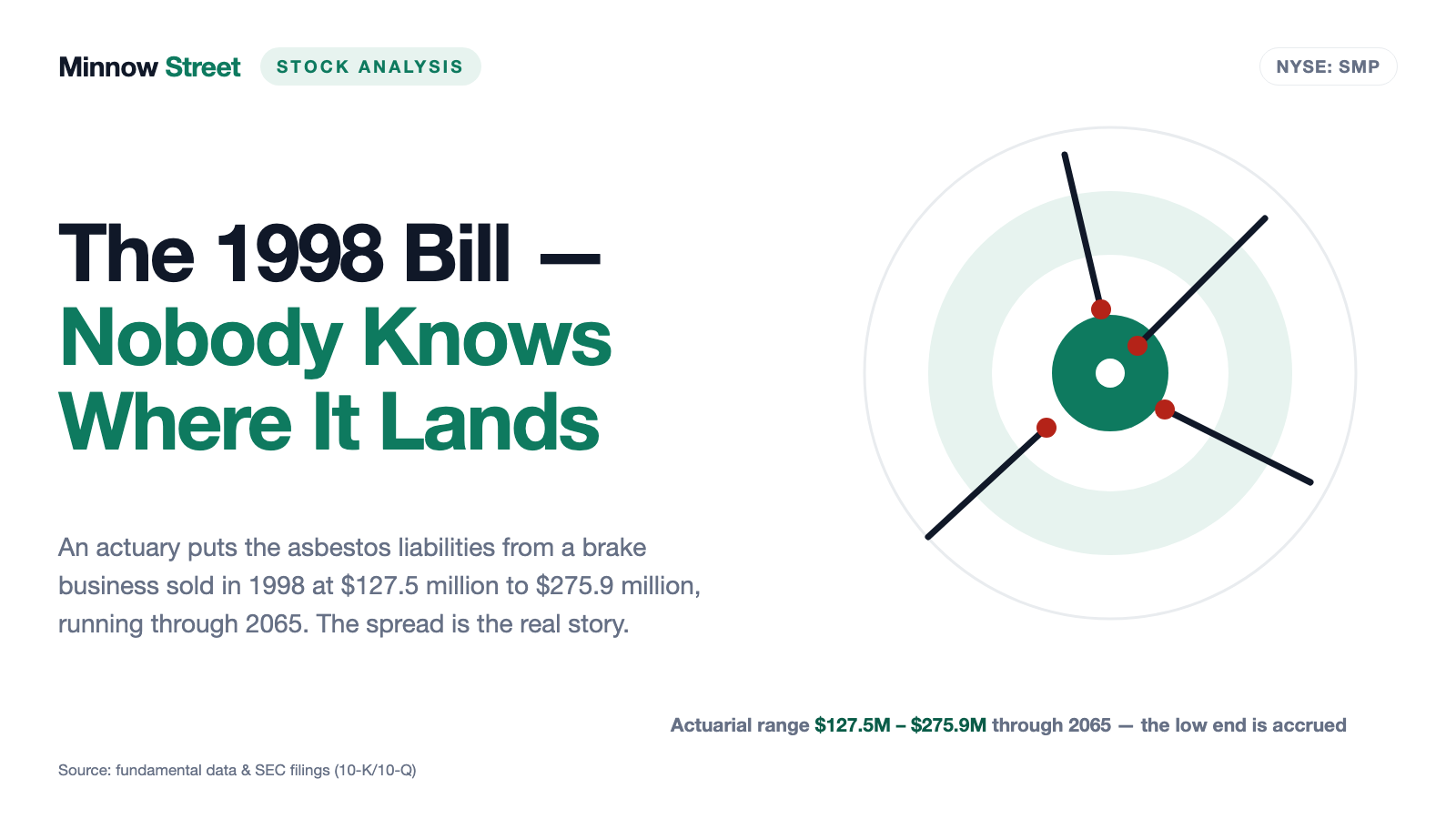
Redwire Stock Forecast: 58 Percent More Revenue, Triple the Share Count — and a $721 Million Goodwill Mountain
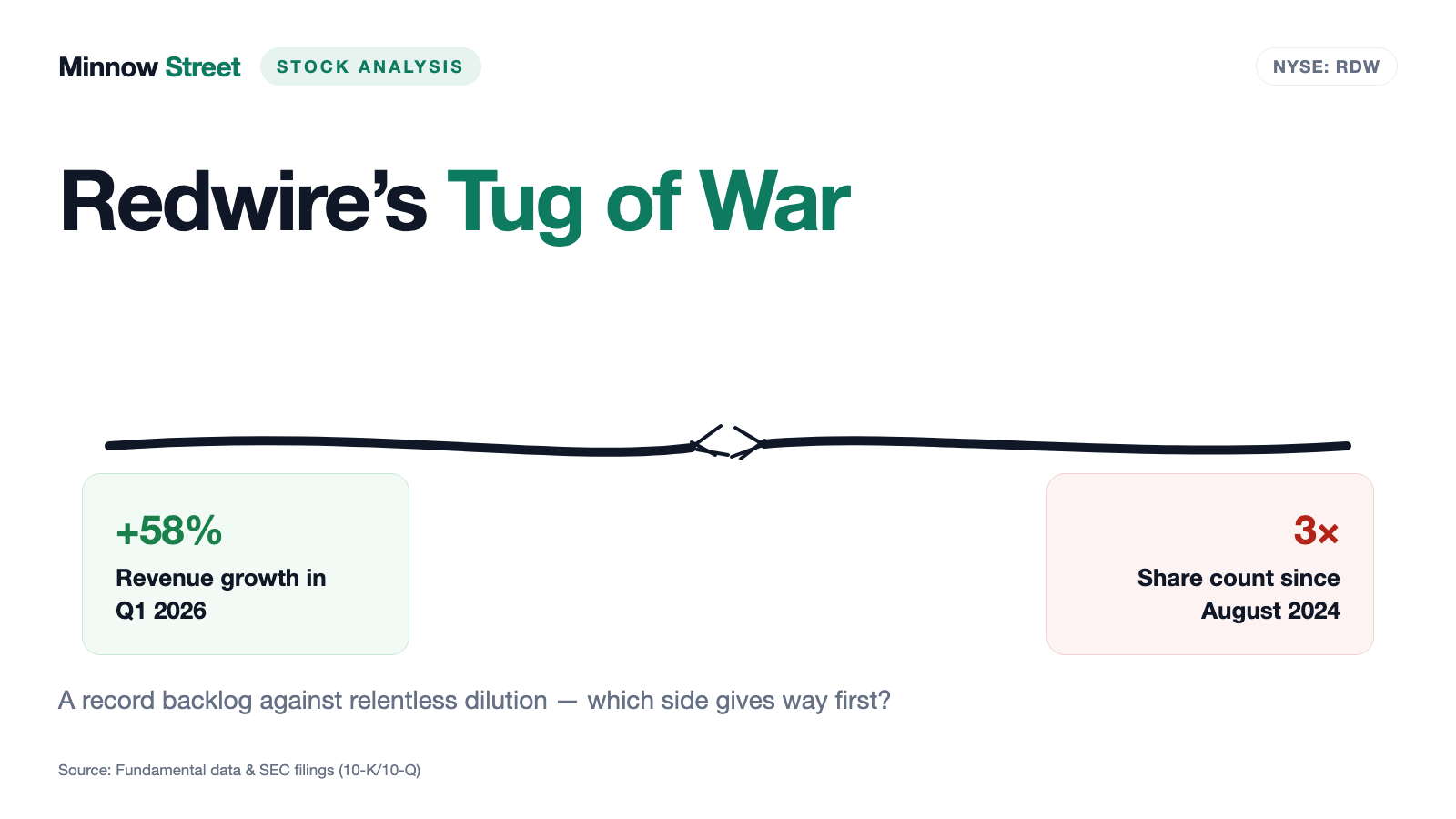
Redwire Space reported a record backlog of $498.1 million for the first quarter of 2026 and a gross margin that nearly doubled within a year. The same report also says: the company's own internal control over financial reporting was not effective as of December 31, 2025, and the share count has nearly tripled since August 2024 — with a freshly launched $500 million dilution program still running. This Redwire stock forecast sorts the record backlog, the governance finding and the dilution before it names a single number. Not investment advice — just the question of which of the two stories ends up weighing more with you.
 Thomas Mücke
Founder & Publisher
Thomas Mücke
Founder & Publisher
Chart
Interactive price chart (TradingView).
Note: pure fact-based analysis, not investment advice and not a solicitation to buy or sell. All figures without guarantee.
There is an investor trap that works best on space stocks precisely because it borrows the perfect image for it: the launch trap. A price rockets straight up, and your brain automatically reads that as liftoff — something big is happening here, get in now before it leaves the pad. With Redwire Corporation (NYSE: RDW), better known as Redwire Space, exactly that movie played out in the spring of 2026: swept up in the SpaceX-IPO hype, the stock climbed to an all-time high of $26.64 (late May 2026) — up from a 52-week low of just $4.87. Whoever bought in then is sitting on a loss of roughly two-thirds today: at the close on July 31, 2026, the stock stood at $8.62. A rocket that is falling still looks, from a distance, like a rocket that is climbing — right up until it doesn't anymore.
So let's make a deal before you read the next forecast on the Redwire stock: we read together, first, what Redwire actually told the U.S. securities regulator, the SEC — the annual report (10-K) for 2025 from February 27, 2026, and the most recent quarterly report (10-Q) as of March 31, 2026 from May 7, 2026, plus every mandatory filing through July 29, 2026. A filing to the SEC is honest under penalty of law. And this one tells two stories at once: a record backlog and a gross margin that nearly doubled within a year — and a share count that has nearly tripled since August 2024, while a fresh $500 million dilution program keeps running. By the end, you decide for yourself which of the two stories weighs more with you.
Contents
- Redwire Space or Redwire Corporation — Who Is RDW?
- What Redwire Actually Does
- How This Stock Landed on Our Desk
- The Numbers Over the Years
- What the Filings Say — the Uncomfortable Truths
- Redwire Stock Forecast: Price Targets and What the Numbers Support
- Opportunities and Risks at a Glance
- A Human Conclusion
- Sources
Redwire Space or Redwire Corporation — Who Is RDW?
The name on the paperwork is Redwire Corporation; in the market and in its own branding, the company calls itself Redwire Space — both names mean exactly the same business, listed on the NYSE under the ticker RDW. At the U.S. securities regulator, the SEC, everything runs under a single identifier, CIK 0001819810. Anyone who knows that number can pull up every mandatory filing the company has made since going public — and that is exactly what we did for this analysis.
Redwire is not a startup in the classic sense; it is the product of a de-SPAC: on September 2, 2021, the operating Redwire group merged with the empty acquisition shell Genesis Park Acquisition Corp. and inherited its stock listing — the faster, but also bumpier, road to the public markets compared with a traditional IPO. Going public through a SPAC means the operating company skipped the usual, often months-long roadshow process with investors; instead, it stepped into an already-listed empty shell and was tradable within weeks. The upside is speed; the downside, which we'll see in the uncomfortable-truths chapter, is less runway to build out everything a company's controls and processes normally need time to mature. The company is headquartered in Jacksonville, Florida, and incorporated in Delaware. At the helm since the founding are Chairman, CEO and President Peter Cannito and CFO Chris Edmunds; the financial statements are audited by KPMG — a name that matters again in the uncomfortable-truths chapter.
As of the July 31, 2026 data cutoff, Redwire employed roughly 1,400 people per fundamental data. The fiscal year ends December 31, and the most recently filed periodic report is the quarterly report (10-Q) as of March 31, 2026, filed May 7, 2026. The second-quarter 2026 report was still pending at the time of this analysis — Redwire had announced it for after market close on August 5, 2026, with an earnings call the following day, August 6, 2026. What you're reading here, then, is the picture immediately before that release: the last officially confirmed numbers, not the next ones — and every statement about the second quarter is deliberately flagged as a dated outlook, not a fact.
Every price mentioned anywhere in this piece is a dated valuation anchor, never a buy signal for today — that rule holds throughout.
What Redwire Actually Does — Space Infrastructure and Defense Tech Under One Roof
Translated into an everyday picture: Redwire is a supplier of things meant to stay in orbit or fly there — not a rocket builder like SpaceX, but more like the toolbox-and-parts supplier for the companies that are. The business splits into two segments: Space (satellite components, solar-array technology, robotics, digital engineering services) and Defense Tech — a segment that has only existed at this scale since June 13, 2025, the day the acquisition of Edge Autonomy closed.
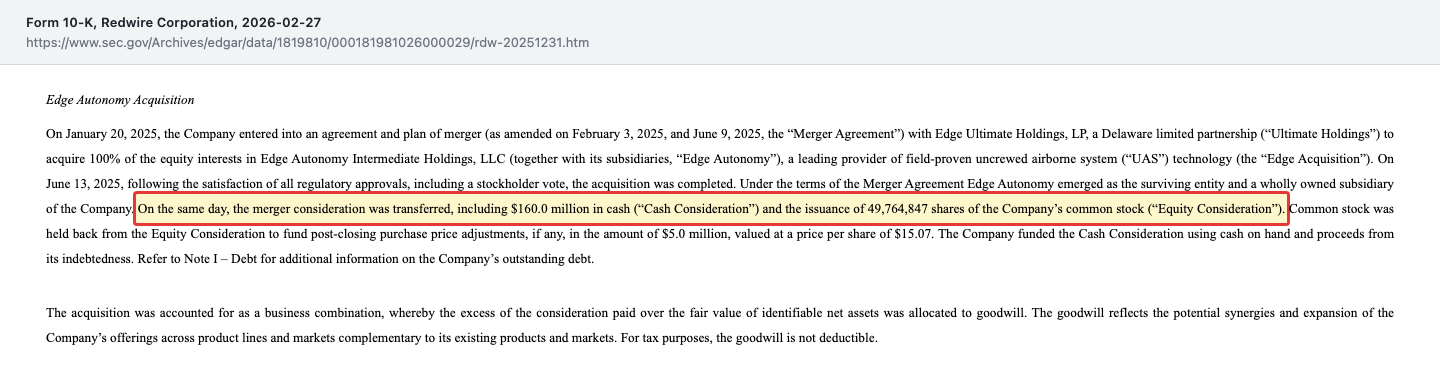
Edge Autonomy is the single largest step in Redwire's recent history. Per the annual report, the purchase price consisted of $160.0 million in cash plus the issuance of 49,764,847 shares of Redwire's own common stock:
"On the same day, the merger consideration was transferred, including $160.0 million in cash (“Cash Consideration”) and the issuance of 49,764,847 shares of the Company’s common stock (“Equity Consideration”).
— Redwire Corporation, SEC annual report 10-K for 2025, Note C "Edge Autonomy Acquisition"
Edge Autonomy brings unmanned aerial systems (UAS) and autonomy technology in-house — Redwire's answer to how the company can broaden out of pure space work into a market with real, near-term demand from defense budgets. The deal was funded from cash on hand, a new $90 million JPMorgan credit facility, and a "Seller Note" of $100 million — a loan from the seller itself, at 15 percent interest with a 1.2x minimum-return clause. Who exactly that seller was, and what it means for Redwire's ownership structure, is its own story, one we've broken out separately in the side-finds attached to this analysis — here in the main text we're focused on the operating business.
Across all of fiscal 2025, Space still carried the lion's share: $209.8 million of revenue against $125.6 million from Defense Tech — though Defense Tech only entered the annual figure from mid-June, so barely more than half a year. By the first quarter of 2026, the first full comparable quarter, the picture had already shifted noticeably: Space contributed $52.7 million to revenue, Defense Tech $44.3 million — after just one more quarter under the same roof, that's already close to half the business. The backlog shows the same shift: of the $411.2 million total at year-end 2025, $299.8 million sat with Space and $111.4 million with Defense Tech. If you want to see how other small space-and-defense suppliers handle exactly this two-segment structure, our T3 Defense analysis is an instructive counterpoint: the word "Defense" carries the name there too, but without the operating substance Redwire at least partly bought along with Edge Autonomy.
A look at the customer mix shows who Redwire actually works for: in fiscal 2025, 46.9 percent of revenue came from the national-security segment, 21.6 percent from civil agencies (such as NASA and ESA), and 31.5 percent from commercial customers; 41.6 percent of revenue came from customers outside the United States. Two individual customers together accounted for roughly 39 percent of revenue (about 19 and 20 percent) — a noticeable customer concentration, though not unusual in the space and defense supply chain. The international share of backlog grew from $70.5 million (end of 2024) to $193.1 million (end of 2025) — more than a tripling, driven in part by Edge Autonomy's Ukraine business. The annual report itself names that exact business as a risk: should the war end, the associated revenue would likely decline — a demand driver nobody wishes for, but one that is genuinely contributing to the backlog today.
A word on the "artificial intelligence" buzzword that hangs around almost every tech-adjacent stock: the annual report for 2025 describes "digital engineering and artificial intelligence automation" as part of the company's own offering — mostly inside the autonomous systems Edge Autonomy brought along. Redwire is therefore not an AI company; it uses AI technology specifically where autonomy is genuinely needed — for instance, in unmanned aircraft that have to navigate on their own. For valuation purposes that means: AI is a component in the product, not a revenue line of its own and not a standalone stock argument.
How This Stock Landed on Our Desk
Redwire surfaced repeatedly through our in-house stock scanner — what we call confluence, when a stock keeps showing up across different filters regardless of whether you sort by balance-sheet strength, price momentum, or valuation metrics. That's rarely a coincidence, and usually a sign that several kinds of market participants are looking at the same story from different angles. With Redwire, the trigger wasn't a single metric but a contradiction between several. The balance-sheet metrics look solid at first glance: an equity ratio of 73.15 percent and a debt-to-equity ratio of just 0.087 (data as of July 31, 2026) — figures more typical of a solid industrial than a company on eight consecutive quarters of net losses. The catch, which we unpack in the uncomfortable-truths chapter: that strength comes almost entirely from freshly issued shares, not from retained earnings.
The Piotroski F-Score, a nine-point test of accounting quality (it checks, among other things, profitability, leverage, and operating efficiency against the prior year), sits at 4 of 9 for Redwire — translated: "okay, not good." A genuinely healthy, growing company usually scores 7 or 8. The Altman Z-Score of 2.31 sits in the so-called gray zone (between 1.81 and 2.99) — neither clearly distressed nor clearly safe, a case for closer scrutiny, not for alarm. Net current asset value (NCAV) is negative at −$102.9 million; for a growing industrial company that's less alarming than it would be for a pure balance-sheet bet, but it shows: there is no cushion of liquid net working capital here — the $144.5 million of cash sits against substantial current liabilities.
Especially telling is the analyst estimate for earnings per share: −$0.12 for the current fiscal year but −$0.68 for the following one (data as of July 31, 2026) — the consensus, in other words, expects a larger loss per share two years out, not a smaller one. Whether that's driven by planned investment, expected further dilution, or conservative modeling, the raw number doesn't say — but it's a reason to look closer, not to trust the rally.
One check our scanner rarely skips: debt against the size of the company. As of the July 31, 2026 data cutoff, Redwire carries a market capitalization of roughly $2.02 billion; against that stands comparatively low net debt, per the feed, of just $63.7 million. Translated: whoever bought the entire company would pay comparatively little on top for the debt — the balance sheet is genuinely a plus here, as contradictory as that reads next to eight loss-making quarters. In short: the scanner shows "solid balance sheet, middling quality, unclear outlook" — on a stock that had hit its all-time high only weeks before the data cutoff and had since given back roughly two-thirds of it. That gap between the metrics and the price action is exactly why this analysis exists.
The Numbers Over the Years — What Genuinely Impresses First
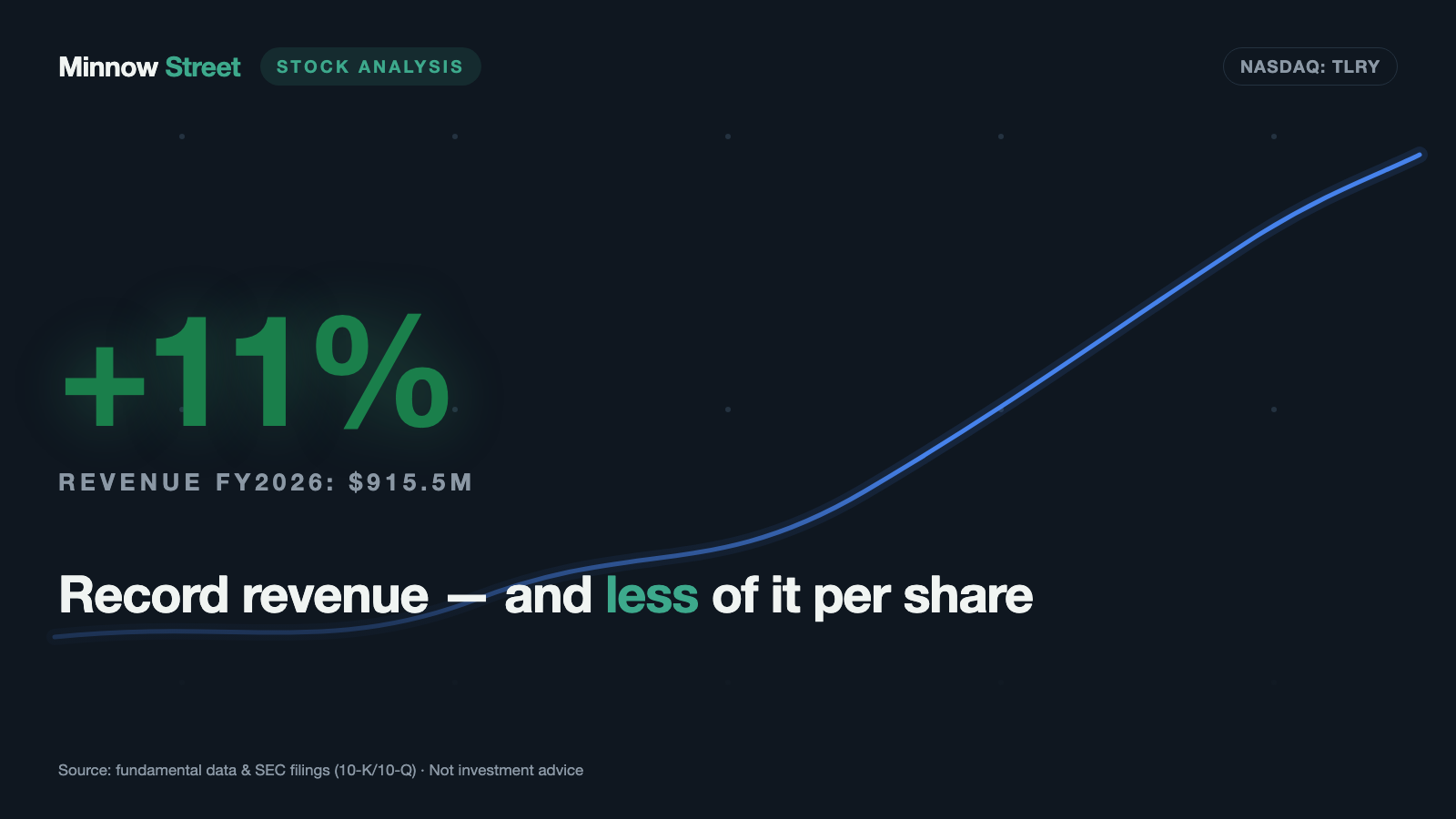
Let's start with what genuinely speaks for Redwire, and it's more than the net loss alone suggests. Revenue has grown every single year since the IPO: from $137.6 million (2021) through $160.5 million (2022) and $243.8 million (2023) to $304.1 million (2024) and $335.4 million for fiscal 2025 — up 10 percent, $107.1 million of it from Edge Autonomy, consolidated since mid-June 2025. In the first quarter of 2026, growth accelerated sharply to up 58 percent year over year — $97.0 million of revenue against $61.4 million. That's the number on our cover image too.
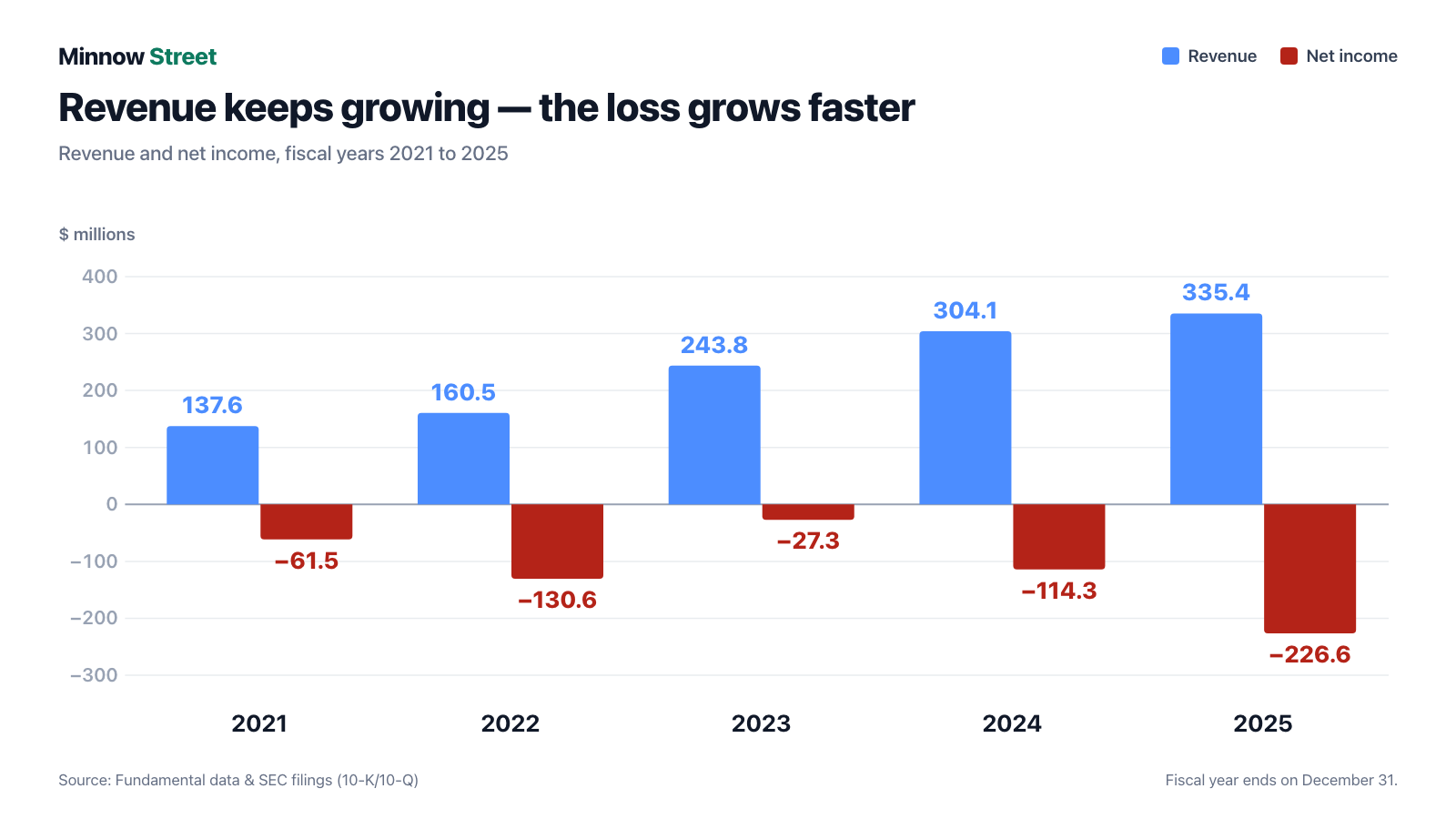
The red series in the chart is the other half of the truth: not one of those five years produced a positive net result. The net loss came in at $61.5 million (2021), $130.6 million (2022), $27.3 million (2023), $114.3 million (2024) and, most recently, $226.6 million (2025). 2023 was by far the best year of the five — since then the shortfall has been widening again, and the 2025 figure is the largest in company history.
Operating cash flow — the cash that actually moves in or out of day-to-day business, independent of accounting effects — also shows no straight line, but a recognizable pattern: −$37.4 million (2021), −$31.7 million (2022), then a single positive year at +$1.2 million (2023), followed by −$17.3 million (2024) and a deep drop to −$177.3 million in the acquisition year 2025 — before easing sharply in the first quarter of 2026 to just −$6.7 million. That number alone explains why Redwire, despite a record net loss in 2025, has no going-concern problem: the large 2025 cash outflow was overwhelmingly integration- and acquisition-related, not a permanent operating state.
The quarter-by-quarter view also shows that 2025 was not a straight path: after $61.4 million of revenue in the first quarter of 2025 (net loss of just $2.9 million, helped by a one-time warrant-valuation gain), a weak second quarter followed with $61.8 million of revenue but a $97.0 million net loss. Business then picked up: $103.4 million of revenue in the third quarter (net loss $41.2 million) and $108.8 million in the fourth quarter of 2025 — the highest single-quarter revenue in company history to that point — at a net loss of $85.5 million, partly due to the goodwill impairment booked that same quarter. The first quarter of 2026, with $97.0 million of revenue and a $76.5 million net loss, continues that pattern: revenue growth, yes; a positive net result, not yet by a long shot.
The real surprise sits in the metrics that rarely make headlines: gross margin jumped from 15 percent (Q1 2025) to 27 percent (Q1 2026), operating cash flow improved from minus $45.1 million to just minus $6.7 million — nearly break-even. And backlog hit a record $498.1 million as of March 31, 2026, up from $411.2 million at year-end 2025:
"Backlog increased to $498.1 million as of March 31, 2026 from $411.2 million as of December 31, 2025."
— Redwire Corporation, SEC quarterly report 10-Q as of 03/31/2026, Item 2 (MD&A)

Behind that sits the book-to-bill ratio — a simple metric, translated: is more new business coming in than is being worked off? A value above 1 means yes, the backlog is growing. For Redwire, this ratio jumped from 0.92 (Q1 2025, backlog shrank slightly) to 1.92 (Q1 2026):
"Book-to-bill ratio increased to 1.92 for the three months ended March 31, 2026 from 0.92 for the same period in 2025."
— Redwire Corporation, SEC quarterly report 10-Q as of 03/31/2026, Item 2 (MD&A)
Liquidity is also sturdier than the net loss would suggest: $144.5 million of cash plus a $30 million undrawn credit line as of March 31, 2026, for $174.5 million total — up 21 percent from year-end. A small but telling detail on the side: standby letters of credit (collateral Redwire has to post with business partners) fell from $15.4 million (end of 2024) to just $0.7 million (end of 2025) — a sign that counterparties are now extending more trust to the company. Redwire itself states a line every investor should read before putting money in, because it is the opposite of a going-concern qualification:
"We believe our existing sources of liquidity will be sufficient to meet our working capital needs and debt service obligations and to comply with our debt covenants for at least the next twelve months from the date on which our condensed consolidated financial statements were issued."
— Redwire Corporation, SEC quarterly report 10-Q as of 03/31/2026, notes (Liquidity)
The debt side has visibly eased too. At the end of 2025, Redwire fully retired its expensive Adams Street loans ($75.5 million of term loans plus a $30 million revolver) out of ATM proceeds — with a $1.0 million loss on early extinguishment. On February 20, 2026 came a new JPMorgan credit agreement: a $90 million term loan plus a $30 million revolver, maturing May 2029, at SOFR plus 3.25 to 3.75 percent — an effective rate around 8.06 percent, well below the prior term loan's effective 13.31 percent. Refinancing added a $2.5 million loss on debt extinguishment in the first quarter of 2026. And on July 1, 2026 came a solid piece of progress: Redwire prepaid $40 million of that loan — the remaining term loan shrank to just $50 million, while the revolver capacity was simultaneously raised to $50 million.
Alongside conventional debt, Redwire also carries expensive preferred capital: 46,505.13 Series A preferred shares with a 13 percent cash (or 15 percent payment-in-kind) dividend and a liquidation preference of $118.4 million as of December 31, 2025 — considerably pricier than any bank loan on the books. Total equity, over the same window, flipped from −$188.7 million (12/31/2024) to +$1,087.5 million (03/31/2026) — a sign change that, as we'll see next, comes overwhelmingly from new shares, not from earnings. Whoever looks only at the net loss misses this half of the story. Whoever looks only at the record backlog misses the other half — the one we turn to now.
What the Filings Say — the Uncomfortable Truths
Now for the other side of the tug-of-war. The chapters so far have deliberately started with what speaks for Redwire — growth, margin recovery, record backlog, falling debt. That wasn't spin; it was the first half of a complete picture. The second half comes now: five findings from the same mandatory SEC reports, each independently sourced and documented — and together they explain why this analysis's quality light lands on red, even though the operating business has genuinely improved lately.
Uncomfortable truth No. 1: the share count has nearly tripled since August 2024 — and the next program is already running
Dilution means your slice of the pie gets smaller because the pie keeps getting cut into more pieces — even as the pie itself grows. At Redwire you can read this straight off the cover pages of the company's own SEC filings, because each one states the current share count as of the filing date:
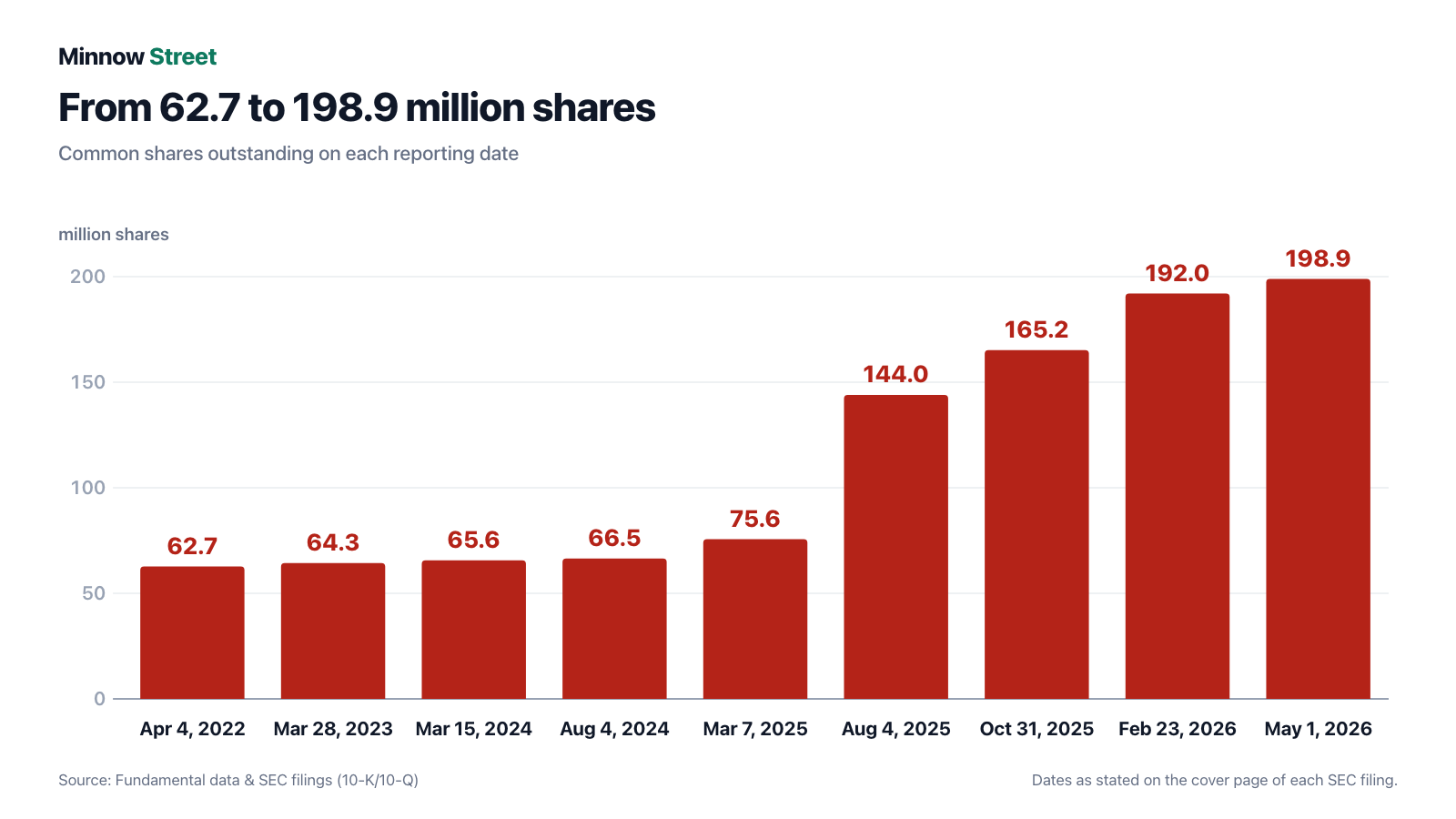
In the first years after the IPO, dilution stayed modest: 62.7 million shares as of April 4, 2022, 64.3 million as of March 28, 2023 and 65.6 million as of March 15, 2024 — fewer than three million additional shares in almost three years. The big jump happens between August 2024 (66.5 million shares) and today: 75.6 million in March 2025, 144.0 million in August 2025, 165.2 million in October 2025, 192.0 million in February 2026, and most recently 198,918,728 shares as of May 1, 2026 — the latest date any SEC filing names. Part of that comes from the Edge Autonomy purchase (49.8 million new shares in June 2025) and from a capital raise used to retire the expensive seller note (15,525,000 shares at $16.75 in June 2025, $245 million net proceeds). The larger and more durable driver, though, is a so-called ATM program — "at-the-market," a standing authorization to keep selling new shares directly into the market in small tranches, like a faucet that never quite fully closes. The $250 million program launched in November 2025 was, per the quarterly report, effectively exhausted within roughly five months: in the first quarter of 2026 alone, Redwire sold 6,942,924 shares this way:
"During the three months ended March 31, 2026, the Company sold 6,942,924 shares of its common stock at a weighted average price of $9.38 for $65.1 million of gross proceeds."
— Redwire Corporation, SEC quarterly report 10-Q as of 03/31/2026, Note J (Stockholders' Equity)

The quarterly report itself admits the program had only a "nominal amount" of capacity left as of March 31, 2026 — and it was promptly replaced. On May 6, 2026, Redwire launched a new $350 million ATM program; on June 9, 2026 — just five weeks later — that one was already replaced by a $500 million program with ten participating banks. The escalation, in numbers: $250 million (November 10, 2025) → $350 million (May 6, 2026) → $500 million (June 9, 2026). On top sits a dilution reservoir that hasn't even been tapped yet: as of March 31, 2026 the preferred stock was convertible into roughly 16,079,001 common shares, plus 2,633,195 warrants with an $11.50 strike price (expiring September 2, 2026) and 3,351,023 shares reserved for employee stock purchases. That this pattern isn't a one-off shows in the rear-view mirror: the public warrants from the SPAC era are already fully spent — 6,738,225 of them were exercised by early 2025 at $11.50 each ($77.5 million of proceeds for Redwire), and another 1,450,586 were redeemed for just $0.01 each. Those were new shares too, every one of them. And the ceiling is set high: Redwire's charter authorizes up to 500,000,000 common shares — against 198.9 million issued as of May 1, 2026, there's formally plenty of room for further dilution without a shareholder vote. Remember the mechanism: every new share issued shrinks the slice belonging to everyone already holding one — even while revenue keeps growing at the same time. Anyone who owns 1 percent of Redwire today would have owned roughly 3 percent of it in August 2024.
Uncomfortable truth No. 2: the company's own accounting controls failed their own inspection
Internal control over financial reporting (ICFR), translated into an everyday image, is the safety inspection for a company's books: a system of checks meant to ensure the numbers in the financial statements are correct before they ever reach the outside auditors. Redwire's own management reached a clear verdict for fiscal 2025 — and it reads: failed.
"Based on this assessment, management concluded that our internal control over financial reporting was not effective as of December 31, 2025 because of the material weaknesses described below."
— Redwire Corporation, SEC annual report 10-K for 2025, Item 9A (Controls and Procedures)
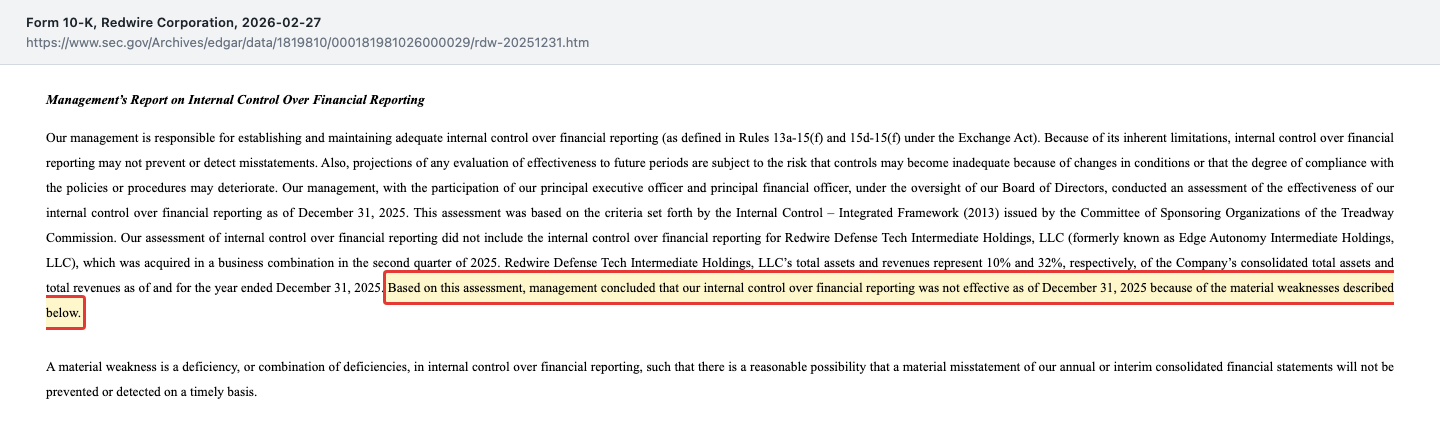
Important context: this is not an accusation of misstated numbers — the report doesn't name any resulting financial-statement errors. It's a process verdict: controls in the United States couldn't be demonstrably operated effectively for long enough, and Europe plus the rest of the U.S. business lacked sufficient IT general controls (ITGCs). Auditor KPMG confirmed that verdict with a so-called "adverse opinion" — the harshest rating available for internal control. Making it worse: the newly acquired Edge Autonomy unit — a full 10 percent of total assets and 32 percent of group revenue — was entirely excluded from this 2025 assessment and carries its own, still-unresolved control weaknesses. Translated: the largest single acquisition in company history hadn't even been through the same inspection as the rest of the group yet.
Redwire is no stranger to this topic. The company already went through a restatement era in 2021 — late quarterly filings (NT 10-Q in May and November 2021) and an amended annual report (10-K/A), fallout from the SPAC era, when many freshly listed companies had to re-do their warrant accounting. That same period produced a shareholder class action (filed December 2021) that was already settled earlier. At the annual meeting on May 20, 2026, all nominated directors were elected and KPMG was ratified as auditor for 2026 — the record date of March 27, 2026 carried voting rights for the 198,918,728 common shares plus 46,505.13 preferred shares (equivalent to 16,067,291 votes). A routine, unremarkable outcome on its own — but a signal that current leadership continues to hold investor confidence while the control question stays unresolved in the background. Separately, since February 2026, a settlement has been working through a distinct shareholder derivative suit (Yingling v. Cannito) that also traces back to the restatement era: it provides for governance reforms and D&O-insurance-funded legal fees, received preliminary court approval on June 8, 2026, and had its final hearing scheduled for July 30, 2026. Two separate suits, one shared root: the accounting troubles of the early years after the SPAC listing. As a countermove, Redwire brought a former EY audit partner with 38 years of experience, Gregory L. Heston, onto the board and audit committee on July 14, 2026 — succeeding David Kornblatt. Whether that's enough won't be clear before the next annual report: remediation steps are planned for 2026 but not yet complete.
Uncomfortable truth No. 3: the Edge bet — $721 million of goodwill, the first impairment came after two quarters
Of the $160.0 million cash purchase price and the 49.8 million new shares for Edge Autonomy, the largest single chunk landed not in machinery, patents, or customer contracts, but in a balance-sheet line that's hard to pin down: goodwill. Translated: the premium a buyer pays above a company's tangible value — for expectations, market position, future hope. For Edge Autonomy that came to $721.3 million, alongside $264.8 million of developed technology, $15.4 million of customer relationships, and $17.9 million of trade name. Goodwill is the line that falls first at the annual impairment test when expectations don't pan out — and that's exactly what already happened at Redwire, and quickly: just two quarters after the June 13, 2025 closing, Redwire had to write down $34.7 million in the fourth quarter of 2025, $20.9 million of it against goodwill, $10.9 million against intangibles, and $2.6 million against property and equipment.
For scale: $721.3 million of goodwill equals roughly 68 percent of the $1,060.0 million of equity reported as of December 31, 2025, and more than a third of the roughly $2.02 billion feed market value. Put another way: Defense Tech, the segment carrying this goodwill, generated $44.3 million of revenue in the first quarter of 2026 — the goodwill alone equals roughly 16 times a single quarter of that segment's revenue. A concentration risk of this size means: should the annual impairment test — the next one due with the fiscal 2026 annual report — again trigger a write-down, it would hit reported equity directly, without a single dollar of cash moving. One additional, concrete risk specific to this goodwill: part of Edge Autonomy's business is tied to the war in Ukraine, whose associated revenue the annual report already describes as declining — should the war end, that demand driver could disappear entirely. How seriously the auditor itself treats this line shows in the fact that KPMG flags the Edge Autonomy purchase price allocation in the annual report as a "Critical Audit Matter" — a distinct, specially highlighted audit note reserved for balance-sheet items with high judgment and high significance to the financial statements. Translated: even the auditor is implicitly saying the valuation of this one item carries an unusual amount of judgment. Fairness demands the other side of the ledger too: Defense Tech, the segment Edge Autonomy anchors, is at the same time the only segment with a positive segment result (Adjusted EBITDA of plus $5.4 million in the first quarter of 2026) — the bet isn't lost from the outset, but it's expensive, and it has already gone wrong once.
Uncomfortable truth No. 4: the net loss is real, but larger than the operating picture — and 2025's gross margin was the exception, not the norm
Two numbers from the first quarter of 2026 deserve closer scrutiny because they point in opposite directions if you only read the headline. First: the reported net loss of $76.5 million contains more than $44 million of one-time effects — $42.1 million alone from accelerated vesting costs on "Edge Incentive Units" (a stock-based compensation component from the purchase agreement whose acceleration clause triggered in the first quarter of 2026). SG&A costs (sales, general and administrative expenses) totaled $82.9 million — 85 percent of quarterly revenue — as a result. Already across full-year 2025, the same line item had risen sharply, driven in part by $47.1 million of additional stock-based compensation, $44.4 million of which was those same Edge Incentive Units — so the Q1 2026 spike was the continuation of a pattern already set in motion in 2025, not a one-off surprise out of nowhere. Adjusted EBITDA, which strips out effects like these, came in at "only" minus $9.2 million, and Defense Tech was already positive at the segment level, at plus $5.4 million. So the net loss is real — but noticeably smaller than the headline number suggests.
Second, and this puts the gross-margin recovery from the previous chapter in perspective: across all of fiscal 2025, gross margin was just 5 percent — down from 15 percent the year before. The main reason sits in a term worth understanding once, because Redwire's numbers barely make sense without it: EAC adjustments (Estimate-at-Completion). Many space and defense contracts are multi-year fixed-price agreements — Redwire promises today's price for work that won't be finished for two or three years. If a project turns out to cost more than budgeted along the way, the company has to book that retroactively in the current period. That is exactly what happened in 2025, at a scale large enough to drive the weak margin on its own: −$54.5 million of net adjustments, after already −$17.7 million the prior year — more than a tripling. On top came $13.6 million of non-cash purchase-accounting effects from the Edge acquisition. A third cost block weighed on the 2025 income statement as well: net interest expense rose $26.2 million, $20.0 million of it from the previously mentioned "seller note" — the 15 percent-interest loan from the seller that Redwire had already retired by June 2025, but only after several months of expensive bridge financing.
Translated into an everyday picture: a construction contractor promises a customer a fixed price for a building project. If material costs rise faster than expected during construction, the contractor eats the difference — not the customer. With several large projects running at once, that can eat an entire year's margin. The jump to 27 percent in the first quarter of 2026 is therefore an encouraging signal, but not yet proof: the quarterly report doesn't break out EAC adjustments for the single quarter, and one good quarter doesn't disprove a multi-year series of fixed-price cost overruns. Whether 27 percent is the new normal or a snapshot won't be clear before the next annual report at the earliest. One last footnote for anyone doing their own earnings-per-share math: because the bottom line is a loss, warrants, preferred stock, and employee purchase rights are explicitly treated as not dilutive in the earnings-per-share calculation per the quarterly report ("anti-dilutive") — the real dilution from Truth No. 1 therefore doesn't yet show up fully in the EPS figure at all, only in the raw share count.
Uncomfortable truth No. 5: the company's own revenue guidance calls for quarters Redwire has never once delivered
For full-year 2026, Redwire most recently affirmed revenue guidance of $450 to $500 million:
"For the full year ended December 31, 2026, Redwire affirms that it is forecasting revenues of $450 million to $500 million."
— Redwire Corporation, Results release, 8-K of 05/06/2026, Ex 99.1
Let's do the arithmetic on what that requires. In the first quarter of 2026, Redwire generated $97.0 million. To reach the $450 million floor, the remaining three quarters together need to deliver $353 million — an average of roughly $118 million per quarter. For the $500 million ceiling, it would be roughly $134 million per quarter. The strongest single quarter in company history to date was the fourth quarter of 2025 at $108.8 million — below both target figures. The guidance, in other words, requires Redwire to beat its own all-time record in each of the next three quarters, and on average by a meaningful margin.
That's not an automatic red flag — the record backlog ($498.1 million, book-to-bill 1.92) and the "Andromeda" umbrella contract with the Space Systems Command announced in May 2026, with a $1.8 billion ceiling (a shared award vehicle with no guaranteed individual task order, and therefore not reflected in backlog), at least supply an order base for it. A $12.8 million order for ELSA solar arrays from Moog, more than $20 million of Stalker UAS orders from the U.S. Marine Corps, and an order from the European Space Agency (with Honeywell) for space-based quantum key distribution also landed in the first quarter of 2026 — and after quarter-end, the Artemis II mission launched with Redwire technology on board. But a full backlog doesn't guarantee revenue that lands on time — as Truth No. 4 just showed. Whoever buys into Redwire's own revenue guidance is implicitly also buying the bet that three record quarters land back-to-back — something this company has never once managed before.
Redwire Stock Forecast: Price Targets and What the Numbers Support
Every serious Redwire stock forecast has to open with a caveat: for a company on eight consecutive quarters of losses, there's no price-to-earnings ratio that can be meaningfully computed. What's left are revenue multiples and a look at what professionals are actually willing to pay for the stock. As of July 31, 2026, price-to-sales on a trailing-twelve-month basis stood at roughly 5.5, and price-to-book at roughly 1.7. Neither is a bargain, but neither is astronomical either, the way some space story-stocks trade — the valuation sits in a middle range, neither fire-sale nor full-blown growth premium.
A quick cross-check on market cap, because feed data shouldn't be taken on faith: multiplying the most recently SEC-documented share count (198,918,728, as of May 1, 2026) by the most recent price named in a mandatory filing ($9.74, an insider sale on July 14, 2026) yields a market value of roughly $1.94 billion. The data provider shows roughly $2.02 billion as of July 31, 2026 — a gap of roughly 4 percent, plausibly explained by further ATM sales and price movement between the two dates, well below the threshold at which we'd flag a feed value as unreliable.
A look at the ownership side rounds out the picture. BlackRock reported a position of 14,582,726 shares as of June 30, 2026 — roughly 7.3 percent of shares then outstanding — a stake typical of broadly diversified index funds, not an active buy signal from a single investor. On the insider side, several executives reported stock sales (Form 4) between late May and mid-July 2026; the most recently documented one was a sale to cover taxes owed on vesting stock awards, not a discretionary exit — a distinction any serious insider-sale analysis should make before treating "insiders are selling" as a warning sign.
Just how bumpy the ride there was shows in the 52-week range itself: $4.87 to $26.64, a factor of more than five. As of the July 31, 2026 data cutoff, the stock sat roughly 67 percent below its high and roughly 70 percent above its low — and over the trailing six months the stock was down roughly 33 percent, even though it was still up roughly 13 percent year-to-date. Three completely different views of the same stock, depending only on which window you pick — one more reason to anchor on annual and quarterly figures rather than the price chart itself.
The analyst consensus — the "professionals' view," put in context rather than taken at face value — stood, as of the July 31, 2026 data cutoff, at an average price target of $14.875, built from six estimates (four "Strong Buy," two "Buy"). Measured against the same day's closing price ($8.62), that's roughly 70 percent above the level at the time — but a consensus price target is a snapshot of sentiment from six people on one particular day, not a guarantee and not our own analysis. If you're looking for a Redwire stock forecast for 2030: neither the company nor any analyst we reviewed offers a credible multi-year price range. Any number for 2030 would be pure extrapolation off the current 2026 revenue guidance ($450 to $500 million), not a fact drawn from the SEC filings. More useful is a look at the building blocks that would have to support or undercut such a forecast: the record backlog, the gross-margin recovery, the ongoing dilution, and the goodwill from the Edge bet — all four of which we've backed with numbers in the chapters above.
One comparison point investors in other space and defense stocks will recognize: readers of our Intuitive Machines analysis will spot the same pattern — a revenue jump driven by acquisitions and large contracts, while the loss persists and the share count grows. The difference at Redwire: there's already a segment (Defense Tech) with a positive result contribution, and the operating cash-flow gap has narrowed noticeably of late. Whether that's enough to outweigh the dilution is, in the end, the central math behind any Redwire stock forecast — and every reader runs that math for themselves.
For anyone who wants to track the building blocks of that math directly, rather than trust someone else's forecast, three concrete, dated questions the next quarterly report will answer offer a useful anchor: first, does Redwire deliver second-quarter 2026 revenue above roughly $110 to $118 million — meaningfully above the current record of $108.8 million? Second, does gross margin hold at roughly 25 to 27 percent, or does it slide back toward the 5 percent seen for full-year 2025? And third, what does the cover-page share count show — does it stay close to the 198.9 million from May 1, 2026, or does it reveal that the $500 million ATM program has been drawn down hard in the meantime? Those three numbers, not the daily stock price, will decide which of Redwire's two stories ends up on top.
One question readers regularly ask us has a short answer: Redwire pays no dividend on its common stock — every available dollar goes into growth, integration, and debt paydown, not back to common shareholders. There is a recurring payout in the building, just not for you as a common shareholder: it goes to the holders of the preferred stock (13 percent cash, or 15 percent in additional preferred shares), which we already put in context in the numbers chapter. Whoever is hoping for cash income from Redwire isn't waiting on a dividend — ultimately, they're waiting on a higher stock price.
Opportunities and Risks at a Glance
Both sides of the tug-of-war, side by side once more, taken equally seriously — neither cancels the other out.
What speaks for Redwire:
- Record backlog of $498.1 million (03/31/2026) at a book-to-bill ratio of 1.92 — meaningfully more new business coming in than is being worked off.
- Gross margin jumped from 15 percent (Q1 2025) to 27 percent (Q1 2026); operating cash flow improved from −$45.1 million to just −$6.7 million — nearly break-even.
- Debt paydown: a $40 million prepayment on July 1, 2026 left the remaining JPMorgan term loan at just $50 million; no going-concern qualification.
- Defense Tech (Edge Autonomy) already delivers a positive segment result (+$5.4 million Adjusted EBITDA, Q1 2026) and diversifies the business away from pure space work.
- Liquidity of $174.5 million as of March 31, 2026 (up 21 percent from year-end); the "Andromeda" umbrella contract, with an $1.8 billion ceiling, offers additional order upside.
What speaks against it:
- Internal control over financial reporting was not effective as of 12/31/2025 (KPMG "adverse opinion"), and the newly acquired Edge unit was excluded from that assessment entirely.
- Share count has nearly tripled since August 2024 (66.5 to 198.9 million), the current $500 million ATM program keeps running, and a further, untapped dilution reservoir sits in preferred stock and warrants.
- $721.3 million of goodwill from the Edge acquisition (roughly 68 percent of equity), $34.7 million already written down after just two quarters, with Ukraine-revenue risk on top.
- Fiscal 2025 gross margin was just 5 percent because of −$54.5 million of fixed-price contract rebookings — whether the 27 percent from Q1 2026 is sustainable won't be clear before the next report.
- 2026 revenue guidance ($450–500 million) requires three consecutive quarters above the current record — a feat Redwire has never delivered; customer concentration, with two customers making up roughly 39 percent of revenue.
What's striking is how cleanly the two lists split: the positive side is almost entirely made up of operating progress — margin, cash flow, backlog, debt. The negative side is almost entirely made up of structural questions — controls, capital structure, balance-sheet risk, the pace of guidance. That's not a coincidence; it is exactly the tug-of-war this analysis is named for: the operating business and the corporate structure have recently been moving in opposite directions, and neither side undoes the other.
A Human Conclusion
Back to the launch trap from the beginning. Its core isn't that Redwire is a bad company — the record backlog, the margin recovery, and the debt paydown are real, documented progress. Its core is that a steeply climbing price tells your brain the problem is already solved — even though the same report that announces the record backlog admits, a few paragraphs later, that internal control isn't effective and unveils a $500 million dilution program. Both statements sit in the same documents. Both are true.
The honest question for you, then, isn't "Am I missing the next SpaceX effect?" but: do you trust a management team that's showing real operating progress but failed its own accounting-control review — and are you willing to keep watching your slice shrink while the company grows? Both answers are legitimate. Whoever says yes is buying a bet on a management team that is currently proving it can deliver operationally, hoping the governance and dilution problems shrink rather than grow by the next annual report. Whoever says no would rather wait for more proof — a clean ICFR opinion, an ATM program that actually stops running, or simply one more quarter without a new surprise. If you answer that question yes, you have a thesis. If not, you had a rocket. What you make of it is your decision — and no Redwire stock forecast anyone hands you changes that. Not investment advice.
Sources
All original documents used in this analysis — to read for yourself:
- Redwire Corporation — SEC annual report 10-K for 2025 (filed February 27, 2026)
- Redwire Corporation — SEC quarterly report 10-Q as of March 31, 2026 (filed May 7, 2026) — most recent periodic report evaluated
- Redwire Corporation — Results release, 8-K of May 6, 2026 (Ex 99.1, Q1 2026)
- Redwire Corporation — current reports (8-K) of May 20, June 9, June 18, July 1 and July 14, 2026, plus ownership filings (SCHEDULE 13D/A of May 20, SCHEDULE 13G of July 29, 2026)
- Full SEC filing history of Redwire Corporation: EDGAR overview (sec.gov)
- Fundamental data (metrics, price data, scanner metrics; data as of July 31, 2026), reconciled with the SEC filings and the SEC XBRL financial series.
Transparency & disclaimer: This analysis is a journalistic contextualization of publicly available information and is not investment advice, not a financial analysis in the regulatory sense, and not a solicitation to buy or sell securities. Stock investments carry substantial risks up to total loss. All information without warranty; the data cutoff is noted in the text throughout. The author holds no position in Redwire shares at the time of publication.
Our Bottom Line at a Glance
- Governance & internal controls negative
- Redwire's own management concluded that internal control over financial reporting was not effective as of December 31, 2025; auditor KPMG confirmed that with an "adverse opinion" — the harshest rating available. The newly acquired Edge Autonomy unit (10% of total assets, 32% of revenue) was excluded from this assessment entirely.
- Dilution negative
- The share count rose from 66.5 million (08/04/2024) to 198,918,728 (05/01/2026) — nearly tripling. The third ATM program within eight months ($250 million → $350 million → $500 million) keeps running, with an untapped reservoir of convertible preferred stock and warrants on top.
- Operating turnaround positive
- Gross margin of 27 percent in Q1 2026 (prior-year quarter 15%), operating cash flow nearly break-even (−$6.7 million, prior-year quarter −$45.1 million), record backlog of $498.1 million at a book-to-bill of 1.92. A genuine operating step forward versus fiscal 2025.
- Goodwill concentration risk (Edge) negative
- $721.3 million of goodwill from the Edge acquisition (roughly 68% of equity) — already in the fourth quarter of 2025, two quarters after closing, a $34.7 million impairment followed. KPMG itself flags the purchase price allocation as a "Critical Audit Matter."
- Debt & balance-sheet structure neutral
- JPMorgan term loan cut to $50 million (prepayment 07/01/2026), effective interest rate reduced from 13.31 to 8.06 percent. Total equity flipped from −$188.7 million to +$1,087.5 million — driven overwhelmingly by new shares, not earnings.
- Earnings quality negative
- The $226.6 million net loss (FY2025) includes $54.5 million of fixed-price contract rebookings; the $76.5 million Q1 2026 loss includes more than $44 million of one-time effects from accelerated stock vesting. Adjusted EBITDA remains negative even excluding those effects (−$9.2 million, Q1 2026).
Redwire Space, for the first time since the Edge Autonomy acquisition, shows a clearly identifiable operating turnaround: gross margin and operating cash flow improved noticeably in the first quarter of 2026, backlog hit a record $498.1 million, and the expensive JPMorgan loan was paid down to $50 million by July 1, 2026. Over the same window, though, the company admitted internal control over financial reporting was not effective (KPMG "adverse opinion," as of 12/31/2025), the share count nearly tripled since August 2024, and $721.3 million of goodwill from the Edge bet carries a concentration risk that has already triggered one impairment. Not investment advice.
What Our Rating Means
Substance risk
We found at least one documented issue that threatens the company itself — regardless of how the stock is currently valued.
Red, because a documented governance finding touches the substance of the reporting itself — not the entry price of the stock. Redwire's own management concluded, for fiscal 2025, that internal control over financial reporting was not effective; auditor KPMG confirmed that with an "adverse opinion," the harshest rating available, and excluded the newly acquired Edge Autonomy unit — 10 percent of total assets, 32 percent of revenue — from the assessment entirely. That is a balance-sheet/governance breach under our criteria, not a footnote: when the control system for the numbers themselves isn't rated reliable, every other number in the report earns the benefit of the doubt, not certainty. That is compounded by a dilution series with no visible end: the share count has nearly tripled since August 2024, and the $500 million ATM program launched June 9, 2026 is already the third escalation within eight months. On top sits a concentration risk: $721.3 million of goodwill from the Edge acquisition, flagged by KPMG itself as a "Critical Audit Matter," already written down once by $34.7 million. In fairness, the other side deserves to be said plainly, because it does not undo this rating but does put it in context: the operating turnaround is real and documented — 27 percent gross margin in the first quarter of 2026 (prior-year quarter 15%), operating cash flow nearly break-even (−$6.7 million instead of −$45.1 million), a record backlog of $498.1 million at a book-to-bill of 1.92, plus debt paid down to just $50 million of term loan by July 1, 2026. Those results speak well of the management team that has been executing since the acquisition — but they do not cancel the governance finding; they only show that work is already underway on the operating front. Whether that is enough to move the light to yellow at the next annual report depends chiefly on a clean remediation of internal controls — not on the stock price. The decision is yours.
A journalistic assessment by our editorial team at the time of the deep dive, based on public sources — not investment advice and not a solicitation to buy or sell. Your personal circumstances (investment goals, risk capacity, taxes) cannot be taken into account. What our levels mean, how verdicts are formed, and what conflicts of interest exist →
Worth Noting
- Redwire reached our research list via our in-house stock scanner, triggered by a contradiction between balance-sheet strength (equity ratio 73.15%, debt-to-equity 0.087) and middling overall quality (Piotroski 4 of 9, Altman Z-score 2.31 in the gray zone; data as of 07/31/2026) — on a stock that hit an all-time high of $26.64 in the spring 2026 SpaceX hype and had given back roughly two-thirds of it by 07/31/2026.
- Recency gate: the most recent periodic report evaluated is the quarterly report (10-Q) as of March 31, 2026, filed May 7, 2026. The second-quarter 2026 report was announced as of this analysis's data cutoff (08/01/2026) — for 08/05/2026 (call 08/06/2026) — but had not yet been filed; every statement about it is deliberately flagged as a dated outlook.
- Market-cap cross-check: share count of 198,918,728 (05/01/2026) times the most recent price documented in a mandatory filing, $9.74 (Form 4, 07/14/2026), yields roughly $1.94 billion; the feed market value of roughly $2.02 billion (07/31/2026) differs by roughly 4% — plausibly explained by further ATM sales and price movement, well below the threshold for an unreliable-data flag.
- Risk of confusion: Redwire Corporation (Redwire Space, NYSE: RDW) is an independent company with no tie to SpaceX; name and topical similarity caused confusion on forums during the spring 2026 SpaceX-IPO hype.
- The quality light rates the company, not the entry price: whether the stock is cheap or expensive at the current price ($8.62, 07/31/2026) is a question for the scanners and valuation metrics (price-to-sales roughly 5.5, price-to-book roughly 1.7), not this light.
Frequently Asked Questions
Redwire Corporation, known in the market as Redwire Space (NYSE: RDW), builds space infrastructure — satellite components, solar-array technology, robotics — in its Space segment, and, since the Edge Autonomy acquisition (June 13, 2025), unmanned aircraft and autonomy technology in its Defense Tech segment. In fiscal 2025, 46.9 percent of revenue came from the national-security segment, and 41.6 percent came from customers outside the United States.
The analyst consensus stood, as of July 31, 2026, at an average price target of $14.875, built from six estimates (four "Strong Buy," two "Buy") — roughly 70 percent above the $8.62 closing price on the same day. That is a dated snapshot of sentiment from six people, not a guarantee: Redwire itself gives only a 2026 revenue guidance ($450 to $500 million), not a price target.
That is your call to make — this analysis gives no buy or sell recommendation. In Redwire's favor: the record backlog and the margin recovery. Against it: internal control was not effective (KPMG "adverse opinion," as of 12/31/2025) and the share count has nearly tripled since August 2024. Our in-house stock scanner reads Redwire as "solid balance sheet, middling quality" (Piotroski 4 of 9, data as of 07/31/2026).
Not on common stock — every available dollar goes into growth, integration and debt paydown. There is a recurring payout only for holders of the Series A preferred stock (46,505.13 shares, held by the AE Industrial group): a 13 percent cash (or 15 percent payment-in-kind) dividend, with a liquidation preference of $118.4 million as of 12/31/2025.
Per the company's own announcement, after market close on August 5, 2026, with an earnings call on August 6, 2026. As of this analysis's data cutoff (August 1, 2026), those numbers were not yet available — every statement about the second quarter in this piece is deliberately flagged as an outlook, not a result.
No. Redwire Corporation (Redwire Space) and SpaceX are two separate, independent companies with no capital or corporate tie. Name similarity and the spring 2026 rally around the SpaceX IPO hype caused confusion on forums and social media, but that changes nothing about either company's SEC filings.
Neither Redwire nor any analyst we reviewed offers a credible multi-year price range for 2030. The only reliably documented figure is full-year 2026 revenue guidance ($450 to $500 million, affirmed May 6, 2026) — any number for 2030 would be pure extrapolation, not a fact drawn from the SEC filings.
At the close on July 31, 2026, the stock stood at $8.62, after a 52-week high of $26.64 (late May 2026) and a 52-week low of $4.87. As a daily price, that figure is already stale the day after publication — for context, annual and quarterly figures matter, not a single snapshot.
Found an error?
Did you spot a factual error, an outdated number, or a typo in this deep dive? Let us know briefly — your report goes straight to the editorial team.