Information Services Group: 30 Percent of Revenue Now Comes From AI — and Revenue Still Shrank
In its 2025 annual report, Information Services Group calls itself an "AI-centered" advisory firm and puts AI consulting and research at about 30 percent of firmwide revenue, up from 10 percent a year earlier. The same report says total revenue fell by $2.9 million to $244.7 million. Run those two disclosures against each other and the AI business added roughly $48 million while everything else lost roughly $51 million. Add an operating cash outflow of $0.7 million in the first quarter, a disputed $4.7 million receivable carried without a reserve, and a risk factor in which the firm warns about the very technology it sells. Not investment advice — just the question of what has actually grown behind the new name plate.
 Thomas Mücke
Founder & Publisher
Thomas Mücke
Founder & Publisher
Chart
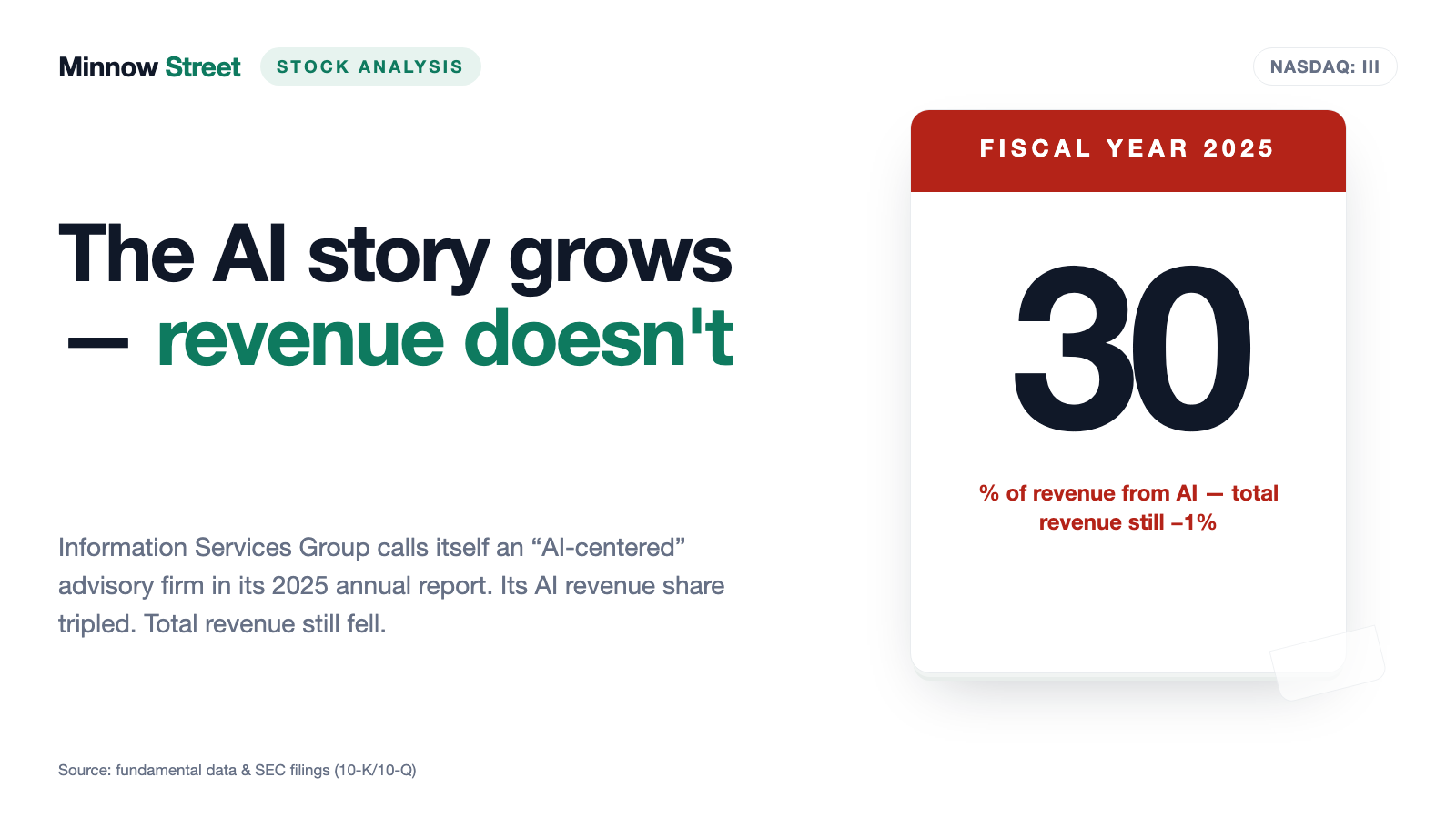
Interactive price chart (TradingView).
Note: pure fact-based analysis, not investment advice and not a solicitation to buy or sell. All figures without guarantee.
There is an investor trap that starts in a restaurant and gets expensive on the stock market: the menu trap. You know the moment. The menu has been redesigned, the paper is heavier, and the header now reads "local, handmade, sustainable." The kitchen is the same as last year. So is the chef. So are the portions. And yet it tastes better to you, and you happily pay two dollars more. The new label changed nothing about the food — only about your expectations. That exact trap has been trading on Nasdaq under the ticker III since 2025. Information Services Group of Stamford, Connecticut, no longer describes itself in its 2025 annual report as simply an advisory house, but as "a global AI-centered technology research and advisory firm." So let us make a deal: before we buy the new name plate, we read together what the company itself told the U.S. securities regulator, the SEC — the annual report (10-K) for 2025, the quarterly report (10-Q) as of March 31, 2026, the 2026 proxy statement and the insider filings (Form 4) through June 2026. Those documents are honest under penalty of law. And they describe an AI business that really is growing — just not fast enough to replace what is falling away beside it. What you make of that is your call.
What Information Services Group actually does — the enterprise buyer's advisor
Picture a large corporation putting its entire IT out to tender: data centers, software, networks, service providers. That is a billion-dollar exercise with hundreds of vendors, opaque pricing and contracts that run for ten years. Who tells the head of procurement whether the price is market rate? That is where Information Services Group sits. The company describes its own business as "fact-based sourcing advisory services" and runs it as one single reportable segment. There are no divisions to break the business down by; reporting is by region only.
Four building blocks carry the model. First, advisory: designing tenders, comparing vendors, negotiating contracts and supervising delivery. Second, ISG Research: proprietary market research, provider evaluations (the ISG Provider Lens) and benchmarking databases — fed, by the company's own account, from nearly 10 million real-world data points out of benchmarking and sourcing contracts. Third, the proprietary platforms: GovernX for supplier and contract governance, Inform for performance benchmarking and Tango for the sourcing process — the annual report says more than $25 billion of total contract value now runs through Tango. Fourth, network and software advisory.
The scale: 1,290 employees worldwide as of December 31, 2025, of whom 1,254 are full-time, spread across more than 20 countries. More than 900 clients, including 75 of the world's top 100 enterprises according to the company. Michael P. Connors has been chairman and chief executive since the firm was founded in 2006, having previously served as vice chairman of ACNielsen; his contract runs through December 31, 2029. One small detail that captures the self-presentation nicely: the same annual report that reports 1,290 employees in its human-capital section describes the firm elsewhere as having "approximately 1,500 professionals worldwide." Both numbers live in one document — that is not forbidden, but it is worth knowing which one you are reading.
Which brings us to the central tension of this analysis, and it runs through every chapter that follows: the AI business at Information Services Group is demonstrably growing, and growing fast — yet total revenue is still falling, because the legacy business is shrinking faster than the new one expands. The story is real. The only question is whether it will be enough.
How the stock landed on our desk
Not through a momentum hit, and not through a Reddit surge. Information Services Group came onto our list through the data reconciliation of our in-house stock scanner on August 1, 2026 — a late arrival that had not shown up in any of our screens before. What stood out was the combination of a beaten-down price and a surprisingly intact balance sheet: the stock traded 31.8 percent below its twelve-month high and 25.6 percent below where it stood six months earlier (data as of August 1, 2026), at a market capitalization of roughly $0.199 billion. At the same time the company reported an 11.2 percent return on equity, a 44.9 percent equity ratio and a Piotroski score of 6 out of 9.
A quick translation of what those numbers say — and what they are worth. The Piotroski score is a nine-point balance-sheet checklist: profit positive? Cash flow positive? Leverage down? Margin up? A 6 out of 9 means solid, not sound; a genuinely strong company scores 8 or 9. The Altman Z-score of 2.17 measures distance from insolvency and lands squarely in the well-known grey zone between 1.8 and 3.0 — no alarm, but no free pass either. An interest coverage ratio of 4.38 means operating income covers the interest bill more than four times over; below 1 would be dangerous. Two analysts follow the stock with a consensus score of 4.5 on a scale where 5 is the best rating (data as of August 1, 2026). That is a friendly picture drawn from a very thin sample. Note the finding up front: at this company the balance sheet is not the issue. Revenue is.
The numbers over the years — honestly credited
First, what genuinely impresses, and 2025 offers plenty. Operating income tripled from $5.8 million to $17.8 million. Net income rose from $2.8 million to $9.3 million. Operating cash flow — the money the business actually brought in — climbed from $19.9 million to $29.0 million, a gain of 46 percent. The cost side made it possible: operating expenses fell by $14.9 million, or roughly 6 percent, partly because $8.0 million of automation software license fees disappeared after the divestiture. And the interest burden eased: $4.1 million of interest expense against $5.8 million a year earlier.
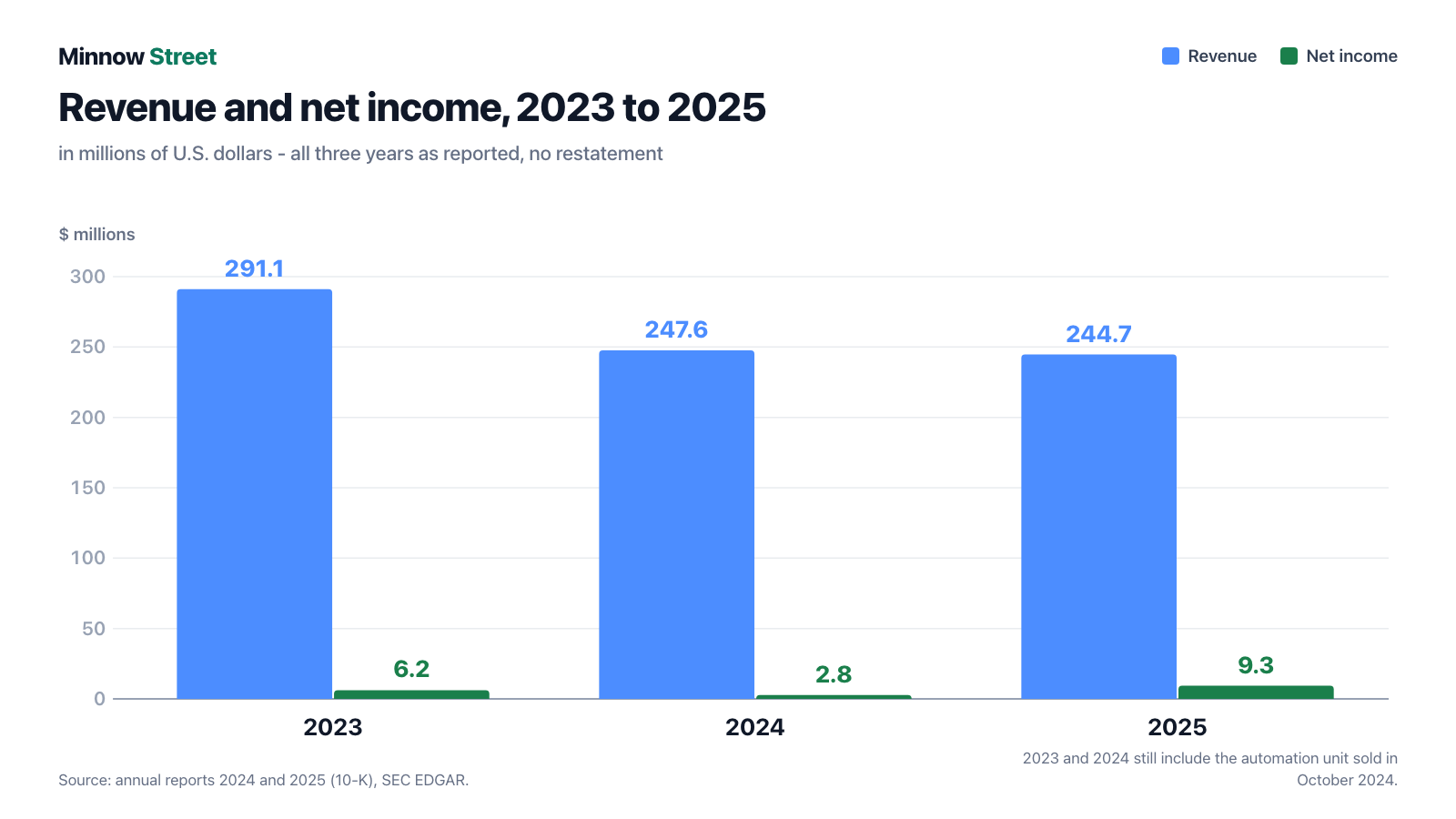
Now the line that matters. All three years in the chart below are shown as reported — consolidated, with no restatement — which means 2023 and 2024 still include the automation unit sold to UST Global Inc. on October 1, 2024. That is the honest presentation; why it matters is the subject of uncomfortable truth No. 2.
By region, 2025 looked like this: Americas $160.9 million (up 1 percent), Europe $65.5 million (down 3 percent), Asia Pacific $18.3 million (down 13 percent). In the first quarter of 2026 the picture almost inverted: Americas $39.8 million (down 3 percent), Europe $17.3 million (up 25 percent), Asia Pacific $4.1 million (down 15 percent). Overall, quarterly revenue rose 3 percent to $61.2 million, net income went from $1.5 million to $2.7 million, and adjusted earnings before interest, taxes, depreciation and amortization rose 12 percent to $8.3 million. For the second quarter of 2026 the company guided, in its May 7, 2026 earnings release, to revenue of between $62.5 million and $63.5 million. That is growth — but growth back toward a level the firm already had in 2019. Which brings us to the uncomfortable truths.
What the filings say — the uncomfortable truths
Uncomfortable truth No. 1: the AI business added about $48 million, everything else lost about $51 million
This is the calculation that explains the whole case, and the elegant part is that both numbers sit in the same document. The 2025 annual report writes in its results discussion:
"Enterprise AI consulting and research, not surprisingly, played a significant part in our growth, and now represents about 30 percent of our firmwide revenue, up from 10 percent last year."
— Information Services Group, Inc., SEC annual report 10-K for 2025, Item 7 (Management's Discussion and Analysis)
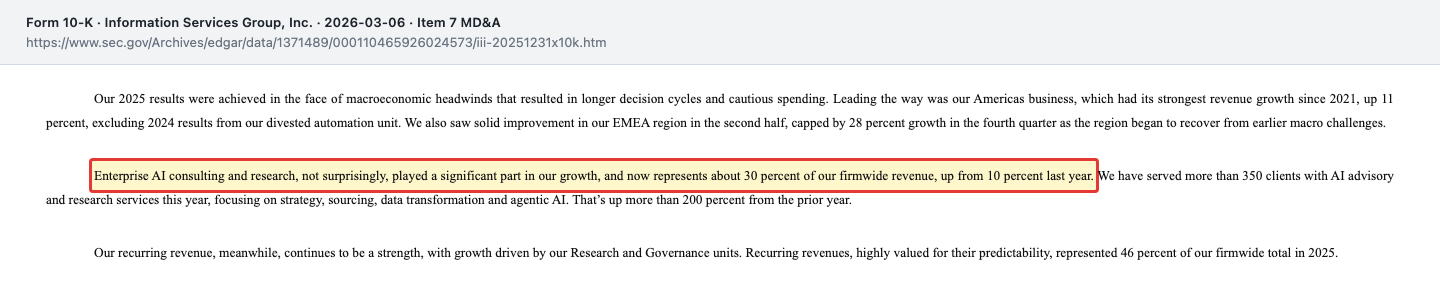
Now the arithmetic, and it is deliberately rough, because the company discloses only rounded percentages. Thirty percent of $244.7 million is roughly $73 million of AI revenue in 2025. Ten percent of $247.6 million is roughly $25 million in 2024. So the AI business added roughly $48 million — a real achievement for a firm this size. And the rest? It fell from roughly $223 million to roughly $171 million, a decline of about $50 million, or roughly a quarter. The net result was minus $2.9 million.
Translated into everyday terms: a baker opens a coffee counter that does genuinely well in its first year and brings in $48,000 more. In the same year he sells $51,000 less bread. The coffee is a real success — the bank balance simply does not notice. That is the state of Information Services Group in 2025. It also explains why the company talks so eagerly about the AI share and so reluctantly about total revenue: one number is the future, the other is the present.
Uncomfortable truth No. 2: same revenue, two truths — down 1 percent or up 7 percent
Anyone searching for revenue figures on Information Services Group will find two growth rates for the same year, and both come from the company. The audited version sits in the annual report:
"Total revenues for the year ended December 31, 2025 decreased by $2.9 million or approximately 1% in 2025, with revenues decreasing in Europe and Asia Pacific but increasing in the Americas."
— Information Services Group, Inc., SEC annual report 10-K for 2025, Item 7 (Management's Discussion and Analysis)
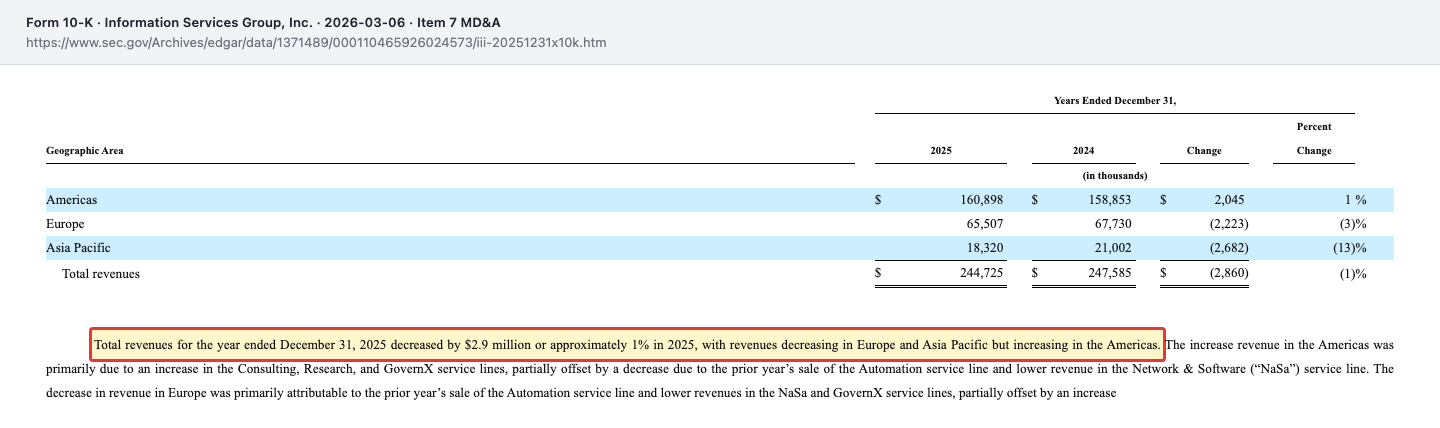
The 2026 proxy statement, where the compensation committee explains its bonus decisions, says something else: revenues were "up 7% (excluding the divestiture of our automation business)." Both disclosures are legitimate and neither is wrong. They simply measure different things.
The background: on October 1, 2024 Information Services Group sold its automation business line to UST Global Inc. for $27 million in cash — $20 million at closing and $7 million into escrow, from which another $2.0 million plus a $0.7 million working-capital settlement flowed in during 2025. The decisive sentence for comparability sits in the notes: the company did not report the sale in discontinued operations, because it was not a strategic shift with a major effect on results. In plain English, prior years were not restated. The $291.1 million of 2023 and the $247.6 million of 2024 still contain the unit; the $244.7 million of 2025 does not.
For you as a reader that means both figures may be quoted, but never mixed. This analysis works consistently as reported — consolidated, every year on the same basis. Anyone citing the 7 percent from the compensation section has to say that it excludes a business that still generated nine months of revenue in 2024. The rule of thumb: a time series tolerates exactly one basis of calculation — and which one belongs in the caption.
Uncomfortable truth No. 3: cash flow turned negative — and why the first quarter almost always is
In the first quarter of 2026, the operating business did not bring cash in, it let cash out: minus $0.7 million. The cash balance fell from $28.7 million at year-end to $22.7 million as of March 31, 2026. Anyone who sees only that number thinks of a company in trouble. So let us check the year-ago quarter — and the picture changes considerably.
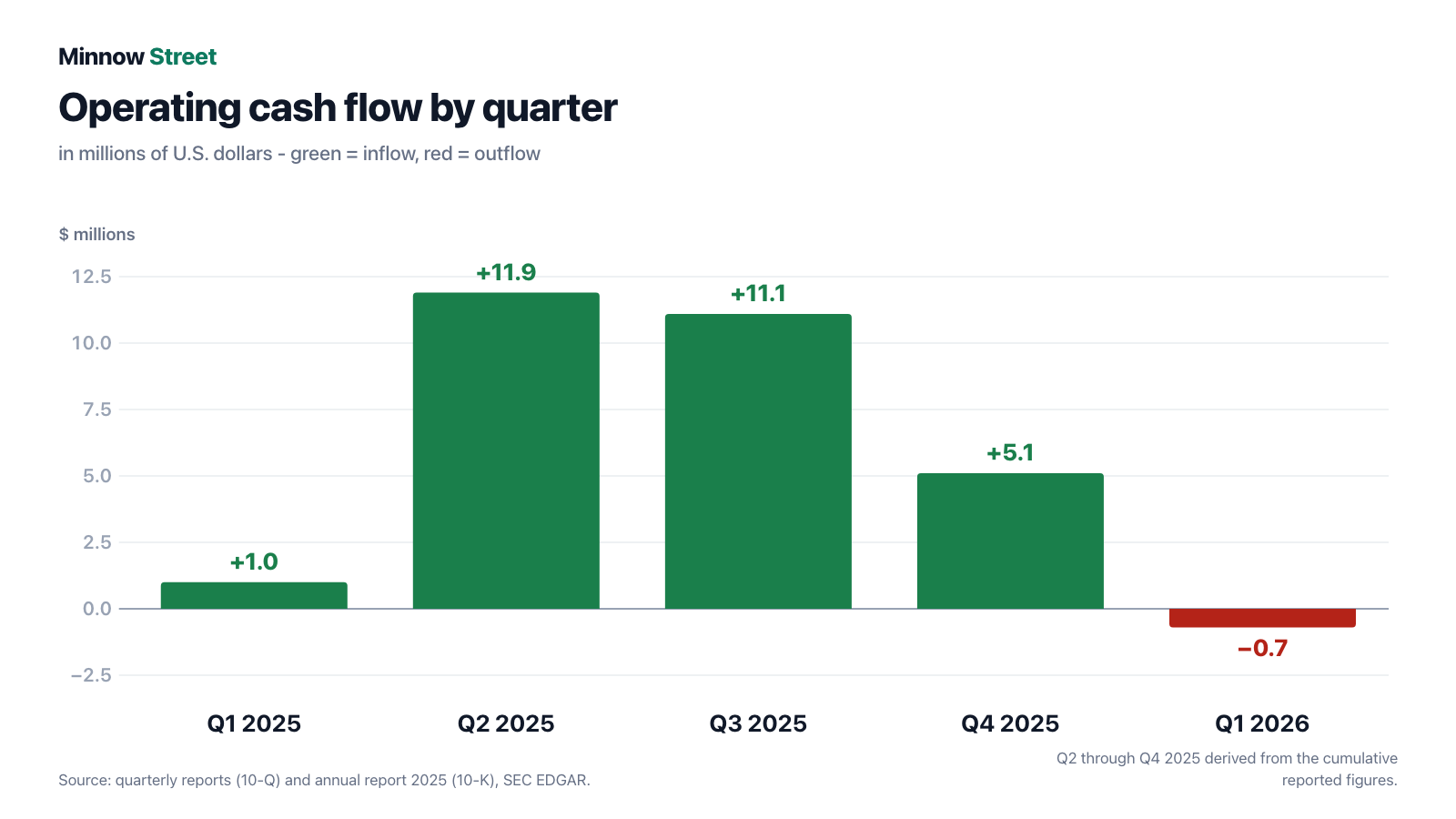
The first quarter of 2025 produced plus $1.0 million of operating cash flow — next to nothing against a full-year figure of $29.0 million. The opening quarter is structurally weak at this company, and the cash flow statement shows why: in the first quarter of 2026, $4.1 million flowed out through accrued expenses and other liabilities (largely prior-year bonuses paid in the spring), $2.5 million through contract liabilities and $2.1 million through accounts payable. Payments like these are a calendar, not a crisis.
An honest deterioration still remains: minus $0.7 million instead of plus $1.0 million, a $1.7 million swing against the year-ago quarter even though earnings improved. And in the same quarter the firm paid $2.2 million in dividends and repurchased $2.1 million of stock — money that did not come out of the quarter's business but out of the bank account. Anyone judging 2026 should therefore look not at this one quarter but at the summer and autumn quarters, when this firm actually earns its money. The rule of thumb: one weak quarter proves nothing — the year-ago comparison does.
Uncomfortable truth No. 4: a $4.7 million receivable in litigation, with no reserve behind it
The quarterly report as of March 31, 2026 contains a passage that is easy to miss because it sits in the receivables note. Two clients owe the company money they are not paying. In the first case — two multi-year projects from 2021 and 2022 — a court issued a final, non-appealable judgment on September 3, 2025 for roughly $5.6 million plus 5 percent interest per annum; no assets of the debtor had been identified as of the reporting date. The second case is the more open one:
"The Company is pursuing collection of the full outstanding balance of $4.7 million in litigation. As of March 31, 2026, we have not recorded material reserves against this balance."
— Information Services Group, Inc., SEC quarterly report 10-Q as of March 31, 2026, Note 5
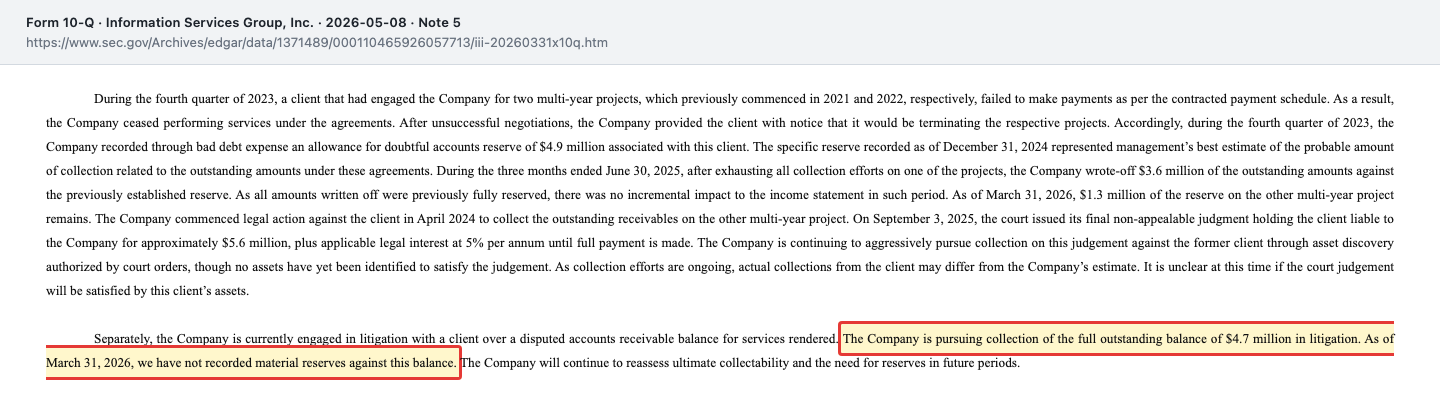
Why it matters: total net income for 2025 was $9.3 million. This single receivable equals roughly half a year of earnings — and it sits on the balance sheet undiminished, because the company believes it will collect. That is a legitimate judgment, but it is a judgment. Put plainly: the amount has not been written off, it is waiting. Anyone following the stock reads exactly that line in every new quarterly report.
Uncomfortable truth No. 5: the firm warns about the technology it sells
This is the most elegant passage in the whole annual report, and it sits in the risk factors. An advisory firm sells consulting hours; its revenue depends on how many people work how long on a project. If artificial intelligence takes over that work, the firm gains a new product — and a hole in its business model. It writes this down itself:
"AI and automation may also diminish the need for certain services currently provided by our personnel, and we may not be able to adjust our delivery model, pricing, staffing, training or organizational structure in a timely or cost-effective manner."
— Information Services Group, Inc., SEC annual report 10-K for 2025, Item 1A (Risk Factors)
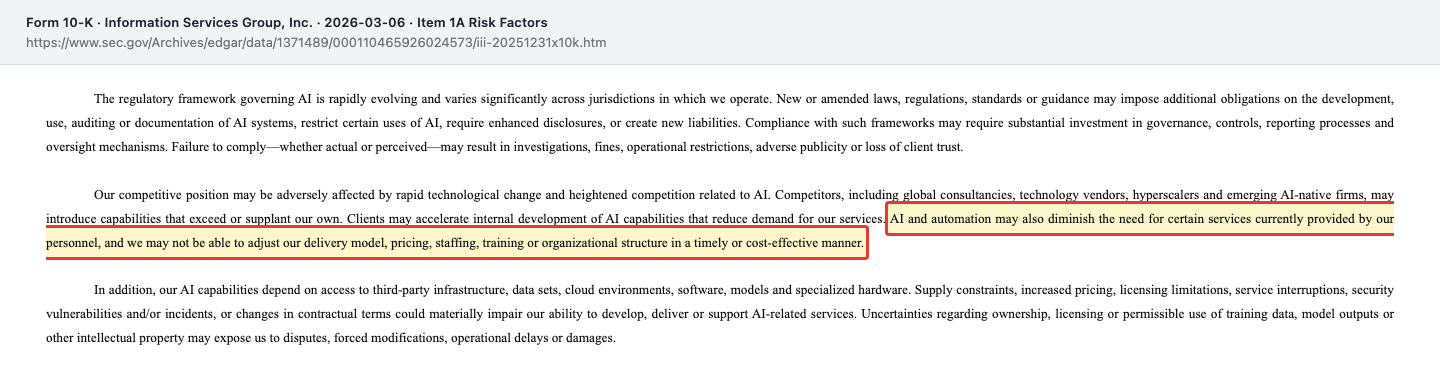
For context, without cynicism: risk disclosures like this are standard, and a company naming its own hazards speaks well of its reporting. What is interesting is the combination. The same firm that celebrates AI's share of its revenue lists AI in the risk section three times over — as competition from hyperscalers and AI-native vendors, as clients building their own AI capabilities and therefore buying less advice, and as a technology that can replace its own consultants. Its own AI acquisition, meanwhile, was small: on January 13, 2026 the company bought the AI Maturity Index software for $750,000 — $500,000 at closing and $250,000 payable in two years. Against a market capitalization of roughly $199 million (data as of August 1, 2026), that is a rounding error. The AI pivot at Information Services Group is mostly a matter of people and labels, hardly one of capital.
What the stock costs — valuation in orders of magnitude
First the anchor, so it is clear what everything refers to: as of August 1, 2026 the market capitalization stood at roughly $0.199 billion. The cross-check holds: the cover page of the quarterly report lists 47,839,274 shares as of May 1, 2026; multiplied by a price of $4.16 that gives exactly $199 million. Measured against the last price documented in a filing — $4.51 in the insider report of June 1, 2026 — the deviation is just under 8 percent and comfortably inside tolerance.
From that follows the valuation picture, each figure an order of magnitude:
- Price-to-sales of roughly 0.8 ($199 million of market value against $244.7 million of 2025 revenue). For an advisory firm with a gross margin above 40 percent that is cheap, though hardly sensational — firms without growth regularly trade below one year of revenue.
- Price-to-earnings of roughly 20 per the data service (as of August 1, 2026). Do the math yourself and the spread becomes visible: against reported 2025 earnings of $0.19 per share it is about 22, against the adjusted figure of $0.33 about 13. The difference consists almost entirely of stock compensation, intangible amortization and restructuring costs.
- Price-to-book of roughly 2.1 ($199 million against $94.7 million of equity as of December 31, 2025). An advisory firm has almost no fixed assets, so book value says little here — the assets go home in the evening.
- Dividend yield of roughly 4.3 percent: $0.045 per quarter, so $0.18 a year, against $4.16 (as of August 1, 2026). The company paid out $9.2 million for that in 2025 — covered by $29.0 million of operating cash flow, but not a small line item.
The debt side is manageable: $59.2 million drawn against a $140.0 million revolving facility maturing on February 22, 2028, all of it floating rate; the quarterly report states a debt-to-EBITDA ratio of 1.80 times and confirms the company is in compliance with its financial covenants. One detail worth tracking: of the $25 million repurchase authorization approved on August 1, 2023, $5.9 million remained as of December 31, 2025, and the firm bought back another $2.1 million in the first quarter of 2026. The program is running down — an extension would take a new board decision, not an automatic renewal.
And the professional view? Two analysts follow the stock with a consensus score of 4.5 on a scale where 5 is the best rating (as of August 1, 2026). That is a benign picture — but two opinions are not a market consensus, they are two opinions. At a company this size that is normal, and it should not be an argument on its own.
Opportunities and risks at a glance
Opportunities
- The AI business is growing on the record: from roughly 10 percent to roughly 30 percent of firmwide revenue within a year, more than 350 clients served and a gain of more than 200 percent in client count (2025 annual report).
- Recurring revenue from subscriptions and multi-year contracts made up 46 percent of the firmwide total in 2025 — the predictable part of the business, and it is growing.
- Earnings power clearly improved in 2025: operating income from $5.8 million to $17.8 million, net income from $2.8 million to $9.3 million, operating cash flow from $19.9 million to $29.0 million.
- Europe is turning: up 28 percent in the fourth quarter of 2025 and up 25 percent in the first quarter of 2026 — the region had been the drag before.
- On May 7, 2026 the company announced the largest single client contract in its history: up to $17 million over multiple years to govern $300 million of technology spend across 200 vendors.
- The balance sheet and the payout are steady: a 44.9 percent equity ratio, debt at 1.80 times EBITDA, a quarterly dividend of $0.045 held for years and an active buyback.
Risks
- Revenue has fallen three years running: $291.1 million (2023), $247.6 million (2024), $244.7 million (2025). So far AI growth only replaces what is lost elsewhere.
- The business is one single reportable segment; there is no second earnings stream to absorb a downturn in technology advisory demand.
- Disputed receivables: $4.7 million in litigation with no material reserve, plus a roughly $5.6 million judgment against a former client where no assets have been found (as of March 31, 2026).
- Operating cash flow in the first quarter of 2026 was minus $0.7 million; the seasonality explains it, but the year-ago quarter was still plus $1.0 million.
- The firm names AI itself as a threat to its delivery model — clients could build their own AI capabilities and buy less advice.
- Insiders and the largest holder sold: 493,703 shares by the chief executive in November 2025 for roughly $2.64 million, and 450,000 shares by Chevrillon & Associés in December 2025 for roughly $2.71 million. No insider bought on the open market after June 2025.
- The float is tight and the company is small: roughly $199 million of market value, with three addresses holding more than a quarter of the shares between them.
A human conclusion
Back to the menu. The awkward thing about the menu trap is not that the new menu lies — it rarely does. The awkward thing is that it is true and still misleads: the chef really did add a new dish, and it really is good. It just does not say on the same menu that three old dishes were dropped.
That is exactly how the 2025 annual report of Information Services Group reads. The AI business is real: about 30 percent of firmwide revenue instead of 10 percent, more than 350 clients, a new flagship contract worth up to $17 million. This firm did not merely relabel itself; it actually built something. And the same report says total revenue fell by $2.9 million, that the rest of the business lost roughly a quarter of its volume, that a disputed $4.7 million receivable sits on the balance sheet without a reserve, and that AI appears three times in the risk factors as a danger to the firm itself. Both are true. Anyone who walks away with only the loudest number — and here the loudest number is 30 — did not read the report, only the headline.
What speaks for the company is the rest of the balance sheet: profitable, 44.9 percent equity, covenants met, dividend paid, stock repurchased, a chief executive in place since the founding. What speaks against it is the one line that has pointed the same way for three years. Whether 2026 becomes the year the new business finally overtakes the old will not be decided by a press release but by four quarterly reports. For us that leaves a yellow light: a functioning company with one open operating question. You may see it differently — perhaps the rebuild-while-running is precisely your reason to buy. What you make of that is your decision. And that is exactly as it should be.
If you want to see how the same question looks at another process outsourcer — there it is a single large client that talks openly about automation — read our TaskUs analysis.
Sources
- Information Services Group, Inc. — SEC quarterly report 10-Q as of March 31, 2026 (filed May 8, 2026): balance sheet, statement of income, cash flow statement, Note 5 (receivables and disputed balances), Note 6 (earnings per share), Note 10 (financing arrangements), liquidity and interest-rate discussion, share count on the cover page.
- Information Services Group, Inc. — SEC annual report 10-K for 2025 (March 6, 2026): Item 1 (business, platforms, human capital), Item 1A (risk factors on AI, dispositions, competition), Item 7 (results discussion, regional revenue, AI share, liquidity), notes on the automation divestiture, dividends and share repurchases.
- Information Services Group, Inc. — SEC annual report 10-K for 2024 (March 13, 2025): comparative figures for 2023 and 2024, notes on the sale of the automation business line to UST Global Inc.
- SEC quarterly report 10-Q as of March 31, 2025 (May 9, 2025), as of June 30, 2025 (August 7, 2025) and as of September 30, 2025 (November 3, 2025): cumulative cash flow statements from which the quarterly operating cash flow figures are derived.
- SEC Form 8-K of May 7, 2026, Item 2.02 with Exhibit 99.1 (first-quarter 2026 earnings release): regional revenue, cash balance, dividend declaration, the contract worth up to $17 million and second-quarter 2026 guidance.
- SEC Form 8-K of April 27, 2026, Item 5.07: results of the annual meeting held April 24, 2026, ratification of PricewaterhouseCoopers LLP as auditor, 47,674,341 shares entitled to vote.
- SEC proxy statement DEF 14A 2026 (March 11, 2026): beneficial ownership as of February 25, 2026, executive compensation, performance-based restricted stock units with the $5.00 / $6.00 / $7.00 price rungs, and the revenue statement "up 7% (excluding the divestiture of our automation business)."
- SEC insider filings (Form 4) for CIK 0001371489, reviewed through June 3, 2026: sales by Michael P. Connors (November 7 to 12, 2025) and by Chevrillon & Associés (December 11 and 15, 2025), plus grants and tax withholdings.
- Fundamental data for market capitalization, ratios, price distances and the analyst picture (data as of August 1, 2026).
This analysis is journalistic commentary on publicly available information and is not investment advice. It is not a solicitation to buy or sell securities. Stocks can lose substantial value; a total loss of the capital invested is possible. All figures come from the primary documents linked above and carry the reporting date of their respective filing. The author holds no position in Information Services Group, Inc. at the time of publication.
Our Bottom Line at a Glance
- Business model neutral
- An established research and advisory house with genuine differentiators: proprietary benchmark data from nearly 10 million contract data points, more than 900 clients, and more than $25 billion of total contract value running through the Tango platform according to the 2025 annual report. But there is only one reportable segment, and therefore no second earnings stream if demand for technology advisory softens.
- Revenue trend negative
- Three years pointing the same way: $291.1 million (2023), $247.6 million (2024), $244.7 million (2025) — all as reported. The AI business added roughly $48 million in 2025 while the rest lost roughly $51 million. The first quarter of 2026 brought growth back for the first time, up 3 percent to $61.2 million, carried by Europe at plus 25 percent.
- Earnings power positive
- The cost side was visibly tidied in 2025: operating income from $5.8 million to $17.8 million, net income from $2.8 million to $9.3 million, operating cash flow from $19.9 million to $29.0 million, interest expense from $5.8 million to $4.1 million. In the first quarter of 2026 adjusted EBITDA rose 12 percent to $8.3 million and the margin went from 12.4 percent to 13.5 percent.
- Balance sheet and financing positive
- Equity of $94.7 million on total assets of $211.0 million (a 44.9 percent ratio as of December 31, 2025), $59.2 million of debt drawn on a $140.0 million facility maturing February 22, 2028, debt-to-EBITDA of 1.80 times and covenants explicitly in compliance (quarterly report as of March 31, 2026). No going-concern warning and a clean audit opinion.
- Receivable risk negative
- As of March 31, 2026 the company is suing for an outstanding receivable of $4.7 million and has explicitly recorded no material reserve against it — roughly half of full-year 2025 net income. A second case ended on September 3, 2025 with a judgment of about $5.6 million; no assets of the debtor had been identified as of the reporting date.
- Ownership and pay neutral
- Directors and executive officers hold 15.8 percent as a group (February 25, 2026), with the chief executive alone at 9.9 percent — real skin in the game. At the same time he sold 493,703 shares in November 2025 for roughly $2.64 million, and large holder Chevrillon & Associés sold another 450,000 in December 2025 for roughly $2.71 million; no insider bought on the open market after June 2025. The CEO's performance restricted stock units only pay out above a $5.00 share price, measured through June 2, 2028.
Information Services Group is the rare case of a company whose AI story is true and whose overall picture it still does not rescue. About 30 percent of firmwide revenue came from AI consulting and research in 2025 after about 10 percent a year earlier — roughly $48 million of added revenue on the company's own numbers. In the same year total revenue fell $2.9 million to $244.7 million, because everything else lost roughly $51 million. Earnings improved markedly (operating income $17.8 million against $5.8 million, operating cash flow $29.0 million against $19.9 million) and the balance sheet carries its weight at a 44.9 percent equity ratio with covenants met. What stays open is a disputed $4.7 million receivable without a reserve, an operating cash outflow of $0.7 million in the first quarter, and the question of whether the new business will ever overtake the old. Not investment advice.
What Our Rating Means
Open questions
The business works in principle, but one material question is open. As long as it stays open, our findings do not carry a quality verdict.
Yellow here stands for a company that does its homework and for one operating question it has not yet answered. The substance is documented: $244.7 million of revenue and $9.3 million of net income in fiscal 2025, $29.0 million of operating cash flow, a 44.9 percent equity ratio, debt at 1.80 times EBITDA, covenants in compliance, no going-concern warning, a quarterly dividend held for years and an active buyback. What is open is the revenue question: the top line has fallen three years running, AI so far only replaces what the legacy business loses, and the firm has a single reportable segment with which to absorb any drop in demand. Add a disputed receivable of $4.7 million carried without a material reserve as of March 31, 2026 — roughly half a year of earnings. None of this threatens the substance, so not red; but it is too much unfinished business for green. On price, which explicitly does not set the light: roughly 0.8 times annual revenue and a dividend yield of about 4.3 percent is not an expensive entry — though the market is not paying for a growth story here, it is paying for a company mid-rebuild. The decision is yours.
A journalistic assessment by our editorial team at the time of the deep dive, based on public sources — not investment advice and not a solicitation to buy or sell. Your personal circumstances (investment goals, risk capacity, taxes) cannot be taken into account. What our levels mean, how verdicts are formed, and what conflicts of interest exist →
Worth Noting
- Information Services Group reached our list through the data reconciliation of our in-house stock scanner on August 1, 2026, not through a momentum or hype hit. At the time of this analysis the stock was new to our universe; the scanner lists are recalculated daily.
- The AI share of about 30 percent is a management disclosure from the results discussion of the annual report, not an audited segment figure — the company runs one single reportable segment. The amounts derived from it (roughly $73 million of AI revenue in 2025, roughly $25 million in 2024) are deliberately marked as estimates, because the company discloses only rounded percentages.
- Time-series basis: every revenue and earnings figure in this analysis is shown as reported, meaning consolidated and without restatement. The automation business sold on October 1, 2024 was not reported in discontinued operations and therefore still sits inside the 2023 and 2024 figures. The "up 7 percent" the company cites in its compensation section excludes that business and must not be mixed with the reported series.
- All point-in-time figures — cash, debt, interest rate, credit facility, share count, management, auditor — come from the most recent document that states them: the quarterly report 10-Q as of March 31, 2026 (filed May 8, 2026), the earnings release of May 7, 2026, the annual-meeting report of April 27, 2026 and the insider filings through June 3, 2026. Market capitalization was cross-checked against the share count on the quarterly report and the last price documented in a filing.
- Data services and the primary documents disagree on insider ownership. This analysis uses the figure from the 2026 proxy statement: 15.8 percent for directors and executive officers as a group as of February 25, 2026, of which 9.9 percent for the chief executive.
Frequently Asked Questions
Information Services Group advises large enterprises on buying technology: designing tenders, comparing vendors, negotiating contracts and supervising delivery. It adds proprietary market research (ISG Research) and the GovernX, Inform and Tango platforms. The company runs one single reportable segment, "fact-based sourcing advisory services," and employed 1,290 people worldwide as of December 31, 2025.
The 2025 annual report cites "about 30 percent of our firmwide revenue," up from 10 percent a year earlier. Applied to reported revenue that is roughly $73 million in 2025 against roughly $25 million in 2024. The company publishes no audited standalone figure for the AI business — there is only one reportable segment, so the disclosure is a management measure, not a segment number.
Because everything else is shrinking faster. Running the company's own percentages against reported revenue, the AI business added roughly $48 million in 2025 while the rest fell from roughly $223 million to roughly $171 million — about $50 million, or roughly a quarter. The net effect was a decline of $2.9 million to $244.7 million.
Both figures come from the company and measure different things. The audited annual report shows a decline of roughly 1 percent. The proxy statement cites a 7 percent gain in its compensation section — explicitly excluding the automation business sold on October 1, 2024. Because the sale was not reported in discontinued operations, prior years were never restated, so the two figures must never be mixed in one time series.
Because the opening quarter is structurally weak at this company. The first quarter of 2026 saw an outflow of $0.7 million, including $4.1 million through accrued expenses such as prior-year bonuses, $2.5 million through contract liabilities and $2.1 million through accounts payable. The cross-check: the first quarter of 2025 produced only plus $1.0 million, against $29.0 million for the full year 2025.
Yes. The board declares $0.045 per share each quarter; the second-quarter 2026 dividend was approved on May 5, 2026 and paid on June 26, 2026. In 2025 the company paid out $9.2 million in total against $29.0 million of operating cash flow. A $25 million share repurchase program also remains in place, with $5.9 million still available as of December 31, 2025.
As of February 25, 2026, directors and executive officers as a group (eight people) held 15.8 percent of the shares, of which chairman and CEO Michael P. Connors alone held 9.9 percent. The largest outside holders are Chevrillon & Associés with 11.0 percent, Private Capital Management with 10.0 percent and BlackRock with 5.7 percent. Institutional investors hold roughly 69.5 percent in total (data as of August 1, 2026).
Both are harmless legacies of the company's early years as a blank-check acquisition vehicle. On January 31, 2008 the firm voluntarily withdrew its securities from the American Stock Exchange in order to move to Nasdaq. On January 31, 2011 Nasdaq removed the warrants and units left over from the initial public offering. The common stock has traded continuously under the ticker III; there has never been an involuntary delisting.
Found an error?
Did you spot a factual error, an outdated number, or a typo in this deep dive? Let us know briefly — your report goes straight to the editorial team.