T3 Defense: Zero Revenue, $78.6 Million of Profit — and 126 Million Shares That Became One Million
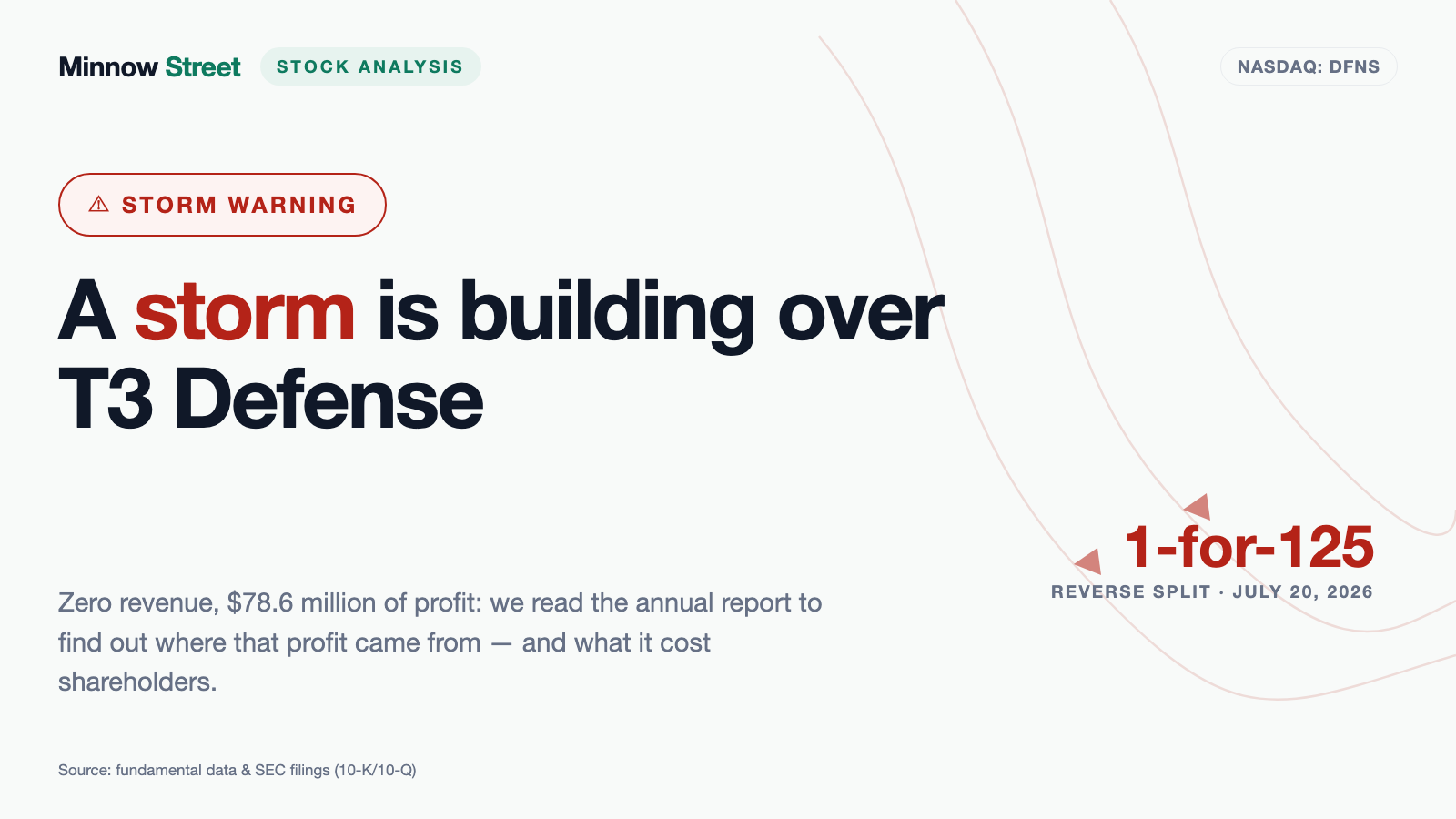
T3 Defense has only carried that name since February 2026. Before that it was Nukkleus, a vendor of foreign-exchange and blockchain technology; before that it was Brilliant Acquisition Corporation, an empty shell company. Today it buys up Israeli defense suppliers. Its annual report for 2025 pairs two numbers you have to read twice: no revenue at all and $78.6 million of net income. The profit comes almost entirely from remeasuring the company's own warrants ($131.8 million). Between December 31, 2025 and July 9, 2026 the share count went from 19.0 to 126.3 million; on July 20, 2026 every 125 shares became one — a ratio that had still read 1-for-50 three days earlier. Not investment advice — just a look at who paid for that profit.
 Thomas Mücke
Founder & Publisher
Thomas Mücke
Founder & Publisher
Chart
Interactive price chart (TradingView).
Note: pure fact-based analysis, not investment advice and not a solicitation to buy or sell. All figures without guarantee.
There is an investor trap that has nothing to do with numbers and still costs more money than any miscalculation: the costume trap. It works like this. A company puts on the outfit of whatever theme everyone is talking about, and our mind quietly fills in the rest. Put "Defense" in the name and we think of government order books, counter-drone systems, a sector with a tailwind. T3 Defense Inc. (NASDAQ: DFNS) has worn that costume only since February 2026. Before that the company was called Nukkleus Inc. and sold technology for foreign-exchange trading and blockchain. Before that it was Brilliant Acquisition Corporation, an empty shell company from the British Virgin Islands. Three names in a little over two years: Brilliant Acquisition Corporation became Nukkleus Inc. on December 22, 2023 and T3 Defense Inc. on February 9, 2026.
So let us make a deal. Before you trust the sign above the door, we will read together what this company has told the U.S. securities regulator, the SEC, about itself: the annual report (10-K) for 2025 filed on April 9, 2026, the quarterly report (10-Q) as of March 31, 2026 filed on May 20, 2026, and everything that has landed since. An SEC filing is honest under threat of prosecution. And this one tells a story of profit without revenue, of a share count that sextupled in six months, and of a reverse split whose ratio grew from 1-for-50 to 1-for-125 in three days. You get to draw your own conclusion at the end.
Contents
- What T3 Defense actually does — a roll-up in Israel
- How the stock landed on our desk
- The numbers — first, what really counts
- What the filings say — the uncomfortable truths
- Valuation: what the market pays for one quarter of revenue
- Opportunities and risks at a glance
- A human conclusion
- Sources
What T3 Defense actually does — a roll-up in Israel
T3 Defense is not a defense contractor; it is an acquisition holding company. In everyday terms: it makes nothing itself but buys small supplier businesses and gathers them under one roof, the way someone might take over five workshops one after another and turn them into a group. The annual report for 2025 states the strategy: the targets are "Tier 2 and Tier 3 suppliers," that is, businesses that do not sell to governments directly but to the large prime contractors.
As of the annual report the portfolio held five acquisitions, all closed within a few weeks of each other: Tiltan Software Engineering (closed December 30, 2025), an Israeli software house for simulation, 3D mapping and navigation without satellite signal, 14 employees; Star 26 Capital (January 12, 2026) with its subsidiary B. Rimon Agencies, which supplies generators for the launchers of Israel's Iron Dome missile defense system, 18 employees; Nimbus Drones Technologies (January 15, 2026), two employees; and I.T.S. Industrial Techno-Logic Solutions with its subsidiary Positech (February 16, 2026), 50 employees between them — machinery, assembly lines and motion control. On July 6, 2026 the company added 60 percent of Project 35, an Israeli maker of unmanned aerial systems that, per the filing, supplies Israel Aerospace Industries, Elta, Rafael and Elbit. In total the group employed 112 people — two of them at T3 Defense itself, per the annual report for 2025.
That frames the central tension of this analysis, and it runs through every chapter: at the bottom sit real, small, partly profitable workshops in Israel — on top sits a financial structure whose numbers have almost nothing to do with those workshops. If you want a yardstick for what a mature supplier looks like, our analysis of Astronics and aerospace electronics provides one: decades of order history there, a portfolio that began in December 2025 here.
How the stock landed on our desk
Not through a metrics screen — those simply do not work here. With no dependable profit there is no price-to-earnings ratio, with no revenue history there is no meaningful price-to-sales ratio, and two reverse splits have distorted the price series so badly that any momentum metric returns nonsense. The trigger was something else, and anyone can look it up in the SEC filing calendar: 22 filings between May 20 and July 24, 2026 — one quarterly report, two registration statements for new shares plus the notice of effectiveness, one prospectus, two shareholder meeting notices with one revision and three supplements, eight current reports (8-K), one insider filing (Form 3) and two ownership filings. Plus the 1-for-125 reverse split on July 20, 2026.
Remember that finding right at the start, because it carries the whole analysis: where 22 mandatory filings pile up in two months, the important things are not happening in the business but in the capital structure. That is exactly where we will look. And yes — our in-house stock scanner now carries DFNS in its universe; it shows no analyst consensus for the company (data as of July 31, 2026), which for a Nasdaq-listed stock is a statement in itself.
The numbers — first, what really counts
Let us begin with what has genuinely improved since the start of the year, because something has. For the first time since the foreign-exchange service contracts ended in early 2024 there is revenue again — and for the first time it comes from an operating business with third-party customers. That qualifier matters, because "zero revenue" does not mean this company never took in money. The annual report records: "The Company has historically generated substantially most of its revenue through the services rendered under the GSA" — almost all of the historical revenue came from a single services agreement. The counterparty was Triton Capital Markets, a foreign-exchange dealer connected to the former chief executive; the contract ran from May 2016, provided for minimum payments of $1.6 million a month and was terminated effective January 1, 2024. A second reason the revenue line reads zero for 2024 and 2025 is that the blockchain payments unit Digital RFQ has been reported separately as a discontinued operation since the third quarter of 2025. In the first quarter of 2026 (as of March 31, 2026) T3 Defense reported $3.653 million of revenue — in the prior-year quarter it was zero. Gross profit came to $0.371 million, or 10.2 percent of revenue. The segment breakdown in the notes: Rimon $1.601 million of revenue and $0.325 million of gross profit, I.T.S. $1.403 million of revenue and a gross loss of $0.212 million, Tiltan $0.592 million of revenue and $0.243 million of gross profit, other segments $0.057 million.
The balance sheet also looks better at first glance: equity swung from −$15.579 million (December 31, 2025) to +$42.523 million (March 31, 2026). Total assets grew from $202.386 million to $315.486 million. And backlog stood at $12.1 million as of March 31, 2026, per the company's own release of April 15, 2026. Measured against a company that had no business at all a year earlier, those are real steps forward.
Now the number that overshadows everything. The annual report for 2025 shows $78.631 million of net income — on zero revenue. Not "little revenue." Zero:

"We had no revenues from operations during the twelve months ended December 31, 2025 and 2024, due to the transformation of the Company to a strategic acquirer and operator of aerospace and defense businesses."
— T3 Defense Inc., SEC annual report 10-K for 2025, Item 7 (MD&A)
So where does the profit come from? The answer sits one level down in the income statement — and it can be drawn as a bridge:
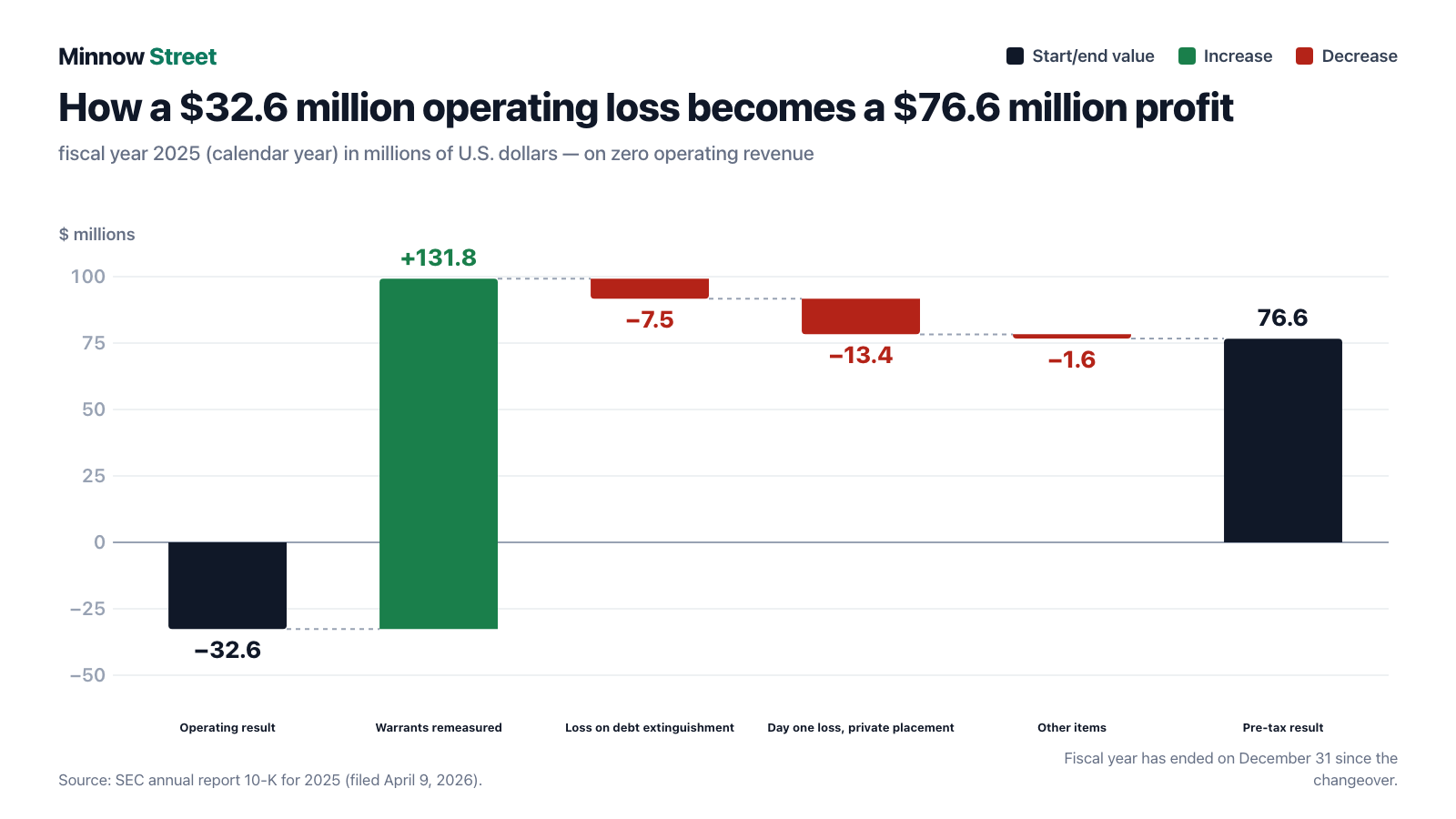
Two numbers, one gap worth knowing: the bridge ends at $76.610 million — that is the pre-tax result from continuing operations. Two items separate it from the reported net income of $78.631 million: $9 thousand of income taxes and a $2.030 million gain from discontinued operations, the separation from the blockchain payments unit Digital RFQ. $76.610 million minus $0.009 million plus $2.030 million is $78.631 million. Where this article says $78.6 million, it means net income; the $76.6 million is the step before it.
A word about the fiscal year, because it causes confusion otherwise. Nukkleus historically closed its books on September 30. On February 14, 2025 the board approved the change to December 31, effective for the year beginning January 1, 2024. In between sits a transition period from October 1 to December 31, 2024, covered by a separate transition report (Form 10-KT). In practice: "fiscal 2025" is calendar 2025. And the calendar-2024 comparatives printed alongside it are, per the report itself, unaudited and shown "for comparative purposes only."
What the filings say — the uncomfortable truths
Uncomfortable truth No. 1: the profit is a valuation figure, not money
Those $78.6 million never touched a bank account. Here is how they arise. When a company issues warrants — instruments that give the holder the right to buy shares later at a fixed price — it has to carry that obligation on the balance sheet and remeasure it every quarter. If the share price falls, the right becomes less valuable, the liability shrinks — and the accounting rules book that shrinkage as a gain. In everyday terms: you promised to sell someone your car for $10,000. If the car loses value, your promise hurts less — an accounting gain, even though not a cent has moved and your car is worth less than before.
That is exactly what happened in 2025: plus $131.766 million from remeasuring warrants, against a $13.435 million day one loss on a private placement, a $7.484 million loss on debt extinguishment and $1.100 million of penalties for late registration. Those penalties, together with a few smaller items, make up the $1.6 million shown as "other items" in the chart: a $1.250 million loss on shares issued as a commitment for the equity line, offset by $0.588 million from remeasuring an embedded derivative, $0.279 million of interest income at consolidated variable interest entities and $0.154 million of net financial expense. How unreliable the mechanism is shows in the counter-test: in the transition quarter from October to December 2024 it ran the other way and produced minus $140.585 million — a net loss of $160.788 million in three months. And in the first quarter of 2026 again: minus $26.635 million from the warrant remeasurement, a net loss of $26.351 million, even though the operating loss was only $3.811 million.
The one number in this calculation that does not swing is the cash burn: $6.147 million flowed out of operations in 2025 and $4.9 million in the first quarter of 2026 alone. Remember the line: profit is an opinion, cash is a fact.
Uncomfortable truth No. 2: 19 million shares became 126 million — in just over six months
Dilution means your slice of the cake gets smaller because the cake is cut into more pieces. At T3 Defense you can read it straight off the cover pages of the company's own filings, because each one states the current share count:
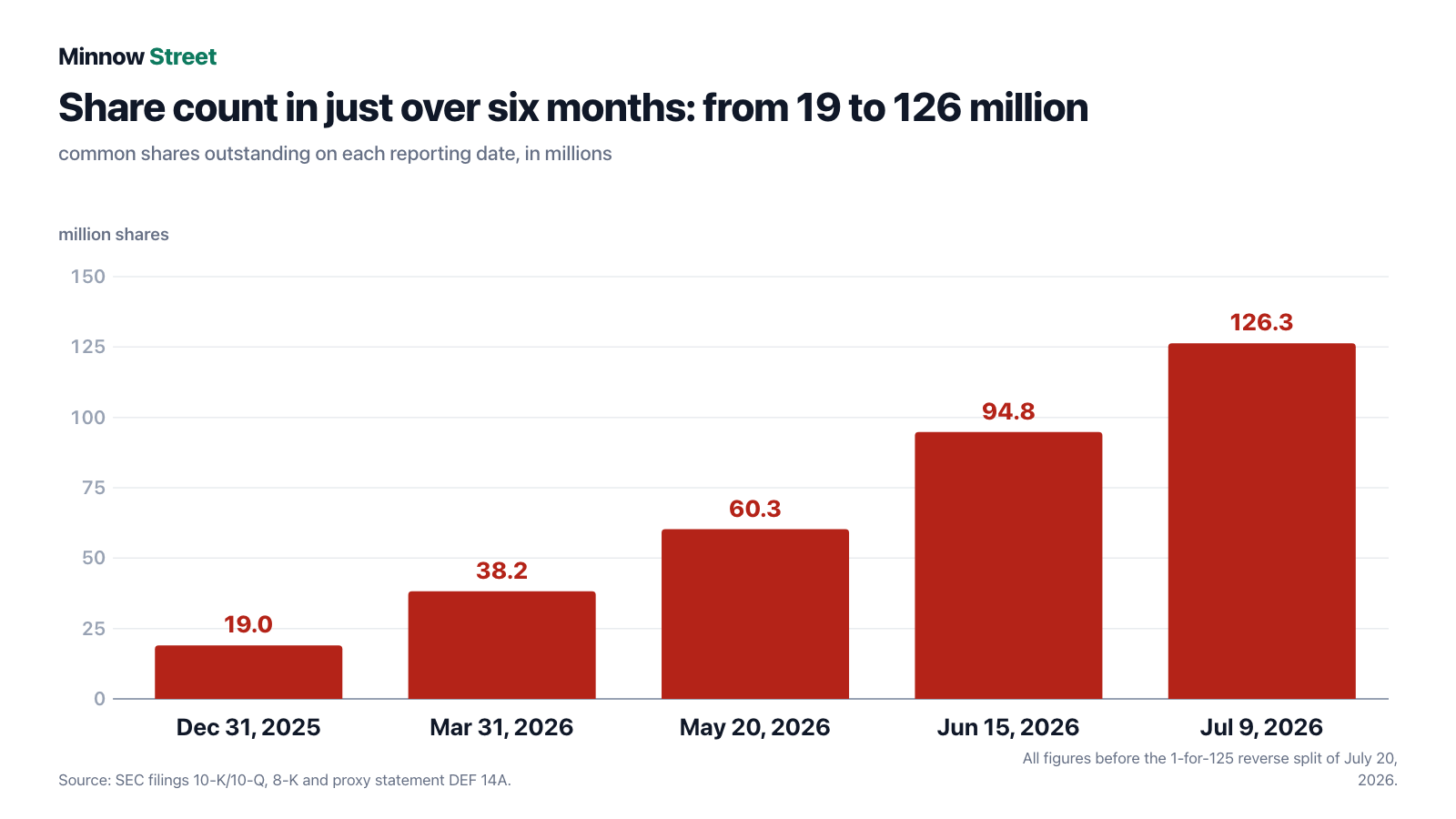
Where did the shares come from? Partly from an equity line of credit — an arrangement under which an investor takes new shares from the company on demand. The current report of June 15, 2026 lists the draws one by one: between April 20 and June 12, 2026 T3 Defense sold 17,294,784 shares for a total of $4,545,236 to Esousa Group Holdings — 15,187,265 of them on June 12 alone, for $3,805,929. Partly from acquisitions: for 60 percent of Project 35 the company issued 21,059,871 shares on July 6, 2026 plus a $1.25 million promissory note, and undertook to invest a further $2.5 million in Project 35. The seller, X S.E. Security and Defense Ltd. of Netanya, reported a 16.67 percent stake on July 24, 2026 — and wrote in the same document that it is already in talks to sell another asset to T3 Defense, consideration: more shares.
For you as an investor that means every one of those shares was issued because the company needed something — cash or a business. And every one of them shrank the stake of those already there. Anyone holding 1 percent on December 31, 2025 held about 0.15 percent on July 9, 2026 without selling a single share.
The next round is already on the calendar. At the annual meeting on August 5, 2026 shareholders vote on a share-based compensation plan — sized at 22,000,000 shares in the proxy statement of July 9, 2026. A supplement of July 14, 2026 clarified that this number would not be adjusted for the upcoming reverse split; two days later the company withdrew that supplement and corrected it:

Even the corrected number is large: 176,000 shares equal roughly 17.4 percent of the 1,010,495 shares the ownership filing of July 24, 2026 reports as of July 6, 2026 — and per the plan the pool grows another 8 percent every year from August 1, 2027 through 2036.
Uncomfortable truth No. 3: the reverse split grew from 1-for-50 to 1-for-125 in three days
On May 5, 2026 Nasdaq notified the company that the price had broken the $1.00 threshold; the annual report names the date since which the stock has traded below it: March 20, 2026. Compliance deadline: November 2, 2026. On June 24, 2026 a special meeting gave the board authority to reverse split the stock at any ratio between 1-for-2 and 1-for-250. On July 13, 2026 the company announced it had chosen 1-for-50 and had already filed the certificate in Delaware. Three days later, on July 16, 2026, came the correction:
"The Board of Directors of the Company has determined to increase the amount of the reverse stock split of the Company's issued and outstanding Common Stock at a ratio of 1-for-125 (the “Reverse Stock Split”)."
— T3 Defense Inc., SEC current report 8-K of July 16, 2026, Item 5.03

A reverse split creates no value — it swaps certificates. Every 125 shares become one, the price rises 125-fold on paper, your stake stays the same size. Economically nothing happens. Regulatorily, however, quite a lot does, and that is the real news of this chapter.
Uncomfortable truth No. 4: after the second reverse split there is no grace period left
In October 2024 the company, then Nukkleus Inc., had already reverse split its stock once, 1-for-8. (Its own report is inconsistent on the date: the risk factor names October 11, 2024 as the effective date, the notes October 24, 2024 as the day the charter was amended.) Together with 1-for-125 that makes 1,000-to-1 within 21 months. Why that matters is set out in the company's own annual report, in a risk factor that is easy to skim past:
"Under Nasdaq Rule 5810(c)(3)(A)(iv), if the price of our Common Stock fails to satisfy the Minimum Bid Price Requirement (A) within one year after effectiveness of a reverse stock split or (B) if the Company has effected one or more reverse stock splits over the prior two-year period with a cumulative ratio of 250 shares or more to one, then the Company shall not be eligible for any compliance period specified in Rule 5810(c)(3)(A) and the Listing Qualifications Department will issue a Staff Delisting Determination under Rule 5810 with respect to that security, and the Common Stock would be subject to delisting by Nasdaq without any opportunity for a cure period."
— T3 Defense Inc., SEC annual report 10-K for 2025, Item 1A (Risk Factors)

In plain terms: through July 20, 2027 T3 Defense has no second attempt. If the closing price slips back below a dollar in that window, the stock is removed from Nasdaq under this rule — without the usual 180 days of grace. The rule has two doors into the same room: condition (B), the cumulative 250-to-1 over two years, has applied since July 20, 2026 at 1,000-to-1 — but only until the 1-for-8 split drops out of the two-year window in October 2026, leaving 125-to-1, which is not enough. After that condition (A) carries it alone, and that runs to July 20, 2027.
A delisting would also be more than a change of venue: the same annual report explains that it would trigger debt acceleration and breach acquisition agreements. The most prominent example is in the report as well — but in the past tense, and that is good news for shareholders. On a delisting within twelve months of closing, Star 26 could have required the company to exchange the $16 million investment note for "all the shares of Star then held by the Company", with cash payments already made staying with Star 26 and T3 Defense retaining an equity interest equal to those payments. That clause has been defused: on March 31, 2026 the entire obligation was cancelled. The report puts it this way: "the entire $16,000,000 obligation to Star 26, including principal, accrued interest and any other amounts owing with respect thereto, were cancelled, terminated and rendered of no further force or effect" — at no cost, with no dilution, and with T3 Defense keeping Star 26 in full. The annual report lists that cancellation as the first item of its own liquidity plan.
Uncomfortable truth No. 5: the company's own guidance outlives its own quarterly report
On April 15, 2026 T3 Defense reported preliminary figures: roughly $4.2 million of first-quarter revenue, $12.1 million of backlog, and a reaffirmation of full-year guidance of $26 million. On May 20, 2026 the quarterly report arrived — and named $3.653 million. That is 13 percent below what had been guided five weeks earlier. The remarkable part comes next: the prospectus dated June 30, 2026 and filed July 1, 2026 repeats the old figure unchanged.
"Previously management determined that as of fiscal year 2026, there was $4.2 million in revenue, a backlog of $12.1 million, and a $26 million full-year revenue projection in connection with our first quarter operating as a defense company."
— T3 Defense Inc., SEC prospectus 424B3 of June 30, 2026, "Overview"
Run the guidance through the arithmetic: if the year is to bring $26 million and the first quarter brought $3.653 million, the remaining three quarters have to deliver $22.3 million between them — an average of $7.4 million per quarter, roughly double the first. It is possible; the I.T.S. and Project 35 acquisitions were only partly or not at all included in the first quarter. But it is a claim, not a finding. And next to it sits the cash: $7.4 million unrestricted as of March 31, 2026 against $4.9 million of cash used in operations during the quarter. The report says two things about that, and both deserve to be read. First the uncomfortable one:
"Absent any other action, the Company will require additional liquidity to continue its operations for the next 12 months."
— T3 Defense Inc., SEC quarterly report 10-Q as of March 31, 2026, Note 1 G (Going concern)
And immediately after it, in the same note, comes the second sentence — the company's counter-position, which must not be skipped:
"After evaluating these conditions, management concluded that its plans, when considered in aggregate, alleviate substantial doubt about the Company’s ability to continue as a going concern."
— T3 Defense Inc., SEC quarterly report 10-Q as of March 31, 2026, Note 1 G (Going concern)
So the company does the arithmetic differently than we do — and it shows its work. The MD&A states: "we anticipate that we will need approximately $6,000,000 for the next 12 months of operations", that is, roughly $6 million of cash needs for twelve months; the $7.4 million cash balance is described as "sufficient to fund projected operating expenses through the look-forward period". Alongside it the report names the equity line with Esousa, the self-funding subsidiaries Rimon and Nimbus, ongoing efforts to secure bank facilities at the subsidiaries, and the option of settling obligations in stock rather than cash. One point of context matters here: the audit opinion for fiscal 2025 contains no going-concern qualification. The qualification reprinted in the annual report comes from the predecessor auditor GreenGrowth CPAs and relates to the September 30 and December 31, 2024 statements.
Who is right? This is exactly where you have to do the sums yourself, so we say whose sums are whose. Our arithmetic takes the actual cash burn of the first quarter — $4.9 million — and, against $7.4 million of cash, arrives at about one and a half quarters. The company's arithmetic takes the planned need of $6 million for twelve months and covers the whole period; it assumes a burn of roughly $1.5 million a quarter, less than a third of the first quarter. Both numbers sit in the same document, and the next quarterly report decides which one holds. The negative working capital deserves a qualifier too: of the roughly $69 million, per the same note $56 million are warrant liabilities "that do not require cash settlement" — they are not payable in cash.
The "other action" management puts first, however, is the equity line with Esousa — that is, precisely the mechanism that took the share count from 19 to 126 million. Remember the loop: the company pays its bills with shares, and the shares are paid for by shrinking your stake.
One last look at the balance sheet, because it looks bigger than it is. Of the $315.486 million of total assets as of March 31, 2026, $174.568 million is cash in the trust account of a separate acquisition vehicle that only appears on the balance sheet because of consolidation rules — the same amount sits on the liability side as a redeemable non-controlling interest. Another $100.150 million is goodwill, that is, the premium paid above the tangible value of the acquisitions, plus $12.543 million of other intangibles. Strip both out and roughly $28 million of tangible assets remain. Most of the goodwill comes from a single transaction: the purchase of Star 26 from the company's own chief executive.
"Mr. Shalom, the Company’s Chief Executive Officer and a director, is also a controlling shareholder and director of Star."
— T3 Defense Inc., SEC quarterly report 10-Q as of March 31, 2026, Note 1 C
The consideration came to $69.433 million, of which $72.255 million is goodwill; the net tangible assets acquired were negative $3.702 million. Rimon, the operating subsidiary behind it, produced $1.601 million of revenue in the first quarter of 2026 and employs 18 people. That is not an accusation — such transactions are permitted and were properly disclosed. But it is information worth having before taking the goodwill line at face value.
Valuation: what the market pays for one quarter of revenue
Valuation turns into detective work here, because two reverse splits have shredded every price series. So we use two numbers, both of which appear in an SEC filing. First the share count: the ownership filing of July 24, 2026 states 1,010,495 shares as of July 6, 2026, explicitly after the 1-for-125 reverse split. Second a price: the prospectus of June 30, 2026 names as its last documented closing price $0.3756 on June 1, 2026 — $46.95 once converted for the split.
Multiplied together, that gives a valuation anchor of roughly $47 million. As a cross-check, fundamental data show a market value of roughly $51 million as of July 31, 2026 — a 7 percent difference, so the order of magnitude holds. What does it mean?
- Against current revenue: the first quarter of 2026 brought $3.653 million. Annualized, that is $14.6 million — so the anchor equals roughly three times annual revenue.
- Against the company's own guidance: if the $26 million full-year projection held, the ratio would be just under two times. For a defense supplier that would not be expensive — provided the projection holds.
- Against the company's own acquisitions: for Star 26 alone T3 Defense paid $69.4 million. At the anchor, the market values the entire group at roughly $47 million — considerably less than it paid for one of its subsidiaries.
- No price-to-earnings ratio: the reported profit is a valuation figure that flips sign. Building a multiple on it would be cosmetics.
The professionals' view is missing here: fundamental data show no analyst consensus for DFNS (data as of July 31, 2026). What the metric models of our in-house stock scanner say is clear enough: the Altman Z-score, a statistical early-warning measure for insolvency, stands at −0.88 (data as of July 31, 2026) — anything below 1.8 counts as the warning zone. The Piotroski F-Score, which checks nine balance-sheet criteria, stands at 5 out of 9: middling, not catastrophic, but not a healthy company either; that one scores 8 or 9.
Opportunities and risks at a glance
What speaks for T3 Defense:
- For the first time there is an operating business with third-party customers: $3.653 million of revenue in the first quarter of 2026 against zero in the prior-year quarter, plus $12.1 million of backlog as of March 31, 2026. The earlier revenue came almost entirely from a single services agreement that ended on January 1, 2024.
- The $16 million obligation to Star 26, which on a delisting could have forced the Star 26 shares back to the seller, was cancelled in full on March 31, 2026 — at no cost and with no new shares.
- The acquisitions are not vapor: Rimon supplies generators for the launchers of Israel's missile defense system, Project 35 supplies Israel Aerospace Industries, Elta, Rafael and Elbit per the company's filing, and Tiltan has worked for the Israeli defense industry for more than 30 years.
- The sector tailwind is real — rising defense budgets meet suppliers with tight capacity. For a comparison, see our analysis of AEVEX Aerospace and unmanned aviation.
- Equity swung from −$15.579 million (December 31, 2025) to +$42.523 million (March 31, 2026), and since 2026 the auditor has been Somekh Chaikin, a member firm of KPMG International.
- Management describes two subsidiaries — Rimon and Nimbus — as self-funding; per the filing they require no capital support from the parent.
What speaks against T3 Defense:
- Earnings are dominated by the remeasurement of the company's own warrants: plus $131.766 million in 2025, minus $140.585 million in the transition quarter, minus $26.635 million in the first quarter of 2026. No earning power can be read out of numbers like these.
- Shares outstanding rose from 19.0 to 126.3 million between December 31, 2025 and July 9, 2026; the equity line with Esousa is an explicit part of the funding plan and remains in place.
- Cash covers roughly one and a half quarters on our arithmetic: $7.4 million unrestricted as of March 31, 2026 against $4.9 million of quarterly cash burn. Management budgets roughly $6 million for twelve months and considers the cash sufficient — the next quarterly report shows which figure holds. Working capital is roughly −$69 million, of which $56 million are warrant liabilities that require no cash settlement.
- Listing risk: the minimum bid price has been breached since March 20, 2026, with a deadline of November 2, 2026 — and after two reverse splits (1-for-8 in October 2024, 1-for-125 in July 2026) any renewed breach through July 20, 2027 comes with no cure period at all.
- Concentration in Israel: nearly all subsidiaries, the entire board and most of the workforce are located in Israel; the quarterly report describes the situation as of March 31, 2026 as "unstable and unpredictable" and cites a renewed escalation with Iran on February 28, 2026. How deeply the country as a location can shape a business model also shows in our analysis of Alpha Tau Medical.
- Related-party exposure: Star 26 came from the company's own chief executive; $100.150 million of the balance sheet is goodwill and $174.568 million is trust cash that does not economically belong to shareholders.
A human conclusion
Back to the costume trap from the beginning. It works so well here because the costume is not even a lie: T3 Defense really does own companies that really do supply defense hardware. There are generators for launchers, there is simulation software, there are drones. The trap springs one level above — where five small workshops with 112 employees between them and $3.7 million of quarterly revenue turn into a $315 million balance sheet and $78.6 million of annual profit, without a single one of those millions coming out of a workshop.
What does that mean in practice? Anyone investing here is not buying a defense business at a discount. They are buying a bet that management can turn acquired workshops into revenue faster than the cash runs out and the share count climbs — and that the Nasdaq listing survives the coming twelve months, in which there is no second attempt. It can work. The calendar even supplies the test dates: the shareholder meeting on August 5, 2026 with the vote on the compensation plan, the next quarterly report with the question of whether $7.4 million of quarterly revenue is achievable, and every trading day through July 20, 2027 with the $1.00 threshold.
We have not judged a single number in this analysis that does not appear in a mandatory filing. That is the whole trick against the costume trap: do not read the sign above the door, read the cash book. What you make of it is your decision. And that is exactly as it should be.
Sources
- SEC annual report 10-K for fiscal year 2025, T3 Defense Inc., filed April 9, 2026 (CIK 0001787518)
- SEC quarterly report 10-Q as of March 31, 2026, filed May 20, 2026
- SEC prospectus 424B3 dated June 30, 2026, filed July 1, 2026
- SEC proxy statement DEF 14A of July 9, 2026 (annual meeting on August 5, 2026) and the DEFA14A supplements of July 14, 2026 and July 16, 2026
- SEC current reports 8-K: April 15, 2026 (preliminary quarterly figures, Item 2.02), May 8, 2026 (Nasdaq minimum bid price), June 15, 2026 (equity line, share count), June 29, 2026 (special meeting results), July 9, 2026 (Project 35 acquisition), July 13, 2026 (1-for-50 reverse split) and July 16, 2026 (raised to 1-for-125)
- SEC ownership filing SCHEDULE 13D of July 24, 2026 (X S.E. Security and Defense Ltd., 168,479 shares or 16.67 percent)
- Metrics and price anchor: source: fundamental data & SEC filings (annual and quarterly reports, 10-K/10-Q), data as of July 31, 2026
Disclaimer: This article is journalistic analysis and expressly not investment advice, not a buy or sell recommendation and not a solicitation to buy or sell securities. All figures are taken from publicly available mandatory filings and market data and have been checked with care; we cannot guarantee their accuracy or completeness. Shares of small companies with thin trading liquidity, negative working capital and open listing proceedings carry a risk of total loss. The author holds no position in T3 Defense Inc. at the time of publication and receives no compensation from any party for this article.
Our Bottom Line at a Glance
- Earnings quality negative
- Net income of $78.631 million for fiscal 2025 sits next to zero revenue and an operating loss of $32.600 million; $131.766 million of it comes from remeasuring the company's own warrants. The same mechanism produced a $160.788 million loss in the October-to-December 2024 transition quarter and a $26.351 million loss in the first quarter of 2026. No earning power can be derived from figures like these.
- Liquidity and cash runway negative
- As of March 31, 2026 the group held $7.4 million of unrestricted cash against $4.9 million of cash used in operations during the quarter — roughly one and a half quarters on our arithmetic. Management does the sums differently: it budgets roughly $6 million for twelve months, considers the cash sufficient, and concluded that its plans in aggregate alleviate substantial doubt about the going concern; the fiscal 2025 audit opinion carries no going-concern qualification. The quarterly report also states that, absent other action, additional liquidity will be needed for the next twelve months; the main source is the equity line, that is, further dilution. Working capital stood at roughly −$69 million, of which $56 million are warrant liabilities requiring no cash settlement.
- Dilution negative
- Shares outstanding rose more than sixfold between December 31, 2025 (19,025,767) and July 9, 2026 (126,311,902) before the 1-for-125 reverse split of July 20, 2026. On top of that sat warrants on 10,596,213 shares as of March 31, 2026, and on August 5, 2026 shareholders vote on a compensation plan covering 176,000 shares (17.4 percent of the share count) plus 8 percent a year.
- Listing and exchange rules negative
- Per the annual report the stock has traded below the $1.00 threshold since March 20, 2026; the Nasdaq deadline runs to November 2, 2026. After the reverse splits of 1-for-8 (October 2024) and 1-for-125 (July 20, 2026), a renewed breach through July 20, 2027 triggers Rule 5810(c)(3)(A)(iv): no compliance period, an immediate delisting determination. The cumulative condition (250-to-1 over two years) has applied since July 20, 2026 but lapses once the 1-for-8 split leaves the two-year window in October 2026. A delisting would, per the report, trigger debt acceleration and breach acquisition agreements.
- Operating substance neutral
- There is an operating business with third-party customers for the first time: $3.653 million of revenue in the first quarter of 2026 against zero in the prior-year quarter, $12.1 million of backlog as of March 31, 2026 and subsidiaries with documented customers — Rimon supplies generators for missile defense launchers, Project 35 supplies Israel Aerospace Industries, Elta, Rafael and Elbit per the filing. But the gross margin was 10.2 percent, and I.T.S., the segment with the most staff, ran a gross loss; the biggest segment by revenue was Rimon at $1.601 million.
- Related parties and balance-sheet quality negative
- Star 26 was bought from the company's own chief executive, who was at the same time the seller's controlling shareholder and director; of the $69.433 million of consideration, $72.255 million is goodwill against net tangible assets of negative $3.702 million. Of $315.486 million of total assets, $174.568 million is trust cash at an acquisition vehicle and $100.150 million is goodwill.
T3 Defense is the costume trap in its purest form: under the holding roof sit real, small Israeli supplier businesses with 112 employees between them and $3.653 million of quarterly revenue — above them a financial structure whose reported annual profit of $78.631 million comes from remeasuring the company's own warrants and has never touched a bank account. Between December 31, 2025 and July 9, 2026 the share count went from 19.0 to 126.3 million, on July 20, 2026 the stock was reverse split 1-for-125, and under Nasdaq Rule 5810(c)(3)(A)(iv) there is no second attempt through July 20, 2027. With $7.4 million of cash and $4.9 million of quarterly burn, the next financing is not an option but a necessity. Not investment advice.
What Our Rating Means
Substance risk
We found at least one documented issue that threatens the company itself — regardless of how the stock is currently valued.
Red, because several documented findings threaten the substance of the company itself — not the price of the stock. First, the cash runway: $7.4 million of unrestricted cash as of March 31, 2026 against $4.9 million of operating cash burn in the quarter works out, on our arithmetic, to about one and a half quarters, and the quarterly report itself states that additional liquidity will be needed for the next twelve months absent other action. Against that stands management's explicit view: it budgets roughly $6 million for twelve months, considers the $7.4 million sufficient and concluded that its plans in aggregate alleviate substantial doubt about the going concern; the audit opinion for fiscal 2025 carries no going-concern qualification, and of the roughly −$69 million of working capital, $56 million are warrant liabilities requiring no cash settlement. It stays red nonetheless, because that plan depends on something shareholders pay for — the equity line. Second, listing risk for financial reasons: the minimum bid price has been breached since March 20, 2026 with a deadline of November 2, 2026, and after the 1-for-8 and 1-for-125 reverse splits no cure period applies through July 20, 2027. Third, dilution as a permanent condition: the share count rose more than sixfold in just over six months, and management's funding plan rests explicitly on continuing that same mechanism. That real businesses with real customers sit under the holding roof, and that revenue has risen from zero to $3.653 million in a quarter for the first time, argues for the future — but it cancels none of the three findings. Whether the stock is expensive or cheap at the roughly $47 million valuation anchor is a price argument and does not set the color. The decision is yours.
A journalistic assessment by our editorial team at the time of the deep dive, based on public sources — not investment advice and not a solicitation to buy or sell. Your personal circumstances (investment goals, risk capacity, taxes) cannot be taken into account. What our levels mean, how verdicts are formed, and what conflicts of interest exist →
Worth Noting
- DFNS reached the research list not through a metrics screen but through the density of its filings with the U.S. securities regulator, the SEC: 22 mandatory filings between May 20 and July 24, 2026, including the 1-for-125 reverse split of July 20, 2026. Classic metrics do not apply here anyway — the reported profit is a valuation effect, and two reverse splits in 21 months distort every price series.
- Recency gate: the most recent periodic report is the quarterly report (10-Q) as of March 31, 2026, filed May 20, 2026 — evaluated and listed in the sources. All 22 filings from that day onward were reviewed individually. The share count comes from the most recent document that states one (proxy statement of 07/09/2026 with 126,311,902 shares pre-split, ownership filing of 07/24/2026 with 1,010,495 shares post-split). Market value was checked against the last price documented in a filing ($0.3756 on 06/01/2026 per the prospectus): a 7 percent difference.
- Risk of confusion: T3 Defense Inc. is the same legal entity as the former Nukkleus Inc. and Brilliant Acquisition Corporation (CIK 0001787518) — not a successor company and not a new listing. All share counts through July 9, 2026 are stated before the 1-for-125 reverse split, as are the warrant exercise prices of $2.13 to $92.00 as of March 31, 2026. The going-concern paragraph reprinted in the annual report comes from the predecessor auditor GreenGrowth CPAs and relates to the September 30 and December 31, 2024 statements; the Somekh Chaikin opinion for fiscal 2025 contains no such paragraph.
- Two calculations, kept apart on purpose: the cash runway of roughly one and a half quarters ($7.4 million of cash against $4.9 million of quarterly burn) is our own. In the same quarterly report the company budgets roughly $6 million for twelve months, calls the cash "sufficient to fund projected operating expenses through the look-forward period" and concludes that its plans in aggregate alleviate substantial doubt about the going concern. Neither the 10-K for 2025 nor the 10-Q as of 03/31/2026 carries an auditor's going-concern qualification; the "Going concern" note exists but ends with the doubt being alleviated. The negative working capital belongs in the same category: roughly $69 million, of which $56 million are warrant liabilities "that do not require cash settlement".
- On Nasdaq Rule 5810(c)(3)(A)(iv): condition (B) — a cumulative 250-to-1 or more over the prior two years — has applied since 07/20/2026 (1-for-8 times 1-for-125 equals 1,000-to-1), but falls away once the 1-for-8 split leaves the two-year window in October 2026 (leaving 125-to-1). Condition (A) is not a state but a trigger: it bites if the price slips back below a dollar within one year of the split becoming effective — that is, through 07/20/2027. The July 20, 2027 date follows from (A) alone.
Frequently Asked Questions
T3 Defense Inc. (NASDAQ: DFNS, based in New York) is an acquisition holding company for defense and aerospace suppliers, mostly in Israel. Its portfolio includes Star 26 Capital with the generator maker B. Rimon, the simulation software house Tiltan, the drone operator Nimbus, the machinery builder I.T.S. with Positech and, since July 6, 2026, 60 percent of Project 35. In total 112 people worked in the group per the annual report for 2025, two of them at the parent company.
Yes, twice. The company was formed on May 24, 2019 as Brilliant Acquisition Corporation, a shell company from the British Virgin Islands. After the business combination with Nukkleus Inc. on December 22, 2023 it was called Nukkleus Inc. and offered foreign-exchange and blockchain technology. Since February 9, 2026 it has traded as T3 Defense Inc. The shift into defense acquisitions began when Menachem Shalom was appointed chief executive in September 2024.
Because the profit is not an operating profit. The operating result for 2025 was −$32.600 million. The reported net income of $78.631 million comes from remeasuring the company's own warrants at plus $131.766 million, less a $13.435 million day one loss on a private placement and a $7.484 million loss on debt extinguishment. It is an accounting effect: when the share price falls, the warrant obligation is worth less, and that reduction is booked as a gain.
Severely. Common shares outstanding rose from 19,025,767 (December 31, 2025) through 38,215,119 (March 31, 2026), 60,270,525 (May 20, 2026) and 94,832,476 (June 15, 2026) to 126,311,902 on the record date of July 9, 2026. Anyone holding 1 percent at the start of the year held roughly 0.15 percent afterwards. On July 20, 2026 every 125 shares became one; the ownership filing of July 24, 2026 has reported 1,010,495 shares since.
Every 125 old shares became one new share, the nominal price rose accordingly, and each shareholder's stake stayed the same. Economically it creates no value. The stated purpose, per the filing of July 16, 2026, was to lift the price back above $1.00 and satisfy Nasdaq Rule 5550(a)(2). The board resolution had read 1-for-50 on July 13, 2026 and was raised to 1-for-125 three days later; it became effective on July 20, 2026.
It is concrete. On May 5, 2026 Nasdaq notified the company of a breach of the $1.00 minimum bid price rule; the compliance period runs to November 2, 2026. More important is the company's own risk factor in the annual report: under Nasdaq Rule 5810(c)(3)(A)(iv) no compliance period applies at all if the minimum bid price is missed again within one year of a reverse split. After the split of July 20, 2026 that runs through July 20, 2027.
As of March 31, 2026 the group held roughly $7.4 million of unrestricted cash while $4.9 million flowed out of operations during the first quarter — on our arithmetic about one and a half quarters of runway. Management does the sums differently: it budgets roughly $6 million for the next twelve months, considers the $7.4 million sufficient, and concluded that its plans in aggregate alleviate substantial doubt about the going concern. The quarterly report also states that, absent other action, the company will need additional liquidity for the next twelve months; management names the equity line with Esousa as the main source. Working capital was roughly −$69 million — of which $56 million are warrant liabilities that require no cash settlement. The audit opinion for fiscal 2025 contains no going-concern qualification.
The fiscal year historically ended on September 30. On February 14, 2025 the board approved the change to December 31, effective for the year beginning January 1, 2024 — per the filing, to align reporting with the calendar year and with the subsidiary Star. A separate transition report (Form 10-KT) was filed for the transition period from October 1 to December 31, 2024. The calendar-2024 comparatives in the annual report are unaudited.
Found an error?
Did you spot a factual error, an outdated number, or a typo in this deep dive? Let us know briefly — your report goes straight to the editorial team.