Standard Motor Products: Revenue Up 22 Percent — and Half the Income Statement Belongs to 1998
On paper it is the best year in a long time: Standard Motor Products lifted revenue 22.4 percent in 2025 to $1.791 billion, gross margin climbed from 28.9 to 31.2 percent, and operating income rose from $80.6 million to $136.5 million. Then you read the next line of the income statement. Continuing operations produced $79.033 million attributable to shareholders — what actually reached them was $41.335 million. The $37.698 million difference goes to a brake business the company sold in March 1998 and whose asbestos claims it has carried itself since September 2001: 1,032 cases outstanding as of March 31, 2026, roughly $108.1 million already paid, no insurance. This analysis works out what is left of a record year once you count the closed chapters too. Not investment advice — just the question of which bills a company has really put behind it.
 Thomas Mücke
Founder & Publisher
Thomas Mücke
Founder & Publisher
Chart
Interactive price chart (TradingView).
Note: pure fact-based analysis, not investment advice and not a solicitation to buy or sell. All figures without guarantee.
The closed-chapter trap: what we tick off does not stop costing
There is a relief that few others match: finally being able to tick something off. The old contract is cancelled, the apartment handed back, the car sold — done, next item. Our minds love closed chapters so much that they close them before they are actually shut.
In the stock market this trap has its own address. It is called "discontinued operations." When a company sells off a business, that business moves to a separate line of the income statement, below continuing operations. Almost every metric you see on a stock page — price-to-earnings ratio, return on equity, earnings growth — then counts only what sits above. The rest is history. Closed.
Standard Motor Products is the textbook case. The company bought a brake business in 1986 and sold it again in March 1998. Since September 2001 it has contractually carried every newly filed asbestos claim from that business itself. This is not background noise: in 2023, 2024 and 2025 that long-sold chapter cost $28.996 million, $26.128 million and $37.698 million — each time roughly half of what the operating business earned for shareholders in the same year.
The deal for this piece: we read the original filings with the U.S. securities regulator, the SEC, together, and count everything this company genuinely pays — including what no quick metric shows any more. At the end, you decide.
What Standard Motor Products actually does
Standard Motor Products makes and sells replacement parts for cars. Not the parts fitted when a vehicle is built, but the ones you need when something breaks after eight years: ignition coils, sensors, switches, fuel injectors, air conditioning compressors, radiators. In the trade this business is called the aftermarket.
It is a remarkably undramatic business model. Anyone standing in a repair shop in July with a broken air conditioner rarely haggles over price and rarely defers the repair to next year. The company itself calls this, in its earnings release of April 30, 2026, the "non-discretionary nature of our products."
The firm was founded in 1919, is a New York corporation and sits in Long Island City, New York. As of December 31, 2025 it employed roughly 5,700 people, 1,900 of them in the United States and 3,800 in Mexico, Canada, Denmark, France, Germany, Hungary, Italy, the Netherlands, Poland, Slovakia, Spain, the United Kingdom, China and Hong Kong. Around 2,900 of them work in production.
Since the Nissens Automotive acquisition the company reports in four segments. Revenue for 2025 (Form 10-K, filed February 26, 2026):
- Vehicle Control — $785.4 million (2024: $762.6 million). Ignition, emissions, fuel delivery, electrical switches and sensors. The legacy business, up 3 percent, held back by the continuing secular decline in wire sets.
- Temperature Control — $426.4 million (2024: $380.1 million). Air conditioning components and thermal products, up 12 percent. This segment lives off the summer: a long, hot July fills the order book, a cool one empties it.
- Nissens Automotive — $305.4 million (2024: $35.7 million). The European acquisition covering engine cooling, air conditioning and engine efficiency, part of the group since November 1, 2024.
- Engineered Solutions — $274.5 million (2024: $285.5 million). Custom-engineered technology for commercial vehicles, construction, agriculture, power sports and marine — the only segment that shrank in 2025, by 4 percent.
Worth remembering: three of the four segments sell replacement parts to distributors and workshops, the fourth sells to equipment makers. And two of the four — Temperature Control and Nissens — depend on the weather.
How the stock landed on our desk
No forum hype, no ownership filing. SMP came onto our desk through an ordinary fundamental screen of small and mid-cap U.S. names, cut-off August 1, 2026 — the kind of list that collects names looking cheap and financially sound. And that is exactly how it looked:
- Piotroski score of 7 out of 9. This scale counts nine signs of balance sheet health, from earnings power to leverage. A thoroughly healthy company scores 8 or 9; anything from 5 upward is respectable. Seven is a good result — not exceptional, but clearly above average.
- Price-to-earnings ratio of 10.3. A little over ten years of earnings as the purchase price. For an industrial name, that is the territory where investors go looking for bargains.
- Price-to-book ratio of 1.24 and return on equity of 12.4 percent. You pay roughly a quarter above book equity and get a double-digit return on it — on paper, a fair trade.
- Interest coverage of 5.6 and an equity ratio of 34.3 percent. Operating profit covers interest more than five times over, and a good third of the balance sheet belongs to shareholders. Both are sustainable; neither is generous.
- Altman Z-score of 2.35. This metric estimates proximity to insolvency from balance sheet relationships. Below 1.8 is the distress zone, above 3.0 is considered safe — 2.35 sits in the grey area in between. Not an alarm, but not a clean bill of health either.
All values as of August 1, 2026. And here is where this analysis begins: almost every one of those metrics counts continuing operations only. The 10.3 price-to-earnings ratio comes from earnings of roughly $3.72 per share over the four quarters through March 31, 2026 — and that is earnings from continuing operations. Use what actually reached shareholders and you get roughly $2.03 per share, which is a price-to-earnings ratio of about 19.
The bargain turns into a normally valued industrial name. The difference is not accounting sleight of hand; it is precisely the line the closed-chapter trap hides. Anyone who finds SMP through a metrics screen finds a company whose most expensive legacy does not appear in the screen at all.
The numbers over the years — given their due
Start with what genuinely impresses, because there is plenty of it here.
Consolidated net sales rose from $1,358.3 million (2023) through $1,463.8 million (2024) to $1,791.2 million (2025). Gross margin — what remains after pure production costs — improved from 28.9 percent in 2024 to 31.2 percent in 2025. Operating income climbed from $80.6 million to $136.5 million, and operating margin from 5.5 to 7.6 percent. Those are solid jumps for a business that has been doing much the same thing for more than a century.
The first quarter of 2026 held up too: net sales of $451.166 million against $413.379 million a year earlier, up 9.1 percent, with all four segments growing. Gross margin rose from 30.2 to 30.8 percent, operating income from $24.462 million to $34.093 million, and operating margin from 5.9 to 7.6 percent.
And now the cross-check you should run on any such jump: is this growth, or is this an acquisition? That is exactly what comes next.
Uncomfortable truth no. 1: 82 percent of the growth was bought
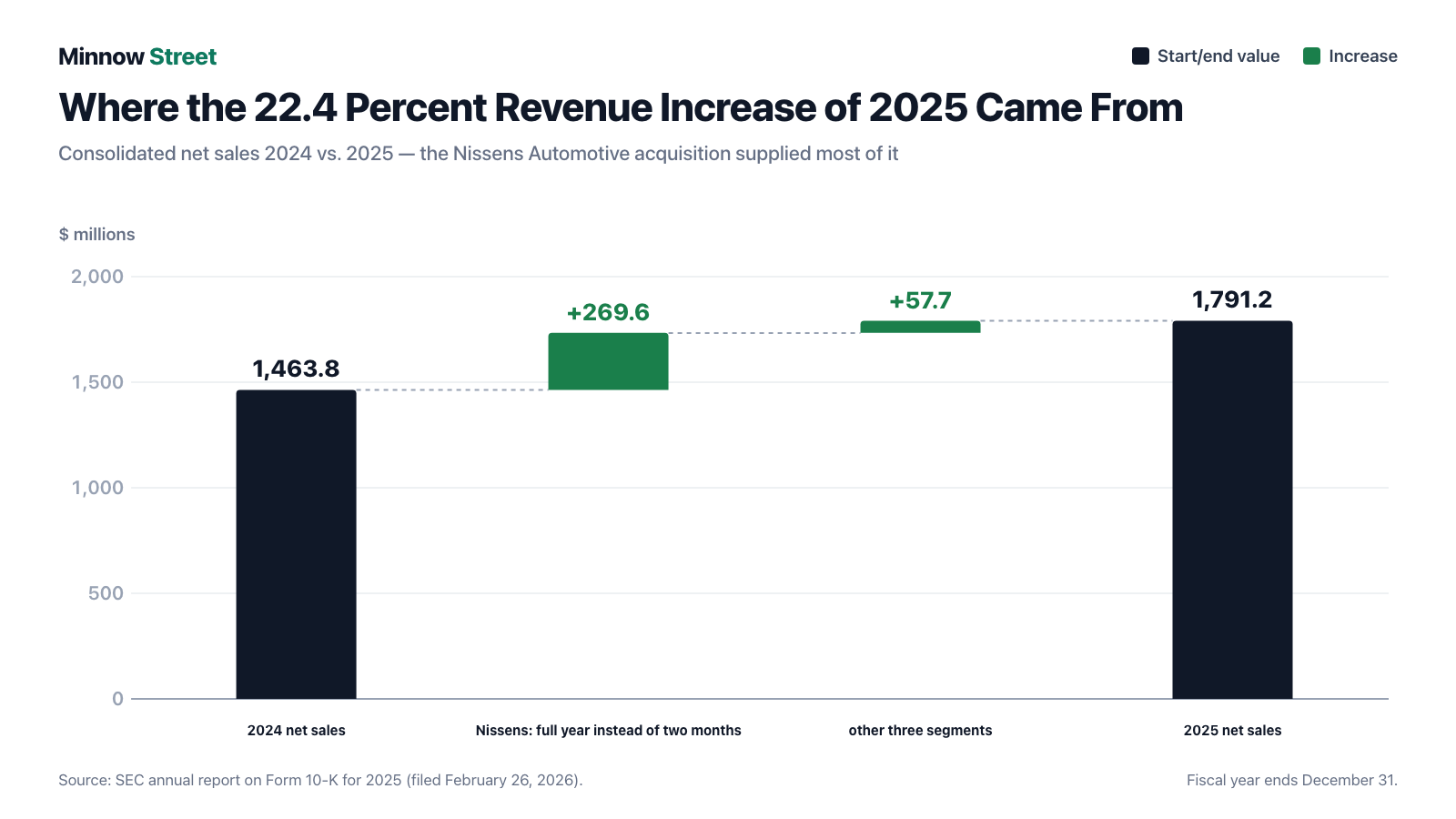
On November 1, 2024, Standard Motor Products acquired the Danish replacement parts supplier Nissens Automotive for 366.8 million euros (roughly $397.1 million). In 2024 that business therefore counted for only two months; in 2025 it counted for a full year for the first time. That is exactly where the revenue jump comes from. The annual report lists it as the first reason itself:

"$269.6 million higher net sales in 2025 due to the inclusion of a full year performance of our new segment, Nissens Automotive which was acquired on November 1, 2024, as compared to two months in 2024,"
— Standard Motor Products, SEC Form 10-K for 2025, Item 7 (Management's Discussion and Analysis)
Work it through properly. Revenue rose by $327.3 million. Of that, $269.6 million is the calendar effect at Nissens — 82 percent. The other three segments combined grew $57.7 million, or roughly 4.0 percent. Not bad. But 4 percent, not 22.
And the acquisition came with a price that shows up in the interest line. Interest expense rose from $13.512 million in 2024 to $31.339 million in 2025 — more than a doubling, explicitly because of the borrowings taken on for Nissens. As of March 31, 2026, total debt stood at $658.620 million after $618.715 million at year-end 2025, at a weighted average interest rate of 4.9 percent. We traced what an acquisition can do to an industrial balance sheet in our analysis of DMC Global as well.
To be fair, Nissens is performing operationally: the segment beat the company's own expectations in 2025, and its gross margin rose from 32.2 to 39.4 percent. In the first quarter of 2026, Nissens grew 12.4 percent to $74.4 million — although, as the company itself writes, growth in local currency was only 2.7 percent. The rest was the exchange rate.
What that means for the future the company states itself in its earnings release of April 30, 2026: for full-year 2026 it expects sales growth "in the low to mid-single digit range." The calendar effect is used up.
Uncomfortable truth no. 2: a 1998 sale takes nearly half the profit
Now to the line this analysis is really about.
In 1986 Standard Motor Products bought a brake business. In March 1998 the company sold it again. When it originally acquired the business it had assumed the future liabilities for alleged exposure to asbestos-containing products made by the seller — and under the purchase agreement it carries every claim filed on or after September 2001 itself.

"At March 31, 2026, approximately 1,032 cases were outstanding for which we may be responsible for any related liabilities. Since inception in September 2001 through March 31, 2026, the amounts paid for settled claims and awards of asbestos-related damages, including interest, were approximately $108.1 million. We do not have insurance coverage for the indemnity and defense costs associated with the claims we face."
— Standard Motor Products, SEC Form 10-Q as of March 31, 2026, Note 18 "Commitments and Contingencies"
The last sentence is the most expensive one: no insurance. Every dollar of settlement and every dollar of legal fees comes out of the company's own pocket.
How much that is becomes clear when you look at three years side by side. Two lines sit next to each other in the income statement: what the operating business earned for shareholders — and what the discontinued brake business took back out.
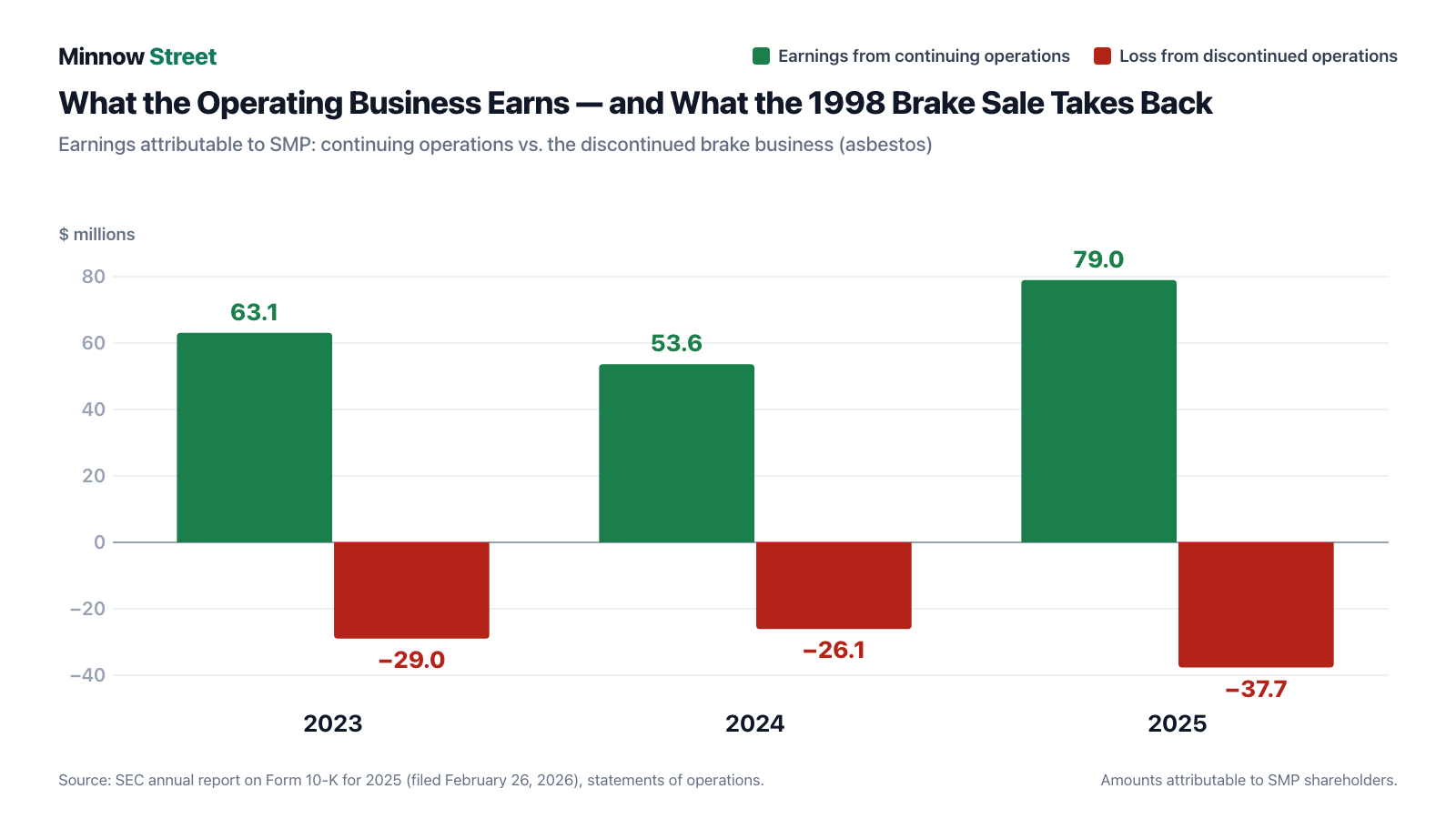
In figures, each attributable to SMP shareholders (Form 10-K for 2025):
- 2023: $63.144 million from continuing operations, minus $28.996 million from discontinued — leaving $34.148 million. Per diluted share: $2.85 minus $1.31 makes $1.54.
- 2024: $53.628 million minus $26.128 million makes $27.500 million. Per share: $2.41 minus $1.17 makes $1.24.
- 2025: $79.033 million minus $37.698 million makes $41.335 million. Per share: $3.52 minus $1.68 makes $1.84.
This is not an outlier but a pattern: 45.9, 48.7 and 47.7 percent of continuing earnings went, in three consecutive years, to a business the company sold 28 years ago.
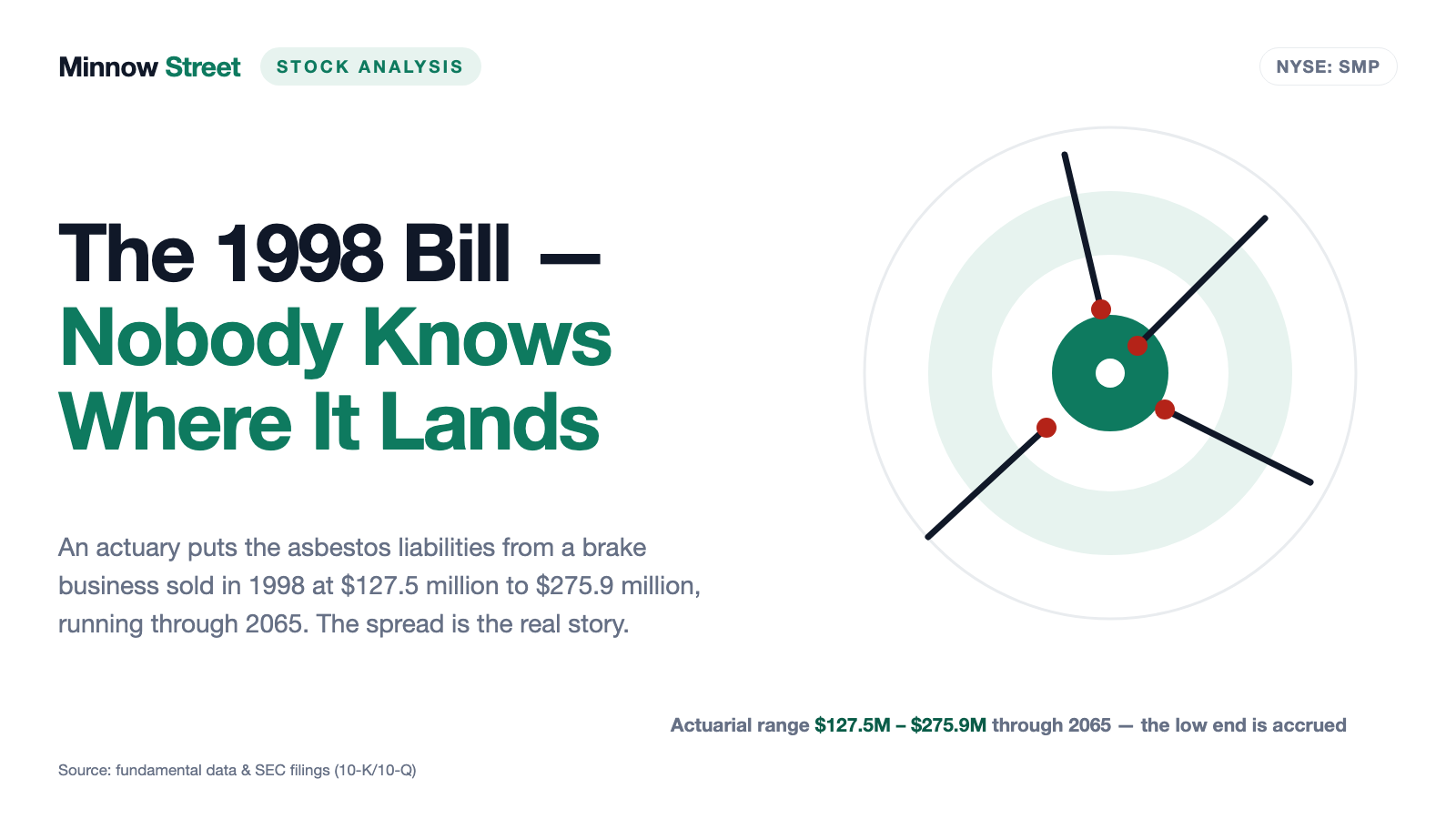
And the bill is not shrinking; it is growing. SMP has the future burden estimated each year in the third quarter by an independent actuarial firm. The study as of August 31, 2025 produced a range of $127.5 million to $275.9 million for settlements and damages through the year 2065, excluding legal costs. Against the study a year earlier, the low end rose by $27.9 million and the high end by $65.1 million. Because no value within the range is more likely than any other, SMP accrues the low end under its own accounting policy: in September 2025 the liability was raised to $127.5 million and charged with an incremental pre-tax provision of $44.4 million. Estimated legal costs through 2065 run, per the same study, to another $48.5 million to $115.3 million.
For context: market cap stood at roughly $867 million as of August 1, 2026. At the low end of the range, the asbestos bill including legal costs equals roughly a fifth of the company's market value; at the high end, roughly 45 percent. The balance sheet as of March 31, 2026 carries the long-term asbestos accrual at $109.783 million.
In fairness: the cash goes out slowly. In the first quarter of 2026, total operating cash outflows related to discontinued operations — settlements, damages and legal costs together, net of taxes — came to $2.9 million, against $4.4 million a year earlier. This is not a liquidity problem. It is a permanent deduction from profit, spread across four decades.
Uncomfortable truth no. 3: the 2025 dividend came partly from the credit line
Standard Motor Products pays quarterly dividends and has raised them steadily: $0.29 per share in 2024, $0.31 in 2025, and $0.33 since February 2026. For a company this size, a solid gesture of reliability.
Except that in 2025 the business did not fund the payout itself. The arithmetic is simple. Operating cash flow came to $57.4 million (2024: $76.7 million). Of that, $38.7 million went into capital expenditures. Roughly $18.7 million of free cash remained. Dividends paid were $27.3 million. Where the rest came from, the annual report states itself:

"During 2025, we paid dividends to SMP shareholders of $27.3 million funded with net borrowings under our 2024 Credit Agreement and cash provided by our operating activities."
— Standard Motor Products, SEC Form 10-K for 2025, Item 7 "Liquidity and Capital Resources"
Which brings us to the second question this company demands: why was operating cash flow negative at minus $28.2 million in the fourth quarter of 2025 and minus $41.9 million in the first quarter of 2026, when the bottom line showed a profit?
The honest answer is: that is mostly seasonality, not substance. The prior-year cross-check proves it. In the first quarter of 2025, $60.2 million flowed out; in the first quarter of 2026, only $41.9 million — so it improved, by $18.3 million. The reason is the business model: SMP builds inventory ahead of summer and ships to distributors before the air conditioning season starts. Cash goes out in the first quarter and comes back in the second and third — in 2025, for instance, $54.3 million in the second quarter and $91.6 million in the third. For the full year 2025, a $57.4 million inflow remained.
Two things do amplify the effect right now. First, inventories: they rose by $81.6 million in 2025 against $36.9 million the year before — per the filing because of higher sales, the timing of shipments for early 2026, and "capitalized tariff costs," meaning duty costs rolled into inventory value. As of March 31, 2026, inventories stood at $726.308 million, more than a third of the entire balance sheet. Second, financing: in the first quarter of 2026, SMP drew an additional $47.5 million to fund operating activities, tariff costs, capital expenditures and the dividend.
One side note that belongs in the picture: the buyback program authorized in 2022 for $30 million is dormant. The last purchases were in 2024 (321,229 shares for $10.4 million); there were none in 2025 or in the first quarter of 2026. As of March 31, 2026, $19.6 million remained available.
Uncomfortable truth no. 4: the auditor failed the internal controls
A quick definition first. U.S. listed companies must have not only their numbers audited but also their internal control over financial reporting — the question of whether the machinery producing the numbers works reliably at all. Think of it as a roadworthiness test for the accounting machine: the numbers can be right and the machine can still fail.
That is exactly what happened. For fiscal 2025, SMP identified a material weakness in its internal control over financial reporting — in the general information technology controls at Nissens Automotive, the segment acquired in 2024. Specifically: information for tracking administrative users was not available, so the controls for reviewing and monitoring their activity were ineffective. As a consequence, all automated and manual controls relying on data from those systems were deemed ineffective too.
Management concluded that internal control over financial reporting was "not effective" as of December 31, 2025. And the auditor, KPMG, drew the consequence:

"KPMG LLP, our independent registered public accounting firm, has audited our consolidated financial statements included in the Annual Report on Form 10-K and, as part of their audit, has issued an adverse opinion on the effectiveness of the Company's internal control over financial reporting due to the material weakness at our Nissens Automotive operating segment described above …"
— Standard Motor Products, SEC Form 10-K for 2025, Item 9A "Controls and Procedures"
Two qualifications belong here, in both directions.
In mitigation: the consolidated financial statements themselves received an unqualified opinion, and the company states explicitly that it has not identified any errors in those statements arising from the control deficiencies. The weakness affects a business acquired in 2024 with its own IT landscape — a classic integration finding, not an accounting scandal.
Against: as of March 31, 2026 the weakness was not remediated. The quarterly report calls it "un-remediated" and lists five measures in progress — temporary external resources, a reduced number of privileged system users, tools for logging privileged activity, improved monitoring controls, and additional substantive procedures. One point of timing is worth noting: on June 8, 2026 the chief information officer and vice president of IT sold 5,822 shares at $39.75, after selling 1,950 shares at $38.28 on June 1 (Forms 4). After those sales he holds 35,327 shares. At roughly $300,000 in total this is not a market-moving amount — it is worth a mention only because the IT function is the one that owns the open weakness.
There was movement at the top anyway: effective June 1, 2026, James J. Burke stepped down as chief operating officer after 47 years with the company and became executive advisor; he remains on the board. His successor is Sunil Bhandari, previously 14 years at Eaton Corporation.
Uncomfortable truth no. 5: three customers, 54.3 percent of revenue — and tariffs run right through
Anyone selling replacement parts in the United States sells them to very few, very large addresses. The annual report is blunt about it:
"In 2025, three customers each accounted for more than 10% of our consolidated net sales at 25.2%, 18.6% and 10.5%, respectively. … The loss of one or more of these customers or, a significant reduction in purchases of our products from any one of them, could have a materially adverse impact on our business, financial condition and results of operations."
— Standard Motor Products, SEC Form 10-K for 2025, Item 1A (Risk Factors)
Together that is 54.3 percent of consolidated revenue across three addresses. The filing does not name them — so neither do we. What matters is the structure: a company doing more than half its business with three buyers does not negotiate as an equal. You can see it in the Vehicle Control gross margin, which slipped from 32.3 to 31.9 percent in the first quarter of 2026 — explicitly because higher tariffs were "passed through to customers at cost": at cost, without a markup. That protects profit in absolute dollars but compresses the margin.
Which brings us to the tariff chapter, and at SMP it is a tangled one. Since February 2025 the U.S. government has imposed new tariffs on imports from Canada, Mexico, China, the European Union and many other countries. SMP itself manufactures in Canada, Mexico, China and the EU and imports from there into the United States. Its own framing: more than half of U.S. sales come from North American manufacturing and are currently mostly exempt under the USMCA trade agreement; roughly a quarter of U.S. sales is sourced from China. We wrote up how another U.S. distributor experienced the same tariff bill in our analysis of Global Industrial.
Then came an event that turns the calculation around again. On February 20, 2026 the U.S. Supreme Court invalidated the tariffs imposed under the emergency statute known as IEEPA. The administration replaced them with temporary tariffs under the Trade Act of 1974, and U.S. Customs and Border Protection announced it would begin processing refunds of IEEPA tariffs from April 2026. SMP is holding back:
"There remains significant uncertainty regarding potential legal action and administrative delays and therefore, we will continue to evaluate the likelihood of receiving refunds of IEEPA tariffs until such time as the criteria for recording an asset are met. We have not recorded any receivables for potential refunds as of March 31, 2026."
— Standard Motor Products, SEC Form 10-Q as of March 31, 2026, Note 1
That is commercially prudent and doubly significant for a reader. It means the balance sheet as of March 31, 2026 carries not a cent of potential tariff refunds. Any such refund would therefore be an upside surprise — but the filings do not put a number on it, and so neither do we. The 2026 guidance explicitly excludes further changes in the tariff landscape.
The other side: what genuinely holds up here
Read only the five sections above and you get a lopsided picture. So here is the other side, from the same sources.
The business makes money, and more of it than before. Operating income of $136.5 million in 2025 against $92.7 million in 2023 — with a margin that moved from 6.8 through 5.5 to 7.6 percent. In the first quarter of 2026 operating income rose from $24.462 million to $34.093 million. All four segments grew.
The balance sheet holds. As of March 31, 2026 there is $2,048.299 million of total assets, of which $707.579 million is equity — an equity ratio of roughly 34.6 percent. Total debt of $658.620 million equals 0.93 times equity. The 2024 Credit Agreement runs to September 2029, covers roughly $750 million and costs an average 4.9 percent in interest. The company states explicitly in the quarterly report: "The Company is in compliance with its debt covenants." Total available liquidity as of March 31, 2026 was $146.4 million.
The acquisition works operationally. Nissens beat the company's own expectations in 2025, lifted consolidated gross margin and diversifies revenue away from the United States — a genuine advantage in a tariff dispute. The segment's gross margin rose from 35.1 to 43.1 percent in the first quarter of 2026, though mainly because a one-off $4.6 million purchase accounting charge on inventory dropped out of the comparison.
The capital spending peak is behind it. The new distribution facility in Shawnee, Kansas, is complete; capital expenditures fell from $44.0 million (2024) through $38.7 million (2025) to $6.7 million in the first quarter of 2026 — back to normal levels, per the filing.
And the ownership base is stable. Institutional holders account for roughly 84.2 percent, insiders roughly 5.2 percent (as of August 1, 2026). Three analysts cover the stock, with a consensus of 5.0 — on this scale 5 is the best possible grade. With only three voices, though, you should not build an argument on it: that is a very thin base.
What the market is asking for it
Let us work in orders of magnitude, not daily prices.
As of August 1, 2026, market capitalization was roughly $867 million. The cross-check: 22,263,279 shares outstanding (cover page of the quarterly report, as of April 28, 2026) times $39.75 — the last price documented in a filing, an insider report dated June 9, 2026 — gives roughly $885 million. The two calculations sit about 2 percent apart; the figure is reliable.
On that basis:
- Price-to-sales ratio of roughly 0.5. $867 million of market value against $1,791 million of annual revenue. For a manufacturer with a 31 percent gross margin, that is not expensive.
- Price-to-earnings ratio of 10.3 — or roughly 19. The low figure comes from earnings of continuing operations (roughly $3.72 per share over the four quarters through March 31, 2026). The higher one comes from what actually reached shareholders (roughly $2.03). Which number is right depends on whether you believe the asbestos bill ever ends. The actuarial study runs to 2065.
- Price-to-book ratio of 1.24. With $693.327 million of equity attributable to SMP shareholders as of March 31, 2026, that equals a little over $31 of book value per share. A moderate premium.
- Enterprise value. Market cap plus net debt of $599.4 million gives roughly $1.47 billion — 7.4 times a full-year adjusted EBITDA at the low end of the company's own guidance (11 percent of $1.79 billion of revenue is roughly $197 million). That is not an inflated price either.
The sentence that sticks from the valuation work: the market is paying here for the operating business and only partly pricing in the legacy. Whether that is an opportunity or a trap turns on how the asbestos range develops in the coming annual studies — it has most recently risen at both ends.
Opportunities and risks at a glance
Opportunities
- Replacement parts for cars are a needs-driven business: a broken air conditioner gets fixed, and the average age of vehicles on U.S. roads keeps rising. The company itself calls its products non-discretionary.
- Nissens Automotive beat expectations in 2025 and lifted consolidated gross margin from 28.9 to 31.2 percent. For 2026 and beyond the company expects additional revenue and cost synergies.
- The European footprint reduces dependence on the U.S. tariff regime — and more than half of U.S. sales come from North American manufacturing, currently mostly tariff-exempt.
- Potential refunds of the IEEPA tariffs struck down by the Supreme Court on February 20, 2026 are carried at zero in the balance sheet as of March 31, 2026. Every dollar of them would be additive.
- The spending peak for the Shawnee, Kansas distribution facility is done; capital expenditures are back to normal levels. Of the buyback authorization, $19.6 million is untouched.
Risks
- Asbestos liability from the brake business sold in 1998 took roughly half of continuing earnings from 2023 through 2025; the actuarial range most recently rose at both ends and runs through 2065. There is no insurance coverage.
- The material weakness in internal controls at Nissens was not remediated as of March 31, 2026; KPMG issued an adverse opinion on control effectiveness as of December 31, 2025.
- Three customers accounted for 54.3 percent of consolidated revenue in 2025. The filing itself calls the loss of one of them materially adverse.
- Net debt stood at 3.0 times adjusted EBITDA as of March 31, 2026; the company targets 2.0 times by the end of 2026. Interest expense rose to $31.3 million in 2025.
- Two of the four segments depend on summer weather. A cool July feeds straight through to Temperature Control and Nissens.
- Tariffs are passed through at cost — protecting dollar profit but compressing margin. The 2026 guidance explicitly excludes further changes in the tariff landscape.
A human conclusion
Back to the closed-chapter trap. Standard Motor Products sold a brake business in 1998, and in every sense in which a company can close something, that chapter is closed: there is no brake plant, no brake workforce, no brake revenue. The accounting files it under "discontinued." The company just keeps paying — 1,032 cases outstanding as of March 31, 2026, roughly $108.1 million so far, estimated through 2065.
And that is why this stock looks better in a metrics screen than it is. Not because anyone is cheating — the presentation is entirely correct and explained at length — but because our tools take the same shortcut our minds do: what is ticked off no longer gets counted. A price-to-earnings ratio of 10.3 instead of roughly 19. A return on equity of 12.4 percent instead of the just-over-6 percent that fiscal 2025 produces from $41.335 million of profit on $683.699 million of equity. Same company, same numbers, two completely different stories.
This is not an indictment. There are good arguments for this company: a needs-driven business running since 1919, a rising gross margin, an acquisition that delivers operationally, a balance sheet that holds, and a dividend that has been raised for years. There are equally good arguments against: bought growth that will not repeat in 2026, a payout partly funded from the credit line in 2025, an auditor who failed the controls, and a legacy whose estimate most recently grew in both directions.
What you make of that is your decision. And that is exactly as it should be. One thing we would leave you with, though: before you treat a low price-to-earnings ratio as a bargain at any company, check whether there is a second line below the bottom line. Sometimes that is where the most expensive chapter sits — neatly ticked off.
Sources and disclaimer
- Annual report on Form 10-K for fiscal 2025, filed February 26, 2026 (Item 1 Business, Item 1A Risk Factors, Item 7 MD&A, Item 8 Financial Statements, Item 9A Controls, Note 2 Business Acquisitions, Note 20 Segments)
- Quarterly report on Form 10-Q as of March 31, 2026, filed April 30, 2026 (balance sheet, statements of operations, cash flow statement, Note 1 tariffs, Note 9 credit facilities, Note 18 commitments and contingencies, Item 4 controls)
- Earnings release on Form 8-K Item 2.02 dated April 30, 2026, Exhibit 99.1 (quarterly figures, net debt, leverage, 2026 guidance, dividend declaration)
- Form 8-K dated May 12, 2026, Item 5.02 (chief operations officer succession effective June 1, 2026)
- Insider filings on Forms 3 and 4 dated June 2, June 3 and June 9, 2026 (restricted stock award to the incoming chief operations officer, sales by the chief information officer)
- Fundamental data (industry, price series, holder structure, scores), as of August 1, 2026
Source: fundamental data & SEC filings (annual and quarterly reports, 10-K/10-Q).
Disclaimer: This article is journalistic research and analysis. It is not investment advice and not a solicitation to buy or sell securities. All figures are taken from the original sources named above and carry the as-of dates stated there; they may have changed since. Stocks can lose substantial value, and a total loss is possible. The author holds no position in Standard Motor Products, Inc. at the time of publication. Anyone who invests makes that decision themselves and should base it on their own research.
Our Bottom Line at a Glance
- Business model and operating performance positive
- Replacement parts for cars are a needs-driven business — the company itself calls its products non-discretionary in the earnings release of April 30, 2026. Revenue rose to $1,791.2 million in 2025, gross margin from 28.9 to 31.2 percent, operating income from $80.6 million to $136.5 million and operating margin from 5.5 to 7.6 percent. In the first quarter of 2026 all four segments grew, revenue by 9.1 percent to $451.166 million and operating income to $34.093 million. The firm has been in business since 1919.
- Where the growth came from negative
- Of the $327.3 million revenue increase in 2025, $269.6 million came purely from Nissens Automotive — acquired on November 1, 2024 for 366.8 million euros — counting for a full year instead of two months. That is 82 percent of the increase. The other three segments grew a combined $57.7 million, or roughly 4.0 percent; Engineered Solutions shrank 4 percent in 2025. The company itself qualifies the 12.4 percent Nissens gain in the first quarter of 2026: in local currency it was 2.7 percent. For 2026 it guides to growth only in the low to mid-single digit range.
- Asbestos legacy from the 1998 sale negative
- From a brake business bought in 1986 and sold in March 1998, SMP has carried every newly filed asbestos claim itself since September 2001, without insurance coverage. As of March 31, 2026, 1,032 cases were outstanding and roughly $108.1 million had been paid. In the income statement this chapter took 45.9, 48.7 and 47.7 percent of continuing earnings in 2023 through 2025: $28.996 million, $26.128 million and $37.698 million. The actuarial study as of August 31, 2025 raised the estimated range to $127.5 million to $275.9 million through 2065 (prior-year study: up $27.9 million and $65.1 million), for which a $44.4 million incremental provision was booked in September 2025. Estimated legal costs of $48.5 million to $115.3 million through 2065 come on top.
- Balance sheet, leverage and payout neutral
- The balance sheet holds: $2,048.299 million of total assets as of March 31, 2026, $707.579 million of equity, interest coverage of 5.6, covenants complied with, and a credit agreement running to September 2029 at an average 4.9 percent. Against that: total debt rose in the first quarter of 2026 from $618.715 million to $658.620 million, net debt stands at $599.4 million, or 3.0 times adjusted EBITDA — and the company's own target of 2.0 times by the end of 2026 requires substantial repayment within nine months. The $27.3 million dividend exceeded free cash of roughly $18.7 million in 2025; the annual report names borrowings as the source. Interest expense rose from $13.512 million to $31.339 million.
- Internal controls and leadership negative
- KPMG issued an adverse opinion on the effectiveness of internal control over financial reporting as of December 31, 2025; the cause is a material weakness in IT general controls at Nissens Automotive, the segment acquired in 2024, specifically around monitoring privileged access. As of March 31, 2026 the weakness was not remediated, with five measures in progress. In mitigation: the consolidated financial statements received an unqualified opinion, and the company says it identified no resulting errors. In parallel, the chief operating officer changed on June 1, 2026 — James J. Burke handed the role to Sunil Bhandari after 47 years with the company.
- Customer concentration and tariffs neutral
- Three customers accounted for 25.2, 18.6 and 10.5 percent of consolidated revenue in 2025 — 54.3 percent combined; the annual report itself calls the loss of one of them materially adverse. The U.S. tariffs imposed since February 2025 are passed through at cost, which pushed the Vehicle Control gross margin from 32.3 to 31.9 percent in the first quarter of 2026. The manufacturing footprint cushions this: more than half of U.S. sales come from North American production and are currently mostly USMCA-exempt, with roughly a quarter sourced from China. Following the Supreme Court decision of February 20, 2026 on the IEEPA tariffs, SMP has recorded no receivable for potential refunds as of March 31, 2026.
Standard Motor Products is earning more in its core business than it has in years: $1,791.2 million of revenue in 2025, a 31.2 percent gross margin, $136.5 million of operating income, and all four segments growing in the first quarter of 2026. Two qualifications sit alongside that, both from the company's own filings. First, the 22.4 percent revenue jump was 82 percent bought — $269.6 million of the $327.3 million increase came from Nissens Automotive counting for a full year for the first time; for 2026 the company expects only low to mid-single digit growth. Second, a brake business sold in 1998 has, through its asbestos liability, taken roughly half the profit for three years running: $37.698 million in 2025 alone, with 1,032 cases outstanding as of March 31, 2026 and an actuarial estimate running to 2065. Add an adverse auditor opinion on internal controls, a dividend partly funded from the credit line in 2025, and three customers accounting for 54.3 percent of revenue. Anyone seeing a price-to-earnings ratio of 10.3 here is reading the bill without its second line. Not investment advice.
What Our Rating Means
Open questions
The business works in principle, but one material question is open. As long as it stays open, our findings do not carry a quality verdict.
Yellow, because the business fundamentally works but several material operating questions are open. Much argues for the substance: a needs-driven business running since 1919, a rising gross margin, positive operating income in each of the last three years, $57.4 million of operating cash flow in 2025, an equity ratio of roughly 34.6 percent as of March 31, 2026, interest coverage of 5.6, covenants complied with, and an unqualified opinion on the consolidated financial statements. None of the criteria for a documented threat to substance is met — no going-concern qualification, no negative equity, no interest coverage below 1, no persistently negative operating cash flow: the negative figures in the fourth quarter of 2025 and the first quarter of 2026 are seasonal inventory build, and the 2026 outflow was in fact smaller than the prior-year quarter. Against green stand four documented open items. First, growth was 82 percent bought, leaving roughly 4 percent organic, while the company's own guidance for 2026 calls for only low to mid-single digit growth. Second, the asbestos burden from the brake business sold in 1998 is not fading but recently rose at both ends of the actuarial range, and has taken roughly half of continuing earnings for three years. Third, the auditor declared internal controls ineffective as of December 31, 2025, and the weakness was not remediated as of March 31, 2026. Fourth, the 2025 dividend was not covered by free cash, and the self-imposed reduction of net debt from 3.0 to 2.0 times by the end of 2026 is unproven. Explicitly not reflected in this color: the share price and the valuation level. That the stock looks cheap measured against continuing earnings is a price argument and does not set the light. The decision is yours.
A journalistic assessment by our editorial team at the time of the deep dive, based on public sources — not investment advice and not a solicitation to buy or sell. Your personal circumstances (investment goals, risk capacity, taxes) cannot be taken into account. What our levels mean, how verdicts are formed, and what conflicts of interest exist →
Worth Noting
- SMP reached our research list through a fundamental screen of small and mid-cap U.S. names, cut-off August 1, 2026 — Piotroski 7 of 9, price-to-earnings ratio 10.3, price-to-book ratio 1.24, return on equity 12.4 percent, Altman Z 2.35, interest coverage 5.6. Crucial for the reading: these metrics use earnings from continuing operations and leave out the asbestos line. Measured against what actually reached shareholders — roughly $2.03 per share over the four quarters through March 31, 2026 — the price-to-earnings ratio is about 19 rather than 10.3.
- Recency gate: the most recent periodic report is the Form 10-Q as of March 31, 2026, filed April 30, 2026; it has been evaluated, as has the same-day earnings release (Form 8-K Item 2.02 dated April 30, 2026) carrying guidance, net debt and leverage. Every filing dated on or after April 30, 2026 was reviewed individually: DEFR14A April 30, 2026, Form 8-K May 12, 2026 (Item 5.02, chief operations officer succession), six Forms 4 dated May 22, 2026, Form 8-K May 22, 2026 (Item 5.07), Form SD May 29, 2026, Forms 144 dated June 1 and June 8, 2026, Form 3 dated June 2, 2026 and Forms 4 dated June 2, June 3 and June 9, 2026. No Form 25, no Form 15, no 424B*, no S-3, no beneficial ownership report.
- Traps to avoid: the price-to-earnings ratio, return on equity and earnings growth taken from data feeds all refer to continuing operations at SMP — the asbestos line sits below them and is absent from those metrics. Market capitalization was cross-checked: 22,263,279 shares (April 28, 2026) times $39.75 (Form 4 dated June 9, 2026) gives roughly $885 million against $866.9 million from fundamental data, a deviation of about 2 percent. The negative first-quarter operating cash flow is seasonal and was smaller in 2026 than in 2025. And the $269.6 million figure is not Nissens' annual revenue but only the increase from the calendar effect — Nissens generated $305.4 million in total in 2025.
Frequently Asked Questions
Founded in 1919 and headquartered in Long Island City, New York, the company makes replacement parts for cars and sells them to distributors and repair shops — ignition, emissions, sensors, switches, air conditioning components and radiators. In 2025 it generated $1,791.2 million in revenue across four segments: Vehicle Control ($785.4 million), Temperature Control ($426.4 million), Nissens Automotive ($305.4 million) and Engineered Solutions ($274.5 million). It employed roughly 5,700 people as of December 31, 2025.
Because of an acquisition, to the tune of 82 percent. Of the $327.3 million increase in revenue, $269.6 million came from Nissens Automotive — acquired on November 1, 2024 — counting for a full year in 2025 instead of two months. The other three segments grew a combined $57.7 million, or roughly 4 percent. For 2026, the earnings release of April 30, 2026 guides to growth only in the low to mid-single digit range.
The company bought a brake business in 1986 and sold it again in March 1998, but had assumed liability for asbestos claims. Since September 2001 it has carried every newly filed claim itself, without insurance coverage. As of March 31, 2026, 1,032 cases were outstanding and roughly $108.1 million had been paid. The burden appears in the income statement under discontinued operations: $37.698 million in 2025 alone.
Because the common metrics count continuing operations only. Over the four quarters through March 31, 2026 that produces earnings of roughly $3.72 per share and a price-to-earnings ratio of 10.3 (as of August 1, 2026). Use what actually reached shareholders after the asbestos line — roughly $2.03 per share — and the ratio is about 19. Both figures are correct; they simply answer different questions.
Not fully from its own resources in 2025. Operating cash flow of $57.4 million was offset by $38.7 million of capital expenditures, leaving roughly $18.7 million of free cash — against $27.3 million paid out. The annual report names the funding explicitly: net borrowings under the 2024 Credit Agreement plus cash from operating activities. The quarterly dividend was nevertheless raised from $0.31 to $0.33 per share in February 2026.
Mostly seasonality. Standard Motor Products builds inventory ahead of summer and ships to distributors before the air conditioning season; the cash returns in the second and third quarters. In the first quarter of 2026, $41.9 million flowed out, against $60.2 million a year earlier — so it improved. For full-year 2025 there was a $57.4 million inflow. The effect is amplified by tariff costs capitalized into inventory value.
KPMG concluded that internal control over financial reporting was not effective as of December 31, 2025 — because of deficient IT controls at Nissens Automotive, the segment acquired in 2024, specifically around monitoring administrative users. The consolidated financial statements themselves received an unqualified opinion, and the company says it found no resulting errors. As of March 31, 2026 the weakness was still un-remediated, with five remediation steps in progress.
Noticeably, but cushioned. More than half of U.S. sales come from North American manufacturing and are currently mostly exempt under the USMCA trade agreement; roughly a quarter of U.S. sales is sourced from China. Tariffs are passed through to customers at cost, which compresses margin. On February 20, 2026 the Supreme Court invalidated the IEEPA tariffs; SMP has recorded no receivable for potential refunds as of March 31, 2026.
Found an error?
Did you spot a factual error, an outdated number, or a typo in this deep dive? Let us know briefly — your report goes straight to the editorial team.