Tilray Brands: Record Revenue — and Less of It per Share
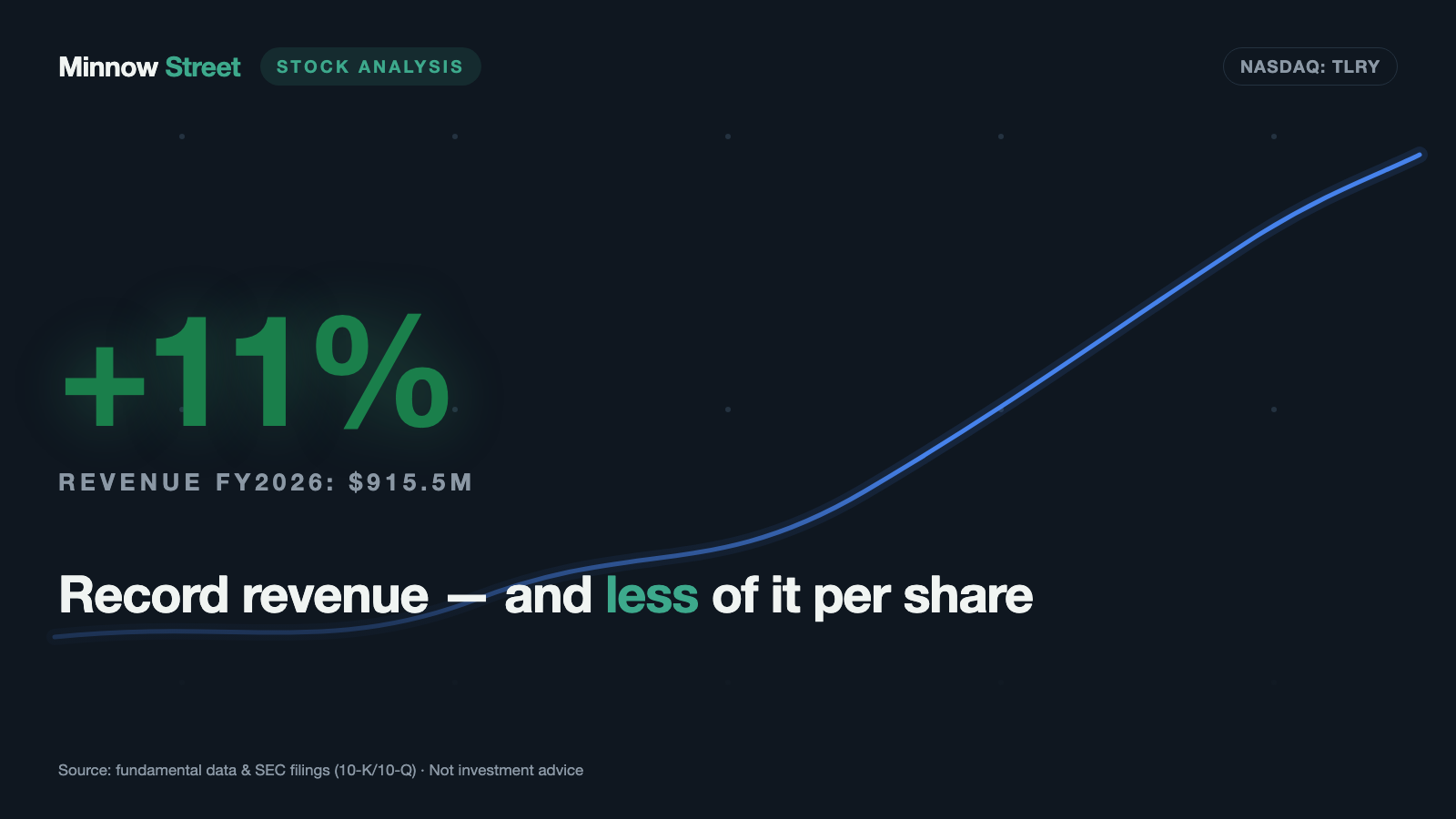
Tilray Brands posted more revenue in fiscal 2026 than ever before: $915.5 million, up 11 percent. Something else grew faster over the same period — the share count. From 106.1 million on May 31, 2025 to 136.2 million on July 24, 2026, an increase of 28.4 percent. Per share, revenue therefore fell from $9.22 to $8.19. We read the annual report (10-K) filed on July 28, 2026 line by line: how much money shareholders have put in since 2018, what is left of it, and why the company chose April 2026 to sell 12.8 million new shares. Not investment advice — just the question of who is actually selling you the stock.
 Thomas Mücke
Founder & Publisher
Thomas Mücke
Founder & Publisher
Chart
Interactive price chart (TradingView).
Note: pure fact-based analysis, not investment advice and not a solicitation to buy or sell. All figures without guarantee.
The trap: the question almost nobody asks
When a stock jumps by double digits in a single morning, you ask yourself a lot of questions. How much further can this run? Do I buy now or wait for a pullback? Is my position big enough? One question you almost never ask: who is actually selling this to me?
Usually the answer is harmless — some other investor taking profits. Sometimes the answer is uncomfortable: the company itself. There is a contractual arrangement that lets a listed company sell new shares in small slices directly on the exchange, quietly, without announcement, a little every day. In the United States it is called an at-the-market or ATM program. The money flows into the corporate treasury. The shares flow to you. And your ownership of the company gets a little smaller — your slice of the pie shrinks even though you did nothing wrong.
Tilray Brands, Inc. (Nasdaq: TLRY) is a case study in this, and an unusually well documented one. Because the company itself writes into its annual report exactly when it sold — and the timing says more than any analyst opinion.
So let us make a deal: we will read together what Tilray Brands filed with the U.S. securities regulator, the SEC — the annual report (10-K) for fiscal 2026 filed on July 28, 2026, the earnings release of the same day (Form 8-K, exhibit 99.1) and the registration statement of July 31, 2026 (Form S-8). A filing with the SEC is honest under threat of penalty, including where it hurts. What you make of it is your decision.

What Tilray Brands actually sells
The name says cannabis. The invoice says something else. Tilray Brands runs four segments, and the largest of them has nothing to do with cannabis.
Here is how fiscal 2026 revenue broke down, net of excise taxes:
- Distribution: $327.2 million — wholesale of pharmaceutical and wellness products in Europe, essentially the German subsidiary CC Pharma. Gross margin: 12 percent.
- Cannabis: $268.3 million — medical and adult-use cannabis in Canada plus a growing international business. Gross margin: 40 percent.
- Beverage: $254.0 million — craft beer, spirits and brewpubs; brands such as SweetWater, Montauk, Breckenridge and, since March 2026, BrewDog. Gross margin: 36 percent.
- Wellness: $65.9 million — hemp foods, essentially Manitoba Harvest. Gross margin: 33 percent.
Remember that ratio: the biggest revenue segment is also the thinnest-margin one. Distribution accounts for 35.7 percent of revenue but only 15.6 percent of gross profit. Anyone treating Tilray as a cannabis bet is in fact buying, for more than a third of the ticket, a European pharmaceutical wholesaler.
Two things have to be kept in mind with this company from the start, or the math goes wrong.
First: the fiscal year ends May 31, not December 31. When Tilray says "fiscal 2026" it means June 1, 2025 through May 31, 2026. The fourth quarter of fiscal 2026 therefore ran from March to May 2026 — a spring quarter on the calendar. Every annual and quarterly figure in this analysis follows the company's own counting. Where data vendors lay calendar quarters alongside, the mapping slips by a quarter.
Second: on December 2, 2025 ten shares became one. Tilray carried out a 1-for-10 reverse split. The notes to the annual report put it this way:
“Effective December 2, 2025, the Company implemented a reverse stock split of its outstanding shares of Common Stock, at a ratio of one-for-ten (the “Reverse Stock Split”).”
— Tilray Brands, Inc., SEC annual report on Form 10-K for fiscal 2026, note 2

A reverse split changes nothing about the value of a company — ten thin slices of cake become one thick slice, the cake stays the same size. It changes everything about the optics of any price history. The annual report gives a split-adjusted trading range of $3.60 to $21.00 for fiscal 2026. Anyone looking at an unadjusted price history sees one tenth of that, which makes every "X percent above the 52-week low" statement worthless. That is why no such statement appears in this analysis.
One more naming point, because it confuses databases to this day: the company was called Tilray, Inc. until January 2022 and has been Tilray Brands, Inc. ever since — same legal entity, same SEC identifier (CIK 0001731348), just a broader name for a business that had broadened. Some data sources still carry the old one.
How the stock landed on our desk
Tilray did not reach us through a momentum or value screen but through an oddity in the metrics. The fundamental data (as of August 1, 2026) carry two model scores that rarely sit side by side: a Piotroski F-Score of 3 and an Altman Z-Score of minus 1.95.
Both are point systems, not prophecies. The Piotroski F-Score runs nine yes-or-no questions on balance sheet quality — earnings, cash flow, leverage, margin, share count. Three out of nine is weak; a genuinely healthy company scores eight or nine. The Altman Z-Score estimates from five balance sheet ratios how far a company sits from financial distress. Readings below roughly 1.8 count as the warning zone in that model; minus 1.95 is far below it. But the Z-Score is extremely sensitive to accumulated losses — and Tilray has plenty. A number like that is a reason to look, not a verdict.
And then came the actual reason to write this analysis: the vendor metrics did not match the freshly filed annual report. The data feed reported a revenue decline for the year; the annual report filed on July 28, 2026 shows an 11 percent increase. Contradictions like that have a simple rule: where data disagree, the filing wins. An annual report is audited and signed; a data feed is a copy. So every revenue, earnings, balance sheet and share figure in this analysis comes from the 10-K filed on July 28, 2026 or from the filings of the days that followed. From the fundamental data we take only what could be reconciled with the filing: price, market capitalization, valuation ratios and the model scores named above — each as of August 1, 2026.
The numbers over the years — honestly credited
Let us start with what genuinely impresses. Because there is something here.
Revenue is at a record. $788.9 million in fiscal 2024, $821.3 million in fiscal 2025, $915.5 million in fiscal 2026 — up 11 percent in the last year and 16 percent over two. In the fourth fiscal quarter (March to May 2026) revenue reached $281.7 million, a quarter more than the year before.
Gross profit grew with it. $260.4 million in fiscal 2026 after $240.6 million, at a gross margin of 28 percent versus 29 percent. For a company that runs a good third of its revenue through wholesale, that is a respectable number.
The international cannabis business is growing clearly. Revenue outside Canada rose 34 percent to $84.9 million in fiscal 2026. This is the part of the group that looks most like a future: medical cannabis in Europe, with its own production in Portugal and Germany and a distribution structure that reaches pharmacies.
The balance sheet is not the problem. As of May 31, 2026 total assets of $2,328.0 million stood against $733.1 million of liabilities. Equity attributable to Tilray stockholders was $1,614.3 million, giving an equity ratio of 69.3 percent. Financial debt added up to roughly $226.9 million, against $226.0 million of cash plus $3.4 million of restricted cash and $5.3 million of marketable securities. The company therefore puts its net debt at $0.7 million. Practically zero.
And management is giving guidance. For fiscal 2027 Tilray expects adjusted EBITDA of $68 million to $75 million (earnings release of July 28, 2026). Adjusted EBITDA is earnings before interest, taxes, depreciation and a long list of further items — a measure the company defines itself. It says something about operating direction; it says nothing about whether money ends up in the bank.
Now the other half of the truth.
There was no profit in any of these years. The net loss was $222.4 million in fiscal 2024, $2,181.4 million in fiscal 2025 and $105.2 million in fiscal 2026. The 2025 outlier has a name: a $2,096.1 million impairment of goodwill and intangible assets. Translated: the company had to concede that businesses it had bought expensively over the years were no longer worth what the balance sheet said. In fiscal 2026 there was no such write-down, and the operating loss shrank accordingly from $2,282.7 million to $63.0 million.
Anyone who wants to see how a write-down year reshapes a balance sheet, and what remains of the acquisition story afterwards, will find the same mechanism in a different industry in our analysis of Teladoc Health: expensively purchased acquisitions, a billion-dollar figure that disappears from the balance sheet in a single year — and a business that is still there afterwards, just carried at a lower value.
The loss per share says the most. $3.30 in fiscal 2024, $24.56 in fiscal 2025, $1.09 in fiscal 2026, each split-adjusted. In the fourth fiscal quarter of 2026 it was $0.43 per share, considerably more than in the quarters before. That was not the operation: the quarterly operating loss was $16.5 million. It was a tax expense of $13.9 million despite a pre-tax loss, and the fact that $11.6 million of the quarterly result belonged to minority holders of subsidiaries — money earned inside the group but not owned by Tilray shareholders. Over the full fiscal year that effect came to $16.2 million: the group net loss was $105.2 million, the loss attributable to Tilray stockholders $121.4 million.
Uncomfortable truth no. 1: revenue rose 11 percent, the share count 28
This is the core of the analysis, and it fits in one sentence: the pie got bigger, the number of slices grew faster.
Tilray Brands' share count, each figure split-adjusted:
- May 31, 2025: 106,067,875 shares
- May 31, 2026: 131,683,075 shares, up 24.2 percent
- July 24, 2026 (cover page of the annual report): 136,203,579 shares
From the end of May 2025 to the end of July 2026 — barely 14 months — the share count therefore grew 28.4 percent. Revenue grew 11 percent over the same fiscal year. What that means for an existing shareholder shows up in the simplest calculation of all: revenue divided by the weighted average number of shares.
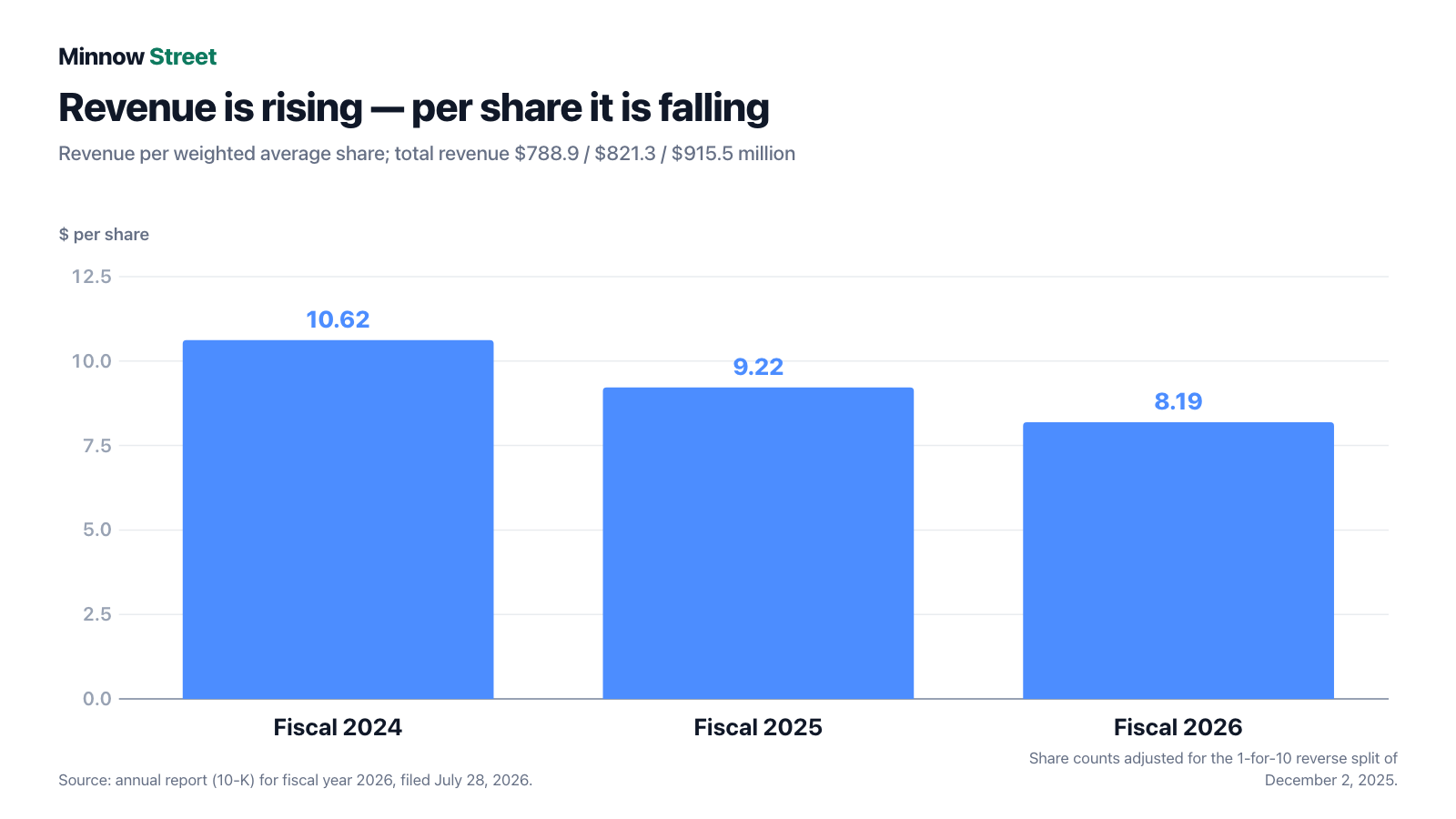
Over two fiscal years revenue rose 16.0 percent — and fell 22.9 percent per share. That is not an opinion, it is a division. And it holds for every other metric just the same: gross profit per share, cash per share, book value per share. Whatever the company gains in operating progress, it spreads across more heads.
Where do the new shares come from? The annual report lists it. In fiscal 2026 alone Tilray issued 19,625,505 shares through ATM programs for gross proceeds of $161.6 million and net proceeds of $158.0 million after commissions. On top of that came 3,138,878 shares used to retire $17.0 million principal of convertible notes, plus 620,900 shares from warrant exercises in September 2025.
And it continues. After the fiscal year end, in June 2026, another 639,581 shares came out of the ATM program for gross proceeds of $3.5 million, along with 3,852,527 shares from three private exchange transactions that retired $18.0 million principal of convertible notes. Of the TLRY 27 notes maturing on June 15, 2027, $70.0 million principal remained outstanding as of the filing date, down from $88.0 million at May 31, 2026.
One point worth doing in your head: the charter authorizes 1,416,000,000 shares of common stock. Shares outstanding on July 24, 2026 were roughly 136.2 million. Less than a tenth of the authorized capital is used. That is not a forecast — nobody is claiming Tilray will exhaust it. But it answers the question of whether the dilution runs into a natural limit. It does not.
Uncomfortable truth no. 2: Tilray sold 12.8 million new shares into its own rally
Back to the opening question: who is actually selling this to you?
On April 15, 2026 Tilray entered into a new ATM program of up to $180 million. By the fiscal year end on May 31, 2026 the company had issued 12,848,281 shares under it for gross proceeds of $87.0 million, at an average price of $6.77 per share. And then the annual report contains a sentence worth reading twice:
“A substantial portion of these shares were issued on April 22 and April 23, 2026, during a period of increased trading activity and share price appreciation following developments related to the potential U.S. cannabis rescheduling process.”
— Tilray Brands, Inc., SEC annual report on Form 10-K for fiscal 2026, liquidity section

There are two ways to read this, and both are legitimate.
From the company's side this is good craftsmanship. If you need equity, you raise it when it is expensive, not when it is cheap. Collecting $87.0 million at $6.77 per share is simply the cheapest financing available to a group that is burning cash in operations. No management team gets criticized for that.
From the buyer's side the same transaction looks different. Prices rose on those days because of a political headline — the possible rescheduling of cannabis under U.S. federal law. Anyone who bought the headline was, to a substantial extent, not buying shares from another investor but freshly issued stock from the company. As of August 1, 2026 the shares traded at $4.54. This is not an accusation against Tilray. It is the answer to a question too rarely asked before hitting the buy button.
Of the $180 million program, roughly $93 million was still untapped as of May 31, 2026. Against a market capitalization of about $618 million (data as of August 1, 2026), that is a reserve of a good 15 percent — available without a shareholder vote, without advance notice, on any trading day.
Uncomfortable truth no. 3: the business has never funded itself
Profit is an opinion, cash flow is a fact — that old line rarely fits as precisely as it does here.
Tilray Brands' operating cash flow, the money the running business actually put into the till:
- Fiscal 2024: minus $30.9 million
- Fiscal 2025: minus $94.6 million
- Fiscal 2026: minus $69.1 million
Three years, three minus signs. On top of that came $33.0 million of investment in capital and intangible assets in fiscal 2026. All in, roughly $102 million more flowed out than in. The company does not bury this — it writes it into its risk factors:
“Our business has not generated positive cash flow from operations. If this continues in the future, we may not have sufficient cash flows to service our debt and make necessary capital expenditures.”
— Tilray Brands, Inc., SEC annual report on Form 10-K for fiscal 2026, risk factors (Item 1A)

And yet cash rose slightly in fiscal 2026, from $221.7 million to $226.0 million. How does that add up? The answer is in the financing section: $158.0 million net from the sale of new shares. Without those share sales, cash would have shrunk by roughly $150 million in fiscal 2026.
That is the engine of this entire analysis in one sentence: the cash holds because shares are sold. And shares are sold because otherwise the cash would not hold.
Let us still work out the runway honestly. As of May 31, 2026 Tilray held $226.0 million in cash, $3.4 million in restricted cash and $5.3 million in marketable securities — $234.6 million together. At an outflow of roughly $102 million a year, that lasts a good two years, about nine quarters, if nothing comes in and nothing is cut. This is not an acute emergency. The annual report carries no going-concern warning; the accounts are expressly prepared on a going concern basis, and the auditor PricewaterhouseCoopers issued an unqualified opinion on July 28, 2026. The distinction matters: Tilray does not have a survival problem tied to deadlines. Tilray has a self-funding problem.
One detail on the side that is worth knowing: on July 24, 2026 a subsidiary agreed an amendment to its credit agreement with Bank of America under which the revolving commitments were cut from $25.0 million to $15.0 million and certain financial covenants were modified. The same agreement acknowledges a voluntary principal prepayment of $10.0 million made on May 29, 2026. Taken together this reads less like distress than like tidying up — but a reduced credit line is a reduced credit line.
Uncomfortable truth no. 4: $6.63 billion paid in, $0.62 billion of market value
Perhaps the most honest number in the whole annual report is not in the income statement but in the balance sheet, in two lines directly beneath each other.
The first is additional paid-in capital, and it stands at $6,627.1 million as of May 31, 2026. Simplified, that is the sum of all money shareholders and sellers of acquired companies have put into this business since it was formed in 2018 — through capital raises, through acquisitions paid for in stock, through exchanged convertible notes.
The second is the accumulated deficit, at minus $4,968.6 million. That is the sum of every loss incurred since formation.
Adding the par value of the shares to the paid-in surplus ($0.1 million at $0.0001 par per share), shareholders have contributed $6,627.2 million in total. From that come off the accumulated losses and a $44.2 million currency reserve.
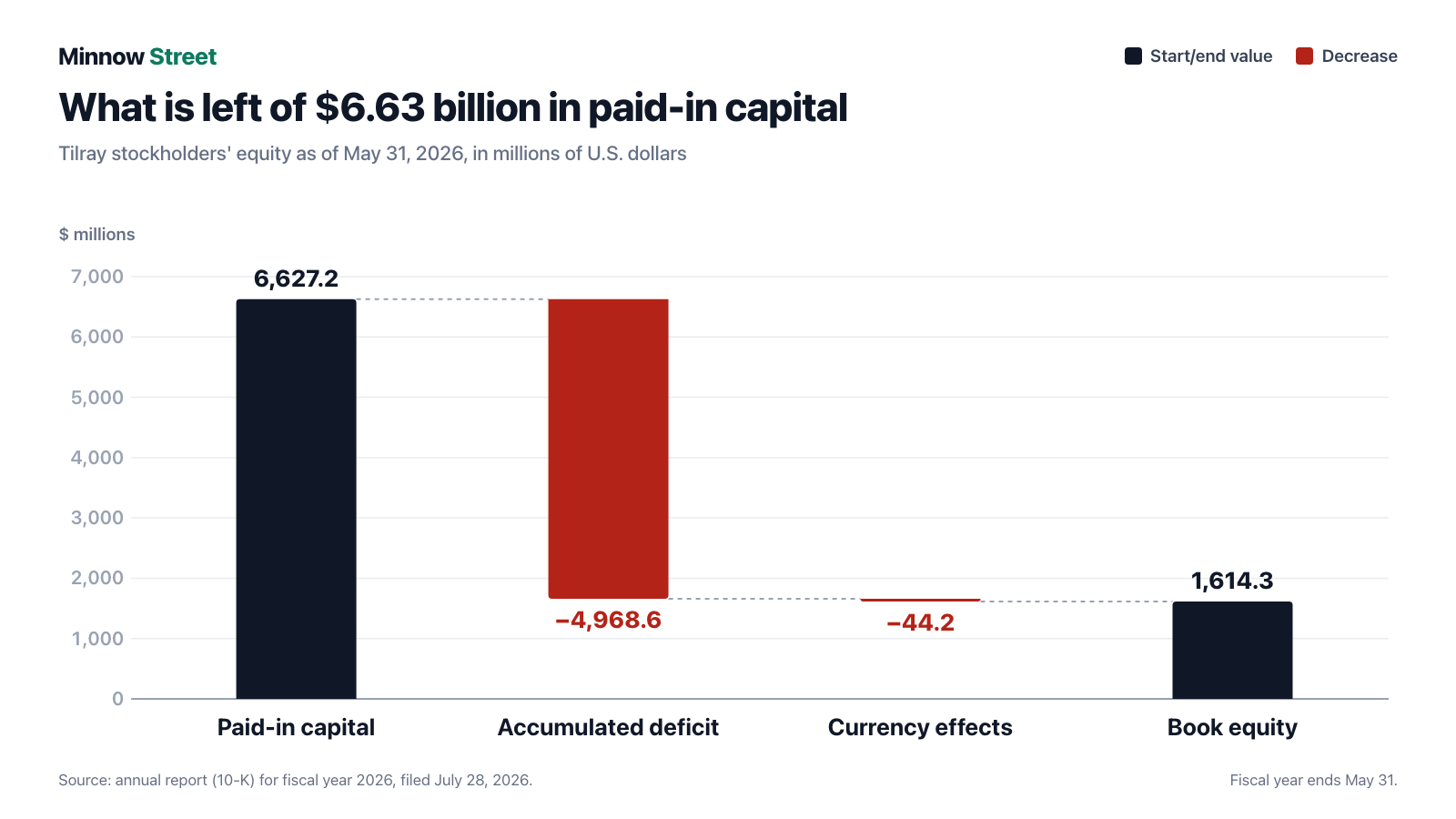
What remains is $1,614.3 million of equity on the balance sheet. The market valued the company at roughly $618 million as of August 1, 2026 — a good third of book value, a price-to-book ratio of 0.38, and about 9 percent of what shareholders have paid in altogether.
Why does the market sit so far below book? A large part of the answer lies in a single balance sheet line. Goodwill stands unchanged at $752.4 million and relates entirely to the cannabis business. Goodwill is neither a building nor a machine but the premium Tilray paid above the tangible value of the companies it bought. The market value of the entire group is therefore below the carrying value of that one line item. Translated: the market does not believe the goodwill.
The auditor made exactly this its critical audit matter — the one point flagged in the opinion as especially challenging and judgmental:
“Management uses significant judgment in assessing the qualitative factors to be considered in the qualitative goodwill impairment assessment, including macroeconomic factors, industry trends, cost factors, overall financial performance and the Company’s share price and resultant market value capitalization in comparison to its book value.”
— PricewaterhouseCoopers LLP, report of independent registered public accounting firm in the SEC annual report on Form 10-K for fiscal 2026
The outcome of that assessment was: no impairment in fiscal 2026. That is a decision, not a law of nature. Should the market value stay below book value, the same question lands on the table again in the next annual report — and in fiscal 2025 the answer was $2,096.1 million.
Uncomfortable truth no. 5: the equity plan grows automatically every January 1
Three days after the annual report, on July 31, 2026, Tilray made another filing with the SEC: a Form S-8 registration for 11,355,231 additional shares issuable under its employee equity plan. That is roughly 8.3 percent of all shares outstanding.
The notable part is not the number but the mechanism behind it:
“Pursuant to such provision, on January 1 of each year through 2027, the number of shares authorized for issuance under the Plan is automatically increased by a number equal to four percent of the outstanding shares of Common Stock as of the end of the Registrant’s immediately preceding fiscal year, or any lesser number of shares of Common Stock determined by the board of directors of the Registrant.”
— Tilray Brands, Inc., SEC registration statement on Form S-8, July 31, 2026

The 11,355,231 shares registered now are the sum of three annual rounds: 2,970,901 shares on January 1, 2024, 3,736,909 on January 1, 2025 and 4,647,421 on January 1, 2026. The amounts grow year by year, because four percent of a larger base is more than four percent of a smaller one. It is compound interest — running against the existing shareholder.
How quickly that mechanism turns into actual shares is visible in the insider filings (Form 4) of the same week. On July 30 and 31, 2026 ten executives and directors of Tilray reported awards totalling 2,390,464 restricted stock units, granted on July 29 and 30, 2026 — of which 1,289,211 went to chief executive Irwin D. Simon alone. That is roughly 1.8 percent of all shares outstanding, awarded in two days. Nobody reported an open-market sale in those filings; the only shares leaving went to the tax authorities as withholding, at reported prices of $3.99 and $4.20.
On top of that sits the dilution potential already granted, which the annual report lists in its earnings-per-share footnote: 7,583,186 shares from restricted stock units, 303,148 from options and 3,314,080 from convertible debentures — roughly 11.2 million shares in total. Because the group reports a loss, they are excluded from the diluted loss per share calculation, since including them would arithmetically shrink the loss. They exist all the same.
The counterweight: what really carries here
An analysis that only lists the uncomfortable side is as crooked as a marketing brochure. So here is the other direction, from the same sources.
The European business is real and growing. $84.9 million of international cannabis revenue in fiscal 2026, up 34 percent. Behind it sit production sites in Portugal and Germany with EU-GMP certification, a pharmaceutical wholesaler with pharmacy access and, since fiscal 2026, the U.K. Lyphe group as well. That is infrastructure nobody rebuilds in a quarter.
The balance sheet is not the problem. An equity ratio of 69.3 percent, net debt of $0.7 million per the company's own calculation, no customer accounting for more than 10 percent of annual revenue. Cash covers the entire financial debt. That sets Tilray clearly apart from the many consumer goods groups that paid for their acquisitions with borrowed money and whose room to move now hangs on credit covenants — as we described, for example, in our analysis of Utz Brands. Tilray paid its price differently: with shares instead of debt. For the survival of the company that is the safer route. For the existing shareholder it is the more expensive one.
The write-down year is behind it. The $2,096.1 million from fiscal 2025 is booked. What survived — $752.4 million of goodwill and $42.8 million of intangible assets — is a fraction of what once sat on the balance sheet. The drop height is smaller now.
And management is showing numbers that point the right way. In the fourth fiscal quarter of 2026 Tilray reported adjusted EBITDA of $31.9 million, up from $27.6 million a year earlier, and adjusted net income of $5.3 million, or $0.05 per share. For fiscal 2027 the group guides to $68 million to $75 million of adjusted EBITDA and expects to pass $1 billion of annual revenue for the first time. Adjusted metrics are house recipes — but the direction is right, and it stands in a document filed with the SEC.
One curiosity to close this chapter, because the annual report really does say it: under the heading "AI and Cryptocurrency Business Strategy" Tilray describes using artificial intelligence to manage its greenhouses — and at the same time exploring "strategic initiatives related to cryptocurrency". The balance sheet carries digital assets at $0.674 million after a $1.0 million investment in fiscal 2026. The size is immaterial for the group. As a signal about how a company courts the attention of the capital market, it is not.
What the market is charging for it
Every figure in this chapter carries a data date of August 1, 2026 and is expressly not a price forecast.
Tilray Brands' market capitalization stood at roughly $618 million (136,203,579 shares at $4.54). That produces the following orders of magnitude:
- Price-to-sales ratio: roughly 0.68 — the market pays a good 68 cents for a dollar of annual revenue. For a growing consumer goods business that would be cheap; for one that buys every revenue dollar with an operating loss, it is an open question.
- Price-to-book ratio: 0.38 — the market pays 38 cents for a dollar of book equity. The discount is that large because a substantial part of that equity consists of $752.4 million of goodwill the market does not trust.
- Price-to-earnings ratio: not calculable — there are no earnings.
- Cash per share: roughly $1.72 ($234.6 million divided by 136.2 million shares). A good third of the share price is cash.
And the professionals? Twelve analysts covered the stock as of August 1, 2026, with an average rating of 3.67 on a scale where 5 is the best mark. Translated: a mildly positive stance, a long way from enthusiasm. Institutional investors held roughly 8.6 percent of the shares, insiders roughly 0.65 percent — both low. With Tilray that is no accident: the group is one of the best-known retail investor stocks on the market.
Perhaps the most sober valuation statement of all sits in the annual report itself. The company has to show what would have become of $100 invested on May 31, 2021. As of May 31, 2026 it was:
- Tilray Brands: $3.24
- Horizons Marijuana Life Sciences Index: $15.74
- Nasdaq Composite: $196.18
Tilray therefore did not merely underperform the broad market; it badly underperformed its own industry. That is history and says nothing about the future — but it says a great deal about how this capital structure came about.
Opportunities and risks at a glance
Opportunities
- European medical cannabis: up 34 percent to $84.9 million in fiscal 2026, with in-house EU-GMP production, pharmaceutical wholesale and clinical access — infrastructure that benefits first if further countries regulate.
- Potential U.S. rescheduling: in the earnings release of July 28, 2026 the group describes a ready blueprint for a U.S. medical business. If regulation arrives, that is a market where Tilray sells essentially nothing today.
- Balance sheet flexibility: net debt of $0.7 million per the company's own calculation, an equity ratio of 69.3 percent and $234.6 million of liquidity. No lender dictates the timetable here.
- Adjusted earnings metrics point upward: $31.9 million of adjusted EBITDA in the fourth fiscal quarter of 2026, guidance of $68 million to $75 million for fiscal 2027.
- Valuation with an asset cushion: price-to-book of 0.38 and roughly $1.72 of cash per share (data as of August 1, 2026).
Risks
- Continuing dilution: up 28.4 percent in shares in barely 14 months, roughly $93 million of ATM capacity still open, authorized capital of 1,416,000,000 shares and a four percent annual automatic increase in the employee plan through 2027.
- No positive operating cash flow: minus $30.9 million, minus $94.6 million and minus $69.1 million in fiscal 2024 through 2026, flagged as a risk by the company itself.
- Goodwill concentration: $752.4 million of goodwill in the cannabis segment — more than the entire market capitalization. The auditor treats its valuation as a critical audit matter.
- Weak core in Canada and beverages: beverage revenue would have shrunk roughly 15 percent without the BrewDog deal; Canadian wholesale cannabis revenue fell 60 percent to $7.3 million.
- Regulatory dependence: Health Canada licences, EU-GMP certifications, U.S. federal law, U.K. and German law — the business model rests on permits that can be withdrawn or changed.
- Minority share of earnings: $16.2 million of the fiscal year result belonged to minority holders, so the loss attributable to Tilray stockholders ($121.4 million) is larger than the group net loss ($105.2 million).
A human conclusion
Back to the opening question: who is actually selling this to you?
At Tilray Brands the answer sits in the annual report, with a date on it. On April 22 and April 23, 2026, when prices jumped on a political headline, the company issued a substantial portion of 12,848,281 new shares at an average of $6.77. That is not shady. It is sensible — any management team should raise equity when others are paying up for it. But it answers the question that gets lost in the excitement.
And it explains why two truths that seem irreconcilable are both correct here. As a company, Tilray Brands got better in fiscal 2026: more revenue, more gross profit, a growing European medical business, a balance sheet with almost no net debt, no more billion-dollar write-downs. As a stock, Tilray Brands got smaller over the same period: $8.19 instead of $9.22 of revenue per share, 28.4 percent more shares, a book value spread over ever more heads.
Both are true. The difference lies in who paid for the improvement — and that was the existing shareholders, in the currency of their ownership.
Anyone weighing Tilray today is therefore not betting on cannabis, on beer or on Europe. They are betting that the point arrives where the business brings in more money than it consumes — and that it arrives before the next batch of shares is printed. Two figures in the next quarterly report (10-Q) answer that more honestly than any press release: operating cash flow, and the share count on the cover page.
And the next time a headline pulls you into a rally, pause and ask the question. Sometimes the answer is another investor. Sometimes it is in the annual report.
What you make of it is your decision. And that is exactly as it should be.
Sources and disclaimer
- Tilray Brands, Inc. — annual report (Form 10-K) for the fiscal year ended May 31, 2026, filed July 28, 2026 (SEC EDGAR, CIK 0001731348) — primary source for all revenue, earnings, balance sheet, cash flow and share figures
- Tilray Brands, Inc. — earnings release (Form 8-K, Item 2.02) of July 28, 2026 with exhibit 99.1 (press release) — segment figures, adjusted metrics and fiscal 2027 guidance
- Tilray Brands, Inc. — registration statement (Form S-8) of July 31, 2026 covering 11,355,231 additional shares for the employee equity plan
- Insider filings (Form 4) for Tilray Brands of July 30 and 31, 2026 — ten filings reporting awards of 2,390,464 restricted stock units in total; no open-market sale
- Fundamental data (price, market capitalization, price-to-book, Piotroski F-Score, Altman Z-Score, analyst and ownership figures), data as of August 1, 2026
Disclaimer. This article is journalistic analysis and expressly not investment advice, not a solicitation to buy or sell securities and not a recommendation. All figures come from the primary sources named above and carry the stated reference date; they may have changed since. Shares of companies that persistently spend more than they take in and fund themselves by issuing new stock are especially volatile — a total loss is possible. Anyone who invests makes that decision, and carries that risk, themselves. At the time of publication the author holds no position in Tilray Brands, Inc.
Our Bottom Line at a Glance
- Business model and revenue positive
- Revenue reached the highest level in company history in fiscal 2026 at $915.5 million, up 11 percent, and gross profit rose to $260.4 million. International cannabis revenue grew 34 percent to $84.9 million on the back of in-house EU-GMP production in Portugal and Germany. Four legs to stand on, and no customer above 10 percent of revenue.
- Dilution negative
- Shares outstanding rose from 106,067,875 on May 31, 2025 to 131,683,075 on May 31, 2026 and 136,203,579 on July 24, 2026 — up 28.4 percent in barely 14 months. Revenue per share fell from $10.62 in fiscal 2024 to $9.22 and then $8.19. Roughly $93 million of ATM capacity is still open, authorized capital runs to 1,416,000,000 shares, and the employee plan grows automatically by 4 percent every January 1 through 2027.
- Cash flow and self-funding negative
- Operating cash flow was negative in fiscal 2024, 2025 and 2026 at minus $30.9 million, minus $94.6 million and minus $69.1 million; the risk factors of the 10-K put it plainly: "Our business has not generated positive cash flow from operations." Cash rose in fiscal 2026 only because $158.0 million net came in from the sale of new shares.
- Balance sheet and leverage positive
- An equity ratio of 69.3 percent as of May 31, 2026, net debt of $0.7 million per the company, and $234.6 million of liquidity against roughly $226.9 million of financial debt. No going-concern warning, and an unqualified opinion from PricewaterhouseCoopers dated July 28, 2026. The group does not depend on lenders — it depends on the equity market.
- Balance sheet quality and goodwill negative
- Within $1,614.3 million of equity sit $752.4 million of goodwill, entirely in the cannabis segment — more than the whole market capitalization of roughly $618 million as of August 1, 2026. The auditor treats that valuation as a critical audit matter and expressly cites the comparison of market capitalization with book value. In fiscal 2025 the same question cost $2,096.1 million.
- Earnings power and outlook neutral
- On an adjusted basis the fourth fiscal quarter of 2026 shows EBITDA of $31.9 million and net income of $5.3 million, and guidance for fiscal 2027 stands at $68 million to $75 million of adjusted EBITDA. Under U.S. accounting rules the year still ended with a net loss of $105.2 million. The direction is right; the proof in the form of cash inflows is still outstanding.
In fiscal 2026 Tilray Brands got better as a company and smaller as a stock: record revenue of $915.5 million (up 11 percent), gross profit of $260.4 million, no more billion-dollar write-down, a balance sheet with a 69.3 percent equity ratio and practically no net debt — alongside 28.4 percent more shares in barely 14 months, revenue per share down from $9.22 to $8.19, and three consecutive fiscal years of negative operating cash flow (minus $30.9 million, minus $94.6 million, minus $69.1 million). That cash still held was down to $158.0 million net from selling new shares — including 12,848,281 shares at an average of $6.77, a substantial portion of them, per the annual report, on April 22 and 23, 2026, straight into a price rally. Not investment advice.
What Our Rating Means
Substance risk
We found at least one documented issue that threatens the company itself — regardless of how the stock is currently valued.
Red, and expressly not because of looming insolvency: the annual report carries no going-concern warning, PricewaterhouseCoopers issued an unqualified opinion on July 28, 2026, net debt stands at $0.7 million, and the $234.6 million of liquidity covers roughly nine quarters at the current rate of outflow. Red here stands for a different but equally documented risk to the substance of the business: the operation has not carried itself for three fiscal years. Operating cash flow was negative in 2024, 2025 and 2026 (minus $30.9 million, minus $94.6 million, minus $69.1 million); an operating loss of $63.0 million does not begin to cover interest expense of $23.7 million, so interest coverage is below 1; and cash held in fiscal 2026 only because $158.0 million net came in from selling new shares. Where funding permanently comes from issuing fresh equity, the existing shareholder becomes the funding source: 28.4 percent more shares in barely 14 months, revenue per share down from $10.62 to $8.19, roughly $93 million of ATM capacity still open and authorized capital of 1,416,000,000 shares. That $752.4 million of goodwill sits on a balance sheet whose counterpart is worth only about $618 million on the stock market (data as of August 1, 2026) does not improve the grade. The traffic light judges the company, not the share price — and this company has paid for its progress with fresh shares every single year. The decision is yours.
A journalistic assessment by our editorial team at the time of the deep dive, based on public sources — not investment advice and not a solicitation to buy or sell. Your personal circumstances (investment goals, risk capacity, taxes) cannot be taken into account. What our levels mean, how verdicts are formed, and what conflicts of interest exist →
Worth Noting
- The hook for this analysis was a contradiction: the fundamental data (as of August 1, 2026) reported a revenue decline for Tilray and an operating margin of about minus 53 percent, while the annual report filed on July 28, 2026 shows an 11 percent revenue increase and an operating loss equal to 6.9 percent of revenue. Where data disagree, the filing wins: every revenue, earnings, balance sheet, cash flow and share figure in this analysis comes from the 10-K of July 28, 2026 and the filings of the days that followed. From the fundamental data only price, market capitalization, valuation ratios, model scores (Piotroski, Altman Z) and analyst and ownership figures were used.
- Two traps with Tilray: the fiscal year ends May 31, so calendar-quarter labels shift the mapping by one quarter. And on December 2, 2025 ten shares were combined into one (a 1-for-10 reverse split); price histories without split adjustment show one tenth of the actual values, which is why statements such as "X percent above the 52-week low" are deliberately avoided here.
- The market capitalization was cross-checked: 136,203,579 shares (cover page of the 10-K, as of July 24, 2026) times $4.54 gives $618.4 million, exactly matching the figure from the fundamental data. The company should not be confused with its former name "Tilray, Inc.", which some data sources still carry; the SEC identifier CIK 0001731348 is unchanged.
Frequently Asked Questions
Tilray Brands, Inc. (Nasdaq and TSX: TLRY) is a consumer goods group with four segments. In fiscal 2026, $327.2 million of revenue came from distribution — pharmaceutical and wellness wholesale in Europe — $268.3 million from cannabis, $254.0 million from beverages (craft beer, spirits, brewpubs and, since March 2026, BrewDog) and $65.9 million from wellness products. The company is headquartered in Leamington, Ontario, and New York, and employed roughly 3,595 people as of May 31, 2026.
Tilray Brands runs a fiscal year that differs from the calendar year and ends on May 31 each time. "Fiscal 2026" therefore covers June 1, 2025 through May 31, 2026, and the fourth fiscal quarter covers March to May 2026. Anyone laying calendar quarters alongside will map the figures one quarter out. Every figure in this analysis follows the company's own counting from the annual report (10-K) filed on July 28, 2026.
Yes. Effective December 2, 2025, Tilray Brands combined every ten old shares into one new share, a 1-for-10 ratio. All share, price and per-share figures in the filings and in this analysis are retroactively adjusted. The annual report gives a split-adjusted trading range of $3.60 to $21.00 for fiscal 2026. Price histories that are not adjusted show one tenth of those values, which makes statements such as "X percent above the 52-week low" useless.
Shares outstanding rose from 106,067,875 on May 31, 2025 to 131,683,075 on May 31, 2026 and on to 136,203,579 on July 24, 2026 — up 28.4 percent in barely 14 months. In fiscal 2026 alone Tilray issued 19,625,505 shares through at-the-market programs for net proceeds of $158.0 million. Revenue per share consequently fell from $9.22 to $8.19 even though total revenue rose 11 percent.
No. The large impairment of goodwill and intangible assets happened a year earlier: $2,096.1 million in fiscal 2025. There was no such write-down in fiscal 2026, and goodwill stands unchanged at $752.4 million, relating entirely to the cannabis segment. The auditor PricewaterhouseCoopers treats the impairment assessment of that item as a critical audit matter in its opinion dated July 28, 2026.
No. The accounts as of May 31, 2026 are expressly prepared on a going concern basis, and PricewaterhouseCoopers issued an unqualified opinion on July 28, 2026 with no substantial-doubt paragraph. Liquidity stood at $234.6 million and net debt at $0.7 million per the company's own calculation. The problem is not solvency but self-funding: operating cash flow was negative throughout fiscal 2024, 2025 and 2026.
A price-to-earnings ratio cannot be formed, because there are no earnings. As of August 1, 2026 the market capitalization was roughly $618 million, which corresponds to a price-to-sales ratio of about 0.68 and a price-to-book ratio of 0.38. The discount to book has a reason: within the $1,614.3 million of equity sit $752.4 million of goodwill — more than the entire company costs on the stock market.
ATM stands for "at the market": the company may sell new shares continuously and directly on the exchange through banks, without a separate announcement. Tilray used two such programs in fiscal 2026 and issued 19,625,505 shares. Of the program launched on April 15, 2026 with capacity of up to $180 million, roughly $93 million was still untapped as of May 31, 2026 — a dilution reserve of a good 15 percent of the market capitalization.
Found an error?
Did you spot a factual error, an outdated number, or a typo in this deep dive? Let us know briefly — your report goes straight to the editorial team.