Ready Capital: Almost a Third of the Loan Book Pays No Interest — and the Cheap Cash Flow Comes from Shrinking
Our in-house stock scanner puts Ready Capital 7th in the price-to-free-cash-flow ranking of the U.S. selection on July 26, 2026, at a ratio of 0.3. Add a share price at roughly one-fifth of reported book value. The filings with the U.S. securities regulator, the SEC, explain both with the same number: as of March 31, 2026, 29.3 percent of loans on the books were on non-accrual status, meaning no interest income is recognized on them. The cash flow that makes the ratio look cheap comes from selling the loan book, not from lending: net interest income turned negative at minus $15.1 million in the first quarter of 2026. Some discounts are not an offer. They are a description.
 Thomas Mücke
Founder & Publisher
Thomas Mücke
Founder & Publisher
Chart
Interactive price chart (TradingView).
Note: pure fact-based analysis, not investment advice and not a solicitation to buy or sell. All figures without guarantee.
There is an investor trap that feels like a gift: the discount reflex. It fires the moment we see a number sitting far below another number we treat as the "real" value. A crossed-out price tag. A share price at one-fifth of book value. Our head fills in the rest by itself: "Four-fifths free." That is how Ready Capital Corporation (NYSE: RC) landed on our desk — with a price-to-free-cash-flow ratio of 0.3 and a stock that closed at $1.47 on July 24, 2026 while the balance sheet as of March 31, 2026 showed book value of $7.43 per share. So let us make a deal: before we celebrate the discount, we read what it refers to. The sources are the filings Ready Capital submits to the U.S. securities regulator, the SEC — the annual report (10-K) for 2025, the quarterly report (10-Q) as of March 31, 2026 and several current reports (Form 8-K) from 2026. Those filings are honest under threat of prosecution. And they describe a real estate lender whose loan book is shrinking, whose lending economics have turned negative, and where almost every third dollar of loans carries a label that explains everything. What you make of it is your call.
Contents
- What Ready Capital actually does
- How the stock reached our desk — and what a 0.3 ratio means at a lender
- The numbers over the years — honestly credited
- Uncomfortable truth no. 1: the cash flow is inventory liquidation
- Uncomfortable truth no. 2: 29.3 percent pay no interest
- Uncomfortable truth no. 3: book value is melting — and can melt further
- Uncomfortable truth no. 4: the dividend follows a number deep in the red
- Valuation: what 0.2 times book really means
- Opportunities and risks at a glance
- A human conclusion
- Sources
What Ready Capital actually does
Ready Capital Corporation is a real estate lender — not a company that owns buildings, but one that lends other people the money for them. It is headquartered at 1251 Avenue of the Americas in New York and was formed in 2011 under Maryland law. It first traded as ZAIS Financial Corp., then as Sutherland Asset Management Corp from 2016 to 2018, and has carried its current name since September 2018. As of December 31, 2025 it had 442 full-time employees (10-K for 2025).
The business stands on two legs. The larger one is called LMM Commercial Real Estate — loans on lower-to-middle-market commercial property. These are loans of up to roughly $40 million to trades businesses, medical practices and small investors: to buy an apartment building, an office property, a warehouse. A large part of them are bridge loans — short-term financings that let an owner buy and improve a property until permanent bank financing takes over. Think of it as a construction loan with a high rate and the expectation of being refinanced within one to three years. When rates rise and property prices fall, the owner cannot find that permanent financing — and the bridge stops carrying anyone.
The second leg is Small Business Lending. Through its subsidiary ReadyCap Lending, Ready Capital originates small business loans under the SBA 7(a) program. The Small Business Administration is a U.S. federal agency that guarantees most of each such loan; the lender can sell the guaranteed portion at a premium to investors. Ready Capital holds an unusual position here: one of only 16 non-bank Small Business Lending Company licenses in the program, plus preferred lender status. The Madison One and Funding Circle USA platforms acquired in 2024 add USDA lending and an online origination platform. The third leg — residential mortgage banking through the subsidiary GMFS — was sold on June 30, 2025 and is reported as a discontinued operation.
One structural feature shapes the company: it has no management of its own. Ready Capital is externally managed by Waterfall Asset Management, LLC, an investment adviser formed in 2005. The annual report states it directly: "We do not have, or expect to have, our own employees, as our management team is designated by Waterfall." The manager receives a fee of 1.5 percent per year on the first $500 million of stockholders\' equity and 1.00 percent on anything above that. Keep that sentence in mind — the fee is tied to equity, not to profit.
And with that the central tension of this analysis is on the table, running through every chapter that follows: Ready Capital is shrinking its balance sheet, and that shrinkage produces exactly the cash flows that make the stock look dirt cheap on one ratio — while at the same time reducing the earnings base that ratio is supposed to come from.
How the stock reached our desk — and what a 0.3 ratio means at a lender
Ready Capital surfaced in our in-house stock scanner, specifically in the price-to-free-cash-flow ranking. That ranking sorts the entire stock universe by the price-to-free-cash-flow ratio, ascending, cheapest first. On July 26, 2026 the list held 544 hits, of which the top 25 are displayed; in the U.S. selection Ready Capital sat at rank 7 with a ratio of 0.3. To repeat the search: open the stocks section, choose scanners, select the price-to-free-cash-flow ranking and set the market filter to the United States. The lists are recomputed daily, so the placement is a snapshot from July 26, 2026, not a permanent state.
Now the ratio itself, in plain language. Free cash flow is the money left over after all running expenses and investments — the cash a company could use to repay debt, pay dividends or buy back stock. The price-to-free-cash-flow ratio divides market capitalization by that amount. A ratio of 20 means you pay twenty times what is left over each year, which works out to a 5 percent yield. A ratio of 0.3 would mean the company generates more than three times its own market capitalization in free cash in a single year. At a machinery maker that would be a sensation.
At a lender it is not. That is the most important sentence in this analysis. At a machinery maker, operating cash flow comes from machines sold; it mirrors earning power. At a lender, the same line collects movements of the loan book. Loans held for resale are treated as inventory — like sofas in a furniture dealer\'s warehouse: funding them is an operating outflow, selling them an operating inflow. A lender that stops originating and sells the existing stock produces an enormous operating inflow — precisely while it is shrinking the business. The furniture dealer clearing the warehouse and ordering nothing new has more cash in the register that month than ever before. That is not earning power. That is inventory.
That is exactly how the first quarter of 2026 reads at Ready Capital. Operating cash flow came to $590.2 million — against a net loss of $200.1 million. The bridge between the two sits in the cash flow statement, and it is unambiguous:
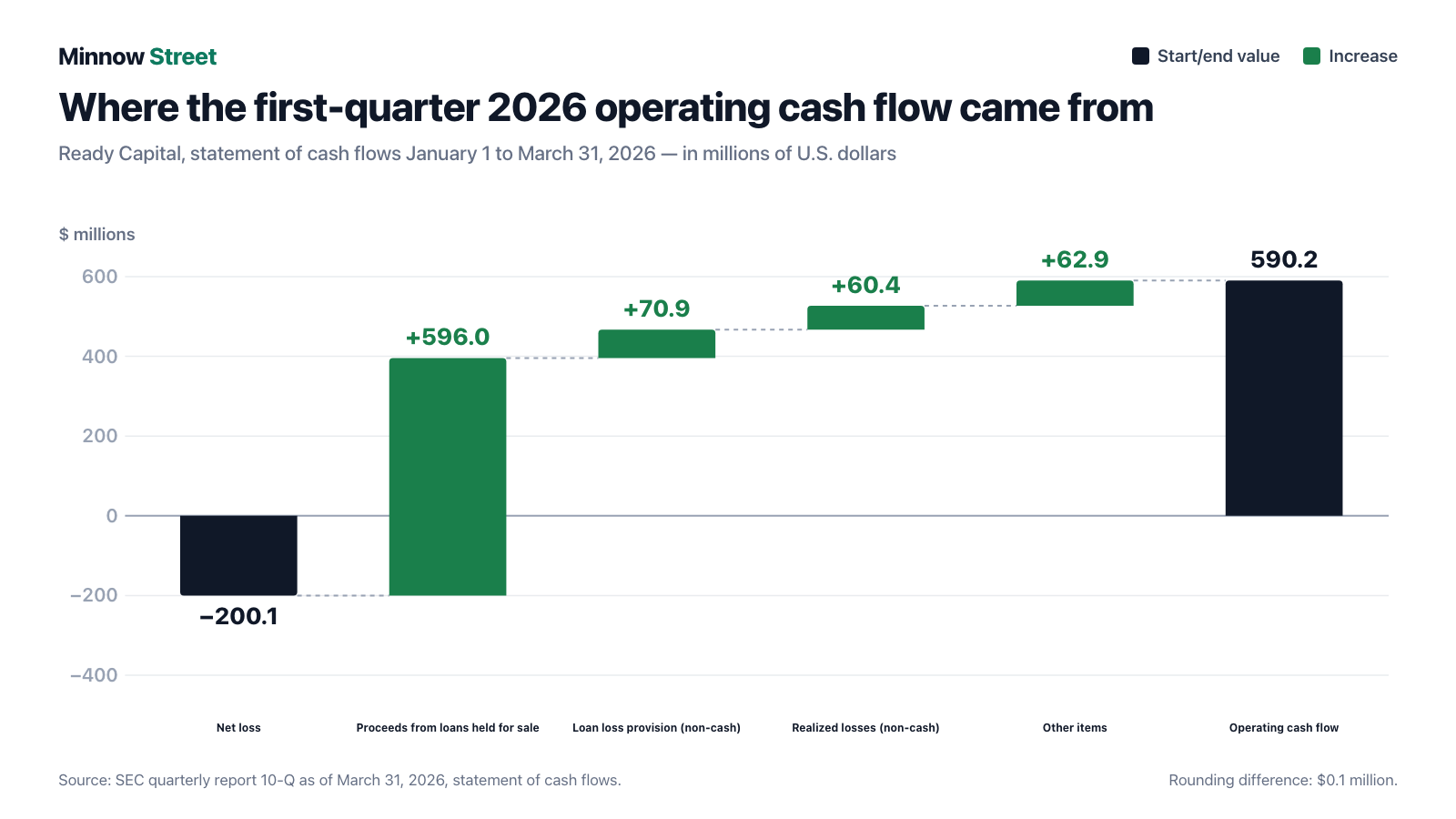
Free cash flow over the four quarters through March 31, 2026 adds up, from the cash flow statements of the filings (continuing operations), to roughly $966 million. It is distributed as unevenly as it gets: minus $48.4 million in the second quarter of 2025, plus $434.7 million in the third, minus $10.8 million in the fourth and plus $590.2 million in the first quarter of 2026. Two of the four quarters were negative on an operating basis. The two positive ones shared a cause: selling loans out of the book.
One more word on the rest of the scanner picture, because it belongs here: on July 26, 2026 our stock profile listed Ready Capital in four verified scanner strategies — strong DCR, power trend, dividend cutters and Beneish M-score. The last two are explicitly warning screens, not a seal of approval. Pure ratio rankings such as the price-to-free-cash-flow list do not count as hits there. Those lists are also recomputed daily.
The numbers over the years — honestly credited
Start with what genuinely impresses, because there was a time when this company worked. Total assets grew from $5.372 billion on December 31, 2020 to $12.441 billion on December 31, 2023 — more than a doubling in three years, driven by acquisitions and by a low-rate era in which bridge lending on commercial property was good business. In 2023 Ready Capital reported income from continuing operations of $351.2 million, and in 2022 $159.6 million (annual report 10-K for 2024). Book value per share stood at $14.10 on December 31, 2023, and the dividend came to $1.46 for full-year 2023 and still $1.10 per share for full-year 2024.
The platform is real too. One of 16 non-bank licenses in the SBA 7(a) program cannot be bought, and neither can preferred lender status. Servicing Freddie Mac multifamily loans, the USDA business, financing affordable housing through tax-exempt bonds — those are capabilities a new competitor does not assemble in a year. And the small business segment still earns its spread: the first quarter of 2026 showed $22.8 million of interest income against $16.2 million of interest expense.
Then the direction changed. Total assets fell from $12.441 billion (December 31, 2023) via $10.142 billion (December 31, 2024) and $7.770 billion (December 31, 2025) to $6.314 billion on March 31, 2026 — roughly a halving in a little over two years. The result swung to minus $412.0 million in 2024 and minus $215.9 million in 2025 (continuing operations in both cases). The first quarter of 2026 added minus $200.1 million. There was one bright spot: the first quarter of 2025 showed a profit of $82.4 million — but $102.5 million of that came from a bargain purchase gain, because United Development Funding IV, acquired on March 13, 2025, was bought below its carrying value. An accounting effect, not money earned.
A rule of thumb for this chapter: a shrinking balance sheet is not automatically a sick one — but it cannot grow and generate earnings at the same time. Whatever Ready Capital sells stops earning the day it leaves.
Uncomfortable truth no. 1: the cash flow is inventory liquidation
The first truth needs no derivation — the company writes it into its own quarterly report:
"The net cash provided by operating activities primarily reflected the sale of Loans, held for sale, realized losses on financial instruments and provision for loan losses, partially offset by net losses."
— Ready Capital Corporation, SEC quarterly report 10-Q as of March 31, 2026, Liquidity and Capital Resources

In figures: the cash flow statement line "Loans, held for sale, net" contributed $596.0 million in the first quarter of 2026 — against operating cash flow of $590.2 million. That is 101 percent. Without that single line the quarter would have been negative on an operating basis. The nine-month report for 2025 showed the same pattern: $556.2 million from the same line against $466.7 million of operating cash flow.
And where did the money go? Not to shareholders. In the first quarter of 2026, $1.267 billion flowed out through financing activities — mostly repayments of secured borrowings and securitized debt obligations. That is the honest description of what is happening here: Ready Capital sells loans and hands the cash back to its own creditors. Loans held for sale fell in the process from $710.9 million on December 31, 2025 to $360.2 million on March 31, 2026. That is the crucial caveat: this source of cash has a floor.
Uncomfortable truth no. 2: 29.3 percent of the loans pay no interest
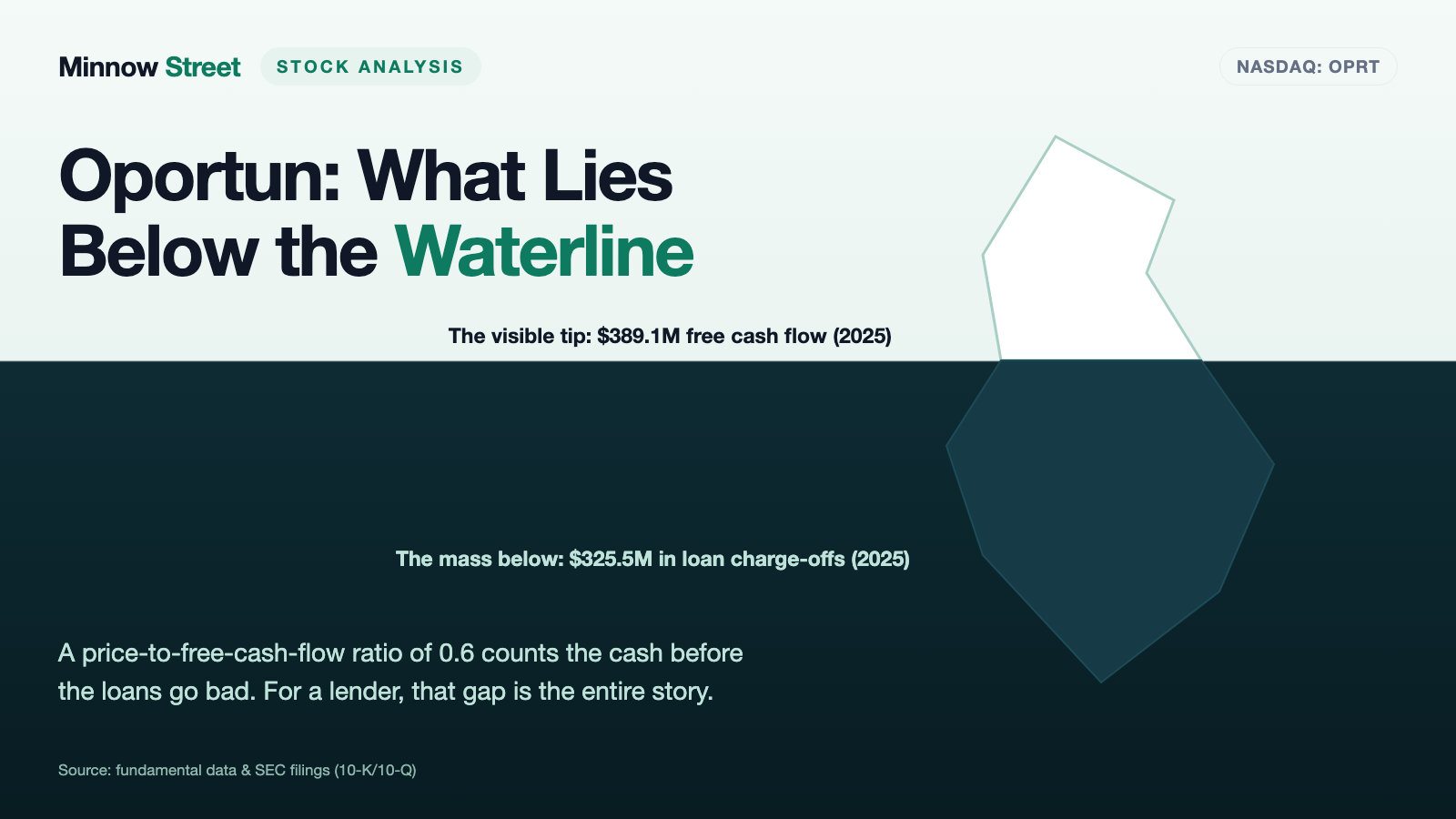
Now to the word sitting under the magnifying glass in this article\'s cover image: "non-accrual". It means a lender no longer recognizes interest income on a loan because it considers collection of principal and interest on the original terms unlikely. In practice that happens once a loan is 90 days or more past due. The loan stays on the balance sheet, but it stops earning.
As of March 31, 2026 this applied to $1.221 billion at Ready Capital — by the company\'s own table, 29.3 percent of loans on the books. Three months earlier it was 25.5 percent. Only 79.8 percent of loans were current; 14.9 percent were 60 days or more past due. Bridge loans took the worst of it: of $1.886 billion, $1.066 billion sat on non-accrual — more than every second dollar.
The consequence appears in the same report, in the segment discussion, backed by numbers:
"Interest income of $58.9 million represented a decrease of $66.1 million, primarily due to decreased loan balances primarily driven by loan sales and an increased balance of loans on non-accrual status driven by a higher probability that principal and interest will not be collected under the original contractual terms."
— Ready Capital Corporation, SEC quarterly report 10-Q as of March 31, 2026, LMM Commercial Real Estate segment results
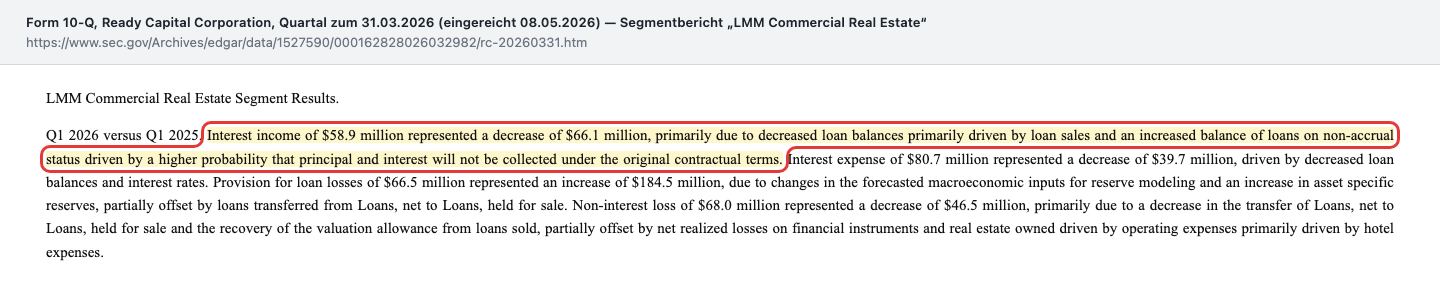
That brings us to the hardest finding in this analysis. For the group as a whole, the first quarter of 2026 showed $81.7 million of interest income against $96.8 million of interest expense — net interest income before provisions of minus $15.1 million. A year earlier it was plus $14.5 million. Translated: the interest Ready Capital pays on its own funding is higher than the interest its loan book brings in. For a picture of what it looks like when a lending spread does work, see our analysis of Pathward Financial — there the net interest margin carries the business; here it no longer does.
A rule of thumb: a non-accrual loan is not a written-off loan — but it is a loan that works without paying. The allowance attributable to that part of the book was $146.7 million as of March 31, 2026; the total allowance stood at $235.7 million. Whether that is enough will only be settled when the collateral is worked out.
Uncomfortable truth no. 3: book value is melting — and can melt further
Book value per share is the central valuation measure at a lender. It answers one question: what would be left per share if every asset were sold at its carrying value and every liability repaid? At Ready Capital that number looks like this across five quarter-ends:
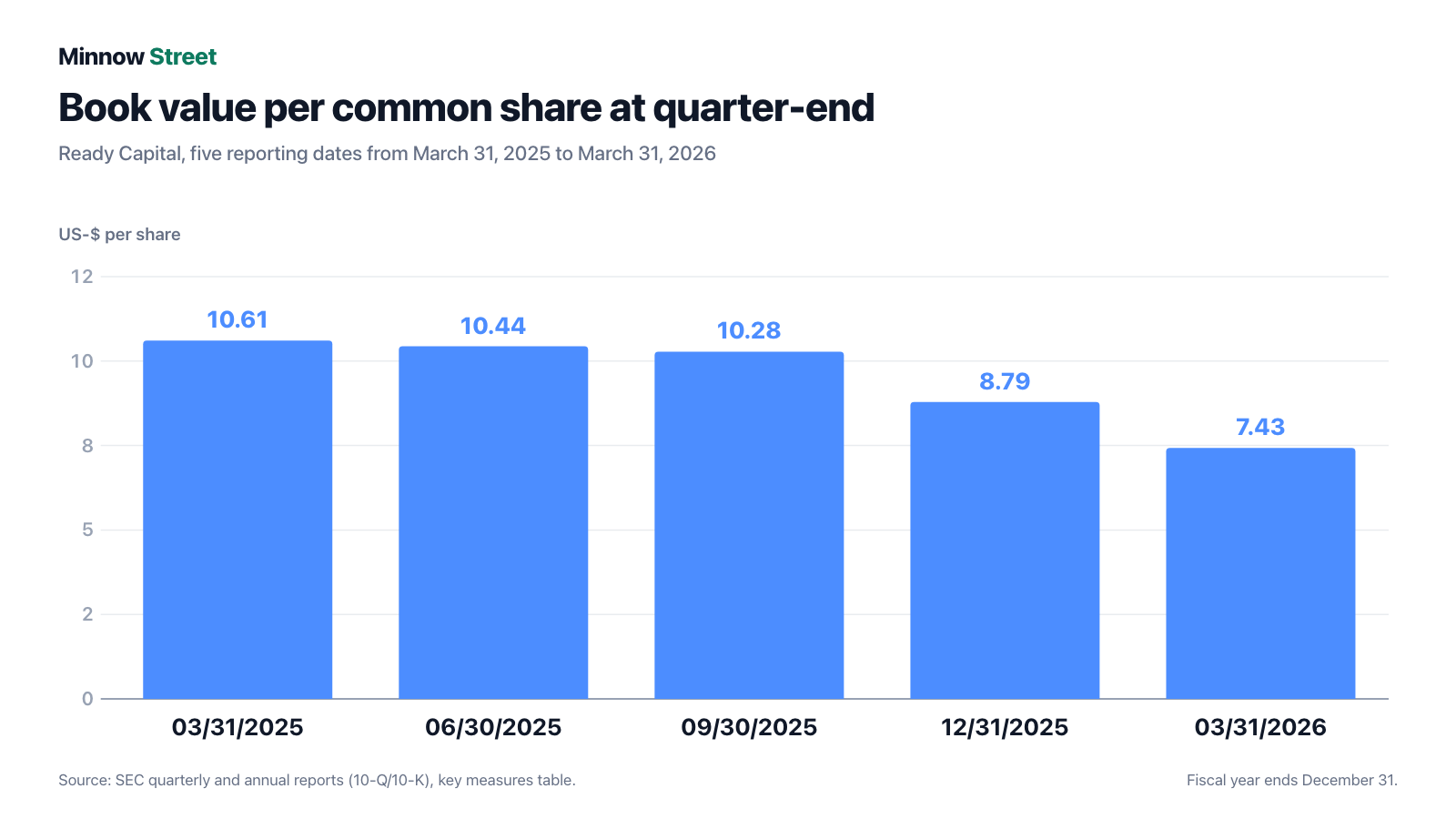
The equity behind those figures fell from $1.643 billion on December 31, 2025 to $1.440 billion on March 31, 2026, of which $1.340 billion is attributable to Ready Capital itself. The accumulated retained deficit stood at $1.013 billion as of March 31, 2026.
Then comes the sentence that shows the company knows where it stands. In its liquidity discussion it cites $200.0 million of unrestricted cash, $700.0 million of unencumbered assets, roughly $450.0 million of debt maturing in 2026 and a further $450 million of expected inflows from maturities and asset resolutions. And then:
"We expect the combination of these items to de-lever the balance sheet, which may impact book value depending on the size, timing and pricing of such actions."
— Ready Capital Corporation, SEC quarterly report 10-Q as of March 31, 2026, Liquidity and Capital Resources

The wording is careful, the content is not ambiguous: selling loans below carrying value to repay debt lowers book value. That is the plan — and that is why a discount to book is not an automatic bargain.
Uncomfortable truth no. 4: the dividend follows a number deep in the red
Ready Capital is a REIT — a structure that pays almost no corporate income tax as long as it distributes most of its taxable income. For shareholders the dividend is therefore not a side dish but the main course. Ready Capital states that it sets its dividend by reference to distributable earnings, a self-defined measure that strips out non-cash effects. For the first quarter of 2026 that number reads:
"Consolidated distributable losses of $159.8 million for the three months ended March 31, 2026 represented an increase of $148.5 million from the three months ended March 31, 2025 due to certain charge-offs and losses realized on sales of real estate owned assets and LMM loans."
— Ready Capital Corporation, SEC quarterly report 10-Q as of March 31, 2026, Non-GAAP financial measures
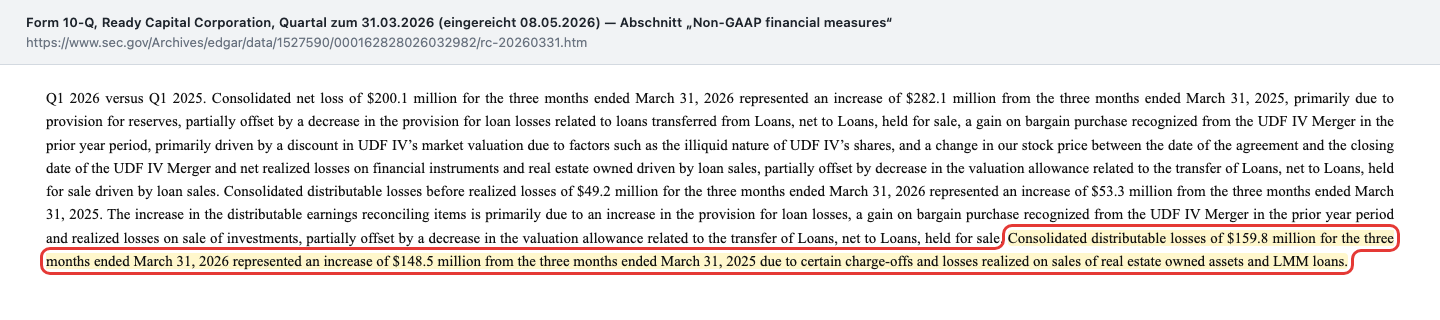
Per share that is minus $1.00. For full-year 2025 the figure was minus $246.0 million or minus $1.59 per share; in 2024 it was still plus $28.4 million or plus $0.07. The dividend followed step by step: $0.250 per share (declared December 13, 2024), then three times $0.125 (March, June and September 2025), then $0.010 (declared December 15, 2025) and $0.010 again (declared March 13, 2026). From the peak that is 96 percent less.
Two points of context. First, the Series C and Series E preferred shares are still being served — $2.0 million in the first quarter of 2026 alone, while roughly $1.7 million was declared for all common shareholders combined. Second, the management fee paid to Waterfall in the same quarter came to $4.1 million, more than twice the common dividend, and $7.8 million of accrued fees sat unpaid on the books. For a very different example of how quickly a REIT payout can collide with operating cash flow, see our piece on SmartStop Self Storage, where the 2025 dividend cost more than the company took in from operations.
Valuation: what 0.2 times book really means
For orientation, deliberately without fixating on the daily quote: at the July 24, 2026 close of $1.47 and 165.2 million common shares (10-Q cover page, as of May 7, 2026), market capitalization comes to roughly $0.24 billion. Against that sit book value of $7.43 per share and $1.340 billion of equity attributable to Ready Capital. The price-to-book ratio is therefore about 0.2 — the market pays roughly 20 cents for a dollar of reported book.
That number is neither a buying opportunity nor a verdict. It is a question: what exactly does the market doubt? The filings give three answers. First, the value of the loans themselves — 29.3 percent on non-accrual is a statement. Second, earning power — net interest income of minus $15.1 million in a quarter cannot be argued away. Third, the durability of book value, because the company itself writes that de-levering may reduce it.
There is no price-to-earnings ratio because there are no earnings. The Altman Z-score, which our stock profile shows at 2.81, carries no meaning here: the formula was built for industrial companies and uses working capital, revenue and operating income. A lender does not report those items in a comparable way — its assets are the loan book. We therefore do not use it. The Piotroski F-score of 5 out of 9 says: middling, not solid; a genuinely healthy company scores 8 or 9.
The professional view, as of July 26, 2026: of eight analyst opinions on file, seven said hold and one said sell, none said buy. The average price target was $1.80. That is remarkably modest for a stock trading at one-fifth of book value — and it shows that book value is not treated as a reliable anchor by professional observers either.
Opportunities and risks at a glance
Opportunities
- The discount is enormous. Book value of $7.43 per share as of March 31, 2026 against a closing price of $1.47 on July 24, 2026. If the loan book works out better than priced in, the leverage is correspondingly large.
- The platform has value. One of 16 non-bank licenses in the SBA 7(a) program, preferred lender status, Freddie Mac servicing, the USDA business and the Madison One and Funding Circle USA platforms cannot be rebuilt quickly.
- The smaller segment earns. Small business lending posted $22.8 million of interest income against $16.2 million of interest expense in the first quarter of 2026 — a positive spread.
- Liquidity is in place. $200.0 million of unrestricted cash and $700.0 million of unencumbered assets as of March 31, 2026 against roughly $450.0 million of debt maturing in 2026. No going-concern language, no covenant breach, no listing deficiency.
- Rate cuts would help. Roughly 80 percent of the loan book carried floating rates as of March 31, 2026. If market rates fall, funding costs drop faster than income — and borrowers find permanent financing more easily.
Risks
- 29.3 percent on non-accrual, and rising. Up from 25.5 percent on December 31, 2025. In bridge loans, more than every second dollar. Every further deterioration eats equity through provisions.
- Negative net interest income. Minus $15.1 million in the first quarter of 2026 after plus $14.5 million a year earlier. Without a positive spread there is no basis for a recovery.
- Book value is not a fixed point. Down 30 percent in four quarters — and the company itself writes that the planned de-levering may reduce it further.
- The cash source has a floor. Loans held for sale fell from $710.9 million to $360.2 million. What carries the 0.3 ratio is finite.
- External management with its own incentives. The management fee is calculated on equity, not on results; the first quarter of 2026 brought $4.1 million against roughly $1.7 million of common dividends. Terminating the agreement triggers a fee equal to three times the average annual base management fee of the prior 24 months.
- Commercial real estate remains the bottleneck. The company notes in its quarterly report that the Federal Reserve did not cut rates in the first quarter of 2026 and that it is uncertain whether and when it will.
A human conclusion
Back to the discount reflex. It is not a stupid instinct — it has served us well at the supermarket. It fails only where the crossed-out price was never a real price. At Ready Capital the book value of $7.43 per share is neither fraud nor invention; it is an accounting figure produced under the rules. But it is not a promise either. It is the sum of loans of which almost a third currently pays no interest, and it has fallen 30 percent in four quarters while the company announces that it will keep selling.
The same holds for the ratio that brought us here in the first place. A price-to-free-cash-flow ratio of 0.3 looks like an arithmetic error in your favor. It is in fact the correct depiction of a process nobody wants to buy: a lender selling its inventory and passing the money on to its creditors. The number is real. Its meaning is different from what the ranking suggests.
What remains is an honest picture: a platform with rare licenses and 442 employees, a smaller segment that earns, a larger one that no longer covers its own funding, and one date — August 6, 2026 — that will show whether the first quarter of 2026 was the floor or a waypoint. Anyone buying here is not buying a ratio but a bet that the loans are worth more than the market assumes. That can work out. It can also fail. What you make of it is your decision. And that is exactly as it should be.
Sources
- Ready Capital Corporation, quarterly report 10-Q as of March 31, 2026 (filed May 8, 2026) — balance sheet, statement of operations, statement of cash flows, Note 6 (loans and allowance for credit losses), Note 9 (discontinued operations), Management Agreement, Liquidity and Capital Resources, and segment results
- Ready Capital Corporation, annual report 10-K for 2025 (filed March 2, 2026) — business description, headcount, key measures table, dividend history, credit facilities and covenants
- Ready Capital Corporation, annual report 10-K for 2024 (filed March 3, 2025)
- Quarterly report 10-Q as of September 30, 2025 (November 7, 2025) · as of June 30, 2025 (August 8, 2025) · as of March 31, 2025 (May 9, 2025)
- Current report 8-K of March 24, 2026, Item 8.01 — redemption of the 6.20 percent notes due 2026 on April 22, 2026
- Current report 8-K of July 23, 2026, Item 5.07 — results of the annual meeting held July 17, 2026 and the list of securities registered on the NYSE
- Form 25 delisting notice of April 22, 2026 — relates to the 6.20 percent notes due 2026, not to the common stock
- Source: fundamental data & SEC filings (annual and quarterly reports, 10-K/10-Q); price and analyst figures as of July 26, 2026, closing price of July 24, 2026. Scanner placement measured live on July 26, 2026.
This analysis is journalism and editorial context, not investment advice. It contains no buy or sell recommendation and is not a solicitation to buy or sell securities. Share prices can move sharply; a total loss is possible. All figures come from the primary sources named above and carry the as-of date stated with them. The author holds no position in Ready Capital Corporation at the time of publication.
Our Bottom Line at a Glance
- Platform and licenses positive
- The infrastructure is real and not easily replicated: Ready Capital holds one of only 16 non-bank Small Business Lending Company licenses under the SBA 7(a) program and has preferred lender status; it also services Freddie Mac multifamily loans, runs a USDA business and owns the Madison One and Funding Circle USA platforms acquired in 2024. The small business segment posted $22.8 million of interest income against $16.2 million of interest expense in the first quarter of 2026 — a positive spread.
- Credit quality negative
- As of March 31, 2026, $1.221 billion or 29.3 percent of loans on the books were on non-accrual status, up from 25.5 percent on December 31, 2025. In bridge loans it was more than every second dollar ($1.066 billion of $1.886 billion). Only 79.8 percent of loans were current; 14.9 percent were 60 days or more past due. The allowance attributable to non-accrual loans was $146.7 million (10-Q as of March 31, 2026, Note 6).
- Lending economics negative
- The first quarter of 2026 showed $81.7 million of interest income against $96.8 million of interest expense — net interest income before provisions of minus $15.1 million, after plus $14.5 million a year earlier. In the commercial real estate segment interest income fell to $58.9 million against $80.7 million of interest expense. The loan book currently does not cover its own funding cost.
- Book value and payout negative
- Book value per common share fell from $10.61 (March 31, 2025) to $7.43 (March 31, 2026), a decline of 30 percent in four quarters. Distributable earnings, the measure the company uses to set its dividend, came in at minus $159.8 million (minus $1.00 per share) in the first quarter of 2026 after minus $246.0 million for full-year 2025. The quarterly dividend fell accordingly from $0.250 to $0.010 per share.
- Liquidity and maturities neutral
- As of March 31, 2026 the company reports $200.0 million of unrestricted cash and $700.0 million of unencumbered assets against roughly $450.0 million of debt maturing in 2026, and expects a further $450 million of net liquidity from maturities and asset resolutions within twelve months. There is no going-concern language, no covenant breach and no listing deficiency. The price of that comfort is the de-levering itself, which the company says may weigh on book value.
- Hook and data quality neutral
- Rank 7 in our in-house price-to-free-cash-flow ranking of the U.S. selection at a ratio of 0.3 (as of July 26, 2026, 544 hits, 25 listed). The underlying free cash flow of roughly $966 million over four quarters is arithmetically correct but comes from selling loans held for resale: $596.0 million in the first quarter of 2026 alone against $590.2 million of operating cash flow. Two of the four quarters were negative on an operating basis. The Altman Z-score carries no meaning at a lender and is not used here.
Ready Capital is not a cheap stock attached to a good business. It is a shrinking lender whose shrinkage makes one ratio look cheap. The roughly $966 million of free cash flow over four quarters that lifts the stock to rank 7 in the price-to-free-cash-flow ranking is the proceeds from selling its own loan book — $596.0 million of it in the first quarter of 2026 alone. The platform, with its SBA license, Freddie Mac servicing and 442 employees, is real, and the small business segment still earns its spread. Against that stand 29.3 percent of loans on non-accrual, net interest income of minus $15.1 million, a book value down 30 percent in four quarters to $7.43 a share, and a dividend cut from 25 cents to 1 cent a quarter. Not investment advice.
What Our Rating Means
Substance risk
We found at least one documented issue that threatens the company itself — regardless of how the stock is currently valued.
The red rating is not about the fallen share price or the low valuation. It rests on two documented findings about the business itself. First: as of March 31, 2026, 29.3 percent of loans on the books were on non-accrual status — almost every third dollar of the loan book no longer produces interest income, and in bridge loans more than every second dollar. Second: net interest income before provisions turned negative at minus $15.1 million in the first quarter of 2026; the interest Ready Capital pays on its own funding exceeds the interest its loan book brings in. Both are operating findings taken from the quarterly report, not price arguments. Against them stand a solid liquidity position, no going-concern language and a platform whose licenses have real value. In that mix the more cautious rating applies. The decision is yours.
A journalistic assessment by our editorial team at the time of the deep dive, based on public sources — not investment advice and not a solicitation to buy or sell. Your personal circumstances (investment goals, risk capacity, taxes) cannot be taken into account. What our levels mean, how verdicts are formed, and what conflicts of interest exist →
Worth Noting
- Hook and source: rank 7 in our in-house price-to-free-cash-flow ranking of the U.S. selection, measured live on July 26, 2026 (544 hits in total, 25 listed). The scanner lists are recomputed daily, so the placement is a snapshot.
- Why free cash flow reads differently at a lender: loans held for resale run through the operating line of the cash flow statement as inventory. Selling or collecting them produces operating cash inflow without any earnings being generated. First quarter of 2026: $596.0 million from that line against $590.2 million of operating cash flow and a net loss of $200.1 million. Nine months of 2025: $556.2 million against $466.7 million of operating cash flow.
- Possible confusion: Ready Capital has four securities listed on the NYSE (RC, RC PRC, RC PRE, RCD). The Form 25 delisting notices of February 17, 2026 and April 22, 2026 relate to notes — the 6.20 percent senior notes due 2026 were redeemed at par on April 22, 2026 per the 8-K of March 24, 2026. The common stock remains listed.
- The Altman Z-score is deliberately not used for this stock: the formula relies on working capital, revenue and operating income of an industrial company. At a lender, book value per share, the share of loans on non-accrual, loan loss reserves and distributable earnings are the load-bearing measures.
- Price and analyst figures are as of July 26, 2026 (closing price of July 24, 2026). All balance sheet, income and credit figures carry the as-of date of their filing.
Frequently Asked Questions
Ready Capital is a commercial real estate lender organized as a REIT. The larger segment originates and acquires loans on lower-to-middle-market commercial property — bridge, construction and stabilized financings of up to roughly $40 million. The second segment originates government guaranteed small business loans under the SBA 7(a) program. The company is externally managed by Waterfall Asset Management.
Because the ranking divides market capitalization by free cash flow over the trailing four quarters — and at a lender that cash flow comes largely from selling loans held for resale. In the first quarter of 2026 that single line contributed $596.0 million to operating cash flow of $590.2 million, while the bottom line showed a loss of $200.1 million.
Non-accrual means the lender no longer recognizes interest income on that loan because it considers collection of principal and interest on the original terms unlikely. Loans are generally placed on non-accrual after 90 days of delinquency. At Ready Capital this applied to $1.221 billion, or 29.3 percent of loans on the books, as of March 31, 2026 — up from 25.5 percent three months earlier.
Book value was $7.43 per common share as of March 31, 2026; the closing price on July 24, 2026 was $1.47. The market is therefore questioning book value itself. The filings support that doubt: 29.3 percent non-accrual, negative net interest income, and the company's own statement that planned de-levering may weigh on book value.
No. The last transaction, the acquisition of United Development Funding IV, closed on March 13, 2025, and the related filings end that month. There is no pending registration for a business combination and no tender offer. The delisting notices from February and April 2026 relate to notes, not to the common stock.
Ready Capital has four securities listed on the NYSE: the common stock RC, the 6.25 percent Series C preferred (RC PRC), the 6.50 percent Series E preferred (RC PRE) and the 9.00 percent senior notes due 2029 (RCD). The 6.20 percent notes due 2026 were redeemed on April 22, 2026 and removed from listing — hence the Form 25 filing.
No. The Altman Z-score was built for industrial companies and uses working capital, revenue and operating income. A lender does not report those items in a comparable way; its assets are the loan book. The meaningful measures here are book value per share, the share of loans on non-accrual, loan loss reserves and distributable earnings.
Second-quarter 2026 results are expected on August 6, 2026 as of the July 26, 2026 data. They answer three questions raised here: whether operating cash flow stays positive without large loan sales, where book value per share lands, and whether the share of loans on non-accrual keeps rising.
Found an error?
Did you spot a factual error, an outdated number, or a typo in this deep dive? Let us know briefly — your report goes straight to the editorial team.