MarketWise: The Cheap Cash Flow That Is 85 Percent Not Yours
Our in-house stock scanner ranks MarketWise 18th in its P/FCF ranking: the market value equals 1.0 times free cash flow (as of July 26, 2026). The filings with the U.S. securities regulator, the SEC, show why that number does not deliver what it promises. As of December 31, 2025 the listed share held just 15.2 percent of the operating company — 84.8 percent of the cash flow in the denominator belongs to somebody else. No recommendation, just arithmetic: one sixth on top, the whole thing below.
 Thomas Mücke
Founder & Publisher
Thomas Mücke
Founder & Publisher
Chart
Interactive price chart (TradingView).
Note: pure fact-based analysis, not investment advice and not a solicitation to buy or sell. All figures without guarantee.
There is a reading error we make almost every day with stocks, and it has no name — so let us give it one: the whole-company illusion. We read a ratio such as "market value divided by free cash flow" and quietly picture ourselves buying the entire business. At MarketWise, Inc. (Nasdaq Global Market: MKTW) that ratio stands at 1.0 (data as of July 26, 2026). Translated, the number claims that a single year's worth of cash costs as much as the whole company. If it were true, it would be one of the best deals in the U.S. market. So let us make a deal of our own: before you decide whether there is a bargain here, we read together what MarketWise itself has filed with the U.S. securities regulator, the SEC — the annual report (10-K) for 2025 filed March 6, 2026, the quarterly report (10-Q) for the quarter ended March 31, 2026 filed May 7, 2026, and everything that followed. Those documents are signed under penalty of law. And a single sentence inside them explains why the fraction does not work.
What MarketWise actually does — the publisher you pay three years in advance
Picture a publishing house that sells no magazines at a newsstand, only advice by email. An editor writes every week about the stock he considers undervalued, the bond he avoids, the case for gold. For that you pay not five dollars at the counter but several hundred to several thousand dollars — up front, and often for several years at once. That is the MarketWise business. The annual report lists the brands: Stansberry Research, InvestorPlace, TradeSmith, Altimetry, Chaikin Analytics and Brownstone Research. Alongside them sits software for self-directed investors: screeners, portfolio tools, alerts.
The scale as of December 31, 2025: 374 thousand paid subscribers, plus 2.1 million active free subscribers as of June 30, 2026, 451 employees, headquarters in Baltimore, Maryland. The average subscriber has been invoiced roughly $2,031 over the entire customer relationship; 63 percent of paying subscribers have spent more than $600, and 30 percent more than $5,000. This is not a mass market but a business built on a few very loyal and very willing payers. For a look at what a listed subscription data seller looks like once it has grown big and boring, see our analysis of FactSet.
Two terms carry the rest of this piece, and both are simple. Billings are the amounts MarketWise invoices its customers in a quarter — the money that actually moves. Revenue is the same amount spread across the life of the subscription. Sell a three-year subscription in January for $3,600 and you book $3,600 of billings and $100 of revenue that month. The difference parks on the balance sheet as a contract liability — an obligation settled not in money but in newsletters. Remember the image: a subscription publisher is a cash register with a pile of undelivered promises standing next to it.
And that names the central tension of this analysis, which runs through every chapter: the business earns real cash and carries no debt whatsoever — but the listed share is only a small claim on that register, and the large remainder draws its share every quarter.
How the stock landed on our desk
We run thousands of stocks through our in-house stock scanner every day. MarketWise sits in 18th place in the P/FCF ranking (as of July 26, 2026). The list is easy to explain: it collects every stock with positive free cash flow and a low ratio of market value to that cash flow, then sorts ascending — the arithmetically cheapest first. In total 544 stocks pass the criteria; the 25 strongest hits are displayed. MarketWise appears there at 1.0. To get there yourself: open the P/FCF ranking from the "Scanner" menu on minnowstreet.com and look for the MKTW row.
What does the metric measure? P/FCF is market value divided by one year of free cash flow — the money left after all running costs and after investment. A P/FCF of 15 means, loosely, that you are paying fifteen annual portions. A P/FCF of 1.0 means one. And here is the principle that carries this analysis: a fraction is only as honest as the question of whether numerator and denominator describe the same object. Here they do not — and that is not a flaw in the scanner but a feature of the corporate structure you have to know about. We will work through the arithmetic in a moment.
The same scanner card shows more, and the picture is split (all values as of July 26, 2026). Our in-house fundamental rating stands at D (minus 31 out of 100). The Piotroski F-Score, a nine-point test on the direction of the books, sits at 2 out of 9 — weak; a genuinely healthy company scores 8 or 9. At the same time the stock is technically strong: Weinstein Stage 2 (uptrend) and a stress RS rating of 71 out of 99. The price stood at $19.90, up 17.9 percent year to date and up 31.3 percent over six months.
One qualifier matters. The scanner overview counts MarketWise as a hit in five verified scanner strategies — strong DCR (80 or above), power trend, Stan Weinstein Stage 2, above the 50- and 200-day moving averages, and, as a warning signal, the Beneish M-Score. The P/FCF ranking itself deliberately does not count as a hit, because pure metric rankings sort the whole universe instead of testing a condition. Four trend hits and one accounting warning: that is exactly how this stock reads. And the Beneish M-Score belongs to the red lists — being on one is not a seal of approval but an invitation to look harder at the accounting. These lists are recalculated every day; the placement is a dated snapshot, not a permanent property.
The numbers over the years — honestly acknowledged
Start with what genuinely impresses, because there is plenty. MarketWise has no debt. Not a little — none. The annual report puts it in a single bullet: cash and cash equivalents stood at $70.1 million as of December 31, 2025, "and no debt outstanding." No loan, no bond, no revolver, no interest rate that can turn against the company later. In a ranking otherwise populated by heavily indebted issuers, that is a real exception.
And the business earns. Operating income came in at $62.6 million in 2025, after $89.0 million in 2024 and $51.8 million in 2023 — on revenue of $328.1 million, an operating margin of 19.1 percent. Operations produced $46.0 million of cash in 2025; after $1.6 million of investing outflows, $44.4 million of free cash flow remains. And since a publisher needs almost no machinery, that is not a one-off: 2023 delivered $60.7 million.
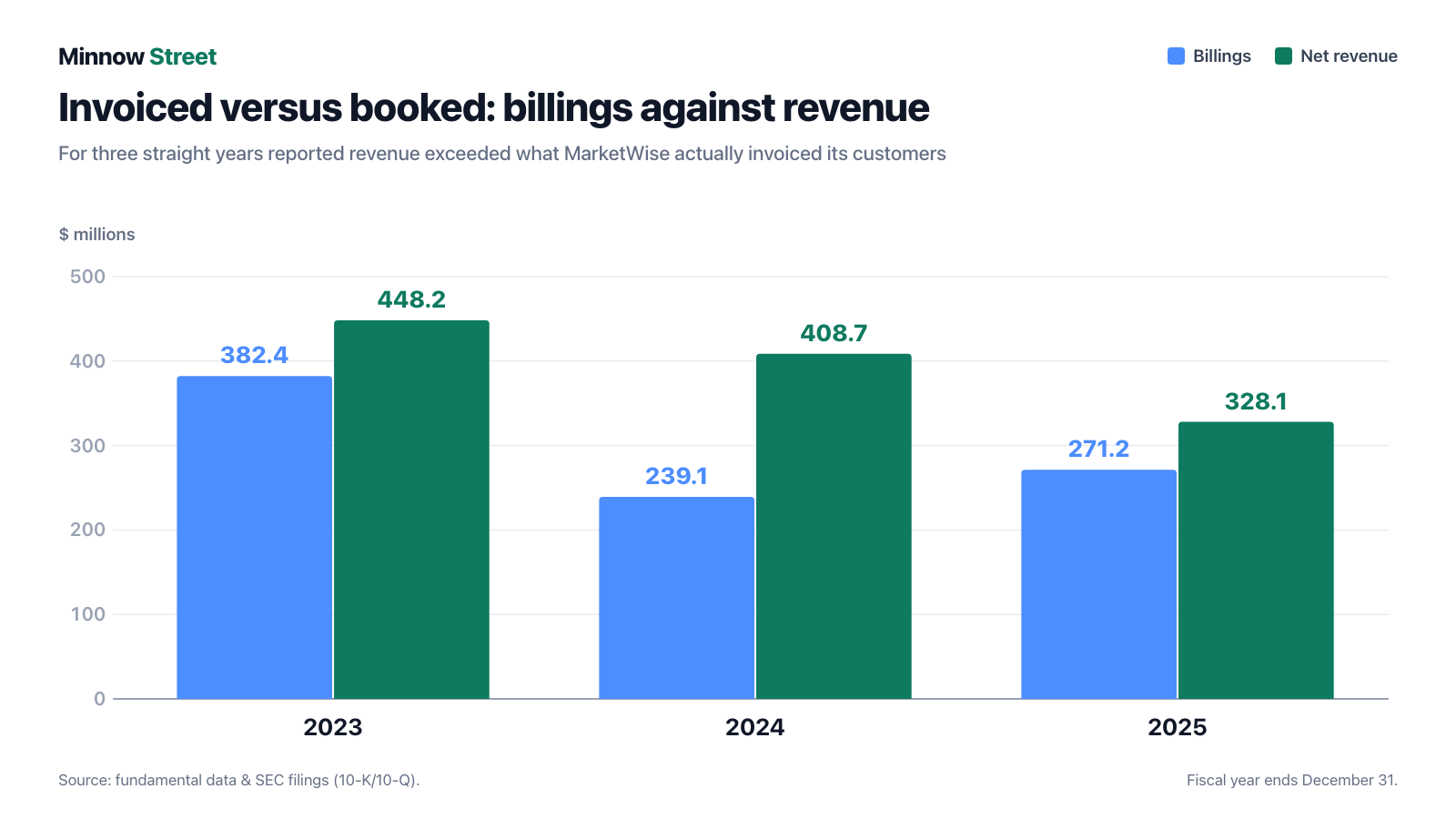
The most important figure, though, points forward. Billings are growing again. After the 2024 collapse to $239.1 million, down 37.5 percent, they rose to $271.2 million in 2025 (up 13.4 percent), to $81.4 million in the first quarter of 2026 (up 15 percent) and, on preliminary figures, to roughly $91 million in the second quarter of 2026 — up 56 percent year over year and the highest quarterly figure since 2023. On July 9, 2026 the company raised its full-year target by 10 percent to $330 million.
Something else stands out: revenue per customer is exploding. Average revenue per paid subscriber (ARPU in the filings) climbed from $394 at December 31, 2024 to $670 at December 31, 2025, $738 at March 31, 2026 and a preliminary $821 at June 30, 2026. MarketWise is losing cheap customers and winning expensive ones. That is deliberate, and so far it works.
What the filings say — the uncomfortable truths
Uncomfortable truth No. 1: the listed company owns 15.2 percent
Here is the sentence this analysis exists for. MarketWise is not a conventional company but an Up-C structure — the design American family businesses use to go public without giving up control. The operating business sits inside MarketWise, LLC. The listed MarketWise, Inc. is a holding company that owns nothing but a stake in that LLC. How large that stake is, the annual report states verbatim.
„As of December 31, 2025, MarketWise, Inc.'s controlling interest in MarketWise, LLC was 15.2% and the noncontrolling interest was 84.8%.“
— MarketWise, Form 10-K for fiscal 2025, "Net Income Attributable to Noncontrolling Interests"

What that means in money shows up in the income statement of the same report. Group net income for 2025 was $64.0 million. Of that, $58.4 million went to the noncontrolling interests and $5.6 million to MarketWise, Inc. — the entity whose shares you buy on the Nasdaq. The year before: $86.0 million versus $7.1 million. Remember this: when 85 percent of a profit lands on the "noncontrolling interests" line, the listed shell is not the company but a minority stake in it.
Uncomfortable truth No. 2: the fraction divides one sixth by the whole
Now the P/FCF of 1.0 can be taken apart properly. The market value quoted for MKTW by data services stood at roughly $52.6 million as of July 26, 2026. It comes from 2,638,780 Class A shares (as of May 5, 2026, per the cover page of the quarterly report) times the price. That is correctly computed for the Class A stock — but it is the value of the Class A shares, not of the company. Alongside them sit the Class B shares held by the LLC members, exchangeable one for one into Class A. MarketWise itself explains how the sum should be taken.
„When determining the market capitalization or equity value of the Company, we believe it is appropriate to include the total of the Class A and Class B common shares.“
— MarketWise, Form 8-K of July 10, 2026, Exhibit 99.1

The same release gives the numbers: as of June 30, 2026 there were 2,664,541 Class A and 12,986,774 Class B shares, totaling 15,651,315. So let us do the arithmetic. All shares at $19.90 give an equity value of roughly $311 million. Divided by the $44.4 million of free cash flow from 2025 that is about 7 — not 1.0.
The cross-check from the other direction lands in the same place. If you want to keep the $52.6 million Class A market value, then you must also count only the share of cash flow that belongs to that stock: 15.2 percent of $44.4 million is $6.7 million, and on the share counts of June 30, 2026 (17.0 percent) it is $7.5 million. $52.6 million divided by $6.7 to $7.5 million gives seven to eight. Both routes agree. Remember: when a ratio looks unbelievable, first check whether numerator and denominator even describe the same company. For the same effect at a software house weighed down by preferred stock instead of a minority partner, see our analysis of Upland Software.
Uncomfortable truth No. 3: the cash did not come from fresh prepayments but from a shrinking pile
At a subscription publisher with falling subscriber counts, one suspicion is natural: the handsome cash flow comes from money collected for services not yet delivered — prepayments that will have to be worked off later. At MarketWise the truth is exactly the opposite, and that is the real surprise of this research.
The balance sheet carries the invoiced but undelivered amounts as contract liabilities. That balance has collapsed over three years: $658.8 million at December 31, 2022, $588.9 million (2023), $424.3 million (2024), $368.0 million (2025). In the cash flow statement the run-off appears as an outflow — minus $67.1 million (2023), minus $162.1 million (2024), minus $56.1 million (2025). In plain terms: for three years MarketWise booked more revenue than it invoiced. So the $44.4 million of free cash flow in 2025 is not flattered by prepayments — it was earned against a $56 million headwind. That speaks for the substance of the business.
How brutal that headwind can be shows in 2024: despite reported group net income of $93.1 million, operating cash flow was negative at minus $22.2 million, because contract liabilities alone melted by $162.1 million. Remember: at subscription publishers the profit shows the past and the cash balance shows the present. And the first quarter of 2026 flips the sign for the first time in years: contract liabilities rose again, to $372.3 million at March 31, 2026, and the cash flow statement shows a plus of $4.2 million. That is the line against which the 2026 recovery can be measured.
Uncomfortable truth No. 4: the cash leaves the building every quarter
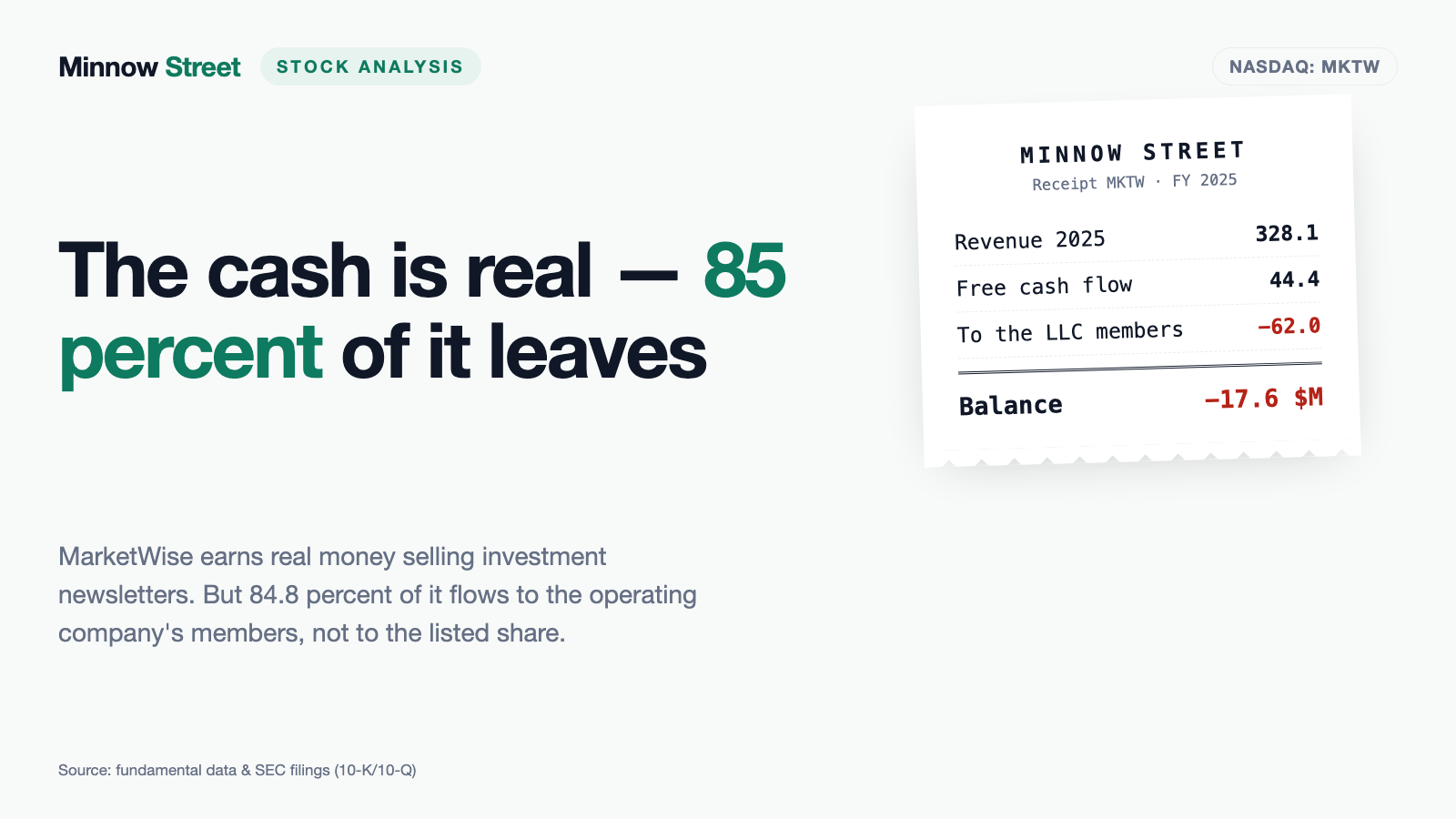
A claim on a cash register is worth only what actually flows toward it. At MarketWise most of it flows elsewhere — by obligation, not by whim. The Up-C structure requires the LLC to make tax distributions to its members: because the LLC pays no taxes itself and its members do, it has to hand them the money for that. The 2025 cash flow statement therefore reads as follows:
- Tax distributions to noncontrolling interests: $49.8 million (2024: $9.6 million)
- Other distributions to noncontrolling interests: $12.2 million (2024: $11.5 million)
- Dividends to Class A shareholders: $4.8 million (2024: $1.5 million)
- Share buybacks: $3.4 million (2024: $10.8 million)
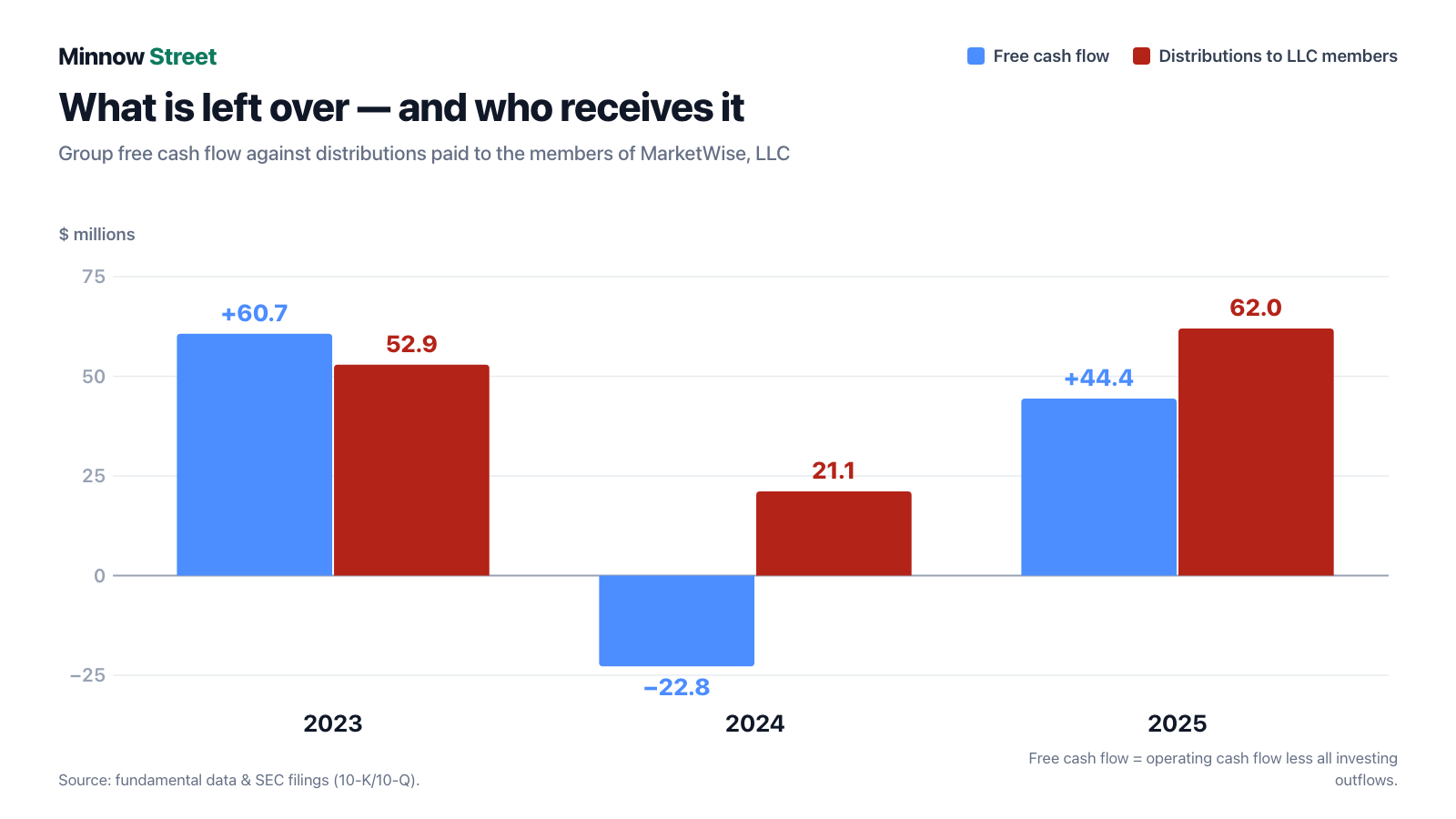
Add it up: of $44.4 million in free cash flow, $62.0 million went to the LLC members and $4.8 million to shareholders. Between free cash flow and the distributions to the LLC members alone there is a gap of $17.6 million. And this is no one-year accident: in 2023, $60.7 million of free cash flow met $52.9 million of distributions ($3.4 million of tax distributions plus $49.5 million of other distributions), and in 2024, against a cash outflow of $22.8 million, still $21.1 million. Which is why cash fell in a good year from $97.9 million to $70.1 million. It stood at $52.7 million on March 31, 2026 and, preliminarily, at roughly $33 million on June 30, 2026. The company expects tax distributions of roughly $40 million for 2026, of which $31 million fell in the first half and $9 million is expected in the second.
Fairness demands the other half: Class A holders are not left empty-handed. The quarterly dividend was most recently $0.45 per share, with a full-year 2026 target of $1.80; over the trailing twelve months $1.70 per share was paid (data as of July 26, 2026). On May 7, 2026 the board also reauthorized a share repurchase program of up to $50 million for twelve months — and for every Class A share repurchased, the LLC redeems a corresponding unit, which mathematically shrinks rather than grows the listed company's stake. That is precisely why the stake has crept up only slowly, from 12.4 percent (2024) to 15.2 percent (2025): the increase comes from exchanged Class B shares, not from buybacks.
Uncomfortable truth No. 5: a quarter of the subscribers are gone — and the customer math does not add up yet
The subscriber base has been shrinking for two years, and the annual report says why.
„As of December 31, 2025, our Paid Subscriber base was 374 thousand, down 132 thousand, or 26.0% as compared to 506 thousand at December 31, 2024, primarily related to elevated churn associated with the shutdown of our Legacy Research business.“
— MarketWise, Form 10-K for fiscal 2025, "Key Factors Affecting Our Performance"

Of the 132 thousand subscribers lost, 58 thousand — roughly 44 percent — came from the Legacy Research shutdown, with the remainder mostly from the low-price segment. By June 30, 2026 the base was preliminarily back at 400 thousand. But measured across four trailing quarters, subscriber numbers still fell 22 percent while billings rose 35 percent. So far the recovery is a price recovery, not a volume recovery.
That the growth is bought expensively shows in the first-quarter 2026 income statement. Sales and marketing cost $39.7 million — 51.5 percent of revenue, up from 40.8 percent a year earlier; direct marketing alone rose from $13.3 million to $26.3 million. The result: an operating loss of $1.1 million against a $16.8 million profit in the prior-year quarter, and an operating cash outflow of $2.1 million. The company calls this its strategy — it toggles "on a near real-time basis" between growth and margin and says it will scale marketing back in the second half of 2026.
Whether the investment pays is measured by a metric of the company's own: the ratio of lifetime value to customer acquisition cost (LTV/CAC). The annual report names the benchmark itself — a ratio above 3x is said to indicate strong profitability and marketing efficiency. What was achieved as of December 31, 2025 is roughly 2.0x, up from 1.3x a year earlier. Better, then, but still under the bar the company set for itself.
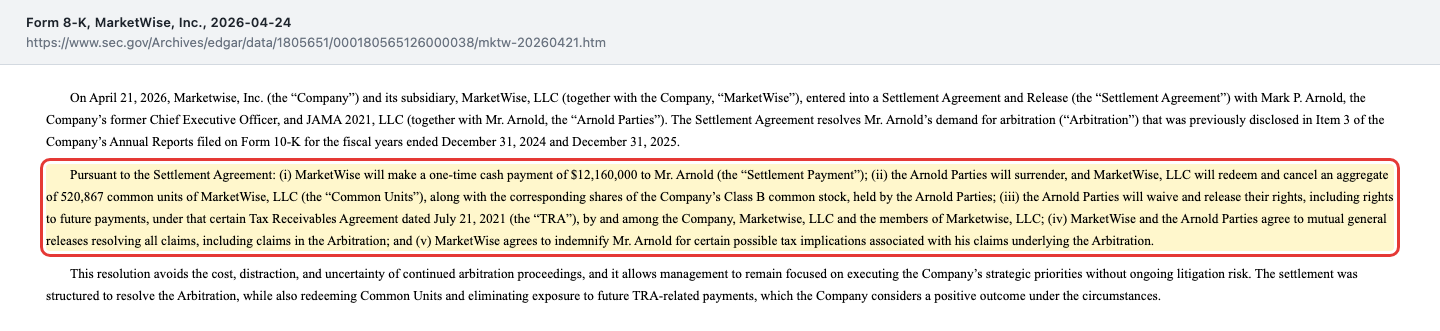
April 2026 also brought an invoice from the past. Former chief executive Mark P. Arnold had filed for arbitration in November 2024, seeking damages in excess of $9 million. On April 21, 2026 the parties settled: MarketWise paid a one-time $12,160,000, redeemed and cancelled 520,867 LLC units together with the corresponding Class B shares — roughly three percent of all units — and terminated Arnold's rights under the 2021 Tax Receivables Agreement. The cash left in April 2026 and explains much of the second-quarter decline in the cash balance. For scale: $12.16 million equals roughly 23 percent of the entire Class A market value (data as of July 26, 2026).
Valuation — what you get and what you pay
Let us place the orders of magnitude side by side, all as of July 26, 2026 and without daily-price chatter. The Class A market value stood at roughly $52.6 million, the equity value across both share classes at roughly $311 million. Against $44.4 million of free cash flow (2025) that gives a ratio of about 7 — for a debt-free subscription business with an operating margin near 20 percent that is not expensive, but it is no miracle either. The price-to-earnings ratio stood at 11.9, and at 12.1 on analyst estimates for the next twelve months; the price-to-sales ratio at 0.16 — the latter again with the Class A market value on top and group revenue below, so the same mismatch as with P/FCF.
The professionals' view is thin: fundamental data show a price target of $22.66 — from a single estimate. With a free float of roughly 1.75 million shares and average trading volume in the low five figures, this is a stock that two sizeable orders can move. The dividend yield stood at roughly 4.3 percent on the most recently reported payout (data as of July 26, 2026). For income-oriented investors that, not the P/FCF, is the real anchor.
A word on the reverse stock split: effective April 2, 2025 every 20 shares became one; authorized Class A capital fell from 950 million to 47.5 million shares and Class B from 300 million to 15 million. Every figure in this analysis is stated after the split, and the financial statements were retroactively adjusted. If you see price histories from before April 2025, check whether they are adjusted — unadjusted, the price jumps that day from $0.51 to $10.30 with nothing having happened.
Opportunities and risks at a glance
Opportunities
- No debt, real cash. $70.1 million as of December 31, 2025, no loan, no bond. No interest risk, no covenants, no looming maturity.
- Billings are growing again. Up 13.4 percent (2025), up 15 percent (first quarter 2026) and preliminarily up 56 percent (second quarter 2026); the full-year target was raised to $330 million on July 9, 2026.
- Revenue per customer is climbing sharply. From $394 at the end of 2024 to a preliminary $821 at June 30, 2026 — the high-priced products are working.
- A payout with substance. A $0.45 quarterly dividend, a $1.80 full-year target, plus a new buyback authorization of up to $50 million (May 7, 2026).
- A scalable business. Investing outflows of $1.6 million on $328.1 million of revenue (2025); each additional subscriber costs almost nothing in fixed assets.
Risks
- The share is a minority stake. 15.2 percent of the operating company as of December 31, 2025; 84.8 percent of profit and cash flow belong to others.
- Balance-sheet insolvency. Liabilities of $432.0 million against total assets of $218.4 million (December 31, 2025); equity stands at minus $213.6 million and at minus $226.9 million as of March 31, 2026.
- Cash is melting. From $155.2 million (end of 2023) through $97.9 million (end of 2024) and $70.1 million (end of 2025) to a preliminary $33 million at June 30, 2026 — with roughly $40 million of tax distributions expected for 2026 alone.
- Growth bought with margin. Marketing at 51.5 percent of revenue in the first quarter of 2026, an operating loss of $1.1 million, LTV/CAC at 2.0x against the company's own benchmark of 3x.
- Volume has not turned yet. On a trailing four-quarter basis subscribers still fell 22 percent through June 30, 2026; revenue declined 7.8 percent in the first quarter of 2026.
- A thin market. A free float of roughly 1.75 million shares, one analyst estimate, low turnover — every order moves the price.
A human conclusion
Remember the whole-company illusion from the opening? At MarketWise it is not malicious — nobody is hiding anything. The 15.2 percent stake sits in an ordinary sentence in the middle of the annual report, the share counts of both classes appear in every mandatory filing, and the company even volunteers how its market value should be computed. It is simply a fraction whose numerator and denominator measure two different things — and our minds fill in the missing line automatically, without asking.
What is left once the fraction is straightened out? A debt-free publisher with loyal, well-paying customers, an operating margin around 19 percent, growing billings and a decent dividend — valued at roughly seven times its free cash flow. That is a perfectly normal, perfectly sensible story. Just not a sensation. And next to it sits a balance sheet where liabilities exceed assets by $213.6 million, because the publisher still owes years of newsletters that were paid for long ago.
Whether that appeals to you depends on the question you ask a stock. If you want the arithmetic bargain the scanner advertised, it was not one. If you want a small, debt-free income story with a visible turning point in the order book, it is right here — footnoted with the fact that five sixths of the house belongs to somebody else. What you make of it is your decision. And that is exactly as it should be.
Sources
- Form 10-K for fiscal year 2025 (filed March 6, 2026)
- Form 10-Q for the quarter ended March 31, 2026 (filed May 7, 2026)
- Form 8-K of April 24, 2026 (Item 1.01, settlement with the former chief executive)
- Form 8-K of May 7, 2026 (Items 2.02 and 8.01, quarterly results and buyback authorization)
- Form 8-K of July 10, 2026, Exhibit 99.1 (preliminary second-quarter 2026 figures)
- All SEC filings of MarketWise, Inc. (CIK 0001805651)
- Fundamental data & SEC filings (annual and quarterly reports, 10-K/10-Q); price, screener and scanner data as of July 26, 2026
This analysis is journalistic commentary on publicly available company disclosures and is not investment advice. It is not a solicitation to buy or sell securities. Share prices can move sharply; a total loss of the capital invested is possible. The author holds no position in MarketWise, Inc. at the time of publication. All figures come from the primary documents listed above and carry the as-of dates stated there.
Our Bottom Line at a Glance
- Business model and cash positive
- A subscription publisher with almost no capital needs: $328.1 million of revenue on $1.6 million of investing outflows (2025), operating income of $62.6 million and free cash flow of $44.4 million. No financial debt and $70.1 million of cash as of December 31, 2025 (10-K 2025).
- Order book 2026 positive
- Billings are turning: $271.2 million in 2025 (up 13.4 percent), $81.4 million in the first quarter of 2026 (up 15 percent) and preliminarily roughly $91 million in the second quarter (up 56 percent, the highest since 2023). The full-year target was raised by 10 percent to $330 million on July 9, 2026 (8-K of July 10, 2026, Exhibit 99.1).
- Stake held by the listed share negative
- MarketWise, Inc. held only 15.2 percent of the operating company as of December 31, 2025 (December 31, 2024: 12.4 percent). Of the 2025 group net income of $64.0 million, $58.4 million went to the noncontrolling interests and $5.6 million to the listed company. The P/FCF of 1.0 shown by the scanner therefore divides a Class A market value by a group cash flow (10-K 2025).
- Balance-sheet structure negative
- Liabilities of $432.0 million stand against total assets of $218.4 million (December 31, 2025); equity is minus $213.6 million and minus $226.9 million as of March 31, 2026. The cause is $368.0 million of invoiced but undelivered subscriptions, settled in newsletters rather than in money (10-K 2025, 10-Q for March 31, 2026).
- Cash drain to the minority holders negative
- In 2025 the company paid $49.8 million of tax distributions and $12.2 million of other distributions to the LLC members, against $4.8 million of dividends to Class A shareholders. Cash consequently fell in a good year from $97.9 million to $70.1 million and, preliminarily, to roughly $33 million by June 30, 2026. Roughly $40 million of tax distributions are expected for 2026 (10-K 2025, 8-K of July 10, 2026).
- Customer base and marketing efficiency neutral
- Paid subscribers fell 26.0 percent to 374 thousand in 2025 and stood preliminarily at 400 thousand on June 30, 2026; on a trailing four-quarter basis they still declined 22 percent. Revenue per customer rose from $394 to a preliminary $821. The ratio of lifetime value to acquisition cost stands at 2.0x against the benchmark of 3x named by the company itself (10-K 2025, 10-Q for March 31, 2026).
MarketWise is not a one-year bargain but a debt-free subscription publisher in which the listed share owns a 15.2 percent stake. The business works: $62.6 million of operating income and $44.4 million of free cash flow in 2025, no financial debt, billings growing again (preliminarily up 56 percent in the second quarter of 2026) and a quarterly dividend of $0.45. But 84.8 percent of profit and cash flow belong to the LLC members, $62.0 million flowed to them in 2025, equity stands at minus $213.6 million and cash fell from $97.9 million to a preliminary $33 million. The P/FCF of 1.0 therefore does not measure the company: on a consistent basis the ratio is about 7. Not investment advice.
What Our Rating Means
Substance risk
We found at least one documented issue that threatens the company itself — regardless of how the stock is currently valued.
Red here stands for documented substance findings, not for a share price — and this is expressly a borderline case. Documented are equity of minus $213.6 million as of December 31, 2025 and minus $226.9 million as of March 31, 2026, liabilities of $432.0 million against total assets of $218.4 million, an operating cash outflow of $22.2 million in 2024 despite reported group net income of $93.1 million, and a cash balance that has fallen from $155.2 million (end of 2023) to a preliminary $33 million (June 30, 2026) while tax distributions to the minority holders continue. Against that stands a great deal: no financial debt, no maturity, no covenant, a profitable business, and liabilities that are largely delivery obligations rather than money claims. We do not read this as proximity to insolvency but as a documented question about substance — and in doubt the more cautious level applies. The decision is yours.
A journalistic assessment by our editorial team at the time of the deep dive, based on public sources — not investment advice and not a solicitation to buy or sell. Your personal circumstances (investment goals, risk capacity, taxes) cannot be taken into account. What our levels mean, how verdicts are formed, and what conflicts of interest exist →
Worth Noting
- MarketWise reached our research list through our in-house stock scanner: 18th place in the P/FCF ranking at a ratio of 1.0 (544 stocks pass the criteria and the 25 strongest hits are shown; as of July 26, 2026). These lists are recalculated daily, so the placement is a dated snapshot.
- Numerator and denominator of the ratio do not match: the market value of roughly $52.6 million contains only the Class A shares, while the $44.4 million of free cash flow comes from the whole group. On a consistent basis — all 15,651,315 shares of both classes against $44.4 million, or $52.6 million against the 15.2 to 17.0 percent share — the ratio is about seven.
- Reverse stock split alert: effective April 2, 2025 every 20 shares became one. All figures in this analysis are stated after the split and the financial statements were retroactively adjusted. Unadjusted price series jump that day from $0.51 to $10.30 — that is the split, not a gain.
- The second-quarter 2026 figures cited here (roughly $91 million of billings, 400 thousand subscribers, roughly $33 million of cash, a $330 million full-year target) come from the release of July 9, 2026 and are expressly preliminary and unaudited. The full report is scheduled for August 6, 2026.
Frequently Asked Questions
Because numerator and denominator measure different things. The market value of roughly $52.6 million (data as of July 26, 2026) contains only the 2,638,780 Class A shares, while the $44.4 million of free cash flow (2025) comes from the whole group. Counting all 15,651,315 shares across both classes gives a ratio of about 7.
The operating business sits inside MarketWise, LLC; the listed MarketWise, Inc. holds only a stake in it — 15.2 percent as of December 31, 2025. The remaining 84.8 percent belongs to founders and legacy members through Class B shares exchangeable one for one into Class A. Of the 2025 group net income of $64.0 million, $58.4 million went to those noncontrolling interests.
No. The 2025 annual report shows cash of $70.1 million as of December 31, 2025 and explicitly no debt outstanding. The quarterly report for March 31, 2026 confirms it at a cash balance of $52.7 million. There is therefore no interest-rate risk and there are no credit covenants.
Because $368.0 million of the $432.0 million in liabilities as of December 31, 2025 are subscriptions already invoiced and not yet delivered. Those contract liabilities are settled in newsletters, not in money. Together with the losses from the public-company years that produces equity of minus $213.6 million.
Because revenue and billings diverge at subscription publishers. Billings in 2025 were $271.2 million, up 13.4 percent, while booked revenue was $328.1 million, down 19.7 percent. The difference came from running off older prepayments: contract liabilities fell from $424.3 million to $368.0 million.
On April 21, 2026 MarketWise paid a one-time $12,160,000 to Mark P. Arnold. In return it redeemed and cancelled 520,867 LLC units together with the corresponding Class B shares — roughly three percent of all units — and terminated Arnold's rights under the 2021 Tax Receivables Agreement. The cash left in April 2026.
Every 20 shares became one; authorized Class A capital fell from 950 million to 47.5 million shares and Class B from 300 million to 15 million. It changes nothing about the value of the company. All financial statements were retroactively adjusted; unadjusted price series jump on April 2, 2025 from $0.51 to $10.30.
MarketWise has scheduled its full and audited second-quarter 2026 report for August 6, 2026. The figures released on July 9, 2026 — roughly $91 million of billings, 400 thousand subscribers and roughly $33 million of cash — are explicitly preliminary and unaudited.
Found an error?
Did you spot a factual error, an outdated number, or a typo in this deep dive? Let us know briefly — your report goes straight to the editorial team.