SmartStop Stock: Fresh on the NYSE, a $1.60 Dividend — and 2025 Operating Cash Flow That Didn't Cover It
SmartStop Self Storage rents storage units across the United States and Canada, made the jump to the NYSE in April 2025 — and shows up in the top 20 of our FCF/market-cap scanner. We worked through the annual report (10-K) for 2025 and the quarterly report (10-Q) as of March 31, 2026, and we'll say honestly what we found: a decently growing storage landlord with 92.5 percent occupancy — but also a scanner hit owed to a gappy data series, a $194 million accumulated deficit, and distributions that consumed the entire 2025 operating cash flow. Not investment advice — just the acid test of what a screener hit is worth when the data series behind it is barely a year old.
 Thomas Mücke
Founder & Publisher
Thomas Mücke
Founder & Publisher
Chart
Interactive price chart (TradingView).
Note: pure fact-based analysis, not investment advice and not a solicitation to buy or sell. All figures without guarantee.
There is an investor trap that snaps shut on stock market newcomers with particular relish: the data-gap trap. It works like this: a stock has only recently come to the exchange, the data vendors have not yet cleanly backfilled its history — and a screener that computes with those gaps spits out fantasy values. Your brain reads the hit as confirmation ("even the scanner found it!") when all it has done is mistake an empty cell for a bargain. That is exactly what happened here: SmartStop Self Storage REIT (NYSE: SMA), publicly listed only since April 2025, stood at rank 16 of our FCF/market-cap ranking on July 18, 2026 — a list that is supposed to show only companies whose market value is at most four times their annual free cash flow. Recomputed, SmartStop costs more like 18 times. So let's make a deal: we take the scanner hit not as a buy signal but as an occasion — and read together what the company itself reported to the U.S. securities regulator, the SEC, in the annual report (10-K) for 2025 and the quarterly report (10-Q) as of March 31, 2026. An SEC filing is honest under penalty of law. And for a REIT — a tax-advantaged real estate trust that must distribute nearly all of its income — it tells a story that the usual metric lenses were never built for. In the end, you decide for yourself.
What SmartStop actually does
SmartStop rents storage units to consumers and businesses — "self storage": the moving-box heaven where Americans park everything that no longer fits in the basement, the garage or their lives. The business model is gloriously unglamorous and robust precisely because of it: thousands of tenants pay month-to-month rents for metal boxes that need hardly any staff, hardly any maintenance and no kitchens; the leases run month to month, which makes price increases easier; on top, the operator sells locks, boxes and, above all, an in-house "tenant protection" plan. SmartStop has grown big on this logic: as of December 31, 2025, the company owned 177 storage facilities with roughly 122,000 units and 13.9 million square feet of rentable space across 19 U.S. states, Washington, D.C. and Canada — per its own annual report, that makes it the tenth-largest self-storage owner and operator in the United States. Add a second business that is easily overlooked: SmartStop also manages 273 third-party facilities (roughly 140,000 units, 20.4 million square feet) — partly for self-sponsored, non-traded sister REITs it sponsors, partly, since October 2025, through the acquired third-party manager Argus. The company's history explains why the structure looks so convoluted: founded in 2013 as Strategic Storage Trust II, SmartStop spent years raising money from retail investors as a non-traded REIT, renamed itself in 2019 — and only dared the jump to the NYSE on April 2, 2025. The company is led by founder H. Michael Schwartz as chairman and CEO, with more than 1,000 employees. And that brings us to the central tension of this analysis, which runs through every chapter: SmartStop is a genuinely growing landlord with 92.5 percent occupancy and a real cash stream — but the scanner hit that led us here is a data artifact, the GAAP bottom line shows a $194 million accumulated deficit, and the new exchange-listed dividend already consumes practically the entire operating cash flow. How to read REITs instead is something we walked through at the commercial landlord CTO Realty Growth — and, for what a monthly dividend really costs, at the mortgage REIT Dynex Capital — SmartStop is the newest addition to that series.
Where the stock shows up in our scanner — and why caution applies right here
Every day we run about 3,500 stocks through our scanners. As of the July 8, 2026 data cut-off, SMA delivered 6 hits, and the trend side is quite respectable: price above the 50- and 200-day lines, Power Trend, plus the confidence scanners "CEO buys" and "institutions + CEO buying" — the insider data records a CEO share purchase within twelve months, and more funds added than trimmed. To replicate it yourself: open the SMA stock page or browse the FCF/market-cap scanner. And then there is that sixth hit which triggered this analysis: rank 16 in the FCF/market-cap ranking (as of July 18, 2026) — a scanner meant to show only companies whose market capitalization is at most 4 times the last four quarters of free cash flow. Now the honest announcement that matters more to us than any hit: for SmartStop, this placement is a measurement error waiting to happen. First, the young IPO's data series was simply missing its market capitalization as of the cut-off — and an empty field passes every size comparison. Run the numbers with real figures and SmartStop cost about $1.8 billion on July 8, 2026 against roughly $98.7 million of operating cash flow for the four quarters through March 31, 2026 — 18 times, not 4 times. Second, "free cash flow" fundamentally measures the wrong thing at a REIT: the real investments — in 2025, a net $380.8 million went into acquisitions and stakes — run through investing cash flow and never appear in the metric at all; and what comes in from operations is not "free" at a REIT but largely earmarked for the legally expected distribution. Remember the image: a screener with a data gap is like a scale with a missing weight — it doesn't read "light", it reads nonsense. Which is exactly why we now recompute with the SEC numbers.
The numbers over the years — honestly appraised
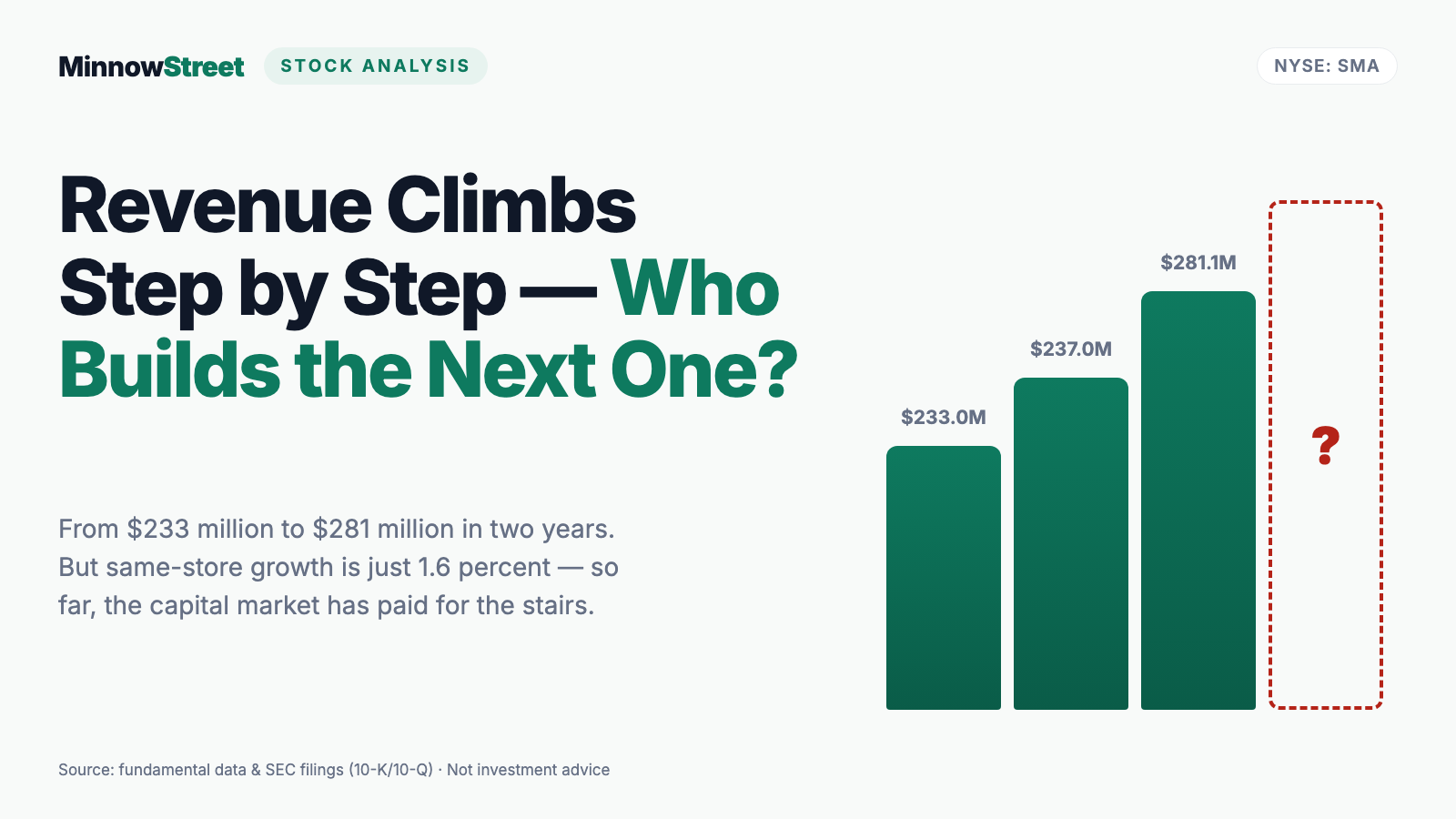
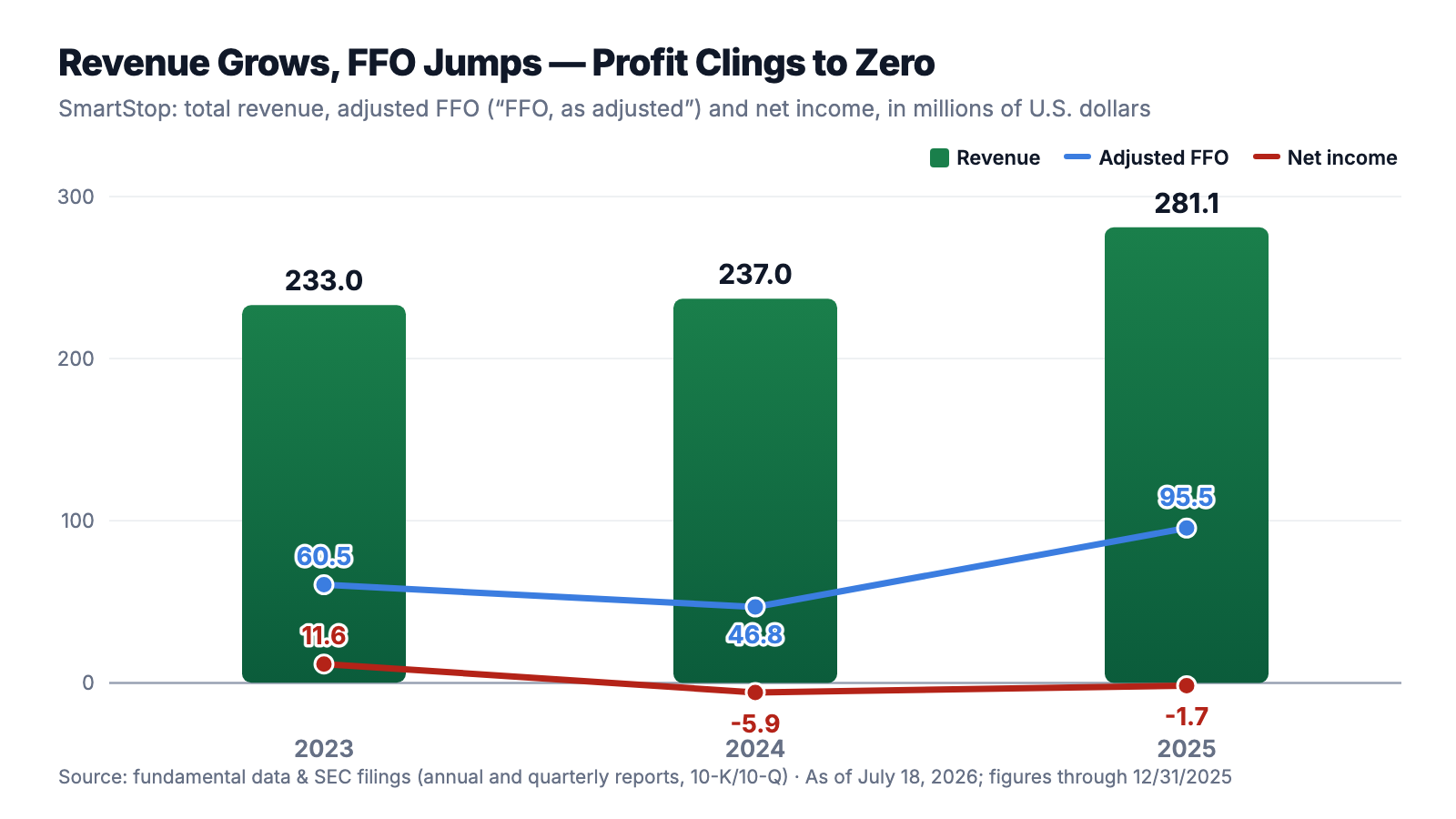
First, what genuinely impresses. SmartStop grows reliably: total revenue rose from $233.0 million (2023) through $237.0 million (2024) to $281.1 million in 2025 — plus 18.6 percent — and the first quarter of 2026 added $78.3 million (+19.7 percent). The substance behind it is solidly let: 92.5 percent of the space was occupied on average in 2025, rent per occupied square foot stood at $20.03, and property net operating income (NOI) grew 11.9 percent to $157.8 million. The IPO also visibly detoxified the balance sheet: offering proceeds paid off $647.1 million of expensive legacy debt and redeemed $200 million of preferred capital; two Canadian bond issues totaling C$700 million at 3.91 and 3.89 percent replaced bank debt costing around 5.9 percent — interest expense fell from $22.0 million (Q1 2025) to $13.1 million (Q1 2026), and rating agency KBRA lifted the credit rating to BBB in July 2025. Here is the picture — and the blue line shows at the same time which metric really counts at a REIT:
Now the honest framing of that growth: it is mostly bought, not organic. Of the $30.5 million self-storage revenue increase in 2025, $25.8 million came from 17 newly acquired facilities; the comparable same-store portfolio grew only 1.6 percent in revenue and a meager 0.6 percent in operating income — in the first quarter of 2026 it was 1.5 and 2.0 percent. The U.S. storage market is still digesting an oversupply from the pandemic-era construction boom; occupancy also treaded water at 92.5 percent (prior year: 92.2 percent on average). The second chart shows what that means for the till — and why the scanner metric grasps at thin air here:
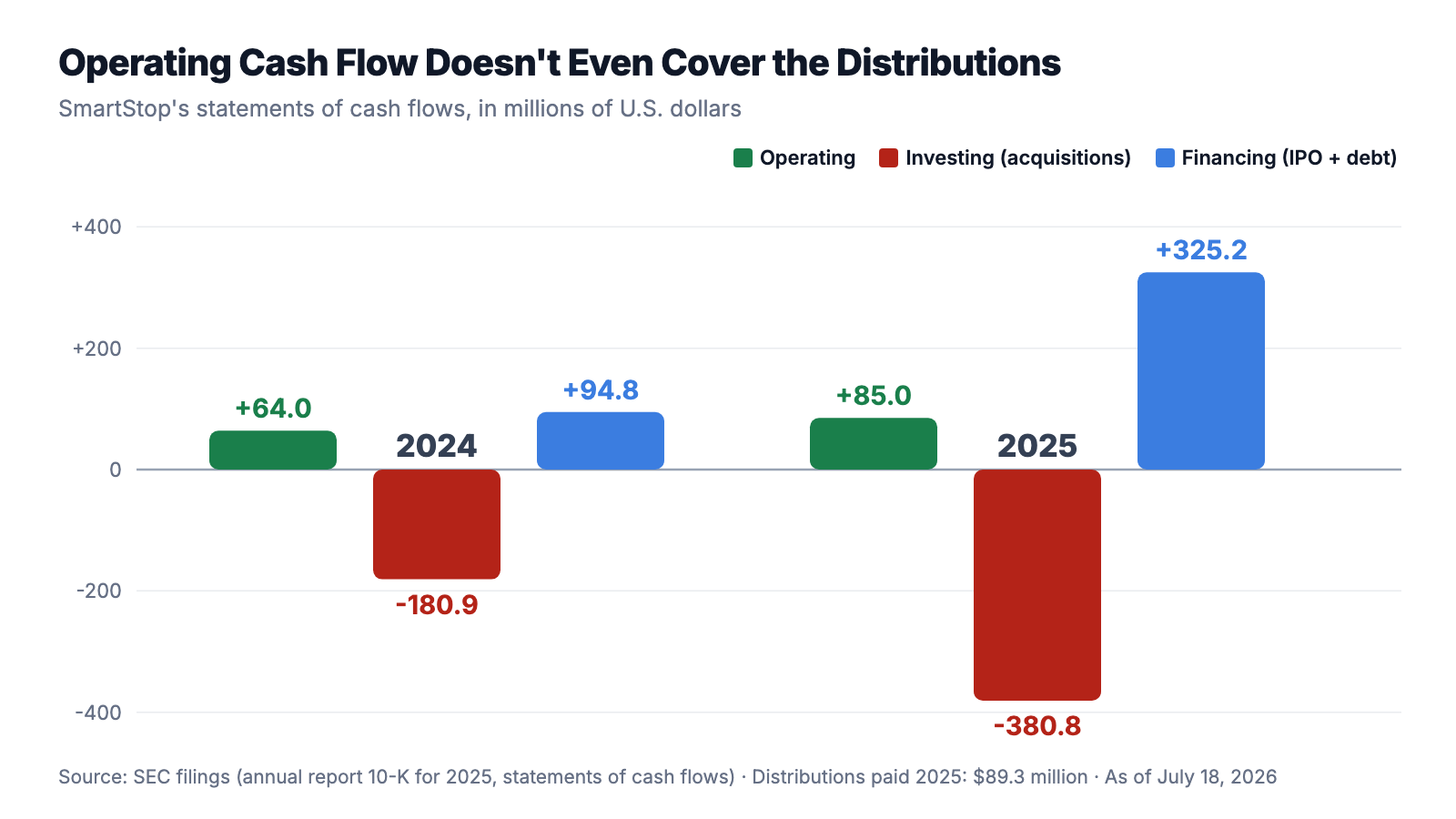
Remember the pattern: at a REIT, operating cash flow does not describe what is left over — it describes what is about to be paid right back out. Which brings us to the uncomfortable truths.
What the filings say — the uncomfortable truths
Uncomfortable truth no. 1: The GAAP bottom line shows a loss — and a $194 million hole
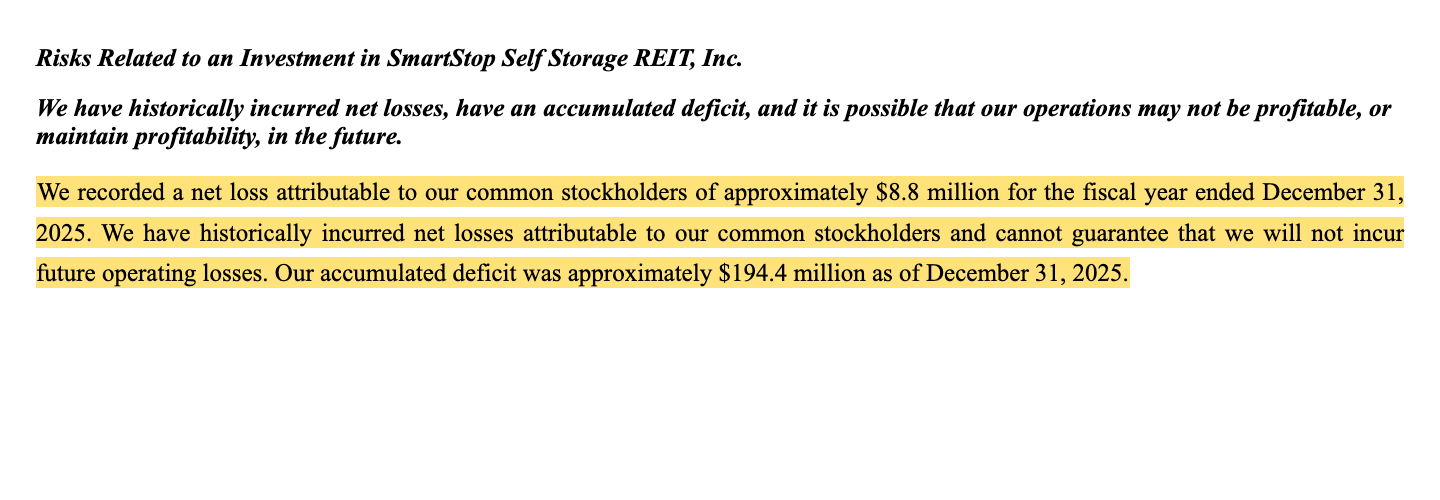
Anyone who looks only at the screener column "earnings" sees, depending on the data cut, a grotesque P/E of about 100 at SmartStop — or none at all. The annual report explains why, refreshingly bluntly, in its own risk chapter:
"We recorded a net loss attributable to our common stockholders of approximately $8.8 million for the fiscal year ended December 31, 2025. We have historically incurred net losses attributable to our common stockholders and cannot guarantee that we will not incur future operating losses. Our accumulated deficit was approximately $194.4 million as of December 31, 2025."
— SmartStop Self Storage REIT, Inc., SEC annual report 10-K for fiscal year 2025, Item 1A "Risk Factors"
To be fair: at property REITs, a GAAP loss is often bookkeeping, not bleeding. The largest expense item — a hefty $73.2 million of depreciation in 2025 — is not a cash outflow but the fiction that storage buildings lose value on schedule every year. That is why the industry converts to FFO ("funds from operations"): net income plus real estate depreciation, per the standard of the REIT association NAREIT. Measured that way, SmartStop earned $65.0 million in 2025, and adjusted for one-off effects such as the IPO stock grants even $95.5 million ("FFO, as adjusted") — after $46.8 million the year before; the first quarter of 2026 added $28.8 million. That is the right lens, and through it the company looks respectable. But you should still hold on to two things: first, the $194 million deficit makes visible that this REIT's non-traded era (2014 through 2025) generated, on balance, no accounting profit for its investors — the distributions of those years were to a large extent a return of capital. And second, the company itself warns against confusing FFO with available money — verbatim: "FFO and FFO, as adjusted, are not necessarily indicative of cash flow available to fund cash needs" (10-K 2025). Why that warning is so practically relevant is what the next truth shows.
Uncomfortable truth no. 2: The $1.60 dividend claimed more than the entire 2025 operating cash flow
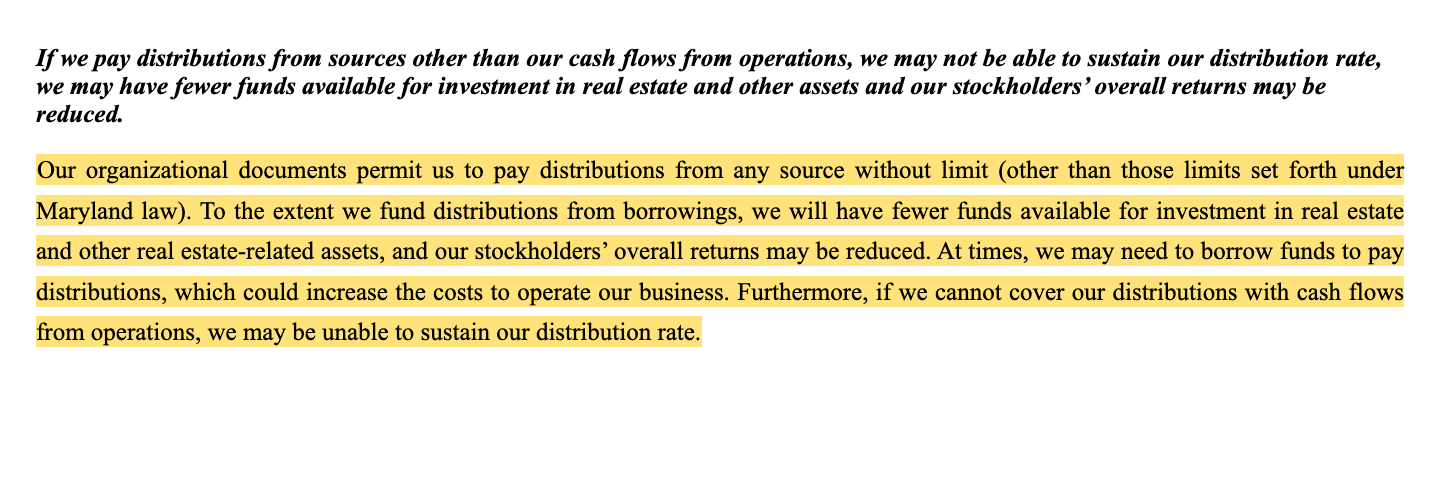
Since the IPO, SmartStop has paid monthly distributions of $1.60 per share annualized — at the July 8, 2026 price (about $32.80) a yield of just under 5 percent, and for many buyers the argument. Now the counter-calculation from the statement of cash flows: in 2025, SmartStop paid $89.3 million in distributions ($74.8 million to common stockholders, $7.1 million to holders of partnership units, $7.0 million to the preferred investor, $0.4 million to other minorities) — against an operating cash flow of $85.0 million. In the first quarter of 2026, $23.9 million of distributions stood against $24.2 million of operating inflows: a 99 percent load factor before a single dollar has gone into maintenance, acquisitions or debt repayment. What happens when it does not suffice is settled by the risk report with remarkable candor:
"Our organizational documents permit us to pay distributions from any source without limit (other than those limits set forth under Maryland law). To the extent we fund distributions from borrowings, we will have fewer funds available for investment in real estate and other real estate-related assets, and our stockholders’ overall returns may be reduced. At times, we may need to borrow funds to pay distributions, which could increase the costs to operate our business. Furthermore, if we cannot cover our distributions with cash flows from operations, we may be unable to sustain our distribution rate."
— SmartStop Self Storage REIT, Inc., SEC annual report 10-K for fiscal year 2025, Item 1A "Risk Factors"
Two mitigations in fairness. First: measured against adjusted FFO, the dividend is — narrowly — covered: $89.3 million of distributions against $95.5 million of FFO (2025) is a 93 percent ratio, and 83 percent in the first quarter of 2026 (23.9 against $28.8 million); the difference versus operating cash flow in 2025 mainly reflected unfavorable working-capital swings. Second, $7.0 million of the $89.3 million belonged to the since-redeemed preferred investor — that burden has been history since April 2025. But the direction stands: a buffer that oscillates between 1 and 17 percent is not a buffer, it is a bet on uninterrupted operations. The 10-K moreover says explicitly that such payments may represent "a return of investors’ capital" — a return of your own money, packaged as yield. A picture for it: a landlord who forwards the entire monthly rent to his financiers every month has set nothing aside when the roof needs replacing — he will have to buy on credit.
Uncomfortable truth no. 3: The growth is bought — paid for with $931 million of fresh investor money
The 18.6 percent revenue increase in 2025 looks like a breakout. Its source is in the report:
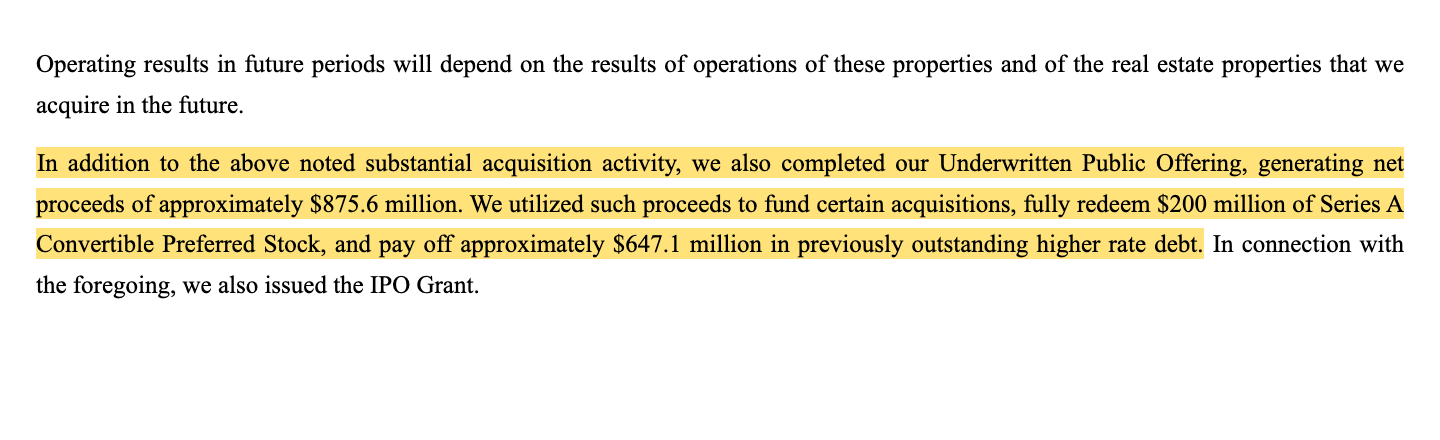
"In addition to the above noted substantial acquisition activity, we also completed our Underwritten Public Offering, generating net proceeds of approximately $875.6 million. We utilized such proceeds to fund certain acquisitions, fully redeem $200 million of Series A Convertible Preferred Stock, and pay off approximately $647.1 million in previously outstanding higher rate debt."
— SmartStop Self Storage REIT, Inc., SEC annual report 10-K for fiscal year 2025, Item 7 "Management’s Discussion and Analysis"
That is not an accusation — paying down debt with share proceeds is solid balance-sheet policy, and the nearly halved interest expense is the main reason FFO jumped so sharply in 2025. But you should see through the mechanics: 17 acquired facilities delivered $25.8 million of the $30.5 million revenue increase; under its own power, the same-store portfolio grew only 1.6 percent, its operating income 0.6 percent — rent per square foot: plus 0.3 percent. Put differently: the 2025 growth engine was the capital market, not the storage market. The pattern has a system, because this REIT's prehistory was already a chain of capital measures: from 2014 to 2017, the then Strategic Storage Trust II raised roughly $566 million from retail investors; in 2019 it bought its own sponsor; in 2019/2020 came the $200 million preferred package from Extra Space (most recently at 7.0 percent); in March 2025 a 1-for-4 reverse stock split; in April 2025 the IPO at $30.00. For new shareholders the outcome is fine — they bought a deleveraged balance sheet. The question that remains: what happens to growth once the IPO money is invested and new acquisitions have to be financed at today's rates? The $600 million credit facility and future share issuances stand ready — but each of those sources costs money, and the existing facilities alone do not currently carry the growth pace.
Uncomfortable truth no. 4: C$700 million of debt, a 2028 maturity wall — and a quarterly profit with one-off ingredients
That leaves the look at the debt and the quality of the latest profit. Net of cash, SmartStop owed $1,098.2 million as of December 31, 2025 — down from $1,317 million a year earlier, and thanks to the refinancing, 94 percent is now fixed-rate. So far the good news. The less good: $608.3 million of it is denominated in Canadian dollars — above all the two bonds of C$500 million and C$200 million — and the 10-K itself computes that a 10 percent move of the U.S. dollar against the CAD would push a non-cash loss of roughly $51.1 million through the income statement. How mobile that position is was shown, of all things, by the showcase quarter: in the first quarter of 2026, SmartStop reported its first proper GAAP profit since the IPO, $10.2 million ($0.17 per share) — but inside sat $5.4 million of currency and derivative gains, $1.2 million from an insurance recovery for fire damage and $0.9 million from a legal settlement. The company itself strips these items back out of its adjusted FFO — one more reason to watch that metric rather than the quarterly profit. Then there is the calendar: in 2028, $459.0 million falls due at once — the C$500 million bond and further loans — roughly 42 percent of all debt in a single year, to be refinanced at whatever rates then prevail. A picture for it: SmartStop has cleverly refinanced its mortgage — but the fixed-rate periods expire in large blocks, and part of the house stands in a foreign currency.
Valuation: 18 times cash flow, 16 times FFO — and a 5 percent yield as the anchor
As of the July 8, 2026 data cut-off, SMA stock cost about $32.80; with 55.4 million shares outstanding (as of February 18, 2026) that is roughly $1.8 billion of market value — the partnership units of the legacy holders come on top. Measured against the annualized adjusted FFO of the first quarter of 2026 (roughly $115 million), the stock trades at about 16 times FFO — no bargain for self-storage REITs, but no outlier either; the big names in the sector recently cost about the same and likewise barely grow organically. The "P/E" of about 100 from the raw data (as of July 8, 2026) you can safely ignore — it measures the depreciation fiction, not earning power. The professionals' view is interesting: eleven analyst estimates produced a consensus near "buy" as of the cut-off — though by now you know that consensus on a market newcomer often says more about the underwriting banks than about the company. That leaves the dividend yield of just under 5 percent as the most honest anchor: it is real, monthly, and currently covered by an FFO buffer of 7 to 17 percent — but it is also the reason hardly any money stays in the house. Share buybacks or net debt repayment out of the company's own funds are an illusion at this payout ratio; any future growth will need new capital. In short: you get a fairly priced, cleanly financed storage landlord with a dependable monthly dividend — but not an overlooked cash-flow bargain, because that was an arithmetic error of the data situation.
Opportunities and risks at a glance
What speaks for SMA:
- A robust, recurring business: tenth-largest U.S. self-storage operator, 92.5 percent occupancy, month-to-month leases with pricing power — plus a capital-light management business spanning 273 third-party facilities (as of December 31, 2025).
- The IPO repaired the balance sheet: $647.1 million of expensive debt paid off, $200 million of preferred capital (7.0 percent) redeemed, C$700 million refinanced at fixed 3.89 to 3.91 percent — quarterly interest expense nearly halved from $22.0 million to $13.1 million, rating upgrade to BBB (KBRA, July 2025).
- An FFO jump with substance: adjusted FFO 2025 up 104 percent to $95.5 million, Q1 2026: $28.8 million after $11.2 million — carried by interest savings and acquisitions that now contribute year-round.
- A monthly distribution of $1.60 annualized (yield just under 5 percent, data as of July 8, 2026), covered out of adjusted FFO (83 percent ratio in Q1 2026); plus insider confidence: the CEO bought shares within twelve months ("CEO buys" scanner, data as of July 8, 2026).
- Canada as a growth lane with partner SmartCentres (13 joint-venture locations, three in development) — a market with thinner self-storage supply than the United States.
What speaks against it:
- The scanner find is a data artifact: in reality SmartStop cost roughly 18 times its annual operating cash flow (data as of July 8, 2026) instead of "at most 4 times" — and at REITs, "free cash flow" measures the wrong thing anyway, because acquisitions run through investing cash flow and the rest is paid out.
- Distributions at the limit: in 2025 the $89.3 million paid out exceeded operating cash flow ($85.0 million); Q1 2026: 99 percent load. The charter permits distributions "from any source without limit" — on credit if need be, which the 10-K lists as its own risk factor.
- Meager organic growth: same-store revenue up 1.6 percent (2025) and 1.5 percent (Q1 2026), operating income up 0.6 and 2.0 percent, rent per square foot nearly flat — the revenue increase comes from acquisitions funded with fresh capital.
- A 2025 GAAP loss year (minus $8.8 million for common stockholders) and a $194.4 million accumulated deficit from the non-traded era; the Q1 2026 profit contained $5.4 million of currency/derivative gains plus $2.1 million of further one-off items.
- Refinancing and currency risk: $459.0 million — roughly 42 percent of the debt — matures in 2028; $608.3 million is denominated in CAD, where a 10 percent exchange-rate move means a computed $51.1 million book loss (10-K 2025).
A human conclusion
Back to the data-gap trap from the beginning. Its core is not that screeners lie — our own did find SMA, just for the wrong reason. Its core is that a hit is only ever as good as the data series behind it, and that series is naturally full of holes for a market newcomer. Anyone who had read rank 16 in the cash-flow ranking as a buy signal would have bought a metric that never existed. What remains after the recount is still not a bad company: an unexcited storage landlord with 92.5 percent occupancy, a cleverly deployed IPO billion, nearly halved interest expense and a monthly dividend that is currently — narrowly — covered out of adjusted FFO. Against that stand growth that the capital market has paid for so far, a distribution without a meaningful buffer, a 2028 debt wall and $608 million in a foreign currency. So the honest question to you is not "how can a scanner hit with a 5 percent dividend be wrong?" — it is: would you buy this REIT even if the scanner had never spat it out — at 16 times FFO, with 1.6 percent organic growth and a dividend that practically uses up the cash flow? If yes, then because of the monthly income and the repaired balance sheet — knowing that growth here gets diluted or bought on credit. If no, the data-gap trap has just taught you to hold every screener find up against the original filings once — an exercise cheaper than any failed investment. What you make of it is your decision. And that is exactly as it should be.
Sources
All original documents used in this analysis — for your own reading:
- SmartStop Self Storage REIT, Inc. — SEC annual report 10-K for fiscal year 2025 (filed February 27, 2026)
- SmartStop Self Storage REIT, Inc. — SEC annual report 10-K for fiscal year 2024 (filed March 12, 2025)
- SmartStop Self Storage REIT, Inc. — SEC quarterly report 10-Q as of March 31, 2026 (filed May 8, 2026)
- Complete SEC filing history of SmartStop Self Storage REIT, Inc. (including the rename from Strategic Storage Trust II): EDGAR overview (sec.gov)
- Fundamental data (metrics, quarterly series, valuation; data as of July 8, 2026), cross-checked against the SEC filings.
- Screener and rating data: in-house stock scanner (data as of July 8, 2026; FCF/market-cap rank verified on July 18, 2026).
Transparency & disclaimer: This analysis is a journalistic contextualization of publicly available information and is not investment advice, not a financial analysis in the regulatory sense and not a solicitation to buy or sell securities. Stock investments carry substantial risks up to and including total loss. All information without guarantee; the data cut-off is noted in the text. The author holds no position in SMA shares at the time of publication.
Our Bottom Line at a Glance
- Business model & portfolio positive
- Tenth-largest U.S. self-storage operator with 177 owned facilities (92.5 percent occupancy, month-to-month leases) plus a capital-light management business spanning 273 third-party facilities — a robust, granular rental business without cluster tenants (10-K 2025).
- The scanner metric FCF/market cap negative
- Rank 16 (as of July 18, 2026) is a data artifact of the young listing: in reality the stock cost roughly 18 times its annual operating cash flow (about $1.8 billion against $98.7 million, data as of July 8, 2026) instead of at most 4 times — and at REITs, "free cash flow" captures neither the acquisitions (2025: a net $380.8 million in investing cash flow) nor the distribution requirement.
- Earnings: GAAP vs. FFO neutral
- A GAAP loss of $8.8 million attributable to common stockholders (2025) and a $194.4 million accumulated deficit — but adjusted FFO of $95.5 million (+104 percent) and $28.8 million in Q1 2026, carried by nearly halved interest expense; the Q1 GAAP profit of $10.2 million contained $5.4 million of currency/derivative gains and $2.1 million of further one-off items (10-K 2025, 10-Q Q1 2026).
- Distribution coverage negative
- Distributions paid of $89.3 million exceeded 2025 operating cash flow of $85.0 million; in Q1 2026 the load stood at 99 percent (23.9 against $24.2 million), and at 83 percent measured against adjusted FFO — and the charter expressly permits distributions without limit from any source, from borrowings if need be (10-K 2025, Item 1A).
- Balance sheet & refinancing neutral
- IPO proceeds paid off $647.1 million of expensive debt and $200 million of preferred capital; net debt fell to $1,098.2 million (94 percent fixed, rating BBB) — set against $459.0 million of 2028 maturities and $608.3 million in Canadian dollars with a computed $51.1 million book loss per 10 percent currency move (10-K 2025).
- Valuation & source of growth neutral
- About 16 times annualized adjusted FFO and a dividend yield just under 5 percent (data as of July 8, 2026) are in line with the sector — but the 18.6 percent revenue increase stems almost entirely from capital-market-funded acquisitions while the same-store portfolio grew just 1.6 percent; further growth requires new capital (10-K 2025).
SMA is not a cash-flow bargain but a fairly priced market newcomer with a cleanly deployed IPO billion: the scanner hit rested on a data gap; in reality the REIT costs roughly 16 times adjusted FFO. Behind it stands a robust rental business with 92.5 percent occupancy, nearly halved interest expense and a monthly dividend yielding just under 5 percent — but also meager organic growth, distributions near 100 percent of operating cash flow, a 2028 debt wall and $608 million in Canadian currency. Whoever buys the stock buys the dividend and the discipline of management — not the metric. Not investment advice.
What Our Rating Means
- If you don't own the stock
- As long as the question raised in the bottom line stays open, we see no basis for an entry.
- If you hold it in your portfolio
- Our findings offer no acute reason to sell — the checkpoints named remain decisive.
A journalistic assessment by our editorial team at the time of the deep dive, based on public sources — not investment advice and not a solicitation to buy or sell. Your personal circumstances (investment goals, risk capacity, taxes) cannot be taken into account. What our categories mean, how verdicts are formed, and what conflicts of interest exist →
Worth Noting
- SMA reached the research list via rank 16 in the in-house FCF/market-cap scanner (as of July 18, 2026; scanner data as of July 8, 2026) — the analysis deliberately discloses that this hit rests on the gappy data series of the young listing and that the metric is generally unfit as a buy signal for REITs.
- REIT specifics: what matters is FFO/adjusted FFO, distribution coverage, same-store growth and refinancing costs — the price-to-earnings ratio and "free cash flow" are systematically distorted by real estate depreciation and the distribution requirement.
- Price and valuation figures dated July 8, 2026 (about $32.80, roughly $1.8 billion market value); analyses are evergreen, daily prices are not a buy argument.
Frequently Asked Questions
SmartStop Self Storage REIT (NYSE: SMA) rents storage units ("self storage") to consumers and businesses: 177 owned facilities with roughly 122,000 units and 13.9 million square feet across 19 U.S. states, Washington, D.C. and Canada (December 31, 2025) — per its own annual report the tenth-largest operator in the United States. On top, the company manages 273 third-party facilities as fund sponsor and third-party manager. Total revenue 2025: $281.1 million (+18.6 percent).
Twice over: first, the market capitalization was simply missing from the screener data series for the market newcomer (NYSE listing April 2025) as of the July 8, 2026 cut-off — the hit in the FCF/market-cap scanner was a data artifact. In reality the stock cost roughly 18 times its annual operating cash flow ($1.8 billion against $98.7 million), not at most 4 times. Second, at REITs the acquisitions (2025: a net $380.8 million) run through investing cash flow, and the operating remainder is largely paid out — little about it is "free".
It is cut close: in 2025, distributions paid of $89.3 million exceeded operating cash flow of $85.0 million; in the first quarter of 2026, $23.9 million claimed about 99 percent of the $24.2 million operating inflow. Measured against adjusted FFO, the ratio was narrowly covered at 93 percent (2025) and 83 percent (Q1 2026). The risk report expressly permits distributions "from any source without limit" — from borrowings if need be; there is no guarantee.
Because of real estate accounting: 2025 carried $73.2 million of (non-cash) depreciation — leaving a net loss of $8.8 million attributable to common stockholders and an accumulated deficit of $194.4 million. The REIT industry therefore converts to FFO: adjusted, SmartStop earned $95.5 million in 2025 (2024: $46.8 million) and $28.8 million in the first quarter of 2026. A "P/E" of about 100 measures the depreciation fiction here, not the business.
The sale of 31.05 million shares at $30.00 each raised $931.5 million gross and $875.6 million net. That funded acquisitions, repaid the $200 million of Series A preferred stock held by competitor Extra Space Storage (most recently at a 7.0 percent rate) for $203.6 million, and paid off $647.1 million of expensive legacy debt. Interest expense fell from $22.0 million (Q1 2025) to $13.1 million (Q1 2026); net debt declined from $1,317 million to $1,098 million over 2025.
Barely: the comparable same-store portfolio grew revenue by 1.6 percent in 2025 and operating income by 0.6 percent, and by 1.5 and 2.0 percent in the first quarter of 2026; occupancy held steady at 92.5 percent and rent per occupied square foot at $20.03 (+0.3 percent). The reported revenue increase comes mostly from 17 acquired facilities paid for with IPO proceeds and borrowings.
Net debt of $1,098.2 million (December 31, 2025), 94 percent of it fixed-rate — but $459.0 million (roughly 42 percent) matures all at once in 2028, above all the C$500 million bond. In total, $608.3 million of the debt is denominated in Canadian dollars; per the 10-K, a 10 percent exchange-rate move would push a computed $51.1 million of non-cash loss through the income statement.
Found an error?
Did you spot a factual error, an outdated number, or a typo in this deep dive? Let us know briefly — your report goes straight to the editorial team.