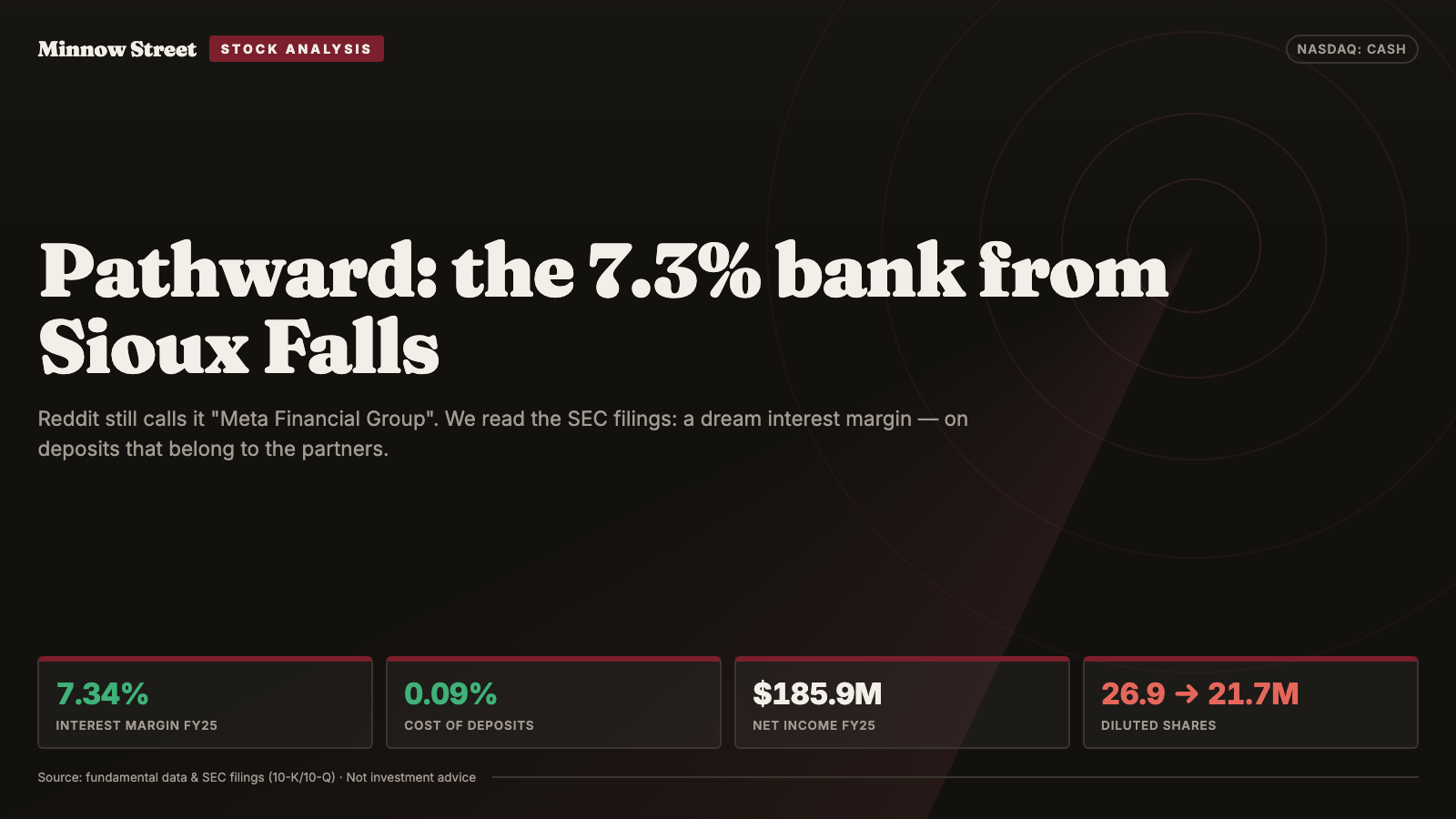
Pathward Stock: A Bank Earning a 7.3 Percent Interest Margin — on Deposits It Does Not Own
The Reddit feed still calls it "Meta Financial Group," its ticker is CASH — and behind both hides an unassuming bank in Sioux Falls that has already shed its name twice and today goes by Pathward Financial. It earns a net interest margin of 7.34 percent (fiscal 2025) that any ordinary bank would envy, because its deposits cost almost nothing (0.09 percent). The catch: that cheap money belongs to its card partners, not to the bank; and the fattest profit lands once a year at tax time. We read the annual report (10-K) for 2025, the quarterly report (10-Q) as of March 31, 2026, and the required filings. Not investment advice — just the question of what is left of a bank once you strip away the name and work out who really owns the interest engine.
 Thomas Mücke
Founder & Publisher
Thomas Mücke
Founder & Publisher
Chart
Interactive price chart (TradingView).
Note: pure fact-based analysis, not investment advice and not a solicitation to buy or sell. All figures without guarantee.
There is an investor trap that snaps shut while you are still reading your watchlist — long before you have seen a single number: the name trap. It works like this: a company called "Meta Financial Group" shows up on the Reddit radar, ticker CASH. Your mind makes three jumps at once: "Meta" sounds like tech, like the Facebook universe; "Financial" sounds like fintech; and "CASH" — well, like plain money. A gut feeling is ready, with no annual report required. Except almost nothing about that name is true anymore. The company has been called Pathward Financial, Inc. (Nasdaq: CASH) since July 13, 2022, sits in Sioux Falls, South Dakota, and is not a tech firm but a nationally chartered bank — one that, by the way, has changed its name more than once: before "Meta Financial Group" it was, until 2005, "First Midwest Financial." The Reddit feed is simply one name behind (3 mentions in 24 hours, ApeWisdom, as of July 23, 2026). So let's make a deal: before you buy a label the company itself has shed twice, we read together what Pathward reported to the U.S. securities regulator, the SEC — the annual report (10-K) for fiscal year 2025 (it ends September 30), the quarterly report (10-Q) as of March 31, 2026, and the required filings. A filing to the SEC is honest under penalty of law. And this one tells of a bank with an almost unreal interest margin, of deposits that cost next to nothing and yet are not its own, of a profit with a season — and of a share count that shrinks year after year. In the end, the decision is yours.
What Pathward actually does — the bank behind the fintechs
Pathward is a bank you rarely meet as a customer — and that is precisely the business model. Picture it this way: Pathward is the bank engine under someone else's hood. When a fintech, a payroll processor or a tax office wants to offer its users a bank account, a prepaid card or a tax advance without holding a bank charter of its own, it rents the charter and the processing from Pathward. The annual report states the role with confidence: "Pathward sits at the hub of the financial ecosystem where traditional banking and financial technology intersect." That is called banking-as-a-service (BaaS) — the bank as a behind-the-scenes provider. Concretely, it runs through two business lines. Partner Solutions is the card and payments business: prepaid and debit cards (Pathward is, per the filing, "one of the leading prepaid card issuers in the United States"), deposit accounts, payment processing, consumer lending, and the tax products. Commercial Finance is the lending business for companies: working-capital and leasing finance, asset-based lending, insurance-premium finance, and government-guaranteed loans. For reporting, the bank sorts this into three segments (Consumer, Commercial, Corporate). The 1892-founded thrift ancestor from Iowa is today a fintech-infrastructure bank with 1,182 employees — and a name it only gave itself in 2022. That names the central tension of this analysis, and it runs through every chapter: Pathward earns like almost no other bank — but the ingredients of that success (cheap deposits, tax-season profits) largely belong to other people or to a single season.
Where the stock shows up — and why it is not a typical scanner find
Pathward did not land on our research list through one of our momentum or value scanners, but through the Reddit hype scanner: 3 mentions in 24 hours (ApeWisdom, as of July 23, 2026) — and even there under the wrong, old name "Meta Financial Group." That is, honestly, atypical, and exactly why it is interesting. Pathward is not a feverish growth story but a profitable, boring-looking regional-bank shell with a very un-bank-like interior. Classic momentum metrics find nothing to grip here: the appeal is not a 200-percent curve but a number you rarely see at a bank — a net interest margin of 7.34 percent. Remember the finding right at the start: with Pathward you don't measure with the price thermometer, you measure with a ruler against the interest margin — and ask what it stands on. So let's lay the ruler down.
The numbers over the years — honestly appraised
First what genuinely impresses, and for a bank this size that is a lot. Pathward earns steadily and well: net income rose from $163.6 million (FY 2023) to $168.4 million to $185.9 million (FY 2025), and return on equity in fiscal 2025 was around 22 percent ($185.9 million of profit on roughly $849 million of average equity) — a figure many large banks would pin to their chest. Total revenue (interest plus noninterest income) grew from $704.5 million to $754.7 million to $839.9 million. And diluted earnings per share climbed from $5.99 to $6.62 to $7.87 (FY 2025). But that last jump carries a trick you need to know:
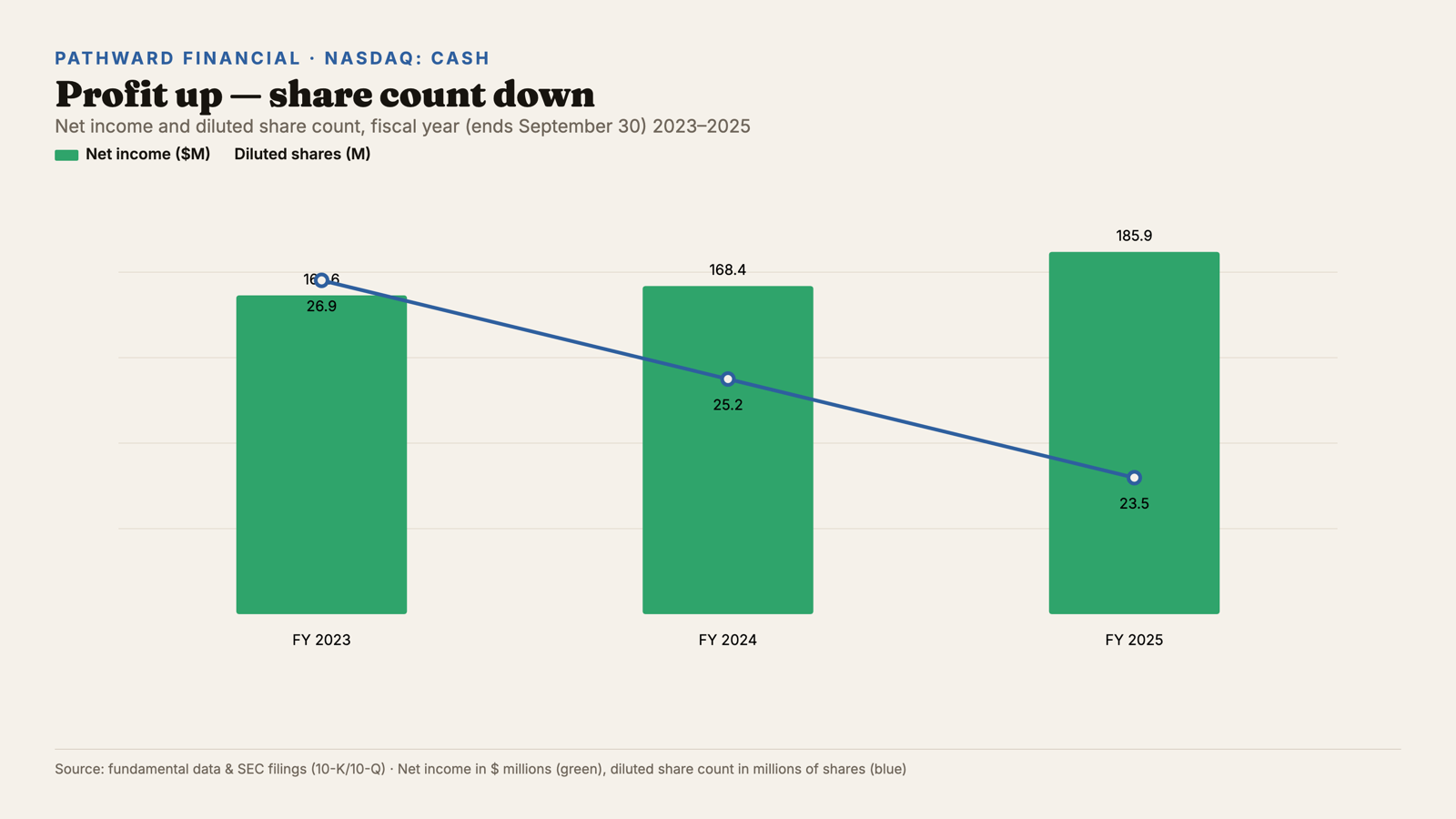
Under the repurchase program authorized in August 2023, the diluted share count shrank from 26.9 million (FY 2023) to 25.2 million to 23.5 million (FY 2025), and on to 21.7 million in the quarter ended March 31, 2026. That is not accounting cosmetics but real capital returned to shareholders — yet it explains why EPS (+31 percent) grew more than twice as fast as net income (+14 percent). Remember the difference: part of the pretty EPS growth comes not from the bank earning more, but from it being split across fewer shares. Which brings us to the uncomfortable truths — and the first one hides in the very thing that makes Pathward so profitable.
What the filings say — the uncomfortable truths
Uncomfortable truth no. 1: The moat is borrowed — the cheap deposits belong to the partners
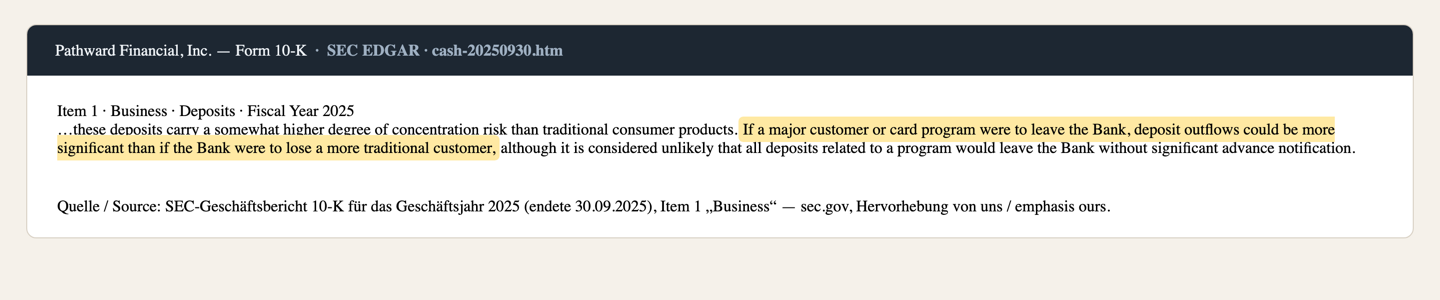
The one number that sets Pathward apart from any ordinary bank is its net interest margin (NIM) of 7.34 percent in fiscal 2025 (2024: 7.01; 2023: 6.40). For context: a solid regional bank like Arrow Financial runs a margin around 3 percent — Pathward earns more than twice as much on every dollar put to work. The net interest margin is, in an image, a bank's trading spread: the gap between what it earns on money lent out and what it pays for the money it takes in. And Pathward's secret lies entirely on the buying side. The cost of deposits in fiscal 2025 was just 0.09 percent — effectively zero. The reason: roughly $5.9 billion of deposits are non-interest-bearing balances from the partners' prepaid and card programs. Pathward holds the money sitting on millions of prepaid cards, payroll cards and tax accounts — and pays nothing for it. Only: that money is not Pathward's. It belongs to the card programs and their users. And the annual report says so itself:
"If a major customer or card program were to leave the Bank, deposit outflows could be more significant than if the Bank were to lose a more traditional customer, although it is considered unlikely that all deposits related to a program would leave the Bank without significant advance notification."
— Pathward Financial, Inc., SEC annual report 10-K for fiscal year 2025, Item 1 "Business" (Deposits) · sec.gov
Picture it this way: imagine an innkeeper who gets his wine for free because the vintners store their casks with him — as long as they stay, his margin is a dream. If a big vintner moves out, he suddenly has to buy like everyone else. That is exactly Pathward's risk: the 7.3-percent margin is not money conjured from nothing, but the reward for being allowed to hold other people's balances. As long as the partners stay, it is a license to print money. But it is a moat that others filled — and that they can drain again. To be fair: the bank considers the portfolio historically stable, no single disclosed program dominates the balance sheet, and a sudden full withdrawal is deemed unlikely. But remember the direction: Pathward's greatest strength sits on the liability side — and the liability side belongs to the partners.
Uncomfortable truth no. 2: The profit has a season
Banks are supposed to be steadily dull. Pathward is the opposite — the profit swings dramatically through the year, and the reason is called tax season. Through its tax products, Pathward advances millions of U.S. taxpayers their refund before the IRS pays, and handles "refund transfers." The annual report describes the business like this:
"These tax solutions offer tax-related financial products, such as electronic refund advances and refund transfers, that ease the pressure of tax season and help over 42,000 independent tax offices stay competitive in a crowded marketplace."
— Pathward Financial, Inc., SEC annual report 10-K for fiscal year 2025, Item 1 "Business" · sec.gov

Because U.S. refunds flow in spring, Pathward's profit concentrates in fiscal Q2 (January through March). And it does so hard:
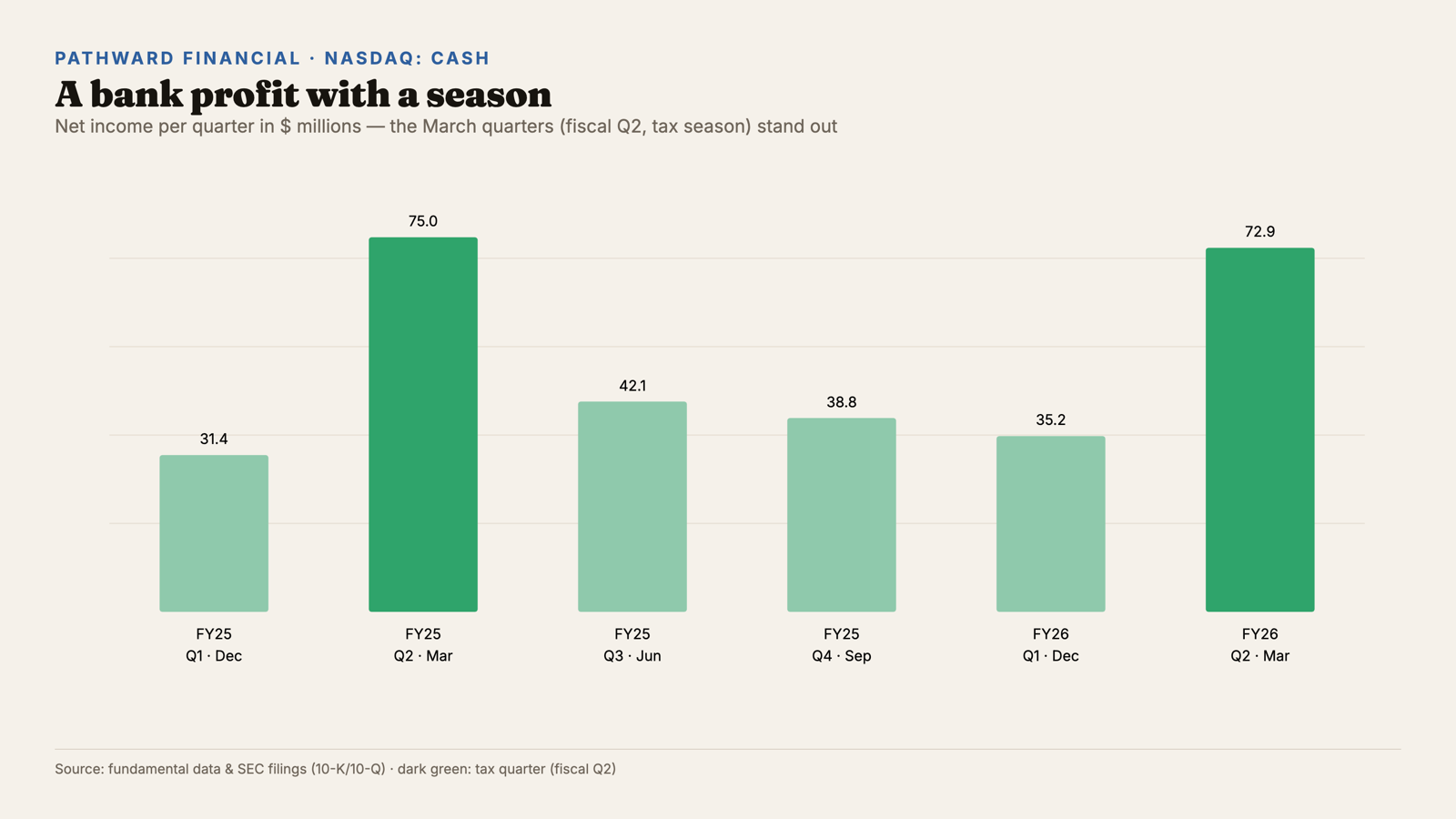
In the quarter ended March 31, 2026, Pathward earned $72.9 million net — more than double the quarter ended December 31, 2025 ($35.2 million). Noninterest income jumped to $151.2 million in the March quarter, up from $53.8 million the quarter before. That is not a problem in itself — it is a known, recurring pattern, and the bank plans for it. But for you as an investor it means two things. First, a single quarter is worthless for comparison; comparing Pathward's March numbers with its December quarter is measuring apples against pears. Second, a large part of the annual profit hangs on a single season and on a business tightly woven into the rules of the tax-refund industry. If one tax season comes in weaker — fewer advances, tighter rules, one partner less — the whole year loses its peak. Remember the image: Pathward's profit is not a calm river but a river with a spring snowmelt.
Uncomfortable truth no. 3: The regulator sits close — and the business model attracts it
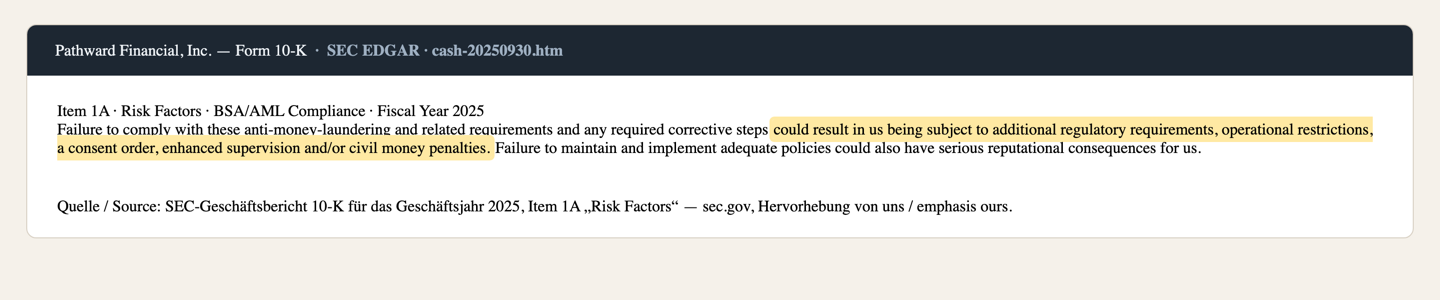
Pathward's business — renting its bank charter to third-party fintechs, holding millions of prepaid accounts, extending tax advances — is exactly the corner of banking regulators have scrutinized most closely of late. As a nationally chartered bank, Pathward answers to the Office of the Comptroller of the Currency (OCC) as its primary regulator, plus the deposit insurer FDIC and the Federal Reserve. The annual report names the flip side of the BaaS model openly — breaches of anti-money-laundering and compliance rules (BSA/AML) can become costly and severe:
"…required corrective steps could result in us being subject to additional regulatory requirements, operational restrictions, a consent order, enhanced supervision and/or civil money penalties."
— Pathward Financial, Inc., SEC annual report 10-K for fiscal year 2025, Item 1A "Risk Factors" · sec.gov
On top comes its own dependence on the tax-refund business, which the filing explicitly places under the "laws and regulations relating to the tax refund industry" — if lawmakers change the rules for refund advances, it hits Pathward's most profitable quarter directly. None of this is an acute alarm; Pathward discloses it, has the compliance machinery of a nationally supervised bank, and has worked in this field for years. But it belongs on the table: whoever runs BaaS and tax advances runs a business whose biggest single risk is not the economy but a letter from the regulator. How quickly supervisory issues can turn a fintech valuation, we saw at Atlanticus — there in consumer credit, here in card and tax infrastructure.
Valuation: double-digit return at a single-digit price-to-earnings ratio
How much does this interest engine cost? Since analyses are evergreen and daily prices are not a buy argument, we take a clean anchor the company dated itself: in its fiscal fourth quarter of 2025 (July 2025), Pathward repurchased its own shares at an average of $82.95. Measured against diluted EPS of $7.87 (FY 2025), that is a price-to-earnings ratio of about 10.5 — strikingly modest for a bank with roughly 22 percent return on equity and a 7-percent-plus interest margin. Book value per share was around $39 ($851.5 million of equity as of March 31, 2026 on roughly 22 million shares), so the price-to-book ratio at the buyback level was a bit above 2. That is the intriguing double meaning of this stock: on the metrics alone it looks like a quality bargain — high, steady return, clean per-share growth, and management actively retiring its own shares. Yet the market pays only a single-digit to low-double-digit multiple for exactly that reason: an earnings quality resting on borrowed deposits and a single season, and a business model in the regulatory spotlight. A low P/E at a bank is rarely a gift — it is usually a price tag for a risk the market has already seen and you still have to weigh.
Opportunities and risks at a glance
What speaks for Pathward:
- Exceptional profitability for a bank: net interest margin of 7.34 percent (FY 2025), roughly 22 percent return on equity, steadily rising net income ($163.6 million to $168.4 million to $185.9 million, FY 2023–2025).
- Near-free funding: cost of deposits of just 0.09 percent (FY 2025), carried by roughly $5.9 billion of non-interest-bearing card-program deposits — a structural cost advantage ordinary banks lack.
- Shareholder-friendly capital policy: repurchase program of up to 7.0 million shares (through September 30, 2028); diluted share count already cut from 26.9 million to 21.7 million — EPS rose 31 percent as a result (FY 2023–2025).
- Leading niche in BaaS and prepaid: per the filing, one of the leading prepaid card issuers in the United States, with a broad partner base across payments, tax services and consumer credit.
- Moderate valuation: price-to-earnings ratio of about 10.5 at the company's own buyback level ($82.95, July 2025) — cheap relative to return and margin.
What speaks against it:
- The moat is borrowed: the cheap deposits belong to the card partners; the filing itself warns of "more significant" deposit outflows if "a major customer or card program" were to leave the Bank (10-K 2025, Item 1).
- A profit with a season: the tax refund-advance business concentrates earnings in fiscal Q2 ($72.9 million net in the March 2026 quarter versus $35.2 million in the December quarter) — single quarters are not comparable, and a weak tax season hits the whole year.
- Core regulatory risk: the OCC as primary supervisor, BSA/AML compliance with an explicit consent-order risk, plus tax-refund-industry regulation — the biggest single risk is a letter from the regulator, not the economy.
- EPS growth partly bought: a meaningful part of the pretty per-share growth comes from the shrinking share count, not from more operating profit — and the authorization is finite (last roughly 3.4 million of 7.0 million shares free).
- Settlement and card risks: $267.3 million of assets were subject to settlement risk as of September 30, 2025; the card business carries operating risks (fraud, prefunding, program settlement).
A human conclusion
Back to the name trap from the start. Its core is not that "Meta Financial Group" is wrong — it is merely outdated, like the whole gut feeling it triggers. Whoever buys the old name buys an idea of tech and fintech; whoever reads the new name finds a bank from South Dakota that has existed for over a century and now carries its name for the third time. And whoever reads the annual report finds a third thing: an unusually profitable niche bank whose success rests on two pillars that are only half its own — cheap deposits that belong to the partners, and a profit that belongs to a single season. That is not a warning, it is a clarification. So the honest question is not "Is this the next fintech winner?" but: Do you trust that the card partners stay, the tax seasons hold, and the regulator stays calm — three bets you would not even have to place at an ordinary bank? If yes, you get a double-digit return at a single-digit price-to-earnings ratio. If no, you understand why the market prices exactly that so cheaply. What you make of it is your decision. And that is exactly as it should be.
Sources
All original documents used in this analysis — to read for yourself:
- Pathward Financial, Inc. — SEC annual report 10-K for fiscal year 2025 (ended Sep 30, 2025, filed November 25, 2025)
- Pathward Financial, Inc. — SEC annual report 10-K for fiscal year 2024 (filed November 26, 2024)
- Pathward Financial, Inc. — SEC quarterly report 10-Q as of March 31, 2026 (filed May 7, 2026)
- Pathward Financial, Inc. — SEC quarterly report 10-Q as of December 31, 2025 (filed February 5, 2026)
- Pathward Financial, Inc. — SEC report 8-K of July 22, 2026 (third fiscal quarter 2026 results)
- Pathward Financial, Inc. — SEC proxy statement DEF 14A for the 2026 annual meeting (filed January 14, 2026)
- Identity and name history (formerNames "META FINANCIAL GROUP INC" through July 13, 2022, before that "FIRST MIDWEST FINANCIAL INC"): EDGAR overview CIK 0000907471 (sec.gov)
- Fundamental data (metrics, quarterly series, valuation; data as of July 23, 2026), reconciled with the SEC filings and the SEC XBRL fact series.
- Reddit mentions: ApeWisdom (as of July 23, 2026, feed name still "Meta Financial Group"); surfaced via our in-house stock scanner.
Transparency & disclaimer: This analysis is a journalistic contextualization of publicly available information and is not investment advice, not a financial analysis in the regulatory sense, and not a solicitation to buy or sell securities. Stock investments carry substantial risks up to total loss. All information without warranty; the data cut-off is noted in the text. The author holds no position in Pathward Financial shares at the time of publication.
Our Bottom Line at a Glance
- Profitability & interest margin positive
- Exceptional for a bank: a net interest margin of 7.34 percent (FY 2025) at a cost of deposits of just 0.09 percent, roughly 22 percent return on equity, and steadily rising net income ($163.6 million to $168.4 million to $185.9 million, FY 2023–2025). The interest engine runs as long as the cheap card-program deposits stay.
- Deposit concentration negative
- The moat is borrowed: roughly $5.9 billion of near-free deposits belong to the card partners, not to the bank. The annual report itself warns of "more significant" deposit outflows if "a major customer or card program" were to leave the Bank (10-K 2025, Item 1) — the greatest strength sits on the liability side, and that belongs to others.
- Earnings quality & seasonality neutral
- The profit has a season: the tax refund-advance business (over 42,000 tax offices) concentrates earnings in fiscal Q2 — $72.9 million net in the March 2026 quarter versus $35.2 million in the December quarter. That is known and planned for, but it makes single quarters incomparable and hangs a large part of the year on a single season.
- Regulation negative
- The BaaS and tax model attracts supervision: the OCC as primary regulator, an explicit consent-order risk on BSA/AML breaches (10-K 2025, Item 1A), plus tax-refund-industry regulation. The biggest single risk is not an economic downturn but a letter from the regulator.
- Capital policy & valuation positive
- Shareholder-friendly and modestly valued: the repurchase program for up to 7.0 million shares cut the diluted share count from 26.9 million to 21.7 million, and EPS rose 31 percent as a result (FY 2023–2025). Price-to-earnings ratio around 10.5 at the company's own buyback level ($82.95, July 2025) — but part of the EPS growth is bought, not earned, and the authorization is finite.
Pathward is one of the most profitable niche banks on the U.S. market — and a lesson against the name trap: the Reddit feed still lists it as "Meta Financial Group," when in fact it is a bank in Sioux Falls that has shed its name twice. Its 7.34 percent interest margin (FY 2025) and roughly 22 percent return on equity are real, but they rest on two pillars only half its own: near-free deposits that belong to the card partners, and a profit that concentrates in tax season. Add a business model in the regulatory spotlight (OCC, BSA/AML, consent-order risk) and EPS growth that comes partly from buybacks rather than the business. That is precisely why the market pays only a price-to-earnings ratio around 10 for a double-digit return. Not investment advice.
What Our Rating Means
Open questions
The business works in principle, but one material question is open. As long as it stays open, our findings do not carry a quality verdict.
Whoever buys today is betting on three things you would not have to bet on at an ordinary bank: that the big card partners and their cheap deposits stay, that the tax seasons hold, and that the regulator stays calm — and gets roughly 22 percent return on equity at a single-digit to low-double-digit price-to-earnings ratio in return. Whoever waits checks four things in each quarterly report (10-Q): does the net interest margin stay above 7 percent and the deposit base stable? Does fiscal Q2 carry the tax season (noninterest income last at $151.2 million in the March quarter)? Are there new supervisory or consent-order disclosures? And how much of the EPS growth still comes from the finite buyback authorization? The decision is yours.
A journalistic assessment by our editorial team at the time of the deep dive, based on public sources — not investment advice and not a solicitation to buy or sell. Your personal circumstances (investment goals, risk capacity, taxes) cannot be taken into account. What our levels mean, how verdicts are formed, and what conflicts of interest exist →
Worth Noting
- Pathward landed on our research list through the Reddit hype scanner (3 mentions in 24 hours, ApeWisdom, as of July 23, 2026) — and even there under the outdated name "Meta Financial Group." It is not a typical momentum or value scanner find but a profitable BaaS bank; classic momentum metrics find no grip on it.
- Identity verified against SEC EDGAR (CIK 907471): formerNames "META FINANCIAL GROUP INC" (through July 13, 2022) and "FIRST MIDWEST FINANCIAL INC" (through 2005); SIC 6021 National Commercial Banks; U.S. domestic filer, no Form 15. Not to be confused with Meta Platforms, the Facebook parent (Nasdaq: META).
- Price and valuation figures dated: the valuation anchor (average buyback price of $82.95) comes from the fiscal fourth quarter of 2025 (July 2025, 10-K); analyses are evergreen, daily prices are not a buy argument. The fiscal year ends September 30, so "fiscal year 2025" essentially covers October 2024 through September 2025.
Frequently Asked Questions
Pathward Financial, Inc. (Nasdaq: CASH) of Sioux Falls, South Dakota, is a nationally chartered U.S. bank that works mainly as a banking-as-a-service provider: it lends partners (fintechs, card programs, tax offices) its bank charter and handles the payments. Two business lines — Partner Solutions (prepaid/debit cards, payments, tax products) and Commercial Finance (working-capital, leasing and asset-based loans). Net income in fiscal year 2025 (ended September 30, 2025): $185.9 million, with 1,182 employees.
Because the feed carries an outdated name. The company was called "Meta Financial Group" through July 13, 2022, and before that, until 2005, "First Midwest Financial"; since then it has been Pathward Financial, Inc. (the bank subsidiary was renamed from MetaBank to Pathward, N.A.). The name history is documented via the formerNames entries in the SEC EDGAR register (CIK 907471). The bank has nothing to do with Meta Platforms, the Facebook parent (Nasdaq: META).
Because its deposits cost almost nothing. The net interest margin in fiscal 2025 was 7.34 percent (2024: 7.01; 2023: 6.40), and the cost of deposits was just 0.09 percent. The reason: roughly $5.9 billion of deposits are non-interest-bearing balances from the partners' prepaid and card programs. Pathward manages that money and pays practically no interest for it — the catch is that the balances belong to the partners, not to the bank.
Because of the tax refund-advance business. Pathward advances U.S. taxpayers their refund through more than 42,000 independent tax offices (refund advances) and handles refund transfers. Because refunds flow in spring, profit concentrates in fiscal Q2 (January–March): in the quarter ended March 31, 2026, Pathward earned $72.9 million net, versus only $35.2 million in the quarter ended December 31, 2025. Single quarters are therefore not directly comparable.
Partly, yes. Under the repurchase program authorized in August 2023 (up to 7.0 million shares through September 30, 2028), the diluted share count fell from 26.9 million (FY 2023) to 23.5 million (FY 2025) and on to 21.7 million (Q2 FY 2026). As a result, diluted EPS rose 31 percent ($5.99 to $7.87) while net income rose only 14 percent. Part of the EPS growth therefore comes from the shrinking share count, not from more operating profit.
As a nationally chartered bank, the Pathward bank subsidiary answers to the Office of the Comptroller of the Currency (OCC) as its primary federal regulator, plus the deposit insurer FDIC; the holding company is supervised by the Federal Reserve. The banking-as-a-service and card business sits under heightened supervision (anti-money-laundering/compliance rules, BSA/AML); the annual report explicitly names the risk of a consent order, operational restrictions and money penalties for breaches, on top of tax-refund-industry regulation.
Found an error?
Did you spot a factual error, an outdated number, or a typo in this deep dive? Let us know briefly — your report goes straight to the editorial team.