Oportun Financial: What a Price-to-Free-Cash-Flow of 0.6 Actually Measures at a Lender
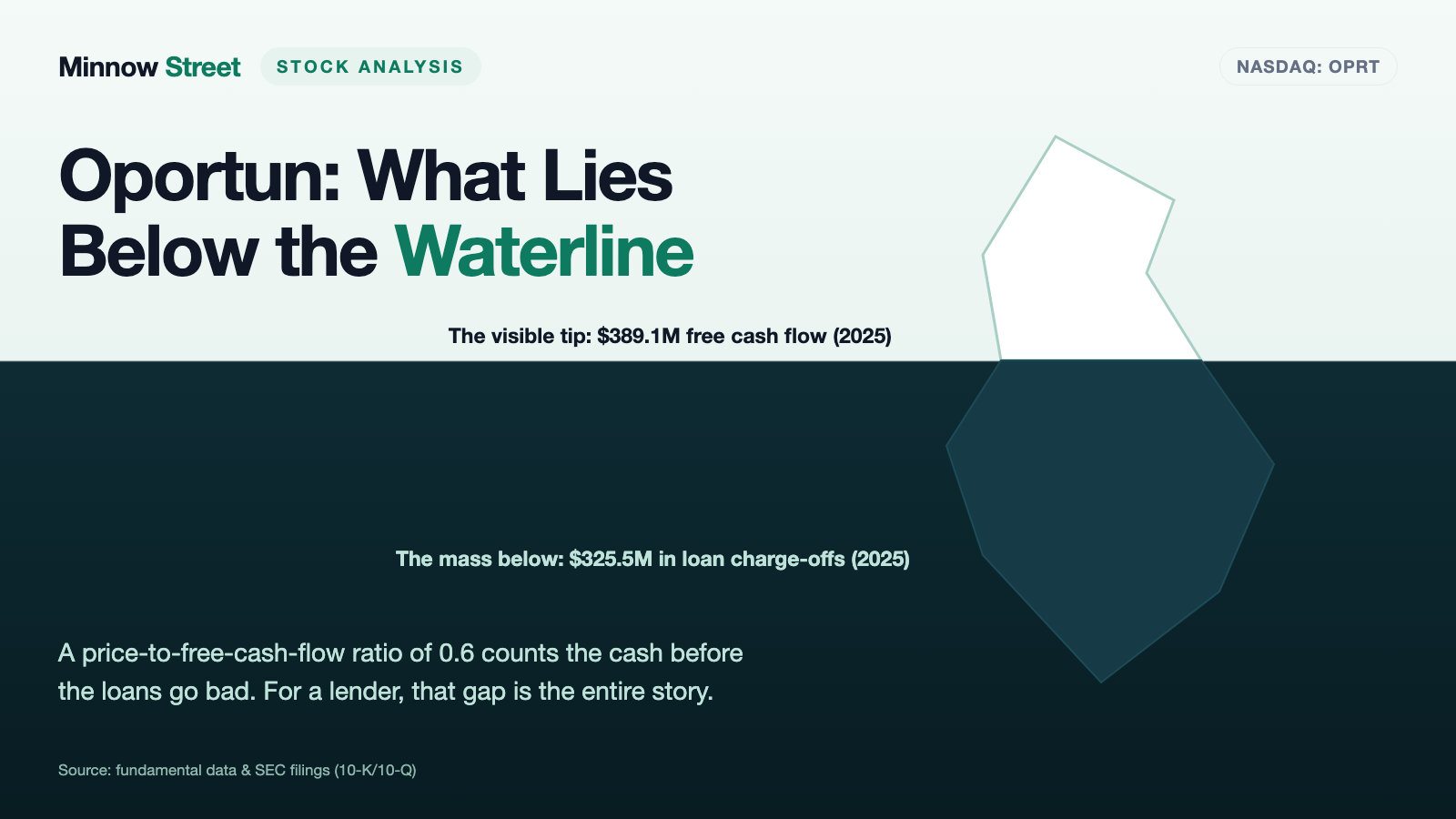
On July 26, 2026, our in-house stock scanner placed Oportun Financial 13th among the listed U.S. hits in the price-to-free-cash-flow ranking, at a ratio of 0.6. The arithmetic is right. It simply measures something other than what its name suggests when the company is a consumer lender. In 2025, $413.4 million of operating cash came in — and in the same year $325.5 million of loans were charged off without ever touching that inflow. Add a loan book that has been shrinking for years, a charge-off rate that is climbing again, a corporate loan at 15 percent interest and a leadership team replaced almost wholesale in 2026. At a lender, free cash flow is borrowed time: it has to go back into the loan book, or the business shrinks.
 Thomas Mücke
Founder & Publisher
Thomas Mücke
Founder & Publisher
Chart
Interactive price chart (TradingView).
Note: pure fact-based analysis, not investment advice and not a solicitation to buy or sell. All figures without guarantee.
There is an investor trap that never catches the lazy — it catches the diligent. Call it the fraction trap. It works like this: you take a ratio, dutifully check that numerator and denominator are computed correctly, and in doing so skip the only question that matters — what is actually inside the numerator? That is exactly how Oportun Financial Corporation (Nasdaq: OPRT) landed on our desk: with a price-to-free-cash-flow ratio of 0.6. The fraction is right. The numerator is right too. And it still measures something other than what its name promises at this particular company. So let us make a deal: instead of celebrating the number, we take it apart. Our sources are the filings Oportun submits to the U.S. securities regulator, the SEC — the annual report (Form 10-K) for 2025, the quarterly report (Form 10-Q) for the quarter ended March 31, 2026, several current reports (Form 8-K) from spring and summer 2026, and the proxy statement (DEF 14A) dated June 29, 2026. Those documents are honest under penalty of law. And they describe a lender whose free cash flow looks so large mainly because the losses in its own loan book never touch it. What you do with that is your call.
Contents
- What Oportun Financial actually does
- Where the stock came across our desk — and what P/FCF measures at a lender
- The numbers over the years, honestly assessed
- What the filings say — the uncomfortable truths
- Valuation: at a lender, the charge-off rate decides
- Opportunities and risks at a glance
- A human conclusion
- Sources
What Oportun Financial actually does
Oportun is a consumer lender — and it serves precisely the customers big banks walk past. Its target group is working U.S. households, largely of Hispanic origin, with no credit history or only a thin one. Without a credit score in the United States you effectively do not exist for the conventional lending apparatus: no score, no credit, no history, no score. Oportun breaks that loop by assessing ability to pay from other data — bank account activity, income verification, payment behavior. Since 2009 the company has been certified by the U.S. Treasury as a Community Development Financial Institution (CDFI), a federal designation for institutions serving underbanked communities.
The product line is down to earth. There is the unsecured installment loan of $300 to $10,000 with terms of 12 to 54 months; the average loan originated in the first quarter of 2026 was $3,360. There is the auto-secured personal loan of $2,525 to $18,500, offered in eight states, averaging $6,607. And there is Set & Save, an automated savings product that uses pattern recognition to work out how much a member can put aside each day without running short; since 2015 members have set aside more than $12.8 billion through it. Those balances belong to the members and explicitly sit outside Oportun\'s balance sheet. Distribution runs through the app, the website, the phone, 126 retail locations and 460 partner locations (as of March 31, 2026). Unsecured personal loans are originated in 41 states, "primarily through our partnership with Pathward, N.A." — that is, largely through a partner bank whose loans Oportun then purchases in full.
The word "members" is not the author\'s flourish; it is Oportun\'s own term for its customers. Over nineteen years the company says it has extended more than $21.8 billion in credit and cards (as of December 31, 2025); by the end of June 2026 the figure was $22.2 billion, and 1.3 million people built a credit history through it in the first place. The Net Promoter Score for the personal loan stands at 77 — unusually high for a lender.
How does Oportun make money? Almost entirely from interest. Of the $956.7 million in total revenue for 2025, $893.2 million was interest income, or 93.4 percent. The rest is fees, subscriptions and gains on loan sales. The loan book is funded in the capital markets: since 2015 Oportun has sponsored or co-sponsored 28 securitizations, in which loan receivables are bundled and sold as bonds; every one of them included investment-grade rated tranches. As of December 31, 2025, $2.2 billion of such asset-backed notes were outstanding.
One accounting feature matters for everything that follows: Oportun carries its loan book at fair value rather than at amortized cost. Instead of a conventional loan loss provision running through the income statement as an expense, the entire portfolio is remeasured every quarter. Losses therefore do not appear as a "provision" but inside a collective line called "Total net decrease in fair value." That is permitted, it is transparent — and it has a consequence for the very ratio that brought us here that almost nobody has on their radar.
Where the stock came across our desk — and what P/FCF measures at a lender
The hook is a snapshot, not a permanent state. On July 26, 2026, Oportun Financial sits at rank 13 among the 25 listed U.S. hits in our in-house price-to-free-cash-flow ranking, at a ratio of 0.6. The full ranking counted 544 hits that day; the page shows the strongest 25 for the selected market region. To reproduce it: open the scanner, choose the price-to-free-cash-flow ranking, set the market filter to the United States, and read the list, which is sorted by the ratio in ascending order. The lists are recomputed daily, so tomorrow Oportun may sit two places higher or lower.
What does the ranking measure? It divides market capitalization by free cash flow over the trailing four quarters. Cash counts as free once it has come out of operations and investment spending has been paid; the remainder is available for dividends, buybacks or debt reduction. A ratio of 4 corresponds to a free cash flow yield of 25 percent. A ratio of 0.6 would mean the company earns back its entire market capitalization in under eight months. In numbers: market capitalization of roughly $257 million, free cash flow over the four quarters through March 31, 2026 of roughly $392 million (data as of July 26, 2026). For an industrial company that would be an extraordinary finding. At a lender it is a measurement error — more precisely, a measurement of something other than what the reader assumes.
Two things go wrong here, and both trace back to the business model.
First: new lending sits in investing activities, not in operations. When a machine builder buys steel, its operating cash flow falls. When Oportun disburses a loan, it does not — originating loans for the company\'s own book is recorded in the investing section of the cash flow statement. In 2025, $1.76 billion flowed out there for originations and purchases, against $1.42 billion of principal repayments coming back. So the "free" cash flow is not free at all: it has to go back into the loan book, or the business shrinks.
Second: charge-offs never touch operating cash flow. Because the loan book is carried at fair value, charge-offs form part of the non-cash remeasurement — and that is added back in the cash flow statement on the way from net income to operating cash flow. The annual report spells it out: operating cash flow comprises net income "adjusted for (i) non-cash items … including … fair value adjustments, net." The loan charge-offs sit inside exactly that collective line.

None of this makes the ratio wrong — it simply makes it useless as a valuation yardstick. We took the same effect apart once before in this ranking, that time at a small Florida bank: in our analysis of BayFirst Financial, the seemingly sensational cash inflow came from selling the bank\'s own loan book. At Oportun the mechanics differ, the lesson does not: open the numerator, or you are buying a number rather than a company. One more name from the same list sits close by in substance — Consumer Portfolio Services, an auto lender to credit-impaired borrowers, ranks two places behind Oportun on the same date.
The numbers over the years, honestly assessed
Start with what genuinely impresses. 2025 was the first profitable year since 2021. After losses of $77.7 million (2022), $180.0 million (2023) and $78.7 million (2024), fiscal 2025 closed with net income of $25.2 million — a $103.9 million swing in a single year. Diluted earnings per share went from −$1.95 to $0.53. And it was not an accounting trick: operating expenses fell from $410.4 million to $361.8 million, down 11.8 percent, while originations grew 10.2 percent to $1.96 billion. More business with less overhead is the honest version of efficiency.
Funding got cheaper too. Average cost of debt fell from 8.4 percent (2024) to 8.2 percent (2025) and further to 7.0 percent in the first quarter of 2026; quarterly interest expense dropped from $57.4 million to $48.0 million, down 16.4 percent. Liquidity is comfortable: as of March 31, 2026 the company had $1.16 billion of available liquidity — $130.4 million of unrestricted cash, $79.5 million of restricted cash and $921.7 million of undrawn warehouse capacity. Management states that it targets liquidity sufficient to cover at least twelve months of expected net cash outflows including new originations, without drawing on the corporate financing facility or the equity markets. All debt covenants were met as of December 31, 2025.
Now the other half of the picture. The managed loan book has been shrinking for years: $3.18 billion at the end of 2023, $2.97 billion in 2024, $2.91 billion in 2025 — and $2.80 billion as of March 31, 2026. In the first quarter of 2026, originations fell 11.2 percent to $416.9 million. Revenue follows the balance downward: $1,001.8 million (2024), $956.7 million (2025), and $228.8 million in the first quarter of 2026 against $235.9 million a year earlier. Little of the 2025 earnings jump survived into the new year: $2.3 million of net income in the first quarter of 2026 against $9.8 million in the prior-year quarter, a drop of more than three quarters. It was the sixth consecutive quarter of GAAP profitability — and the smallest of the six.
What the filings say — the uncomfortable truths
Uncomfortable truth no. 1: free cash flow is computed without the loans that never come back
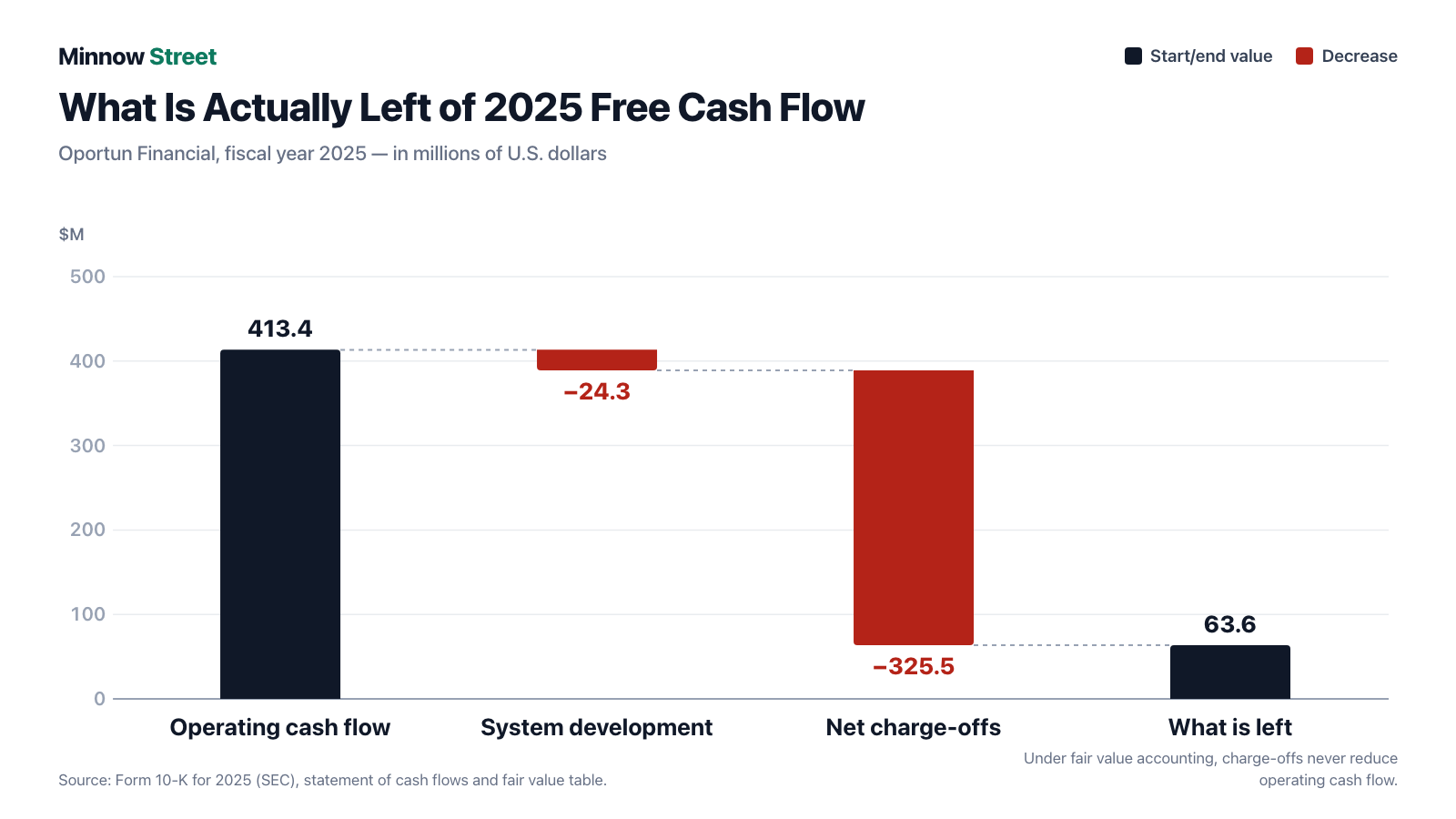
This is the heart of it. In fiscal 2025, operating activities generated $413.4 million. Of that, $24.3 million went into capitalized system development, the only meaningful investment outside the loan book. That leaves $389.1 million of "free cash flow" on the definition our ranking uses. In the same fiscal year, $325.5 million of loans were charged off net — money paid out that never came back.
"The net decrease in charge-offs, net of recoveries, for 2025 was $325.5 million."
— Oportun Financial Corporation, Form 10-K for 2025, Item 7 (MD&A)
Subtract that amount and $63.6 million of the $389.1 million remains — a price-to-free-cash-flow ratio of roughly 4.0 instead of 0.6. That is still not expensive. But it is an entirely different finding: "this cannot be right" becomes "this is decent, and explainable." The rule of thumb: at a lender, free cash flow is the gross margin, not the profit.
Uncomfortable truth no. 2: the cash came free precisely because less was lent out
Something notable happens in the first quarter of 2026 cash flow statement: investing activities turn positive. They provided $8.0 million, after using $55.5 million a year earlier. The reason sits right underneath: $318.1 million went out for originations and purchases, while $332.8 million came back as principal repayments. More returned than went out.
That is exactly the configuration to be wary of at a lender. When a loan book repays more than it originates, liquidity appears in the short run — the same liquidity a ratio like price-to-free-cash-flow reads as strength. In reality it signals contraction: the managed principal balance fell in that same quarter from $2.91 billion to $2.80 billion. And the cash did not stay put, it kept moving: financing activities used $100.8 million, mostly repayments of asset-backed notes. Cash on hand rose by all of $10.9 million. That is what "free cash flow" looks like in reality when you follow it to the end.
In fairness to the company: the slowdown is deliberate. The filings cite a "continued conservative credit posture," and management says it plans to ramp originations back up over the remainder of the year. A decline out of caution is a different animal from a decline out of necessity. It just does not change the fact that the ratio scores both the same.
Uncomfortable truth no. 3: the charge-off rate is climbing again — and the customers are under pressure
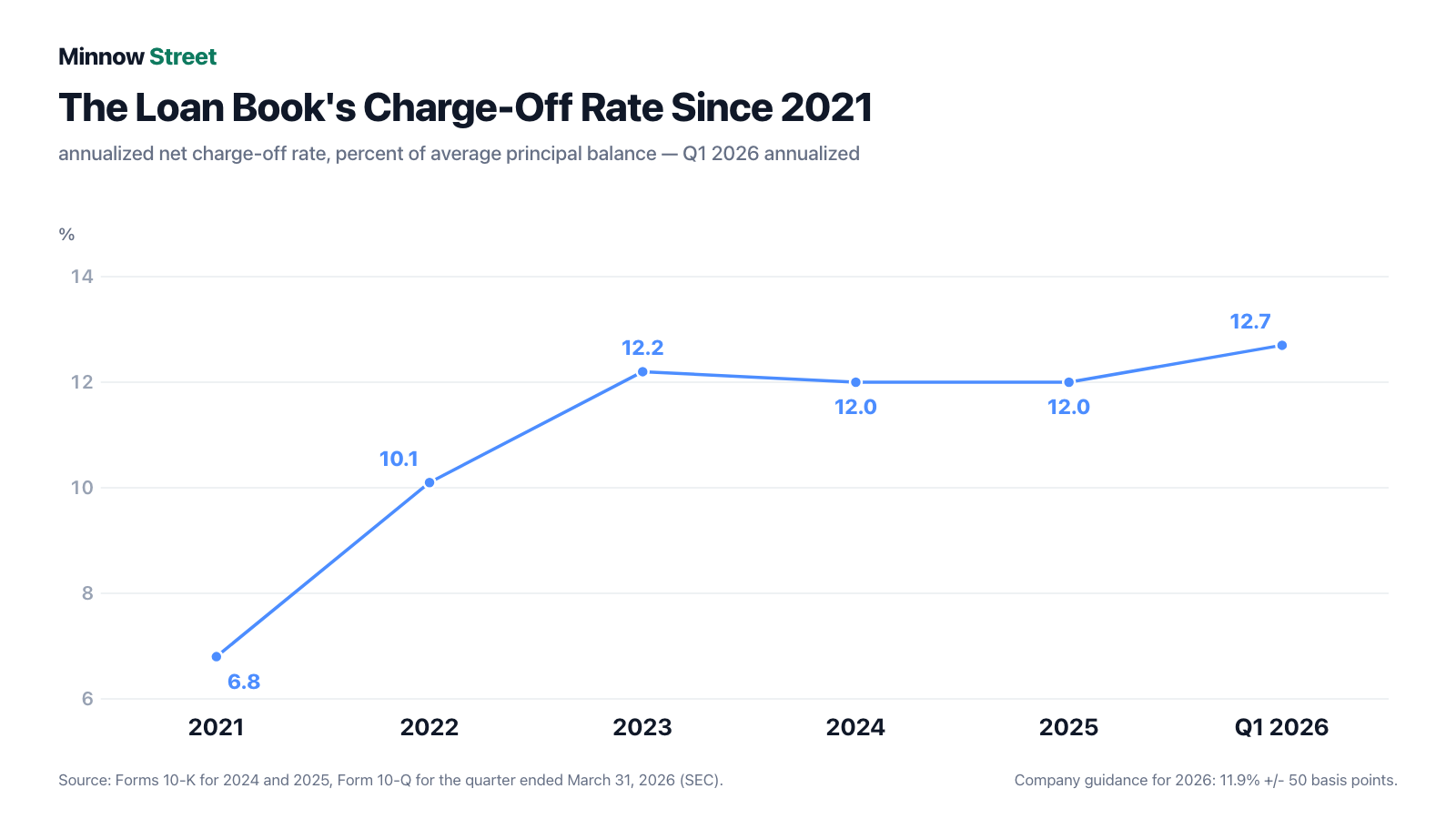
The annualized net charge-off rate measures what share of the average loan balance is written off over a year. It was 6.8 percent in 2021, climbed to 10.1 percent in 2022 and 12.2 percent in 2023, held at 12.0 percent in both 2024 and 2025 — and rose again to 12.7 percent in the first quarter of 2026, 46 basis points above the prior-year quarter. The filing names two causes: a higher share of new members in the originations of the first half of 2025, and the cost of living faced by borrowers. In the company\'s own words, higher costs for food, fuel and rent have "continued to put pressure on our members."
The vintage data show how long that lingers. Of the 2021 vintage, 18.4 percent of the originally disbursed principal was permanently lost as of December 31, 2025; of the 2022 vintage, 21.9 percent — one dollar in five. The 2023 vintage (13.8 percent) and the 2024 vintage (6.1 percent) look considerably better but are not yet fully seasoned. So the credit tightening from July 2022 onward did work. Whether it worked enough will be decided by the 2025 and 2026 vintages — and those are precisely what is driving the move to 12.7 percent. Company guidance for full-year 2026 is 11.9 percent plus or minus 50 basis points. The quarter that has to support that guidance is still ahead.
One more scale check, because it is easy to miss: twelve percent of charge-offs against a portfolio yield of roughly 32 percent means a good third of interest income goes straight into covering losses. That is not an accident, it is the business model. It works exactly as long as the gap between those two numbers holds.
Uncomfortable truth no. 4: the 36 percent cap, the company\'s calling card, is set to go
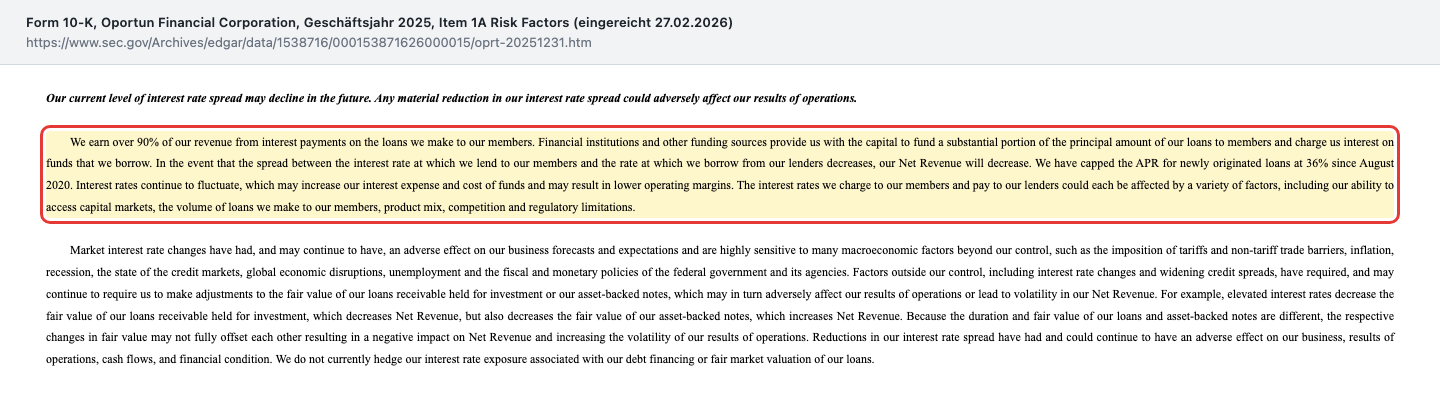
For six years one self-imposed commitment was Oportun\'s sharpest differentiator against the high-cost lending crowd. It appears in the 2025 annual report in the barest of terms.
"We have capped the APR for newly originated loans at 36% since August 2020."
— Oportun Financial Corporation, Form 10-K for 2025, Item 1A (Risk Factors)
On June 29, 2026, the new chief executive announced in the proxy statement that the cap will be broken.
"First, we are working to responsibly expand access through a risk-based pricing program, including pricing above 36% where permitted and appropriate for shorter-term loans and certain higher-risk segments, including for some customers we are not able to approve today."
— Oportun Financial Corporation, Proxy statement (DEF 14A) of June 29, 2026, letter from the chief executive officer
One day later the machinery was in place. On June 30, 2026, Oportun entered into a program management agreement with Column National Association, a national banking association. Column will originate unsecured personal loans in select states, Oportun provides the platform — marketing, application processing, fraud prevention, servicing — and may purchase the loans. Four years of initial term, automatic one-year renewals thereafter, plus exclusivity provisions for specified products. Why a bank? Because a nationally chartered bank may export interest rates above individual state caps where its home state allows it. The bank partnership is therefore not merely a distribution question but the legal precondition for pricing above 36 percent.

Commercially the move makes sense: a lender capping at 36 percent while running a 12.7 percent charge-off rate simply cannot price certain applicants and has to decline them. Higher rates make part of that pipeline underwritable. The price is a different one: the commitment that set Oportun apart disappears. For a company whose CDFI certification and reputation rest on exactly that distinction, this is the most consequential product decision since the exit from the credit card business in November 2024. How it turns out will be visible in the quarterly reports of the next twelve months — in portfolio yield, in the charge-off rate, and in whether the sentence about the 36 percent cap still appears in the next annual report.
Uncomfortable truth no. 5: leadership changes every six months, two activists in twelve
Anyone trying to establish who runs Oportun in 2026 needs a calendar. On April 3, 2026, Raul Vazquez, chief executive for many years, stepped down and left the board. Until a successor was found, chief legal officer Kathleen Layton and lending general manager Gaurav Rana led the company jointly. On April 20, 2026, Doug Bland took over, previously a long-serving PayPal executive and a director of partner bank WebBank. On June 15, 2026, chief credit officer Patrick Kirscht left after eighteen years; the filing states expressly that no disagreements were involved. Two days later Sean Rowles started as chief risk officer, previously at PayPal and Citizens Bank. The chief financial officer role is held on an interim basis as of the date of this analysis. At a lender whose entire business hangs on the quality of its risk models, simultaneous turnover at the top, in risk and in finance is more than a personnel note.
Running alongside is a dispute with activist shareholders that began in late 2023. Findell Capital Management ran an open proxy contest in 2025 with its own competing slate; it ended on July 14, 2025 with an agreement: a board seat for Warren Wilcox, the retirement of a long-serving director by the 2026 annual meeting, a standstill through 2028 and expense reimbursement of up to $1.2 million. At that same annual meeting shareholders voted to declassify the board and to strip supermajority provisions from the charter. Just under a year later, on June 22, 2026, a second agreement followed — this time with Bradley L. Radoff and the Radoff Family Foundation: two more directors will retire no later than the conclusion of the 2026 annual meeting, in exchange for voting with the board\'s recommendations and a standstill through 2028.

A note on the mandatory merger check, because standstill agreements almost reflexively raise the question: the entire SEC filing history contains no merger prospectus (Form S-4), no merger proxy (DEFM14A), no Rule 425 communication and no tender offer (SC TO). Both agreements expressly bar the activists from pursuing extraordinary transactions — while reserving their free vote should one ever be put to shareholders. That is boilerplate, not evidence of a live process. As of July 26, 2026, Oportun is neither being acquired nor going private.
Valuation: at a lender, the charge-off rate decides
Start with what does not help here. The Altman Z-score, which our overviews report for industrial companies, is meaningless at a lender: it was built for manufacturers and inevitably reads a balance sheet that is more than 90 percent loan receivables and roughly 88 percent debt as a distress case. The same goes for enterprise value and the price-to-sales ratio: treating a lender\'s funding debt like corporate debt adds the raw material to the purchase price. And, as shown, it goes for the price-to-free-cash-flow ratio that brought us here.
What does help are three orders of magnitude. First, book value. As of March 31, 2026, stockholders\' equity was $396.3 million, or roughly $8.69 per share on 45.6 million shares outstanding. Against a market capitalization of about $257 million that is a price-to-book ratio of roughly 0.65 — the market values this lender\'s equity at about a one-third discount. At an institution running a 12.7 percent charge-off rate, that is not an overreaction but a price tag on uncertainty about the true value of the loan book.
Second, earnings. On a GAAP basis Oportun earned $0.53 per diluted share in 2025. On the four quarters through March 31, 2026 the figure is roughly $0.37, implying a price-to-earnings ratio of about 15. The company itself guides to adjusted earnings per share of $1.50 to $1.65 for 2026, alongside revenue of $935 million to $955 million and adjusted earnings before interest, taxes, depreciation and amortization of $150 million to $165 million. "Adjusted" here excludes, among other things, stock-based compensation and certain fair value effects. The distance between $0.53 and $1.50 is the distance between two accounting worlds — anyone using the guidance as a valuation anchor should know which one they are buying.
Third, balance sheet structure. Total assets of $3.17 billion against equity of $396.3 million works out to an equity ratio of roughly 12.5 percent as of March 31, 2026. For a lender with this charge-off rate that is not lavish but workable, and it grew over the year (December 31, 2024: $353.8 million). Six of the nine Piotroski balance sheet criteria are met — solid, no more than that.
The professional view is split and gives the turnaround some credit: of six recorded analyst opinions, three say buy and three say hold, none says sell; the average price target is $9 (data as of July 26, 2026). Consensus figures like these are not an argument but a mood reading — they say more about expectations than about the company.
Opportunities and risks at a glance
Opportunities
- The turnaround is documented, not asserted: six consecutive quarters of GAAP profitability, operating expenses down 11.8 percent in 2025, the first profitable year since 2021.
- Funding is getting measurably cheaper — cost of debt from 8.4 percent (2024) to 8.2 percent (2025) to 7.0 percent in the first quarter of 2026; every further repayment of the 15 percent corporate loan feeds straight into earnings.
- Ample liquidity: $1.16 billion available as of March 31, 2026, including $921.7 million of undrawn warehouse capacity, with all covenants met.
- The market values the equity at roughly a one-third discount (price-to-book 0.65) — if the loan book proves more valuable than feared, that is the lever.
- The risk-based pricing program and the Column bank partnership open up applicants who must be declined today, supporting both portfolio yield and volume.
- A genuine niche with high customer satisfaction: Net Promoter Score of 77, CDFI certified since 2009, $22.2 billion of credit extended and 1.3 million first-time credit histories built.
Risks
- The charge-off rate is climbing again: 12.7 percent in the first quarter of 2026 against 12.2 percent a year earlier, versus full-year guidance of 11.9 percent — that guidance requires improvement, not continuation.
- The managed loan book has been shrinking since 2023 ($3.18 billion to $2.80 billion) and originations fell 11.2 percent in the first quarter of 2026; revenue and interest income follow with a lag.
- Only $2.3 million of the 2025 earnings jump survived into the first quarter of 2026 — more than three quarters less than a year earlier.
- $165.0 million of corporate financing at 15.00 percent ties up annual interest on the scale of the entire 2025 profit; maturity is November 14, 2028.
- 2,682,788 outstanding warrants at $0.01 per share represent another 5.9 percent of dilution; the share count has already risen roughly 27 percent since the end of 2024.
- A chief executive in place only since April 2026, a chief risk officer since June 2026, and an interim chief financial officer — turnover at three key posts at once.
- Dependence on partner banks: unsecured personal loans are originated in 41 states primarily through Pathward, and the new program rests on Column.
- Regulatory risk around automated credit decisions: California\'s rules on automated decision-making took effect on January 1, 2026, and further states are drafting their own.
A human conclusion
Back to the fraction trap from the opening. It would not have misled us because the arithmetic was wrong — it was right. It would have misled us because we would have forgotten to ask what sits inside the numerator. At Oportun Financial, what sits there is the cash returning from a loan book whose losses are recorded on a different line. Add those losses back — $325.5 million in 2025 alone — and about one sixth of the $389.1 million of "free" cash flow remains. A price-to-free-cash-flow ratio of 0.6 becomes roughly 4.0. Still interesting. No longer spectacular.
And then there is the company behind the number, which deserves no belittling. A lender serving people who would otherwise end up at a pawnshop. A Net Promoter Score of 77. A turnaround that, after three loss-making years, genuinely happened — six consecutive profitable quarters and operating expenses down 11.8 percent. Alongside it: a shrinking loan book, a charge-off rate climbing again, a leadership team replaced at three key posts within months, and the coming departure from the 36 percent promise that made the brand.
This is not an accounting scandal and not a crisis. It is a company in the middle of a transition whose outcome is still open. Two dates will make it measurable: the next quarterly report with its charge-off rate, originations and portfolio yield — and the annual meeting on August 11, 2026, at which two more directors step down. Anyone forming a view here should anchor it in those numbers rather than in a fraction. What you do with that is your decision. And that is exactly as it should be.
Sources
- Oportun Financial Corporation, Annual Report (Form 10-K) for fiscal 2025, filed February 27, 2026
- Oportun Financial Corporation, Annual Report (Form 10-K) for fiscal 2024, filed February 20, 2025
- Oportun Financial Corporation, Quarterly Report (Form 10-Q) for the quarter ended March 31, 2026, filed May 8, 2026
- Current Report (Form 8-K) of July 7, 2026, Item 1.01 — program management agreement with Column National Association
- Current Report (Form 8-K) of June 24, 2026, Item 1.01 — agreement with Bradley L. Radoff and The Radoff Family Foundation
- Current Report (Form 8-K) of June 18, 2026, Item 5.02 — departure of the chief credit officer, appointment of the chief risk officer
- Current Report (Form 8-K) of April 17, 2026, Item 5.02 — appointment of Doug Bland as chief executive officer
- Current Report (Form 8-K) of April 2, 2026, Item 5.02 — chief executive transition
- Current Report (Form 8-K) of July 14, 2025, Item 1.01 — agreement with Findell Capital Management LLC
- Proxy statement (DEF 14A) of June 29, 2026
- First-quarter 2026 earnings release (Exhibit 99.1 to the Form 8-K of May 7, 2026)
- SEC filing history, CIK 0001538716 (checked for merger and tender offer filings)
- Fundamental data (market capitalization, quarterly cash flow series, analyst consensus), as of July 26, 2026
This analysis is journalistic commentary on publicly available documents. It is expressly not investment advice and not a solicitation to buy or sell securities. Shares of small consumer lenders can be highly volatile; a total loss is possible. All figures come from the filings named above and carry their respective as-of dates. The author holds no position in Oportun Financial Corporation at the time of publication.
Our Bottom Line at a Glance
- Core business positive
- A genuine niche with documented customer satisfaction: consumer loans for households without a conventional credit history, a Net Promoter Score of 77, certified as a Community Development Financial Institution since 2009. Originations reached $1.96 billion in 2025, up 10.2 percent, and interest income was $893.2 million. Distribution runs through the app, the phone, 126 retail locations and 460 partner locations (as of March 31, 2026).
- Turnaround positive
- After three loss-making years, 2025 produced net income of $25.2 million (2024: −$78.7 million), or $0.53 per diluted share after −$1.95. Operating expenses fell 11.8 percent to $361.8 million and cost of debt moved from 8.4 to 8.2 percent and on to 7.0 percent in the first quarter of 2026. It was the sixth consecutive profitable quarter.
- Credit quality negative
- The annualized net charge-off rate rose to 12.7 percent in the first quarter of 2026 from 12.2 percent a year earlier; in 2021 it was 6.8 percent. In dollars, $325.5 million of loans were charged off in 2025. Of the 2022 vintage, 21.9 percent of disbursed principal was permanently lost as of December 31, 2025. Full-year guidance of 11.9 percent requires improvement over the current run rate.
- Growth negative
- The managed loan book has been shrinking since 2023: $3.18 billion (December 31, 2023), $2.97 billion (2024), $2.91 billion (2025) and $2.80 billion at March 31, 2026. Originations fell 11.2 percent to $416.9 million in the first quarter of 2026 and revenue fell 3.0 percent to $228.8 million. Net income came to $2.3 million against $9.8 million a year earlier.
- Funding and dilution neutral
- Liquidity is ample at $1.165 billion available, and all debt covenants were met as of December 31, 2025. Against that stands a corporate loan of $165.0 million principal at 15.00 percent (due November 14, 2028), whose annual interest is on the scale of 2025 net income. The share count rose through exercised one-cent warrants from 36.1 million (December 31, 2024) to 45.7 million (May 4, 2026), with 2,682,788 warrants still outstanding.
- Leadership and ownership negative
- Three key posts changed within months: Doug Bland became chief executive on April 20, 2026, the chief credit officer left on June 15, 2026, a new chief risk officer started on June 17, 2026, and the chief financial officer role is held on an interim basis. Add two standstill agreements with activist shareholders within twelve months (Findell Capital July 14, 2025, Bradley L. Radoff June 22, 2026); two more directors retire by the annual meeting on August 11, 2026.
- Hook and data basis neutral
- Rank 13 among the 25 listed U.S. hits in our in-house price-to-free-cash-flow ranking at a ratio of 0.6 (as of July 26, 2026, 544 hits in the full ranking). The underlying free cash flow is arithmetically correct but measures gross margin rather than surplus at a lender: originations sit in investing activities and charge-offs are non-cash fair value adjustments. Deducting the 2025 charge-offs produces a ratio of roughly 4.0. The Altman Z-score, enterprise value and price-to-sales are meaningless here.
Oportun Financial is not a bargain but a lender in transition whose most striking ratio measures something other than assumed. Of $389.1 million of free cash flow in 2025, roughly $63.6 million survives $325.5 million of charge-offs — a price-to-free-cash-flow ratio of 0.6 becomes about 4.0. The turnaround is real: the first profitable year since 2021, six consecutive profitable quarters, operating expenses down 11.8 percent, cost of debt down to 7.0 percent. Alongside it sit a loan book shrinking since 2023, a charge-off rate back up at 12.7 percent, a $165.0 million corporate loan at 15 percent and a leadership team that is new at three key posts. Not investment advice.
What Our Rating Means
Open questions
The business works in principle, but one material question is open. As long as it stays open, our findings do not carry a quality verdict.
Yellow here stands for an open operating question, not a threat to substance. Against red: stockholders' equity of $396.3 million at March 31, 2026 on total assets of $3.17 billion, $1.165 billion of available liquidity, all debt covenants met, no going-concern language and six consecutive profitable quarters. Against green, equally documented: the managed loan book has shrunk from $3.18 billion to $2.80 billion since 2023, the annualized charge-off rate climbed to 12.7 percent in the first quarter of 2026, only $2.3 million of profit survived that quarter, and a single corporate loan at 15 percent ties up annual interest on the scale of the entire 2025 net income. On top of that comes a product change with an open outcome: the 36 percent rate cap that defined the brand is due to fall in the second half of 2026. This grade judges the company, not the share price. The decision is yours.
A journalistic assessment by our editorial team at the time of the deep dive, based on public sources — not investment advice and not a solicitation to buy or sell. Your personal circumstances (investment goals, risk capacity, taxes) cannot be taken into account. What our levels mean, how verdicts are formed, and what conflicts of interest exist →
Worth Noting
- Hook and source: rank 13 among the 25 listed U.S. hits in our in-house price-to-free-cash-flow ranking, measured live on July 26, 2026 (544 hits in the full ranking). The scanner lists are recomputed daily, so the placement is a snapshot.
- Why free cash flow reads differently at a lender: originating loans for the company's own book is recorded in investing activities, not in operations — $1.76 billion flowed out there in 2025 against $1.42 billion of principal repayments coming back. At the same time, charge-offs never reduce operating cash flow because the loan book is carried at fair value and the losses are added back as a non-cash adjustment ($325.5 million in 2025). In the first quarter of 2026, investing activities were even positive at $8.0 million — because $332.8 million of repayments met only $318.1 million of new originations.
- Lenders require their own metrics. The Altman Z-score our overviews report for industrial companies is meaningless here, and so are enterprise value and the price-to-sales ratio. What matters is the net charge-off rate, portfolio yield, cost of debt, managed principal balance, delinquency rate and equity ratio.
- Data basis and checks: the most recent periodic report is the Form 10-Q for the quarter ended March 31, 2026 (filed May 8, 2026). Every filing after it was reviewed — Forms 8-K of May 7, June 18, June 24 and July 7, 2026, the Form S-8 of June 5, 2026, the DEF 14A of June 29, 2026 and beneficial ownership filings through July 23, 2026. No merger prospectus (S-4), merger proxy (DEFM14A), Rule 425 communication or tender offer appears anywhere.
- Name history and possible confusion: the SEC registrant name is "Oportun Financial Corp"; until September 2013 the company was named "Progreso Financiero Holdings, Inc." The credit card portfolio was sold on November 12, 2024, so figures from 2025 onward are not directly comparable with earlier years.
Frequently Asked Questions
Oportun is a U.S. consumer lender for households without a conventional credit history, largely of Hispanic origin. It offers unsecured installment loans of $300 to $10,000, auto-secured loans up to $18,500 and the automated savings product Set & Save. As of March 31, 2026 it ran 126 retail locations and 460 partner locations, and it has been certified as a Community Development Financial Institution since 2009.
Because free cash flow over the four quarters through March 31, 2026 was roughly $392 million while market capitalization was only about $257 million. At a lender, however, the ratio does not measure earning power: new lending sits in investing activities, and charge-offs never reduce operating cash flow because the loan book is carried at fair value. After deducting charge-offs, the ratio comes to roughly 4.0.
No. The filing history with the U.S. securities regulator, the SEC, contains no merger prospectus (Form S-4), no merger proxy (DEFM14A), no Rule 425 communication and no tender offer. The two Item 1.01 filings from summer 2026 cover a bank partnership with Column National Association and a standstill agreement with shareholder Bradley L. Radoff. As of July 26, 2026 there is no acquisition process under way.
Because it was built for industrial companies. At a lender, assets consist almost entirely of loan receivables and liabilities are roughly 88 percent funding debt — to the formula that looks like insolvency when it is simply the business model. The same applies to enterprise value and the price-to-sales ratio. The meaningful measures are the charge-off rate, portfolio yield, cost of debt, managed loan balance and equity ratio.
In fiscal 2025, $325.5 million of loans were charged off net, after $331.4 million in 2024 and $363.8 million in 2023. Measured against the average daily principal balance, that is an annualized charge-off rate of 12.0 percent in both 2024 and 2025. It rose to 12.7 percent in the first quarter of 2026; company guidance for full-year 2026 is 11.9 percent plus or minus 50 basis points.
Since August 2020 the annual percentage rate on newly originated loans has been capped at 36 percent. In the proxy statement of June 29, 2026, management announced a risk-based pricing program with rates above that threshold for the second half of 2026. The enabler is the program management agreement with Column National Association dated June 30, 2026: a nationally chartered bank may export rates above individual state caps.
Findell Capital Management ran an open proxy contest in 2025 and settled on July 14, 2025: a new director, the retirement of a long-serving board member and a standstill through 2028. A second agreement followed on June 22, 2026 with Bradley L. Radoff, under which two more directors retire no later than the conclusion of the 2026 annual meeting. Both parties are bound by standstill commitments through 2028.
The next quarterly report (Form 10-Q) for the quarter ended June 30, 2026 will update the charge-off rate, originations and portfolio yield; per the current report, the Column National Association program agreement is also to be filed as an exhibit to it. The annual meeting takes place virtually on August 11, 2026; the record date for voting was June 16, 2026.
Found an error?
Did you spot a factual error, an outdated number, or a typo in this deep dive? Let us know briefly — your report goes straight to the editorial team.