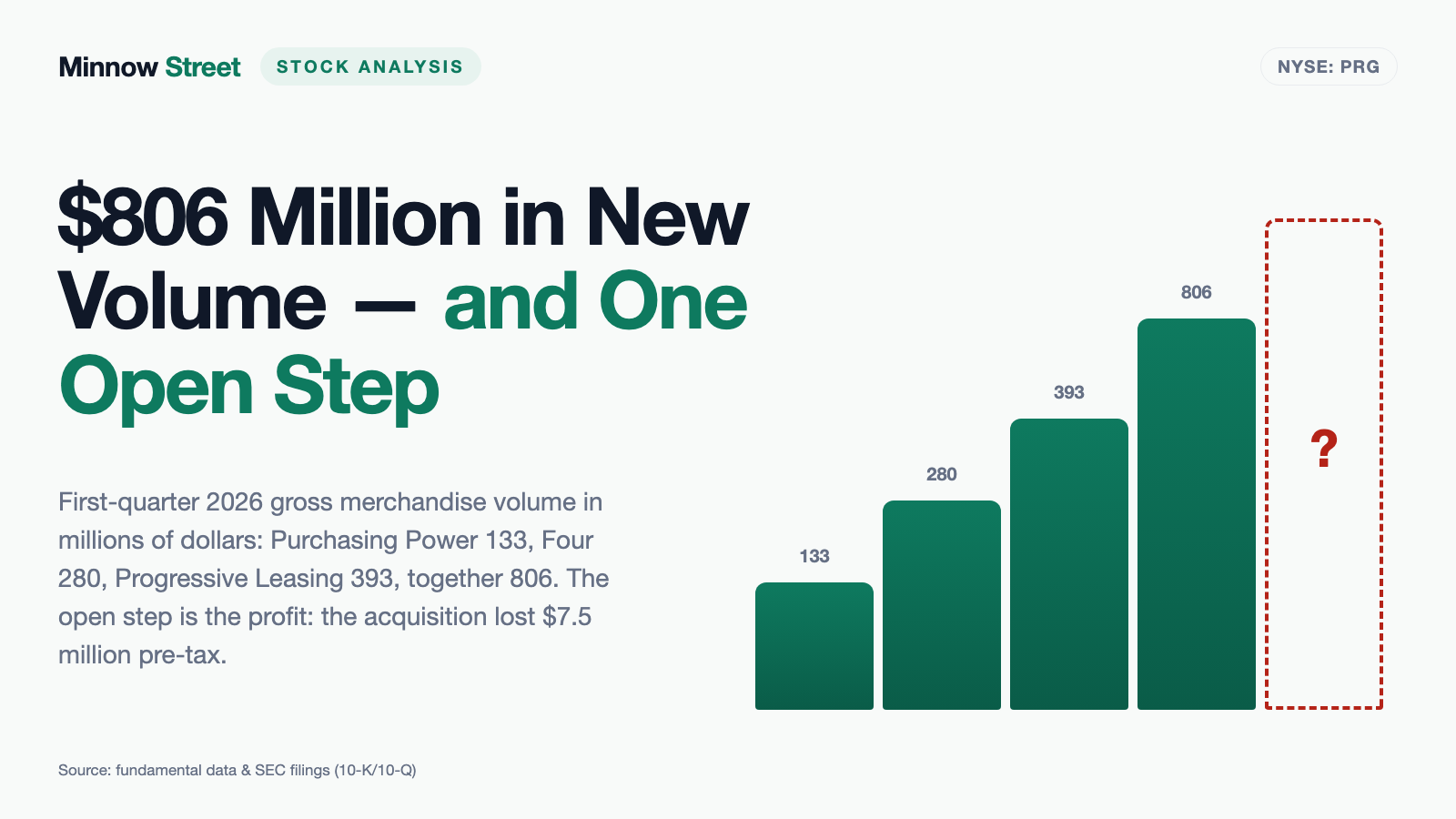
PROG Holdings Stock: An Earnings Beat of 122 Percent — and a $424 Million Acquisition That Lost Money in Its First Quarter
PROG Holdings leases sofas, phones and jewelry to shoppers who cannot get credit — and it now appears in two of our rankings (as of July 25, 2026) because the first quarter of 2026 beat the consensus by 122 percent. We read the annual report (10-K) for 2025, the quarterly report as of March 31, 2026, and four current reports: $2.4 billion in revenue, a price-earnings ratio around 11 — but also a shrinking core business, a segment bought for $424 million that lost $7.5 million before tax in its first quarter, and a leverage cap that had to be raised. This analysis does the math on what a beat is worth once you own the company behind it.
 Thomas Mücke
Founder & Publisher
Thomas Mücke
Founder & Publisher
Chart
Interactive price chart (TradingView).
Note: pure fact-based analysis, not investment advice and not a solicitation to buy or sell. All figures without guarantee.
There is one number that points upward before you have thought about it: "earnings beat expectations by 122 percent." It sounds like a verdict on the company, but it is first of all a verdict on the estimate. Call it the surprise trap: the lower the bar, the more spectacular the jump looks. PROG Holdings, Inc. (NYSE: PRG) appears in two of our rankings today because the first quarter of 2026 produced exactly that kind of jump: $0.89 in diluted earnings per share against a $0.40 consensus (data as of July 25, 2026). Before the reflex takes over, let us make a deal: we read what the filings actually say — the annual report (10-K) for 2025, the quarterly report (10-Q) as of March 31, 2026, and four current reports (8-K) filed between December 2025 and May 2026. The reason for the jump is in there. So is the price: an acquisition for $424.2 million that lost $7.5 million before tax in its first quarter.

What PROG Holdings actually does — installments for shoppers without a credit card
PROG Holdings is based in Draper, Utah, incorporated in Georgia, and employed 1,235 people as of December 31, 2025 (1,151 at Progressive Leasing, 15 at Four, 69 in other functions). The company is what remained of Aaron's: in October 2020 the group was split, the furniture retail business went its own way, and the holding company carried the name "Aaron's Holdings Company, Inc." until November 23, 2020. What is left is a financial technology holding company with three building blocks.
Progressive Leasing is the core and accounted for roughly 96 percent of consolidated revenue in 2025. The model in plain language: you are standing in a furniture store in front of a $1,200 sofa and your credit score will not support a financing offer. Progressive buys the sofa from the retailer and leases it to you — weekly, biweekly, semi-monthly or monthly payments over a term of up to twelve months. Pay it through and you own it. Change your mind and you return it without penalty. The offer runs through roughly 24,000 point-of-sale partner locations and e-commerce sites in 45 states, the District of Columbia and Puerto Rico; Progressive operates no stores of its own. The merchandise mix in 2025: furniture, appliances and electronics 58 percent of segment revenue, mobile phones and accessories 16 percent, jewelry 15 percent.
Four is the second leg: a buy now, pay later app that splits a purchase into four interest-free installments over roughly six weeks. Tickets are far smaller than in leasing, but customers transact more often. For the pure-play comparison, see our analysis of Sezzle. Alongside sits MoneyApp, an interest-free cash advance app still too small to be a reportable segment.
Purchasing Power, part of the group since January 2, 2026, is the new third block — and it works differently: employers offer their staff a voluntary benefit program through which they buy brand-name products and services and repay via payroll deduction in six, twelve or eighteen installments, with no credit check. More than 360 employer partners are connected.
Which names the central tension of this analysis, and it runs through every chapter: the large, profitable core is shrinking — and the expensive replacement does not earn money yet, it costs interest.
Where the stock landed on our desk
PRG sits in two rankings of our in-house stock scanner, both with data as of July 25, 2026: at rank 32 of 81 in the Big Earnings Surprise scanner (U.S. selection) and at rank 27 of 28 in the Richard Moglen 1-Week Top Performers scanner. The relative strength rating is 76 out of 100 in both lists. These lists are recomputed daily — today's placements are a snapshot, not a permanent state.
To reproduce it: both rankings are open at Scanner; the country filter switches to the U.S. selection, and sorting runs on the relative strength rating.
What the entries mean, translated and assessed:
- Earnings surprise of 122.5 percent. On April 29, 2026 the company reported $0.89 in diluted earnings per share against a $0.40 estimate. The record, however, shows this was the fifth consecutive quarter above expectations (up 8.4, 27.5, 21.6, 23.3 and 122.5 percent). Estimating too low five times in a row does not reveal a company; it reveals a model with a tilt. Assessed soberly: this is evidence of underestimation, not of growth — earnings per share rose from $0.83 to $0.89, or 7 percent.
- Relative strength of 76. On a scale to 100 that means better than three-quarters of the market, but well below true momentum leaders at 90 and above. Solid, not spectacular.
- Rank 27 of 28 in the weekly list. An honest signal: in the short-term ranking PRG sits at the very bottom of the field. The stock followed the move, it did not lead it.
One thing matters for context. The first-quarter earnings jump has a visible technical component: the result includes, for the first time, a $6.5 million gain on the sale of charged-off lease receivables and a $5.7 million gain on the change in fair value of acquired receivables — together $12.2 million against $47.6 million of pre-tax earnings.
The numbers over the years — what genuinely impresses
Start with what is good, because there is plenty. PROG Holdings is not a loss-making business hunting for a model; it has earned hundreds of millions for years.
Consolidated revenue from continuing operations was $2,339.4 million in 2023, $2,399.1 million in 2024 and $2,409.2 million in 2025 — a flat but stable line. Pre-tax earnings from continuing operations rose to $174.5 million in 2025 from $163.4 million a year earlier. Total diluted earnings per share came to $3.59 in 2025 ($4.53 in 2024, $2.98 in 2023). The 2024 spike has a reason worth knowing: the tax line that year carried a benefit of $33.9 million rather than an expense; in 2025 it was a $50.2 million expense. The decline from 2024 to 2025 is therefore largely a tax effect, not an operating collapse.
Cash generation impresses: operating cash flow jumped to $335.0 million in 2025 from $138.5 million in 2024 and $204.2 million in 2023. The main driver is ambiguous, though — less new business means less cash spent buying lease merchandise. A $153.9 million reduction in merchandise purchases is the single largest item behind that jump.
And then there is Four. The small segment is clearly the best thing in these accounts:
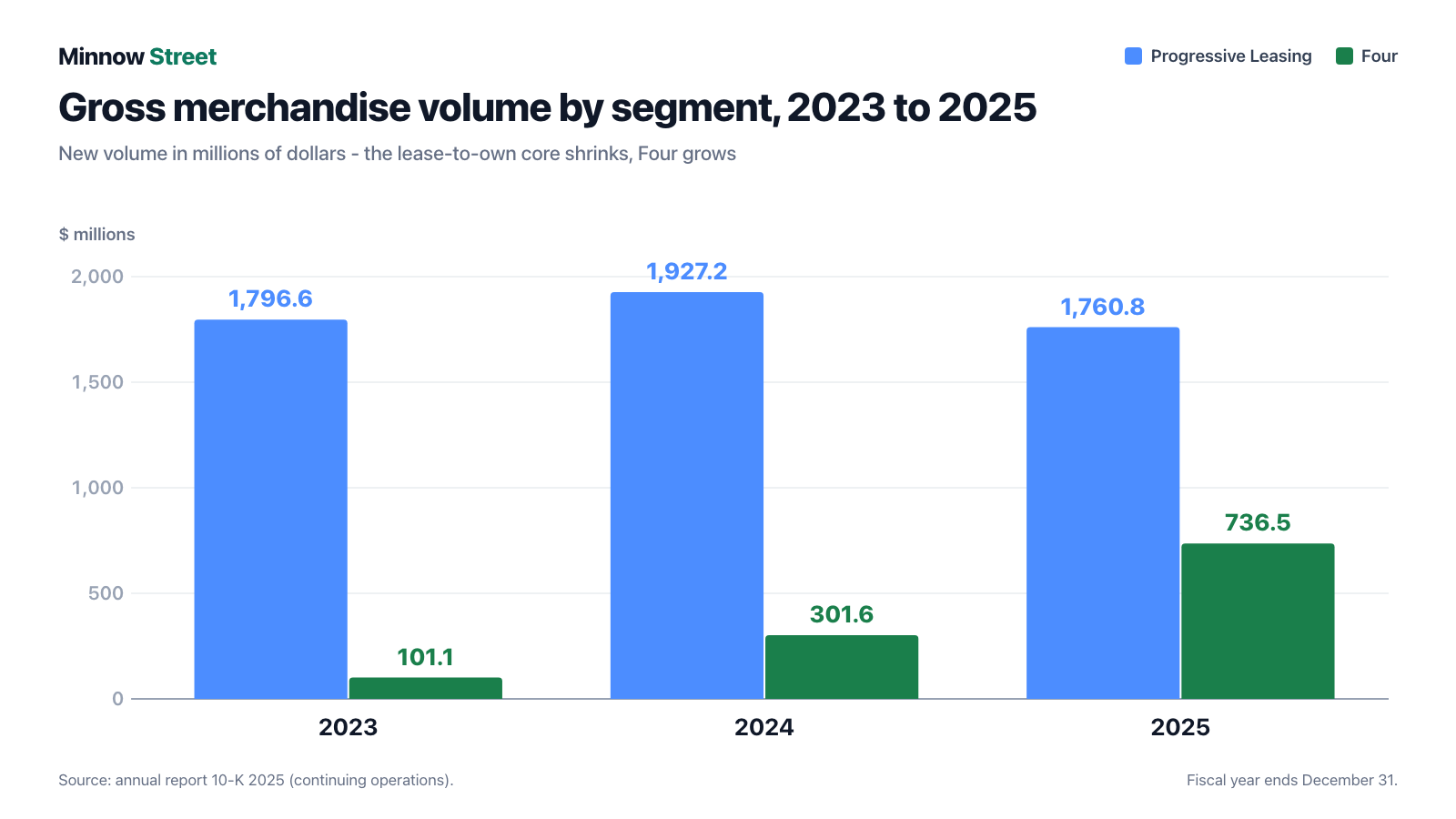
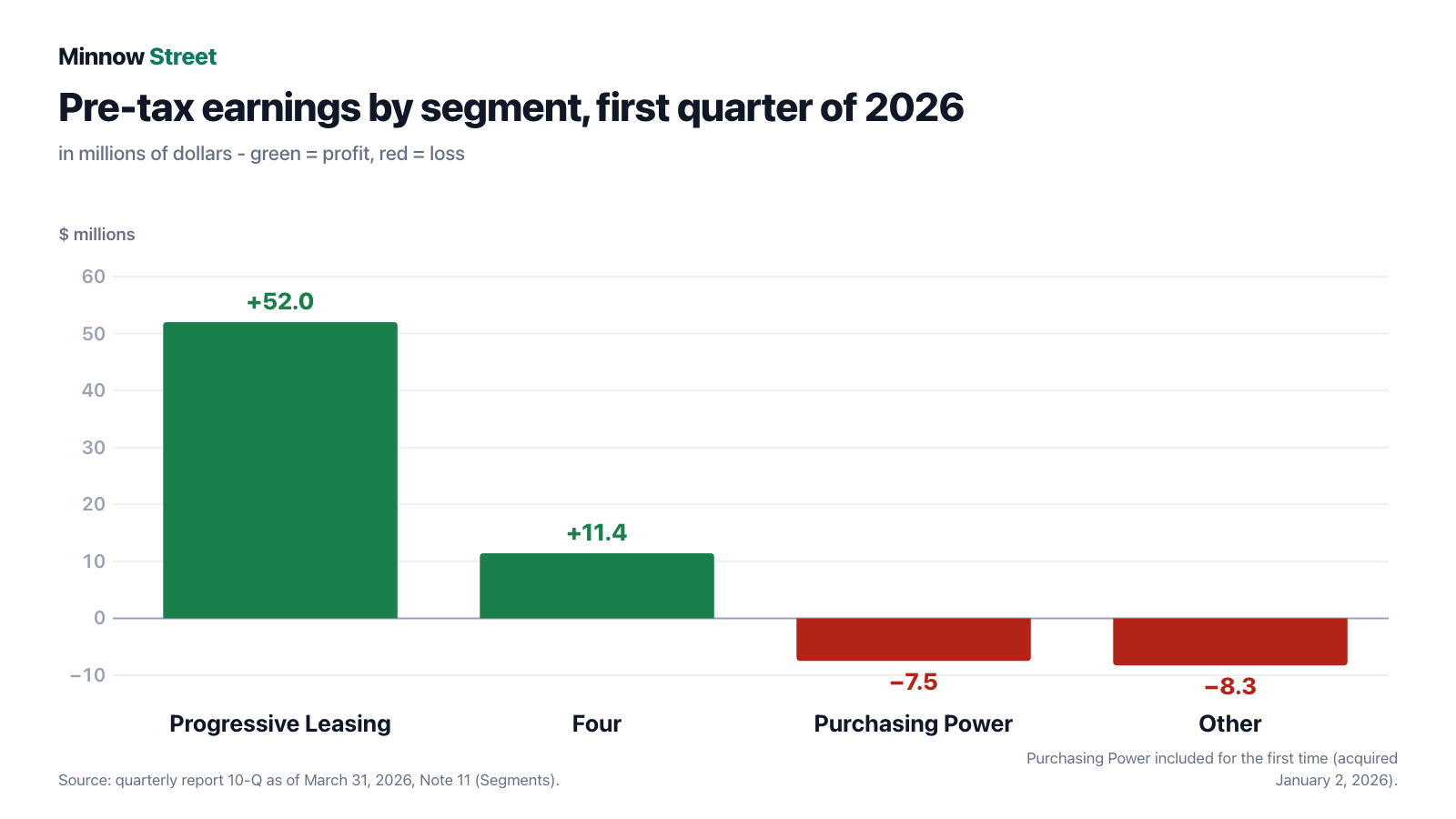
Gross merchandise volume — the value of newly written business — rose at Four from $101.1 million (2023) through $301.6 million (2024) to $736.5 million (2025); the first quarter of 2026 added $280.0 million, up 133.6 percent year over year. Four's active customer count climbed from 157,000 at the end of 2024 to 486,000 at the end of 2025. And Four already earns money: $11.4 million in pre-tax earnings in the first quarter of 2026 on $35.0 million of revenue.
The short version: the smallest segment is the healthiest one.
What the filings say — the uncomfortable truths
Uncomfortable truth No. 1: the core is shrinking on every metric
Progressive Leasing carries 96 percent of revenue — and it is contracting. New volume fell 8.6 percent in 2025 to $1,760.8 million. Active customers dropped from 934,000 at the end of 2024 to 838,000 at the end of 2025 and further to 763,000 by March 31, 2026 — down 18 percent in fifteen months. Segment revenue in the first quarter of 2026 was $596.9 million against $651.6 million a year earlier, a shortfall of $54.7 million.
The filings name three causes: the bankruptcy of Big Lots in late 2024, which closed most of its stores during 2025; the bankruptcy of furniture retailer American Signature in November 2025, which will close many stores in 2026; and a self-imposed tightening of lease decisioning in early 2025. The third is the most interesting because it was voluntary: the company traded volume for portfolio quality.
There is a concentration risk on top: two individual retail partners each generated more than 10 percent of consolidated revenue in 2025. Which ones is not disclosed.
Uncomfortable truth No. 2: the $424 million acquisition lost money in its first quarter
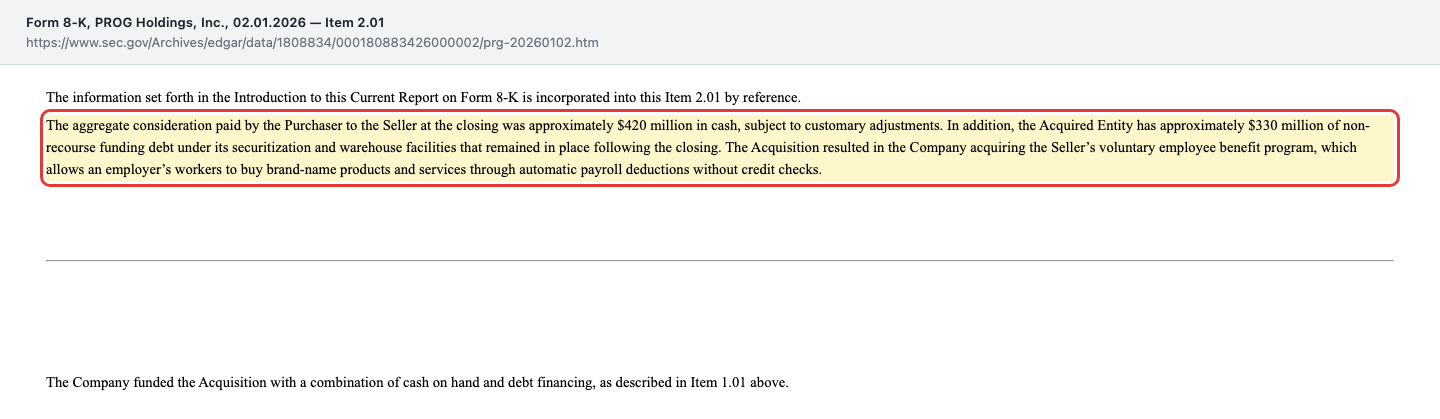
PROG signed the purchase agreement on December 1, 2025 and closed on January 2, 2026. The wording of the current report:
"The aggregate consideration paid by the Purchaser to the Seller at the closing was approximately $420 million in cash, subject to customary adjustments. In addition, the Acquired Entity has approximately $330 million of non-recourse funding debt under its securitization and warehouse facilities that remained in place following the closing."
— PROG Holdings, Form 8-K filed with the U.S. securities regulator, the SEC, dated January 2, 2026, Item 2.01
The quarterly report turns that into an exact bill: $424.2 million of total consideration, of which $216.2 million went to the seller, $199.3 million repaid the seller's debt, $6.7 million covered the seller's transaction costs and $2.0 million went into escrow. Of the assets acquired, $319.0 million sits in intangibles (client relationships $258.0 million, broker relationships $24.0 million, trade name $29.0 million, developed technology $8.0 million) and $110.7 million in goodwill. There was no dilution: the deal was paid in cash and debt.
What did it deliver in the first quarter? The notes say it plainly: $107.1 million in revenue and a $7.5 million loss. On top came $9.7 million of acquisition-related costs in the quarter (plus $2.2 million already in 2025) and $8.1 million of amortization on the acquired assets in this quarter alone.
Uncomfortable truth No. 3: the installments ride on federal paychecks
Purchasing Power collects its installments straight from the paycheck — the strength of the model and its fault line at once. The quarterly report names as the primary credit quality indicator whether the debtor works for the federal government, because federal employees may end the deduction under applicable law. Then the report gets specific:
"While customer payment delinquencies and write-offs for Purchasing Power are generally lower than those of Progressive Leasing due to Purchasing Power's payroll deduction and allotment repayment model, the recent federal government workforce disruptions, including DOGE workforce reductions and multiple government shutdowns, have resulted in elevated delinquencies and write-offs with Purchasing Power's current and former federal government employee-customers."
— PROG Holdings, Form 10-Q as of March 31, 2026, Item 2 (MD&A)

In numbers: the segment's provision for credit losses was $12.96 million in the first quarter of 2026 — more than half of the group's total $24.2 million. The segment's receivable book stood at $387.6 million as of March 31, 2026, of which $203.0 million is carried at fair value. For those fair-value receivables no allowance for credit losses is recorded; deterioration flows through fair value changes rather than a visible provision line. That makes the trend harder to read, not less dangerous.
Uncomfortable truth No. 4: the leverage cap had to be raised
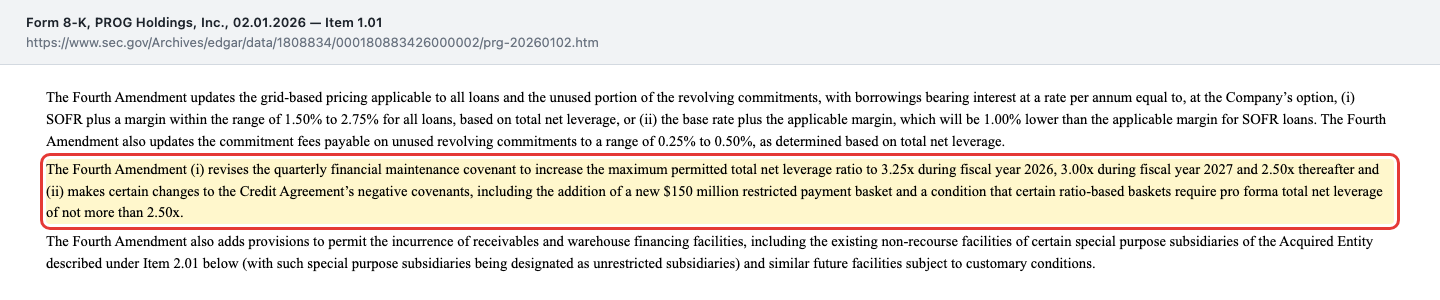
Before the deal, net debt could not exceed 2.5 times earnings before interest, taxes, depreciation and amortization — a credit agreement covenant whose breach lets the banks accelerate the loans. On closing day that line was moved:
"The Fourth Amendment (i) revises the quarterly financial maintenance covenant to increase the maximum permitted total net leverage ratio to 3.25x during fiscal year 2026, 3.00x during fiscal year 2027 and 2.50x thereafter."
— PROG Holdings, Form 8-K dated January 2, 2026, Item 1.01
The balance sheet shows what the new headroom was for. Gross debt rose from $600.0 million (December 31, 2025) to $943.7 million (March 31, 2026), while cash fell from $308.8 million to $69.4 million. The stack includes the older $600 million of 6.00 percent senior unsecured notes due November 15, 2029, a new term loan and, for the first time, $291.4 million of asset-backed notes from the acquisition — among them a February 2026 securitization of $220 million with coupons from 4.37 to 7.54 percent by class.
To be fair, the company is paying down visibly. Of the $125 million term loan, $75 million was voluntarily prepaid in the first quarter, and the $135 million drawn on the revolver was back at zero by March 31, 2026. Interest expense rose anyway: $18.4 million in the first quarter of 2026 against $10.0 million a year earlier.
Uncomfortable truth No. 5: losses are priced in — and the rules can change
A lease-to-own provider serving credit-challenged customers lives by budgeting for losses. PROG does so openly:
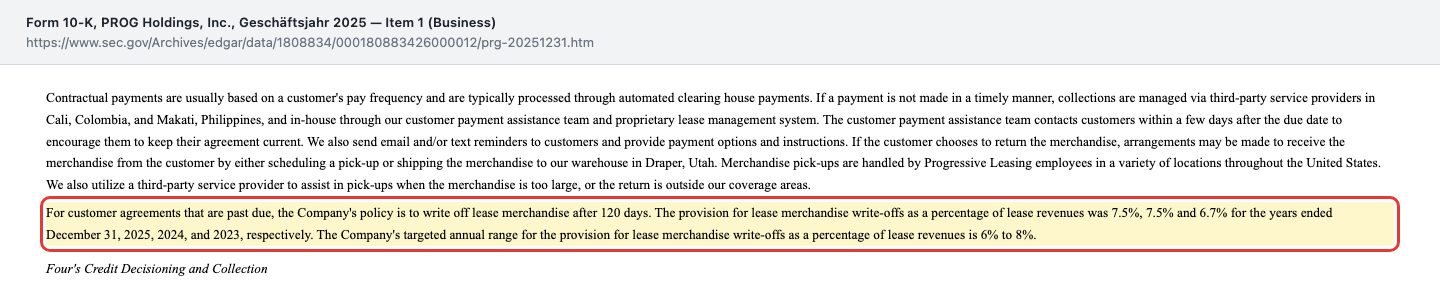
The write-off provision came to 6.7 percent of lease revenues in 2023 and 7.5 percent in both 2024 and 2025 — in the upper third of the company's own 6 to 8 percent target range. The first quarter of 2026 ran at 7.3 percent. In absolute terms: $173.1 million of merchandise written off in 2025 alone.
Then there is the regulatory overhang that never leaves this business model. In April 2020 Progressive Leasing paid $175 million to the Federal Trade Commission to settle allegations about advertising and marketing practices, without admitting any violation. In the third quarter of 2024 the same agency requested documents evidencing compliance. The Pennsylvania attorney general sued in 2022 over disclosures on merchandise hang tags; the case settled in January 2024. Nearly every state regulates lease-to-own separately, and the stricter statutes cap what a provider may charge above the retail price. For Four, seven state attorneys general opened a coordinated inquiry into the buy now, pay later industry in December 2025 — Four itself was not among the companies contacted. How tight that frame can become for comparable lenders is visible in our analysis of World Acceptance.
One more echo: the 2023 data breach at Progressive Leasing, which exposed Social Security numbers among other data, ended in a court-approved settlement of $3.3 million on February 6, 2026 — paid in full by the company's cyber insurance.
What the stock costs — valuation in orders of magnitude
As of July 24, 2026 the market capitalization stood at roughly $1.75 billion. The cross-check holds: 40,065,564 shares (10-Q cover page, April 24, 2026) times a closing price of $43.71 produces exactly that figure.
The resulting orders of magnitude: a price-earnings ratio around 11, a price-sales ratio around 0.7 and a price-book ratio around 2.3 on book value of $19.33 per share. Translated: the market pays about eleven dollars for a dollar of annual profit — well below the average U.S. listing. That is the usual discount for a business whose customers feel price increases first.
What the professionals say: seven analyst votes produce an average price target of $51.43 and a rating of 4.29 on a five-point scale. Generous — and, at seven votes, a thin base. Quality measures from the fundamental data (as of July 25, 2026): a Piotroski score of 6 out of 9 — okay, not good; a genuinely healthy company sits at 8 or 9. The Altman Z-score of 5.32 is comfortably above the critical threshold, the equity ratio is 46 percent and debt to equity 0.80. The stock swings more than the market (beta of 1.78) and traded between $25.57 and $47.73 over the trailing twelve months.
The dividend is $0.14 per share per quarter (most recently declared February 25, 2026), roughly $5.6 million a quarter and a yield in the order of 1.3 percent at the stated data cut-off.
Opportunities and risks at a glance
Opportunities
- Four is growing at triple-digit rates and already earns money: $736.5 million of new volume in 2025, up 144.2 percent, and $11.4 million of pre-tax earnings in the first quarter of 2026.
- The acquisition brings a distribution channel PROG did not have: more than 360 employer partners and a benefit-broker network, plus 263,000 active customers as of March 31, 2026 to cross-sell into.
- Valuation with a margin: price-earnings around 11, price-sales around 0.7, equity ratio of 46 percent, Altman Z of 5.32 (as of July 25, 2026).
- The online share of the core is rising: 25.7 percent of new volume in the first quarter of 2026 against 16.8 percent a year earlier — a channel that does not depend on store closures.
- Visible deleveraging discipline: a $75 million voluntary prepayment in the first quarter of 2026 and a revolver back at zero.
Risks
- 96 percent of revenue comes from one segment whose volume, revenue and customer count are all falling at once.
- Two retail partners each account for more than 10 percent of consolidated revenue, and two other partners have gone bankrupt since late 2024.
- The acquisition is still loss-making (minus $7.5 million before tax in the first quarter of 2026) and depends on payroll deductions that federal employees may end unilaterally.
- Gross debt of $943.7 million against $69.4 million of cash (March 31, 2026), interest expense nearly doubled, and a leverage cap lifted from 2.50x to 3.25x specifically for this deal.
- Permanent regulatory exposure: a $175 million FTC settlement (2020), a renewed document request (2024), a state attorney general suit (2022, settled 2024) and an industry inquiry into buy now, pay later since December 2025.
- The customer base is structurally the most vulnerable: the filings cite elevated living and fuel costs as the reason for weaker demand and weaker payment performance.
A human bottom line
Back to the surprise trap. The 122 percent that carried PRG into our ranking are correctly calculated — and they still do not tell this company's story. The story sits three clicks deeper, in the segment table of the quarterly report: the core still earns good money but gets smaller every quarter. The replacement has been bought, paid for dearly, and is losing money so far. In between sits a balance sheet stretched by $344 million of additional debt, with a leverage cap that had to be raised.
That is not a disaster. It is not a growth story either. It is a rebuild while the shop stays open — and rebuilds have the property that you see the result only afterward while the bill arrives immediately. Buying PRG means betting that Purchasing Power turns its start-up loss into profit before Progressive Leasing shrinks further. Not buying means passing on a company that, at a price-earnings ratio around 11 and a 46 percent equity ratio, prices in little imagination and little fear at the same time.
What you make of that is your decision. And that is exactly as it should be.
Sources
- Form 10-K for fiscal year 2025 (filed February 18, 2026) — business model, segments, employees, write-off rates, regulation, balance sheet, cash flow, repurchase program
- Form 10-Q as of March 31, 2026 (filed April 29, 2026) — segment tables, purchase price allocation, indebtedness, receivables, share count on the cover page
- Form 8-K dated December 2, 2025 — unit purchase agreement for Purchasing Power
- Form 8-K dated January 2, 2026 — closing of the acquisition, credit agreement amendment, leverage cap
- Form 8-K dated February 27, 2026 — quarterly dividend of $0.14 per share
- Form 8-K dated May 7, 2026 — annual meeting, chairman role, special award to the chief executive
- Form 10-K for fiscal year 2024 (filed February 19, 2025) — comparative gross merchandise volume
- Fundamental data & SEC filings (annual and quarterly reports, 10-K/10-Q), data as of July 25, 2026 — valuation metrics, earnings surprises, analyst votes, scanner rankings
This analysis is journalistic commentary on publicly available filings. It is not investment advice, not a buy or sell recommendation and not a solicitation to buy or sell securities. Share prices can move sharply and a total loss is possible. Every figure carries the cut-off date of its source and may have changed since. The author holds no position in PROG Holdings, Inc. at the time of publication.
Our Bottom Line at a Glance
- Earnings power and valuation positive
- $174.5 million of pre-tax earnings from continuing operations in 2025 and $335.0 million of operating cash flow against a market capitalization of roughly $1.75 billion — a price-earnings ratio around 11, price-sales around 0.7 and an equity ratio of 46 percent (10-K 2025; data as of July 24 and 25, 2026).
- Growth at Four positive
- New volume of $101.1 million, $301.6 million and $736.5 million from 2023 to 2025, plus $280.0 million in the first quarter of 2026, up 133.6 percent; 486,000 active customers as of December 31, 2025; the segment already earns $11.4 million before tax (10-K 2025; 10-Q as of March 31, 2026).
- Progressive Leasing core negative
- 96 percent of revenue is shrinking in volume, revenue and customer count at once: new volume down 8.6 percent to $1,760.8 million in 2025, active customers from 934,000 to 838,000 to 763,000 between December 31, 2024 and March 31, 2026; two retail partners each account for more than 10 percent of consolidated revenue (10-K 2025; 10-Q as of March 31, 2026).
- Purchasing Power acquisition negative
- $424.2 million in cash for a business that produced a $7.5 million pre-tax loss on $107.1 million of revenue in the first quarter of 2026 — weighed down by $9.7 million of transaction costs, $8.1 million of amortization on acquired assets and a $12.96 million provision for credit losses (10-Q as of March 31, 2026, Notes 2 and 11).
- Debt and covenants negative
- Gross debt rose from $600.0 million to $943.7 million and cash fell from $308.8 million to $69.4 million between December 31, 2025 and March 31, 2026; the credit agreement leverage cap was lifted from 2.50x to 3.25x for 2026 on January 2, 2026; interest expense was $18.4 million against $10.0 million a year earlier (8-K dated January 2, 2026; 10-Q as of March 31, 2026, Note 7).
- Regulation and customer quality neutral
- A write-off provision of 7.5 percent of lease revenues in 2025 sits in the upper third of the company's own 6 to 8 percent target range; permanent oversight by the FTC ($175 million settlement in 2020, renewed document request in 2024), by the states, and since December 2025 by seven attorneys general examining buy now, pay later (10-K 2025, Items 1 and 1A).
PROG Holdings is not a momentum name in the usual sense but a solidly profitable lease-to-own business in the middle of a rebuild: the Progressive Leasing core carries 96 percent of revenue and is shrinking on every metric, while the buy now, pay later unit Four grows at triple-digit rates and Purchasing Power, bought for $424.2 million, still produced a $7.5 million pre-tax loss in the first quarter of 2026. The deal was paid for not in shares but in debt — gross debt climbed to $943.7 million and the leverage cap had to be raised. Buying here is not buying the 122 percent earnings surprise; it is betting that the acquisition turns its start-up loss faster than the core shrinks. Not investment advice.
What Our Rating Means
Open questions
The business works in principle, but one material question is open. As long as it stays open, our findings do not carry a quality verdict.
The valuation is undemanding and the business earns money — but the decisive number is still outstanding. Whoever waits checks four lines in the next quarterly report (10-Q): the pre-tax result of the Purchasing Power segment (last: minus $7.5 million), its provision for credit losses ($12.96 million), Progressive Leasing new volume (last: $393.0 million for the quarter) and gross debt ($943.7 million). If the first two turn positive, the acquisition was well timed; if the third keeps falling, you are buying rebuild risk at book value. A 122 percent beat measures the estimate, not the company. The decision is yours.
A journalistic assessment by our editorial team at the time of the deep dive, based on public sources — not investment advice and not a solicitation to buy or sell. Your personal circumstances (investment goals, risk capacity, taxes) cannot be taken into account. What our levels mean, how verdicts are formed, and what conflicts of interest exist →
Worth Noting
- PRG made the research list twice over: rank 32 of 81 in our in-house Big Earnings Surprise scanner and rank 27 of 28 in the Richard Moglen 1-Week Top Performers scanner (U.S. selection, both as of July 25, 2026, relative strength 76). Both rankings are recomputed daily.
- Valuation and scanner metrics use data as of July 24 and 25, 2026; balance sheet and segment figures come from the quarterly report as of March 31, 2026 and the 2025 annual report. The market capitalization was cross-checked: 40,065,564 shares (10-Q cover page, April 24, 2026) times the July 24, 2026 closing price of $43.71.
- Do not confuse the names: PROG Holdings is not the furniture retailer Aaron's (NYSE: AAN), from which the holding company separated in October 2020, and not the biotechnology name Precigen (Nasdaq: PGEN). The ticker PRG trades on the New York Stock Exchange.
- Vive Financial, a separate segment until October 20, 2025, was sold and is reported as a discontinued operation; every revenue and earnings series in this analysis therefore refers to continuing operations.
Frequently Asked Questions
PROG Holdings, Inc. (NYSE: PRG, Draper, Utah, 1,235 employees as of December 31, 2025) runs three businesses. Progressive Leasing leases furniture, appliances, phones and jewelry with a purchase option to credit-challenged customers — about 96 percent of 2025 consolidated revenue of $2.409 billion. Four offers payment in four interest-free installments, and Purchasing Power sells through employers via payroll deduction.
Because the first quarter of 2026 came in far above expectations: $0.89 in diluted earnings per share against a $0.40 consensus, a surprise of 122.5 percent. PRG therefore sits at rank 32 of 81 in the Big Earnings Surprise scanner and rank 27 of 28 in the Richard Moglen 1-Week Top Performers scanner (U.S. selection, both as of July 25, 2026, relative strength 76). Both lists are recomputed daily.
On January 2, 2026, PROG acquired Purchasing Power for $424.2 million in cash; a further $338.6 million of non-recourse funding debt remained in place. Purchasing Power lets employees of more than 360 employers buy brand-name goods and repay through payroll deduction over six to eighteen installments. Of the assets acquired, $319.0 million sits in intangibles and $110.7 million in goodwill.
Not in the first quarter of 2026. The notes to the quarterly report show $107.1 million of segment revenue and a $7.5 million pre-tax loss. The drag came from $9.7 million of acquisition-related costs, $8.1 million of amortization on acquired assets and a $12.96 million provision for credit losses, which the report attributes to federal workforce reductions and government shutdowns.
Gross debt rose from $600.0 million on December 31, 2025 to $943.7 million on March 31, 2026, while cash fell from $308.8 million to $69.4 million. The core is $600 million of 6.00 percent senior unsecured notes due November 15, 2029, plus a term loan and $291.4 million of asset-backed notes. Since January 2, 2026 the credit agreement permits net leverage of 3.25 times instead of 2.50 times.
Yes. New volume fell 8.6 percent in 2025 to $1,760.8 million, active customers dropped from 934,000 at the end of 2024 to 838,000 at the end of 2025 and to 763,000 by March 31, 2026. The causes are the bankruptcies of retail partners Big Lots in late 2024 and American Signature in November 2025, plus a deliberate tightening of lease decisioning in early 2025.
The quarterly dividend is $0.14 per share, most recently declared on February 25, 2026, or $5.6 million in the first quarter of 2026. No shares were repurchased in either the fourth quarter of 2025 or the first quarter of 2026; of the $500 million authorization renewed on February 21, 2024, $309.6 million remained open as of March 31, 2026. It expires on February 21, 2027.
Progressive Leasing paid a $175 million settlement to the Federal Trade Commission in April 2020, and the agency requested compliance documents again in 2024. The Pennsylvania attorney general sued in 2022 and the case settled in January 2024. Nearly every state regulates lease-to-own separately, and since December 2025 seven state attorneys general have been examining the buy now, pay later industry.
Found an error?
Did you spot a factual error, an outdated number, or a typo in this deep dive? Let us know briefly — your report goes straight to the editorial team.