Sezzle Stock: No. 1 in Our Quality Scanner — and 77 Percent of Revenue Is Paid by Its Own Customers
Sezzle (Nasdaq: SEZL), the "buy now, pay later" provider from Minneapolis, sits at no. 1 in our Terry Smith quality scanner (U.S. selection, as of July 18, 2026): revenue up 66 percent, a 39 percent operating margin, return on equity beyond 90. We read the annual reports (10-K) and the latest quarterly report (10-Q) — and found out who pays for those dream numbers: only 23 percent of revenue comes from merchants, the rest mostly from the consumers themselves, the loans come from a single bank partner, and consumer underwriting was deliberately loosened. Not investment advice — just a close look at whose money a dream margin is made of.
 Thomas Mücke
Founder & Publisher
Thomas Mücke
Founder & Publisher
Chart
Interactive price chart (TradingView).
Note: pure fact-based analysis, not investment advice and not a solicitation to buy or sell. All figures without guarantee.
There is an investor trap that works better the prettier the numbers are: the halo effect. It goes like this: one radiant feature — a seal of quality, a ranking, a mission — casts its glow over everything else, and we stop asking what sits underneath. Hardly any stock wears as many halos at once in the summer of 2026 as Sezzle Inc. (Nasdaq: SEZL): no. 1 in our Terry Smith quality scanner (U.S. selection, as of July 18, 2026), a return on equity beyond 90 percent, and a corporate charter as a purpose-driven public benefit corporation with the declared mission to financially empower the next generation. Quality, returns and good intentions — what more could you want? So let's make a deal: before the halo outshines your questions, we read together what Sezzle itself reported, under penalty of law, to the U.S. securities regulator, the SEC — the annual report (10-K) for fiscal year 2025 and the latest quarterly report (10-Q) as of March 31, 2026. And these filings answer, very precisely, a question the scanner never asks: who actually pays for this dream margin? In the end, you decide for yourself.
What Sezzle actually does — a digital tab at the corner store
Sezzle runs a "buy now, pay later" (BNPL) platform — at its core, the digital version of running a tab at the corner store. The flagship product is called "pay-in-four": shoppers pay a quarter of the purchase price up front and the rest in three more installments every two weeks, over six weeks in total — free of interest and fees, or not, depending on the configuration. On top come two paid subscriptions (Sezzle Premium for large, non-integrated merchants; Sezzle Anywhere with a virtual card usable almost everywhere), on-demand payments without a subscription, and referral services for longer-term installment loans from external lenders. One thing is essential to understand: Sezzle does not originate the short-term consumer loans in the United States itself — a "substantial majority" comes from its bank partner WebBank, an FDIC-insured industrial bank chartered in Utah; Sezzle then purchases the receivables and carries the credit risk. Remember this construction, it matters later: Sezzle is the store, but the banking license hangs on the neighbor's house.
The company itself is a curiosity of stock market history: incorporated in Delaware on January 4, 2016, headquartered in Minneapolis, platform launched in 2017 — yet for years this U.S. company was listed only in Australia. Per its SEC filings, Sezzle historically financed itself through capital raises on the Australian Securities Exchange (ASX); only since the 2023 ASX delisting has Nasdaq been the sole trading exchange (listed there since August 17, 2023). With the U.S. securities regulator, Sezzle is an entirely ordinary domestic issuer filing annual reports (10-K) and quarterly reports (10-Q) — we verified the EDGAR identity: no name changes, no withdrawal from reporting duties. Since June 2020, Sezzle has been organized as a Delaware public benefit corporation: a legal form whose board must, by charter, weigh a public benefit alongside stockholders' interests. At the end of 2025 the company employed just 201 people in the United States and Canada. And that brings us to the central tension of this analysis, which runs through every chapter: metrics straight from the quality investor's textbook — but the margin behind them is built mostly on fees paid by its own, often cash-strapped customers, originated over a borrowed banking license and through a deliberately loosened credit filter. How a BNPL business model feels when it takes the opposite route — growth first, profit later — is something we dissected at the much larger competitor Affirm.
Where the stock shows up in our scanner
Every day we run roughly 3,500 stocks through our scanners. Sezzle landed on the research list via the Terry Smith quality scanner — where the stock sits at no. 1 of the U.S. selection (as of July 18, 2026). The filter translates the published criteria of Fundsmith founder Terry Smith ("Buy good companies, don't overpay, do nothing") into five hurdles, and Sezzle clears them all: a return on equity around 92 percent (required: at least 15) — for every $100 of equity, roughly $90 of annual profit —, an operating margin far above the 20 percent hurdle (39.3 percent in fiscal year 2025, 50.9 percent in the first quarter of 2026), a nearly complete conversion of profit into free cash flow, a debt-to-equity ratio of 0.74 (required: at most 1) and interest coverage around 23 (required: at least 10) — operating profit could pay the interest bill 23 times over (scanner data as of July 10, 2026). For perspective: at no. 8 of the same U.S. selection sits the insurer Globe Life — quality by the numbers spans very different business models.
What stands out is the confluence: Sezzle simultaneously appears in 27 more scanners, mostly trend and momentum filters — "Stan Weinstein: stage 2" (price above a rising 200-day line), "RS leader 90," "above 50 & 200 SMA," "institutional accumulation" (12 funds adding, 6 trimming) and "EPS acceleration" (scanner data as of July 10, 2026). Behind that stands a stock price riding a rollercoaster like few others: up 414 percent in the second quarter of 2025 alone, down 56 percent in the third, and well up again since the start of 2026 (data as of July 10, 2026) — with a 6-for-1 stock split effective March 28, 2025, in between. The "professionals' view" is narrower here than usual, by the way: just two analyst firms cover the stock (both with buy ratings, data as of July 10, 2026) — astonishingly little coverage for a multi-billion-dollar company, and a hint at how young this stock market story is. Remember the finding: when one quality filter and a dozen momentum filters praise the same young stock, they are describing the same steep climb — not its cruising altitude five years out.
The numbers over the years — honestly appraised
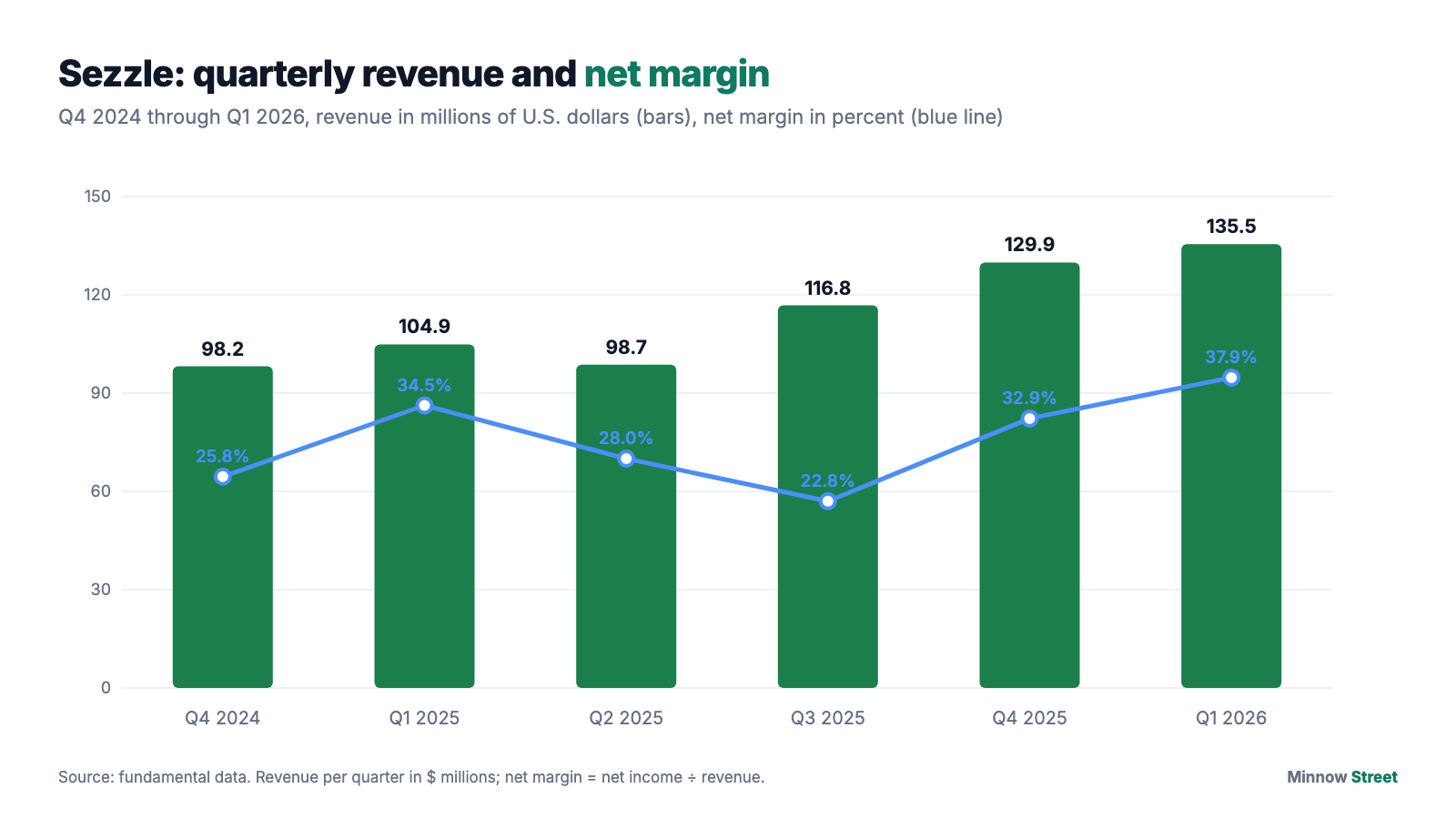
First, what genuinely impresses — and here that is a lot. As recently as fiscal year 2022, Sezzle lost $38.1 million; 2023 brought the first small profit of $7.1 million, 2024 already $78.5 million (helped by a one-time tax benefit of $11.2 million), and fiscal year 2025 then delivered $133.1 million of net income on $450.3 million of revenue — revenue growth of 66.1 percent and a net margin of nearly 30 percent. Gross merchandise volume (GMV — the value of goods flowing across the platform) grew 55.1 percent to $3.94 billion in 2025, active consumers reached 3.05 million, and monthly on-demand users and subscribers rose 29.8 percent to 918,000. And the machine keeps running: in the first quarter of 2026, revenue rose 29.2 percent to $135.5 million and net income to $51.3 million — an operating margin of 50.9 percent in a single quarter. That is, without irony, one of the steepest turnarounds our scanners show this year.
But now the follow-up question the halo outshines: what exactly earns a payments company with 201 employees such margins? A classic BNPL provider tells the story like this: merchants pay us a commission because we bring them more sales — the consumer ideally pays nothing. At Sezzle, that story is now true for less than a quarter of the business. Revenue in 2025 breaks down into transaction income ($234.1 million), subscription revenue ($99.4 million) and income from other sources ($116.8 million) — and inside transaction income, next to $102.2 million from merchants and partners, sit $131.9 million of consumer fees. Which brings us to the uncomfortable truths.
What the filings say — the uncomfortable truths
Uncomfortable truth no. 1: Only 23 percent of revenue comes from merchants — the rest mostly from Sezzle's own customers
The annual report itemizes, soberly, who pays Sezzle — and it is less and less the merchants:
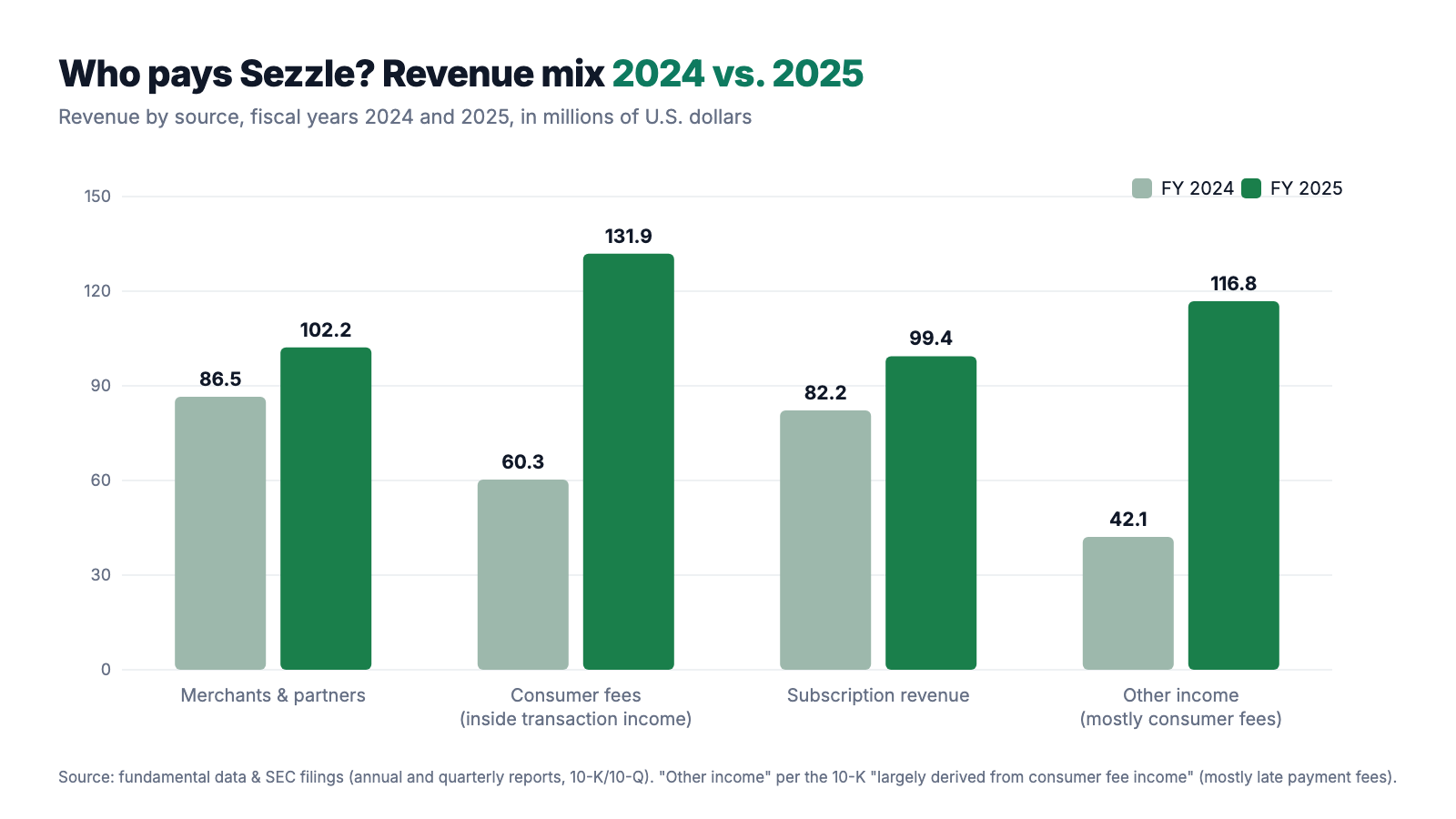
"Transaction income also increased as a result of consumer fees, which totaled $131.9 million and $60.3 million for the years ended December 31, 2025 and 2024, respectively."
— Sezzle Inc., SEC annual report 10-K for fiscal year 2025, Item 7 "Management's Discussion and Analysis"
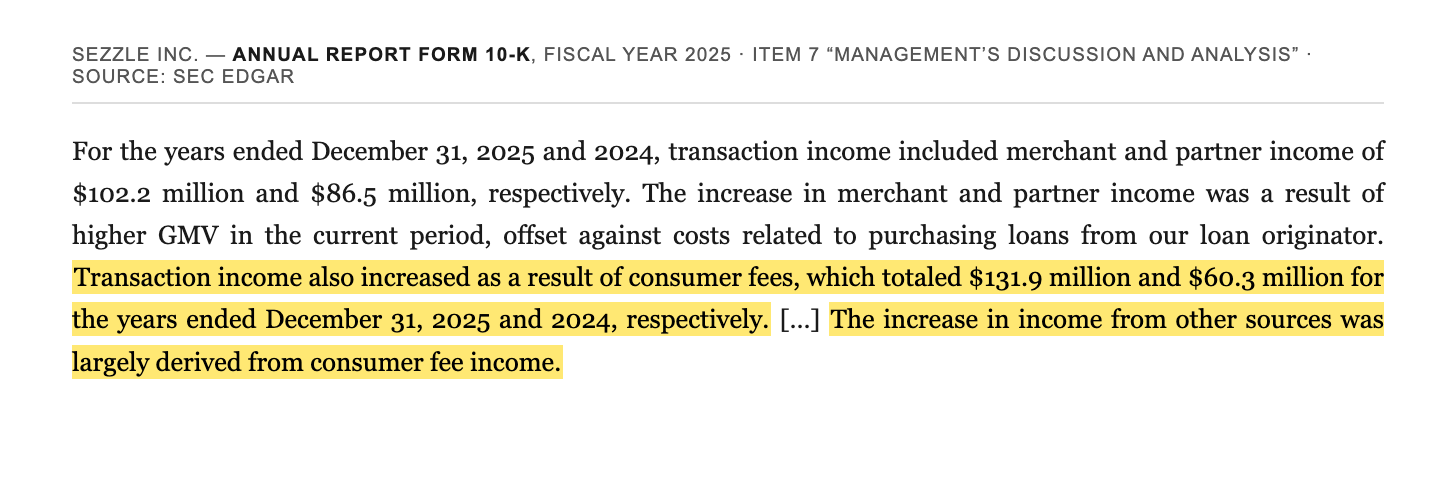
Add up all the revenue streams carried by consumers themselves — consumer fees, paid subscriptions, plus the "income from other sources" that the filing calls "largely derived from consumer fee income," above all late payment fees — and in fiscal year 2025, $348.1 of $450.3 million came directly or predominantly from consumers: 77 percent. A year earlier it was 68 percent. And the trend has a mechanism, as the latest quarterly report shows — it contains a sentence worth reading twice:
"The increase in consumer fees was driven by higher fee prices in the current period, resulting in an increase of approximately $9.0 million, offset against a decrease in the number of fees charged in the current period, resulting in a decrease of approximately $5.5 million."
— Sezzle Inc., SEC quarterly report 10-Q as of March 31, 2026, "Management's Discussion and Analysis"
Translated: the latest fee growth did not come from more fees being charged — it came from the same fees getting more expensive. In fairness: Sezzle discloses hardship and fee-forgiveness programs, requires past-due amounts to be settled before new purchases, and no customer is forced into a subscription. But for the investment decision, the finding stands: the dream margin of this quality hit is paid, to more than three quarters, by consumers — many of whom pay in installments precisely because money is tight. Picture a baker who practically gives away his bread but charges at the register for the tab, for rebooking and for paying late: the revenue looks like bread, but it is baked from fees.
Uncomfortable truth no. 2: The bank does not belong to Sezzle — and it may terminate
The second truth sits in the engine room. Sezzle does not originate its U.S. consumer loans itself but through its bank partner WebBank — a model widespread in U.S. fintech that lets Sezzle offer uniform terms across all states (the "standardization" of consumer fees alone contributed roughly $13.7 million of additional 2025 revenue, per the filing). The price for it is spelled out in the risk factors:
"We rely on WebBank to originate a substantial majority of the loans facilitated by the Sezzle Platform and to comply with various federal and state laws. The agreement with WebBank (the 'WebBank Agreement') is subject to early termination or suspension by WebBank upon certain events."
— Sezzle Inc., SEC annual report 10-K for fiscal year 2025, Item 1A "Risk Factors"
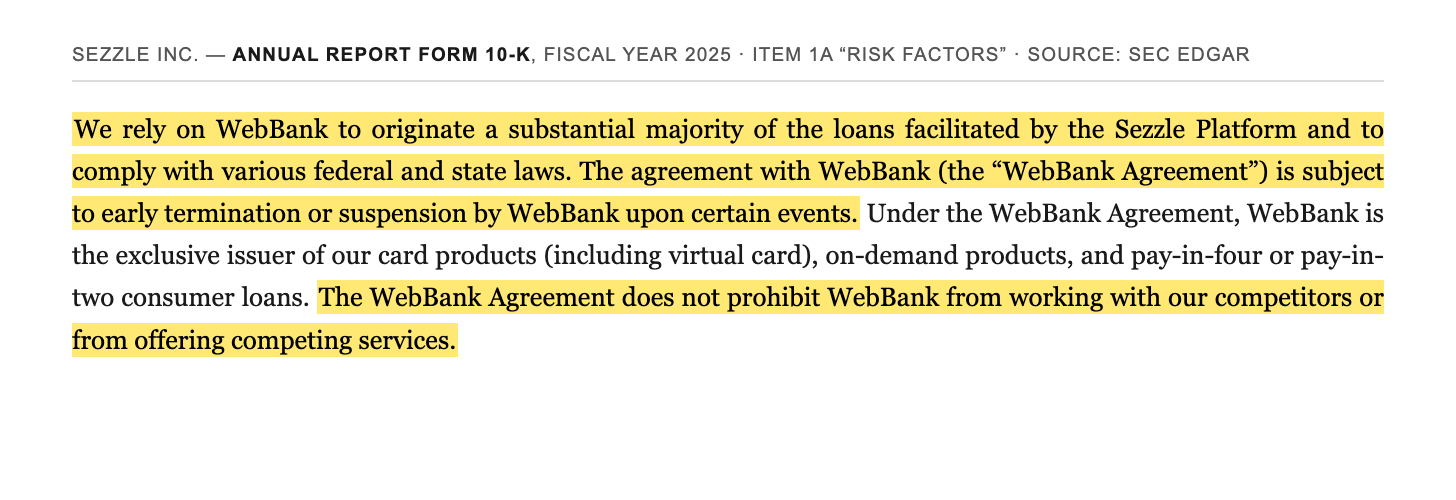
The filing adds two details you should not skim past: under the agreement, WebBank is the exclusive issuer of Sezzle's card products, on-demand products and pay-in-four loans — while, conversely, the agreement does not prohibit WebBank from working with Sezzle's competitors at the same time. And the partnership is young: it has carried the lending business only since September 26, 2024. Customer concentration is a familiar risk — this is a supplier concentration in the business model's most important ingredient: when your entire supply comes through a single gate and the gatekeeper may cancel, you negotiate every contract renewal from the weaker position. On top of that sits the oversight: as a consumer lending platform, Sezzle and its bank partner fall, among others, under the examination and enforcement authority of the U.S. consumer watchdog CFPB — in an industry whose rules, per the filing, keep evolving.
Uncomfortable truth no. 3: Growth also came from a deliberately loosened credit filter
The third truth concerns the raw material of the business: customers' ability to pay. The provision for credit losses — the pot for bills that will likely never be paid — rose 62.3 percent to $89.3 million in fiscal year 2025; that is 19.8 percent of revenue, after 20.3 percent the year before. The ratio eased slightly — but the reason given for the absolute increase deserves a second look:
"The increase in credit losses was a result of higher GMV during the year ended December 31, 2025, when compared to the year ended December 31, 2024, as well as changes to consumer underwriting to promote consumer acquisition and retention."
— Sezzle Inc., SEC annual report 10-K for fiscal year 2025, Item 7 "Management's Discussion and Analysis"
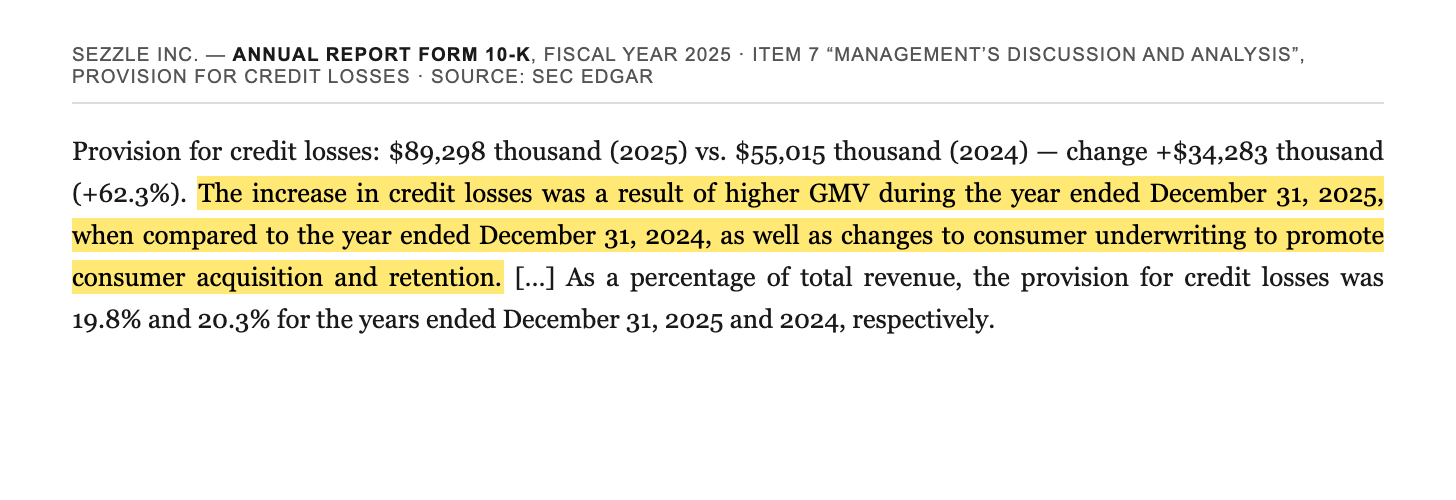
A loosened credit filter is not a mistake per se — it is a dial: more customers let through means more revenue and more defaults, and the filing itself says the effect of future underwriting changes on the loss ratio is "challenging to predict." The dial, by the way, is operated by an in-house machine learning model, the "Prophet Score," which sorts the receivables portfolio into quality buckets A through C. Add the seasonality: the fourth quarter regularly brings the strongest volumes, per the filing — and, subsequently, the highest charge-offs. Remember the mechanism: in a lending business, revenue growth is always also a risk decision — the bill arrives one or two quarters later.
Uncomfortable truth no. 4: One man holds 44.2 percent — and 19 insider sales stand against one buy
The fourth truth concerns the balance of power. Co-founder, CEO and Chairman Charles Youakim is by far the largest stockholder:
"As reported in Amendment No. 1 to Mr. Youakim's Schedule 13D filed with the SEC on February 11, 2025, Mr. Youakim holds approximately 44.2% of all shares of our common stock outstanding and can exert significant influence over us, including in relation to the election of directors, the appointment of new management and the potential outcome of matters submitted to the vote of stockholders."
— Sezzle Inc., SEC annual report 10-K for fiscal year 2025, Item 1A "Risk Factors"
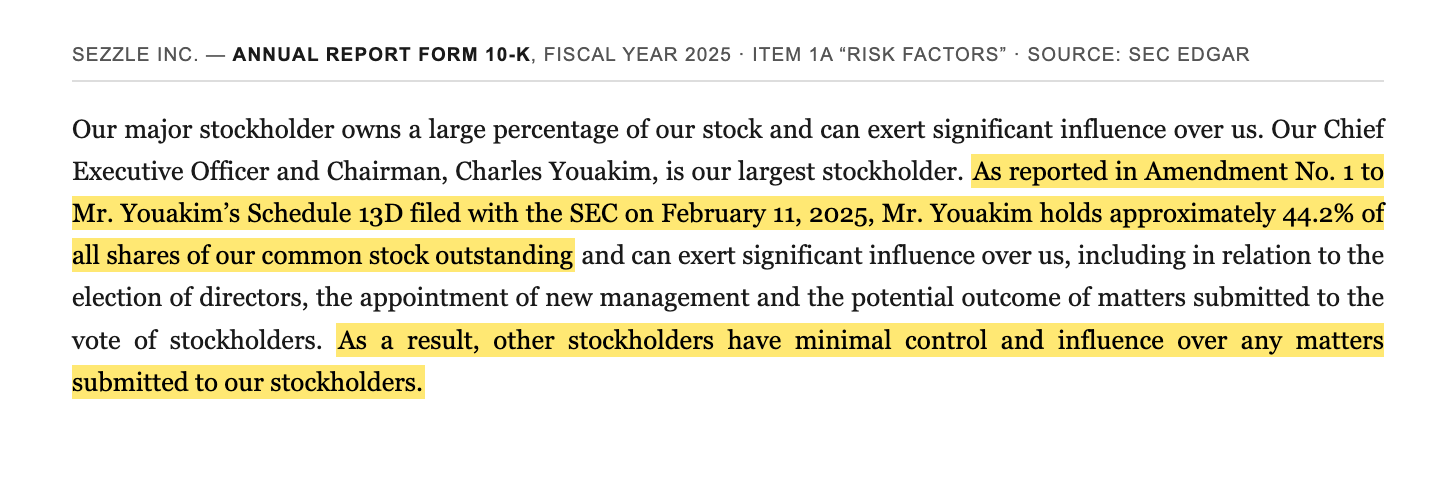
That cuts both ways. The friendly reading: a founder with 44.2 percent loses more in every crash than all his critics combined — his interests and the stockholders' are roughly aligned, and the filing itself points to the buybacks as a counterweight: Sezzle repurchased $50.0 million of its own stock in 2025, and a further $100 million program was approved on December 15, 2025. The uncomfortable reading: the remaining stockholders have, in the filing's own words, "minimal control" — whoever buys SEZL rides in Youakim's passenger seat. And our scanner data notes in the margin: 19 insider sales against a single buy recently (data as of July 10, 2026) — not unusual for a young company after a steep rally, but not an extra vote of confidence either.
Valuation: about $5.7 billion of market value for a fee powerhouse
In mid-2026, Sezzle weighed in at roughly $5.7 billion of market value (data as of July 10, 2026), with just under 34 million shares outstanding. Measured against the net income of the last four quarters (roughly $148 million), that is a price-to-earnings ratio around 38; against the revenue of the last four quarters (roughly $481 million), a price-to-sales ratio around 12 — the market is not paying for the status quo here, but for many more years of steep growth. Yet that growth is already normalizing: from plus 66.1 percent in fiscal year 2025 to plus 29.2 percent in the first quarter of 2026. The balance sheet itself is decent for a lending platform: as of March 31, 2026, $120.4 million of cash and $263.0 million of net receivables stood against a line of credit of $144.4 million, and equity reached $196.7 million — with $14.0 million of net interest expense in fiscal year 2025. The only capital return of note is the buybacks (Q1 2026: $25.7 million); Sezzle pays no dividend. Two things to keep in mind about the optically dazzling return metrics: the return on equity around 92 percent is that high partly because equity is still small after years of losses — and the 2024 profit contained a one-time tax benefit that flatters the comparison base.
Opportunities and risks at a glance
What speaks for Sezzle:
- A real, steep turnaround: from a $38.1 million loss (2022) through a $7.1 million profit (2023) to $133.1 million of net income in fiscal year 2025; Q1 2026 with $51.3 million and a 50.9 percent operating margin.
- No. 1 in the Terry Smith quality scanner (U.S. selection, as of July 18, 2026): return on equity around 92 percent, interest coverage around 23, debt-to-equity 0.74, nearly complete cash conversion of profit (scanner data as of July 10, 2026).
- A growing, active user base: 3.05 million active consumers, 918,000 monthly on-demand users and subscribers (+29.8 percent), gross merchandise volume of $3.94 billion (+55.1 percent) in fiscal year 2025.
- Solid liquidity and shareholder returns: $120.4 million of cash (March 31, 2026), $50 million of buybacks in 2025 plus a new $100 million program; a founder-CEO with 44.2 percent in the same boat.
- Momentum and institutional interest: hits in 27 more scanners (incl. stage 2, RS leader 90), 12 funds adding against 6 trimming (data as of July 10, 2026).
What speaks against it:
- The revenue mix: only 23 percent of 2025 revenue came from merchants and partners — 77 percent was carried mostly by consumers (fees, subscriptions, late payment fees), and per the 10-Q the latest fee growth came mainly from higher fee prices. That is exposed to reputation and regulation (CFPB oversight).
- A single bank partner: WebBank originates the "substantial majority" of the loans, exclusively on the product side, with termination and suspension rights — while remaining free to work with competitors (10-K 2025, Item 1A).
- Credit risk as a dial: provision for credit losses up 62.3 percent to $89.3 million, partly due to deliberately loosened consumer underwriting; the fourth quarter seasonally brings the highest charge-offs.
- Concentrated power and insider sales: 44.2 percent with CEO Youakim ("minimal control" for the rest), 19 insider sales against 1 buy (data as of July 10, 2026); only two analyst firms cover the stock.
- A sporty valuation on normalizing growth: price-to-earnings around 38, price-to-sales around 12 (data as of July 10, 2026) — on revenue growth that cooled from 66 to 29 percent, and a stock that managed plus 414 percent in one quarter of 2025 and minus 56 percent in the next.
A human conclusion
Back to the halo effect from the opening. Its core is not that radiant features lie — Sezzle's turnaround is real, the margins are real, the no. 1 rank in the quality scanner is correctly computed. Its core is that a halo outshines the follow-up questions: what is the margin made of? Who controls the company? What happens if the only bank partner terminates, or the consumer watchdog turns its attention to the fee practices? The annual report answers these questions with disarming candor: 77 percent of revenue is carried by consumers, the credit filter was deliberately loosened, one man holds 44.2 percent, and the bank belongs to the neighbor. None of it is illegal, none of it is hidden — it is all in the mandatory text, under the heading "Risk Factors." So the honest question for you is not "is Sezzle a quality company?" (by the numbers: currently yes), but: do you believe a margin built mostly on fees from tight budgets can be defended for many years against competition, regulation and the economy — and are you willing to pay nearly 40 times annual earnings for it? Whoever answers both with yes finds one of the most profitable growth machines of its niche here. Whoever hesitates has just taken off the halo and looked at the company. What you make of it is your decision. And that is exactly as it should be.
Sources
All original documents used in this analysis — for your own reading:
- Sezzle Inc. — SEC annual report 10-K for fiscal year 2025 (ended December 31, 2025; filed February 26, 2026)
- Sezzle Inc. — SEC quarterly report 10-Q as of March 31, 2026 (filed May 7, 2026)
- Sezzle Inc. — SEC annual report 10-K for fiscal year 2024 (ended December 31, 2024; filed February 27, 2025)
- Sezzle Inc. — SEC annual report 10-K for fiscal year 2023 (ended December 31, 2023; filed February 29, 2024; ASX delisting and capital history)
- Complete SEC filing history of Sezzle Inc.: EDGAR overview (sec.gov)
- Fundamental data (metrics, quarterly series, valuation; data as of July 10, 2026), reconciled against the SEC filings.
- Screener and rating data: in-house stock scanner, Terry Smith: Quality (U.S. selection, as of July 18, 2026) and 27 more filters (data as of July 10, 2026).
Transparency & disclaimer: This analysis is a journalistic contextualization of publicly available information and is not investment advice, not a financial analysis in the regulatory sense, and not a solicitation to buy or sell securities. Stock investments carry substantial risks up to and including total loss. All information without guarantee; the data cut-off is noted in the text. The author holds no position in Sezzle stock at the time of publication.
Our Bottom Line at a Glance
- Growth & profitability positive
- A genuine turnaround: from a $38.1 million loss (2022) to $133.1 million of net income on $450.3 million of revenue (+66.1 percent) in fiscal year 2025; Q1 2026 with $51.3 million of profit and a 50.9 percent operating margin (10-K FY 2025, 10-Q as of 03/31/2026).
- Revenue source & reputation negative
- Only 23 percent of 2025 revenue came from merchants and partners; 77 percent was carried mostly by consumers (consumer fees $131.9 million, subscriptions $99.4 million, other income $116.8 million) — and per the 10-Q the latest fee growth came mainly from higher fee prices. Exposed to regulation and reputation (CFPB oversight).
- WebBank dependency negative
- The "substantial majority" of loans has been originated since 09/26/2024 by a single bank partner (WebBank) with termination and suspension rights, which remains free to work with competitors (10-K FY 2025, Item 1A) — a supplier concentration in the business model's most important ingredient.
- Credit risk & underwriting neutral
- Provision for credit losses up 62.3 percent to $89.3 million (19.8 percent of revenue, ratio slightly down), but per the 10-K partly a result of deliberately loosened consumer underwriting "to promote consumer acquisition and retention"; the fourth quarter seasonally brings the highest charge-offs.
- Governance & ownership negative
- CEO and Chairman Youakim holds approximately 44.2 percent (Schedule 13D/A of 02/11/2025), the remaining stockholders have "minimal control" per the 10-K; only two analyst firms cover the stock, and 19 insider sales stand against 1 buy (data as of July 10, 2026). Counterweight: $50 million of buybacks in 2025 plus a $100 million program.
- Valuation neutral
- Roughly $5.7 billion of market value, P/E around 38 and P/S around 12 on the trailing four quarters (data as of July 10, 2026) — sporty for growth normalizing from 66 to 29 percent; a solid balance sheet ($120.4 million cash, $196.7 million equity as of 03/31/2026) as a buffer.
By the numbers, Sezzle is currently one of the most profitable BNPL providers on the market: no. 1 in our Terry Smith quality scanner (U.S. selection, as of July 18, 2026), $133.1 million of net income in fiscal year 2025, an operating margin above 50 percent in the latest quarter. But the filings show what the dream margin is made of: 77 percent of revenue is carried mostly by consumers (fees, subscriptions, late payment fees), the loans come from a single bank partner with termination rights, the credit filter was deliberately loosened, and one man controls 44.2 percent of the shares. Whoever invests here buys a highly profitable but concentratedly risky fee powerhouse at nearly 40 times annual earnings. Not investment advice.
What Our Rating Means
- If you don't own the stock
- As long as the question raised in the bottom line stays open, we see no basis for an entry.
- If you hold it in your portfolio
- Our findings offer no acute reason to sell — the checkpoints named remain decisive.
A journalistic assessment by our editorial team at the time of the deep dive, based on public sources — not investment advice and not a solicitation to buy or sell. Your personal circumstances (investment goals, risk capacity, taxes) cannot be taken into account. What our categories mean, how verdicts are formed, and what conflicts of interest exist →
Worth Noting
- SEZL landed on the research list via the Terry Smith quality scanner (no. 1 of the U.S. selection, as of July 18, 2026); the confluence with 27 mostly momentum scanners describes the same price climb (plus 414 percent in the second quarter of 2025, minus 56 percent in the third) and is no independent proof of quality.
- The return on equity around 92 percent is partly a consequence of equity still being small after loss years ($196.7 million as of 03/31/2026); the 2024 profit contained a one-time tax benefit of $11.2 million — read the return metrics as a snapshot rather than a steady state.
- Price and valuation figures dated July 10, 2026 (market value roughly $5.7 billion); analyses are evergreen, daily prices are not a buy argument. Identity verified via EDGAR submissions: U.S. domestic filer (10-K/10-Q), CIK 0001662991, incorporated in Delaware on 01/04/2016, no name changes, Nasdaq the sole trading exchange since the 2023 ASX delisting; 6-for-1 stock split effective 03/28/2025.
Frequently Asked Questions
Sezzle Inc. (Nasdaq: SEZL), based in Minneapolis, runs a "buy now, pay later" platform in the United States and Canada: consumers pay a quarter of the purchase price up front and the rest in three interest-free installments over six weeks ("pay-in-four"). Added to that are paid subscriptions (Sezzle Premium, Sezzle Anywhere), on-demand payments and a virtual card. Revenue in fiscal year 2025 (ended December 31, 2025): $450.3 million (+66.1 percent), net income $133.1 million.
Mostly the customers: in fiscal year 2025, per the annual report (10-K), only $102.2 of $450.3 million (23 percent) came from merchants and partners. $131.9 million was consumer fees inside transaction income (prior year: $60.3 million), $99.4 million subscription revenue and $116.8 million income from other sources — per the filing "largely derived from consumer fee income," above all late payment fees. Together, consumers carry roughly 77 percent of revenue (2024: 68 percent).
The scanner translates Terry Smith's published Fundsmith criteria into five hurdles, and Sezzle cleared them all (U.S. selection, as of July 18, 2026): return on equity around 92 percent, operating margin of 39.3 percent in fiscal year 2025, nearly complete conversion of profit into free cash flow, debt-to-equity of 0.74 and interest coverage around 23 (scanner data as of July 10, 2026). The scanner deliberately checks no valuation — the price is for the investor to judge.
Sezzle does not originate its U.S. consumer loans itself: per the 10-K for 2025, the "substantial majority" of loans has come from its single bank partner WebBank, a Utah-chartered industrial bank, since September 26, 2024. The agreement is subject to early termination or suspension by WebBank upon certain events — and does not prohibit WebBank from working with competitors in parallel. If this partner walks away, the business model loses its banking license.
The provision for credit losses rose 62.3 percent to $89.3 million in fiscal year 2025 (19.8 percent of revenue). As reasons, the annual report names higher gross merchandise volume and changes to consumer underwriting "to promote consumer acquisition and retention" — a deliberately more permissive credit filter. Lending decisions are steered by the in-house machine learning model "Prophet Score"; the fourth quarter seasonally brings the highest charge-offs.
CEO and Chairman Charles Youakim holds approximately 44.2 percent of all shares per the Schedule 13D/A of February 11, 2025; the remaining stockholders have, per the 10-K, "minimal control." Valuation: roughly $5.7 billion of market value (data as of July 10, 2026), about 38 times the net income and 12 times the revenue of the respective last four quarters — the price pays for further steep growth, while revenue growth recently cooled from 66 to 29 percent.
Found an error?
Did you spot a factual error, an outdated number, or a typo in this deep dive? Let us know briefly — your report goes straight to the editorial team.