FIGS: The Best Quarter in Company History — and the Tariff a Court Struck Down
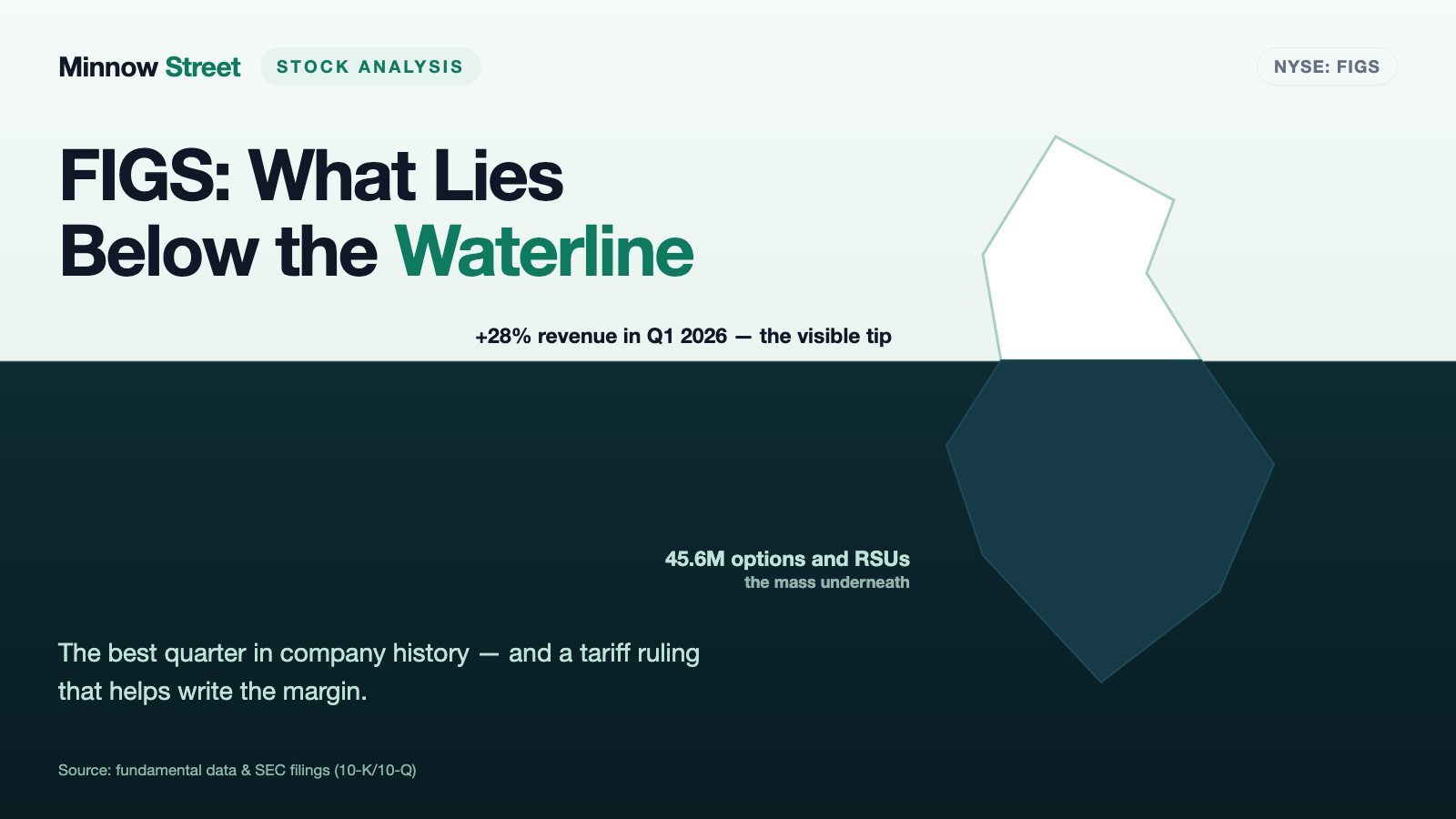
FIGS sells scrubs and lab coats directly to nurses and doctors — and delivered its strongest numbers since the IPO in the first quarter of 2026: $159.9 million in net revenues, up 28.0 percent, and $6.3 million in net income after a $0.1 million loss a year earlier. But part of the tailwind came from Washington rather than from the store. The U.S. Supreme Court struck down the IEEPA tariffs in February 2026, and FIGS applied for roughly $20 million in refunds — extent and timing uncertain, the quarterly report says. Below the waterline sit 45.6 million options and RSUs at a weighted-average exercise price of $4.09 (as of December 31, 2025) and a voting structure in which 4.97 percent of the equity carries 51.1 percent of the vote. Our in-house stock scanner ranks FIGS 44th among earnings surprises in the U.S. selection (as of July 25, 2026). No recommendation — just the question of how much of this quarter the company earned itself.
 Thomas Mücke
Founder & Publisher
Thomas Mücke
Founder & Publisher
Chart
Interactive price chart (TradingView).
Note: pure fact-based analysis, not investment advice and not a solicitation to buy or sell. All figures without guarantee.
There is an investor trap that springs precisely when everything looks good — the tailwind trap. It works like this: a company posts a brilliant quarter, and your brain automatically credits the crew. Nobody asks who made the wind. FIGS, Inc. (NYSE: FIGS) of Santa Monica delivered the best quarter in its history in the first three months of 2026: $159.9 million in net revenues against $124.9 million a year earlier, and $6.3 million in net income against a $0.1 million loss. But part of that wind blew in from Washington. In February 2026 the Supreme Court of the United States ruled that using the IEEPA emergency statute to impose tariffs was not permitted — and the tariff bill FIGS had calculated three months earlier at roughly 400 basis points of margin pressure for 2026 was suddenly a different bill. So let us make a deal: before you treat the quarter as proof of a better business model, we will read together what FIGS itself reported to the U.S. securities regulator, the SEC — the annual report (10-K) for 2025, the quarterly report (10-Q) as of March 31, 2026, and the proxy statement for the 2026 annual meeting. Those filings are honest under penalty of law. And they describe a real, growing brand, a $20 million tariff refund nobody has yet, 45.6 million options and share awards below the waterline — and 4.97 percent of the equity that carries 51.1 percent of the vote. In the end, you decide.
What FIGS Actually Does: A Brand for a Garment That Had None
If you have ever been in a hospital, you have seen the product without noticing it: the plain tops and trousers that nurses and physicians wear. They are called scrubs. For decades they were a commodity without a name — bought through hospital procurement or uniform shops, made of thin polyester, available in a handful of colors. FIGS, founded in 2013 by Heather Hasson and Catherine Spear, turned that into a brand: a proprietary fabric called FIONx, considered fits, limited-run color drops, and sales made directly through its own website and app to the people who wear the garment rather than to a purchasing department.
The company calls its customers Awesome Humans and describes its business model as dryly as only a mandatory filing can: it has "branded a previously unbranded industry and de-commoditized a previously commoditized product." Alongside scrubs FIGS now sells underscrubs, outerwear, lab coats, footwear and compression socks, grouped in the filings as non-scrubwear. In the first quarter of 2026, $126.6 million of revenue came from scrubwear and $33.3 million from non-scrubwear; geographically, $131.6 million came from the United States and $28.3 million from the rest of the world. Add five company-run stores that FIGS calls Community Hubs and a business-to-business arm named TEAMS. Manufacturing is outsourced: in 2025 finished-goods production was split "approximately evenly between suppliers in Vietnam and Jordan," with limited production in China and Peru. Remember this: FIGS is a branded apparel company selling online — the factories belong to somebody else, but FIGS pays the tariffs.
Two things make the business unusually resilient. First, workwear is a necessity rather than a wish: shift workers wear out their scrubs, and the filings explicitly describe the business as "largely non-discretionary, replenishment-driven." Second, there is almost no seasonality: unlike fashion retail, FIGS sells the same core items all year, with only the fourth quarter running higher because of promotions. The price of that model is that a brand premium on a basic garment has to be re-earned every year — through marketing, colors and newness. And that marketing rose 62.4 percent in the first quarter of 2026.
Where This Stock Landed on Our Desk
FIGS did not reach us through a price move but through a pattern. Our in-house stock scanner looks for companies whose reported earnings came in well above analyst expectations — the Big Earnings Surprise list. FIGS sits there at rank 44 of 81 U.S. hits, with an RS rating of 64, as of July 25, 2026. If you want to follow along, the list is public at Big Earnings Surprise; it is recomputed daily, so today's rank is not tomorrow's.
What sits behind the ranking is four consecutive beats (data as of July 25, 2026, against analyst consensus):
- First quarter 2026 (reported May 7, 2026): $0.03 against $0.02 per share — a 50 percent beat
- Fourth quarter 2025 (February 26, 2026): $0.10 against $0.02 — a 400 percent beat
- Third quarter 2025 (November 6, 2025): $0.05 against $0.02 — a 150 percent beat
- Second quarter 2025 (August 7, 2025): $0.04 against $0.02 — a 100 percent beat
Those numbers are real, but they need translation. A 400 percent surprise sounds enormous and is in fact an eight-cent gap: $0.10 instead of $0.02. For a company only just lifting off the zero line, the percentage surprise is close to meaningless — any one-cent deviation produces triple-digit percentages. So here is our first judgment: the streak is a genuine turn in earnings power, but its percentages are inflated. More interesting is what the market did with it. On May 7, 2026 the stock closed at $15.37; the day after the quarterly report it closed at $11.63, nearly a quarter lower, despite the beat. By July 24, 2026 the closing price stood at $9.51. An earnings surprise, in other words, is not a buy signal but a question: why did the market not celebrate it? The answer is in the filings.
The Numbers Across the Years — Honestly Credited
Let us start with what genuinely impresses. FIGS has grown in every single year since its May 2021 IPO — through the post-pandemic slump, through the inflation years, through the tariff turbulence:
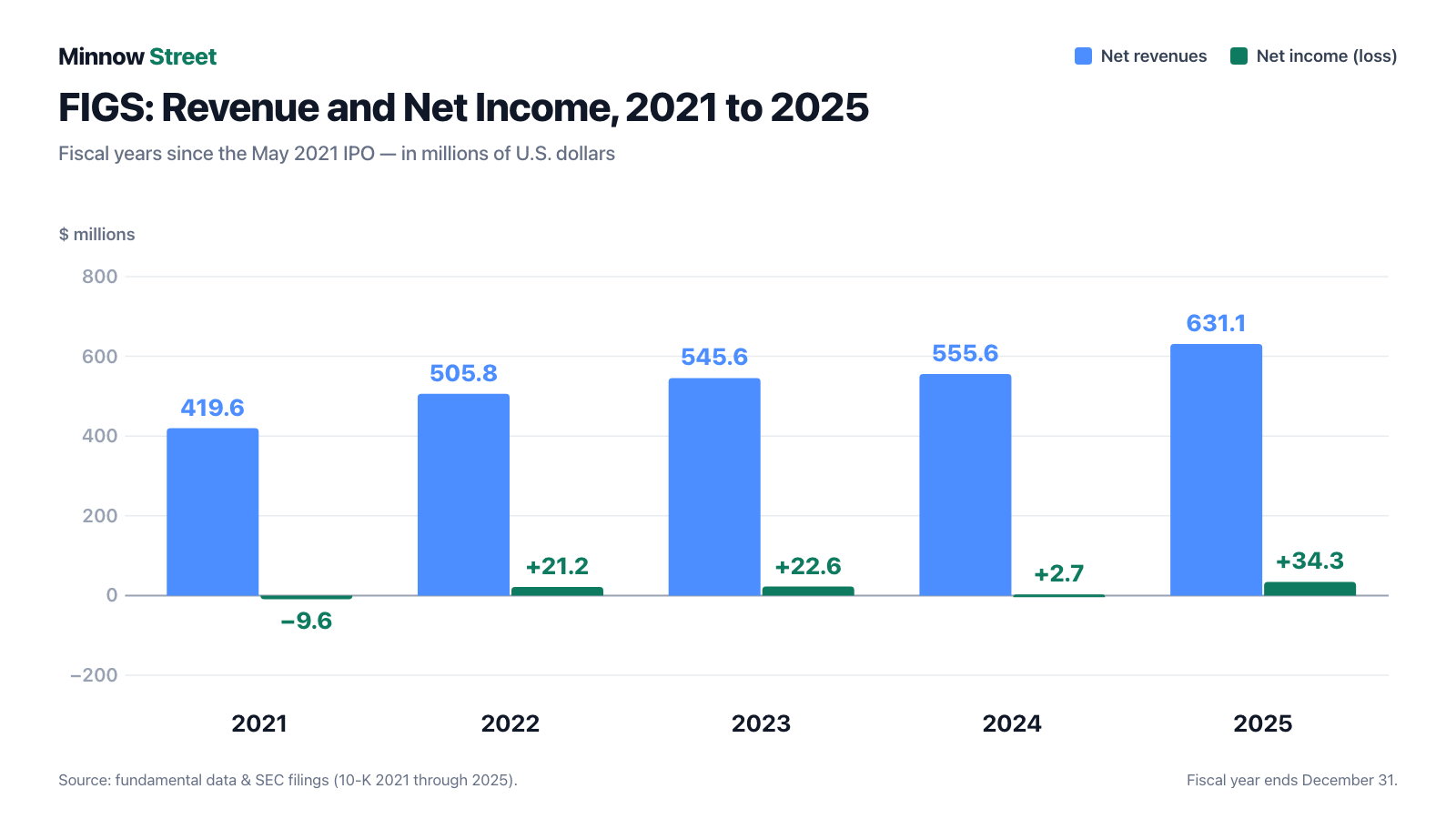
In figures: $419.6 million (2021), $505.8 million (2022), $545.6 million (2023), $555.6 million (2024), $631.1 million (2025) — 50 percent more revenue across four years. Net income, by contrast, rode a roller coaster: minus $9.6 million (2021), plus $21.2 million (2022), plus $22.6 million (2023), plus $2.7 million (2024), plus $34.3 million (2025). The year 2024 was the low point: 1.8 percent revenue growth, gross margin down 1.5 percentage points, and $42.7 million of stock-based compensation that consumed almost the entire result. In 2025 the turn came: revenue rose 13.6 percent, stock-based compensation fell to $26.9 million, and $2.7 million of profit became $34.3 million.
Then came the first quarter of 2026. FIGS lists the headline numbers in the quarterly report itself:

The supporting numbers fit. Gross margin edged up from 67.6 percent to 67.7 percent, adjusted EBITDA rose from $9.2 million to $13.9 million, and active customers grew from 2.696 million to 3.024 million. Net revenues per active customer climbed from $208 to $220, and average order value from $119 to $124. International was the standout: $28.3 million against $18.9 million, roughly 50 percent more. And the balance sheet is one of the cleanest you will find at this size: $74.3 million in cash plus $202.7 million in short-term investments as of March 31, 2026 against $132.8 million in total liabilities, not one dollar of which is bank debt. The $100 million Bank of America revolving facility is untouched apart from $8.4 million of letters of credit and, since the second amendment of November 3, 2025, runs to November 3, 2030.
That is the tip of the iceberg, and it is real. Now we dive.
What the Filings Say
Uncomfortable Truth No. 1: A Court Rewrote the Margin Guidance — and $20 Million Is Still With Customs
On February 26, 2026 FIGS filed its annual report for 2025. It carried a clear warning: absent mitigation, tariffs would cut gross margin in 2026 by roughly 400 basis points, or four percentage points. For a company running a 66.5 percent gross margin that is a meaningful hit; in 2025 tariffs had already cost 120 basis points, and 260 basis points in the fourth quarter alone.
Two and a half months later, in the quarterly report of May 7, 2026, the same paragraph read differently. The reason was the Supreme Court ruling of February 2026.
"In February 2026, the United States Supreme Court ruled that the use of the International Emergency Economic Powers Act ("IEEPA") to impose tariffs was not permitted, invalidating a significant portion of U.S. tariffs that had been in effect since April 2025. … We have applied for a refund of approximately $20 million of IEEPA tariffs paid by us, however the ultimate extent and timing of such refunds remains uncertain."
— FIGS, Inc., SEC quarterly report 10-Q as of March 31, 2026, Recent Developments

Three things sit in that single paragraph, and all three matter for FIGS. First: the administration replaced the invalidated tariffs with a 10 percent global tariff under Section 122 of the Trade Act of 1974, limited to 150 days — effective February 24, 2026 and scheduled to expire on July 24, 2026 unless extended by Congress. An intention to raise the rate to 15 percent was expressed but not formally implemented. What has happened since May 7, 2026 appears in no FIGS filing: the next quarterly report is the first place where the company documents the actual state of play. Second: FIGS revised its own guidance downward — tariffs would still weigh on 2026 gross margin, "although to a lesser extent than we previously disclosed in our 2025 Annual Report on Form 10-K." Third: the $20 million applied for is money FIGS has already paid and wants back. It appears on no balance sheet line — and it equals 58 percent of total net income for 2025.
Why that matters for judgment: gross margin in the first quarter of 2026 came in at 67.7 percent, just 0.1 percentage points above the prior year — and FIGS attributes the increase to price increases and efficiency, "largely offset by higher tariffs and product mix shift." In plain terms: the operating improvement was almost entirely swallowed by tariffs. Remove the tariff and there is headroom. Bring it back, or raise it to 15 percent, and the headroom is gone. Anyone valuing FIGS today is also valuing a trade policy over which the company has no influence. A comparable case from the same tariff wave sits in our analysis of Hyster-Yale — there the bill ran to roughly $100 million, and there too a family holds the voting majority.
Uncomfortable Truth No. 2: A Quarter of Earnings Per Share Belongs to the Options
Dilution, in everyday terms, means your slice of the cake gets smaller because new guests arrive at the table — even though the cake itself has not shrunk. At FIGS the effect stayed invisible for four years, for an accounting reason: as long as a company reports a loss, options are removed from the earnings-per-share calculation because they would arithmetically shrink the loss per share. In the first quarter of 2025 that applied to 17,784,006 options.
In the first quarter of 2026 FIGS made a profit — and the options surfaced:
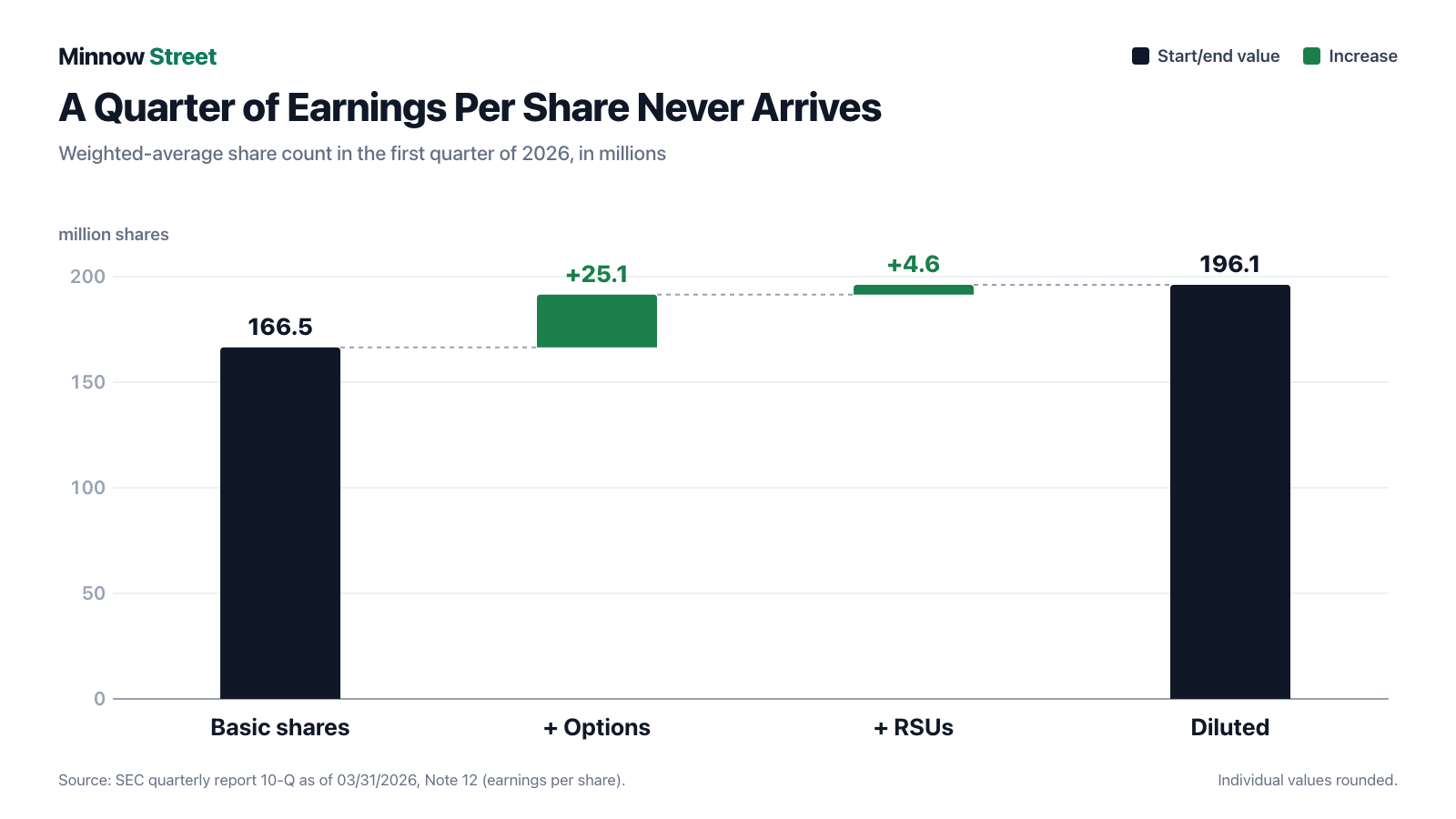
The weighted-average share count rose from 166,460,085 to 196,090,295 — plus 25.06 million from options and 4.57 million from restricted stock units. That is 17.8 percent more shares and earnings per share of $0.03 instead of $0.04. A quarter of earnings per share disappears into dilution.
The reservoir behind that single jump is larger. As of December 31, 2025 the proxy statement lists 37,791,945 options at a weighted-average exercise price of $4.09 plus 7,839,905 RSUs — 45.63 million instruments against 165.84 million shares outstanding, roughly 27 percent. Another 9,264,545 instruments remained unissued, and the equity plan pool grows automatically every January 1 by up to 5 percent of shares outstanding. To place that exercise price: $4.09 sits far below the $11.36 closing price on December 31, 2025, so these options are deep in the money and very likely to be exercised. FIGS pushes back with buybacks: in the first quarter of 2026 it repurchased 571,592 shares for roughly $8.8 million, leaving $43.2 million of the $100 million authorization as of March 31, 2026. Do the arithmetic: $8.8 million of buybacks in a quarter against an option stack that would bring roughly $155 million of exercise proceeds into the cash box while creating 37.8 million new shares. The buyback slows the dilution; it does not reverse it.
Uncomfortable Truth No. 3: 4.97 Percent of the Equity Holds 51.1 Percent of the Vote — With a Switch to 82.7
FIGS has two classes of stock. Class A, which trades on the New York Stock Exchange, carries one vote per share. Class B, which does not trade, carries twenty. As of the annual meeting record date of April 8, 2026 there were 158,761,109 Class A and 8,283,641 Class B shares outstanding. Class B therefore accounts for 4.97 percent of the equity — and, per the proxy statement, 51.1 percent of the voting power. FIGS is formally a controlled company under New York Stock Exchange rules and exempt from parts of the governance requirements; the proxy states plainly that stockholders "may not have the same protections" as at other companies.
On its own that would be unremarkable for a recent U.S. listing. What is unusual is the mechanism above it — a contract dating from the IPO:
"As of April 8, 2026, Mses. Hasson and Spear retain the Exchange Right over a remaining 10,236,060 and 18,831,060 shares, respectively, underlying outstanding options."
— FIGS, Inc., SEC proxy statement DEF 14A 2026, "Equity Award Exchange Agreement"

Follow that to its conclusion — and the proxy statement does the arithmetic itself: if both founders exercised their options and exchanged the resulting Class A shares fully into Class B, they would together hold 82.7 percent of total voting power, with Catherine Spear alone at 69.6 percent and Heather Hasson alone at 49.5 percent. Both are additionally bound by a voting agreement that secures their mutual election to the board. Class B converts automatically into Class A only on June 1, 2031 — ten years after the IPO.
None of this is a scandal, and all of it is disclosed. But it is a fact with a price tag: anyone buying FIGS stock buys economic participation without control. A takeover against the founders' wishes is effectively impossible until 2031; an activist pressing for cost discipline or capital returns has no lever. If that troubles you, it should trouble you before the purchase rather than after.
Uncomfortable Truth No. 4: The Growth Cost 62 Percent More Marketing — and Free Cash Flow Turned Negative
Free cash flow is the money actually left after operations and investment — the most honest figure any income statement has to offer. At FIGS it swung from plus $7.9 million to minus $5.6 million in the first quarter of 2026, even as net income rose from minus $0.1 million to plus $6.3 million. Cash from operations fell from plus $9.2 million to minus $3.2 million. How do those go together?
Partly through working-capital timing: inventories rose $11.4 million in the quarter, accounts payable fell $10.6 million, and accrued compensation fell $12.3 million as 2025 bonuses were paid out. That is timing, not lost substance. The structural part sits beside it:
"Marketing expense increased by $11.3 million, or 62.4%, for the three months ended March 31, 2026, compared to the prior year period … The increase in marketing expense as a percentage of net revenues was primarily driven by our 2026 Winter Olympics campaign, partially offset by leverage on higher net revenues."
— FIGS, Inc., SEC quarterly report 10-Q as of March 31, 2026, Operating Expenses

Marketing thus jumped from 14.5 percent to 18.4 percent of net revenues. That is the decisive question for the coming quarters, and it fits into one sentence: did FIGS buy 28 percent growth, or earn it? In favor of earned: selling and administrative costs each fell by 3.4 percentage points of revenue in the same quarter, and the customer base grew 12.2 percent. In favor of bought: the Olympics campaign is a one-off. Without it marketing would hardly have risen by $11.3 million, and without those $11.3 million operating income would have been roughly $15.8 million instead of $4.5 million. The honest answer is both — and the first quarter without an Olympics will show the proportion. One more item belongs here: the effective tax rate in the first quarter of 2026 was just 2.4 percent against 105.5 percent a year earlier, thanks to a tax benefit from stock-based compensation. A meaningful share of the $6.3 million in net income therefore came from a tax effect tied to the share price at vesting — which is not something a company can plan.
Valuation: What FIGS Costs on the Exchange
First, an honest note on why this section shows a range rather than a single figure. FIGS had 167,047,253 shares outstanding as of April 30, 2026 (158,763,612 Class A plus 8,283,641 Class B). The most recent trading price documented in an SEC filing comes from an insider report: on April 2, 2026 Catherine Spear sold 62,335 Class A shares at $14.44 to cover taxes on vested restricted stock units. The closing price on July 24, 2026 was $9.51. Between those two dated anchors lies a third of the value — the stock fell sharply in under four months. Both figures are documented; neither is more correct. So we use both.
- Market capitalization: roughly $1.59 billion (July 24, 2026) to roughly $2.41 billion (April 2, 2026).
- Price-to-sales: against $666.1 million of trailing twelve-month revenue, roughly 2.4 to 3.6. For a branded apparel company with 66 to 68 percent gross margins and double-digit growth that is no bargain, but no bubble either — unbranded apparel retailers trade at 0.5 to 1, premium brands with comparable margins at 3 to 5.
- Price-to-earnings: on $0.22 of trailing twelve-month diluted earnings per share, roughly 43 to 66. That is expensive, and it shows how thin the earnings base still is. Against the analyst estimate for 2026 of $0.27 per share it works out at roughly 36 to 54.
- Enterprise value: roughly $1.3 billion as of July 24, 2026, because $277.0 million of cash and short-term investments comes off and no financial debt sits against it. Roughly 17 percent of the market capitalization is simply money.
- Book value: $430.6 million of stockholders' equity as of March 31, 2026, or $2.58 per share — a price-to-book ratio of roughly 3.6 (data as of July 25, 2026).
The professionals are notably cautious: of ten covering firms, as of July 25, 2026, one rates the stock a buy, seven a hold and two a sell. The average price target sits at $17.63, well above the last closing price — a combination worth noting but not reading as a forecast, since targets are updated less often than ratings, and the stock lost roughly 44 percent between its 2026 high of $17.12 on March 2, 2026 and July 24, 2026. For the current year the consensus expects $729.0 million of revenue, up 15.5 percent. How quickly a strong brand can still end up in the bargain bin is something we saw at Deckers — there too record numbers stood against a falling share price.
Opportunities and Risks at a Glance
What speaks for FIGS:
- Genuine brand strength in a niche that previously had none: 3.024 million active customers as of March 31, 2026, up 12.2 percent, $220 of revenue per active customer, and gross margins of 66 to 68 percent — figures normally reserved for luxury labels in apparel.
- Demand that barely tracks the economic cycle: shift workers wear out their scrubs and replace them, and the filings describe the business as "largely non-discretionary, replenishment-driven."
- A debt-free balance sheet: $277.0 million of cash and short-term investments as of March 31, 2026, $430.6 million of equity, no drawn borrowings, and a $100 million facility running to November 3, 2030 — roughly 17 percent of the market capitalization is cash.
- Growth headroom internationally and in the business-to-business arm: international revenue rose from $18.9 million to $28.3 million in the first quarter of 2026, roughly half again, and still accounts for only 17.7 percent of the total.
- A possible one-time gain from the tariff refund: $20 million would equal 58 percent of total 2025 net income — and since it appears on no balance sheet line, nothing is lost if it never arrives.
What speaks against it:
- Dilution of roughly 27 percent: 37,791,945 options at a weighted-average exercise price of $4.09 plus 7,839,905 RSUs as of December 31, 2025 against 165.84 million shares outstanding. In the first quarter of 2026 that cut earnings per share from $0.04 to $0.03. The buyback of $8.8 million in the quarter slows it but reverses nothing.
- No control for capital providers: 4.97 percent of the equity carries 51.1 percent of the vote, and the exchange right could take the founders to 82.7 percent. Automatic conversion arrives only on June 1, 2031.
- Tariff and supply-chain risk at the core of the business: production in 2025 was split "approximately evenly" between Vietnam and Jordan; the 10 percent Section 122 tariff was scheduled to expire on July 24, 2026 per the quarterly report, and an increase to 15 percent was announced but not implemented. FIGS has no influence on any of it.
- Earnings quality: the effective tax rate in the first quarter of 2026 was 2.4 percent against 105.5 percent a year earlier, thanks to a share-price-dependent tax benefit from stock-based compensation. And free cash flow swung from plus $7.9 million to minus $5.6 million despite the jump in net income.
- A valuation with little cushion: price-to-earnings of roughly 43 to 66 on trailing twelve months, price-to-sales of 2.4 to 3.6, and ten covering firms at one buy, seven holds and two sells as of July 25, 2026. Add a legal overhang: the dismissed IPO-related class action is on appeal, with oral argument scheduled for July 7, 2026.
A Human Conclusion
Back to the tailwind trap. Its core is not that FIGS is a bad company — quite the opposite. Somebody here turned a garment nobody took seriously into a brand that three million people identify with, at gross margins apparel retailers dream about. The core of the trap is that a brilliant quarter spares you the question of what it is made of. At FIGS it is made of at least four parts: real customer growth of 12.2 percent, a one-off Olympics campaign worth $11.3 million of extra marketing, a share-price-dependent tax benefit, and a court ruling in Washington that rewrote the tariff bill. Three of those FIGS controls. One it does not.
And below the waterline sits the part that is unimpressed by any single quarter: 45.6 million options and share awards at an average price of $4.09, which spread every future dollar of profit across more heads — and a voting structure in which your share participates in the earnings but not in the decision. So the honest question is not "was that a good quarter?" It was. The question is: are you paying for a brand that grew 28 percent, or for a quarter in which four favorable things happened at once — and are you willing to sit through it without a meaningful vote until 2031? If yes, you have a thesis. If no, you had a headline. The decision is yours.
Sources
Every original document used in this analysis, so you can read it yourself:
- FIGS, Inc. — SEC quarterly report 10-Q as of 03/31/2026 (filed May 7, 2026)
- FIGS, Inc. — SEC annual report 10-K for 2025 (filed February 26, 2026)
- FIGS, Inc. — SEC annual report 10-K for 2024 (filed February 27, 2025)
- FIGS, Inc. — SEC proxy statement DEF 14A for the 2026 annual meeting (filed April 23, 2026)
- Catherine Spear — SEC Schedule 13D/A No. 10 (filed May 12, 2026), source of the documented trading price of April 2, 2026
- Complete SEC filing history for FIGS, Inc. (CIK 0001846576): EDGAR overview (sec.gov)
- Fundamental data (metrics, valuation, analyst consensus, earnings surprises; data as of July 25, 2026, closing prices through July 24, 2026), reconciled against the SEC filings.
- Hook: our in-house stock scanner, the Big Earnings Surprise list (rank 44 of 81 U.S. hits, RS rating 64, as of July 25, 2026; recomputed daily).
Transparency & disclaimer: This analysis is journalistic commentary on publicly available information. It is not investment advice, not a regulated financial analysis, and not a solicitation to buy or sell securities. Equity investments carry substantial risk up to and including total loss. All information is provided without warranty; the data cutoff is noted in the text. The author holds no position in FIGS shares at the time of publication.
Our Bottom Line at a Glance
- Brand and customer loyalty positive
- FIGS turned a nameless commodity into a brand: 3.024 million active customers as of March 31, 2026, up 12.2 percent, $220 of net revenue per active customer against $208 a year earlier, and gross margins of 66.5 percent in 2025 rising to 67.7 percent in the first quarter of 2026. Revenue has grown every year since the IPO — from $419.6 million in 2021 to $631.1 million in 2025.
- Balance sheet and liquidity positive
- As of March 31, 2026 the company held $74.3 million in cash plus $202.7 million in short-term investments against $132.8 million of total liabilities and no drawn borrowings; the $100 million facility runs to November 3, 2030. Roughly 17 percent of the market capitalization is therefore simply money — a rare cushion at this size.
- Earnings quality neutral
- First-quarter 2026 net income of $6.3 million benefited from an effective tax rate of 2.4 percent against 105.5 percent a year earlier, driven by a share-price-dependent benefit from stock-based compensation. At the same time free cash flow swung from plus $7.9 million to minus $5.6 million as inventories were built and $11.3 million of extra marketing went into the Olympics campaign.
- Dilution negative
- As of December 31, 2025 there were 37,791,945 options outstanding at a weighted-average exercise price of $4.09 plus 7,839,905 RSUs — roughly 27 percent of the 165.84 million shares outstanding, with a further 9,264,545 instruments unissued. In the first quarter of 2026 that lifted the share count from 166.5 million to 196.1 million and cut earnings per share from $0.04 to $0.03.
- Governance and control negative
- 4.97 percent of the equity carries 51.1 percent of the vote as of the April 8, 2026 record date, because each Class B share holds twenty votes. Under the Equity Award Exchange Agreement the two co-founders could exchange a further 29.07 million option shares into Class B and reach 82.7 percent. FIGS qualifies as a controlled company and is exempt from parts of the NYSE governance rules; automatic conversion arrives only on June 1, 2031.
- Tariff and supply-chain risk negative
- Production in 2025 was split "approximately evenly" between Vietnam and Jordan. Tariffs cost roughly 120 basis points of gross margin in 2025 and 260 basis points in the fourth quarter alone. The 10 percent Section 122 tariff was scheduled to expire on July 24, 2026 per the quarterly report, an increase to 15 percent was announced but not implemented — and the roughly $20 million refund applied for is uncertain in both extent and timing.
FIGS is the tailwind trap in its purest form: a real, growing brand with luxury-like gross margins, a debt-free balance sheet and the best quarter in its history — $159.9 million of net revenues, up 28.0 percent, and $6.3 million of net income in the first quarter of 2026. But that quarter is made of at least four parts: real customer growth of 12.2 percent, a one-off Olympics campaign worth $11.3 million of extra marketing, a share-price-dependent tax benefit (an effective tax rate of 2.4 percent against 105.5 percent), and a U.S. Supreme Court ruling that voided the company's own roughly 400 basis point tariff guidance. Below the waterline sit 45.6 million options and RSUs at an average price of $4.09 and a voting structure in which 4.97 percent of the equity carries 51.1 percent of the vote. Not investment advice.
What Our Rating Means
Open questions
The business works in principle, but one material question is open. As long as it stays open, our findings do not carry a quality verdict.
The brand is real, the balance sheet is clean, the growth is documented — but the three decisive questions will only be answered by the next quarterly report. First: does growth stay in double digits without the Olympics campaign, and does the marketing ratio fall back from 18.4 percent toward 15? Second: does the roughly $20 million tariff refund arrive, and what is the actual tariff burden after July 24, 2026? Third: does free cash flow turn back up from minus $5.6 million? Anyone buying today pays a price-to-earnings ratio of roughly 43 to 66 for an earnings base four quarters old, and accepts roughly 27 percent dilution plus a vote without weight until 2031. Watching here means recalculating the four building blocks of the quarter one by one before extrapolating them as a trend. The decision is yours.
A journalistic assessment by our editorial team at the time of the deep dive, based on public sources — not investment advice and not a solicitation to buy or sell. Your personal circumstances (investment goals, risk capacity, taxes) cannot be taken into account. What our levels mean, how verdicts are formed, and what conflicts of interest exist →
Worth Noting
- FIGS reached our research list through our in-house stock scanner, the Big Earnings Surprise list: rank 44 of 81 U.S. hits, RS rating 64, as of July 25, 2026. The lists are recomputed daily. On reading the surprise streak: with profits close to the zero line, a single cent of deviation produces triple-digit percentages — the 400 percent fourth-quarter surprise means $0.10 instead of $0.02 per share.
- Valuation figures are deliberately given as a range. Market capitalization of roughly $1.59 billion (167,047,253 shares times the closing price of $9.51 on July 24, 2026) was checked against the most recent trading price documented in an SEC filing — $14.44 on April 2, 2026 per Schedule 13D/A, which corresponds to roughly $2.41 billion. The gap comes from a genuine price decline (2026 high of $17.12 on March 2, 2026), not from faulty data, so price-to-sales, price-to-earnings and market capitalization carry two dated anchors rather than one point estimate.
- Recency status: the most recent periodic report is the 10-Q as of March 31, 2026 (filed May 7, 2026). Filings submitted afterwards — the 8-K of June 8, 2026 with the annual meeting voting results, the Schedule 13D/A of May 12, 2026, insider Form 4 reports and Form 144 sale notices — were reviewed and do not change the picture. There is no pending acquisition: no 8-K Item 1.01, no DEFM14A or PREM14A, no SC 13E-3. The second-quarter 2026 report was expected on August 6, 2026.
- Not to be confused: FIGS is an apparel company and is sometimes classified under the healthcare sector in databases because its customers work there. It is not a medical technology or healthcare services provider. The FIGS ticker has stood for the same company without interruption since the May 2021 IPO; SEC registration lists no former names.
Frequently Asked Questions
FIGS, Inc. (NYSE: FIGS) of Santa Monica, California sells healthcare apparel directly to nurses, physicians and other healthcare professionals — mainly scrubs and lab coats, plus underscrubs, outerwear, footwear and compression socks. Sales run primarily through the company's own website and app, supplemented by five company-run stores called Community Hubs and a business-to-business arm named TEAMS. In fiscal 2025 the company reported $631.1 million in net revenues.
Net revenues rose from $124.9 million to $159.9 million, up 28.0 percent, net income moved from minus $0.1 million to plus $6.3 million, and active customers grew from 2.696 million to 3.024 million. Several effects landed at once: more orders from new and existing customers, a higher average order value of $124 against $119, a large 2026 Winter Olympics campaign, and an effective tax rate of just 2.4 percent thanks to a benefit from stock-based compensation.
Production in 2025 was split "approximately evenly" between Vietnam and Jordan, so tariffs flow straight into cost of goods sold. They cost 120 basis points of gross margin in 2025 and 260 basis points in the fourth quarter alone. The annual report for 2025 projected roughly 400 basis points for 2026; after the February 2026 Supreme Court ruling, the quarterly report of May 7, 2026 said the impact would be "to a lesser extent than we previously disclosed."
In February 2026 the U.S. Supreme Court ruled that using the IEEPA emergency statute to impose tariffs was not permitted. FIGS had already paid such tariffs and, according to the quarterly report of May 7, 2026, applied for a refund of roughly $20 million. Extent and timing are explicitly uncertain, and no receivable appears on the March 31, 2026 balance sheet. For context, $20 million equals 58 percent of total net income for 2025.
As of December 31, 2025 there were 37,791,945 options outstanding at a weighted-average exercise price of $4.09 plus 7,839,905 restricted stock units — 45.63 million instruments against 165.84 million shares outstanding, roughly 27 percent. In the first quarter of 2026 that lifted the weighted-average share count from 166,460,085 to 196,090,295 and cut earnings per share from $0.04 to $0.03.
As of the April 8, 2026 record date there were 158,761,109 Class A shares at one vote each and 8,283,641 Class B shares at twenty votes each. Class B accounts for 4.97 percent of the equity but 51.1 percent of the voting power. Under the Equity Award Exchange Agreement, co-founders Heather Hasson and Catherine Spear may exchange a further 29.07 million option shares into Class B, taking them to 82.7 percent. Class B converts automatically on June 1, 2031.
Against $666.1 million of trailing twelve-month revenue, the price-to-sales ratio runs from roughly 2.4 at the July 24, 2026 closing price of $9.51 to roughly 3.6 at the documented trading price of $14.44 on April 2, 2026. Price-to-earnings works out at roughly 43 to 66. Of ten covering firms, one rates the stock a buy, seven a hold and two a sell as of July 25, 2026. Roughly 17 percent of the market capitalization is cash and short-term investments.
The quarterly report lists, among others: historical growth may not be sustainable; success depends on brand reputation and on retaining existing customers; trade policy has been "dynamic, unpredictable and subject to ongoing modification"; and conflict in the Middle East has disrupted shipping routes serving the Jordanian manufacturers. On top of that sits the appeal against the dismissed IPO-related class action, with oral argument scheduled for July 7, 2026.
Found an error?
Did you spot a factual error, an outdated number, or a typo in this deep dive? Let us know briefly — your report goes straight to the editorial team.