Biogen: 23.5 Percent Above the Earnings Estimate — and $4.5 Billion Below the Revenue of 2019
Biogen has beaten analyst estimates for five straight quarters, most recently by 23.5 percent. That is why our in-house stock scanner ranks the shares 40th in the U.S. selection of its biggest earnings surprises (as of July 25, 2026). The SEC filings tell a second story alongside it: revenue fell from $14,377.9 million in 2019 to $9,890.6 million in 2025 and is guided lower again for 2026. On May 14, 2026 the company therefore bought Apellis Pharmaceuticals — roughly $5.3 billion, paid out of its own cash cushion plus two billion in bank loans. We read the filings before the bill for Apellis shows up on the balance sheet.
 Thomas Mücke
Founder & Publisher
Thomas Mücke
Founder & Publisher
Chart
Interactive price chart (TradingView).
Note: pure fact-based analysis, not investment advice and not a solicitation to buy or sell. All figures without guarantee.
There is an investor trap that feels like good news: the beat trap. It works like this. A company reports earnings above the analyst estimate. Your brain turns that into a sentence in one second: "Doing better than expected." What you do not ask in that moment is: expected by whom, and measured against what? An estimate is not a law of nature. People set it, people lower it, and clearing a bar that has been lowered is not the same as jumping higher. That question sits at the center of Biogen (NASDAQ: BIIB), the biotechnology company based in Cambridge, Massachusetts. Five quarters in a row it reported above the estimate, most recently by 23.5 percent. Over the same stretch, revenue fell. So here is the deal: before you stick the word "outperformer" on this one, we read together what Biogen itself filed with the U.S. securities regulator, the SEC — the annual report (10-K) for 2025, the quarterly report (10-Q) for March 31, 2026, and everything that followed. An SEC filing is honest under penalty of law. And this one describes a shrinking base business, an acquisition worth $5.3 billion — and a cash cushion that was almost entirely spent to pay for it.
What Biogen Actually Does — Four Businesses Under One Roof
Biogen is one of the oldest biotechnology companies in the world; the stock has traded since September 16, 1991. It is incorporated in Delaware and sits on Binney Street in Cambridge, across from the Massachusetts Institute of Technology. At December 31, 2025 it employed roughly 7,500 people, about 4,200 of them in the United States and 3,300 abroad. The company develops and sells medicines for neurological and rare diseases. That sounds like one business — it is four, and they point in different directions:
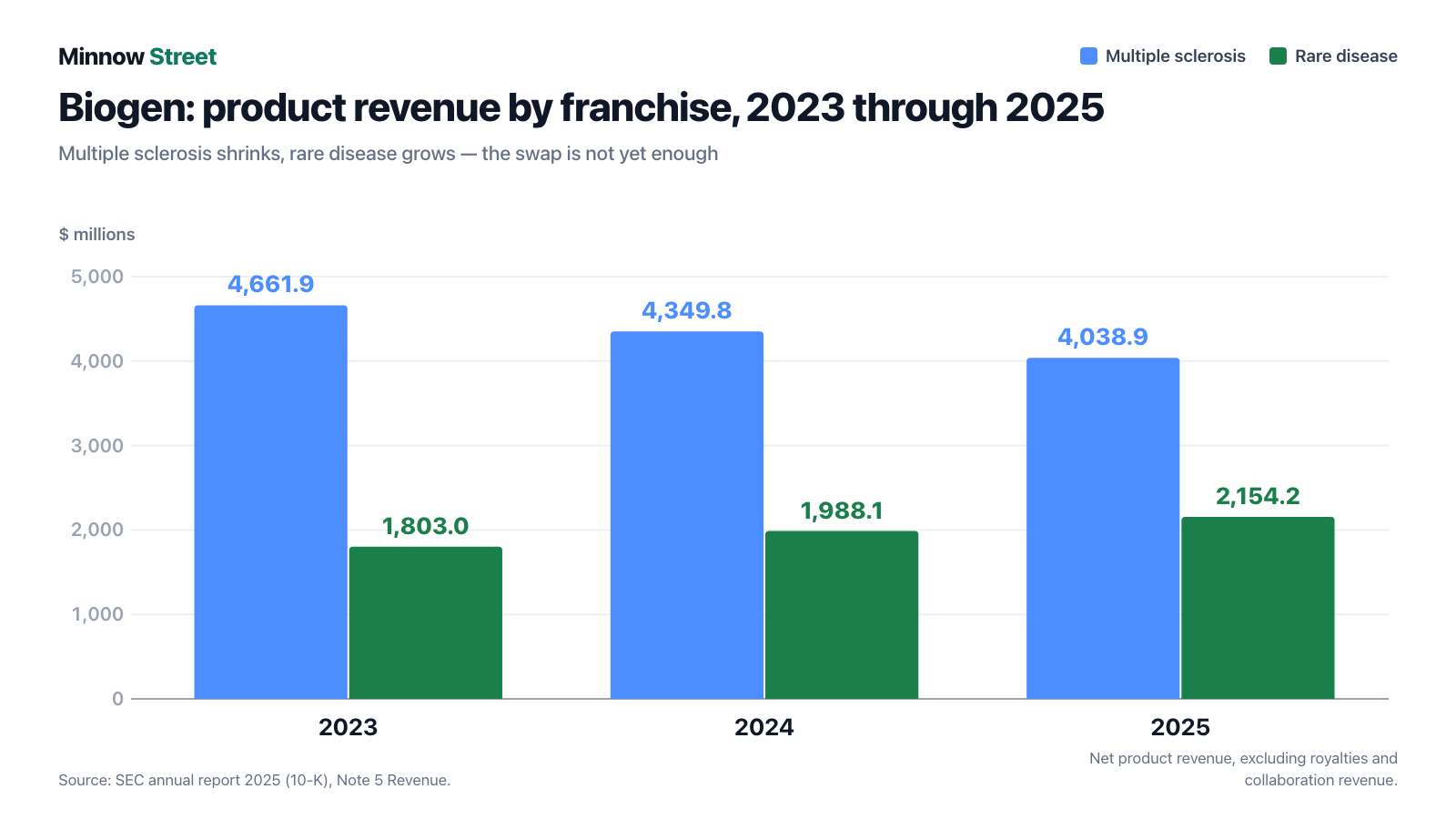
- Multiple sclerosis — the foundation. TYSABRI, VUMERITY, TECFIDERA, AVONEX and PLEGRIDY produced $4,038.9 million of product revenue in 2025. Multiple sclerosis is a condition in which the immune system attacks the protective sheath around nerve fibers; these medicines slow the relapses. This business is shrinking because the patents are running out.
- Rare disease — the hope. SPINRAZA for spinal muscular atrophy, SKYCLARYS for Friedreich ataxia and QALSODY for an inherited form of ALS together produced $2,154.2 million in 2025. This business is growing.
- Royalties on other companies\' medicines — the quiet giant. Old collaboration agreements with Genentech (Roche) pay Biogen royalties on RITUXAN, GAZYVA, LUNSUMIO and above all OCREVUS: $1,860.6 million in 2025, of which $1,414.9 million came from OCREVUS alone. The irony is not small: OCREVUS is itself a multiple sclerosis drug — Biogen earns on the medicine that is taking share from its own.
- Biosimilars and collaborations — the rest. Copies of biologic medicines (BENEPALI, IMRALDI, FLIXABI) brought in $729.1 million, the postpartum depression treatment ZURZUVAE $195.1 million, and the Alzheimer\'s collaboration with Japanese partner Eisai contributed $177.7 million.
Two terms carry the rest of this piece. A generic means a patent has expired and other manufacturers may copy the same molecule and sell it for a fraction of the price. A biosimilar is the same idea for biologically manufactured compounds — never exactly identical, but therapeutically equivalent. For the originator both mean the same thing: revenue disappears, often within a few quarters. Biogen sits on both sides of that trade. Which brings us to the central tension of this analysis, running through every chapter that follows: Biogen beats the earnings estimate quarter after quarter — but the base business has been shrinking for six years, and the growth meant to close the gap was just bought for $5.3 billion.
Where This Stock Landed on Our Desk — and What the Scanner Really Measures
We run roughly 3,500 stocks through our scanners every day. As of July 25, 2026 Biogen sits at rank 40 in the U.S. selection of our big earnings surprise scanner (81 hits), with a relative strength rating of 69 out of 99. The model looks for companies whose most recently reported earnings per share came in well above the analyst estimate and whose share price has held up better than the market. To repeat it yourself: open the scanner, set the country filter to "US", sort by the surprise column. These lists are recalculated daily — the ranking is a dated snapshot, not a property of the company.
Now the honest reading. The beats are real and they repeat:
- First quarter of 2025: $3.02 against $2.95 expected — 2.4 percent above
- Second quarter of 2025: $5.47 against $3.88 — 41.0 percent above
- Third quarter of 2025: $4.81 against $3.88 — 24.0 percent above
- Fourth quarter of 2025: $1.99 against $1.62 — 22.8 percent above
- First quarter of 2026: $3.57 against $2.89 — 23.5 percent above
But those figures are not earnings under U.S. accounting rules. They come from the measure Biogen itself calls non-GAAP, which strips out amortization of acquired intangible assets, restructuring charges and one-time items. The gap is enormous. For 2025 Biogen reported $15.28 per diluted share on a non-GAAP basis — and $8.79 under GAAP. In the fourth quarter of 2025 the non-GAAP figure was $1.99 and the GAAP figure was a loss of $0.33. Remember the principle: an earnings-surprise scanner measures the distance between two expectations — not the distance between expectation and reality. What it looks like when a company beats five quarters running while revenue stands still, we saw at Puma Biotechnology — same scanner list, same pattern.
The Numbers Over the Years — Given Their Due
First what genuinely speaks for Biogen, and it is more than the revenue line suggests. The company was profitable in every single year, including the bad ones. It earns real money: $2,204.6 million of operating cash flow in 2025 against only $153.8 million of capital expenditure — leaving roughly $2,050.8 million of free cash flow. That is the number that matters when a company has to sit out a dry spell. And Biogen has cleaned house: the "Fit for Growth" cost program delivered roughly $1.0 billion in gross operating expense savings by the end of 2025, at the price of a net headcount reduction of roughly 1,400 and about $320 million in restructuring charges.
The newer products deliver, too. In the first quarter of 2026 SKYCLARYS grew to $151 million (up 22 percent), ZURZUVAE to $55 million (up 100 percent) and QALSODY to $33 million (up 110 percent). LEQEMBI, the Alzheimer\'s treatment Biogen markets together with Eisai, reached $168 million in global in-market sales, up 74 percent year over year, of which $86 million came from the United States. For the full year 2025, Alzheimer\'s collaboration revenue rose from $59.9 million to $177.7 million — close to a tripling.
It simply is not enough. Here is the line that matters:
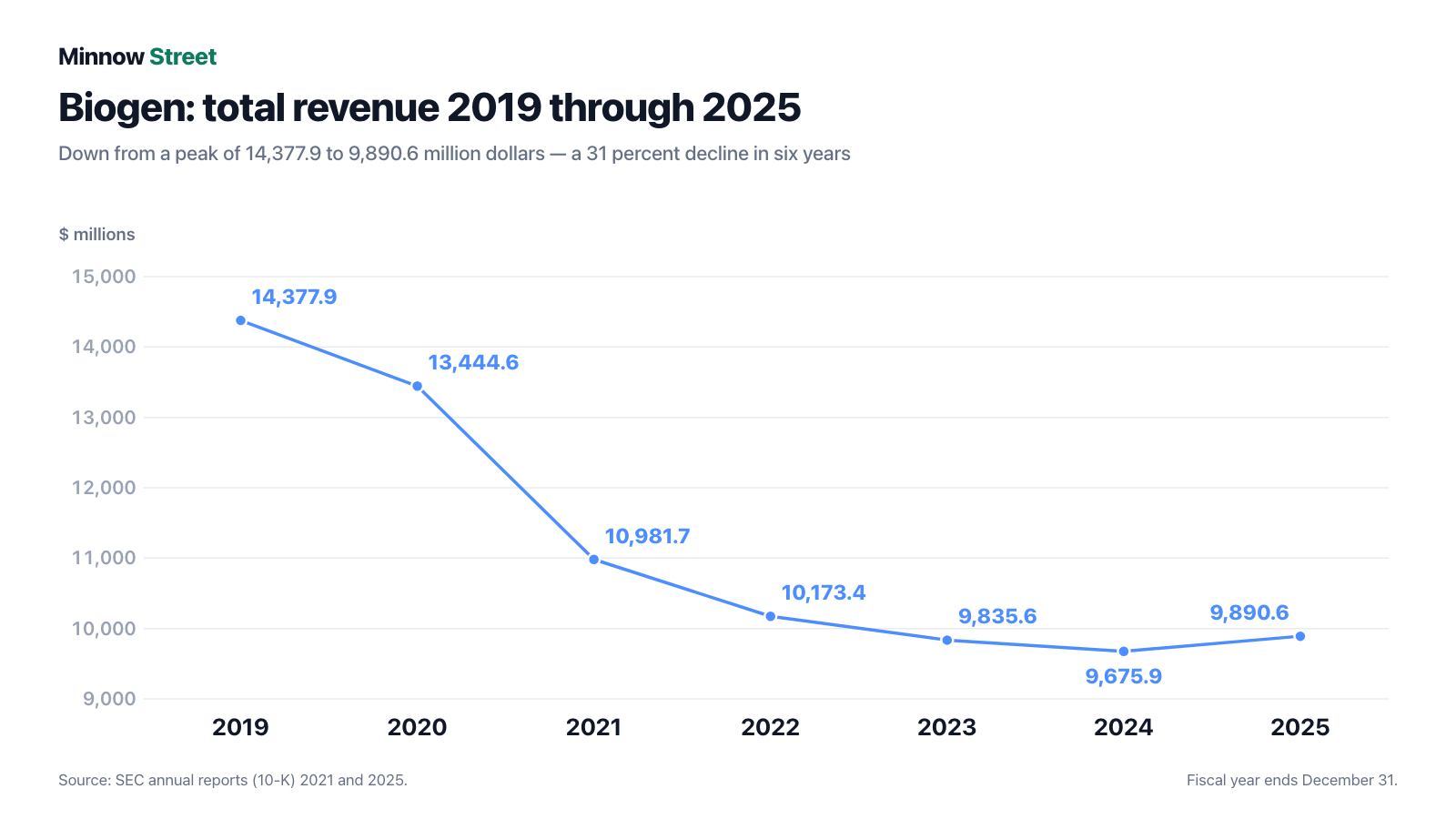
Earnings followed the line. GAAP diluted earnings per share stood at $31.42 in 2019, $7.97 in 2023, $11.18 in 2024 and $8.79 in 2025. Net income for 2025 was $1,292.9 million after $1,632.2 million the year before — down 20.8 percent. In plain terms: Biogen today is a profitable company with solid cash generation and a profit worth less than a third of what it earned in 2019.
What the Filings Say — the Uncomfortable Truths
Uncomfortable Truth No. 1: The Foundation Has Been Crumbling for Six Years
The multiple sclerosis franchise was once the most profitable in biotechnology. In 2019 it produced $8,529.3 million. In 2025 it produced $4,038.9 million — less than half. The fumarates took the worst of it, meaning TECFIDERA and its successor VUMERITY: from $4,438.2 million in 2019 to $1,426.5 million in 2025, down 68 percent. TECFIDERA alone fell from $1,012.5 million in 2023 through $967.1 million in 2024 to $679.7 million in 2025. The reason is written into the annual report in a way that cannot be misread:
"The generic competition for TECFIDERA has significantly reduced our TECFIDERA revenue and we expect that TECFIDERA revenue will continue to decline. In November 2025 the Technical Boards of Appeal of the European Patent Office revoked our EP 2 653 873 patent related to TECFIDERA, after which we stopped enforcing this patent and its national counterparts."
— Biogen Inc., Form 10-K for 2025, Item 1 Business, Competition (filed February 6, 2026)

And TECFIDERA is not the only piece wobbling. A biosimilar version of TYSABRI has been approved in the United States and the European Union since 2023; Biogen states that future TYSABRI sales will continue to be adversely affected. Copies of RITUXAN, part of the royalty stream, have been on the U.S. market for years. The good news alongside it: rare disease is catching part of the fall. The swap is happening — just more slowly than the foundation is giving way:
Uncomfortable Truth No. 2: Full-Year Guidance Was Cut — on the Day of the Big Beat
On February 6, 2026 Biogen guided to full-year 2026 non-GAAP diluted earnings of $15.25 to $16.25 per share. On April 29, 2026 the company reported the 23.5 percent beat for the first quarter — and in the same document cut the full-year range to $14.25 to $15.25. A full dollar less at both ends.
The explanation belongs in the picture, and it is reasonable: the new range includes roughly $1.00 of acquired in-process research and development, upfront and milestone expense, which Biogen does not forecast in advance. Arithmetically, therefore, the guidance is unchanged. In cash it is not: $1.00 per share on 148.4 million diluted shares is about $148 million — roughly 11 percent of the $1,292.9 million of net income booked in 2025. And it kept going: on July 1, 2026 Biogen said roughly $164 million of such payments would land in the second quarter (about $0.95 per share) and $290 million to $320 million in the third ($1.75 to $1.95 per share). The second half of the guidance is more uncomfortable still, because it is not an accounting question: full-year 2026 revenue is expected to decline by a mid-single-digit percentage versus 2025. A seventh year of decline, announced by the company itself.
Uncomfortable Truth No. 3: The Cash Cushion Is Nearly Gone After Apellis
At March 31, 2026 Biogen held roughly $4.7 billion in cash and marketable securities. That was the cushion for bad weather. On the same day, March 31, 2026, the company signed the agreement to buy Apellis Pharmaceuticals, a business with two approved medicines: SYFOVRE for geographic atrophy, a progressive retinal disease, and EMPAVELI for several rare blood and kidney disorders. The price: $41.00 per share in cash plus a contingent value right — a non-transferable claim on up to $4.00 more if SYFOVRE hits defined sales thresholds. How it would be paid for is stated in the quarterly report:
"We plan to fund the proposed acquisition of Apellis through approximately $3.6 billion of available cash and marketable securities on hand, supplemented by approximately $2.0 billion in bank loans."
— Biogen Inc., Form 10-Q for the quarter ended March 31, 2026, Note 2 Acquisitions (filed April 29, 2026)

The tender offer expired on May 13, 2026; 105,687,831 Apellis shares, or roughly 82.4 percent, were tendered. On May 14, 2026 the deal closed. The aggregate amount per the Form 8-K: approximately $5.3 billion, excluding fees and excluding any payments under the contingent value rights. The $2.0 billion credit agreement, signed with U.S. Bank on May 12, 2026, was drawn in full a day later — $1.0 billion on a 364-day tranche due May 12, 2027 and $1.0 billion due May 12, 2028. And it brings a condition that was not there before:
"The Credit Agreement also includes a financial covenant requiring Biogen to maintain, as of the end of each fiscal quarter, a maximum consolidated leverage ratio of 3.75 to 1.0 (which shall be temporarily increased, at the option of Biogen, to 4.25 to 1.0 upon notice by Biogen to U.S. Bank as a result of other material acquisitions from time to time, subject to customary limitations)."
— Biogen Inc., Form 8-K filed May 14, 2026, Item 1.01, Term Loan Credit Agreement

In plain language: before the deal Biogen was a company with plenty of cash and moderate debt — $6,288.5 million of long-term notes against $4.7 billion of liquid assets at March 31, 2026, roughly $1.6 billion of net debt. After it, roughly $8.3 billion of financial debt faces considerably less liquidity, and a ratio with a contractual ceiling now hangs over everything. The cushion that made a shrinking base business bearable for years was consumed in a single transaction. The first balance sheet date on which this can be checked is June 30, 2026.
Uncomfortable Truth No. 4: For $5.3 Billion, Not a Single Apellis Number Has to Be Filed
When a U.S. company buys a significant business, it normally files an amendment with the SEC: the audited statements of the acquired business plus pro forma numbers showing what the combined company would have looked like. Biogen announced exactly that in its report of May 14, 2026. On June 10, 2026 it withdrew the announcement:
"Subsequent to the filing of the Original Report and upon further analysis, Biogen has determined that financial statements required by Item 9.01(a) of Form 8-K and pro forma financial information required by Item 9.01(b) of Form 8-K, in each case, relating to the Merger are not required because the Merger was not a 'significant' acquisition as defined in Regulation S-X."
— Biogen Inc., Form 8-K/A filed June 10, 2026, Item 9.01

This is not a trick — the Regulation S-X thresholds measure the purchase price against, among other things, the buyer\'s total assets, and Biogen is large enough that $5.3 billion stays below them. But it means that the first reliable number on what Apellis actually contributes appears only in the quarterly report for June 30, 2026 — and by then already consolidated, not as a standalone set of accounts. Until that point, everything said about the contribution of SYFOVRE and EMPAVELI is an expectation. Remember: what a company is not required to disclose, it rarely discloses voluntarily.
Uncomfortable Truth No. 5: More Than Half the Balance Sheet Is Goodwill and Rights
At March 31, 2026 Biogen carried total assets of $29,483.1 million. Inside that sit $6,488.7 million of goodwill and $9,053.5 million of intangible assets — together $15,542.2 million, or 52.7 percent. In plain terms: more than half of what the balance sheet calls assets is not a building, a machine or a bank balance, but the carrying value of acquired drug rights and the premium paid in earlier acquisitions. Measured against equity of $18,651.7 million it is 83.3 percent.
For a pharmaceutical company that is normal — drug rights are the asset. But there is a flip side worth knowing: such items do not wear out like a machine, they are written down when the expectation fails. If a medicine misses approval or sells worse than planned, the value leaves the balance sheet and the income statement in one stroke. Biogen knows the drill: 2025 alone carried $515.0 million of amortization and impairment of acquired intangible assets, plus a $52.9 million impairment on a leased building from the Reata acquisition. Apellis makes that block larger — by how much will only appear in the next quarterly report. Which is exactly why the question "can growth be bought?" is not rhetorical here.
Valuation — What the Market Is Paying
As of July 25, 2026 Biogen carries a market capitalization of roughly $29.9 billion. The cross-check adds up cleanly: 147,637,117 shares outstanding (as of April 27, 2026) times the last closing price of $202.19 (July 24, 2026) also gives $29.85 billion. Four orders of magnitude follow — all to be read as ranges, not point values:
- Price-to-sales of roughly 3.0 on 2025 revenue of $9,890.6 million. For a pharmaceutical company with falling revenue that is no bargain, but it is not stretched either.
- Price-to-earnings of roughly 21 to 22 on trailing twelve-month GAAP earnings of $9.38 per share — and only roughly 13 to 14 on the company\'s own 2026 guidance of $14.25 to $15.25. That gap is the entire argument about Biogen in one number: believe the non-GAAP measure and you see a cheap stock; follow the accounting rules and you see an ordinary one.
- Price-to-book of roughly 1.6 against book value of $126.37 per share. Since more than half of the asset side is goodwill and rights, this anchor is softer than it looks.
- No dividend. Biogen pays none. The share repurchase program authorized in October 2020 for $5.0 billion still had roughly $2.1 billion of room at March 31, 2026 — used neither in the first quarter of 2026 nor in the first quarter of 2025.
The professionals lean cautiously positive: 37 firms cover the stock, 13 with a strong buy, 4 with a buy, 20 with a hold and none with a sell; the average price target is $227.59 (data as of July 25, 2026). That is a mood reading, not a forecast — and analyst targets are the first thing to move when a quarter goes wrong. For a neighbor whose revenue is running in the opposite direction, see our analysis of Eli Lilly.
Opportunities and Risks at a Glance
What speaks for Biogen:
- Real cash generation. $2,204.6 million of operating cash flow in 2025 against only $153.8 million of capital expenditure — roughly $2.05 billion of free cash flow to service interest and fund deals.
- The newer products grow at double-digit rates. In the first quarter of 2026: SKYCLARYS up 22 percent, ZURZUVAE up 100 percent, QALSODY up 110 percent, LEQEMBI global in-market sales up 74 percent to $168 million.
- Royalties as a quiet buffer. $1,860.6 million from the anti-CD20 programs in 2025, of which $1,414.9 million from OCREVUS — money that arrives without a sales force and rose again versus 2024.
- Apellis brings two approved medicines, not just pipeline hope. SYFOVRE and EMPAVELI already sell; Biogen expects the transaction to be accretive from 2027.
- Cost discipline is proven. The "Fit for Growth" program delivered roughly $1.0 billion in gross savings — demonstrated, not merely announced.
What speaks against Biogen:
- Revenue is falling for a seventh year. From $14,377.9 million in 2019 to $9,890.6 million in 2025, and the company itself guides to a mid-single-digit percentage decline for 2026.
- The cushion is gone. Roughly $3.6 billion of the $4.7 billion of liquidity (March 31, 2026) went into Apellis, joined by $2.0 billion of bank debt carrying a leverage ceiling of 3.75 to 1.0 and a $1.0 billion repayment due May 12, 2027.
- GAAP earnings are far smaller than the non-GAAP measure. $8.79 versus $15.28 per share in 2025 — and a loss of $0.33 in the fourth quarter of 2025.
- 52.7 percent of the balance sheet is goodwill and rights. $15,542.2 million out of $29,483.1 million at March 31, 2026; every disappointed expectation lands here as a write-down.
- Two wholesalers account for 43.8 percent of gross product revenue (28.0 percent and 15.8 percent in 2025, after 25.9 percent and 13.4 percent in 2024) — the dependency grew within a single year.
- Biogen does not have the final word on LEQEMBI. Under the collaboration agreement, final decision-making authority rests with Eisai; costs and profits are shared equally.
A Human Conclusion
Back to the beat trap from the opening. Five quarters above the estimate is not an illusion — it is a pattern, and it belongs to the truth about Biogen just as much as the falling revenue line does. The company works with discipline, has cut costs it can prove, keeps developing and earns money every year. None of that answers the one question on the cover image: can growth be bought?
Biogen gave a very expensive answer on May 14, 2026. Roughly $5.3 billion, $3.6 of it out of its own account and $2.0 on credit, for two approved medicines and the prospect of a better 2027. It can work — Apellis sells real products to real patients, not slides. It can also mean that a company which could not hold its foundation has spent the cushion that would have protected it. Which of the two stories is true will not be settled by an analyst estimate but by three sober numbers in the next report: the revenue contributed by Apellis, the leverage ratio against the 3.75 to 1.0 ceiling, and whether 2026 revenue really falls only by a mid-single-digit percentage.
What you do with that is your decision. And that is exactly as it should be.
Sources
- Biogen Inc., Form 10-K for 2025 (filed February 6, 2026; Item 1 Business and Competition, Item 1A Risk Factors, Note 4 Restructuring, Note 5 Revenue, consolidated financial statements)
- Biogen Inc., Form 10-Q for the quarter ended March 31, 2026 (filed April 29, 2026, most recent periodic report; Note 2 Acquisitions, balance sheet, Part I Item 2, Part II Item 2)
- Biogen Inc., Form 10-K for 2021 (filed February 3, 2022; revenue series 2019 through 2021)
- Biogen Inc., first quarter 2026 news release (Exhibit 99.1 to the Form 8-K filed April 29, 2026; 2026 guidance, product revenue)
- Biogen Inc., fourth quarter and full year 2025 news release (Exhibit 99.1 to the Form 8-K filed February 6, 2026; original 2026 guidance)
- Biogen Inc., Form 8-K filed May 14, 2026 (Items 1.01, 2.01 and 2.03: completion of the Apellis acquisition, CVR agreement, $2.0 billion credit agreement)
- Biogen Inc., Form 8-K/A filed June 10, 2026 (Item 9.01: Apellis financial statements and pro forma information not required)
- Biogen Inc., Form 8-K filed July 1, 2026 (Item 2.02: expected acquired in-process research and development expense for the second and third quarters of 2026)
- Biogen Inc., Form 8-K filed June 10, 2026 (Item 5.07: voting results of the annual meeting held June 9, 2026)
- All SEC filings of Biogen Inc. (CIK 0000875045)
- Fundamental data (valuation metrics, analyst consensus, quarterly estimates and surprise figures; data as of July 25, 2026)
This analysis is journalistic commentary on publicly available company filings. It is not investment advice, not a recommendation to buy or sell, and not a solicitation to buy or sell securities. Shares can suffer substantial losses, up to and including the total loss of the capital invested. All figures come from the sources named above and carry the reporting date stated there; they may have changed since. The author holds no position in the security discussed at the time of publication.
Our Bottom Line at a Glance
- Earnings quality neutral
- Five quarters above the analyst estimate, most recently by 23.5 percent (first quarter of 2026: $3.57 against $2.89). But the beats refer to the non-GAAP measure: 2025 showed $15.28 per diluted share there and only $8.79 under GAAP — and a loss of $0.33 in the fourth quarter of 2025.
- Revenue trend negative
- Revenue fell from $14,377.9 million (2019) to $9,890.6 million (2025), down 31 percent. The multiple sclerosis franchise halved from $8,529.3 million to $4,038.9 million; the fumarates TECFIDERA and VUMERITY lost 68 percent. For 2026 Biogen itself guides to a mid-single-digit percentage decline (as of April 29, 2026).
- Cash flow and cost discipline positive
- Operating cash flow of $2,204.6 million in 2025 against only $153.8 million of capital expenditure — roughly $2.05 billion of free cash flow. The "Fit for Growth" program delivered roughly $1.0 billion in gross operating expense savings by the end of 2025 at a net headcount reduction of roughly 1,400 and about $320 million in restructuring charges.
- Growth products positive
- In the first quarter of 2026 SKYCLARYS grew to $151 million (up 22 percent), ZURZUVAE to $55 million (up 100 percent) and QALSODY to $33 million (up 110 percent); global LEQEMBI in-market sales rose 74 percent to $168 million. The rare disease franchise grew from $1,803.0 million (2023) to $2,154.2 million (2025).
- Balance sheet and funding negative
- Roughly $3.6 billion of the $4.7 billion of liquidity (March 31, 2026) went into Apellis, joined by $2.0 billion of bank debt carrying a leverage ceiling of 3.75 to 1.0 and a $1.0 billion repayment due May 12, 2027. At March 31, 2026 the balance sheet already carried $6,288.5 million of long-term notes; 52.7 percent of total assets are goodwill and intangible assets.
- Deal transparency neutral
- On June 10, 2026 Biogen determined that the Apellis merger was not a significant acquisition as defined in Regulation S-X, so financial statements and pro forma information are not required. Formally correct against $29,483.1 million of total assets, it means in practice that the first reliable contribution from SYFOVRE and EMPAVELI appears only in the quarterly report for June 30, 2026.
Biogen is the beat trap in pure form: earnings came in above the analyst estimate five quarters in a row, most recently by 23.5 percent — and yet revenue has fallen 31 percent since 2019 to $9,890.6 million, with a further decline as the company's own guidance for 2026. The multiple sclerosis foundation halved, the growth products grow at double-digit rates but do not yet fill the gap. To close it, Biogen acquired Apellis Pharmaceuticals on May 14, 2026 for roughly $5.3 billion — paid from $3.6 billion of its own liquidity and $2.0 billion of bank debt carrying a leverage ceiling of 3.75 to 1.0. The cushion that made the shrinking bearable is now largely spent. Not investment advice.
What Our Rating Means
Open questions
The business works in principle, but one material question is open. As long as it stays open, our findings do not carry a quality verdict.
Buying today means buying a profitable biotechnology company with roughly $2 billion of free cash flow at about 13 to 14 times its own 2026 guidance — and, at the same time, three open questions that will all be answered in the same report. First: what does Apellis actually contribute, measured against quarterly revenue of $2,477.8 million? Second: where does the consolidated leverage ratio sit against the contractual ceiling of 3.75 to 1.0 after $3.6 billion of liquidity left and $2.0 billion of credit was drawn? Third: does revenue really fall only by a mid-single-digit percentage? Watching here means waiting for the quarterly report covering June 30, 2026 rather than betting on the next earnings beat — which says less about the state of the business than about the level of the estimate. The decision is yours.
A journalistic assessment by our editorial team at the time of the deep dive, based on public sources — not investment advice and not a solicitation to buy or sell. Your personal circumstances (investment goals, risk capacity, taxes) cannot be taken into account. What our levels mean, how verdicts are formed, and what conflicts of interest exist →
Worth Noting
- Biogen came onto the research list through our in-house stock scanner: rank 40 in the U.S. selection of the biggest earnings surprises (81 hits), relative strength 69, as of July 25, 2026. Scanner lists are recalculated daily, so the ranking is a dated snapshot. The scanner measures the distance between reported earnings and the analyst estimate — not the distance between expectation and reality.
- Two earnings measures that must not be confused: GAAP diluted earnings per share were $8.79 in 2025, the non-GAAP figure $15.28. The scanner surprise values and the guidance range of $14.25 to $15.25 refer to the non-GAAP measure, which excludes amortization of acquired drug rights, restructuring charges and one-time items.
- Data currency: the most recent periodic report is the Form 10-Q for the quarter ended March 31, 2026, filed April 29, 2026. Everything filed after that was reviewed — the tender offer amendments of May 6, 12 and 14, 2026, the Schedule 13D/A of May 14, 2026, the Form 8-K of May 14, 2026 on the completion of the Apellis acquisition, the Forms 8-K and 8-K/A of June 10, 2026 and the Form 8-K of July 1, 2026. The balance sheet figures for March 31, 2026 therefore predate the closing; the first balance sheet including Apellis is the quarterly report for June 30, 2026. The share count comes from the most recent document that names one (147,637,117 as of April 27, 2026). Valuation figures are orders of magnitude as of July 25, 2026, not daily prices.
- Possible confusion: Biogen Inc. was named IDEC Pharmaceuticals Corp. until 2003 and Biogen Idec Inc. until 2015, so the SEC history under CIK 0000875045 begins under a different name. The ticker BIIB belongs to this company alone.
Frequently Asked Questions
Because reported earnings per share came in above the analyst estimate five quarters in a row. In the first quarter of 2026 it was $3.57 against $2.89 expected — 23.5 percent above. Before that: 22.8 percent (fourth quarter of 2025), 24.0 percent (third quarter), 41.0 percent (second quarter). Our in-house stock scanner therefore ranks the shares 40th in the U.S. selection of its biggest earnings surprises (81 hits, relative strength 69, as of July 25, 2026).
Because the multiple sclerosis base business is under generic and biosimilar pressure. The fumarates TECFIDERA and VUMERITY together produced $4,438.2 million in 2019 and only $1,426.5 million in 2025. The whole multiple sclerosis franchise fell from $8,529.3 million to $4,038.9 million. Earnings still beat because Biogen has cut costs and because analyst estimates are set against the lower revenue base. For 2026 the company guides to a mid-single-digit percentage revenue decline.
Biogen completed the acquisition of Apellis Pharmaceuticals on May 14, 2026: $41.00 per share in cash plus a non-transferable right to up to $4.00 more if SYFOVRE reaches defined sales thresholds. The aggregate amount per the Form 8-K is approximately $5.3 billion excluding fees. The purchase brought two approved medicines: SYFOVRE for geographic atrophy of the retina and EMPAVELI for rare blood and kidney disorders.
From roughly $3.6 billion of its own liquidity and roughly $2.0 billion in bank loans. At March 31, 2026 Biogen held $4.7 billion in cash and marketable securities. The credit agreement signed with U.S. Bank on May 12, 2026 comprises two tranches of $1.0 billion each: tranche A matures on May 12, 2027, tranche B on May 12, 2028. The agreement carries a maximum consolidated leverage ratio of 3.75 to 1.0, measured at the end of every fiscal quarter.
Because Biogen publishes two measures. Under U.S. accounting rules (GAAP), 2025 earnings were $8.79 per diluted share; on the company's own non-GAAP basis, which strips out amortization of acquired rights and one-time items, they were $15.28. In the fourth quarter of 2025 the non-GAAP figure was $1.99 while GAAP showed a loss of $0.33. Scanner surprise figures refer to the non-GAAP measure.
No. Biogen pays no dividend. Instead it has a share repurchase program authorized by the board in October 2020 for $5.0 billion with no expiration date. Roughly $2.1 billion of that remained available at March 31, 2026. No shares were repurchased in the first quarter of 2026 or in the first quarter of 2025.
Smaller than the headlines suggest. Global in-market sales reached $168 million in the first quarter of 2026 (up 74 percent), of which $86 million in the United States. Only Biogen's 50 percent share of net revenue and cost of sales shows up in its income statement: $59.5 million in the first quarter of 2026 and $177.7 million for the full year 2025. Final decision-making authority over the collaboration rests with partner Eisai.
Biogen sells no AI and reports no AI revenue, but it uses the technology. In the 2025 annual report and the quarterly report for March 31, 2026 the company states that AI-based software is increasingly used in the industry, including by Biogen, for research, marketing, manufacturing and commercialization, and that it expects to increase that usage. It also lists the use as a separate risk factor. Our AI classification therefore lists Biogen as a user.
Found an error?
Did you spot a factual error, an outdated number, or a typo in this deep dive? Let us know briefly — your report goes straight to the editorial team.