Nextdoor Stock: 105 Million Neighbors — and 22 Million Who Actually Show Up
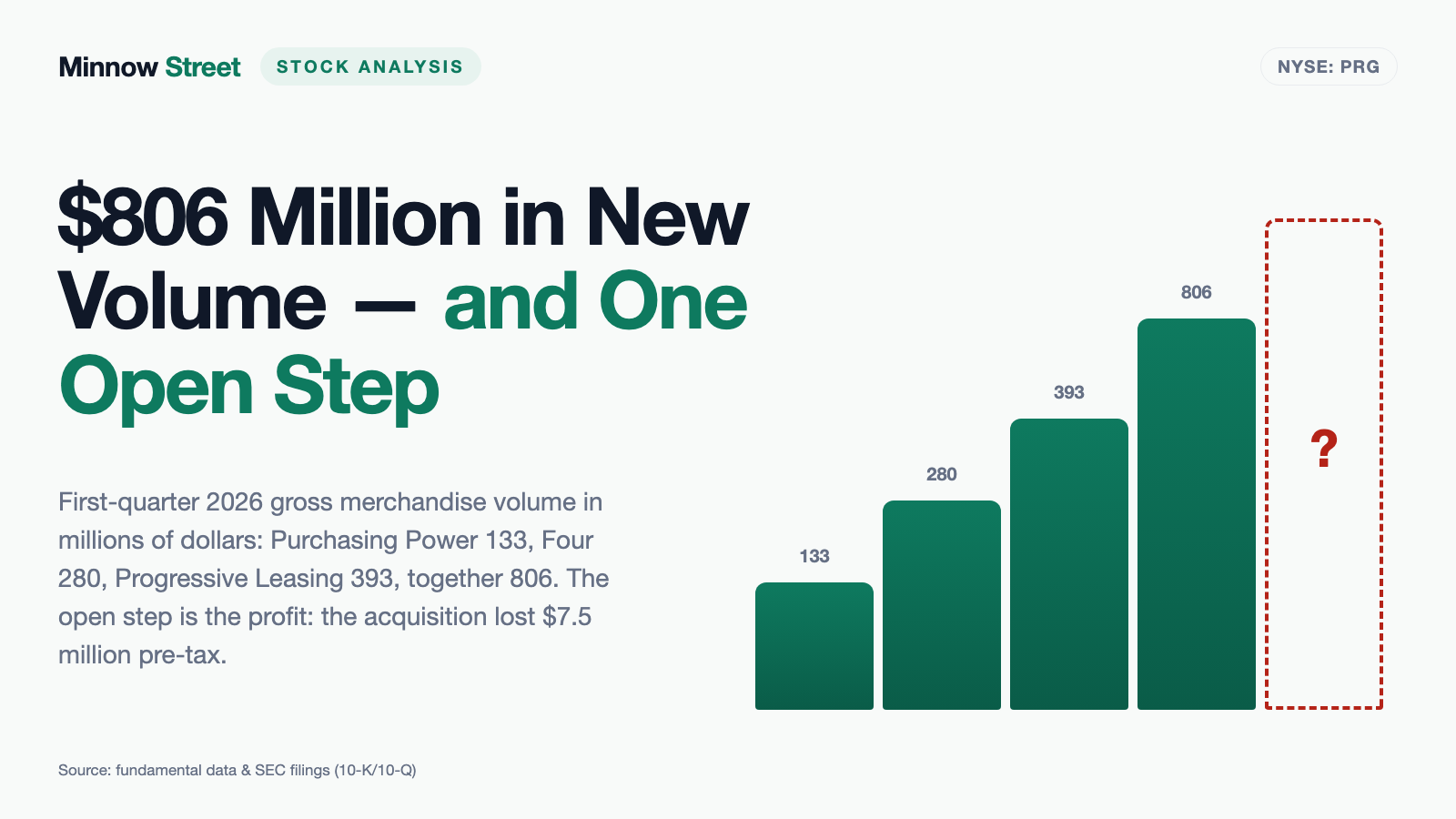
Nextdoor ranks 38th in our in-house Big Earnings Surprise screen (U.S. selection, as of July 25, 2026): four quarters in a row the reported loss per share came in smaller than analysts expected. We read the 2025 annual report (10-K), the quarterly report (10-Q) for March 31, 2026, and everything filed with the U.S. securities regulator, the SEC, since — and found three numbers that belong side by side: more than 105 million registered neighbors, 22.3 million weekly active ones, and $373.2 million sitting in the bank. Whether that becomes a business is decided by the number in the middle.
 Thomas Mücke
Founder & Publisher
Thomas Mücke
Founder & Publisher
Chart
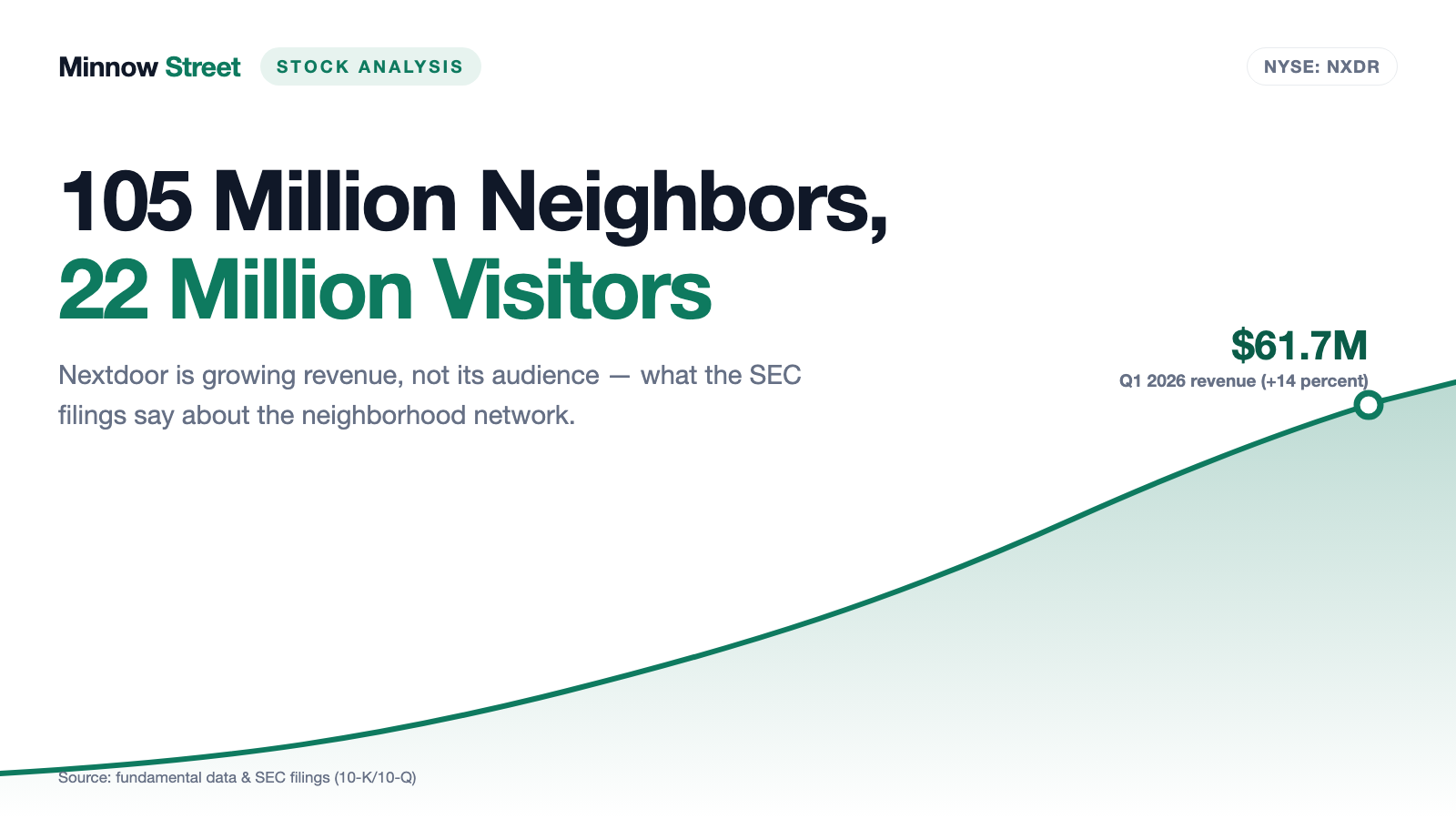
Interactive price chart (TradingView).
Note: pure fact-based analysis, not investment advice and not a solicitation to buy or sell. All figures without guarantee.
There is an investor trap that springs on platform stocks almost every time: the big-number trap. It works like this — a company names an enormous user base, your brain quietly multiplies it by an advertising rate, and suddenly you are looking at a billion-dollar business. Nextdoor Holdings, Inc. (NYSE: NXDR) supplies the big number in the very first sentence of its annual report: more than 105 million Verified Neighbors across more than 350,000 neighborhoods in 11 countries. A few pages later comes the second number, the one nobody puts in a headline: 22.3 million of them actually opened the app in an average week during the first quarter of 2026.
So four out of five registered neighbors do not show up in a normal week. Before we turn that into a verdict, let us make a deal: we read together what the company itself filed, under penalty of law, with the U.S. securities regulator, the SEC — the 2025 annual report (10-K), the quarterly report (10-Q) for March 31, 2026, and everything submitted since. There is more candor in there than you would expect.
What Nextdoor actually does — the bulletin board of your block
Nextdoor is a social network with an unusual entry ticket: you do not sign up with a made-up handle but with your home address, and that address gets verified. Once inside, you mostly see what is happening in your own neighborhood — lost cats, contractor recommendations, fire department warnings, a couch going free. The company calls these vetted members Verified Neighbors and describes itself this way:
"Nextdoor is the essential neighborhood network connecting over 105 million Verified Neighbors to the people, places, and information that matter most in their local communities. Operating in over 350,000 neighborhoods across 11 countries …"
— Nextdoor Holdings, Inc., SEC annual report, Form 10-K for 2025, Item 1
The money comes exclusively from advertising. A painting contractor buys a handful of ZIP codes, an insurer buys an entire region, a city government posts a road closure notice. What Nextdoor sells is something the big platforms can only approximate: local relevance attached to a name and an address. The advertising business runs through a self-serve booking interface, through programmatic partners and through a sales team for larger accounts. Since 2025 there are also AI tools that generate locally relevant ad copy and imagery.
In 2025 the company rebuilt the product. Under the banner of "the new Nextdoor," the feed moved from a pure neighbor forum to a mix of neighbor posts, local news from publisher partners and real-time alerts, sorted by algorithms. Anyone who knows platform economics can guess the logic: more editorial content means more reasons to open the app, and more opens mean more ad slots. How hard that is for ad-funded media businesses we took apart in our analysis of People Inc. — a publisher with 200 million readers that also carries its costs almost entirely on advertising.
And that brings us to the central tension of this analysis, which runs through every chapter: Nextdoor is not growing its audience, it is growing its price. The number of weekly visitors has been flat for five quarters — revenue rises because more advertising is sold per neighbor. The question is how far that lever can be pulled before the feed breaks.
How the stock landed on our desk
We run roughly 3,500 stocks through our screens every day. As of July 25, 2026, Nextdoor sits at rank 38 in the U.S. selection of our Big Earnings Surprise ranking (81 hits). To reproduce it: open the screen, set the country filter to U.S. — the list shows the serial surprisers in screen order and is recalculated daily, so the rank can shift.
The streak looked like this (fundamental data, as of July 25, 2026):
- Q2 2025: minus $0.04 against minus $0.06 expected — 33.3 percent better.
- Q3 2025: minus $0.02 against minus $0.06 expected — 66.7 percent better.
- Q4 2025: minus $0.01 against minus $0.03 expected — 66.7 percent better.
- Q1 2026: minus $0.03 against minus $0.04 expected — 25.0 percent better.
Read the signs again. All four numbers are negative. Nextdoor beat expectations by losing less money than forecast, not by earning more. That is neither a trick nor an accusation — a shrinking loss is good news. But it is something other than an earnings surprise, and the difference belongs at the top of any valuation. Remember the principle: a surprise ranking measures how wrong the estimate was, not how good the business is.
The fundamental view of the same data set is mixed (as of July 25, 2026): a relative strength rating of 72 — solid, not an outlier; an Altman Z-score of 7.45, a bankruptcy early-warning gauge whose danger zone historically starts below 1.8 (Nextdoor is nowhere near it, because there is essentially no debt on the balance sheet); and a Piotroski F-score of 5 out of 9. The Piotroski is a nine-point test of the direction of a balance sheet: are returns, leverage, liquidity and margins improving? Five out of nine is middling — a genuinely healthy company scores 8 or 9.
One note on the price history, or you will hunt through the charts in vain: the ticker has only been NXDR since the summer of 2025. Before that the same stock traded as "KIND" — a nod to the kindness reminder Nextdoor shows inside its app. The 2025 annual report records it in one sentence:
"Our Class A common stock is listed and traded on the New York Stock Exchange under the trading symbol “NXDR”. Effective July 21, 2025, our trading symbol was changed from “KIND” to “NXDR”."
— Nextdoor Holdings, Inc., SEC annual report, Form 10-K for 2025, Item 5

One more piece of provenance: Nextdoor did not go public in the traditional way but merged on November 5, 2021 with the shell company Khosla Ventures Acquisition Co. II — which is why that name still appears as a former name in the SEC register. Listings through a shell company have a distinctive afterlife; our analysis of Virgin Galactic shows what it can look like.
The numbers over the years — what genuinely impresses
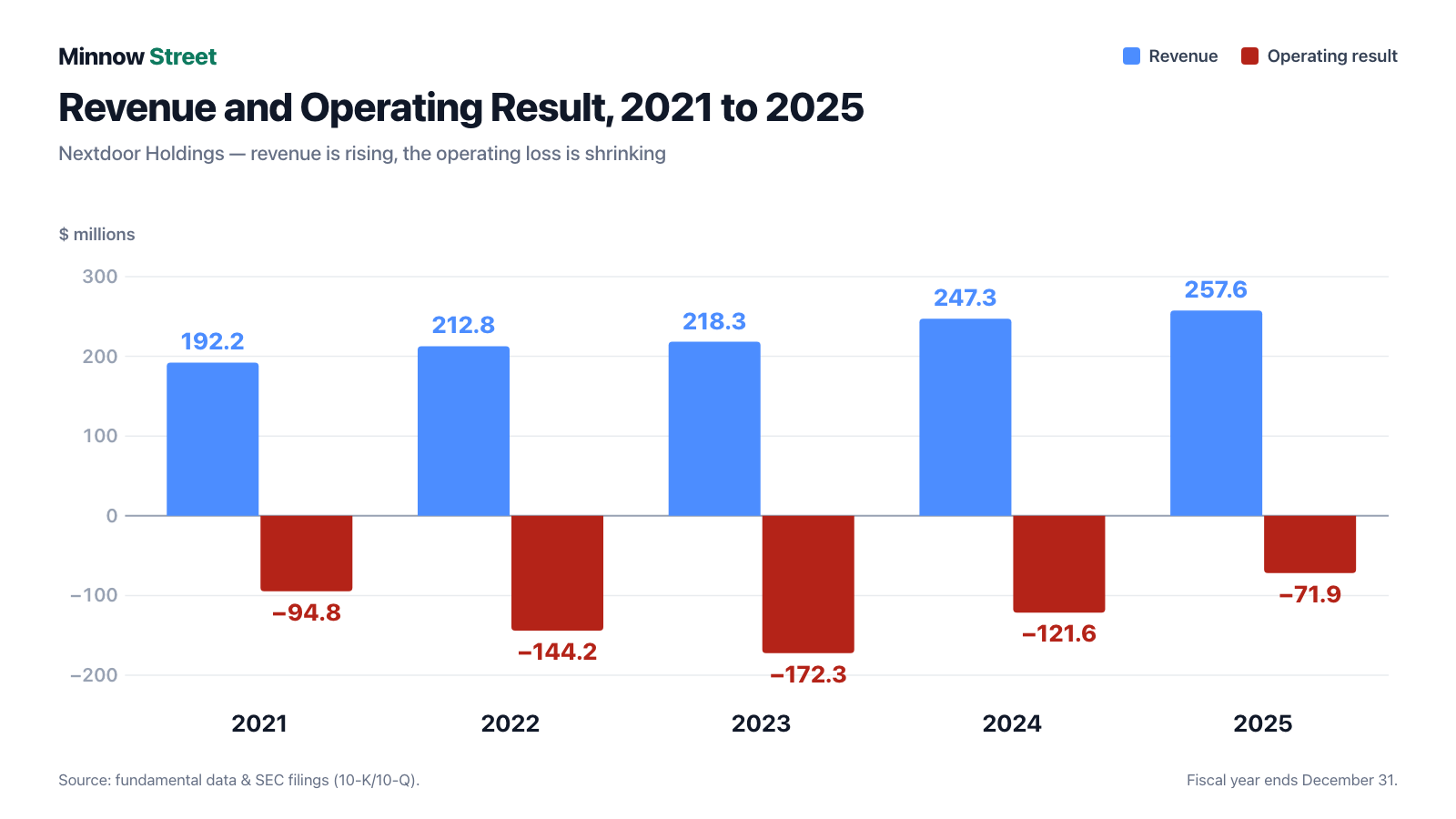
Let us start with what is good, because it is more than the share price suggests. Revenue has risen by a third in five years: from $192.2 million (2021) through $212.8 million (2022), $218.3 million (2023) and $247.3 million (2024) to $257.6 million (2025). The other series is more impressive. The operating loss, still $172.3 million in 2023, shrank to $121.6 million (2024) and $71.9 million (2025). In two years, roughly $100 million of annual loss was taken out while revenue kept climbing.
In 2025 came the moment investors in young platforms wait years for: cash finally flowed into the business rather than out of it — positive $6.5 million, after negative $20.2 million (2024), negative $59.3 million (2023) and negative $60.5 million (2022). With capital expenditure of only $0.6 million, almost all of that survives as free cash flow. It is a thin strip of black after four years of red — but it is one.
The first quarter of 2026 extended the trend and even accelerated it: $61.7 million of revenue (up 13.8 percent from $54.2 million a year earlier), an operating loss of only $15.3 million against $27.0 million, and a net loss of $11.4 million against $22.0 million. Adjusted EBITDA, as reported by the company, came in at negative $0.2 million — essentially break-even, after negative $9.2 million a year earlier. The chief financial officer called it "a standout quarter" in the release of May 6, 2026.
And the balance sheet is a relief. As of March 31, 2026 there were $56.1 million in cash and $317.0 million in marketable securities — $373.2 million together — against total liabilities of $51.0 million. Not one dollar of that is borrowed money; the largest items are office lease obligations. The equity ratio stood at 88.6 percent. If you wonder why a loss-making company is under no pressure, that is the answer.
Uncomfortable truth No. 1: the visitor count is standing still
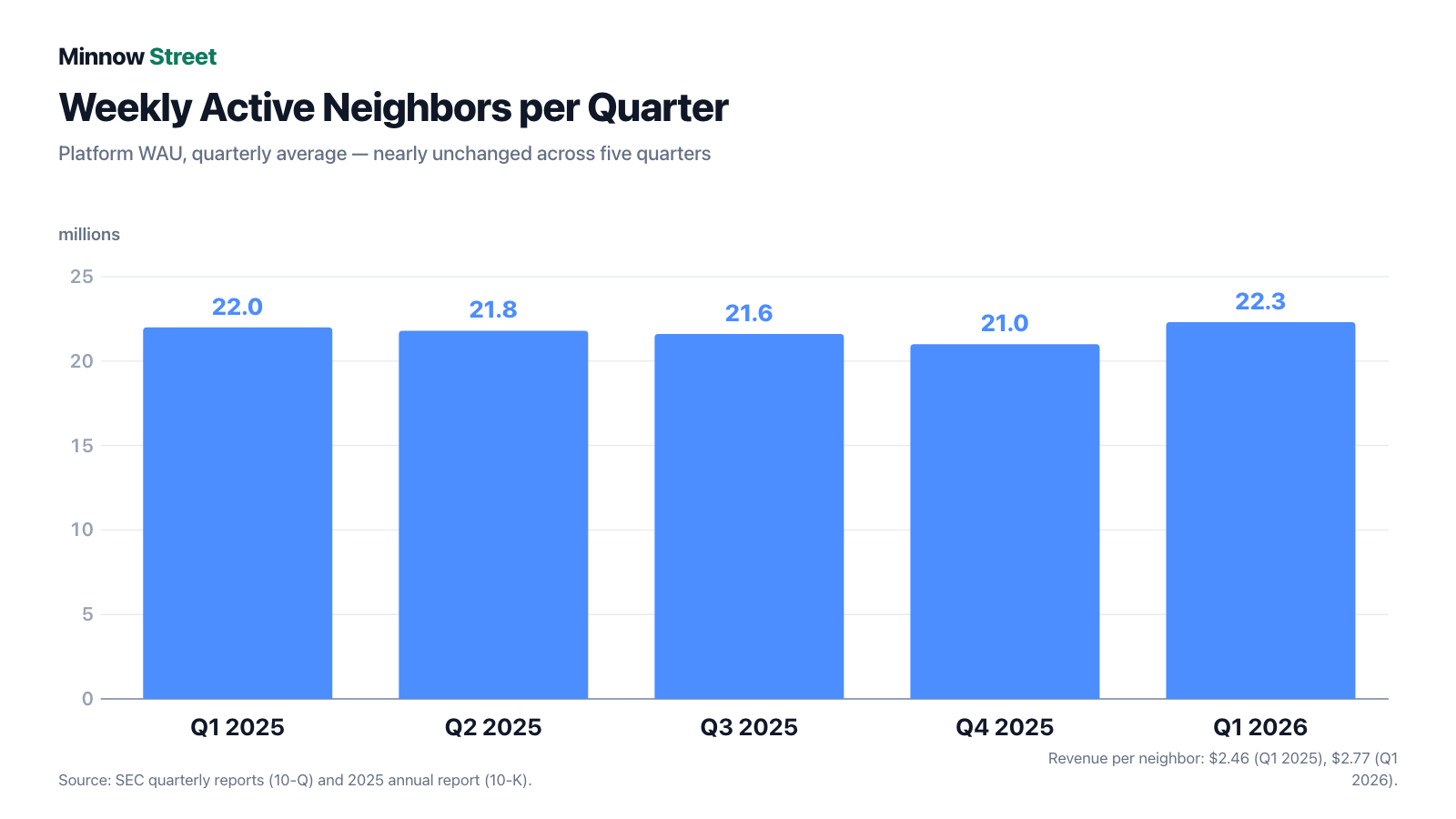
Now to the metric everything hangs on. Nextdoor reports Platform WAU — the average number of people who open the app or visit the website in a given week. Here is the sequence of the last five quarters, straight from the filings:
The weakest point of that series sits in the annual report, and the company states it plainly:
"Our Platform WAU for the three months ended December 31, 2025 and 2024 was 21.0 million and 22.2 million, respectively, which represents a 5% decrease period over period."
— Nextdoor Holdings, Inc., SEC annual report, Form 10-K for 2025, Item 7

So where did the revenue growth come from? From price. Revenue per weekly active neighbor — the company calls it Platform ARPU — rose from $11.36 to $11.94 for the full year and from $2.46 to $2.77 in the first quarter, up 12.6 percent. Translated: every visitor sees more advertising, or more expensive advertising. That is the lever the entire case rests on, and it has a natural limit, because at some point the feed is full.
In fairness: the first quarter of 2026 was the first in a while with an increase, and the company described weekly active users as an all-time high in its release. One quarter is not a turn — but it is the number the product overhaul has to be judged by.
Uncomfortable truth No. 2: the core metric had to be corrected
When a single metric carries the whole story, you want to be sure it is right. In 2025 Nextdoor had to admit it was not. An error in counting iOS push notifications meant weekly active users had been overstated for five quarters — from the first quarter of 2024 through the first quarter of 2025. The correction appeared in the quarterly report for the second quarter of 2025. In that same quarter the company also switched definitions: from "WAU" (which counted anyone who opened the app or engaged with an email containing monetizable content) to the narrower "Platform WAU."
"For example, in Q2 2025, we identified an issue related to iOS push notifications in the calculation of our Platform WAU metric which resulted in an immaterial overstatement of the Platform WAU figures previously disclosed for Q1 2024 through Q1 2025."
— Nextdoor Holdings, Inc., SEC quarterly report, Form 10-Q for March 31, 2026, Item 1A
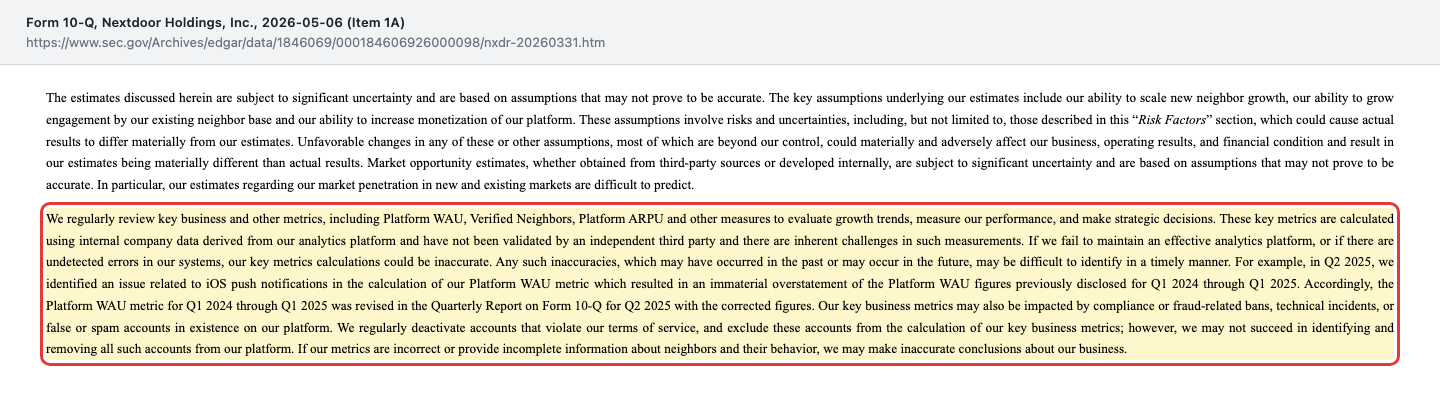
Two things matter here. First: the company found the error itself and disclosed it — that is the right order. Second: the risk summary states that estimates of market opportunity and key metrics could prove inaccurate "and have been inaccurate in the past." Anyone reading the five-quarter series above should therefore know that its older half was revised downward and its definition narrowed along the way. A rule worth keeping: a metric only the company itself computes is a claim with a footnote.
Uncomfortable truth No. 3: stock compensation is bigger than the loss
Nextdoor pays a substantial part of its workforce in its own shares. That costs no cash — but it costs you as a shareholder something, namely ownership. The image for it: the pie stays the same size but gets cut into more slices; your slice shrinks without you doing anything.
The scale: in 2025 the company recorded $65.3 million of stock-based compensation — a quarter of $257.6 million in revenue. In the first quarter of 2026 it was $14.8 million, and therefore more than the entire net loss of $11.4 million. Put differently: without stock compensation the bottom line would have been positive — which is precisely why adjusted EBITDA of negative $0.2 million looks so friendly. Both numbers are true. They simply tell different stories.
What is still to come sits in the same report: as of March 31, 2026, $113.6 million of stock-based compensation had yet to be recognized, spread over a weighted 2.5 years. And the number of securities that could one day become shares stood at 74.087 million — 11.996 million options, 60.770 million unvested restricted stock units and 1.321 million from the employee purchase plan. Against 377.6 million shares outstanding that is close to 20 percent of potential dilution.
Uncomfortable truth No. 4: the buyback is a treadmill
The company pushes back against that dilution with its own money — and in the first quarter of 2026, surprisingly hard:
"During the three months ended March 31, 2026, the Company repurchased and retired 16,992,982 shares of Class A common stock at an average purchase price of $1.69 per share for an aggregate repurchase price of $28.7 million."
— Nextdoor Holdings, Inc., SEC quarterly report, Form 10-Q for March 31, 2026, Note 7

Seventeen million shares is about 4.5 percent of everything outstanding — in one quarter. It was not paid for out of the business (which contributed $1.2 million of cash) but out of the bank account. And the effect? On March 31, 2026 the company counted 250.105 million Class A shares. The cover page of that same report shows 253,892,530 as of May 4, 2026 — five weeks later, roughly 3.8 million shares more, because new employee shares had vested. That is exactly what the treadmill image means: you run to stay in the same place.
The old authorization (May 2022 for $100 million, increased by $150 million in February 2024) expired on March 31, 2026. In April 2026 the board approved a new one of up to $100 million running through June 30, 2028; it was made public on May 6, 2026. For comparison: $75.5 million went into buybacks in 2024, only $18.9 million in 2025.
Uncomfortable truth No. 5: "11 countries" — but the international business is shrinking
The annual report advertises 11 countries. The revenue table in the notes tells a different story: revenue outside the United States fell from $11.8 million (2023) through $10.6 million (2024) to $9.0 million (2025) — three declines in a row. Over the same period U.S. revenue climbed from $206.5 million to $248.6 million. International therefore contributes 3.5 percent of group revenue. Measured in dollars, Nextdoor is an American company with a few overseas outposts.
The cost side fits the picture. Three rounds of cuts in three years: at the end of 2023 the workforce was reduced by roughly 25 percent ($11.1 million of charges), in April 2024 another 38 positions followed ($2.8 million) — plus a $22.8 million impairment for floors of the San Francisco headquarters that were vacated. August 2025 brought the third round ($5.6 million). As of December 31, 2025, 463 people worked for Nextdoor, in the United States, Canada and the United Kingdom. The shrinking operating loss is therefore not only growth — a good part of it is thrift.
One remnant of the past is still running. Two shareholder suits were dismissed (the securities class action on November 20, 2025, final, and the derivative complaint on January 7, 2026). Still open is a third one in Delaware, filed in October 2024 by shareholders of the KVSB shell company who did not redeem their shares before the merger. Nextdoor moved to dismiss on April 6, 2026; as of March 31, 2026 the motion was pending. The company records no quantifiable provision.
What the stock costs — valuation in orders of magnitude
Let us walk through it slowly, with a single dated anchor: on July 24, 2026 the stock closed at $2.19. With 381,387,725 shares of both classes outstanding (as of May 4, 2026), that works out to a market value of roughly $835 million. Of that, $373 million sits on the balance sheet as cash and marketable securities — 45 percent of the market value. Buy the stock and you are paying roughly $460 million for the actual business.
Against trailing twelve-month revenue of $265.1 million (as of July 25, 2026), that means roughly 3.2 times revenue for the whole company and roughly 1.7 times for the business excluding cash. There is no price-earnings ratio, because there are no earnings. Book value stood at $401.5 million on March 31, 2026, or $1.06 per share — so the price was a little over twice book, and more than half of that book value is cash.
Two qualifications. First, this valuation is not expensive for an advertising network with an 88 percent equity ratio — but it assumes the cash does not get burned. Second, the professionals' view: the average analyst price target stood at $2.64 as of July 25, 2026. That is not euphoria; it is the expectation that the company roughly delivers what it has promised. The 52-week range ran from $1.33 to $3.72 — despite the sturdy balance sheet, this is not a quiet stock.
Opportunities and risks at a glance
Opportunities
- A neighborhood graph you cannot buy. More than 105 million address-verified neighbors and more than 200,000 volunteer moderators are an asset no competitor rebuilds quickly (as of the 2025 annual report).
- The operating trend is right. Operating loss down from $172.3 million to $71.9 million in two years, first positive operating cash flow in 2025 (positive $6.5 million), adjusted EBITDA essentially at break-even in the first quarter of 2026.
- The balance sheet buys time. $373.2 million of cash and marketable securities, no financial debt, an 88.6 percent equity ratio (March 31, 2026). Plus federal net operating loss carryforwards of $583.9 million and state carryforwards of $365.5 million that can shelter future profits for years.
- The pricing lever works. Revenue per neighbor rose 12.6 percent to $2.77 in the first quarter, and from $11.36 to $11.94 for the 2025 full year.
Risks
- A stalled audience. 22.0 / 21.8 / 21.6 / 21.0 / 22.3 million weekly active neighbors across five quarters, down 5 percent year over year in the fourth quarter of 2025. Without more visitors, the pricing lever eventually runs out.
- Dilution. 74.1 million potentially dilutive securities against 377.6 million shares, and $113.6 million of stock-based compensation still unrecognized (March 31, 2026).
- Home-cooked metrics. Platform WAU and Platform ARPU are calculated by the company itself, unaudited by third parties — with an acknowledged correction for Q1 2024 through Q1 2025.
- Lopsided voting power. Class B shares carry ten votes each, Class A one. As of March 31, 2026 the voting majority rested with officers, employees, directors and their affiliates — outside shareholders cannot meaningfully influence fundamental decisions.
- Dependence on the ad market and on third parties. Nearly all revenue is advertising, overwhelmingly in the United States; the technical backbone runs on Amazon Web Services and distribution runs through the app stores.
- An open case in Delaware. The motion to dismiss filed on April 6, 2026 was undecided at the reporting date, and the company cannot quantify a possible loss.
A human bottom line
Back to the big-number trap from the beginning. Nextdoor wrote both numbers honestly into its filings — the flattering one (105 million registered neighbors) and the hard one (22.3 million who show up in a normal week). Read only the first and you see a network the size of a continent. Read both and you see a soundly financed, mid-sized advertising business that is learning to live on less money — and whose audience has been standing in the same spot for five quarters.
The encouraging part: the company sugarcoats nothing. The 5 percent decline is in the annual report, the metric error is in the risk section, and the cash is real. The discouraging part: much of the progress of the last two years came from cost cuts, and stock compensation is larger than the loss it helps create.
Whether $460 million strikes you as fair for a neighborhood network with 22 million weekly visitors comes down to a single conviction: whether those 22 million soon become 25 — or whether 22 is simply the number Nextdoor is. What you make of that is your decision. And that is exactly how it should be.
Sources
- SEC annual report, Form 10-K for 2025, Nextdoor Holdings, Inc. (CIK 0001846069), filed February 18, 2026 — Item 1 (business, Verified Neighbors, employees, AI use), Item 1A (risk factors), Item 5 (ticker change, holders of record), Item 7 (Platform WAU, Platform ARPU, restructuring), Note 12 (revenue by geography), Note 13 (restructuring).
- SEC quarterly report, Form 10-Q for March 31, 2026, filed May 6, 2026 — cover page (share count as of May 4, 2026), balance sheet, statement of operations, statement of cash flows, Note 6 (legal proceedings), Note 7 (share repurchases, stock-based compensation), Note 8 (earnings per share, dilutive securities), Item 1A (metric revision, voting rights).
- SEC quarterly report, Form 10-Q for September 30, 2025, filed November 5, 2025 — Platform WAU and Platform ARPU for the third quarter.
- SEC quarterly report, Form 10-Q for June 30, 2025, filed August 7, 2025 — second-quarter Platform WAU and the footnote on the user-metric revision.
- SEC annual report, Form 10-K for 2022, filed February 28, 2023 — comparative figures for 2021 and 2022.
- SEC current report, Form 8-K of July 11, 2025, Item 8.01 — announcement of the ticker change from "KIND" to "NXDR" effective July 21, 2025 with the CUSIP unchanged.
- SEC current report, Form 8-K of August 7, 2025, Item 2.05 — cost reduction plan with expected one-time charges of roughly $5 million plus roughly $1 million of stock-based compensation.
- SEC current report, Form 8-K of November 5, 2025, Item 5.02 — appointment of Indrajit Ponnambalam as chief financial officer effective December 1, 2025.
- SEC current report, Form 8-K of May 6, 2026, Items 2.02 and 8.01 — quarterly results including Exhibit 99.2 (press release) and the new buyback authorization of up to $100 million through June 30, 2028.
- Screening and valuation data: our in-house stock scanner and fundamental data (as of July 25, 2026), including the Big Earnings Surprise ranking (U.S. selection, rank 38 of 81).
This article is journalistic analysis of publicly available company filings. It is not investment advice, not a recommendation to buy or sell, and not a solicitation to trade securities. Stocks can lose all of their value at any time. All figures come from the SEC filings named above and from fundamental data with the stated as-of dates; price and valuation figures carry an as-of date of July 25, 2026 and will age. The author holds no position in Nextdoor Holdings, Inc. at the time of publication. Please make your own investment decisions — or make them with an adviser you trust.
Our Bottom Line at a Glance
- Balance sheet & financial strength positive
- As of March 31, 2026 the balance sheet held $373.2 million in cash and marketable securities with not a single financial liability, an equity ratio of 88.6 percent and an Altman Z-score of 7.45. That is roughly 45 percent of a market value of about $835 million (share price $2.19 on July 24, 2026).
- Cost discipline & earnings trend positive
- The operating loss fell from $172.3 million (2023) through $121.6 million (2024) to $71.9 million (2025); in 2025 operations generated cash for the first time (positive $6.5 million). In the first quarter of 2026 adjusted EBITDA reached negative $0.2 million, against negative $9.2 million a year earlier.
- Audience & source of growth negative
- Weekly active neighbors across five quarters ran 22.0 / 21.8 / 21.6 / 21.0 / 22.3 million, down 5 percent year over year in the fourth quarter of 2025. Revenue growth comes almost entirely from price: revenue per neighbor rose from $2.46 to $2.77 in the first quarter.
- Dilution & stock compensation negative
- Stock-based compensation cost $65.3 million in 2025 (a quarter of revenue) and, at $14.8 million in the first quarter of 2026, exceeded the net loss of $11.4 million. As of March 31, 2026, $113.6 million was unrecognized and 74.1 million potentially dilutive securities were outstanding — close to 20 percent of 377.6 million shares.
- Data quality & governance negative
- Platform WAU and Platform ARPU are computed by the company itself and not validated by an independent third party; an iOS bug forced a revision of the figures for Q1 2024 through Q1 2025, and the definition was narrowed at the same time. Class B shares carry ten votes each and secure insiders the voting majority (as of March 31, 2026).
- Valuation neutral
- A market value of roughly $835 million equals about 3.2 times trailing twelve-month revenue of $265.1 million and about 2.1 times book value (as of July 25, 2026). Strip out the $373.2 million of cash and securities and the operating business costs roughly $460 million — about 1.7 times revenue. There is no price-earnings ratio, because there are no earnings.
Nextdoor is the neighborhood network built on a verified home address — more than 105 million people are registered, but only 22.3 million open the app in an average week. That is where the case sits: revenue rose to $257.6 million in 2025 and by 13.8 percent in the first quarter of 2026, yet the audience has been flat for five quarters; what grew was the price per neighbor. Operationally the progress is real — the operating loss has more than halved since 2023, 2025 brought the first positive operating cash flow, and the balance sheet holds $373.2 million with no debt. Against that stand stock compensation larger than the loss, close to 20 percent of potential dilution, and metrics the company computes itself and has already had to correct once. Not investment advice.
What Our Rating Means
Open questions
The business works in principle, but one material question is open. As long as it stays open, our findings do not carry a quality verdict.
Buy today and, net of cash, you are paying roughly $460 million for an advertising business whose visitor count has been stuck around 22 million for five quarters. Wait, and the next quarterly report (10-Q) gives you four lines to check: weekly active neighbors against 22.3 million, revenue per neighbor against $2.77, the Class A share count against 253,892,530 (as of May 4, 2026), and cash and securities against $373.2 million. If the audience grows two quarters in a row, the case changes. The decision is yours.
A journalistic assessment by our editorial team at the time of the deep dive, based on public sources — not investment advice and not a solicitation to buy or sell. Your personal circumstances (investment goals, risk capacity, taxes) cannot be taken into account. What our levels mean, how verdicts are formed, and what conflicts of interest exist →
Worth Noting
- NXDR came onto the research list as rank 38 of 81 U.S. hits in our in-house Big Earnings Surprise ranking (as of July 25, 2026, relative strength rating 72) — part of our series filling the top 50 of that ranking with analyses. The screen lists are recalculated daily.
- All four surprises in the streak are loss figures: the reported loss per share came in smaller than estimated (Q1 2026: minus $0.03 against minus $0.04). The ranking measures deviation from the estimate, not earning power.
- Possible confusion: the ticker was "KIND" until July 21, 2025 — price, options and filing history before that date live there. The SEC register also carries the former name "Khosla Ventures Acquisition Co. II" (February 12, 2021 to November 3, 2021), the shell company behind the November 5, 2021 listing. Not to be confused with the KIND identifier used by other issuers.
- Recency note: the most recent quarterly report (10-Q) is dated May 6, 2026. Filings submitted after it have been reviewed — the current report 8-K of June 15, 2026 (Item 5.07, results of the annual meeting held June 9, 2026) and Rule 144 notices from June and July 2026; none of them changes the picture. Fundamental data list August 4, 2026 as the expected reporting date for second-quarter 2026 results (as of July 25, 2026).
Frequently Asked Questions
Nextdoor Holdings, Inc. (NYSE: NXDR, San Francisco) runs a neighborhood network where members sign up with a verified home address, and it earns almost all of its money from advertising: through a self-serve booking interface, through programmatic partners and through its own sales team. In 2025 the company generated $257.6 million of revenue, of which $248.6 million came from the United States and $9.0 million from abroad.
It is the same company. The 2025 annual report states that the trading symbol changed from "KIND" to "NXDR" effective July 21, 2025, with the company name, NYSE listing and CUSIP unchanged. Price and filing history before that date therefore sits under the old symbol. The SEC register also lists the former name "Khosla Ventures Acquisition Co. II" — the shell company Nextdoor merged with on November 5, 2021.
Because the reported loss per share came in smaller than the analyst estimate four quarters in a row: by 33.3 percent (Q2 2025), 66.7 percent (Q3 2025), 66.7 percent (Q4 2025) and 25.0 percent (Q1 2026, minus $0.03 instead of minus $0.04). As of July 25, 2026 that is good for rank 38 of 81 U.S. hits. Note that all four values are negative — the surprise was a smaller loss, not a profit.
The 2025 annual report cites more than 105 million Verified Neighbors across more than 350,000 neighborhoods in 11 countries. Weekly active users in the first quarter of 2026, however, numbered only 22.3 million. The last five quarters read 22.0, 21.8, 21.6, 21.0 and 22.3 million. In the fourth quarter of 2025 the figure was 5 percent below the year-ago quarter.
Because Nextdoor sells more advertising per neighbor. Revenue per weekly active neighbor rose from $11.36 (2024) to $11.94 (2025) for the full year and from $2.46 to $2.77 in the first quarter, up 12.6 percent. That pricing lever carried the 4.2 percent revenue increase in 2025 and the 13.8 percent increase to $61.7 million in the first quarter of 2026.
Under U.S. accounting rules, no. The 2025 net loss was $54.2 million, and the first quarter of 2026 brought a loss of $11.4 million. The trend, however, points clearly upward: the operating loss fell from $172.3 million (2023) to $121.6 million (2024) and $71.9 million (2025), operations generated $6.5 million of cash for the first time in 2025, and adjusted EBITDA reached negative $0.2 million in the first quarter of 2026.
As of March 31, 2026 there was $56.1 million in cash and $317.0 million in marketable securities, or $373.2 million together. There was no financial debt; total liabilities of $51.0 million consist mainly of office leases and ordinary payables. The equity ratio stood at 88.6 percent and shareholders' equity at $401.5 million.
Materially. Stock-based compensation cost $65.3 million in 2025 — a quarter of annual revenue — and at $14.8 million in the first quarter of 2026 it exceeded the net loss of $11.4 million. As of March 31, 2026, $113.6 million was still unrecognized and 74.1 million potentially dilutive securities were outstanding — close to 20 percent of the 377.6 million shares outstanding.
Found an error?
Did you spot a factual error, an outdated number, or a typo in this deep dive? Let us know briefly — your report goes straight to the editorial team.