World Acceptance Stock: A Cash Machine Charging 51 Percent Interest — and the One Sentence in the 10-K That Could End It All
World Acceptance lends small sums through 1,009 branches to Americans hardly anyone else will lend to — at an average annual rate of 51.4 percent (March 31, 2026). The result: $259 million of operating cash flow in fiscal 2026 against a market value of only about $640 million — rank 11 in our FCF/market-cap scanner (as of July 18, 2026). We read the annual reports (10-K) for fiscal 2025 and 2026 and the quarterly reports (10-Q) and found things no ratio shows: a sentence stating that a 36 percent rate cap would "almost certainly eliminate" the business, a 61 percent profit collapse, a CEO who left in April 2026, a bank that had to loosen its loan covenants, and an anchor shareholder holding 46.3 percent. Not investment advice — just the math on what a money machine is worth when one sentence from Washington could erase its blueprint.
 Thomas Mücke
Founder & Publisher
Thomas Mücke
Founder & Publisher
Chart
Interactive price chart (TradingView).
Note: pure fact-based analysis, not investment advice and not a solicitation to buy or sell. All figures without guarantee.
There is an investor trap that catches thorough people in particular: the cheapness trap. It works like this: you find a stock trading at three or four times its free cash flow, and something clicks in your head — "this cheap, what could possibly go wrong?" From that moment on you look for confirmation, not for counterarguments. The fact that a single-digit multiple is not a gift but an opinion — namely the market's opinion that something must be baked into that price — drowns in the little thrill of the bargain. In the summer of 2026, hardly any stock lends itself better to this self-test than World Acceptance Corporation (Nasdaq: WRLD): a small-loan lender from South Carolina that generated $259 million of operating cash flow in fiscal 2026 (ended March 31, 2026) — against a market value of only about $640 million (data as of July 8, 2026). In our FCF/market-cap scanner, the stock sat at rank 11 on July 18, 2026. So let's make a deal: before you book the bargain, we read together what the company itself reported, under penalty of law, to the U.S. securities regulator, the SEC — the annual reports (10-K) for fiscal 2025 and 2026 and the quarterly reports (10-Q). And in this one there is a sentence you should have read before touching a single share. In the end, you decide for yourself.
What World Acceptance actually does
World Acceptance runs 1,009 loan branches under the name "World Finance" across 16 U.S. states — more than 100 each in Texas and Georgia alone (as of March 31, 2026). The product is as old as it is unglamorous: the storefront installment loan, between $400 and $5,300, averaging $2,015 per origination, repaid in fixed monthly installments. The annual report describes the clientele soberly: people "with limited access to other sources of consumer credit" — those to whom banks and card issuers will lend little or nothing. In one word: subprime. This business prices its risk accordingly — more on that in a moment, because that is the core of the case. Around the loans, the firm has built an ecosystem: as an agent it sells credit insurance (life, accident, unemployment) and auto club memberships, and it prepares its customers' income tax returns — roughly 91,000 of them in fiscal 2026, netting $40.4 million of revenue, including interest-free advances on the expected refund. A dividend, by the way, World Acceptance has not paid since 1989; the money goes into share buybacks instead — more on that soon, too. Which brings us to the central tension of this analysis, and it runs through every chapter: here works one of the cheapest cash machines in the U.S. market — but its entire business model lives above an interest-rate line that Washington debates on a regular basis, its profit rides a roller coaster, its CEO is gone, and almost half the company belongs to a single shareholder camp. How subprime business models feel on the stock market is something we dissected at the credit-card specialist Atlanticus — and what modern installment lending looks like without any branches at the "buy now, pay later" provider Affirm.
Where the stock shows up in our scanner — and where the catch is
Every day we run about 3,500 stocks through our scanners. As of the July 8, 2026 data cut-off, WRLD fires in 12 filters at once: on the trend side a Stan Weinstein stage-2 uptrend (price above a rising 200-day average), price above both the 50- and 200-day lines, Power Trend and "Pros 80"; on the valuation side three cash-flow filters at once, among them "free cash flow to market cap" — where the stock ranked 11th of 31 U.S. hits as of July 18, 2026. The numbers behind it: a price around 3.6 times free cash flow, a Piotroski F-score of 7 of 9 (a nine-point test of the direction of the books — 7 means more metrics improving than deteriorating) and a trailing P/E around 29 that we will put in its place later. But before you click, here is the sentence that carries this whole article: for a lender, operating cash flow is only half the truth. The reason is accounting: the interest and principal customers pay flow through the operating column — but the money newly lent out counts as "investing" and never shows up there. In fiscal 2026, World Acceptance originated $1,452 million of loans and collected $1,222 million of repayments; net that loan-book expansion of roughly $230 million against the $259 million of operating cash flow, and a far more modest surplus remains. An FCF/market-cap scanner therefore systematically flatters lenders — the machine only spits out money as long as the loans come back. To replicate it yourself: open the WRLD stock page — all twelve hits are listed there. And one more signal from the same data source you should know: the insider tally of the past twelve months reads 9 sales, zero purchases (data as of July 8, 2026).
The numbers over the years — honestly appraised
First, what genuinely impresses. The business is astonishingly steady: $585.2 million of revenue in fiscal 2026 (+3.7 percent after $564.2 million a year earlier), the lion's share interest and fee income, plus insurance commissions and the growing tax business. Operating cash flow reached $259.4 million, while capital expenditures came to all of $3.9 million — a branch needs little more than carpet, a counter and a telephone. And the firm pays out: $132.4 million went into share repurchases in fiscal 2026 (prior year: $54.2 million), and the share count fell from 8.8 to 4.6 million within ten years. But now flip the chart — measured by profit, the same company looks like this:
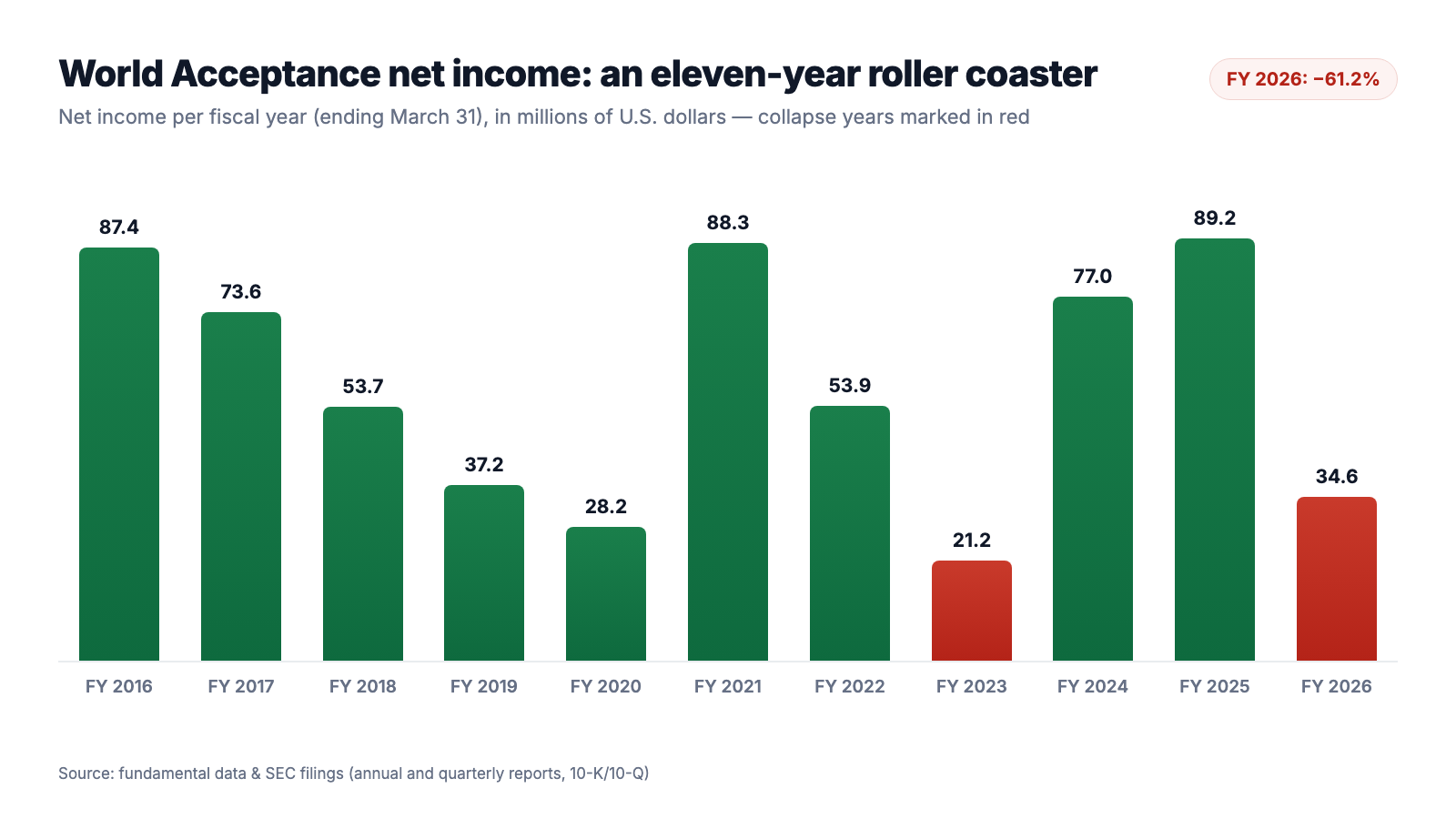
Eleven years, no trend, swings by a factor of four — that is the earnings curve of a business in which credit losses, provisioning and (as we are about to see) bonus accounting drive the bottom line, not revenue growth. The second chart shows why the stock has worked for years anyway:
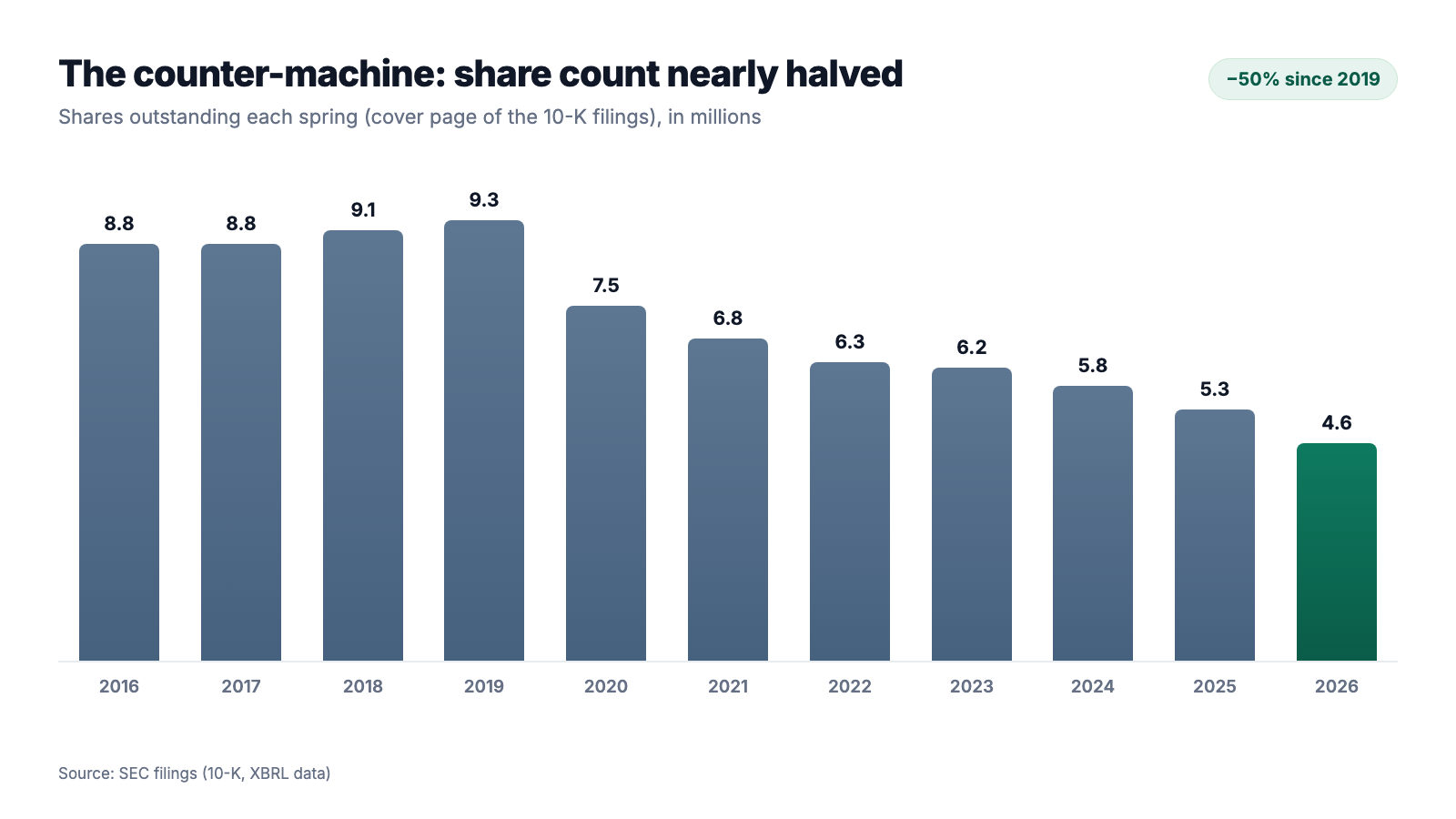
That is the real capital story: where other companies pay dividends, World Acceptance shreds shares. Halve the share count and earnings per share double — without the company growing at all. That is how fiscal 2025 produced $16.21 of earnings per share, and fiscal 2026 still $6.88. Remember the pattern: a buyback program is an amplifier — it amplifies good years upward and cushions weak ones, but it is no substitute for a stable profit. And inside the loan book sits the number that explains everything: the net charge-off ratio was 18.5 percent of average net loans receivable in fiscal 2026 (prior year: 17.5 percent; ten-year average: 17.1 percent, peak 23.7 percent in fiscal 2023). Nearly one in five dollars lent does not come back — priced in, of course. Which raises the question of how you price something like that. The answer is in the filings.
What the filings say — the uncomfortable truths
Uncomfortable truth no. 1: The business model lives above 36 percent — and the company itself says what a rate cap would mean
As of March 31, 2026, 61.7 percent of gross loans receivable ($789.7 of $1,279.0 million) carried an annual percentage rate above 36 percent; the average APR of the entire loan book was 51.4 percent. That is not a scandal but the pricing formula of the trade: whoever lends to customers with an 18.5 percent charge-off ratio needs rates no bank would ever have to quote. But it makes the company a target — and the annual report names the stakes itself, in a sentence of rare clarity:
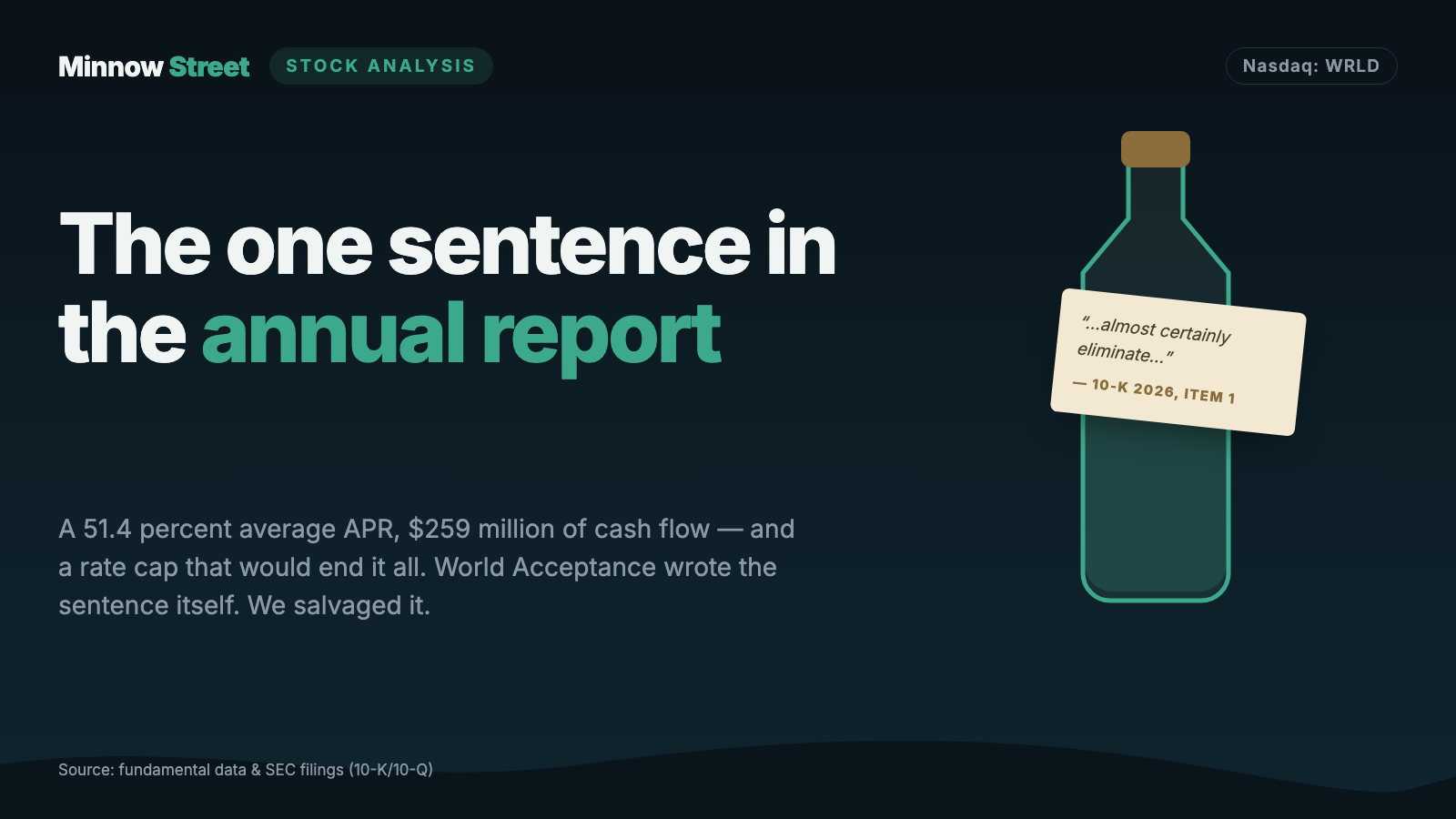
"Any federal law that would impose a national 36% or similar annualized credit rate cap on our services would, if enacted, almost certainly eliminate our ability to continue our current operations."
— World Acceptance Corporation, SEC annual report 10-K for fiscal year 2026, Item 1 "Business — Government Regulation"

In an everyday image: World Acceptance is a house built entirely below a dam. The dam holds — for decades now, in 16 states whose laws expressly permit these rates. But the builder herself writes into the deed that a single dam break — a federal law with a 36 percent cap, which consumer advocates have demanded for years and which already applies to loans to U.S. service members — would "almost certainly" wash the house away. Add the supervisor: the U.S. consumer watchdog CFPB holds explicit supervisory and enforcement powers over non-bank lenders, and its small-dollar lending rule would, among other things, restrict debiting practices for loans above 36 percent that come with a payment authorization. Whether and when any of this arrives, nobody knows — the political weather for the industry has lately turned milder, if anything. But that is precisely the point of the cheapness trap: the low multiple is not a market inefficiency. It is the insurance premium the market pays you for carrying that dam risk.
Uncomfortable truth no. 2: Half of the 61 percent profit collapse is a bonus yo-yo — and you should read that twice
$34.6 million of profit after $89.2 million a year earlier — what happened? The answer sits in the personnel line: personnel expense jumped by $59.0 million to $200.0 million (+41.8 percent), of which $39.0 million was additional stock-based compensation alone. And that number has a backstory that opens a window into the firm's incentive machinery: in fiscal 2025, World Acceptance had reversed $22.0 million of previously booked stock-based compensation — $18.5 million of it because the $20.45 earnings-per-share target of one equity package was "no longer probable" of being achieved, another $3.5 million through forfeited shares of a second package. Such reversals are correct under U.S. accounting rules — but they mean: the record profit of fiscal 2025 was partly a refund of burst bonuses, and the fiscal 2026 collapse is partly their sequel — new equity packages were granted in December 2024 and June 2025 and are now generating expense again. Smooth the two years and you land somewhere in between — and still see no growth: the provision for credit losses rose $19.4 million (+11.5 percent) in fiscal 2026 and consumed 32.2 percent of revenue (prior year: 30.0 percent), the G&A ratio climbed to 51.6 percent of revenue, and return on average equity fell from 21.0 to 9.0 percent. One detail from the human-capital chapter belongs in this picture: annual turnover among branch employees ran at about 51 percent — every second position refills within a year, in a business that, per its own annual report, lives on personal customer relationships. Remember: when a company's profit swings more on bonus accounting than on its business, the P/E ratio is a random-number generator — at WRLD it reads 7 or 29 depending on the year.
Uncomfortable truth no. 3: The CEO left in April — and in May the bank had to loosen the loan covenants
Two disclosures from the spring of 2026 that together tell more than each alone. First, from the annual report's subsequent events:
"On April 10, 2026, R. Chad Prashad informed the Company of his resignation from his positions as President and Chief Executive Officer and as a member of the Company’s Board of Directors, effective April 10, 2026, in order to pursue other opportunities."
— World Acceptance Corporation, SEC annual report 10-K for fiscal year 2026, Note 19 "Subsequent Events"

The resignation was contractually treated as a termination by the company without cause — with $1.26 million of severance over 24 months and accelerated vesting. Taking over as interim CEO: Janet L. Matricciani — remarkably, the same executive who ran World Acceptance from 2015 to 2018, with Capital One and Countrywide Financial on her résumé. Shortly before, the chief operating officer had already been replaced. A company that re-staffs both of its top operating posts within weeks is not flying on autopilot. And second, six weeks later:
"Pursuant to Section 8.7(b) of the Revolving Credit Agreement, the Company and its Restricted Subsidiaries are required to maintain a ratio of Net Income Available for Fixed Charges to Fixed Charges (the "Financial Covenant") of not less than 2.25 to 1.0 for each fiscal quarter. The Modification provides for a limited, temporary modification of the Financial Covenant as follows: i. 2.20 to 1.0 as of the fiscal quarter ending March 31, 2026; ii. 2.10 to 1.0 as of the fiscal quarter ending June 30, 2026; and iii. 2.15 to 1.0 as of the fiscal quarter ending September 30, 2026."
— World Acceptance Corporation, SEC annual report 10-K for fiscal year 2026, Note 19 "Subsequent Events" (Consent and Limited Modification dated May 22, 2026)
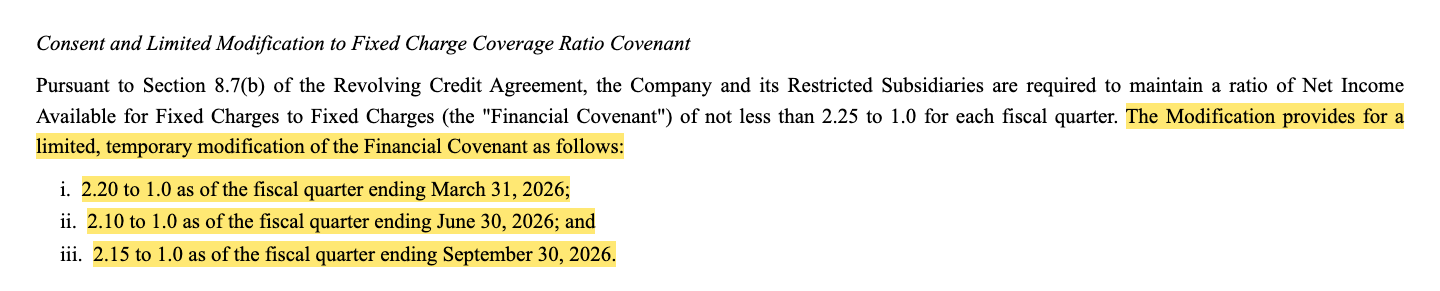
A covenant is the fever chart a bank straps onto its borrower: if earnings power drops below an agreed threshold, the bank may call the loan. When the threshold has to be lowered so that it can be met — for exactly the quarters ending March, June and September 2026 — that says two things: the bank still believes in the firm (otherwise there would be no modification but a termination), and earnings are closer to the line than befits a cash machine. The background: in the summer of 2025, World Acceptance redeemed its $300 million bond early at 101.75 percent and moved its entire funding onto a secured credit facility ($640 million, Bank of Montreal, through July 2028) plus a securitization warehouse line ($175 million, through September 2027) — interest expense: $49.3 million in fiscal 2026, debt of $587.2 million against $351.0 million of equity. The machine runs — but it now runs entirely on the drip of a single secured bank line whose conditions were last met only by grace.
Uncomfortable truth no. 4: Almost half the company belongs to one camp — and the buyback purse recently paid that camp directly
The buyback machine from chapter three has a peculiarity you should know. Whom it most recently bought shares from is in the annual report:
"On September 3, 2025, in accordance with its share repurchase program, the Company, after approval by the Audit and Compliance Committee, repurchased 347,064 shares of its common stock for $60.0 million in a privately negotiated transaction from certain affiliates of Prescott General Partners, LLC, who, along with its affiliates, beneficially own approximately 46.3% of the Company's common stock as of March 31, 2026. The price per share was $172.88, which was the closing market price at September 3, 2025."
— World Acceptance Corporation, SEC annual report 10-K for fiscal year 2026, Item 5 / Note 11 (share repurchases)

For fair framing, no scandal: the repurchase was done at the market closing price, approved by the audit committee, and fully disclosed; for the company, a block purchase can even be more efficient than vacuuming up shares over the exchange for months. But you should see the structure: Prescott holds about 46.3 percent of a company with only 4.6 million shares left — the annual report itself warns that a small number of shareholders "may exert significant influence" over everything put to a vote. The freely tradable remainder is correspondingly thin, which amplifies price moves in both directions — one reason the stock looks so good in trend scanners. And when the buyback purse that is supposed to lever every shareholder's earnings per share ends up financing the anchor shareholder's partial exit, the ownership structure shifts further toward dominance. Picture an owners' meeting where one co-owner holds 46 percent of the votes and the common till buys his shares — legal, approved, minuted. But as a small shareholder, you sit in the very back row of that meeting.
Valuation: a $640 million market value — and three lenses that contradict each other
As of the July 8, 2026 data cut-off, World Acceptance cost about $640 million on the stock market. Through the cash-flow lens that looks absurdly cheap: about 3.6 times free cash flow per the scanner — but you now know that lens's catch with lenders (newly lent money bypasses the operating column). Through the earnings lens the stock is not cheap at all: on the collapsed fiscal 2026 profit it trades at a P/E around 29; on the prior-year profit (flattered by bonus reversals) it would be about 7. The truth lies in between and is uncomfortably imprecise — which is exactly why the third lens fits best here: substance and returns. World Acceptance trades at about 2.7 times book value with a return on equity that swung between 9 percent (fiscal 2026) and 21 percent (fiscal 2025), carrying $1.70 of debt per dollar of equity. For a subprime loan book with an 18.5 percent charge-off ratio, covenant forbearance and a regulatory sword of Damocles, that is no obvious undervaluation — it is a fair price for a business whose risks the market knows. What remains striking is the behavior of the participants: 9 insider sales and zero purchases in the twelve months through July 2026, while the company itself, at $132.4 million, was the biggest buyer of its own stock. When the company buys and the managers sell, two signals are telling you two different things — and both have inside knowledge.
Opportunities and risks at a glance
What speaks for World Acceptance:
- Extreme cash conversion of the existing book: $259.4 million of operating cash flow against $3.9 million of capital expenditures (fiscal 2026) — the branch model needs practically no capital beyond the loan book itself.
- The buyback record is real: shares outstanding nearly halved from 9.3 million (2019) to 4.6 million (May 2026), with $132.4 million of repurchases in fiscal 2026 alone — every remaining share owns a growing slice of the company.
- Pricing power in a niche: a 51.4 percent average APR, steady revenue ($585.2 million, +3.7 percent), 1,009 branches with local customer ties and a growing tax-preparation side business ($40.4 million net).
- Technicals and scanner confluence: 12 hits including the stage-2 trend and Power Trend, Piotroski 7 of 9 (data as of July 8, 2026) — the market has lately priced out the worst rather than priced it in.
- The state level expressly permits the business: 16 states with accommodating rate laws; a federal 36 percent cap has been demanded for years but never enacted.
What speaks against it:
- An existential regulatory risk, named by the company itself: a national 36 percent rate cap would "almost certainly eliminate" the current business — 61.7 percent of the loan book sits above that threshold (10-K FY 2026).
- Profit without a trend: net income between $21.2 and $89.2 million across eleven years, most recently −61.2 percent to $34.6 million — driven by loss provisioning (32.2 percent of revenue) and a bonus yo-yo ($22.0 million reversed in fiscal 2025, $39.0 million more stock compensation in fiscal 2026).
- Funding on a drip: after the bond redemption, everything hangs on the secured $640 million facility plus the warehouse line; the fixed-charge covenant had to be lowered temporarily on May 22, 2026 (2.25 → 2.10–2.20), with $587.2 million of debt against $351.0 million of equity.
- A leadership vacuum: the CEO resigned effective April 10, 2026 with an interim successor, the COO changed in February 2026, and branch staff turnover runs at 51 percent — a lot of motion for a relationship business.
- Ownership concentration and insider behavior: 46.3 percent with Prescott (including a $60 million buyback made directly from the anchor shareholder), a thin float, and 9 insider sales against zero purchases in twelve months (data as of July 8, 2026).
A human conclusion
Back to the cheapness trap from the opening. Its core is not that cheap stocks are bad — its core is that the multiple ends the thinking when it should start it. At World Acceptance, the thinking leads to a clear finding: yes, a genuine money machine works here — a capital-light branch network that has lent for decades to people nobody else serves, and that has rewarded its shareholders not with dividends but by retiring every second share. And yes, the price tag is low. But it is low because on the other side stand things no ratio smooths over: a business model whose ending the company itself describes in a single sentence, a profit that rides a roller coaster of bonus entries and loss waves, a bank that had to lower its bar, a corner office in transition, and an anchor shareholder holding almost half the votes. So the honest question for you is not "is 3.6 times cash flow cheap?" — it is: would you still want this company at twice the price, if buying it means carrying the dam risk, the bonus yo-yo and the ownership structure? If yes, you are getting a lot of cash flow for little money, and the coming quarterly reports (10-Q) will show you in three places whether the bet holds: the net charge-off ratio (does it stay below the ten-year average of 17.1 percent?), the fixed-charge covenant (does the firm clear the regular 2.25 bar again from December 2026 on?), and the CEO search (who takes over for good?). If no, then the low multiple was exactly what it usually is on close inspection: not a gift, but a price tag with fine print. What you make of it is your decision. And that is exactly as it should be.
Sources
All original documents used in this analysis — for your own reading:
- World Acceptance Corporation — SEC annual report 10-K for fiscal year 2026 (ended March 31, 2026; filed June 4, 2026)
- World Acceptance Corporation — SEC annual report 10-K for fiscal year 2025 (filed May 22, 2025)
- World Acceptance Corporation — SEC quarterly report 10-Q as of December 31, 2025 (filed February 9, 2026)
- World Acceptance Corporation — SEC Form 8-K dated April 15, 2026 (CEO resignation, interim succession)
- World Acceptance Corporation — SEC Form 8-K dated May 26, 2026 (Consent and Limited Modification to the fixed-charge covenant)
- Complete SEC filing history of World Acceptance Corporation: EDGAR overview (sec.gov)
- Fundamental data (metrics, quarterly series, valuation; data as of July 8, 2026), reconciled against the SEC filings; history series (net income, share count) from the XBRL data of the 10-K filings.
- Screener and rating data: in-house stock scanner (scanner rank as of July 18, 2026; metrics data as of July 8, 2026).
Transparency & disclaimer: This analysis is a journalistic contextualization of publicly available information and is not investment advice, not a financial analysis in the regulatory sense, and not a solicitation to buy or sell securities. Stock investments carry substantial risks up to and including total loss. All information without guarantee; the data cut-off is noted in the text. The author holds no position in WRLD shares at the time of publication.
Our Bottom Line at a Glance
- Cash conversion & buyback machine positive
- $259.4 million of operating cash flow against $3.9 million of capital expenditures and $132.4 million of share repurchases in fiscal 2026; shares outstanding fell from 9.3 million (2019) to 4.6 million (May 2026) — a capital-light business that consistently returns to its remaining shareholders (10-K FY 2026).
- Earnings quality & loan book negative
- Net income without a trend ($21.2 to $89.2 million across eleven years, most recently −61.2 percent to $34.6 million), driven by loss provisioning (32.2 percent of revenue) and a bonus yo-yo ($22.0 million reversed in FY 2025, $39.0 million more stock compensation in FY 2026); an 18.5 percent net charge-off ratio against a 51.4 percent average APR.
- Regulatory risk negative
- The company itself writes that a national 36 percent rate cap would "almost certainly eliminate" the current business; 61.7 percent of the loan book sits above that threshold, and the CFPB holds supervisory powers (10-K FY 2026, Item 1/1A). Not an acute risk, but a permanent existential one.
- Leadership & funding negative
- CEO resignation effective April 10, 2026 with an interim successor (Matricciani, CEO 2015–2018), a COO change in February 2026; after the bond redemption, funding hangs on a secured bank facility whose fixed-charge covenant had to be lowered temporarily from 2.25 to as low as 2.10 on May 22, 2026 (10-K FY 2026, Note 19).
- Technicals & ownership structure neutral
- Stage-2 uptrend, Power Trend, 12 scanner hits, Piotroski 7 of 9 (data as of July 8, 2026) — but a thin float (Prescott ~46.3 percent, only 4.6 million shares) amplifies moves in both directions, and the insider tally reads 9 sales to zero purchases in twelve months.
World Acceptance is the cheapness trap in its purest form, served as an exam question: a genuine cash machine with a radical buyback policy at 3.6 times a free cash flow that is systematically flattered for lenders — set against a business model whose ending the company itself describes in one sentence, a profit zigzagging on bonuses and charge-offs, a bank covenant loosened on May 22, 2026, a vacant corner office and a 46.3 percent anchor shareholder. The low multiple is the premium for exactly these risks — not the proof they are absent. Not investment advice.
What Our Rating Means
- If you don't own the stock
- As long as the question raised in the bottom line stays open, we see no basis for an entry.
- If you hold it in your portfolio
- Our findings offer no acute reason to sell — the checkpoints named remain decisive.
A journalistic assessment by our editorial team at the time of the deep dive, based on public sources — not investment advice and not a solicitation to buy or sell. Your personal circumstances (investment goals, risk capacity, taxes) cannot be taken into account. What our categories mean, how verdicts are formed, and what conflicts of interest exist →
Worth Noting
- WRLD reached the research list via rank 11 in our in-house FCF/market-cap scanner (as of July 18, 2026); the 12 hits in the in-house stock scanner (data as of July 8, 2026) provided the confluence. Scanner memberships shift daily — the stated data cut-off governs.
- Lender particularity: operating cash flow contains interest and principal collections but not newly originated loans (investing cash flow). FCF-based metrics therefore systematically overstate free liquidity; in fiscal 2026 the loan book grew by roughly $230 million net. The trailing P/E is simultaneously distorted by stock-compensation reversals (FY 2025) and catch-up expense (FY 2026).
- Valuation figures dated July 8, 2026 (about $640 million market value); analyses are evergreen, daily prices are not a buy argument. All filing quotes were verified verbatim against the SEC originals (10-K FY 2026, filed June 4, 2026).
Frequently Asked Questions
World Acceptance (Nasdaq: WRLD) of Greenville, South Carolina, makes installment loans of $400 to $5,300 (average: $2,015) through 1,009 branches operating as "World Finance" in 16 U.S. states — to customers with limited access to other sources of credit. On top come credit insurance sold as an agent and an income-tax preparation service (91,000 returns, $40.4 million of net revenue in fiscal 2026). Total revenue in fiscal 2026 (ended March 31, 2026): $585.2 million (+3.7 percent).
As of March 31, 2026, the average annual percentage rate of the loan book was 51.4 percent; 61.7 percent of gross loans receivable ($789.7 of $1,279.0 million) carry more than a 36 percent annual rate. These rates are legal in the 16 states where the company operates and price the default risk: the net charge-off ratio was 18.5 percent of average net loans receivable in fiscal 2026 (ten-year average: 17.1 percent).
Net income fell from $89.2 to $34.6 million — mainly because personnel expense rose $59.0 million, of which $39.0 million was additional stock-based compensation: in fiscal 2025 the company had reversed $22.0 million of previously booked compensation because earnings targets were deemed unreachable (which flattered the prior-year profit), and in December 2024 and June 2025 it issued new equity grants that now generate expense. In addition, the provision for credit losses rose $19.4 million (+11.5 percent) to 32.2 percent of revenue.
The annual report (10-K) for fiscal 2026 words it itself: a federal law imposing a national 36 percent rate cap would "almost certainly eliminate our ability to continue our current operations." 61.7 percent of the loan book sits above that threshold. Such a federal law has been demanded for years but never enacted; at the state level the rates are permitted. It remains the central long-term risk of the stock.
In fiscal 2026, World Acceptance generated $259.4 million of operating cash flow against just $3.9 million of capital expenditures — measured against a market value of about $640 million (data as of July 8, 2026), that is a price-to-FCF ratio around 3.6. The catch: for lenders, newly originated loans count as investing activity and never appear in operating cash flow. In fiscal 2026 the company lent out a net of roughly $230 million more than was repaid — the truly free surplus is much smaller than the scanner metric suggests.
Prescott General Partners, LLC and its affiliates beneficially owned about 46.3 percent of the common stock as of March 31, 2026 — with only about 4.6 million shares outstanding (May 2026). On September 3, 2025, the company repurchased 347,064 of its own shares for $60.0 million in a privately negotiated transaction directly from Prescott affiliates ($172.88 per share, the day's closing price). The annual report itself warns of the significant influence a small number of shareholders can exert over every vote.
CEO R. Chad Prashad resigned from all positions effective April 10, 2026; the resignation was contractually treated as a termination without cause ($1.26 million of severance over 24 months plus accelerated vesting). Janet L. Matricciani, who already ran the company as CEO from 2015 to 2018, took over as interim CEO. Shortly before, the chief operating officer had changed as well (J. Tobin Turner succeeded D. Clinton Dyer in February 2026). The search for a permanent leader was still ongoing as of the annual report (June 2026).
Found an error?
Did you spot a factual error, an outdated number, or a typo in this deep dive? Let us know briefly — your report goes straight to the editorial team.