People Inc.: America's Largest Publisher — and a Casino Stake That Decides Whether the Year Ends Green or Red
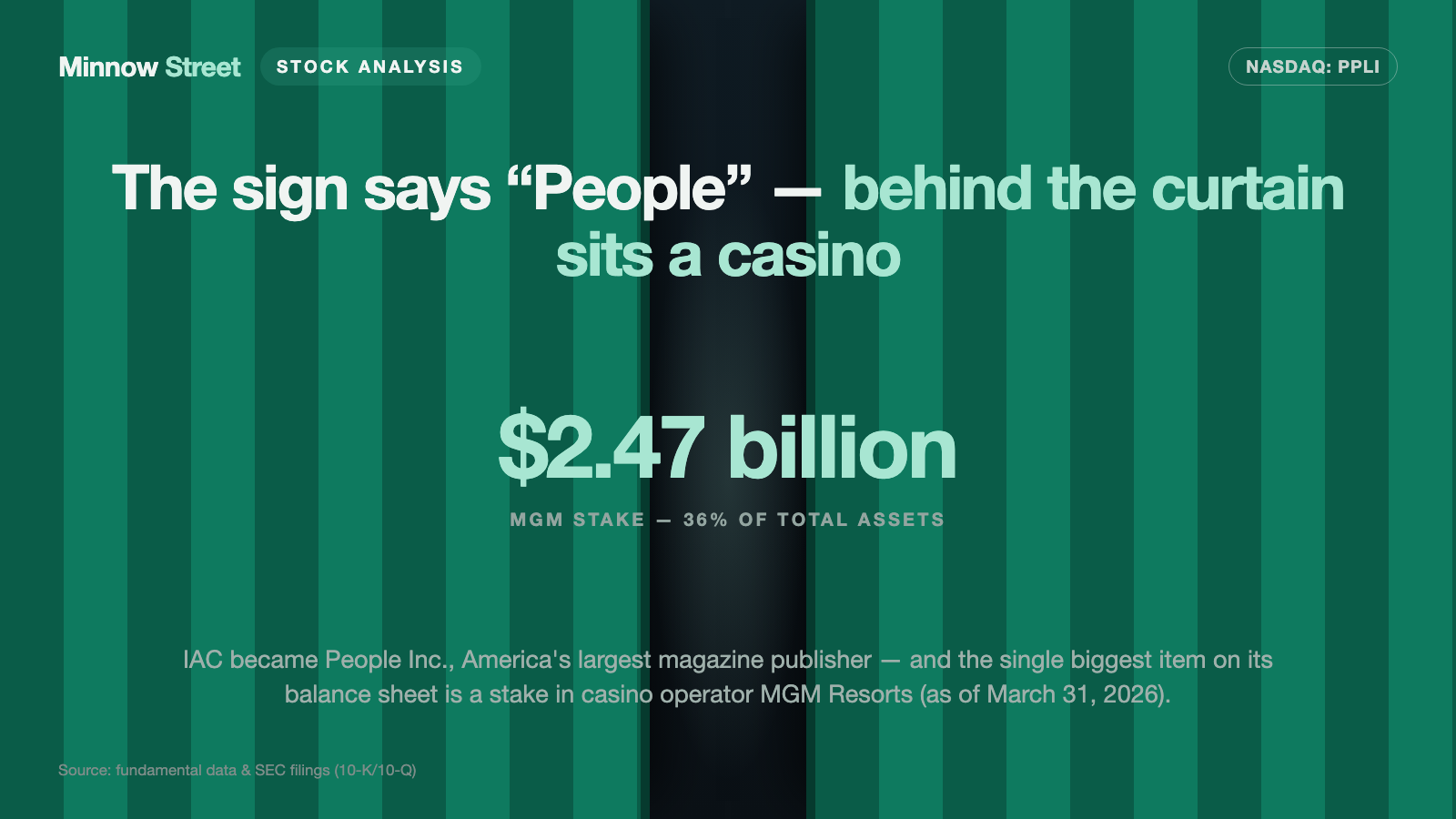
Since June 4, 2026 the company formerly known as IAC has been called People Incorporated and trades under the ticker PPLI. The new name promises a publisher: more than 40 brands from PEOPLE to Better Homes & Gardens, 175 million readers a month, 15.4 million subscriptions. The filings to the U.S. securities regulator, the SEC, tell a different story. The single largest item on the balance sheet is a 26.1 percent stake in casino operator MGM Resorts International, carried at $2.47 billion — 36 percent of total assets — and for years that share price, not the magazines, has decided whether the year ends in profit or loss. Meanwhile Google cancelled the search agreement that still paid $210.7 million in 2025, and the Search segment is gone. Then, on June 1, 2026, the publisher bid $48.30 a share in cash for the whole casino. Not investment advice — just the question of what you are actually buying when the sign on the door says "publisher".
 Thomas Mücke
Founder & Publisher
Thomas Mücke
Founder & Publisher
Chart
Interactive price chart (TradingView).
Note: pure fact-based analysis, not investment advice and not a solicitation to buy or sell. All figures without guarantee.
There is an investor trap so ordinary that you never notice it: the door-sign trap. It works like this — you read what a company is called, and your head instantly fills in what happens inside. "People Incorporated"? A publisher. Magazines, recipes, celebrity stories, home ideas. The picture is complete, and you have not looked at a single number. That is precisely the point: since June 4, 2026 the company that used to be IAC Inc. has been called People Incorporated and trades on the Nasdaq under the ticker PPLI. The publisher behind that name is real and large — more than 40 brands, from PEOPLE through Better Homes & Gardens to Investopedia, reaching 175 million people a month. But the largest single item on the balance sheet is not a magazine: it is 66.8 million shares of casino operator MGM Resorts International, carried at $2.47 billion — 36 percent of all assets (as of March 31, 2026). So let's make a deal: before you buy the door sign, we read together what the company itself filed with the U.S. securities regulator, the SEC — the annual report (10-K) for 2025, the quarterly report (10-Q) as of March 31, 2026, and five current reports (8-K) from the spring and summer of 2026. A filing to the SEC is honest under penalty of law. And this one tells the story of a publisher whose annual result has hung on a casino share price for years, of a Google contract that was cancelled and took an entire segment with it — and of a $48.30-a-share cash proposal with which the publisher wants to own the casino outright. What you make of it is your decision.
What People Incorporated actually is — a publisher, a casino stake and a very long history
Start with the name, because it is the first stumbling block. People Incorporated is the listed parent company. People Inc. — without the "-orated" — is the publisher underneath, which was called Dotdash Meredith until 2025. Both now carry almost the same name, and that is deliberate: the company is stepping away from its holding-company structure and putting the publisher at the center. The publisher is the operating heart. It runs a Digital and a Print business across more than 40 brands, sorted by area of life: entertainment (PEOPLE, Entertainment Weekly), food (Allrecipes, Food & Wine, EatingWell), home (Better Homes & Gardens, REAL SIMPLE, Southern Living, Martha Stewart), beauty (InStyle, Byrdie), health (Verywell Health, Parents) and travel and finance (Travel + Leisure, Investopedia). As of December 31, 2025 it published 18 magazines plus roughly 425 special interest publications a year, and 15.4 million active subscriptions were running. It earns money from advertising, from commissions on shopping recommendations ("performance marketing"), from subscriptions and newsstand sales — and increasingly from licensing: content is licensed to Apple News+, to Meta (a partnership signed in the fourth quarter of 2025) and to OpenAI, a partnership that began in May 2024.
Next to that stands what is left of a 25-year corporate history. IAC built and spun off Expedia, Match Group, Vimeo, Ticketmaster and LendingTree over the years. Lately it moved fast: on March 31, 2025 the home-services platform Angi was spun off to shareholders by special dividend and has been an independent public company since; on March 16, 2026 the company sold the caregiving marketplace Care.com for net proceeds of $295.7 million — booking a $75.6 million loss after tax. What remains beside the publisher is a roughly 33 percent stake in the car-sharing marketplace Turo, a controlling interest in the healthcare staffing platform Vivian Health, the news site The Daily Beast — and the holding this analysis is about: 26.1 percent of MGM Resorts International, operator of the Bellagio, MGM Grand and Mandalay Bay in Las Vegas. That names the central tension of this analysis, and it runs through every chapter: the operating business is a shrinking but cash-generating publisher — what shows up on the bottom line, however, is decided by a casino share price.
Where the stock showed up on our desk
Not through one of our momentum or value scanners, but through a mandatory filing: the Form 13F of the London hedge fund Helikon Investments Ltd as of March 31, 2026 (filed May 8, 2026). It shows a position of 3,518,414 shares worth $140,842,112. The issuer name in the filing, however, still reads "IAC INC" — and that is where this research began, because no company trades under that name any more. The SEC's own registry now lists "People Inc" with former names "IAC Inc.", "IAC/InterActiveCorp" and "IAC Holdings, Inc.". Remember this reflex; in practice it is worth more than most ratios: when a name in a filing no longer matches the company, that is not a typo, it is a lead.
The fund's behavior is notable too. The position stood at 2,036,840 shares on June 30, 2025, was cut to 1,325,799 by September 30, 2025, rebuilt to 1,866,442 by December 31, 2025 — and then nearly doubled to 3,518,414 shares in the first quarter of 2026 (+88.5 percent). In the same quarter the fund opened six new positions and exited six others entirely; the whole portfolio held 17 positions worth $2,648,555,113. One more detail: the same filing also lists MGM Resorts International (2,875,004 shares, $106,403,898) — so as of the reporting date the fund held both sides of the takeover proposal that became public two months later. Before that turns into a story, the hard limit of this source: a 13F shows only U.S.-listed long positions, 35 to 45 days after the fact, without short positions, without derivatives and without European holdings. It is a rear-view mirror, not a roadmap. What a fund held in March it may have sold in May, and why it bought is nowhere on the record.
There is, however, a source fresher than the 13F — and it points not to an exit but to the opposite. Anyone crossing five percent of a U.S.-registered share class has to disclose it separately. On July 9, 2026 Helikon did exactly that: in an amendment to its ownership report (Schedule 13G/A) as of June 30, 2026 the fund reports 5,652,519 shares of the "Common Stock, par value $0.0001" class, or 7.60 percent. Against the 3,518,414 shares in the 13F as of March 31, 2026 that is an increase of about 61 percent in a single quarter — the very quarter that also contains the MGM proposal of June 1, 2026. Whether the one has anything to do with the other is stated in none of the documents, and we do not claim it. The filing is made under Rule 13d-1(b), that is as a passive investor with no control intent; voting and dispositive power are reported solely as shared, and the reporting persons are Helikon Investments Limited and Federico Riggio (SEC Schedule 13G/A of July 9, 2026, accession 0001172661-26-002530). The rear-view mirror, in other words, shows a fund that kept buying after the 13F date — and nothing more.
And the numbers from our in-house stock scanner? Honestly, they help very little here, and that belongs in the piece. A price-to-earnings ratio cannot be formed, because the company reported losses under U.S. accounting rules in 2024 and 2025 — losses that mostly come from remeasuring the MGM shares and involve no cash. A price-to-sales ratio compares a market value that consists largely of an investment with revenue that does not contain that investment at all. And balance-sheet scorecards such as the Piotroski F-Score reward earnings jumps that here only mirror the mood of the market. People Incorporated is a sum-of-the-parts case, not a screening case. So we will add the parts up later, piece by piece.
The numbers over the years — honestly appraised
First what genuinely speaks for the company. The publisher is no turnaround case but a profitable operation: the People Inc. segment generated $1,762.1 million in revenue in 2025 (2024: $1,777.2 million) and turned that into $357.1 million of adjusted EBITDA — earnings before interest, taxes, depreciation and amortization as the company defines it — up from $295.4 million, a gain of 21 percent. Inside the publisher, the digital side is growing: it added $94.1 million, or 10 percent, in 2025, carried by performance marketing (+21 percent) and licensing (+28 percent). Consolidated revenue nonetheless fell 9 percent to $2,393.2 million — almost entirely because the Search segment collapsed by $174.8 million to $212.9 million. The balance sheet is comfortable: $1,112.4 million in cash as of March 31, 2026 against $1,420.3 million of debt, all of it sitting at the publisher People Inc. And now the chart that explains everything — net income attributable to shareholders next to the valuation effect from the MGM stake:
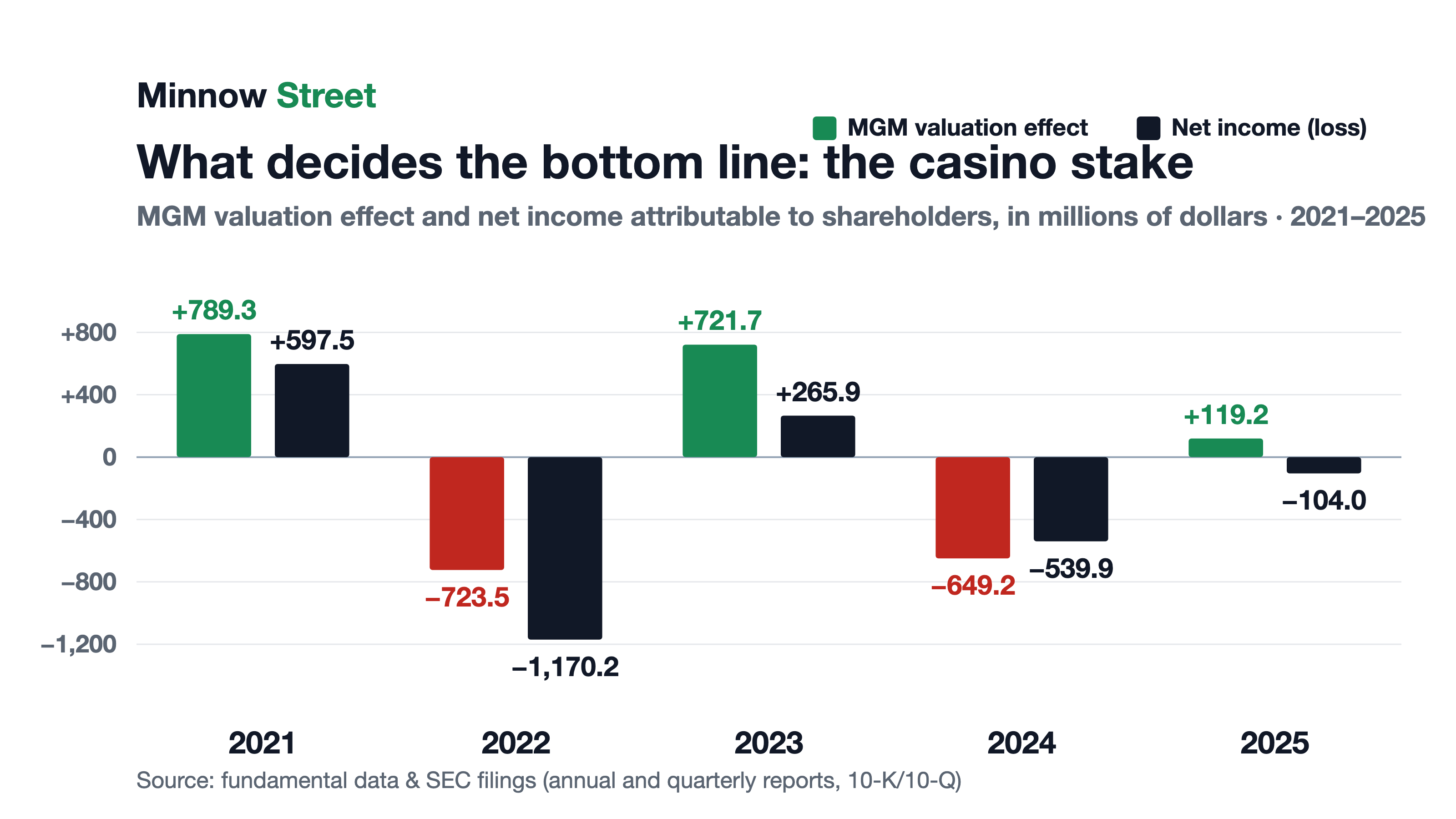
The first quarter of 2026 repeated the pattern with the signs reversed: consolidated revenue fell to $422.9 million (prior-year quarter: $481.7 million), a $24.1 million operating profit turned into a $40.1 million operating loss — and the bottom line showed a $71.9 million net loss even though the MGM stake contributed a $34.0 million valuation gain. The reason lies in one-off items: a $75.6 million loss on the Care.com sale and $37.8 million more stock-based compensation, because the prior-year quarter had booked a $49.8 million credit when the former chief executive's restricted stock award was forfeited. Remember this image for everything that follows: at this company the bottom line almost never tells you anything about the business. Which brings us to the uncomfortable truths.
What the filings say — the uncomfortable truths
Uncomfortable truth no. 1: a casino share price decides profit and loss
The company accounts for its MGM stake under the fair value option: it is remeasured to MGM's closing price every quarter, and the difference lands immediately in the income statement. Not in equity, not in a side note — directly in earnings. The annual report quantifies the leverage itself:
"At December 31, 2025 and 2024, the carrying value of the Company's investment in MGM, which includes the cumulative unrealized pre-tax gains, was $2.4 billion and $2.2 billion, or approximately 34% and 23% of the Company's consolidated total assets, respectively. A $2.00 increase or decrease in the share price of MGM would result in an unrealized gain or loss, respectively, of $131.6 million."
— IAC Inc. (today People Incorporated), SEC annual report 10-K for 2025, "Quantitative and Qualitative Disclosures About Market Risk — Equity Price Risk"
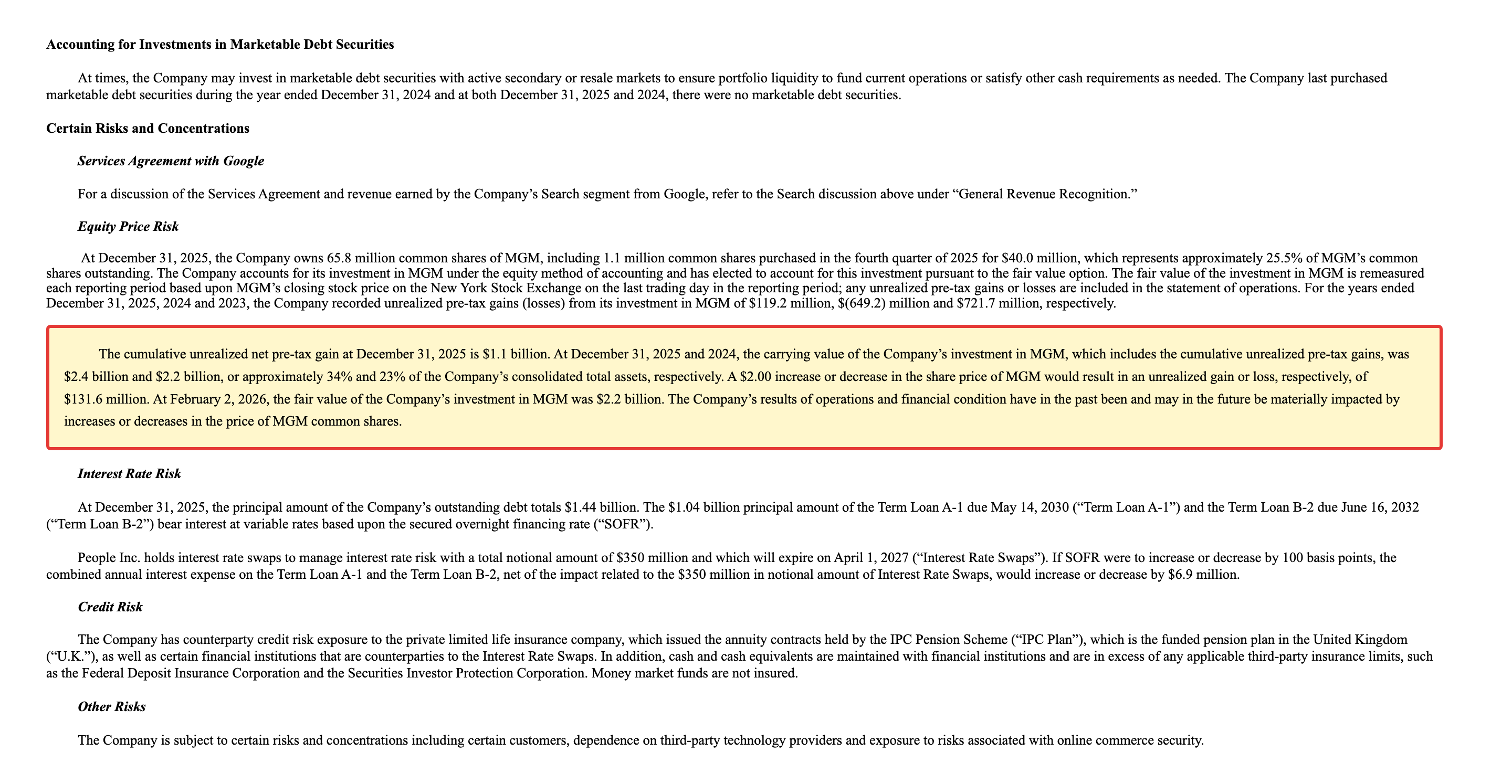
Picture a well-run contracting business whose annual accounts are required to include the current market value of the owner's private stock portfolio. In good market years the business looks brilliant, in bad ones it looks broken — and neither has anything to do with the quality of the work. The numbers bear the image out: the valuation effect was +$789.3 million in 2021, −$723.5 million in 2022, +$721.7 million in 2023, −$649.2 million in 2024 and +$119.2 million in 2025. As of March 31, 2026 the company held 66.8 million MGM shares, including 1.0 million bought for $37.2 million in the first quarter of 2026; the carrying value rose to $2,473.1 million, and cumulative unrealized pre-tax gains stand at roughly $1.1 billion. Remember that last number for the valuation chapter — unrealized gains are not cash until the tax authority has been paid. How quickly a Las Vegas asset can rewrite a balance sheet is also visible in our Sphere analysis: on the Strip, capital intensity is never a footnote.
Uncomfortable truth no. 2: Google cancelled the contract — and a whole segment disappeared
Since October 26, 2015 Google had supplied paid listings to the company's search sites (Ask.com, Reference.com and others) and shared the revenue. For years that was comfortable money. On December 10, 2025 Google cancelled the automatic renewal. How dependent the segment was, the annual report says in one sentence:
"For the years ended December 31, 2025 and 2024, 99% and 97%, respectively, of the revenue earned by the Search segment was earned pursuant to the Services Agreement."
— IAC Inc. (today People Incorporated), SEC annual report 10-K for 2025, Item 7 MD&A "Services Agreement with Google"
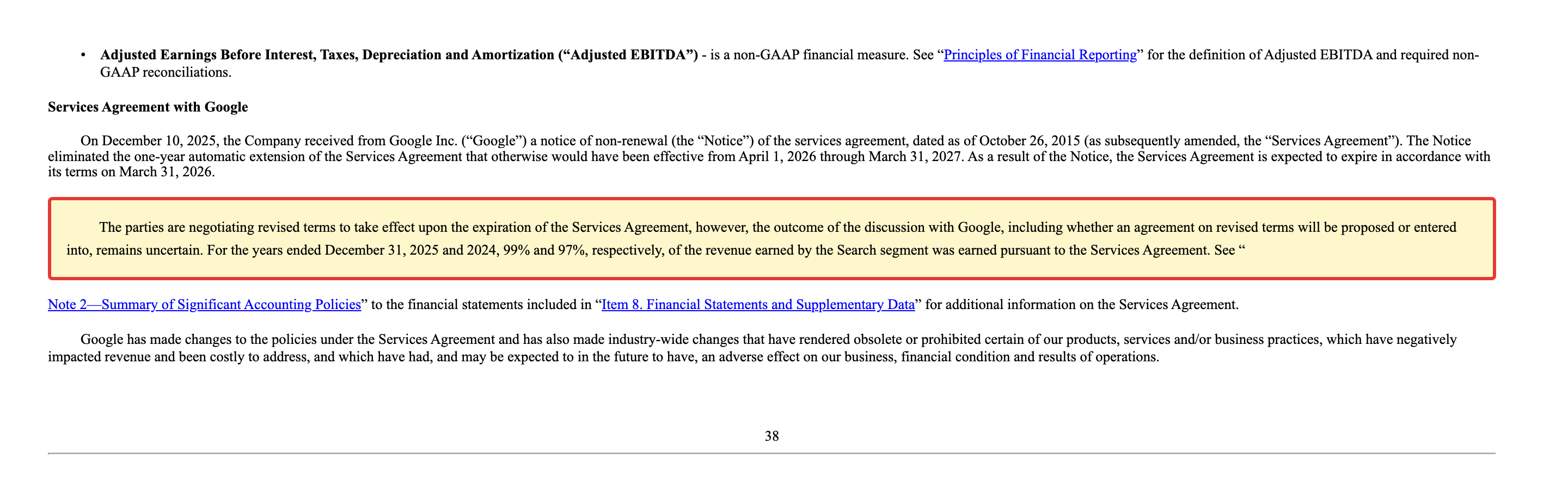
What followed is in a current report dated June 2, 2026: the agreement was extended through April 30, 2026 and then expired — "In connection with the expiration of the Services Agreement, the Company ceased operations of its Search segment." An entire segment is gone. The second chart shows how much money that was:
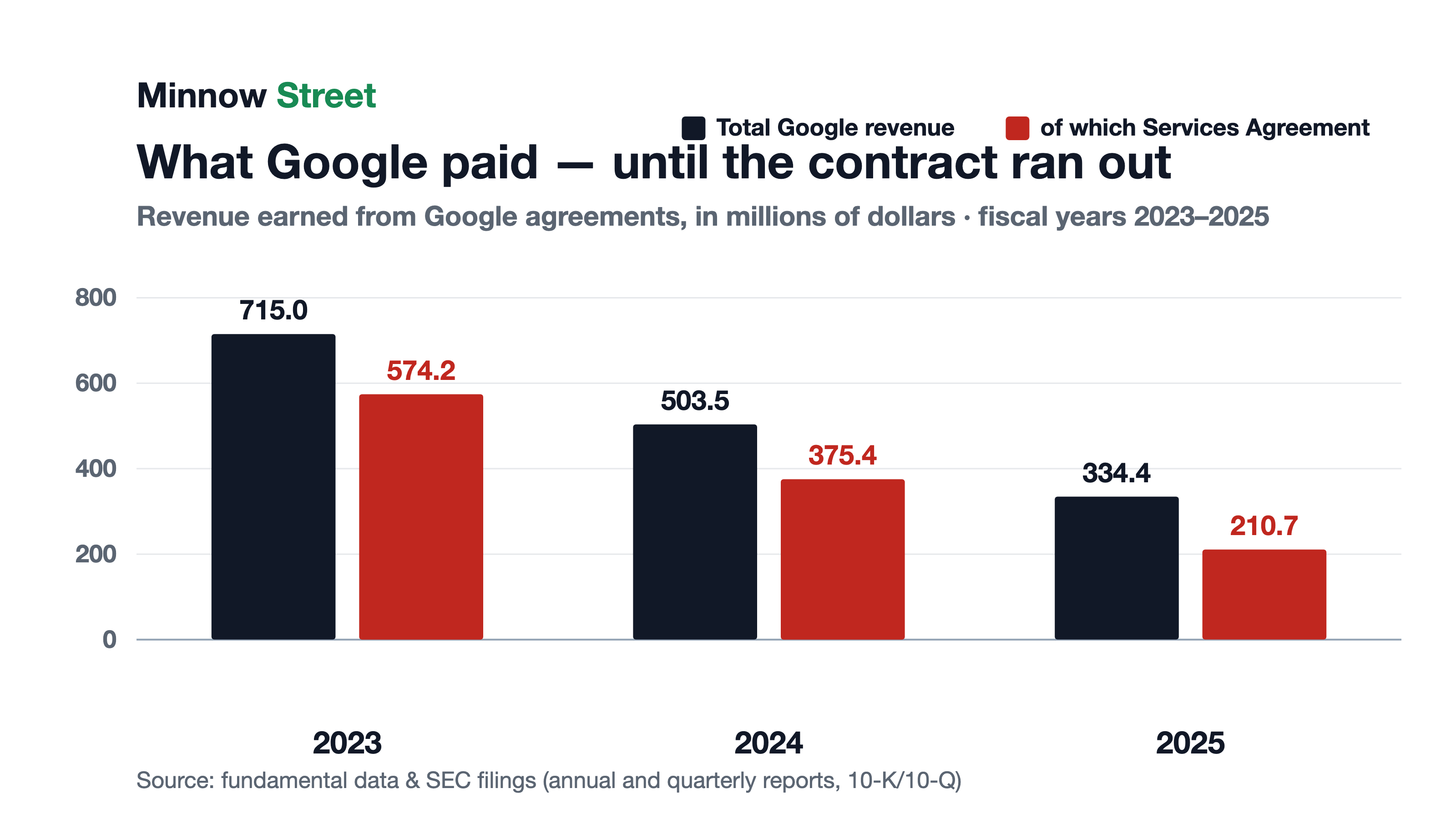
To be fair: the segment was barely profitable by the end — in the first quarter of 2026 Search posted adjusted EBITDA of minus $8.3 million, against plus $3.0 million a year earlier. So the loss costs less profit than the revenue figure suggests. But the episode says something fundamental about concentration risk. Picture a contractor who receives 99 percent of his orders from a single client: he is not an entrepreneur, he is an employee with a business license. When that client walks away, no amount of cost discipline helps. Growth that hangs on one contract is borrowed.
Uncomfortable truth no. 3: the same Google is taking readers from the core business — and being sued for it
The publisher lives on people landing on its pages. A large share of those people arrive via Google search. Since Google began showing AI summaries ("AI Overviews") in its results, the search engine answers many questions directly — the click through to the recipe page never happens. The company measures this as "Core Sessions" and names the cause itself:
"The Company expects the increasing prominence of Google AI Overviews to continue to negatively impact Core Sessions and advertising revenue."
— IAC Inc. (today People Incorporated), SEC quarterly report 10-Q as of March 31, 2026, Item 2 MD&A (Digital)
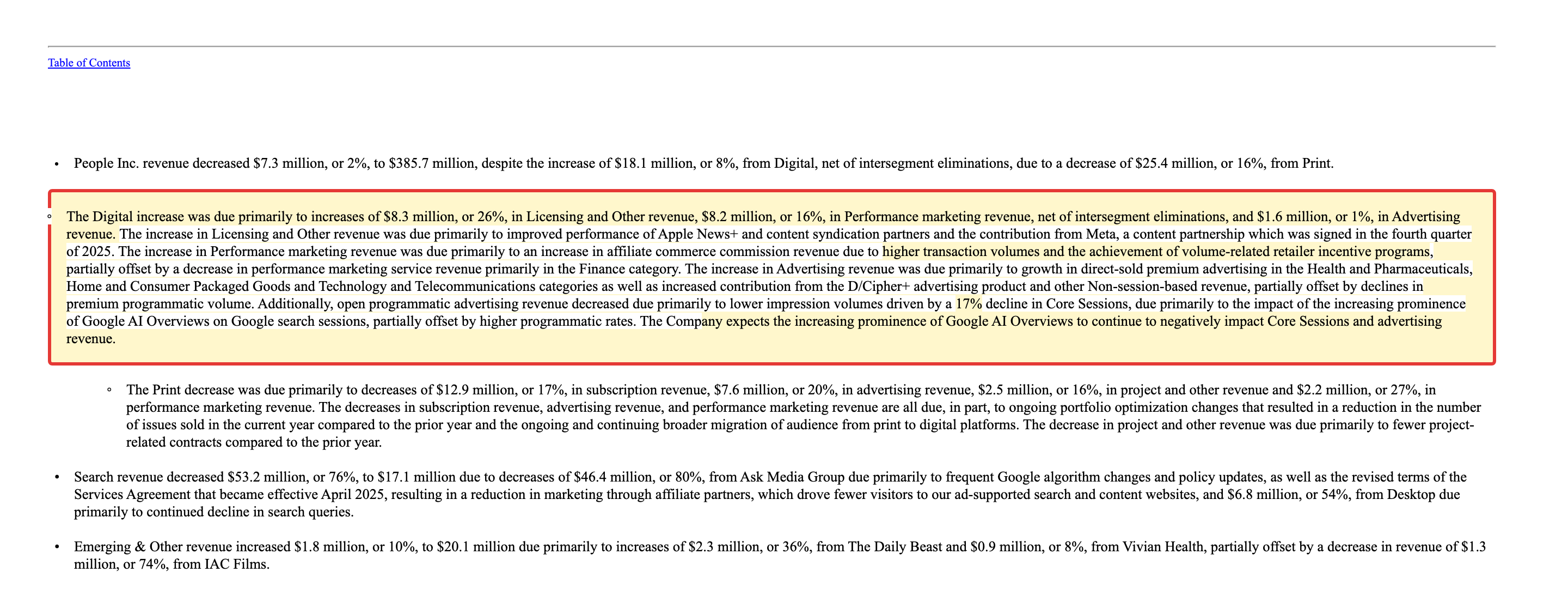
The magnitude: Core Sessions fell 5 percent to 8,602 million in 2025 and 17 percent to 1,841 million in the first quarter of 2026. That digital revenue still grew 8 percent speaks for the publisher — it is selling more direct advertising, more commission business and more licensing, and is becoming less dependent on search traffic. But the headwind is structural and it will stay. The other side of the same market is laid out in our Alphabet analysis. And there is a third layer: since August 29, 2025 the publishing subsidiary People Inc. has been suing Google and Alphabet for monopolization in the ad-tech business, seeking treble damages. On October 27, 2025 the presiding court held in a parallel case that Google may not relitigate core findings from the Government's antitrust case. The outcome is open — but the company now faces the same counterparty as customer, competitor and defendant all at once.
Uncomfortable truth no. 4: print is shrinking by double digits — and the debt sits at the publisher
The printed side of the publisher is losing ground faster than many would expect: print revenue fell $109.3 million, or 14 percent, in 2025 and a further $25.4 million, or 16 percent, in the first quarter of 2026 — subscriptions alone down 17 percent. The report says plainly that it expects the trend to continue. That is not drama, it is arithmetic: readers move online, and the publisher is deliberately shrinking its title list with them. Still, the second number belongs beside it: the company's entire debt of $1,420.3 million (March 31, 2026) is a liability of People Inc. — the publisher, not the holding company. Interest expense came to $120.0 million in 2025, more than the consolidated operating result. The publisher carries the debt while the investment sits one floor above; anyone valuing the publishing business on its own has to assign that debt to it. Add the cost side: on April 28, 2026 the company announced it would consolidate its corporate functions with the publisher's — targeting roughly $40 million in annual run-rate savings against roughly $63 million in one-time costs, to be completed by the first quarter of 2027. The chief financial officer and chief legal officer are leaving; the publisher's chief executive, Neil Vogel, is to run the company. The door sign is not just being swapped — the house is being rebuilt.
The move that resets everything: the proposal for MGM
On June 1, 2026 the company made public what would turn an investment into a takeover:
"People Incorporated is accordingly submitting a non-binding proposal to acquire all of the outstanding shares of common stock of MGM not already owned by IAC, for 100% cash consideration of $48.30 per share."
— People Incorporated, SEC current report 8-K dated June 1, 2026, Exhibit 99.1 (press release and letter to the MGM board of directors)
The price is 24.1 percent above MGM's volume-weighted average price over the 30 trading days ended May 29, 2026, and 10.6 percent above the last closing price before that. Funding would come from existing cash at both companies plus additional debt and equity commitments; People Incorporated expects to hold just over 50.1 percent of the equity afterwards and to control MGM. And then comes the sentence that catches every bit of enthusiasm: no assurance can be given that a definitive agreement will be reached, and the bidder reserves the right to modify or withdraw the proposal at any time. For you as an investor that means: this is not a transaction, it is a proposal. It may happen, it may get richer, it may disappear. Buying the stock for that reason is a bet on a negotiation, not on a business model. How the same situation looks from the other side of the table — at the target, which sold its casinos long ago and now leases them back — is laid out in our MGM Resorts analysis.
Valuation: the sum of the parts — and what it leaves out
Because an earnings multiple measures nothing here, we take the company apart. As a dated price anchor we use the price at which the company itself bought back its own shares: an average of $40.35 between April 1 and May 1, 2026 (before that: $37.71 in the first quarter of 2026 and $41.18 on average during 2025). With 74.6 million shares outstanding as of March 31, 2026 that puts the market value in the order of $3.0 billion. From that we subtract the MGM stake at $2.47 billion and cash of $1.11 billion, and add back debt of $1.42 billion. That leaves roughly $0.85 billion for everything else — for the publisher with $1.76 billion of annual revenue and $357.1 million of adjusted EBITDA (2025), plus the Turo stake, Vivian Health and The Daily Beast, which together with other holdings sit in long-term investments at $404.6 million. Strip those investments out at book value and the publisher is being valued at a little over $0.4 billion — barely more than one year of its own adjusted operating profit.
Before that turns into a bargain, three honest caveats. First, "adjusted EBITDA" is a company-defined measure; it excludes amortization and depreciation (2025: $93.1 million plus $37.5 million) and stock-based compensation, and corporate overhead cost another $113.4 million in 2025. Second, the $1.1 billion of cumulative MGM gains are pre-tax — a sale would hand a meaningful share of that to the tax authority, which is why carrying value and realizable value are not the same thing. Third, the valuation gap is not an accident but the price of the structure: buying this stock does not buy a pure publishing stake but a bundle of publisher, casino holding, private investments and a live takeover attempt — and the market has historically discounted such bundles. You may consider that discount unjustified. You should simply know that you are buying it.
Who owns the company
Two share classes sort out the power: common stock with one vote and Class B stock with ten. All 5,789,499 Class B shares are held by Barry Diller, chairman and senior executive, his wife Diane von Furstenberg and his stepson Alexander von Furstenberg. Together with their common shares that amounts to roughly 46 percent of the total voting power, according to the annual report, on a single-digit share of the equity (Diller himself reported 8.9 percent of the class and roughly 46.4 percent of the votes on June 22, 2026). Picture a residents' association in which one family owns a small apartment but casts almost half the votes at the meeting. It is fully disclosed, it has been the IAC model for decades — and it means that directional decisions such as the renaming, the Care.com sale or the MGM proposal are effectively made there. Investing here means investing in a family business that happens to be listed.

Opportunities and risks at a glance
What speaks for People Incorporated:
- A profitable, market-leading publisher: $1,762.1 million of segment revenue in 2025 and $357.1 million of adjusted EBITDA (+21 percent), carried by more than 40 brands, 175 million consumers a month and 15.4 million subscriptions.
- The digital business grows despite the search headwind: up 10 percent in 2025 and 8 percent in the first quarter of 2026 — with licensing revenue from Apple News+, Meta and OpenAI and the in-house D/Cipher+ ad product as less search-dependent legs.
- A visible valuation gap: at the company's own $40.35 buyback price (April 2026), roughly $2.47 billion of the market value is the MGM stake alone; less than a billion remains for the publisher and the private investments.
- A consistent clean-up: Angi spun off (March 2025), Care.com sold (March 2026), Search shut down (May 2026), roughly $40 million of annual cost savings targeted — the structure is getting simpler, not more complex.
- The company buys back its own stock at scale: roughly 7.7 million shares at an average of $41.18 in 2025 and another 3.3 million at $37.71 in the first quarter of 2026 — together around ten percent of all shares in little more than a year.
What speaks against it:
- Earnings are not steerable: the MGM valuation effect swung between +$789.3 million and −$723.5 million in a single year, and a $2.00 move in MGM equals $133.6 million of earnings impact. Holding the stock means holding a bet on Las Vegas.
- Structural erosion in the core business: Core Sessions down 17 percent in the first quarter of 2026 because of Google AI Overviews — with the company explicitly expecting more of the same; print down 14 percent (2025) and 16 percent (Q1 2026).
- A whole segment is gone: the Google search agreement still produced $574.2 million of revenue in 2023, expired on April 30, 2026, and the Search segment was shut down — a case study in concentration risk.
- Debt of $1,420.3 million sits entirely at the publisher, against $120.0 million of interest expense (2025) and a consolidated operating loss of $97.4 million in the same year.
- Concentrated control and an open outcome: roughly 46 percent of the vote with the Diller family through ten-vote shares; the MGM proposal is explicitly non-binding, with no assurance of an agreement — and a successful bid would add further debt and equity leverage.
A human conclusion
Back to the door-sign trap. Its core is not that the sign lies — the publisher behind "People" is real, large and profitable. Its core is that the sign answers a question you never asked. You wanted to know what your money hangs on. The sign tells you what the company would like to be called. Buying this stock buys four things at once: a publisher whose digital revenue is growing while a search engine takes away its readers; a casino stake that rewrites the consolidated result every quarter; a non-binding takeover proposal with an open outcome; and a family that holds almost half the votes on a small slice of the equity. That can be a very good idea — if the sum of the parts is worth more to you than the price the market pays for the bundle, and if you can live with an annual result that hangs on a scoreboard in Las Vegas. So the honest question is not "is this a good publisher?" but: would you take home a portfolio in which a magazine publisher, a casino stake and a live takeover proposal sit inside a single security — run by a family you can never outvote? If yes, you have a thesis. If no, you had a door sign. What you make of it is your decision. And that is exactly as it should be.
Sources
Every original document used in this analysis — read them yourself:
- IAC Inc. (today People Incorporated) — SEC annual report 10-K for 2025 (filed February 20, 2026)
- IAC Inc. (today People Incorporated) — SEC quarterly report 10-Q as of March 31, 2026 (filed May 4, 2026)
- People Incorporated — SEC current report 8-K dated June 4, 2026, Item 5.03 (name change and ticker switch to PPLI)
- People Incorporated — SEC current report 8-K dated June 1, 2026, Exhibit 99.1 (proposal to acquire MGM Resorts at $48.30 per share)
- IAC Inc. — SEC current report 8-K dated June 2, 2026, Item 7.01 (expiration of the Google agreement, shutdown of the Search segment)
- IAC Inc. — SEC current report 8-K dated April 28, 2026 (renaming, restructuring plan, management changes)
- People Incorporated — SEC current report 8-K dated July 17, 2026, Item 5.07 (results of the July 16, 2026 annual meeting)
- Helikon Investments Ltd — SEC Form 13F-HR as of March 31, 2026 (filed May 8, 2026, accession 0001839497-26-000002)
- Helikon Investments Ltd — SEC Schedule 13G/A of July 9, 2026 as of June 30, 2026 (5,652,519 shares, 7.60 percent, accession 0001172661-26-002530)
- Complete SEC filing history of People Incorporated: EDGAR overview (sec.gov)
- Fundamental data (metrics, segment contributions, valuation; data as of July 23, 2026), reconciled against the SEC filings and the SEC's XBRL financial series.
Transparency & disclaimer: this analysis is a journalistic contextualization of publicly available information and is not investment advice, not a financial analysis in the regulatory sense and not a solicitation to buy or sell securities. Equity investments carry substantial risks up to total loss. All information without warranty; the data cut-off is noted in the text. At the time of publication the author holds no position in shares of People Incorporated or MGM Resorts International.
Our Bottom Line at a Glance
- Operating substance positive
- The publisher People Inc. is market-leading and profitable: $1,762.1 million of segment revenue in 2025 and $357.1 million of adjusted EBITDA (+21 percent from $295.4 million), more than 40 brands, 175 million consumers a month, 15.4 million subscriptions. The digital business grew 10 percent in 2025 and 8 percent in the first quarter of 2026.
- Earnings quality negative
- Reported earnings measure the market, not the business: the MGM valuation effect ranged from +$789.3 million (2021) to −$723.5 million (2022) and set the sign of net income in four of five years. A $2.00 move in MGM equals $133.6 million of earnings impact — none of it plannable.
- Dependence on Google negative
- Google cancelled the search agreement running since 2015 effective April 30, 2026; it accounted for $210.7 million and 99 percent of Search revenue in 2025, and the segment was shut down. At the same time Google AI Overviews are cutting the publisher's Core Sessions (Q1 2026: −17 percent to 1,841 million), with the company explicitly expecting that to continue.
- Balance sheet & valuation neutral
- Solid footing with $1,112.4 million of cash against $1,420.3 million of debt (March 31, 2026), all of it at the publisher. The sum of the parts at the company's own $40.35 buyback price shows a gap: roughly $0.85 billion is left for the publisher and the private investments. Against that stand $120.0 million of interest expense and taxes on $1.1 billion of unrealized gains.
- Governance & special situation negative
- Roughly 46 percent of the vote sits with the Diller family through ten-vote shares on a single-digit equity stake. The MGM proposal of June 1, 2026 at $48.30 per share is explicitly non-binding, revocable at any time and carries no assurance of an agreement — and a successful bid would add further debt and equity leverage to the balance sheet.
People Incorporated is the door-sign trap in pure form: the name promises a publisher, and the publisher is real — profitable, market-leading, with a growing digital business ($357.1 million of adjusted EBITDA in 2025). But profit and loss are decided by a casino stake: 66.8 million MGM shares worth $2.47 billion, 36 percent of total assets, remeasured to the market price every quarter. Add the loss of the Google search agreement, a 17 percent drop in Core Sessions caused by Google AI Overviews, and a non-binding takeover proposal for MGM with an open outcome. Whoever invests here buys a special situation, not a publisher. Not investment advice.
What Our Rating Means
Open questions
The business works in principle, but one material question is open. As long as it stays open, our findings do not carry a quality verdict.
Holding this stock is a bet on two things at once: that the publisher shifts its revenue away from Google search faster than AI Overviews take its readers — and that the MGM stake either appreciates or is converted into something tangible through a takeover. A new buyer additionally buys a discount on a bundle that the market has historically priced below the sum of its parts, and accepts that directional decisions sit with a family holding roughly 46 percent of the vote. Whoever waits checks three numbers in every report: Core Sessions (last 1,841 million, −17 percent), the publisher's adjusted EBITDA (last $43.5 million in the first quarter of 2026) and the status of the MGM proposal. The decision is yours.
A journalistic assessment by our editorial team at the time of the deep dive, based on public sources — not investment advice and not a solicitation to buy or sell. Your personal circumstances (investment goals, risk capacity, taxes) cannot be taken into account. What our levels mean, how verdicts are formed, and what conflicts of interest exist →
Worth Noting
- People Incorporated landed on the research list through the SEC Form 13F of Helikon Investments Ltd as of March 31, 2026 (3,518,414 shares worth $140,842,112, filed May 8, 2026) — still listed there under the old name "IAC INC". A 13F shows only U.S.-listed long positions, 35 to 45 days delayed, without short positions and derivatives: a rear-view mirror, not a roadmap.
- Classic scanner metrics do not work on this stock: there is no price-to-earnings ratio because of the losses in 2024 and 2025, and those losses come mostly from remeasuring the MGM stake, not from the business. Balance-sheet scorecards such as the Piotroski F-Score end up scoring share-price swings instead of operating progress. The company is a sum-of-the-parts case.
- Valuation figures are dated and evergreen: the price anchors are the company's own share repurchases (average $41.18 during 2025, $37.71 in the first quarter of 2026, $40.35 between April 1 and May 1, 2026); analyses are evergreen, daily prices are not a buy argument. Not to be confused: "People Incorporated" is the listed parent, "People Inc." is the publisher underneath (formerly Dotdash Meredith).
Frequently Asked Questions
People Incorporated (Nasdaq: PPLI) is the listed parent company, called IAC Inc. until June 4, 2026 and IAC/InterActiveCorp before that. The renaming was announced on April 28, 2026 and executed through a certificate of amendment to the charter; the stock has traded as PPLI instead of IAC since then, with the CUSIP number 44891N 208 unchanged. The name follows People Inc. (formerly Dotdash Meredith), the publisher the company is now built around.
Because the company remeasures its 66.8 million MGM shares (26.1 percent, as of March 31, 2026) to the market price and books the change directly through the income statement. The effect was +$789.3 million in 2021, −$723.5 million in 2022, +$721.7 million in 2023, −$649.2 million in 2024 and +$119.2 million in 2025. The annual report quantifies the leverage: a $2.00 move in the share price equals $133.6 million of earnings impact.
Angi was spun off to shareholders by special dividend on March 31, 2025 and is now independently listed. Care.com was sold on March 16, 2026 for net proceeds of $295.7 million, booking a $75.6 million loss after tax. The Search segment was shut down after the Google agreement expired on April 30, 2026 and is presented as discontinued operations from the second quarter of 2026 onward.
Google paid the company $334.4 million in total in 2025, 14 percent of consolidated revenue; $210.7 million of that came from the search services agreement, which produced 99 percent of Search revenue. That agreement expired on April 30, 2026. On top of that, Google AI Overviews are cutting the publisher's search traffic: Core Sessions fell 17 percent to 1,841 million in the first quarter of 2026.
On June 1, 2026 People Incorporated submitted a non-binding proposal to the MGM board to acquire all MGM shares it does not already own for $48.30 per share in cash — a 24.1 percent premium to the 30-day volume-weighted average price through May 29, 2026. Funding would combine cash at both companies with debt and equity commitments, leaving the company with just over 50.1 percent. There is no assurance that a definitive agreement will be reached.
There is common stock with one vote and Class B stock with ten votes. All 5,789,499 Class B shares are held by Barry Diller, Diane von Furstenberg and Alexander von Furstenberg; together with their common shares that equals roughly 46 percent of the voting power according to the annual report. Barry Diller alone reported 8.9 percent of the class and roughly 46.4 percent of the votes on June 22, 2026.
A price-to-earnings ratio cannot be formed without earnings. Adding up the parts at the company's own $40.35 buyback price (April 2026) and 74.6 million shares gives a market value around $3.0 billion; less the MGM stake ($2.47 billion) and cash ($1.11 billion), plus debt ($1.42 billion), roughly $0.85 billion remains for the publisher and the investments. Keep in mind: $1.1 billion of cumulative MGM gains are pre-tax.
Found an error?
Did you spot a factual error, an outdated number, or a typo in this deep dive? Let us know briefly — your report goes straight to the editorial team.