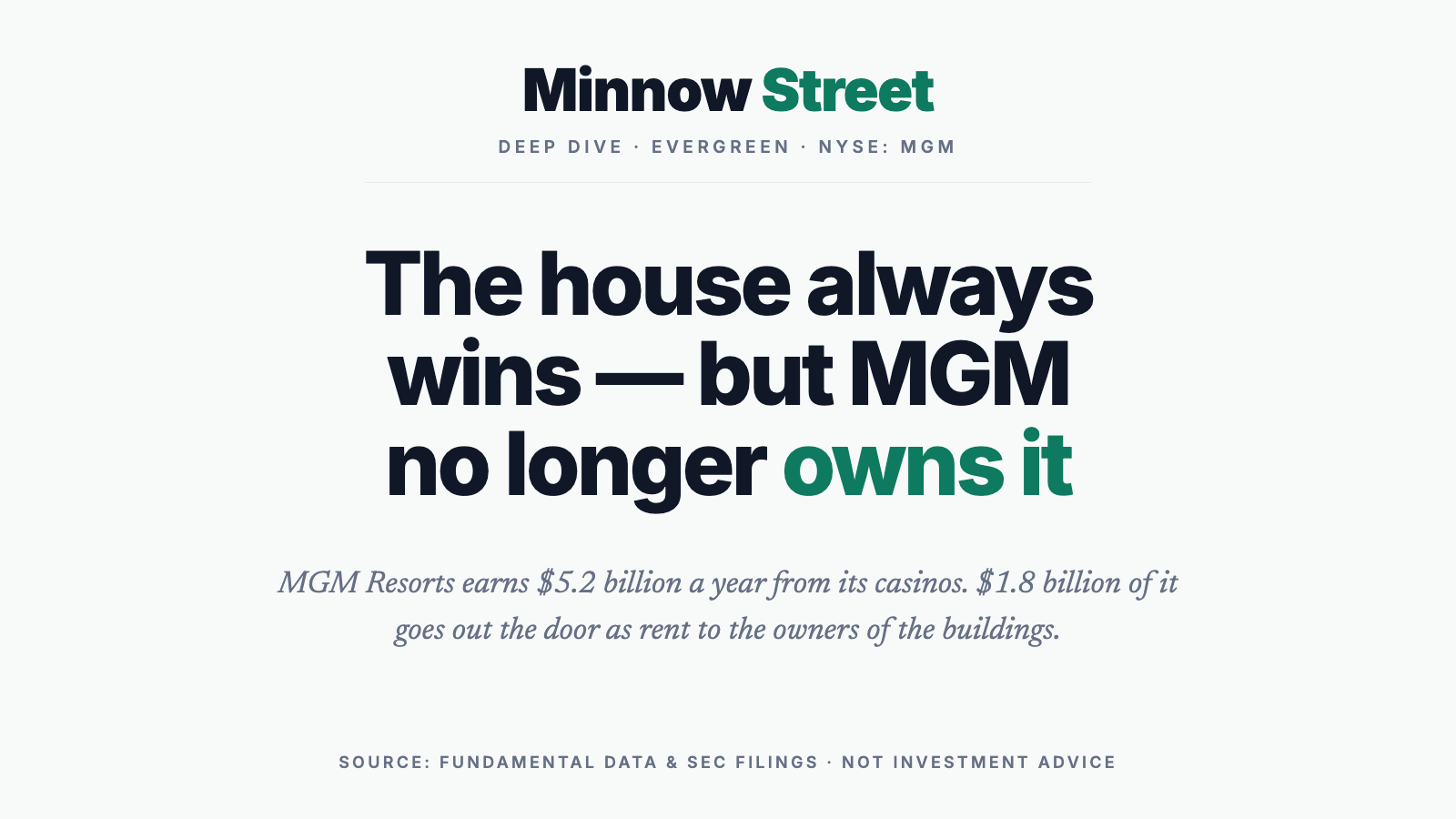
MGM Resorts: The House Always Wins — But MGM No Longer Owns the House
Bellagio, Aria, Mandalay Bay, MGM Grand: MGM Resorts runs the most famous addresses on the Las Vegas Strip — it does not own them. It sold the real estate and rents it back. The filings to the U.S. securities regulator, the SEC, show what that costs: the resorts produced $5.2 billion of segment earnings in 2025, $1.8 billion went out as cash rent to the landlords, and on $17.5 billion of revenue only $206 million of net income was left — down from $1,142 million in 2023. Over five years MGM spent $9.4 billion buying back its own stock while equity melted from $6.07 billion to $2.43 billion. And since June 1, 2026 a non-binding cash proposal of $48.30 per share is on the table: the largest shareholder, publisher People Incorporated with 26.1 percent, wants to buy every share it does not already own — with no response from the MGM board on file as of the editorial cut-off. Not investment advice — just the question of who owns the house the game is played in.
 Thomas Mücke
Founder & Publisher
Thomas Mücke
Founder & Publisher
Chart
Interactive price chart (TradingView).
Note: pure fact-based analysis, not investment advice and not a solicitation to buy or sell. All figures without guarantee.
There is a sentence everyone knows who has ever walked through a casino: "the house always wins." Mathematically it is true — the house edge is built in, and over enough hands it shows up reliably. Which is exactly what makes it dangerous as an investing thought: it sounds like a finished thesis. Buy a casino stock and it feels like you finally get to sit on the right side of the table. The house-edge trap is that the comfort of that idea stops you from asking who actually owns the house. At MGM Resorts International (NYSE: MGM) that is not a rhetorical question. The company runs Bellagio, Aria, Mandalay Bay, MGM Grand, Luxor, New York-New York and The Cosmopolitan — the best-known addresses on the Las Vegas Strip. It does not own them. It sold the real estate and leases it back. So let's make a deal: before you bet on the house edge, we read together what MGM itself reported, under penalty of law, to the U.S. securities regulator, the SEC — the annual report (10-K) for 2025, the quarterly report (10-Q) as of March 31, 2026 and the current reports (8-K) from the spring of 2026. That record tells a story of record revenue, of rent that costs more than five times the interest bill, of $9.4 billion in buybacks — and of equity that shrank to a third along the way. On top of all that sits one event that has hung over the stock since June 1, 2026: the largest shareholder, publisher People Incorporated with 26.1 percent, put a non-binding cash proposal of $48.30 per share in front of the board for every share it does not already own. What you make of it is up to you.
What MGM Resorts actually is — an operator, not an owner
MGM Resorts is a casino and hotel operator with four business segments. First, the Las Vegas Strip Resorts: nine large properties including Bellagio, Aria (with Vdara), The Cosmopolitan, MGM Grand, Mandalay Bay, Luxor, New York-New York, Excalibur and Park MGM. They generated net revenues of $8,441.5 million in 2025 — and more than half of that did not come from gambling, but from hotel rooms, restaurants, shows and conventions. Second, Regional Operations: seven properties outside Nevada as of December 31, 2025, from MGM Grand Detroit to Borgata in Atlantic City to MGM National Harbor near Washington ($3,772.3 million) — one of them, MGM Northfield Park, was sold in April 2026; here the bulk of revenue does come from the casino floor. Third, MGM China: the roughly 56 percent owned subsidiary that runs MGM Macau and MGM Cotai ($4,461.7 million, up 11 percent). Fourth, MGM Digital: the online business built around Sweden- and Malta-based LeoVegas ($654.2 million, up 19 percent). Two important investments are not consolidated: the 50 percent stake in BetMGM (North American sports betting and iGaming, with Entain) and MGM Osaka, the planned resort in Japan.
The decisive sentence about the business model sits on page 1 of the annual report, and it is easy to skim past:
"We lease the real estate assets of our domestic properties pursuant to triple net lease agreements."
— MGM Resorts International, SEC annual report 10-K for 2025, Item 1 "Business"
Picture what a triple net lease means: it is the hardest form of renting there is. You pay the base rent and on top of that the property taxes, the insurance, the utilities and the maintenance — the landlord gets his number no matter what happens. It is as if you sold your own house, stayed in it, kept paying for every repair yourself, and additionally wired the new owner a rent check that rises every year for thirty years. That is precisely what MGM did: Bellagio went to a REIT venture in 2019, Mandalay Bay and MGM Grand in 2020, Aria and Vdara in 2021, a whole bundle of further properties to VICI Properties in 2022, and The Cosmopolitan in 2022 as well. That names the central tension of this analysis, and it runs through every chapter: the resorts earn more than ever — but the largest part of that earning power is contractually promised to the landlords, and what remains has recently gone into buybacks rather than into substance.
How this stock landed on our desk
Not through one of our momentum or value scanners, but through a mandatory filing. MGM Resorts appears in the Form 13F report of Helikon Investments Ltd, a London hedge fund, as of March 31, 2026 (filed May 8, 2026). The position: 2,875,004 shares worth $106,403,898 — tenth largest in a portfolio of 17 U.S. positions totaling $2,648,555,113. The interesting part is not the holding but its path: on June 30, 2025 the fund still held 8,810,322 shares, then 3,486,261 (September 30, 2025), 2,988,773 (December 31, 2025) and 2,875,004 (March 31, 2026). In other words, the fund cut the position by roughly two thirds within three quarters — and has held the remainder almost unchanged ever since. In the same quarter Helikon opened six new positions and exited six others entirely; MGM is one of the few older holdings that survived.
The same filing contains one more detail that only made sense two months later: as of March 31, 2026 Helikon also held 3,518,414 shares of People Incorporated ($140.8 million), a position it had increased by 88.5 percent in that quarter. On the reporting date the fund therefore sat on both sides of the proposal that became public on June 1, 2026. What that stake looks like from the other side — as the single largest item on a magazine publisher's balance sheet — is laid out in our People Incorporated analysis.
Before that turns into a signal, here is the framing that is missing from most write-ups of 13F data: a 13F is a rearview mirror, not a roadmap. It shows only U.S.-listed long positions, appears 35 to 45 days after the reporting date, and contains no short sales, no derivatives and no European holdings. Nobody outside the fund knows what happened between the reporting date and publication. All that is provable is the fact: a professional investor cut two thirds of its MGM position and left the rest in place. Why, it does not say.
What about the usual metrics? At MGM they mislead, which is why this belongs here rather than in the valuation chapter. A price-to-earnings ratio on 2025 earnings is close to worthless because a $278.9 million goodwill impairment distorts the result. And any leverage ratio that counts only the $6.2 billion of financial debt misses the real burden: a lease liability of $25.1 billion. Remember the point from the start: at MGM you do not measure with the debt counter, you measure with the lease.
The numbers over the years — honestly appraised
First what speaks for MGM, and it is more than the headline suggests. The operating business works: net revenues rose to $17,537.7 million in 2025, the highest in company history ($17,240.5 million in 2024; $16,164.2 million in 2023; $12,899.7 million in 2019, before the pandemic). Consolidated Adjusted EBITDA — earnings before interest, taxes, depreciation and amortization — came in at $2,425.6 million, slightly above the prior year ($2,410.8 million). Operating cash flow was $2,529 million; after $1,069 million of capital expenditures, roughly $1.5 billion of free cash flow was left. Macau keeps recovering (MGM China revenue up 11 percent, Macau visitor arrivals up 15 percent according to the Statistics and Census Service of the Macau Government), the online business grows at double digits, and at $6.2 billion the financial debt is manageable for a company this size.
And yet: only $205.9 million was left for MGM shareholders in 2025 — after $746.6 million in 2024 and $1,142.2 million in 2023. Earnings per share fell from $3.19 to $2.40 to $0.76, and that despite a sharply lower share count over the same period. Where the difference goes is the subject of the first chart: what the resorts earn, and what the rent takes out of it.
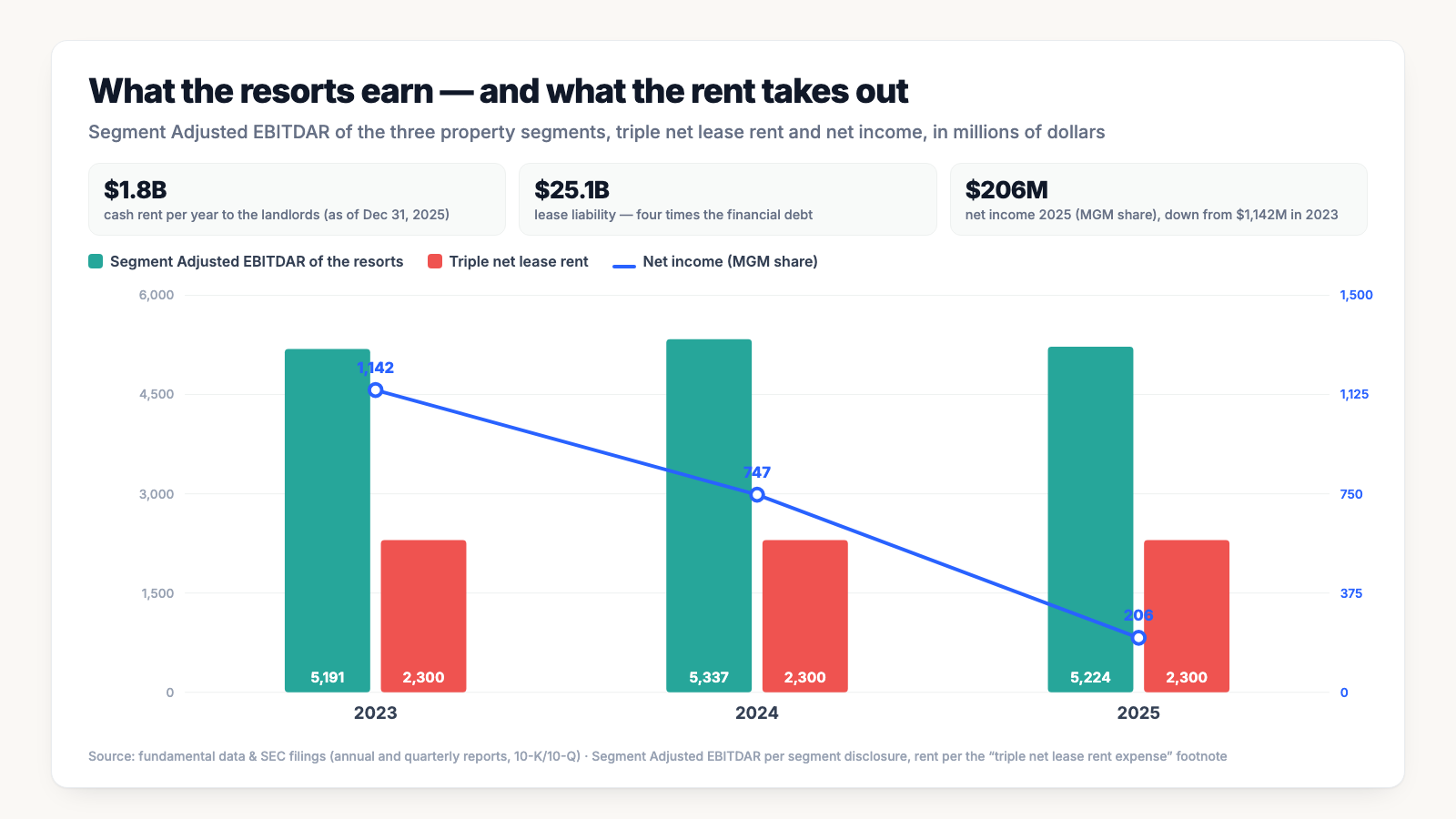
Half the analysis sits between the green bars and the red ones. And 2026 did not start better: in the first quarter, revenue rose 4 percent to $4,454.7 million, but operating income fell 22 percent to $301.2 million and net income to $125.1 million (prior-year quarter: $148.6 million). Strip revenue was essentially flat while segment profit there dropped 8 percent. One quarter proves nothing on its own — but the direction matches the full year.
What the filings say — the uncomfortable truths
Uncomfortable truth no. 1: the rent costs more than five times the interest bill
MGM Resorts' largest cost item is not a loan, it is a lease. The annual report states it in the risk factors about as plainly as these documents ever get:
"We are required to make annual rent payments of $1.8 billion, in the aggregate, under our triple net lease agreements, which leases are also subject to annual escalators as described elsewhere in this Annual Report on Form 10-K."
— MGM Resorts International, SEC annual report 10-K for 2025, Item 1A "Risk Factors"
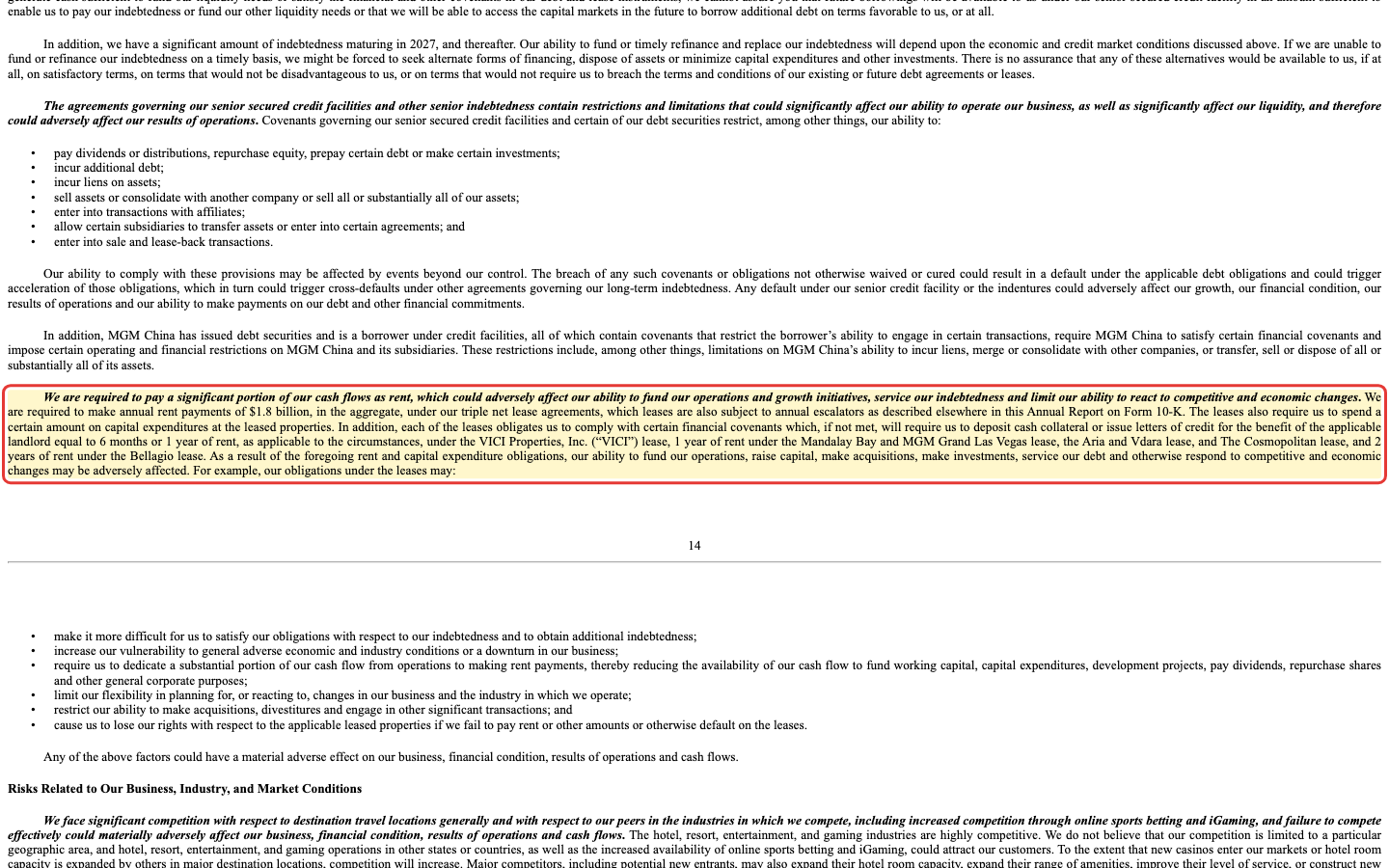
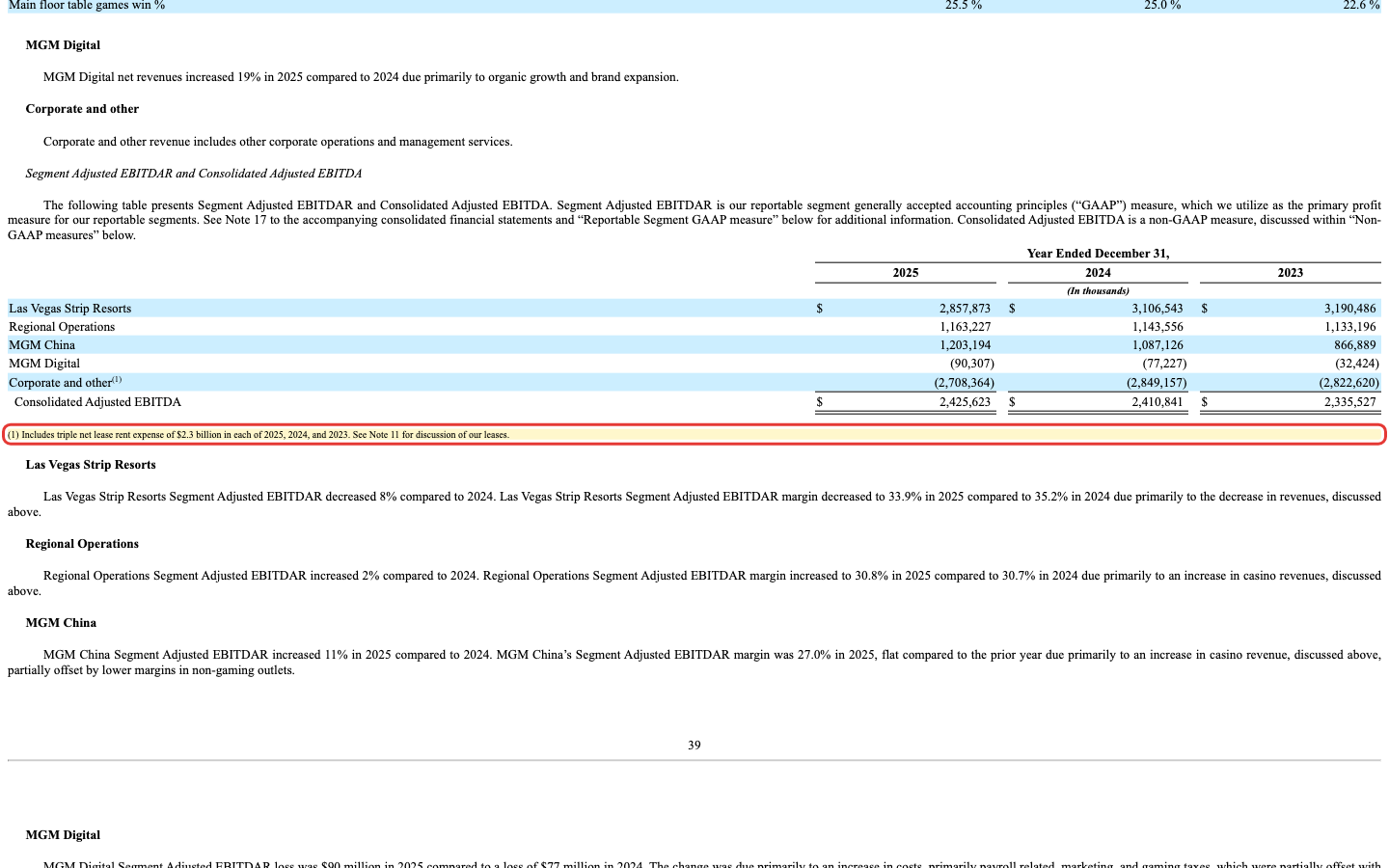
The individual leases are listed in the notes, and they read like a directory of the best addresses in Las Vegas: $775 million a year to VICI Properties (for Luxor, New York-New York, Park MGM, Excalibur, MGM Grand Detroit, Beau Rivage, Borgata, Empire City, MGM National Harbor and others), $322 million for Mandalay Bay and MGM Grand Las Vegas, $276 million for Bellagio, $233 million for Aria and Vdara, $212 million for The Cosmopolitan. In the income statement the rent shows up as roughly $2.3 billion — for comparison, total interest expense in 2025 was only $419.0 million. MGM pays more than five times as much rent as interest. Where exactly that sits in the numbers is visible in the segment table: the three property segments earned $5,224.3 million together, but the "Corporate and other" line subtracts $2,708.4 million again — and the footnote explains why.
And this rent is not a line you trim in a bad year. It rises by at least 2 percent annually, in later phases tied to inflation and capped at 3 to 4 percent. The initial terms run 25 to 30 years plus renewal options. In balance-sheet terms: the lease liability stood at $25,068.7 million on December 31, 2025, and the undiscounted total of all future lease payments at $54,679.6 million. Remember the image: MGM traded its buildings for cash — and signed a standing order worth $55 billion in return.
Uncomfortable truth no. 2: $9.4 billion of buybacks — and equity down to a third
What does a company do with the money the real estate sales released? At MGM, a large part of the answer is: buy back its own stock. From 2021 through 2025, $9.4 billion went into repurchases — $1,753.5 million (2021), $2,775.2 million (2022), $2,291.9 million (2023), $1,357.9 million (2024) and $1,228.3 million (2025). The share count fell from 453.8 million to 258.3 million, a drop of 43 percent. On its own that is shareholder friendly: whoever stays owns a bigger slice of the same company. But the second number belongs in the picture.
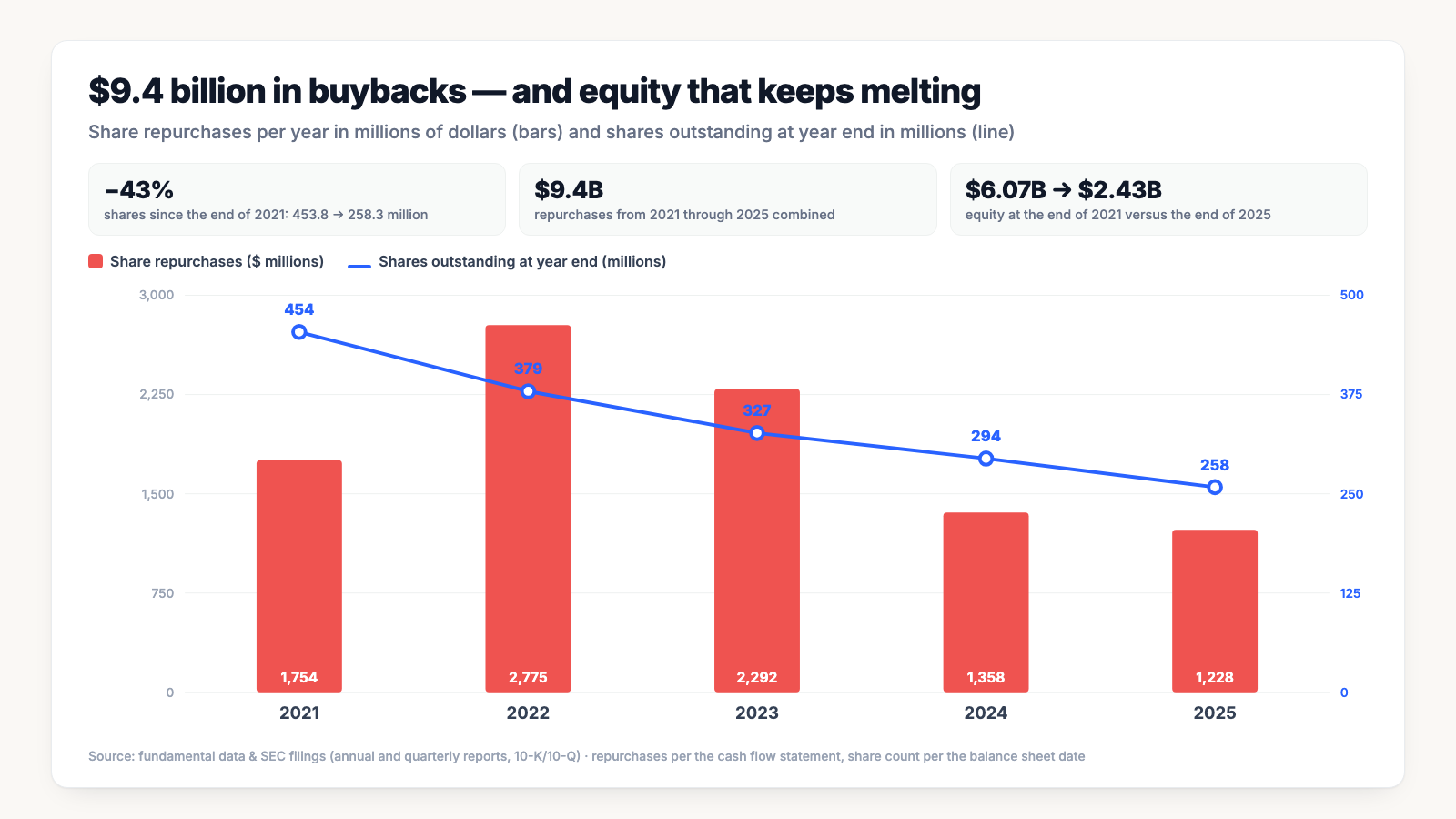
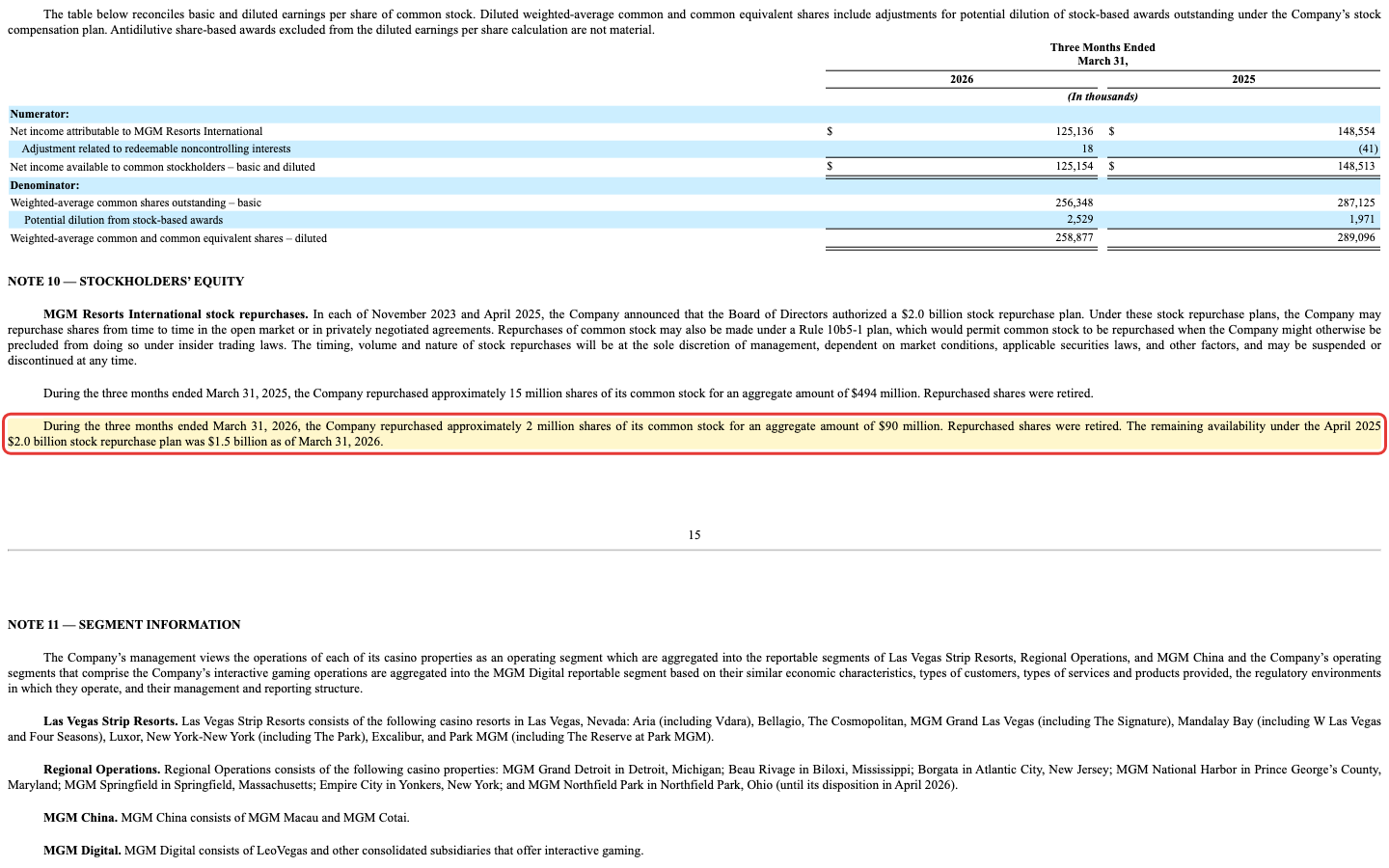
Equity attributable to MGM shareholders was $7,727.3 million at the end of 2019 and $6,070.6 million at the end of 2021 — and only $2,429.9 million at the end of 2025. Picture a homeowner who sells his house, uses the proceeds to buy out his co-owners, and then rents in the same house. He now owns a bigger share — of considerably less. Buybacks shrink the cake and the number of eaters at the same time; whether that was a good trade depends entirely on whether the price paid was below the value received. With earnings per share down from $3.19 to $0.76 despite 43 percent fewer shares, that question does not have a confident yes. And in the first quarter of 2026 the engine is nearly off: roughly 2 million shares for $90 million, after roughly 15 million shares for $494 million in the prior-year quarter — with $1.5 billion of authorization still free.
Uncomfortable truth no. 3: MGM guarantees $6 billion of its own landlords' debt
The story behind the property sales is called asset-light — get lean, free up capital, hand off the risk. The first two parts hold. The third gets interesting:
"We currently also provide shortfall guarantees of the $3.01 billion and $3.0 billion principal amount of indebtedness (and any interest accrued and unpaid thereon) of the landlords of Bellagio and Mandalay Bay and MGM Grand Las Vegas, respectively."
— MGM Resorts International, SEC annual report 10-K for 2025, Item 1A "Risk Factors"
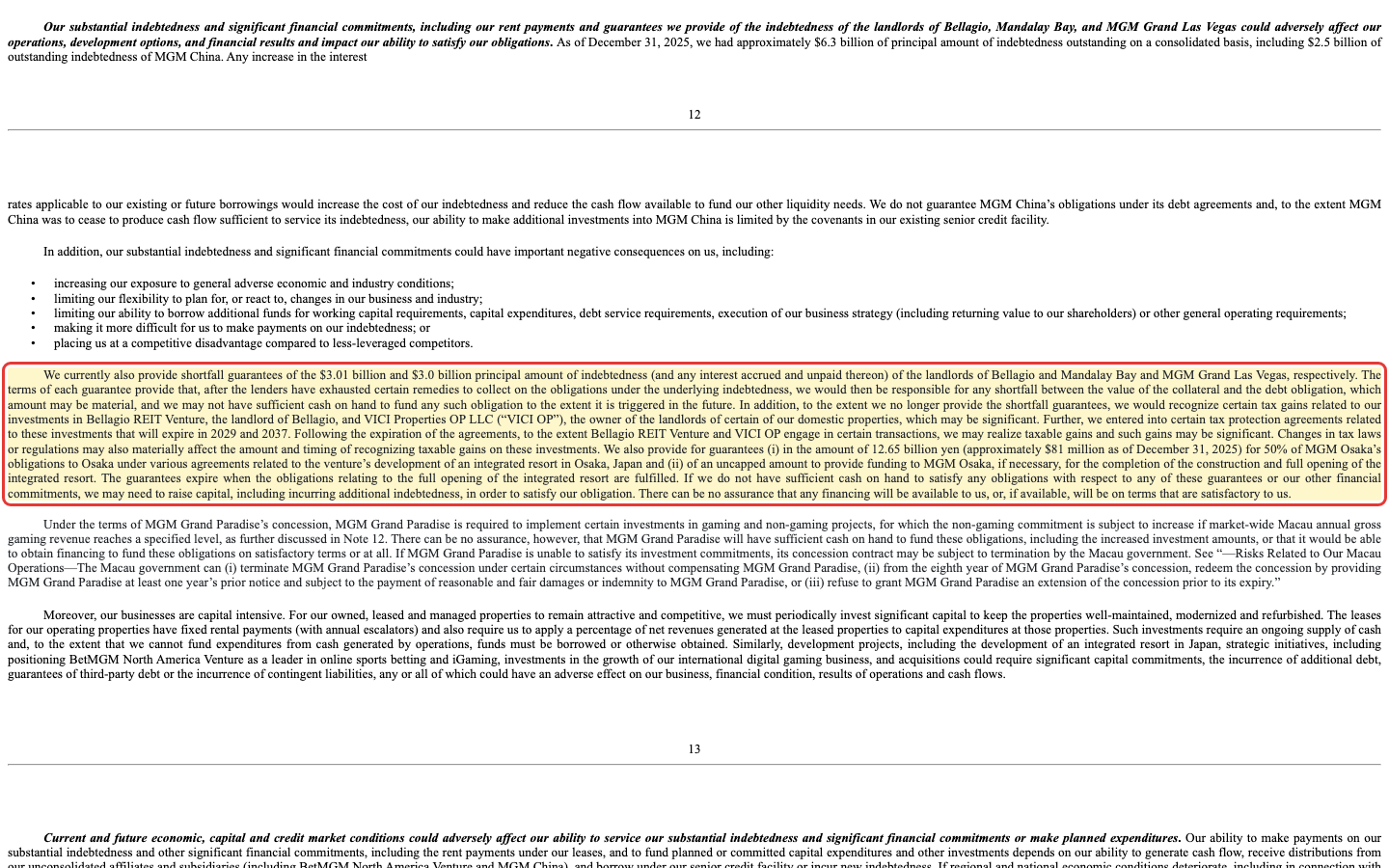
Together that is roughly $6.0 billion — two and a half times the entire $2,429.9 million of equity. To be fair: the guarantee only bites after the lenders have exhausted their remedies and the property is worth less than the debt; the Bellagio landlord's debt matures in 2029, and the balance sheet carries the guarantee at an immaterial fair value under the applicable standard. But the direction is notable: the buildings are sold, the real estate risk is not entirely. Then there is the second open flank, Japan. For MGM Osaka the company has committed to fund a total of JPY 428 billion, of which JPY 335.9 billion (roughly $2.1 billion) was still outstanding on March 31, 2026 — payable quarterly through 2028. And for the completion of the resort the notes disclose a guarantee "of an uncapped amount." Set against equity of $2.43 billion, that means: MGM has promised roughly as much for Osaka as its entire book equity.
Uncomfortable truth no. 4: Las Vegas is softening — and in Macau the minority owners earn more than you
The heart of the company, the Las Vegas Strip Resorts, had a difficult 2025: revenue fell 4 percent to $8,441.5 million, room revenue by 9 percent. Occupancy slipped from 94 to 92 percent, the average daily rate from $260 to $249, revenue per available room from $245 to $229. This is not purely self-inflicted: Las Vegas visitor volume fell 8 percent in 2025 according to the Las Vegas Convention and Visitors Authority. But it hits the segment with the highest margin, whose segment profit dropped 8 percent to $2,857.9 million — while the rent stays exactly where it is.
The offset came from Macau. MGM China grew revenue 11 percent to $4,461.7 million and segment profit to $1,203.2 million. The catch: MGM owns roughly 56 percent of MGM China — the other 44 percent belongs to someone else. Which produces a number worth reading twice: of the $520.9 million in consolidated net income for 2025, $315.0 million went to noncontrolling interests and only $205.9 million to MGM shareholders. Picture two pots: the American one, where the rent eats the result, and the Chinese one, which runs well but belongs 44 percent to others. Remember the image: the part of the business that performed best in 2025 is only half yours.
Two further burdens from 2025 belong in the record. MGM withdrew its application for a commercial gaming license for Empire City in Yonkers, New York, and wrote off that location's entire $256 million of goodwill plus $93 million of further write-downs. And in April 2026 the sale of MGM Northfield Park for $546 million closed, cutting the VICI rent by $53 million a year. One cost money once; the other saves rent permanently — both show the same company trimming its portfolio.
The largest shareholder wants the whole house: the $48.30 cash proposal
On June 1, 2026 the question of who owns the house was asked all over again — and this time not because of the landlords. On that day MGM's largest single shareholder put a written offer in front of the board to buy every share it does not already own. The headline of the accompanying filing leaves no room for interpretation:
"PEOPLE INCORPORATED PROPOSES TO ACQUIRE MGM RESORTS INTERNATIONAL FOR $48.30 PER SHARE IN CASH"
— People Incorporated (IAC Inc. until June 2026), SEC current report 8-K dated June 1, 2026, Item 7.01, Exhibit 99.1 (press release including the letter to the MGM board)
Who is bidding — and how long it has been here
The bidder is People Incorporated (Nasdaq: PPLI), known as IAC Inc. until early June 2026: the New York company behind America's largest magazine publisher, home to PEOPLE, Better Homes & Gardens and Investopedia. It is no stranger at MGM. On August 10, 2020 IAC first disclosed a stake to the SEC — 59,033,902 shares, or 12.0 percent, bought in the open market for roughly $1,018.5 million and expressly "for investment purposes." Not quite six years later that has become 66,822,350 shares, or 26.1 percent (Schedule 13D/A, Amendment No. 8 of June 1, 2026, calculated against 255,851,235 shares outstanding as of April 27, 2026).
And here is the part that never makes a headline: over almost six years the shareholder bought only 7,788,448 additional shares — a 13 percent addition to its own holding. The percentage more than doubled anyway, because MGM retired 48 percent of its own stock over the same period. Had People Incorporated bought nothing at all since 2020, its stake would still stand at 23.1 percent instead of 12.0 percent. Of the roughly 14 percentage points of increase, about 11 points came from MGM's own buyback program and only 3 from purchases. The shareholder writes it down in its December 9, 2025 filing as flatly as these documents ever put anything:
"As a result of repurchases under this program …, the number of shares of outstanding Common Stock decreased, and consequently, the percentage of shares of Common Stock beneficially owned by the Reporting Person passively increased …"
— IAC Inc., SEC Schedule 13D/A on MGM Resorts (CUSIP 552953101), Amendment No. 5 dated December 9, 2025
Picture an estate shared by ten heirs that buys out four of them: the share of everyone left grows without a cent being invested. MGM spent $9.4 billion on buybacks and in doing so lifted its largest shareholder past the one-quarter mark. The buyback helped create the bidder. Hold on to that link — it is why the previous chapter and this one are telling the same story.
Two months earlier: the voting cap of April 3, 2026
Before the proposal came an agreement that looks, in hindsight, like a switch being thrown. On April 3, 2026 MGM Resorts, IAC Inc. and Barry Diller personally entered into a voting agreement. Its core sits in the current report MGM filed four days later:
"IAC, Mr. Diller and their respective controlled affiliates … will vote any voting securities that they beneficially own that collectively constitute in excess of 25.73% of the total voting power of the outstanding voting securities of the Company … in the same proportion as the stockholders of the Company (other than the Covered Entities) vote their voting securities on such matters."
— MGM Resorts International, SEC current report 8-K dated April 7, 2026, Item 1.01, on the Voting Agreement of April 3, 2026 (Exhibit 10.1)
Everything above 25.73 percent is effectively voteless — it simply mirrors how the rest of the shareholder base votes. The threshold, incidentally, is not a round number but a measured one: 25.73 percent is exactly what MGM's proxy statement of March 27, 2026 lists as IAC's holding (65,822,350 shares). The cap was set precisely at the stake the shareholder held at that moment. In exchange, the MGM board must nominate two directors designated by IAC. And more important for today: the agreement terminates automatically upon a change of control of MGM — as it does if the stake falls below 17.5 percent or the two directors are not nominated. If the takeover succeeds, the self-imposed voting cap disappears with it.
What the letter says — and what it expressly does not
The bidder puts the price at 24.1 percent above the volume-weighted average price over the 30 trading days ended May 29, 2026, more than 30 percent above the 90-day average and 10.6 percent above the last closing price before that. Funding is to come from "existing cash on hand at People Incorporated and MGM and additional debt and equity funding commitments" — that is, partly from the target's own cash, topped up with fresh debt and equity. Afterwards the bidder expects to hold "just over 50.1%" of the equity and to control MGM, with other investors taking the remainder. There would be no financing condition, but there would be competition and gaming regulatory approvals. And then comes the sentence that catches every bit of takeover romance:
"This letter is a non-binding expression of interest only, and People Incorporated reserves the right to withdraw or modify the proposal at any time, or to terminate discussions and negotiations at any time in our sole discretion. No legal obligation with respect to our proposal or any other matter will arise unless and until we have executed definitive transaction documentation with MGM."
— Barry Diller for People Incorporated, letter to the MGM board of directors dated June 1, 2026, Exhibit 99.1 to the SEC current report 8-K
Two commitments in the same letter matter, because they pin down the situation for everyone outside. First, People Incorporated states it has "no intention to sell our existing ownership stake in MGM, or to pursue or vote in favor of any merger … that would result in a change in control to another party." A competing bidder would therefore have to get past a quarter-owner who has said in writing that it will not sell. Second, the governance side: Barry Diller sits on MGM's own board, and so does Joey Levin, IAC's chief executive until 2025 — both were re-elected at the annual meeting on May 6, 2026 (Diller with 130.0 million votes for and 7.2 million against). In his letter Diller states that he will recuse himself from any deliberations of the MGM board about this transaction or any alternative. Picture it plainly: the buyer sits at the seller's table and leaves the room for the price negotiation. That is the standard procedure for deals like this — it does not make it a deal between strangers.
And the MGM board? As of the cut-off: nothing on file
This is the most honest part of the chapter, because it consists of what is not in the record. Between June 1, 2026 and the editorial cut-off of this analysis on July 24, 2026, MGM Resorts has filed no response to the proposal with the SEC — no current report (8-K), no board statement, no proxy supplement. The company's most recent filings of any kind are four Forms 4 dated July 2, 2026 covering the quarterly credit of deferred stock units to non-employee directors: routine. The bidder, for its part, has not amended its Schedule 13D since June 1, 2026; Amendment No. 8 states expressly that no further disclosures about the proposal are intended unless a definitive agreement has been reached.
So the provable position is plain: a proposal exists, no response is on the public record, and the outcome is open. It may lead to an agreement, it may get richer, it may quietly disappear. What you are reading here is not a deal timetable but a dated snapshot — and the one source that will show the next step first is another mandatory filing: a new Schedule 13D/A on CUSIP 552953101 or an 8-K from MGM.
Valuation: buy MGM, buy the lease with it
A price-to-earnings ratio on 2025 earnings is a poor guide here — $0.76 per share is distorted by the Empire City impairment; measured against the prior year's $2.40 the same stock suddenly looks three times cheaper. A clean, dated anchor sits on the cover page of the annual report itself: the aggregate market value of shares held by non-affiliates was $5.8 billion as of June 30, 2025. What matters more is what you automatically take on when you buy the stock: $6.2 billion of financial debt and $25.1 billion of lease liability, against $2.1 billion of cash. The enterprise value is therefore dominated not by the market capitalization but by the lease.
Since June 1, 2026 there is a second dated anchor, and it is uncomfortably precise: $48.30 per share. Applied to the 255,851,235 shares outstanding, the proposal values the entire equity at roughly $12.4 billion; the 73.9 percent the bidder does not yet own would cost about $9.1 billion in cash. And now the number that ties this chapter together: add the balance sheet — $6.2 billion of financial debt and $25.1 billion of lease liability less $2.1 billion of cash as of December 31, 2025 — and even at the proposed price the enterprise value lands in the order of $42 billion. The 24.1 percent premium therefore applies to roughly a quarter of the capital employed. The other three quarters sit in the lease — and a private owner pays that rent too.
Which requires the necessary honesty: a non-binding proposal is not a completed deal. Until a definitive agreement is signed, $48.30 is not a price but a statement of intent that the bidder may withdraw at any time — and the MGM board has filed nothing in response as of the cut-off. Buy the stock for that number and you are not buying a casino business, you are taking a position in the outcome of a negotiation whose progress nobody outside the boardrooms can see. Buy it for the business and you should still know that a second force now acts on the share price, one that has nothing to do with room rates or visitor counts.
That also settles which metric counts at MGM: not earnings or book value, but how much of the segment profit survives the rent, and how stable that remainder is. In 2025 it was $2,425.6 million of Consolidated Adjusted EBITDA — a figure that has been remarkably steady for three years ($2,335.5 million in 2023; $2,410.8 million in 2024) even as reported profit fell by four fifths. If you want to see the other side of this business — an owner who holds hotels and collects the rent — our Host Hotels analysis lays it out; and if you want a study in what heavy leverage plus a shrinking equity base does to a leisure business over time, the AMC Entertainment analysis is the cautionary companion piece. The comparison is worth the time, because "casino stock" can mean two completely different business models.
Opportunities and risks at a glance
What speaks for MGM Resorts:
- A portfolio that cannot be rebuilt: Bellagio, Aria, Mandalay Bay, MGM Grand, The Cosmopolitan and more at the best addresses on the Las Vegas Strip, plus 16 U.S. properties in total and two resorts in Macau.
- Record revenue and steady operating earnings: net revenues of $17,537.7 million in 2025, Consolidated Adjusted EBITDA of $2,425.6 million ($2,410.8 million in 2024; $2,335.5 million in 2023), operating cash flow of $2,529 million — leaving roughly $1.5 billion of free cash flow after capital expenditures.
- Growth outside Las Vegas: MGM China revenue up 11 percent (segment profit $1,203.2 million), MGM Digital up 19 percent and up 43 percent in the first quarter of 2026; BetMGM delivered its first positive contribution in that quarter (+$7.4 million after −$15.2 million a year earlier).
- Manageable financial debt: $6.3 billion of principal ($2.5 billion of it at MGM China) against $2.1 billion of cash, with nothing drawn on the corporate revolver at December 31, 2025; expected consolidated cash interest for 2026 is about $350 million.
- Active portfolio management: the sale of MGM Northfield Park ($546 million, closed April 2026) permanently cuts the VICI rent by $53 million a year, and $1.5 billion of buyback authorization remains available.
- An interested buyer who knows the business and sits on its board: largest shareholder People Incorporated (26.1 percent) offered $48.30 per share in cash for all remaining shares on June 1, 2026 — a 24.1 percent premium to the 30-day average price through May 29, 2026, with no financing condition and a written commitment not to sell its own stake.
What speaks against it:
- Rent is the dominant, non-cancellable cost: $1.8 billion of cash rent a year with annual escalators, $2.3 billion of rent expense in the income statement, a $25,068.7 million lease liability and $54.7 billion of undiscounted future lease payments.
- Profit is collapsing despite record revenue: operating income down 33 percent to $1,001.8 million, net income attributable to MGM at $205.9 million after $1,142.2 million in 2023, earnings per share at $0.76 after $3.19 — and operating income down another 22 percent in the first quarter of 2026.
- The core business on the Strip is shrinking: revenue down 4 percent, room revenue down 9 percent, occupancy 92 instead of 94 percent, revenue per available room $229 instead of $245; Las Vegas visitor volume fell 8 percent in 2025.
- Equity has melted to a third ($7,727.3 million at the end of 2019 to $2,429.9 million at the end of 2025) while $9.4 billion went into buybacks; alongside that sit roughly $6.0 billion of guarantees for landlord debt and an uncapped completion guarantee for Osaka.
- Capital tied up in Japan and Macau: roughly $2.1 billion of Osaka funding still due through 2028, plus MGM China investment commitments of about $2.5 billion through the concession's expiry in December 2032 — and 44 percent of the Macau profit belongs to minority holders.
- A pending situation with an open outcome: the $48.30 proposal is expressly non-binding and revocable at any time, and no response from the MGM board was on file as of July 24, 2026. The share price now hangs partly on a negotiation nobody outside can observe — and a withdrawal would remove a support that does not come from the business.
A human conclusion
Back to the house-edge trap. "The house always wins" still holds at MGM Resorts — the casinos make money, every year, reliably, with more than five billion dollars of segment profit. It is just that MGM is no longer the house; it is the tenant in the house. The company made a trade that can be argued for on the merits: real estate capital for cash, cash for growth and buybacks. What the filings show is the price of that trade — $1.8 billion of cash rent a year, rising annually, for thirty years, plus guarantees for the debt of the parties that now own the buildings. So buying MGM today is not simply buying Bellagio and Aria. It is buying an operating result of which a large share is already promised to third parties, a growth promise in Japan that still costs roughly $2.1 billion, and a cash balance that has to be split between Osaka and the buyback program. And since June 1, 2026 you are buying one more thing that appears on no balance sheet: an open negotiation. The largest shareholder is offering $48.30 a share for the rest, the board has filed nothing in reply, and either of those can change tomorrow. Buy solely for that reason and you are not betting on Las Vegas, you are betting on minutes you will never get to read. The honest question is therefore not "does the house win?" It is: would you take a stake in a business that plays the best addresses in town but does not own them — and whose landlord gets paid first regardless of how the year goes? If your answer is yes, because you trust the operator and the location, you have a thesis. If it is no, you had a gut feeling. What you make of it is your decision. And that is exactly as it should be.
Sources
Every original document used in this analysis — read them yourself:
- MGM Resorts International — SEC annual report 10-K for 2025 (filed February 11, 2026)
- MGM Resorts International — SEC annual report 10-K for 2024 (filed February 18, 2025)
- MGM Resorts International — SEC quarterly report 10-Q as of March 31, 2026 (filed April 29, 2026)
- MGM Resorts International — SEC current report 8-K dated April 7, 2026, Item 1.01 (Voting Agreement of April 3, 2026) and the agreement itself (Exhibit 10.1)
- People Incorporated (IAC Inc. until June 2026) — SEC current report 8-K dated June 1, 2026, Exhibit 99.1: press release and letter to the MGM board ($48.30 per share)
- Ownership filings on MGM Resorts (CUSIP 552953101): Schedule 13D dated August 10, 2020 (initial disclosure, 12.0 percent), Amendment No. 5 dated December 9, 2025 and Amendment No. 8 dated June 1, 2026 (26.1 percent, the proposal)
- MGM Resorts International — proxy statement DEF 14A dated March 27, 2026 and voting results of the annual meeting of May 6, 2026 (8-K, Item 5.07)
- Complete SEC filing history of MGM Resorts International: EDGAR overview (sec.gov)
- Helikon Investments Ltd — Form 13F reports as of March 31, 2026 and prior quarters (sec.gov)
- Fundamental data (metrics, segment contributions, valuation; data as of July 23, 2026), reconciled with the SEC filings and the SEC's XBRL financial series.
Transparency & disclaimer: this analysis is a journalistic contextualization of publicly available information and is not investment advice, not a financial analysis in the regulatory sense and not a solicitation to buy or sell securities. Equity investments carry substantial risk up to total loss. All information without guarantee; the data cut-off is stated in the text. The author holds no position in MGM Resorts shares at the time of publication.
Our Bottom Line at a Glance
- Market position & portfolio positive
- With Bellagio, Aria, Mandalay Bay, MGM Grand and The Cosmopolitan, MGM runs addresses that cannot be rebuilt, plus seven regional properties, two resorts in Macau and a growing online business. Net revenues hit a record $17,537.7 million in 2025 and Consolidated Adjusted EBITDA of $2,425.6 million came in slightly above the prior year.
- Lease structure negative
- The real estate of the domestic properties no longer belongs to the company. The 10-K for 2025 puts contractual cash rent at $1.8 billion a year with annual escalators; the income statement carries $2.3 billion of rent expense, the balance sheet a $25,068.7 million lease liability and $54.7 billion of undiscounted future lease payments. Interest expense next to that is only $419.0 million.
- Earnings trend negative
- Despite record revenue, operating income fell 33 percent to $1,001.8 million in 2025 and net income attributable to MGM to $205.9 million (2023: $1,142.2 million). Earnings per share dropped from $3.19 to $0.76 even though the share count was cut by 43 percent. The trend continued in the first quarter of 2026: operating income down 22 percent.
- Use of capital neutral
- From 2021 through 2025, $9.4 billion went into share repurchases (share count 453.8 → 258.3 million) while equity fell from $6,070.6 million to $2,429.9 million. In the first quarter of 2026 the buyback was throttled to $90 million (prior-year quarter $494 million) even though $1.5 billion of authorization was free — the cash is needed for Osaka and capital expenditures. A side effect of the program: the largest shareholder's stake rose from 12.0 to 26.1 percent on the shrinking denominator alone.
- Takeover proposal (pending) neutral
- On June 1, 2026 People Incorporated (IAC Inc. until June 2026), the largest shareholder with 66,822,350 shares or 26.1 percent, offered $48.30 per share in cash for all remaining shares — a 24.1 percent premium to the 30-day average price through May 29, 2026, with no financing condition and funded partly out of MGM's own cash. The proposal is expressly non-binding and revocable at any time; as of July 24, 2026 the MGM board had filed no response with the SEC. It follows the voting agreement of April 3, 2026, which binds votes above 25.73 percent and terminates on a change of control. A non-binding proposal is not a completed deal: the outcome is open.
- Off-balance-sheet obligations negative
- MGM guarantees $3.01 billion and $3.0 billion of debt owed by its own landlords (Bellagio REIT Venture and the landlord of Mandalay Bay/MGM Grand Las Vegas) and still has roughly $2.1 billion to fund for MGM Osaka — plus an uncapped completion guarantee. For comparison: equity was $2,433.4 million on March 31, 2026.
- Regional balance neutral
- The decline on the Las Vegas Strip (revenue −4 percent, revenue per available room $229 instead of $245, city visitor volume −8 percent) was offset in 2025 by Macau (+11 percent revenue). But 44 percent of MGM China belongs to others: of $520.9 million in consolidated net income, $315.0 million went to noncontrolling interests and only $205.9 million to MGM shareholders.
MGM Resorts is the largest operator on the Las Vegas Strip — and, since selling the real estate, a tenant in its own buildings. The operating business delivers: $17,537.7 million of revenue in 2025, $5,224.3 million of segment profit from the three property segments, $2,529 million of operating cash flow. But $1.8 billion of cash rent a year with escalators, a $25.1 billion lease liability and roughly $6.0 billion of guarantees for the landlords' debt claim a large part of it; the bottom line was $205.9 million after $1,142.2 million in 2023. Meanwhile equity has shrunk to $2,429.9 million after $9.4 billion of buybacks — and that same buyback lifted the largest shareholder to 26.1 percent, who on June 1, 2026 put a non-binding cash proposal of $48.30 per share on the table for the rest. No response from the MGM board was on file as of July 24, 2026. Not investment advice.
What Our Rating Means
Open questions
The business works in principle, but one material question is open. As long as it stays open, our findings do not carry a quality verdict.
Buying today is less a bet on Bellagio or Aria than on an arithmetic: that the resorts' segment profit grows faster than the contractually rising rent — and that Macau and the online business keep covering the softness on the Strip while roughly $2.1 billion flows to Osaka. Whoever waits watches three lines in every filing: how Las Vegas Strip segment profit develops (last down 8 percent to $2,857.9 million); how much survives the rent at the Consolidated Adjusted EBITDA line (last $2,425.6 million); and how quickly the buyback is turned back up (last $90 million a quarter after $494 million). Since June 1, 2026 a fourth line has been added that has nothing to do with operations: the largest shareholder's non-binding cash proposal of $48.30 per share, to which the MGM board had filed no response as of July 24, 2026. It may lead to an agreement, it may get richer, it may vanish — which is exactly why it does not improve the picture, it adds uncertainty. The lease structure remains the dominant risk, the pending proposal comes on top. The decision is yours.
A journalistic assessment by our editorial team at the time of the deep dive, based on public sources — not investment advice and not a solicitation to buy or sell. Your personal circumstances (investment goals, risk capacity, taxes) cannot be taken into account. What our levels mean, how verdicts are formed, and what conflicts of interest exist →
Worth Noting
- MGM Resorts came onto the research list not through a momentum or value scanner but through the Form 13F of Helikon Investments Ltd as of March 31, 2026 (2,875,004 shares, $106,403,898). The fund had previously cut the position from 8,810,322 shares (June 30, 2025) to 2,988,773 (December 31, 2025). A 13F shows only U.S.-listed long positions, appears 35 to 45 days late and contains no shorts and no derivatives — a rearview mirror, not a roadmap.
- Standard metrics mislead at MGM: 2025 earnings per share ($0.76) are distorted by the $278.9 million goodwill impairment, and any leverage ratio that counts only $6.2 billion of financial debt misses the $25.1 billion lease liability. Segment Adjusted EBITDAR and rent expense are the more telling figures.
- Valuation figures dated and evergreen: the cover page of the annual report puts the aggregate market value of shares held by non-affiliates at $5.8 billion as of June 30, 2025; analyses are evergreen, daily prices are not a buy argument. Diary dates: the next Form 13F (reporting date June 30, 2026, published mid-August 2026) and the Osaka funding schedule through 2028.
- Status of the takeover proposal as of the editorial cut-off on July 24, 2026, documented from the primary filings: proposal of June 1, 2026 at $48.30 per share in cash (8-K of IAC Inc./People Incorporated, accession 0001104659-26-068672, Item 7.01, Exhibit 99.1, plus Schedule 13D/A Amendment No. 8 of the same day); it follows the voting agreement of April 3, 2026 (MGM 8-K, accession 0000789570-26-000029, Item 1.01, Exhibit 10.1). MGM Resorts has filed nothing with the SEC in response — the company's most recent filings are four Forms 4 dated July 2, 2026 covering director deferred stock units. In Amendment No. 8 the bidder states it does not intend further disclosures unless a definitive agreement has been reached. Diary date: a new Schedule 13D/A on CUSIP 552953101 or an 8-K from MGM.
Frequently Asked Questions
MGM Resorts International (NYSE: MGM), based in Las Vegas, operates 16 casino resorts in the United States — including Bellagio, Aria, Mandalay Bay, MGM Grand, Luxor and The Cosmopolitan — two properties in Macau through its roughly 56 percent stake in MGM China, and the online business MGM Digital (LeoVegas). Net revenues reached $17,537.7 million in 2025. On the Las Vegas Strip more than half of revenue comes from hotel, food and beverage, entertainment and conventions rather than gaming.
Because rent absorbs most of the earning power. The three property segments produced Segment Adjusted EBITDAR of $5,224.3 million in 2025; roughly $2.3 billion of that left as triple net lease rent expense. Together with higher depreciation, higher gaming taxes in Macau and a $278.9 million goodwill impairment ($256 million of it for Empire City), operating income fell 33 percent to $1,001.8 million and net income attributable to MGM to $205.9 million.
No. MGM sold the real estate of its domestic properties and leases it back under triple net leases: Bellagio (2019), Mandalay Bay and MGM Grand (2020), Aria and Vdara (2021), a bundle of further properties to VICI Properties and The Cosmopolitan (both 2022). The 10-K for 2025 puts contractual cash rent at roughly $1.8 billion a year, with annual escalators of at least 2 percent and initial terms of 25 to 30 years plus renewal options.
Financial debt stood at roughly $6.3 billion of principal on December 31, 2025 ($2.5 billion of it at MGM China), against $2.1 billion of cash. The real burden sits next to it: a lease liability of $25,068.7 million from the leases, with undiscounted future lease payments of $54,679.6 million. Interest expense in 2025 was $419.0 million, while rent expense was about $2.3 billion.
From 2021 through 2025 MGM repurchased its own stock for a combined $9.4 billion: $1,753.5 million (2021), $2,775.2 million (2022), $2,291.9 million (2023), $1,357.9 million (2024) and $1,228.3 million (2025). The share count fell from 453.8 million to 258.3 million. In the first quarter of 2026 only about 2 million shares were bought for $90 million, after roughly 15 million shares for $494 million a year earlier; $1.5 billion of authorization remained available.
Helikon Investments Ltd of London reports MGM Resorts in its Form 13F as of March 31, 2026 with 2,875,004 shares worth $106,403,898. The path matters: on June 30, 2025 it still held 8,810,322 shares, then 3,486,261 (September 30, 2025) and 2,988,773 (December 31, 2025). A 13F shows only U.S.-listed long positions, appears 35 to 45 days after the reporting date and contains no shorts and no derivatives — it is a rearview mirror, not a roadmap.
MGM Osaka is a joint venture with ORIX for an integrated resort in Osaka, Japan; after minority investors subscribed, MGM expects to hold roughly 43.5 percent. It has committed to fund JPY 428 billion in total, of which roughly JPY 335.9 billion (about $2.1 billion) was still outstanding on March 31, 2026, payable quarterly through 2028. MGM additionally guarantees an uncapped amount for the completion and full opening of the resort.
Found an error?
Did you spot a factual error, an outdated number, or a typo in this deep dive? Let us know briefly — your report goes straight to the editorial team.