Teekay Stock: The Group Runs 34 Tankers — Its Shareholders Own 30.7 Percent of Them
Teekay's income statement reads like that of a large shipping company: $949.5 million in revenue and $352.0 million of net income for 2025. One line below, it says where that profit goes — $253.9 million to the minority shareholders of its listed subsidiary Teekay Tankers, $98.1 million to Teekay's own shareholders. The parent company no longer owns a single vessel. It holds 10.6 million shares of the subsidiary (market value $690.5 million as of June 30, 2026) and $56.4 million in cash — that is all. Because its Class B shares carry five votes each, a 30.7 percent economic interest delivers 54.8 percent of the votes, and control forces full consolidation. Not investment advice — just the question of who ends up on which line of the balance sheet.
 Thomas Mücke
Founder & Publisher
Thomas Mücke
Founder & Publisher
Chart
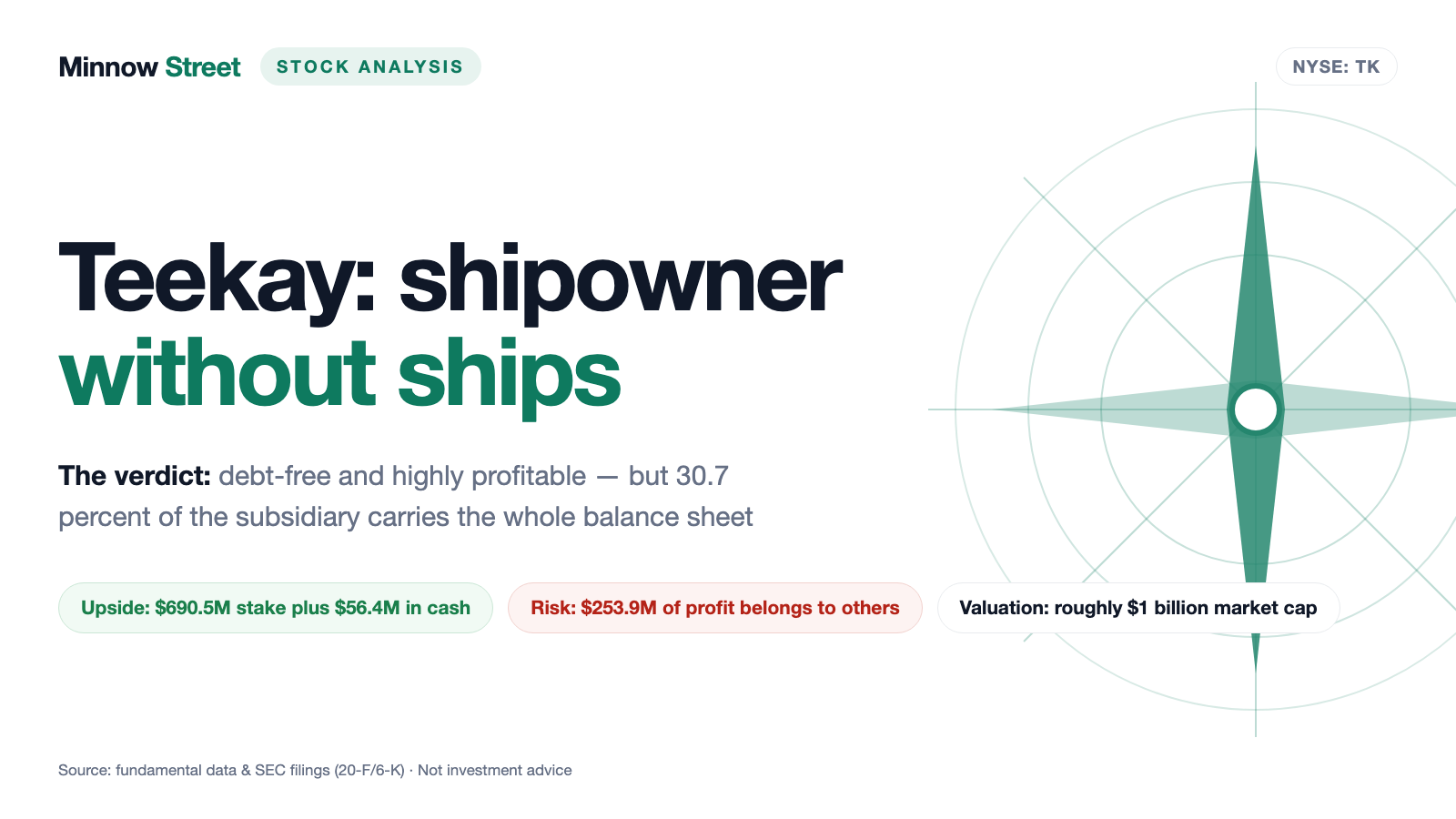
Interactive price chart (TradingView).
Note: pure fact-based analysis, not investment advice and not a solicitation to buy or sell. All figures without guarantee.
There is an investor trap that strikes precisely when you are doing your homework: the label trap. You open the annual report, find the biggest number on the page — revenue, total assets, cash — and your brain quietly turns it into an ownership claim. "$949.5 million in revenue" becomes "my company owns $949.5 million in revenue." With Teekay Corporation Ltd. (NYSE: TK) that is the most expensive mistake available. The parent company does not own a single ship. It owns shares in another publicly listed company — and because it controls that company's votes, it must consolidate the whole subsidiary onto its own balance sheet as if it owned all of it. So let us make a deal: before you buy the label "shipping company with a billion in revenue," we will read together what Teekay itself told the U.S. securities regulator, the SEC — the annual report on Form 20-F for 2025 and the interim reports on Form 6-K through July 29, 2026. Those documents are honest under penalty of law. They describe a debt-free group in a red-hot tanker market — and they show that the line that matters to you sits at the bottom and is considerably smaller. The decision at the end is yours.
What Teekay actually is — a holding company with two assets
Teekay Corporation Ltd. is a holding company. Picture someone who used to run a trucking business with his own fleet, then spun every truck into a separate company and floated it on the stock exchange. Today he holds a block of shares in that second company — plus a bank account. That is exactly where Teekay stands. The 20-F annual report for 2025 puts it plainly:
"Following the maturity of Teekay's convertible senior notes in January 2023 (or the Convertible Notes), Teekay Parent repaid all of its debt and is now debt free. As at December 31, 2025 Teekay Parent has a cash and short-term investments position of approximately $120 million. Teekay Parent no longer has direct interests in any vessels or related equipment of any related management companies, and no longer employs seagoing staff or shore-based personnel."
— Teekay Corporation Ltd., SEC annual report 20-F for 2025, Item 4 A

The operating company is called Teekay Tankers Ltd. (NYSE: TNK) and is a separate corporation listed on the same exchange. As of the July 29, 2026 release it ran a fleet of 34 double-hull tankers — 14 Suezmax, 18 Aframax/LR2 and two Suezmax newbuildings on order — plus three time-chartered vessels. It also operates a ship-to-ship transfer business in the U.S. Gulf and the Caribbean and manages vessels for the Australian government and Australian energy companies. For scale: a Suezmax tanker carries roughly one million barrels of crude, an Aframax about 750,000. This is real, physical business — it simply happens one floor down.
Which names the central tension of this analysis, and it runs through every chapter: Teekay consolidates 100 percent of a subsidiary in which its own shareholders hold 30.7 percent. The big numbers in the report are real — more than two-thirds of them just belong to someone else.
Why the company has had a different name since October 2024
Search older documents and you will find "Teekay Corporation," or earlier still "Teekay Shipping Corporation." Since October 1, 2024 the company has been Teekay Corporation Ltd. — and that is not marketing, it is a move. Teekay was incorporated in the Marshall Islands and relocated, together with Teekay Tankers, to Bermuda. The reason is set out in the proxy statement and prospectus (Form 424B3 dated August 20, 2024): in response to the OECD global minimum tax (Pillar Two), Bermuda enacted its own corporate income tax in December 2023, effective from 2025. Under that law Teekay would have been Bermuda tax resident anyway, since management sits there. Without the move, the group would have had to satisfy the economic substance requirements of both the Marshall Islands and Bermuda. The annual report sums up the consequence:
"As a result of the redomiciliation of Teekay and Teekay Tankers to Bermuda on October 1, 2024, the provisions of the Bermuda CIT Act apply to tax years starting on January 1, 2025 to our Bermuda Constituent Entity Group (which includes Teekay Tankers and its Bermuda constituent entities), which may result in corporate income tax being payable, depending on the nature of our income, profits or gains."
— Teekay Corporation Ltd., SEC annual report 20-F for 2025, Item 10 E "Bermuda Taxation"
Legally, no new company came into being: the prospectus makes clear that the redomiciliation does not create a new legal entity and leaves the identity of the company untouched. Income from international shipping is in principle exempt from the new Bermuda tax provided the local management requirements are met. In parallel, Teekay Tankers' vessel-owning subsidiaries elected into the U.K. tonnage tax regime in November 2024 for an initial eight years: tax is then calculated on a notional daily profit per net registered ton rather than on actual profit. You can see the result in the tax line — in 2025 the group reported a tax recovery of $4.6 million.
How the stock reached our desk
Through the filings, not through a screen. There is no momentum signal and no valuation filter that would have led us here; the route was the SEC's document archive, where a holding company with a nine-figure balance sheet and no vessels of its own is an unusual sight. Teekay is also a useful case study in how the profit of an asset-heavy business can sit somewhere other than where a first glance suggests — the same lesson we drew from Liberty Energy, where the reported result owed more to a portfolio position than to the core operation. One practical note before the numbers: as a foreign private issuer, Teekay files no quarterly report on Form 10-Q. It files an annual report on Form 20-F and interim reports on Form 6-K. Anyone hunting for a 10-Q will find nothing — and will miss exactly the documents that carry the current figures.
The numbers over the years — credit where it is due
First the genuinely impressive part, and there is plenty of it. Teekay carries no financial debt. At December 31, 2025, total assets of $2,360.1 million faced just $197.5 million of liabilities — and not one dollar of that is a bank loan; it is trade payables, accruals and lease obligations. The equity ratio stands at 91.6 percent. As recently as 2023 the group carried $139.6 million of financial debt; it has been repaid in full. Against that sits $972.7 million of cash and short-term investments (2024: $695.3 million, 2023: $652.7 million). Interest income of $36.2 million in 2025 exceeded interest expense of $2.9 million by a factor of twelve. In an industry where debt is traditionally the main risk, that is a rare position.
Operationally the company is no problem case either. In 2025 the group generated $949.5 million of revenue and $302.8 million of operating income. Revenue is falling, though: $1,465.0 million (2023), $1,220.4 million (2024), $949.5 million (2025) — down 35.2 percent in two years. The report gives two reasons: weaker average spot rates and a smaller fleet, after nine Suezmax and five Aframax/LR2 tankers were sold and five chartered-in vessels redelivered between the start of 2024 and the end of 2025. The average number of Suezmax tankers fell from 26.0 (2023) to 21.1 (2025), Aframax/LR2 from 25.6 to 18.5.
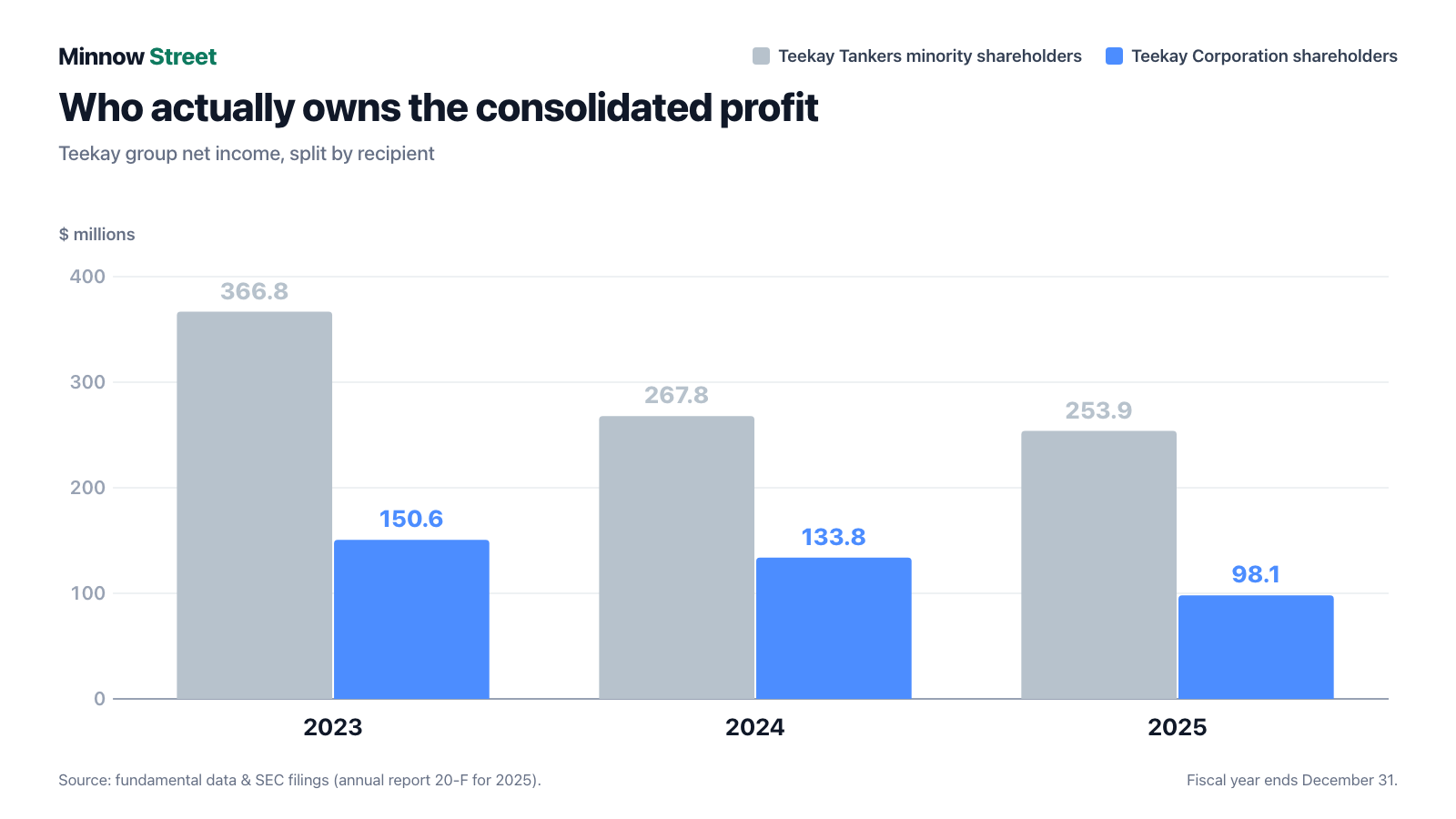
And now the line this whole analysis turns on. The group earned $352.0 million of net income in 2025. What reached Teekay shareholders: $98.1 million. The remaining $253.9 million was reported as the share of Teekay Tankers' minority shareholders — in 2024 that was $267.8 million of $401.6 million, and in 2023 as much as $366.8 million of $517.4 million, leaving $133.8 million and $150.6 million respectively for Teekay shareholders.
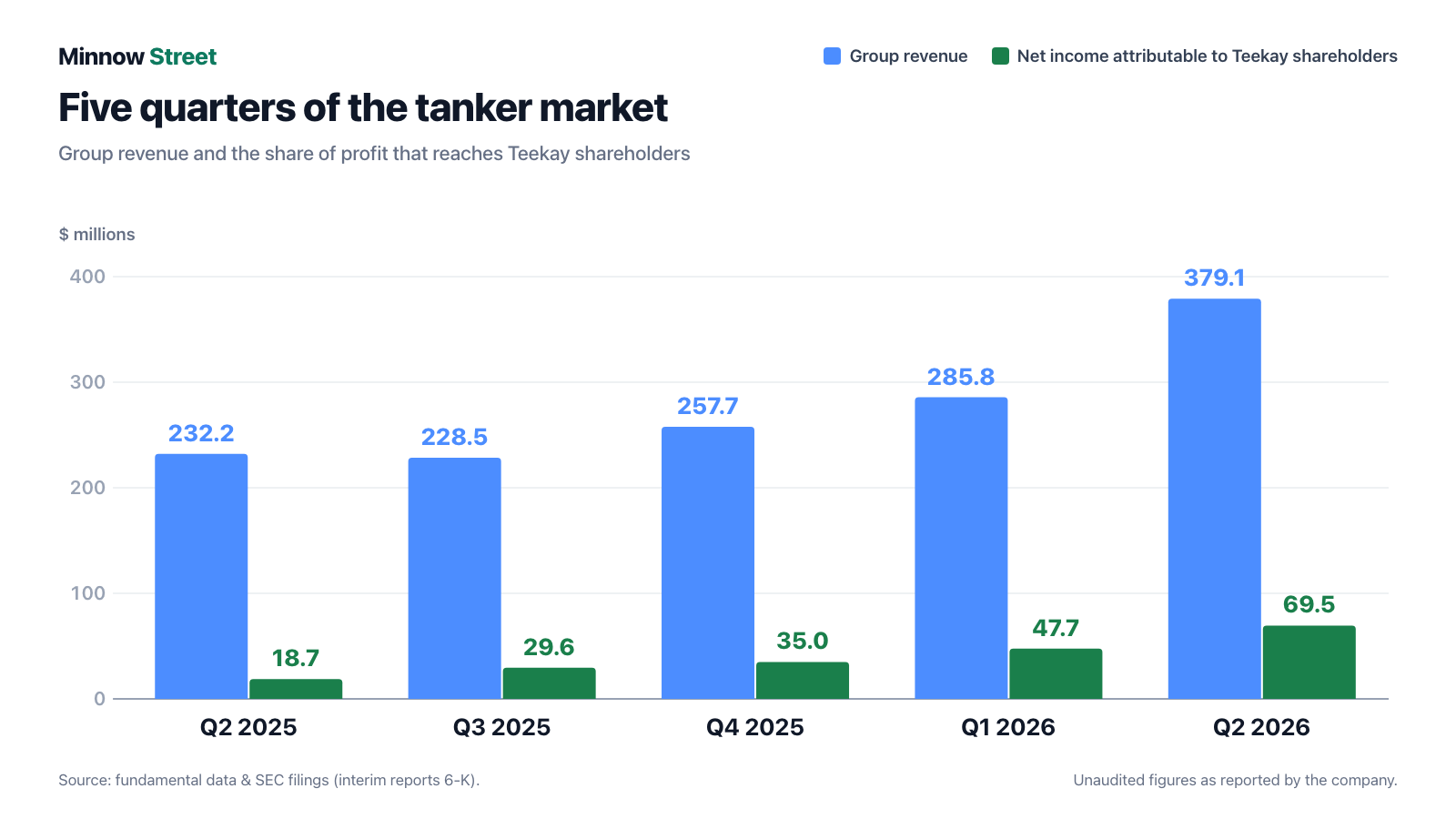
The current tanker market, by contrast, is excellent, and it shows quarter by quarter. In the second quarter of 2026 Teekay reported $379.1 million of revenue and a $69.5 million share of profit ($0.79 per share); a year earlier the figures were $232.2 million and $18.7 million. Over the first six months of 2026 that adds up to $117.2 million for Teekay shareholders — more than the whole of 2025 ($98.1 million). The last five quarters show the pace: revenue of $232.2 million, $228.5 million, $257.7 million, $285.8 million and $379.1 million, with an attributable result of $18.7 million, $29.6 million, $35.0 million, $47.7 million and $69.5 million.
The freight market itself is the reason. The July 29, 2026 release reports record levels:
"Teekay Tankers reported the highest quarterly adjusted net income in its history in the second quarter of 2026, and record spot rates with Suezmax and Aframax/LR2 averaging $109,200 per day and $74,100 per day, respectively."
— Teekay Corporation Ltd., SEC interim report 6-K, July 29, 2026
For context: a spot rate is the price for a single voyage, negotiated at prevailing market terms — the opposite of a long-term lease. It swings hard. The same release puts third-quarter 2026 rates so far at $104,800 per day for Suezmax and $59,900 per day for Aframax/LR2, with roughly 44 percent of spot days booked — meaning the Aframax rate has already dropped noticeably below the record quarter. Remember the image: at Teekay you measure earning power in daily rates, not in years — and daily rates are not loyal.
What the filings say — the uncomfortable truths
Uncomfortable truth No. 1: about 28 cents of every dollar of profit stays with you
This is the heart of the story, and it sits in a single line of the income statement. In 2025 the group earned $352.0 million. Directly below comes "Net income attributable to non-controlling interests" at minus $253.9 million — the share owed to Teekay Tankers' minority shareholders. What remains is $98.1 million for Teekay shareholders, or 27.9 percent. Prior years look similar: $133.8 million of $401.6 million in 2024 (33.3 percent) and $150.6 million of $517.4 million in 2023 (29.1 percent).
So why consolidate at all? Because accounting asks about control, not ownership. And control sits with Teekay, by way of a second class of shares:
"Teekay's significant non-wholly-owned subsidiary Teekay Tankers is publicly traded and consolidated in these financial statements. As of December 31, 2025, Teekay owned 30.8% of the share capital of Teekay Tankers (2024 – 31.0%), including Teekay Tankers' outstanding Class B common shares, which entitle the holders to five votes per share, subject to a 49% aggregate Class B Common share voting power maximum. Teekay maintains majority voting control of Teekay Tankers through its ownership of Class A common shares and Class B common shares."
— Teekay Corporation Ltd., SEC annual report 20-F for 2025, Note 1 "Summary of Significant Accounting Policies"

The mechanics in detail: Teekay Tankers has two classes of shares. Class A carries one vote, Class B up to five — capped at 49 percent of total voting power in aggregate. Teekay owns 100 percent of those Class B shares. Together with the Class A shares it holds, that produced 54.8 percent of the votes on a 30.7 percent economic interest as of March 1, 2026.

None of this is a trick or a scandal — it is the rules applied correctly. But it carries a consequence you need to know: every ratio built on a consolidated figure is distorted at Teekay unless you pair it with the parent's market capitalization. More on that in the valuation chapter.
Uncomfortable truth No. 2: a third of 2025 operating income came from selling ships
Inside the $302.8 million of 2025 operating income sits a line called "Gain on sale and write-down of assets" worth $101.7 million. Those are gains on selling tankers — on disposing of fixed assets, not on carrying crude. Strip it out and operating income is $201.1 million. For comparison: the same line was $38.1 million in 2024 (operating income without it: $327.2 million) and $10.4 million in 2023 ($521.4 million). The share of operating income coming from disposals has climbed from 2 percent to 10 percent to 34 percent, while the underlying result beneath it has fallen.
In fairness: for a shipowner, selling older vessels is part of ordinary business, and Teekay Tankers runs a declared fleet renewal program — older units out, younger ones in. In 2026 that meant three 2016-built Aframax tankers bought for $141.5 million, two Suezmax tankers built in 2007 and 2009 sold for $73 million (a $22.7 million gain), two Korean Suezmax newbuildings ordered in April for $190 million with delivery in 2027, one 2009-built Suezmax sold in May for $53.5 million, and a 2013-built VLCC sold in the third quarter with an expected gain of $22.9 million. Recognize the pattern and you know how to read it: disposal gains are not a manipulation of the number, but they are not a repeatable earnings stream either. They are harvest, not yield — and they run highest exactly when secondhand vessels are expensive, which is to say in a boom. The same capital cycle shapes other marine fleet operators; we walked through it in detail with Carnival, where the ships are ordered at the top of the cycle and paid for over decades.
Uncomfortable truth No. 3: nearly all of that cash belongs to the subsidiary
The consolidated balance sheet shows $972.7 million of cash and short-term investments at December 31, 2025. Of that, $120.2 million sat at the parent — 12.4 percent. The rest belongs to Teekay Tankers, in which Teekay shareholders hold 30.7 percent. Equity tells the same story: of $2,162.6 million, $1,438.1 million was attributable to minority shareholders; $724.5 million belonged to Teekay shareholders, or $8.42 per share.
By mid-2026 the parent's position had shifted again. At June 30, 2026 Teekay Parent held only $56.4 million in cash and short-term investments, down from $127.4 million at March 31. The footnote to the release gives the reason: a special dividend of $1.00 per share paid in June 2026 cost $87.4 million, offset in part by $13.3 million of dividends received from Teekay Tankers, proceeds from stock option exercises and working capital changes. Widen the frame: $183.4 million (December 31, 2024), $120.2 million (December 31, 2025), $56.4 million (June 30, 2026) — down 69 percent in eighteen months. The parent has no income of its own beyond dividends and interest; at the subsidiary's regular quarterly dividend of $0.25 per share, its 10.6 million shares yield roughly $2.7 million a quarter.

Uncomfortable truth No. 4: the second leg carries almost nothing
Teekay reports two segments: "Tankers" and "Marine Services and Other." The second sounds like diversification — maintenance and operating services for the Australian government and Australian energy companies, plus management fees. In 2025 that segment produced $125.5 million of revenue, or 13 percent of the group total. It earned $3.5 million of operating income from it — 1.2 percent of the group's operating result. And even that includes $2.1 million of gains, namely management fees Teekay Corporation Ltd. charged on the sale of the subsidiary's vessels. The service business is a thin-margin operation, not a second earnings pillar. When you read about diversification at Teekay, put that number next to it.
Uncomfortable truth No. 5: the buyback is paused while the share count rises
On October 30, 2024 the board authorized a $40 million repurchase program. It was used in the first quarter of 2025 — and not since: 734,639 shares for $4.9 million at an average of $6.71, spread across January, February and March. From April through December 2025 the program stood still, and $28.1 million of the authorization was still open at December 31, 2025. No further repurchase is reported through the July 29, 2026 release.
Movement in the other direction was brisk. Dilution means your slice of the pie gets smaller because new slices are handed out. In 2025, 2.305 million options were exercised at an average of $4.98. Shares outstanding rose from 84,059,952 (December 31, 2024) via 86,056,804 (December 31, 2025) to 87,691,370 (June 30, 2026) — up 4.3 percent in eighteen months. At December 31, 2025 another 1.916 million options were outstanding at an average exercise price of $7.87, 7,593,824 shares were reserved for the compensation plans, and authorized capital stands at 725 million shares. Remember the image: a buyback program that sits idle while options are exercised is not a buyback program — it is a brake nobody presses.
And artificial intelligence? One new paragraph, nothing more
In the 2024 annual report, artificial intelligence appeared only as an aside in the data privacy section. The 2025 report carries a dedicated risk factor for the first time:
"We are investigating the use of artificial intelligence to improve productivity and streamline processes. However, any further investment in and use of artificial intelligence may not achieve the expected benefits, and the use of artificial intelligence by our competitors may give them advantages relative to us."
— Teekay Corporation Ltd., SEC annual report 20-F for 2025, Item 3 D "Risk Factors"
That is an honest description of exactly what it is: an exploratory stage. Teekay neither sells AI products nor depends on AI for its business model. A tanker runs on heavy fuel oil, not on compute.
Valuation — and why the usual ratios lie here
Teekay's market capitalization is on the order of $1.0 billion (data as of July 30, 2026). As a cross-check: an insider sale notice (Form 144) dated June 22, 2026 lists 18,119 shares with an aggregate market value of $224,166.22, or $12.37 per share — applied to 87.7 million shares that is about $1.08 billion. Both routes land in the same order of magnitude.
Now the part where databases go systematically wrong. A widely used metric is enterprise value: market capitalization plus debt minus cash. Compute it mechanically at Teekay and you get roughly $47 million — the $1.0 billion market capitalization minus $940.7 million of consolidated cash. That is nonsense, for a clear reason: market capitalization reflects only the Teekay shareholders' claim, while the cash being deducted belongs about two-thirds to the subsidiary's minority shareholders. Done properly, the $1,438.1 million non-controlling interest would have to be added back. Remember the sentence: at groups with large minority interests, an enterprise value pulled from a data sheet is a trap, not a metric.
The look-through calculation is more useful, and it is simple: what does the parent own, and what does the market charge for it? At June 30, 2026 Teekay Parent held subsidiary shares worth $690.5 million and $56.4 million of cash — together $746.9 million, or $8.52 per share. Book value agrees: $724.5 million of equity attributable to Teekay shareholders at December 31, 2025 equals $8.42 per share. So the market pays noticeably more for Teekay than the sum of those two assets — the opposite of the discount many holding companies trade at. What sits inside that premium is interpretation: control of the subsidiary, the prospect of further gains in tanker rates, or the possibility that the structure is simplified one day. None of those expectations is documented anywhere.
On the price-to-earnings ratio, be careful which earnings you use. Against the $1.14 per share attributable to Teekay shareholders in 2025, the multiple is roughly ten (data as of July 30, 2026). Against the first six months of 2026 at $1.34 per share it would look far cheaper — but that is one half-year in a record market, and spot rates are not a subscription. On price-to-book, Teekay trades at roughly 1.3 times ($8.42 book value per share at December 31, 2025). Our data set carries no usable analyst consensus for Teekay — neither a recommendation distribution nor traceable estimates — so we quote none.
Opportunities and risks at a glance
What speaks for Teekay:
- No financial debt anywhere in the group (December 31, 2025), $972.7 million of cash and short-term investments, a 91.6 percent equity ratio. In an industry where debt regularly kills companies, that is a real buffer.
- The tanker market is running. Record spot rates in the second quarter of 2026 ($109,200 per day for Suezmax) and $117.2 million of attributable profit in the first half of 2026, against $98.1 million for all of 2025.
- A young fleet through active renewal: older Suezmax tankers and a VLCC sold, three 2016-built Aframax tankers bought, two Suezmax newbuildings ordered for 2027 ($190 million).
- The parent itself is uncomplicated: no debt, no employees, no operating risk — one block of shares and one account. Whatever flows in can in principle be paid straight out.
- Tax affairs are settled: Bermuda domicile since October 2024, U.K. tonnage tax since November 2024 — and in 2025 the income statement even showed a $4.6 million tax recovery.
What speaks against it:
- About 69 percent of group profit belongs to others. $253.9 million of $352.0 million in 2025 was reported as the minority shareholders' share; every consolidated ratio is misleading without that correction.
- Revenue is down 35.2 percent in two years ($1,465.0 million to $949.5 million), because the fleet shrank and rates softened in the interim.
- A third of 2025 operating income came from vessel sales ($101.7 million of $302.8 million) — not repeatable at that scale.
- The parent's cash is melting: from $183.4 million (December 31, 2024) to $56.4 million (June 30, 2026), because the $87.4 million special dividend far exceeds recurring dividend inflows.
- Full exposure to the spot market: third-quarter 2026 Aframax/LR2 rates had already fallen from $74,100 to $59,900 per day (as of July 29, 2026, roughly 44 percent of spot days booked). There are no long-term contracts to cushion that.
- Limited shareholder say: as a foreign private issuer Teekay relies on exemptions from NYSE rules — share issuances and equity compensation plans are approved by the board rather than by shareholders, and the audit committee consists of one member and two non-voting observers. The largest owner is Resolute Investments, Ltd. with 36.71 percent (as of May 28, 2026).
A human conclusion — no recommendation
Back to the label trap. Read the big sign at Teekay — almost a billion in revenue, $2.4 billion in assets, nearly a billion in cash, no debt — and you see an impressive company. All of it is true. It is simply not the company whose stock you buy. The company whose stock you buy owned, as of June 30, 2026, a block of shares worth $690.5 million and $56.4 million in the bank. Everything else does not belong to it; it is merely counted in, because it has a say.
That is not a criticism of Teekay. The structure is openly documented, the numbers are clean, the balance sheet is as conservative as shipping gets, and the market is running beautifully right now. It is a note on how to read this stock: not through the group income statement, but through two lines in the footnote of an interim report — the market value of the stake and the parent's cash. Buying Teekay means buying a leveraged, controlling position in Teekay Tankers plus a shrinking bank account, and paying a premium over the arithmetic value of those two items.
So the questions to answer before you decide are different from those you would ask of an ordinary shipowner. Do you trust the tanker cycle over the next few years? Would you rather hold the subsidiary directly than through the parent — and what is the control premium worth to you? And do you expect Teekay to keep paying special dividends after the parent's cash shrank 69 percent in eighteen months? What you make of that is your call. And that is exactly as it should be.
Sources and notes
- Teekay Corporation Ltd., SEC annual report 20-F for fiscal year 2025 (filed March 13, 2026, CIK 0000911971)
- Teekay Corporation Ltd., SEC annual report 20-F for fiscal year 2024 (filed March 14, 2025)
- SEC interim report 6-K, July 29, 2026 (second quarter 2026 figures)
- SEC interim report 6-K, May 13, 2026 (first quarter 2026 figures, special dividend)
- SEC interim report 6-K, February 18, 2026 (fourth quarter and full year 2025 figures)
- SEC interim report 6-K, May 6, 2026 (notice and proxy statement for the 2026 annual general meeting)
- Schedule 13D/A No. 15, May 28, 2026 (holding of Resolute Investments, Ltd.)
- Prospectus Form 424B3, August 20, 2024 (background and rationale for the redomiciliation to Bermuda)
- Fundamental data (market capitalization, ratios, share statistics; data as of July 30, 2026)
- Related coverage on the same capital cycle: Carnival (CCL)
Note: this article is journalistic analysis of publicly available documents. It is not investment advice, not a recommendation to buy or sell, and not a solicitation to buy or sell securities. Share prices can move sharply; a total loss of invested capital is possible. All figures come from the primary sources named above and carry the as-of date stated with them. The author holds no position in Teekay Corporation Ltd. or Teekay Tankers Ltd. at the time of publication.
Our Bottom Line at a Glance
- Balance sheet and funding positive
- The entire group carried no financial debt at December 31, 2025 — $197.5 million of total liabilities against $2,360.1 million of assets, a 91.6 percent equity ratio, and $972.7 million in cash and short-term investments. Interest income of $36.2 million exceeded interest expense of $2.9 million by a factor of twelve. For a shipping group, that is unusually conservative.
- Earnings in the current market positive
- The tanker market is running: $379.1 million of revenue and $69.5 million of attributable profit in the second quarter of 2026, against $232.2 million and $18.7 million a year earlier. On July 29, 2026 Teekay Tankers reported the highest quarterly adjusted net income in its history at Suezmax spot rates of $109,200 per day. The first half of 2026 delivered $117.2 million for Teekay shareholders, more than all of 2025.
- Group structure and attribution negative
- Teekay consolidates Teekay Tankers in full but owns only 30.7 percent of the capital (as of March 1, 2026). In 2025, $253.9 million of $352.0 million in group profit was therefore reported as the minority shareholders' share, and $1,438.1 million of $2,162.6 million in equity belongs to them as well. Any ratio derived from consolidated numbers — price-to-sales, enterprise value, net cash — is misleading without that correction.
- Earnings quality neutral
- The $302.8 million of 2025 operating income included $101.7 million of gains on vessel sales (2024: $38.1 million, 2023: $10.4 million). Without them, $201.1 million remains, after $327.2 million and $521.4 million in the prior years. The disposals are part of a declared fleet renewal program and therefore ordinary business — but not repeatable at that scale. The second segment, marine services, produced $125.5 million of revenue and $3.5 million of operating income.
- Capital returns neutral
- Three consecutive special dividends of $1.00 per share (2024, 2025, 2026) are a genuine return of capital — the June 2026 payout cost $87.4 million. It was funded largely out of substance: parent cash fell from $183.4 million (December 31, 2024) to $56.4 million (June 30, 2026). The buyback program has been idle since March 2025 with $28.1 million of authorization open, while the share count rose 4.3 percent to 87,691,370 through option exercises.
- Spot market exposure negative
- Practically all earnings depend on daily rates with no long-term hedging. The company's own July 29, 2026 release shows how fast that turns: third-quarter 2026 Aframax/LR2 rates stood at $59,900 per day, down from $74,100 in the second quarter, with roughly 44 percent of spot days booked. Group revenue has already fallen from $1,465.0 million (2023) to $949.5 million (2025).
Teekay is the label trap in its purest form: a debt-free group with $949.5 million of revenue, $972.7 million of cash and record tanker rates — of which its own shareholders own barely a third. In 2025, $253.9 million of $352.0 million in group profit was reported as the share of Teekay Tankers' minority shareholders. The parent itself owns no vessel and no personnel, only a block of shares worth $690.5 million and $56.4 million in cash (June 30, 2026). Investing here means buying a controlling interest in the subsidiary — and paying a premium over its arithmetic value. Not investment advice.
What Our Rating Means
Quality confirmed
Business model, numbers and balance sheet hold up to our review. Whether the current price supports an entry is a separate question — it hangs on the price, not on the company.
Green here stands for documented business quality, not for an entry point. The business works: 34 tankers in a record market, $117.2 million of attributable profit in the first half of 2026 alone, no debt since January 2023, $972.7 million in cash and short-term investments, a 91.6 percent equity ratio, no going-concern warning, no accounting or governance breach, a clean audit opinion and a group structure that is openly and traceably documented. The three weak spots are real, but none of them threatens the substance: a third of 2025 operating income came from vessel sales, revenue fell 35.2 percent in two years, and parent cash shrank from $183.4 million to $56.4 million in eighteen months — the last of these because money was voluntarily paid out, not burned. On price, which explicitly does not set the traffic light: the market pays roughly $1.0 billion for parent assets of $746.9 million (June 30, 2026). Paying that premium means buying control of the subsidiary along with it, and anyone who would rather hold the subsidiary directly should do that arithmetic first. The decision is yours.
A journalistic assessment by our editorial team at the time of the deep dive, based on public sources — not investment advice and not a solicitation to buy or sell. Your personal circumstances (investment goals, risk capacity, taxes) cannot be taken into account. What our levels mean, how verdicts are formed, and what conflicts of interest exist →
Worth Noting
- Teekay came onto our list through the SEC filing trail rather than a price or ratio screen. The risk of confusion is real: TK is the holding company, TNK the operating fleet company. Mixing their figures counts the same ships twice.
- Teekay is a foreign private issuer and files no quarterly report (10-Q). The basis here is the 20-F annual report for 2025 (filed March 13, 2026) and the 6-K interim reports, most recently dated July 29, 2026. Every point-in-time figure — cash, share count, stake value — comes from the most recent document that states it.
- Valuation figures are dated and deliberately kept as orders of magnitude: market capitalization roughly $1.0 billion (data as of July 30, 2026), cross-checked against 87,691,370 shares and the $12.37 per share price documented in a Form 144 notice dated June 22, 2026. An enterprise value derived from consolidated numbers is useless at Teekay, because it deducts the subsidiary's cash without adding back the $1,438.1 million non-controlling interest.
Frequently Asked Questions
Teekay Corporation Ltd. (NYSE: TK), based in Hamilton, Bermuda, is a holding company with no ships of its own. As of June 30, 2026 its assets were 10.6 million shares of listed subsidiary Teekay Tankers Ltd. (NYSE: TNK) worth $690.5 million, plus $56.4 million in cash. The operating business — 34 crude and product tankers, ship-to-ship transfer services and vessel management for Australia — sits entirely at the subsidiary. The 20-F annual report for 2025 states that the parent owns no vessels and employs no personnel.
Because accounting asks about control, not ownership. Teekay owns 100 percent of Teekay Tankers' Class B shares, which carry five votes each. That produced 54.8 percent of the votes on just 30.7 percent of the capital as of March 1, 2026. Whoever holds majority voting power must consolidate the subsidiary in full. The other owners' share then appears on its own line: in 2025 that was $253.9 million of $352.0 million in group profit.
In 2025, $98.1 million of $352.0 million in group profit stayed with Teekay shareholders — about 28 percent, or $1.14 per share. In 2024 it was $133.8 million of $401.6 million, in 2023 $150.6 million of $517.4 million. The first half of 2026 brought $117.2 million ($0.55 per share in the first quarter and $0.79 in the second) — more than the whole of the prior year.
The U.S. securities regulator, the SEC, treats Teekay as a foreign private issuer. Such companies file no quarterly report on Form 10-Q; they file an annual report on Form 20-F and interim reports on Form 6-K. The most recent annual report covers fiscal 2025 and was filed on March 13, 2026; the latest figures appear in the interim report dated July 29, 2026. The fiscal year ends December 31.
No regular dividend, but special dividends. The board declared $1.00 per share in 2024, 2025 and 2026. The July 2025 payout cost $85.3 million, the June 2026 payout $87.4 million. It is funded mostly from the parent's cash, because Teekay Tankers' regular quarterly dividend yields only about $2.7 million a quarter on the 10.6 million shares held. Parent cash fell accordingly, from $183.4 million (December 31, 2024) to $56.4 million (June 30, 2026).
Teekay was incorporated in the Marshall Islands and moved its domicile to Bermuda on October 1, 2024, together with Teekay Tankers. The trigger was the OECD global minimum tax: Bermuda enacted a 15 percent corporate income tax for large groups in December 2023, effective from 2025. Because management already sits in Bermuda, Teekay would otherwise have had to satisfy the economic substance requirements of two jurisdictions at once. Legally no new company was created, and income from international shipping is in principle exempt from the new tax.
The largest owner is Resolute Investments, Ltd. with 31,936,012 shares, or 36.71 percent (Schedule 13D/A dated May 28, 2026, based on 87,004,134 shares outstanding). Resolute is wholly owned, through Kattegat Limited, by The Kattegat Trust, a Bermudian charitable trust whose principal business, per the filing, is distributing income for charitable purposes. Its stake fell most recently not through sales but because the total share count rose through option exercises.
Teekay Tankers Ltd. (TNK) is the operating company: it owns the 34 tankers, generates the revenue and has paid a fixed quarterly dividend of $0.25 per share since 2023 plus repeated special dividends. Teekay Corporation Ltd. (TK) is the parent, holding 30.7 percent of the capital and 54.8 percent of the votes in TNK (as of March 1, 2026). Buying TK means acquiring an indirect, controlling interest in TNK plus the holding company's cash — most recently at a premium to the arithmetic value of those items.
Found an error?
Did you spot a factual error, an outdated number, or a typo in this deep dive? Let us know briefly — your report goes straight to the editorial team.