SandRidge Stock: A $1.6 Billion Tax Shield — and the Company Itself Writes Off 83 Percent of It
SandRidge Energy pays no income tax. Not a little — none: cash taxes were "de minimis" for three years running, and the first quarter of 2026 shows a tax line of exactly zero. The reason is $1.6 billion of loss carryforwards from the 2016 bankruptcy, and they drive the whole strategy. We read the annual report (10-K) for 2025 and the quarterly report (10-Q) as of March 31, 2026 to find out what that shield is really worth — and found a number the company puts on the record itself: of $463.2 million in deferred tax assets, $384.9 million is written off. Not investment advice — just a careful look at the expiry dates on the most valuable asset this company owns.
 Thomas Mücke
Founder & Publisher
Thomas Mücke
Founder & Publisher
Chart
Interactive price chart (TradingView).
Note: pure fact-based analysis, not investment advice and not a solicitation to buy or sell. All figures without guarantee.
Imagine a drawer full of gift vouchers. Face value: a fortune. You feel wealthy every time you open it — and you are not wrong, exactly. But two things are true that the face value does not tell you. Each voucher carries an expiry date. And you can only redeem so many per visit. Psychologists call the reflex anchoring: the first big number you see becomes the yardstick for everything after it, and the conditions printed underneath never get the same attention. SandRidge Energy (NYSE: SD) hands you exactly that drawer. The company carries $1.6 billion of loss carryforwards from its 2016 bankruptcy — against a stock market value of roughly $506 million (data as of July 8, 2026). It pays no income tax. None. And Reddit, for what it is worth, has barely noticed: our Reddit hype scanner counted 2 mentions in 24 hours (ApeWisdom, as of July 16, 2026). So let us make a deal: we open the drawer together and read the small print on the vouchers — using only what SandRidge itself reported, under penalty of law, to the U.S. securities regulator, the SEC. Our material is the annual report (10-K) for 2025 and the quarterly report (10-Q) as of March 31, 2026. At the end you will not get a verdict from us. You will get the expiry dates.
What SandRidge actually does — 102 people, one rig, and a lot of old wells
SandRidge Energy is an oil and gas producer, and a deliberately small one. It drills for and produces oil, natural gas and natural gas liquids (NGLs) in the Mid-Continent region — Oklahoma and Kansas — where it holds 574,599 gross (378,537 net) acres and operates 1,446 gross (825 net) producing wells. NGLs, if the term is new to you, are the heavier components that get stripped out of the gas stream — propane, butane and their relatives — and sold by the gallon; at SandRidge they make up about 35.4 percent of proved reserves. The company employs 102 full-time people (82 in the field, 20 in the office) and, as of December 31, 2025, ran exactly one active drilling rig. That is not a typo, and it is not a sign of distress — it is the model. Think of a landlord with a large portfolio of paid-off apartment buildings: the rent comes in whether or not anything new is built, and one construction crew is enough to add a unit here and there.
What makes the company genuinely unusual is not the geology. It is the tax position. SandRidge went through Chapter 11 in 2016, and it came out the other side with an enormous pile of unused losses. The company does not treat that as an accounting footnote — it treats it as the strategy. The annual report says so in the first paragraph of its business section:
"The Company’s primary strategic focus is to grow the value of our asset base in a safe, responsible and efficient manner, while utilizing our net operating loss carry forwards to maximize cash flow."
— SandRidge Energy, Inc., SEC annual report 10-K 2025, Item 1 "Business — Our Business Strategy"

Read that sentence again, because it is the whole company in one line: grow the asset base — while using the losses to maximize cash flow. Every barrel SandRidge pumps arrives at the bottom line untaxed, so long as the shield holds. Which brings us to the central tension of this analysis, and it runs through every chapter that follows: SandRidge owns the cleanest balance sheet you will find in the oil patch — no debt, a pile of cash, a perfect score on the standard test of book quality — and a tax shield that makes its profits tax-free. Yet the market pays only about book value for it. The reason is not in the headline numbers. It is in the expiry dates.
Where the stock shows up in our scanner — 12 hits, and almost none of them are warnings
Every day we run about 3,500 stocks through our scanners. SandRidge has a row in our database — its company profile sits in the stocks section — and it lights up in 12 filters (scanner recomputed July 16, 2026). What is remarkable is which ones, because they are almost the exact opposite of the usual small-cap deep-value picture. SandRidge sits in Altman-Z: balance-sheet fortress, in quality growth, in EPS acceleration, in the P/E and price-to-cash-flow rankings, in Martin Zweig's growth screen — and in insiders buying (net). Not a single distress list. Not one.
The metrics behind that read almost too good. The Piotroski F-Score — a nine-point test of the health of the books, covering profit, cash flow, debt and efficiency, where anything from 7 up counts as very solid — stands at 9 of 9. The perfect score. The Altman Z-Score, the decades-old early-warning thermometer for financial distress where below 1.8 is the danger zone and above 3 is considered safe, comes in at 6.96. Quarterly revenue growth: plus 16.8 percent. Quarterly earnings growth: plus 42.9 percent. Institutional ownership: 81.6 percent. And now the punchline, from the same row: the stock is roughly flat year to date (minus 0.1 percent), up 25.0 percent over twelve months, and sits in stage 1 — the base-building, going-nowhere stage in Stan Weinstein's framework — with a relative-strength rating of just 43 out of 99 (all metrics carry the July 8, 2026 data cut-off).
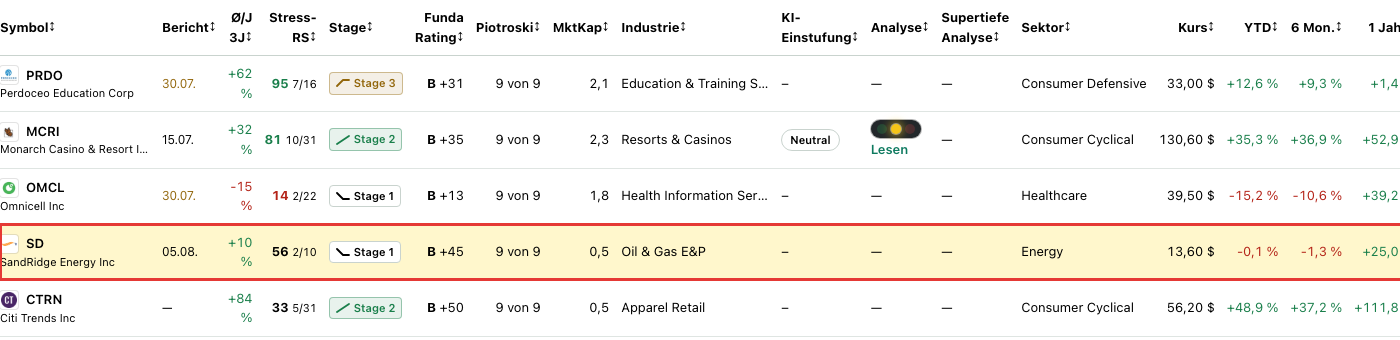
A stock with a perfect books score, a fortress balance sheet and net insider buying that has gone nowhere for a year is not a contradiction — it is a question. Quality filters compute what has happened; the price trades what people think will happen. When the two disagree this loudly, the answer is usually somewhere the filters cannot look. Remember that gap: the scanner grades the books, not the barrels left in the ground. For the opposite balance-sheet case in the same industry, our look at W&T Offshore is instructive — there the retirement obligations for old wells outweigh the entire company; here they are a manageable $73.7 million against a debt-free balance sheet.
The numbers over the years — honestly appraised
First, what genuinely impresses. SandRidge is profitable, and not by a hair: net income was $60.9 million (2023), $63.0 million (2024) and $70.2 million (2025) — three solid years in a row from a company with 102 employees. Operating cash flow in 2025 was $100.1 million. The balance sheet is close to pristine: $111.0 million of cash at year-end 2025, no debt whatsoever, total liabilities of just $133.2 million against $644.0 million of assets — and of those liabilities, $72.4 million are asset retirement obligations, the eventual bill for plugging the old wells. Costs are falling where it counts: production costs per barrel of oil equivalent dropped from $6.80 (2023) via $6.61 (2024) to $5.35 (2025). And the first quarter of 2026 kept the trend: revenue up 16.8 percent to $49.8 million, net income $18.7 million, $0.51 per share.
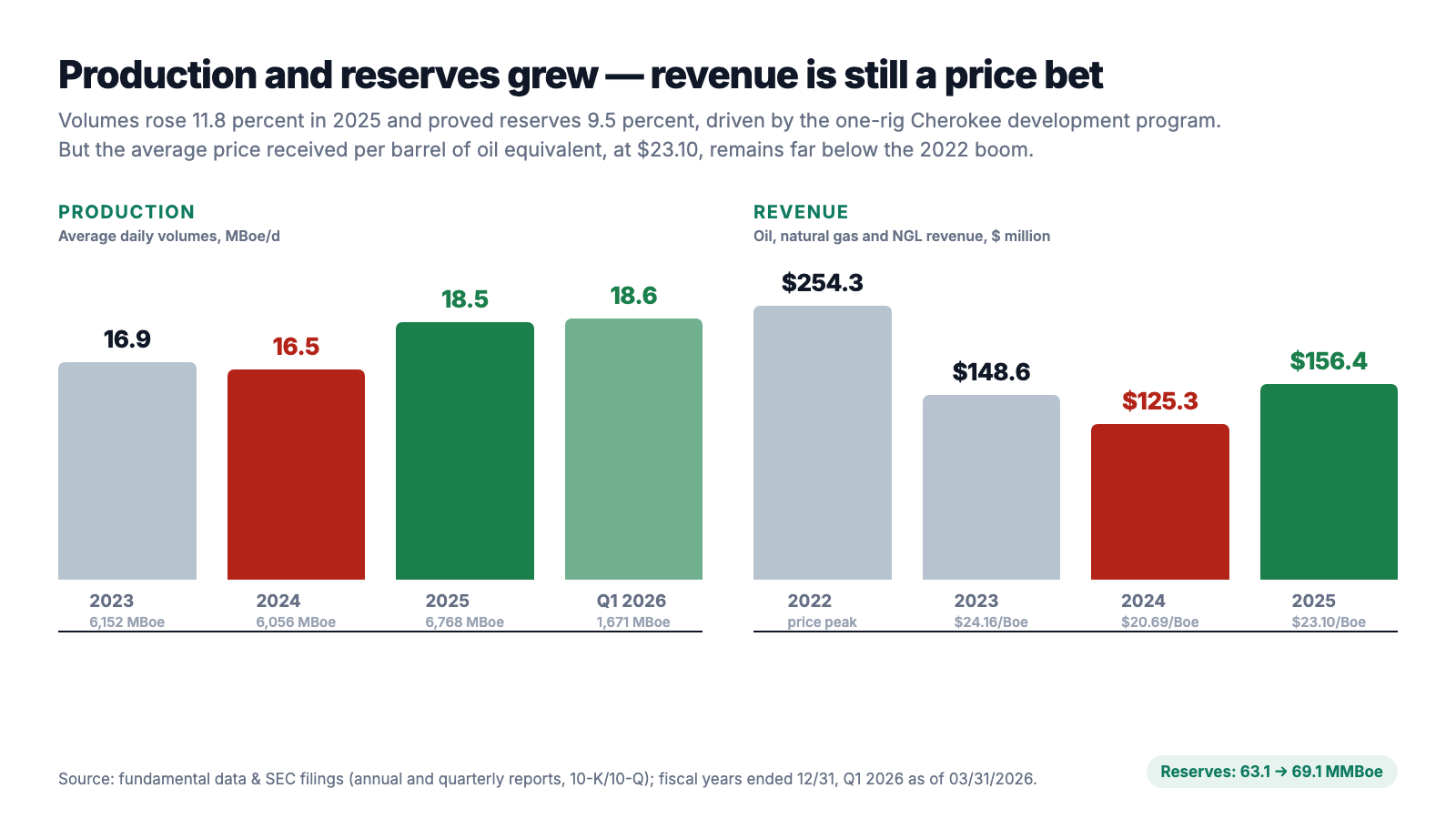
Now the part that answers the question everyone actually has about a post-bankruptcy driller — is this thing shrinking? In 2025, honestly: no. Production rose 11.8 percent, from 6,056 to 6,768 MBoe (16.5 to 18.5 MBoe/d), and the first quarter of 2026 held at 18.6 MBoe/d. Proved reserves grew 9.5 percent, from 63.1 to 69.1 MMBoe. PV-10 — the discounted value of those reserves at the prices the SEC prescribes — rose from $362.7 million to $439.6 million. That is a producer replacing more than it pumps, which is the whole job.
But hold the applause and put the third number next to the first two: revenue. In 2022, SandRidge took in $254.3 million. In 2025, with more barrels coming out of the ground, it took in $156.4 million — 38 percent less. The difference is not the business. It is the price: SandRidge realized $23.10 per barrel of oil equivalent in 2025 (2024: $20.69; 2023: $24.16). Natural gas — nearly half of everything the company produces by volume — fetched $2.10 per thousand cubic feet in 2025, after $1.10 in 2024. Remember the mechanism, because it governs every chapter after this one: SandRidge controls its barrels; it does not control its dollars.
What the filings say — the uncomfortable truths
Uncomfortable truth no. 1: the tax shield has an expiry date — and SandRidge writes off 83 percent of it itself
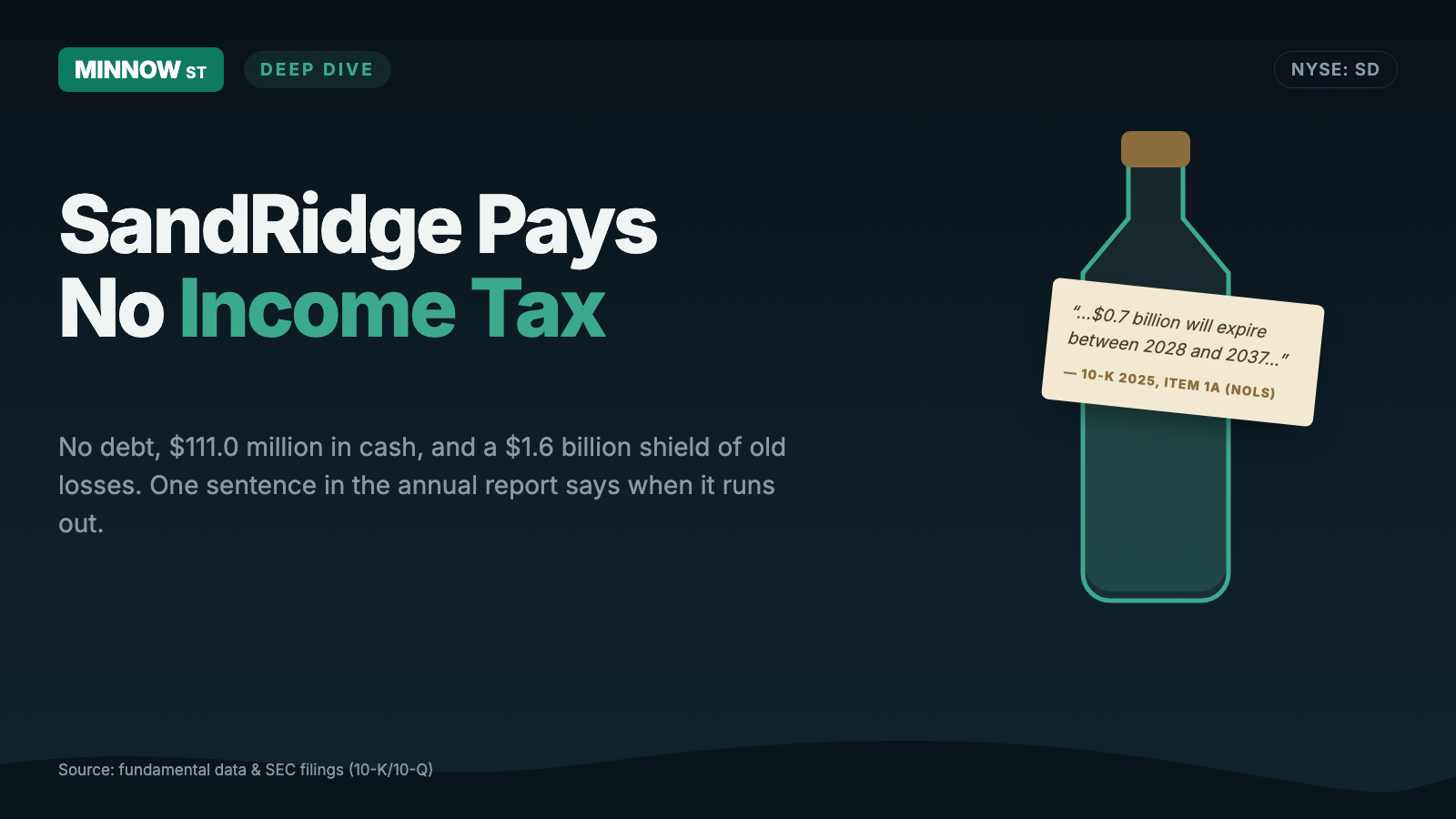
This is the one that matters, so we will take it slowly. The headline number is real: SandRidge genuinely has $1.6 billion of federal loss carryforwards, and they genuinely make its profits tax-free — cash paid for income taxes in 2023, 2024 and 2025 was, in the annual report's own words, "de minimis", and the first quarter of 2026 shows an income tax line of exactly $0. But now read the sentence in the risk factors where the company prints the small print on the vouchers:
"As of December 31, 2025, we had U.S. federal NOLs of $1.6 billion, net of NOLs expected to expire unused due to the 2016 IRC Section 382 limitation, of which approximately $0.7 billion will expire between 2028 and 2037, if not limited by additional triggering events prior to such time."
— SandRidge Energy, Inc., SEC annual report 10-K 2025, Item 1A "Risk Factors"

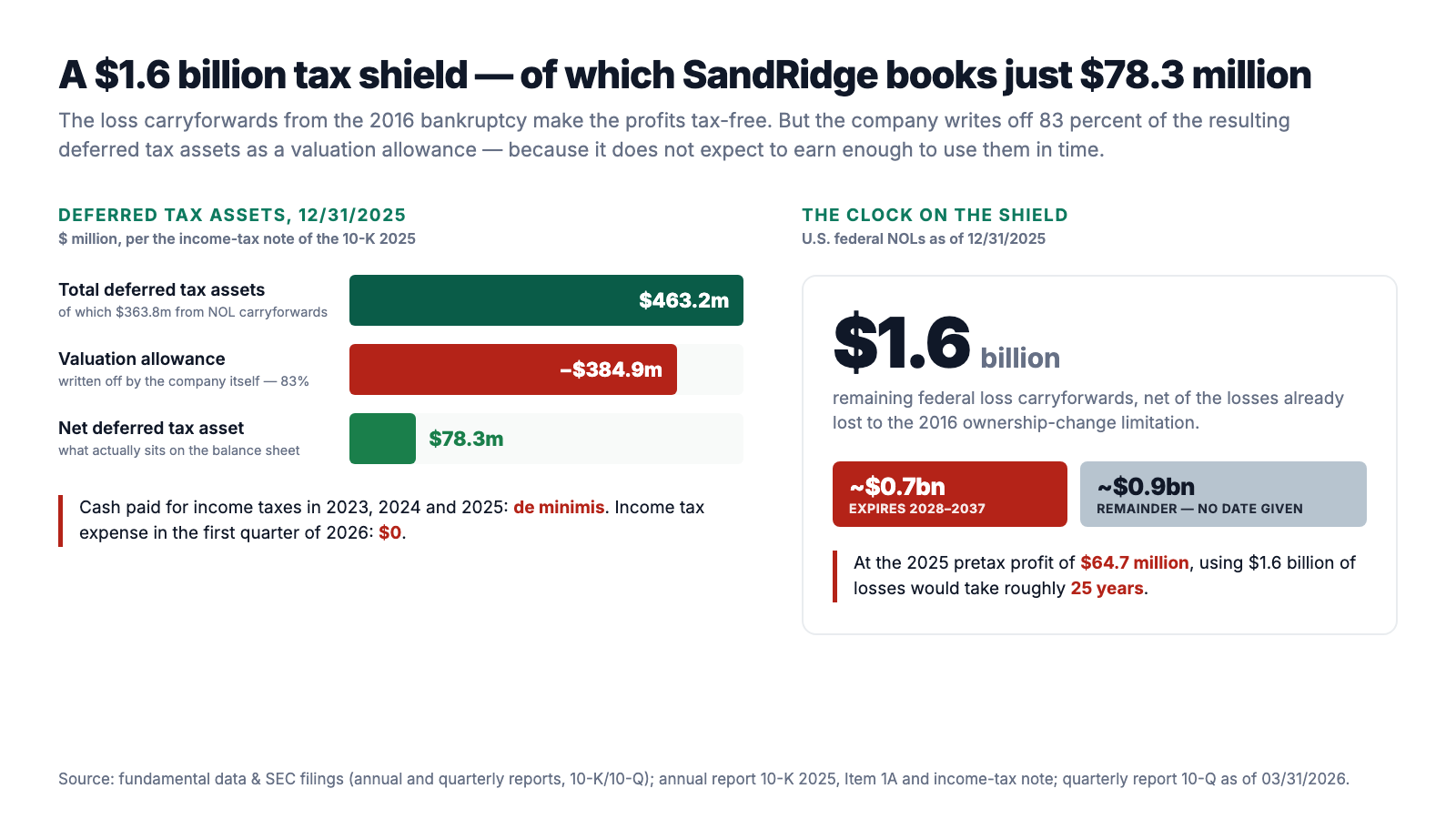
Two things are packed into that sentence. First, the $1.6 billion is already the number after a haircut: it is "net of NOLs expected to expire unused" because of the ownership change SandRidge went through in its 2016 reorganization — losses that are simply gone. Second, and more pressing: approximately $0.7 billion of what is left starts expiring in 2028. Now do the arithmetic that the face value invites you to skip. SandRidge's pretax income in 2025 was $64.7 million. At that rate, working through $1.6 billion of losses takes roughly 25 years. The vouchers expiring between 2028 and 2037 would need the company to earn something on the order of $700 million of taxable income inside twelve years — against a current run rate near $65 million. The drawer is worth a fortune. The visits are too few and too small.
You do not have to take our arithmetic for it, because SandRidge's own accountants did the same sum and wrote the answer into the balance sheet. Under U.S. accounting rules, a company may only carry a deferred tax asset if using it is "more likely than not"; whatever fails that test gets parked in a valuation allowance — an explicit write-down of your own tax asset. Here is what the income tax note says:
"In prior years, we determined that the deferred tax assets did not meet the more likely than not threshold of being utilized and thus recorded a valuation allowance."
— SandRidge Energy, Inc., SEC annual report 10-K 2025, Item 7 "Critical Accounting Policies and Estimates — Income Taxes"

And the numbers in the deferred tax table are unambiguous. Total deferred tax assets as of December 31, 2025: $463.2 million (of which $363.8 million comes from the NOL carryforwards). Valuation allowance: minus $384.9 million. Net deferred tax asset actually carried on the balance sheet: $78.3 million. That is a write-off of 83 percent — performed by SandRidge, on SandRidge's own tax asset, and signed off by its auditors. To be fair, the direction is improving: the company released $72.8 million of the allowance as of December 31, 2024 and added $5.5 million more in 2025 "due to changes in expected future income" — that release is exactly why the 2024 and 2025 income statements show a tax benefit rather than a tax expense, and why net income exceeded pretax income in both years. But the honest reading of that table is this: of a $1.6 billion shield, the company itself is willing to vouch for about $78 million.
Uncomfortable truth no. 2: everything sits in one basin, on one rig
SandRidge's second risk is the mirror image of its efficiency. A company with 102 employees and a single rig has almost no overhead — and almost no diversification. The annual report does not dress it up:
"All of our production and reserves are located in the Mid-Continent region. This concentration could disproportionately expose us to operational and regulatory risk in this area."
— SandRidge Energy, Inc., SEC annual report 10-K 2025, Item 1A "Risk Factors"

Put a number on the clock while we are here. SandRidge's reserves-to-production ratio is 10.2 years: at the 2025 rate of pumping, the proved reserves on the books run out in a decade. That is not unusual for a shale-era producer, and the company also cites a "weighted average economic reserve life" of 35 years for the existing wells, whose output tails off slowly rather than stopping. But it does mean the drilling program is not optional. A producer that stops drilling does not plateau; it declines. Which is precisely why the third truth exists.
Uncomfortable truth no. 3: the dividend was cut by 80 percent to pay for the drilling
Here is where the strategy quietly changed, and it is the part an income investor most needs to see. Look at what SandRidge paid its shareholders: $81.5 million in 2023. $72.3 million in 2024. $15.9 million in 2025 — or $0.46 per share. That is a cut of roughly 80 percent from the 2023 level. The money did not vanish; it was redirected. In August 2024 the company spent $121.9 million in cash on the Cherokee Play acquisition in the Western Anadarko Basin (plus $5.2 million more that December), which is why cash fell from $252.4 million (end of 2023) to $98.1 million (end of 2024). Capital spending including acquisitions ran to $156.5 million in 2024 and $77.5 million in 2025, against $33.7 million in 2023.
And the pace is not letting up. For 2026 the company plans a capital budget of $76.0 million to $97.0 million, "excluding any expenditures for acquisitions which may arise" — against operating cash flow of $100.1 million in 2025. Translated into the household image: the rent still comes in, but nearly all of it now goes back into the building. Free cash flow has already narrowed from $77.9 million (2023) via $47.5 million (2024) to $32.5 million (2025), and on the 2026 budget it could approach zero. The annual report is careful to promise nothing:
"There is no guarantee of future dividends or stock repurchases. The declaration of dividends and repurchases of our common stock are at the discretion of our Board of Directors, based on relevant considerations, with no assurance of future payments or repurchases at levels anticipated by stockholders."
— SandRidge Energy, Inc., SEC annual report 10-K 2025, Item 1A "Risk Factors — Risks Relating to our Common Stock"
None of this is mismanagement — you can make a strong case that converting a dwindling cash pile into producing wells while the tax shield is still alive is exactly the right move, and the 2025 production and reserve growth says it is working so far. But be clear about what changed. Two years ago SandRidge was a company that harvested old wells and posted the proceeds to shareholders. Today it is a company that reinvests almost everything into a single drilling play and pays a modest dividend on the side ($0.12 per share declared on March 3, 2026). Those are two different investments wearing the same ticker. Remember the switch: you are no longer being paid to wait — you are being asked to fund the drilling. What a full oil-and-gas cycle can do to a company that keeps reinvesting is worth reading alongside our analysis of ProPetro, where seven years of exactly that produced nothing for shareholders.
Valuation — cheap on every ratio, and the market still says no
In early July 2026 the stock cost about $13.60, which put SandRidge's market value near $506 million (all valuation figures: data as of July 8, 2026). Against that: a price-to-earnings ratio of about 6.7 on trailing twelve-month earnings of $2.05 per share, a price-to-book of about 0.96 — the market pays 96 cents for a dollar of accounting equity — and, after deducting the cash, an enterprise value of roughly $403 million, or about 3.5 times EBITDA. Price-to-sales sits near 3.1. There is a second way to triangulate it, and it is the more instructive one for an oil producer: the proved reserves are carried at a PV-10 of $439.6 million, and the company holds $102.7 million of cash (March 31, 2026) with no debt. Add those and you get roughly $542 million against a $506 million market value — meaning the market currently pays slightly less than the SEC-prescribed value of the oil in the ground plus the money in the bank, and assigns nothing to the acreage, the tax shield or the drilling program. The caveat matters: PV-10 is computed at fixed SEC prices held constant for the life of the properties. It is a yardstick, not an appraisal.
And the professionals' view? It barely exists. Our data shows a single analyst rating with a target price of $15. For a $506 million company with 102 employees that is not a consensus — it is one person's opinion, and treating it as a crowd would be a mistake. The far louder signal is who owns the stock: institutions hold 81.6 percent, and Carl Icahn holds about 13.4 percent, with BlackRock (8.0 percent) and Vanguard (6.4 percent) behind him. On July 18, 2025, the board expanded from five members to six and appointed Brett Icahn — Carl Icahn's son — effective August 1, 2025. Whatever else is true of this stock, the largest owner has now put a family member in the room where the capital allocation gets decided.
Opportunities and risks at a glance
What speaks for SandRidge:
- A balance sheet with no weak spot: zero debt, $102.7 million of cash (March 31, 2026), total liabilities of $126.2 million — of which $73.7 million is the eventual plugging bill, spread over decades. Altman-Z of 6.96, Piotroski 9 of 9 (data as of July 8, 2026).
- Genuine, tax-free profits: net income of $60.9 / $63.0 / $70.2 million in 2023 / 2024 / 2025, with cash income taxes "de minimis" throughout and a tax line of $0 in the first quarter of 2026. On the reserves currently booked, the standardized measure equals PV-10 exactly — SandRidge expects to owe no federal tax on them at all.
- The 2025 growth is real and measurable: production up 11.8 percent to 18.5 MBoe/d, proved reserves up 9.5 percent to 69.1 MMBoe, PV-10 up from $362.7 to $439.6 million, production costs down to $5.35 per barrel of oil equivalent from $6.80 in 2023.
- Optionality that costs nothing to hold: about 95 percent of the leasehold is held by production, so the acreage does not expire on a clock; $68.3 million of buyback authorization is unused; and the stated strategy explicitly hunts "opportunistic, value-accretive acquisitions" — with cash on hand and no lenders to ask.
What speaks against it:
- The shield is worth far less than its face value: $384.9 million of $463.2 million in deferred tax assets is written off by the company itself (83 percent); approximately $0.7 billion of the $1.6 billion in NOLs expires between 2028 and 2037; and at the 2025 earnings rate, consuming the full amount would take about 25 years.
- Revenue is a price bet, not a business decision: with more barrels produced in 2025 than in 2022, revenue was 38 percent lower ($156.4 million vs. $254.3 million). Nearly half of production by volume is natural gas, realized at $2.10 per thousand cubic feet in 2025. Hedging is modest — swaps on 3,750 MMBtu per day at $4.20 for February to December 2026.
- One region, one rig, 10.2 years: all production and reserves sit in the Mid-Continent; the reserves-to-production ratio is 10.2 years, so drilling is mandatory, not optional. A single operational or regulatory shock in Oklahoma or Kansas hits everything at once.
- The payout was cut by roughly 80 percent (from $81.5 million in 2023 to $15.9 million in 2025) and free cash flow has narrowed to $32.5 million against a 2026 capital budget of $76.0 to $97.0 million. The company guarantees nothing: "There is no guarantee of future dividends or stock repurchases."
The drawer, reopened
So let us go back to the drawer of vouchers. Everything we found says the face value is real: the $1.6 billion exists, the tax bill really is zero, the balance sheet really is a fortress, and in 2025 the company really did pump more oil and book more reserves than the year before. This is not a value trap dressed up in a good story — it is a genuinely well-run small company that earns money and owes nobody anything.
But the small print is also real, and SandRidge printed it itself. Approximately $0.7 billion of the vouchers starts expiring in 2028. The company's own accountants have written off 83 percent of what the shield is worth on paper. And the strategy has quietly changed underneath the ticker: the cash that used to be posted to shareholders now goes into the ground in a single basin, through a single rig, at a pace that consumes nearly all the cash the wells produce. Whether that works depends on something neither the filings nor we can tell you — what oil and gas will fetch in 2028 and 2030, when the vouchers start running out.
Which leaves you with the question the face value was hiding all along. Not "how big is the tax shield?" — that one has a headline answer. The real one is: can this company earn fast enough to spend it before it expires? The market, paying 96 cents on a dollar of book value for a debt-free, profitable, tax-free producer, has clearly formed a view. You have now read the same expiry dates it read. What you make of them is your decision. And that is exactly as it should be.
Sources
- SandRidge Energy, Inc. — SEC annual report 10-K for fiscal year 2025 (filed March 5, 2026; Item 1 "Business", Item 1A "Risk Factors", Item 7 "MD&A", income tax note, reserve tables)
- SandRidge Energy, Inc. — SEC quarterly report 10-Q as of March 31, 2026 (filed May 7, 2026; condensed income statements, balance sheets, production and pricing, subsequent events)
- SEC EDGAR — SandRidge Energy, Inc., CIK 0001349436, filing history
- Fundamental data & in-house stock scanner (scanner hits as of July 16, 2026; fundamental metrics and valuation figures as of July 8, 2026)
- Reddit hype scanner (ApeWisdom), mention count as of July 16, 2026
This analysis is a journalistic contextualization of publicly available information and is not investment advice, nor a solicitation to buy or sell securities. All figures come from SandRidge Energy, Inc.'s own SEC filings and from fundamental data with the data cut-offs named above. Stocks carry the risk of total loss. Analyses are evergreen; daily prices are not a buy argument. Please make your own decisions — or ask an advisor you trust.
Our Bottom Line at a Glance
- Balance sheet & profitability positive
- No debt at all, $102.7 million of cash (03/31/2026), total liabilities of just $126.2 million against $652.1 million of assets; three profitable years in a row ($60.9 / $63.0 / $70.2 million in 2023–2025) and operating cash flow of $100.1 million in 2025. Piotroski 9 of 9, Altman-Z 6.96 (data as of July 8, 2026); production costs down to $5.35 per Boe from $6.80 in 2023.
- The tax shield neutral
- Real but heavily discounted: $1.6 billion of federal NOLs make the profits tax-free (cash taxes 2023–2025 "de minimis", tax line of $0 in Q1 2026), and on the booked reserves the standardized measure equals PV-10 exactly. But approximately $0.7 billion expires 2028–2037, the company writes off $384.9 million of $463.2 million in deferred tax assets itself (83 percent), and at the 2025 pretax rate of $64.7 million consuming the full amount would take roughly 25 years.
- Growth & reserves positive
- Production rose 11.8 percent to 18.5 MBoe/d in 2025 and held at 18.6 MBoe/d in Q1 2026; proved reserves grew 9.5 percent to 69.1 MMBoe and PV-10 from $362.7 to $439.6 million — a producer replacing more than it pumps. The growth was bought, though: the $121.9 million Cherokee Play acquisition of August 2024, and a reserves-to-production ratio of 10.2 years makes further drilling mandatory rather than optional.
- Capital allocation & payout negative
- The dividend was cut roughly 80 percent, from $81.5 million (2023) via $72.3 million (2024) to $15.9 million / $0.46 per share (2025), to fund drilling and acquisitions; free cash flow narrowed to $32.5 million against a 2026 capital budget of $76.0–97.0 million. The $75.0 million buyback is 91 percent unused after two and a half years, and the filing promises nothing: "There is no guarantee of future dividends or stock repurchases."
- Concentration & price exposure negative
- All production and reserves sit in the Mid-Continent, worked by a single rig ("All of our production and reserves are located in the Mid-Continent region", 10-K 2025, Item 1A). Revenue is a price bet: with more barrels produced in 2025 than in 2022, revenue was 38 percent lower ($156.4 vs. $254.3 million); nearly half of volume is natural gas, realized at $2.10 per Mcf in 2025, and hedging is modest.
- Valuation & signals neutral
- Cheap on every ratio — P/E about 6.7, price-to-book about 0.96, EV of some $403 million or about 3.5 times EBITDA — and roughly at the sum of PV-10 ($439.6 million) plus cash. Against that: a stock flat year to date in stage 1 with a relative-strength rating of 43, and an "analyst consensus" consisting of exactly one rating (target $15). Carl Icahn holds about 13.4 percent; Brett Icahn joined the board on August 1, 2025 (data as of July 8, 2026).
SandRidge Energy is a rarity: a debt-free, genuinely profitable small-cap oil and gas producer that pays no income tax at all, scores a perfect 9 of 9 on the standard test of book quality, and in 2025 grew both production (+11.8 percent) and proved reserves (+9.5 percent). The market still pays only about book value for it — and the filings show why the discount is not irrational: approximately $0.7 billion of the $1.6 billion tax shield expires from 2028, the company itself writes off 83 percent of the resulting deferred tax assets, everything sits in one basin on one rig with 10.2 years of reserves, and the dividend was cut 80 percent to fund the drilling that keeps the whole thing running. Not investment advice.
What Our Rating Means
- If you don't own the stock
- As long as the question raised in the bottom line stays open, we see no basis for an entry.
- If you hold it in your portfolio
- Our findings offer no acute reason to sell — the checkpoints named remain decisive.
A journalistic assessment by our editorial team at the time of the deep dive, based on public sources — not investment advice and not a solicitation to buy or sell. Your personal circumstances (investment goals, risk capacity, taxes) cannot be taken into account. What our categories mean, how verdicts are formed, and what conflicts of interest exist →
Worth Noting
- SD reached our research list via the Reddit hype scanner (ApeWisdom, 2 mentions in 24 hours, as of July 16, 2026) — the silence is the point: this is a profitable, debt-free producer nobody is shouting about. The 12 hits in our in-house stock scanner were recomputed on July 16, 2026 and rotate daily; the underlying fundamental metrics carry the July 8, 2026 data cut-off.
- Identity check: SandRidge files under CIK 0001349436 (formerly Riata Energy, Inc.) and has done so continuously; the Form 15-12B of June 23, 2017 deregistered a class of securities after the reorganization and did not create a successor issuer. Filings are 10-K/10-Q — SandRidge is a U.S. domestic filer, not a foreign private issuer.
- PV-10 and the standardized measure are computed at the SEC-prescribed 12-month average prices held constant for the life of the properties; they are a standardized yardstick, not a market appraisal, and exclude hedging.
- Price and valuation figures are dated to July 8, 2026 (about $13.60, market value roughly $506 million); analyses are evergreen, daily prices are not a buy argument.
Frequently Asked Questions
SandRidge Energy (NYSE: SD) produces oil, natural gas and natural gas liquids (NGLs) in the Mid-Continent region of Oklahoma and Kansas. As of December 31, 2025 the company held 1,446 gross (825 net) producing wells on 574,599 gross acres and ran exactly one active drilling rig, with 102 full-time employees. Fiscal year 2025 revenue was $156.4 million and net income $70.2 million.
Because of $1.6 billion in U.S. federal loss carryforwards (NOLs) left over from the 2016 Chapter 11 reorganization. They offset taxable income, so cash paid for income taxes in 2023, 2024 and 2025 was "de minimis" per the annual report, and the first quarter of 2026 shows an income tax line of exactly $0 — net income of $18.7 million equals pretax income to the dollar.
Far less than the $1.6 billion face value. Approximately $0.7 billion expires between 2028 and 2037 (10-K 2025, Item 1A). Of the $463.2 million in deferred tax assets that result from the losses, SandRidge writes off $384.9 million — 83 percent — as a valuation allowance because using them is not "more likely than not". What remains on the balance sheet as of December 31, 2025: $78.3 million.
It grew in 2025. Average daily production rose 11.8 percent from 16.5 to 18.5 MBoe/d (6,056 to 6,768 MBoe), and the first quarter of 2026 held at 18.6 MBoe/d. Proved reserves rose 9.5 percent from 63.1 to 69.1 MMBoe. The driver was the one-rig Cherokee development program following the $121.9 million Cherokee Play acquisition of August 2024. The reserves-to-production ratio is 10.2 years.
To fund drilling and acquisitions. Dividend payments fell from $81.5 million (2023) via $72.3 million (2024) to $15.9 million, or $0.46 per share, in 2025. In parallel, capital spending including acquisitions rose to $156.5 million (2024) and $77.5 million (2025); the 2026 budget is $76.0 to $97.0 million against operating cash flow of $100.1 million in 2025. The board declared $0.12 per share on March 3, 2026.
No. As of March 31, 2026 the company carried no borrowings at all. Total liabilities were $126.2 million, of which $73.7 million are asset retirement obligations — the eventual cost of plugging old wells — against $102.7 million of cash and stockholders' equity of $526.0 million. Our scanner rates the Altman-Z at 6.96 and the Piotroski score at 9 of 9 (data as of July 8, 2026).
Institutional investors hold about 81.6 percent. The largest single holder is Carl Icahn with roughly 13.4 percent, ahead of BlackRock (8.0 percent) and Vanguard (6.4 percent); data as of July 8, 2026. On July 18, 2025 the board expanded from five to six members and appointed Brett Icahn, effective August 1, 2025.
On every common ratio, yes. In early July 2026 the stock cost about $13.60, a market value of roughly $506 million: a price-to-earnings ratio near 6.7, price-to-book about 0.96 and an enterprise value of some $403 million, or about 3.5 times EBITDA. For context, proved reserves carry a PV-10 of $439.6 million and cash adds $102.7 million — with no debt (data as of July 8, 2026).
Found an error?
Did you spot a factual error, an outdated number, or a typo in this deep dive? Let us know briefly — your report goes straight to the editorial team.