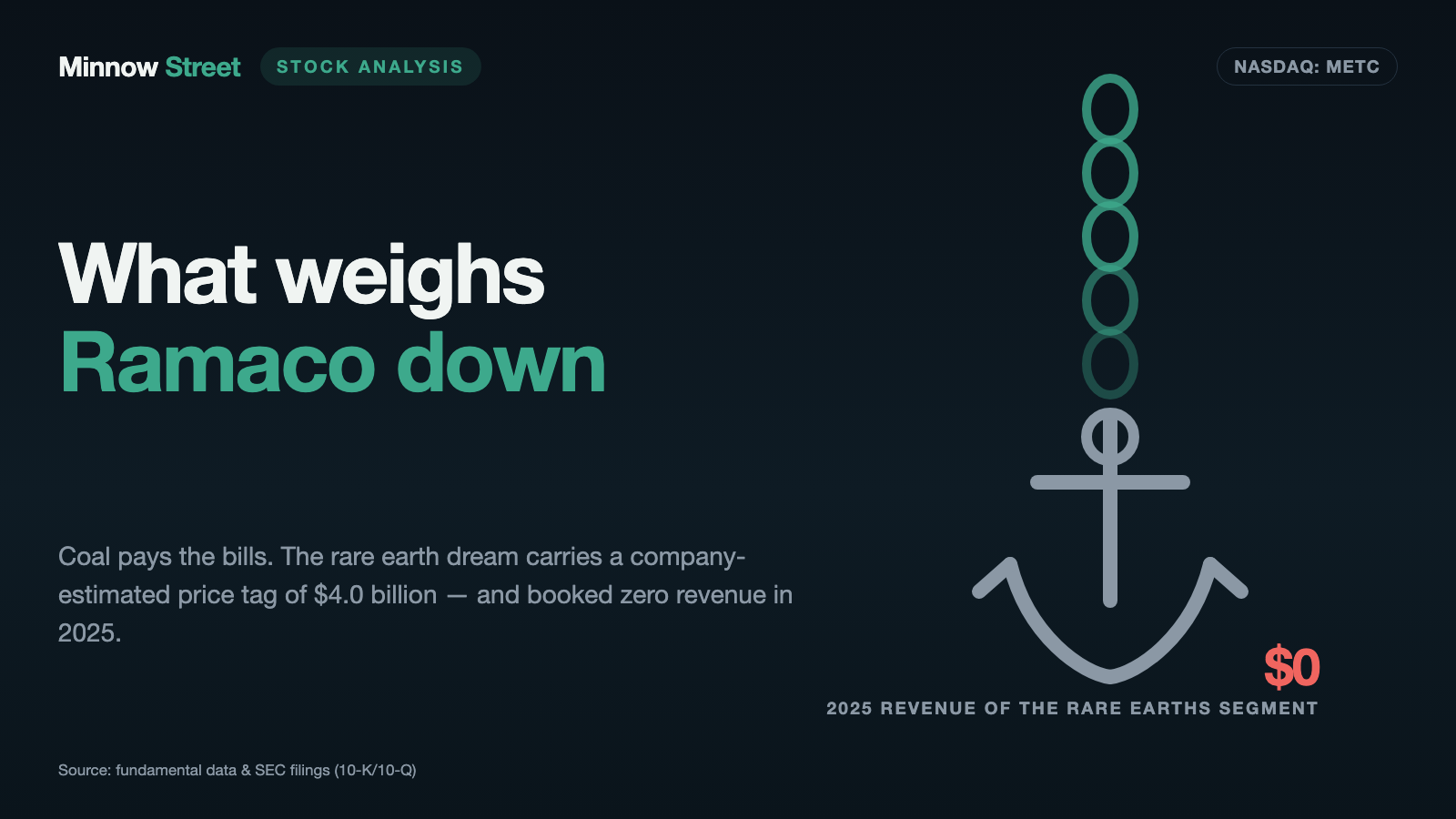
Ramaco Resources: Coal Money for a Four-Billion-Dollar Dream
Ramaco Resources sells metallurgical coal to steel mills — but the market talks about rare earths. In July 2026 the company had to amend its own annual report in response to comments from the staff of the U.S. securities regulator, the SEC, deleting the very sentences that asserted the technical and economic viability of its Brook Mine project. Five days later it published a new, internally prepared number: an $8.0 billion net present value. In between sit a segment with zero revenue, a $51.4 million loss for 2025 and a $4.0 billion capital cost estimate. We read what the filings say — and what was taken out of them.
 Thomas Mücke
Founder & Publisher
Thomas Mücke
Founder & Publisher
Chart
Interactive price chart (TradingView).
Note: pure fact-based analysis, not investment advice and not a solicitation to buy or sell. All figures without guarantee.
The trap: an engineering study feels like proof
There is an investor trap that catches careful readers in particular — call it the engineering study trap. It works like this: a number does not come from a press office but from a real engineering firm. It carries decimal places. It has a cover page. And because a professional produced it, your mind stops asking to which standard it was produced. That is precisely what determines its worth: depending on the mandate, the same firm delivers either a rough order-of-magnitude sketch or a bankable feasibility study, and the distance between the two is enormous.
At Ramaco Resources, Inc. (Nasdaq: METC and METCB) a regulator forced that distinction into the open in the summer of 2026. A July 2025 study by the engineering firm Fluor on the Brook Mine rare earth project was first described in the annual report as a "Preliminary Economic Assessment." On July 24, 2026, Ramaco filed the same annual report again, this time as an amendment. Since then the study is called only the "Fluor Study" and is described as a conceptual study. The sentences about technical and economic viability are gone. The reason sits in the opening section of the document, and it is not a footnote: the changes were made in response to comments from the staff of the U.S. securities regulator, the SEC.
So let us make a deal. Before you form a view on the stock, we read together what Ramaco itself filed with the SEC — the annual report (10-K) for 2025 filed February 26, 2026, its amendment (10-K/A) of July 24, 2026, the quarterly report (10-Q) as of March 31, 2026 filed May 11, 2026, and the current reports (Form 8-K) through July 29, 2026. Those filings are honest under penalty of law. And they describe a coal company that is currently losing money while a number hovers above it that is about a hundred times larger than its best annual profit of the past three years ($82.3 million in 2023). In the end, the decision is yours.
What Ramaco Resources actually does
Ramaco Resources is first and foremost a coal mining company — but not the kind of coal you burn. The product is metallurgical coal, and it does not end up in a power plant but in a blast furnace: it is baked into coke, and coke is what turns iron ore into steel. Put plainly: Ramaco does not sell heat, it sells an ingredient without which conventional steel does not exist. Demand therefore tracks the steel cycle, not electricity prices.
Mining takes place at four active complexes in Central Appalachia: Elk Creek in southern West Virginia, Berwind on the West Virginia–Virginia border, Knox Creek in Virginia and Maben in southern West Virginia. Estimated aggregate annual production capacity as of December 31, 2025 is approximately four million clean tons, excluding idled properties; the longer-term ambition is more than seven million tons. In 2025 the company sold 3.8 million tons, with 37 percent of revenue from North America and 63 percent from export markets. Roughly 900 people worked for the company at the end of 2025, none of them covered by collective bargaining agreements.
And then there is the second business, which is not yet a business: the Brook Mine near Sheridan in northeastern Wyoming, about 15,800 acres of controlled mineral rights, of which 4,500 acres are permitted for mining. According to the company it holds rare earth elements and critical minerals — gallium, germanium, scandium and other materials used in semiconductors, magnets and defense hardware. Since the third quarter of 2025 Ramaco reports it as a separate segment: "Rare Earths and Critical Minerals" alongside "Metallurgical Coal." How far along that second business is, the quarterly report states in a single sentence worth committing to memory:
"There is no assurance that we will be able to successfully develop the Brook Mine into a commercial scale mine, and there is no certainty that any part of the inferred mineral resources estimated will be converted into higher confidence mineral resources and eventually mineral reserves in the future."
— Ramaco Resources, Inc., SEC quarterly report 10-Q as of March 31, 2026, Note 1 "Business and Basis of Presentation"
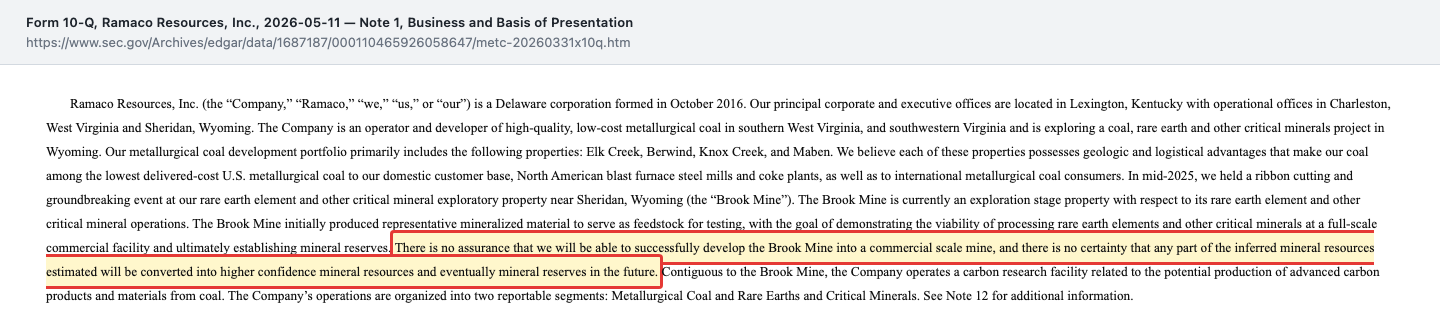
That frames the central tension of this analysis, and it runs through every chapter that follows: coal earns the money, the dream carries the valuation, and between them sits a construction project the company itself prices at four billion dollars.
How the stock landed on our desk
Not through a price jump and not through a momentum screen, but through something far more mundane: routine review of new SEC filings. On July 24, 2026, Ramaco Resources filed two amendment documents on the same day — an amended annual report (10-K/A) and an amended current report (8-K/A). That is unusual. A company that refiles a five-month-old annual report while simultaneously swapping out a ten-month-old shareholder letter has either found a typo or something larger.
Our in-house stock scanner captured the stock as of July 30, 2026 with figures worth knowing before reading on. The Piotroski score — a nine-point checklist of balance-sheet health, one point per criterion met — stands at 3 out of 9. That is weak; a genuinely healthy company sits at 8 or 9, and anything below 4 signals that profitability, leverage and operating efficiency are under pressure at the same time. The equity ratio of 42.4 percent is respectable and the debt-to-equity ratio of 0.95 is manageable. The Altman Z″ of 1.4 sits in the grey zone of the scale — below 1.1 is the distress zone, 2.6 and above the safe zone. That is no alarm bell, but no clean bill of health either; for a capital-intensive miner with heavy fixed assets the reading is structurally low anyway, so read it as context, not as a bankruptcy forecast — the company had $355.2 million in the bank as of March 31, 2026. Keep this in mind for the rest of the text: the balance sheet is well stocked, the earnings power is not.
The numbers over the years — given their due
Start with what Ramaco genuinely does well. The company is among the lowest-cost metallurgical coal producers in the United States, and that is not marketing but arithmetic: cash cost per ton sold was $98 in the first quarter of 2026 — the third consecutive quarter below $100, achieved without wage or benefit cuts and despite diesel prices roughly 23 percent higher year over year. In a market where, by the company's own account, almost all high-vol mines worldwide are unprofitable at current prices, a first-quartile cost position is a real advantage. And the order book for 2026 filled early: as of April 30, 2026, 3.5 million tons were committed — 90 percent of full-year production guidance at the midpoint of 3.9 million tons.
Now the chart that explains the rest.
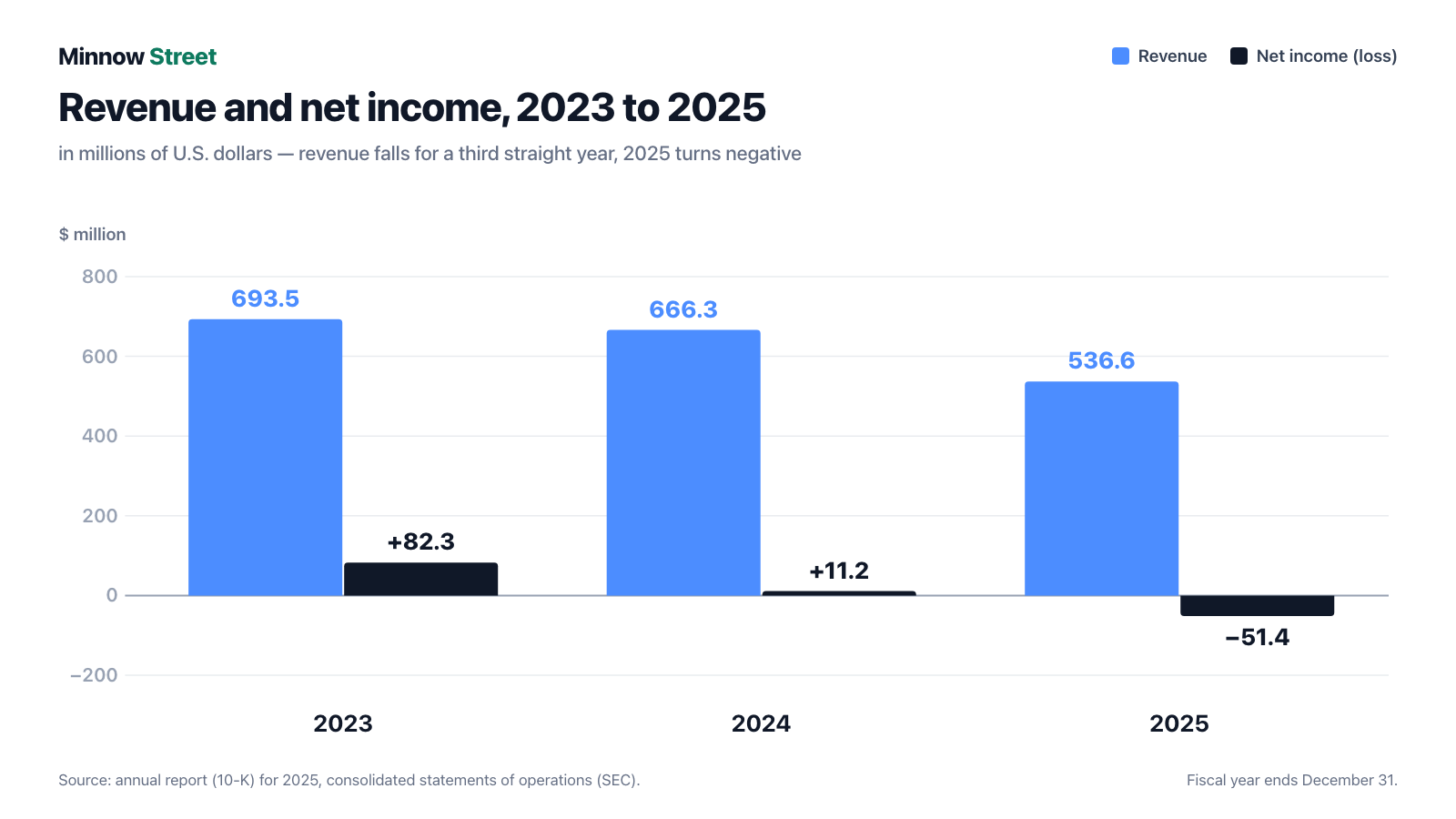
Revenue fell roughly 19 percent in 2025 to $536.6 million, driven by weaker pricing and 4 percent fewer tons sold. An operating profit of $95.2 million in 2023 became an operating loss of $56.0 million in 2025; the bottom line showed a $51.4 million loss after an $11.2 million profit the year before. One line stands out because it does not depend on the market: selling, general and administrative expenses rose from $49.3 million to $69.4 million — up 41 percent while revenue fell 19 percent.
The picture is starker for money that actually arrives. Cash from operating activities — in plain terms, what really lands in the account before anything is invested — collapsed from $161.0 million (2023) through $112.7 million (2024) to $2.0 million (2025). In the first quarter of 2026 it was negative $34.6 million. Against that stood 2025 capital expenditures of $62.8 million plus an $18.5 million land and mineral acquisition. Put differently: in 2025 the core business no longer funded even its own replacement capital spending.
The first quarter of 2026 continued the trend: $121.6 million of revenue (against $134.7 million a year earlier), an $18.3 million net loss, adjusted EBITDA of negative $1.8 million after positive $9.8 million a year before. Realized price per ton fell from $122 to $114, cash margin from $24 to $16 per ton. At 892,000 tons sold in the quarter, eight dollars less margin per ton is roughly seven million dollars — with cash costs unchanged. Price, not performance, produced these numbers.
Uncomfortable truth no. 1: the regulator made them delete the sentence that carried the story
In July 2025 Ramaco published a study by the engineering firm Fluor on the Brook Mine project and referred to it in the annual report as a "Preliminary Economic Assessment." The report stated that the study had established the project's technical and economic viability. On August 19, 2025, the SEC's Division of Corporation Finance sent a comment letter on the quarterly report for the second quarter of 2025. The subject was exactly those formulations — the basis for asserting technical and economic viability "in light of the AACE Class 5 classification and the conceptual nature of the underlying exploration target."
A brief aside, because that acronym is the heart of the matter. AACE Class 5 is the lowest rung of an internationally used cost-estimate scale. It denotes the earliest phase, where you sketch rather than calculate. The accuracy range the company itself cites is minus 35 to plus 50 percent. Translated: saying a house costs $400,000 at Class 5 means "somewhere between $260,000 and $600,000."
Eleven months after the comment letter, Ramaco acted. The amended annual report arrived on July 24, 2026 — and it lists in nine points what was changed. Points two and three and the closing sentence read:
"… (ii) to remove statements asserting the technical and economic viability of the Company’s Brook Mine rare earth/critical minerals project; (iii) to revise disclosures regarding the Company’s Brook Mine to characterize the project as an exploration stage property with respect to critical mineral operations … The foregoing revisions were made in response to comments from the staff of the Commission."
— Ramaco Resources, Inc., SEC amended annual report 10-K/A for 2025 (filed July 24, 2026), Explanatory Note
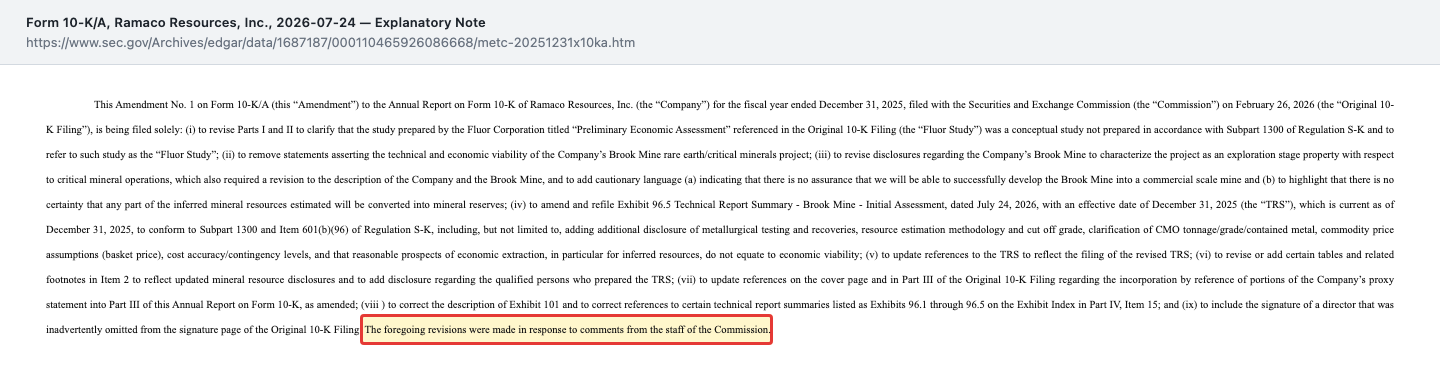
On the same day Ramaco also swapped out the shareholder letter of September 18, 2025 by way of an amended current report (8-K/A). Removed from it were "certain tabulations covering development options, margin analysis, cash flow analysis, valuation, and summary of production metrics" — in other words, precisely the numbers a shareholder cares about.

An important qualification, and fairness demands it: the financial statements themselves were not restated. What changed were the descriptive chapters — business, properties, management's discussion and analysis — and the technical report on the Brook Mine. Auditor Grant Thornton confirmed effective internal control over financial reporting as of December 31, 2025, and a material weakness reported the prior year was considered remediated in 2025. So this is not about wrong numbers, but about words that went too far. For a company whose market narrative rests almost entirely on a description of the future, that is not a small distinction.
Uncomfortable truth no. 2: five days later a bigger number arrived — from in-house
You might expect a company to go quiet after an episode like that. Ramaco got louder. On July 29, 2026 — five days after the deletion — it published a new shareholder letter by current report, together with a new conceptual study by the engineering firm Hatch. The headline figures: a pre-tax net present value of $8.0 billion (up 567 percent from the Fluor study), $6.4 billion after tax, a pre-tax internal rate of return of 24 percent and average adjusted EBITDA of $1.3 billion per year over an assumed 40-year mine life.
For scale: Ramaco's best net income of the past three years was $82.3 million (2023). The projected annual EBITDA of the project is therefore roughly fifteen times the best consolidated profit of recent memory — and it comes from a segment that has never booked revenue. The company says so itself, with notable candor:
"These estimates are internally prepared by Ramaco and are not the output of an ‘initial assessment,’ pre-feasibility study or feasibility study prepared by a qualified person under Regulation S-K, Subpart 1300."
— Ramaco Resources, Inc., SEC current report 8-K of July 29, 2026, Exhibit 99.2 (shareholder letter), footnote 2
And one more sentence from the same letter, more honest than any footnote:
"The assessment was based on 100% inferred mineral resources which are speculative, and there is no certainty that the results of the Initial Assessment will be realized. However, if no Inferred mineral resources were included in the cash flow of the Initial Assessment, then there would be no project."
— Ramaco Resources, Inc., SEC current report 8-K of July 29, 2026, Exhibit 99.2 (shareholder letter), footnote 1
Two terms deserve plain-language translation. Inferred resources are the lowest confidence tier in mining: you have drilled, you have samples, you extrapolate — but the tonnage is estimated, not measured. Reserves, by contrast, are the portion that qualified professionals judge economically mineable at today's prices. Ramaco has declared no reserves for the rare earths, only inferred resources. We have walked through the same distinction on another mining case before — in our analysis of Silvercorp Metals, where it decides half the valuation.
Then there is the cost side. Hatch puts the total initial pre-production capital cost of the project at $3.2 billion plus roughly $0.8 billion of contingency, or $4.0 billion in total. The AACE Class 5 classification attaches to the cost estimate for the processing facility, and Ramaco itself gives the range: roughly $2.6 billion to $6.0 billion. The letter also records that no sensitivity analysis was presented — that is, no answer to how the $8.0 billion net present value shrinks if the assumed commodity prices fail to materialize. Remember the ratio: a company with $437.0 million of equity is planning a project whose pre-production capital cost is, by its own estimate, nine times as much.
Uncomfortable truth no. 3: the segment everyone talks about has zero revenue
Since the third quarter of 2025 Ramaco reports in two segments. The numbers from that split are the most honest part of the annual report, and management's discussion states the position in a single sentence:
"There are no revenues from rare earth elements and critical minerals at this time."
— Ramaco Resources, Inc., SEC amended annual report 10-K/A for 2025, Item 7 (MD&A), section "Revenue"
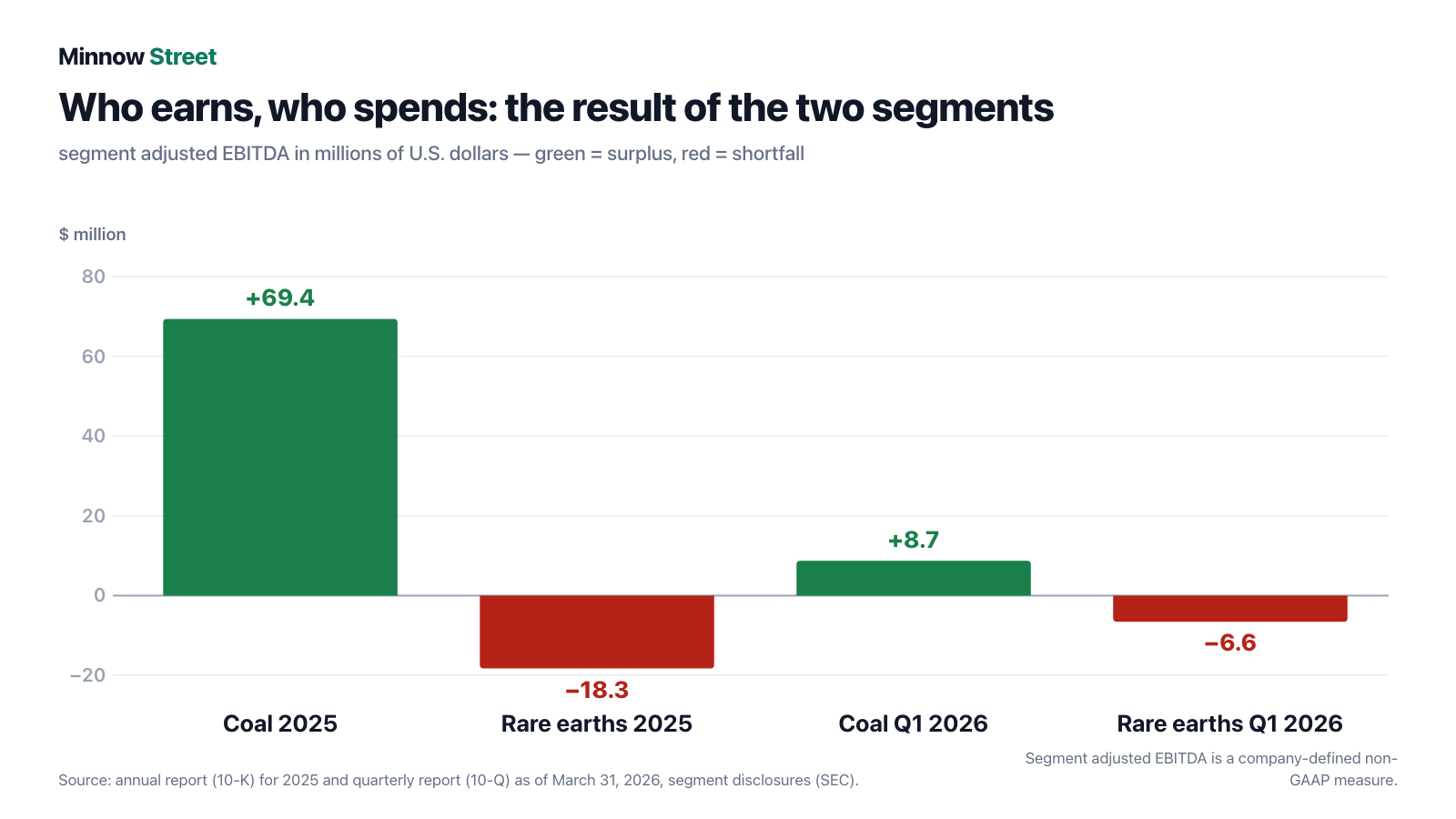
In 2025 the coal segment produced segment adjusted EBITDA of $69.4 million and the rare earths segment negative $18.3 million on exactly zero revenue. In the first quarter of 2026 the same figures were positive $8.7 million and negative $6.6 million. The ratio is shifting: as the coal contribution shrinks, the drag from the future project stays. Capital spending in 2025 still ran the other way — $61.7 million into coal, $4.5 million into rare earths. The real bill has yet to arrive.
The timetable shows how far off that is. The shell of the pilot plant in Wyoming is due to be complete in October 2026, the process modules fabricated by Zeton are projected to ship in the first half of 2027, and full pilot operation is expected later in 2027. A Technical Report Summary compliant with Subpart 1300 of Regulation S-K — the first version that fully satisfies the regulator's requirements — is promised in the shareholder letter by the end of calendar year 2026. Until then the valuation of this segment rests on paper that was expressly not prepared under the regulator's rules.
Uncomfortable truth no. 4: the half billion of liquidity was not earned
One of the most impressive numbers in the earnings release of May 11, 2026 is liquidity: $488.8 million as of March 31, 2026 — more than 310 percent above the year-earlier figure, made up of $355.2 million of cash and $133.6 million of borrowing availability. The release calls the balance sheet "among the strongest in its history." That is even true. But the decisive question about any cash pile is not how big it is, but where it came from.
The answer is in the 2025 statement of cash flows. Operations delivered $2.0 million. Issuing new shares brought in $189.0 million, issuing long-term debt $398.5 million. Of that, $32.8 million went out for capped call transactions — hedges a company buys to blunt part of the dilution from a convertible note — and another $34.5 million repaid an older note. Cash climbed from $33.0 million (end of 2024) to $440.3 million (end of 2025). The chief executive summarized it himself in May 2026: over nine months the company had raised more than $500 million — equity at $18.75 per share and the zero-coupon convertible at a reference price of $24.25 per share.
In the first quarter of 2026 some of it already flowed back out: $34.6 million from operations, $17.0 million for capital spending, $11.9 million for share repurchases. On balance, cash fell by $85.1 million in three months. Extrapolating only operations and investment — $51.6 million for the quarter — the balance lasts roughly seven quarters; add the $11.9 million of discretionary buybacks and it is about five and a half. Both overstate the case, though: working capital swings alone cost $32.9 million (mainly $18.4 million of inventory build and $12.0 million of higher receivables), and without them cash from operations for the quarter would have been about negative $1.7 million rather than negative $34.6 million. Panic would be misplaced. But the statement stands: the money in the bank came from the capital market, not from coal.
How cyclical this business is, and how quickly a cost advantage turns into a loss when prices roll over, we worked through with U.S. oilfield service providers in our analysis of Liberty Energy — the pattern is the same.
Uncomfortable truth no. 5: what the bond market thinks of the company
There is one place in every quarterly report where the company is not speaking but the market is: the fair value disclosure on its own debt. For Ramaco it sits in Note 5 of the quarterly report as of March 31, 2026 — and it is remarkable.
"The Company’s 2031 Convertible Senior Notes had an estimated fair value of $253.1 million and $292.9 million at March 31, 2026 and December 31, 2025, respectively."
— Ramaco Resources, Inc., SEC quarterly report 10-Q as of March 31, 2026, Note 5 "Debt"

The convertible carries $345.0 million of principal, pays no interest at all and matures on November 1, 2031. A buyer therefore earns only through repayment at par or through conversion into shares — and the latter only above a conversion price of roughly $32.74 per Class A share. A fair value of $253.1 million means roughly 73 cents on the dollar. And it fell by $39.8 million within a single quarter.
For comparison, the same paragraph lists the two interest-bearing notes: 8.375 percent due 2029 ($57.5 million of principal, $57.8 million fair value) and 8.250 percent due 2030 ($65.0 million of principal, $65.3 million fair value) — both essentially at par. The discount therefore hits precisely the instrument whose value depends on the share. Translated: the noteholders financing the same company that assigns its flagship project an $8.0 billion net present value are paying 73 cents on the dollar for their own claim. That is not an opinion but a traded price under a Level 2 measurement — and a counterpoint no shareholder letter supplies.
The counterweight — what is genuinely solid here
So this text does not tip over: there is a whole set of things at Ramaco that are demonstrably good, and they sit in the same filings.
The cost position. Three consecutive quarters below $100 of cash cost per ton, most recently $98 in the first quarter of 2026 — with diesel prices up and no wage cuts. In a market where competitors file for bankruptcy, idle production or put themselves up for sale, that is a buffer, not a detail.
The order book. As of April 30, 2026, 3.5 million tons were committed for 2026, of which 1.1 million tons at an average $138 per ton to North American customers and 1.0 million tons at $107 per ton to seaborne customers; another 1.4 million tons run on index-linked pricing. That is 90 percent of full-year guidance.
The balance sheet. $355.2 million of cash, a $350.0 million revolving credit facility maturing December 30, 2030 with an accordion feature for a further $150.0 million, and net financial debt of roughly $97 million against $437.0 million of equity. The largest single obligation carries no interest and runs to 2031. Cash interest paid in the first quarter of 2026 was only $2.3 million.
Growth in the core business. The Laurel Fork mine has been restarted and a third section is being added at Berwind in the summer of 2026 — together Ramaco expects an additional 100,000 to 200,000 tons in 2026 and 500,000 tons in 2027. At the Maben complex a rail loadout is due by year-end that the company says saves roughly $20 per ton in trucking costs.
The controls. The material weakness in internal controls reported in the 2024 annual report — insufficient appropriately qualified accounting staff — was remediated during 2025; as of December 31, 2025 auditor Grant Thornton judged internal control over financial reporting to be effective.
Valuation: two share classes, one price from a filing
Here the fine print pays, because many data services capture only half of this company. Ramaco has two listed classes of stock: Class A (METC) and Class B (METCB). As of May 8, 2026, the cover page of the quarterly report reported 53,804,858 Class A shares and 11,370,005 Class B shares — 65,174,863 in total. The share count in the fundamental data, by contrast, shows only the 53,804,858 Class A shares; the Class B class — around 17 percent of all shares — is missing from that tally.
For a dated anchor you do not need a daily quote, you need a filing. The current report of June 15, 2026 states the Class B closing price on June 12, 2026: $11.43 — it served to calculate the stock dividend. No price for the Class A share is documented in any filing, so we apply the $11.43 to it as well, for want of a better anchor. Because both classes trade separately and can diverge, the result is a range rather than a point value: measured at the documented Class B price, both classes together come to roughly $0.75 billion, while the fundamental data show roughly $0.63 billion as of July 30, 2026. So work with an order of magnitude of $0.6 billion to $0.75 billion. From that follow the following, all as orders of magnitude rather than daily prices:
- Price-to-sales ratio of roughly 1.2 to 1.4 — measured against 2025 revenue of $536.6 million. For a commodity producer with falling prices, that is not bargain territory.
- Price-to-book ratio of roughly 1.4 to 1.7 — measured against equity of $437.0 million as of March 31, 2026, which is roughly $6.70 per share across both classes.
- No meaningful price-to-earnings ratio, because 2025 and the first quarter of 2026 were loss-making.
- Enterprise value (market capitalization plus $452.1 million of financial debt minus $355.2 million of cash) of roughly $0.73 billion to $0.85 billion. The project's pre-production capital cost is $4.0 billion by the company's own estimate — about five times what the entire business is worth today.
The professional view is considerably friendlier: three analysts cover the stock, all three at the top rating, with a mean price target of $26.13 (as of July 30, 2026). That is more than double the documented June price — and at the same time below the company's own convertible conversion price of $32.74. Three analysts is a very thin base, and an institutional ownership share of 91.5 percent against only 10.1 percent insider ownership shows that funds, not management, dominate the register.
Two further dilution items belong on the table, because they enlarge the denominator of these ratios. First: on a so-called make-whole fundamental change, the zero-coupon convertible can create up to roughly 14.2 million additional Class A shares — a good quarter of today's Class A count. Second: the annual meeting of June 10, 2026 increased the long-term incentive plan by 4,000,000 Class A shares (33.6 million votes for, 5.4 million against), registered on Form S-8 on July 2, 2026. Against that stands a $100 million repurchase program under which 1,032,202 shares had been bought back at an average of $14.56 through March 31, 2026.
Opportunities and risks at a glance
Opportunities
- First-quartile cost position: $98 cash cost per ton in the first quarter of 2026, a third consecutive quarter below $100 — a buffer while competitors idle production.
- Filled order book: 3.5 million tons committed for 2026 as of April 30, 2026, which is 90 percent of guidance at the 3.9 million ton midpoint.
- Financial strength: $488.8 million of liquidity as of March 31, 2026, the largest obligation interest-free until 2031, a $350.0 million credit facility running to the end of 2030.
- Growth in the core business without acquisitions: Laurel Fork restarted, a third section at Berwind, the Maben rail loadout saving roughly $20 per ton.
- Brook Mine optionality: if even a fraction of the internal estimates proves durable, today's enterprise value of roughly $0.73 billion to $0.85 billion sits against a project the company values at a multiple of that.
- Policy tailwind: discussions with U.S. government agencies, a non-binding memorandum of understanding with magnet materials company REalloys dated May 28, 2026, and a $6.1 million state grant from Wyoming.
Risks
- Regulatory episode: the 2025 annual report had to be amended on July 24, 2026 in response to comments from the SEC staff; under "Unresolved Staff Comments" Ramaco records that those comments remained unresolved.
- Earnings: a $51.4 million net loss in 2025, $18.3 million in the first quarter of 2026, cash from operations down from $161.0 million (2023) to $2.0 million (2025) and then negative.
- Price dependence: cash margin fell from $24 to $16 per ton within a year purely on index pricing — cash costs were unchanged.
- Brook Mine funding gap: $4.0 billion of estimated pre-production capital cost (processing facility estimate ranging from $2.6 billion to $6.0 billion) against $437.0 million of equity; the intended non-dilutive project financing has not been concluded.
- Dilution: up to roughly 14.2 million additional shares from the convertible, plus 4,000,000 new shares in the incentive plan since June 10, 2026.
- Customer concentration: in the first quarter of 2026, three customers accounted for 17, 10 and 10 percent of revenue; four customers held 19, 17, 12 and 10 percent of receivables.
- A second share class with soft content: Class B conveys no direct claim on the internal unit CORE, and the board may reset its assets and fees at any time without shareholder approval.
A human conclusion
Back to the engineering study trap. It is stubborn precisely because nothing is wrong with the studies. The Fluor study was a real study by a real engineering firm. The Hatch report is a real report by a real engineering firm. Nobody invented anything here. The difference lies entirely in the standard: both are conceptual studies at the lowest accuracy tier, minus 35 to plus 50 percent, and neither was prepared under the rules the U.S. securities regulator requires for economic assertions in mining. In the summer of 2026 the regulator enforced exactly that — it did not dispute the numbers, it disputed the weight given to them in an annual report.
What remains is an uncomfortable double nature. Ramaco Resources is a well-run, very low-cost coal producer in a bad pricing year — with a full order book, a strong cash position and a cost structure many competitors envy. And Ramaco Resources is at the same time an exploration company planning a four-billion-dollar project whose entire economics rest on inferred resources, for which no sensitivity analysis exists and whose first regulator-compliant technical report is still only announced.
The honest question is therefore not "is the Brook Mine good?" — nobody can answer that credibly today, the company included. It is: are you paying today for a coal company with a falling margin at a price that only works if a project succeeds whose numbers the regulator has just made it delete from its annual report? If you answer yes, can live with a horizon into 2027 at the earliest and price in the dilution, you have a thesis. If not, you have spent a very instructive hour with an annual report. The decision is yours.
Sources
All primary documents used in this analysis — to read for yourself:
- Ramaco Resources, Inc. — SEC quarterly report 10-Q as of March 31, 2026 (filed May 11, 2026)
- Ramaco Resources, Inc. — SEC amended annual report 10-K/A for 2025 (filed July 24, 2026)
- Ramaco Resources, Inc. — SEC annual report 10-K for 2025 (filed February 26, 2026)
- Ramaco Resources, Inc. — SEC annual report 10-K for 2024 (filed March 17, 2025)
- Ramaco Resources, Inc. — SEC current report 8-K of May 11, 2026 (Item 2.02, first quarter 2026 earnings release, Exhibit 99.1)
- Ramaco Resources, Inc. — SEC current report 8-K/A of July 24, 2026 (replacement of the September 18, 2025 shareholder letter)
- Ramaco Resources, Inc. — SEC current report 8-K of July 29, 2026 (Hatch conceptual study and Brook Mine shareholder letter)
- Ramaco Resources, Inc. — SEC current report 8-K of June 15, 2026 (Class B stock dividend ratio, closing price of June 12, 2026)
- Ramaco Resources, Inc. — SEC current report 8-K of June 10, 2026 (annual meeting results, increase of the incentive plan)
- Ramaco Resources, Inc. — SEC current report 8-K of May 28, 2026 (non-binding memorandum of understanding with REalloys, Inc.)
- Ramaco Resources, Inc. — SEC registration statement S-8 of July 2, 2026 (registration of 4,000,000 additional Class A shares for the long-term incentive plan)
- Ramaco Resources, Inc. — SEC prospectus 424B4 of February 6, 2017 (initial public offering at $13.50 per share, Nasdaq listing under "METC")
- Complete SEC filing history of Ramaco Resources: EDGAR overview (sec.gov)
- Fundamental data (metrics, quarterly series, valuation; as of July 30, 2026), reconciled with the SEC filings.
- Screener and rating data: in-house stock scanner (as of July 30, 2026).
Transparency & disclaimer: This analysis is journalistic commentary on publicly available information. It is not investment advice, not a financial analysis in any regulatory sense and not a solicitation to buy or sell securities. Equity investments carry substantial risk up to and including total loss. All information without warranty; the as-of date of each figure is noted in the text. The author holds no position in Ramaco Resources shares at the time of publication.
Our Bottom Line at a Glance
- Cost position in the core business positive
- Cash cost of $98 per ton in the first quarter of 2026 — a third consecutive quarter below $100, achieved without wage cuts and despite diesel prices roughly 23 percent higher. On top of that, 3.5 million tons were already committed for 2026 as of April 30, 2026, which is 90 percent of guidance at the 3.9 million ton midpoint. In a market where competitors are idling production, that is a documented advantage.
- Earnings and cash generation negative
- Revenue down for three straight years ($693.5 million to $666.3 million to $536.6 million), net income swung from +$82.3 million (2023) to −$51.4 million (2025), with a further $18.3 million loss in the first quarter of 2026. Cash from operating activities fell from $161.0 million to $2.0 million (2025) and was negative $34.6 million in the first quarter of 2026. Cash margin per ton fell from $24 to $16 within a year.
- The Brook Mine project negative
- The rare earths segment booked no revenue in 2025 or the first quarter of 2026 and cost $18.3 million and $6.6 million respectively. On July 24, 2026, in response to comments from the SEC staff, Ramaco had to delete the statements asserting technical and economic viability from its annual report; the $8.0 billion net present value published on July 29, 2026 is, per its own footnote, an internal estimate resting on 100 percent inferred resources with no sensitivity analysis.
- Balance sheet and funding neutral
- As of March 31, 2026 the company held $355.2 million of cash, $488.8 million of liquidity and $437.0 million of equity against $452.1 million of financial debt — $345.0 million of it interest-free until 2031. Net financial debt is roughly $97 million and cash interest paid in the quarter was only $2.3 million. But the money came from a $189.0 million equity offering and $398.5 million of notes issued in 2025, not from operations — and the planned project carries $4.0 billion of pre-production capital cost by the company's own estimate.
- Capital structure and governance negative
- Two share classes, of which Class B (11.37 million shares as of May 8, 2026) conveys no direct claim on the internal unit CORE; the board may redefine CORE assets and per-ton fees without shareholder approval and may exchange all Class B shares into Class A. Add up to roughly 14.2 million additional shares from the convertible and 4,000,000 new shares in the incentive plan since June 10, 2026. On the positive side: the control weakness reported in 2024 was considered remediated as of December 31, 2025.
Ramaco Resources is the engineering study trap in its purest form: two genuine engineering studies, both at the lowest accuracy tier — and it took the U.S. securities regulator, the SEC, to make the label say so. On July 24, 2026 the company deleted the statements asserting the technical and economic viability of its Brook Mine project from its annual report in response to comments from the regulator's staff, and the same day swapped the September 2025 shareholder letter for a version without margin, cash flow and valuation tables. Five days later a new letter arrived carrying an internally prepared $8.0 billion net present value against an estimated $4.0 billion of capital cost. Underneath it works a very low-cost coal producer that lost $51.4 million in 2025, whose cash from operations collapsed to $2.0 million and whose half billion of liquidity came from the capital market rather than from mining. Not investment advice.
What Our Rating Means
Open questions
The business works in principle, but one material question is open. As long as it stays open, our findings do not carry a quality verdict.
Yellow rather than red: there is no documented threat to the substance of the business. As of March 31, 2026 the company held $355.2 million of cash and $488.8 million of liquidity against $452.1 million of financial debt, $345.0 million of which is interest-free until 2031; net financial debt is roughly $97 million against $437.0 million of equity, cash interest paid in the quarter was $2.3 million, there is no going-concern language, the $350.0 million credit facility runs to the end of 2030, and the control weakness reported in 2024 was considered remediated as of December 31, 2025. The first-quarter 2026 outflow from operations and investment ($51.6 million) would leave roughly seven quarters of runway, and much of it was inventory and receivables build: excluding working capital swings of $32.9 million, cash from operations was only about negative $1.7 million. Yellow rather than green: revenue has fallen for three straight years, the result swung to a $51.4 million loss in 2025, cash from operations collapsed to $2.0 million and turned negative in the first quarter of 2026, and cash margin per ton fell from $24 to $16 within a year — while the second leg the market narrative rests on has never booked a dollar of revenue, costs $18.3 million a year and was downgraded in the company's own annual report on July 24, 2026, at the regulator's prompting, from a viable project to an exploration stage property. That both classes together cost on the order of $0.6 billion to $0.75 billion — depending on whether one applies the documented Class B closing price of June 12, 2026 or the fundamental data as of July 30, 2026 — is a price argument, does not set the colour, but belongs on the table. The decision is yours.
A journalistic assessment by our editorial team at the time of the deep dive, based on public sources — not investment advice and not a solicitation to buy or sell. Your personal circumstances (investment goals, risk capacity, taxes) cannot be taken into account. What our levels mean, how verdicts are formed, and what conflicts of interest exist →
Worth Noting
- Ramaco Resources reached our research list through routine review of new SEC filings: on July 24, 2026 an amended annual report (10-K/A) and an amended current report (8-K/A) arrived on the same day. This article reflects the state of play as of July 31, 2026; second-quarter 2026 results were scheduled for August 5, 2026 at that time.
- A caution on data feeds: Ramaco has two listed share classes. The share count in the fundamental data shows only the 53,804,858 Class A shares and omits the 11,370,005 Class B shares — around 17 percent of all shares. The dated anchor used in this analysis is the Class B closing price of June 12, 2026 ($11.43) documented in the current report of June 15, 2026; because no Class A price is documented in any filing, it is applied there as well for want of a better anchor. The market capitalization of both classes is therefore given as a range: roughly $0.6 billion to $0.75 billion (fundamental data as of July 30, 2026: roughly $0.63 billion).
- The Brook Mine figures (net present value $8.0 billion, annual adjusted EBITDA $1.3 billion, pre-production capital cost $4.0 billion) are expressly Ramaco's internal estimates based on the Hatch conceptual study. They are not independently verified, were not prepared under Subpart 1300 of Regulation S-K and rest on 100 percent inferred resources. A regulator-compliant technical report is announced for the end of 2026. "Segment adjusted EBITDA" is a company-defined non-GAAP measure.
Frequently Asked Questions
Ramaco Resources mines metallurgical coal — the grade that is baked into coke for steelmaking, not thermal coal for power plants. Mining takes place at four active complexes in West Virginia and Virginia: Elk Creek, Berwind, Knox Creek and Maben. In 2025 the company sold 3.8 million tons for $536.6 million of revenue. It is also developing the Brook Mine rare earth and critical minerals project in Wyoming — an exploration stage property with no revenue.
On July 24, 2026, Ramaco filed an amendment (10-K/A). It removes the statements asserting the technical and economic viability of the Brook Mine project, relabels the July 2025 Fluor study as a conceptual study and describes the project as an exploration stage property. The document states verbatim that the revisions were made in response to comments from the staff of the U.S. securities regulator, the SEC. The financial statements themselves were not restated.
METC is the Class A share and METCB the Class B share; both trade on the Nasdaq Global Select Market and carry one vote each. Class B is intended to track the internal unit CORE, which is credited with per-ton infrastructure fees on coal and future income from rare earths. CORE is not a separate legal entity, however: per the quarterly report, Class B holders own no direct interest in CORE assets, and the board may redefine its scope at any time.
In the shareholder letter of July 29, 2026, engineering firm Hatch puts the total initial pre-production capital cost of the project at $3.2 billion plus roughly $0.8 billion of contingency — $4.0 billion in total. The cost estimate for the processing facility carries an AACE Class 5 classification, so Ramaco itself gives the range as roughly $2.6 billion to $6.0 billion. For comparison, shareholders equity stood at $437.0 million as of March 31, 2026.
No. 2025 brought a net loss of $51.4 million after profits of $11.2 million (2024) and $82.3 million (2023). The first quarter of 2026 added an $18.3 million loss. Cash from operating activities fell from $161.0 million (2023) through $112.7 million (2024) to $2.0 million (2025) and was negative $34.6 million in the first quarter of 2026. The main cause is the price decline in high-vol metallurgical coal.
An inferred resource is the lowest confidence tier in mining: tonnage and grade are extrapolated from drilling rather than measured. A reserve, by contrast, is the portion qualified professionals consider economically mineable at today's prices. Ramaco has declared no reserves for its rare earths. According to its own footnote, the $8.0 billion net present value cited in the shareholder letter rests on 100 percent inferred resources.
In the shareholder letter of July 29, 2026 Ramaco says it expects to file a Technical Report Summary compliant with Subpart 1300 of Regulation S-K by the end of calendar year 2026. Until then the published economics are expressly the company's internal estimates. Full pilot operation of the test facility in Wyoming is not expected to begin until later in 2027.
Found an error?
Did you spot a factual error, an outdated number, or a typo in this deep dive? Let us know briefly — your report goes straight to the editorial team.