A Silver Project Worth $2.65 Billion on Paper — and $589 Spent on Drilling in Nine Months
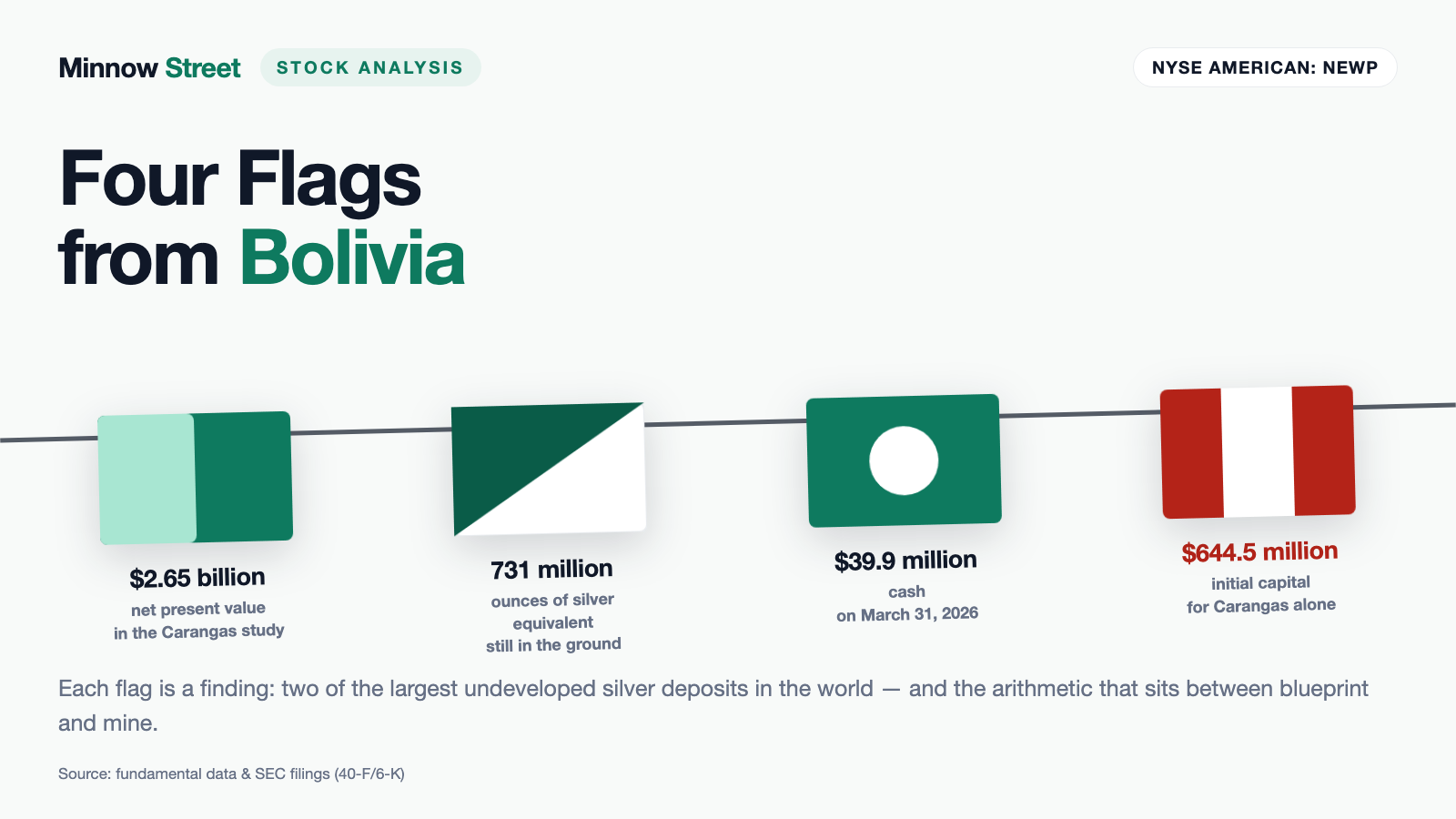
New Pacific Metals owns two of the largest undeveloped silver deposits in the world, both in Bolivia. The updated study on its Carangas project, published July 16, 2026, puts the post-tax net present value at $2.65 billion. The same table names the build cost: $644.5 million. Cash on March 31, 2026 was $39.9 million. Flagship Silver Sand lost its environmental categorization back in November 2024, the contract with the state mining company has been waiting on Bolivia’s parliament since 2019 — and across all three projects the company capitalized $589 for drilling and assaying in nine months. A London fund went from zero to 9.96 percent of the company in a year. What follows is not advice but arithmetic: what is a blueprint worth while nobody is building?
 Thomas Mücke
Founder & Publisher
Thomas Mücke
Founder & Publisher
Chart
Interactive price chart (TradingView).
Note: pure fact-based analysis, not investment advice and not a solicitation to buy or sell. All figures without guarantee.
There is a trap that catches everyone who has ever looked at an architect’s rendering — call it the blueprint trap. It works like this. On the page there is a house. Glass front, garden, sunlight from the left, a number beside it. And because the drawing is so precise, your head starts treating it as property. What the page does not say: that part of the lot still belongs to someone else, that the building permit has expired, and that the construction loan was never approved. The rendering is not lying. It is answering a different question from the one you asked. At New Pacific Metals Corp. (NYSE American: NEWP; TSX: NUAG) that trap is unusually well lit in the summer of 2026, because on July 16, 2026 the company published a very fine rendering of its own: post-tax net present value $2.65 billion. So let us make a deal. We read the fine print together — not the headline of the release, but what the company filed with the U.S. securities regulator, the SEC: the annual report on Form 40-F for fiscal 2025, the interim report as of March 31, 2026, and the study itself. A filing to the SEC is honest under penalty of law. And this one tells of two remarkable silver deposits, of a treasury that covers four percent of the blueprint, of a permit that lapsed in November 2024 — and of $589 capitalized for drilling and assaying in nine months. In the end you decide.
What New Pacific actually does — and what it explicitly does not
Start with what is missing from the income statement: revenue. In all eight quarters through March 31, 2026 that line reads zero, and it is not an accident, it is the business model. New Pacific is an explorer and project developer: it looks for ore, drills it, has engineers calculate whether a mine would pay, and tries to obtain the permits to build one. Nothing is sold. Everything is paid for out of equity raises. The head office is in Vancouver, the listings are in New York and Toronto, and the work happens in Bolivia — with 36 employees as of June 30, 2025.
Three projects carry the story, and they sit at very different stages. Silver Sand in the Potosí department is the flagship: 5.42 square kilometres at 4,072 metres above sea level, drilled out between 2017 and 2022 with 139,920 metres in 564 holes. The resource estimate reports 201.77 million ounces of silver in the measured and indicated categories at a grade of 116 grams per tonne. A pre-feasibility study dated August 8, 2024 turns that into a post-tax net present value of $740 million on initial capital of $358 million. Carangas in the Oruro department is younger and bigger: 40.75 square kilometres, three exploration licenses, a resource estimate of 529.6 million ounces of silver equivalent in the indicated category. Silverstrike, southwest of La Paz, is early stage and on standby.
A word on the jargon, because almost everything here hangs on it. A resource is rock you are fairly sure is there — in everyday terms: you know there is oil in the basement, you do not know whether pumping it out pays. A reserve is the slice of it that somebody has calculated to be mineable at stated prices. And an inferred resource is the least certain grade of all: sketched from few holes and, by the rulebook, "too speculative" to become a reserve. Remember that, because it comes back in a moment: the $2.65 billion calculation for Carangas expressly leans on inferred resources as well. With that, the central tension of this analysis is set, and it runs through every chapter: the studies get bigger year by year — the ground beneath them stays untouched, and in part belongs to someone else.
How this stock landed on our desk
This analysis does not begin with a hit in our in-house stock scanner but with a form. On May 8, 2026, Helikon Investments Ltd of London filed its Form 13F-HR with the SEC as of March 31, 2026 (accession 0001839497-26-000002). A 13F is the mandatory quarterly disclosure for large U.S. asset managers: anyone managing more than $100 million in U.S.-listed equities must show what they hold. Helikon’s table lists 17 positions worth $2,648,555,113 in total — and among them 9,936,183 shares of New Pacific Metals worth $41,135,798.
The trajectory is the interesting part. As of June 30, 2025 and September 30, 2025 the same fund reported zero shares. As of December 31, 2025 it held 2,293,539; as of March 31, 2026, 9,936,183 — a gain of 333 percent in a single quarter. That is by far the most aggressive build in the entire portfolio; six other positions were opened in the same quarter and six were sold out completely. A rebuild quarter, then, not a top-up — and New Pacific was the steepest line in it.
And it did not stop. On July 9, 2026 Helikon additionally filed a Schedule 13G/A, the ownership disclosure required above five percent — and that one is more recent than the 13F. It reports 18,438,377 shares as of June 30, 2026, another 86 percent more than three months earlier, and puts the stake at 9.96 percent of 185,184,189 shares outstanding. Voting and dispositive power are reported as shared throughout; the reporting persons are Helikon Investments Limited and Federico Riggio personally, filing under Rule 13d-1(b), that is, as a passive investor. From zero shares on September 30, 2025 to almost ten percent of a company with no revenue — in nine months.
Now the limit that belongs with every 13F, so a mandatory filing does not turn into a legend. A 13F shows U.S.-listed long positions only, reported with a 35- to 45-day lag, without short sales, without derivatives and without anything listed outside the United States. It is a rear-view mirror, not a road map. It says what sat in the account at quarter end — not why, not at what price and not whether it is still there. The 13G/A simply moves the mirror forward one quarter; it does not turn it into a windshield.
A word on the scanner, because honesty demands it — and because New Pacific is a textbook case of metrics that simply do not apply. Our filters show, data as of July 24, 2026, a picture you must not take at face value. The Piotroski F-Score stands at 2 of 9. That nine-point test measures whether a company is getting more profitable, more liquid and more efficient than a year ago; at a company with no revenue and no profit it cannot come out anywhere but low. Two of nine here says nothing about quality and everything about the metric not applying. The Altman Z-Score of 559.51 is starker still. It is meant to measure distance from insolvency; anything above 2.6 counts as safe. But 559 arises only because the formula divides assets by liabilities — and as of March 31, 2026 New Pacific carried $1.1 million of liabilities against $160.8 million of total assets. You are dividing by very nearly nothing. The figure is arithmetically correct and worthless as proof of creditworthiness. A price/earnings ratio does not exist because there are no earnings, and interest coverage does not exist because there is no interest. What remains is an equity ratio of 99.3 percent — that one is real, and it says exactly one thing: this company owes nobody anything. It says nothing about whether it can afford what it plans to do.
Why there is no quarterly report from New Pacific — and when the fiscal year ends
Two peculiarities you have to know, or you will compare apples with pears. First: there is no 10-K and no 10-Q from New Pacific. The company is Canadian and uses the multijurisdictional disclosure system between Canada and the United States. Its annual report is Form 40-F — filed for fiscal 2025 on September 15, 2025 — and consists essentially of the Canadian originals: the Annual Information Form, the MD&A and the consolidated financial statements audited by Deloitte. Interim numbers appear only as an exhibit to a Form 6-K, unaudited. Accounting is IFRS, reporting currency the U.S. dollar.
Second: the fiscal year ends June 30. That is why the annual report lands in September, and why the quarter that ended March 31, 2026 is the third quarter of fiscal 2026. Miss that and you are constantly comparing shifted periods. Every annual figure in this analysis therefore carries its fiscal year.
And third, a sentence worth reading once. The very first note of the audited financial statements says what this company legally is:
"The Company is in the stage of exploring and advancing the development of its mineral properties and has not yet determined if they contain economically recoverable mineral reserves. The underlying value and the recoverability of the amounts shown for mineral property interests are entirely dependent upon the existence of recoverable mineral reserves, the ability of the Company to obtain the necessary financing to complete the exploration and development of the mineral properties, and future profitable production or proceeds from the disposition of the mineral property interests."
— New Pacific Metals Corp., audited consolidated financial statements as of June 30, 2025, Note 1 "Corporate Information" (40-F exhibit 99.3)
That is standard language for explorers — and still the most honest line in the whole report. It says: the $119.5 million at which the projects sit on the balance sheet is not a value anyone has bid. It is the sum of what has been put in over the years. Whether it ever becomes money depends on three conditions, none of which is met.
The numbers over the years — what an explorer offers instead of revenue
When there is no revenue, the view shifts to three other quantities: how much money is there, how fast is it leaving, and how many shares are there by now? Start with what looks good. As of March 31, 2026 the treasury held $39,863,639 — more than twice the $16,839,959 of nine months earlier. Total assets were $160.8 million, equity $159.7 million, total liabilities $1,060,053. There is no bank debt, no bond, no convertible. Working capital stood at $39.3 million. For a company with no income that is an unusually clean balance sheet.
Consumption is low as well. In the first nine months of fiscal 2026, $2,884,019 flowed out of operations and $2,645,215 into the projects — roughly $5.5 million in nine months, or a little over $7 million annualized. At that pace the treasury lasts more than five years on paper. Except that this pace is precisely the problem, as we are about to see.
Here is the curve that matters. We put cash at every fiscal year end since 2019 next to the number of shares issued:
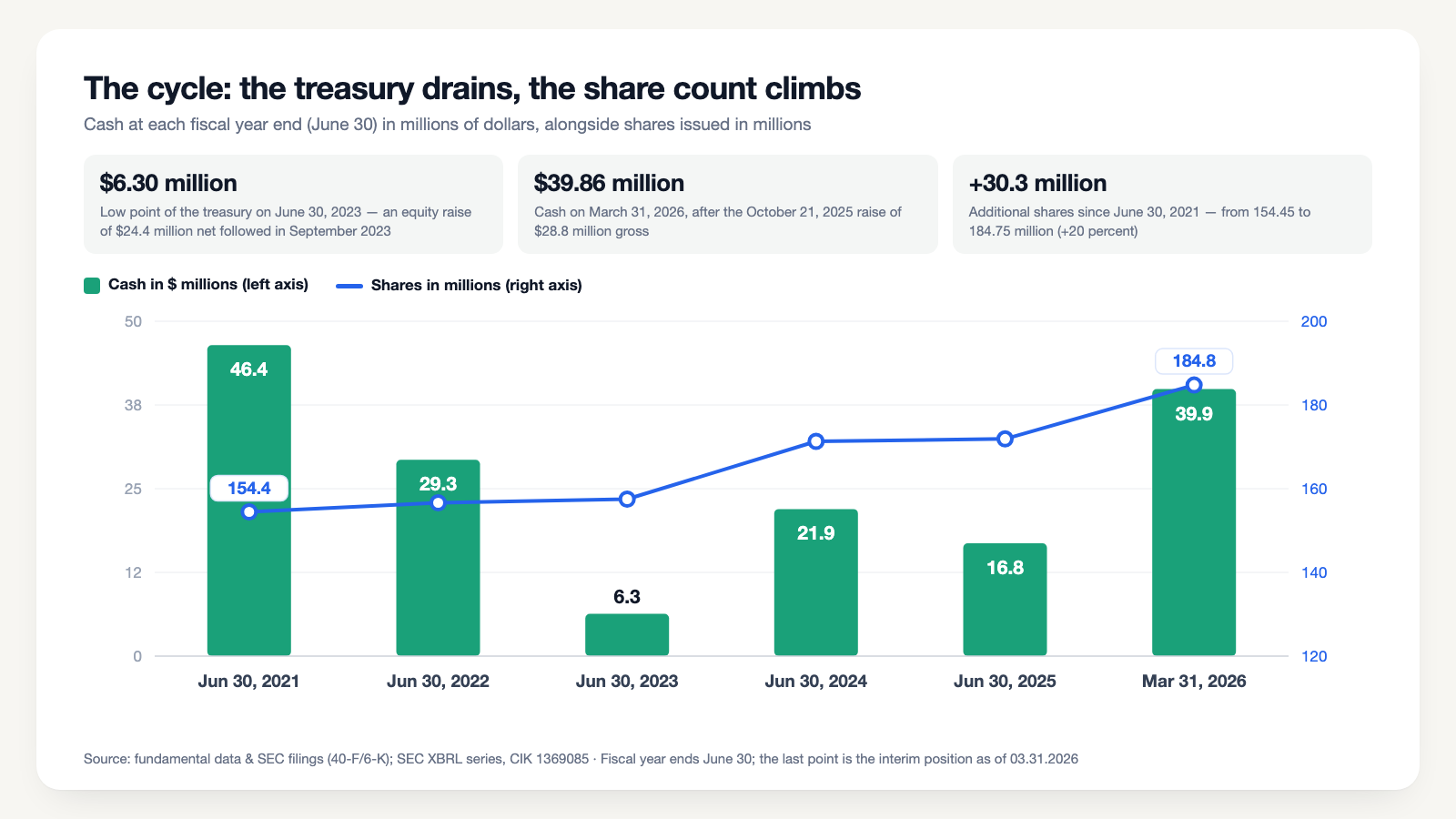
The staircase is clear. By 2023 the treasury had drained to $6,296,312 — barely a year of runway. In September 2023 a raise brought in $24.4 million net, cash jumped to $21.95 million, and the share count went from 157,491,172 to 171,299,119. Two years later, the same pattern: on October 21, 2025 New Pacific placed 11,385,000 new shares at $2.53 (C$3.55) and took in $28,823,813 gross. As of March 31, 2026, 184,749,865 shares were outstanding, a good 7 percent more than nine months earlier.
Put in everyday terms: dilution means your slice of the cake gets smaller because new slices are cut without the cake getting bigger. At an explorer that is not an accident, it is the engine — there simply is no other source of money. So the honest question is not "whether" but "how many more times and at what price." Over the past five years the share count has climbed from 154,451,263 (June 30, 2021) to 184,749,865, roughly 20 percent. And the accumulated losses sitting on the balance sheet as a deficit add up to $81.6 million. For scale: the fiscal 2025 loss was $3,780,222, and the first nine months of fiscal 2026 cost $3,204,963.
What the filings say — the uncomfortable truths
Uncomfortable truth no. 1: the blueprint crosses land the company does not own
On July 16, 2026 New Pacific published the updated preliminary economic assessment for Carangas, prepared by Ausenco Engineering Canada. The numbers are striking: post-tax net present value $2.65 billion at a 5 percent discount rate, internal rate of return 35.9 percent, a 19-year life, 339.0 million ounces of silver equivalent, payback of initial capital in 2.4 years. The earlier study of September 5, 2024 came to $501 million and 26 percent.
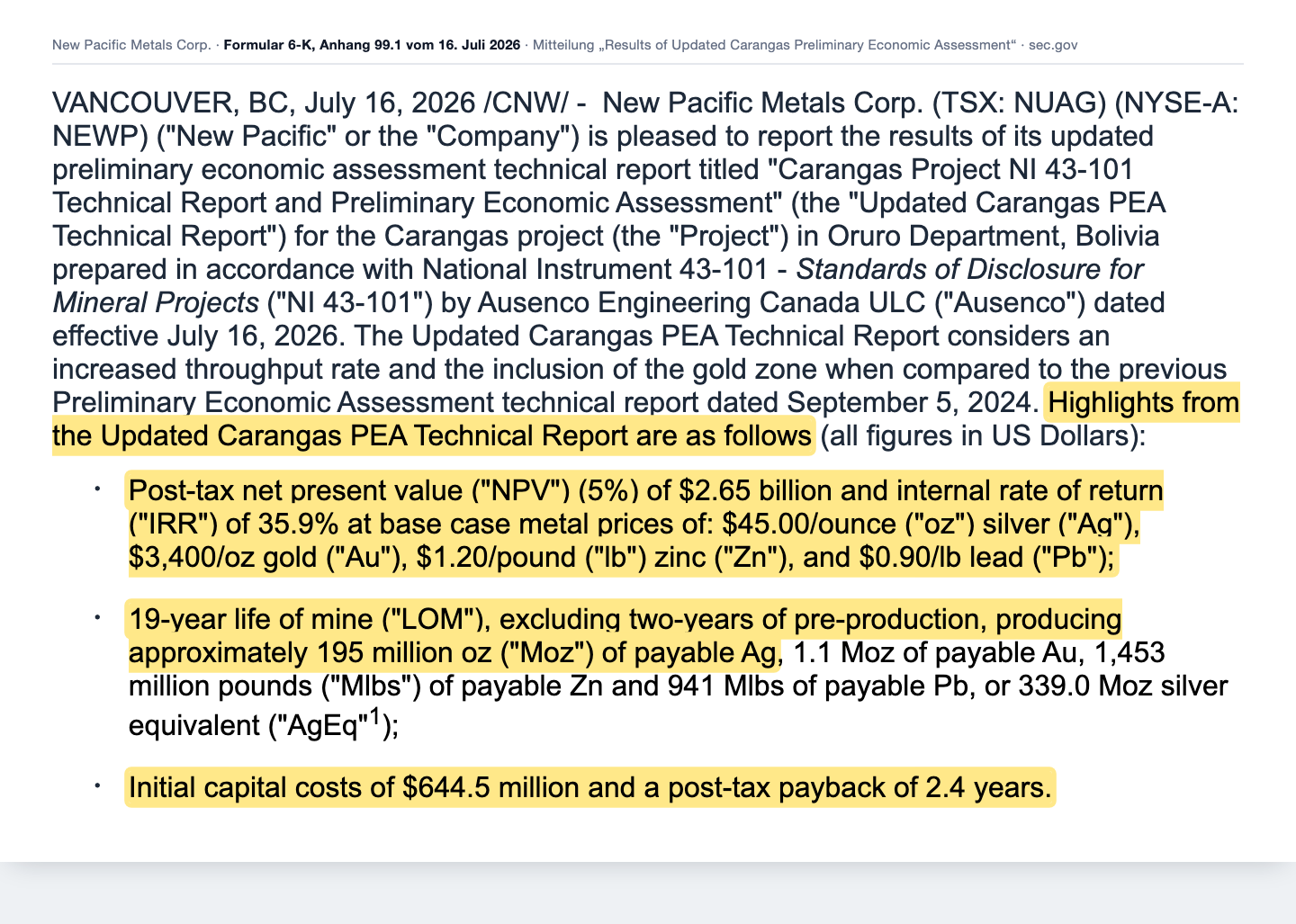
Read only the headline and you see value multiplied by five in under two years. Put the assumptions beside it and you see something else. The old study assumed $24.00 per ounce of silver, the new one $45.00. On top of that the gold zone was added and throughput was doubled from 8 to as much as 16 million tonnes a year. A large part of the jump therefore comes from the price deck, not from new rock. The study shows this itself: at $22.50 per ounce the net present value falls to $973 million and the return to 16.3 percent.
And then comes the paragraph at the very end that almost nobody reads:
"The pit design for the deeper gold zone requires mining of waste (waste stripping) on Mining Concessions in the southern portion of the planned open pit that do not belong to the Company. These concessions include approximately 1.85% of the mineral resources that have been included in the economic analysis for this PEA. These Concessions are held by the state of Bolivia and are not currently available for tenure."
— New Pacific Metals Corp., news release of July 16, 2026, section "Cautionary Note Regarding Results of Preliminary Economic Assessment" (6-K exhibit 99.1)
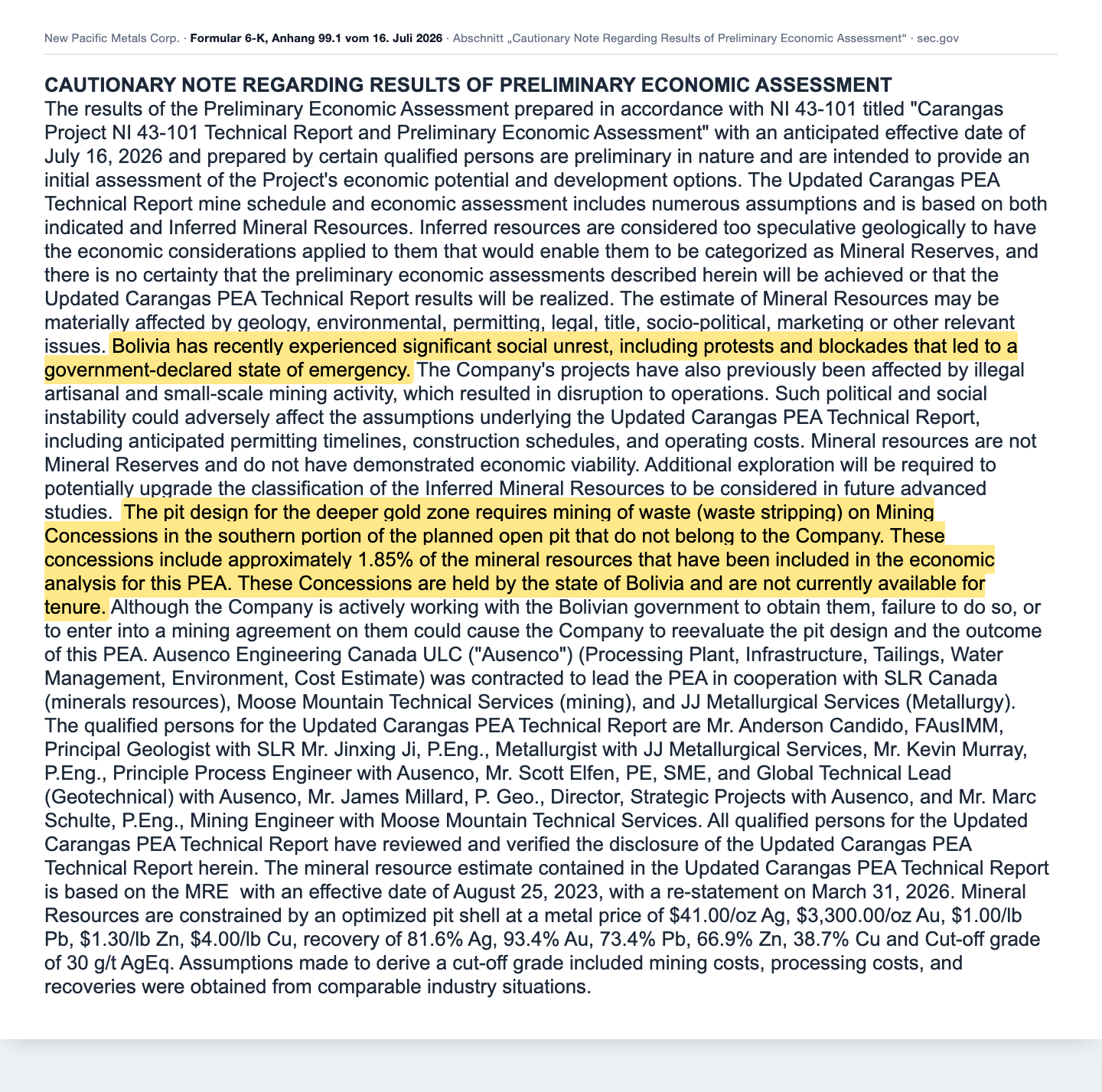
1.85 percent sounds harmless. But the issue is geometry, not tonnage: without that southern strip the waste above the gold zone cannot be stripped as planned — and the gold zone delivers roughly 142,700 ounces of gold a year in years 9 through 16. The company itself writes that it would otherwise have to re-evaluate the pit design and the outcome of the study. Translated: a sixteenth of the schedule hangs on a concession the state is not currently handing out.
Uncomfortable truth no. 2: the flagship lost its environmental permit — and has been waiting on a parliament since 2019
Silver Sand is the more advanced of the two projects: it has a valid mining contract for the main block, a pre-feasibility study and even declared reserves — 52.01 million tonnes at 105 grams of silver per tonne, or 175.42 million ounces, calculated at $23.00 per ounce. Which is exactly why the permitting status stings here. In May 2023 the project received its environmental categorization as a proposed open-pit operation — the formal starting gun for the environmental impact study itself. The MD&A as of March 31, 2026 says what became of it:
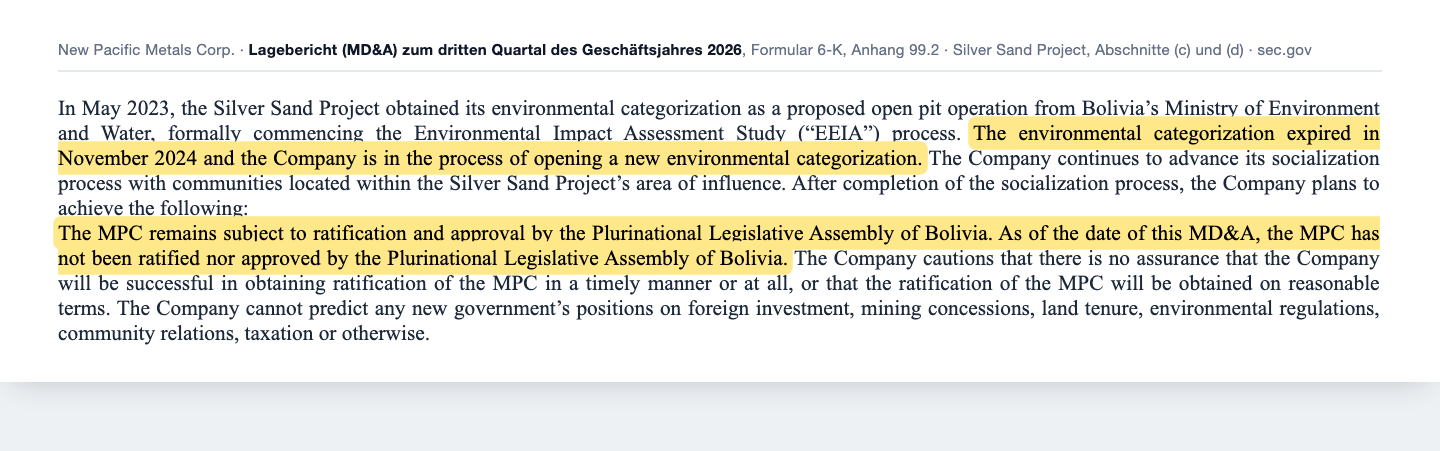
"The environmental categorization expired in November 2024 and the Company is in the process of opening a new environmental categorization."
— New Pacific Metals Corp., interim MD&A for the third quarter of fiscal 2026, Silver Sand Project, section (c) "Permitting" (6-K exhibit 99.2)
The second open door at Silver Sand is a contract. On January 11, 2019 subsidiary Minera Alcira signed a mining production contract with COMIBOL, Bolivia’s state mining corporation, securing rights over ground immediately adjoining Silver Sand that holds roughly 10 percent of the resources in the pre-feasibility study. An update followed on January 19, 2022; since October 2023 the company has been working on ratification. The filing puts it tersely:
"The MPC remains subject to ratification and approval by the Plurinational Legislative Assembly of Bolivia. As of the date of this MD&A, the MPC has not been ratified nor approved by the Plurinational Legislative Assembly of Bolivia."
— New Pacific Metals Corp., interim MD&A for the third quarter of fiscal 2026, Silver Sand Project, section (d) "Mining Production Contract" (6-K exhibit 99.2)
Seven years after signature. There is a third front, apparently settled now, that shows what you are dealing with here: between 2023 and June 2025 illegal artisanal miners worked on the Silver Sand ground. New Pacific went to court in December 2023, obtained an enforcement order from mining authority AJAM on May 7, 2024, and on June 25, 2025 won an amparo — a constitutional protection order — from the Departmental Court of Justice of La Paz. The miners withdrew as of July 1, 2025; preliminary survey work indicated the material extracted was not material. Two years of blockade for a piece of paper — that is the scale on which Bolivian processes run here.
Uncomfortable truth no. 3: nine months, $589 on drilling
An explorer lives by drilling. New rock, better grades, higher confidence categories — that is the currency. The schedule of capitalized project costs in the interim report as of March 31, 2026 has a line for exactly that: "drilling and assaying." For the first nine months of fiscal 2026 it reads $0 for Silver Sand, $0 for Carangas and $589 for Silverstrike. Across the group, $589 in nine months. For all of fiscal 2025 it was $12,230.
The $2.6 million of capitalized project costs went instead into "project management and support" ($1,832,549), camp services ($743,127), reporting and assessment ($168,629) and license fees. That is the honest explanation for something you would otherwise miss: the Carangas resource estimate underpinning the $2.65 billion calculation carries an effective date of March 31, 2026 — but rests, as the footnote to the table states, on drilling results up to June 1, 2023. It is the same data set as three years ago, re-estimated.
That is meant to change. After the prior consultation completed on July 6, 2026, the company plans a 30,000-metre drill programme at Carangas from September 2026, of which roughly 25,000 metres are aimed at converting inferred resources into indicated. It is exactly the right step — and it costs money that will lift the recent burn rate of a little over $7 million a year sharply. Remember this: the low burn rate at this company is not a sign of discipline, it is a sign of standstill. The moment work resumes, it rises.
Uncomfortable truth no. 4: $644.5 million to build, $39.9 million in the bank
Now the sum that everything turns on. Between them the two studies name initial capital of $1,002.5 million — $358 million for Silver Sand, $644.5 million for Carangas. Over the life of Carangas another $422.7 million of expansion capital and $166.5 million of sustaining capital follow, plus $149.8 million of closure costs. Cash as of March 31, 2026 was $39.9 million. We put the figures side by side:
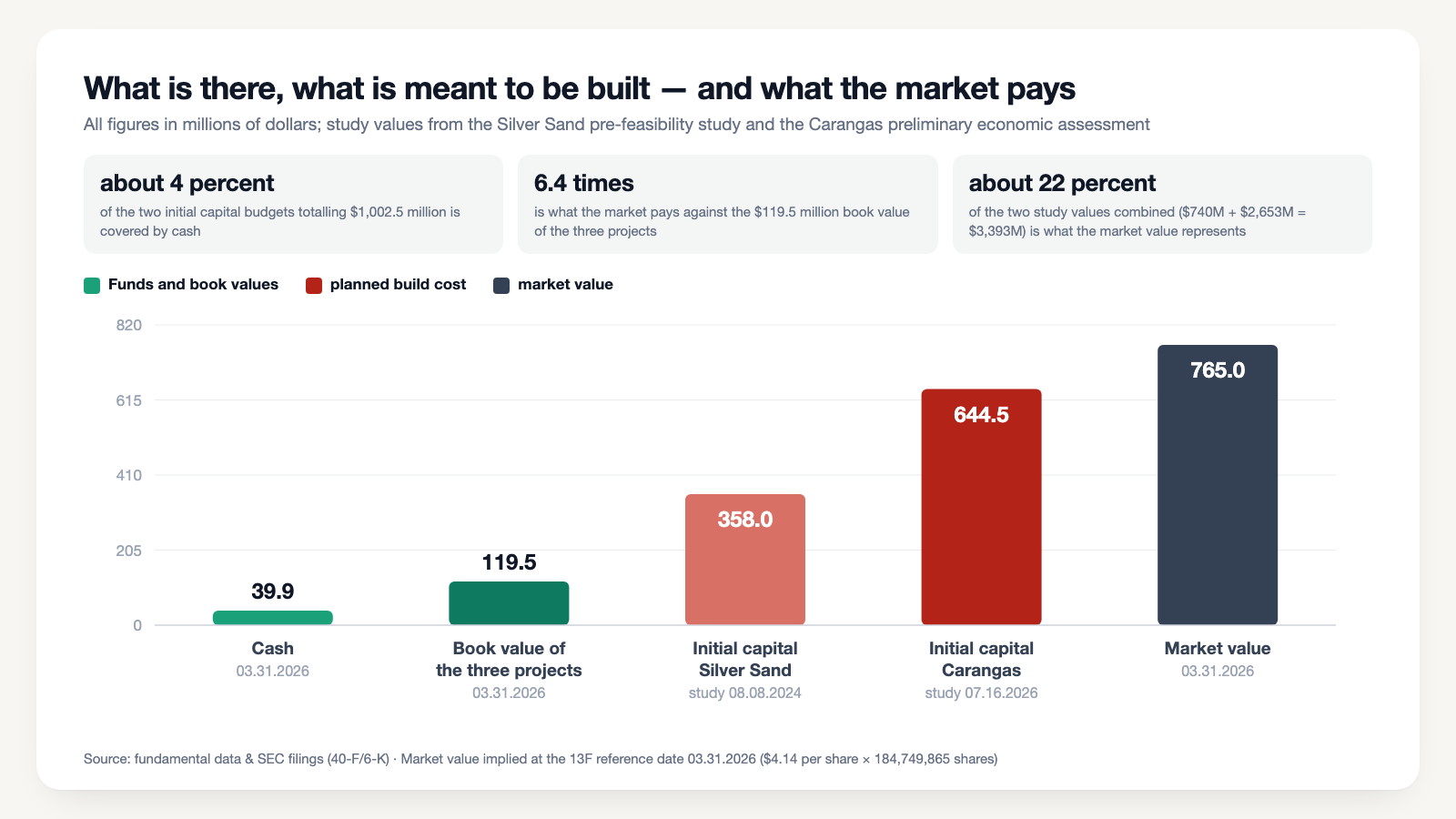
Cash covers about 4 percent of what the company’s own studies list as initial capital. And because there is no revenue, only three routes close that gap: new shares, a partner buying into a project, or a sale of the company. All three are legitimate, and all three cost today’s shareholder a share. Buy New Pacific and you are betting that this dilution comes in cheaper than the value added by permits and drilling.
What the company says about it is carefully worded: it believes it has "sufficient funds to support its normal permitting and operating requirements for at least, but not limited to, the next twelve months." That is true — and it is a statement about operating, not about building.
Uncomfortable truth no. 5: where the money from the last raise but one actually went
Canadian issuers must disclose what they did with money they raised. That table is the most revealing page in the entire interim report. The financing of September 29, 2023 brought in $24,446,086 net. Of that, $15,532,000 was earmarked for Silver Sand — including $11,908,000 for permitting and preliminary mine development — and $4,660,000 for Carangas, of which $2,071,000 for drilling.
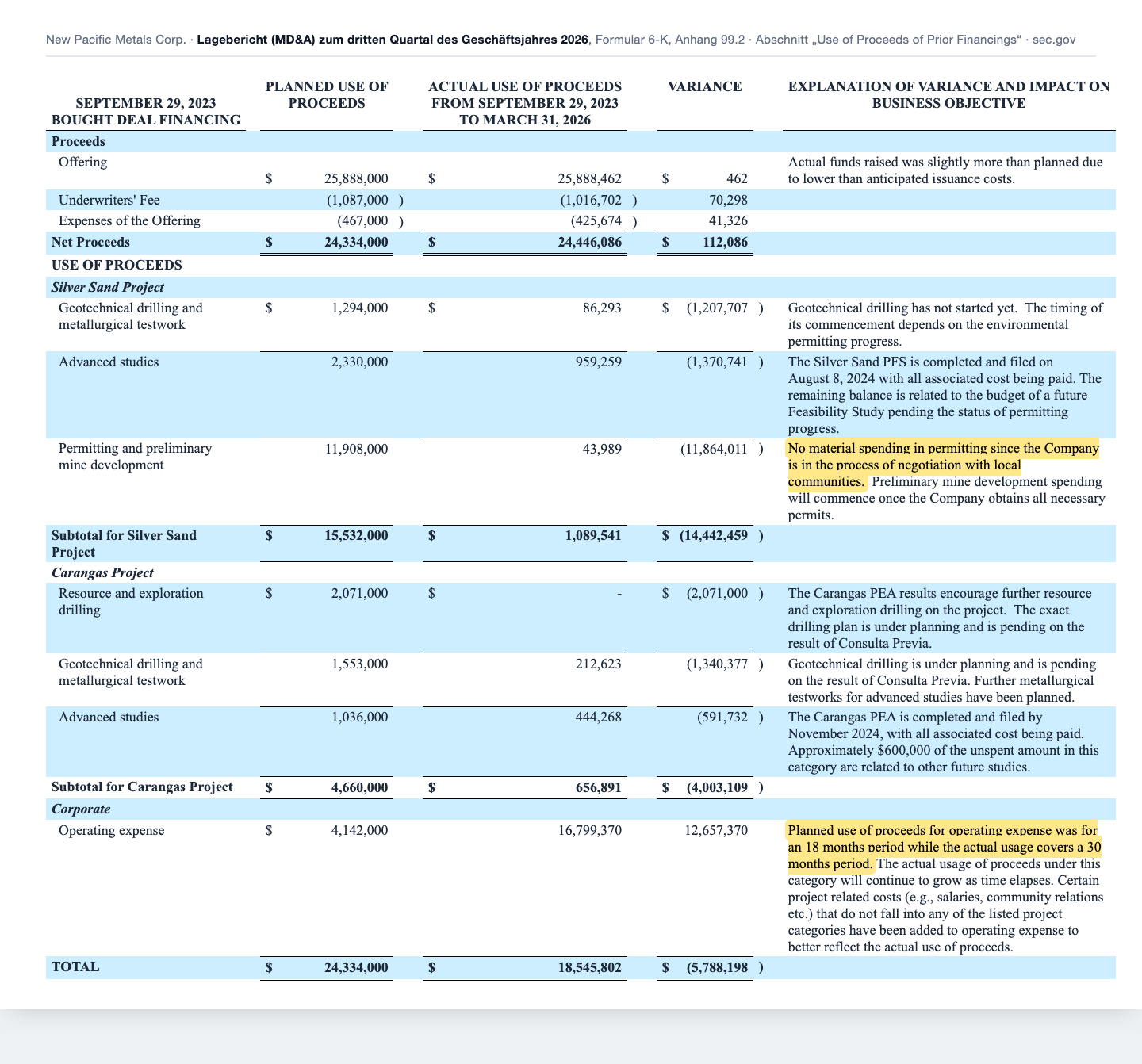
Actually spent through March 31, 2026: $1,089,541 on Silver Sand (of which $43,989 on permitting), $656,891 on Carangas (of which zero on drilling) — and $16,799,370 on "operating expense" against a plan of $4,142,000. Of the $18,545,802 used at all, roughly 91 percent went into running the company.
Fairness requires two explanations, and the company gives both. First, the original plan covered 18 months while actual use now spans 30 — that line grows with time alone. Second, project-adjacent costs such as salaries and community work were assigned there because they fit no project category. Both are plausible. And the number still stands, and you should read it once: more of the raise but one has flowed into the head office than into both projects combined. The $28.8 million from the October 2025 round was still entirely untouched at the reporting date.
Who owns this company — and why that matters more than usual here
At a company with no revenue the shareholder register is not a footnote; it is a statement about the ability to finance. Three addresses have reported their stakes to the SEC. Silvercorp Metals Inc., a producing silver miner with operations in China, holds 51,426,988 shares, or 28.0 percent (as of December 31, 2025). Pan American Silver Corp, one of the world’s largest silver producers, holds 21,071,264 shares, or 11.5 percent (as of October 21, 2025). And London’s Helikon Investments holds 18,438,377 shares, or 9.96 percent (as of June 30, 2026). Together, roughly 49 percent.
For you that cuts two ways. On the positive side: two experienced silver producers have looked at these deposits and stayed invested — a form of due diligence no private investor can replicate. How close the Silvercorp connection runs is in the notes to the annual report: the two companies share an office in Vancouver, share a director in Paul Simpson, and Silvercorp billed New Pacific $801,406 for general administrative services in fiscal 2025. If you want to see this stake from the other side, our Silvercorp Metals analysis has it: there the New Pacific holding sits at $53.5 million of book value and was worth $212.9 million in the market on March 31, 2026.
On the negative side: the free float is thin and the ties are close. A shared director, a shared office and a services agreement are not an accusation — they are common among Canadian explorers and are properly disclosed. But they mean that the interests of a 28 percent holder and those of the free float are not automatically the same, for instance when the price of an equity raise or a takeover is on the table.
Valuation: what the market pays for a blueprint
For an evergreen anchor we need a dated reference instead of a daily price — and the form from the opening supplies it. From $41,135,798 for 9,936,183 shares comes an implied price of $4.14 per share as of March 31, 2026. Against the 184,749,865 shares outstanding on the same date, that is a market value in the order of $765 million. The cross-check holds: Silvercorp puts the market value of its 27.84 percent stake on the same date at $212.9 million, which grosses up to the same $765 million. Subtract the $39.9 million of cash and you get an enterprise value of roughly $725 million.
Compared with what? There is no price/earnings ratio, because there are no earnings, and no price/sales ratio, because there is no revenue. That is not a data gap; that is the nature of the thing. Three yardsticks remain. First, the book value of the projects: $119.5 million, of which $92.2 million for Silver Sand, $22.2 million for Carangas and $5.0 million for Silverstrike. The market pays roughly 6.4 times what has been put in. Second, the study values: $740 million for Silver Sand plus $2,653 million for Carangas make $3,393 million; the market value is about 22 percent of that. Third, the ounces in the ground: add Silver Sand’s 201.77 million ounces of silver to Carangas’ 529.6 million ounces of silver equivalent and the market is paying roughly one dollar per ounce of silver equivalent still underground.
A discount of about 78 percent to the study value sounds enormous — but it is normal for development projects and well earned here: the studies assume that permits arrive, that a billion dollars of construction capital is found and that the silver price assumptions hold. Each of those has a price, and that is precisely what the market deducts. What a mining company looks like once those hurdles are cleared is in our Allied Gold analysis; how modestly even a small producing miner is valued we wrote up at TRX Gold. All valuation figures: data as of July 24, 2026; analyses are evergreen, daily prices are not a buy argument.
Opportunities and risks at a glance
What speaks for New Pacific:
- Two unusually large deposits in one hand: Silver Sand with 201.77 million ounces of silver in the measured and indicated categories (116 g/t) and declared reserves of 175.42 million ounces; Carangas with 529.6 million ounces of silver equivalent in the indicated category, containing 213.4 million ounces of silver and 2.2 million ounces of gold.
- Studies that work on paper: per the July 16, 2026 assessment Carangas shows a post-tax net present value of $2.65 billion and a 35.9 percent return with payback of initial capital in 2.4 years; Silver Sand shows $740 million at 37 percent. Even at $22.50 silver, Carangas still shows $973 million.
- A balance sheet without debt: $160.8 million of total assets against $1.06 million of liabilities as of March 31, 2026, an equity ratio of 99.3 percent, $39.9 million of cash and $39.3 million of working capital. No lender can put this company under pressure.
- Support in the register: two producing silver companies hold 39.5 percent between them (Silvercorp 28.0, Pan American Silver 11.5), and a London fund went from zero to 9.96 percent within a year.
- Visible progress on the soft factors: a framework community agreement at Carangas in February 2026, a favourable community assembly vote in August 2025, prior consultation completed on July 6, 2026, and the withdrawal of illegal artisanal miners from Silver Sand since July 1, 2025 after a court protection order.
What speaks against it:
- No revenue, no profit, no runway for construction: revenue was zero in all eight quarters through March 31, 2026, and the $39.9 million of cash covers about 4 percent of the $1,002.5 million of initial capital the two studies call for.
- Permits are the bottleneck: Silver Sand’s environmental categorization expired in November 2024; the contract with state-owned COMIBOL has been unratified since 2019 and covers roughly 10 percent of the resources in the Silver Sand study; the Carangas exploration licenses have not yet been converted into mining contracts; the environmental study there is only expected to be completed by the end of 2027.
- Country risk in concrete form: foreign entities may not own property within 50 kilometres of the border — Carangas and Silverstrike sit there and are held through Bolivian partner companies. The study itself cites significant social unrest, blockades and a government-declared state of emergency, plus earlier disruption from illegal artisanal mining.
- Part of the study value comes from the price deck and from uncertain rock: the five-fold rise in the Carangas value since September 2024 rests partly on lifting the silver assumption from $24.00 to $45.00 per ounce, and the calculation expressly includes inferred resources that the rulebook calls too speculative for reserves.
- Dilution is the funding model: the share count rose from 154,451,263 (June 30, 2021) to 184,749,865 (March 31, 2026), most recently by 11,385,000 shares at $2.53 on October 21, 2025. Of the funds used from the 2023 round, roughly 91 percent went into running the company.
- Thin disclosure: as a Canadian issuer New Pacific files no 10-K and no 10-Q; interim numbers are unaudited 6-K exhibits, and the annual report only arrives in September.
A human conclusion
Back to the blueprint trap from the opening. Its core is not that the rendering is fake — quite the opposite: Ausenco, SLR and Moose Mountain are serious firms, the arithmetic is clean and the assumptions sit openly beside it. Its core is that a rendering answers a different question from the one you are actually asking. The rendering answers: what would this mine be worth if it stood? Your question is: what is this company worth as it stands today? And today it is a business with 36 employees, $39.9 million in the bank, no revenue at all, two very good deposits, three open administrative files in La Paz and a capital requirement fifteen times its cash.
So the honest question is not "is Carangas worth $2.65 billion?" but this: are you willing to wait several years for permits, years in which nothing is mined, in which your slice shrinks with every financing round and in which a Bolivian agency or a parliament sets the schedule — in exchange for a deposit that almost nobody could replicate if it works? If yes, you have a thesis, and you should count it in years, not quarters. If no, you have at least understood why a net present value of $2.65 billion and a market value of $765 million are not a contradiction but the same sentence in two languages. The London fund that went from zero to 9.96 percent in twelve months knew all of this or accepted it — its forms say only that it bought, not why and not whether it is still there. What you make of it is your decision. And that is exactly as it should be.
Sources
Every original document used in this analysis — to read for yourself:
- New Pacific Metals Corp. — SEC annual report on Form 40-F for fiscal 2025 (filed September 15, 2025, accession 0001104659-25-090086)
- New Pacific Metals Corp. — Annual Information Form as of June 30, 2025 (40-F exhibit 99.1) with project descriptions, reserves and risk factors
- New Pacific Metals Corp. — Management's Discussion and Analysis for fiscal 2025 (40-F exhibit 99.2)
- New Pacific Metals Corp. — Audited consolidated financial statements as of June 30, 2025 and 2024 (40-F exhibit 99.3)
- New Pacific Metals Corp. — Unaudited condensed consolidated interim financial statements as of March 31, 2026 (6-K exhibit 99.1, furnished May 14, 2026)
- New Pacific Metals Corp. — Interim Management's Discussion and Analysis for the third quarter of fiscal 2026 (6-K exhibit 99.2)
- New Pacific Metals Corp. — News release on the updated Carangas preliminary economic assessment, July 16, 2026 (6-K exhibit 99.1)
- Helikon Investments Ltd — Form 13F-HR as of March 31, 2026 (filed May 8, 2026, accession 0001839497-26-000002)
- Helikon Investments Ltd — Schedule 13G/A on New Pacific Metals, event date June 30, 2026 (filed July 9, 2026)
- Silvercorp Metals Inc. — Schedule 13G/A on New Pacific Metals, event date December 31, 2025 (filed February 12, 2026)
- Pan American Silver Corp — Schedule 13G/A on New Pacific Metals, event date October 21, 2025 (filed January 6, 2026)
- Complete SEC filing history of New Pacific Metals Corp.: EDGAR overview (sec.gov)
- Fundamental data (metrics; data as of July 24, 2026), reconciled with the SEC filings and the SEC XBRL series (CIK 1369085).
Transparency & disclaimer: This analysis is a journalistic contextualization of publicly available information and is not investment advice, not a financial analysis in the regulatory sense and not a solicitation to buy or sell securities. Equity investments carry substantial risks up to and including total loss. All information without warranty; the data cut-off is noted in the text. The author holds no position in New Pacific Metals shares at the time of publication.
Our Bottom Line at a Glance
- Deposits positive
- Two very large silver deposits in one hand: Silver Sand carries 201.77 million ounces of silver in the measured and indicated categories at 116 grams per tonne and already declares reserves of 175.42 million ounces. Carangas reaches 529.6 million ounces of silver equivalent in the indicated category, containing 213.4 million ounces of silver and 2.2 million ounces of gold. Both deposits are flat-lying and open-pittable — at Carangas with a strip ratio of 1.4 to 1.
- Balance sheet positive
- As of March 31, 2026, $160.8 million of total assets faced just $1.06 million of liabilities; equity was $159.7 million and the equity ratio 99.3 percent. Cash stood at $39.9 million with working capital of $39.3 million. There is no bank debt, no bond and no convertible — no lender can put this company under pressure. The Altman Z-Score of 559.51 is arithmetically correct and worthless as proof of creditworthiness for exactly that reason: it arises only because there are almost no liabilities.
- Permits & country risk negative
- Silver Sand’s environmental categorization expired in November 2024 and a new one is being opened. The 2019 contract with state mining company COMIBOL has still not been ratified by Bolivia’s parliament and covers roughly 10 percent of the resources in the Silver Sand study. The Carangas exploration licenses have not yet been converted into mining contracts, and roughly 1.85 percent of the resources in the economic model sit on concessions held by the state of Bolivia that are not currently on offer. The study itself cites significant social unrest, blockades and a declared state of emergency.
- Funding & dilution negative
- The two studies together call for $1,002.5 million of initial capital; cash covers about 4 percent of that. With no revenue, only new shares, a project partner or a sale of the company can close the gap. The share count rose from 154,451,263 on June 30, 2021 to 184,749,865 on March 31, 2026, most recently by 11,385,000 shares at $2.53 on October 21, 2025. Of the $18,545,802 used from the 2023 raise, roughly 91 percent went into running the company.
- Project progress & disclosure neutral
- The soft factors are moving: a framework community agreement at Carangas in February 2026, prior consultation completed on July 6, 2026, and the withdrawal of illegal artisanal miners from Silver Sand since July 1, 2025. Drilling, by contrast, has all but stopped — $589 was capitalized group-wide for drilling and assaying in the first nine months of fiscal 2026, and the Carangas resource estimate rests on drilling results up to June 1, 2023. A 30,000-metre programme is due to start in September 2026. As a Canadian issuer, New Pacific files no 10-K and no 10-Q.
New Pacific Metals is the blueprint trap in pure form: the updated Carangas assessment of July 16, 2026 shows a post-tax net present value of $2.65 billion and a 35.9 percent return — and the same list names $644.5 million of initial capital, against $39.9 million of cash on March 31, 2026. Add Silver Sand and initial capital comes to $1,002.5 million; cash covers about 4 percent of it. Meanwhile the flagship’s environmental categorization has been expired since November 2024, the contract with the state miner has been unratified since 2019, and $589 was capitalized group-wide for drilling in nine months. Against that stand two exceptional deposits, a debt-free balance sheet and two silver producers on the register. Not investment advice.
What Our Rating Means
Open questions
The business works in principle, but one material question is open. As long as it stays open, our findings do not carry a quality verdict.
Buy today and you are not buying a business, you are buying a permitting bet with a financing requirement. The deposits are real and rare, the balance sheet carries no debt, and in Silvercorp Metals and Pan American Silver two experienced producers hold 39.5 percent between them. But between today’s company and the mine in the study sit three Bolivian administrative processes, a capital requirement fifteen times the cash balance, and several years without a single dollar of revenue. If you wait, watch exactly three things in the next filings: are the Carangas exploration licenses actually converted into mining contracts within the six months the company has indicated? Does the 30,000-metre programme start in September 2026 as announced? And at what price does the next equity raise come, after the last one was done at $2.53 a share? The decision is yours.
A journalistic assessment by our editorial team at the time of the deep dive, based on public sources — not investment advice and not a solicitation to buy or sell. Your personal circumstances (investment goals, risk capacity, taxes) cannot be taken into account. What our levels mean, how verdicts are formed, and what conflicts of interest exist →
Worth Noting
- New Pacific Metals reached our research list not through a scanner hit but through the Form 13F-HR of Helikon Investments Ltd (London) as of March 31, 2026: 9,936,183 shares worth $41,135,798, after 2,293,539 shares as of December 31, 2025 and zero as of September 30, 2025 — a gain of 333 percent in one quarter and the strongest build in the entire portfolio. A later ownership filing already reports 18,438,377 shares, or 9.96 percent, as of June 30, 2026. A 13F shows only U.S.-listed long positions with a 35- to 45-day lag, without shorts and derivatives — a rear-view mirror, not a road map.
- The scanner metrics on this stock are deliberately not to be read as a quality verdict. The Piotroski F-Score of 2 of 9 measures changes in profitability and efficiency — at a company with no revenue and no profit it cannot come out high. The Altman Z-Score of 559.51 arises only because $160.8 million of total assets face just $1.06 million of liabilities. A price/earnings ratio and an interest coverage ratio cannot be formed, because neither earnings nor interest expense exist (data as of July 24, 2026).
- New Pacific is a Canadian issuer under the multijurisdictional disclosure system with the United States: there is no 10-K and no 10-Q. Audited figures appear once a year in the Form 40-F (filed September 15, 2025 for fiscal 2025); interim figures are furnished only as unaudited exhibits to a Form 6-K. Accounting is IFRS, reporting is in U.S. dollars. The fiscal year ends June 30, which is why every annual and quarterly figure here is named with its fiscal year.
Stock Watch
This analysis is as of July 24, 2026. Stock Watch will tell you what's changed at NEWP since then.
Later $1 a month per stock — signing up is free, and you'll be the first to know when it launches.
Frequently Asked Questions
New Pacific Metals Corp. (NYSE American: NEWP, TSX: NUAG, headquartered in Vancouver) is an exploration and development company with no production and no revenue. It holds three projects in Bolivia: the Silver Sand silver project in the Potosí department, the Carangas silver-gold project in the Oruro department and the early-stage Silverstrike project southwest of La Paz. As of June 30, 2025 the company had 36 employees.
It calculates a post-tax net present value of $2.65 billion at a 5 percent discount rate and an internal rate of return of 35.9 percent — assuming $45.00 per ounce of silver and $3,400 per ounce of gold. The plan runs 19 operating years plus two years of construction and produces 339.0 million ounces of silver equivalent. Initial capital is $644.5 million. It is a preliminary assessment that expressly includes inferred resources. The predecessor study of September 5, 2024 showed $501 million — it assumed $24.00 per ounce; at $22.50 the new study shows $973 million.
As of March 31, 2026 cash stood at $39,863,639 against $1,060,053 of liabilities, with working capital of $39,275,196. In the first nine months of fiscal 2026, $2.9 million flowed out of operations and $2.6 million into the projects. At that pace the treasury lasts several years — but against the $1,002.5 million of initial capital named in the two studies it covers roughly 4 percent.
At Silver Sand the environmental categorization expired in November 2024 and a new one is being opened. The mining production contract signed with state mining company COMIBOL in 2019 has still not been ratified by the Plurinational Legislative Assembly — its ground holds roughly 10 percent of the resources in the Silver Sand study. At Carangas the exploration licenses must first be converted into mining contracts; the environmental impact study is expected to be completed by the end of 2027.
Because Carangas lies within 50 kilometres of the border with Chile. In that so-called Frontier Area, Bolivia does not permit foreign entities to own property. The three exploration licenses are therefore held by a Bolivian company in which New Pacific has a 98 percent interest through a mining association agreement, funding 100 percent of the spending. In July 2025 the Oruro department created a route by which direct foreign ownership becomes possible once a project is declared a "state of necessity" and parliament approves.
Because New Pacific is a Canadian company using the multijurisdictional disclosure system between Canada and the United States. The annual report appears as Form 40-F (filed September 15, 2025 for fiscal 2025) and contains the Canadian original documents. Interim figures are furnished only as an unaudited exhibit to a Form 6-K. Accounting is IFRS, reporting is in U.S. dollars, and the fiscal year ends June 30.
Three holders have reported stakes to the SEC: Silvercorp Metals Inc. with 51,426,988 shares or 28.0 percent (as of December 31, 2025), Pan American Silver Corp with 21,071,264 shares or 11.5 percent (as of October 21, 2025) and Helikon Investments Ltd of London with 18,438,377 shares or 9.96 percent (as of June 30, 2026). Together that is roughly 49 percent. Silvercorp shares an office in Vancouver and one director with New Pacific.
A 13F is the quarterly disclosure required of large U.S. asset managers. Helikon Investments Ltd of London reported 9,936,183 shares worth $41,135,798 as of March 31, 2026, after 2,293,539 shares as of December 31, 2025 and zero as of September 30, 2025 — the strongest build in the whole portfolio. A later ownership filing already reports 18,438,377 shares as of June 30, 2026. A 13F shows only U.S.-listed long positions with a 35- to 45-day lag, without shorts or derivatives: a rear-view mirror, not a road map.
Found an error?
Did you spot a factual error, an outdated number, or a typo in this deep dive? Let us know briefly — your report goes straight to the editorial team.