Western Union: The Network of 360,000 Counters Is Shrinking — the Dividend Is Not
A price-to-earnings ratio around 5 and a double-digit dividend yield make Western Union look like a bargain hunter's dream. The filings with the U.S. securities regulator, the SEC, explain why: money-transfer revenue fell from $4,005.0 million (2023) to $3,507.4 million (2025), and in every one of those years the payout to shareholders exceeded free cash flow — in 2025 it was covered only 72 percent. On July 30, 2026, the company cut its own guidance for adjusted earnings per share from $1.75 to $1.85 down to $1.25 to $1.35. Not investment advice — just the question of how long one till can serve two masters.
 Thomas Mücke
Founder & Publisher
Thomas Mücke
Founder & Publisher
Chart
Interactive price chart (TradingView).
Note: pure fact-based analysis, not investment advice and not a solicitation to buy or sell. All figures without guarantee.
There is an investor trap that feels like a reward for being sensible: the dividend trap. It works like this. You see a stock with a double-digit payout yield, you see a company your grandmother could name, and within seconds your head has done the math: "Twelve percent a year, and even if the share price goes nowhere, I have my money back in eight years." What your head quietly assumes is that the dividend stays. That is the assumption nobody checks. The Western Union Company (NYSE: WU) is a textbook case. So let us make a deal: we park the yield math for a moment and read together what the company itself filed with the U.S. securities regulator, the SEC — the annual report (10-K) for 2025, the quarterly report (10-Q) as of June 30, 2026, and the earnings release of July 30, 2026. An SEC filing is honest under penalty of law. What you make of it is your call.
The central tension of this analysis sits in the first two rows of numbers, and it runs through every chapter: Western Union earns real money every year — but the core business has been shrinking for years, and in each of the last three years the payout to shareholders was larger than what the business left over after investment.
What Western Union actually does — one counter, 200 countries, two businesses
Western Union moves money across borders. That sounds mundane, but it is a remarkably physical business: someone walks into a shop, puts cash on the counter, and minutes later someone else picks that money up at another counter in another country. The annual report (10-K) for 2025 sizes the network: agent locations in more than 200 countries and territories, payout in nearly 130 currencies, and roughly 360,000 locations that actually processed money-transfer activity in the twelve months to December 31, 2025. About 90 percent of those locations sit outside the United States. Headcount as of December 31, 2025 was roughly 9,600 people, about 1,600 of them in the United States, spread across more than 50 countries.
The company reports in two segments. Consumer Money Transfer (CMT) is the core — classic person-to-person remittance, which the 10-K puts at roughly 87 percent of consolidated revenue in 2025. That includes Branded Digital: transfers initiated on the company's own websites and apps or through partner apps. The second segment, Consumer Services, is the shop next door: bill payments in Argentina and the United States, money orders, travel money and foreign exchange, prepaid cards, a media network and digital wallets — roughly 13 percent of revenue.
Since November 2025 the company has run a digital strategy called "Beyond," which gets its own paragraph in the annual report: digital wallets, consumer financial services and a digital asset network backed by a proprietary U.S. dollar stablecoin. On October 28, 2025, Western Union announced the U.S. Dollar Payment Token (USDPT) — to be issued on the Solana blockchain by Anchorage Digital Bank, expected in the first half of 2026 according to the annual report. Sounds like the future? Partly it is. Only the future does not pay bills yet: whether the issuance actually happened within that window is recorded in no filing to date — neither the quarterly report as of June 30, 2026, nor any current report since. Nor does any filing so far disclose revenue from the stablecoin. If you want to see what a company looks like that walked this road digitally from day one, the counter-example is our Remitly analysis — there the first profitable year has only just arrived, but the business is growing.
How the stock landed on our desk — through the calendar, not the scanner
Western Union did not reach our research list through our in-house stock scanner but through the SEC filing calendar. On July 30, 2026, two documents arrived on the same day: the quarterly report (10-Q) as of June 30, 2026, and the earnings release filed as Exhibit 99.1 to a current report (8-K). The company guidance lives in that exhibit — and it looked different from three months earlier.
The headline metrics at that point spoke clearly: a price-to-earnings ratio in the region of 5, a price-to-sales ratio around 0.5, a dividend yield in double digits (data as of August 1, 2026). Numbers like that show up for only two reasons: either you have found a genuine bargain, or the market knows something you do not. A P/E of 5 is not a valuation, it is a question. And that question can only be answered with the original documents. So we opened them.
The numbers over the years — honestly appraised
First what genuinely speaks for Western Union, and there is more of it than the share price suggests. This company is profitable, and clearly so. In 2025 it posted revenue of $4,050.7 million, operating income of $757.3 million — an operating margin of roughly 18.7 percent — and net income of $499.6 million, or $1.52 per diluted share. Operating activities produced $543.7 million of cash in 2025. For context: the entire market capitalization stood in the region of two billion dollars in early August 2026. A company that earns better than a quarter of its market value in operating income in a single year is not a workout case.
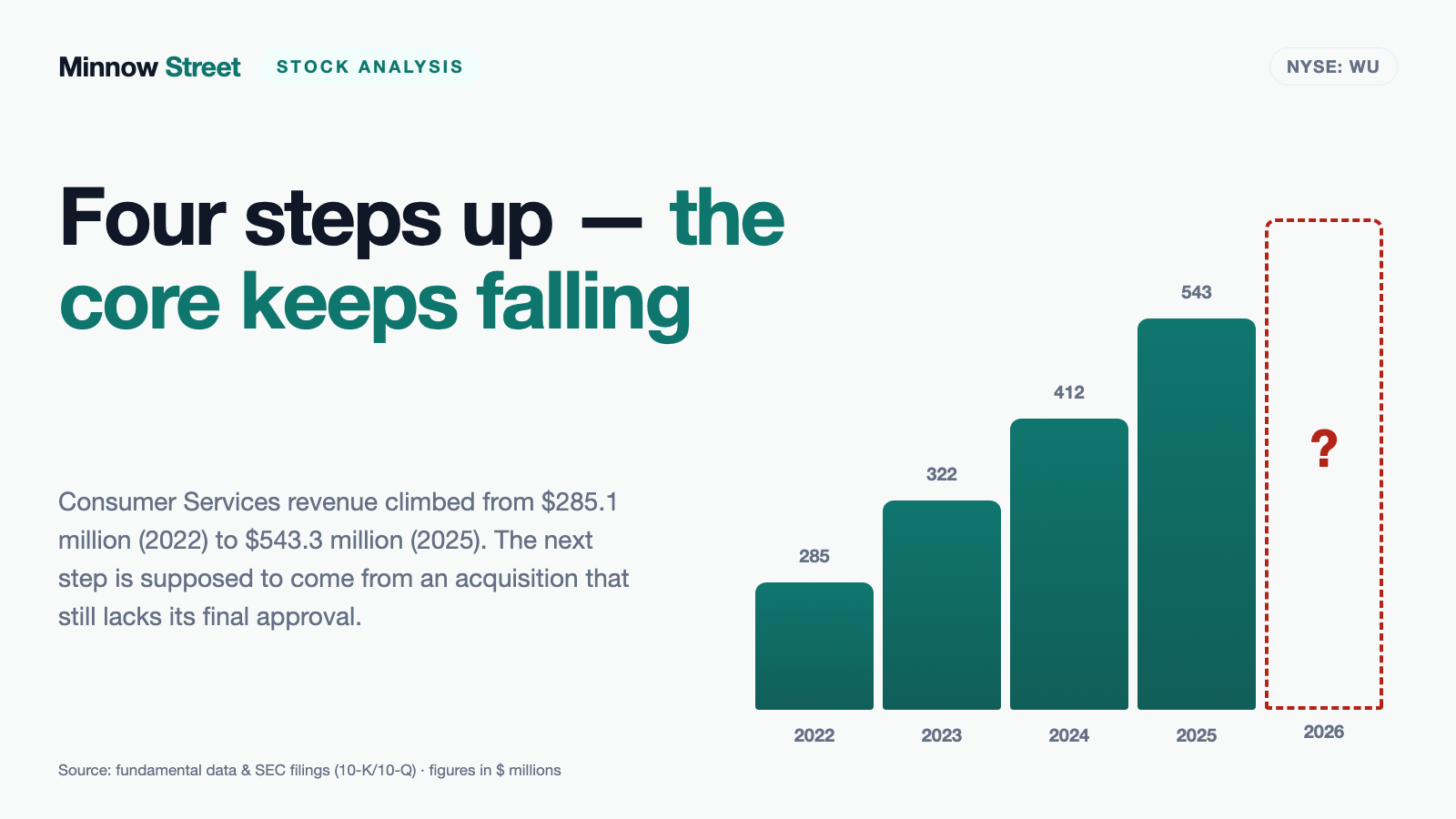
The network itself is an asset no balance sheet shows. The annual report notes that the 40 largest agents and partners have been with the company for more than 20 years on average. And one part of the group is growing fast: Consumer Services revenue rose from $285.1 million (2022) through $322.3 million (2023) and $411.7 million (2024) to $543.3 million (2025) — close to a doubling in three years, carried by travel money (including the acquired Eurochange Limited) and cash bill payments at Argentine retail counters.
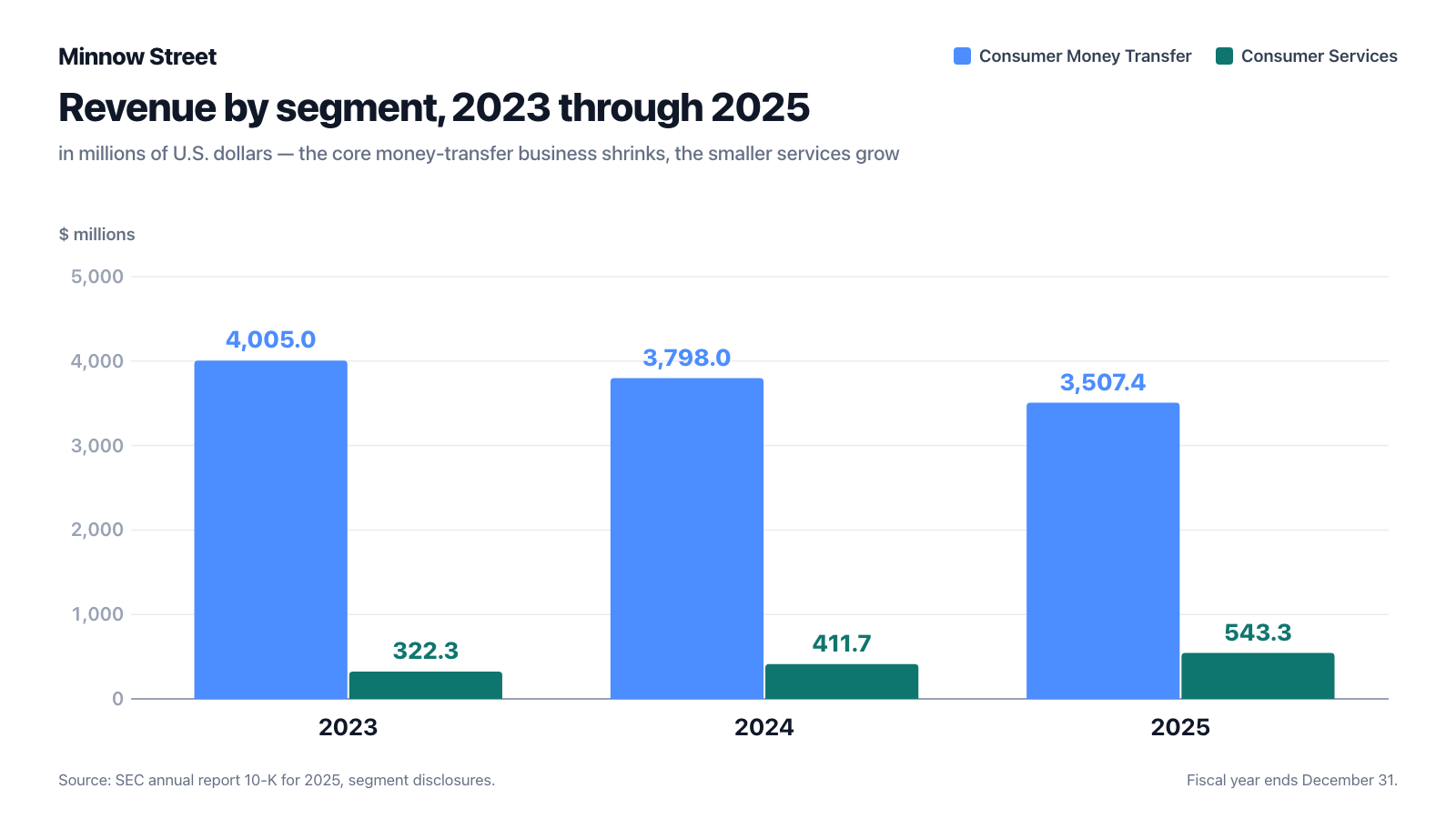
Which brings us to the problem. The core is shrinking — not dramatically in any one year, but reliably in every one. Consumer Money Transfer revenue fell from $4,005.0 million (2023) through $3,798.0 million (2024) to $3,507.4 million (2025): down 12.4 percent in two years. Consolidated revenue went from $4,357.0 million (2023) through $4,209.7 million (2024) to $4,050.7 million (2025); the 2023 figure still contains $29.7 million from the business-to-business unit sold on July 1, 2023. In the first half of 2026 revenue came to $1,995.9 million, roughly one percent below the prior-year period. Remember the image: the small business grows fast, the large one shrinks slowly — and the large one is more than six times the size.
What the filings say — the uncomfortable truths
Uncomfortable truth no. 1: more was paid out than the business left over
This is the heart of the dividend trap in this name. Let us do the arithmetic a merchant would do: how much cash actually remains after investment, and how much goes to shareholders? Free cash flow — operating cash flow less spending on software, contract costs and property and equipment — was $635.3 million (2023), $275.7 million (2024) and $392.9 million (2025). Over the same years the company paid out $657.4 million, $507.7 million and $543.6 million in dividends and share buybacks. In every single year more went out than came in: in 2025 free cash flow covered just 72 percent of the payout.
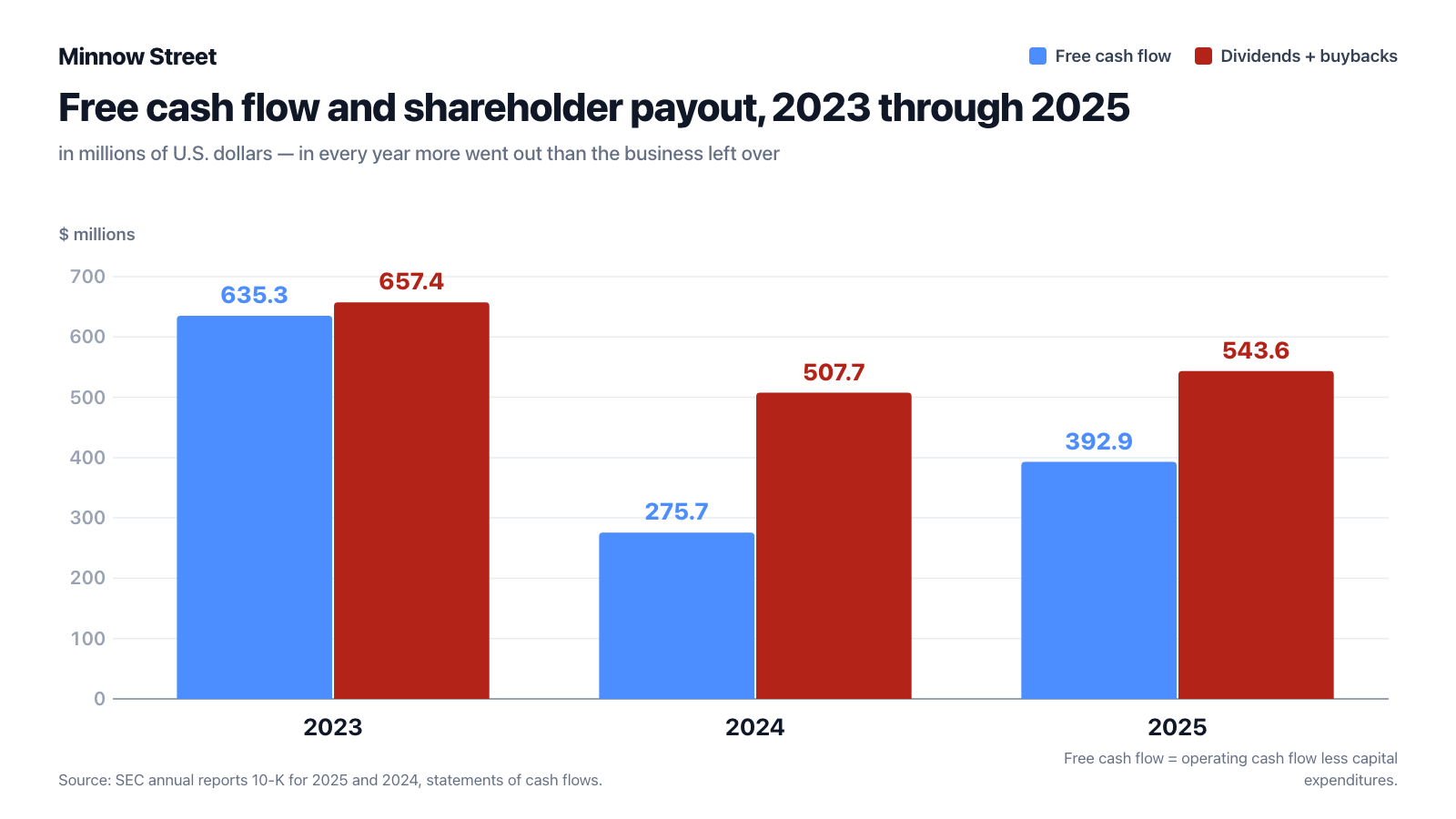
In the first half of 2026 the pattern continued, only more sharply. The quarterly report states the numbers itself:
"During the six months ended June 30, 2026 and 2025, 5.7 million and 14.8 million shares were repurchased under this authorization for $53.7 million and $149.7 million, respectively, excluding commissions, at an average cost of $9.35 and $10.08, respectively."
— The Western Union Company, SEC quarterly report 10-Q as of June 30, 2026, Item 2 MD&A, "Share Repurchases and Dividends"

Added up: in the first half of 2026 Western Union paid $152.8 million in dividends and spent $64.0 million on buybacks — $216.8 million together. Against that stood $213.9 million of operating cash flow and $88.2 million of capital expenditure, leaving $125.7 million. The gap of roughly $91 million had to come out of the till — and you can see it there: cash and cash equivalents fell from $1,234.4 million (December 31, 2025) to $919.8 million (June 30, 2026). At the same time the accumulated deficit widened from $11.5 million to $83.8 million: that is precisely what it looks like when a company distributes more than it earns. Equity slipped from $957.8 million to $914.7 million.
To be fair: none of this is illegal, hidden or unusual for a mature cash-generating group. The dividend of $0.235 per share per quarter has been unchanged for years, and management visibly throttled buybacks in the first half of 2026 — $53.7 million instead of $149.7 million under the authorization. But the overall picture stands: the payout is no longer fully earned, it is part-financed.
Uncomfortable truth no. 2: the company's own guidance fell by almost a third in three months
On April 24, 2026, Western Union published full-year 2026 guidance alongside its first-quarter results and explicitly reaffirmed it: revenue growth of 5 to 8 percent on a GAAP basis, 6 to 9 percent adjusted, earnings per share of $1.50 to $1.60 on a GAAP basis and $1.75 to $1.85 adjusted. On July 30, 2026, the same table read: revenue growth of 3 to 5 percent, 4 to 6 percent adjusted — and adjusted earnings per share of $1.25 to $1.35. For GAAP earnings per share the company gave no figure at all. At the midpoint that means $1.30 instead of $1.80, a drop of roughly 28 percent within a single quarter — though the two tables do not rest on quite the same basis: the April guidance still assumed the Intermex acquisition would close in the second quarter, the July guidance only on September 1, 2026. Part of the cut is therefore the delayed acquisition rather than the underlying business.
Chief Executive Devin McGranahan named the reasons in the release himself:
"In the second quarter, we did not see the improvement in Americas Retail that we had expected, and the delayed close of our Intermex acquisition pushed out expected synergies, contributing to meaningful margin pressure and lower-than-expected EPS."
— Devin McGranahan, President and Chief Executive Officer, The Western Union Company, SEC current report 8-K of July 30, 2026, Exhibit 99.1 (second-quarter 2026 earnings release)

How hard the pressure bites shows in the GAAP operating margin across the quarterly series in the release: 19 percent in the second quarter of 2025, 20 percent in the third, 18 percent in the fourth — and then 13 percent in the first and again 13 percent in the second quarter of 2026. First-half 2026 operating income fell 31 percent to $255.1 million, net income 42 percent to $141.4 million. And one detail that is easy to skim past: a footnote to the July 30 guidance states that the model assumes the Intermex acquisition closes on September 1, 2026. How much of the projected 3 to 5 percent revenue growth comes from the acquisition, the company nowhere quantifies. Our reading of it, explicitly a conclusion and not a quote: a shrinking core — down one percent in the first half of 2026 — does not produce a 3 to 5 percent gain on its own, so the step up has to come overwhelmingly from an acquisition that has not closed.
Uncomfortable truth no. 3: the digital business grows in volume, not in price
The digital story is the hope of this stock. It is also true — just not in the way the headline sounds. The second-quarter 2026 release puts it precisely:
"Branded Digital revenue increased 7% on a GAAP basis, and 6% on an adjusted basis, with transaction growth of 25% compared to the prior year period."
— The Western Union Company, SEC current report 8-K of July 30, 2026, Exhibit 99.1 (second-quarter 2026 earnings release)

Set those two numbers against each other and you have the real news: if the number of transfers rises 25 percent while revenue rises only 7 percent, then revenue per transfer has fallen by roughly 14 percent. In everyday terms: the baker sells a quarter more rolls and barely takes in more money — because he had to cut the price to win the customers. And this is not one quarter's wobble. The quarterly series shows the same pattern four times running: third quarter of 2025, up 12 percent transactions against up 7 percent revenue; fourth quarter, up 13 against up 7; first quarter of 2026, up 21 against up 9; second quarter, up 25 against up 7. The more digital the business gets, the cheaper the individual transfer becomes. Branded Digital already accounted for 43 percent of transactions but only 32 percent of revenue in the money-transfer segment in the second quarter of 2026 — the same scissors in a single line. The whole segment shows it too: transactions rose 3 percent in the second quarter of 2026 while revenue fell 2 percent.
Uncomfortable truth no. 4: the acquisition depends on a regulator — and its financing on a deadline
On August 10, 2025, Western Union agreed to buy the entire share capital of International Money Express (Intermex) for roughly $500 million in cash, plus repayment of Intermex's revolving credit facility. Intermex serves remittances from the United States to Latin America and the Caribbean — exactly the corridors in which Western Union's North America business fell 11 percent in 2025. The quarterly report as of June 30, 2026, says the company expects to close "as soon as reasonably practicable," subject to the remaining regulatory approval; the earnings release names the regulator: the New York State Department of Financial Services. At the time of this analysis that approval has been outstanding for nearly a year.
More interesting than the approval itself is what hangs on it. To finance the deal, Western Union entered into a separate commitment on January 9, 2026, for $800.0 million, drawn only when needed. That commitment has an expiry date — and it has already been pushed back once:
"The Company has until November 10, 2026 to draw upon the Delayed Draw Term Loan Facility, which matures on the third anniversary of the initial funding date."
— The Western Union Company, SEC quarterly report 10-Q as of June 30, 2026, Note 11 "Borrowings"

That puts a very concrete date on the board. If the approval arrives in time, the acquisition is paid for with debt — and borrowings rise from roughly $2.7 billion to something like $3.5 billion. If it does not, the commitment has to be extended or renegotiated a second time, and the 2026 guidance, which assumes a September 1 close, is waste paper. Either way it is an event with a date. Watching this stock means watching a calendar.
Uncomfortable truth no. 5: the record year 2024 came partly from the tax line
Run your eye down the earnings series and you stumble over 2024: $934.2 million of net income, almost double 2023 ($626.0 million) and 2025 ($499.6 million). That looks like a strong year. One line higher tells a different story: operating income in 2024 was $725.8 million and therefore below both 2023 ($817.5 million) and 2025 ($757.3 million). The jump at the bottom came from the tax line — instead of a tax charge, 2024 carried a tax benefit of $315.6 million. For judging the business that means: 2024 is not a usable comparison year. Anyone measuring 2024 earnings of $2.74 per share against guidance of $1.25 to $1.35 for 2026 is comparing a one-off tax event with a normal year.
Valuation: cheap is not the same as good value
Market capitalization stood in the region of two billion dollars in early August 2026 (data as of August 1, 2026). Cross-check from the mandatory filings: as of July 22, 2026, the cover page of the quarterly report showed 311,878,981 shares outstanding; the only price documented in a filing is the average of the company's own June 2026 buybacks at $7.71 per share. But a buyback average is not a price anchor — the share counts include, per the footnote, shares withheld from employees to cover tax withholding on vested awards, and the average price excludes the one percent excise tax. So we deliberately stay at the order of magnitude rather than a decimal place.
On that basis: revenue for the twelve months to June 30, 2026, was $4,036.9 million, and diluted earnings per share over the same period $1.24 ($1.52 for 2025, less $0.73 for the first half of 2025, plus $0.45 for the first half of 2026). That works out to a price-to-sales ratio of roughly 0.5 to 0.6 and a price-to-earnings ratio in the region of 5 to 6. The annual dividend of $0.94 per share (four times $0.235) equates to roughly 12 to 15 percent at a share price between six and eight dollars — and costs the company about $293 million a year.
That is cheap. Whether it is good value is decided by the balance sheet. As of June 30, 2026, $2,697.2 million of borrowings (par value $2,710.1 million) stood against equity of $914.7 million — three times over. The weighted-average effective rate was 5.1 percent; first-half 2026 interest expense of $75.7 million met operating income of $255.1 million. Interest is therefore covered a good three times — solid, but without much room if margins keep falling and $800 million of new debt arrives for the acquisition. Maturities: $45.3 million within one year, $800.0 million the following year (the already-drawn term loan, terminating December 13, 2027) and $615.0 million the year after (the 4.750 percent notes due 2029).
And the professionals' view? Twenty analysts had a rating out in early August 2026: 2 strong buys, 11 holds, 4 sells and 3 strong sells, an average score of 2.7 on a scale where 5 is the best mark. The average price target was $8.43 (data as of August 1, 2026). Translated: the trade sees recovery potential but almost nobody wants to own it. A consensus shaped like that is rarely a buy signal — it is a warning to do the homework yourself.
Opportunities and risks at a glance
What speaks for Western Union:
- A business that earns real money: $757.3 million of operating income and $543.7 million of operating cash flow in 2025 — against a market value in the region of two billion dollars.
- A network that cannot be rebuilt in weeks: roughly 360,000 active locations in more than 200 countries, payout in nearly 130 currencies, the 40 largest agents on board for more than 20 years on average (as of December 31, 2025).
- The side business is growing fast: Consumer Services from $285.1 million (2022) to $543.3 million (2025); Branded Digital already accounts for 43 percent of transactions in the money-transfer segment (second quarter of 2026).
- The Intermex acquisition for roughly $500 million targets exactly the weakest region — the corridors from the United States to Latin America and the Caribbean.
- A valuation with pessimism built in: price-to-sales of roughly 0.5 to 0.6, price-to-earnings in the region of 5 to 6, a double-digit dividend yield (data as of August 1, 2026).
What speaks against it:
- The core business shrinks reliably: money-transfer revenue from $4,005.0 million (2023) to $3,507.4 million (2025), with North America down 11 percent in 2025.
- The payout exceeds free cash flow — in every year from 2023 through 2025 and in the first half of 2026 as well ($216.8 million against $125.7 million); cash fell from $1,234.4 million to $919.8 million in six months.
- Guidance for 2026 was cut between April and July from $1.75 to $1.85 to $1.25 to $1.35 of adjusted earnings per share; for GAAP earnings per share the company no longer gives a number at all.
- Projected 2026 revenue growth assumes the Intermex acquisition closes on September 1, 2026 — the final regulatory approval has been outstanding for nearly a year, and the $800.0 million credit commitment must be drawn by November 10, 2026.
- The GAAP operating margin fell from 19 percent (full year 2025) to 13 percent in both quarters of 2026; borrowings of $2,697.2 million stand against $914.7 million of equity, and revenue per transfer is falling in the digital business.
A human conclusion
Back to the dividend trap. Its core is not that a high yield always lies — Western Union has paid $0.235 a quarter for years, and nobody has cut it. Its core is that the yield answers a question you never asked. It tells you what is being paid today. It does not tell you where the money comes from. And at Western Union a growing share of it has, for three years, come not from the business but from the till and the credit line: free cash flow covered 72 percent of the payout in 2025 and 58 percent in the first half of 2026.
Anyone buying this stock is buying three very concrete things: a payout network unlike any other in the world that is slowly losing value because more and more money moves digitally and ever more cheaply; a management team that knows exactly that and is pushing back with a $500 million acquisition and a stablecoin of its own; and a payout that is currently not fully earned. That can be a good bet — if the acquisition clears, if the cost programs stabilize the margin, if the price erosion in digital eventually finds a floor. Three ifs, and all three have a date: the next quarterly report.
So the honest question is not "how high is the yield?" but this: would you lend money to a landlord who pays you interest on time every month — but takes part of it out of his savings account because the rents are falling? If you believe he will refurbish the building in time, that is a deal. If not, the punctual payment is only a run-up. What you make of it is your decision. And that is exactly as it should be.
Sources
Every original document used in this analysis — for you to read yourself:
- The Western Union Company — SEC quarterly report 10-Q as of June 30, 2026 (filed July 30, 2026)
- The Western Union Company — SEC current report 8-K of July 30, 2026, Exhibit 99.1: second-quarter 2026 earnings release
- The Western Union Company — SEC current report 8-K of April 24, 2026, Exhibit 99.1: first-quarter 2026 earnings release (April guidance)
- The Western Union Company — SEC annual report 10-K for 2025 (filed February 20, 2026)
- The Western Union Company — SEC annual report 10-K for 2024 (filed February 20, 2025)
- The Western Union Company — SEC current report 8-K of June 24, 2026: extension of the credit commitment draw period
- The Western Union Company — SEC current report 8-K of July 23, 2026: departure of the chief legal officer and the voluntary retirement program
- The Western Union Company — SEC prospectus supplement 424B5 of April 30, 2026: $165 million add-on to the 4.750 percent notes due 2029
Metrics and valuation inputs: Source: fundamental data & SEC filings (annual and quarterly reports, 10-K/10-Q), data as of August 1, 2026.
This analysis is a journalistic contextualization of publicly available information and is not investment advice. It is neither an offer nor a solicitation to buy or sell securities. Equity investments can lead to the total loss of the capital invested. At the time of publication the author holds no position in shares of The Western Union Company.
Our Bottom Line at a Glance
- Earning power positive
- The business earns real money: $757.3 million of operating income and $543.7 million of operating cash flow in 2025, against a market value in the region of two billion dollars (data as of August 1, 2026). Even in the weak first half of 2026 it produced $255.1 million of operating income and $213.9 million of operating cash flow.
- Core revenue trend negative
- Money-transfer segment revenue fell from $4,005.0 million (2023) through $3,798.0 million (2024) to $3,507.4 million (2025), with North America alone down 11 percent in 2025. The growing Consumer Services segment ($543.3 million in 2025) is too small to offset the decline.
- Shareholder payout negative
- Dividends and buybacks exceeded free cash flow in every year from 2023 through 2025 (2025: $543.6 million against $392.9 million, a coverage ratio of 72 percent); in the first half of 2026, $216.8 million of payout met $125.7 million. Cash fell from $1,234.4 million to $919.8 million and the accumulated deficit widened from $11.5 million to $83.8 million.
- Margin trend negative
- The GAAP operating margin fell from 19 to 20 percent across the 2025 quarters to 13 percent in the first and second quarters of 2026. In the digital business volume is growing far faster than revenue — second quarter of 2026: up 25 percent transactions against up 7 percent revenue, meaning roughly 14 percent less revenue per transfer.
- Guidance and acquisition negative
- Between April 24 and July 30, 2026, the company cut its own 2026 adjusted earnings guidance from $1.75 to $1.85 down to $1.25 to $1.35 per share and stopped giving a GAAP figure. The projected revenue growth assumes the Intermex acquisition closes on September 1, 2026 — its final approval has been outstanding since August 10, 2025.
- Balance sheet and funding neutral
- As of June 30, 2026, borrowings of $2,697.2 million stood against equity of $914.7 million; first-half interest expense of $75.7 million was covered a good three times by $255.1 million of operating income. An undrawn $800.0 million credit commitment stands ready for the acquisition, with a draw period ending November 10, 2026.
Western Union is the dividend trap in pure form: a payout network unlike any other in the world, with roughly 360,000 locations, which still generated $757.3 million of operating income in 2025 — and at the same time a core business whose revenue fell from $4,005.0 million to $3,507.4 million, a payout that exceeded free cash flow in every year (2025: $543.6 million against $392.9 million), and company guidance that collapsed within three months from $1.75 to $1.85 down to $1.25 to $1.35 per share. The projected 2026 growth is not earned but bought: it assumes the Intermex acquisition closes on September 1, 2026, and that deal's final approval has been outstanding since August 2025. Not investment advice.
What Our Rating Means
Open questions
The business works in principle, but one material question is open. As long as it stays open, our findings do not carry a quality verdict.
Yellow here stands for an open operational question, not for a risk to the substance. The substance is documented: 2025 produced $757.3 million of operating income and $543.7 million of operating cash flow, equity is positive at $914.7 million, first-half 2026 interest expense was covered a good three times, there is no going-concern paragraph and no listing risk. What is open is the business itself: the core has been shrinking for years, the operating margin fell within two quarters from 19 to 20 percent down to 13 percent, revenue per transfer is falling in the digital business, and the payout has not been fully earned for three years — 72 percent covered in 2025, 58 percent in the first half of 2026. On top of that sits a turnaround that hangs on a single regulatory decision. The stock is cheap in any case — a price-to-earnings ratio in the region of 5 to 6 — but that is a price argument and does not drive this rating. It would turn red only if interest coverage or equity gave way; it would turn green once core revenue grows again and the payout is covered by the business itself. The decision is yours.
A journalistic assessment by our editorial team at the time of the deep dive, based on public sources — not investment advice and not a solicitation to buy or sell. Your personal circumstances (investment goals, risk capacity, taxes) cannot be taken into account. What our levels mean, how verdicts are formed, and what conflicts of interest exist →
Worth Noting
- Western Union reached our research list through the SEC filing calendar: on July 30, 2026, the quarterly report (10-Q) as of June 30, 2026, and the earnings release filed as Exhibit 99.1 to a current report (8-K) arrived on the same day. The reduced guidance appears only in Exhibit 99.1, not in the quarterly report.
- Data basis: annual figures as of December 31, 2025, from the annual report (10-K); interim figures as of June 30, 2026, from the quarterly report (10-Q); guidance and quarterly metrics as of July 30, 2026; market value and analyst consensus as of August 1, 2026. Market value is deliberately used only as an order of magnitude: the share count of 311,878,981 (as of July 22, 2026) comes from the quarterly report cover page, but no reliable share price appears in any filing — the only price documented there is the June 2026 buyback average of $7.71, and that is not a price anchor.
- Do not confuse the two $800 million facilities: they are separate agreements. The already-drawn term loan facility (maturing December 13, 2027) sits on the balance sheet; the credit commitment for the Intermex acquisition (the delayed draw term loan facility dated January 9, 2026) is undrawn so far and must be taken up by November 10, 2026.
Stock Watch
This analysis is as of August 2, 2026. Stock Watch will tell you what's changed at WU since then.
Later $1 a month per stock — signing up is free, and you'll be the first to know when it launches.
Frequently Asked Questions
The filings show no cut, but they do show a funding gap. Western Union has paid $0.235 per share per quarter for years, or $0.94 a year, costing roughly $293 million. In 2025 free cash flow covered only 72 percent of the combined payout of dividends and buybacks; the difference came from cash on hand and credit lines.
Because the market is pricing in shrinking revenue. Money-transfer revenue fell roughly 12.4 percent between 2023 and 2025, the GAAP operating margin dropped from 19 to 20 percent to 13 percent in both quarters of 2026, and the company cut its own 2026 guidance sharply on July 30, 2026. A low price-to-earnings ratio here is a question, not a valuation.
On August 10, 2025, Western Union agreed to buy International Money Express for roughly $500 million in cash. Intermex serves the corridors from the United States to Latin America and the Caribbean. The final regulatory approval from the New York State Department of Financial Services is still missing; the earnings release of July 30, 2026, assumes a close on September 1, 2026.
On April 24, 2026, the company guided to adjusted earnings per share of $1.75 to $1.85 and GAAP revenue growth of 5 to 8 percent. By July 30, 2026, that had become $1.25 to $1.35 and 3 to 5 percent. For GAAP earnings per share, previously $1.50 to $1.60, the company no longer gives a figure at all.
In volume yes, in price no. In the second quarter of 2026 Branded Digital transactions rose 25 percent while revenue rose only 7 percent — revenue per transfer therefore fell by roughly 14 percent. In the same quarter Branded Digital accounted for 43 percent of transactions but only 32 percent of revenue in the money-transfer segment.
As of June 30, 2026, the quarterly report showed borrowings of $2,697.2 million at carrying value against equity of $914.7 million. The weighted-average effective rate was 5.1 percent, and first-half interest expense of $75.7 million met operating income of $255.1 million — interest was therefore covered a good three times.
On October 28, 2025, Western Union announced the U.S. Dollar Payment Token, a dollar-backed stablecoin to be issued on the Solana blockchain by Anchorage Digital Bank. Plans include trading through licensed crypto exchanges, a credit card secured by the token, and faster payments between the company and its agents. The annual report expected issuance in the first half of 2026; whether it happened is recorded in no filing to date, and neither is any revenue from it.
The annual report for 2025 cites roughly 360,000 locations that actually processed money transfers in the preceding twelve months, across more than 200 countries and territories, paying out in nearly 130 currencies. About 90 percent of those locations are outside the United States. The 40 largest agents and partners have been with the company for more than 20 years on average.
Found an error?
Did you spot a factual error, an outdated number, or a typo in this deep dive? Let us know briefly — your report goes straight to the editorial team.