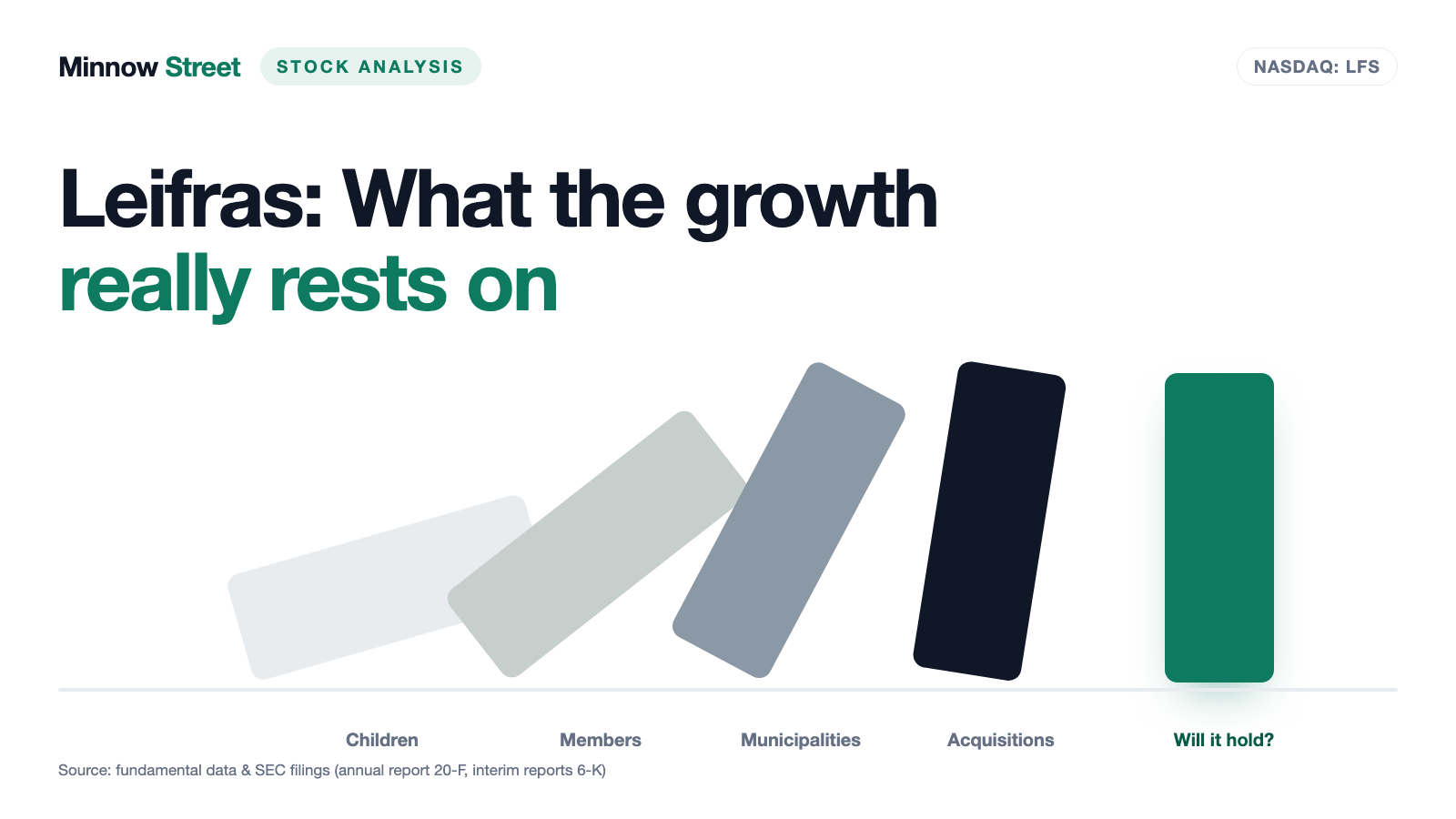
LEIFRAS Stock (LFS): 70,688 Children, a Perfect Piotroski Score — and an Annual Report That Describes Somebody Else's Business
LEIFRAS Co., Ltd. (Nasdaq: LFS) teaches roughly 70,688 children soccer, baseball and basketball at about 4,500 locations across Japan, has been profitable for years and scores a perfect 9 of 9 on the Piotroski test. The same annual report states that the company's disclosure controls and procedures were not effective as of December 31, 2025 — and describes, in its use-of-proceeds paragraph, physical stores, franchise partners and distribution centers that a children's sports school does not own. Sympathy is not an audit, and this is where the two get separated.
 Thomas Mücke
Founder & Publisher
Thomas Mücke
Founder & Publisher
Chart
Interactive price chart (TradingView).
Note: pure fact-based analysis, not investment advice and not a solicitation to buy or sell. All figures without guarantee.
There is an investor trap that has nothing to do with balance sheets and everything to do with your gut, and it is one of the quietest ones out there. Call it the sympathy trap. Show someone a company that teaches seven-year-olds how to trap a soccer ball, that runs after-school programs for children with disabilities, that puts on fitness classes for pensioners in a Japanese city — and something in the brain files it away, without asking permission first, under these are the good guys. And the good guys, surely, would not get their own paperwork wrong. LEIFRAS Co., Ltd. (Nasdaq: LFS) out of Tokyo is exactly that kind of company. It has been profitable for years. It generates cash. It scores a perfect nine out of nine on the Piotroski test, a rating almost nothing in the small-cap world reaches. And none of that is the point here, because sympathy is a feeling and an audit is a procedure — and only one of the two gets written down.
So let us make a deal before you read one more word about this stock: we read together what Leifras actually filed with the U.S. securities regulator, the SEC — the annual report (Form 20-F) for 2025, filed April 8, 2026, plus every interim report (Form 6-K) through July 1, 2026. A filing is a statement made under penalty of law; a warm brand impression is not. And these particular documents tell two stories at once. One is a small, unglamorous, cash-generating Japanese services business that grew revenue 13.5 percent last year and carries more cash than debt. The other is a report whose own authors write that "our disclosure controls and procedures were not effective" as of December 31, 2025 — and which, a few pages later, describes physical stores, franchise partners and distribution centers that a children's sports school does not own. That tension runs through every chapter below. At the end, you decide which of the two stories weighs more with you.
Contents
- Who Is LEIFRAS (Nasdaq: LFS)?
- What Leifras Actually Does
- How This Stock Landed on Our Desk
- The Numbers Over the Years
- What the Filings Say — the Uncomfortable Truths
- Valuation: What the Company Costs, in Orders of Magnitude
- Opportunities and Risks at a Glance
- A Human Conclusion
- Sources
Who Is LEIFRAS (Nasdaq: LFS)?
LEIFRAS Co., Ltd. was founded on August 28, 2001 in Tokyo as a kabushiki kaisha — the Japanese equivalent of a stock corporation — and it started with a single soccer school. Today the head office sits in the Ebisu Garden Place Tower in Shibuya-ku, Tokyo. There has been no renaming, no predecessor company, no reverse merger: the entity you buy today is the entity that opened that first soccer school, which is rarer among newly listed micro caps than you might assume.
The company is a foreign private issuer. That single label explains almost everything unusual about how Leifras reports. A foreign private issuer files an annual report on Form 20-F and, in between, interim reports on Form 6-K — filings that carry whatever the company has already published at home in Japan. It does not follow the U.S. domestic quarterly reporting calendar at all. So if you go looking for a quarterly report the way you would with an American company, you will not find one; you will find a 6-K, filed when the company chooses to publish, and there is no fixed U.S. deadline forcing it. The fiscal year is simple by comparison: it equals the calendar year and ends December 31.
The listing itself is young. Leifras went public on the Nasdaq Capital Market on October 10, 2025, selling 1,250,000 ADSs at $4.00 each for gross proceeds of $5.00 million (JPY 739.9 million), with Kingswood Capital Partners, LLC as lead underwriter. One ADS equals exactly one ordinary share — no ratio games, no dual-class structure, one class of stock with 80,000,000 shares authorized. Net proceeds, per note 20 of the annual report, came to JPY 658,666,480 ($4,302,198).
Here is the part that surprises most first-time readers of this filing. Of the 26,160,619 shares outstanding (as of April 8, 2026), only 2,172,020 — 8.30 percent — exist as ADSs at all (Bank of New York Mellon, as of December 31, 2025). The rest sits in Japan, in ordinary Japanese share form, untouched by the U.S. listing. And the register is just as lopsided: the annual report counts 229 holders of record, not one of them in the United States. Translated into an everyday picture: the U.S. listing is a narrow window cut into a Japanese building. The window is real and you can genuinely buy through it — but the building was never designed around it.
Control is where this gets structural. Founder and Representative Director Kiyotaka Ito holds 13,176,142 shares, or 50.37 percent (7,314,502 directly, 5,861,640 through his asset-management vehicle K2MY Co., Ltd.); directors and senior management together hold 52.32 percent. That makes LFS a "controlled company" under Nasdaq Rule 5615(c). To the company's credit, it expressly declines to use the governance exemptions that status would allow. But it does follow Japanese home-country practice, and one line in that section is worth reading twice: under Japanese practice "it is acceptable to have articles of incorporation provide that there is no quorum requirement for a general resolution of shareholders." Put plainly: a shareholder vote does not need a minimum turnout to be valid. With a founder past 50 percent, the outcome of any ordinary vote is settled before the meeting starts. If you want to see what that looks like over decades rather than months, our Biglari Holdings analysis walks through the long-running version, where a single majority holder decides everything and minority shareholders simply come along for the ride.
Two more facts for the file: Leifras has never paid a dividend since inception and has never repurchased stock, and the company has received no Nasdaq deficiency notice. The finance seat changed hands recently — CFO Mitsuharu Yazawa resigned effective March 27, 2026, "not the result of any disagreement" per the filing, and remains on the board; Rei Yamamoto, a U.S. CPA, took over the same day. Given what the next chapters cover, hiring a CFO with U.S. accounting credentials is not a footnote; it is a response.
What Leifras Actually Does — Two Businesses Under One Roof
Since January 1, 2025, Leifras reports in two segments, and they are genuinely different animals. The first, the sports school business, is the one you can picture without help: 13 school brands running lessons for children — Liberta for soccer (the original, since August 2001), Porte for baseball (since May 2006), Hearts for basketball, JJMIX for absolute beginners from age two, Rugina for girls, a kendo school called "Kokoro," and more. The scale is the striking part: roughly 4,500 locations across 45 of Japan's 47 prefectures, 70,688 active members, and 811,998 members since inception (all as of the annual report date, April 8, 2026). Between 87 and 88 percent of those members are elementary-school children. In practice, Leifras rents gym halls, fields and community spaces and sends coaches to them — it does not own a national estate of sports facilities, which is exactly why the business can carry 4,500 locations on a balance sheet totaling under JPY 4.7 billion.
The second segment, the social business, is the one nobody talks about and the one that has been moving the profit needle. It bundles four things: supporting or fully running school club activities for municipalities and schools — explicitly described in the filing as "business-to-government ('B2G')" — the LEIF after-school daycare service for children with disabilities, facility management, and senior health courses ("Sport day Lesport," running since 2022 under a contract with the City of Sendai). In 2025 this segment served 381 schools (up from 347) and 2,120 club activities (up from 1,971).
Why does that matter? Because Japan is in the middle of moving school club activities out of teachers' hands and into private ones. The government calls it the "Reform Implementation Period," it runs from 2026 to 2031, and the Japan Sports Agency has, per the annual report, allocated 8.2 billion yen in the 2025 supplementary budget and 5.7 billion yen in the 2026 budget proposal to it. Leifras is standing directly in that stream. That is an opportunity and a dependency in the same sentence — and we come back to the dependency in the uncomfortable-truths chapter, because the single largest government contract this company ever signed was not renewed.
Staffing tells you what kind of business this really is. As of December 31, 2025, Leifras employed 1,055 full-time staff and 3,544 part-timers (prior year 999 and 2,715). That is roughly one full-time employee for every 67 members and a part-time base that grew 30 percent in a year. This is a people business, not a technology business, and the cost base moves with headcount, not with servers.
Which brings us to the artificial-intelligence question, because it hangs over every listed company right now. Leifras sells no AI and develops none; it uses AI internally for recruiting screens and back-office efficiency, and says so in a risk factor ("we may experience any number of difficulties"). What is unusual is the strategic argument it builds on top — the company casts itself as a beneficiary of the AI wave precisely because what it sells cannot be automated:
"As artificial intelligence ("AI") and digital technologies advance, the relative value of human-centered services continues to rise. While AI and systems increasingly perform in areas such as cognitive capability (knowledge and reasoning) and standardized tasks, the areas handled by our company, non-cognitive capabilities (human ability) and human relationships, become more valuable and differentiated…"
— LEIFRAS Co., Ltd., SEC annual report Form 20-F for 2025, Item 4.B (growth strategy)
The company adds that it reinvests the efficiency it wins from automation "into people, allowing our instructors to focus on what only humans can provide: empathy, passion, and on-site judgment when interacting with children." As an investment argument that is honest and unusual — most companies claim the opposite. As a valuation input it is worth almost nothing: there is no AI revenue line, no AI product, and no AI margin. File it as strategy, not as a growth driver you can count.
How This Stock Landed on Our Desk
This one did not come from a screener at all. It came from noise. Our Reddit attention scanner — a social-media attention signal that simply counts how often a ticker is being talked about, data as of August 1, 2026 — pushed LFS onto the list. Attention is not a quality signal and we never treat it as one; it is a reason to look, nothing more. Plenty of tickers that surface this way get discarded within an hour.
This one did not, because the cross-check against our in-house stock scanner came back with something rare. The headline number: a Piotroski F-Score of 9 out of 9 (data as of August 1, 2026). The Piotroski score is a nine-point accounting-health test — it checks whether a company is profitable, whether the profit is backed by real cash flow, whether debt fell, whether margins and asset efficiency improved year over year. Let us say this plainly rather than bury it in a list: 9 of 9 is the maximum score, and it is genuinely uncommon. Most decent companies land at 6 or 7. A 9 means every single box was ticked in the same year. That does not make a stock cheap and it does not make it safe, but it does mean the accounting picture is internally consistent — profits, cash flow, leverage and efficiency all pointing the same way.
The rest of the row backs it up. Return on equity of 29.2 percent — for every 100 yen of shareholders' money in the business, roughly 29 came back as annual profit. That is a strong number in any industry and an unusual one in a labor-intensive services business. The equity ratio of 39.5 percent means a bit under 40 percent of the balance sheet is financed by owners rather than lenders — solid, not fortress-like, and normal for a company that collects fees monthly. Interest coverage of 38 is the one that ends the debt conversation before it starts: operating profit covers the interest bill 38 times over. Companies get into trouble below 2. At 38, borrowing costs are a rounding error.
The valuation metrics are where opinions start. A price-earnings ratio of 19.8 — you pay roughly 20 years of current annual profit for the whole company — is not a bargain-bin number for a business growing profit at single digits. A price-to-book ratio of 4.74 means the market pays nearly five times the accounting value of the company's net assets, which is a lot for a business whose main assets are rented gym halls and a payroll. And insider ownership of 52.3 percent cuts both ways: the founder's money is fully on the line alongside yours, and the founder can also outvote you on anything, forever.
So the scanner verdict, in one line: the accounting quality is as good as this test gets, and the price already knows it. That combination — pristine metrics, unglamorous business, almost no U.S. float — is exactly why we opened the filings rather than stopping at the scores.
The Numbers Over the Years — the Impressive Part First
Start with what genuinely impresses, because there is real substance here and it deserves to be stated before anything is qualified. Revenue has climbed every year: JPY 9.30 billion (2023) to JPY 10.33 billion (2024) to JPY 11.73 billion (2025) — up 13.5 percent in the most recent year. That is roughly $74.8 million at the rate the annual report itself applies. And it was not bought with margin: gross margin rose from 25.1 percent to 29.6 percent over the same three years. Growing revenue while widening the gross margin is the hard combination; most services businesses growing at this pace do the opposite.
Operating income followed: JPY 396 million (2023), JPY 520 million (2024), JPY 627 million (2025) — a 58 percent improvement in two years. Net income went JPY 245 million, JPY 419 million, JPY 438 million. Operating cash flow was positive in all three years (JPY 677.9 million, JPY 207.1 million, JPY 468.3 million), and after JPY 53.5 million of capital spending, 2025 left free cash flow of JPY 414.8 million — cash the business actually generated and kept. That is the single most reassuring number in this entire analysis, because reported profit can be shaped by judgment and cash cannot.
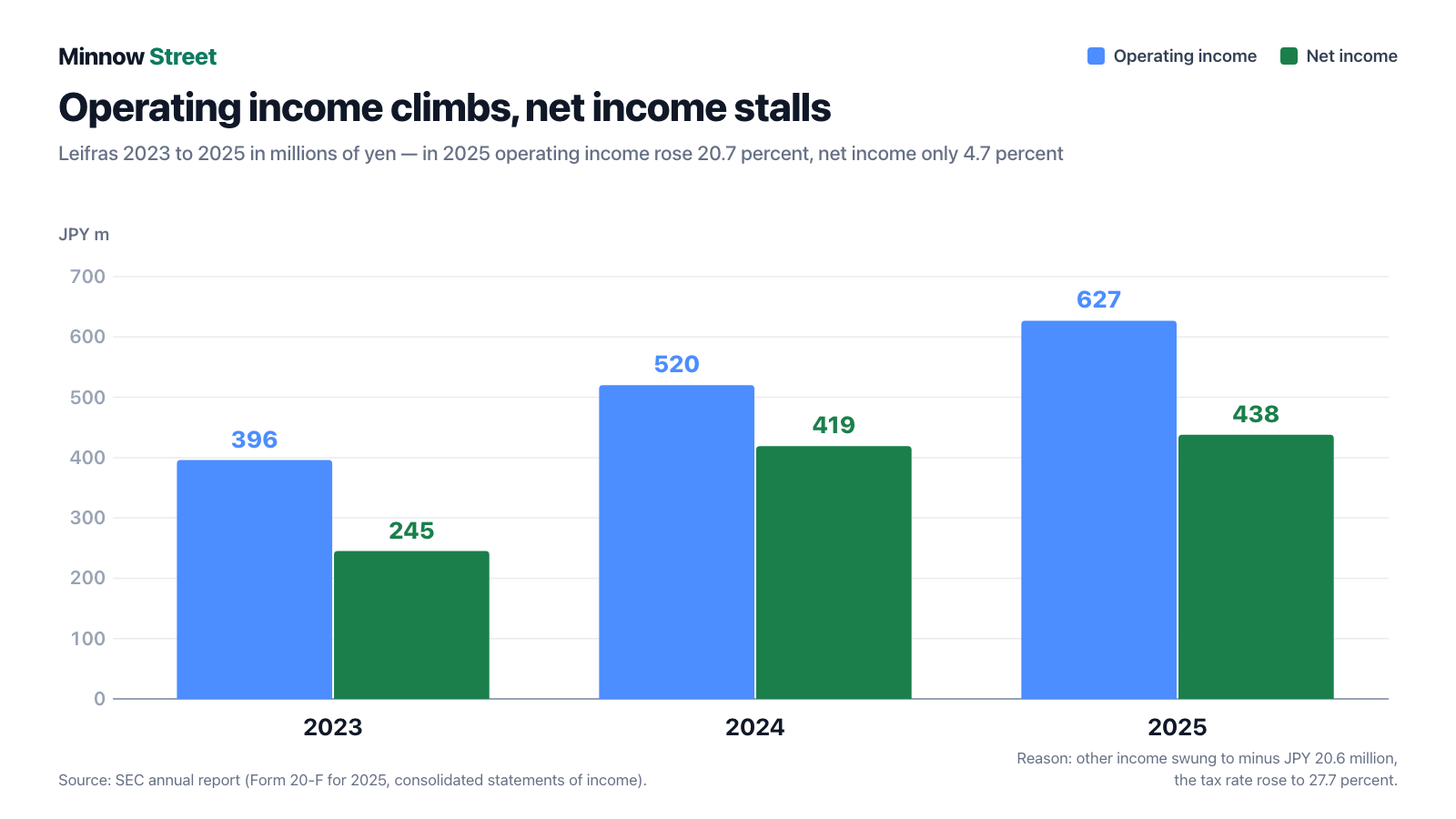
That gap is worth a paragraph of its own, because a fast reader will see "operating income up 20.7 percent" and assume the bottom line moved with it. It did not — net income rose just 4.7 percent. Two things ate the difference, and neither has anything to do with the business itself. First, other income swung from plus JPY 18.2 million to minus JPY 20.6 million — a JPY 38.8 million reversal in a line that sits below the operating result. Second, the tax rate rose from 22.2 percent to 27.7 percent, which alone cost roughly JPY 33 million versus the prior year's rate. In other words: the operating engine performed better than the headline profit suggests, and the shortfall was structural and non-operating. That is the honest reading in both directions.
Where the growth came from is the other half of the picture, and the segment chart makes it obvious.
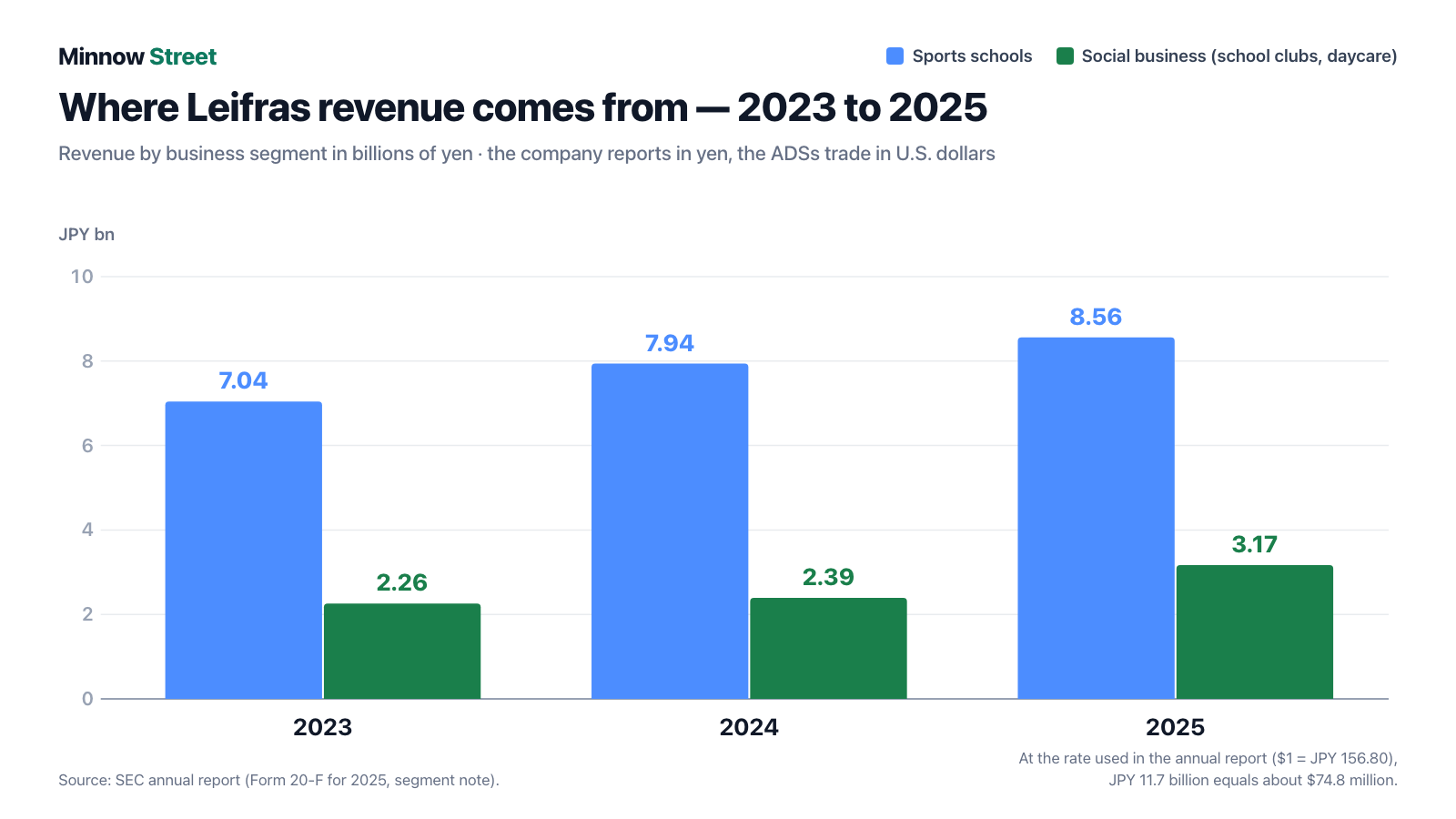
The sports schools remain the bulk of revenue (JPY 8.56 billion in 2025) and contribute JPY 2.13 billion of segment profit before central costs. But the social business is the accelerator: revenue up 32.8 percent to JPY 3.17 billion, and segment profit up from JPY 102.7 million to JPY 469.1 million — a 14.8 percent segment margin against 0.7 percent just two years earlier. Note the qualifier: these are segment results before the allocation of central costs, which came to JPY 1.97 billion in 2025. That is why the two segment profits add up to far more than group net income; it is normal reporting practice, not a trick, but it does mean segment margins always look better than the company's real margin.
The balance sheet is boring in the best sense. Cash of JPY 2,524,082,266 against financial debt of JPY 333,627,440 at December 31, 2025 leaves net cash of roughly JPY 2.19 billion — about $14.0 million. Leifras also paid down JPY 830.8 million of bank loans during 2025. Equity nearly doubled to JPY 1.85 billion, helped by the IPO. Goodwill sits at JPY 27,999,994 and has not moved — for a company that has since bought three businesses, that number is about to become interesting.
One more thing you need to hold in your head for every figure above: the books are kept in yen and the ADSs trade in dollars. Leifras converts for U.S. readers at a single stated rate — the annual report uses the Federal Reserve noon buying rate of $1 = JPY 156.80; the interim report for the first quarter of 2026 already uses $1 = JPY 159.08. Nothing in the business changed between those two rates, yet the same yen profit is worth roughly 1.5 percent less in dollars at the second one. There is no documented currency hedging. Readers of our Gorilla Technology analysis have met the harsher version of this problem — a company where a single customer supplies 77 percent of revenue and the invoice is written in a currency that keeps sliding away from the one shareholders count in. At Leifras the effect is milder and it cuts both ways, but it is real: your return here is a yen return wearing a dollar costume.
What the Filings Say — the Uncomfortable Truths
Everything above is the part a fan of the company would happily quote. Now we read the same documents for what they concede. Five findings, each with the original wording, each traceable to a document you can open yourself.
Uncomfortable truth No. 1: the company says its own reporting controls do not work
Disclosure controls and procedures, translated into an everyday image, are the safety inspection for a company's paperwork: the routine that is supposed to catch errors before numbers leave the building. Leifras ran that inspection on itself for fiscal 2025 and published the result.
"Based on this evaluation, our management has concluded that, as of December 31, 2025, our disclosure controls and procedures were not effective due to the following material weaknesses in internal control over financial reporting described below: (i) lack of sufficient accounting personnel with appropriate knowledge and experience of U.S. GAAP and reporting requirements set forth by the SEC…; (ii) lack of formalized financial reporting controls and procedures to properly address complex or unusual transactions…; and (iii) lack of effective internal controls over certain aspects of information technology environments including segregation of duties, user access, third-party service provider management, and change management within IT systems that support the financial reporting process."
— LEIFRAS Co., Ltd., SEC annual report Form 20-F for 2025, Item 15 (Controls and Procedures)

Three separate weaknesses, and the report is equally clear that none of them is fixed: "While we are currently implementing these remediation measures, they have not yet been fully implemented and assessed, and therefore the material weaknesses remain." On top of that, as an "emerging growth company" Leifras is exempt from having an outside auditor attest to its internal controls at all — so nobody independent has signed off on this area.
Does that mean the numbers are wrong? No, and it is important to be precise: the report names no resulting misstatement, and the financial statements themselves were audited. It is a verdict on the process, not on the arithmetic. But a process verdict has consequences for how much benefit of the doubt each individual figure has earned — and in this document the consequences are visible with the naked eye. The same annual report contains three different location and membership counts for the same date (4,600 locations and "over 70,000" members; 4,500 and "over 70,780"; 4,500 and "approximately 70,688"). It contains an ownership table listing ten named individuals under the heading "All directors and senior management as a group (seven individuals)." It contains a subtotal line reading "INCOME BEFORE INCOME TAX POVISION." And it refers to an "ADS Ratio Change (as defined below)" that is never defined anywhere in the document. None of those is a scandal on its own. Together, in a report that already tells you its controls do not work, they are the evidence for the finding rather than an exception to it.
Uncomfortable truth No. 2: the use-of-proceeds paragraph describes somebody else's business
Every company that raises money in a U.S. offering has to say what it did with it. Here is what Leifras filed, verbatim:
"The net proceeds raised from the initial public offering were $2.64 million after deducting underwriting discounts and the offering expenses payable by us. As of December 31, 2025, we had used the net proceeds for (i) opening new directly-operated physical stores and adding franchise stores, (ii) brand marketing, (iii) improving our distribution centers and logistics systems, and (iv) talent acquisition and retention, respectively."
— LEIFRAS Co., Ltd., SEC annual report Form 20-F for 2025, Item 14 (Use of Proceeds)
Read it again slowly. Physical stores. Franchise stores. Distribution centers. Logistics systems. Leifras runs children's sports lessons in rented gym halls. It has no retail stores, no franchisees, no distribution centers and no logistics network — none of those words appear anywhere else in the business description, because none of those things exist. This is boilerplate text from a completely different kind of company that was pasted in and never removed.
And the same short paragraph contains a second problem. It uses $2.64 million as both the offering costs and the net proceeds in one sentence — a figure that cannot be both. Meanwhile note 20 of the very same document, and the management discussion alongside it, put net proceeds at JPY 658,666,480, or $4,302,198. And a risk factor on page 20 of the same report describes what the money was actually spent on: full-time staff, sports facilities, part-time coaches and working capital. Three passages, one document, three different answers to the same question.
Why does a copy-paste error deserve its own chapter? Because it is the first uncomfortable truth made visible. A working control process is precisely the thing that catches a paragraph describing the wrong industry before it is filed with a securities regulator. This one was not caught. When you next weigh a number from this report, that is the context it sits in.
Uncomfortable truth No. 3: over-claimed daycare fees, with a 40 percent penalty on the table
The after-school daycare business for children with disabilities is a growth pillar — and it has an open regulatory file.
"In October 2024, we received a guidance notice from the Health and Welfare Department of Hakodate City indicating our after-school daycare service facilities over-claimed fees by overstating the number of qualified workers in the fiscal years ended December 31, 2023 and 2024, along with noncompliance with required staffing standards. In accordance with the Act on Providing Comprehensive Support for the Daily Life and Life in Society of Persons with Disabilities (Act No. 123 of November 7, 2005, as amended), certain orders could have been issued, including the reimbursement of the over-paid amount plus a 40% penalty and/or the revocation or suspension of operator designations."
— LEIFRAS Co., Ltd., SEC annual report Form 20-F for 2025, Item 4.B (Legal Proceedings) and note 24

Note 24 fills in the scope: four facilities in Hokkaido were affected (Shiroishi, Asahi, Teine and Hakodate), the repayments were made in full during 2025, and a remaining JPY 0.6 million followed in January 2026. So the money side is settled. What is not settled is the sanction side — the filing uses the conditional, "could have been issued," for both the 40 percent penalty and the revocation or suspension of operator designations.
Sit with the second one for a moment, because it is the part that matters commercially. An operator designation is the licence that lets a facility bill the public system at all. Losing it does not shrink a margin; it switches a location off. And this is exactly the business line Leifras is expanding by acquisition right now — two of the three companies bought between May and July 2026 are childcare and after-school daycare operators. A live regulatory matter in the very line you are buying into is a different kind of risk than a bad quarter.
Uncomfortable truth No. 4: the JPY 2.3 billion government contract was not renewed
The single largest contract this company has ever disclosed came from the Japan Sports Agency — and it is gone.
"In April 2024, we entered into an agreement with the Japan Sports Agency, where we agreed to conduct a demonstration project pursuant to the Japan Sports Agency's initiative to have community sports clubs and local governments be more responsible for conducting school athletic club activities. […] The term of this contract was from April 1, 2024 to March 31, 2025 and the contract price was approximately JPY2.3 billion. The agreement was not renewed beyond March 31, 2025."
— LEIFRAS Co., Ltd., SEC annual report Form 20-F for 2025, Item 4.B (Material Contracts)

For scale: JPY 2.3 billion is roughly a fifth of the company's entire 2025 revenue and about 73 percent of the social business segment's full-year revenue. A single contract that size arriving and then leaving is the kind of event that distorts every year-over-year comparison around it. Fairness demands the other side too — the social business still grew 32.8 percent in 2025, so the replacement business was found. But the pattern remains: this segment's largest single relationship was a one-year government project that ended, in a country where such projects are awarded annually.
There is a second sentence in that same paragraph that most readers skip: "In connection with our participation in this government project and from a compliance perspective to avoid potential conflicts of interest, we terminated certain contracts with some local governments." Leifras gave up existing municipal business to take the big project. The big project then was not renewed. Whether the surrendered contracts came back, the filing does not say.
Uncomfortable truth No. 5: membership is flat while the report calls it steady growth
This is the finding that reframes the whole growth story. Active sports-school membership went from 70,663 (2024) to 70,688 (2025). That is an increase of 25 children — 0.0 percent — in a year when 19,311 members left and had to be replaced. In the first quarter of 2026 the number fell outright: 60,960 against 62,495 a year earlier, down 2.5 percent, with event participants down 5.7 percent alongside it. Here is what the annual report says about the same period:
"Recognition by public institutions and appearances in public meetings contributed to brand building and customer confidence. Our membership kept a steady growth rate during the past three years despite the fact that we raised membership fees, evidencing strong brand recognition and customer loyalty."
— LEIFRAS Co., Ltd., SEC annual report Form 20-F for 2025, Item 4.B (business overview)

The claim and the operating table are in the same document. Take the sentence apart and the honest version is visible inside it: the fees were raised, and revenue per member rose with them. That is a real and respectable result — the sports-school segment grew 7.8 percent in 2025 on a membership base that did not move at all. But "we raised prices and kept our customers" is a fundamentally different investment case from "more and more children are joining," and only the second one is what the sentence sells. In the first quarter of 2026 the company was more candid: revenue rose 5.6 percent "due to higher monthly fees," with membership dipping on graduations.
There is a related figure the report volunteers, and it is the most quietly hopeful number in the whole filing: "assuming a maximum capacity of 20 students per lesson, only 29.7% of the total lessons were at full capacity" (December 31, 2025). Seven out of ten lessons run with empty spots. Read pessimistically, that is weak demand. Read optimistically, it is capacity that is already paid for — coaches hired, halls rented — waiting to be filled at almost no extra cost. Both readings are legitimate; the number will tell you which one is right long before the revenue line does.
One last item on the same theme, from the first-quarter release of June 18, 2026. The headline announces "Record High Revenue, Adjusted Income from Operations, and Net Income." The financial statements below it show operating income down 7.7 percent year over year, from JPY 166.1 million to JPY 153.3 million. The "record" applies only to the adjusted figure — after adding back JPY 14.5 million of acquisition costs — and a footnote quietly narrows it further: "Record high in US-GAAP figures since 2025." A record measured against one prior year. Revenue really did rise 10.0 percent and net income really did rise 1.5 percent; both are genuine. But the word "record," here, is doing more work in the headline than in the accounts.
Valuation: What the Company Costs, in Orders of Magnitude
No daily price chasing here — orders of magnitude and dated anchors only. At the August 1, 2026 data cutoff, Leifras carried a market value of roughly $62 million. That is a genuine micro cap: the entire company is worth less than a single office building in the district it is headquartered in.
Because feed data deserves a cross-check rather than faith, here is the arithmetic. The share count documented in the annual report is 26,160,619 (as of April 8, 2026), and no capital measure has occurred since — all three acquisitions were paid in cash. Multiply by the $2.38 price at the data cutoff and you get $62.3 million. The feed shows $62.3 million. The two agree exactly, which is not always the case and is worth knowing when you rely on a screener.
Against that market value sits $2.8 million of annual profit (JPY 438.5 million for 2025), which puts the price-earnings ratio at roughly 20 — the feed reads 19.8. Against $74.8 million of revenue, price-to-sales is roughly 0.8. Those two numbers pull in opposite directions and both are true: measured on revenue this is a cheap company, measured on profit it is an ordinarily priced one. The reason is the net margin of 3.7 percent. A business converting under four cents of every revenue dollar into profit does not get a cheap earnings multiple by being cheap on sales — it gets one by improving the margin. That is the entire bull case in a sentence.
Management has put its own number on the coming year. For 2026, first issued April 8, 2026 and affirmed June 18, 2026, Leifras guides to $82.9 million to $95.7 million of revenue (up 10.8 to 27.9 percent) and $4.5 million to $5.4 million of operating income (up 13.2 to 33.9 percent). That is a wide range and an ambitious top end. It also carries an assumption stated in the filing itself: the guidance "is based on the assumption that no business acquisitions, restructuring activities, or legal settlements will take place during the period." Three acquisitions have closed since — May 1, June 1 and July 1, 2026. So the guidance and reality have already parted company, in a direction that should help revenue and hurt near-term costs. Which way it nets out will be visible in the next interim report and not before.
There is no analyst consensus for this stock. Not a thin one, not a stale one — none. No broker publishes a price target or an earnings estimate we could find. That is normal for a company with a $62 million market value, 229 holders of record and 8.30 percent of its shares in ADS form, but it changes how you should read every number above: there is no professional crowd here to be right or wrong. You are the analyst.
For a dated price anchor, the filing supplies its own, and it is a sobering one: between the October 10, 2025 IPO and April 7, 2026, "the closing price of the ADSs has ranged from $1.68 to $11.37 per ADS." A factor of nearly seven inside six months, on a stock that was sold at $4.00. That range is not a forecast and not a target — it is a measurement of how thin this market is. With roughly two million ADSs outstanding, modest order flow moves the price a long way. Any valuation conclusion you draw here has to survive that fact first.
Opportunities and Risks at a Glance
Both sides, side by side, taken equally seriously — neither list cancels the other.
What speaks for Leifras:
- Profitable in every reported year with positive operating cash flow throughout (JPY 677.9 million, JPY 207.1 million, JPY 468.3 million for 2023 to 2025) and free cash flow of JPY 414.8 million in 2025.
- Net cash of roughly JPY 2.19 billion at December 31, 2025, interest coverage of 38 and a Piotroski F-Score of 9 of 9 (data as of August 1, 2026) — the maximum on that test.
- Gross margin widened from 25.1 to 29.6 percent between 2023 and 2025 while revenue grew 26 percent — growth that did not cost margin.
- The social business is riding a stated government program: the Japan Sports Agency reform period runs from 2026 to 2031, with JPY 8.2 billion allocated in the 2025 supplementary budget and JPY 5.7 billion in the 2026 budget proposal.
- Only 29.7 percent of lessons ran at full capacity at December 31, 2025 — spare capacity that is already paid for, and the cheapest growth available if demand shows up.
What speaks against it:
- Disclosure controls and procedures were not effective as of December 31, 2025 on three material weaknesses, none remediated as of April 8, 2026, and no outside auditor attests to internal controls at all.
- Visible errors in the annual report itself — a use-of-proceeds paragraph describing stores, franchises and distribution centers the company does not have, three conflicting membership counts, and $2.64 million named as both cost and net proceeds in one sentence.
- A live regulatory matter over over-claimed daycare fees at four Hokkaido facilities, with a possible 40 percent penalty and revocation of operator designations — in exactly the line being expanded by acquisition in 2026.
- Membership is flat (70,688 at year-end 2025, up 0.0 percent) and fell 2.5 percent in the first quarter of 2026; growth comes from price increases and government work, not from more children.
- Structural pressure that will not go away: Japan's falling birth rate, a JPY 2.3 billion government contract already lost to non-renewal, full-time staff who can leave on 60 days' notice with no key-man insurance, a founder controlling 50.37 percent, and yen earnings behind a dollar-quoted share with no documented hedging.
Notice how cleanly the two lists split. Almost everything positive is operational — margin, cash, capacity, a funded market. Almost everything negative is structural — controls, disclosure quality, regulation, demographics, control. That is the tension named at the top of this piece, and it has not resolved in either direction.
A Human Conclusion
Back to the sympathy trap. Its danger was never that Leifras is a bad company — the cash flow is real, the margin improvement is real, the nine out of nine is real, and a business that has taught 811,998 children to play sport since 2001 has produced something worth having. The danger is subtler: liking what a company does makes you read its paperwork more gently. And this paperwork does not deserve gentleness. It tells you, in its own words, that the process meant to keep it accurate is not working — and then proves the point by describing a retail chain with distribution centers that does not exist.
So the honest question is not "is this a nice company?" It is: are you willing to own a business whose operations you can verify but whose reporting the company itself says you cannot fully rely on — with a founder who can outvote you forever and a U.S. window covering barely eight percent of the shares? There are reasonable people on both sides of that. Someone who says yes is betting that a new U.S.-credentialed CFO fixes the reporting while the operating engine keeps running, and that a $62 million market value leaves room for that repair to be worth something. Someone who says no is not calling the company a fraud — they are simply declining to pay for numbers they cannot check, which has never been an unreasonable position.
What we can tell you is where to look next, and it is specific: the next interim report is the first one that consolidates all three 2026 acquisitions, the first that shows whether membership kept falling, and the first chance to see whether "the material weaknesses remain" is still the sentence in the controls section. What you make of it is your decision. And that is exactly as it should be.
Sources
Every original document used in this analysis — to read for yourself:
- LEIFRAS Co., Ltd. — SEC annual report Form 20-F for 2025 (filed April 8, 2026) — audited financial statements, segment note 23, legal proceedings and note 24, controls (Item 15), use of proceeds (Item 14), shareholdings (Item 6.E and 7.A)
- LEIFRAS Co., Ltd. — interim report Form 6-K filed June 18, 2026 for the period ended March 31, 2026 (unaudited financial statements, management discussion, results release and presentation) — the most recent interim report evaluated
- LEIFRAS Co., Ltd. — Interim report Form 6-K of June 23, 2026 (SWIFT JAPAN share purchase agreement, JPY 454,580,040)
- LEIFRAS Co., Ltd. — Interim report Form 6-K of December 5, 2025 (two committed credit facilities totaling JPY 2.5 billion)
- LEIFRAS Co., Ltd. — further interim reports Form 6-K of April 7 and 8, May 1, May 21, June 2 and July 1, 2026 (CFO change and annual general meeting, annual results and first 2026 guidance, three completed acquisitions); every mandatory filing through July 1, 2026 reviewed
- Full SEC filing history of LEIFRAS Co., Ltd.: EDGAR overview (sec.gov)
- Fundamental data (valuation metrics, scanner metrics; data as of August 1, 2026), reconciled against the SEC filings; attention signal from our Reddit attention scanner (data as of August 1, 2026).
Transparency & disclaimer: This analysis is a journalistic contextualization of publicly available information and is not investment advice, not a financial analysis in the regulatory sense, and not a solicitation to buy or sell securities. Stock investments carry substantial risks up to total loss. All information without warranty; the data cutoff is noted in the text throughout. The author holds no position in LEIFRAS shares at the time of publication.
Our Bottom Line at a Glance
- Reliability of the reporting negative
- Management states that "our disclosure controls and procedures were not effective" as of December 31, 2025 on three material weaknesses, none remediated as of the annual report filed 04/08/2026; as an emerging growth company, no outside auditor attests to internal controls. Visible consequences in the same document: three conflicting membership counts, a table of ten people headed "seven individuals," and the subtotal "INCOME BEFORE INCOME TAX POVISION."
- Earnings quality and balance sheet positive
- Profitable in all three reported years with positive operating cash flow throughout (JPY 677.9 million, JPY 207.1 million, JPY 468.3 million for 2023–2025) and free cash flow of JPY 414.8 million in 2025. Net cash of roughly JPY 2.19 billion at 12/31/2025, equity ratio 39.5%, return on equity 29.2%, Piotroski F-Score 9 of 9 (data as of 08/01/2026).
- Composition of growth neutral
- Revenue rose 13.5% in 2025, but membership was flat at 70,688 (+0.0% versus 70,663) and fell 2.5% to 60,960 in the first quarter of 2026. Growth came from higher fees ("due to higher monthly fees," 6-K of 06/18/2026) and from the government-funded social business (+32.8% revenue), not from more children.
- Regulatory matter in the growth line negative
- A guidance notice from Hakodate City (October 2024) found over-claimed after-school daycare fees at four Hokkaido facilities for 2023 and 2024; repayments were completed in 2025 with JPY 0.6 million following in January 2026, but a 40% penalty and revocation or suspension of operator designations remain possible per the annual report — in exactly the line expanded by two of the three 2026 acquisitions.
- Ownership and control neutral
- Founder Kiyotaka Ito holds 50.37% (13,176,142 of 26,160,619 shares, 04/08/2026), directors and senior management 52.32% — a "controlled company" under Nasdaq Rule 5615(c). The exemptions are expressly not used, but Japanese home-country practice permits articles under which "there is no quorum requirement for a general resolution of shareholders." Only 8.30% of shares exist as ADSs; 229 holders of record, none in the United States.
- Guidance and dependence on the state neutral
- 2026 guidance ($82.9–95.7 million of revenue, $4.5–5.4 million of operating income) was affirmed 06/18/2026 while explicitly assuming "no business acquisitions" — three closed on 05/01, 06/01 and 07/01/2026. The social business is 27% of revenue and expressly business-to-government; its largest single contract, roughly JPY 2.3 billion from the Japan Sports Agency, was not renewed beyond March 31, 2025.
Leifras is an operationally sound micro cap with an unusually poor paper trail. The business has been profitable every reported year, generated JPY 414.8 million of free cash flow in 2025, carries net cash of roughly JPY 2.19 billion and scores the maximum 9 of 9 on the Piotroski test (data as of 08/01/2026). The same annual report, filed April 8, 2026, states that disclosure controls and procedures were not effective as of December 31, 2025 on three unremediated material weaknesses, describes a use of IPO proceeds belonging to a retail business the company does not operate, calls flat membership a "steady growth rate," and discloses a live regulatory matter carrying a possible 40 percent penalty in the very line being expanded by acquisition. Not investment advice.
What Our Rating Means
Substance risk
We found at least one documented issue that threatens the company itself — regardless of how the stock is currently valued.
Red, because the finding sits in the reporting itself rather than in the business or the share price. Management concluded that "our disclosure controls and procedures were not effective" as of December 31, 2025, naming three material weaknesses — accounting staffing, formalized controls for complex transactions, and IT general controls — and states that they "remain" unremediated as of the filing on April 8, 2026; as an emerging growth company, no outside auditor attests to internal controls at all. That is not a theoretical finding here: the same document describes the use of IPO proceeds as "opening new directly-operated physical stores and adding franchise stores" and "improving our distribution centers and logistics systems" — a retail and logistics business that a children's sports-school operator does not run — and names $2.64 million in one sentence as both the offering cost and the net proceeds, while note 20 of the same report puts net proceeds at JPY 658,666,480 ($4,302,198). On top of that sits a live regulatory matter: Hakodate City found over-claimed after-school daycare fees at four Hokkaido facilities, with a possible 40 percent penalty and revocation or suspension of operator designations still on the table — in exactly the business line the company is expanding by acquisition in 2026. The counter-case deserves to be stated just as plainly, because it is strong and it does not disappear: Leifras has been profitable in every reported year, scores the maximum 9 of 9 on the Piotroski accounting-health test, holds net cash of roughly JPY 2.19 billion against financial debt of JPY 333.6 million, earns a return on equity of 29.2 percent and produced positive free cash flow of JPY 414.8 million in 2025 (figures as of 12/31/2025, market data as of 08/01/2026). Those are the numbers of a healthy small company, and nothing in this analysis suggests otherwise. But red here is a judgment on the reliability of the reporting, not on the share price and not on whether the shares are cheap or expensive: when a company tells you the process that keeps its own numbers accurate is not working, and then demonstrates it three times inside one document, every figure in that document earns the benefit of the doubt rather than certainty. A clean controls section in the next annual report, together with a resolved Hakodate matter, is what would move this light. The decision is yours.
A journalistic assessment by our editorial team at the time of the deep dive, based on public sources — not investment advice and not a solicitation to buy or sell. Your personal circumstances (investment goals, risk capacity, taxes) cannot be taken into account. What our levels mean, how verdicts are formed, and what conflicts of interest exist →
Worth Noting
- LFS reached our research list through our Reddit attention scanner (social-media attention signal, data as of August 1, 2026) and was then cross-checked against our in-house stock scanner, which returned an unusual combination: Piotroski 9 of 9, return on equity 29.2%, interest coverage 38.07 and equity ratio 39.5%, alongside a price-earnings ratio of 19.8 and a price-to-book of 4.74 (data as of 08/01/2026).
- Recency gate: the most recent interim report evaluated is the Form 6-K filed June 18, 2026 for the period ended March 31, 2026; every mandatory filing through July 1, 2026 was reviewed, and the 6-K of July 1, 2026 (completion of the SWIFT JAPAN acquisition) is the most recent filing of any kind. Leifras is a foreign private issuer and reports on Form 20-F and Form 6-K only.
- Market-value cross-check: 26,160,619 shares (04/08/2026, unchanged since — all three 2026 acquisitions were paid in cash) times $2.38 gives $62.3 million, matching the feed market value of $62.3 million exactly (0% deviation, data as of 08/01/2026).
- The quality light rates the company, not the entry point: the red is a judgment on the reliability of the reporting, not a statement about whether the ADS is cheap or expensive at a price-earnings ratio of roughly 20 and a price-to-sales of roughly 0.8 (data as of 08/01/2026). No analyst consensus exists for this stock.
- Currency note: all revenue and costs arise in yen while the ADSs trade in dollars, with no documented hedging. Dollar figures in this analysis use the rate the filings themselves apply — $1 = JPY 156.80 in the annual report for 2025, $1 = JPY 159.08 in the interim report for the first quarter of 2026 — so dollar amounts are not comparable across the two periods without that adjustment.
Frequently Asked Questions
LEIFRAS Co., Ltd. runs children's sports schools in Japan under 13 brands — soccer, baseball, basketball, kendo and more — at roughly 4,500 locations with 70,688 active members, 87 to 88 percent of them elementary-school children (as of April 8, 2026). A second segment, the social business, runs school club activities for municipalities, after-school daycare for children with disabilities and senior fitness courses.
Because Leifras is a foreign private issuer. Companies with that status file an annual report on Form 20-F and interim reports on Form 6-K instead of following the U.S. domestic quarterly calendar. The most recent interim report was filed June 18, 2026 for the period ended March 31, 2026 — published when the company chooses, not on a fixed U.S. deadline.
No. Leifras has never paid a dividend since its founding on August 28, 2001, and has never repurchased stock. Cash stays in the business: the company held JPY 2,524,082,266 at December 31, 2025 and has since spent at least JPY 586.6 million of it on three all-cash acquisitions closed between May and July 2026.
That is your call — this analysis gives no buy or sell recommendation. In its favor: years of profitability, net cash of roughly JPY 2.19 billion and a Piotroski score of 9 of 9 (data as of August 1, 2026). Against it: the company itself states its disclosure controls were not effective as of December 31, 2025, and membership is flat.
Founder Kiyotaka Ito holds 13,176,142 shares, or 50.37 percent, directly and through his vehicle K2MY Co., Ltd. (as of April 8, 2026); directors and senior management together hold 52.32 percent. That makes LFS a "controlled company" under Nasdaq Rule 5615(c). The company declines the governance exemptions that status allows but follows Japanese home-country practice.
Because all revenue and costs arise in Japan. Leifras keeps its books in yen and converts for U.S. readers at a stated rate: the annual report uses $1 = JPY 156.80, the interim report for the first quarter of 2026 already uses $1 = JPY 159.08. There is no documented hedging, so the exchange rate moves your dollar return without anything in the business changing.
At the August 1, 2026 data cutoff the ADS stood at $2.38, giving a market value of roughly $62.3 million. The annual report documents a closing range of $1.68 to $11.37 per ADS between the October 10, 2025 IPO at $4.00 and April 7, 2026. A daily price is stale the next morning; the dated range is the more useful anchor.
Found an error?
Did you spot a factual error, an outdated number, or a typo in this deep dive? Let us know briefly — your report goes straight to the editorial team.