Lithium Americas: A Billion-Dollar Construction Site With No Revenue Line
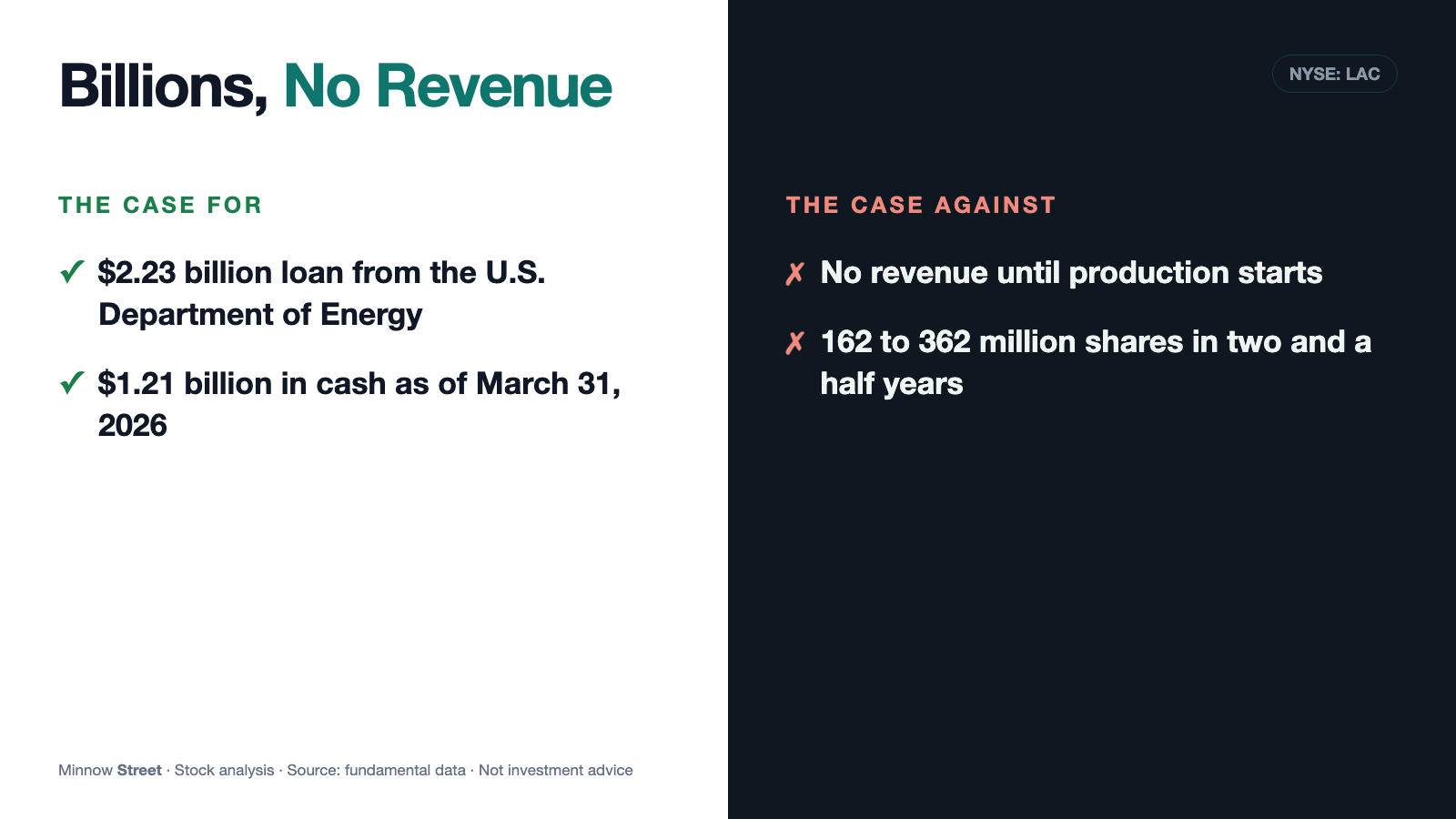
The largest lithium mine in the Western world is taking shape in Nevada, with General Motors as co-owner and a $2.23 billion loan from the U.S. Department of Energy. More than 1,300 people were working on the site in mid-May 2026, and $1.28 billion had been spent by March 31, 2026. Only one thing is entirely missing from the filings with the U.S. securities regulator, the SEC: a revenue line. That arrives with the production ramp-up in 2028 at the earliest. Until then the build is paid for by lenders, by a carmaker — and by shareholders, whose stake was diluted from 161.8 million shares at the end of 2023 to 361.8 million in June 2026. Not investment advice — just the question of who ends up owning the mine.
 Thomas Mücke
Founder & Publisher
Thomas Mücke
Founder & Publisher
Chart
Interactive price chart (TradingView).
Note: pure fact-based analysis, not investment advice and not a solicitation to buy or sell. All figures without guarantee.
There is an investor trap that catches the down-to-earth ones in particular — the people who want substance rather than slide decks. Call it the excavator trap. It works like this: you see photographs of cranes, structural steel, a half-finished plant, 1,300 people in hard hats. Your mind says: "That is real. You can touch it. It is going to work." And just like that you feel safe, without having checked a single number. Lithium Americas Corp. (NYSE and TSX: LAC) supplies that feeling in abundance. In the Nevada desert it is building Thacker Pass, the first large lithium plant in the United States; General Motors is a co-owner, the U.S. Department of Energy has committed a $2.23 billion loan, and senators and the governor of Nevada have visited the site. So let us make a deal. Before you buy the construction photograph, we will read together what the company itself has told the U.S. securities regulator, the SEC — the annual report (10-K) for 2025, the quarterly report (10-Q) for March 31, 2026, the earnings release of May 14, 2026 and the shelf prospectus of June 26, 2026. An SEC filing is honest under threat of prosecution. And this one describes a company without a single revenue line, a cash pile the parent may only partly touch, a profit born of its own share-price decline — and a share count that has more than doubled in two and a half years. What you make of it is up to you.
What Lithium Americas actually is — and which company it expressly is not
Start with the confusion, because it can be expensive. There are two companies with almost the same name, and they own entirely different things. Today's Lithium Americas Corp. was incorporated in British Columbia on January 23, 2023 — initially under the clerical name "1397468 B.C. Ltd.". Its sole purpose was to take over the North American business of the former Lithium Americas. That separation was completed on October 3, 2023, and the new entity took the familiar name. The Argentine lithium assets stayed with the predecessor, which is now called Lithium Argentina AG (previously Lithium Americas (Argentina) Corp., symbol LAAC). Remember this before you buy anything: LAC is Nevada. Argentina is somewhere else.
So what does this company do? It builds. Specifically, in Humboldt County in northern Nevada, inside an extinct supervolcano called the McDermitt Caldera, it is building a plant that leaches lithium out of claystone and processes it into battery-quality lithium carbonate — the white powder that goes into the cathodes of electric-vehicle batteries. Phase 1 is designed for 40,000 tonnes a year. Five phases are conceivable in total, up to 160,000 tonnes annually, with a possible mine life of up to 85 years, as stated in the 2025 annual report. The deposit is, according to the company, the largest known measured and indicated lithium resource in the world.
Ownership matters here, because it colors almost every figure in this analysis. Thacker Pass does not belong to Lithium Americas alone but to the joint venture Lithium Nevada Ventures LLC. Lithium Americas holds 62 percent of it, General Motors 38 percent (as of May 13, 2026). Because Lithium Americas holds the voting majority and runs the project under a management services agreement, it must fully consolidate the joint venture — the balance sheet therefore shows 100 percent of the assets even though only 62 percent belongs economically to its own shareholders. That is not sleight of hand, it is the rule under U.S. accounting standards; you simply have to know it when reading the numbers. The annual report itself presents the reserves in two columns: on a 100 percent project basis, 1,056.7 million tonnes of run-of-mine ore containing 14.3 million tonnes of lithium carbonate equivalent — and on a 62 percent control basis, 655.2 million tonnes containing 8.9 million tonnes (as of December 31, 2025).
That also frames the central tension of this analysis, and it runs through every chapter: on one side the largest known lithium deposit in the world, a carmaker as partner and a billion-dollar loan from the American government. On the other side no revenue, permanent cash outflow, and a share count growing faster than the construction site.
How the stock landed on our desk
Lithium Americas did not reach us through a buy-signal screen but through the laggard review of our stock universe: a company with more than three billion dollars of total assets that has no revenue line at all in our in-house stock scanner. Gaps like that are a reason to look closer — not because they are suspicious, but because they make the usual metrics useless.
Which is exactly what happens here. The Piotroski score, our nine-point test of balance-sheet quality, stands at 1 out of 9 (calculated on fiscal 2025; retrieved August 2, 2026). That sounds catastrophic, but it is largely structural: seven of the nine points test things like profit, margin improvement and asset turnover. Where there is neither revenue nor profit, those points cannot be earned. The same goes for the price-to-sales ratio (no sales, so no value), the price-to-earnings ratio (no earnings) and the Altman Z-score, which estimates bankruptcy risk by relating sales and operating income to total assets — both are zero here, so the score is systematically low without saying anything about actual solvency. Remember this: for a pre-operational mining developer you do not measure with earnings metrics, you measure with a stopwatch on the cash.
What the scanner does show usefully: an equity ratio of 41.1 percent and a debt-to-equity ratio of 0.49 — both calculated on fiscal 2025 (retrieved August 2, 2026), that is, before the second loan tranche; as of March 31, 2026 the equity ratio was 43.2 percent measured against equity attributable to LAC shareholders and 60.3 percent including the non-controlling interest. Alongside that, an analyst picture of 3.7 out of 5 points from 15 analysts (5 being the top mark; data as of August 2, 2026). Alongside that, short interest of 7.9 percent of the free float — there is a visible group betting on a falling price. Institutions hold 32.9 percent and insiders 7.0 percent (both as of August 2, 2026).
The numbers over the years — given their due
First what genuinely impresses, and at this company that is the funding. A mining developer with no income building a plant for close to three billion dollars is normally chronically short of money. Lithium Americas is the opposite. As of March 31, 2026 the books showed $1,207.6 million of cash and restricted cash — after $905.6 million at the end of 2025 and $446.9 million on March 31, 2025. Total assets grew to $3,112.7 million (end of 2025: $2,579.0 million) and mineral properties, plant and equipment to $1,667.3 million. One note for reading all the annual figures: the fiscal year at Lithium Americas matches the calendar year and ends on December 31.
Where the money came from and where it went is clearest in the first-quarter 2026 cash flow:
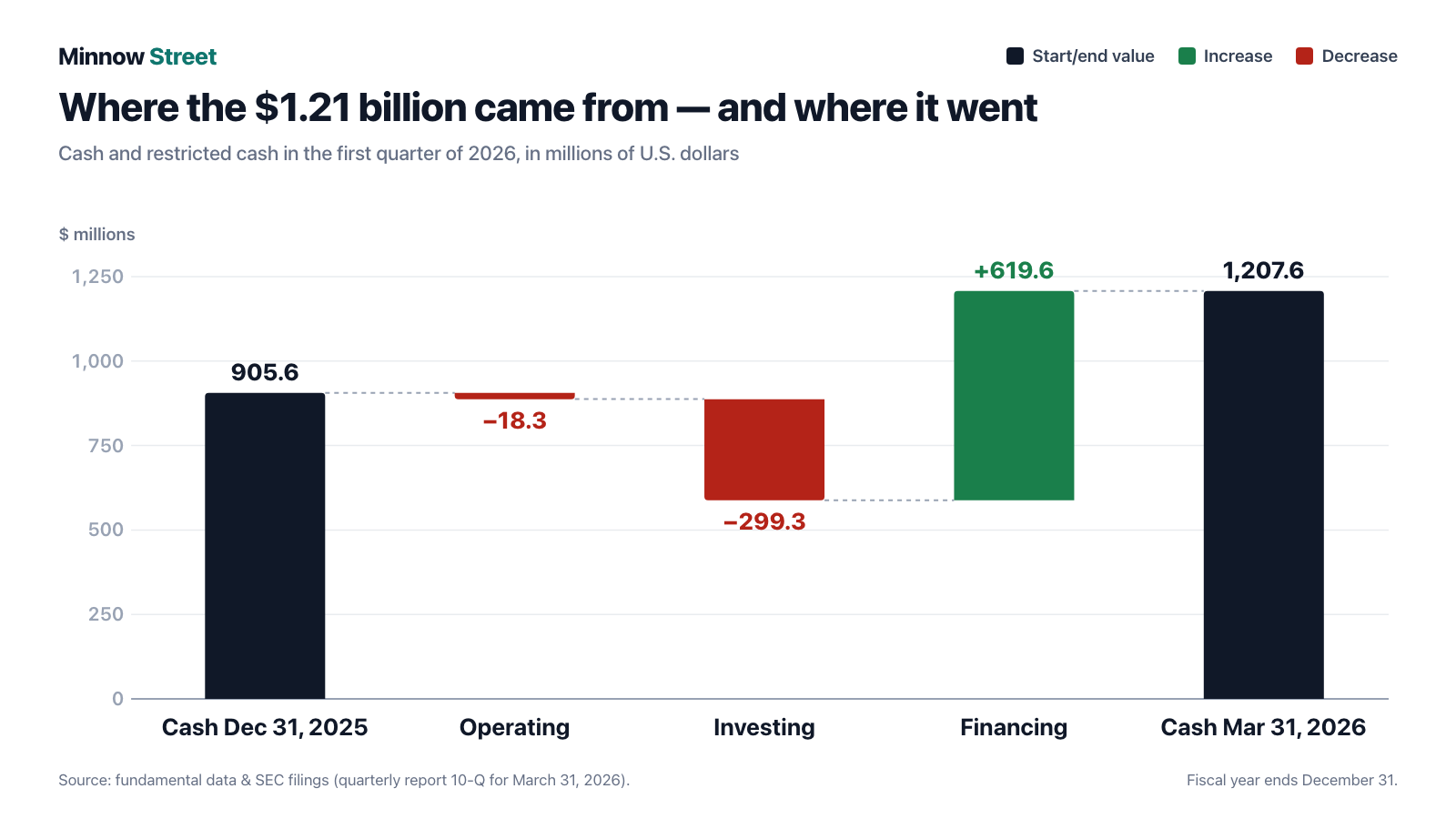
The $619.6 million financing inflow comes largely from two sources: $432.0 million from the second tranche of the Department of Energy loan (drawn on February 24, 2026) and $189.7 million net from selling 32.5 million new shares at an average of $5.92, less finance-lease principal payments and financing fees. The first tranche of $435.0 million had already arrived on October 20, 2025, at a fixed interest rate of 4.38 percent; repayment does not begin until January 2029 and the loan matures on July 20, 2048.
Construction progress is real and well documented too. As of March 31, 2026, the earnings release reports 2.43 million work hours without a serious injury (total recordable incident frequency rate of 0.25), detailed engineering more than 95 percent complete, procurement more than 70 percent complete, and roughly 1,065 people on site — by mid-May 2026 the number exceeded 1,300, and it is expected to pass 2,000 at peak. In all, $1,277.2 million of construction and project costs had been capitalized through March 31, 2026. Only $1,138.1 million of that counts toward the $2.93 billion frame, however; the remaining $101.4 million of other capitalized development costs and $37.7 million of capitalized interest are not part of that estimate at all.
And the revenue side? There isn't one. The quarterly report puts it as plainly as it can:
"The Company has recurring net losses and negative operating cash flows and expects to continue to operate at a loss for the foreseeable future, which includes the period that Thacker Pass Phase 1 is under development. As the Company develops Thacker Pass, it will not generate revenues from operations and there is no expectation it will generate any revenue from operations until after Thacker Pass begins production."
— Lithium Americas Corp., SEC quarterly report 10-Q for March 31, 2026, "Liquidity and Capital Resources"

What appears in the income statement instead is costs and valuation effects. In 2025 operating expenses were $52.8 million (2024: $28.3 million) and the net loss $86.3 million (2024: $42.6 million). Here too it pays to read one line further: Lithium Americas shareholders bore a loss of $122.1 million, while $35.8 million of income was attributed to the non-controlling interest. In the first quarter of 2026 general and administrative expenses rose to $11.1 million from $6.5 million a year earlier — the result of hiring, share-based compensation and higher professional and regulatory fees. Which brings us to the uncomfortable truths.
What the filings say — the uncomfortable truths
Uncomfortable truth no. 1: the quarterly profit does not belong to shareholders — and it exists because the share price fell
The headline of the first quarter of 2026 sounds like a turning point: net income of $4.6 million after an $11.5 million loss a year earlier. Read one line further and there are two catches. First, $5.0 million of that $4.6 million went to the non-controlling interest — that is, to General Motors. Lithium Americas shareholders were left with a loss of $0.4 million. Second, the swing did not come from the business but from a $14.3 million fair-value gain on an embedded derivative in the convertible note held by the resource investor Orion. And that gain has an awkward cause:
"This non-cash, fair value gain on the embedded derivative primarily reflects the impact of a decrease in the Company's share price from $4.36 at December 31, 2025 to $3.95 at March 31, 2026."
— Lithium Americas Corp., SEC earnings release 8-K Item 2.02, exhibit 99.1 of May 14, 2026
Translated into everyday terms: imagine you have promised an acquaintance that, if it comes to it, you will hand over your apartment at a fixed price. If property prices fall, that promise becomes less burdensome for you — on paper you have grown "richer". Nobody would claim you had earned anything. That is exactly what happened here: the reported profit is the mirror image of the company's own share-price loss, not cash in the bank. The reverse holds too. In 2025 the same convertible note produced a loss of $171.0 million, while the Department of Energy warrants produced a gain of $160.0 million. Numbers like these move the bottom line by hundreds of millions without a single dollar changing hands.
Uncomfortable truth no. 2: much of the cash belongs to the parent on paper only
Of the $1,207.6 million of cash at March 31, 2026, $449.1 million is restricted. It sits in accounts of the project company Lithium Nevada, managed by a collateral agent (Citibank), and may only be moved under the rules of the loan agreement. It becomes even clearer when you ask whether money may travel upward:
"The DOE Loan imposes certain restrictions on the transfer of assets from LN to the Company, including prohibitions on dividend payments and loans from LN to the Company, the making of other payments to the Company, and transfers of any assets comprising part of the collateral package."
— Lithium Americas Corp., SEC quarterly report 10-Q for March 31, 2026, "Joint Venture with GM"
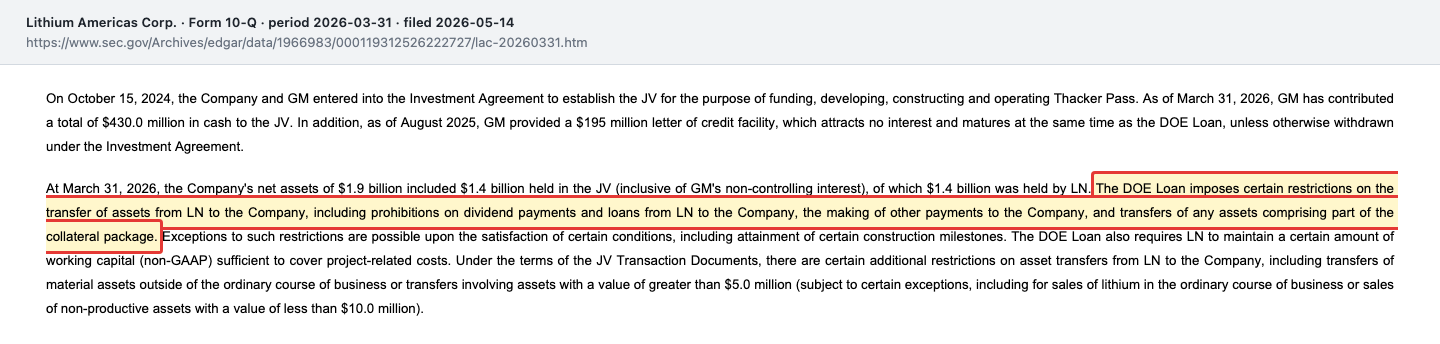
None of this is unusual for a project financing — the lender wants certainty that its money stays in the mine rather than draining into head office. For you as a shareholder it still means something concrete: the billion-dollar cash pile is a construction account, not a war chest. And part of it is already spoken for. The company has committed to paying a further $120 million into the reserve accounts within twelve months of the loan amendment of October 7, 2025 — roughly 16 percent of the $758.5 million of unrestricted funds held at March 31, 2026.
Uncomfortable truth no. 3: dilution is not a side effect here, it is the funding model
Dilution means your slice of the cake gets smaller because new slices keep being cut. At Lithium Americas that is not a footnote but one of the three pillars of funding, alongside the federal loan and the money from General Motors. The trend is unambiguous:
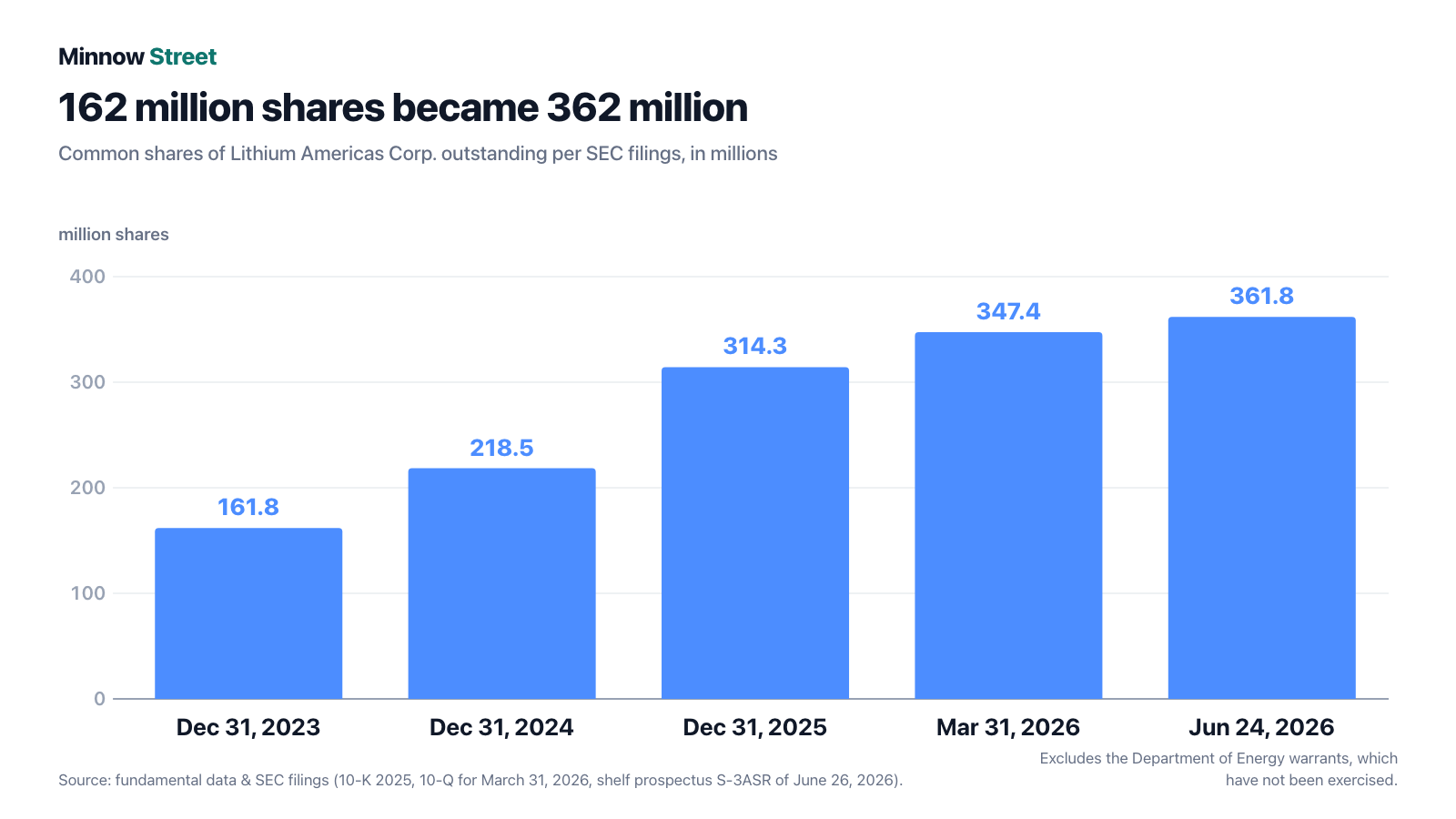
The mechanism is the at-the-market program, under which a company sells new shares in small slices directly on the exchange without announcing a fixed offering price. The first of these programs ran in October 2025: launched on October 8 and already completed on October 14, it placed 30.5 million shares at an average of $8.19 for net proceeds of $246.4 million. The program launched in November 2025 was completed on January 26, 2026: 43.3 million shares at an average of $5.78, for net proceeds of $246.7 million. On March 19, 2026 the next program followed, for up to $250 million; through May 13, 2026 it had sold 2.3 million shares at an average of $5.20. On top of that, in October 2025 the investor Orion converted $97.5 million of note principal into 25.8 million new shares.
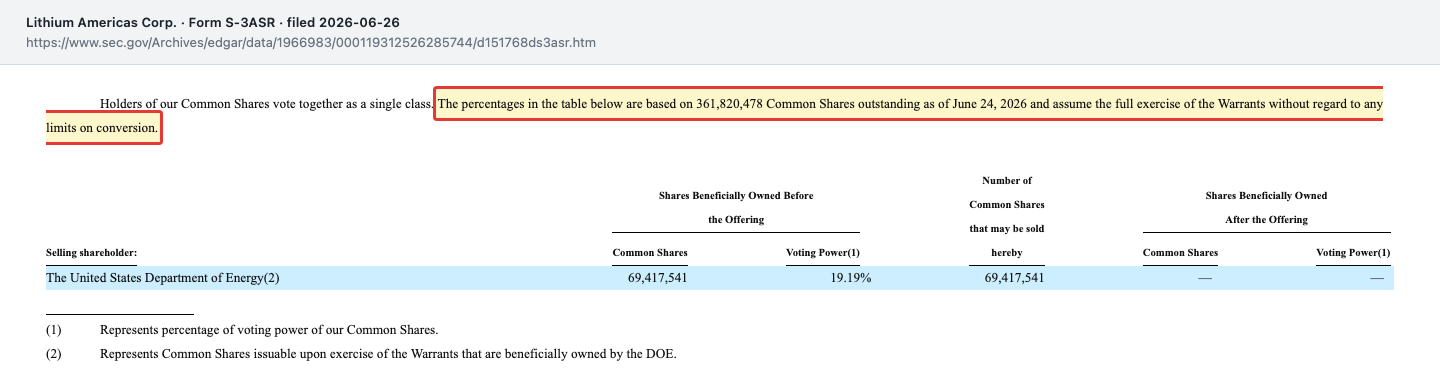
And then there is the government. Since January 30, 2026 the U.S. Department of Energy has held a warrant for 18,268,687 shares at one cent apiece — equal to 5 percent of all shares then outstanding — plus a second warrant for 8,656,509,695 non-voting units of the joint venture, again economically 5 percent. On June 26, 2026 Lithium Americas filed a shelf prospectus registering the resale of up to 69,417,541 shares by the department. The warrants had not been exercised at that point — the prospectus expressly describes the shares as issuable upon exercise, which is why they are not yet part of the share count in the chart above:
If the joint-venture warrant is exercised in full, the stake in the mine itself shifts as well. The quarterly report spells it out:
"In the event that the DOE exercises the JV Warrant in full, the JV economic interests will be (prior to funding of the additional $120 million DOE Loan reserve accounts as required within 12 months of the OWCA) 59% held by Lithium Americas, which will continue to be the manager of the Project, 36% held by GM and 5% held by the DOE, with voting interest in the JV remaining 62% for Lithium Americas and 38% for GM."
— Lithium Americas Corp., SEC quarterly report 10-Q for March 31, 2026, "Department of Energy Loan"
Put both layers together and the picture is clear: of the 40,000 tonnes of annual phase 1 capacity, a Lithium Americas shareholder would be economically entitled to 59 percent — and would share that entitlement with roughly 20 percent more shares if the government exercises its rights. Growth paid for with fresh equity and warrants is never entirely free.
Uncomfortable truth no. 4: the cost estimate everything hangs on is out of date — and the structural steel travels through a war zone
Every figure on the economics of Thacker Pass rests on the technical report dated December 31, 2024 and its capital estimate of $2.93 billion for phase 1. The earnings release of May 14, 2026 states outright what is missing: "The total Capex estimate of $2.93 billion did not include any exposure to tariffs." The company now puts that exposure at roughly $80 million to $120 million, mostly falling in 2026. The same document adds the consequences of the Middle East conflict, higher fuel prices and general inflation. A new, definitive capital estimate is therefore under way, with completion targeted for the second half of 2026. For fiscal 2026 the company guides to capital expenditure of $1.3 billion to $1.6 billion.
And then there is a risk you do not expect to meet in a balance-sheet analysis. It sits in the risk factors of the 2025 annual report:
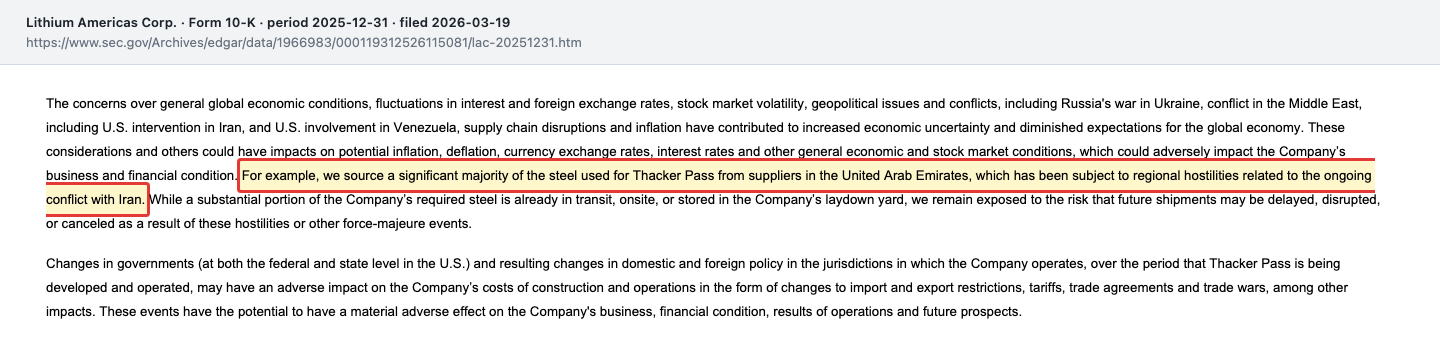
"For example, we source a significant majority of the steel used for Thacker Pass from suppliers in the United Arab Emirates, which has been subject to regional hostilities related to the ongoing conflict with Iran."
— Lithium Americas Corp., SEC annual report 10-K for 2025, Item 1A "Risk Factors"
The earnings release adds that more than 75 percent of the structural steel is already in transit or on site, and that shipments were rerouted through the Port of Jeddah after the closure of the Strait of Hormuz. That is good crisis management — and at the same time proof of how thin the thread is that holds a schedule running to the end of 2027. How quickly timetables slip at capital-intensive energy projects is something we have seen at other manufacturers in the energy transition, for instance in our analysis of Eos Energy.
Uncomfortable truth no. 5: part of the future revenue is sold before the first dollar arrives
In April 2025 Lithium Americas raised a total of $220.0 million from funds managed by the resource investor Orion Resource Partners. The annual report splits the sum: Orion paid $195.0 million for senior unsecured convertible notes and a further $25.0 million for payments tied to the minerals produced and the gross revenue generated by Thacker Pass. The notes carry a conversion price of $3.78 per share and interest of 9.875 percent, and mature on April 1, 2030; outstanding principal was $113.2 million as of March 31, 2026. So far, so ordinary for a developer without income.
The second part of the deal, the one those $25.0 million bought, is more interesting: a production payment agreement. Under it Orion receives fixed payments per tonne of lithium processed for 72 quarters after first production — plus 0.96 percent of total gross revenue in perpetuity. Both apply to the first 41,500 tonnes a year, which in practice means the whole of phase 1 capacity of 40,000 tonnes. The annual report adds a sentence worth reading twice:
"The PPA has not been included in the economic model of the Reports."
— Lithium Americas Corp., SEC annual report 10-K for 2025, "Orion Investment"
In other words, the attractive economics in the technical reports do not know about this royalty. The same applies to a second anchor: the reserve estimate was optimized on an assumed sales price of $29,000 per tonne of lithium carbonate (pit optimization of 2024). Whether that price is realistic across an 85-year mine life is the real wager behind the entire project — the annual report explicitly warns that lithium products are not quoted on any major commodities exchange and that their prices can be volatile.
Valuation: what can be calculated — and what cannot
This is where it gets uncomfortable, honestly uncomfortable: the usual valuation metrics do not exist for this company. No price-to-earnings ratio, because there is no sustained profit. No price-to-sales ratio, because there are no sales. No meaningful Altman Z-score, because its formula needs sales and operating income. Anyone looking for a metrics table here will find blanks — and that is the correct answer, not an arithmetic failure.
What can be calculated properly is book value. As of March 31, 2026, equity attributable to Lithium Americas shareholders stood at $1,343.9 million, with the General Motors share of the joint venture ($532.9 million) presented separately. Spread across the 347.4 million shares outstanding on the same date, that gives a book value of roughly $3.87 per share. For the same date the company cites a share price of $3.95. At the end of March 2026 the stock therefore traded roughly at book value.
On market capitalization we deliberately pair dates that belong together, rather than multiplying a June share count by a March price. Two pairs are available. First, the quarter-end: 347.4 million shares times $3.95, both as of March 31, 2026, gives roughly $1.37 billion. Second, the interim-reporting date: the cover page of the quarterly report shows 351,062,478 shares as of May 13, 2026 — and that is exactly the count behind the market capitalization in our fundamental data, which is therefore internally consistent. It differs from our cross-check only because of the price anchor: the last share price documented in an SEC filing dates from March 18, 2026 ($4.28) and is months old. For an evergreen article neither daily price works as a valuation statement, so we record only the order of magnitude: a good $1.3 billion as of March 31, 2026.
For comparison, capitalized construction costs in the mine stood at $1,277.2 million on March 31, 2026. Economically, though, only 62 percent of that belongs to a Lithium Americas shareholder — roughly $792 million; and of the $2.93 billion total frame for phase 1, roughly $1.8 billion falls to him, before tariffs. For the LAC share, the market is therefore paying noticeably more than has been built into it so far, but distinctly less than the full stake in the finished plant.
And the professional view? The 15 analysts we track average 3.7 out of 5 points (5 being the top mark), with a mean price target of about $5.71 (data as of August 2, 2026). At the same time 7.9 percent of the free float is sold short. Together those two describe the situation better than either alone: the professional world thinks the project is valuable and the road to it risky.
Opportunities and risks at a glance
What speaks for Lithium Americas:
- An asset of rare scale: Thacker Pass is, per the company, the largest known measured and indicated lithium resource in the world; proven and probable reserves stood at 1,056.7 million tonnes of run-of-mine ore containing 14.3 million tonnes of lithium carbonate equivalent on a 100 percent project basis as of December 31, 2025.
- Funding is unusually far advanced: a $2.23 billion Department of Energy loan (of which $867.0 million was drawn in two tranches through February 24, 2026), $430.0 million of cash contributed by General Motors plus a $195 million letter of credit facility, and $1,207.6 million of cash at March 31, 2026.
- An offtaker is contractually locked in — though not for the full volume: per the annual report, General Motors takes 20 percent of its own lithium requirements, up to 100 percent of phase 1 production, under an agreement extended to 20 years; for volumes General Motors does not take in the first five years, the loan amendment expressly permits the joint venture to sign third-party offtake agreements. On top of that comes a 20-year agreement for up to 38 percent of phase 2 volumes.
- Construction is running and well documented: 2.43 million work hours without a serious injury, detailed engineering more than 95 percent and procurement more than 70 percent complete, mechanical completion targeted for late 2027 (as of March 31, 2026).
- Operating cash burn is small: only $18.3 million in the first quarter of 2026 — the company itself is lean, and only the build is expensive.
What speaks against it:
- No revenue, and expressly none until production begins: mechanical completion late 2027, ramp-up 2028. Until then every valuation is a bet on a schedule.
- Dilution as a permanent condition: 161.8 million shares on December 31, 2023, 361.8 million on June 24, 2026 — up 124 percent. Plus a shelf prospectus covering up to 69,417,541 shares for the U.S. Department of Energy, 19.19 percent of voting power.
- The cash is only partly free: $449.1 million of the $1,207.6 million is restricted, and the loan agreement bars the project company from paying dividends or lending to the parent; a further $120 million must be paid into reserve accounts by October 2026.
- The cost base is out of date: the $2.93 billion estimate contains no tariffs (an expected $80 million to $120 million), no consequences of the Middle East conflict and no recent inflation; a new definitive estimate arrives only in the second half of 2026.
- The shareholder gets only part of it: economically 62 percent of the project, and 59 percent after full exercise of the government warrant — while part of future revenue is already assigned to Orion through the production payment (0.96 percent of gross revenue in perpetuity), which is not included in the economic model of the technical reports.
- The whole economic case rests on a lithium price set at $29,000 per tonne in the pit optimization — for a product that is not quoted on any major commodities exchange.
A human conclusion
Back to the excavator trap from the beginning. Its core is not that the construction site is fake — it is as real as anything gets: 1,300 people, 2.43 million work hours, $1.28 billion spent. Its core is that visible progress feels like safety, when all it proves is that money has been spent. Anyone buying Lithium Americas today is buying three very concrete things. First, a share of an extraordinary deposit — economically 62 percent, and soon perhaps 59. Second, a schedule: mechanical completion late 2027, ramp-up 2028, and not a cent of revenue before that. Third, an invoice that is still being written — the definitive cost estimate is outstanding, $80 million to $120 million of tariffs are priced in nowhere so far, and if money runs short it will come from the same place as before: from you, through new shares. So the honest question is not "will the mine get built?" — it very probably will. The question is: are you willing to fund a construction site for two years whose final cost is not yet known, and watch your share of it shrink while you do? If yes, you have a thesis. If no, you had a photograph. What you make of it is up to you.
Sources
Every original document used in this analysis, so you can read it yourself:
- Lithium Americas Corp. — SEC quarterly report 10-Q for March 31, 2026 (filed May 14, 2026)
- Lithium Americas Corp. — SEC earnings release 8-K Item 2.02, exhibit 99.1 of May 14, 2026
- Lithium Americas Corp. — SEC annual report 10-K for 2025 (filed March 19, 2026)
- Lithium Americas Corp. — SEC amendment 10-K/A to the 2025 annual report (filed April 30, 2026, Part III)
- Lithium Americas Corp. — SEC shelf registration S-3ASR of June 26, 2026
- Lithium Americas Corp. — SEC prospectus supplement 424B5 of March 19, 2026 ($250 million at-the-market program)
- Lithium Americas Corp. — SEC report 8-K of June 23, 2026 (results of the annual meeting of June 22, 2026)
- Full SEC filing history of Lithium Americas Corp.: EDGAR overview (sec.gov)
- Fundamental data (scanner metrics, analyst picture, short interest; data as of August 2, 2026), reconciled with the SEC filings.
Transparency & disclaimer: this analysis is journalistic commentary on publicly available information. It is not investment advice, not a financial analysis in the regulatory sense and not a solicitation to buy or sell securities. Equity investments carry substantial risks up to and including total loss. All information is provided without warranty; the data date is noted in each case in the text. The author holds no position in Lithium Americas Corp. shares at the time of publication.
Our Bottom Line at a Glance
- Asset and partners positive
- Thacker Pass is, according to the company, the largest known measured and indicated lithium resource in the world; proven and probable reserves stood at 1,056.7 million tonnes of run-of-mine ore containing 14.3 million tonnes of lithium carbonate equivalent as of December 31, 2025 (100 percent project basis). General Motors holds 38 percent and is tied in through 20-year offtake agreements — backing few developers of this size can claim.
- Funding and liquidity positive
- As of March 31, 2026 the books held $1,207.6 million of cash and restricted cash, while operating cash outflow for the quarter was only $18.3 million. Of the $2.23 billion Department of Energy loan, two tranches of $435.0 million and $432.0 million had been drawn; repayment does not start until January 2029. The company considers itself funded for at least twelve months.
- Earnings position negative
- There is no revenue and, per the quarterly report for March 31, 2026, none until production begins; mechanical completion is targeted for late 2027 and the ramp-up for 2028. The reported quarterly profit of $4.6 million included $5.0 million belonging to the non-controlling interest and arose from a valuation gain triggered by the company's own share price falling from $4.36 to $3.95.
- Dilution and ownership negative
- Shares outstanding rose from 161.8 million (December 31, 2023) to 361.8 million (June 24, 2026), up 124 percent. In addition, the shelf prospectus of June 26, 2026 registers up to 69,417,541 shares for the U.S. Department of Energy, which the document puts at 19.19 percent of voting power. Economically, an LAC shareholder owns 62 percent of the project, and 59 percent after full exercise of the joint-venture warrant.
- Cost certainty negative
- The capital estimate of $2.93 billion comes from the technical report dated December 31, 2024 and, per the earnings release of May 14, 2026, expressly contains no tariffs; the company expects $80 million to $120 million for those alone. A new definitive cost estimate is announced for the second half of 2026. Until then the decisive number of the project is open.
- Availability of funds neutral
- Of $1,207.6 million of cash, $449.1 million is restricted and sits in project-company accounts managed by a collateral agent; the loan agreement bars that company from paying dividends or lending to the parent. A further $120 million must go into reserve accounts by October 2026. For a project financing this is normal — but the total should not be read as a freely available cushion.
Lithium Americas is developing the largest known lithium deposit in the world at Thacker Pass in Nevada — funded by a $2.23 billion loan from the U.S. Department of Energy, by General Motors with $430.0 million of cash, and by its own shareholders, whose stake keeps shrinking: 161.8 million shares on December 31, 2023 became 361.8 million on June 24, 2026. There is no revenue before the 2028 production ramp-up, $5.0 million of the $4.6 million quarterly profit belonged to the co-owner and the rest came from a valuation effect of the company's own share-price decline, and the $2.93 billion cost estimate contains neither tariffs nor the consequences of the Middle East conflict. Anyone investing here is funding a construction site with an open final bill. Not investment advice.
What Our Rating Means
Open questions
The business works in principle, but one material question is open. As long as it stays open, our findings do not carry a quality verdict.
Yellow, and deliberately neither green nor red. Not green, because the material operational question is simply still open: the company has no revenue, expects none before production begins per the quarterly report for March 31, 2026, and its entire value rests on whether a plant reaches mechanical completion by the end of 2027 — a plant whose definitive cost estimate is not due until the second half of 2026, with the existing figure of $2.93 billion expressly excluding tariffs the company puts at $80 million to $120 million. Not red, because no risk to the substance of the business is documented: there is no going-concern warning, equity attributable to shareholders is $1,343.9 million, cash of $1,207.6 million covers the operating outflow of $18.3 million per quarter many times over, repayment of the federal loan does not begin until January 2029, and all loan covenants were met as of March 31, 2026. The dilution from 161.8 million to 361.8 million shares is substantial and expensive for existing holders — but it threatens their share of the company, not the company itself. Whether the stock is cheap or expensive is a separate matter, decided by the scanners rather than by this rating. The decision is yours.
A journalistic assessment by our editorial team at the time of the deep dive, based on public sources — not investment advice and not a solicitation to buy or sell. Your personal circumstances (investment goals, risk capacity, taxes) cannot be taken into account. What our levels mean, how verdicts are formed, and what conflicts of interest exist →
Worth Noting
- Lithium Americas reached our research list through the laggard review of our stock universe: a company with more than three billion dollars of total assets and no revenue line at all. Classic earnings metrics (price-to-earnings, price-to-sales, Altman Z-score) cannot be calculated here or carry no meaning; the Piotroski score of 1 out of 9 (data as of August 2, 2026) is structural, because seven of the nine points test profit, margin or asset turnover.
- Risk of confusion: this Lithium Americas Corp. (CIK 0001966983) was created on January 23, 2023 as "1397468 B.C. Ltd." and took over only the North American business in the separation of October 3, 2023. The Argentine assets sit with the sister company, today named Lithium Argentina AG (formerly Lithium Americas (Argentina) Corp., symbol LAAC). Despite Canadian incorporation the company reports under U.S. GAAP and files 10-K/10-Q rather than 40-F or 20-F.
- On market capitalization: the article states only an order of magnitude built from dates that belong together — 347.4 million shares times $3.95, both as of March 31, 2026, so a good $1.3 billion. The market capitalization in the fundamental data is internally consistent: it uses the 351,062,478 shares from the cover page of the quarterly report (as of May 13, 2026). It differs from a cross-check against the last share price documented in an SEC filing only because that anchor dates from March 18, 2026 and is months old. Analyses are evergreen; daily prices are not a reason to buy.
- Currency of the data: the most recent periodic report is the quarterly report 10-Q for March 31, 2026 (filed May 14, 2026). Every filing from that day onward was reviewed — the earnings release 8-K of May 14, 2026, a Schedule 13G/A of May 15, 2026, an 8-K and an SD of June 23, 2026, the shelf registration S-3ASR of June 26, 2026, and insider filings (Form 4) of June 17, June 22, June 29 and July 8, 2026. No report for the second quarter of 2026 was available as of August 2, 2026.
Stock Watch
This analysis is as of August 2, 2026. Stock Watch will tell you what's changed at LAC since then.
Later $1 a month per stock — signing up is free, and you'll be the first to know when it launches.
Frequently Asked Questions
Lithium Americas Corp. (NYSE and TSX: LAC) is developing and building the Thacker Pass lithium project in Humboldt County, Nevada. Battery-quality lithium carbonate is to be produced from the claystone of the McDermitt Caldera, with phase 1 designed for 40,000 tonnes a year. There is no revenue yet: mechanical completion is targeted for late 2027 and the production ramp-up for 2028. The company had 94 full-time employees as of December 31, 2025.
Today's Lithium Americas Corp. was incorporated in British Columbia on January 23, 2023 as "1397468 B.C. Ltd." and took over only the North American business of the former Lithium Americas in the separation of October 3, 2023 — essentially Thacker Pass. The Argentine lithium assets stayed with the predecessor company, now named Lithium Argentina AG. Buying LAC means buying Nevada, not Argentina.
As of May 13, 2026 Lithium Americas held 62 percent of the joint venture Lithium Nevada Ventures and General Motors held 38 percent. Because Lithium Americas holds the voting majority, it consolidates the joint venture in full — the balance sheet therefore shows 100 percent of the assets. If the U.S. Department of Energy exercises its joint-venture warrant in full, the economic stake of Lithium Americas falls to 59 percent according to the quarterly report.
The company reported net income of $4.6 million after an $11.5 million loss a year earlier. Of that, $5.0 million went to minority owner General Motors; Lithium Americas shareholders were left with a loss of $0.4 million. The swing came from a non-cash fair-value gain of $14.3 million on a convertible note, triggered by the company's own share price falling from $4.36 to $3.95 during the quarter.
Through three pillars. First, a $2.23 billion loan from the U.S. Department of Energy, of which two tranches of $435.0 million and $432.0 million had been drawn by February 24, 2026; repayment starts in January 2029. Second, General Motors with $430.0 million of cash and a $195 million letter of credit facility. Third, sales of new shares: the November 2025 program alone brought in $246.7 million net.
Common shares outstanding rose from 161.8 million on December 31, 2023 to 361.8 million on June 24, 2026 — an increase of 124 percent. On top of that come the U.S. Department of Energy warrants: the shelf prospectus of June 26, 2026 registers the resale of up to 69,417,541 shares, which the document puts at 19.19 percent of voting power.
Because the usual metrics need revenue or earnings, and there is neither. A price-to-sales ratio is undefined without sales, a price-to-earnings ratio without earnings, and the Altman Z-score relates sales and operating income to total assets. Book value remains meaningful: roughly $3.87 per share as of March 31, 2026, against a share price of $3.95 cited by the company for the same date.
Three. First, the new definitive cost estimate for phase 1, targeted for the second half of 2026 — the old estimate of $2.93 billion contains no tariffs. Second, the payment of $120 million into the loan reserve accounts, due within twelve months of October 7, 2025. Third, mechanical completion at the end of 2027 as the precondition for the 2028 production ramp-up.
Found an error?
Did you spot a factual error, an outdated number, or a typo in this deep dive? Let us know briefly — your report goes straight to the editorial team.