Millrose Stock: A 10 Percent Dividend From Lennar's Land Machine — Which Has No Employees, and Whose Founder Kept the Keys
Millrose Properties stockpiles buildable land for America's homebuilders: the Lennar spin-off of February 2025 buys and develops lots and lets builders take them, finished, against monthly option payments — 143,347 homesites worth $9.2 billion (March 31, 2026). Our FCF/market-cap scanner ranks the stock near the top, the dividend yields roughly 10 percent annualized, and the shares trade below book value (data as of July 8, 2026). We read the first full annual report (10-K) and the quarterly report (10-Q) as of March 31, 2026: a REIT with no employees of its own, an external manager collecting 1.25 percent of total assets, a former parent providing 84 percent of revenue while holding special rights — and a scanner metric that measures the throughput of a machine here, not free money. Not investment advice — just the owner's manual for a dividend where you should know who holds the tap.
 Thomas Mücke
Founder & Publisher
Thomas Mücke
Founder & Publisher
Chart
Interactive price chart (TradingView).
Note: pure fact-based analysis, not investment advice and not a solicitation to buy or sell. All figures without guarantee.
There is an investor weakness that hits the sensible ones hardest: the yield-hunter's goggles. Put them on and the whole stock market sorts itself by a single column — the payout. Ten percent dividend yield? Shares below book value? And the scanner flags the stock near the top on free cash flow too? From that moment every objection feels like spoiling the fun, because the goggles show you the coupon, never the machine behind it. Exactly such a stock is on the table today: Millrose Properties (NYSE: MRP), the land spin-off of America's second-largest homebuilder Lennar — an annualized dividend yield of roughly 10 percent, about 0.85 times book value, and rank 15 in our FCF/market-cap ranking (as of July 18, 2026; price data as of July 8, 2026). So let's make a deal: before you buy the coupon, we read together what the company itself reported, under penalty of law, to the U.S. securities regulator, the SEC — the first full annual report (10-K) for 2025 and the quarterly report (10-Q) as of March 31, 2026. An SEC filing is honest under penalty of law, and this one answers three questions the yield-hunter's goggles filter out: Whom does this machine obey? Who earns a living off it? And what does the dream metric from the scanner actually measure? In the end, you decide for yourself.
What Millrose Properties actually does
Millrose runs a land bank — easiest to picture as a parking garage for buildable land. U.S. homebuilders like Lennar want as many lots as possible in their pipeline but as few as possible on their own balance sheet ("asset-light"). So the builder parks the lot at Millrose: Millrose buys the land, finances the horizontal development (roads, utilities, pad-ready lots), and the builder pays a monthly option fee for it — like a parking fee, generally based on 8.5 to 11 percent per year on the capital tied up. When a construction phase comes due, the builder "picks the car up": it exercises its purchase option and takes down the finished homesites at the pre-agreed price (the "takedown"). If it walks away from the option, it forfeits its deposit — as of March 31, 2026, builder deposits of more than $960.3 million sat with Millrose. The sale proceeds flow straight into the next lots: a capital-recycling machine that as of March 31, 2026 held 143,347 homesites across 904 communities and 30 states worth about $9.2 billion; the expected takedown prices across all lots add up to roughly $16.2 billion. The whole thing came into being on February 7, 2025, when Lennar distributed about 80 percent of Millrose's shares to its own stockholders (one Millrose share for every two Lennar shares) and sent the newcomer off with land worth about $5.5 billion plus about $1 billion of cash; three days later Millrose bought the land of homebuilder Rausch Coleman for roughly $859 million on top. For tax purposes Millrose is a REIT (real estate investment trust): such companies pay hardly any corporate income tax but must distribute at least 90 percent of their taxable income — hence the fat coupon. Two peculiarities set Millrose apart from an ordinary landlord REIT, and both will accompany us through this entire article: the company has no employees of its own — it is managed entirely by the external manager Kennedy Lewis for a fee charged on total assets — and its largest customer by far is, of all companies, former parent Lennar, which secured itself extensive special rights on the way out. That names the central tension of this analysis: a predictably earning land machine with a ten percent payout below book value — but you are buying a machine that obeys two others: the manager, who earns on its size, and the founder, who keeps governing without owning meaningful shares. How a scanner dream metric misleads at loan-book companies is something we just walked through at Consumer Portfolio Services — and what actually counts at REITs instead of earnings and cash flow, in our look at property landlord CTO Realty Growth.
Where the stock shows up in our scanner — and why caution is warranted right here
We run roughly 3,500 stocks through our in-house stock scanner every day. MRP delivered 8 hits as of the July 8, 2026 data cut — a remarkable confluence of trend and substance: price above the 50-day and the 200-day line, a Power Trend, tight weekly closes, plus net insider buying (five purchase filings, zero sales), rising institutional ownership, a place in the EBIT-margin ranking (85 percent margin — more on that in a moment), and of course the FCF/market-cap scanner, where MRP ranked 15th among U.S. names (as of July 18, 2026). To check for yourself: open the MRP stock page or browse the FCF/market-cap scanner. And now the footnote that turns this chapter into the most important one of the article: at Millrose, the metric "free cash flow over market cap" does not measure what it claims to measure. Per the filings, roughly $3.76 billion of operating cash flow flowed to Millrose in the four quarters through March 31, 2026 — against a market cap of about $5.0 billion that would be a multiple of roughly 1.3, an "FCF yield" of about 75 percent. The catch sits in the bookkeeping of a recycling machine: when a builder takes down homesites, Millrose records the sale proceeds in operating cash flow — but when Millrose buys new land, the outflow sits in investing cash flow. Sales on top, purchases below: the "operating" cash flow therefore contains proceeds from land sales whose purchase never ran through the same line. A merchant allowed to strike the cost of goods from his invoice would show a dream margin too. Remember the image: at a capital-recycling machine, operating cash flow is the conveyor belt, not the profit — FCF/market cap counts what moves across the belt, not what sticks. What actually sticks is in the income statement — so that is where we go.
The numbers over the years — honestly appraised
First, what genuinely impresses — and that is quite a lot. Millrose earned money from day one as a freshly spun-off company: in the stub fiscal year from the February 7 spin-off through December 31, 2025 it posted $600.5 million of revenue ($571.0 million of option fees plus $29.5 million of interest from development loans), $486.1 million of operating income — an operating margin of 85 percent, of the kind only a business without payroll and production costs can produce — and $404.8 million of net income, or $2.44 per share. AFFO, the payout-capacity measure that matters for REITs, came to $427.9 million, or $2.58 per share. The capital works with striking predictability: as of March 31, 2026 invested capital earned a weighted 9.2 percent — 8.5 percent on the Lennar contracts, 10.7 to 11 percent on contracts with other builders. And the machine accelerates quarter after quarter:
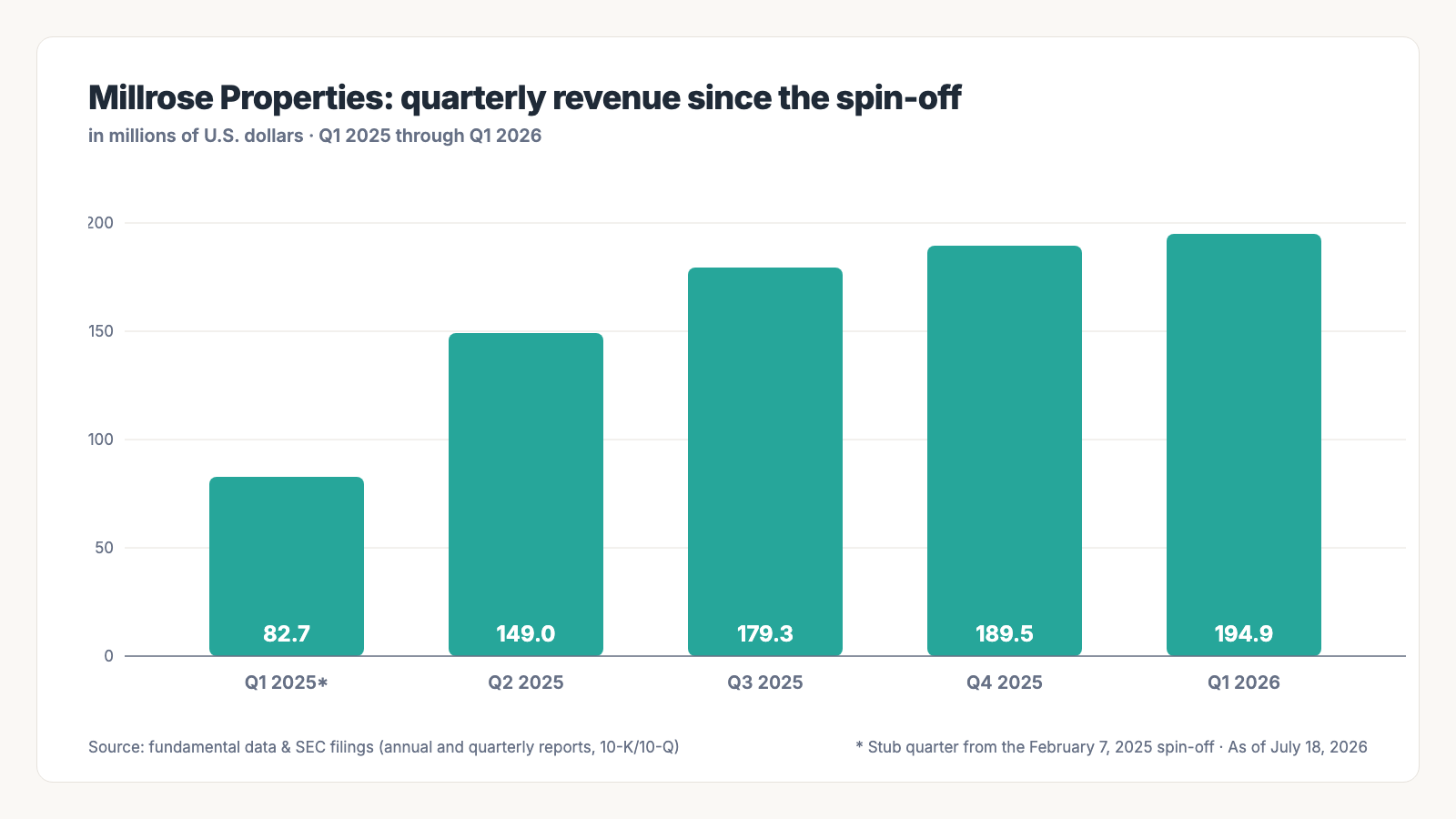
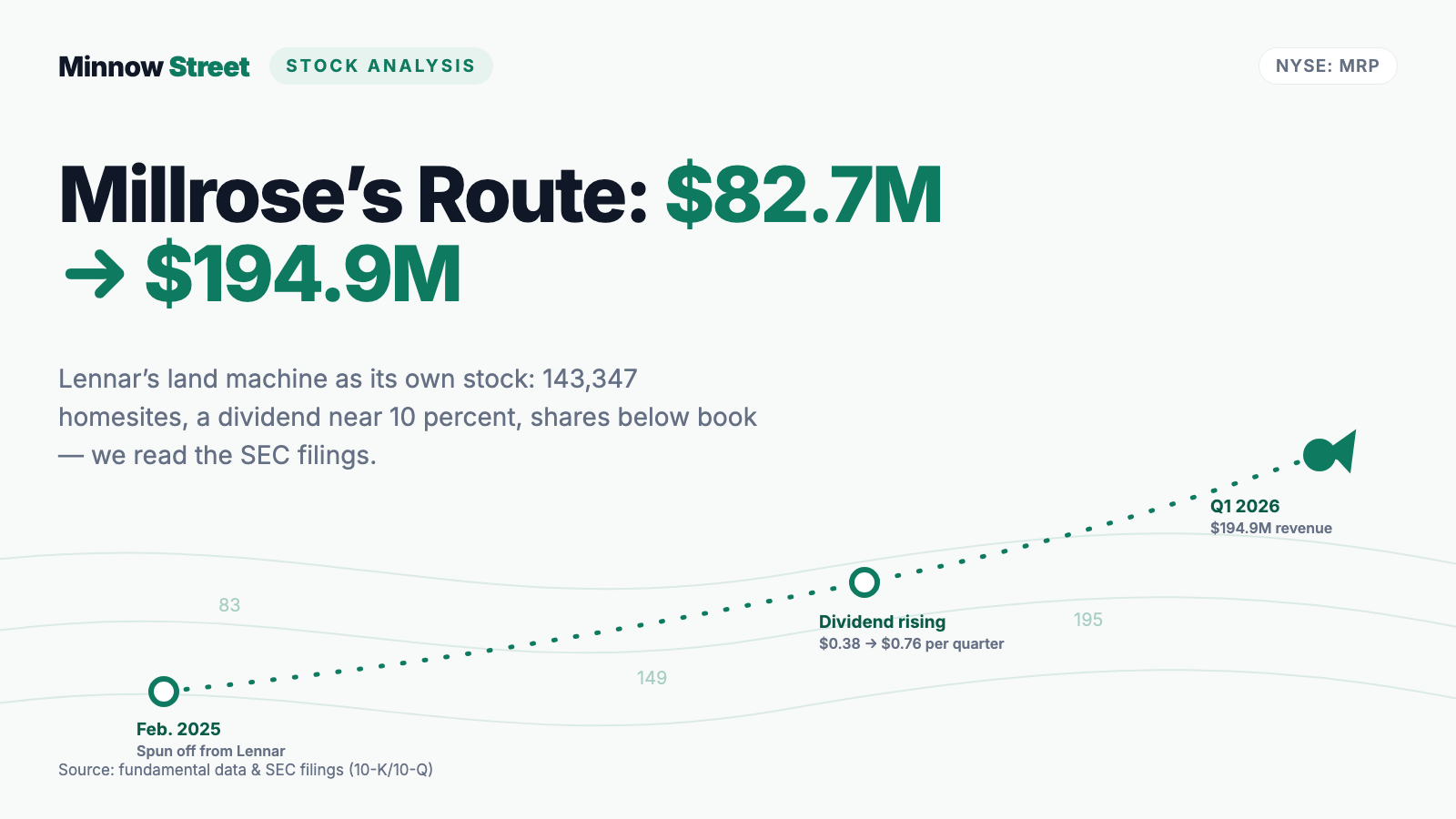
The latest quarter also convinces at first glance: $194.9 million of revenue and $122.9 million of net income ($0.74 per share) in the first quarter of 2026, and the dividend was raised for the fifth time in a row — from $0.38 (April 2025) through $0.69, $0.73 and $0.75 to $0.76 per quarter (paid April 15, 2026). The balance sheet behind it: $9.57 billion of total assets, $5.85 billion of equity (about $35.30 per share), debt of $2.46 billion — $1.25 billion of notes at 6.375 percent (due 2030), $750 million at 6.25 percent (due 2032), $425 million drawn on the credit line — a moderate leverage of roughly 0.42 times equity, whose 1:1 ceiling is, however, contractually cemented (more on that later). So much for the sunny side. The other axis is what the second chart shows — the cash-flow structure that explains why the scanner metric misleads here:
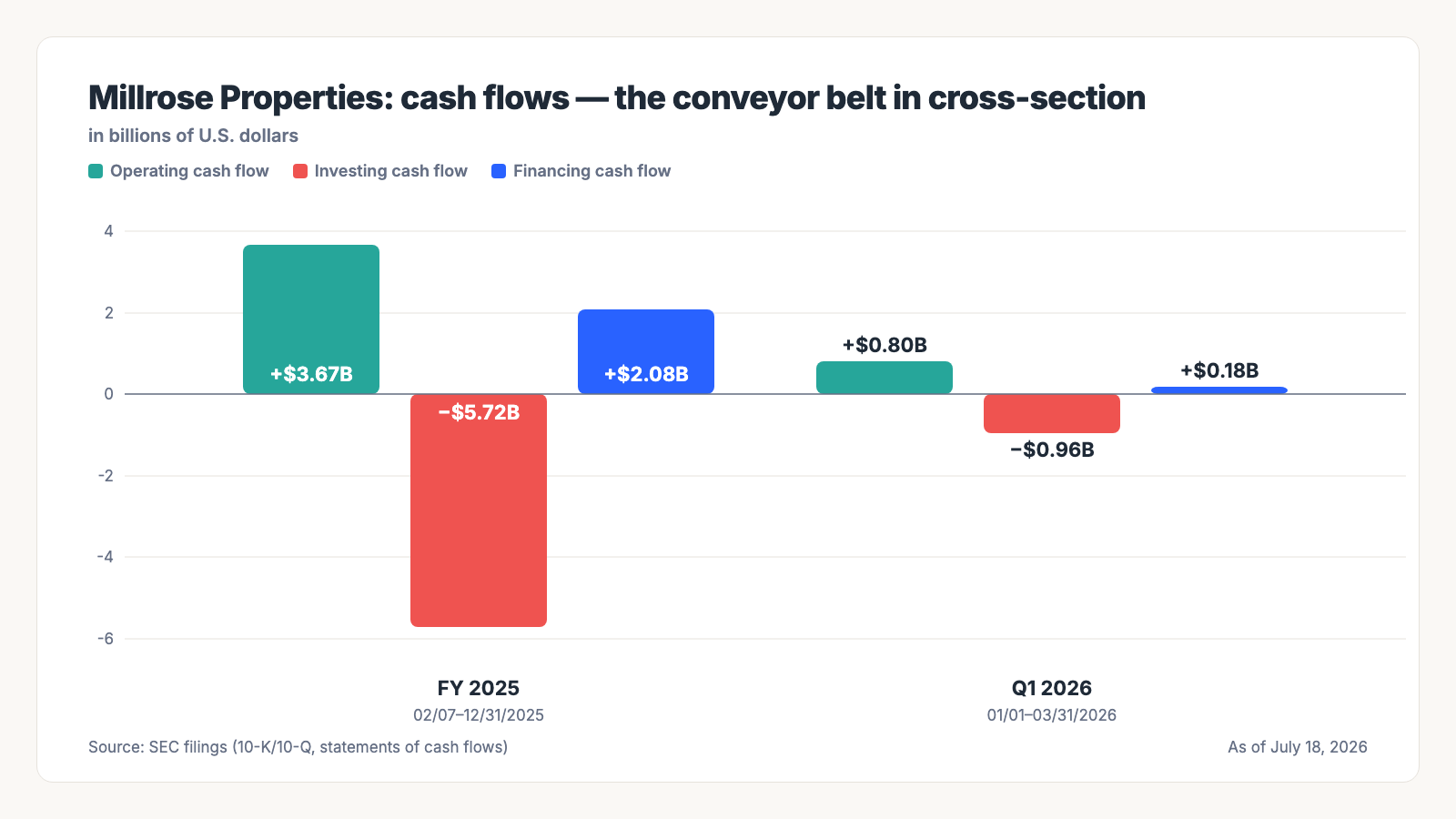
Remember this pattern: the $404.8 million of net income is real — the $3.7 billion of "operating cash flow" is turnover on a conveyor belt. Which brings us to the uncomfortable truths.
What the filings say — the uncomfortable truths
Uncomfortable truth no. 1: the dream metric counts land sales as operating cash flow — the purchases sit in a different line
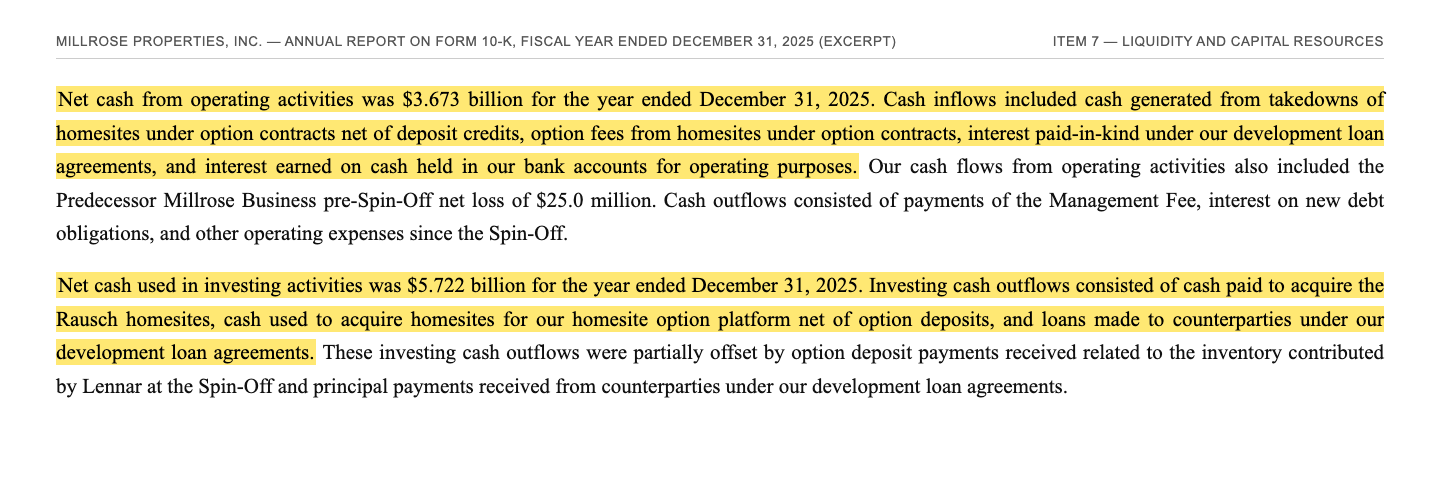
Let's start with the number that lured you here. The annual report itself describes what the operating cash flow consists of:
"Net cash from operating activities was $3.673 billion for the year ended December 31, 2025. Cash inflows included cash generated from takedowns of homesites under option contracts net of deposit credits, option fees from homesites under option contracts, interest paid-in-kind under our development loan agreements, and interest earned on cash held in our bank accounts for operating purposes."
— Millrose Properties, Inc., SEC annual report 10-K for fiscal year 2025, Item 7 "Liquidity and Capital Resources"
The first item is the decisive one: "takedowns of homesites" — the sales of lots to the builders. And where are the purchases? Two paragraphs further down:
"Net cash used in investing activities was $5.722 billion for the year ended December 31, 2025. Investing cash outflows consisted of cash paid to acquire the Rausch homesites, cash used to acquire homesites for our homesite option platform net of option deposits, and loans made to counterparties under our development loan agreements."
— Millrose Properties, Inc., SEC annual report 10-K for fiscal year 2025, Item 7 "Liquidity and Capital Resources"
Add it up: $3.67 billion came in "operationally", $5.72 billion went into new land, and the gap was closed by $2.08 billion of financing cash flow — essentially the two note issues totaling $2 billion and the credit line, less dividends paid. That is no accusation against Millrose — the classification follows the accounting rules for this business model, and the company discloses everything. The accusation is aimed at the unreflected metric: a "free cash flow" that contains sale proceeds whose cost of goods sits in a different line is useless as a valuation yardstick. Telling: our own scanner permanently excludes banks and insurers for exactly this reason — land bankers like Millrose show that the list of business models the formula was not built for is longer. The honest yardsticks here: net income ($404.8 million), AFFO ($427.9 million), book value ($5.85 billion) and the return on invested capital (9.2 percent). Measured by those, Millrose is solid — but no miracle with a 75 percent cash yield.
Uncomfortable truth no. 2: the REIT with no employees — 1.25 percent of total assets goes to a manager whose relationship is "contractual, not fiduciary"
Millrose employs nobody. All personnel — up to and including its own executive officers — are provided by the external manager Kennedy Lewis (in the report: "KL"), a subsidiary of the New York credit-fund house of the same name. In exchange flows a fee whose construction you should know:
"Millrose pays the Manager a quarterly Management Fee equal to 1.25% per annum (0.3125% per quarter) of Tangible Assets. Except for certain reimbursable expenses, all operating expenses incurred by Millrose and its subsidiaries in the ordinary course of business are paid for by the Manager and covered under the Management Fee."
— Millrose Properties, Inc., SEC annual report 10-K for fiscal year 2025, Item 1 "Business" (Management Agreement)
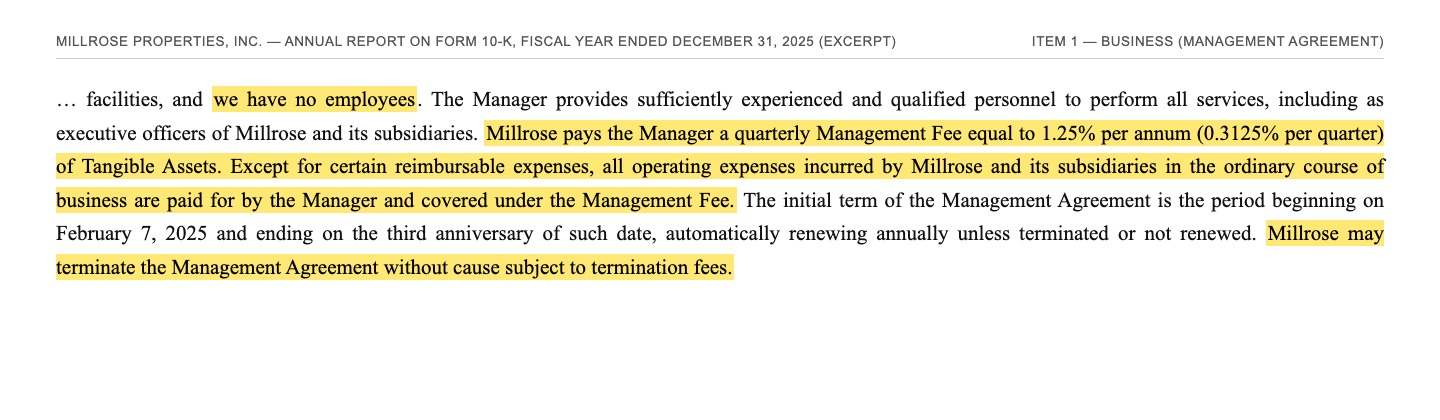
In numbers: $87.8 million of management fees in the 2025 stub year, $28.2 million in the first quarter of 2026 alone — annualized more than $110 million, or nearly a quarter of run-rate net income. To be fair: the fee covers practically all operating costs, there is no additional incentive fee, and 1.25 percent is within the range externally managed REITs pay. But three construction details are exactly what the yield-hunter's goggles should not filter out. First, the incentive: the fee is tied to total assets, not earnings per share — the manager earns on the machine's growth whether or not it pays off for shareholders; for roughly the first 13 months after the spin-off, the contract's definition even counted the cash balance in the fee base. Second, the lock-in: terminating without cause costs a termination fee, and the risk section itself warns: "We pay substantial fees to KL, which reduce funds we have available for distribution to stockholders". Third, the legal nature:
"KL maintains a contractual, not fiduciary, relationship with us, and its liability is limited under the Management Agreement, as we have agreed to indemnify the Manager against certain liabilities."
— Millrose Properties, Inc., SEC annual report 10-K for fiscal year 2025, Item 1A "Risk Factors" (summary)
Translated into an everyday picture: you are buying an apartment building whose property manager is expensive to fire, gets paid by the square foot rather than by rental income — and is explicitly obligated to you only by contract, not as a fiduciary. That can go well for a long time. It is just something different from a management team that belongs to you.
Uncomfortable truth no. 3: 84 percent of revenue comes from the former parent — which gave up its shares, but not its special rights
Who actually pays the option fees the dividend flows from? Overwhelmingly: Lennar. The annual report quantifies the dependence precisely:
"For the year ended December 31, 2025, the Company derived from Lennar approximately 84% of the Company's total revenues and 88% of the Company's total option fee revenues. […] Given the concentration of revenues from Lennar, any significant deterioration in Lennar's business condition could have an adverse impact on the Company's operating results and financial condition."
— Millrose Properties, Inc., SEC annual report 10-K for fiscal year 2025, note "Related Party Transactions"
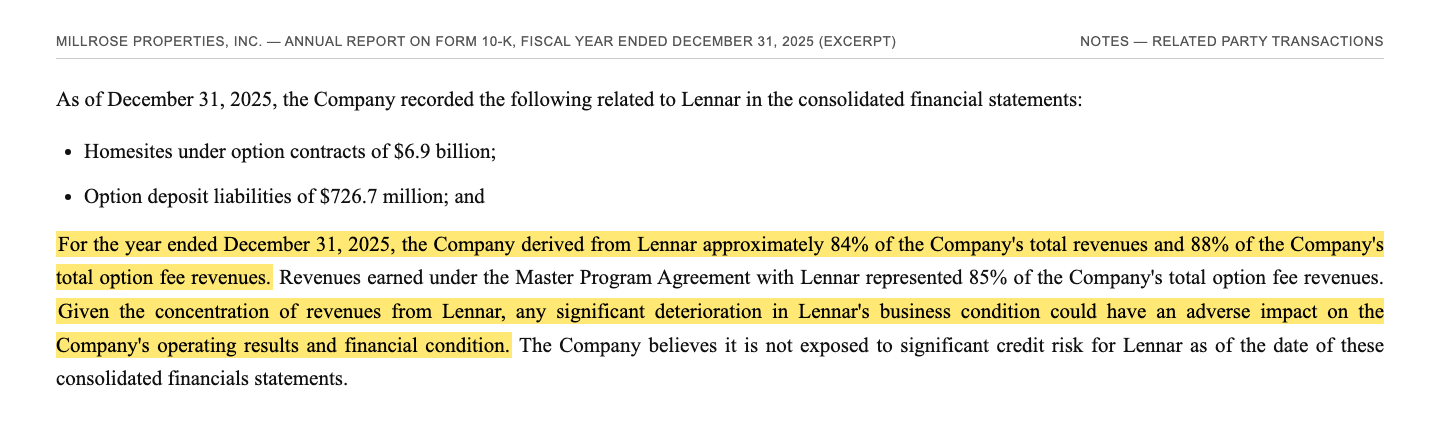
To be fair: diversification is measurably under way. In the first quarter of 2026, Lennar still accounted for 72 percent of revenue ($140.3 million of $194.9 million), and contracts with other builders — among them, since May 2025, the New Home Company — earn the better rates at 10.7 to 11 percent versus Lennar's 8.5 percent. Still: a 72 percent lump remains a lump, especially with 51 percent of the lots sitting in just three states (California, Florida, Texas). And the relationship is more asymmetric than the revenue share suggests. Lennar has long since unwound its equity stake — in November 2025 the group swapped its remaining roughly 20 percent back via an exchange offer; the 10-K notes dryly: "As a result, Lennar now owns a de minimis amount of Common Stock". The rights under the Founder's Rights Agreement Lennar keeps anyway: an evergreen capital priority right (Lennar may reserve Millrose's available capital exclusively for its own future land), a most-favored-pricing clause (if a third party gets a lower option rate, Lennar may match it for future deals — new-customer margins can thus drag down the Lennar terms), the approval right over any successor manager — and even leverage is capped: beyond a 1:1 debt-to-equity ratio Millrose may only go "unless Millrose obtains the prior approval of Lennar". On top of that sits the voting architecture: the unlisted Class B shares carry ten votes each and are guaranteed at least 35 percent of the votes — a lever that, per the risk section, primarily benefits the Miller family, Lennar's founding family. Millrose is legally independent — in practice it remains the extended land balance sheet of its best customer.
Uncomfortable truth no. 4: the dividend exceeds earnings, the cash is thin — and no independent party ever appraised the starting values
That leaves the coupon itself. In 2025 Millrose paid out $2.55 per share ($423.3 million) — more than its net income of $2.44 and roughly 99 percent of its AFFO of $2.58. That is REIT logic, not a scandal: whoever wants the tax privileges must distribute. But it means: practically nothing stays inside the company. Unrestricted cash stood at just $49.3 million as of March 31, 2026 — against $2.46 billion of debt and a quarterly dividend of roughly $126 million. All growth, every dividend increase, depends on the conveyor belt running: on builders exercising their options and proceeds washing back. The risk section says it itself:
"Our recycled capital business model is contingent on our counterparties electing to exercise their land purchase options."
— Millrose Properties, Inc., SEC annual report 10-K for fiscal year 2025, Item 1A "Risk Factors" (summary)
An option is exactly that: a right of the builder, not an obligation. If it walks, it forfeits its deposit — under pooled contracts even the deposits of the whole pool — and Millrose keeps the land at its carrying value. Which brings us to the quietest uncomfortable truth: how reliable are those carrying values? Millrose did not buy its starting land in the market; it was transferred in from its own parent. The risk chapter contains a remarkable sentence about that:
"We have not obtained independent appraisals or fairness opinions as to the value of our real estate assets, including those acquired in the Spin-Off from Lennar and the Rausch Transaction."
— Millrose Properties, Inc., SEC annual report 10-K for fiscal year 2025, Item 1A "Risk Factors" (summary)
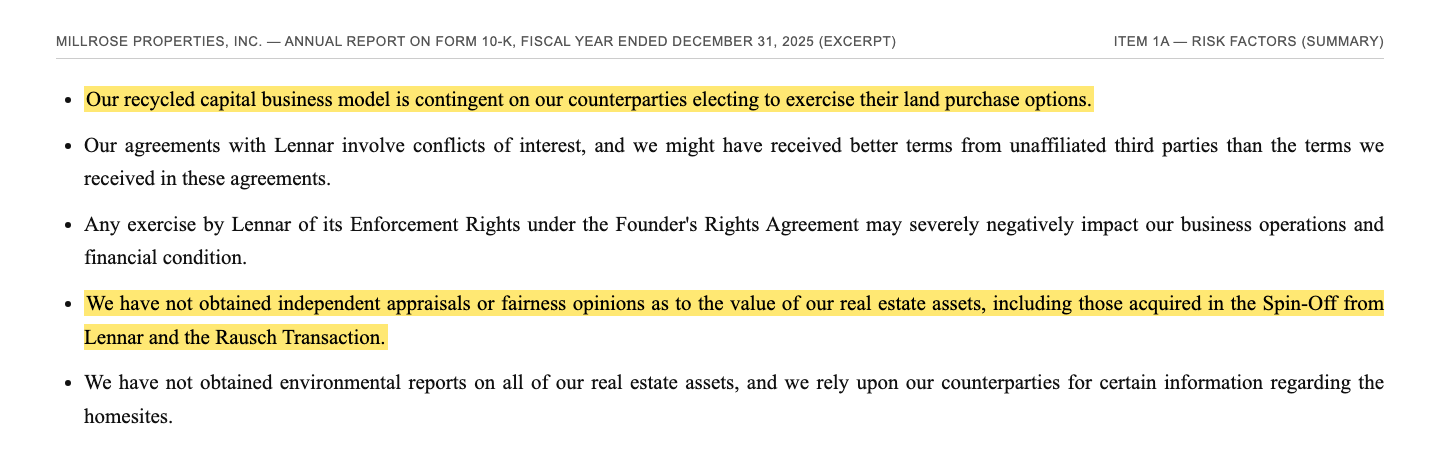
For fair context: the auditor signs off on the balance sheet, the builder deposits ($960.3 million) are real money at risk on the counterparties' side, and so far the machine runs without a hitch — in the first quarter of 2026, homesites worth $706.1 million were taken down. But if the U.S. housing market turns and builders let options lapse, Millrose sits on land whose entry value was set by the seller — and that is exactly when you would find out what "below book value" is really worth. A 15 percent discount to an unaudited book value is not a margin of safety — it is the premium the market charges for open questions.
Valuation: $5 billion of market cap for $5.85 billion of book value — the coupon's price is already in it
As of the July 8, 2026 data cut, the MRP share cost about $29.90, for a market cap of roughly $5.0 billion across 166.0 million shares (Class A and B). Against that stand: book value of $5.85 billion, or about $35.30 per share (March 31, 2026) — the stock thus trades at roughly 0.85 times book —, earnings of $2.44 per share in the 2025 stub year and $0.74 in the first quarter of 2026 (annualized about $2.96), i.e. roughly 10 to 11 times earnings, and about 11.6 times AFFO of $2.58. Analyst coverage is thin at two estimates — on average they expect about $3.11 of earnings per share for the current fiscal year and $3.23 for the next (source: fundamental data, as of July 8, 2026) — for a name that has only traded since February 2025, the "professionals' view" is more of a squint. The real buy case sits in the dividend column: $0.76 per quarter, $3.04 annualized — a good 10 percent yield on the July 8, 2026 price, raised five times in a row. Why do you get 10 percent when ten-year Treasuries pay far less? You know the answers now: because nearly all of the earnings are paid out and growth needs fresh capital; because 72 to 84 percent of revenue hangs on a single customer that simultaneously holds special rights; because the manager earns on total assets and is bound only by contract; and because the book values the stock trades below were never independently appraised. The stock is not expensive — but its discount is not an oversight by the market; it is the market's verdict on the construction.
Opportunities and risks at a glance
What speaks for MRP:
- A predictable earnings model with built-in upward drift: a weighted 9.2 percent return on $8.5 billion of invested capital, monthly option fees, fixed takedown prices — a revenue ramp from $82.7 to $194.9 million in five quarters (Q1 2025 through Q1 2026).
- A REIT coupon with growth: dividend raised five times in a row ($0.38 to $0.76 per quarter), an annualized yield of roughly 10 percent at about 0.85 times book value and 10 to 11 times earnings (data as of July 8, 2026).
- Structural tailwind: U.S. homebuilders are shifting to "asset-light" and outsourcing land — Millrose is, with 143,347 homesites, the largest listed platform of its kind and is diversifying measurably (Lennar's revenue share down from 84 to 72 percent within a year; new customers pay 10.7 to 11 percent instead of 8.5).
- Moderate leverage with a buffer: $2.46 billion of debt on $5.85 billion of equity (about 0.42 times), investment-grade notes due 2030/2032, plus $960.3 million of non-refundable builder deposits as the counterparties' risk cushion.
- The scanner confirms trend and insider behavior: price above the 50-day and 200-day lines, Power Trend, net insider buying (five purchases, zero sales), rising institutional ownership (data as of July 8, 2026).
What speaks against it:
- The scanner metric is a mismeasurement here: roughly $3.76 billion of "operating cash flow" (four quarters through March 31, 2026) contains the land sales whose purchases ($5.72 billion in 2025 alone) sit in investing cash flow — unrestricted cash as of March 31, 2026: $49.3 million.
- Concentration risk squared: 72 to 84 percent of revenue from Lennar, 51 percent of the lots in just three states (California, Florida, Texas) — if the U.S. housing market turns, option walk-aways and land values hit the same balance sheet at the same time.
- External management with a misaligned incentive: a 1.25 percent fee on total assets (2025: $87.8 million; Q1 2026: $28.2 million) rewards balance-sheet growth over earnings per share; the relationship is "contractual, not fiduciary" per the 10-K, termination without cause costs a fee — and the successor would need Lennar's approval.
- The founder governs without capital: Lennar holds only a "de minimis" stake but keeps capital priority, the most-favored-pricing clause on option rates and a veto over leverage beyond 1:1; the Class B voting architecture (ten votes, a 35 percent guarantee) strengthens Lennar's founding Miller family.
- A payout without a net: the $2.55 per share of dividends declared for 2025 exceeded earnings of $2.44 (roughly 99 percent of AFFO); the book values of the starting land were never independently appraised — the discount to book is a risk premium, not a gift.
A human conclusion
Back to the yield-hunter's goggles from the opening. Their flaw is not that they look at the dividend — payouts are the most honest part of any stock story, because they have to be paid. Their flaw is that they stop reading at the coupon. Whoever keeps reading at Millrose finds no catastrophe, but a remarkably open file: a land machine that earned $404.8 million from day one, has raised its dividend five times in a row and occupies a genuine structural theme of the U.S. housing market — and that simultaneously answers to a manager who earns on its size, obeys a former parent that barely holds any shares, and stands on book values no independent party ever examined. The scanner metric that lured you here turns out to be the smallest surprise: at a recycling machine it measures the conveyor belt, not the profit. So the honest question to ask yourself is not "Where else do I get 10 percent?" — it is: would you buy this company even if it paid out only 4 percent — for the business model, despite the manager construction and the Lennar lump? If yes, you collect the remaining 6 percentage points as compensation for risks you have understood and consciously carry. If no, then the 10 percent was never a yield but a lure — and you recognized it as one in time. What you make of it is your decision. And that is exactly as it should be.
Sources
All original documents used in this analysis — for your own reading:
- Millrose Properties, Inc. — SEC annual report 10-K for fiscal year 2025 (filed March 2, 2026)
- Millrose Properties, Inc. — SEC quarterly report 10-Q as of 03/31/2026 (filed May 6, 2026)
- Millrose Properties, Inc. — SEC annual report 10-K for fiscal year 2024 (filed March 31, 2025; pre-spin-off figures of the "Predecessor Millrose Business")
- Complete SEC filing history of Millrose Properties, Inc.: EDGAR overview (sec.gov)
- Fundamental data (metrics, quarterly series, valuation, analyst estimates; data as of July 8, 2026), cross-checked against the SEC filings.
- Screener and rating data: in-house stock scanner (data as of July 8, 2026; FCF/market-cap rank verified on July 18, 2026).
Transparency & disclaimer: This analysis is a journalistic contextualization of publicly available information and is not investment advice, not financial analysis in the regulatory sense and not a solicitation to buy or sell securities. Equity investments carry substantial risks up to and including total loss. All information without guarantee; the data cut-off is noted in the text. The author holds no position in MRP shares at the time of publication.
Our Bottom Line at a Glance
- Business model & start positive
- The largest listed land-banking platform in the U.S. (143,347 homesites, $9.2 billion, 30 states) with predictable option fees earning a weighted 9.2 percent return; profitable from the February 7, 2025 spin-off onward — $404.8 million of net income and $427.9 million of AFFO in the 2025 stub year (10-K 2025).
- Scanner metric FCF/market cap negative
- The top rank (15th, as of July 18, 2026) is a mismeasurement of the business model: the $3.67 billion of operating cash flow (2025) contains the homesite sales while the purchases ($5.72 billion) sit in investing cash flow; unrestricted cash as of 03/31/2026: $49.3 million (10-K 2025, 10-Q Q1 2026).
- Dividend & valuation neutral
- Five raises in a row to $0.76 per quarter (annualized roughly a 10 percent yield) at 0.85 times book and 10 to 11 times earnings (data as of July 8, 2026) — but 2025 paid out $2.55 per share, more than was earned ($2.44), and the spin-off book values were never independently appraised (10-K 2025, Item 1A).
- Customer concentration & founder rights negative
- 84 percent of 2025 revenue (Q1 2026: 72 percent) from Lennar, which after the November 2025 exchange offer holds barely any shares yet keeps capital priority, the most-favored-pricing clause, the manager veto and an approval right over debt beyond 1:1; 51 percent of the lots in three states (10-K 2025).
- External management negative
- No employees of its own; the management fee of 1.25 percent of Tangible Assets ($87.8 million in 2025, $28.2 million in Q1 2026) rewards balance-sheet growth over earnings per share; the relationship is "contractual, not fiduciary" per the 10-K, termination without cause only against a fee and with Lennar approving the successor (10-K 2025, Items 1/1A).
- Financing & buffers neutral
- Moderate leverage of roughly 0.42 times equity ($2.46 billion of debt, maturities 2030/2032) and $960.3 million of non-refundable builder deposits as a cushion — but only $49.3 million of unrestricted cash against a quarterly dividend of roughly $126 million, and the model hangs on builders exercising their options (10-Q Q1 2026, 10-K 2025).
MRP is not a cash-flow miracle but a young land-banking REIT with an honest price tag: at a capital-recycling machine the FCF/market-cap scanner metric measures throughput, not free money — what is real is a roughly 10 percent dividend yield below book value and a predictable fee model earning 9.2 percent on capital, set against a 72-to-84-percent Lennar lump, an external manager paid on total assets, founder rights without founder capital, and book values without an independent appraisal. Whoever buys the stock buys the construction — not the coupon. Not investment advice.
What Our Rating Means
- If you don't own the stock
- As long as the question raised in the bottom line stays open, we see no basis for an entry.
- If you hold it in your portfolio
- Our findings offer no acute reason to sell — the checkpoints named remain decisive.
A journalistic assessment by our editorial team at the time of the deep dive, based on public sources — not investment advice and not a solicitation to buy or sell. Your personal circumstances (investment goals, risk capacity, taxes) cannot be taken into account. What our categories mean, how verdicts are formed, and what conflicts of interest exist →
Worth Noting
- MRP made the research list via rank 15 in our in-house FCF/market-cap scanner (as of July 18, 2026; scanner data as of July 8, 2026) — the analysis deliberately shows why this metric is no buy signal for capital-recycling models such as land banks (analogous to banks and loan-book companies).
- REIT particularity: what matters for payout capacity is net income, AFFO and the return on invested capital — not operating cash flow, which at Millrose contains the proceeds from homesite sales while the land purchases sit in investing cash flow.
- Price and valuation figures dated July 8, 2026 (about $29.90 per share, roughly $5.0 billion market cap); analyses are evergreen, daily prices are not a buy argument.
Frequently Asked Questions
Millrose Properties (NYSE: MRP) runs a land bank: the company buys and develops residential land and sells finished homesites to U.S. homebuilders under option contracts with fixed takedown prices and schedules, in exchange for monthly option fees. As of March 31, 2026 Millrose held 143,347 homesites in 904 communities and 30 states, worth about $9.2 billion. The company was created on February 7, 2025 as a spin-off from Lennar; for tax purposes it is a REIT.
Because the cash flow statement is asymmetric: when Millrose sells homesites to builders (takedowns), the proceeds count as operating cash flow — when Millrose buys new land, the outflow sits in investing cash flow. In 2025 that put $3.67 billion of operating inflows against $5.72 billion of investing outflows; the gap was closed with $2 billion of new notes. The metric measures the throughput of the recycling machine — distributable are net income ($404.8 million) and AFFO ($427.9 million), not the $3.7 billion.
The quarterly dividend was raised five times in a row: from $0.38 (April 2025) to $0.76 (April 2026) — $3.04 annualized, or roughly a 10 percent yield (price about $29.90, data as of July 8, 2026). In 2025 the company declared $2.55 per share — more than its net income of $2.44 and roughly 99 percent of AFFO. As a REIT, Millrose must distribute at least 90 percent of its taxable income; the dividend therefore depends directly on builders exercising their options.
Heavily: in 2025 about 84 percent of total revenue and 88 percent of option fees came from Lennar; in the first quarter of 2026 it was still 72 percent. Since a November 2025 exchange offer Lennar holds only a "de minimis" equity stake, but keeps special rights under the Founder's Rights Agreement: a capital priority right, a most-favored-pricing clause on option rates, approval of any new manager, and a veto over debt beyond a 1:1 ratio to equity.
Millrose has no employees of its own. The REIT is managed by Kennedy Lewis Land and Residential Advisors (KL) for a management fee of 1.25 percent per year on Tangible Assets — $87.8 million in the 2025 stub year, $28.2 million in the first quarter of 2026. The fee covers almost all operating costs, but is tied to total assets rather than earnings per share; per the annual report the relationship is "contractual, not fiduciary", and terminating without cause triggers a termination fee.
More conservatively than the business model suggests: as of March 31, 2026 there was $2.46 billion of debt ($1.25 billion of 6.375% notes due 2030, $750 million of 6.25% notes due 2032, $425 million drawn on the credit line, $33 million of purchase-money mortgages) against $5.85 billion of equity — about 0.42 times. On top sit $960.3 million of non-refundable builder deposits. Unrestricted cash, however, is thin at $49.3 million, because nearly all earnings are paid out.
Optically yes: about $29.90 per share against roughly $35.30 of book value per share (0.85 times book), about 10 to 11 times earnings, 11.6 times AFFO and roughly a 10 percent dividend yield (data as of July 8, 2026). But the discount has reasons: the Lennar revenue lump (72 to 84 percent), external management paid on total assets, founder special rights without an equity stake, and spin-off book values for which no independent appraisals were obtained.
Found an error?
Did you spot a factual error, an outdated number, or a typo in this deep dive? Let us know briefly — your report goes straight to the editorial team.