CTO Stock: A 7 Percent Dividend, an Angry Short Seller — and Insiders Who Bought the Very Next Day
CTO Realty Growth rents out shopping centers across the American Sunbelt and pays a dividend yield of about 7 percent (data as of July 8, 2026). In June 2025 a short report called that payout unaffordable — the next day the CEO, CFO, general counsel and a board member bought shares, and twelve months later the stock sits near an all-time high while Reddit is only starting to notice, at 7 mentions in 24 hours (ApeWisdom, as of July 17, 2026). We read the annual reports (10-K) for 2024 and 2025, the quarterly report (10-Q) as of March 31, 2026, and the insider filings (Form 4): growing rents, a dividend frozen for three years, 45 percent more shares since the end of 2022, and a loan book charging double-digit interest. Not investment advice — just the question of who is right: the wolf at the door or the insiders at the register.
 Thomas Mücke
Founder & Publisher
Thomas Mücke
Founder & Publisher
Chart
Interactive price chart (TradingView).
Note: pure fact-based analysis, not investment advice and not a solicitation to buy or sell. All figures without guarantee.
There is an investor trap that catches sensible people in particular: the dividend hunter's trap. It works like this: a stock offers a 7 percent payout, and in your head the security turns into a salary — predictable, reliable, hitting the account every quarter. From that moment on you stop examining the company and start defending the pension. The fact that a dividend yield is not a promise but a price tag — the market demands 7 percent when it does not quite trust the thing — drowns in the pleasant ring of the quarterly payment. In the summer of 2026, hardly any stock lends itself better to this self-test than CTO Realty Growth (NYSE: CTO): a shopping-center landlord from Florida yielding about 7.2 percent (data as of July 8, 2026), publicly accused by a short seller in June 2025 of never having earned that very dividend — and whose executive suite bought its own shares the day after the attack. On Reddit, all of this is still just a murmur: 7 mentions in 24 hours (ApeWisdom, as of July 17, 2026). So let's make a deal: before you book the 7 percent as salary, we read together what the company itself reported, under penalty of law, to the U.S. securities regulator, the SEC — the annual reports (10-K) for 2024 and 2025, the quarterly report (10-Q) as of March 31, 2026, and the insider filings (Form 4). In the end, you decide for yourself.
What CTO actually does — and where the company comes from
CTO Realty Growth is a REIT, a real estate investment trust. Translated: a listed landlord company that must, by law, pay out nearly all of its taxable income and in return pays almost no tax at the corporate level — an apartment building in stock form, except that what is rented here are not apartments but rows of storefronts. The portfolio: 21 shopping centers and mixed-use properties with 5.5 million square feet across seven U.S. states, deliberately placed in the "Sunbelt", the fast-growing South — 30 percent of the space sits in Georgia, 25 in Florida, 18 in North Carolina and 12 in Texas (December 31, 2025). The strategy, per the annual report: buy centers in markets where retail demand exceeds supply, refresh them, re-lease them. No single tenant accounted for more than 10 percent of revenue in 2025. On top come two side businesses we will examine later: a management business — CTO runs the separate listed REIT Alpine Income Property Trust (PINE) for fees — and a loan book in which CTO itself acts as a real estate lender. The company's origin is remarkable too: until May 2020 the firm was called Consolidated Tomoka Land Co and spent over a century as a land company around Daytona Beach; as recently as 2024 it still owned subsurface mineral rights under roughly 352,000 acres of Florida soil. Today's shopping-center REIT is thus a young business model in a very old shell — REIT status only dates from 2021. Which brings us to the central tension of this analysis, and it runs through every chapter: rents are growing at double-digit rates and the dividend arrives on time — but it has not grown in three years, and whether it is earned or underwritten with freshly printed shares is precisely the question on which a short seller and the insiders publicly disagree. What the world of America's retail tenants looks like from the inside is something we dissected at the discount grocer Grocery Outlet — and what Reddit attention is worth without numbers, in our look at AMC Entertainment.
Where the stock shows up in our scanner
Every day we run about 3,500 stocks through our scanners. CTO delivers a rare picture there: 12 hits as of the July 8, 2026 data cut-off, across categories. The trend side: a Stan Weinstein stage-2 uptrend (price above a rising 200-day average), price above both the 50- and 200-day lines, Power Trend, the all-time-high list — behind that stand plus 27 percent in six months. And, more strikingly, the confidence side: the scanner flags institutional accumulation (most recently 11 funds added, 6 trimmed), net insider buying — 9 insider purchases and zero sales in twelve months — and the signal "CEO buys". To replicate it yourself: open the CTO stock page — all twelve hits are listed there — or browse the stage-2 scanner. The fundamental lens of the same scanner: a grade of B, a Piotroski F-score of 7 of 9 (a nine-point test of the direction of the books — 7 means more metrics improving than deteriorating) and an Altman Z-score around 5.8 (an early-warning gauge of insolvency risk; the danger zone historically starts below 1.8). Only one number appears to scream: a trailing price-to-earnings ratio around 104. Note this right away: for REITs, the P/E ratio is the wrong lens. A landlord books heavy depreciation on its buildings year after year — a pure accounting charge that depresses profit even though the rent actually flows and buildings rarely decay on schedule. That is why the industry counts in FFO ("funds from operations": net income plus real estate depreciation, adjusted for gains on sales) and AFFO ("adjusted FFO": FFO further adjusted for non-cash items) — measured that way, CTO costs about 10 to 11 times. Keep that metric in mind, because its definition is part of the fight we are about to examine.
The numbers over the years — honestly appraised
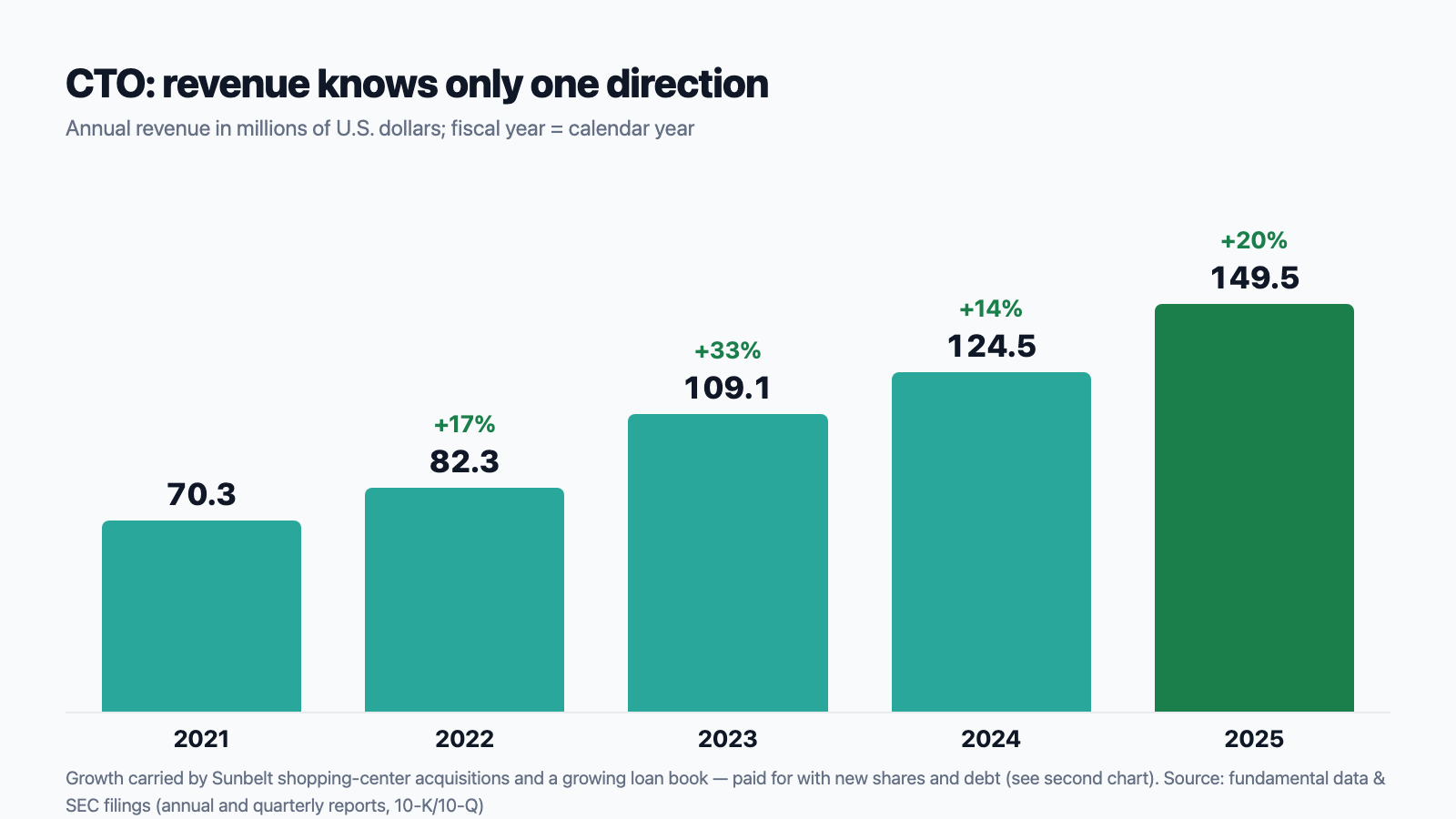
First, what genuinely impresses. Since converting to a REIT, CTO has grown reliably at double-digit rates: revenue climbed from $70.3 million (2021) through $82.3 million and $109.1 million to $149.5 million in 2025 — of which $132.2 million was rental income, $4.8 million management fees and $12.5 million loan interest. The first quarter of 2026 continued seamlessly at $41.2 million (+15 percent). Operationally the direction is right too: the economic occupancy of the shopping centers rose from 89 percent (end of 2023) to 92 percent, and including signed-but-not-yet-occupied space, 96 percent is leased (end of 2025) — that four-point gap is future rent already under contract. The REIT earnings metric FFO per share rose 17 percent to $0.55 in the first quarter of 2026, and operating cash flow reached $64.6 million in 2025 (after $59.9 million in 2024). And GAAP net income? A meager $10.1 million in 2025, even a small loss in 2024 — but you now know why: roughly $60 million of annual depreciation, plus a one-off $20.4 million loss in 2025 from retiring a convertible note early, distort the picture downward. So much for the sunny side:
Now the second chart — same company, different axis:
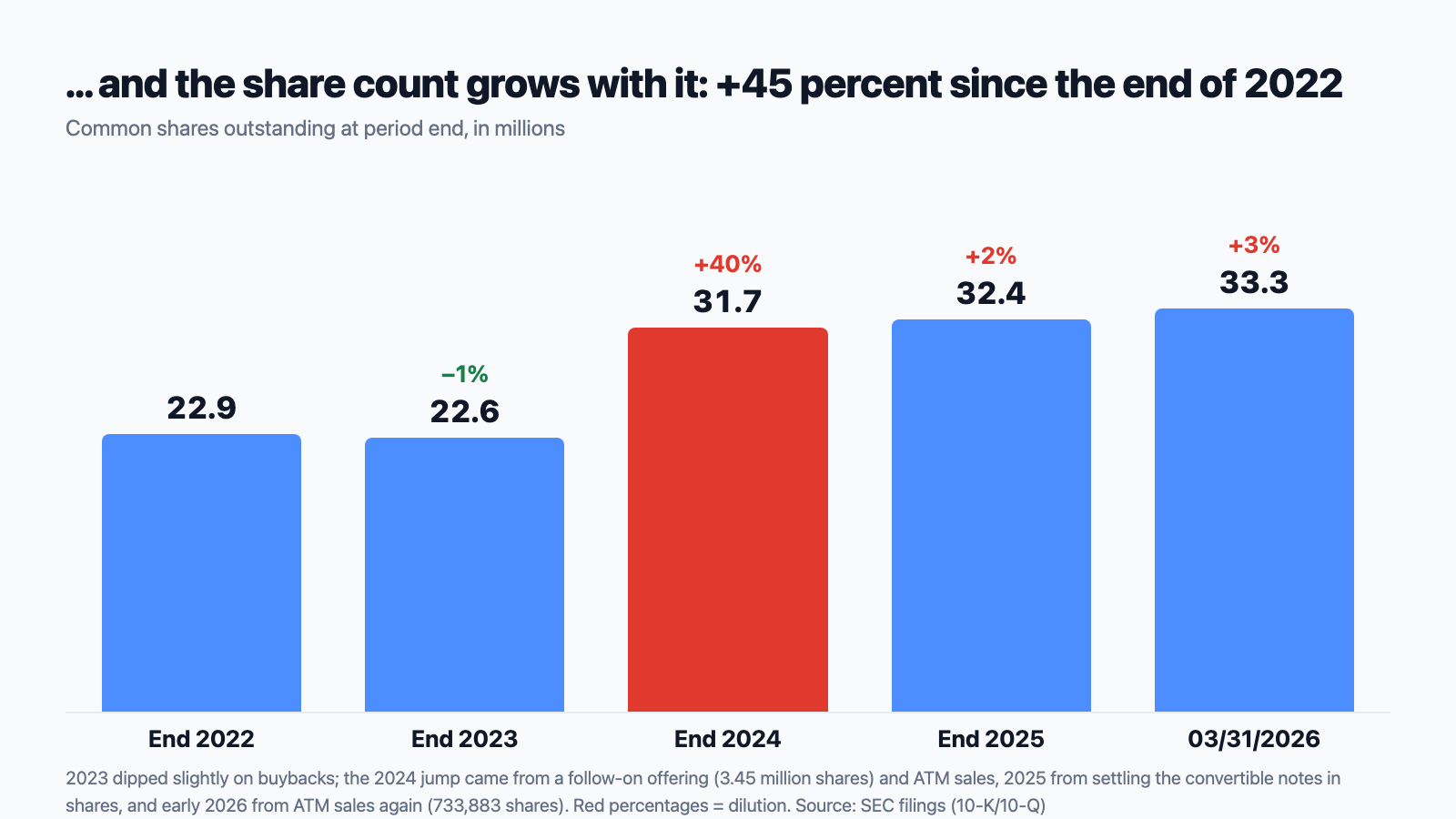
That is the core of the CTO case in two pictures: revenue has grown about 82 percent since the end of 2022 — and the number of shares it is divided among grew 45 percent. Per share, correspondingly little of the growth arrives: AFFO per share has essentially marked time for three years ($1.91 → $2.00 → $1.97), and so has the dividend ($1.52 since 2023, after $1.49 in 2022 and $1.33 in 2021). Dilution means: your slice of the cake gets cut smaller while the bakery gets bigger — as a shareholder, the bigger bakery only helps you once more arrives per slice. Remember the pattern: when a company grows but nothing grows per share, you are not sharing the bill for the growth — you are the bill. Which brings us to the uncomfortable truths.
What the filings say — the uncomfortable truths
First, the flashpoint — chronologically, and with both sides heard. On June 25, 2025, the short seller Wolfpack Research — which bets on falling prices and profits from them; that belongs in the framing — published a report titled "CTO: The B. Riley of REITs". The core allegations per the report and press coverage: CTO had never earned enough cash for its dividend since the 2021 REIT conversion (a cumulative gap of roughly $38 million from 2021 through 2024), plugging the hole with ever more shares; the in-house AFFO definition omits recurring capital expenditures, flattering the very metric to which 70 percent of variable management pay is tied; and a loan allegedly concealed the failure of a major tenant at the Ashford Lane center in Atlanta, whose food-hall operator stopped paying rent in late 2022 and went bankrupt in early 2023. The stock fell almost 4 percent on publication day, and U.S. plaintiff law firms announced "investigations". And the other side? You will not find a defensive press release in the SEC database — instead, Form 4 filings from the very next day: CEO John P. Albright bought 3,800 shares at about $17.05, CFO Philip Mays 1,000 at $17.29, general counsel Daniel E. Smith 1,000 at $17.00, and director George R. Brokaw 2,000 at $16.94 — all regular open-market purchases. The annual report filed three quarters later lists no pending or threatened material legal proceedings, no impairment in the loan book, and zero delinquent loans in the loan schedule (Schedule IV); the auditor, Grant Thornton, was routinely ratified in June 2026, and by mid-2026 the stock traded about 24 percent above the insiders' purchase prices. None of that refutes the report — impairment decisions are, after all, made by management itself. But it pays to hold the three checkable cores of the dispute against the filings, one by one. That is exactly what we do now.
Uncomfortable truth no. 1: The AFFO lens leaves out the renovations — and the executive pay hangs on it
Whether CTO's dividend is "earned" depends on which metric you apply. Against reported AFFO ($1.97 per share in 2025), a $1.52 dividend is a payout ratio of 77 percent — comfortable. Except: how CTO builds its AFFO is spelled out in the annual report, and what stands out is what is not deducted:
"To derive AFFO, we further modify the NAREIT computation of FFO and Core FFO to include other adjustments to U.S. GAAP net income related to non-cash revenues and expenses such as straight-line rental revenue, non-cash compensation, and other non-cash amortization. […] We use AFFO as one measure of our performance when we formulate corporate goals."
— CTO Realty Growth, Inc., SEC annual report 10-K for fiscal year 2025, Item 7 "Non-U.S. GAAP Financial Measures"

In an everyday image: a landlord who calculates his "disposable income" without deducting the regularly recurring renovations, leasing commissions and tenant build-outs is counting himself richer than his bank account — because new roofs and new store fit-outs cost real money even when accounting calls them "investment". At shopping centers, those items recur: for 2026, CTO had already committed $23.1 million of capital improvements at year-end (tenant improvements, commissions, remodels). Counted strictly, the comfortable 77 percent ratio quickly becomes a photo finish: operating cash flow of $64.6 million in 2025 covered $56.6 million of total dividends ($49.0 million to common, $7.5 million to preferred holders) with barely $8 million to spare — before any renovation, any acquisition, any repayment. In fairness: this AFFO definition has stood transparently in the annual report for years, many REITs define it similarly loosely, and NAREIT does not prescribe a capex deduction. But Wolfpack's core point is consistent with the filings — all the way into the pay plan: per the proxy statement (DEF 14A, April 2026), AFFO per diluted share carried a 70 percent weighting in the 2025 annual incentive plan, and the reported $1.97 scored the goal at 150 percent "achievement". The metric that makes the dividend look comfortably earned — and to which the lion's share of the bonuses is tied — is the mildest lens available.
Uncomfortable truth no. 2: The cash machine is called ATM — new shares are officially part of the liquidity plan
Where does the money for acquisitions, renovations and the tight dividend coverage come from? The annual report answers with surprising candor — in its list of liquidity sources:
"We believe we will have sufficient liquidity to fund our operations, capital requirements, maintenance, and debt service requirements over the next twelve months and into the foreseeable future, with cash on hand, cash flow from our operations, $216.5 million of availability remaining under our $250.0 million “at-the-market” equity offering program, and $149.0 million of undrawn commitments available on the existing $300.0 million Credit Facility as of December 31, 2025."
— CTO Realty Growth, Inc., SEC annual report 10-K for fiscal year 2025, Item 7 "Liquidity and Capital Resources"

"ATM" stands for "at the market": the company may continuously sell new shares straight into exchange trading — a cash machine whose balance is provided by the existing shareholders. And it is used vigorously: in 2024, a follow-on offering and ATM sales brought in roughly $228 million of net equity (the share count jumped 40 percent); in 2025 the convertible note was settled with 1.1 million new shares plus a $14.1 million cash premium; and in the first quarter of 2026 alone, CTO again sold 733,883 shares for $14.2 million net — with $202.1 million of program capacity remaining. Why that is necessary shows in the cash balance: $8.3 million as of March 31, 2026 ($6.5 million at the end of 2025) — against roughly $14.4 million of dividends falling due every quarter, $616 million of long-term debt (end of 2025) and a credit line drawn to $184 million of $300 million. For fair framing, no scandal: REITs must pay out nearly everything and therefore grow structurally on fresh capital; as long as new shares are placed above intrinsic value, that can even create value. But you should know the mechanics: at CTO, the company's own stock is an official funding source — and the 7 percent yield that attracts you makes that very attraction part of the business model.
Uncomfortable truth no. 3: The second REIT in the house — one leadership team, two shareholder groups, one built-in conflict of interest
CTO's third-largest revenue source is managing another listed REIT: Alpine Income Property Trust (NYSE: PINE), a net-lease landlord that CTO brought public in 2019, manages externally, and in which CTO holds 15.4 percent (market value $44.5 million, March 31, 2026). For this, CTO collects a base fee of 1.5 percent of PINE's equity plus potential incentive fees — $4.8 million of revenue in 2025 in total. The piquant part: PINE has no employees of its own; the same managers who are supposed to serve you as a CTO shareholder simultaneously run PINE. The annual report names the consequence itself, in the risk factors, in black and white:
"There are various potential conflicts of interest in our relationship with PINE, including our executive officers and/or directors who are also officers and/or directors of PINE, which could result in decisions that are not in the best interest of our stockholders."
— CTO Realty Growth, Inc., SEC annual report 10-K for fiscal year 2025, Item 1A "Risk Factors"

Picture a property manager who serves two homeowners' associations at once, owns a stake in one of them, and collects a fee from it that grows with its size — when an attractive building comes on the market, which association gets the first call? External management structures like PINE's are considered a governance demerit in the REIT industry because the fee is tied to assets under management, not to success per share. Note 5 of the annual report adds one more twist: since late 2023, CTO has also managed the property portfolio of an unnamed third party — and that third party's lender is, of all parties, PINE ("Although the Company has no direct relationship with the third party, PINE is a lender to the third-party pursuant to a mortgage note originated by PINE which is secured by the portfolio"). Manager, co-owner of the lender, steward of the collateral — three roles, one leadership team. None of this is illegal, and all of it is disclosed. But when a short report throws accusations involving loans and entanglements, this web is the reason such accusations sound plausible here — and for shareholders, that alone is a pricing factor.
Uncomfortable truth no. 4: The landlord becomes a bank — $75 million in one stroke, at 12 percent
The fourth chapter is the newest. CTO has been lending money to other real estate projects for years — at the end of 2025, six positions with a carrying value of $108.1 million sat on the books, at interest rates between 6.5 and 14 percent, with 2025 originations averaging 10.7 percent. Per the annual report's loan schedule, no loan was delinquent. Three weeks after quarter-end, CTO then doubled down:
"On April 17, 2026, the Company completed a preferred equity investment whereby the Company contributed $75.0 million of funding towards a Class A premier retail property located in the Southwest. The initial cash yield on the investment is 12.0%."
— CTO Realty Growth, Inc., SEC quarterly report 10-Q as of March 31, 2026, Note 23 "Subsequent Events"

Twelve percent sounds terrific — until you flip the question: which property owner pays 12 to 14 percent when a bank would lend for considerably less? Answer: one to whom the bank will no longer lend at those terms. Preferred equity also ranks behind the bank: if the property struggles, the bank gets paid first, then CTO. The annual report words the risk itself, dryly: "We may suffer losses when a borrower defaults on a loan and the value of the underlying collateral is less than the amount due" (10-K 2025, Item 1A). And this is exactly where Wolfpack's "sham loan" allegation docks: the report claims a loan around the Ashford Lane center papered over the fact that a major tenant had long since failed — the filings show no impairment and zero delinquent loans, which means either the allegation does not hold, or the valuation latitude is being used; from the outside, that cannot be conclusively decided. What can be pinned down is the structure: nearly a tenth of the balance sheet now works as a high-yield loan book with concentration risk — it produces the 12 percent that props up the dividend, and exactly the risks a shopping-center landlord otherwise would not have.
Valuation: a $700 million market value — and the question of which lens counts
In early July 2026 the CTO share cost about $21.10, for a market value of roughly $700 million (data as of July 8, 2026) — on top come $117.8 million of preferred stock (6.375 percent coupon) and $616 million of long-term debt (end of 2025). Through the earnings lens, the stock looks absurdly expensive (trailing P/E around 104); through the REIT lens, moderate: about 10 to 11 times AFFO and 1.3 times book value — shopping-center REITs currently often trade at 12 to 15 times their (usually more strictly calculated) AFFO. So the discount is real, and it has reasons you now know: the milder AFFO definition, the dilution mechanics, the PINE web, the loan book. The dividend yield of about 7.2 percent sits far above the sector average — that is not a reward but the risk premium the market demands. It is worth noting who stands on the other side: institutions hold about 65 percent, insiders just under 4.5 percent, and the insider tally of the past twelve months reads 9 purchases, zero sales (data as of July 8, 2026). Interest expense ran to $26.9 million in 2025 and already $7.3 million in the first quarter of 2026 (annualized roughly $29 million) — every refinancing at higher rates nibbles directly at the payout base. In short: the stock is only cheap if CTO's own numbers lens is the right one. It gets expensive if Wolfpack's lens is.
Opportunities and risks at a glance
What speaks for CTO:
- The core business delivers: revenue up 113 percent in four years ($70.3 million to $149.5 million), Q1 2026 up 15 percent; economic occupancy of the shopping centers improved from 89 to 92 percent, 96 percent including signed leases (December 31, 2025) — the four-point gap is future rent already under contract.
- Sunbelt tailwind: 85 percent of the space in Georgia, Florida, North Carolina and Texas — states with above-average job and population growth; no tenant above 10 percent of revenue (10-K 2025).
- FFO per share has picked up: plus 17 percent in the first quarter of 2026 ($0.55); Piotroski F-score 7 of 9, fundamental grade B, Altman Z around 5.8 (data as of July 8, 2026).
- The confidence signals line up: 9 insider purchases against zero sales in twelve months — including the CEO, CFO and general counsel the day after the short report (Form 4, 06/26/2025); institutional accumulation; 12 scanner hits including the stage-2 trend and the all-time-high list.
- The short report has so far had no legal consequences: no pending material proceedings per the 10-K (February 2026), zero delinquent loans in the loan schedule, the auditor ratified in June 2026.
What speaks against it:
- The dividend is comfortably covered only through the mild lens: 77 percent of an in-house AFFO that does not deduct recurring capital expenditures; operating cash flow in 2025 ($64.6 million) left only about $8 million after $56.6 million of dividends — with $23.1 million of capital improvements already committed for 2026.
- Dilution as a permanent condition: plus 45 percent more shares since the end of 2022 (22.9 to 33.3 million), the ATM program is an official liquidity source per the 10-K ($202.1 million of remaining capacity), and AFFO per share has been frozen around $2 for three years — as has the dividend.
- A thin cushion: $8.3 million of cash (March 31, 2026) against roughly $14.4 million of quarterly dividends, $616 million of long-term debt, a credit line drawn to $184 million of $300 million, and rising interest expense (Q1 2026: $7.3 million).
- A governance web: external management of PINE by the same executives, with the conflict-of-interest risk documented in CTO's own 10-K (Item 1A), plus the triangle of portfolio management and PINE mortgage (Note 5).
- Style drift toward banking: a high-yield loan book (6.5 to 14 percent) plus a $75 million lump at 12 percent (April 2026) — subordinated capital in single properties whose risks only surface in a downturn; the short report's "sham loan" allegation cannot be conclusively checked from the outside.
A human conclusion
Back to the dividend hunter's trap from the opening. Its core is not that high payouts are bad — its core is that the 7 percent ends the thinking when it should start it. At CTO, the thinking leads to an unusually clear interim verdict: the rental business is real and growing, occupancy is rising, the insiders answered the short attack with their own money, and a year of legal saber-rattling has produced no lawsuit. At the same time, the short report pointed at things that really are in the filings: an AFFO lens without renovation costs, a dividend that consumes nearly the entire cash flow, a share count growing faster than anything that arrives per share, and a leadership team with a built-in double mandate. Both are true. So the honest question for you is not "is 7.2 percent a lot?" — it is: would you own this if the dividend were 3 percent and all you got was the business? If yes, the 7.2 percent is your premium for carrying dilution, the governance web and the loan-book risks — and the coming quarterly reports (10-Q) will show you in three places whether the bet is working: AFFO per share (finally growing instead of frozen?), the ATM line (how many new shares?), and the loan schedule (still zero delinquent?). If no, then the 7 before the decimal point is exactly what it always was on close inspection: a price tag, not a gift. What you make of it is your decision. And that is exactly as it should be.
Sources
All original documents used in this analysis — for your own reading:
- CTO Realty Growth, Inc. — SEC annual report 10-K for fiscal year 2025 (filed February 19, 2026)
- CTO Realty Growth, Inc. — SEC annual report 10-K for fiscal year 2024 (filed February 20, 2025)
- CTO Realty Growth, Inc. — SEC quarterly report 10-Q as of 03/31/2026 (filed April 28, 2026)
- CTO Realty Growth, Inc. — Form 4 insider filings dated 06/26/2025: John P. Albright (CEO), Philip Mays (CFO), Daniel E. Smith (General Counsel), George R. Brokaw (Director) (SEC EDGAR)
- CTO Realty Growth, Inc. — Proxy statement (DEF 14A) dated April 28, 2026 (compensation: 70% AFFO weighting in the 2025 annual incentive plan)
- CTO Realty Growth, Inc. — SEC Form 8-K on the annual meeting of June 17, 2026 (election of directors, ratification of the auditor)
- Wolfpack Research — short report "CTO: The B. Riley of REITs" dated June 25, 2025; coverage: Reuters/TradingView (06/25/2025), Investing.com (06/25/2025), Hagens Berman release (07/14/2025) — Wolfpack Research is a short seller and profits from falling prices; the accusations are its claims, not our findings
- Complete SEC filing history of CTO Realty Growth, Inc.: EDGAR overview (sec.gov)
- Fundamental data (metrics, quarterly series, valuation; data as of July 8, 2026), reconciled against the SEC filings.
- Screener and rating data: in-house stock scanner (data as of July 8, 2026); Reddit mentions: ApeWisdom (as of July 17, 2026).
Transparency & disclaimer: This analysis is a journalistic contextualization of publicly available information and is not investment advice, not a financial analysis in the regulatory sense, and not a solicitation to buy or sell securities. Stock investments carry substantial risks up to and including total loss. All information without guarantee; the data cut-off is noted in the text. The author holds no position in CTO shares at the time of publication.
Our Bottom Line at a Glance
- Core business & Sunbelt portfolio positive
- Revenue up 113 percent in four years to $149.5 million (2025), Q1 2026 up 15 percent; economic occupancy of the shopping centers improved from 89 to 92 percent, 96 percent including signed leases; 85 percent of the space in growth states, no tenant above 10 percent of revenue (10-K 2025).
- Dividend coverage & AFFO definition neutral
- A $1.52 dividend is 77 percent of the in-house AFFO ($1.97) — but the definition does not deduct recurring capital expenditures (10-K 2025, Item 7), and 2025 operating cash flow ($64.6 million) left only about $8 million after $56.6 million of total dividends, with $23.1 million of capital improvements already committed. Covered, yes — but only through the mildest lens, and without a raise for three years.
- Dilution & liquidity negative
- Plus 45 percent more shares since the end of 2022 (22.9 to 33.3 million as of 03/31/2026), the $250 million ATM program is an official liquidity source per the 10-K, and Q1 2026 added another 733,883 new shares; $8.3 million of cash against $14.4 million of quarterly dividends and $616 million of long-term debt — AFFO and dividend per share stagnate accordingly.
- Governance: PINE web & loan book negative
- External management of PINE by the same executives, with the conflict risk documented in CTO's own filing ("decisions that are not in the best interest of our stockholders", 10-K 2025, Item 1A), plus the triangle of portfolio management and PINE mortgage (Note 5) and a growing high-yield loan book with a $75 million lump at 12 percent (10-Q Q1 2026, Note 23) — a structure that invites accusations, as the short report of 06/25/2025 demonstrated.
- Technicals & insider signals positive
- Stage-2 uptrend, price near an all-time high, 12 scanner hits, Piotroski 7 of 9, fundamental grade B (data as of July 8, 2026); 9 insider purchases against zero sales in twelve months — the CEO, CFO and general counsel bought the day after the short report (Form 4, 06/26/2025), about 24 percent below the July 2026 price level; no pending proceedings per the 10-K (February 2026).
CTO is a growing Sunbelt landlord with a price tag of a 7.2 percent dividend yield — and the price tag is honest: it pays the investor for carrying a mild AFFO definition, cash coverage that is almost fully used up, ongoing dilution through the ATM program, a governance double mandate around PINE, and a high-yield loan book. The June 2025 short report pointed at real structures but has so far triggered neither a lawsuit nor an impairment — the insiders answered with purchases, the market with an all-time high. Whoever invests here should do it for the business, not for the 7 before the decimal point. Not investment advice.
What Our Rating Means
- If you don't own the stock
- As long as the question raised in the bottom line stays open, we see no basis for an entry.
- If you hold it in your portfolio
- Our findings offer no acute reason to sell — the checkpoints named remain decisive.
A journalistic assessment by our editorial team at the time of the deep dive, based on public sources — not investment advice and not a solicitation to buy or sell. Your personal circumstances (investment goals, risk capacity, taxes) cannot be taken into account. What our categories mean, how verdicts are formed, and what conflicts of interest exist →
Worth Noting
- CTO reached the research list via the Reddit hype scanner (ApeWisdom, 7 mentions in 24 hours, as of July 17, 2026) — the 12 hits in our in-house stock scanner (data as of July 8, 2026) provided the confluence, the short report of 06/25/2025 the audit mandate.
- REIT particularity: the trailing P/E (~104) is distorted by real estate depreciation and the one-off loss from the convertible settlement ($20.4 million, Q2 2025); what matters are FFO/AFFO per share and the cash coverage of the dividend. CTO's AFFO definition does not deduct recurring capital expenditures — comparisons with peer AFFOs therefore limp.
- Price and valuation figures dated July 8, 2026 (about $21.10, about $700 million market value); analyses are evergreen, daily prices are not a buy argument. The short report's accusations are claims by Wolfpack Research (which profits from falling prices); the reconciliation against the filings is marked as such throughout the text.
Frequently Asked Questions
CTO Realty Growth (NYSE: CTO) of Winter Park, Florida, is a self-managed REIT that rents out 21 shopping centers and mixed-use properties with 5.5 million square feet across seven U.S. states — focused on the Sunbelt (Georgia, Florida, North Carolina, Texas). On top come a management business for the external REIT Alpine Income Property Trust (PINE) and a loan book of real estate loans at 6.5 to 14 percent interest. Revenue 2025: $149.5 million (+20 percent).
REITs book heavy depreciation on their buildings, which depresses accounting profit even though the rent actually flows. FFO ("funds from operations") strips out that depreciation and gains on sales; AFFO further adjusts for non-cash items. CTO reported FFO of $1.27 and AFFO of $1.97 per share for 2025. Important: CTO's AFFO definition does not deduct recurring capital expenditures such as tenant build-outs — so the metric paints the mildest available picture of earnings power.
CTO pays $0.38 per quarter ($1.52 a year, roughly a 7.2 percent yield, data as of July 8, 2026) — unchanged since 2023. Against the in-house AFFO ($1.97 per share in 2025) that is a 77 percent payout ratio; operating cash flow in 2025 ($64.6 million) covered total dividends ($56.6 million) with only about $8 million to spare — before investments. Cash stood at just $8.3 million on March 31, 2026, against roughly $14.4 million of dividends per quarter; fresh money regularly comes from share sales under the ATM program.
Wolfpack Research (June 25, 2025, "CTO: The B. Riley of REITs") claimed CTO had never earned its dividend from cash flow since 2021, used a flattering AFFO definition without recurring capital expenditures, and concealed a major tenant's failure through a loan. Checked against the filings: the AFFO definition without a capex deduction really is in the 10-K, as is the tight cash coverage; for the "sham loan", however, the filings show no impairment and zero delinquent loans, and the 10-K filed in February 2026 lists no pending material legal proceedings. The day after the report, the CEO, CFO, general counsel and a director bought shares (Form 4, 06/26/2025).
PINE is a separate listed net-lease REIT with no employees of its own, managed externally by CTO — for a base fee of 1.5 percent of equity ($4.8 million of management revenue in 2025). CTO simultaneously holds 15.4 percent of PINE (market value $44.5 million, 03/31/2026), and the same executives run both companies. CTO's own annual report warns that these conflicts of interest "could result in decisions that are not in the best interest of our stockholders" (10-K 2025, Item 1A).
Shares outstanding rose from 22.9 million (end of 2022) to 33.3 million (March 31, 2026) — plus 45 percent. The drivers were a follow-on offering and ATM share sales in 2024 (+40 percent in a single year), the settlement of a convertible note in shares in 2025, and renewed ATM sales in early 2026 (733,883 shares for $14.2 million net). AFFO per share stagnated around $2 over that period — per share, none of the company's growth has arrived so far.
Depends on the lens: the trailing P/E around 104 is misleading for REITs (heavy accounting depreciation); more relevant are roughly 10 to 11 times AFFO and 1.3 times book value (data as of July 8, 2026) — a tangible discount to shopping-center REITs with more strictly calculated AFFO. The dividend yield of about 7.2 percent is accordingly more risk premium than gift: the market is pricing the mild AFFO definition, the ongoing dilution, the PINE web and the high-yield loan book.
Found an error?
Did you spot a factual error, an outdated number, or a typo in this deep dive? Let us know briefly — your report goes straight to the editorial team.