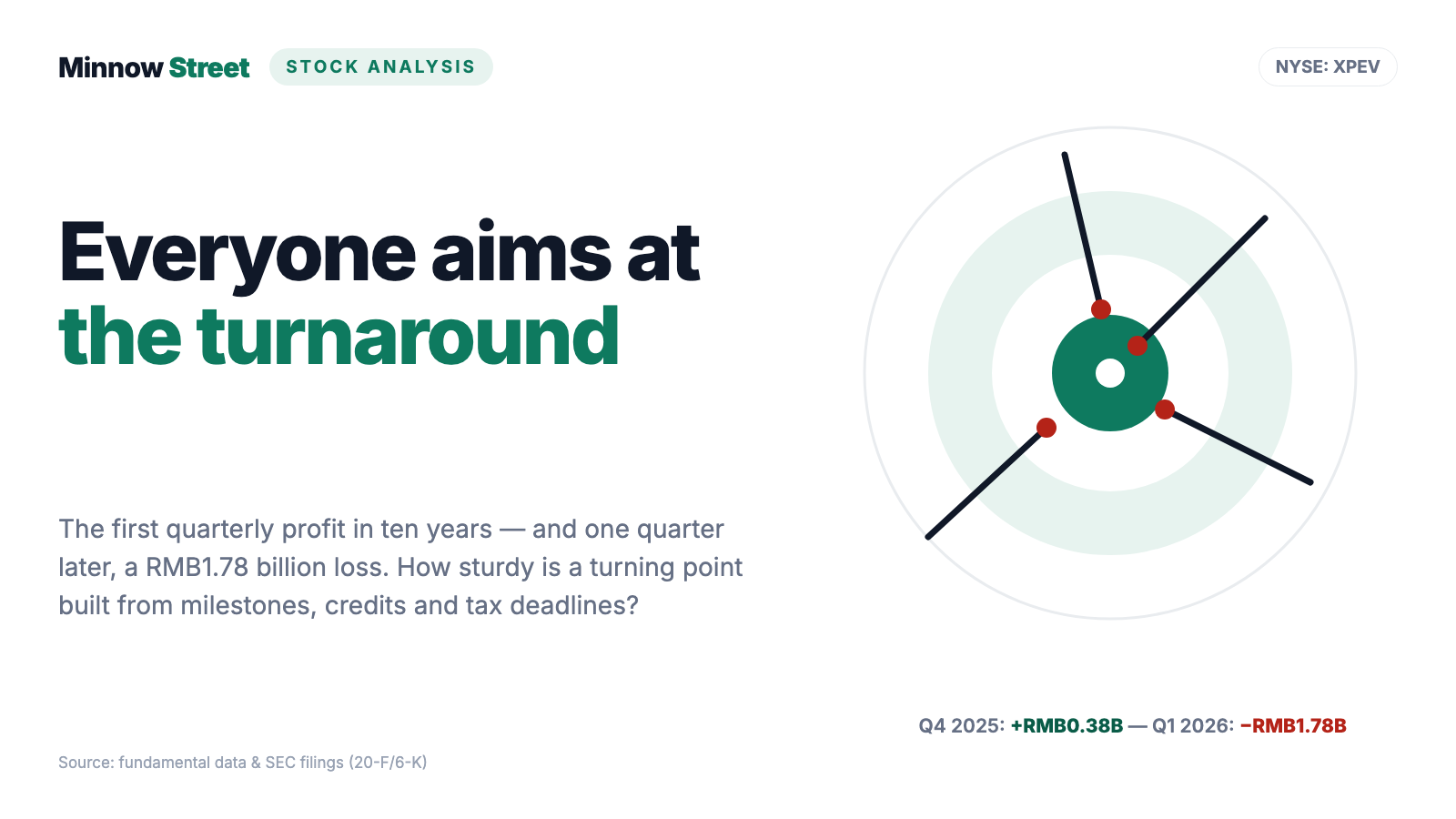
Millicom Stock: A Genuine Turnaround — and a Record Profit That Is Half Borrowed
Millicom runs across eleven Latin American countries as Tigo and has fought its way back from a debt-laden problem child: operating profit (EBITDA) up 11.4 percent to $2,749 million, a record cash inflow of $916 million, leverage pushed down to 2.31x, and the dividend it scrapped in 2023 back on the table. The company surfaced in our in-house Joshua growth scanner (data as of July 17, 2026). We read the annual report (20-F) for 2025 and the latest interim reports (6-K): the record net profit of $1.3 billion includes roughly $727 million of one-off gain from selling the cell towers, nearly a third of operating profit hangs on a single country, and one man holds the voting majority. Not investment advice — just the question of how much of a comeback is real and how much is bookkeeping.
 Thomas Mücke
Founder & Publisher
Thomas Mücke
Founder & Publisher
Chart
Interactive price chart (TradingView).
Note: pure fact-based analysis, not investment advice and not a solicitation to buy or sell. All figures without guarantee.
There is an investor trap that catches the warmhearted in particular: the comeback glow. It works like this: a company was a problem child for years — too much debt, no dividend, a beaten-down stock — and then the turn comes. Record profit, a fat payout, cash in the till. And because we humans love redemption stories, we stop reading the moment the good news arrives. That is exactly where it gets expensive. Hardly any name plays out that trap in the summer of 2026 as textbook-perfectly as Millicom International Cellular S.A. (Nasdaq: TIGO) — the company that runs across eleven Latin American countries under the Tigo brand. It reached our research list through our in-house Joshua growth scanner (data as of July 17, 2026, 75 hits): a filter that gathers stocks with accelerating numbers. And Millicom's numbers did accelerate in 2025 — the only question is where the growth came from. So let's make a deal: before you let the comeback move you, we read together what Millicom itself reported to the U.S. securities regulator, the SEC.
And here is a quirk you have to know up front: Millicom is a foreign private issuer based in Luxembourg. It therefore files not an annual report 10-K and quarterly reports 10-Q like a U.S. company, but an annual report 20-F and interim reports 6-K. Same regulator, same penalty of law, just a different form — and a different calendar: the fiscal year ends December 31, the books follow the international IFRS rules (not U.S. GAAP), and everything is reported in U.S. dollars. We read the annual report (20-F) for 2025 and the interim reports (6-K) for the first quarter of 2026 and for full-year 2025. A filing to the SEC is honest under penalty of law. And this one tells two stories at once: a genuine operating turnaround — and a record that is half a one-off sale. In the end, you decide for yourself.
What Millicom actually does — and where
At its core, Millicom is what Europeans would call a network operator, only for Latin America: mobile, fixed broadband (over cable and fiber), pay-TV and business (B2B) services, all under the Tigo brand. On top of that, Tigo Money is a mobile payments service with 2.8 million active users — in regions where many people have no bank account but do have a phone. As of December 31, 2025, per the annual report, the company served roughly 49.3 million mobile customers and 4.6 million fixed-line customer relationships (4.2 million of them over its own cable/fiber network). Mobile accounts for about 60 percent of service revenue, fixed and other for about 38 percent. Headcount is around 15,000.
The geographic footprint is both a strength and a weakness. Millicom reports by country: separate segments for Guatemala, Colombia, Panama, Honduras, Paraguay and Bolivia, plus an "Other" bucket (El Salvador, Nicaragua, Costa Rica, and the markets it acquired in 2025, Uruguay and Ecuador). That puts Millicom in eleven countries — a broad Latin American spread that, as we will see, stands on very unequal legs. Translated, Millicom is something like the "Vodafone of the Spanish- and Portuguese-speaking small states" — number one or two almost everywhere, but in markets whose currencies and politics are far less predictable than the euro. Which brings us to the central tension of this analysis, and it runs through every chapter: the operating turnaround is real — but the record profit is half borrowed, nearly a third of profit hangs on one country, and a single major shareholder is at the wheel. How a company can be honestly healthy and dangerously lopsided at the same time is something we dissected at data-center operator Rackspace — and why a single catalyst is not a business model, at fiber-hardware maker Clearfield.
Where the stock shows up in our scanner
Every day we run about 3,500 stocks through our scanners. Millicom reached the list through the Joshua growth scanner — a filter tuned for accelerating growth and momentum, showing 75 hits as of the July 17, 2026 data cut-off. At first glance a fitting find: in 2025 operating profit (EBITDA) grew double digits, cash inflow hit a record, and in the first quarter of 2026 revenue shot up 45 percent. This is exactly where a second look pays off, and it is the connecting thread of this analysis: a growth scanner sees the acceleration, but not its origin. Millicom's revenue jump in the first quarter of 2026 was 45 percent reported but only 4.2 percent organic — the rest came from acquisitions. And the record 2025 net profit came half from a one-off sale. Remember this fingerprint: growth built from acquisitions and one-off sales looks exactly like organic growth in the scanner — until you read the footnotes. That is what we do now.
The numbers over the years — honestly appraised
First, what genuinely impresses, and there is plenty. Millicom was a workout case for a long time: high debt, swinging profits, a group loss in 2023 and a scrapped dividend. What management has delivered operationally since then deserves full credit. Operating profit (EBITDA) — the operating result before interest, taxes, depreciation and amortization, the key operating metric for capital-intensive network operators — rose 11.4 percent to $2,749 million in 2025, at a margin of about 47 percent. Equity free cash flow — the money left for shareholders after all investment and interest — reached a record $916 million, comfortably beating the company's own $750 million target. Leverage (net debt divided by EBITDA — how many years of operating profit it would take to repay the debt) fell to 2.31x at year-end; for a telecom that is solid, and Millicom historically ran much higher. And the dividend is back: 2025 saw $5.50 per share in total, with $3.00 proposed for 2026. That is a proper operating turnaround, no question.
Revenue itself is the dullest number in the file: it has been flat for years — $5,661 million (2023), $5,804 million (2024), $5,819 million (2025), a gain of just 0.3 percent last year. So Millicom is not growing through revenue but through efficiency, deleveraging and capital returns. The profit line, by contrast, turns spectacular — and that is exactly where you have to be careful:
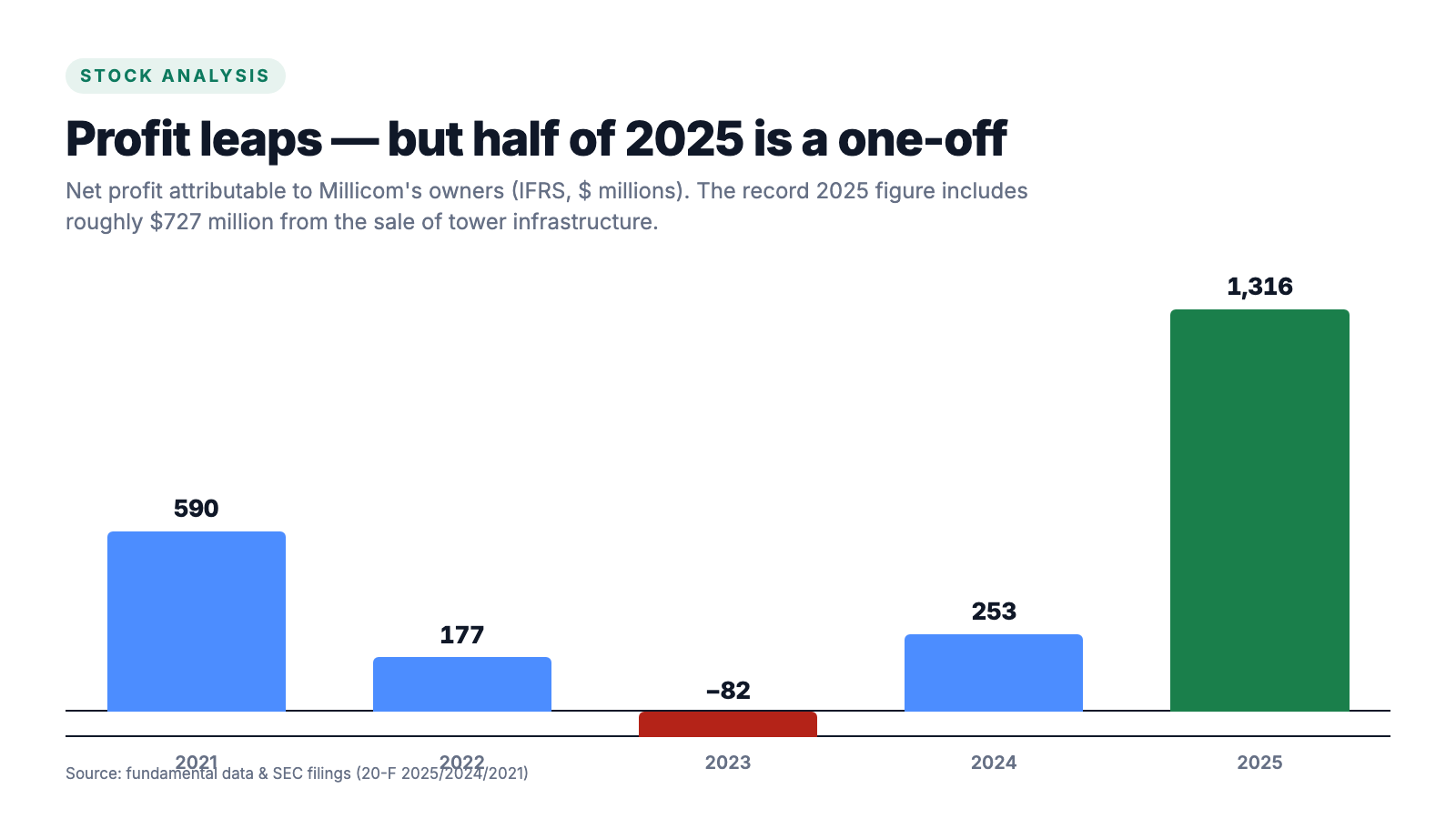
You see the jump immediately — and you see why a growth scanner fires. But the prettiest bar in the series is also the most deceptive. Which brings us to the uncomfortable truths.
What the filings say — the uncomfortable truths
Uncomfortable truth no. 1: The record profit is half borrowed — it comes from selling the cell towers
Anyone reading the headline "Millicom triples its profit" pictures a humming business. The full-year release itself says where the record really comes from:
"Net profit attributable to company owners $1.3 billion, including approximately $727 million net profit from the closure of infrastructure transactions."
— Millicom International Cellular S.A., SEC interim report 6-K, full-year 2025 earnings release (February 26, 2026)

In the income statement of the annual report, the same event shows up as its own line: "Sale of Lati Operations" at $741 million — the monetization of the cell-tower infrastructure. That is entirely legitimate financially: you sell the towers and lease them back (a sale-and-leaseback), take cash now and pay rent later. But it is a one-time event, not a recurring profit. Strip it out and roughly $589 million remains of the record net profit — still more than double 2024, but a very different figure from the reported $1,316 million. On a per-share basis: $7.86 reported, closer to $3.50 underlying. Remember this rule of thumb: when a record profit has its own line with the word "Sale" in it, it is not the profit — it is a sale price dressed as profit.
Uncomfortable truth no. 2: A single country carries the cash — Guatemala
Picture a neighbor who raves about his great company — and then you learn that a single client accounts for nearly a third of his profit. Would you swallow hard? That is exactly Millicom's relationship with Guatemala. The annual report makes no secret of it; it puts it right up front as a risk factor:
"The cash flow we generate is highly dependent on our operations in Guatemala. Our operations in Guatemala have historically generated healthy cash flows."
— Millicom International Cellular S.A., SEC annual report 20-F for 2025, Item 3 "Risk Factors"
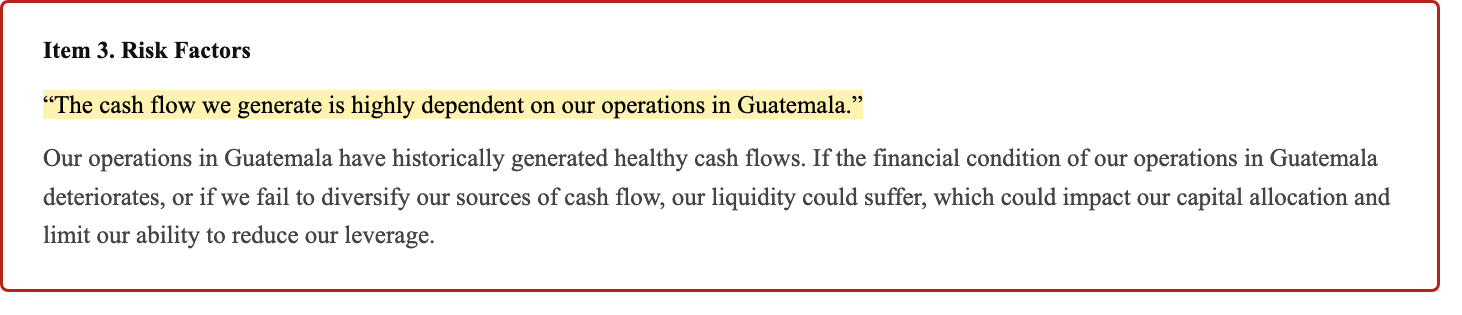
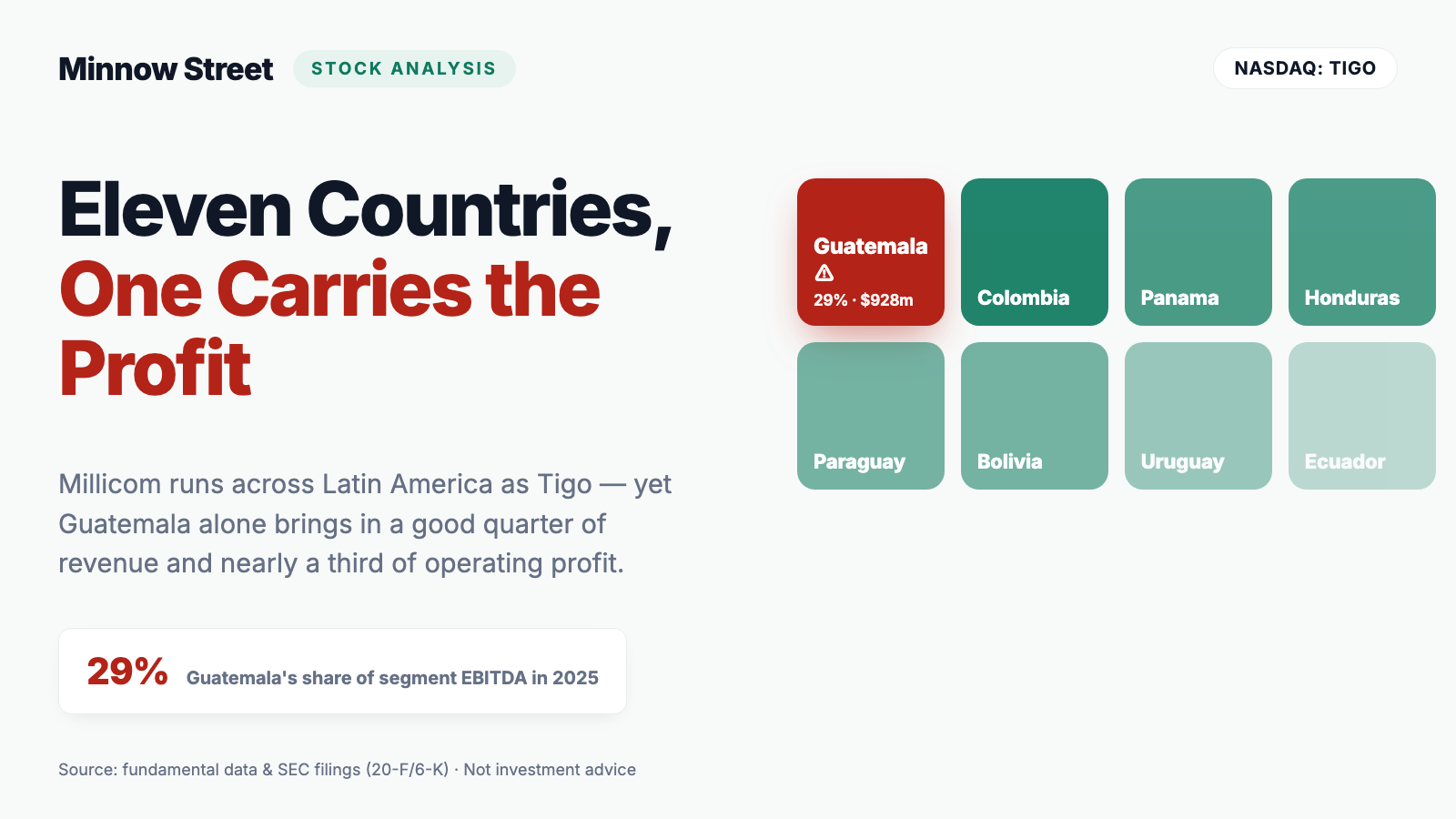
The numbers behind it: Guatemala provided roughly 26 percent of revenue in 2025 and, at $928 million, about 29 percent of segment EBITDA — by far the largest block. Add Colombia (about 22 percent of revenue, $604 million of EBITDA) and two countries together account for roughly 48 percent of operating profit. The rest is spread across nine more, partly small, markets:
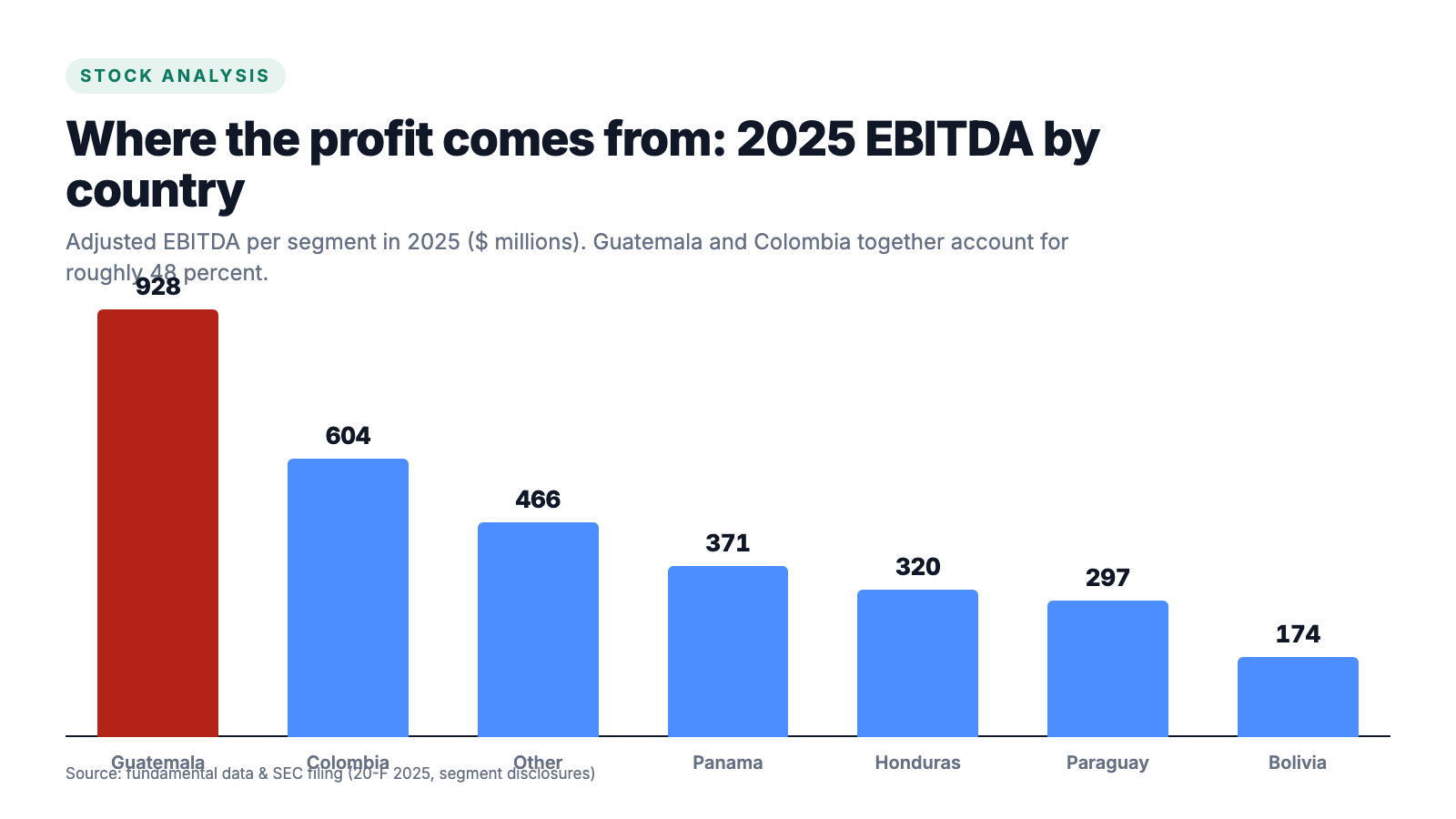
To be fair: Guatemala is a good country for Millicom — high margins, stable cash flows, market leadership. But concentration is concentration, however pretty the lump. If regulation, currency or the economy turns in Guatemala, it is not a tenth of the company that wobbles but nearly a third of operating profit. And unlike a customer lump, a country lump cannot simply be replaced with a new contract.
Uncomfortable truth no. 3: One man holds the voting majority — and appoints half the leadership
With listed companies, we quietly assume that many shareholders jointly decide the direction. At Millicom it is different, and the annual report says so bluntly:
"Xavier Niel owns a significant amount of Millicom's shares, giving him substantial management influence that may not align with the interests of our other shareholders."
— Millicom International Cellular S.A., SEC annual report 20-F for 2025, Item 3 "Risk Factors"
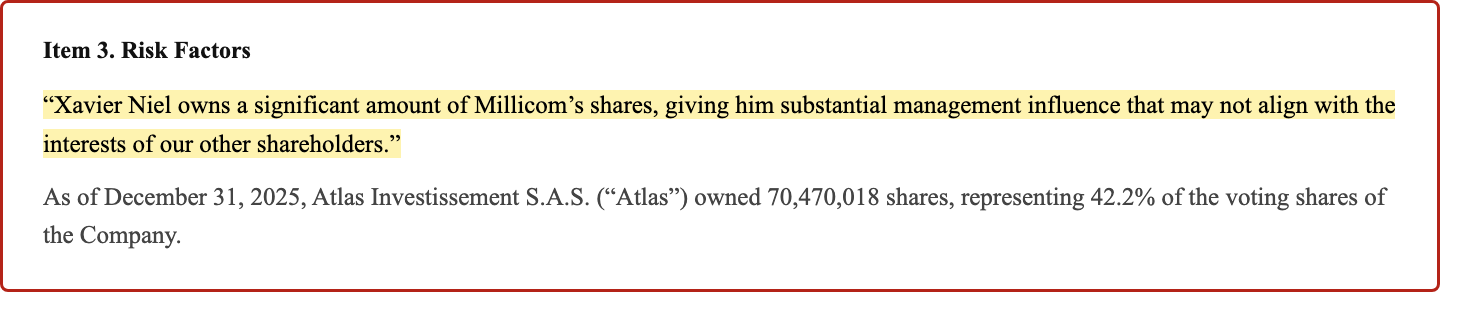
Concretely: as of December 31, 2025, Atlas Investissement S.A.S. — the investment vehicle from the orbit of French billionaire Xavier Niel (via Iliad and the family holding Maya) — held 70,470,018 shares, or 42.2 percent of the voting shares, and appointed four of eight directors. This followed a 2024 takeover offer by Atlas at a last offered price of $25.75 per share. That is not bad in itself — a disciplined anchor shareholder can be a blessing, and the capital returns of the past two years clearly bear his signature. But it is a balance of power an investor must understand: whoever buys a Millicom share buys a minority stake in an effectively controlled company. On the next fundamental question — special dividend or debt reduction, expansion or focus — it is not the free float that decides.
Uncomfortable truth no. 4: The growth is bought, not grown — and the currencies do not cooperate
The revenue jump that triggers the growth scanner does not hold up close. In the first quarter of 2026, revenue rose to $1,985 million — up 45 percent year over year. Sounds enormous, but it is mostly bought: organically it was only 4.2 percent, with the rest coming from the newly consolidated businesses in Colombia, Uruguay and Ecuador. Millicom itself writes that the figures are "not directly comparable" with the prior year. And while revenue optically exploded, net profit attributable to owners fell 43.4 percent to $109 million — because 2025 carried the one-off gain that is now gone. On top of that comes the structural emerging-market risk you can never forget in a Latin American company. In 2025 it produced a drastic example:
"During fiscal year 2025, we determined the Bolivian Boliviano (BOB) lacked exchangeability into other currencies under the Amendments, requiring us to estimate the applicable spot exchange rate."
— Millicom International Cellular S.A., SEC annual report 20-F for 2025, Item 3 "Risk Factors" (currency risk)
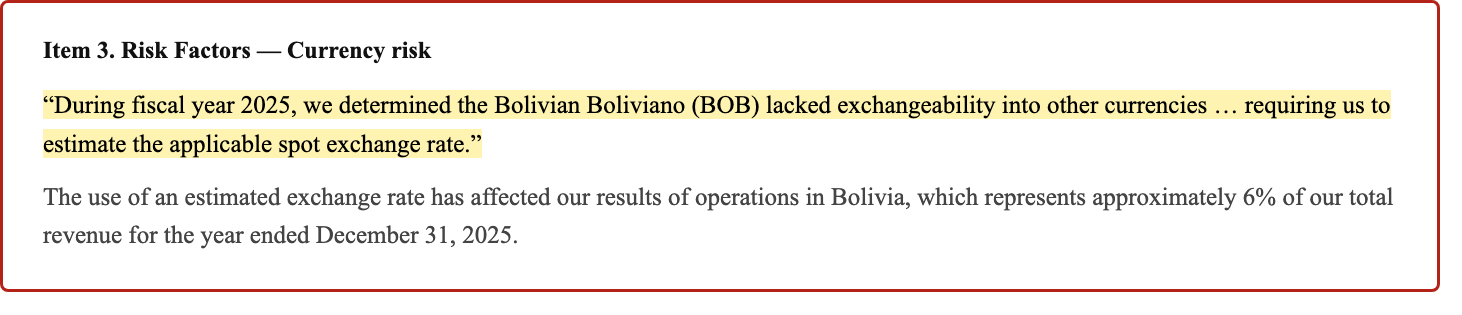
Bolivia accounts for about 6 percent of total revenue, and through the loss of convertibility alone its revenue there fell roughly 41.9 percent — without a single customer making fewer calls. Add the political risks the report names explicitly: in Colombia, the "Clan del Golfo" group was designated a foreign terrorist organization in December 2025; in Nicaragua, government officials sit on U.S. sanctions lists — both, per the annual report, can weigh on the business. Remember the image: in a Latin American company you measure not only how well the business runs, but in which currency and under which politics it is settled.
Valuation: what are you paying for — the record or the running business?
Because Millicom's honest value turns on which profit figure you believe, it is worth looking here at the durable anchors rather than a daily price. Reported earnings per share for 2025 were $7.86 — but roughly half of that is the tower sale; underlying, that is, from the running business, it is closer to $3.50. Anyone calling the stock "cheap" on the $7.86 basis is valuing a one-off as a permanent state. More meaningful is the equity free cash flow of $916 million: on a good 167 million shares that is about $5.40 per share genuinely earned for shareholders — of which $3.00 flows back as a dividend. That is the metric to measure Millicom by, not the inflated book profit. As a dated valuation anchor from the filings there is the 2024 Atlas takeover offer, at a last offered price of $25.75 per share — not a current price, but a real reference point for what a strategic buyer thought the company was worth. Net debt (excluding leases) stood at $5,357 million at the end of 2025; add the lease liabilities from the leased-back towers and it is roughly $7,943 million — so the tower sale brought cash once and, in exchange, raised the permanent lease obligations. Translated: the turnaround eased the balance sheet but did not dissolve the dependence on cash flow — it merely relabeled it from "debt" to "rent."
Opportunities and risks at a glance
What speaks for Millicom:
- A genuine operating turnaround: operating profit (EBITDA) 2025 up 11.4 percent to $2,749 million at about a 47 percent margin, a record equity free cash flow of $916 million, leverage cut to 2.31x (annual report 20-F 2025).
- Capital returns are back: after zero dividend in 2023, 2025 paid $5.50 per share in total (including a special dividend), with $3.00 proposed for 2026, plus ongoing buybacks.
- Market position: leader or number two in eleven Latin American markets under the Tigo brand, 49.3 million mobile and 4.6 million fixed-line customers, plus the Tigo Money payments service with 2.8 million users.
- A disciplined anchor shareholder: the capital discipline of recent years bears the Atlas/Niel signature; the Niel universe (NJJ) opens expansion opportunities such as the recent one in Chile.
- Structural tailwind: in many Latin American markets the broadband and smartphone build-out is not finished; higher-value postpaid plans and fiber offer room to grow revenue per customer.
What speaks against it:
- The record profit is half a one-off: of $1,316 million in 2025 net profit, roughly $727 million comes from the tower sale; underlying, roughly $589 million remains, and earnings per share drops from $7.86 to around $3.50.
- A country lump: Guatemala alone carries about 26 percent of revenue and 29 percent of segment EBITDA, and with Colombia roughly 48 percent — the report itself names the Guatemala dependence as a risk factor.
- Bought rather than grown growth: Q1 2026 revenue up 45 percent reported but only 4.2 percent organic; quarterly profit fell 43.4 percent to $109 million at the same time; leverage rose again to 2.76x after the acquisitions.
- Emerging-market and currency risk: the Bolivian boliviano lost its convertibility in 2025 (Bolivia revenue down 41.9 percent); costs mostly in U.S. dollars, revenue in local currencies; political risks in Colombia and Nicaragua.
- A controlled free float: Atlas/Niel holds 42.2 percent of the voting shares and four of eight directors — on fundamental decisions, it is not the majority of free-float shareholders that decides.
A human conclusion
Back to the comeback glow from the opening. Its core is not that turnarounds are never real — Millicom's operating turn very much is: less debt, more cash flow, dividend back, a management that delivers. Its core is that we stop reading at the good news and then mistake a sale price for a business profit. Look at Millicom soberly and you no longer see a problem child, but you also do not see a record profit machine — you see a decently restructured Latin American network operator whose real result is closer to $3.50 than $7.86 per share, whose cash comes nearly a third from one country, and over which a single major shareholder ultimately decides. So the honest question for you is not "Did Millicom pull off the turnaround?" (operationally, yes), but: are you paying for the record or for the running business — and are you aware whose playbook you are buying along with it? If the answer is "I value the underlying cash flow, I know the Guatemala lump, and I am at peace with a controlling anchor shareholder," then Millicom can be a solid, dividend-rich emerging-market holding. If instead you bought the word "record profit," you have bought half a tower sale. What you make of it is your decision. And that is exactly as it should be.
Sources
All original documents used in this analysis — to read for yourself:
- Millicom International Cellular S.A. — SEC annual report 20-F for fiscal year 2025 (as of December 31, 2025; filed March 24, 2026)
- Millicom International Cellular S.A. — SEC annual report 20-F for fiscal year 2024 (as of December 31, 2024; filed April 8, 2025)
- Millicom International Cellular S.A. — SEC annual report 20-F for fiscal year 2021 (as of December 31, 2021; filed March 1, 2022; Guatemala full consolidation)
- Millicom International Cellular S.A. — SEC interim report 6-K with the first-quarter 2026 earnings release (filed May 14, 2026)
- Millicom International Cellular S.A. — SEC interim report 6-K with the full-year 2025 earnings release (filed February 26, 2026)
- Millicom International Cellular S.A. — SEC interim report 6-K on the annual general meeting and dividend (filed May 21, 2026)
- Millicom's complete SEC filing history: EDGAR overview (sec.gov)
- Fundamental data (metrics, segment and quarterly series, valuation; data as of July 17, 2026), reconciled with the SEC filings.
- Screener data: in-house Joshua growth scanner (data as of July 17, 2026, 75 hits).
Transparency & disclaimer: This analysis is a journalistic contextualization of publicly available information and is not investment advice, not a financial analysis in the regulatory sense, and not a solicitation to buy or sell securities. Stock investments carry substantial risks up to total loss. All information without guarantee; the data cut-off is noted in the text in each case. The author holds no position in Millicom stock at the time of publication.
Our Bottom Line at a Glance
- Operating turnaround & balance sheet positive
- Operating profit (EBITDA) 2025 up 11.4 percent to $2,749 million at about a 47 percent margin, a record equity free cash flow of $916 million, leverage cut to 2.31x, and the dividend restored after the 2023 blank (2025: $5.50 per share in total). Operationally the turn is real and documented (annual report 20-F 2025).
- Earnings quality & the one-off negative
- The record net profit of $1,316 million (EPS $7.86) includes, per the full-year release, roughly $727 million of one-off gain from the tower sale ("Sale of Lati Operations" at $741 million in the income statement); underlying, roughly $589 million remains and earnings per share of about $3.50. Anyone valuing the stock on the $7.86 basis is treating a sale price as a permanent profit.
- Country concentration negative
- Guatemala alone carries about 26 percent of revenue and, at $928 million, about 29 percent of segment EBITDA, and with Colombia roughly 48 percent — the annual report names the Guatemala dependence as a risk factor itself ("highly dependent on our operations in Guatemala"). Unlike a customer lump, a country lump cannot be replaced.
- Ownership & governance neutral
- Atlas Investissement (Xavier Niel / Iliad orbit) holds 42.2 percent of the voting shares and four of eight directors (12/31/2025); the report lists Niel's influence as a risk factor. It cuts both ways: disciplined capital allocation and expansion opportunities via the Niel universe (NJJ, Chile) stand against a potential conflict of interest to the detriment of the free float.
- Growth & emerging-market risk negative
- The revenue jump is bought: Q1 2026 up 45 percent reported but only 4.2 percent organic (acquisitions in Colombia/Uruguay/Ecuador); quarterly profit fell 43.4 percent to $109 million, and leverage rose again to 2.76x. Add structural currency risk: the boliviano lost its convertibility in 2025 (Bolivia revenue down 41.9 percent), costs in U.S. dollars, revenue in local currencies; political risks in Colombia and Nicaragua.
Millicom has delivered a genuine operating turnaround: operating profit and cash flow at records, leverage cut to 2.31x, dividend back. But the reported record net profit of $1,316 million is half a one-off from the tower sale — underlying closer to $589 million — nearly a third of operating profit hangs on Guatemala alone, the latest revenue growth is bought rather than grown, and with 42.2 percent of the voting shares a single anchor shareholder effectively decides the company. Whoever invests here buys a decently restructured Latin American network operator with concentration and control risk — not the record profit machine of the headline. Not investment advice.
What Our Rating Means
- If you don't own the stock
- As long as the question raised in the bottom line stays open, we see no basis for an entry.
- If you hold it in your portfolio
- Our findings offer no acute reason to sell — the checkpoints named remain decisive.
A journalistic assessment by our editorial team at the time of the deep dive, based on public sources — not investment advice and not a solicitation to buy or sell. Your personal circumstances (investment goals, risk capacity, taxes) cannot be taken into account. What our categories mean, how verdicts are formed, and what conflicts of interest exist →
Worth Noting
- TIGO reached our research list via the in-house Joshua growth scanner (data as of July 17, 2026, 75 hits in total); growth scanners capture the acceleration of the numbers, not their origin — at Millicom the 2025 profit jump came half from a one-off sale and the Q1 2026 revenue gain mostly from acquisitions.
- As a foreign private issuer, Millicom files on annual report 20-F and interim report 6-K (not 10-K/10-Q); the fiscal year ends December 31, with IFRS accounting in U.S. dollars. The 2021 figures are not directly comparable with later years because Guatemala was only fully consolidated at the end of 2021.
- Metrics and valuation anchors are dated to the 2025/Q1 2026 reports or the July 17, 2026 screener cut-off; a daily price is deliberately omitted (analyses are evergreen). The $25.75 reference price comes from the 2024 Atlas takeover offer and is not a current price.
Frequently Asked Questions
Millicom International Cellular S.A. (Nasdaq: TIGO), based in Luxembourg, is a mobile, broadband and cable operator active in eleven Latin American countries under the Tigo brand — including Guatemala, Colombia, Panama, Honduras, Paraguay and Bolivia. As of December 31, 2025, it served about 49.3 million mobile and 4.6 million fixed-line customers, plus the Tigo Money mobile payments service. Revenue in 2025: $5,819 million.
Because Millicom is a foreign private issuer based in Luxembourg. Such companies do not file an annual report 10-K or quarterly reports 10-Q with the U.S. securities regulator, the SEC; they file an annual report 20-F and interim reports 6-K. It is the same regulator and the same penalty of law, just a different form. The fiscal year ends December 31, and the accounts follow the international IFRS rules, reported in U.S. dollars.
Net profit attributable to owners jumped to $1,316 million in 2025 (earnings per share of $7.86). But per the full-year release it includes roughly $727 million of one-off gain from selling the tower infrastructure — booked on the balance sheet as "Sale of Lati Operations" at $741 million. Without that one-off, the result is roughly $589 million and earnings per share around $3.50 rather than $7.86.
Very dependent. Guatemala provided about 26 percent of revenue in 2025 and, at $928 million, about 29 percent of segment EBITDA — together with Colombia roughly 48 percent. The annual report (20-F) names it as a risk factor itself: "The cash flow we generate is highly dependent on our operations in Guatemala." If regulation, currency or the economy falters in Guatemala, it hits nearly a third of the group's operating profit.
Yes, again. No dividend was paid in 2023 ("No dividend distributions were made in 2023"). For 2025, Millicom paid $5.50 per share in total (a regular $3.00 plus $2.50 in special dividends). For 2026, the board has again proposed a regular dividend of $3.00 per share (payable July 2026 through April 2027).
The largest shareholder is Atlas Investissement S.A.S., the investment vehicle from the orbit of French billionaire Xavier Niel (via Iliad and the family holding Maya). As of December 31, 2025, Atlas held 70,470,018 shares, or 42.2 percent of the voting shares, and appointed four of eight directors. The annual report lists Niel's influence explicitly as a risk factor.
As of December 31, 2025, net financial debt (excluding leases) stood at $5,357 million and leverage (net debt divided by EBITDA) at 2.31x — solid for a telecom, and Millicom historically ran higher. Add the lease liabilities from the leased-back towers and financial obligations rise to roughly $7,943 million. After the acquisitions, leverage rose again to 2.76x in the first quarter of 2026.
Found an error?
Did you spot a factual error, an outdated number, or a typo in this deep dive? Let us know briefly — your report goes straight to the editorial team.