Rackspace Stock: The Price Went Up Sevenfold — While Its Own Creditors Sell at Half Price
Rackspace Technology shows up in our Reddit hype scanner (4 mentions in 24 hours as of July 15, 2026) — no surprise: up 649 percent year to date (data as of July 8, 2026). We read the annual reports (10-K) for 2024 and 2025 and the quarterly report (10-Q) as of March 31, 2026: a third straight year of losses, negative $1.2 billion in stockholders' equity, a $2.45 billion debt wall in 2028 — and a quarterly "profit" that only exists because the company bought back its own notes for roughly half of face value. Not investment advice — just the question of who knows more here: the share price or the lenders.
 Thomas Mücke
Founder & Publisher
Thomas Mücke
Founder & Publisher
Chart
Interactive price chart (TradingView).
Note: pure fact-based analysis, not investment advice and not a solicitation to buy or sell. All figures without guarantee.
There is a whisper every investor knows who has ever watched a stock run away from them: "A rally like that doesn't come from nowhere. Somebody knows something." Psychologists call the mechanism behind it momentum belief — we treat the price move itself as proof that someone with better information has already bought in. Hardly any ticker feeds that reflex in the summer of 2026 as reliably as Rackspace Technology (Nasdaq: RXT): up 649 percent year to date, a relative-strength rating of 99, a stock that went from penny-stock candidate to near-tenbagger within months (data as of July 8, 2026) — and that now shows up in our Reddit hype scanner as well (ApeWisdom, 4 mentions in 24 hours, as of July 15, 2026). So let's make a deal: before you believe the price, we ask the only people who have to be honest under penalty of law — the SEC filings. We read the annual report (10-K) for 2025, its predecessor and the quarterly report (10-Q) as of March 31, 2026, all filed with the U.S. securities regulator, the SEC. And in those filings there is a second group of professionals who also "know something": the company's own creditors. They are selling. At half price. In the end, you decide whom to believe.
What Rackspace actually does — and what the company really earns from
Rackspace, founded in San Antonio in 1998, was once the very definition of web hosting: its own data centers, its own servers, "Fanatical Support" as the trademark. That business no longer exists in that form — today Rackspace is what the annual report calls an "end-to-end hybrid cloud and AI solutions company". Translated: Rackspace is the repair shop for other people's clouds. The company does not own the cloud — Amazon, Microsoft and Google do — it designs, builds and operates other companies' cloud environments and earns on the operation. The business runs in two segments. Public Cloud ($1,696.0 million of revenue in 2025) bundles services around AWS, Microsoft Azure and Google Cloud: migration, management, optimization, consulting. Private Cloud ($989.7 million in 2025) is the legacy of the old hosting business: dedicated infrastructure operated by the company — these days mostly on VMware — for customers who cannot or will not put their data into the big shared pool. Since 2023 Rackspace has also been trying to ride the AI wave: the "Foundry for Artificial Intelligence (FAIR)" grew into the "Rackspace AI" portfolio. Sounds like a future story? The segment accounts tell the uncomfortable version: the growing business earns little, the shrinking business earns a lot. Public Cloud delivered a segment margin of 4.7 percent in the first quarter of 2026 — of $100 taken in, less than $5 remain before corporate costs. Private Cloud managed 24.7 percent, but has been losing customers migrating off the legacy platforms for years: revenue down 13.2 percent in 2024, down 6.1 percent in 2025, down 6.0 percent in the first quarter of 2026. Which brings us to the central tension of this analysis, and it runs through every chapter: a stock that went up sevenfold meets a company whose profitable core is eroding — and a $2.45 billion debt wall in 2028 whose creditors are handing off their claims at steep discounts. What a price explosion and a strained balance sheet look like together is something we recently dissected at AMC Entertainment; how an entire brand can end up serving its lenders, at Wendy's.
Where the stock shows up in our scanner
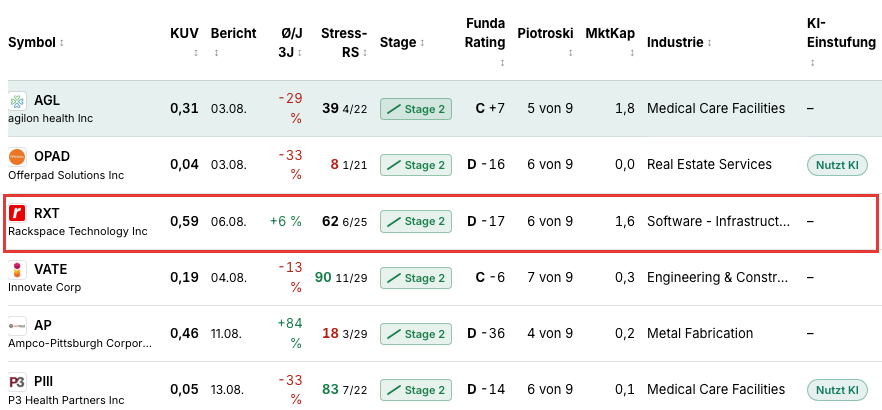
Every day we run about 3,500 stocks through our scanners. Rackspace reached our research list via the Reddit hype scanner — 4 mentions in 24 hours (ApeWisdom, as of July 15, 2026) is no storm, but for an infrastructure services firm without a consumer brand it is noticeable enough, and the chart explains the murmur. In our metrics scanners the stock lights up in the P/S ranking as of the July 8, 2026 data cut-off: a price-to-sales ratio of 0.59 — the market pays just 59 cents for every dollar of annual revenue, while healthy IT services firms often fetch two to four times sales. The same row shows why that discount exists, and it reads like two expert opinions about two different companies. Opinion one, the trend lens, is rhapsodic: a relative-strength rating of 99 — the stock performed better than 99 percent of all others —, a stage-2 uptrend, up 649 percent year to date, up 526 percent in three months (all data as of July 8, 2026). Opinion two, the balance-sheet lens, judges mercilessly: an Altman Z-score of -2.27 — the classic insolvency early-warning built from several balance-sheet ratios historically starts warning below 1.8; a negative reading emerges almost only when losses and negative equity come together. Add 5 distress flags, interest coverage around zero, a fundamental grade of D — only the Piotroski F-Score, a nine-point test for the direction of balance-sheet quality, stands passably at 6 of 9, because losses and cash flow improved most recently. About 69 percent of the shares sit with institutional investors. Cheap on sales, hot on trend, alarming on the balance sheet — this fingerprint appears when the market reprices a stock before the balance sheet has caught up.
A word of honesty about this rally: it started from an extremely low base. As late as September 2025, Rackspace itself valued freshly granted share packages at $1.30 apiece (more on that later); as of the July 8, 2026 data cut-off the stock cost about $6.40 — still roughly 74 percent below its all-time high from 2021. Whoever looks at the chart from far enough away sees no success story, but a crash with a spectacular echo. The question is whether the echo has a foundation.
The numbers over the years — honestly appraised
First, what is genuinely improving — and it is more than the raw losses suggest. The net loss shrank from $858.2 million to $225.8 million in 2025; strip out the special items and Non-GAAP operating profit improved from $105.6 million to $126.1 million (up 19 percent). Operating cash flow turned from a meager $39.9 million (2024) to $151.4 million (2025). Selling, general and administrative expenses fell 330 basis points to 22.6 percent of revenue — the cost program is biting. Public Cloud is growing again: up 0.8 percent in 2025, up 6.7 percent in the first quarter of 2026, carried by services revenue. And one risk that plagues many turnaround candidates is absent here: the customer base is broad — per the annual report, no single customer accounted for 6 percent or more of revenue in 2025. Whoever reads only these paragraphs understands why the market took a fresh look. Now turn the page:
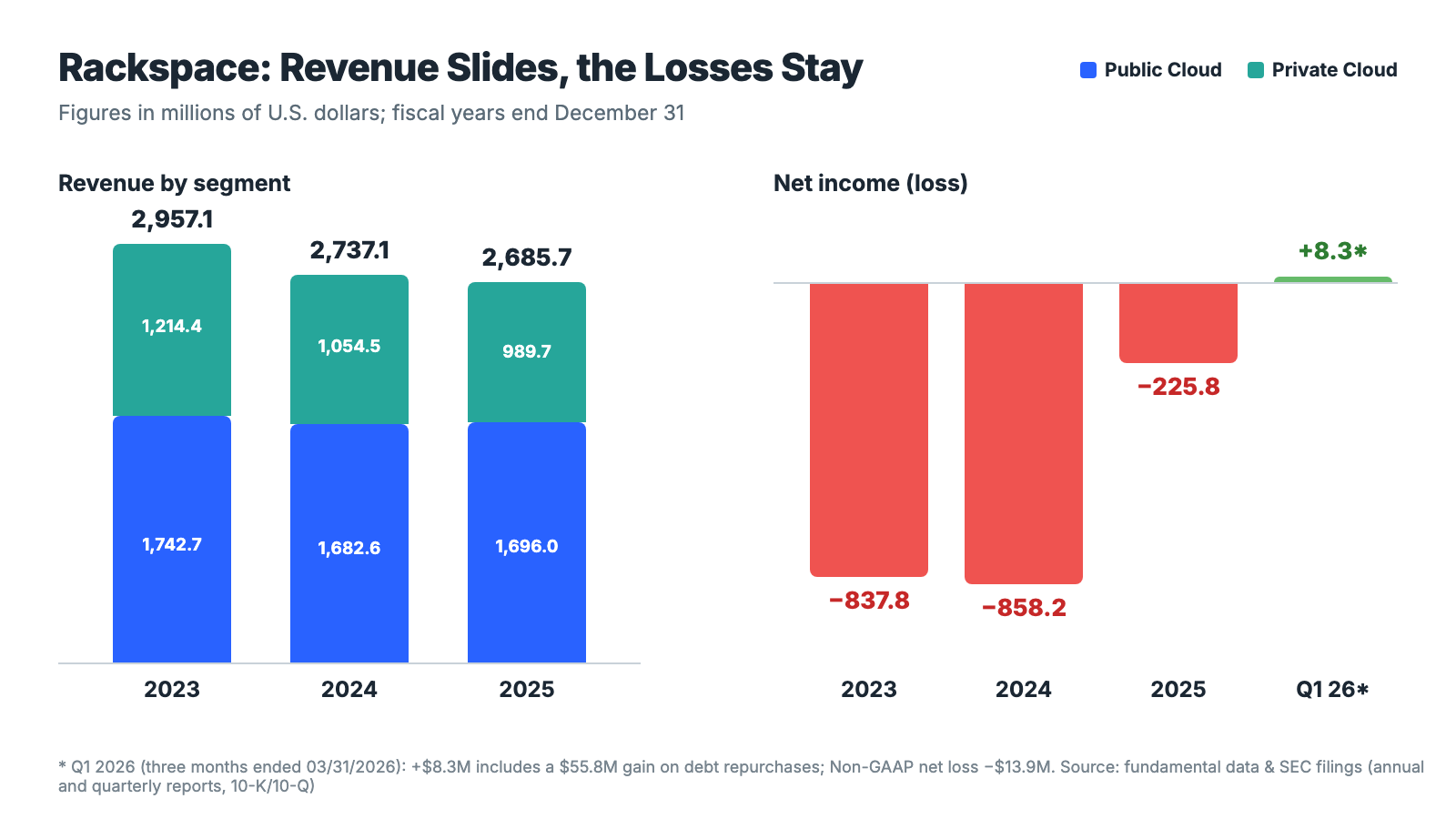
Total revenue has been falling for three years: $2,957.1 million (2023), $2,737.1 million (2024), $2,685.7 million (2025). The driver is always the same: the high-margin Private Cloud lost almost a fifth of its revenue within two years ($1,214.4 million down to $989.7 million) as customers migrate off the legacy platforms — the annual report calls it, dryly, "customer transitions off legacy platforms". The losses pile up: in 2023 and 2024 Rackspace wrote off more than $700 million of goodwill in each year — that is the moment a company admits the expectations it once paid for can no longer be sustained. The accumulated deficit reached $3,908.2 million at the end of 2025, stockholders' equity stood at negative $1,219.5 million — liabilities exceed assets by more than a billion dollars. Remember this sentence, it is the key to the rest of the analysis: where no equity is left, the company economically belongs to its creditors — and their verdict is not shown in any stock app. Which brings us to the uncomfortable truths.
What the filings say — the uncomfortable truths
Uncomfortable truth no. 1: debt service eats the entire operating cash flow — and almost everything comes due at once in 2028
Rackspace carries the legacy of Apollo's 2016 buyout on its balance sheet to this day. The annual report says it without ceremony:
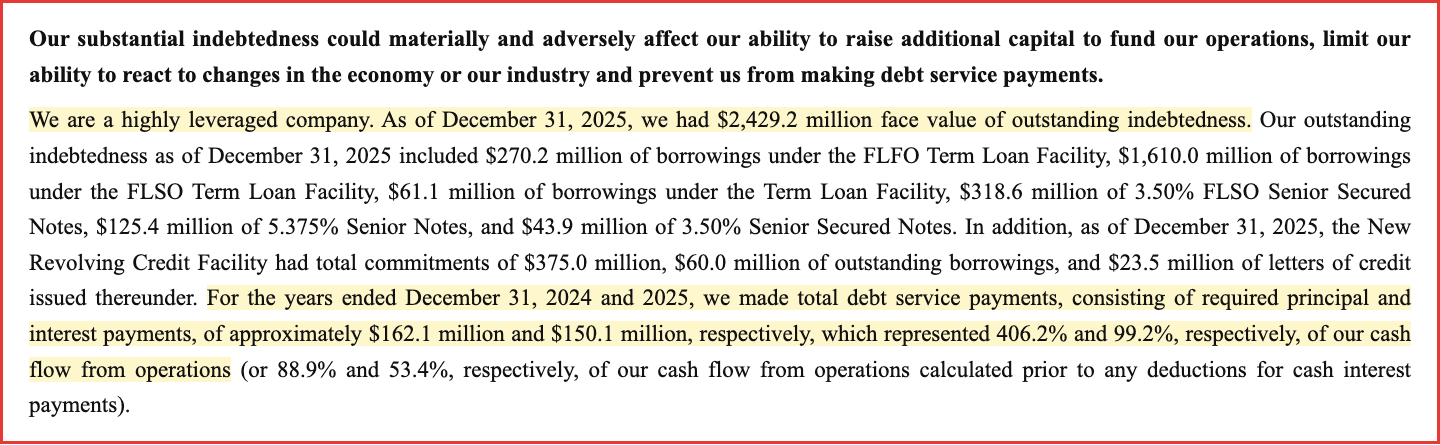
"We are a highly leveraged company. As of December 31, 2025, we had $2,429.2 million face value of outstanding indebtedness."
— Rackspace Technology, SEC annual report 10-K 2025, Item 1A "Risk Factors"
How heavily that load sits on the day-to-day business is quantified two sentences later in the same section — perhaps the most important number in the entire report:
"For the years ended December 31, 2024 and 2025, we made total debt service payments, consisting of required principal and interest payments, of approximately $162.1 million and $150.1 million, respectively, which represented 406.2% and 99.2%, respectively, of our cash flow from operations (or 88.9% and 53.4%, respectively, of our cash flow from operations calculated prior to any deductions for cash interest payments)."
— Rackspace Technology, SEC annual report 10-K 2025, Item 1A "Risk Factors"
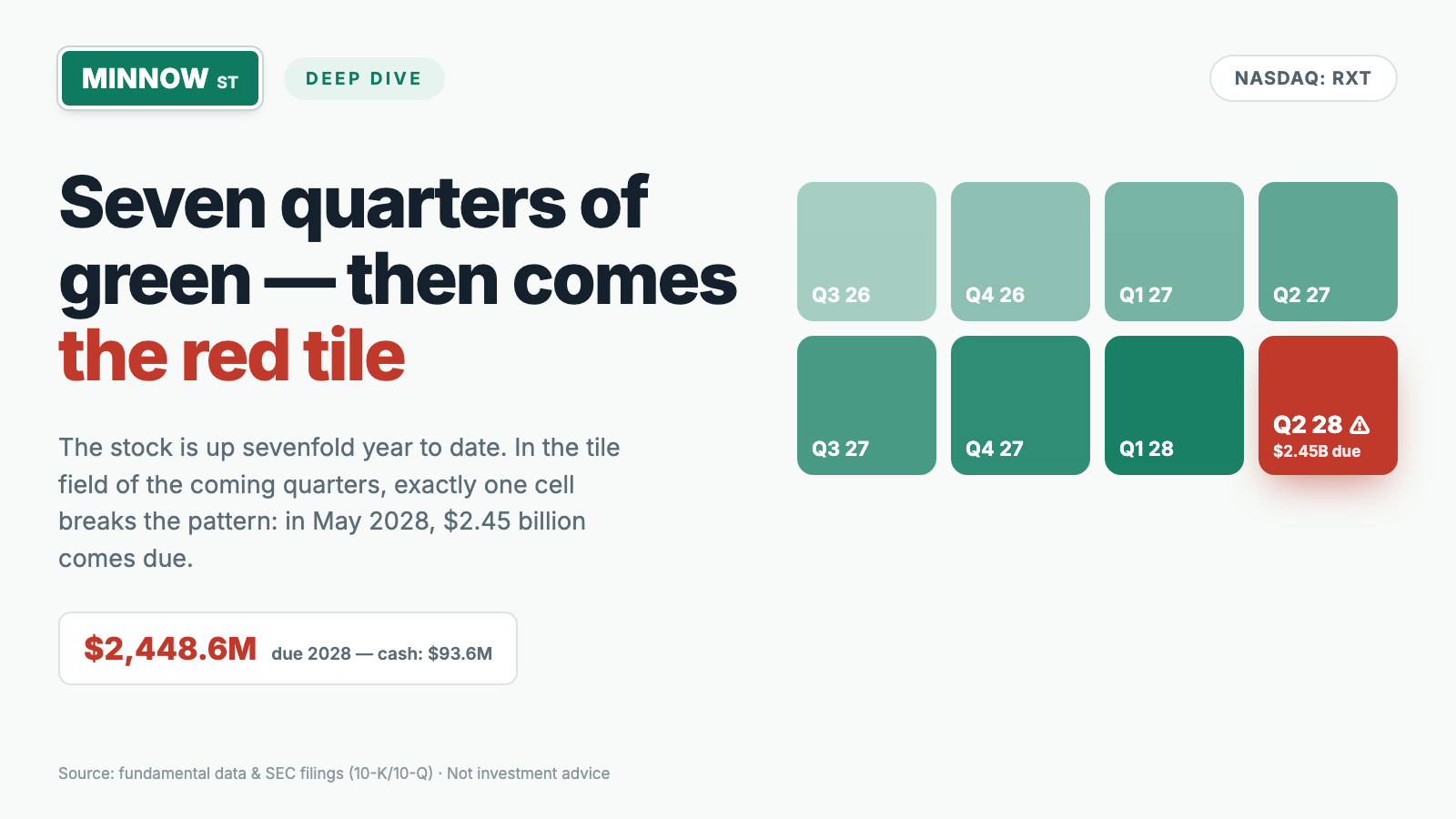
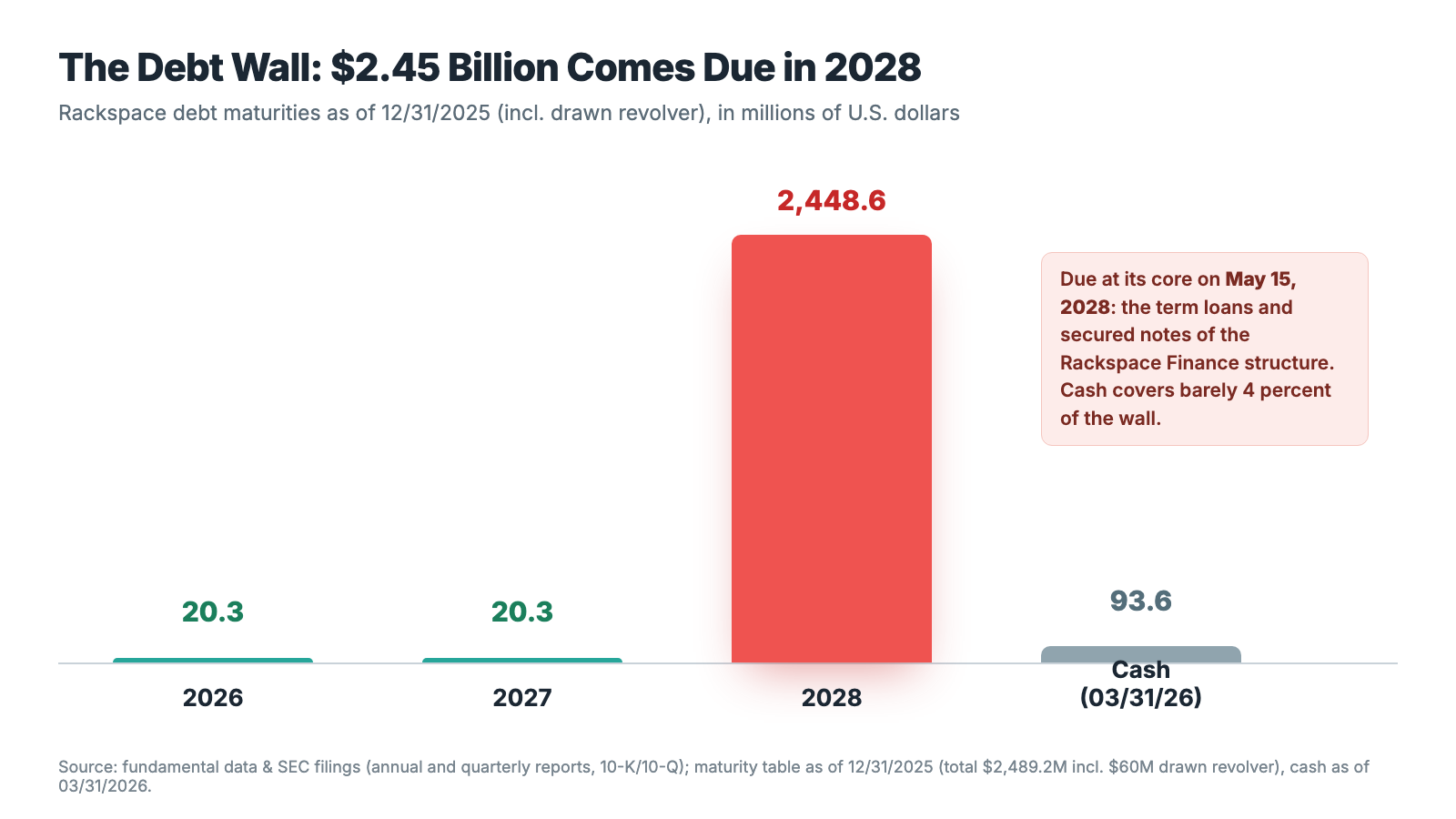
Translated into everyday language: of every dollar earned in operations in 2025, practically the whole dollar went to the creditors — almost nothing was left over from the company's own resources for investment, product development or a buffer (the $58.4 million of capital expenditures still happened, partly via leasing). And this is the good case, because the big maturities are still ahead: of the $2,489.2 million in total maturities (including the drawn revolver), the maturity table shows $20.3 million due in 2026, $20.3 million in 2027 — and $2,448.6 million in 2028, at its core on May 15, 2028. Against that stood just $93.6 million of cash as of March 31, 2026, and the revolver was already drawn to $150 million of $375 million. A wall like that is not paid out of cash flow — it is refinanced. At what price a market refinances a company whose own bonds trade far below face value is the open question everything hangs on.
Uncomfortable truth no. 2: the company's own creditors sell at half price — and the quarterly "profit" is an accounting effect
In the first quarter of 2026 Rackspace reported $8.3 million of net income — after a $71.5 million loss in the prior-year quarter. Sounds like a turning point. The quarterly report shows what that profit is made of:
"During the three months ended March 31, 2026, Rackspace Finance repurchased and surrendered for cancellation $68.3 million principal amount of the 3.50% FLSO Senior Secured Notes for $34.5 million, including accrued interest and fees of $0.4 million."
— Rackspace Technology, SEC quarterly report 10-Q as of March 31, 2026, Note 5 "Debt"

Pause for a moment and translate what that says. Professional investors holding secured Rackspace notes — paper that would have to be repaid at 100 percent in 2028 — handed them over voluntarily for roughly 50 cents on the dollar. On the unsecured 5.375% notes the distrust is even starker: the annual report put their market value at $26.4 million of $125.4 million face value at the end of 2025 — about 21 cents on the dollar. A bondholder who believes in full repayment does not sell at half price; that discount is a probability statement about what happens in 2028. For the company, the buybacks are smart business — every repurchased note retires a dollar of debt for 50 cents. But the accounting turns it into earnings: the repurchases produced a $55.8 million gain on debt extinguishment, and exactly that line item flipped the quarter into the black. Without it, operations showed a $17.8 million loss; Rackspace itself reports a Non-GAAP net loss of $13.9 million. It is the same mechanism that was already at work in 2024: the March 2024 restructuring — creditors exchanged roughly $1.9 billion of claims into new instruments of roughly $1.6 billion, discounts of about 18 to 30 percent depending on the tranche — also produced $147.2 million of extinguishment gains. Remember the sentence: a profit that exists because your own creditors are selling their hope is not a sign of strength — it is their price tag. In fairness: the company is exploiting the situation methodically, retiring a good $160 million of face value below par from 2024 through early 2026 — while at the same time drawing the revolver up from $60 million to $150 million. Deleveraging with one hand, new borrowing with the other.
Uncomfortable truth no. 3: Apollo controls the company — as owner and as lender
Who actually owns this company? The answer sits unvarnished in the risk section:
"We continue to be controlled by Apollo, and Apollo's interests may conflict with our interests and the interests of other stockholders. As of December 31, 2025, Apollo beneficially owned approximately 53% of the voting power of our outstanding common stock."
— Rackspace Technology, SEC annual report 10-K 2025, Item 1A "Risk Factors"

The history behind this is essential to understanding the stock: Apollo Global Management took Rackspace over in November 2016 in a leveraged buyout — that is, with debt the company itself subsequently carried — and brought it back to the market in August 2020. Today's debt pile is the direct inheritance of that construction. As a "controlled company" under Nasdaq rules, Rackspace may also waive governance standards ordinary companies must meet — such as a majority of independent directors; an executive committee with two Apollo appointees can act broadly between board meetings. And one detail from the debt footnote deserves special attention: Apollo affiliates are simultaneously lenders — as of December 31, 2025 they held $79.7 million of the company's most important loan. The majority shareholder thus sits on both sides of the table: if the equity wins, Apollo wins; if a restructuring comes, Apollo also negotiates from the creditors' bench. The risk section further notes, dryly, that the equityholders — "including Apollo and its affiliates" — have no continuing obligation ever to provide the company with fresh debt or equity financing. For you as a minority shareholder that means: you are riding in a car whose steering wheel, brakes and loan agreement belong to someone else.
Uncomfortable truth no. 4: three years of losses, negative $1.2 billion of equity — and the report promises no improvement
The loss history is not our interpretation; it is a self-disclosure:
"We have a history of losses and may not be able to achieve profitability in the future. We incurred net losses of $837.8 million, $858.2 million and $225.8 million in the fiscal years ended December 31, 2023, 2024 and 2025, respectively."
— Rackspace Technology, SEC annual report 10-K 2025, Item 1A "Risk Factors"

Two footnotes to this that get drowned out in the rally noise. First, the interest burden: the reported interest expense of $83 million (2025) looks manageable — but it systematically understates the load, and the report says so itself: through the accounting for the 2024 restructuring, part of the contractual interest payments is booked against carrying premiums rather than as expense. In its own Non-GAAP reconciliation, Rackspace quantifies that effect at another $83.0 million for 2025 — the contractual interest burden was thus nearly twice the reported figure, and in the first quarter of 2026 interest expense already climbed from $19.4 million to $26.2 million. Second, dilution: the number of shares outstanding grew from 229.1 million to 245.3 million in 2025 alone — up 7 percent within a year, in part through compensation packages granted near the price lows. Your slice of the pie is getting smaller while the pie itself is still shrinking.
Valuation: a $1.6 billion market value — and why the P/S of 0.59 is an optical illusion
In early July 2026 the Rackspace stock cost about $6.40, for a market value of roughly $1.6 billion (data as of July 8, 2026). Against $2.7 billion of revenue that looks dirt cheap — a price-to-sales ratio of 0.59, hence the hit in our P/S ranking. But calculate like a buyer of the whole company: add roughly $2.33 billion of debt face value plus the $150 million drawn revolver, subtract $94 million of cash (all as of March 31, 2026) — an enterprise value around $4 billion, roughly 1.5 times revenue. On top of that sit $470 million of lease obligations. A P/E does not exist (there is no sustained profit), a price-to-book ratio is meaningless with negative equity. What you actually acquire when you buy is a leveraged bet: if the 2028 refinancing succeeds and the turnaround holds, a large part of the enterprise value suddenly belongs to the shareholders — which is exactly why such a stock can go up sevenfold without much changing in the business. But the leverage works in both directions: if the refinancing fails, $2.4 billion of creditor claims stand ahead of the shareholders — along with a majority owner who also sits on the creditor side. The bond prices (50 cents secured, 21 cents unsecured) show how the credit market currently prices that bet. The stock market prices the opposite. They cannot both be right.
Opportunities and risks at a glance
What speaks for Rackspace:
- The operating trend is turning: Non-GAAP operating profit up from $105.6 million to $126.1 million (up 19 percent), operating cash flow improved from $39.9 million to $151.4 million, SG&A ratio cut by 330 basis points (annual report 10-K for 2025).
- Public Cloud is growing again: up 6.7 percent in the first quarter of 2026 to $443.4 million, carried by services — plus an AI story ("Rackspace AI") with partnerships around AWS, Microsoft Azure and Google Cloud.
- A broad customer base instead of concentration risk: per the annual report, no customer accounted for 6 percent or more of revenue in 2025; customers across all sectors, including regulated industries.
- Deleveraging at discount prices: from 2024 through early 2026, a good $160 million of face value was retired for a fraction of par; the Q1 2026 buyback alone saved roughly $34 million of face value — as long as the company's own bonds trade low, every dollar of cash works double.
- Momentum and attention: a relative-strength rating of 99, a stage-2 uptrend, up 649 percent year to date (data as of July 8, 2026) — the market is already trading the turnaround scenario, and about 69 percent of the shares sit with institutional investors.
What speaks against it:
- The debt wall: $2,429.2 million of face value (12/31/2025), of which $2,448.6 million (incl. revolver) comes due in 2028; 2025 debt service = 99.2 percent of operating cash flow; cash of only $93.6 million, revolver already drawn to $150 million of $375 million (03/31/2026).
- The credit professionals' verdict: the company's own secured notes were repurchased at roughly 50 cents on the dollar in the first quarter of 2026, and the unsecured 5.375% notes were valued around 21 cents at the end of 2025 — the bond market prices a far worse scenario than the stock price does.
- The profitable core is eroding: Private Cloud (24.7 percent segment margin) lost nearly a fifth of its revenue from 2023 to 2025; the growing Public Cloud business earns only a 4.7 percent segment margin (Q1 2026) — growth has not yet replaced the disappearing contribution.
- Substance used up: a third straight annual loss ($225.8 million in 2025), stockholders' equity of negative $1,219.5 million, an accumulated deficit of $3.9 billion, more than $1.4 billion of goodwill impairments in 2023/2024; an Altman Z-score of -2.27 and 5 distress flags in the scanner (data as of July 8, 2026).
- Power structure: Apollo controls about 53 percent of the voting power, uses Nasdaq's controlled-company exemptions, is simultaneously a lender ($79.7 million in the FLSO term loan) — and owes shareholders nothing; add 7 percent dilution in 2025 alone.
A human conclusion
Back to the whisper from the opening: "Somebody knows something." Maybe that is even true. The market saw real improvements — a net loss shrinking from $858 million to $226 million, operating cash flow coming back, a Public Cloud business growing again, and a management retiring debt at 50 cents on the dollar. Starting from a market value that at times sat below half a billion dollars, that prospect was enough for a 649 percent run. But hold next to it what the other professionals know: the creditors, who sit closer to the numbers than any Reddit thread, are selling this very company at discounts of 50 to 79 percent of face value — on paper that ranks ahead of your shares. Between today and the day it becomes clear who was right lies one date: May 15, 2028, when practically the entire $2.45 billion debt pile comes due — negotiated by a majority owner who sits on both sides of the table and owes the minority shareholders nothing. A stock with negative equity is not a claim on substance; it is an option on things going right. Options can multiply — this one just proved it — and options can expire. The price may know something. The lenders know something too. What you make of it is your decision. And that is exactly as it should be.
Sources
All original documents used in this analysis — to read for yourself:
- Rackspace Technology, Inc. — SEC annual report 10-K for 2025 (filed March 6, 2026)
- Rackspace Technology, Inc. — SEC annual report 10-K for 2024 (filed March 21, 2025)
- Rackspace Technology, Inc. — SEC quarterly report 10-Q as of March 31, 2026 (filed May 8, 2026)
- Rackspace Technology, Inc. — SEC quarterly report 10-Q as of September 30, 2025 (filed November 10, 2025)
- Rackspace Technology, Inc. — SEC quarterly report 10-Q as of June 30, 2025 (filed August 11, 2025)
- Rackspace Technology, Inc. — SEC quarterly report 10-Q as of March 31, 2025 (filed May 12, 2025)
- Rackspace Technology's complete SEC filing history: EDGAR overview (sec.gov)
- Fundamental data (metrics, quarterly series, valuation; data as of July 8, 2026), reconciled with the SEC filings.
- Screener and rating data: in-house stock scanner (data as of July 8, 2026); Reddit mentions: ApeWisdom (as of July 15, 2026).
Transparency & disclaimer: This analysis is a journalistic contextualization of publicly available information and is not investment advice, not a financial analysis in the regulatory sense, and not a solicitation to buy or sell securities. Stock investments carry substantial risks up to total loss. All information without guarantee; the data cut-off is noted in the text in each case. The author holds no position in Rackspace stock at the time of publication.
Our Bottom Line at a Glance
- Business model & market position neutral
- An established multicloud services firm with $2,685.7 million of revenue (2025), partnerships with AWS, Microsoft Azure and Google Cloud and a broad customer base (no customer at 6 percent or more of revenue). But the margin mechanics are unfavorable: the growing Public Cloud segment earns a 4.7 percent segment margin, while the high-margin Private Cloud segment (24.7 percent) has been shrinking for years (annual and quarterly reports).
- Earnings & substance negative
- A third straight year of losses (−$225.8 million in 2025 after −$858.2 and −$837.8 million), more than $1.4 billion of goodwill impairments in 2023/2024, an accumulated deficit of $3,908.2 million, stockholders' equity of negative $1,219.5 million (12/31/2025); plus 7 percent dilution in 2025 alone. The report itself warns that profitability may not be achieved in the future either.
- Balance sheet & the 2028 debt wall negative
- $2,429.2 million face value of debt, of which $2,448.6 million (incl. revolver) comes due in 2028; 2025 debt service = 99.2 percent of operating cash flow; cash of $93.6 million, revolver drawn to $150 of $375 million (03/31/2026). The bond market prices in skepticism: secured notes around 50, unsecured around 21 percent of face value; an Altman Z-score of -2.27 and 5 distress flags (data as of July 8, 2026).
- Operational turnaround positive
- The direction is right: Non-GAAP operating profit up 19 percent to $126.1 million (2025), operating cash flow improved from $39.9 million to $151.4 million, SG&A ratio cut by 330 basis points, Public Cloud up 6.7 percent in Q1 2026 — and deleveraging below face value (a good $160 million of principal retired for a fraction of par since 2024).
- Ownership & governance negative
- Apollo controls about 53 percent of the voting power, uses Nasdaq's controlled-company exemptions and is simultaneously a lender through affiliates ($79.7 million of the FLSO term loan) — in a potential 2028 restructuring the majority owner sits on both sides of the table, and nobody is obligated to inject fresh capital (10-K 2025, Item 1A).
Rackspace is a real turnaround candidate with real progress — a shrinking loss, returning operating cash flow, a growing Public Cloud business — and at the same time a balance sheet that economically belongs to the creditors: negative equity, debt service equal to the entire operating cash flow, and a $2.45 billion wall in 2028. While the stock went up sevenfold, the company's own lenders sold their claims at 50 cents (secured) to 21 cents (unsecured) on the dollar. The equity market and the credit market are telling two irreconcilable stories about the same company. Not investment advice.
What Our Rating Means
- If you don't own the stock
- In our view, the documented risks clearly outweigh — we see no basis for an entry.
- If you hold it in your portfolio
- In our view, the findings carry enough weight to warrant a critical look at your own position.
A journalistic assessment by our editorial team at the time of the deep dive, based on public sources — not investment advice and not a solicitation to buy or sell. Your personal circumstances (investment goals, risk capacity, taxes) cannot be taken into account. What our categories mean, how verdicts are formed, and what conflicts of interest exist →
Worth Noting
- RXT reached our research list via the Reddit hype scanner (ApeWisdom, 4 mentions in 24 hours, as of July 15, 2026); attention waves of this kind are snapshots, not a quality verdict. The hit in the P/S ranking carries the July 8, 2026 data cut-off and rotates daily.
- Scanner metrics (P/S, relative strength, Altman Z, Piotroski, distress flags, interest coverage) are computed from trailing twelve-month figures; the Q1 2026 gain on debt repurchases skews earnings-based metrics upward.
- Price and valuation figures are dated to July 8, 2026 (about $6.40, market value roughly $1.6 billion); analyses are evergreen, daily prices are not a buy argument.
Frequently Asked Questions
Rackspace Technology (Nasdaq: RXT) designs, builds and operates cloud environments for other companies. The Public Cloud segment ($1,696.0 million of revenue in 2025) provides services around AWS, Microsoft Azure and Google Cloud; the Private Cloud segment ($989.7 million) operates dedicated infrastructure, mostly on VMware. Since 2023 the company has also marketed AI services under "Rackspace AI". Total revenue 2025: $2,685.7 million.
The stock gained about 649 percent year to date (data as of July 8, 2026) — albeit from an extremely low base: as late as September 2025 the company valued its own share grants at $1.30 apiece. What verifiably improved: the net loss (from $858.2 million to $225.8 million), operating cash flow ($151.4 million in 2025) and Public Cloud growth (up 6.7 percent in Q1 2026). Even after the rally the stock still traded roughly 74 percent below its 2021 high.
As of December 31, 2025, $2,429.2 million of face value was outstanding — against stockholders' equity of negative $1,219.5 million. $2,448.6 million (including the drawn revolver) comes due in 2028, at its core on May 15, 2028. Per the annual report, debt service consumed 99.2 percent of operating cash flow in 2025; as of March 31, 2026, only $93.6 million of cash was on hand.
The reported $8.3 million of net income stems from an accounting effect: Rackspace repurchased $68.3 million principal amount of its own notes for $34.5 million — roughly half — and thereby booked a $55.8 million gain on debt extinguishment. Operations showed a $17.8 million loss; the company's own Non-GAAP net loss came to $13.9 million (quarterly report 10-Q as of March 31, 2026).
Apollo Global Management controlled about 53 percent of the voting power as of December 31, 2025 — a legacy of the 2016 leveraged buyout (re-IPO in August 2020). That makes Rackspace a "controlled company" under Nasdaq rules, exempt from parts of the governance requirements. Notably, Apollo affiliates are also lenders, holding $79.7 million of the FLSO term loan. About 69 percent of the shares sit with institutional investors (data as of July 8, 2026).
Only at first glance. The market value of roughly $1.6 billion (data as of July 8, 2026) is the smaller part of the purchase price: including roughly $2.5 billion of debt (with the revolver) and net of $94 million of cash, the enterprise value comes to about $4 billion — 1.5 times revenue. A P/E does not exist for lack of profit, and price-to-book is meaningless with negative equity. The stock is a leveraged bet on the 2028 refinancing.
On May 15, 2028, the big loan tranches come due — per the annual report's maturity table, a total of $2,448.6 million in 2028 (including the revolver). That cannot be repaid from the company's own resources; it must be refinanced. The bond market prices in skepticism: secured notes were repurchased at roughly 50 cents on the dollar in early 2026, and the unsecured 5.375% notes were valued around 21 cents on the dollar at the end of 2025.
Found an error?
Did you spot a factual error, an outdated number, or a typo in this deep dive? Let us know briefly — your report goes straight to the editorial team.