Clearfield Stock: A Full Cash Box, a Finished Runway — and a Takeoff That Washington Keeps Postponing
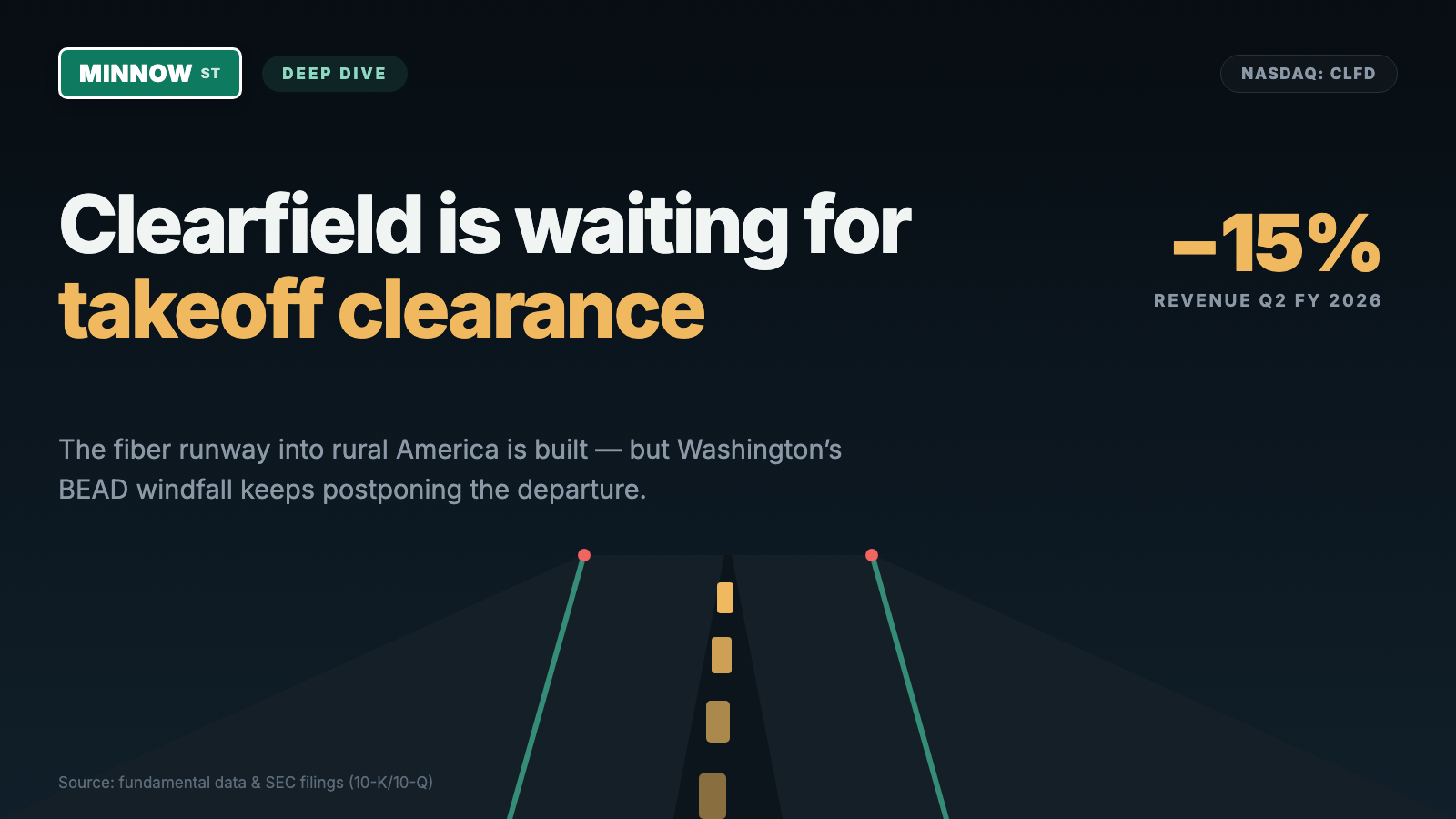
Clearfield equips rural U.S. broadband providers with fiber connectivity hardware — and lights up four trend filters in our in-house stock scanner at once (data as of July 10, 2026), while Reddit musters just 2 mentions in 24 hours (as of July 15, 2026). We read the annual reports (10-K) for fiscal years 2024 and 2025 and the quarterly report (10-Q) as of March 31, 2026: a revenue mountain that ran from plus 92 to minus 44 percent, a recovery that snagged on delays in the BEAD funding program in the latest quarter (minus 15 percent), a Finnish acquisition that went for one dollar — and $147 million in cash and investments with no bank debt. Not investment advice — just the question of what a promised windfall is worth before the money is wired.
 Thomas Mücke
Founder & Publisher
Thomas Mücke
Founder & Publisher
Chart
Interactive price chart (TradingView).
Note: pure fact-based analysis, not investment advice and not a solicitation to buy or sell. All figures without guarantee.
There is an investor trap that catches the patient ones in particular: the catalyst trap. It works like this: you find a stock with a clean balance sheet and a plausible future, plus one big event on the horizon — an approval, a mega-contract, a government funding program. And then you wait. If the event slips, you wait some more, because "selling now would mean giving up just before the finish line." Hardly any small cap feeds that trap in the summer of 2026 as textbook-perfectly as Clearfield, Inc. (Nasdaq: CLFD) from Minnesota: a supplier of fiber-optic connectivity hardware for rural America, about 72 percent below its pandemic-era all-time high, with a well-stuffed cash box — and with a $42 billion federal funding program called BEAD as its eternal "any moment now." On Reddit, the stock is not a hype but a whisper: just 2 mentions in 24 hours (ApeWisdom, as of July 15, 2026). So let’s make a deal: before you take a seat in the waiting room, we read together what the company itself reported, under penalty of law, to the U.S. securities regulator, the SEC — the annual reports (10-K) for fiscal years 2024 and 2025 and the quarterly report (10-Q) as of March 31, 2026. And these filings tell a story of a boom, a hangover, and a runway on which the plane is still parked. In the end, you decide for yourself.
What Clearfield actually does — and for whom
Clearfield builds the unglamorous gear without which no fiber connection works: cabinets, splice cassettes, enclosures, pre-terminated cables and access points — everything that sits between a provider’s network and a customer’s wall. The industry calls it FTTx, "fiber to the x": fiber to the home, the business, the cell tower. Translated, Clearfield is something like the maker of wall sockets and junction boxes for the fiber age — not the power plant, not the cable trunk, but the hardware at the end of the line that turns a strand of glass into a working connection. Per the annual report (10-K) for fiscal year 2025, 98 percent of revenue comes from broadband service providers, and mostly the small ones: "Community Broadband" — local and regional telecoms, utilities, municipalities — contributed the largest block at $66.8 million in fiscal year 2025, followed by cable operators ($32.4 million), large regional providers ($33.7 million) and national carriers ($9.7 million). Substantially all final assembly happens in Brooklyn Park, Minnesota, and Tijuana, Mexico; after the sale of the Finnish cable business (more on that below), the company employs roughly 243 full-time people, all in the United States. One quirk belongs right at the start because it trips up every casual reader of the numbers: Clearfield’s fiscal year ends on September 30. When this analysis says "fiscal year 2025," it means October 2024 through September 2025 — and the "second quarter of fiscal year 2026" covers January through March 2026. Which brings us to the central tension of this analysis, and it runs through every chapter: the balance sheet is rock-solid and the technicals have turned — but growth hangs on the drip-feed of a funding program whose money still is not flowing. How fast an infrastructure boom can turn into an inventory hangover is something we dissected at Rackspace in a different corner of tech infrastructure — and why Reddit attention is no substitute for numbers, in our look at AMC Entertainment.
Where the stock shows up in our scanner
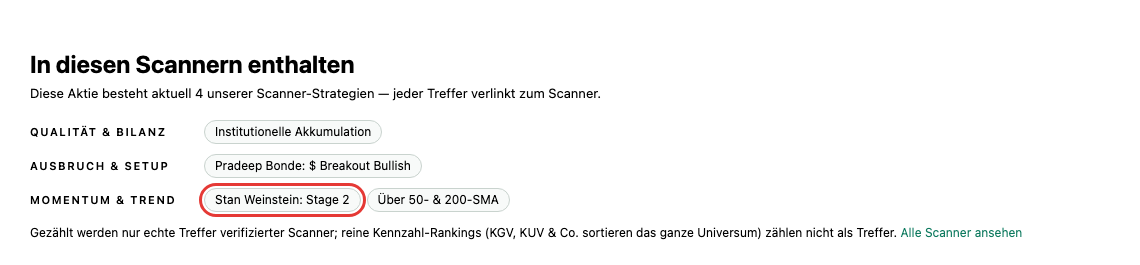
Every day we run about 3,500 stocks through our scanners. Clearfield did not reach the research list through hype this time — 2 Reddit mentions in 24 hours are the opposite of tavern noise — but through a striking confluence in the trend filters: 4 hits as of the July 10, 2026 data cut-off, and all four tell the same story. The stock sits in a Stan Weinstein stage-2 uptrend (price above a rising 200-day average), trades above both the 50- and the 200-day lines, shows institutional accumulation — most recently 14 funds added while only 4 trimmed — and fired a Pradeep Bonde breakout signal. Behind that stand plus 40 percent in three months and plus 32 percent in six (data as of July 10, 2026). So much for the trend lens. The fundamental lens of the very same scanner judges far more coolly: a fundamental grade of D, a Piotroski F-score of 3 of 9 (a nine-point test of the direction of the books — 3 means more metrics are deteriorating than improving), a trailing price-to-earnings ratio around 168, and revenue that shrank about 10 percent over the trailing twelve months. Only the Altman Z-score (an early-warning gauge of insolvency risk built from several balance-sheet ratios) shines at around 20 — the danger zone historically starts below 1.8, and thanks to its net cash Clearfield plays in the "practically unbreakable" league here. Remember this fingerprint: when a stock’s price climbs while its earnings are missing, the market is not buying the business — it is buying a date on the calendar.
The numbers over the years — honestly appraised
First, what genuinely impresses. When half of America moved into the home office during the pandemic and the government pumped billions into broadband, Clearfield delivered one of the steepest growth curves in its industry: in fiscal year 2022 (through September 30, 2022), revenue jumped 92 percent to $270.9 million — including the freshly acquired Nestor business — after $140.8 million the year before. In fiscal year 2023, continuing operations earned $33.7 million in net income at a 35.4 percent gross margin. The recent past has bright spots too: in fiscal year 2025, revenue grew again by 20 percent to $150.1 million, gross margin recovered from 20.6 to 33.7 percent, continuing operations earned $6.3 million, and operating cash flow reached $26.6 million. Order backlog as of March 31, 2026, stood at $31.6 million, up 12 percent year over year, and the first quarter of fiscal year 2026 (October through December 2025) grew about 16 percent. If you read only these paragraphs, you see a recovery on track. Now look at the whole mountain:
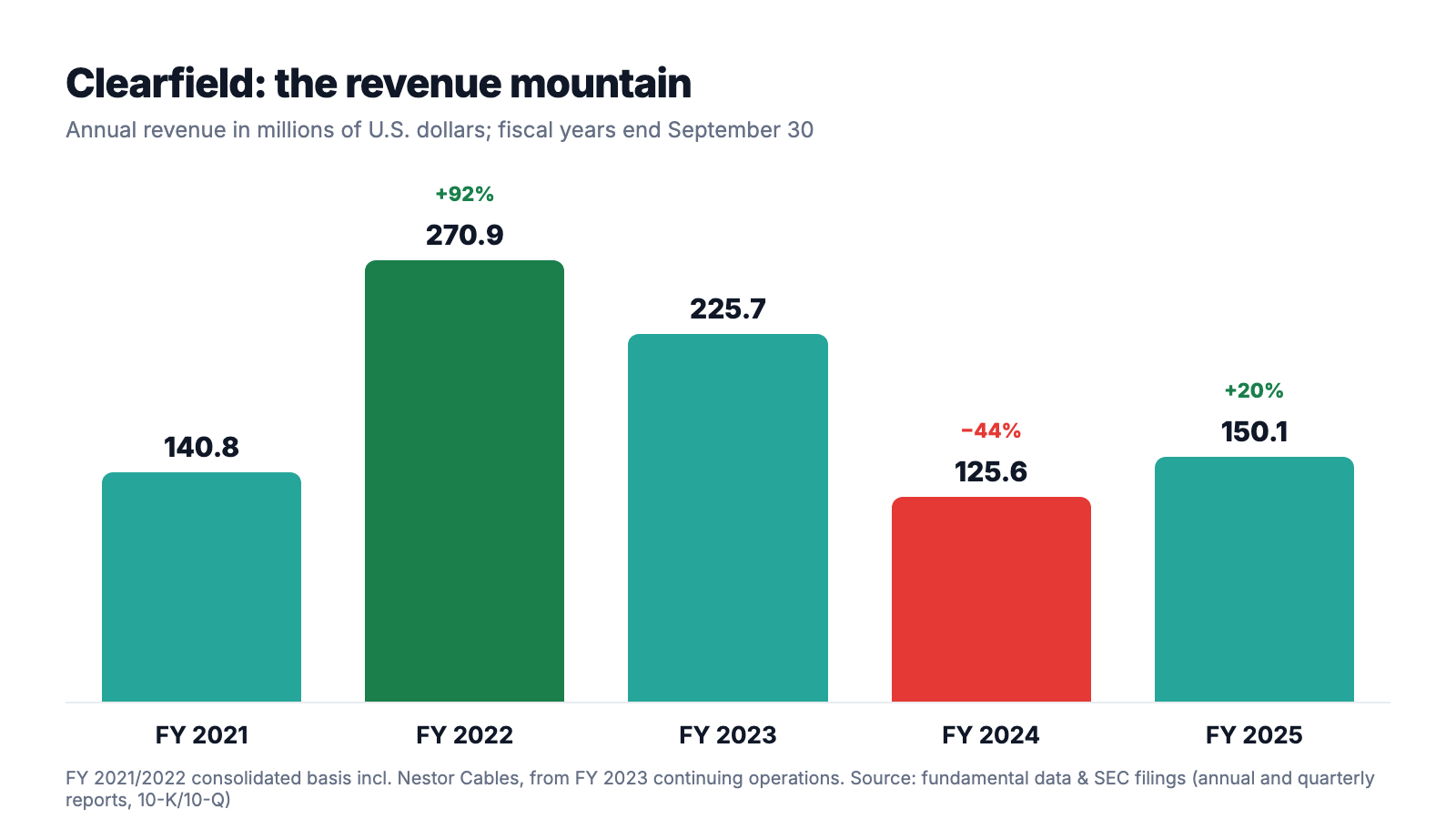
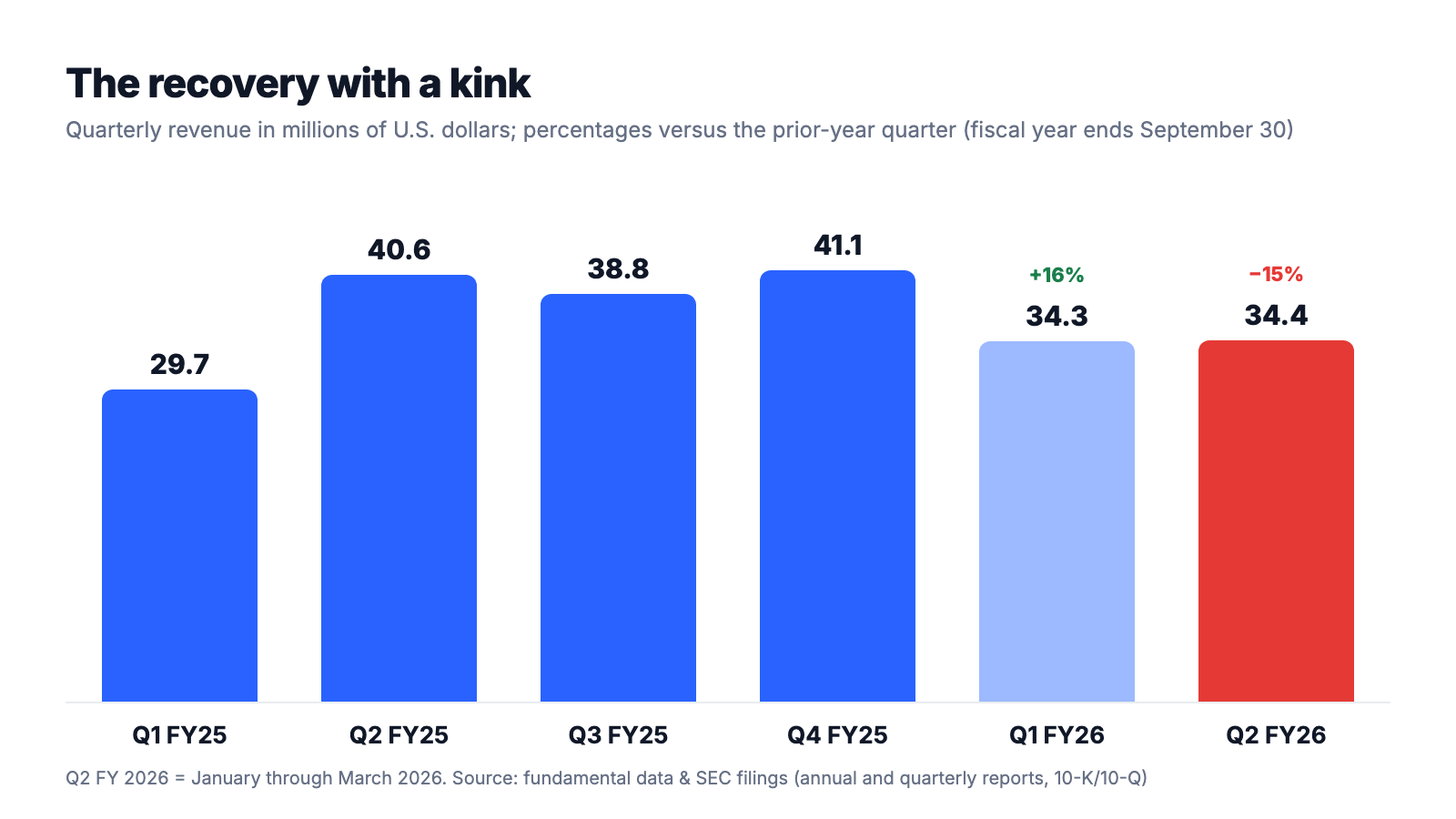
The crash in between was brutal: in fiscal year 2024, revenue fell 44 percent to $125.6 million, gross margin nearly halved to 20.6 percent, and $33.7 million of profit turned into an $8.5 million loss from continuing operations. Fiscal year 2025 recovered only part of that — revenue still sits a third below the 2023 level — and the bottom line showed another net loss of $8.1 million because of the Nestor impairment. And then the second quarter of fiscal year 2026 arrived and bent the recovery curve right back down: $34.4 million of revenue, minus 15 percent versus the prior-year quarter. Remember the rhythm: at Clearfield, the pace is set not by the company’s own factory but by the customers’ order pads — and those hang on inventory levels and subsidy calendars. Which brings us to the uncomfortable truths.
What the filings say — the uncomfortable truths
Uncomfortable truth no. 1: The boom was borrowed — customers spent years eating their own inventory
Why does a fiber-hardware maker lose 44 percent of its revenue in the middle of the fiber age? The annual report answers with disarming clarity — customers had simply over-ordered during the pandemic and then lived off their shelves:
"The decrease in sales to these customers was due to a lull in demand for fiber connectivity products as customers digest their larger than normal inventory levels built up during the pandemic which were purchased over the previous years."
— Clearfield, Inc., SEC annual report 10-K for fiscal year 2025, Item 7 "Management’s Discussion and Analysis"

This passage is more than a look back — it is a character reference for the business model. Clearfield sells capital goods to network operators, and capital-goods demand comes in waves: when customers build, they order twice (once for the job site, once for the shelf); when they save, they order nothing and live off the rack. The manufacturer’s revenue then swings far harder than the underlying end market — economists call it the bullwhip effect: at the far end of the supply chain, every demand wave cracks hardest. Which is exactly why honesty requires the flip side too: America’s fiber build-out is real, and so is Clearfield’s role in it. But whoever buys the stock buys the whip, not the wave — in both directions. The pandemic boom with its 92 percent growth was the same mechanism with the sign reversed.
Uncomfortable truth no. 2: The catalyst called BEAD is braking right now — in black and white in the latest quarterly report
Clearfield’s investment story has rested for years on one four-letter promise: BEAD, the "Broadband Equity, Access, and Deployment" program — a good $42 billion in federal money meant to connect underserved parts of America to fast internet. Clearfield’s core customers, the rural and regional providers, are precisely the target group of those funds. Except: the program has been politically rebuilt several times, and the money is arriving later than planned. What that means in practice is spelled out in the quarterly report (10-Q) as of March 31, 2026 — as the explanation for the quarter’s decline:
"The decrease in sales in the MSO, Community Broadband and Large Regional customer markets for the three months ended March 31, 2026, as compared to the three months ended March 31, 2025, is due to decreased demand in the quarter to customers in these segments and the effect on customers of delays in the BEAD program."
— Clearfield, Inc., SEC quarterly report 10-Q as of March 31, 2026, Item 2 "Results of Operations"

The annual report adds the structural warning: customers may deliberately time their build-outs to the availability of subsidies —
"Customers may seek to time or otherwise adjust their technology or network expansion projects to the availability of subsidies under these or other programs, which will affect the timing and size of orders for our products."
— Clearfield, Inc., SEC annual report 10-K for fiscal year 2025, Item 1 "Business"
Translated into investor language: as long as the funding pot is announced but not paid out, it is not neutral for Clearfield — it is negative. Why would a network operator build today out of its own pocket what the government might subsidize tomorrow? The waiting that is supposed to carry the stock is, for now, braking the business. In fairness: order backlog rose to $31.6 million as of March 31, 2026 (up 12 percent year over year), and if the BEAD billions do flow, Clearfield stands well-stocked at the counter with U.S. manufacturing and products built to meet the Build America, Buy America domestic content requirements. But not one of the six filings we read names a payout date.
Uncomfortable truth no. 3: The European adventure ended for one dollar
In July 2022, at the peak of the boom, Clearfield bought the Finnish fiber-cable maker Nestor Cables: 7.9 million euros ($8.0 million) for the shares plus $7.8 million to repay Nestor’s debt — roughly $16 million all in, funded from the credit line. The idea: vertical integration, in-house cable, a foothold in Europe. Three years later, the ending reads like this in the subsequent-events footnote:
"On November 11, 2025, the Company completed the divestiture of its wholly owned subsidiary, Clearfield Finland Oy, parent company of Nestor Cables Oy, for $1 in cash and the contribution from the Company to Clearfield Finland Oy of $5,785,000 of inter-company receivables owed to the Company by Nestor Cables Oy and Clearfield Finland Oy."
— Clearfield, Inc., SEC annual report 10-K for fiscal year 2025, Note 13 "Subsequent Events"

Before the sale, the company had already impaired the business by a total of $16.6 million ($2.0 million of goodwill, $13.1 million of long-lived assets, $1.5 million of estimated transaction costs) — the charge that pushed fiscal year 2025 into its $8.1 million net loss despite the operating recovery. For perspective, without scandalizing: purchase price and impairment are digestible for a company this size, and management recognized a mistake, quantified it and ended it — more honest than years of window-dressing, and the sale returns the company to the focused U.S. business it was before 2022. But the episode belongs in any verdict on capital allocation: the only major acquisition in the company’s history was bought at the top of the cycle and handed over at the bottom for a dollar. The next time a "strategic beachhead" is announced in a boom, you may remember this dollar.
Uncomfortable truth no. 4: Two middlemen account for nearly a third of revenue — with no purchase obligation at all
The concentrations footnote contains the kind of sentence pair you should read twice:
"For fiscal year 2025, the Company had two customers, Customer A and Customer B, which accounted for approximately 18% and 13% of net sales, respectively. Both of these customers are distributors."
— Clearfield, Inc., SEC annual report 10-K for fiscal year 2025, Item 1A "Risk Factors" and Note 7 "Concentrations"

Picture a baker who delivers nearly a third of his rolls to two kiosks — and the report adds dryly that no contracts oblige these big customers to keep buying: "We do not have any agreements that obligate our customers to purchase products" (10-K for fiscal year 2025). That both large customers are distributors sharpens, of all things, truth no. 1: middlemen keep their own inventories, and their orders swing even harder than end demand — the bullwhip gets a second joint. The fair counterargument applies here too: selling through distributors is standard in network hardware, and behind the two kiosks stand hundreds of small network operators as the actual end customers. But if either of the two reorganizes its warehouse, renegotiates its terms or shifts to a competitor, you will see it immediately in Clearfield’s quarterly numbers — and you may never learn the reason.
Valuation: $550 million in market value — a third of it sits in the bank
In early July 2026 the Clearfield stock cost about $37.60, putting the market value at roughly $550 million (data as of July 10, 2026). Measured against earnings, that is expensive to absurd: the trailing price-to-earnings ratio stands around 168 because the company has earned almost nothing over the trailing twelve months; the price-to-sales ratio is about 4, price-to-book 2.15. But that arithmetic overlooks the cushion: as of March 31, 2026, $147.1 million in cash and investments sat on the books — against zero bank debt. Strip out the net cash and the market pays roughly $400 million for the operating business, about 2.7 times fiscal 2025 revenue. That is no bargain-bin valuation, but no bubble either — it is the price of an option: analyst estimates assume earnings per share roughly doubling in the coming year (data as of July 10, 2026), and even then the price-to-earnings ratio would still sit around 80. Translated: the market is paying today for the BEAD future, not for the present — and the present delivered minus 15 percent in the latest quarter. At least management is putting the waiting time to work: the buyback program was raised to $85 million in November 2025; $16.5 million went into the company’s own shares in fiscal year 2025 and another $12.6 million in the first six months of fiscal year 2026 — and with the share count falling (13.6 million shares as of March 31, 2026, after an average of 14.0 million in fiscal 2025), every future dollar of profit works a little harder per share. Roughly 18 percent of the shares sit with insiders, a good 61 percent with institutional investors (data as of July 10, 2026).
Opportunities and risks at a glance
What speaks for Clearfield:
- A balance sheet like a bulwark: $147.1 million in cash and investments, no bank debt, $242.8 million of equity against $263.5 million in total assets (March 31, 2026); an Altman Z-score around 20 — insolvency risk is practically a non-topic.
- The structural tailwind is real: millions of U.S. households without fast internet, a good $42 billion in BEAD federal funding approved, and Clearfield’s core customers (rural and regional providers) are the target group — while U.S. manufacturing and products built to the Build America, Buy America domestic content requirements are a competitive advantage in subsidized business (annual report 10-K for fiscal year 2025).
- The recovery has anchors of substance: fiscal 2025 revenue plus 20 percent, gross margin recovered from 20.6 to 33.7 percent, $26.6 million in operating cash flow, order backlog up 12 percent as of March 31, 2026.
- Capital returns instead of adventures: buyback program raised to $85 million (November 2025), $16.5 million of repurchases in fiscal year 2025 plus $12.6 million in the first half of fiscal 2026; roughly 18 percent insider ownership, institutional accumulation (14 funds adding versus 4 trimming, data as of July 10, 2026).
- The technicals have turned: a Stan Weinstein stage-2 uptrend, price above the 50- and 200-day averages, plus 40 percent in three months (data as of July 10, 2026).
What speaks against it:
- The growth engine is sputtering again: revenue minus 15 percent in the second quarter of fiscal year 2026, per the quarterly report in part because of the BEAD delays — the story’s catalyst is currently a braking force, and no filing names a payout date.
- Boom-bust is a system property, not an accident: plus 92 percent (fiscal 2022), minus 44 percent (2024), plus 20 percent (2025), minus 15 percent (Q2 fiscal 2026) — distributor inventories and subsidy calendars whip demand in both directions.
- The earnings are missing: a net loss of $8.1 million in fiscal year 2025 (after minus $12.5 million in 2024), and the first half of fiscal 2026 stayed red at minus $0.8 million; trailing P/E around 168, fundamental grade D, Piotroski F-score 3 of 9 (data as of July 10, 2026).
- Concentration risk in distribution: two distributors accounted for roughly 31 percent of fiscal 2025 revenue — with no contractual purchase obligation whatsoever.
- A capital-allocation scar: the Nestor Cables acquisition (roughly $16 million, July 2022) ended, after a $16.6 million impairment, for $1 in November 2025 — bought at the top, handed over at the bottom.
A human conclusion
Back to the catalyst trap from the opening. Its core is not that catalysts never fire — sometimes they do, and then the patient look like geniuses. Its core is that waiting feels free when it is not: whoever waits for BEAD carries, in the meantime, a business with shrinking quarterly revenue, no profit and two middlemen as its bottleneck — at 168 times trailing earnings. The good news stands on the other side of the balance sheet: $147 million in the till, no bank debt, a management team that buys back its own shares and buried a failed acquisition for one dollar instead of feeding it further. Clearfield is no house of cards — it is a solidly financed waiting room. So the honest question for you is not "Is the fiber build-out coming?" (it is), but: do you want to be paid for waiting — or are you paying for it? At Clearfield, right now, you are the one paying: with a sporty valuation, with quarters that hang on the order pads of a subsidy bureaucracy, and with the risk that the next delay lands in the share price first. If the BEAD billions flow and the customer shelves are empty, this runway can indeed see a takeoff — the plants, the products and the cash for it are all in place. Until then, every quarter is a glance at the departures board: boarding delayed. What you make of it is your decision. And that is exactly as it should be.
Sources
All original documents used in this analysis — to read for yourself:
- Clearfield, Inc. — SEC annual report 10-K for fiscal year 2025 (ended September 30, 2025; filed November 25, 2025)
- Clearfield, Inc. — SEC annual report 10-K for fiscal year 2024 (ended September 30, 2024; filed November 15, 2024)
- Clearfield, Inc. — SEC annual report 10-K for fiscal year 2022 (ended September 30, 2022; filed November 23, 2022; Nestor Cables purchase price)
- Clearfield, Inc. — SEC quarterly report 10-Q as of March 31, 2026 (filed May 7, 2026)
- Clearfield, Inc. — SEC quarterly report 10-Q as of December 31, 2025 (filed February 9, 2026)
- Clearfield, Inc. — SEC quarterly report 10-Q as of June 30, 2025 (filed August 7, 2025)
- Clearfield, Inc. — SEC quarterly report 10-Q as of March 31, 2025 (filed May 9, 2025)
- Clearfield, Inc.’s complete SEC filing history: EDGAR overview (sec.gov)
- Fundamental data (metrics, quarterly series, valuation; data as of July 10, 2026), reconciled with the SEC filings.
- Screener and rating data: in-house stock scanner (data as of July 10, 2026); Reddit mentions: ApeWisdom (as of July 15, 2026).
Transparency & disclaimer: This analysis is a journalistic contextualization of publicly available information and is not investment advice, not a financial analysis in the regulatory sense, and not a solicitation to buy or sell securities. Stock investments carry substantial risks up to total loss. All information without guarantee; the data cut-off is noted in the text in each case. The author holds no position in Clearfield stock at the time of publication.
Our Bottom Line at a Glance
- Balance sheet & cash cushion positive
- $147.1 million in cash and investments against zero bank debt, $242.8 million of equity on $263.5 million of total assets (March 31, 2026), an Altman Z around 20; the buyback program was raised to $85 million in November 2025 — Clearfield can afford to wait for BEAD (quarterly report 10-Q as of 03/31/2026).
- Demand & BEAD dependence negative
- Revenue in the second quarter of fiscal year 2026 minus 15 percent to $34.4 million — per the quarterly report in part because of "delays in the BEAD program"; the annual report warns explicitly that customers time orders to the availability of subsidies. The story’s catalyst is currently braking the business.
- Cyclicality & customer concentration negative
- Boom-bust as a system property: plus 92 percent (FY 2022), minus 44 percent (FY 2024), plus 20 percent (FY 2025), minus 15 percent (Q2 FY 2026) — amplified by two distributors with a combined 31 percent of revenue and no purchase obligation at all (10-K FY 2025, Note 7).
- Capital allocation & the Nestor lesson neutral
- The Nestor Cables acquisition (roughly $16 million, July 2022) ended, after a $16.6 million impairment, for $1 in cash (November 11, 2025) — an expensive cycle misstep, but ended consistently rather than window-dressed; since then the money flows into the company’s own shares ($16.5 plus $12.6 million of buybacks since October 2024).
- Valuation & technicals neutral
- A Stan Weinstein stage-2 uptrend, price above the 50- and 200-day averages, institutional accumulation and plus 40 percent in three months meet a trailing P/E around 168, a fundamental grade of D and a Piotroski score of 3 of 9 (data as of July 10, 2026) — the market is paying for a date no filing names; net of cash, the operating business costs roughly 2.7 times revenue.
Clearfield is a solidly financed waiting room: $147.1 million of net cash, no bank debt, and a management team that buys back its own shares and ended the Nestor misstep for one dollar. But the business is not yet delivering the story — the latest quarter shrank 15 percent, explicitly in part because of the BEAD delays, two distributors account for nearly a third of revenue, and at 168 times trailing earnings the market is paying for the subsidy future, not the present. Whoever invests here buys a well-capitalized option on Washington’s payout calendar. Not investment advice.
What Our Rating Means
- If you don't own the stock
- As long as the question raised in the bottom line stays open, we see no basis for an entry.
- If you hold it in your portfolio
- Our findings offer no acute reason to sell — the checkpoints named remain decisive.
A journalistic assessment by our editorial team at the time of the deep dive, based on public sources — not investment advice and not a solicitation to buy or sell. Your personal circumstances (investment goals, risk capacity, taxes) cannot be taken into account. What our categories mean, how verdicts are formed, and what conflicts of interest exist →
Worth Noting
- CLFD reached our research list via the confluence of four trend hits in our in-house stock scanner (data as of July 10, 2026); the Reddit hype scanner showed just 2 mentions in 24 hours at the same time (ApeWisdom, as of July 15, 2026) — attention is not a buy argument here, it is simply absent.
- Scanner metrics (P/E, P/S, Piotroski, Altman Z, fundamental grade) are computed from trailing twelve-month figures; the Nestor impairment (Q4 FY 2025) and the BEAD dip (Q2 FY 2026) are baked in, a potential funding surge naturally is not.
- Price and valuation figures are dated to July 10, 2026 (about $37.60, market value roughly $550 million); analyses are evergreen, daily prices are not a buy argument. Clearfield’s fiscal year ends September 30 — all quarterly references carry that fiscal-year offset.
Frequently Asked Questions
Clearfield, Inc. (Nasdaq: CLFD) of Brooklyn Park, Minnesota, makes fiber management, protection and delivery hardware — cabinets, splice cassettes, enclosures and pre-terminated cables for "fiber to the x" networks. 98 percent of revenue comes from broadband service providers, mostly local and regional operators in rural America. Revenue in fiscal year 2025 (ended September 30, 2025): $150.1 million.
Clearfield’s fiscal year ends September 30. "Fiscal year 2025" therefore covers October 2024 through September 2025, and the "second quarter of fiscal year 2026" means January through March 2026. Anyone comparing Clearfield figures with calendar-year numbers of other companies should keep that one-quarter offset in mind.
BEAD ("Broadband Equity, Access, and Deployment") is a U.S. federal program of a good $42 billion for broadband build-out in underserved regions — exactly Clearfield’s customer base. So far, though, the program has mostly acted as a brake: per the quarterly report (10-Q) as of March 31, 2026, "delays in the BEAD program" contributed to the 15 percent revenue decline, because customers time their build-outs to the availability of the funding.
In fiscal year 2024 (ended September 30, 2024), revenue fell 44 percent to $125.6 million. Per the annual report (10-K), customers were digesting the larger-than-normal inventories they had built up during the pandemic and therefore barely reordered. Before that, revenue had jumped 92 percent to $270.9 million in the pandemic boom of fiscal year 2022.
Clearfield bought the Finnish cable maker Nestor Cables in July 2022 for roughly $16 million ($8.0 million for the shares plus $7.8 million of debt repayment). After a $16.6 million impairment, the business was sold on November 11, 2025, for $1 in cash — with Clearfield additionally contributing $5.8 million of intercompany receivables to the divested business. The impairment pushed fiscal year 2025 to a net loss of $8.1 million.
Very solid: as of March 31, 2026, the books showed $147.1 million in cash and investments and no bank debt; equity stood at $242.8 million against $263.5 million in total assets. The Altman Z-score around 20 (data as of July 10, 2026) sits far outside any danger zone. The share buyback program was raised to $85 million in November 2025.
By classic yardsticks, no: the trailing price-to-earnings ratio stands around 168 and price-to-sales around 4 (data as of July 10, 2026), and fiscal year 2025 ended with a net loss. Against that stand $147.1 million of net cash — more than a quarter of the roughly $550 million market value — and analyst estimates that see earnings per share roughly doubling in the coming year. The market is paying for the BEAD future, not for the present.
Found an error?
Did you spot a factual error, an outdated number, or a typo in this deep dive? Let us know briefly — your report goes straight to the editorial team.