AMC Stock: Packed Theaters, $4 Billion in Debt — and One Share Became a Hundred
AMC is the largest movie theater chain in the world — and, since 2021, the meme stock: the squeeze, the "Apes", the APE units, a reverse split. Five years on, the theaters really are filling up again: $4.85 billion in revenue in 2025, and the first quarter of 2026 grew 21 percent. We read the annual report (10-K) for 2025 and the quarterly report (10-Q) as of March 31, 2026: a share count up roughly a hundredfold since early 2020 and still growing, $4.0 billion of debt at double-digit interest rates, a $3.2 billion maturity wall in 2029 — and management's own words that the current cash burn is "not sustainable long-term". Not investment advice — just the tab that comes due after the credits roll.
 Thomas Mücke
Founder & Publisher
Thomas Mücke
Founder & Publisher
Chart
Interactive price chart (TradingView).
Note: pure fact-based analysis, not investment advice and not a solicitation to buy or sell. All figures without guarantee.
There is an investor weakness stronger than greed and fear combined: the feeling of belonging. Whoever was there in January 2021, when an internet community put Wall Street short sellers to flight, did not simply buy a stock — they joined a tribe. "Apes together strong" was never an investment thesis; it was a club anthem. Psychologists call it herd instinct; the more honest word is campfire. And no campfire in stock market history burned brighter than AMC Entertainment (NYSE: AMC), the largest movie theater chain in the world. Five years later, the embers still glow: AMC recently surfaced in our Reddit hype scanner with 7 mentions within 24 hours (data source ApeWisdom, as of July 15, 2026) — not a storm, but heat. So let's make a deal: we let the legend sit by the fire for a moment and read together what AMC itself reported, under penalty of law, to the U.S. securities regulator, the SEC — the annual report (10-K) for 2025 and the quarterly report (10-Q) as of March 31, 2026. This one tells both stories at once: a theater business that genuinely is recovering — and a capital structure that eats that recovery year after year. In the end, you decide for yourself.
What AMC actually does
Behind the meme sits a very real operation: 855 theatres with 9,640 screens in 11 countries (as of December 31, 2025) — 533 houses in the United States and 322 in Europe, there under brands such as Odeon and UCI, with leading positions in the United Kingdom, Italy, Spain and Germany, among others. Founded in Kansas City in 1920, headquartered today in Leawood, Kansas, with 33,311 associates (30,380 of them part-time), AMC describes itself in the annual report as "the world's largest theatrical exhibition company". In 2025, 219.4 million patrons came through the doors. The business model has two cash registers. At the first, AMC sells admission tickets ($2,652.8 million of revenue in 2025) but has to pass roughly half of that on to the studios as film rent. The second register is the real profit machine: popcorn, nachos, drinks — $1,671.3 million of revenue against just $327.0 million of cost of goods. Translated: of every popcorn dollar, about 80 cents stay in the house before other costs; a movie theater is a restaurant with a screen attached. On top come advertising, fees and a loyalty program (AMC Stubs) with about 39 million households in its database. The quality of the houses is measurable: 8 of the 10 highest-grossing movie theatres in the U.S. in 2025 were AMC houses, and in IMAX, AMC holds a 56 percent U.S. market share.
Why this, of all companies, became a stock market uprising in 2021 is by now part of the equity story itself — the annual report lists "Apes", short squeezes and meme dynamics as risk factors, more on that in a moment. Remember the central tension of this analysis right here: the theater business really is recovering — but every season gained has been paid for with new shares and more expensive debt, and both are running faster than the recovery. It runs through every chapter. How differently companies from the 2021 hype cohort stand today is shown by our analyses of the space pioneer Virgin Galactic and the live entertainment company MSG Entertainment — two very different answers to the same question of what remains after the hype.
Where the stock shows up in our scanner
Every day we run about 3,500 stocks through our scanners. This time AMC landed on the research list not through a balance-sheet metric but through our Reddit hype scanner, which counts mentions across the big stock forums: 7 mentions within 24 hours (data source ApeWisdom, as of July 15, 2026) — a whisper compared with its own 2021 records, but enough to pull the file. In the fundamental scanners, the stock fires in 5 filters as of the July 8, 2026 data cut, and the list reads like a medical chart: "Going Concern (Distress-Proxy)" — our filter that reconstructs the classic ingredients of a going-concern warning — and "Altman-Z: Distress-Zone" with an Altman Z-score (a classic insolvency early-warning built from several balance-sheet ratios) around minus 1.5, deep below the historical danger threshold of 1.8. The Piotroski F-Score (a nine-point test of balance-sheet quality) stands at 3 of 9 — a thoroughly healthy company scores 8 or 9; interest coverage sits around 0.3 — operating income does not even earn a third of the interest bill. Important context: unlike many distress candidates, AMC's annual report contains no going-concern warning — the proxy fires because the ingredients are present, not because the auditor warned. How to read such warning lists — a smoke detector, not a demolition order — is explained in our piece "Insolvency radar: the top 10".
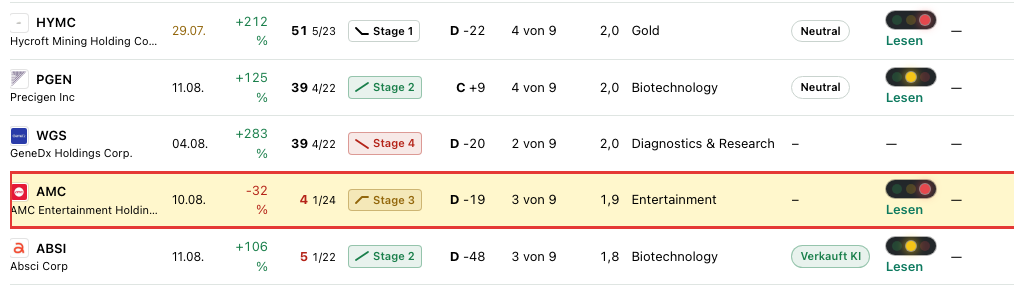
The remaining hits tell the other half of the story: "KUV-Ranking" — our price-to-sales ranking, where AMC, at a P/S ratio around 0.4, ranks among the optically cheapest stocks in the market; "Stan Weinstein: Stage 3" — in Weinstein's stage framework the stock sits in the topping zone, not in a confirmed uptrend; and "Kathy Donnelly: Liquid Movers Down", because the recent move came on heavy volume to the downside — including a downward opening gap of about 24 percent. At the same time, the tape points up: plus 114 percent in three months, up 33 percent year to date, relative strength 76 — with an average daily range around 11 percent and only about 36 percent institutional ownership (all values: data as of July 8, 2026). Our scanner's fundamental rating: D. Translated: a bundle of warning scanners next to a fireworks display — exactly the fingerprint of a stock whose price is moved by waves from the community, not by the income statement. If you swim here, know which wave you are riding.
The numbers over the years — honestly appraised
First, what the legend likes to overlook — and it speaks for the operation: AMC took in more revenue in 2025 than in any year since the pandemic. $4,848.9 million, up 4.6 percent versus 2024, carried by 5.9 percent higher ticket prices in the U.S. markets, record concession spending per patron and growing market share. The operating loss shrank from $79.3 million to just $17.4 million — the core business stands at the threshold of breakeven; adjusted EBITDA rose from $343.9 million to $387.5 million. And the momentum carried on: in the first quarter of 2026, revenue jumped 21.2 percent to $1,045.4 million and the net loss nearly halved, from $202.1 million to $117.1 million. The theaters fill up where the film slate delivers — attendance slipped slightly in 2025 (from 224.2 million to 219.4 million patrons), but every patron left more money behind. That is not cosmetics; that is a genuine operating recovery.
Now the other half: the bottom line for 2025 was still a net loss of $632.4 million — almost twice the 2024 figure ($352.6 million). How does that square with a near-breakeven operating result? The answer sits between operating income and the last line: $530.2 million of interest expense and $196.0 million of losses on the repurchase and exchange of the company's own debt — book losses that arise when creditors are compensated with more valuable packages for their concessions. Remember the sentence: the theaters almost make money — the company loses it to its capital structure. The report itself sets the bar: North America box office grosses in 2025 were still down about 22 percent versus 2019, and only at "at least" pre-COVID revenue levels does the cash burn end. Operating cash flow stayed negative at minus $119.8 million in 2025 (2024: minus $50.8 million), and another $128.5 million flowed out in the first quarter of 2026. Which brings us to the uncomfortable truths.
What the filings say — the uncomfortable truths
Uncomfortable truth no. 1: one share became a hundred — and the machine keeps running
Dilution means your slice of the cake gets smaller because new slices keep being cut. At AMC this is not a footnote but the financing model of the past five years — and the annual report quantifies it itself, in black and white:
"From January 1, 2020 through February 18, 2026, the outstanding shares of our Common Stock have increased by 524,339,457 shares (on a Reverse Stock Split adjusted basis) in a combination of at-the-market sales, forward sales, conversion of Series A Convertible Participating Preferred Stock, shareholder litigation settlement, conversion of Class B common stock, conversion of notes, exchanges of notes, transaction fee payments, and equity grant vesting."
— AMC Entertainment, SEC annual report 10-K 2025, Item 1A "Risk Factors"
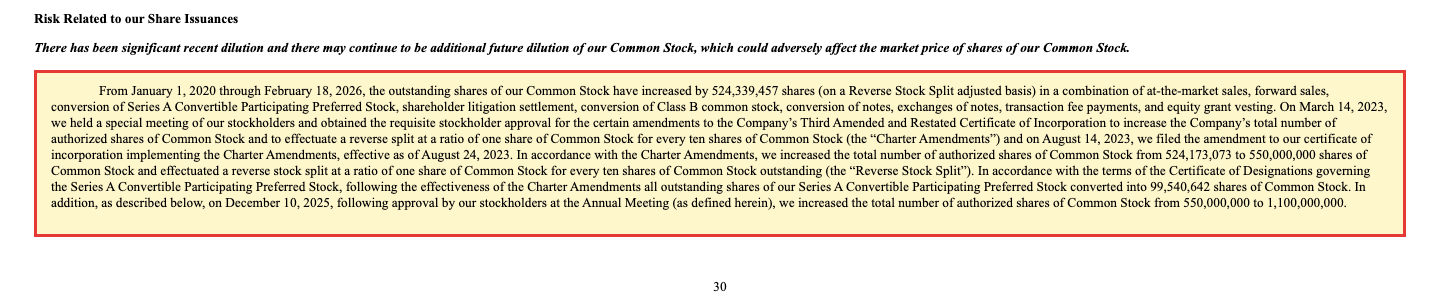
Run that number backwards: on February 18, 2026, there were 529,547,465 shares outstanding — so at the start of 2020, adjusted for the split, there were a good 5 million. One share from back then has become roughly a hundred; whoever has held since early 2020 has seen their voting weight and their claim on profits per share divided by about one hundred. The route there is stock market history: emergency capital raises in 2020/21, the meme rally as a funding source, then in August 2022 the APE units — a second class of equity called "AMC Preferred Equity", its ticker a bow to the company's own fan base, created chiefly so AMC could keep selling new units after it ran out of authorized common shares. In August 2023, the APEs were converted into common stock and a 1-for-10 reverse split was executed — ten shares became one, the customary move when a price would otherwise quote in cents. And the machine keeps running: in the first quarter of 2026 alone, 55.2 million shares were sold through at-the-market offerings at an average of about $1.17, plus 33.1 million shares issued as consent fees to noteholders. In December 2025, the annual meeting doubled the authorized share count to 1.1 billion; in February 2026, a new $150 million sales program was launched. And on May 4, 2026, the holders of the exchangeable notes gave notice to swap their entire $155.8 million of principal into stock — another roughly 142 million shares. The chart shows the whole curve:
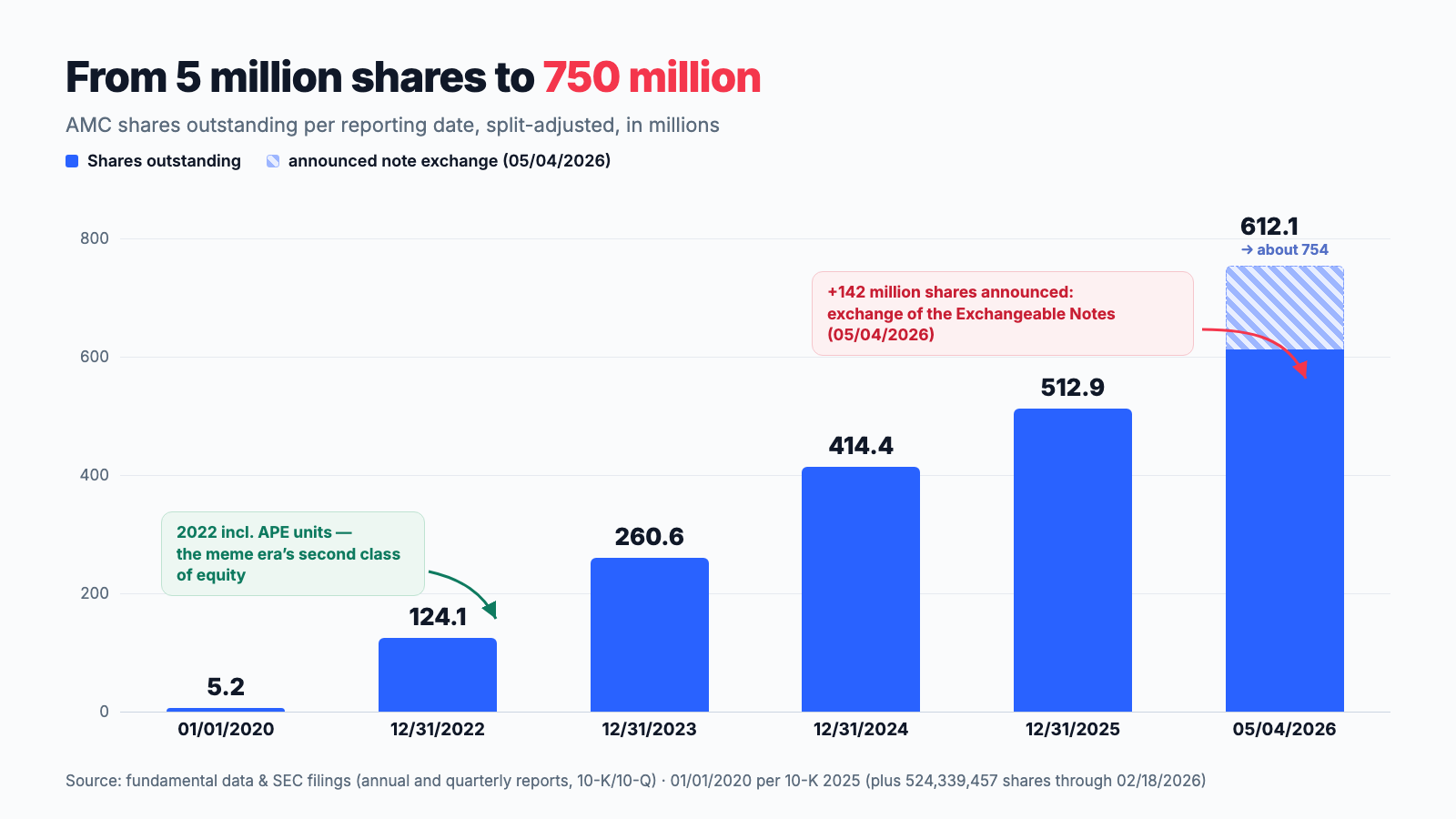
Honesty requires saying: this flood of shares was no end in itself — it saved the company from insolvency twice and is retiring debt today, see truth no. 2. But remember the mechanism: growth paid for with fresh shares is never entirely free — here, so far, it mostly pays for the past.
Uncomfortable truth no. 2: $4 billion of debt at double-digit rates — and the wall stands in 2029
The second permanent construction site is the debt mountain from the pandemic: $4,024.2 million of principal in loans and notes as of December 31, 2025 — plus, easily overlooked, $4,045.0 million in present value of lease liabilities for the theaters themselves, with $945.6 million of lease payments due in 2026 alone. The problem is less the amount than the price: the loans and notes now cost double digits almost across the board — the term loans due 2029 stood at 10.731 percent at the end of 2025, the new secured 2029 notes carry 9 percent cash plus 6 percent PIK ("payment in kind": interest that is not wired but added to the debt pile — compound interest working for the creditors), and the Odeon loans raised in April 2026, due 2031, cost 10.50 percent. The result: $530.2 million of interest expense in 2025, after $443.7 million the year before — more than thirty times the operating loss. The maturities stack up into a wall:
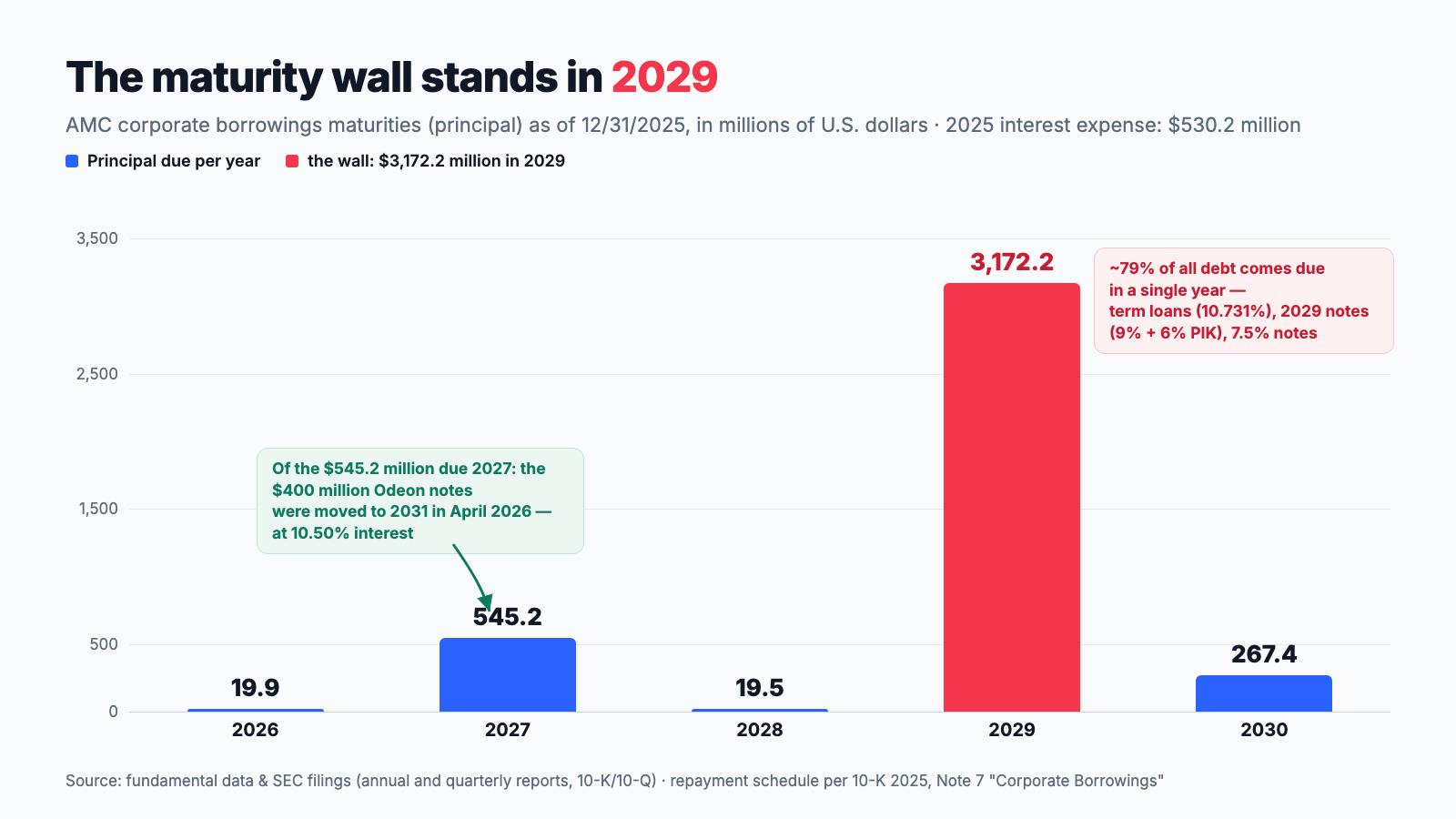
The pattern of recent years: AMC pushes the wall ahead of itself and pays for every push twice — with higher interest and with shares. The "2024 Refinancing Transactions" and "2025 Refinancing Transactions" in the report read like a manual for it: in July 2025, subsidiary Muvico swapped $590.0 million of old 7.5 percent notes plus $244.4 million of new money into $857.0 million of new notes at 9 percent cash plus 6 percent PIK; $143.0 million of exchangeable notes had already been retired against 79.8 million shares in July 2025, and the rest follows after the May 4, 2026 notice — the quarterly report puts a precise number on it:
"The Company will settle the exchange (the “Exchange”) by issuing an aggregate of 129,681,144 shares of Common Stock to the Exchanging Noteholders (including shares in respect of the Exchange Adjustment Consideration (as defined in the New Exchangeable Notes Indenture) and accrued and unpaid interest) in exchange for $142.2 million aggregate principal amount of New Exchangeable Notes."
— AMC Entertainment, SEC quarterly report 10-Q as of March 31, 2026, Note 11 "Subsequent Events"

To be fair: the principal really is coming down — from $4,134.5 million (end of 2024) to $4,024.2 million (end of 2025), and the May exchange removes another good $155 million. But the offsetting entry sits in truth no. 1, and the $196.0 million book loss from these maneuvers sits in the 2025 income statement. Add the balance-sheet optics you should know about: AMC has negative stockholders' equity of $1,894.8 million (end of 2025) and an accumulated deficit of almost $9 billion. Whoever buys the stock buys the hope that the operating business grows faster than interest and share issuance shrink the claim per share — there is time until the wall in 2029; after that, the capital market decides anew.
Uncomfortable truth no. 3: the cash pile is melting — and the report itself calls the burn "not sustainable"
How long can AMC afford the wait for the full recovery? The cash curve sets the direction: $632.3 million at the end of 2024, $428.5 million at the end of 2025, $339.2 million as of March 31, 2026 — nearly halved in five quarters, despite continuous share sales. Operating cash flow: minus $50.8 million (2024), minus $119.8 million (2025), minus $128.5 million in the seasonally weak first quarter of 2026 alone. Management words it remarkably bluntly in the annual report:
"We believe our existing cash and cash equivalents, together with cash generated from operations, will be sufficient to fund our operations and satisfy our obligations currently and through the next twelve months. Our current cash burn rates are not sustainable long-term. In order to achieve net positive cash flows from operating activities we believe that revenues will need to increase to levels at least in line with pre-COVID-19 revenues. North America box office grosses were down approximately 22% for the year ended December 31, 2025, compared to the year ended December 31, 2019."
— AMC Entertainment, SEC annual report 10-K 2025, Item 7 "MD&A — Liquidity Requirements"

Put that in its place, because it is more precise than any headline: this is not a going-concern warning — the twelve-month math works, helped by the $150 million share program from February 2026. But it is the official admission that the math only works permanently if the industry returns to pre-COVID levels — a level that in 2025, six years after the pandemic, was still 22 percent away. Until then: the cash interest on the existing debt alone demands, per the filing, about $381.3 million over the next twelve months, plus capital expenditures (over $200 million net in 2025) and $945.6 million of lease payments for 2026 that run through operating cash flow. A strong film year — the report banks on the 2026 blockbuster pipeline — can close the gap; a strike, a wave of postponed release dates or one weak half-year opens it again. Either way, the reserve that forgives mistakes keeps shrinking: by now it is less "cash" than "the market's willingness to buy new AMC shares".
Uncomfortable truth no. 4: the meme mechanics are a risk factor in the company's own filing — "Apes" included
And so to the feature that separates AMC from every other struggling theater chain: the community that saved the stock in 2021 appears by name in the risk chapter of the annual report. Verbatim:
"Some of our retail investors have referred to themselves as “Apes” on social media and in other forums. Self-proclaimed “Apes” are widely viewed as playing a significant role in the market dynamics that have resulted in substantial increases and volatility in the market price of our Common Stock and other so-called “meme” stocks."
— AMC Entertainment, SEC annual report 10-K 2025, Item 1A "Risk Factors"

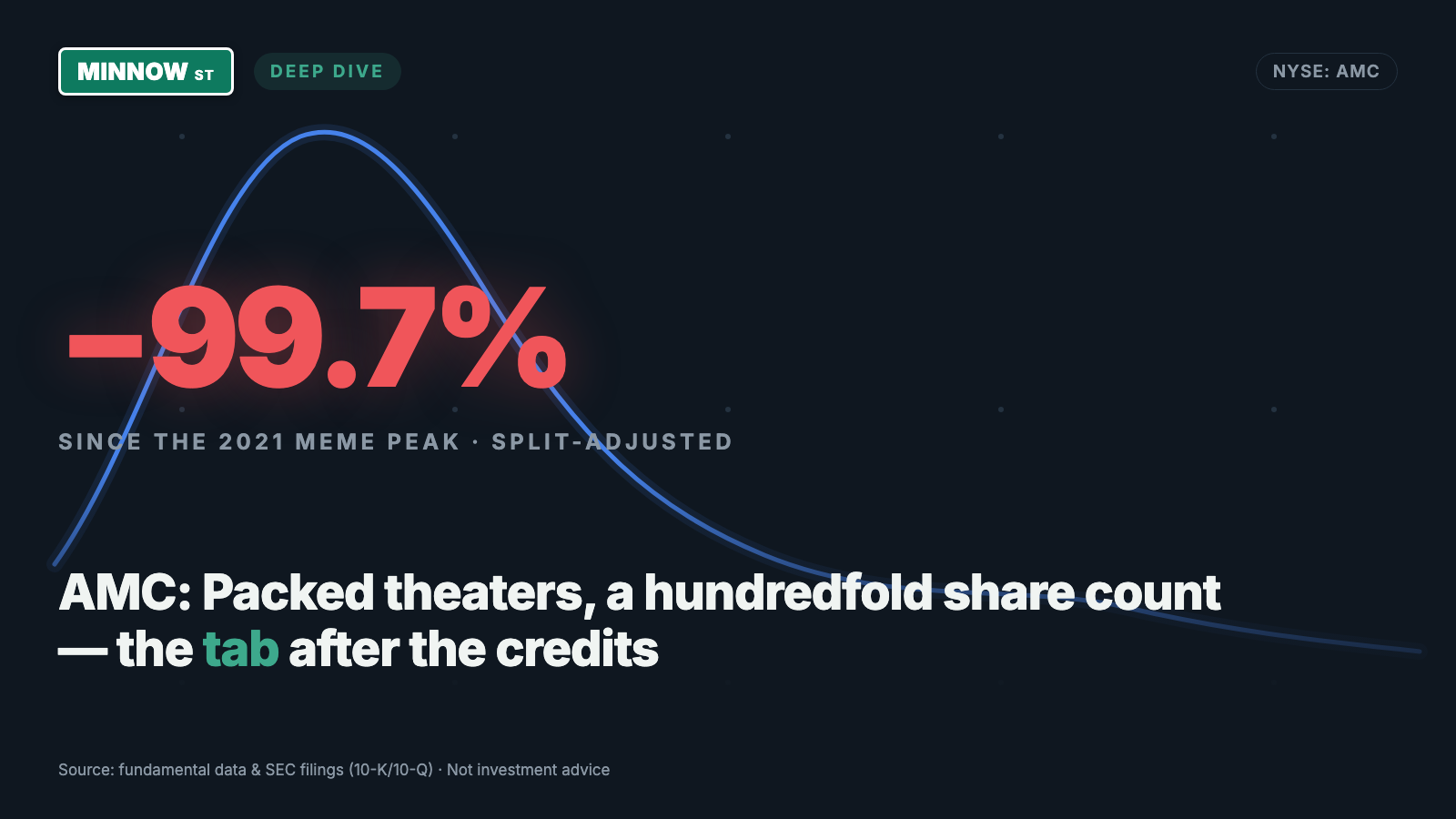
The report follows the thought through, and you should read both halves: the retail base, it says, "has been credited favorably with assisting AMC in raising significant capital in the past" — but, verbatim, "there is no guarantee that AMC will be able to continue to benefit from support from its retail stockholder base in the future." Right next to it stand the warnings about short squeezes ("has led to, may be currently leading to, and could again lead to, extreme price volatility") and about a market capitalization that may reflect "valuations that diverge significantly from historical valuations". Translated out of the legalese: this stock's price is a sentiment gauge of the community, not a mirror of the income statement — and the company knows it. The facts to go with it: split-adjusted, the stock trades roughly 99.7 percent below its 2021 meme peak, moves on average 11 percent per day, jumped 114 percent in three months and recently gapped down about 24 percent (data as of July 8, 2026). For the company, this community has been a life ring; for the individual buyer, it is a risk factor — filed as such by the company itself.
Valuation: a $1.9 billion market value — only the optics are cheap
In early July 2026, AMC stock cost about $1.90, for a market value of about $1.9 billion (data as of July 8, 2026) — at a price-to-sales ratio around 0.4, AMC even shows up in our price-to-sales ranking of the market's optically cheapest stocks. But "cheap" is an optical illusion when it comes to the equity of a highly indebted company: whoever wanted to buy the whole business would take on, next to the $1.9 billion market value, $4.0 billion of financial debt and $4.0 billion of lease liabilities, minus $0.3 billion of cash — an enterprise value of roughly $9.6 billion for a business that generates $4.85 billion in revenue and hovers around zero operating profit. A price-to-earnings ratio does not exist for lack of earnings, and any future earnings stream must first get past $530 million of annual interest. The honest description: the stock is an option certificate on the full theatrical recovery — high leverage to the upside if revenue and cash flow turn before the 2029 wall; ongoing time decay through dilution as long as they do not. One more thing worth knowing: analyst consensus has traditionally played second fiddle in this name — the price moves of the past came from squeezes and community waves, not price targets. You can embrace that or avoid it; you should know it.
Opportunities and risks at a glance
What speaks for AMC:
- Market leadership with measurable quality: the world's largest theater chain, 855 houses in 11 countries, 8 of the 10 highest-grossing U.S. theatres, a 56 percent IMAX market share in the U.S., a loyalty program with about 39 million households (annual report 10-K for 2025).
- The recovery is real: 2025 revenue up 4.6 percent to $4,848.9 million (the best year since the pandemic), the operating loss down to $17.4 million, adjusted EBITDA of $387.5 million — and the first quarter of 2026 grew 21.2 percent with a nearly halved net loss.
- High leverage to a strong film year: popcorn economics with roughly 80 percent gross margin in concessions, rising ticket prices and record per-patron spending — every incremental moviegoer hits the bottom line disproportionately.
- Active debt management: principal reduced from $4,134.5 million to $4,024.2 million (2025), the Odeon notes refinanced to 2031 in April 2026, about $155 million of exchangeable notes being retired for stock since May 2026 — the next big maturity is not due until 2029.
- A loyal retail base that carries capital measures: per the annual report it has been credited with helping AMC raise significant capital — combined with the $150 million share program (February 2026), access to fresh money stays open as long as the community stands.
What speaks against it:
- Dilution as a permanent condition: plus 524,339,457 shares since January 1, 2020 (split-adjusted, through February 18, 2026) — roughly a hundredfold increase; Q1 2026 alone brought 55.2 million ATM shares at about $1.17 plus 33.1 million fee shares, with roughly 142 million more from the note exchange starting May 2026; 1.1 billion shares are now authorized.
- Expensive debt with a wall: $4,024.2 million of principal at mostly double-digit rates (10.731 percent term loans, 10.50 percent Odeon 2031, 9 plus 6 percent PIK), $530.2 million of interest expense in 2025, negative equity of $1,894.8 million — and $3,172.2 million due in 2029.
- Cash burn despite the recovery: operating cash flow of minus $119.8 million (2025) and minus $128.5 million (Q1 2026), cash down from $632.3 million to $339.2 million within five quarters; the report itself calls the burn rates "not sustainable long-term" and requires pre-COVID revenues to end it — the market was still 22 percent below that in 2025.
- Structural headwinds: attendance slightly down in 2025 (219.4 million after 224.2 million patrons), streaming competition and shortened theatrical windows, plus dependence on the studios' blockbuster calendar — factors outside the company's control, as the filing stresses.
- Meme mechanics as an official risk: "Apes", short squeezes and non-guaranteed retail support sit in the risk chapter; split-adjusted the stock is down about 99.7 percent from the 2021 peak, with an 11 percent daily range, Weinstein Stage 3, an Altman Z-score around minus 1.5, Piotroski 3 of 9 and a fundamental rating of D (data as of July 8, 2026).
A human conclusion
Back to the campfire from the opening. It would be cheap to mock the "Apes" — and wrong: in 2021 this community actually pulled off something no textbook contained, and it saved AMC's life twice; even the annual report acknowledges as much. The operation, too, is better than its meme: packed premium screens, pricing power at the popcorn counter, an operating result at the threshold of breakeven. But this is exactly where this case earns you a lesson: belonging is a feeling — your brokerage statement is a number. And the numbers say: whoever has been on board since early 2020 now holds about one hundredth of the original claim per share; the company pays double-digit interest on four billion of debt, calls its own cash burn unsustainable, and has scheduled its next big test for 2029. None of that has to end badly — a strong 2026 film year, cash flows turning positive and a skillful refinancing could brighten the picture considerably, and the leverage would then be substantial. But if you buy the stock then, buy it because of this math, not because of the tribe. The movies live on feeling; investing lives on the reckoning — and the tab always comes after the credits roll. What you make of it is your decision. And that is exactly as it should be.
Sources
All original documents used in this analysis — to read for yourself:
- AMC Entertainment Holdings, Inc. — SEC annual report 10-K for 2025 (filed February 23, 2026)
- AMC Entertainment Holdings, Inc. — SEC annual report 10-K for 2024 (filed February 26, 2025)
- AMC Entertainment Holdings, Inc. — SEC quarterly report 10-Q as of March 31, 2026 (filed May 5, 2026)
- AMC Entertainment Holdings, Inc. — SEC quarterly report 10-Q as of September 30, 2025 (filed November 5, 2025)
- AMC Entertainment's complete SEC filing history: EDGAR overview (sec.gov)
- Fundamental data (metrics, quarterly series, valuation; data as of July 8, 2026), reconciled with the SEC filings.
- Screener and rating data: in-house stock scanner (data as of July 8, 2026); Reddit mentions: in-house Reddit hype scanner, data source ApeWisdom (as of July 15, 2026).
Transparency & disclaimer: This analysis is a journalistic contextualization of publicly available information and is not investment advice, not a financial analysis in the regulatory sense, and not a solicitation to buy or sell securities. It expressly contains no judgment on whether an insolvency will occur. Stock investments carry substantial risks up to total loss. All information without guarantee; the data cut-off is noted in the text in each case. The author holds no position in AMC stock at the time of publication.
Our Bottom Line at a Glance
- Market position & business recovery positive
- The world's largest theater chain with measurable per-house quality (8 of the 10 highest-grossing U.S. theatres in 2025, a 56 percent IMAX market share): 2025 revenue up 4.6 percent to $4,848.9 million, the operating loss down to $17.4 million, Q1 2026 up 21.2 percent (annual report 10-K for 2025, quarterly report 10-Q).
- Capital structure & interest burden negative
- $4,024.2 million of principal at mostly double-digit rates (10.731 percent term loans, 10.50 percent Odeon 2031, 9 plus 6 percent PIK), $530.2 million of interest expense in 2025, negative equity of $1,894.8 million — and a maturity wall of $3,172.2 million in 2029.
- Dilution negative
- Plus 524,339,457 shares since January 1, 2020 (split-adjusted, through February 18, 2026) — roughly a hundredfold increase; and the machine keeps running: 55.2 million ATM shares at about $1.17 and 33.1 million fee shares in Q1 2026 alone, roughly 142 million more from the May exchange, 1.1 billion shares authorized.
- Liquidity & cash burn negative
- Cash down from $632.3 million (end of 2024) via $428.5 million (end of 2025) to $339.2 million (March 31, 2026), operating cash flow of minus $119.8 million (2025) and minus $128.5 million (Q1 2026); the report calls the burn rates "not sustainable long-term" — the condition for the turn is pre-COVID revenue, and the market was still 22 percent below that in 2025.
- Meme dynamics & momentum neutral
- A 114 percent three-month rally and relative strength of 76 stand against an 11 percent daily range, Weinstein Stage 3 and minus 99.7 percent from the 2021 peak (split-adjusted, data as of July 8, 2026); "Apes", short squeezes and non-guaranteed retail support are official risk factors per the 10-K — the community is life ring and risk source at once.
AMC delivered operationally in 2025: the best revenue year since the pandemic, near-breakeven operations, a strongly growing first quarter of 2026. That time was paid for with the wealth of existing shareholders: the share count is up roughly a hundredfold since early 2020 and keeps growing, while $4.0 billion of debt at double-digit rates costs $530 million a year and $3.2 billion of it comes due in 2029. Cash nearly halved within five quarters, and the report itself calls the burn unsustainable long-term. The recovery is real — but so far it belongs to the creditors and the new shares, not to the existing shareholder. Not investment advice.
What Our Rating Means
- If you don't own the stock
- In our view, the documented risks clearly outweigh — we see no basis for an entry.
- If you hold it in your portfolio
- In our view, the findings carry enough weight to warrant a critical look at your own position.
A journalistic assessment by our editorial team at the time of the deep dive, based on public sources — not investment advice and not a solicitation to buy or sell. Your personal circumstances (investment goals, risk capacity, taxes) cannot be taken into account. What our categories mean, how verdicts are formed, and what conflicts of interest exist →
Worth Noting
- AMC landed on the research list via our in-house Reddit hype scanner (7 mentions in 24 hours, data source ApeWisdom, as of July 15, 2026); in the fundamental scanners, as of the July 8, 2026 data cut, the stock sits in "Going Concern (Distress-Proxy)", "Altman-Z: Distress-Zone", "KUV-Ranking" (price-to-sales), "Stan Weinstein: Stage 3" and "Kathy Donnelly: Liquid Movers Down". Scanner memberships are snapshots and rotate daily.
- Unlike classic distress candidates, the annual report for 2025 contains no going-concern warning; the distress proxy fires because of trailing metrics (Altman-Z, interest coverage, Piotroski). These are computed on twelve-month figures and reflect refinancings only with a lag.
- Price and valuation figures are dated to July 8, 2026 (about $1.90, market value about $1.9 billion); the share count of 612.1 million is as of May 4, 2026 (quarterly report 10-Q). Analyses are evergreen; daily prices are not a buy argument.
Frequently Asked Questions
AMC (NYSE: AMC) of Leawood, Kansas, is, per its own annual report, the world's largest movie theater chain: 855 theatres with 9,640 screens in 11 countries (as of December 31, 2025), operating in Europe under brands such as Odeon and UCI. 219.4 million patrons came in 2025; revenue of $4,848.9 million splits into admissions ($2,652.8 million), popcorn and drinks ($1,671.3 million), plus advertising and fees.
In January 2021, an internet community drove the price up severalfold in a short squeeze; its followers call themselves "Apes". That is now literally in the annual report: the 10-K for 2025 lists the "Apes", short squeezes and non-guaranteed retail support as distinct risk factors. Split-adjusted, the stock trades roughly 99.7 percent below its 2021 peak (data as of July 8, 2026).
The annual report quantifies it itself: from January 1, 2020 through February 18, 2026, the outstanding share count rose by 524,339,457 shares, split-adjusted — from a good 5 million to 529.5 million, roughly a hundredfold. By May 4, 2026, the count had grown further to 612.1 million; on top come roughly 142 million shares from the exchangeable-note swap announced in May 2026.
"AMC Preferred Equity units" (ticker APE, a nod to the "Apes" community) were, from August 2022, a second class of equity that let AMC keep selling new units after its authorized common stock was exhausted. In August 2023, following a shareholder vote, the APEs were converted into common stock (99,540,642 shares after the split) and a 1-for-10 reverse split was executed at the same time.
As of December 31, 2025, there was $4,024.2 million of principal in loans and notes on the books, mostly at double-digit interest rates; interest expense in 2025 was $530.2 million. On top come $4,045.0 million in present value of lease liabilities for the theaters. $3,172.2 million of the financial debt comes due in 2029; the $400 million Odeon notes due 2027 were replaced in April 2026 by new loans due 2031 at 10.50 percent.
The annual report for 2025 contains no going-concern warning: management deems liquidity ($339.2 million of cash as of March 31, 2026, plus a $150 million share program) sufficient for the next twelve months. At the same time it calls the current cash burn "not sustainable long-term" and points to $3.2 billion of maturities in 2029. This analysis expressly renders no insolvency verdict.
Operationally, almost: the operating loss shrank to $17.4 million in 2025 (2024: $79.3 million), adjusted EBITDA rose to $387.5 million, and the first quarter of 2026 grew 21.2 percent. The bottom line for 2025 was still a $632.4 million net loss — mainly because of $530.2 million of interest expense and $196.0 million of book losses on debt repurchases and exchanges.
AMC is a public company with an unusually broad retail shareholder base: only about 36 percent of the shares sat with institutions as of the July 8, 2026 data cut, the rest mostly with retail investors — the "Apes" community is described in the annual report as shaping the price dynamics. The largest single holder in company history was China's Wanda Group, whose controlling position ended in 2021 through dilution and sales.
Found an error?
Did you spot a factual error, an outdated number, or a typo in this deep dive? Let us know briefly — your report goes straight to the editorial team.