Host Hotels Stock: 76 Luxury Hotels, 162 Employees — and a Profit Jump That Is Half Made of Three Hotel Sales
Host Hotels & Resorts owns 76 luxury and upper-upscale hotels with roughly 41,700 rooms — and employs just 162 people itself. In our in-house stock scanner, the stock lights up 13 filters in the momentum run of July 17, 2026, and earnings per share doubled in the latest quarter. We read the annual reports (10-K) for 2024 and 2025 and the recent quarterly reports (10-Q): a $1.1 billion price tag for two Four Seasons resorts, a profit jump that is half made of that sale, a REIT metric called FFO growing just 4.8 percent — and 64 percent of the hotels in the hands of a single operator. Not investment advice — just a reminder that a gust is not a climate.
 Thomas Mücke
Founder & Publisher
Thomas Mücke
Founder & Publisher
Chart
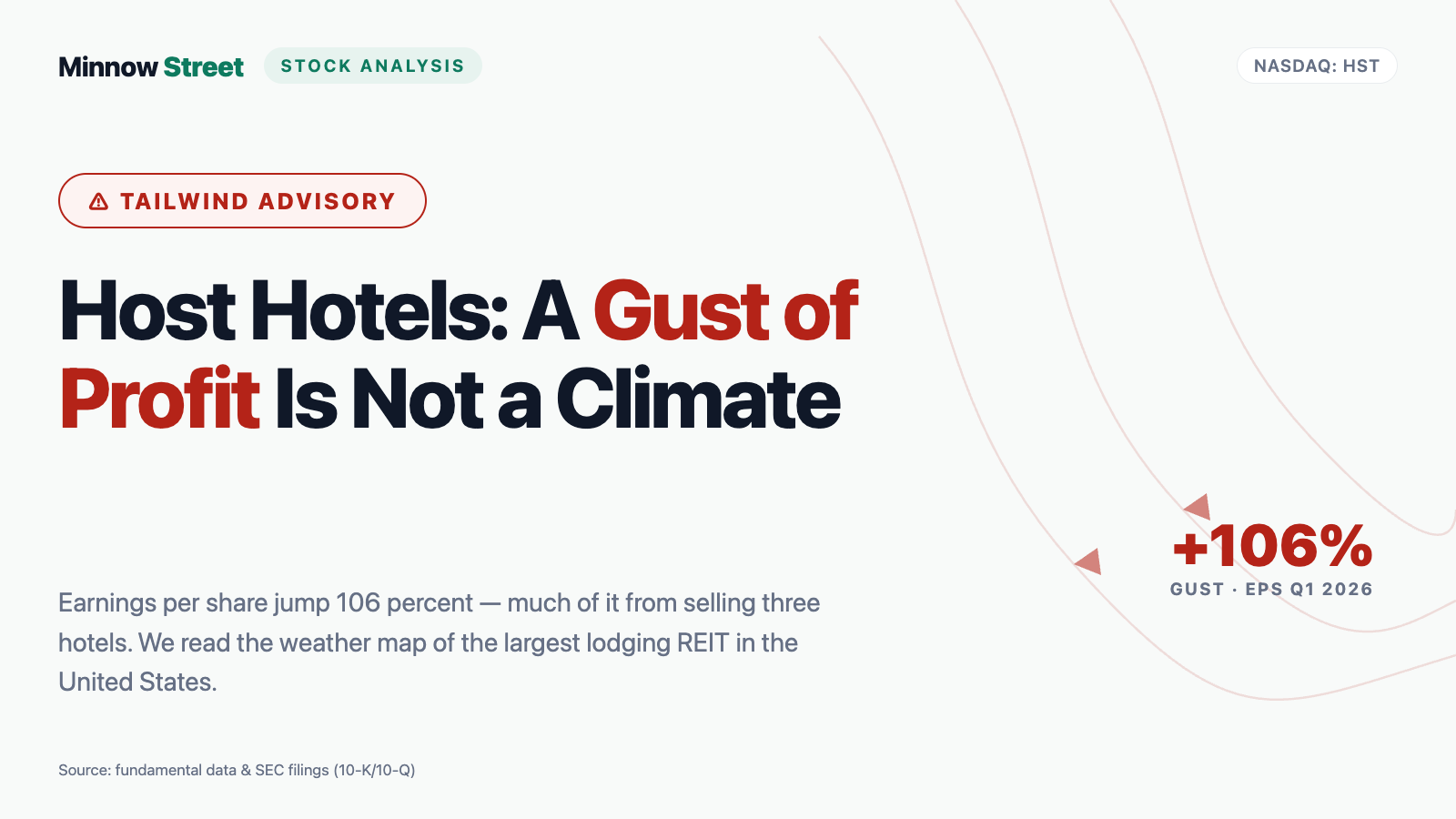
Interactive price chart (TradingView).
Note: pure fact-based analysis, not investment advice and not a solicitation to buy or sell. All figures without guarantee.
There is an investor trap that catches the fast readers in particular: the gust trap. It works like this: a stock reports one spectacular number — "profit doubled!" — and your head turns it into a permanent weather pattern: whatever grows like that will surely keep growing. Meteorologists would object. A gust is weather; whether investing pays is decided by the climate. In the summer of 2026, hardly any large cap offers a better object lesson than Host Hotels & Resorts (Nasdaq: HST), the largest publicly traded lodging REIT in the United States: in our in-house stock scanner, the stock lights up 13 filters in the momentum run of July 17, 2026, trades just about 2 percent below its all-time high — and the latest quarterly report shows a profit jump of 105.7 percent. So let’s make a deal: before you buy this gust, we read together what the company itself reported, under penalty of law, to the U.S. securities regulator, the SEC — the annual reports (10-K) for 2024 and 2025 and the recent quarterly reports (10-Q). And these filings explain the profit jump in a single half-sentence that hardly any momentum buyer is likely to have read. In the end, you decide for yourself.
What Host Hotels actually does — and why nobody here makes beds
Host owns hotels — and the expensive kind: 76 primarily luxury and upper-upscale properties with roughly 41,700 rooms (as of February 20, 2026), including 29 hotels with more than 500 rooms; 71 are in the United States, five in Brazil and Canada. The names on the facades belong to others: Marriott, Ritz-Carlton, Westin, Hyatt, Four Seasons, Fairmont, Hilton. And that is the core of the business model you need to understand before any metric makes sense: Host is the landlord, not the hotelier. Every hotel is run by third parties — the person at the front desk works for Marriott or Hyatt, not for Host. Per the annual report (10-K) for 2025, the company itself employs exactly 162 people, who steer a multi-billion-dollar portfolio from Bethesda, Maryland: buying, selling, renovating, financing. Legally, Host is a REIT ("Real Estate Investment Trust") — a real estate company largely exempt from U.S. corporate income tax as long as it distributes at least 90 percent of its taxable income as dividends. That construct turns REITs into payout machines — with side effects for the balance sheet and the metrics, which we will get to shortly. Which brings us to the central tension of this analysis, running through every chapter: a clean momentum run and a genuinely growing hotel business — but the most spectacular number of the year is a one-off, and viewed through the proper REIT lens, Host grows at a solid single-digit pace rather than a spectacular triple-digit one. What a flawless momentum run feels like when the future still has to be believed is something we dissected at turbocharger world leader Garrett Motion — and how a market prices a comeback as if it were complete, at chipmaker Lattice Semiconductor.
Where the stock shows up in our scanner
We run roughly 3,500 stocks through our scanners every day. Host made the research list via the momentum run of July 17, 2026: 13 hits, almost all from the trend family — the Stan Weinstein stage-2 uptrend (price above a rising 200-day line), near the 52-week high, Mike Webster power-trend leader, price above the 50- and 200-day averages, the 21-day EMA trend, the Minervini trend criteria and the Gary Antonacci dual-momentum setup. Behind them: up 33.7 percent in three months, up 38.6 percent in six, and a relative-strength rating of 82 — the stock beat 82 percent of the market and trades just about 2 percent below its all-time high (data as of July 17, 2026). To replicate: open the Host stock page and walk through the hits section. What stands out this time is the fundamental lens of the same scanner, because it reports good news: fundamental grade B, a Piotroski F-Score of 8 of 9 (a nine-point test of the direction of the books — 8 is top-tier), an Altman Z-Score around 5.4 (a bankruptcy early-warning gauge; the historical danger zone starts below 1.8 — far away here) and a trailing P/E of about 17. And then there is the one hit that triggered this analysis in the first place: EPS acceleration — earnings per share growing faster from quarter to quarter, most recently by 105.7 percent. Remember the question this whole article hangs on: the scanner measures that profit is jumping — not what kind of profit is jumping.
The numbers over the years — honestly appraised
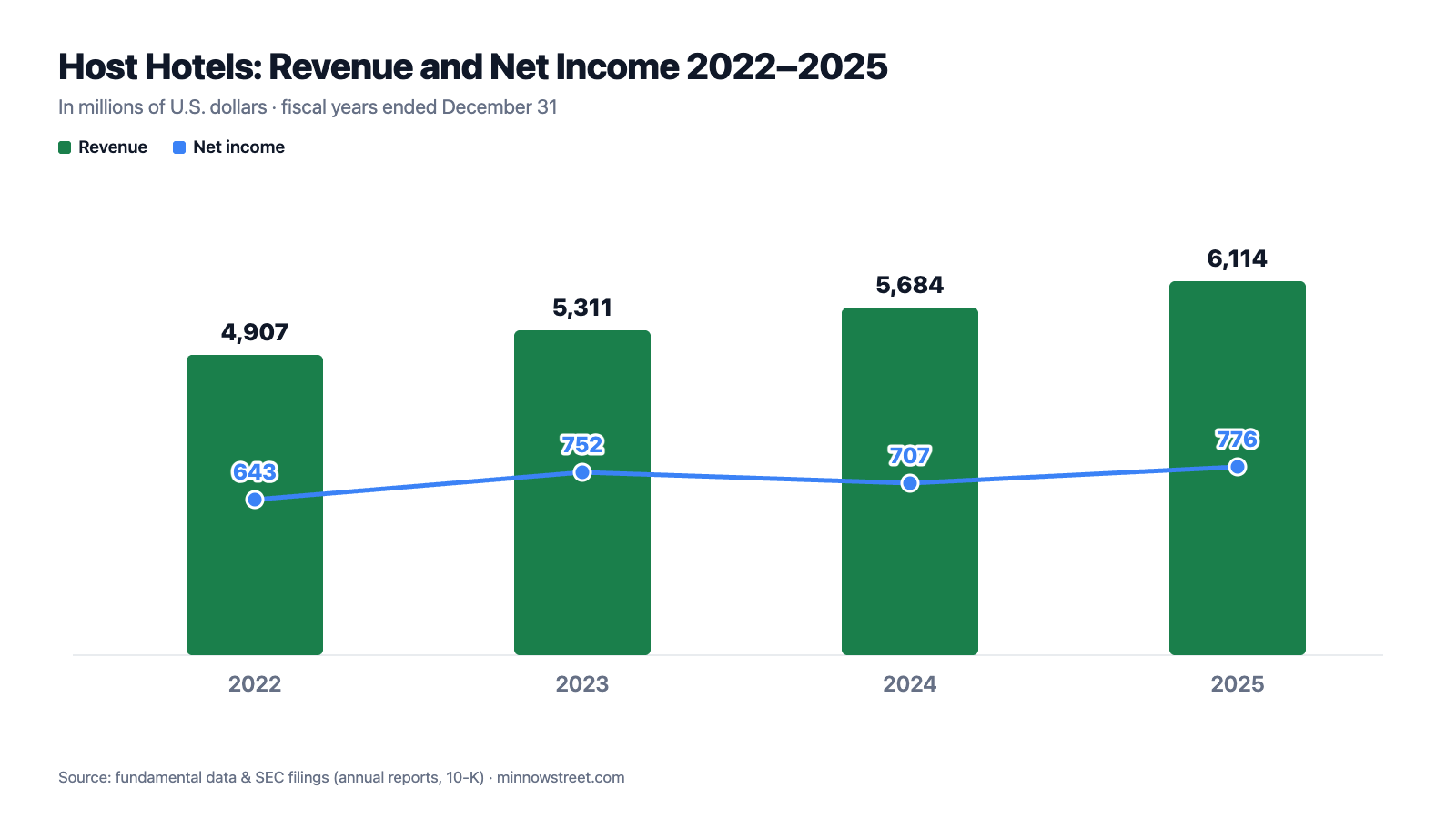
First, what genuinely impresses — and that is quite a lot. Since the pandemic trough, Host has delivered four consecutive growth years: revenue climbed from $4,907 million (2022) via $5,311 million (2023) and $5,684 million (2024) to $6,114 million in 2025 — up 7.6 percent in the latest step. Net income rose 9.8 percent to $776 million in 2025. The industry’s room-revenue yardstick, RevPAR ("revenue per available room"), grew 3.8 percent to $229.24 in the comparable portfolio, led by Atlanta (+16.2 percent) and the recovery on Maui (+13.7 percent). On top came $99 million from an unusual side business — the sale of 16 Four Seasons-branded condominiums next to Disney World — and the 2024 acquisition vintage (including 1 Hotel Central Park and The Ritz-Carlton O’ahu, Turtle Bay) contributing a full year for the first time. The latest quarter was operationally sound as well: in the first quarter of 2026, revenue grew 3.2 percent to $1,645 million, comparable hotel RevPAR rose 4.4 percent (carried by 3.9 percent higher room rates), and the comparable hotel EBITDA margin improved to 32.7 percent. Shareholders get a generous cut: $0.95 in dividends per share for 2025 (including a $0.15 special dividend in the fourth quarter), plus share buybacks of $205 million in 2025 and another $75 million in the first quarter of 2026. But remember the rhythm of this business: hotels are the most cyclical corner of real estate — the leases run exactly one night.
The REIT lens: why "earnings" is the wrong metric at Host
Now for the chapter that makes this analysis worthwhile even if you never touch the stock. For normal companies, earnings per share is the reserve currency. For REITs, it systematically misleads — for two reasons. First: depreciation. Accounting pretends a hotel wears out like a machine and deducts hundreds of millions from profit every year for it (at Host in 2025: $762 million) — even though well-kept locations like a Ritz-Carlton in Naples tend to gain value over decades. Second: gains on sale. When a REIT sells a property, the book gain lands in net income — a one-off that says nothing about the earning power of the remaining hotels. That is why the industry body NAREIT defined its own metric: FFO ("Funds From Operations") — earnings adjusted for exactly these two distortions. Host puts it this way in the annual report:
“NAREIT defines FFO as net income (calculated in accordance with GAAP) excluding depreciation and amortization related to certain real estate assets, gains and losses from the sale of certain real estate assets, gains and losses from change in control, impairment expense of certain real estate assets and investments and adjustments for consolidated partially-owned entities and unconsolidated affiliates.”
— Host Hotels & Resorts, Inc., SEC annual report 10-K for 2025, Item 7 “Non-GAAP Financial Measures”

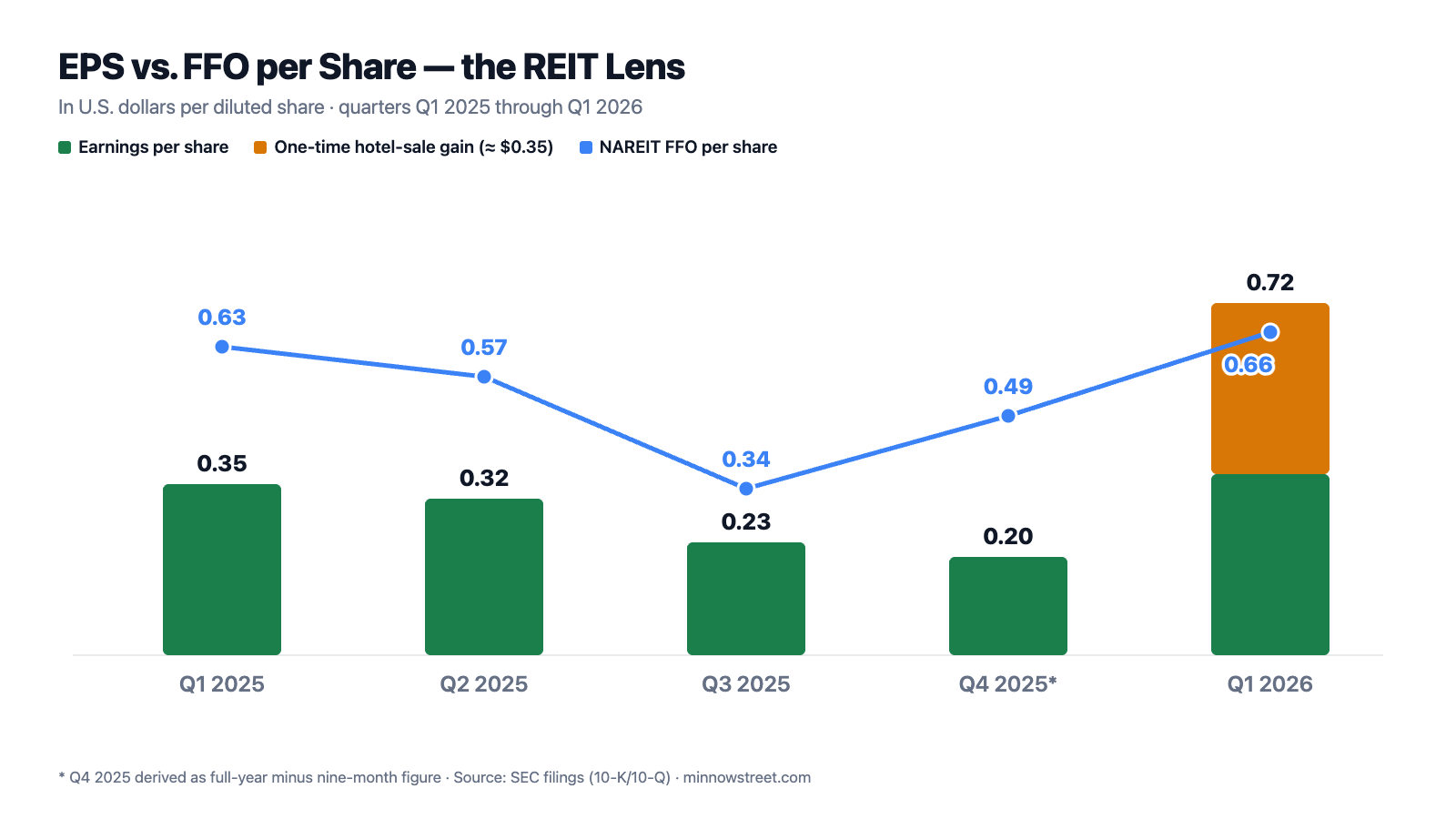
On top of that there is Adjusted FFO (AFFO): Host further adjusts NAREIT FFO for special items such as gains on debt repurchases or stock-based compensation — the metric management measures itself by, which also feeds its compensation programs. Through this lens, Host’s 2025 looks like this: NAREIT FFO per diluted share $2.03 (+3.0 percent), Adjusted FFO per diluted share $2.07 (+3.5 percent) — solid, single-digit growth. No crash, no explosion: the climate. And the earnings per share that rose 11.1 percent to $1.10 in 2025 and jumped 105.7 percent in the first quarter of 2026? That is the weather. Which brings us to the uncomfortable truths.
What the filings say — the uncomfortable truths
Uncomfortable truth no. 1: half of the 106 percent profit jump is sale proceeds
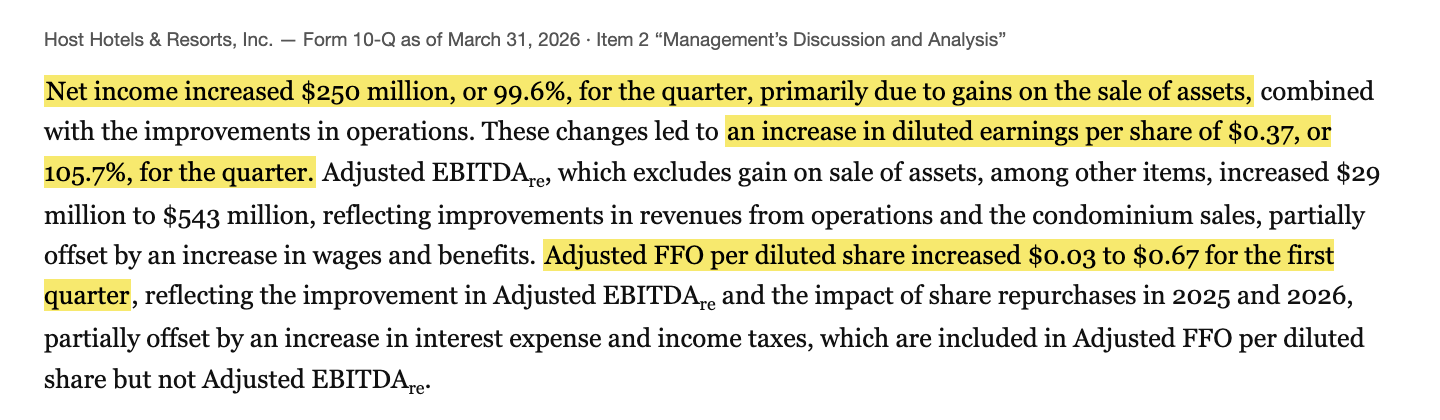
The quarterly report (10-Q) as of March 31, 2026, explains the most spectacular number of the year in the very first sentence of its results section — and demystifies it in the process:
“Net income increased $250 million, or 99.6%, for the quarter, primarily due to gains on the sale of assets, combined with the improvements in operations. These changes led to an increase in diluted earnings per share of $0.37, or 105.7%, for the quarter.”
— Host Hotels & Resorts, Inc., SEC quarterly report 10-Q as of March 31, 2026, Item 2 “Management’s Discussion and Analysis”
What was sold is spelled out in Note 7 of the same report: The St. Regis Houston for $51 million, plus — in a $1.1 billion package to investment firm BDT & MSD Partners — the Four Seasons Resort Orlando at Walt Disney World Resort and the Four Seasons Resort and Residences Jackson Hole. Gain on sale: $242 million, roughly $0.35 per share — about half of the quarter’s $0.72 in earnings per share. One footnote worth knowing: the billion-dollar deal was formally a related-party transaction — Teddy Overton, stepson of Host CEO James Risoleo, is a Principal at BDT & MSD Partners and worked on the transaction on the buyer’s side; per the annual report, Mr. Risoleo did not participate in the negotiations, and the board of directors reviewed and approved the sale (10-K for 2025, Note 11 “Dispositions”). Viewed through the REIT lens, the fireworks shrink to a sparkler: Adjusted FFO per diluted share rose 3 cents to $0.67 — up 4.7 percent. Decent, honest, unspectacular. In fairness: the quarter was operationally good too (RevPAR up 4.4 percent, margin improved), and selling dear is a virtue for a real estate company, not an offense. But the scanner hit "EPS acceleration" and the doubling headline feed on an event that will not repeat — accordingly, analyst consensus sees earnings per share falling back toward $1 next year (data as of July 17, 2026). Remember the mechanism: when a real estate company sells buildings, earnings per share buys itself a turbocharger — and FFO shows what is left without the turbo.
Uncomfortable truth no. 2: 64 percent of the hotels hang on a single operator — and Host employs none of its hotel workers
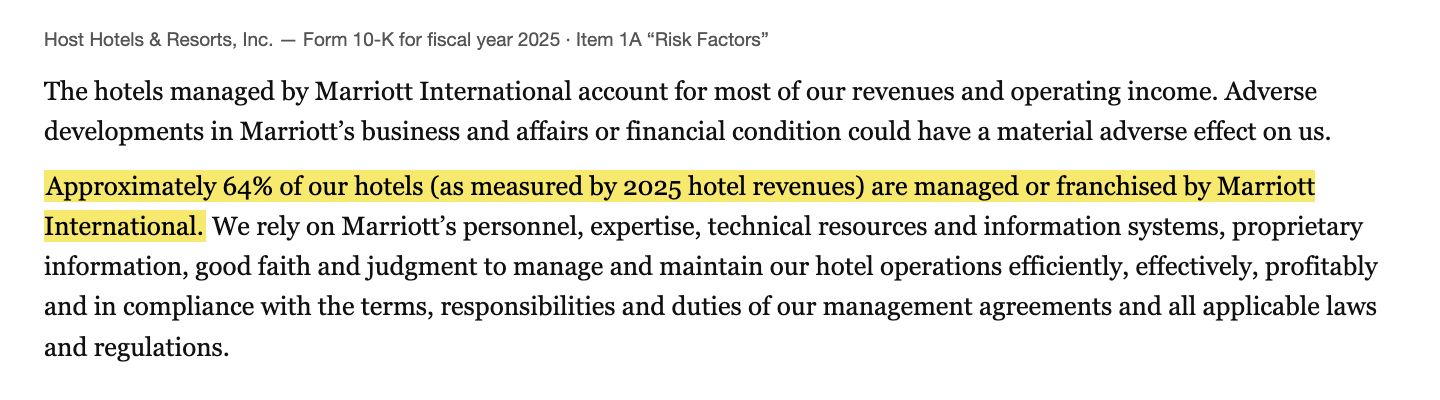
Check in at a Host property and you will not meet a Host employee. That is charming for the cost structure — and delicate for control, because the dependency concentrates massively on one name:
“Approximately 64% of our hotels (as measured by 2025 hotel revenues) are managed or franchised by Marriott International. We rely on Marriott’s personnel, expertise, technical resources and information systems, proprietary information, good faith and judgment to manage and maintain our hotel operations efficiently, effectively, profitably and in compliance with the terms, responsibilities and duties of our management agreements and all applicable laws and regulations.”
— Host Hotels & Resorts, Inc., SEC annual report 10-K for 2025, Item 1A “Risk Factors”
History explains the closeness: Host was called "Host Marriott Corp" until 2006 and is the real estate half of the Marriott group that split in 1993. The division of labor has its logic — brands and booking systems scale with the operator, capital with the owner. But it also means: if staff strike, the booking system stumbles, or Marriott renegotiates its terms, Host bears the consequences without holding the levers. The report says it dryly itself: “We do not directly employ or manage employees at our consolidated hotels” (exception: the three properties in Brazil, where Host is formally the employer but likewise not in charge of direction). Picture a landlord whose entire housing stock is looked after by two property managers — one of whom handles nearly two thirds: as long as the manager delivers, it is comfortable. It remains a concentration all the same.
Uncomfortable truth no. 3: 65 percent of revenues from seven markets — with the weather at the table
The second concentration sits a few pages further into the risk section — the geographic one:
“Hotels in the following cities and states represented approximately 65% of our 2025 hotel revenues: New York, Washington, D.C., San Diego, San Francisco, Phoenix, Florida and Hawaii. […] For example, lodging demand in Maui, one of our largest markets by revenues, has been significantly impacted by the wildfires that occurred in August 2023, and the effect on lodging demand is expected to continue in 2026.”
— Host Hotels & Resorts, Inc., SEC annual report 10-K for 2025, Item 1A “Risk Factors”
Behind the Maui example stands a series: Hurricane Ian hit the majority of the Florida hotels in 2022, the 2023 wildfires hit Maui, and Hurricanes Helene and Milton knocked out Florida properties again in the fall of 2024 — The Ritz-Carlton, Naples and The Don CeSar were temporarily closed altogether. The income statement carries a remarkable line as a result: net insurance gains of $86 million (2023), $110 million (2024) and $24 million (2025) — claims settlements temporarily became a relevant income item, and their $86 million decline was a main reason for the falling operating margin in 2025. In fairness: exactly these locations — beachfront land in Hawaii, city blocks in Manhattan — are also why this portfolio is so hard to copy. The concentration is quality and vulnerability at once. You should simply know that with this stock you are also buying a bet on seven zip-code regions and their weather. The hero image of this analysis is meant more literally than we would like.
Uncomfortable truth no. 4: $5.1 billion of debt — and the 90 percent rule prevents saving up
A REIT may do almost anything except hoard. Host states the system condition itself in the risk section:
“Since we have elected REIT status, Host Inc. must finance its growth and fund debt repayments largely with external sources of capital because it is required to pay dividends to its stockholders in an amount equal to at least 90% of its taxable income (other than net capital gain) each year to qualify as a REIT.”
— Host Hotels & Resorts, Inc., SEC annual report 10-K for 2025, Item 1A “Risk Factors”
The flip side of the payout duty stands two paragraphs further on: “As of December 31, 2025, we and our subsidiaries had total indebtedness of approximately $5.1 billion.” As of March 31, 2026, it was $5,079 million ($3,988 million in senior notes, $997 million credit facility including term loans, $94 million mortgages) — set against, after the hotel sales, $1,703 million in cash, more than double the year-end level. For perspective, without alarm bells: measured against adjusted operating earnings (Adjusted EBITDAre 2025: $1,757 million), that is a for-real-estate moderate leverage of under three times, equity covers a good half of the balance sheet, and the Altman Z-Score of 5.4 signals all-clear. But you should understand the mechanics: a REIT can hardly build crisis buffers — most of what comes in has to go out. In the pandemic, Host suspended its regular quarterly dividend entirely starting with the second quarter of 2020 — "to preserve cash and future financial flexibility," as the annual report (10-K) for 2020 puts it; the payout is as cyclical as the business. 2025 was no exception: $0.95 per share including a $0.15 special dividend — whose size depends anew each year on profits (and on gains from sales!).
Valuation: $17.5 billion of market value — and a P/E ratio that lies
In mid-July 2026 the Host share cost about $25, for a market value of roughly $17.5 billion (data as of July 17, 2026). The trailing P/E of about 17 looks moderate — but you now know why it is the wrong lens: the trailing twelve months include the sale gains of the first quarter of 2026. The REIT math goes like this: at $2.03 of NAREIT FFO per share (2025), the market is paying about 12 times FFO — for a luxury-hotel REIT neither a bargain nor a bubble, but the upper middle of its own history; the stock trades just about 2 percent below its all-time high (data as of July 17, 2026). The dividend yield of roughly 3.8 percent ($0.95 for 2025) is the real purchase argument of this asset class — mind you, including a special dividend that carries no guarantee; the regular quarterly dividend currently runs at $0.20 (most recently declared February 18, 2026). Add the capital discipline: in 2025, Host bought back 13.1 million of its own shares for $205 million (average price $15.68 — well below today’s level), and another 4.0 million for $75 million in the first quarter of 2026; $480 million of buyback capacity remained at year-end. The professionals’ view still counsels sobriety: 19 analyst estimates see earnings per share averaging back around $1 next year — the base effect of the sale gains reverses — and management itself guides comparable hotel RevPAR growth of 3.0 to 4.5 percent for 2026 (10-Q as of March 31, 2026). That is the climate behind the gust: mid-single-digit rates, reliably distributed, highly cyclical.
Opportunities and risks at a glance
What speaks for Host Hotels:
- A hard-to-copy portfolio: 76 luxury and upper-upscale hotels in prime locations (Hawaii, Manhattan, California, Florida), 38 years old on average but continuously renovated; the largest publicly traded lodging REIT in the U.S., with scale advantages in purchasing and capital access (annual report 10-K for 2025).
- Operating growth is real: revenue 2025 up 7.6 percent to $6,114 million, comparable RevPAR up 3.8 percent, Q1 2026 up 4.4 percent with improved margin; 2026 outlook: RevPAR up 3.0 to 4.5 percent.
- Capital discipline with a sense of timing: three hotels sold for a combined roughly $1.15 billion near the cycle high (Q1 2026), buybacks of $205 million plus $75 million at prices below today’s level, $1,703 million in cash (March 31, 2026), investment-grade balance sheet with an Altman Z around 5.4.
- Shareholder returns by design: the 90 percent payout requirement, $0.95 in dividends per share for 2025 (a yield of roughly 3.8 percent, data as of July 17, 2026), plus special dividends in good years.
- The tape confirms it: 13 scanner hits in the momentum run of July 17, 2026 (stage 2, near 52-week high, power-trend leader), RS rating 82, Piotroski 8 of 9, fundamental grade B.
What speaks against it:
- The headline number is a gust: about half of the Q1 2026 profit jump (+105.7 percent per share) comes from the one-off gain on hotel sales ($242 million); Adjusted FFO per share grew just 4.7 percent, and analyst estimates see earnings per share falling back next year (data as of July 17, 2026).
- A double concentration: 64 percent of hotels (by revenues) with a single operator (Marriott), 65 percent of revenues from seven markets — including a documented series of weather and disaster hits from Maui to Florida (10-K for 2025, Item 1A).
- Extreme cyclicality: leases lasting one night; industry RevPAR collapsed historically in the pandemic, and Host’s regular dividend was suspended entirely from the second quarter of 2020 (10-K for 2020) — the 90 percent rule prevents thick crisis buffers.
- $5.1 billion of debt (December 31, 2025) against structurally limited internal financing; rising wages and insurance premiums pressure margins per the annual report (2025 operating margin: minus 140 basis points).
- No control over operations: Host employs no hotel staff and depends entirely on third parties for systems, personnel and brand management — including the cyber risks of the managers’ systems (10-K for 2025).
A human conclusion
Back to the gust trap from the opening. It does not snap shut because gusts are fictional — Host’s profit jump is genuinely booked, the money is in the bank, and $1.1 billion for two Four Seasons resorts was a remarkably good price. It snaps shut because the mind turns a gust into a weather pattern: "profit doubled" feels like a growth stock, when Host is the opposite — a mature, disciplined property owner whose climate consists of 3 to 5 percent RevPAR growth, about $2 of FFO per share and a dividend of most recently $0.95. That is not nothing; a reliable 3.8 percent yield plus single-digit growth has calmed many a portfolio. But it is something fundamentally different from what the doubling headline promises — and it hangs on an operator named Marriott, on seven weather regions, and on the travel appetite of affluent customers, which is more cyclical than almost anything else in real estate. So the honest question for you is not "is profit growing?" but: do you want to own a luxury landlord with night-by-night leases, near its all-time high, at twelve times FFO? If yes, then because of the climate — not the gust. And the next time you read "profit doubled" somewhere, you now know to reach for the weather map: first check whether someone is running a business — or has just sold the family silver at a shine. What you make of it is your decision. And that is exactly as it should be.
Sources
All original documents used in this analysis — for your own reading:
- Host Hotels & Resorts, Inc. — SEC annual report 10-K for 2025 (filed February 25, 2026)
- Host Hotels & Resorts, Inc. — SEC annual report 10-K for 2024 (filed February 26, 2025)
- Host Hotels & Resorts, Inc. — SEC quarterly report 10-Q as of 03/31/2026 (filed May 8, 2026; hotel sales, profit jump, FFO)
- Host Hotels & Resorts, Inc. — SEC quarterly report 10-Q as of 09/30/2025 (filed November 7, 2025)
- Host Hotels & Resorts, Inc. — SEC quarterly report 10-Q as of 06/30/2025 (filed August 1, 2025)
- Host Hotels & Resorts, Inc. — SEC quarterly report 10-Q as of 03/31/2025 (filed May 2, 2025)
- Host Hotels & Resorts, Inc. — SEC annual report 10-K for 2020 (filed February 25, 2021; pandemic dividend suspension)
- Complete SEC filing history of Host Hotels & Resorts, Inc.: EDGAR overview (sec.gov)
- Fundamental data (metrics, quarterly series, valuation; data as of July 17, 2026), reconciled with the SEC filings.
- Screener and rating data: in-house stock scanner (momentum/stage-2 run of July 17, 2026).
Transparency & disclaimer: This analysis is a journalistic contextualization of publicly available information and is not investment advice, not a financial analysis in the regulatory sense and not a solicitation to buy or sell securities. Stock investments carry substantial risks up to and including total loss. All information without guarantee; the data cut-off is noted in the text. The author holds no position in Host Hotels shares at the time of publication.
Our Bottom Line at a Glance
- Portfolio & market position positive
- The largest publicly traded lodging REIT in the U.S.: 76 luxury and upper-upscale hotels with roughly 41,700 rooms in hard-to-copy locations (Hawaii, Manhattan, California, Florida), continuously modernized, with capital access and scale advantages (annual report 10-K for 2025).
- Operations & outlook positive
- Four consecutive growth years: revenue 2025 up 7.6 percent to $6,114 million, comparable RevPAR up 3.8 percent, Q1 2026 up 4.4 percent with improved margin; management outlook for 2026: RevPAR up 3.0 to 4.5 percent (10-Q as of 03/31/2026).
- Earnings quality of the headline quarter negative
- The 105.7 percent EPS jump in Q1 2026 is, per the quarterly report, "primarily due to gains on the sale of assets" — a $242 million one-off from three hotel sales (≈ $0.35 per share); Adjusted FFO per share grew just 4.7 percent, and analyst consensus sees EPS falling back next year (data as of July 17, 2026).
- Concentration: operator & geography negative
- About 64 percent of hotels (by 2025 revenues) hang on Marriott, 65 percent of hotel revenues on seven markets; a documented series of disasters (Maui wildfires 2023, Florida hurricanes 2022/2024) with Maui impact expected through 2026 — Host employs no hotel staff and does not hold the operating levers itself (10-K for 2025, Item 1A).
- Balance sheet & payout neutral
- $5.1 billion of debt (12/31/2025) against $1,703 million of cash after the sales (03/31/2026), leverage under three times Adjusted EBITDAre, Altman Z around 5.4 — solid; but the 90 percent payout requirement prevents crisis buffers, and the dividend ($0.95 for 2025 incl. special dividend) remains as cyclical as the business.
- Valuation & tape neutral
- 13 momentum hits, stage-2 trend, RS 82, just about 2 percent below the all-time high — at about 12 times NAREIT FFO and a dividend yield of roughly 3.8 percent (data as of July 17, 2026): no longer a bargain, not a bubble; the seemingly moderate P/E of about 17 is distorted by the gains on sale.
Host Hotels is a disciplined luxury landlord with real but unspectacular growth: 3 to 5 percent RevPAR, about $2 of FFO per share, $0.95 in dividends — the climate. The doubling headline of the first quarter of 2026, by contrast, is a gust made of $242 million in gains on sale that will not repeat. Whoever buys the stock near its all-time high buys a payout vehicle with a Marriott concentration, seven weather regions and leases one night long — at 12 times FFO. Not investment advice.
What Our Rating Means
- If you don't own the stock
- As long as the question raised in the bottom line stays open, we see no basis for an entry.
- If you hold it in your portfolio
- Our findings offer no acute reason to sell — the checkpoints named remain decisive.
A journalistic assessment by our editorial team at the time of the deep dive, based on public sources — not investment advice and not a solicitation to buy or sell. Your personal circumstances (investment goals, risk capacity, taxes) cannot be taken into account. What our categories mean, how verdicts are formed, and what conflicts of interest exist →
Worth Noting
- HST made the research list via the momentum/stage-2 run of our in-house stock scanner on July 17, 2026 (13 hits, incl. Stan Weinstein stage 2, near 52-week high, EPS acceleration) — not a Reddit hype find.
- Scanner metrics (P/E, Piotroski, Altman Z, fundamental grade) use trailing twelve-month figures; the Q1 2026 gain on sale is baked in and optically lowers the P/E — the REIT-appropriate reading (FFO/AFFO) is in the article.
- Price and valuation figures dated July 17, 2026 (about $25, about $17.5 billion market value); analyses are evergreen, daily prices are not a buy argument.
Frequently Asked Questions
Host Hotels & Resorts (Nasdaq: HST) of Bethesda, Maryland, is the largest publicly traded lodging REIT in the U.S.: the company owns 76 primarily luxury and upper-upscale hotels with roughly 41,700 rooms (as of February 20, 2026), operated by third parties under brands such as Marriott, Ritz-Carlton, Westin, Hyatt and Four Seasons. Host itself employs just 162 people. Revenue 2025: $6,114 million (+7.6 percent).
FFO ("Funds From Operations") is the standard earnings metric for REITs: net income excluding real estate depreciation and excluding gains or losses from property sales. Depreciation assumes a loss of value that well-kept properties often do not suffer, and gains on sale are one-offs — both distort classic earnings per share. At Host, NAREIT FFO per diluted share was $2.03 in 2025 (+3.0 percent) and Adjusted FFO $2.07 (+3.5 percent).
Per the quarterly report (10-Q) as of March 31, 2026, net income rose 99.6 percent "primarily due to gains on the sale of assets": Host sold The St. Regis Houston ($51 million) plus the Four Seasons Resort Orlando and the Four Seasons Jackson Hole ($1.1 billion combined), booking a $242 million gain on sale — roughly $0.35 of the quarter's $0.72 in earnings per share. Adjusted FFO per share rose just 4.7 percent to $0.67.
For 2025, the board declared dividends totaling $0.95 per share — including a $0.15 special dividend in the fourth quarter. The regular quarterly dividend most recently ran at $0.20 (declared February 18, 2026). At a share price of about $25, that is a yield of roughly 3.8 percent (data as of July 17, 2026). As a REIT, Host must distribute at least 90 percent of its taxable income — but in the pandemic the regular dividend was suspended entirely for a time, starting with the second quarter of 2020.
Very: about 64 percent of the hotels (measured by 2025 hotel revenues) are managed or franchised by Marriott International — Host itself was called "Host Marriott Corp" until 2006. The annual report (10-K) for 2025 explicitly names adverse developments at Marriott as a material risk, because Host employs no hotel staff of its own and depends entirely on its operators for systems, personnel and brand management.
The trailing P/E of about 17 (data as of July 17, 2026) deceives, because it includes the gains on sale from the first quarter of 2026. The REIT-standard math: at a price around $25 and $2.03 of NAREIT FFO per share (2025), the stock costs about 12 times FFO — upper mid-range, just about 2 percent below the all-time high. Add a dividend yield of roughly 3.8 percent and a management outlook of 3.0 to 4.5 percent RevPAR growth for 2026.
The annual report (10-K) for 2025 names, among others: the dependence on Marriott (64 percent of hotels by revenues), the geographic concentration (65 percent of hotel revenues from New York, Washington, D.C., San Diego, San Francisco, Phoenix, Florida and Hawaii), natural disasters such as the 2023 Maui wildfires and the Florida hurricanes of 2022/2024, roughly $5.1 billion of debt, and the REIT requirement to distribute at least 90 percent of taxable income.
Found an error?
Did you spot a factual error, an outdated number, or a typo in this deep dive? Let us know briefly — your report goes straight to the editorial team.