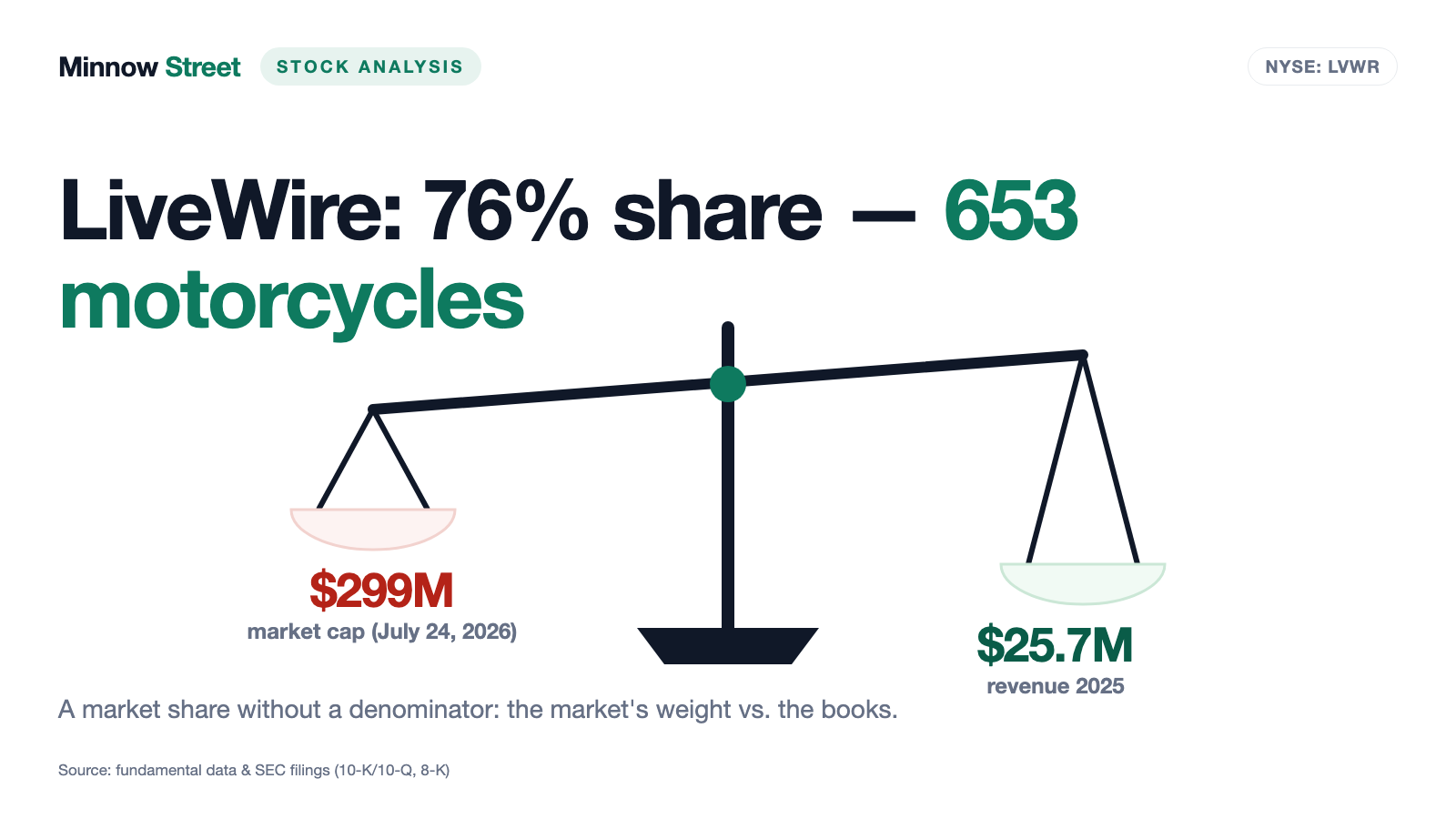
LiveWire: 76 percent market share — and 653 motorcycles in a whole year
LiveWire, the electric motorcycle arm Harley-Davidson spun off in 2022, reported a 76 percent share of the U.S. market for street-legal electric motorcycles above 50 kilowatts for the first half of 2026. The number is accurate — the company also sold just 653 motorcycles in all of 2025, and its bigger business is kids' balance bikes. As of June 30, 2026, shareholders' equity of $11.9 million sat against $76.8 million owed to the majority owner, secured by substantially all assets. The ticker surfaced on Reddit with 5 mentions in 24 hours on July 25, 2026. No recommendation — just the arithmetic behind the percent sign.
 Thomas Mücke
Founder & Publisher
Thomas Mücke
Founder & Publisher
Chart
Interactive price chart (TradingView).
Note: pure fact-based analysis, not investment advice and not a solicitation to buy or sell. All figures without guarantee.
There is an investing trap so unremarkable it rarely gets a name: the percentage-without-a-denominator trap. It works like this. You read "76 percent market share," and your mind fills in a picture — a company that dominates its field, with factories, dealer networks, momentum. What your mind does not ask automatically: how big is that field? Because 76 percent of a million is a corporation, and 76 percent of a thousand is a workshop. LiveWire Group (NYSE: LVWR) of Milwaukee, the electric motorcycle arm Harley-Davidson spun off in 2022, reported exactly that number on July 23, 2026. And because it is true, it is seductive. On July 25, 2026, the ticker surfaced in the Reddit forums with 5 mentions in 24 hours, jumping out of nowhere to rank 81 among the most-discussed U.S. stocks (data from ApeWisdom). So here is the deal: before you believe the percent sign, let us read the denominator together — in the Form 10-K for 2025, the Form 10-Q for March 31, 2026, and the quarterly release of July 23, 2026, all of which LiveWire filed with the U.S. securities regulator, the SEC. An SEC filing is honest under penalty of law. The decision at the end is yours.
What LiveWire actually does — a motorcycle maker whose biggest business is kids' balance bikes
LiveWire builds electric motorcycles, and not as a side project: it comes straight out of Harley-Davidson. The company sits on Juneau Avenue in Milwaukee, the same address as its parent, and listed on the New York Stock Exchange on September 26, 2022 through a merger with the blank-check company AEA-Bridges Impact Corp. Until June 2022 the shell was named "LW EV Holdings, Inc." — worth knowing if you go looking for older paperwork.
The business runs in two segments. First, Electric Motorcycles: built on the in-house ARROW architecture, the S2 Del Mar, Mulholland and Alpinista models, joined in the second quarter of 2026 by the cheaper S4 Honcho. Manufacturing is outsourced — to Harley-Davidson and to the Taiwanese scooter maker KYMCO. Second, STACYC: electric balance bikes for children aged three to eight, plus pedal-assist bikes. Sounds like an afterthought. It is not.
Because this is where the central tension of this analysis lives, and it runs through every chapter: the segment that gives the company its name is the smaller one. Motorcycles account for barely a quarter of revenue and virtually all of the loss — and the whole thing is funded by a majority owner who is simultaneously lender, contract manufacturer and service provider. Here is how revenue splits:
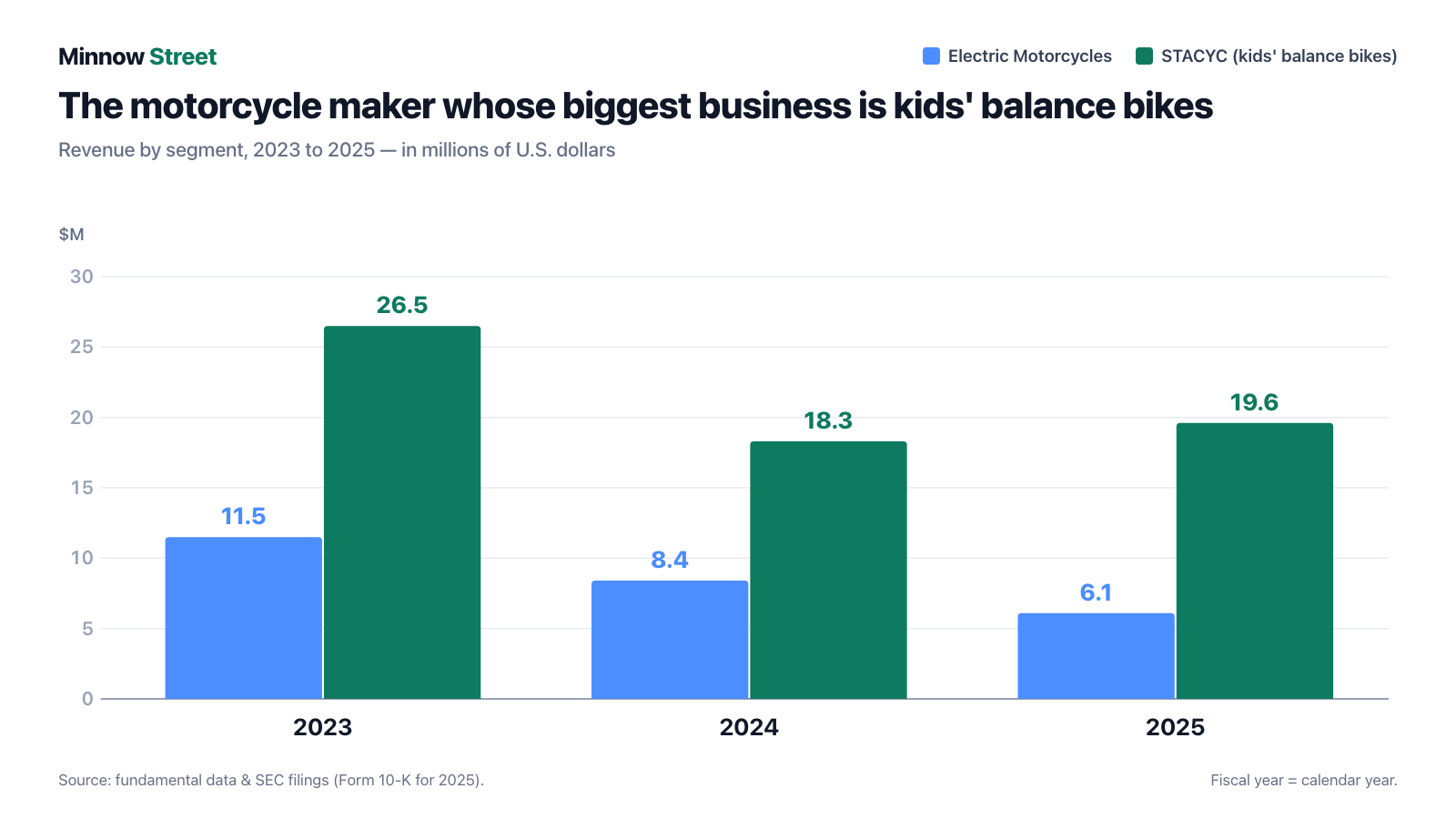
Put in everyday terms: imagine a firm founded as a sports car workshop whose till is actually filled by selling ride-on toys. Nothing dishonorable about it — but it changes the question you have to ask.
How the stock landed on our desk
We run roughly 3,500 stocks through our scanners every day. LiveWire did not reach the research list through a balance sheet metric but through the Reddit hype scanner, which counts which smaller U.S. names the retail forums are talking about: 5 mentions in 24 hours and 32 upvotes, rank 81 among the most-discussed stocks — after the ticker had not appeared in the list at all 24 hours earlier (data from ApeWisdom, as of July 25, 2026). A jump like that out of nothing is rarely coincidence.
A second, far harder data point explains it. On July 24, 2026, 103.3 million LiveWire shares changed hands. The freely tradable float is around 12.6 million shares (as of July 25, 2026) — the entire float turned over more than eight times in a single day. For comparison, on the ten trading days before that, volume mostly ran between 170,000 and 600,000 shares. Where that tightness comes from is the subject of the third uncomfortable truth below; how forum dynamics and a tiny float work together, we took apart at length in our analysis of AMC Entertainment.
In our fundamental and trend filters, LiveWire shows up in three as of July 25, 2026: "Going Concern (distress proxy)", "Professionals 80%" and "Below the 50- and 200-day average". One important qualification: the distress proxy is our calculation, rebuilding the classic ingredients of a going-concern warning — negative operating cash flow, weak balance sheet ratios, no interest coverage. LiveWire's annual report contains no going-concern warning from its auditor; on the contrary, the March 31, 2026 quarterly report states that existing resources will be sufficient "for at least the next twelve months." The filter is a smoke detector, not a demolition order. "Professionals 80%" measures how much of a company sits with large holders and insiders — at LiveWire that is above 94 percent, and here that is not a quality signal but the actual story.
The numbers over the years — given their due
Start with what genuinely speaks for LiveWire, because there is real substance. The turnaround is working. The net loss fell three years running: $109.6 million (2023), $93.9 million (2024), $75.1 million (2025). Total operating costs dropped from $154.0 million to $101.2 million over the same period — a third less, achieved through headcount reductions, moving the development operation from California to Wisconsin, and a new services arrangement with the parent. Loss per share improved from $0.54 to $0.37.
And in 2026 the revenue line turns up for the first time in years. Second quarter 2026 group revenue rose 55 percent to $9.1 million (prior-year quarter: $5.9 million), with motorcycle units up from 55 to 267. First-half operating cash outflow fell 18 percent to $26.4 million and free cash outflow 19 percent to $27.7 million. The STACYC segment broke even in the second quarter of 2026. Chief executive Karim Donnez calls it "an important step forward in the execution of our strategic growth plan." That is not spin; those are real gains.
Now the second chart. It shows what the turnaround cost:
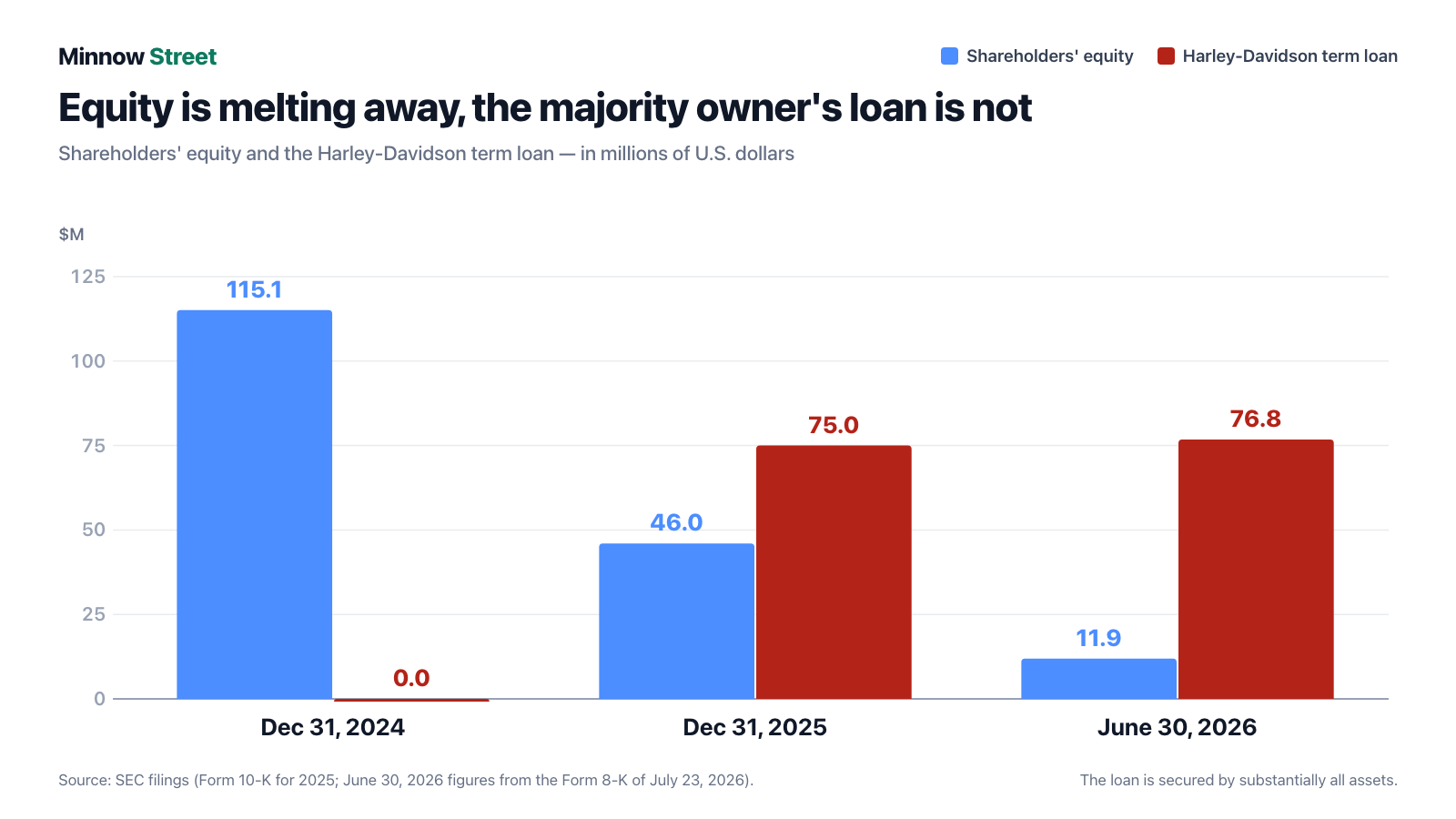
Remember this picture: the loss is getting smaller — but the cushion it is paid from is shrinking faster. Which brings us to the uncomfortable truths.
What the filings say — the uncomfortable truths
Uncomfortable truth No. 1: 76 percent of almost nothing
The market share figure appears verbatim in Exhibit 99.1 to the quarterly release of July 23, 2026:
"Year-to-date through June 30, 2026 market share of 76% in the U.S. electric motorcycle 50+ kilowatt on-road EV segment."
— LiveWire Group, Inc., Form 8-K of July 23, 2026, Exhibit 99.1 (market data source per footnote: Motorcycle Industry Council)

Now the denominator. The Form 10-K for 2025 states the unit numbers without hedging: LiveWire sold 653 motorcycles to dealers and end customers in all of 2025 (2024: 612). In the first quarter of 2026 it was 91, in the second 267 — 358 in the first half. For comparison, STACYC sold 21,633 children's balance bikes in 2025.
A 76 percent share on roughly 350 motorcycles in half a year therefore implies that the entire U.S. segment of street-legal electric motorcycles of 50 kilowatts and above amounts, on this calculation, to something like 450 to 500 vehicles per half year. That is not a market; it is a niche in the making — and leadership in it means about as much as the title of biggest fish in the aquarium. This is not a criticism of the company: the number is accurate and backed by an outside source. It is a warning to the reader. A percentage without a denominator is not information, it is a feeling.
The revenue side confirms it. Motorcycle segment revenue fell from $11.5 million (2023) to $8.4 million (2024) and $6.1 million (2025) — down 47 percent in two years, even though units rose 7 percent in 2025. The filing explains why: new incentives introduced in the third quarter of 2025, including the "Twist & Go" promotion, reduced revenue by $3.2 million. More units are moving; less money is earned on each.
Uncomfortable truth No. 2: the equity lasts roughly another year on paper
This is where it gets serious. As of December 31, 2024, LiveWire had shareholders' equity of $115.1 million. A year later it was $46.0 million. As of June 30, 2026, the filing shows $11.9 million — against total assets of $117.9 million. Put differently, about 90 percent of the balance sheet is now debt-funded.
The largest item on the liability side is a loan from the parent. The annual report describes it this way:
"Our Term Loan provides us with access of up to $75.0 million to be drawn by the Company between November 17, 2025 and December 15, 2025. On December 15, 2025, we borrowed $75.0 million under the Term Loan. All of the obligations under the Term Loan are collateralized by a security interest in substantially all of our assets. The maturity date of the Term Loan is December 15, 2027."
— LiveWire Group, Inc., Form 10-K for 2025, Risk Factors

Translated: the majority owner lent money to its subsidiary and took a lien on everything the subsidiary owns. The effective interest rate was 7.64 percent in 2025, and as of June 30, 2026 the loan carried at $76.8 million.
Now the arithmetic anyone can check. Cash: $82.8 million (December 31, 2025), $67.5 million (March 31, 2026), $52.9 million (June 30, 2026). Operating cash outflow in the first half of 2026: $26.4 million. The company's own guidance, expressly reaffirmed on July 23, 2026: an operating loss of $70 million to $80 million for full-year 2026. At an unchanged pace the cash is gone sometime during 2027 — the same year in which $75 million falls due on December 15. In fairness, the quarterly report states that resources are sufficient "for at least the next twelve months from the issuance date of these consolidated financial statements," and adds in the same paragraph that the company "will require additional capital." Both sentences are there. Both are true.
Uncomfortable truth No. 3: the lifeline belongs to the majority owner
When equity melts, the obvious answer is an equity raise. LiveWire has had a program for that since August 22, 2025, allowing it to sell up to $50.0 million of stock into the market at its discretion; $47.8 million of capacity remained as of December 31, 2025. Except "at its discretion" is not quite the right phrase here.
"Additional sales under the ATM Program are subject to market demand, outside of management's control, and subject to approval by the H-D Board of Directors as we are a controlled company."
— LiveWire Group, Inc., Form 10-Q for March 31, 2026, liquidity discussion
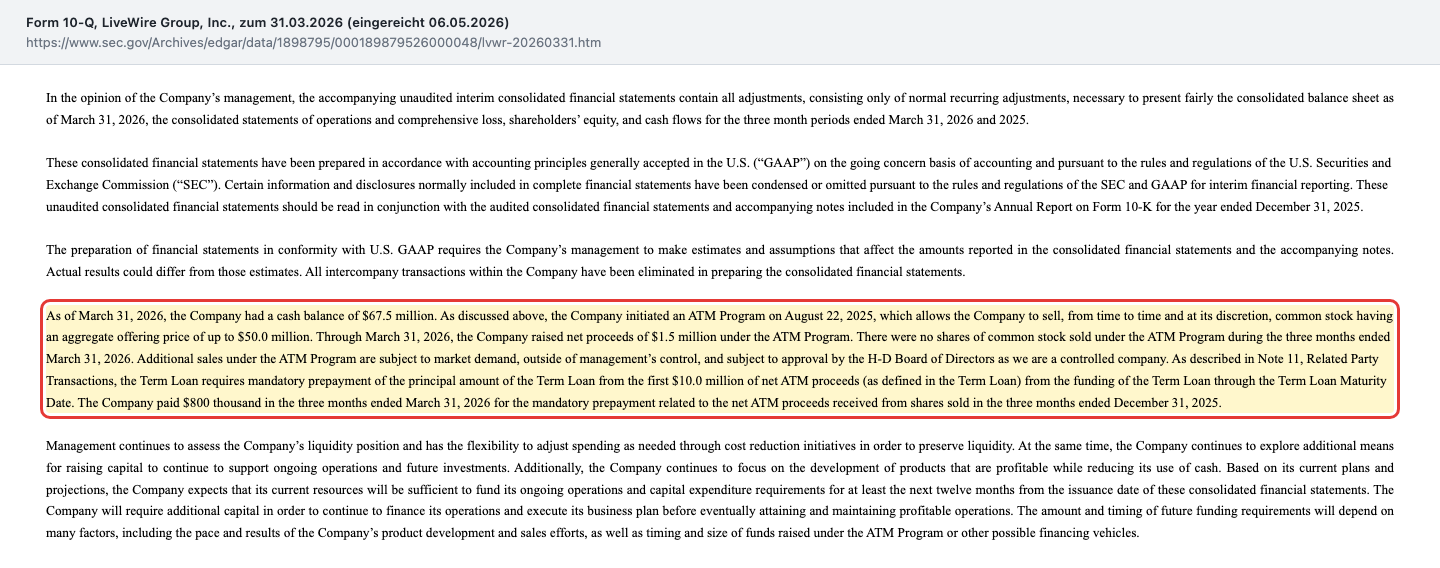
Two sentences later comes the second catch: the first $10.0 million of net proceeds from that program must go back to Harley-Davidson as a mandatory prepayment. $800 thousand was already paid this way in the first quarter of 2026. Across that entire quarter, LiveWire sold not a single share under the program.
Why that carries so much weight becomes clear from the ownership structure. The annual report says it plainly:
"As a result of the Separation, H-D owns more than 50% of the total voting power of our Common Stock and we are a 'controlled company' within the meaning of the corporate governance rules of the NYSE."
— LiveWire Group, Inc., Form 10-K for 2025, Risk Factors

Exactly how much "more than 50 percent" is appears in the proxy statement for the 2026 annual meeting: the Harley subsidiary Legacy LiveWire Equityholder held 181,000,000 of the 204,761,830 outstanding shares as of March 23, 2026 — 88.40 percent. The blank-check sponsor AEA-Bridges holds a further 7,950,000 shares plus 10,500,000 warrants. That leaves roughly 16 million shares for every other investor combined. It explains both the "Professionals 80%" scanner hit and the 103.3 million shares traded in a single day: where the float is tiny, small amounts of money move the price a long way — in both directions.
Uncomfortable truth No. 4: the acquisition is paid for in the company's own shares
On May 18, 2026, LiveWire acquired the business of Dust Motorcycles, Inc. — electric dirt and off-road machines, a new segment. Strategically sensible. What repays a look is the consideration: $375,000 in cash, plus $500,000 in shares promptly after closing, three annual installments of $875,000 each, also in shares, and a contingent earn-out of up to $11.25 million, again in shares. The number of shares is set by the volume-weighted average price over the 30 trading days before each determination date.
Put in everyday terms: paying with your own shares instead of cash gives every existing shareholder a smaller slice of the cake — and the cheaper the stock trades on the determination date, the more slices must be handed over. For scale: the maximum earn-out of $11.25 million is almost exactly the entire book equity as of June 30, 2026 ($11.9 million).
The following day, May 19, 2026, the manufacturing agreement with Taiwan's KYMCO was also restated: five years of exclusivity for the planned "Parisian" maxi-scooter, and pricing shifting from a cost-plus model to free-on-board terms. Termination afterwards requires two years' notice plus termination charges. That is not a scandal, but it is commitment — and commitment costs bargaining power.
Valuation: what the market pays for 653 motorcycles
There is no price-to-earnings ratio because there are no earnings. That leaves the price-to-sales ratio: market capitalization stood at roughly $299 million on July 24, 2026, against $31.3 million of revenue over the trailing four quarters. That works out to about 9.6 times sales — for a vehicle manufacturer, a multiple of the norm; established motorcycle and car makers usually trade below 1, Harley-Davidson itself well below. Measured against book value it is starker still: $299 million of market value against $11.9 million of equity.
That valuation can only be justified by the future — by the S4 Honcho, by Dust, by an electric motorcycle market that eventually becomes large. It may happen. But it is a bet, not a calculation. And the basis for the bet is thin: exactly one analyst covers the stock at all, with a hold rating (as of July 25, 2026). One analyst is not a consensus; it is an opinion. For a picture of an electric vehicle maker that genuinely made the leap to profitability, see our analysis of Blue Bird — there the valuation rests on earnings, not on a story.
Opportunities and risks at a glance
What speaks for LiveWire:
- The turnaround delivers measurably: net loss reduced from $109.6 million (2023) to $93.9 million (2024) and $75.1 million (2025); total operating costs down from $154.0 million to $101.2 million — a third less in two years.
- The second quarter of 2026 shows growth for the first time in years: revenue up 55 percent to $9.1 million, motorcycle units up from 55 to 267, STACYC at segment break-even.
- The backing of a financially strong majority owner: Harley-Davidson provided a $75.0 million loan, manufactures vehicles and supplies services — without that parent the company would not exist in this form.
- A real product push rather than an announcement: the cheaper S4 Honcho entered production in the second quarter of 2026, and the Dust Motorcycles acquisition opens the off-road segment.
- Free cash outflow is falling: $27.7 million in the first half of 2026 against $34.4 million a year earlier — down 19 percent.
What speaks against it:
- The scale: 653 motorcycles sold in all of 2025 and 358 in the first half of 2026 — the reported 76 percent share applies to a niche of a few hundred vehicles.
- Shareholders' equity fell from $115.1 million (December 31, 2024) to $46.0 million (December 31, 2025) and $11.9 million (June 30, 2026), while $76.8 million of debt sits secured on substantially all assets and comes due on December 15, 2027.
- Company guidance for 2026 calls for a $70 million to $80 million operating loss — against $52.9 million of cash as of June 30, 2026.
- Electric motorcycle revenue has been shrinking since 2023 ($11.5 million to $8.4 million to $6.1 million) because incentives depress revenue per vehicle; growth so far comes mainly from the kids' balance bike business.
- Dependence and tightness: 88.40 percent of the shares sit with the Harley subsidiary, equity raises require the approval of Harley's board, and roughly 16 million shares are in public hands — a price pattern that can have little to do with the business.
A human conclusion
Back to the percentage-without-a-denominator trap. It works so well precisely because it makes nobody a liar. LiveWire does have a 76 percent market share; the number is audited and sourced to an industry body. The company has cut costs by a third, has grown revenue 55 percent in the second quarter of 2026, has a cheaper new model in production. All of that is true — and none of it answers the one question that matters: is there enough time? As of June 30, 2026, $11.9 million of equity stands against $76.8 million of secured debt owed to the very majority owner who also controls permission for any equity raise. So the honest question is not "Is LiveWire the market leader?" but this: are you betting that the electric motorcycle market grows faster than this company runs out of equity — and that the majority owner keeps paying the bill even though nothing obliges him to? If yes, you have a thesis. If all you read was the 76 percent, you had a feeling. The decision is yours.
Sources
Every original document used in this analysis, so you can read it yourself:
- LiveWire Group, Inc. — Form 10-K for 2025 (filed February 20, 2026)
- LiveWire Group, Inc. — Form 10-Q for March 31, 2026 (filed May 6, 2026)
- LiveWire Group, Inc. — Form 8-K of July 23, 2026, Exhibit 99.1 (second quarter 2026 results)
- LiveWire Group, Inc. — Form 8-K of May 22, 2026 (Dust Motorcycles purchase, KYMCO manufacturing agreement, annual meeting)
- LiveWire Group, Inc. — Form 8-K of February 10, 2026, Exhibit 99.1 (2025 results and 2026 guidance)
- LiveWire Group, Inc. — Proxy statement DEF 14A for the 2026 annual meeting (filed April 9, 2026)
- Screener and rating data: our in-house stock scanner (as of July 25, 2026); Reddit mentions: our in-house Reddit hype scanner using ApeWisdom data (5 mentions in 24 hours, rank 81, as of July 25, 2026); market capitalization and trading volume: fundamental data (as of July 25, 2026, trading day July 24, 2026).
This analysis is journalism, not investment advice, and not a solicitation to buy or sell securities. Shares of small companies can move sharply; a total loss is possible. All figures come from the original documents linked above and carry the as-of dates stated there. The author holds no position in LiveWire Group, Inc. at the time of publication.
Our Bottom Line at a Glance
- Cost turnaround positive
- The turnaround delivers measurably: net loss down from $109.6 million (2023) to $93.9 million (2024) and $75.1 million (2025), total operating costs from $154.0 million to $101.2 million. Free cash outflow in the first half of 2026 was $27.7 million against $34.4 million a year earlier.
- Scale of the business negative
- The reported 76 percent market share (year-to-date through June 30, 2026, U.S. segment of 50 kilowatts and above) rests on 653 motorcycles sold in 2025 and 358 in the first half of 2026. Motorcycle segment revenue has fallen from $11.5 million in 2023 to $6.1 million; the larger business is kids' balance bikes at $19.6 million.
- Balance sheet and liquidity negative
- Shareholders' equity fell from $115.1 million (Dec 31, 2024) to $46.0 million (Dec 31, 2025) and $11.9 million (June 30, 2026); cash from $82.8 million to $52.9 million. Against that stand $76.8 million of debt secured on substantially all assets and maturing December 15, 2027 — with company guidance of a $70 million to $80 million operating loss for 2026.
- Dependence on the majority owner negative
- Harley-Davidson holds 88.40 percent of the shares through a subsidiary (March 23, 2026) and is simultaneously lender, contract manufacturer and service provider — and must approve every equity raise under the at-the-market program. The first $10.0 million of net proceeds flows back to that same owner as a mandatory prepayment.
- Product push neutral
- The cheaper S4 Honcho entered production in the second quarter of 2026, and the Dust Motorcycles acquisition (May 18, 2026) opens the off-road segment. Unit sales are picking up (Q2 2026: 267 against 55). The acquisition, however, is paid largely in the company's own shares, with an earn-out of up to $11.25 million.
- Price formation and float negative
- The float is roughly 12.6 million of 204.8 million shares (as of July 25, 2026). On July 24, 2026, 103.3 million shares traded in a single day — many times the float. In a stock this tight, the price can diverge far from business performance, in both directions.
LiveWire is the percentage-without-a-denominator trap in its purest form: the reported 76 percent share of the U.S. market for electric motorcycles above 50 kilowatts is documented — but it rests on 653 motorcycles sold in 2025 and 358 in the first half of 2026, while the larger business is kids' balance bikes. The cost turnaround is genuinely working (net loss reduced from $109.6 million to $75.1 million, second quarter 2026 revenue up 55 percent), yet the cushion is melting faster: $11.9 million of equity as of June 30, 2026 against $76.8 million of secured debt owed to majority owner Harley-Davidson, which holds 88.40 percent of the shares and must approve any equity raise. Not investment advice.
What Our Rating Means
Substance risk
We found at least one documented issue that threatens the company itself — regardless of how the stock is currently valued.
Buying today is not a bet on a market share but on a window of time: that the electric motorcycle market grows faster than LiveWire runs out of equity — $11.9 million as of June 30, 2026, against company guidance of a $70 million to $80 million operating loss for 2026 and a $75 million repayment due December 15, 2027. And that Harley-Davidson, holding 88.4 percent, keeps funding it even though nothing obliges the parent to. If you wait, check three lines in every quarterly report: equity, cash, and motorcycle units sold. The extremely tight float of roughly 12.6 million shares makes the price additionally independent of the business — that is the reason for caution. The decision is yours.
A journalistic assessment by our editorial team at the time of the deep dive, based on public sources — not investment advice and not a solicitation to buy or sell. Your personal circumstances (investment goals, risk capacity, taxes) cannot be taken into account. What our levels mean, how verdicts are formed, and what conflicts of interest exist →
Worth Noting
- LVWR reached the research list through our in-house Reddit hype scanner: 5 mentions in 24 hours and rank 81 among the most-discussed U.S. stocks, after the ticker had not been listed at all 24 hours earlier (ApeWisdom data, as of July 25, 2026). In the fundamental scanners the stock sits, as of the same date, in "Going Concern (distress proxy)", "Professionals 80%" and "Below the 50- and 200-day average". Scanner memberships are snapshots and change daily.
- An important qualification on the distress filter: the Form 10-K for 2025 contains no going-concern warning from the auditor. The Form 10-Q for March 31, 2026 expressly states that existing resources are sufficient for at least twelve months — and that additional capital will be required. Both statements sit in the same paragraph.
- All valuation figures are dated and meant to be evergreen: market capitalization of roughly $299 million as of the July 24, 2026 trading day, trailing four-quarter revenue of $31.3 million. Daily prices are not a reason to buy. Not to be confused: LiveWire Group, Inc. (LVWR) is a separate listed company and is not identical to the LiveWire reportable segment inside Harley-Davidson, whose figures under U.S. GAAP may differ.
Frequently Asked Questions
LiveWire is the electric motorcycle arm Harley-Davidson spun off in 2022, headquartered in Milwaukee. It runs two segments: Electric Motorcycles (S2 Del Mar, Mulholland, Alpinista, and the S4 Honcho since 2026) and STACYC, a brand of electric balance bikes for children. Manufacturing is outsourced to Harley-Davidson and Taiwan's KYMCO. Group revenue was $25.7 million in 2025, of which $19.6 million came from kids' balance bikes.
Yes, but the figure needs its denominator. Per Exhibit 99.1 to the Form 8-K of July 23, 2026, the share applies to the U.S. segment of street-legal electric motorcycles of 50 kilowatts and above, year-to-date through June 30, 2026, sourced to the Motorcycle Industry Council. LiveWire sold 653 motorcycles in all of 2025 and 358 in the first half of 2026. The share therefore describes a niche of a few hundred vehicles.
As of March 23, 2026, the Harley subsidiary "Legacy LiveWire Equityholder" held 181,000,000 of the 204,761,830 outstanding shares, or 88.40 percent, according to the proxy statement. The blank-check sponsor AEA-Bridges holds a further 7,950,000 shares plus 10,500,000 warrants, leaving roughly 16 million shares for all other investors. LiveWire is therefore a "controlled company" under NYSE rules and may opt out of several governance requirements.
Cash stood at $52.9 million on June 30, 2026 (December 31, 2025: $82.8 million). Operating activities consumed $26.4 million in the first half of 2026. Guidance reaffirmed on July 23, 2026 calls for a $70 million to $80 million operating loss in 2026. The company states in its quarterly report that resources are sufficient for at least twelve months, while adding that it will require additional capital. The $75 million term loan also matures on December 15, 2027.
The "Going Concern (distress proxy)" filter is an in-house calculation that rebuilds the typical ingredients of a going-concern warning: negative operating cash flow, weak balance sheet ratios, no interest coverage. LiveWire's Form 10-K for 2025 contains no going-concern warning from its auditor, KPMG. The filter is a smoke detector, not a demolition order — it flags that the ingredients are present, not that an auditor has warned.
Only within limits. Since August 22, 2025 an at-the-market program of up to $50.0 million has been in place, with $47.8 million of capacity remaining as of December 31, 2025. The Form 10-Q for March 31, 2026 records, however, that further sales require the approval of Harley-Davidson's board because LiveWire is a controlled company. In addition, the first $10.0 million of net proceeds must go back to Harley-Davidson as a mandatory prepayment. No shares were sold under the program in the first quarter of 2026.
Because the freely tradable float is very small. Of 204,761,830 shares, 181,000,000 sit with the Harley subsidiary and a further 7,950,000 with the blank-check sponsor; the float is around 12.6 million shares (as of July 25, 2026). On July 24, 2026 alone, 103.3 million shares traded — many times the float. Where few shares set the price, small waves of buying or selling move it a long way, in both directions.
On May 18, 2026 LiveWire acquired substantially all of the business of Dust Motorcycles, Inc. — electric dirt and off-road machines. Consideration is $375,000 in cash, $500,000 in shares promptly after closing, three annual installments of $875,000 each in shares, and a contingent earn-out of up to $11,250,000, also in shares. The number of shares is determined by the volume-weighted average price over the 30 trading days before each determination date.
Found an error?
Did you spot a factual error, an outdated number, or a typo in this deep dive? Let us know briefly — your report goes straight to the editorial team.