Blue Bird Stock: A Record Run in the Yellow School Bus — and the Switches Are Set in Washington and Quebec
Blue Bird builds America’s yellow school buses — and lights up our in-house stock scanner with 17 hits across momentum and quality filters at once (scanner run of July 17, 2026). We read the annual reports (10-K) for fiscal years 2024 and 2025, the latest quarterly reports (10-Q) and the acquisition filings (8-K): a record year with $1.48 billion in revenue and $127.7 million in profit, a backlog that collapsed 36 percent in the tariff year, an electric story on the EPA’s drip — and a selling family that is now shareholder, board member, biggest dealer and landlord all at once. Not investment advice — just a look at the switches on the track that no chart plots.
 Thomas Mücke
Founder & Publisher
Thomas Mücke
Founder & Publisher
Chart
Interactive price chart (TradingView).
Note: pure fact-based analysis, not investment advice and not a solicitation to buy or sell. All figures without guarantee.
There is an investor trap that catches the diligent ones in particular: the all-green trap. It works like this: you run a stock through your checklist — trend? Green. Balance sheet? Green. Earnings? Green. Valuation? Defensible. And the more boxes the list ticks, the quieter the voice becomes that asks what is not on the list. Hardly any small cap feeds that trap in the summer of 2026 as well as Blue Bird Corporation (Nasdaq: BLBD): the maker of America’s yellow school buses, showing up in our in-house stock scanner with 17 hits — and, this is the rarity, in momentum and quality filters at once (scanner run of July 17, 2026). So let’s make a deal: before you file that checklist away, we read together what the company itself reported, under penalty of law, to the U.S. securities regulator, the SEC — the annual reports (10-K) for fiscal years 2024 and 2025, the latest quarterly reports (10-Q) and the current reports (8-K, the form for material interim events) on the buyout of the Micro Bird small-bus business. And these filings tell of three switch points that no scanner on earth carries in its metrics: tariff schedules, subsidy pots and family ties. In the end, you decide for yourself.
What Blue Bird actually does — and why the bus is yellow
Blue Bird has built school buses since 1927 — more than 619,000 to date — and describes itself as the country’s only independent maker: the two big competitors belong to Daimler Truck (Thomas Built) and Traton (IC Bus). Sales run through a network of 44 exclusive dealer locations in the U.S. and Canada (92.6 percent of units sold in fiscal 2025 went through dealers and distributors) plus direct business with large fleet operators and government buyers; production happens essentially in one place: Fort Valley, Georgia, on roughly 1.5 million square feet of plant space. The product is a capital good on a government clock: school districts and bus contractors replace their fleets when budgets, tax receipts and — more on this in a moment — subsidy programs allow it. Two peculiarities belong up front. First, the calendar: Blue Bird’s fiscal year ends in late September/early October (FY 2025: on September 27, 2025); the "second quarter of fiscal 2026" therefore covers January through March 2026. Second, the powertrain transition as a selling point: in fiscal 2025, 5,275 of the 9,409 buses sold ran on propane, gasoline or electricity — Blue Bird claims roughly 64 percent market share in alternative-powered school buses since 2015 and delivered its 2,000th electric bus in 2024. Which brings us to the central tension of this analysis: the business delivers records and the checklist is green — but the three biggest levers of the story (tariffs, subsidy pots, the Girardin buyout) appear in not a single scanner metric. How a subsidy program can carry and brake an entire investment story at once is something we recently dissected at Clearfield (fiber optics and the BEAD program) — and what to make of pure momentum signatures, at Garrett Motion.
Where the stock shows up in our scanner
We run roughly 3,500 stocks through our scanners every day. Blue Bird landed on the research list via the momentum run: 17 hits in the scanner run of July 17, 2026 — the trend side is fully assembled, from the Stan Weinstein stage-2 uptrend (price above a rising 200-day average) through near the 52-week high, above the 50- and 200-day averages and the 21-EMA trend to the Pradeep Bonde breakout signal. Behind it: up 42 percent in three months, up 51 percent in six, roughly up 76 percent over twelve months — and a price less than one percent below the all-time high (metrics data as of July 8, 2026). So far, an ordinary momentum story. What is unusual is the second half of the hit list: Buffett criteria, owner-earnings yield, QARP (quality at a reasonable price) and the Altman-Z balance sheet fortress — filters in which momentum rockets normally do not appear. The fundamental lens confirms it: the Piotroski F-Score, a nine-point test of the direction of the books, stands at 7 of 9 (top territory starts at 8), the Altman-Z score (an early-warning gauge of insolvency risk built from several balance sheet ratios) at roughly 8.5 — the historical danger zone starts below 1.8 —, return on equity above 50 percent, and the trailing price-earnings ratio sits around 19 (metrics data as of July 8, 2026). To replicate it yourself: open the Blue Bird stock page or browse the stage-2 scanner. Still, remember the sentence that carries this analysis: a scanner sees numbers — not tariff schedules, not subsidy pots, and not family ties.
The numbers over the years — honestly appraised
First, what genuinely impresses — and there is plenty. As recently as fiscal 2022 (through October 1, 2022), Blue Bird was a casualty of the supply chain crisis: $800.6 million in revenue, a net loss of $45.8 million, because chips and components were missing and buses had to be delivered at old prices whose materials had long become more expensive. Then management turned the ship — new pricing rounds, easing supply chains, more profitable alternative powertrains — and the curve has pointed steeply upward since: $1,132.8 million in revenue and $23.8 million in profit in fiscal 2023, $1,347.2 million and $105.5 million in fiscal 2024, $1,480.1 million and $127.7 million in the record fiscal year 2025. Adjusted EBITDA climbed from $87.9 million (7.8 percent margin) through $182.9 million (13.6 percent) to $221.3 million (15.0 percent); operating cash flow reached $176.2 million in fiscal 2025 against only about $24 million of investing outflows. On the side, the small parts segment ($103.0 million in revenue) earns disproportionately with a gross margin around 50 percent. The first half of fiscal 2026 (through March 28, 2026) held the line as well: $685.7 million in revenue (+1.9 percent), $60.1 million in net income after $54.8 million a year earlier.
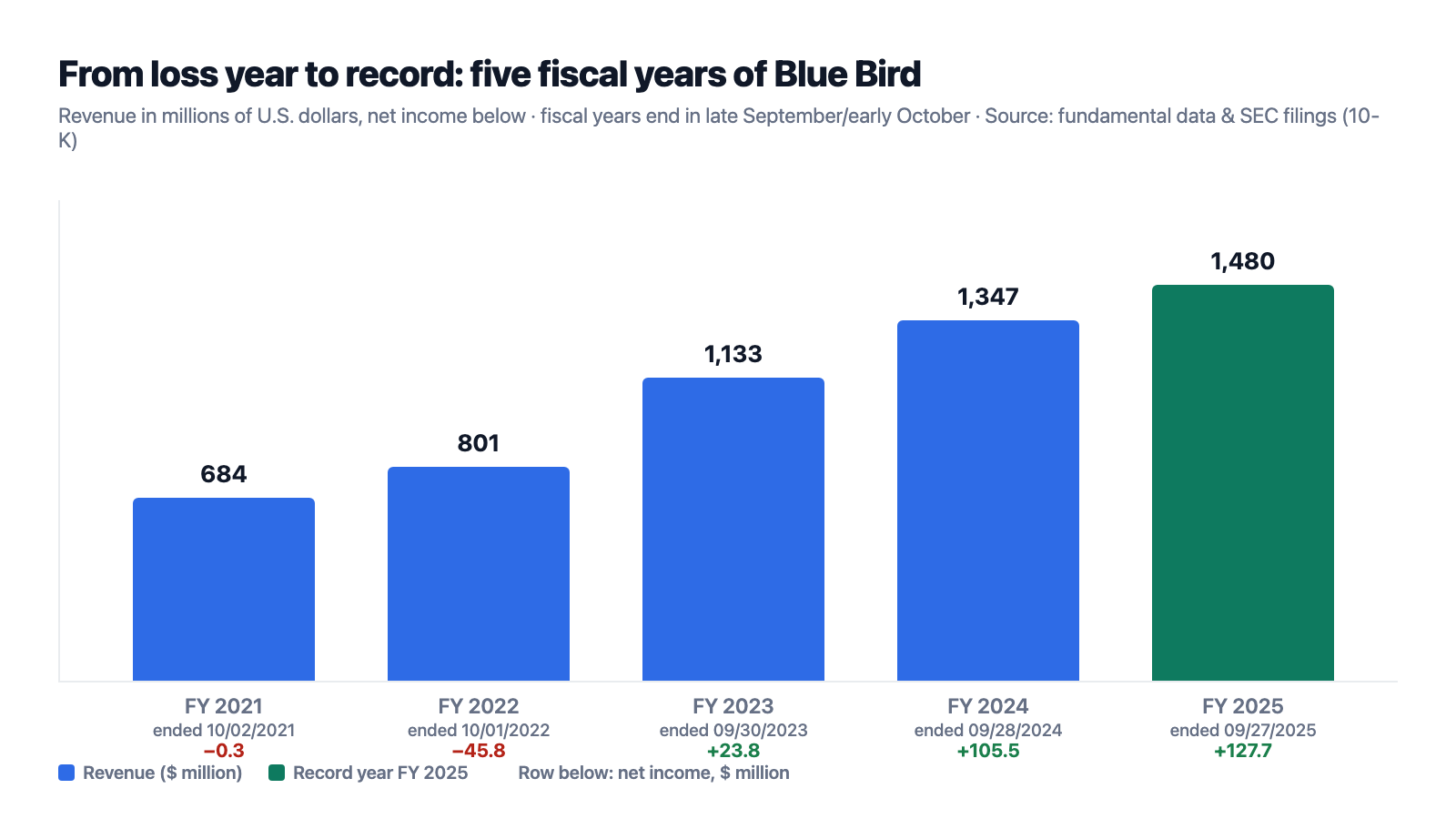
Whoever sees only this curve immediately understands the 17 scanner hits. But a bus maker sells what sits in its order book — and it is there, not in the income statement, that the year 2025 left its marks. Remember the rule of thumb: at a capital goods maker, revenue tells the past — the backlog tells the next year. Which brings us to the uncomfortable truths.
What the filings say — the uncomfortable truths
Uncomfortable truth no. 1: The backlog collapsed 36 percent in the tariff year
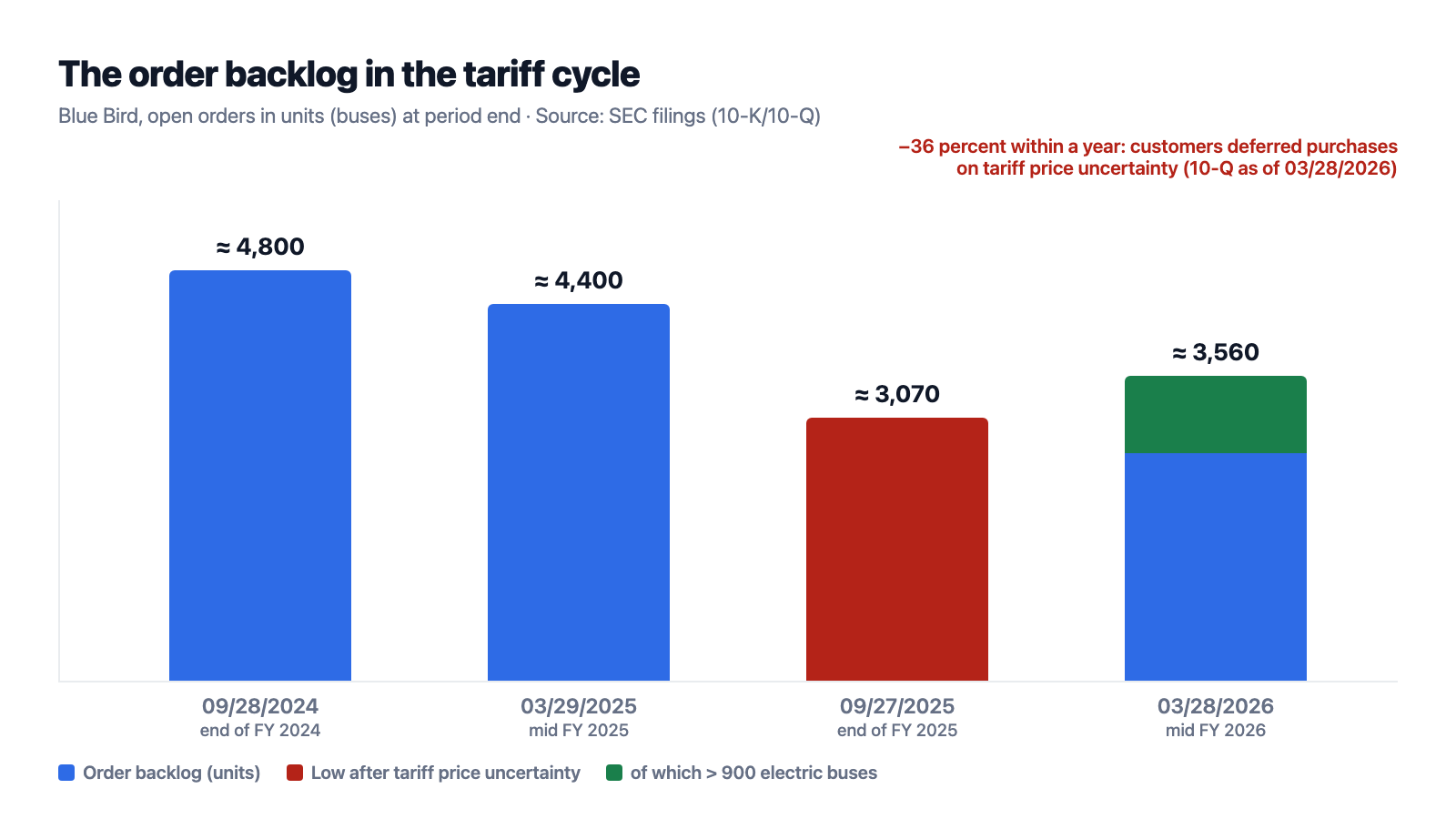
The new U.S. administration’s tariffs hit Blue Bird twice: first they make imported components more expensive, then — and this is the real damage — they make the final price of a bus incalculable, because Blue Bird passes the actual tariff charges into the sales price at delivery. A school district that does not know what the bus will ultimately cost prefers to order later. The quarterly report describes the consequence without varnish:
“… management believes that many customers elected to temporarily defer the purchase of buses towards the end of our fiscal 2025. As a result, the Company’s backlog decreased to approximately 3,070 units as of September 27, 2025.”
— Blue Bird Corporation, SEC quarterly report 10-Q as of March 28, 2026, Item 2 “Management’s Discussion and Analysis”
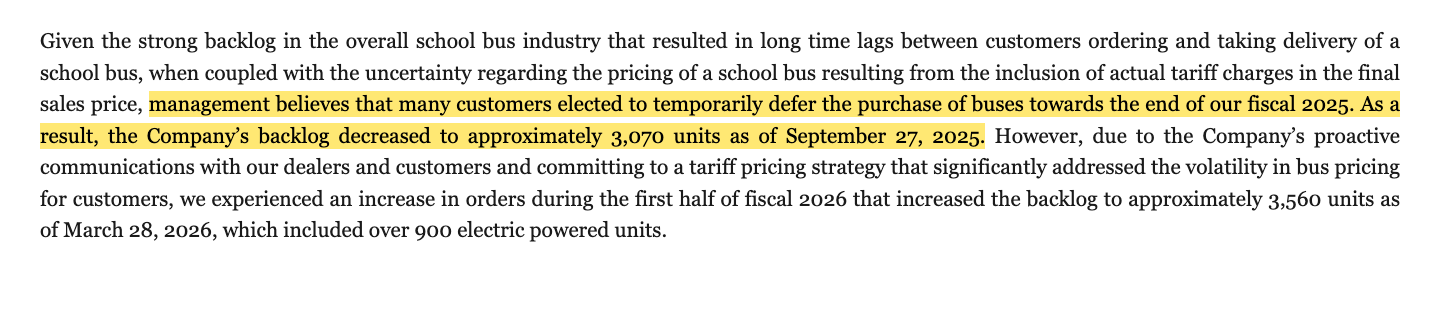
The dimension only becomes visible year over year: at the end of fiscal 2024 roughly 4,800 units sat in the order book, one year later 3,070 — minus 36 percent, while the income statement was celebrating records in parallel. Fairness requires both halves: the recovery has begun — thanks to a committed tariff pricing strategy, the backlog rose again to roughly 3,560 units by March 28, 2026, including over 900 electric buses — and part of the old record backlog was a leftover of the pandemic supply chain years anyway, when orders waited two years for their buses. But the present remains muted: in the second quarter of fiscal 2026, revenue fell 1.7 percent to $352.6 million and units sold dropped 6.4 percent (2,148 after 2,295) — only higher prices, partly tariff-driven, kept the revenue line nearly flat. Translated: volume is shrinking, price is saving the optics. That may well be a transition year. It just sits oddly next to a stock price less than one percent below the all-time high.
Uncomfortable truth no. 2: The electric story hangs on Washington’s purse — which has been silent for over a year
Blue Bird’s growth and margin story of recent years has a quiet co-author: the U.S. Environmental Protection Agency. Its Clean School Bus Program (CSBP) provides $5 billion so school districts can replace old diesel buses with low- and zero-emission ones — and electric buses are by far the most expensive and highest-margin vehicles in the catalog. Three funding rounds are done: roughly $965 million (round 1, October 2022), nearly $1 billion in grants for about 2,700 buses (round 2), over $800 million in rebates for more than 3,200 buses (round 3, May 2024) — from which Blue Bird reports over 490 orders. For round 4, the EPA had announced another $965 million in September 2024; recipients were to be named in May 2025. What has happened since, the annual report describes with remarkable candor:
“Although such funds were not removed from the first budget of the new presidential administration that took office at the beginning of calendar year 2025, there has been no further communication regarding the status of this round of funding. Accordingly, it is currently not known whether or not the EPA will move forward awarding funds from this round of the CSBP.”
— Blue Bird Corporation, SEC annual report 10-K for fiscal year 2025, Item 1 “Business”

That is not the only place where Washington has recently hesitated: the roughly $80 million Department of Energy (DOE) grant for converting a former motorhome factory into a second production site — originally half of a $160 million project — has been under review by the new administration since early 2025; Blue Bird is meanwhile building on with increased money of its own. And that the electric bus market does not yet run on its own without subsidies is something the company just experienced first-hand: the joint venture Clean Bus Solutions, founded in 2023 with investor Generate Capital to rent school districts electric buses plus charging as a subscription, was buried in October 2025 after a $7.4 million impairment. Fairness requires the counter-evidence from the same quarterly report — electric demand is not dead, it is just concentrated and subsidy-driven:
“The balance in other current liabilities as of March 28, 2026 includes approximately $42.8 million of deferred income resulting from an advanced deposit made by a customer for a large order of electric school buses.”
— Blue Bird Corporation, SEC quarterly report 10-Q as of March 28, 2026, Note 6 “Other Current Liabilities”

The honest summary of this mix: the diesel, propane and gasoline business carries the company even without Washington — it essentially paid for the record years 2024 and 2025. But the growth imagination that is supposed to justify a price-earnings ratio near the all-time high sits in the expensive electric buses. And their demand is, as of the filings we read, a function of subsidy pots whose next round has been waiting for a decision for more than a year.
Uncomfortable truth no. 3: The Girardin deal turns the biggest dealer into a major shareholder with a board seat
On April 1, 2026, Blue Bird acquired the second half of its Canadian small-bus joint venture Micro Bird — Type A school buses on Ford and GM chassis plus a new small-bus plant in Plattsburgh, New York. Purchase price: $201.8 million, of which $63.0 million in cash and $138.8 million in stock (2,702,180 shares valued at $51.35). Strategically, the step makes sense: full control of the small-bus line, consolidation from the third quarter of fiscal 2026. What is remarkable is who was on the other side of the table — and which roles the selling Girardin family has combined since. The amended 8-K/A of May 4, 2026 lists them: the family holds 7.88 percent via its holding company (Schedule 13D of April 8, 2026), Steve Girardin sits on the board through 2029, a board election agreement obliges the family to vote with the board’s recommendations — and through its company Superbird, it is at the same time Blue Bird’s dealer:
“(i) Blue Bird received from Superbird approximately $205 million and $146 million in aggregate gross revenues during the fiscal year ended September 27, 2025 and the six months ended March 28, 2026, respectively …”
— Blue Bird Corporation, SEC current report 8-K/A of May 4, 2026, Item 5.02 (Related Party Transactions)
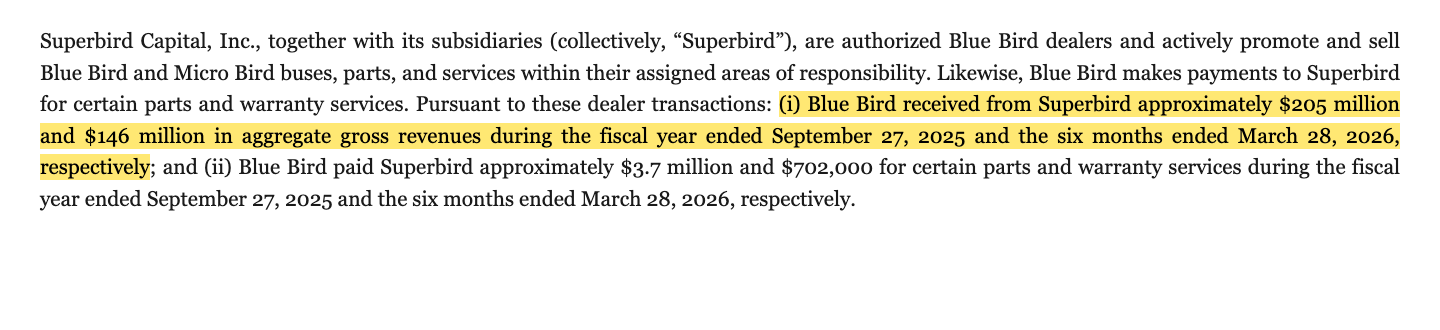
Put the number in proportion: $205 million is roughly 14 percent of consolidated revenue in fiscal 2025 — and the $146 million of the first half of fiscal 2026 equals a good fifth of half-year revenue. Add a third role: through its real estate firm Valiant, the family leases Micro Bird sites back to the company for roughly $3 million in annual rent. Seller, major shareholder, board member, biggest dealer, landlord — all disclosed, approved by the audit committee and declared arm’s length; this is not an indictment, and the 34-year average dealer tenure in the Blue Bird network argues for rather than against such family ties. But two sober observations belong in the picture. First, the timing: the joint venture’s earnings contribution had fallen to $2.1 million in fiscal 2025, from $11.8 million the year before — so the purchase, valuing the whole at a good $400 million, came right after the reported contribution had cratered (management points to start-up costs of the new plant). Second, the power statics: a buyer through whom a fifth of half-year revenue flows now sits at the table where dealer terms are decided. Picture a baker whose biggest kiosk operator becomes co-owner of the bakery and joins the advisory board — it can cement the partnership. It just never makes it entirely neutral again.
Uncomfortable truth no. 4: One plant, one engine supplier — including for the electric powertrains
The annual report’s risk factors contain a double concentration worth knowing. First, production: practically every large Blue Bird bus is born in a single plant complex in Fort Valley, Georgia — damage to the site, a strike or a supply interruption would hit the entire company (the second factory is, as noted, only now being converted). Fitting the picture: the workforce has been unionized since 2023 (United Steelworkers), and the collective bargaining agreement signed in May 2024 runs three years — the next negotiation round therefore falls right into the forecast horizon. Second, purchasing:
“We purchase our engine and transmission components on a single-source basis from major OEMs … Component: Diesel engines — Cummins Inc. … Electric powertrains and battery systems — Accelera (a business segment of Cummins Inc.)”
— Blue Bird Corporation, SEC annual report 10-K for fiscal year 2025, Item 1 “Business” (Suppliers)
Which means: even the electric hope hangs on a single supplier — the same group that delivers the diesel engines. Single sourcing is common in the commercial vehicle industry and backed by long-term contracts (roughly 65 percent of purchasing volume is contractually secured), and Cummins has been a reliable partner for decades. But the combination of one plant, one engine supplier and — see truth no. 3 — one dominant dealer produces a supply chain in which strikingly many links have no substitute. A scanner sees of all this: nothing.
Valuation: record price, solid cash — and a P/E twice what was normal a year ago
In early July 2026 the Blue Bird stock cost about $79, for a market value of roughly $2.5 billion (metrics data as of July 8, 2026) — counting the 2,702,180 exchangeable shares from the Micro Bird deal, closer to $2.7 billion. The trailing price-earnings ratio sits around 19, and around 16 on the analyst estimate for the current fiscal year (roughly $4.93 per share); the price-sales ratio is about 1.7. For a cyclical vehicle maker that is no longer a bargain, but given a 15 percent EBITDA margin and a return on equity above 50 percent it is not a fantasy valuation either — the question is rather whether the record margins are the new normal or the top of a pricing cycle. The balance sheet provides backing: $275.9 million in cash against roughly $88 million in bank debt as of March 28, 2026 (before the $63 million cash portion of the Micro Bird deal flowed out), plus an untouched $150 million credit line. The buyback program was topped up by $100 million in August 2025 (remaining authorization of $110.5 million as of September 27, 2025); $39.5 million went into own shares in fiscal 2025 and another $19.9 million in the first half of fiscal 2026. Blue Bird pays no dividend. Two things belong on your note sheet for the coming reports: first, the wind-down of the old pension plan will push a one-time, non-cash loss of roughly $28.1 million through the income statement in the third quarter of fiscal 2026 — whoever reads headlines about a profit collapse then will now know the reason. Second, the view from inside: our data set shows fourteen insider sales and a single insider purchase in recent months as of July 8, 2026 — near an all-time high no alarm signal, but no vote of confidence either. Seven analysts cover the stock and the consensus is clearly positive (metrics data as of July 8, 2026); after a gain of 612 percent in four years, honesty also demands this framing: the market found the turnaround story long ago.
Opportunities and risks at a glance
What speaks for Blue Bird:
- A proven turnaround with substance: revenue up from $800.6 million (FY 2022) to $1,480.1 million (FY 2025), net income from minus $45.8 million to plus $127.7 million, adjusted EBITDA margin from 7.8 to 15.0 percent, operating cash flow of $176.2 million (FY 2025).
- A structural moat: the only independent U.S. school bus maker, 44 exclusive dealer locations with an average tenure of 34 years, market leadership in alternative powertrains (roughly 64 percent share since 2015; 5,275 of 9,409 buses sold in FY 2025) — and a parts business with a gross margin around 50 percent.
- A robust balance sheet and capital returns: $275.9 million in cash against roughly $88 million in debt (03/28/2026), Altman-Z around 8.5, buyback program topped up by $100 million (August 2025), $59.4 million of repurchases since October 2024.
- The demand base is real: aging school bus fleets across the U.S. and Canada, backlog back up to roughly 3,560 units (03/28/2026, including over 900 electric buses), plus a $42.8 million customer advance for a large electric-bus order expected to convert into revenue in the second half of fiscal 2026.
- Momentum and quality at once: 17 scanner hits, Piotroski 7 of 9, return on equity above 50 percent, P/E around 19 — not a typical overheating signature (metrics data as of July 8, 2026).
What speaks against it:
- The backlog tells a different story than the price: minus 36 percent in the tariff year (4,800 to 3,070 units), units sold in the second quarter of fiscal 2026 down 6.4 percent — higher prices currently mask shrinking volume.
- The growth imagination hangs on subsidy pots: whether the fourth CSBP round ($965 million) will ever be awarded is "currently not known" per the annual report; the $80 million DOE grant sits in review; the electric-bus subscription joint venture was dissolved after a $7.4 million impairment.
- Entanglement with the Girardin family: the sellers of the Micro Bird half ($201.8 million, 70 percent in stock) are at once a 7.88 percent shareholder, a board member, the biggest dealer (roughly a fifth of first-half fiscal 2026 revenue) and a landlord — and the acquired joint venture’s earnings contribution had collapsed from $11.8 million to $2.1 million right before the purchase.
- Concentrated production and supply chain: one plant complex in Fort Valley, single-source engines from Cummins — including the electric powertrains (Accelera) —, the labor contract expires in May 2027; tariffs keep making imported components more expensive.
- After a 612 percent gain in four years and less than 1 percent distance to the all-time high, a lot of future is priced in; insiders sold fourteen times recently (one purchase), and the third quarter of fiscal 2026 carries a one-time charge of roughly $28.1 million from the pension plan termination (metrics data as of July 8, 2026).
A human conclusion
Back to the all-green trap from the beginning. It does not snap shut because the check marks are wrong — Blue Bird’s check marks are real: a real turnaround, real market leadership, real cash, real momentum. It snaps shut because a checklist can only test what can be poured into numbers. The three switch points at which this stock will actually turn in the coming years are written in prose: whether an agency in Washington ends up paying out a funding round that has been silent for over a year; whether the tariff pricing strategy keeps refilling the backlog or volume keeps crumbling; and whether the family ties from Quebec — major shareholder, board seat, biggest dealer, landlord in one hand — remain a partnership or become a concentration risk. None of this is an emergency today; all of it sits openly in the filings. So the honest question for you is not "is the checklist green?", but: do you want to buy, just below the all-time high and at 19 times trailing earnings, a company whose most important growth levers are currently operated by others — by the EPA, by the tariff calendar, by a family in Drummondville? If the funding round comes, the backlog keeps climbing and the electric-bus deposit was only the first large order of several, this price will look cheap in two years. If not, you have bought a very good company at a price that had budgeted no disappointment. What you make of it is your decision. And that is exactly as it should be.
Sources
All original documents used in this analysis — for your own reading:
- Blue Bird Corporation — SEC annual report 10-K for fiscal year 2025 (ended September 27, 2025; filed November 24, 2025)
- Blue Bird Corporation — SEC annual report 10-K for fiscal year 2024 (ended September 28, 2024; filed November 25, 2024)
- Blue Bird Corporation — SEC quarterly report 10-Q as of 03/28/2026 (filed May 6, 2026)
- Blue Bird Corporation — SEC quarterly report 10-Q as of 12/27/2025 (filed February 4, 2026)
- Blue Bird Corporation — SEC current report 8-K of April 2, 2026 (closing of the Micro Bird acquisition)
- Blue Bird Corporation — SEC current report 8-K/A of May 4, 2026 (related-party disclosures on the Girardin family)
- Groupe Autobus Girardin Ltée et al. — Schedule 13D of April 8, 2026 (7.88 percent stake in Blue Bird)
- Complete SEC filing history of Blue Bird Corporation: EDGAR overview (sec.gov)
- Fundamental data (metrics, quarterly series, valuation; metrics data as of July 8, 2026), reconciled against the SEC filings.
- Screener and rating data: in-house stock scanner (scanner run of July 17, 2026).
Transparency & disclaimer: This analysis is a journalistic contextualization of publicly available information and is not investment advice, not a financial analysis in the regulatory sense, and not a solicitation to buy or sell securities. Stock investments carry substantial risks up to and including total loss. All information without guarantee; the data cut-off is noted in the text. The author holds no position in Blue Bird shares at the time of publication.
Our Bottom Line at a Glance
- Business performance & market position positive
- Record fiscal 2025: $1,480.1 million in revenue (+9.9 percent), $127.7 million in net income, adjusted EBITDA margin of 15.0 percent after 7.8 percent in FY 2023; the only independent U.S. school bus maker, with an exclusive dealer network and roughly 64 percent market share in alternative powertrains (10-K FY 2025).
- Balance sheet & capital returns positive
- $275.9 million in cash against roughly $88 million in bank debt (03/28/2026, before the $63 million cash portion of the Micro Bird deal), a $150 million credit line untouched, Altman-Z around 8.5; buyback program topped up by $100 million in August 2025, $59.4 million of repurchases since October 2024 (10-K FY 2025, 10-Q as of 03/28/2026).
- Order book & tariff cycle negative
- Backlog down from roughly 4,800 to 3,070 units in the tariff year (minus 36 percent) because customers, per the quarterly report, deferred purchases on incalculable tariff charges; partial recovery to 3,560 units (03/28/2026), but units sold fell 6.4 percent in the second quarter of fiscal 2026 — higher prices are masking shrinking volume.
- Subsidy dependence of the electric story negative
- Whether the fourth round of the $5 billion EPA program ($965 million) will ever be awarded is "currently not known" per the 10-K; the $80 million DOE grant sits in the new administration’s review, and the electric-bus subscription joint venture Clean Bus Solutions was buried after a $7.4 million impairment — against which stands a $42.8 million customer advance for a large electric-bus order (10-Q as of 03/28/2026).
- Governance & concentration neutral
- After the Micro Bird buyout ($201.8 million, 70 percent in stock), the Girardin family combines four roles: 7.88 percent shareholder, board seat, biggest dealer (roughly a fifth of first-half fiscal 2026 revenue via Superbird) and landlord — disclosed and approved, but never neutral again; add a single plant complex and single-source powertrains from Cummins/Accelera (8-K/A of 05/04/2026, 10-K FY 2025).
- Valuation & market technicals neutral
- 17 scanner hits from momentum and quality, less than 1 percent below the all-time high, up 612 percent in four years — at a P/E around 19 (trailing) resp. 16 (current year) and a Piotroski of 7 of 9 (metrics data as of July 8, 2026); no bubble level, but the market is paying for the record margins to continue, and insiders recently sold fourteen times against one purchase.
Blue Bird is a real turnaround with a real moat: record revenue, record profit, a 15 percent EBITDA margin, net cash and a dealer network that has held for decades. But the three biggest levers of the story from here do not sit in Blue Bird’s books: an EPA funding round with "no further communication" for over a year, a tariff calendar that knocked the backlog down 36 percent, and a selling family that is now major shareholder, board member, biggest dealer and landlord at once. Whoever buys just below the all-time high buys a very good company at a price that budgets little disappointment. Not investment advice.
What Our Rating Means
- If you don't own the stock
- As long as the question raised in the bottom line stays open, we see no basis for an entry.
- If you hold it in your portfolio
- Our findings offer no acute reason to sell — the checkpoints named remain decisive.
A journalistic assessment by our editorial team at the time of the deep dive, based on public sources — not investment advice and not a solicitation to buy or sell. Your personal circumstances (investment goals, risk capacity, taxes) cannot be taken into account. What our categories mean, how verdicts are formed, and what conflicts of interest exist →
Worth Noting
- BLBD landed on the research list via the momentum/stage-2 run of our in-house stock scanner (scanner run of July 17, 2026) — 17 hits, unusually drawn from momentum and quality filters at once; there was no Reddit hype.
- Scanner metrics (P/E, P/S, Piotroski, Altman-Z, performance) use trailing twelve-month figures as of the July 8, 2026 data cut-off; the one-time pension settlement loss (Q3 FY 2026, roughly $28.1 million, non-cash) and the Micro Bird consolidation from Q3 FY 2026 are not yet reflected in them.
- Price and valuation figures dated July 8, 2026 (about $79, roughly $2.5 billion market value excluding exchangeable shares); analyses are evergreen, daily prices are not a buy argument. Blue Bird’s fiscal year ends in late September/early October — all quarterly references carry the fiscal-year offset.
Frequently Asked Questions
Blue Bird Corporation (Nasdaq: BLBD) of Fort Valley, Georgia, is the only independent maker of America’s yellow school buses — more than 619,000 sold since 1927. Sales run through 44 exclusive dealer locations in the U.S. and Canada and directly to fleet operators and government buyers, plus a high-margin parts business. Revenue in fiscal year 2025 (ended September 27, 2025): $1,480.1 million, net income $127.7 million — both records.
Blue Bird’s fiscal year ends on the Saturday closest to September 30 — fiscal 2025 ended on September 27, 2025, and fiscal 2026 ends on October 3, 2026. The "second quarter of fiscal 2026" therefore covers January through March 2026. Whoever compares Blue Bird numbers with calendar-year figures should keep this one-quarter offset in mind.
Between September 28, 2024 and September 27, 2025, the backlog fell from roughly 4,800 to roughly 3,070 units (minus 36 percent). Per the quarterly report (10-Q) as of March 28, 2026, many customers deferred purchases because actual tariff charges were passed into the final price only at delivery, making the bus price incalculable. After a committed tariff pricing strategy, the backlog recovered to roughly 3,560 units by March 28, 2026, including over 900 electric buses.
The base business of diesel, propane and gasoline buses carries the company even without subsidies. The electric story, however, hangs on the EPA’s $5 billion Clean School Bus Program: three rounds have been awarded, but whether the fourth ($965 million) will ever be paid out is "currently not known" per the annual report (10-K) for fiscal 2025. The $80 million Department of Energy grant for a second plant has also been under review since early 2025.
On April 1, 2026, Blue Bird acquired the second half of the Micro Bird small-bus joint venture for $201.8 million — $63.0 million in cash, the rest in 2,702,180 shares at $51.35. The selling Girardin family has since held 7.88 percent of Blue Bird, seats board member Steve Girardin, and via its company Superbird is at the same time the biggest dealer (roughly $205 million in gross revenues in fiscal 2025) as well as, via Valiant, landlord of Micro Bird sites.
As of March 28, 2026, the books showed $275.9 million in cash against roughly $88 million in bank debt — before the $63 million cash portion of the Micro Bird deal flowed out on April 1, 2026 — plus an untouched $150 million credit line. The Altman-Z score around 8.5 (metrics data as of July 8, 2026) sits far outside any danger zone; the buyback program was topped up by $100 million in August 2025. Blue Bird pays no dividend.
Not by its own history anymore: the trailing price-earnings ratio sits around 19, around 16 on estimates for the current fiscal year, and the price-sales ratio around 1.7 (metrics data as of July 8, 2026) — after a 612 percent gain in four years and less than 1 percent distance to the all-time high. Against that stand a 15 percent EBITDA margin, a return on equity above 50 percent and net cash. The market is paying for the record margins to continue — not for proof that they will.
Found an error?
Did you spot a factual error, an outdated number, or a typo in this deep dive? Let us know briefly — your report goes straight to the editorial team.