Johnson & Johnson: $94 Billion in Sales, 76,000 Claims
Johnson & Johnson raised its dividend for the 63rd consecutive year in 2025 and sells $94 billion worth of medicine and medical technology. Reported earnings still jumped from $14 billion to $27 billion — not because of the business, but because of a single line about talc claims. We strip that line out and see which profit belongs to the company itself.
 Thomas Mücke
Founder & Publisher
Thomas Mücke
Founder & Publisher
Chart
Interactive price chart (TradingView).
Note: pure fact-based analysis, not investment advice and not a solicitation to buy or sell. All figures without guarantee.
The reassurance trap
There is one number that ends every conversation about Johnson & Johnson before it starts: 63 consecutive years of dividend increases. People hear that and they no longer hear "company", they hear "bond with upside". Six decades without a break — surely nothing exciting can be happening in there.
That is exactly the trap. Call it the reassurance trap: a long, even track record calms us so reliably that we stop doing the arithmetic. And then we read a sentence like this one and do not even blink. Net earnings from continuing operations were $14,066 million in fiscal 2024 and $26,804 million in fiscal 2025. Almost a doubling. In one year. At a company whose sales grew 6.0 percent over the same period.
Those two facts do not fit together, and they are not supposed to. The difference does not come from the business. It comes from a single line in the notes, about lawsuits over body powder containing talc.
That is the central tension of this analysis, and it runs through every chapter: the Johnson & Johnson business is remarkably calm — the reported profit figure only partly belongs to it. The rest belongs to a courtroom in New Jersey.
The deal for this article: we strip that line out, show the numbers with and without it, and name every trap that makes a year-over-year comparison unclean here. No forecast on how the litigation ends — we do not make one. Only what the original documents say.
What Johnson & Johnson actually does
Since August 2023, Johnson & Johnson has been a different company from the one many people picture. The consumer business — bandages, baby powder, Listerine, Nicorette — was separated and is now called Kenvue. What remains are two pillars, and both sell to professionals, not to you in the drugstore aisle.
Innovative Medicine is the pharmaceutical business: $60,401 million in fiscal 2025 sales, or 64.1 percent of the group. The focus is oncology ($25,380 million), immunology ($15,728 million) and neuroscience ($7,837 million), plus pulmonary hypertension, infectious diseases and cardiovascular and metabolic products.
MedTech is medical technology: $33,792 million, or 35.9 percent of the group, across four franchises — surgery ($10,137 million), orthopaedics ($9,258 million), cardiovascular devices ($8,928 million) and vision with the ACUVUE contact lenses ($5,468 million).
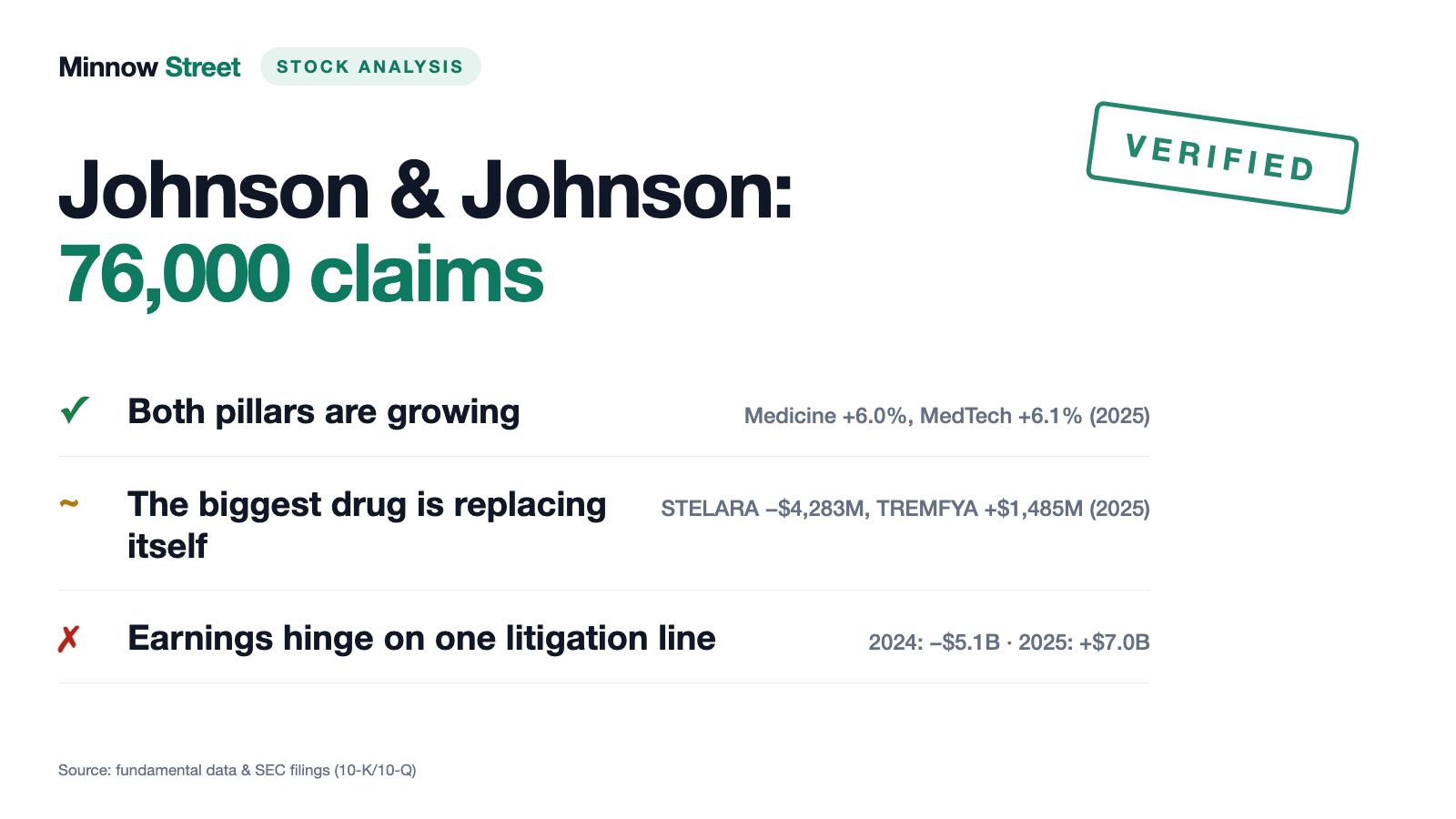
Both pillars grew at nearly the same pace in fiscal 2025: pharmaceuticals up 6.0 percent, medical technology up 6.1 percent. That is rare, and it is the strongest finding in this analysis. A company with $94 billion in sales whose two halves both advance evenly does not have a demand problem.
One announcement from October 2025 belongs here: Johnson & Johnson intends to separate its orthopaedics business — a franchise with $9,258 million in sales, almost a tenth of the group. The timetable in the annual report: completion targeted within 18 to 24 months of the announcement, with the route still open. Anyone comparing segment figures over the next few years will therefore once again be comparing two different companies. More on that shortly.
How the stock landed on our desk
Honestly: not through a signal. Our in-house stock scanner sorts by ratios — valuation, balance sheet quality, momentum. The very large, richly valued names fall out of filters like that as a matter of course, and a company whose reported profit is thrown around by one reserve line certainly does.
This analysis comes out of a stocktaking exercise dated July 28, 2026: we listed the 100 largest U.S. stocks by market value and checked which of them already had an analysis. Johnson & Johnson ranked 17th — and had none. That is the entire hook. Not a buy signal, just closing a gap.
It is also the more honest order of operations: read first, judge second. Not look for a signal and then assemble the reasoning behind it.
Two traps before the first number holds up
At most companies you can lay two annual reports side by side and compare the numbers. Not here. Two things have to be understood first, or you are comparing apples with oranges without noticing.
Trap 1: the fiscal year sometimes has 53 weeks
Johnson & Johnson does not report on the calendar. The fiscal year ends on the Sunday nearest December 31 — December 28 in 2025, December 29 in 2024, December 31 in 2023. Normally that is 52 weeks. Every five or six years an extra week has to be inserted, and then the year has 53 weeks and correspondingly more shipping days. The company states itself when that happened and when it happens again:

„The Company follows the concept of a fiscal year, which ends on the Sunday nearest to the end of the month of December. Normally each fiscal year consists of 52 weeks, but every five or six years the fiscal year consists of 53 weeks, and therefore includes additional shipping days, as was the case in fiscal year 2020, and will be the case again in fiscal year 2026.“
— Johnson & Johnson, Form 10-K for fiscal 2025, Note 1
What that means in practice: the three comparison years 2023, 2024 and 2025 all had 52 weeks — they are cleanly comparable with one another. The current year 2026 has 53 weeks. So if 2026 sales grow one or two percentage points faster than expected, part of that is simply an extra week of shipping and not a new customer. Conversely, 2027 will look optically weaker because that week is gone. Rule of thumb: one extra week is roughly 1.9 percent of a year. Anyone comparing 2026 with 2025 needs to hold that in mind.
Trap 2: Kenvue makes the series incomparable
The separation of the consumer business in August 2023 left a break in the numbers. The company handled it properly — but differently depending on which statement you are looking at.
In the income statement, Kenvue is presented separately as a discontinued operation for every year. That is why the sales and earnings figures for 2023, 2024 and 2025 are comparable with one another: $85,159 million, $88,821 million and $94,193 million of sales from continuing operations. That basis — continuing operations, all years — is the one used throughout this article.
One 2023 figure must not be put in the same row as the others: total net earnings of $35,153 million. That includes $21,827 million from the discontinued operation, and within that a book gain of $20,984 million on the exchange offer for the Kenvue shares. It was a one-time effect without a single dollar of cash coming in. Writing 2023 into a time series with $35 billion of profit destroys the series.
The cash flow statement is different, and that has to be said out loud. Below the table sits a sentence noting that the 2023 amounts were not recast to exclude the discontinued operation. So 2023 there still contains Kenvue. That is why cash flow and capital spending are compared for 2024 and 2025 only in this article. Two years is not much — but two clean years are worth more than three unclean ones.
The numbers over the years — fairly credited
Let us start with what genuinely impresses. And there is plenty.
Sales are growing, and broadly. $85,159 million (2023), $88,821 million (2024), $94,193 million (2025). The 6.0 percent gain in 2025 broke down, per the annual report, into 8.4 percent more volume, 3.1 percent lower prices and 0.7 percent of currency tailwind. Read that again: Johnson & Johnson grew in 2025 even though prices fell. The growth came from units sold, not from price increases — at a pharmaceutical company that is the more durable version.
The gross margin is enviably stable. 68.8 percent (2023), 69.1 percent (2024), 67.9 percent (2025). The company gives two reasons for the 2025 decline: an unfavorable product mix following the STELARA drop, and tariffs in the medical technology business. Two thirds gross margin means that out of every dollar sold, 68 cents remain after manufacturing costs to fund research, selling and profit.
Research is not a footnote. $14,665 million in fiscal 2025, or 15.6 percent of sales. In the pharmaceutical segment it is 19.6 percent of segment sales. The decline from 2024 ($17,232 million, 19.4 percent) is deceptive: 2024 contained upfront payments for acquired research programs — $1.25 billion alone for global rights to a bispecific antibody.
The balance sheet is strong. At December 28, 2025 there were $199,210 million of total assets against $117,666 million of liabilities and $81,544 million of shareholders' equity. Interest expense was $971 million against pre-tax earnings of $32,581 million — interest is covered roughly 34 times over. At June 28, 2026 the company held $20.8 billion in cash and marketable securities. This company does not have a debt problem.
Cash generation is dependable. $24,266 million from operations in fiscal 2024, $24,530 million in fiscal 2025. After capital spending of $4,424 million and $4,832 million, $19,842 million and $19,698 million remain. Two years, almost identical free cash flow — boredom at its finest. (Why 2023 is left out here is explained above under trap 2.)
The current year confirms the picture. In the second quarter of fiscal 2026, through June 28, 2026, sales rose 6.6 percent to $25,310 million; over the first six months they rose 8.2 percent to $49,372 million. Keep the 53rd week of fiscal 2026 from trap 1 in mind while reading that.
And then comes the profit
Up to here everything is calm. Now it gets unruly — which is why the topic gets its own chapter.
Uncomfortable truth no. 1: the profit comes from a courtroom
Reported net earnings from continuing operations: $13,326 million (2023), $14,066 million (2024), $26,804 million (2025). Anyone reading that series without commentary sees a company that doubled its profit in two years. That did not happen.
What did happen sits in the line "other (income) expense, net" and in Note 19. Three years, three talc entries:
- 2023: a charge of roughly $7.0 billion for the settlement then planned.
- 2024: a further charge of roughly $5.1 billion. By year end the reserve had reached a present value of roughly $11.6 billion, with a nominal value of roughly $13.5 billion.
- 2025: after a bankruptcy court in Texas dismissed the case in March 2025, the company reversed roughly $7.0 billion — as income.
The company even names the tax rate at which those amounts were booked: roughly 22 percent of U.S. federal and state tax. That gives us something to work with. We take the talc effect out, tax it at those 22 percent, and put the result alongside. This is our own calculation, not the company's — which is why it is stated in the open:
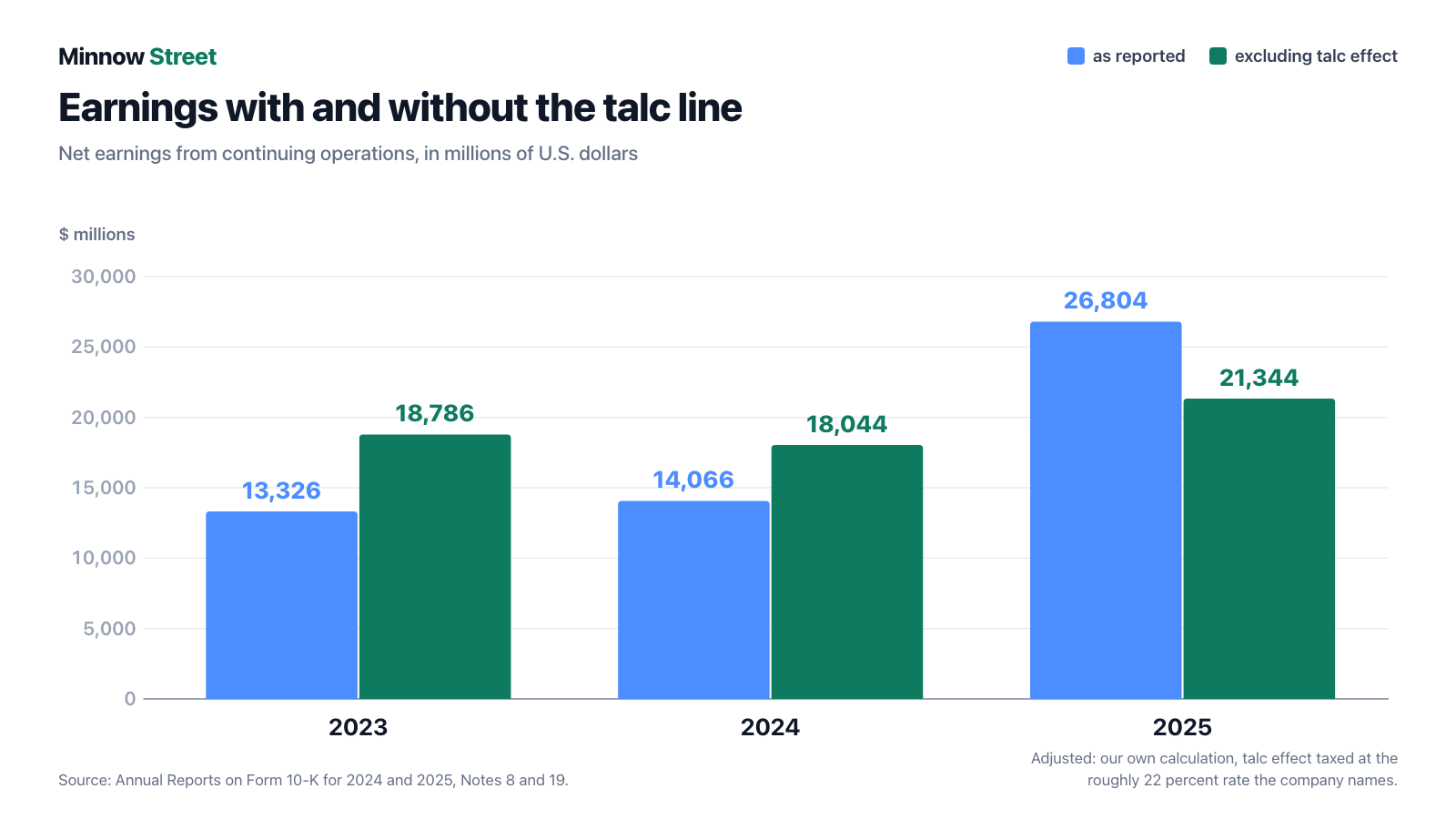
Without the item the series looks like this: $18,786 million, $18,044 million, $21,344 million. A slight decline in 2024, a solid 18.3 percent gain in 2025. That is the company. The other series is the litigation.
The same arithmetic for the current year, and here it becomes especially instructive: over the first six months of fiscal 2026 reported earnings fell from $16,536 million to $10,769 million — down 34.9 percent. That sounds like a collapse. It is not one. The prior-year half contained the $7.0 billion reversal; the current half carries $0.8 billion of fresh talc charges. Adjusted: $11,076 million against $11,393 million, a gain of 2.9 percent.
The rule of thumb for this stock: at Johnson & Johnson the earnings line is the least reliable number in the whole report. Not wrong — the auditor even singled the topic out as a critical audit matter. But without the adjustment it tells the wrong story, in both directions.
Similar effects exist on a smaller scale: write-downs on acquired research programs of $81 million (2025), $211 million (2024) and $313 million (2023), restructuring charges of $228 million, $234 million and $489 million, and an effective tax rate that climbed from 11.5 percent (2023) through 15.7 percent (2024) to 17.7 percent (2025). All in the report, all explained — just not in the headline.
Uncomfortable truth no. 2: the reserve is smaller than the commitment
Now to the core. What the reports say about the talc litigation is sober and fairly unpleasant — and it is the basis for the most important open question at this stock.
The state of play. Johnson & Johnson and its subsidiaries face personal injury claims alleging that body powders containing talc — primarily JOHNSON'S Baby Powder — caused cancer. The number of U.S. plaintiffs with direct claims in pending lawsuits was 74,360 at December 28, 2025 and roughly 76,000 at June 28, 2026. It is rising, not falling.
Three failed bankruptcy solutions. Starting in October 2021 the company restructured repeatedly to move the talc liability into dedicated entities and wind it down there. LTL Management LLC was carved out of the consumer business, later renamed LLT Management LLC and redomiciled to Texas; in 2024 that produced Red River Talc LLC, holding ovarian and other gynecological cancer claims, and Pecos River Talc LLC, holding mesothelioma and other matters. In total three Chapter 11 proceedings were filed — and all three were dismissed: October 2021, April 2023, and in March 2025 the Red River case, by the bankruptcy court in Texas. The company then went back into the ordinary tort system.
The reserve. After the March 2025 dismissal, Johnson & Johnson reversed essentially everything set aside for the bankruptcy resolution. Roughly $3.4 billion of present value remained at the end of fiscal 2025 and roughly $3.7 billion at June 28, 2026, covering settlements already executed, litigation defense and other costs. About 40 percent of it is booked as a current liability:
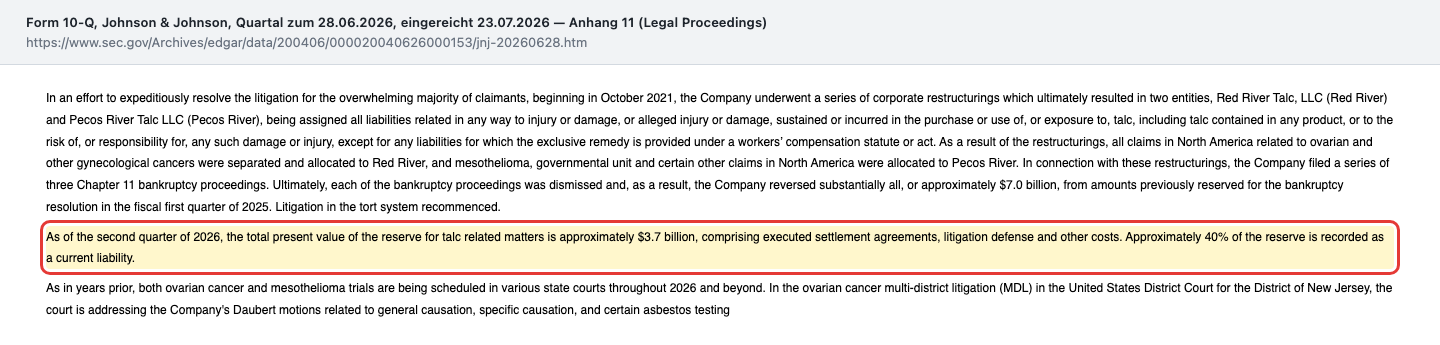
„As of the second quarter of 2026, the total present value of the reserve for talc related matters is approximately $3.7 billion, comprising executed settlement agreements, litigation defense and other costs. Approximately 40% of the reserve is recorded as a current liability.“
— Johnson & Johnson, Form 10-Q for the quarter ended June 28, 2026, Note 11
And then, five days after the quarterly report, this arrived. On July 27, 2026 the company said it had reached agreement with the lead plaintiff firms in the federal multi-district litigation and related state court proceedings on a comprehensive resolution of the ovarian talc claims. The figures from the filing:

„Calls for per claim payments, with a $5.5 billion commitment by the Company and the first payment of no more than $3 billion to be made in 2027 and no additional payments due before 2028.“
— Johnson & Johnson, Form 8-K filed July 28, 2026, Item 7.01, Exhibit 99.1
Put the two side by side: $3.7 billion sits on the balance sheet, $5.5 billion has been committed. The difference of roughly $1.8 billion has not been booked. It will show up as an expense in one of the coming quarters — and then the earnings line will look like a collapse again, even though it is not one. Exactly the mechanism from truth no. 1, only this time foreseeable.
Two conditions are stated explicitly in the announcement, and they are the reason nothing is settled yet. First, the resolution requires the lead plaintiff firms to bring in at least 95 percent of the remaining claims. Second, the $5.5 billion is spread over years — the first payment no more than $3 billion in 2027, nothing further before 2028. If the 95 percent threshold is missed, the company is back where it stood in March 2025: roughly 76,000 individual cases in the ordinary tort system.
Part of the background is that Johnson & Johnson has never conceded the point. The same announcement calls the claims scientifically without merit; in July 2026 plaintiffs withdrew their specific-causation experts in two bellwether cases, after which the federal court on July 22, 2026 ordered them to show why the remaining claims should not be dismissed. From the company's perspective, then, the settlement is not an admission but a line drawn. For you as an investor the distinction does not matter: either way it costs money, and the amount is now on the table.
Two side threads remain unresolved. The shareholder class action filed in February 2018 — alleging inadequate disclosure of possible asbestos contamination — continues; the class is certified, the U.S. Supreme Court denied the company's petition in April 2026, and expert discovery is under way. And roughly $0.9 billion of the opioid settlements was still outstanding at June 28, 2026; of the up to $5.0 billion agreed in 2021, roughly 80 percent had been paid by the end of fiscal 2025. How another company handles a comparable reserve line we worked through in our Visa analysis — there a litigation escrow account shrank from $2,990 million to $888 million in nine months. And how an opioid settlement carries on after the final payment is in our Walmart analysis.
Uncomfortable truth no. 3: the biggest drug is replacing itself
An everyday image first. A biosimilar is a copy of a biotechnologically produced medicine, made once patent protection has lapsed. Unlike a chemical tablet, a biotech compound cannot be copied identically — it is produced by living cells. Hence "similar" rather than "the same". For the price that makes little difference: once copies are on the market, it falls.
That is exactly what is happening to STELARA, the immunology drug that was the company's biggest product for years. The drop in numbers: from $10,361 million (2024) to $6,078 million (2025) — down 41.3 percent, down $4,283 million in a single year. In the United States alone STELARA still accounted for roughly $3.8 billion in fiscal 2025, and the company is clear about what comes next:
„The Company expects continued launches of biosimilar versions of STELARA globally which will continue to negatively impact the Company's sales of STELARA.“
— Johnson & Johnson, Form 10-K for fiscal 2025, Item 7
And now the part that deserves respect: the company more than offset that loss in the same year.
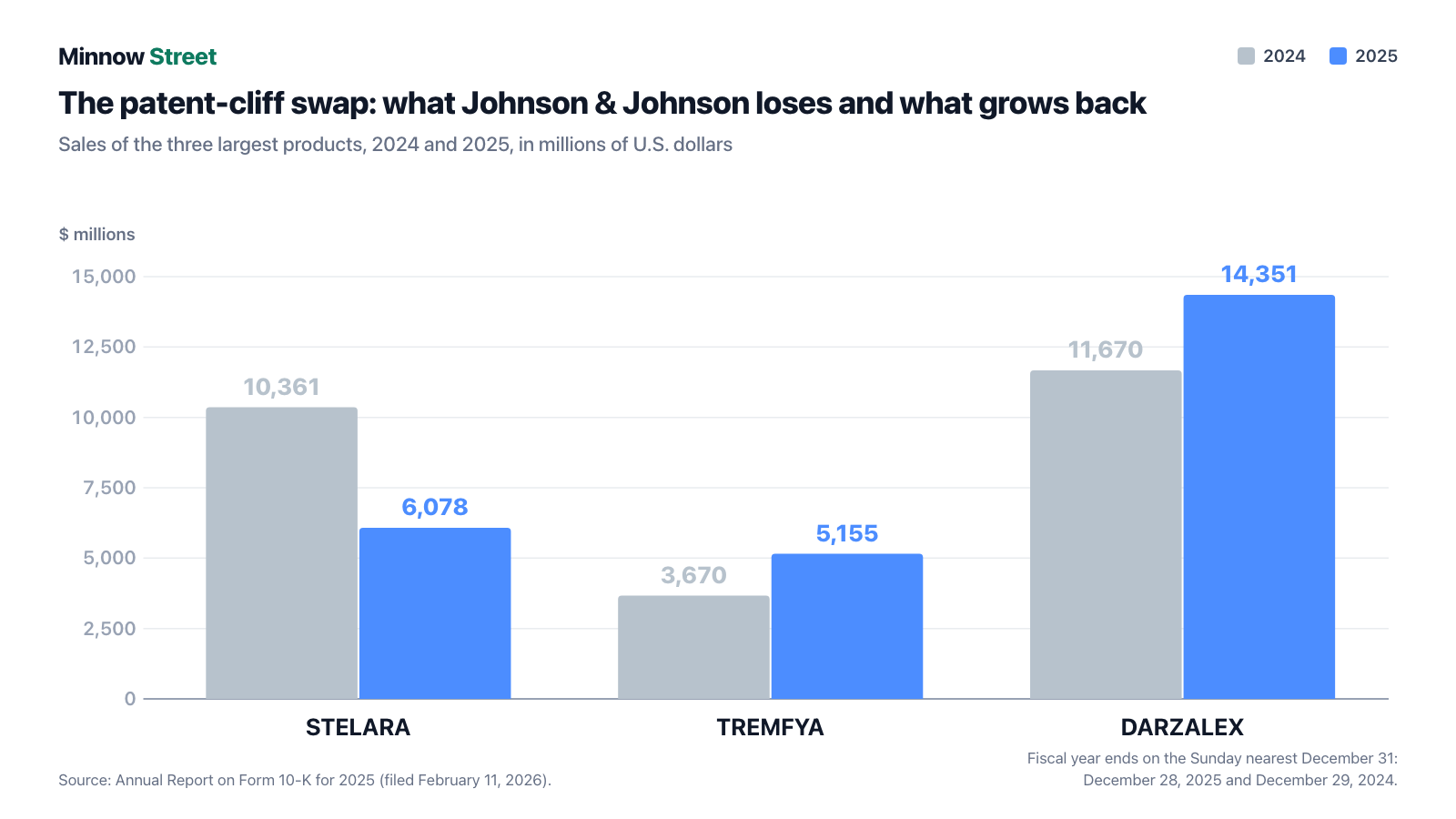
TREMFYA gained $1,485 million to reach $5,155 million, up 40.5 percent. DARZALEX, the multiple myeloma treatment, grew $2,681 million to $14,351 million, up 23.0 percent. Oncology as a whole rose 22.1 percent to $25,380 million. CARVYKTI nearly doubled to $1,887 million, SPRAVATO grew to $1,696 million, and CAPLYTA arrived through the acquisition of Intra-Cellular Therapies on April 2, 2025, contributing $700 million in its first partial year.
This is the heart of the pharmaceutical business, and Johnson & Johnson is good at it: every drug is a product with an expiry date, and the only protection is the next one. In fiscal 2025 the next one was enough.
The flip side is concentration. DARZALEX at $14,351 million accounts for 15.2 percent of group sales, and the three largest products together for 27.2 percent. The next cliff is already named in the report: the company expects generic competition for OPSUMIT in 2026, which "would likely result in a significant reduction in future sales" — that product, together with OPSYNVI, sold $2,325 million in fiscal 2025. For SIMPONI ($2,668 million), at least two parties are pursuing biosimilar approval in the United States. Rule of thumb: at a pharmaceutical company the pipeline is not a fantasy, it is maintenance.
Uncomfortable truth no. 4: three wholesalers, almost half the invoice
This figure sits inconspicuously in the sales discussion and is rarely quoted. In fiscal 2025 Johnson & Johnson shipped through three wholesalers that together accounted for roughly 48.4 percent of total gross revenues — individually 21.8, 15.5 and 11.1 percent. In 2024 the order of magnitude was the same: 20.5, 15.6 and 12.3 percent.

Let us put that in perspective without dramatizing it. U.S. pharmaceutical distribution structurally runs through a handful of wholesalers; that is true for every manufacturer. These three are not customers in the sense of deciding whether DARZALEX is needed — they are the pipes it flows through. A physician still prescribes, regardless of how the package reaches the hospital.
Even so, it is a concentration worth knowing about. Almost half of gross revenues depends on three contractual relationships, and those same contracts hold the rebates: accrued rebates, returns and promotions stood at $19,124 million at December 28, 2025 — more than an entire quarter of gross profit. Anyone wanting to know how firmly a manufacturer holds the chain will find the answer in that line, not in the sales line.
Uncomfortable truth no. 5: goodwill and patents outweigh equity
Another everyday image first. Goodwill arises when you buy a business and pay more than its individual assets are worth. The excess lands on the balance sheet — it is the expectation you paid for. Intangible assets, by contrast, are nameable: patents, approvals, brand rights, ongoing research programs.
At December 28, 2025, Johnson & Johnson carries $48,772 million of goodwill and $50,403 million of intangible assets. Together $99,175 million, against shareholders' equity of $81,544 million. Do the arithmetic:
- $99,175 million of $199,210 million in total assets = 49.8 percent of all assets
- $99,175 million of $81,544 million in equity = 121.6 percent
This is not a scandal, it is the signature of an acquisition strategy. In fiscal 2025 the company spent $17,541 million on acquisitions, after $15,146 million in 2024 — Intra-Cellular Therapies alone cost roughly $14.5 billion and added $3,488 million of new goodwill. Intangible assets jumped from $37,618 million to $50,403 million within a year as a result.
Two consequences show up in the income statement every year. First, cost of products sold contains $4,600 million of intangible asset amortization in fiscal 2025, after $4,500 million in 2024 — that is 4.9 percent of sales running through as expense without cash leaving. Second, when an acquisition disappoints, a write-down follows. In fiscal 2025 that was $81 million for a non-strategic asset from the Abiomed acquisition; in 2024, roughly $200 million for a biosimilar program from the 2020 Momenta acquisition, an asset now fully impaired.
And part of the bill is paid on credit. Net debt rose from $12.1 billion to $27.8 billion during fiscal 2025, total debt from $36.6 billion to $47.9 billion; in the first quarter of fiscal 2025 the company issued $9.2 billion of senior unsecured notes to fund the Intra-Cellular purchase. At June 28, 2026 net debt stood at $28.2 billion.
With $24,530 million of annual operating cash flow and 34 times interest coverage, that is comfortably carried. But the direction of the ratio is unambiguous: Johnson & Johnson buys growth, and part of it sits on the balance sheet as expectation. What it looks like when a company distributes considerably more than it earns after investment we wrote up in our ExxonMobil analysis — there the gap was $13.9 billion. Here it is not the issue: in fiscal 2025, $18,334 million of distributions stood against $19,698 million of free cash flow, with the acquisitions funded separately.
What the stock costs
No daily prices, only orders of magnitude with a data date.
As of July 17, 2026, the cover page of the quarterly report showed 2,409,898,597 shares outstanding. Market value was roughly $643 billion as of July 29, 2026, which at that share count corresponds to a price of roughly $267. The 52-week range ran from $160.21 to $274.90 — so the stock trades at the upper end of its yearly band. As a comparison anchor from a filing: the average repurchase price between November 24 and December 28, 2025 was $204.81 per share.
Measured on the trailing four quarters — fiscal 2025 plus the first six months of fiscal 2026 minus the first six months of fiscal 2025:
- Sales: $97,929 million → price-to-sales roughly 6.6
- Earnings: $21,037 million → price-to-earnings roughly 31
- Earnings excluding the talc charge of the first six months of fiscal 2026: roughly $21,661 million → price-to-earnings roughly 30
- Equity of $81,544 million at December 28, 2025 → price-to-book roughly 7.9
- Dividend yield roughly 2.0 percent at an annualized $5.36 per share
What that means in plain language: at roughly 30 times earnings, Johnson & Johnson is valued like a growth company, not like a dividend stock. With sales growth of 6.0 percent in fiscal 2025 and 8.2 percent over the first six months of fiscal 2026 — including the 53-week effect — that is an advance on the pipeline. The market here is not paying for dependability, it is paying for the next drug.
And the same calculation from the other side: anyone treating a 2.0 percent dividend yield as the main reason should know that $12,381 million of dividends in fiscal 2025 absorbed roughly 63 percent of free cash flow — solidly covered, but without much room for jumps. The 63 consecutive years are an achievement; they are not a promise about the 64th.
A professional consensus is deliberately absent here: analyst targets are snapshots and age faster than this article. Anyone who wants them will find them on the scanner overview, alongside the ratio filters our selections normally come out of.
Opportunities and risks at a glance
What speaks for the company
- Both pillars grew at almost the same pace in fiscal 2025: Innovative Medicine up 6.0 percent to $60,401 million, MedTech up 6.1 percent to $33,792 million.
- The 2025 growth came from 8.4 percent more volume at 3.1 percent lower prices — units sold, not price increases.
- Gross margin stable between 67.9 and 69.1 percent across three years.
- Resilient balance sheet: $81,544 million of equity, 34 times interest coverage, $20.8 billion of liquidity at June 28, 2026.
- The patent-cliff replacement worked in fiscal 2025: STELARA down $4,283 million, offset by TREMFYA up $1,485 million and DARZALEX up $2,681 million.
- Free cash flow of roughly $19.7 billion two years running; distributions of $18,334 million are covered by it.
- The July 27, 2026 talc settlement puts a fixed figure and a payment schedule through 2028 on the risk for the first time.
What speaks against it
- The $5.5 billion resolution is conditioned on participation of at least 95 percent of the remaining claims — without that threshold, roughly 76,000 individual cases remain.
- The reserve of $3.7 billion at June 28, 2026 is roughly $1.8 billion below the commitment; the difference still has to be booked as expense.
- Reported earnings are not meaningful without adjustment: $13,326 million, $14,066 million and $26,804 million against an adjusted $18,786 million, $18,044 million and $21,344 million.
- Three dismissed Chapter 11 proceedings show that the chosen resolution strategy did not work over four years.
- The next patent cliffs are named: generic competition for OPSUMIT ($2,325 million of sales) from 2026, biosimilar filings for SIMPONI ($2,668 million).
- Sales concentration: DARZALEX at 15.2 percent of group sales, three products at 27.2 percent, three wholesalers at 48.4 percent of gross revenues.
- Goodwill and intangible assets at $99,175 million exceed equity by 21.6 percent; net debt rose from $12.1 billion to $27.8 billion during fiscal 2025.
- The planned separation of orthopaedics ($9,258 million of sales) will make coming time series incomparable all over again.
- The shareholder class action over asbestos disclosure continues after the Supreme Court denied the company's petition in April 2026.
A human conclusion
Back to the reassurance trap from the opening. It has a kernel of truth: the Johnson & Johnson business is calm. Two pillars, both growing. Two thirds gross margin, stable for three years. Almost $20 billion of free cash flow, twice in a row almost to the dollar the same. A dividend that rose for the 63rd consecutive year. Anyone looking for dependability in an operating business will find it here — documented, not asserted.
What is not calm is the number underneath. And the trap is not trusting the company; it is mistaking the earnings line for the result of that business. In 2023 and 2024 it was too low, in 2025 too high, and in one of the coming quarters it will be too low again, once the $1.8 billion difference to the settlement commitment is booked. The same item three times, with three different signs.
There is a bitter honesty in these reports. A company that employs 138,200 people and develops cancer treatments has spent fifteen years negotiating about baby powder. It initiated three bankruptcy proceedings, all three were dismissed, and at the end there is a number: $5.5 billion, first installment in 2027. That is roughly a quarter of one year's profit for something that cures not a single patient.
Two lessons follow for you as an investor, and they hold beyond this stock. First: a long track record is not an argument, it is a reason to look more closely. Second: when a company does not show its own adjustment, do the arithmetic yourself — the building blocks are in the notes, tax rate included.
What you make of it is your decision. And that is exactly how it should be.
Sources
- Quarterly report on Form 10-Q for the quarter ended June 28, 2026, Johnson & Johnson, filed July 23, 2026 (SEC EDGAR, CIK 0000200406) — Note 11 on legal proceedings, segment data, liquidity, share count on the cover page
- Annual report on Form 10-K for fiscal 2025, filed February 11, 2026 — Item 1, Item 1A, Item 5, Item 7, Notes 1, 5, 8, 19, 20 and 21, and the critical audit matter "Litigation Contingencies – Talc"
- Annual report on Form 10-K for fiscal 2024, filed February 13, 2025 — source of the 2023 and 2024 comparatives
- Form 8-K filed July 28, 2026, Item 7.01, Exhibit 99.1 — proposed comprehensive resolution of the ovarian talc litigation, event date July 27, 2026
- Earnings release on Form 8-K, July 15, 2026, Item 2.02 with Exhibits 99.1 and 99.2 for the second quarter of fiscal 2026
- Johnson & Johnson filing index at the U.S. securities regulator, the SEC — checked for Form 15, Form 25 and successor registrants
- Fundamental data (valuation ratios, market value, 52-week range; data as of July 29, 2026)
A note on how to read this. This article is journalistic interpretation of publicly available company reports. It is not investment advice, not a recommendation, and not a solicitation to buy or sell securities. All figures come from the sources listed above and carry the reporting date stated there; they may have changed since. The adjustment of earnings for the talc item is this publication's own calculation and is not reported by the company in that form. Stocks are subject to price fluctuations up to and including the total loss of the capital invested. The author holds no position in Johnson & Johnson at the time of publication.
Our Bottom Line at a Glance
- Operating performance positive
- Both segments grew at almost the same pace in fiscal 2025: Innovative Medicine up 6.0 percent to $60,401M, MedTech up 6.1 percent to $33,792M. The group gain of 6.0 percent came from 8.4 percent more volume at 3.1 percent lower prices. In the second quarter of fiscal 2026 sales were 6.6 percent above the prior year.
- Balance sheet and liquidity positive
- At December 28, 2025 equity of $81,544M stood against $47.9B of total debt; interest expense of $971M was covered 33.6 times by pre-tax earnings of $32,581M. At June 28, 2026 the company held $20.8B in cash and marketable securities, with net debt of $28.2B. No risk to the substance of the business is apparent.
- Earnings quality negative
- Reported net earnings from continuing operations ran from $13,326M (2023) through $14,066M (2024) to $26,804M (2025) — driven by talc entries of minus $7.0B, minus $5.1B and plus $7.0B. Without them the figures would have been $18,786M, $18,044M and $21,344M (our own calculation, 22 percent tax rate per the company). The auditor treats the topic as a critical audit matter.
- Talc litigation negative
- Roughly 76,000 U.S. plaintiffs at June 28, 2026, up from 74,360 at December 28, 2025. The reserve of $3.7B in present value sits roughly $1.8B below the $5.5B commitment announced July 27, 2026, which is itself conditioned on participation of at least 95 percent of the remaining claims. Three Chapter 11 proceedings of subsidiaries were dismissed between 2021 and 2025.
- Patent cliff and replacement neutral
- STELARA fell $4,283M to $6,078M in fiscal 2025, down 41.3 percent, fully offset by TREMFYA (up $1,485M) and DARZALEX (up $2,681M). The next wave is named in the 10-K: generic competition for OPSUMIT from 2026 ($2,325M of sales), biosimilar filings for SIMPONI ($2,668M). Research and development ran at $14,665M, or 15.6 percent of sales.
- Balance sheet structure and acquisitions neutral
- Goodwill ($48,772M) and intangible assets ($50,403M) come to $99,175M — 49.8 percent of total assets and 121.6 percent of equity. Fiscal 2025 saw $17,541M spent on acquisitions (Intra-Cellular roughly $14.5B), funded in part with $9.2B of new notes; net debt rose from $12.1B to $27.8B. Ongoing intangible amortization runs at $4.6B a year.
Johnson & Johnson grew roughly 6 percent in both segments in fiscal 2025, to $94,193M of sales, and pulled $24,530M out of operations — the operating picture is as calm as 63 years of dividend increases suggest. The reported earnings line is not: talc entries of minus $7.0B (2023), minus $5.1B (2024) and plus $7.0B (2025) pulled it in three different directions; without them earnings come to $18,786M, $18,044M and $21,344M. On July 27, 2026 the company announced a comprehensive resolution carrying a $5.5B commitment, against a reserve of $3.7B and conditioned on 95 percent participation. Not investment advice.
What Our Rating Means
Open questions
The business works in principle, but one material question is open. As long as it stays open, our findings do not carry a quality verdict.
The business itself carries and is well documented: $94,193M of sales with 6.0 percent growth in both segments, a 67.9 percent gross margin, $24,530M of operating cash flow, $81,544M of equity, 33.6 times interest coverage and $20.8B of liquidity at June 28, 2026. There is no going-concern warning, no negative equity, no accounting or governance breach, and the concentration on three wholesalers is a distribution channel rather than existential dependence on a single counterparty. Two material operating questions are nevertheless open and together justify the more cautious grade. First the talc resolution: the $5.5B commitment of July 27, 2026 is expressly conditioned on participation of at least 95 percent of the remaining claims — if that is missed, roughly 76,000 individual cases are back on the calendar, and the reserve of $3.7B already sits roughly $1.8B below the commitment. Three dismissed Chapter 11 proceedings show that four years of attempted solutions settled nothing. Second the patent cliff: STELARA lost $4,283M of sales in a single year, the company expects further biosimilar launches, and it names generic competition for OPSUMIT and biosimilar filings for SIMPONI for 2026. In fiscal 2025 the replacement was enough — that is proof the pipeline works, but not proof for the next wave. Separately there is the price question: at roughly 31 times trailing earnings and 7.9 times book value, near the top of its yearly range, the stock is paid for like a growth name rather than a dividend holding. That is a valuation argument, not a quality argument, and it does not change the rating. The decision is yours.
A journalistic assessment by our editorial team at the time of the deep dive, based on public sources — not investment advice and not a solicitation to buy or sell. Your personal circumstances (investment goals, risk capacity, taxes) cannot be taken into account. What our levels mean, how verdicts are formed, and what conflicts of interest exist →
Worth Noting
- Origin: stocktaking of the 100 largest U.S. stocks by market value dated July 28, 2026. Johnson & Johnson ranked 17th and had no analysis. Not a scanner hit.
- Data as of: quarterly report 10-Q for the quarter ended June 28, 2026 (filed July 23, 2026), annual reports 10-K for fiscal 2025 and 2024, earnings release on Form 8-K of July 15, 2026 and the Form 8-K of July 28, 2026 (Item 7.01). Fundamental data as of July 29, 2026.
- Fiscal year: 52/53 weeks, ending on the Sunday nearest December 31. Fiscal 2023, 2024 and 2025 each had 52 weeks and are comparable with one another; fiscal 2026 has 53 weeks per the company — roughly 1.9 percent of additional shipping days in a year-over-year comparison.
- Basis of the series: sales and earnings are shown throughout as continuing operations, excluding Kenvue, for every year. The 2023 total of $35,153M includes $21,827M from the discontinued operation, of which a book gain of $20,984M on the Kenvue exchange offer, and does not belong in the series. The 2023 cash flow statement was not recast per the footnote and still contains Kenvue — cash flow and capital spending are therefore compared for 2024 and 2025 only.
- The adjustment of earnings for the talc item is this publication's own calculation, not a company metric. It uses the roughly 22 percent U.S. federal and state rate the company names in Note 8.
- The 25-NSE filings from 2019, 2022 and 2024 relate to matured notes rather than the common stock, and the 2019 Form 15-15D likewise does not concern the common stock. The shares continue to trade on the NYSE — no delisting signal.
Frequently Asked Questions
The fiscal year ends on the Sunday nearest December 31 — December 28 in 2025, December 29 in 2024. Normally that is 52 weeks. Because a calendar year is slightly longer, an extra week has to be inserted every five or six years. That was the case in 2020 and, per the 2025 annual report, is the case again in the current fiscal year 2026. One extra week equals roughly 1.9 percent of a year and flatters the sales comparison.
The consumer business was separated as Kenvue in August 2023. In the income statement it is presented separately as a discontinued operation for every year, so sales and earnings from continuing operations are comparable. In the cash flow statement, however, 2023 still contains Kenvue per the footnote. Cash flow and capital spending can therefore only be compared cleanly for fiscal 2024 and 2025.
At June 28, 2026 the present value of the reserve for talc related matters was roughly $3.7 billion, about 40 percent of it as a current liability. At the end of fiscal 2025 it was roughly $3.4 billion, a year earlier roughly $11.6 billion in present value. The drop came because the company reversed roughly $7.0 billion after the bankruptcy case was dismissed in March 2025.
Johnson & Johnson reached agreement with the lead plaintiff firms on a comprehensive resolution of the ovarian talc claims: per claim payments with a $5.5 billion commitment, the first payment no more than $3 billion in 2027, nothing further before 2028. The resolution requires at least 95 percent of the remaining claims to be included. Until that threshold is met, nothing is final.
Because the talc reserve runs through the income statement. In 2023 it charged earnings by roughly $7.0 billion, in 2024 by a further $5.1 billion, and in 2025 a reversal of roughly $7.0 billion lifted them. Reported net earnings from continuing operations therefore ran from $13,326 million through $14,066 million to $26,804 million. Without that item they would have been roughly $18,786 million, $18,044 million and $21,344 million.
DARZALEX was the largest product in fiscal 2025 at $14,351 million and accounted for 15.2 percent of group sales. The three largest products — DARZALEX, STELARA and TREMFYA — came to 27.2 percent together. For a pharmaceutical company of this size that is fairly moderate, but it explains why every patent deadline becomes an event for the whole stock.
STELARA was the company's largest-selling medicine for years. Since biosimilars — copies of biotechnologically produced compounds — began reaching the market, the price has been falling. Sales dropped from $10,361 million to $6,078 million in fiscal 2025, down 41.3 percent. The company expects further biosimilar launches and consequently further declines in STELARA sales. In fiscal 2025, TREMFYA and DARZALEX fully offset the shortfall.
Per the 2025 annual report, the company raised its dividend for the 63rd consecutive year. It paid $5.14 per share in fiscal 2025, after $4.91 in 2024 and $4.70 in 2023. On July 15, 2026 the board again declared a quarterly dividend of $1.34 per share, payable September 8, 2026 — an annualized $5.36.
Found an error?
Did you spot a factual error, an outdated number, or a typo in this deep dive? Let us know briefly — your report goes straight to the editorial team.