POET Technologies: $1.07 Million of Annual Revenue — and $830 Million of Fresh Equity
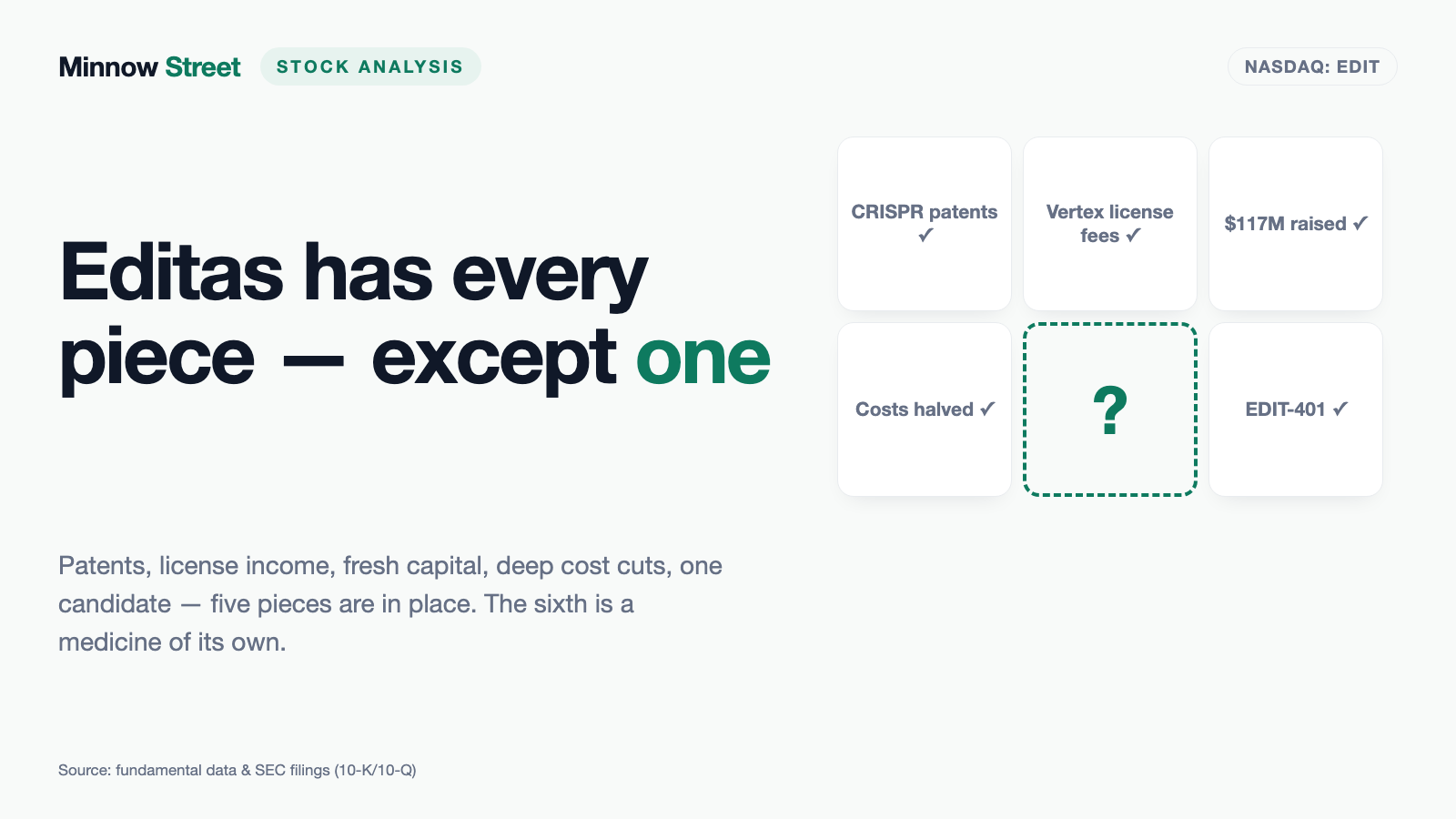
POET Technologies builds optical chips for AI data centers, and the technology story is a good one: the Optical Interposer is meant to take costly hand assembly out of transceiver manufacturing. The filings with the U.S. securities regulator, the SEC, tell the second half. In 2025, $1,074,865 of revenue faced $43.17 million of operating expenses; shares outstanding grew from 76.5 million to 172.6 million; and in April 2026 Marvell cancelled every order from the first production contract in company history — stating that POET had breached confidentiality. We do the arithmetic on how much of this valuation rests on contracts and how much on anticipation.
 Thomas Mücke
Founder & Publisher
Thomas Mücke
Founder & Publisher
Chart
Interactive price chart (TradingView).
Note: pure fact-based analysis, not investment advice and not a solicitation to buy or sell. All figures without guarantee.
There is a trap that catches the technically literate investor in particular — and walking into it feels like diligence. Call it the blueprint trap. It works like this: you read your way into a technology, you genuinely understand it, you see why it beats the state of the art — and your mind quietly adds the next step: "if the technology works, the revenue will follow." A good blueprint feels like a finished house. It is not. Between blueprint and house lie customers, qualification cycles, yield rates, supply agreements and years.
POET Technologies Inc. (Nasdaq: POET) of Toronto is a case study. The company builds the Optical Interposer — in plain terms, a base plate on which the photonic and electronic parts of an optical transceiver are assembled at wafer level in one pass, rather than aligned one by one by hand. For AI data centers pushing data between servers at 800 gigabits and 1.6 terabits per second, that sounds like exactly the right idea at the right moment. And the market listened: POET has raised $830 million of fresh equity in twelve months.
So let us make a deal. Before you decide whether there is a house here or a blueprint, we read together what the company itself filed with the U.S. securities regulator, the SEC: the annual report on Form 20-F for 2025 of March 31, 2026, the interim statements as of March 31, 2026 from the report on Form 6-K of May 15, 2026, the prospectus supplement (424B5) for the $400 million offering of May 18, 2026, and every filing through June 30, 2026. Such filings are honest under penalty of law. At the end, you decide — that is the point of the exercise.
What POET Technologies actually does
An optical transceiver is the plug through which a data center pushes data into a fiber-optic cable. It turns electricity into light and light back into electricity. Inside that plug sits an optical module in which lasers, modulators, photodiodes, lenses and driver chips have to be aligned to within microns. Today that is largely done part by part — expensive, slow, hard to scale. In everyday terms: every watch is assembled by hand instead of stamping movements in series.
This is where POET comes in. The annual report puts it plainly: the platform "eliminates costly components and labor-intensive assembly, alignment, and testing methods employed in conventional photonics." On that base plate the company builds optical engines — the working core of a module — at the industry speeds of 800G and 1.6T, plus the POET Blazar light source line, a hybrid laser meant to link servers and chips directly. In the company's own words:
"We believe that chip-scale integration is essential to developing hardware that can meet such demands and that POET is on the forefront of providing scalable solutions for current and future AI systems."
— POET Technologies Inc., SEC annual report 20-F for 2025, introduction, section "Business of POET Technologies Inc."
None of the building happens in Canada: POET keeps its head office in Toronto, develops in Singapore, assembles in Penang, Malaysia, and runs an additional unit in Shenzhen. As of December 31, 2025 the annual report counted 80 full-time employees, 52 of them in Singapore; by the report of May 18, 2026 it was "more than 115 globally", and at the end of June 2026 the company said it would add roughly 50 more within a few months. A firm the size of a mid-sized workshop, then — carrying a market value in the billions.
A word on where the shell came from, because it explains how this ticker has existed for decades without ever selling much. The prospectus supplement of May 18, 2026 traces the chain: incorporated in British Columbia on February 9, 1972 as Tandem Resources Ltd., a mining shell; renamed OPEL International Inc. in 2006, OPEL Solar International Inc. in 2010, OPEL Technologies Inc. in 2011, and only on July 23, 2013 POET Technologies Inc. From mining shell to solar to photonics. That is not an accusation, but it is a reminder that the corporate shell is older than any product inside it. Readers who like special situations will know the pattern from our analysis of Laser Photonics — a big story wrapped around a small revenue line there too.
Which names the central tension of this analysis, and it runs through every chapter: the technology is real and the treasury is full — but proof that anyone buys this technology in meaningful volume is still outstanding.
How the stock reached our desk
Honesty first: POET is not a scanner hit. As of July 29, 2026 the stock appears in no list of our in-house stock scanner — not in the momentum filters, not in the quality or value screens. That is no mystery: almost every quality filter needs earnings and almost every value filter needs revenue, and POET has too little of both. (Our lists are recomputed daily; the statement holds for that date.)
What put the stock on the desk was the SEC filing stream — the place where companies must publish things they would rather not discuss. Two filings three weeks apart stood out: on April 27, 2026 the cancellation of every purchase order from a major customer, and on May 15, 2026 a capital raise of $400 million from a single institutional investor — MMCAP International Inc. SPC, a Cayman Islands fund managed by MM Asset Management Inc. of Toronto, which subsequently reported holding 19,047,620 shares, or 11.0 percent of the company. This was no stranger writing the cheque: in an ownership filing of May 15, 2026, MMCAP already reported 14,516,820 shares as of March 31, 2026 — 13,022,782 of them underlying warrants — or 9.99 percent. Whoever put up the $400 million was already the largest single holder. A company that loses its flagship order and then raises 372 times its annual revenue in equity within three weeks deserves a second look.
One more data point for context: according to the fundamental data available to us (as of July 29, 2026), two analysts cover the stock. Two. For a business valued in the billions that is remarkably thin — it means almost nobody stands between you and this stock doing the arithmetic professionally. Remember that: where few people look, you have to look harder yourself.
The numbers over the years — given their due
First the things that genuinely impress, and there are more of them than the revenue line suggests.
The balance sheet is exceptional. As of March 31, 2026 the interim statements show $16,537,393 in cash and a further $412,599,049 in short-term investments — per the notes, exclusively guaranteed investment certificates held with Canadian banks. Together that is $429.1 million of immediately or near-immediately available funds. Watch that distinction, it is a classic trip wire: read only the line marked "cash" and POET looks strapped. The opposite is true — the money simply sits one line lower, in term deposits.
Against that stand $13.1 million of total liabilities, including $5.8 million of convertible debt from the purchase of a minority stake. Shareholders' equity is $448.6 million against total assets of $461.8 million — an equity ratio north of 97 percent. The company holds no credit lines, and the annual report says so drily: "The Company currently does not maintain credit facilities." A business without debt does not need any. The $400 million offering of May 18, 2026 added the same amount again.
One balance sheet item does deserve its own look, because it does not belong on a chip developer: $15,194,384 of "Loan receivable". POET has been lending money. Per note 22, $10 million went out on January 7, 2026 and $5 million on January 21 to an entity the report identifies only as "the Borrower"; note 23 adds a further $15 million advanced on April 23, 2026 on the same terms — $30 million in total, 28 times annual revenue. It carries 6 percent interest, falls due after five years or earlier on a "Liquidity Event" of the borrower, and under certain conditions POET may convert it into equity of the borrower. That is the architecture of a venture investment. Who the borrower is appears in none of the filings reviewed.
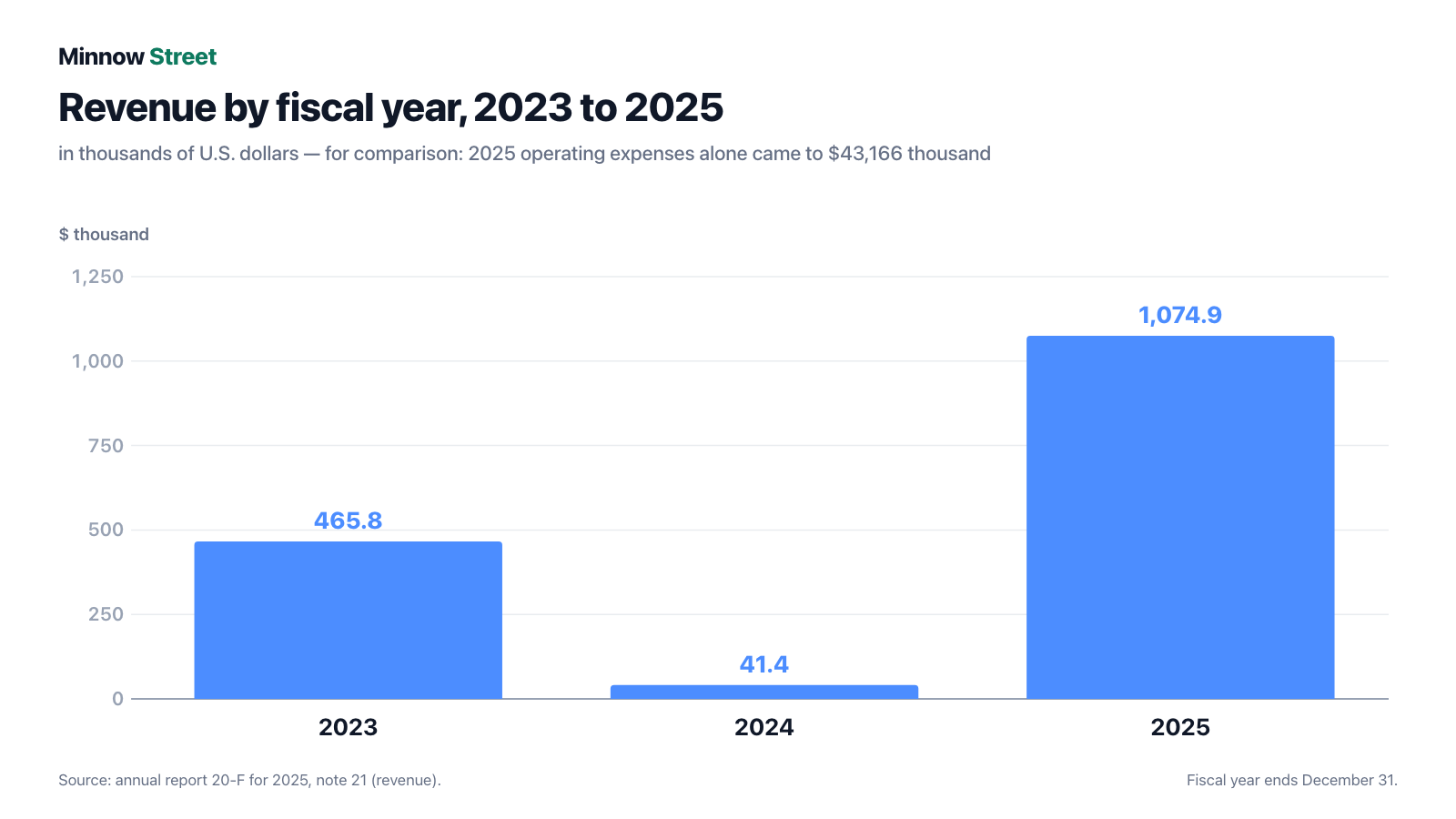
Revenue is growing — off a minuscule base. 2025 brought in $1,074,865, after $41,427 in 2024. That is a gain of roughly 2,495 percent, and it shows you exactly how little percentages are worth when the denominator is tiny. The first quarter of 2026 delivered $503,389 against $166,760 a year earlier — a little over triple, but still half a million dollars in three months.
Something commercial is moving. On May 14, 2026 POET announced a supply agreement with Lumilens Inc., including an initial purchase order of $50 million for engines based on the Electrical-Optical Interposer; the release says the relationship could scale to more than $500 million cumulatively over five years. One detail of the same release stays invisible in the order figure and belongs here anyway: in return, POET granted Lumilens a warrant on up to 22,921,408 of its own shares at $8.25 with a nine-year term — immediately exercisable for 2,292,140 shares, with the remainder vesting in tranches according to how much Lumilens actually orders and pays. The customer pays with orders and becomes a shareholder for it; for existing holders that is dilution which shows up in no price-to-sales calculation. Development partnerships with LITEON Technology and Lessengers (a 1.6T transceiver module) were announced as well. And at the annual meeting on June 26, 2026 the chief executive cited "more than 10 active customer engagements" expected to exceed $100 million of future annual revenue combined.
Internal control has been repaired. Fairness demands this be said: for 2024 the auditors had identified a material weakness — a substantive gap in accounting controls, because too few people could properly review the financial close. POET hired staff, and as of December 31, 2025 the audit firm Davidson & Company LLP declared internal control over financial reporting effective, with an unqualified opinion on the statements as well. Shareholders confirmed the auditors on June 26, 2026 with 97 percent of votes cast. And one more legacy item is gone: for 2023 the previous auditor, Marcum LLP, had still noted "substantial doubt about the Company's ability to continue as a going concern." That paragraph is absent from the 2025 opinion; in the annual report for 2025 it survives only where the old 2023 report is reprinted. With $429 million on hand it would be hard to justify.
One item does remain open, in the fine print of the same interim statements. Among events after the reporting date, note 23(b) says that after March 31, 2026 POET was "threatened with and named as defendants to a pending legal action" in the ordinary course of business; the company does not believe the outcome will be material and is assessing its response. Who is suing and over what does not appear there. We mention it because it is the only legal matter in the filings reviewed — not because any link to the April 2026 cancellation is documented. No filing asserts such a link.
The takeaway for this chapter: POET has solved its funding problem. It has not yet solved its selling problem.
What the filings say — the uncomfortable truths
Uncomfortable truth no. 1: annual revenue does not cover nine days of operating costs
Let us do the arithmetic, because the order of magnitude does not land otherwise. In 2025 POET took in $1,074,865. In the same year it spent $43,166,260 running the business — $25.08 million on selling, marketing and administration, $18.08 million on research and development. The operating loss came to $42,091,395. Full-year revenue therefore covers roughly nine days of operations.
Nor is this an accounting artifact: operations consumed a real $31,086,629 of cash in 2025 and another $8.8 million in the first quarter of 2026. The good news there is arithmetic: at roughly $9 million of quarterly cash burn and more than $800 million of liquid assets after the May raise, the money lasts for many years on paper. The bad news: it has to last for many years, because almost nothing is coming in from sales.
The annual report frames the risk with rare clarity — not marketing copy, but the risk factors section:
"We have limited experience in selling products in this market. We may not be successful in developing a product for this market and even if we do, it may never gain widespread acceptance by large data center operators."
— POET Technologies Inc., SEC annual report 20-F for 2025, Item 3.D "Risk Factors"
One more detail from the notes: revenue comes, per note 21, from "non-recurring engineering services and product sales" — NRE for short. Translated: a customer pays once for a piece of development work. That is not recurring revenue, it is paid preparation. At $1.07 million a year the distinction is academic — but when you read future quarters it is the single most important one: volume shipments repeat, engineering projects do not.
Uncomfortable truth no. 2: the first production order in company history was cancelled
On April 25, 2023 POET announced its first purchase orders for production units — for a company that had been developing for decades, a milestone, and for years the shareholders' strongest argument. The customer was Celestial AI. Three years later came the counter-announcement. On April 23, 2026 Marvell Semiconductor Inc., which had acquired Celestial AI, cancelled every order in writing. The decisive sentence from the report of April 27, 2026 sits in the SEC archive:
"Marvell indicated that the Company had made disclosures of information related to the Purchase Order and shipping information in contravention of its confidentiality obligations."
— POET Technologies Inc., SEC report 6-K of April 27, 2026, exhibit 99.1

Read the reason again. The order was not lost because the product failed, because the price was wrong, or because the customer switched technologies. It was lost because the customer accuses POET of talking too much about him. For a company whose share price fed on order announcements for years, that is a striking finding — it touches not the engineering but the way the business communicates. The same report points to an order "with another technology company with a value of approximately $5 million" — one it calls recently disclosed, so it is not a replacement for the cancelled volume. Three weeks later the $50 million Lumilens order followed. Both are announcements, not booked revenue — and that distinction is the lesson of this chapter.
Uncomfortable truth no. 3: 76.5 million shares became 172.6 — and could become 261
Dilution sounds harmless and is not. The everyday picture: the cake stays the same size, but more and more people sit down at the table. Your slice shrinks without your having done anything wrong. At POET the table was still manageable in January 2025.
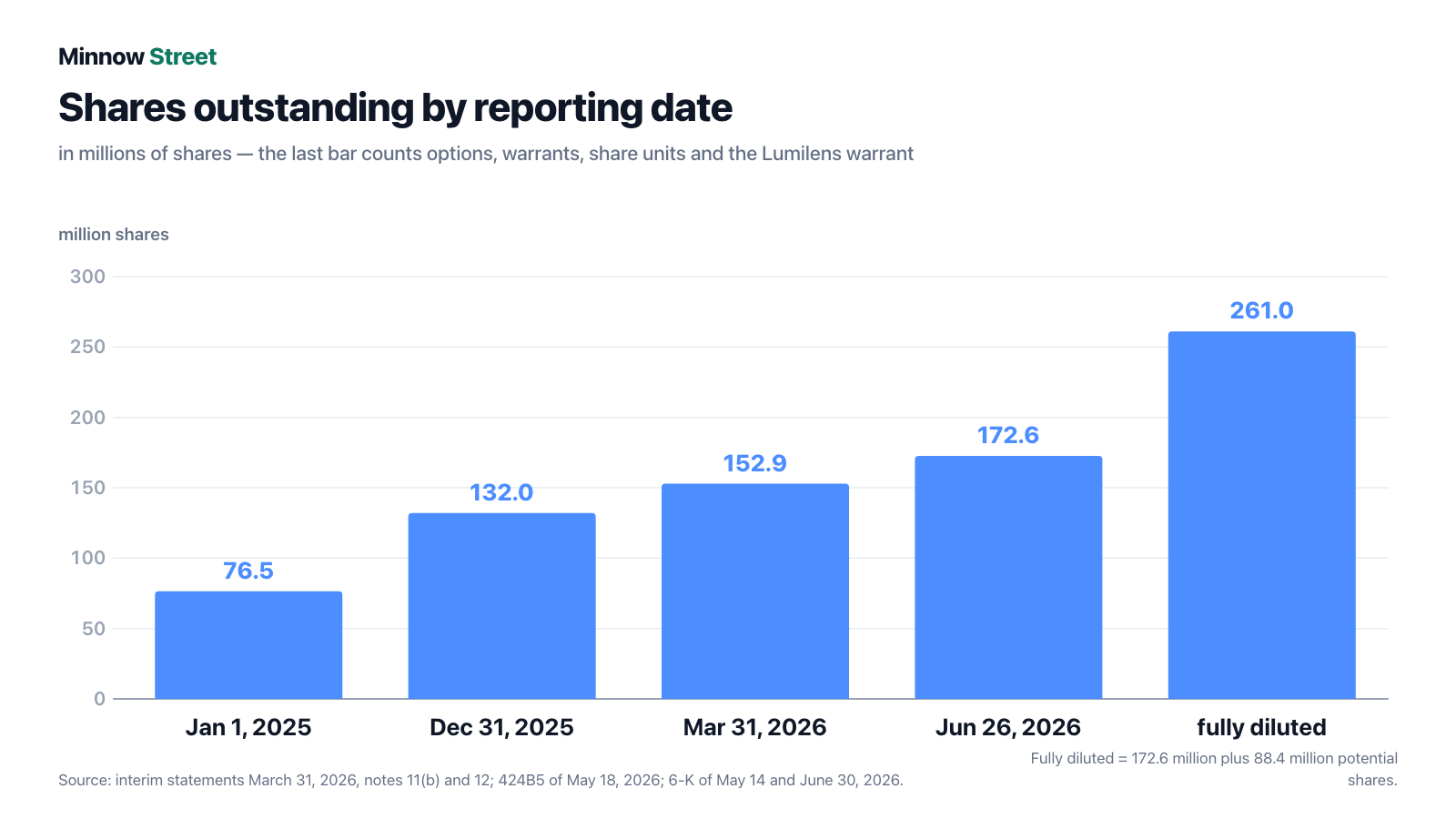
The figures come from the filings themselves: 76,507,157 shares on January 1, 2025 and 132,021,526 on December 31, 2025 (note 11(b) of the interim statements), 152,893,604 on March 31, 2026 and 153,547,786 on May 15, 2026 (prospectus supplement of May 18, 2026), 172,595,406 immediately after the May offering — and exactly 172,590,000 shares issued and outstanding, as the company reported for its annual meeting of June 26, 2026.
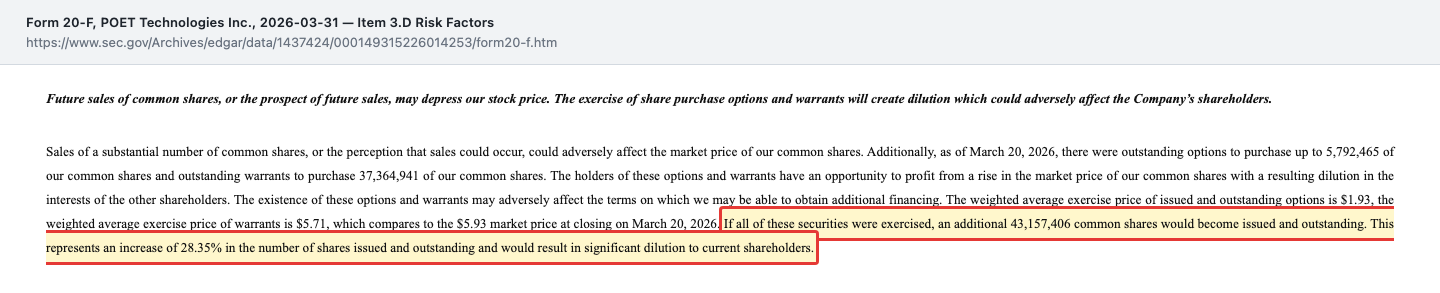
The annual report does the rest of the math itself — as of March 20, 2026, so before the May offering:
"If all of these securities were exercised, an additional 43,157,406 common shares would become issued and outstanding. This represents an increase of 28.35% in the number of shares issued and outstanding and would result in significant dilution to current shareholders."
— POET Technologies Inc., SEC annual report 20-F for 2025, Item 3.D "Risk Factors"
Since the May offering the sum has grown. On top of the 172.6 million shares outstanding, the prospectus supplement of May 18, 2026 lists 5,791,997 options (weighted-average exercise price $2.06), 37,364,941 warrants ($4.39) and 3,262,707 restricted share units held by directors and officers — plus the new warrant for 19,047,620 shares at $26.25. That adds up to 238.1 million shares.
And that list is incomplete. The prospectus supplement puts the warrants at a weighted-average exercise price of $4.39 — exactly the March 31, 2026 position from note 12 of the interim statements. So the warrant POET granted its customer Lumilens four days before the prospectus is not in there: a further up to 22,921,408 shares at $8.25. Together that is up to 261.0 million shares: 88.4 million potential shares on top of the 172.6 million outstanding today, roughly 51 percent more. The warrants alone could bring in "up to an additional $661 million", as POET itself calculates in the report of June 30, 2026; how that sum splits across the individual warrants it does not say.
And now the figure that makes dilution tangible. The prospectus supplement for the May offering states the tangible substance behind each share:

$2.94. Note the word historical in the original: that is the substance per share before the May offering, calculated on the 152.9 million shares outstanding at March 31, 2026. The investor in the May offering paid $21.00 per share plus warrant, and the prospectus computes the gap itself as an "immediate dilution of $16.08 per common share" to that investor. The same table also states the figure after the offering: $4.92 per share ("pro forma as adjusted net tangible book value per share after giving effect to this offering"). Those $4.92 are almost entirely cash as well. Anyone buying POET today buys an expectation at a multiple of that substance — normal for a growth company, but you should know the ratio between the two.
And one postscript to that offering, visible only with hindsight: the investor paid $21.00 per share plus warrant on May 18, 2026. On July 28, 2026 the stock stood at $6.76 — roughly 68 percent below the issue price. The accompanying warrant, exercisable at $26.25, is a long way out of the money. For POET none of that matters: the $400 million was paid and sits in the bank. For you as a shareholder it is still a lesson in the difference between a sum raised and a price held — and in how little an issue price says about the worth of a business.
Uncomfortable truth no. 4: U.S. tax law treats POET as a pot of money, not a business
This finding is the quietest and the most revealing. On April 14, 2026 POET disclosed that it will be treated as a Passive Foreign Investment Company (PFIC) for fiscal 2025.
"Based on our income and assets for the year ended December 31, 2025, we currently believe that we will be treated as a PFIC for the year ended December 31, 2025."
— POET Technologies Inc., SEC report 6-K of April 15, 2026, exhibit 99.1

What that means is spelled out in the annual report: a foreign corporation is a PFIC if either 75 percent or more of its gross income is passive — interest, dividends, rents — or 50 percent or more of its assets produce such income. At POET the ratio is unambiguous: $4,553,061 of other income including interest in 2025 against $1,074,865 of revenue. Under that heading POET booked roughly four times what the product business brought in. On the asset side it is starker still: 96 percent of total assets as of December 31, 2025 were current assets, almost entirely cash and term deposits.
For a U.S. holder the classification carries real tax consequences, which is why the company committed to providing the information needed for a "QEF" election. But as a diagnosis it is worth more than that: an independent, formula-driven test under U.S. tax law concludes that in 2025 this business was economically closer to a pot of money with a development department attached than to a manufacturer. That is the blueprint trap in one sentence. The board resolved on April 14, 2026 to redomicile in the United States — which would settle the PFIC question going forward but changes nothing about the cause.
In fairness, the second half of that disclosure belongs here too: for fiscal 2026 POET says it does not expect PFIC status — "we believe that we will not qualify as a PFIC", per the chief financial officer — while conceding in the same text that the answer depends on income and assets for the full year. The planned redomiciliation has one further consequence: it ends foreign private issuer status. The annual report already carries that loss as a risk factor of its own ("The Company will likely lose its foreign private issuer status") and names June 30, 2026 as the annual test date. Through July 29, 2026 POET has filed nothing on the outcome. If the status goes, the company will have to file U.S. quarterly reports (10-Q) under U.S. GAAP — more work for POET, more numbers for you.
Uncomfortable truth no. 5: the quarterly profit that never was
Finally, a number many investors misread in the spring of 2025. In the first quarter of 2025 POET reported net income of $6,341,558, or $0.08 per share. A profitable quarter! Except that revenue in that quarter was $166,760 and the operating loss $9.54 million. The profit came from a line further down: a fair value adjustment to the derivative warrant liability of $15,382,971.
Here is the mechanism. Because part of the warrants are denominated in Canadian dollars, accounting rules force POET to carry them as a liability and remeasure them each period. When the share price falls, that liability shrinks — and the company books a gain. When the price rises, the reverse. Translated: on paper, the company profits from its own stock going down. For the full year 2025 the same calculation ran the other way and cost $25,280,833; in the fourth quarter of 2025 alone, $30.7 million. That is how the 2025 net loss of $62,963,213 arose even though the operating loss was "only" $42.09 million. In the first quarter of 2026 the effect was a small $1.6 million gain, because the number of warrants carried this way fell from 29.27 million to 493,505. Remember: at POET the "net income" line says little about the business. Look at the operating loss and at cash used in operations.
Valuation: what the market is actually paying for
A note on diligence first, because two data sources meet here. We cross-checked the market value in our fundamental data set against the filings, and it passes: the share count it carries, 172,590,000, is exactly what POET reported for its annual meeting on June 26, 2026, and the market value of $1,166,708,480 is arithmetically those shares at the $6.76 closing price of July 28, 2026 (deviation against the 172,595,406 shares from the prospectus supplement: 0.003 percent). So we work with roughly $1.17 billion, data as of July 28, 2026.
Hold that number next to the others in this article:
- 2025 revenue: $1.07 million. The price-to-sales ratio therefore sits at roughly 1,085 — a good thousand times annual revenue. For comparison: a richly valued software growth stock trades at 15 to 25.
- Net tangible book value: $4.92 per share. That is what the prospectus supplement of May 18, 2026 puts the substance at after the $400 million offering; before it, as of March 31, 2026, the figure was $2.94. The July 28, 2026 price is therefore roughly 1.4 times book — measured against everything else here, the tamest number in this article, because what stands behind the share is almost entirely cash.
- Hoped-for future annual revenue: more than $100 million from "more than 10 active customer engagements" (statement by the chief executive, June 26, 2026). Even if that arrives in full, it would still imply a price-to-sales ratio around 12 — measured against the July 28, 2026 market value and before any further dilution.
And now the price chain from the filings, because it captures the nature of this stock. On January 21, 2026 the prospectus cites $8.37. On March 20, 2026 POET closed at $5.93 according to the annual report. On May 14, 2026 the offering release cites $20.57. On May 15, 2026 — the day the $400 million raise at $21.00 was announced — it was $15.97. And on July 28, 2026 the stock stood at $6.76. More than tripled in eight weeks, down a fifth in a single day, back to a third of the peak ten weeks later. That is not a valuation, it is a mood ring. Which is why no price appears in this article without a date beside it: without one, every single figure here would be wrong by tomorrow.
Anyone thinking about valuation should not miss one thing, and it is the strongest sentence in this chapter: most of the market value is the company's own bank balance. Do the arithmetic: $429.1 million of liquid assets as of March 31, 2026, minus the $15 million advanced as a loan on April 23, plus $400 million gross from the May offering, minus roughly $9 million of quarterly cash burn — call it $800 million. There is no balance sheet for the period after March 31, 2026 yet; this is a calculation from documented line items, not a reported figure. Of the roughly $1.17 billion of market value, that leaves something like $360 million as the price of the blueprint — for patents, platform, factory plans and every hope combined. That is considerably less than the raw price-to-sales number suggests, and it does not change the fact that $360 million for $1.07 million of annual revenue is a very large advance of trust.
Opportunities and risks at a glance
What speaks for POET:
- Funding is secured for years. $429.1 million of liquid assets as of March 31, 2026 plus $400 million from the May offering, against roughly $9 million of quarterly operating cash burn. No bank debt, no need for credit lines.
- The market is real and growing. The shift from 400G to 800G and 1.6T in AI data centers is not a forecast but underway; the annual report cites market estimates of $7 billion to $12 billion for high-speed datacom pluggables.
- The technology is patented and externally validated more than once. Development partnerships with LITEON and Lessengers, plus the Lumilens supply agreement with an initial $50 million purchase order (May 2026).
- The accounting has been put in order. The material weakness identified for 2024 is deemed remediated as of December 31, 2025, with an unqualified auditor opinion on internal control.
- Expansion plans are concrete. Roughly $50 million for capital equipment in the second half of 2026, with a target capacity of up to one million units per month by the end of 2027.
What speaks against POET:
- Commercial proof is missing. $1.07 million of revenue in 2025, mostly from one-off engineering services; volume production is only meant to start in the second half of 2026.
- The flagship order is gone — cancelled by Marvell on April 23, 2026, and specifically over an alleged breach of confidentiality by POET itself.
- Heavy, ongoing dilution. From 76.5 million to 172.6 million shares in eighteen months, potentially up to 261.0 million including the Lumilens warrant. Each further growth step will likely be funded with new shares again.
- The valuation is extreme. Roughly $1.17 billion of market value (July 28, 2026) against $1.07 million of revenue — about 1,085 times. Strip out the company's own bank balance of some $800 million and roughly $360 million remains for platform and patents.
- There are no binding commitments. The annual report states that customers "are typically not contractually committed to buy any quantity of products beyond firm purchase orders" and may cut, delay or cancel existing orders without significant penalty. The April 2026 cancellation demonstrated exactly that.
- Concentration in manufacturing and geography. Assembly in Malaysia, a unit in Shenzhen, development in Singapore — an exposed footprint for a U.S.-listed company serving AI customers.
- Thin coverage. Two analysts (data as of July 29, 2026); on good days and bad, the professional corrective is missing.
A human conclusion
Back to the blueprint trap. It does not spring shut because the blueprint is bad — at POET it plainly is not. It springs shut because our minds skip the intermediate step that is in truth the hardest: from working prototype to paid volume product. POET has been working on this base plate under this name since 2013. The balance sheet says the company has now bought itself more time than ever before. The income statement says it still needs that time.
What this analysis does not claim: that the technology does not work. What it documents: that as of March 31, 2026 more money came from interest than from products, that the most important order in company history was cancelled in April 2026 for reasons unrelated to engineering, and that after the May offering $4.92 of hard substance stands behind each share, exactly as the prospectus supplement of May 18, 2026 works it out.
If you own POET or want to, there is a handful of numbers to look for in the coming interim reports (6-K), and all of them appear in this article. Does the $50 million Lumilens order turn into booked revenue? Does the quarterly figure climb past half a million into the tens of millions? Does the revenue mix shift from one-off engineering to recurring volume shipments? And does the share count stay at 172.6 million — or climb toward the 261.0 million already embedded in options, warrants and share units?
An expectation is not a lie. It is simply not yet arithmetic. What you make of that is your decision. And that is exactly as it should be.
If you want to see the same examination applied to a company whose technology also convinces while the numbers lag behind, read our analysis of Ouster — the revenue base there is far larger, but the question about earning power is the same.
Sources
- SEC annual report 20-F for 2025, POET Technologies Inc. (CIK 0001437424), filed March 31, 2026 — Item 3.D risk factors, Item 4.B business, Item 5.B liquidity, Item 6.D employees, Item 15 internal control, notes 11, 20, 21, 22
- SEC annual report 20-F for 2024, filed April 1, 2025
- Interim statements as of March 31, 2026 (exhibit 99.1 to the SEC report on Form 6-K of May 15, 2026) — balance sheet, statement of operations, notes 3, 11(b), 14, 21, 22 and 23
- SEC prospectus supplement 424B5 of May 18, 2026 — share count, dilution, net tangible book value, corporate history, foreign private issuer status
- SEC prospectus supplement 424B5 of January 23, 2026 — $150 million offering at $7.25 per share
- SEC report 6-K of April 15, 2026 — PFIC status for 2025 and board resolution to redomicile in the United States
- SEC report 6-K of April 27, 2026 — cancellation of all purchase orders by Marvell Semiconductor
- SEC report 6-K of May 14, 2026 — supply agreement with Lumilens Inc., including the warrant on up to 22,921,408 shares at $8.25
- SEC report 6-K of May 15, 2026 — first quarter 2026 results
- SEC free writing prospectus of May 15, 2026 and closing report 6-K of May 18, 2026 — the $400 million offering
- SEC report 6-K of May 18, 2026 (agreement report) — the securities purchase agreement names MMCAP International Inc. SPC as the purchaser in the $400 million offering
- SEC report 6-K of June 30, 2026 — results of the June 26, 2026 annual meeting, share count, capital plans, "up to an additional $661 million" from warrants
- Ownership filings (SCHEDULE 13G) after the interim statements — MMCAP International Inc. SPC of May 20, 2026 (19,047,620 shares, 11.0 percent) and of May 15, 2026 (14,516,820 shares including 13,022,782 underlying warrants, 9.99 percent as of March 31, 2026), plus Marex (May 19, 2026), Jane Street (June 22, 2026) and Citadel Securities (July 8, 2026)
- Fundamental data and company profile of our in-house stock scanner, data as of July 29, 2026
Source: fundamental data & SEC filings (annual reports 20-F, interim reports 6-K). POET Technologies reports as a foreign private issuer under U.S. law, on annual Form 20-F and interim Form 6-K; a U.S. quarterly report (Form 10-Q) does not exist for this company — although POET itself considers it likely that it will lose that status; the test is annual and was last due on June 30, 2026. The financial statements are prepared under IFRS Accounting Standards and expressed in U.S. dollars; the fiscal year ends December 31. The shares trade only on Nasdaq; the former TSX Venture Exchange listing ended in 2024.
Important notice
This article is a journalistic assessment of publicly available company disclosures. It is not investment advice, not a research report within the meaning of any securities regulation, and not a solicitation to buy or sell securities. Shares of companies without meaningful revenue can lose their entire value; a total loss is possible. All figures come from the sources named and refer to the dates stated; they may be out of date by the time you read this. The author holds no position in POET Technologies Inc. at the time of publication.
Our Bottom Line at a Glance
- Financial strength positive
- As of March 31, 2026 the company held $429.1 million of liquid assets ($16.5 million of cash plus $412.6 million of guaranteed investment certificates) against $13.1 million of total liabilities; $400 million gross was added on May 18, 2026. At roughly $9 million of quarterly operating cash burn, funding is secured for years without any bank debt.
- Commercial proof negative
- 2025 revenue of $1,074,865 against $43.17 million of operating expenses — arithmetically nine days of operating costs. It comes mostly from one-off engineering services. Volume production is only meant to begin in the second half of 2026; the annual report concedes the product "may never gain widespread acceptance by large data center operators".
- Customer commitment negative
- Marvell Semiconductor cancelled every order from the first production contract, announced in 2023, on April 23, 2026 — alleging that POET had breached its confidentiality obligations. The annual report itself states that customers are not committed beyond firm purchase orders. The Lumilens order of $50 million (May 14, 2026) is so far an announcement, not booked revenue.
- Dilution negative
- From 76,507,157 shares (January 1, 2025) to 172,590,000 (June 26, 2026), and 238.1 million fully exercised — up to 261.0 million counting the warrant on 22,921,408 shares that POET granted its customer Lumilens on May 14, 2026. Net tangible book value was $2.94 per share as of March 31, 2026 and $4.92 after the offering, against a $21.00 offering price in May — the prospectus itself puts the immediate dilution to the new investor at $16.08 per share.
- Accounting & governance neutral
- The material weakness identified for 2024 is deemed remediated as of December 31, 2025, the auditors issued an unqualified opinion and were confirmed with 97 percent of votes on June 26, 2026. Three items remain open: the PFIC status for 2025 with the resolved U.S. redomiciliation (for 2026 POET expects no PFIC status), $30 million lent to a borrower the filings never name, and a legal action pending after March 31, 2026 that the interim statements merely mention and assess as not material, without naming party or subject.
POET Technologies is the blueprint trap in its purest form: a plausible, patented technology for a genuinely growing market — and next to it an income statement in which $1,074,865 of 2025 revenue meets $43.17 million of operating expenses. The balance sheet is exceptional, with $429.1 million of liquid assets (March 31, 2026) plus $400 million from the May offering, and it was paid for by doubling the share count to 172.6 million. The most important order in company history was cancelled in April 2026 because the customer accuses POET of breaching confidentiality; for 2025 U.S. tax law treats the company as a passive investment vehicle. Anyone buying in buys time and an expectation — both available in abundance, just not yet sold. Not investment advice.
What Our Rating Means
Open questions
The business works in principle, but one material question is open. As long as it stays open, our findings do not carry a quality verdict.
Yellow here marks an open operating question, not a substance risk: the balance sheet is sound — $429.1 million of liquid assets against $13.1 million of liabilities (March 31, 2026), no need for credit lines, no going-concern paragraph left in the statements, and the 2024 control weakness remediated and attested. What is missing is proof that anyone buys this technology in volume: $1.07 million of annual revenue, mostly one-off engineering work, and the only production order in company history was cancelled in April 2026. That the stock trades at roughly 1,085 times annual revenue (market value $1.17 billion, data as of July 28, 2026) is a price argument and does not move the light — it only changes how little room for disappointment remains. This turns green once two or three consecutive quarters show announcements becoming shipments. The decision is yours.
A journalistic assessment by our editorial team at the time of the deep dive, based on public sources — not investment advice and not a solicitation to buy or sell. Your personal circumstances (investment goals, risk capacity, taxes) cannot be taken into account. What our levels mean, how verdicts are formed, and what conflicts of interest exist →
Worth Noting
- This analysis did not start from a scanner hit — POET appeared in none of our scanner lists as of July 29, 2026 — but from the SEC filing stream: the cancellation of all Marvell purchase orders on April 27, 2026 and the $400 million offering of May 15/18, 2026.
- Data basis: annual figures from the 20-F for 2025 (December 31, 2025), interim figures from the statements as of March 31, 2026, share count from the 6-K of June 30, 2026. Fundamental data as of July 29, 2026.
- The market value from fundamental data ($1,166,708,480) was checked against the filings and passed: the share count it carries, 172,590,000, is exactly what POET reported for its annual meeting of 06/26/2026, and 172,595,406 shares from the prospectus supplement × $6.76 closing price of 07/28/2026 gives $1,166,744,945 — a deviation of 0.003 percent. The article therefore uses it as a dated anchor (as of 07/28/2026).
- The older filing prices ($8.37 on 01/21/2026, $5.93 on 03/20/2026, $20.57 on 05/14/2026, $15.97 on 05/15/2026) are historical anchors and expressly not today's valuation. The stock has fallen well below the May offering price of $21.00; that gap is named in the dilution chapter as a documented finding, not as a forecast.
- Easy to confuse: POET Technologies is a Canadian corporation reporting as a foreign private issuer (20-F, 6-K). No U.S. quarterly report (10-Q) exists; anyone searching for one finds nothing and wrongly concludes the company is opaque. Its former SEC name is OPEL International Inc. Second trap: older press releases still carry "TSX Venture: PTK" in the header — per the 20-F for 2025 the Canadian listing already ended in 2024, and the shares trade only on Nasdaq.
- Second pitfall, on net tangible book value: the $2.94 per share in the prospectus supplement of 05/18/2026 is expressly the "historical" figure as of 03/31/2026 — before the $400 million offering and calculated on 152.9 million shares. The same table gives $4.92 per share for the period after it. Comparing the 07/28/2026 price against the $2.94 would make the stock look dearer relative to its substance than it is; the article therefore works with $4.92 (roughly 1.4 times).
- Dilution pitfall in this analysis: the prospectus supplement of 05/18/2026 lists options, warrants and share units with a weighted-average warrant exercise price of $4.39 — exactly the 03/31/2026 position. The warrant on up to 22,921,408 shares at $8.25 that POET granted its customer Lumilens on 05/14/2026 is not included there. The fully diluted share count is therefore up to 261.0 million, not 238.1 million.
- The whole price chain — $8.37 (January 21, 2026), $5.93 (March 20, 2026), $20.57 (May 14, 2026), $15.97 (May 15, 2026), $6.76 (July 28, 2026) — is dated and documented; it appears in the article as evidence of how the price forms, not as a price forecast.
Frequently Asked Questions
POET Technologies Inc. (Nasdaq: POET) of Toronto develops the "Optical Interposer" — a base plate on which the photonic and electronic parts of optical transceivers are assembled at wafer level instead of one by one by hand. On top of it sit optical engines for 800G and 1.6T plus the POET Blazar light source line, both aimed at AI data centers. Development happens in Singapore and assembly in Malaysia; the company had 80 full-time employees as of December 31, 2025.
Very little. The annual report on Form 20-F shows revenue of $1,074,865 for 2025, after $41,427 in 2024 and $465,777 in 2023. The first quarter of 2026 brought $503,389 against $166,760 a year earlier. Against that stood $43.17 million of operating expenses in 2025 and an operating loss of $42.09 million. Revenue comes mostly from one-off engineering services, not from volume shipments.
Because POET Technologies is a Canadian corporation and is treated by the U.S. securities regulator, the SEC, as a foreign private issuer. Such companies file an annual report on Form 20-F and ongoing interim reports on Form 6-K instead of U.S. quarterly reports on Form 10-Q. The financial statements follow IFRS Accounting Standards and are expressed in U.S. dollars; the fiscal year ends December 31. That may change: the 2025 annual report carries the loss of this status as a risk factor of its own ("The Company will likely lose its foreign private issuer status"), and the annual test date was June 30, 2026; nothing had been filed on the outcome through July 29, 2026. If the status goes, quarterly reports (10-Q) under U.S. GAAP would follow.
It was cancelled. Marvell Semiconductor, which had acquired Celestial AI, gave written notice on April 23, 2026 cancelling every purchase order — including the first production units POET announced on April 25, 2023. Per the SEC report of April 27, 2026, Marvell stated that POET had disclosed information about the order and shipments in contravention of its confidentiality obligations. The same report points to a previously disclosed order of roughly $5 million with another company; it is not a replacement for the cancelled volume.
Heavily. Shares outstanding rose from 76,507,157 (January 1, 2025) to 132,021,526 (December 31, 2025), 152,893,604 (March 31, 2026) and 172,590,000 at the annual meeting on June 26, 2026. Counting the options, warrants and share units named in the prospectus supplement of May 18, 2026, the total would be roughly 238.1 million shares; including the warrant on up to 22,921,408 shares that POET granted its customer Lumilens on May 14, 2026, it is up to 261.0 million — about 51 percent above today. That funded $830 million of equity raised in twelve months.
As of March 31, 2026 the interim statements show $16,537,393 in cash plus $412,599,049 in short-term investments (Canadian guaranteed investment certificates) — $429.1 million together. On May 18, 2026 a capital raise added $400 million gross. Total liabilities as of March 31, 2026 were only $13.1 million, and the company states it maintains no credit facilities.
PFIC stands for Passive Foreign Investment Company — a U.S. tax classification for foreign corporations whose income or assets are predominantly passive. POET disclosed on April 14, 2026 that it will be treated as a PFIC for 2025: $4.55 million of other income including interest against $1.07 million of revenue. U.S. holders can mitigate the consequences with a timely QEF election, for which the company has committed to provide the required statements. The board plans to redomicile in the United States to end the issue. For 2026 POET says it does not expect PFIC status — the answer depends on income and assets for the full year.
As of July 28, 2026 the market value stood at roughly $1.17 billion — 172.59 million shares at a closing price of $6.76. Against $1.07 million of 2025 revenue that implies a price-to-sales ratio of about 1,085. Net tangible book value was $2.94 per share as of March 31, 2026 and $4.92 after the May offering (prospectus supplement of May 18, 2026). Strip out the company's own liquid assets of roughly $800 million and the market is paying about $360 million for the platform, the patents and the prospects.
Found an error?
Did you spot a factual error, an outdated number, or a typo in this deep dive? Let us know briefly — your report goes straight to the editorial team.