Editas Medicine: The CRISPR Pioneer That Earns on Someone Else's Medicine
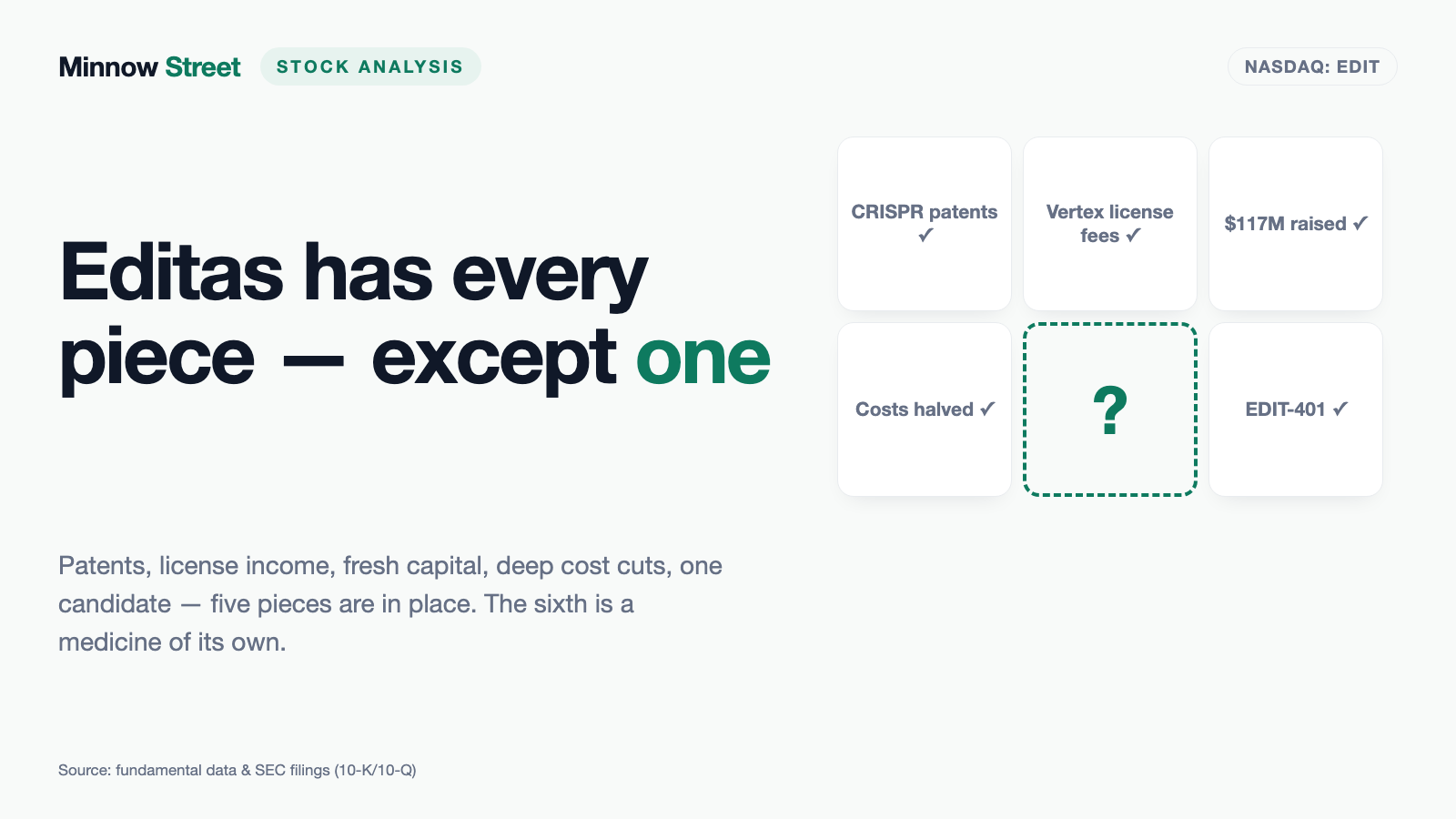
Editas was one of the first names in gene editing — and today it is a company without a medicine of its own. Its quarterly report (10-Q) for the period ended March 31, 2026 says it plainly: never any product revenue — and an accumulated deficit of $1.65 billion. What shows up as revenue is license income, mostly for the Cas9 technology behind Vertex's approved CASGEVY. And even those fees have largely belonged to a royalty investor since October 2024. Editas buried its lead program at the end of 2024 and let go 65 percent of its staff; by March 2026 equity was down to $4.4 million, and in May the company raised fresh money by issuing 55.6 million new shares. Not investment advice — just the question of what a pioneer is worth when it helped invent the tool but not the treatment.
 Thomas Mücke
Founder & Publisher
Thomas Mücke
Founder & Publisher
Chart
Interactive price chart (TradingView).
Note: pure fact-based analysis, not investment advice and not a solicitation to buy or sell. All figures without guarantee.
There is an investor trap that sounds smart, because it looks like a reward for showing up early: the pioneer trap. It works like this. A company helped invent a technology that later changed the world. Your brain fills in the rest automatically: "whoever got there first gets paid first." And now you have an investment thesis before reading a single filing. Editas Medicine (NASDAQ: EDIT) of Cambridge, Massachusetts is exactly that company. It was among the first firms that set out to turn the CRISPR gene-editing tool into medicines. Ten years after its stock market debut the picture looks different: there is no Editas medicine. There never was one. The revenue the company reports is license income — mostly for the Cas9 technology behind CASGEVY, the approved gene therapy of a different company. So here is the deal: before you buy the label "CRISPR pioneer," let us read together what Editas itself told the U.S. securities regulator, the SEC — the annual report (10-K) for 2025, the quarterly report (10-Q) for the period ended March 31, 2026, and everything filed since. An SEC filing is honest under penalty of law. And this one describes a company that buried its best program, watched its equity melt to $4.4 million by March 2026, and restarted in May 2026 with a capital raise. What you make of it is your call.
What Editas Medicine actually does — a gene-editing tool, still without a medicine
Editas Medicine works on gene editing. Translated into everyday terms: your genome is a very long text, and a gene-editing tool is a correction device that finds a faulty passage and changes it. The best-known of these tools is called CRISPR; Editas works with the enzymes Cas9 and Cas12a.
Until late 2024 Editas took the obvious route. You take blood stem cells out of a patient, correct them in the lab and put them back — that is called ex vivo. The program was named reni-cel and targeted sickle cell disease and transfusion-dependent beta thalassemia. It was the company’s most advanced effort. On December 11, 2024 the board discontinued it.
Since then Editas has taken the other route: in vivo — the medicine is injected and corrects cells inside the body. The strategy is called functional upregulation. Instead of repairing a broken stretch of DNA, the intact second copy of a gene is turned up so it produces more of the missing protein. The lead candidate is EDIT-401, aimed at elevated blood lipids (hyperlipidemia). The tool is meant to make the liver build more LDL receptors — more vacuum cleaners for bad cholesterol. The candidate was nominated in September 2025.
And now the sentence everything turns on: EDIT-401 is preclinical. The annual report (10-K) for 2025 states in its risk factor summary that all ongoing programs sit at the preclinical or research stage. That defines the central tension of this analysis, and it runs through every chapter: Editas owns patents on a technology other companies already earn money with — and has not yet tested a single medicine of its own in a human being.
"Preclinical," however, does not mean "someday." The quarterly report (10-Q) for the period ended March 31, 2026 and the prospectus supplement of May 26, 2026 lay out a strikingly tight schedule: a clinical trial notification to the Australian Therapeutic Goods Administration in mid-2026, the first-in-human study — a Phase 1/2 trial of roughly 18 patients with heterozygous familial hypercholesterolemia (HeFH) in three dosing arms — starting later in 2026, and early human proof-of-concept data by the end of 2026, with topline results from the dose-finding part in 2027. Whether that plan holds is the question everything in this stock turns on — and Editas wrote it into the terms of its own warrants. That the trial has actually begun is, as of July 29, 2026, reported in no filing.
The money therefore comes from partners, not patients. Three agreements carry the business. First, the Vertex license of December 2023: Vertex Pharmaceuticals obtained a non-exclusive license to the Editas Cas9 technology for ex vivo medicines targeting the BCL11A gene — precisely the field in which Vertex’s approved CASGEVY operates. Second, the collaboration with Bristol Myers Squibb through its subsidiary Juno Therapeutics, which has produced 14 programs to date. Third, a non-exclusive agreement with Immatics. As of February 1, 2026 Editas had 87 full-time employees, roughly 66 of them in research and development.
How this stock landed on our desk
Not through a screening list, but through the filing calendar of the U.S. securities regulator, the SEC. On May 26, 2026 Editas filed a current report (8-K) announcing a share sale of 55,555,556 shares — against roughly 97.9 million shares outstanding at the time. When a company issues more than half of its existing share count in a single stroke, that is always a reason to open the latest quarterly report. That is exactly what we did.
To repeat the exercise yourself: on EDGAR, the SEC’s filing database, you can filter any company by form type. An 8-K is a current report, a 10-Q the quarterly report, a 10-K the annual report. Read only the 8-K lines of the past six months and the whole Editas story appears in minutes: auditor change in April, trial data in May, a capital raise a few days later. Remember the move: calendar first, metric second.
Conventional metrics do not help much here. There is no price-to-earnings ratio without earnings, and a price-to-sales ratio measures not the business but the accident of the licensing calendar — more on that below. If you are interested in other companies whose market value rests mainly on a promise, two related cases sit in our analyses of Ginkgo Bioworks and Recursion Pharmaceuticals.
The numbers over the years — credit where credit is due
First the part that genuinely speaks for Editas, and it is more than the red bottom line suggests: the cost program works. After the end of reni-cel, research and development spending fell from $199.2 million (2024) to $90.0 million (2025), a decline of 55 percent. General and administrative expenses dropped from $72.0 million to $49.9 million, down 31 percent. The net loss narrowed from $237.1 million to $160.1 million. The first quarter of 2026 continued the trend: $17.6 million of research, $10.2 million of administration and a $25.0 million net loss — against $76.1 million in the prior-year quarter. This is not cosmetic trimming; this is half a company.
And revenue? Revenue is the actual story:
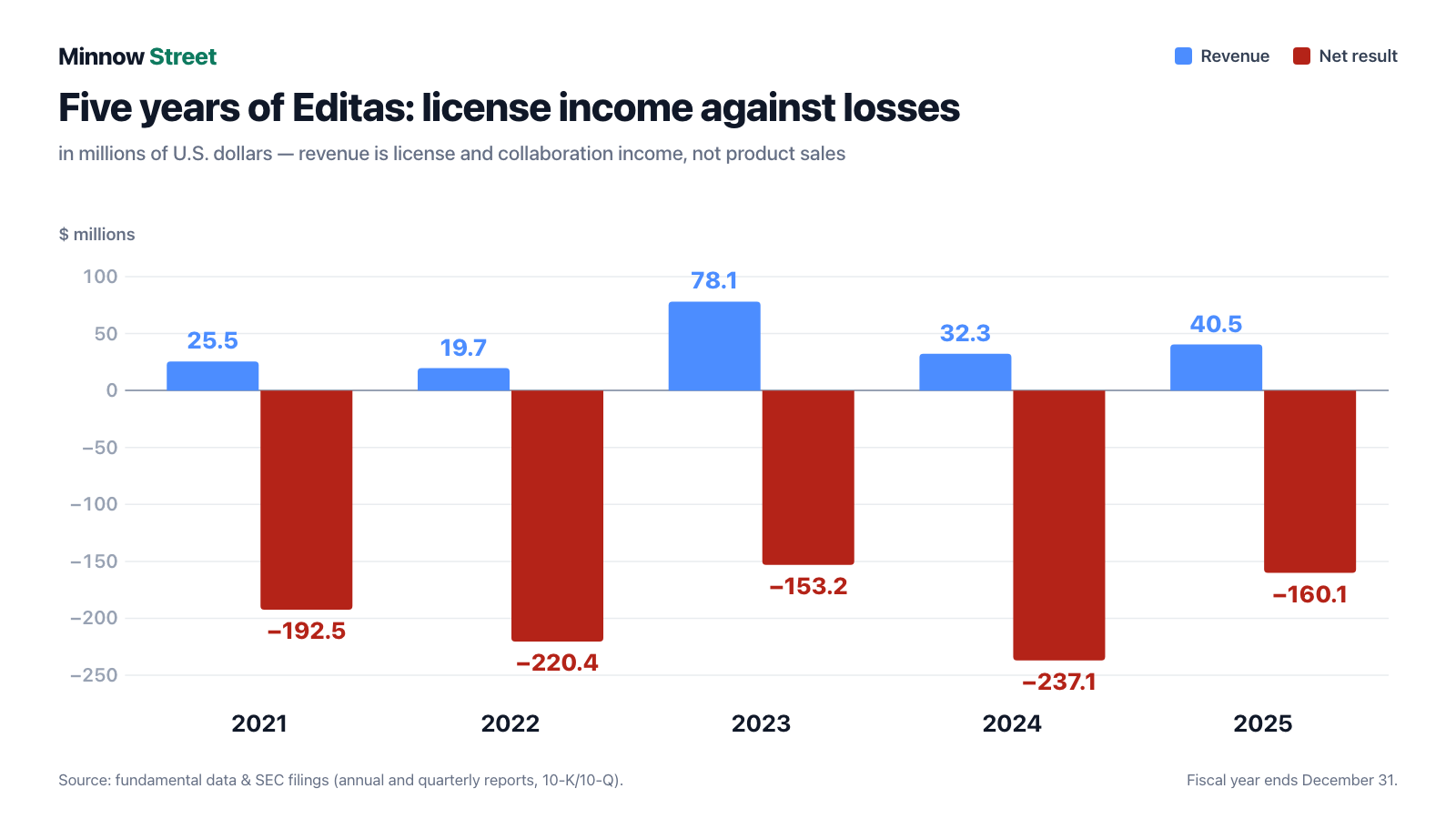
Before the restructuring the loss series looked like this: −$192.5 million (2021), −$220.4 million (2022), −$153.2 million (2023), −$237.1 million (2024) and −$160.1 million (2025). Add the five red bars: $963 million of losses in five years, against $196 million of revenue over the same period. For every dollar taken in, Editas burned roughly five. Accumulated deficit since inception stands at $1.65 billion as of March 31, 2026. And the blue outlier in 2023 — $78.1 million — was not a breakthrough in the business but a single signature: the Vertex upfront payment. Remember the image: at Editas revenue is not a river, it is occasional rainfall. Which brings us to the uncomfortable truths.
What the filings say — the uncomfortable truths
Uncomfortable truth no. 1: The revenue is a license fee on somebody else’s medicine — and it already belongs to a third party
In December 2023 Editas granted Vertex Pharmaceuticals a non-exclusive license to its Cas9 technology for ex vivo medicines targeting the BCL11A gene. That is precisely the ground Vertex’s CASGEVY stands on. Editas collected $50.0 million in the fourth quarter of 2023 and a $10.0 million annual fee in each of the first quarters of 2024 and 2025; the agreement also provides for a potential further $50.0 million upfront payment and ongoing annual fees of $5.0 million to $40.0 million through 2034. A tidy business — for a technology somebody else turned into a medicine.
Except that this money is not entirely Editas money either. Editas does not own the core Cas9 patents; they are in-licensed from The Broad Institute and Harvard University. The annual report (10-K) for 2025 records that Editas must pass a "mid-double-digit percentage" of everything Vertex pays for that Cas9 technology back to Broad and Harvard. Editas does not put a finer number on it, but a mid-double-digit percentage means roughly half of every Vertex dollar leaves again on arrival.
Except that most of those fees no longer reach Editas. In October 2024 the company sold the stream to royalty investor DRI Healthcare:
"Under the DRI Agreement, DRI is purchasing up to 100% of certain future fixed and sales-based annual license fees that the Company is entitled to receive under the Vertex License Agreement, which fees range from $5.0 million to $40.0 million per year, including increases based on sales."
— Editas Medicine, Inc., Form 10-Q for the period ended March 31, 2026, Item 2 (Management’s Discussion and Analysis)
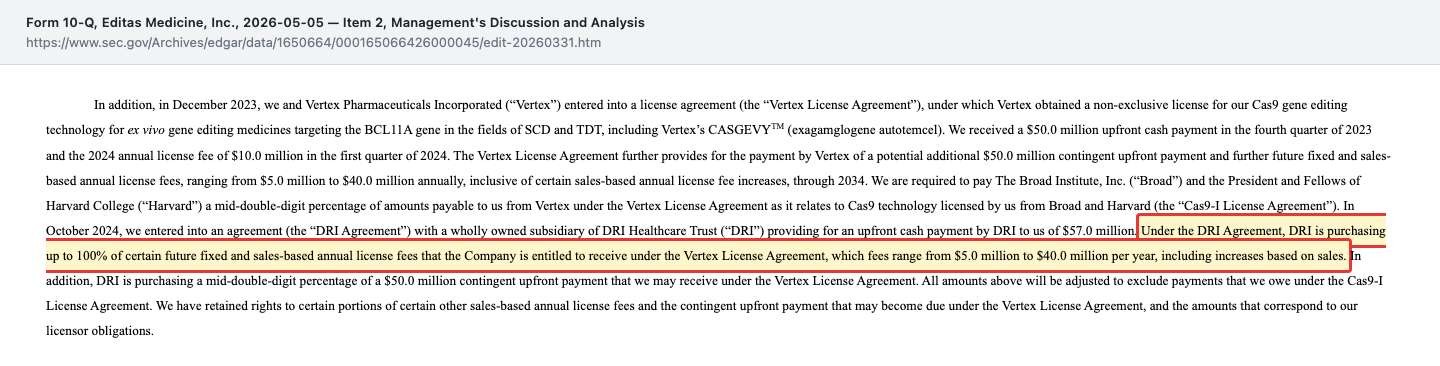
Editas received $57.0 million up front. Under U.S. accounting rules that is not a sale but a loan: the balance sheet carries a "liability for sale of future revenues" of $54.7 million as of March 31, 2026 (December 31, 2025: $58.6 million), at an estimated 7.7 percent effective interest rate. Translated into everyday terms: Editas sold the next decade of rent in advance and lives off the proceeds — the rent now goes to the buyer, the apartment stays on the balance sheet. In the first quarter of 2026 alone $5.0 million flowed out to DRI.
That is why the top line looks the way it does: $2.8 million in the first quarter of 2026, after $4.7 million in the prior-year quarter. Anyone extrapolating a run rate from the $40.5 million of 2025 revenue is counting payments that already belong to someone else.
Uncomfortable truth no. 2: Editas buried its own best program — and let go two-thirds of its staff
December 11, 2024 is the most important date in this corporate history. On that day the board resolved to end the clinical development of reni-cel, the company’s most advanced program, aimed at sickle cell disease and beta thalassemia. Work toward a licensing application stopped. Then came the second part of the decision:
"In connection with the Discontinuation, the Company’s board of directors also approved a reduction in the Company’s employee workforce by approximately 180 positions, or approximately 65% (the “Reduction”)."
— Editas Medicine, Inc., Form 10-Q for the period ended March 31, 2026, Note 12 "Restructuring and Impairment Charges"

The bill arrived in 2025: $60.7 million of restructuring and impairment charges, $40.9 million of it in the first quarter of 2025 alone — with another $12.2 million already booked in the year of the decision, for $72.9 million in total. In the first quarter of 2026 the line stood at zero — the rebuild is paid for. What remains are 87 full-time employees as of February 1, 2026, where roughly three times as many worked before the cut.
Judged fairly, that cut was not a disaster but a decision. In the same field — ex vivo editing of the BCL11A gene against sickle cell disease and beta thalassemia — Vertex was already on the market with CASGEVY, using the very Cas9 technology it licenses from Editas. Building a commercial organization against that head start would have cost hundreds of millions more. A board that abandons an unwinnable race is doing its job. It just does not change the consequence: Editas has fallen back from a clinical-stage company to a preclinical one. Nothing in today’s pipeline has ever met a patient.
Uncomfortable truth no. 3: On March 31, 2026 almost nothing was left of the equity
Equity is the part of a company that belongs to shareholders after all debts are settled — for a house it would be what is left after paying off the bank. At Editas that remainder looked like this: $134.3 million on December 31, 2024, $27.3 million on December 31, 2025 and $4.4 million on March 31, 2026 — against total assets of $149.3 million and liabilities of $144.9 million. Put differently: of every dollar on the balance sheet, three cents belonged to shareholders.
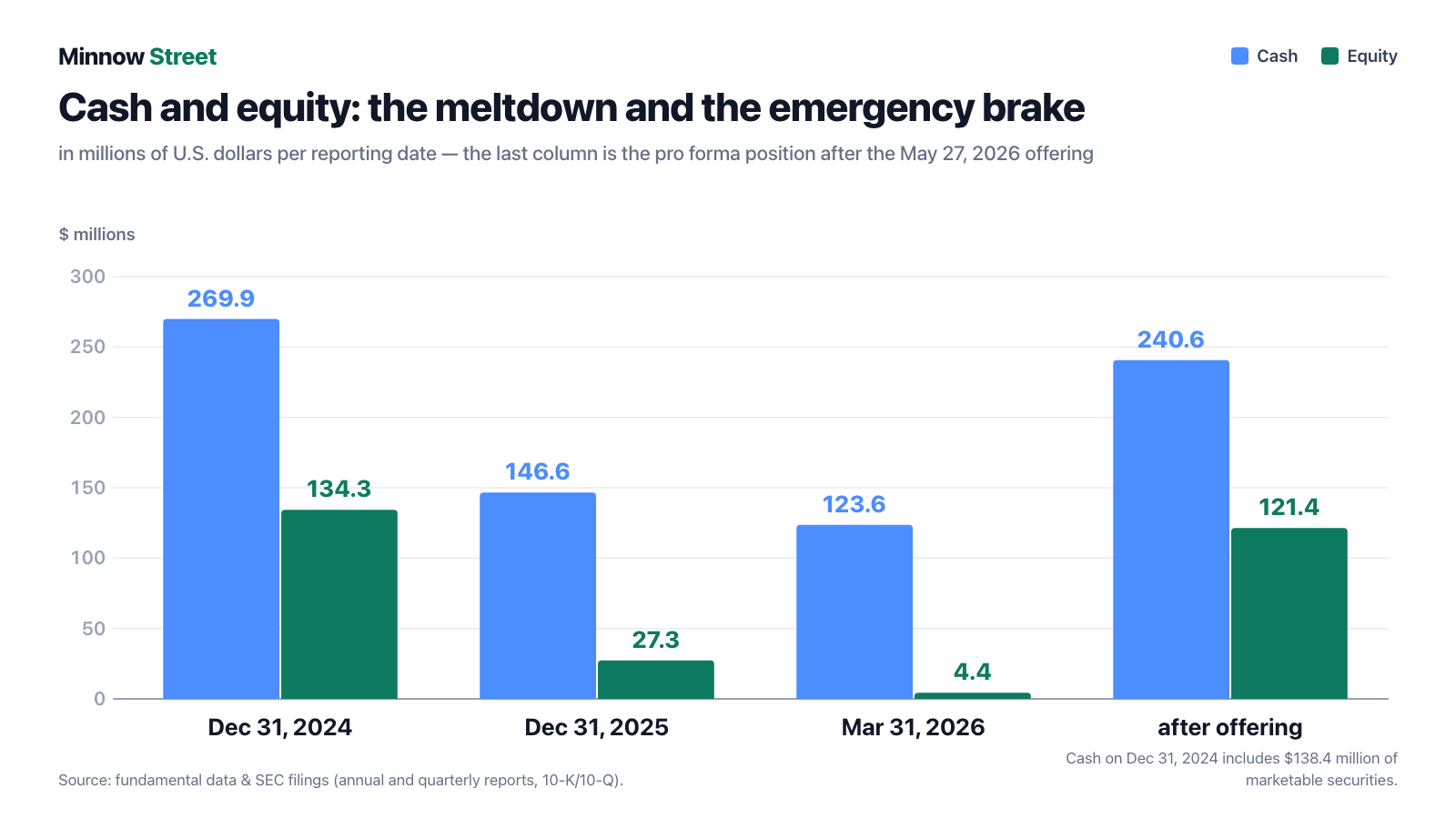
One qualification matters here. Most of those liabilities are not bank debt. The $144.9 million consist essentially of three blocks — the DRI license liability ($54.7 million), deferred revenue from partner agreements ($44.5 million, of which $40.5 million relates to the BMS collaboration) and lease obligations for the laboratories ($17.3 million). The interest-bearing and lease-related items together come to roughly $72.0 million. There is no callable bank loan that could topple the company overnight. But the buffer was gone, and Editas says why:
"The Company had an accumulated deficit of $1.7 billion at March 31, 2026, and will require substantial additional capital to fund its operations. The Company has never generated any product revenue."
— Editas Medicine, Inc., Form 10-Q for the period ended March 31, 2026, Note 1 "Nature of Business", Liquidity
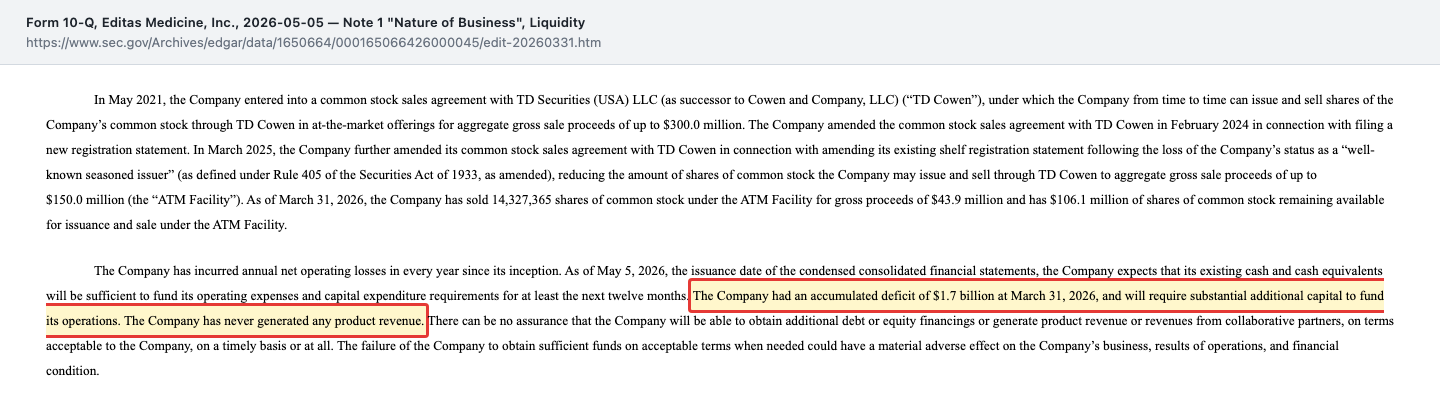
A word on the figure in that quote: the "$1.7 billion" is the rounded number Editas uses in the narrative of its report. The balance sheet in the same report puts the accumulated deficit at exactly $1,653.5 million — which is why this analysis says $1.65 billion throughout.
A going concern warning — the formal notice that survival may be in doubt — is expressly not in this filing. On May 5, 2026 Editas stated that existing funds would be sufficient for at least the next twelve months. The earnings release of the same day carries the harder number behind it: without fresh money the $123.6 million would have funded operating expenses and capital expenditures only "into the third quarter of 2027" (Form 8-K of May 5, 2026, Item 2.02). That runway was clear enough that fresh money arrived three weeks later — and it explains why the offering was no luxury.
Uncomfortable truth no. 4: The rescue cost 56 percent more shares — and carries a built-in bet
On May 26, 2026 Editas placed 55,555,556 shares. Each share came with a warrant for another share; the package cost $2.25 combined. Net proceeds are roughly $117.0 million. Shares outstanding rose from 97,906,282 (as of April 30, 2026) to 153,461,838 — up by more than 56 percent. Dilution means your slice of the cake gets smaller even if the cake stays the same size. The prospectus supplement quantifies it precisely: anyone buying at $2.25 held an as-adjusted net tangible book value of $0.79 per share — immediate dilution of $1.46 per share.
The interesting part, though, is the fine print of the warrant:
"The Common Stock Warrants will be immediately exercisable and will be exercisable from the date of issuance and will expire on the earlier of (i) the date that is 30 days following the first public announcement by the Company of Phase 1 clinical data for the Company’s product candidate, EDIT-401, that discloses at least three patients in the trial that each demonstrated greater than 80% reduction in LDL-cholesterol as compared to baseline with at least one (1) month of follow-up and (ii) the date that is three years after the date of issuance."
— Editas Medicine, Inc., Form 8-K of May 26, 2026, Item 1.01 "Public Offering"
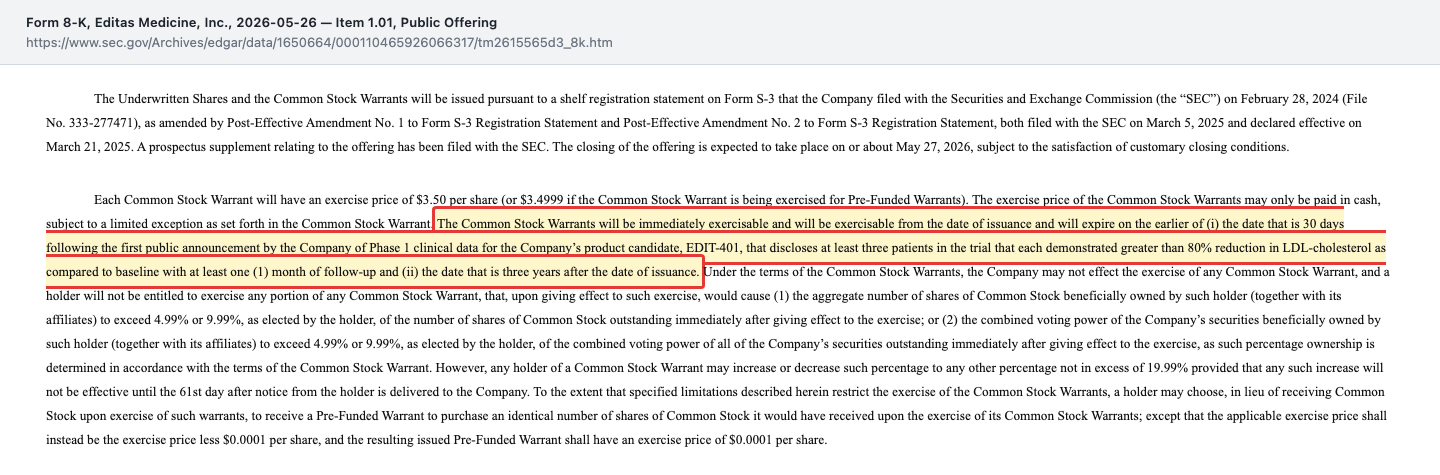
Read that again: it is not the bad news that kills the warrant, it is the good news. If Editas reports convincing Phase 1 data, holders get 30 days to subscribe at $3.50 a share — otherwise the right lapses. For Editas that means up to $192.5 million of additional capital in the success case, and another 55.6 million shares for everyone else. The design is clever and candid at once: it states openly that the next funding step hangs on one number in one trial.
Then there are the usual dilution items. As of April 30, 2026 there were 12,138,251 employee stock options outstanding (weighted-average exercise price $5.99), plus 484,778 unvested restricted stock units and a further 11.3 million shares reserved for employee plans. Together with the warrants that is roughly 79 million potential new shares, on top of the 153.5 million already outstanding. Authorized capital stands at 390 million shares; that ceiling was doubled from 195 million in 2025. There is ample room for further raises, and the at-the-market program still had $106.1 million of capacity as of March 31, 2026.
Valuation — what the market pays for a promise
An honest note first: for a company without product revenue there is no serious metric that answers "cheap" or "expensive." What can be calculated is the order of magnitude, and it goes like this. As of the data cut-off for this analysis (July 28, 2026) the fundamental data put the market value at roughly $402 million: the 153,461,838 shares outstanding after the offering times a closing price of $2.62. Cross-check against the last price Editas itself recorded in a mandatory filing — $2.76 on May 22, 2026, or roughly $424 million: the two calculations sit a good five percent apart, so the order of magnitude holds.
From that you may subtract the cash: $123.6 million on March 31, 2026 plus $117.0 million of net proceeds from the offering, so roughly $241 million on a pro forma basis, before the second-quarter burn. Add back the interest-bearing and lease-related obligations of $72.0 million. On balance the market is paying roughly $230 million for the patents, the platform, the BMS alliance and EDIT-401. Whether that is a lot or a little rests on a single question: does the liver gene-editing approach work in humans?
For the revenue side: against 2025 revenue of $40.5 million the price-to-sales ratio is just under 10. Annualize the first quarter of 2026 ($2.8 million times four) and it is about 36. Both figures are distortions, because revenue consists of one-time payments and milestones nobody can schedule — and because there is barely any of Editas’s own money behind the recurring Vertex fees: the annual report (10-K) for 2025 still books the annual license fee as $10.0 million of revenue, but the cash behind it repays the DRI liability, and a mid-double-digit percentage flows back to Broad and Harvard. Remember this: at Editas the price-to-sales ratio is a coincidence, not a yardstick.
What can be stated reliably is how far the money reaches. Editas quantifies it itself:
"We estimate that the net proceeds from this offering, together with our existing cash and cash equivalents, and assuming no exercise of the common stock warrants being issued in this offering, will be sufficient to enable us to fund our operating expenses and capital expenditure requirements into the second half of 2028."
— Editas Medicine, Inc., Form 424B5 prospectus supplement of May 26, 2026, "Use of Proceeds"
A little over two years — that is how long the money lasts. On the company's own schedule the verdict arrives much sooner: early human proof-of-concept data by the end of 2026, full dose-finding results in 2027. If they land, the warrant clause pulls up to $192.5 million more into the treasury. If it does not, the next capital raise is due, and under the current authorization that would be entirely possible.
Opportunities and risks at a glance
Opportunities
- Real, defended intellectual property. Vertex pays annual fees for the Editas Cas9 technology through 2034; BMS has built 14 programs on it, including a CD19 CAR T program in Phase I clinical development. These are paying, scrutinizing partners — not a prospectus promise. And the long-running fight over who invented that Cas9 technology first went Broad's way for the third time: on March 26, 2026 the Patent Trial and Appeal Board of the U.S. patent office reaffirmed its earlier decision (Form 10-Q for the period ended March 31, 2026).
- The cost program is finished. Research at $90.0 million instead of $199.2 million, administration at $49.9 million instead of $72.0 million, quarterly loss at $25.0 million instead of $76.1 million. The restructuring line stood at zero in the first quarter of 2026 — the rebuild is paid for.
- Funded into the second half of 2028. Roughly $241 million of pro forma cash against $23.1 million of operating cash burn in the first quarter of 2026, no callable bank loan, and no going concern warning in the report filed May 5, 2026.
- A preclinically demonstrated mechanism. On May 14, 2026 Editas reported that EDIT-401 achieved a mean LDL cholesterol reduction of 90 percent or greater across all dose groups in non-human primates, durable through roughly six months — with only 10 to 40 percent of LDLR alleles functionally edited.
- Optional inflows without a new placement. Up to $192.5 million from the warrants and a possible further $50.0 million contingent upfront payment under the Vertex agreement, in which Editas retains a share after the DRI portion.
Risks
- No medicine, no patient, no product revenue — ever. Every program is preclinical or in research; accumulated deficit stands at $1.65 billion as of March 31, 2026.
- Everything hangs on one molecule. The annual report (10-K) for 2025 lists dependence on the success of lead candidate EDIT-401 as the very first risk factor. A setback in the first human trial hits the entire thesis.
- The recurring license stream has been sold. DRI is purchasing up to 100 percent of the future Vertex annual fees; the balance sheet carries $54.7 million of debt for it at an estimated 7.7 percent effective rate (March 31, 2026).
- Dilution is the standard financing method. Shares outstanding went from 82.7 million (end of 2024) to 97.9 million (end of 2025) to 153.5 million (after May 27, 2026), with roughly 79 million more potential shares and 390 million authorized.
- The window is finite — and the company’s own schedule is tighter still. The runway estimate ends in the second half of 2028, but the announced plan calls for a trial notification in mid-2026, a trial start in 2026, early human proof-of-concept data by the end of 2026 and dose-finding results in 2027 (prospectus supplement of May 26, 2026). No filing to date reports that the trial has begun — and in this field timelines slip routinely.
- Editas does not own the decisive Cas9 patents. They are in-licensed from The Broad Institute and Harvard University, and a mid-double-digit percentage of everything Vertex pays for them flows straight back to those two (annual report 10-K for 2025). For part of that patent family, inventorship priority had been disputed before the Patent Trial and Appeal Board since 2019; the board ruled for Broad a third time on March 26, 2026, but the other side (the University of California, the University of Vienna and Emmanuelle Charpentier) may still appeal — whether it will is open, per the quarterly report (10-Q) for the period ended March 31, 2026. Editas states that its remaining in-licensed Cas9 patents and all of its Cas12a patents were not at issue in the proceeding.
- Earning power without Vertex is thin. In the first quarter of 2026, $2.8 million of revenue stood against $27.8 million of operating expenses. No revenue at all was recognized from the BMS collaboration in that quarter or the prior-year quarter.
A human conclusion
Back to the pioneer trap. It is so persistent because it holds a kernel of truth: Editas is a pioneer. The patents are real, Vertex pays for them, BMS builds on them, and the May 2026 data look remarkable for a preclinical program. But "got there first" does not imply "gets paid first." Ten years after going public, Editas has spent $1.65 billion, discontinued its own best program, let go two-thirds of its staff, sold its recurring license stream — and stands today with a candidate that has never treated a human being.
What you buy here is therefore not a company with a business but a well-funded, extremely concentrated bet: that a liver gene-editing therapy does in humans what it did in monkeys, and shows it before the money runs out — on the company’s own schedule as early as the end of 2026, at the latest by the second half of 2028. The company does not hide that. It literally wrote the bet into its warrants. That is more honest than much of what this industry sells.
Which leaves the uncomfortable reminder about the trap. Anyone who turns "CRISPR pioneer" into "winner" has not read the filing. Anyone who does read it sees a tidily reorganized company with one open question — and it happens to be the most important one of all. What you make of that is your decision. And that is exactly as it should be.
Sources
- Editas Medicine, Inc. — Form 10-K for 2025 (filed March 9, 2026)
- Editas Medicine, Inc. — Form 10-Q for the period ended March 31, 2026 (filed May 5, 2026)
- Editas Medicine, Inc. — Form 10-K for 2024 (filed March 5, 2025)
- Editas Medicine, Inc. — Form 10-K for 2022 (filed February 22, 2023)
- Editas Medicine, Inc. — Form 8-K of May 26, 2026 (Item 1.01, share and warrant offering)
- Editas Medicine, Inc. — Form 424B5 prospectus supplement of May 26, 2026 (dilution, use of proceeds, runway)
- Editas Medicine, Inc. — Form 8-K of May 14, 2026 (EDIT-401 data at the ASGCT annual meeting)
- Editas Medicine, Inc. — Form 8-K of May 5, 2026, Item 2.02 with the first-quarter 2026 earnings release (cash runway before the offering)
- Editas Medicine, Inc. — Form 8-K of March 27, 2026 (Patent Trial and Appeal Board decision in favor of the Broad Institute)
- Editas Medicine, Inc. — Form 8-K of April 7, 2026 (change of independent registered public accounting firm to PricewaterhouseCoopers)
- Editas Medicine, Inc. — Form 8-K of June 18, 2026 (results of the annual meeting)
- Complete SEC filing history of Editas Medicine, Inc.: EDGAR overview (sec.gov)
- Fundamental data (metrics, valuation, share count; data as of July 29, 2026), reconciled with the SEC filings.
Transparency & disclaimer: this analysis is journalistic commentary on publicly available information. It is not investment advice, not a financial analysis in any regulatory sense and not a solicitation to buy or sell securities. Equity investments carry substantial risk up to total loss. All information without warranty; the date of each figure is noted in the text. The author holds no position in Editas Medicine shares at the time of publication.
Our Bottom Line at a Glance
- Business model & product maturity negative
- By its own statement in the quarterly report (10-Q) for the period ended March 31, 2026, Editas has never generated any product revenue; the annual report (10-K) for 2025 places every program at the preclinical or research stage. The most advanced program, reni-cel, was discontinued on December 11, 2024 — moving the company back from clinical to preclinical status.
- Revenue source & dependency negative
- The $40.5 million of 2025 revenue consists of collaboration and license income; the $78.1 million peak in 2023 was essentially the $50.0 million Vertex upfront payment. The recurring Vertex fees were sold to DRI Healthcare in October 2024 (up to 100 percent, $57.0 million upfront): they still run through revenue — $10.0 million of annual license fee in fiscal 2025 — but the cash repays the $54.7 million liability (March 31, 2026).
- Cost discipline positive
- The cost program is complete and working: research and development at $90.0 million (2025) after $199.2 million (2024), administration at $49.9 million after $72.0 million, and a quarterly loss of $25.0 million (Q1 2026) after $76.1 million (Q1 2025). The restructuring line stood at zero in the first quarter of 2026 — the $60.7 million rebuild of 2025 is paid for.
- Balance sheet & funding negative
- Equity fell from $134.3 million (December 31, 2024) to $27.3 million (December 31, 2025) and $4.4 million (March 31, 2026) against $144.9 million of liabilities. The May 26, 2026 offering brought roughly $117.0 million net but cost more than 56 percent additional shares (97,906,282 to 153,461,838). Company runway estimate: the second half of 2028.
- Scientific substance neutral
- The patents are solid enough that Vertex pays annual fees of $5.0 million to $40.0 million through 2034 and BMS has built 14 programs on them. For EDIT-401 the company reported on May 14, 2026 a mean LDL cholesterol reduction of 90 percent or greater in non-human primates, durable through roughly six months. Human evidence, however, is entirely absent.
Editas Medicine is the pioneer trap in pure form: a co-founder of the CRISPR era whose patents are good enough that Vertex and Bristol Myers Squibb pay for them — yet which, after $1.65 billion of accumulated deficit, has never earned a dollar of product revenue. Its own best program was discontinued on December 11, 2024, 65 percent of the workforce was let go, and the recurring license stream was sold to a royalty investor. Equity was down to $4.4 million on March 31, 2026; the May 26, 2026 offering brought roughly $117.0 million and more than 56 percent additional shares. What remains is a well-funded, extremely concentrated bet on a single preclinical molecule. Not investment advice.
What Our Rating Means
Open questions
The business works in principle, but one material question is open. As long as it stays open, our findings do not carry a quality verdict.
Yellow, and only just: on the latest evidence none of the hard substance findings that trigger a red light here are present. No filing carries a going concern warning; on May 5, 2026 Editas expressly stated that its funds would last at least twelve months. Equity was almost gone at $4.4 million on March 31, 2026 — but positive, and the May 26, 2026 offering lifted it to a pro forma $121.4 million. Against roughly $241 million of pro forma cash and $23.1 million of operating cash burn in the latest quarter, that reaches well beyond four quarters; there is no callable bank loan, no interest or repayment date that could topple the company, and no listing deadline. What is open is precisely the question everything rests on: since its founding in 2013 not one dollar of product revenue has been booked, $1.65 billion has been consumed, the best in-house program was discontinued on December 11, 2024, and the only recurring cash stream — the Vertex license fees — has been sold to DRI up to 100 percent and now repays debt instead of becoming income. On top of that, the decisive Cas9 patents do not belong to Editas but are in-licensed from Broad and Harvard. What remains is a single preclinical molecule whose first human data Editas itself expects by the end of 2026. A company whose outcome hangs on one readout carries no substance risk in the sense of our traffic light, but no proven quality either — hence yellow. If that readout slips or disappoints, this rating belongs back on the bench. The decision is yours.
A journalistic assessment by our editorial team at the time of the deep dive, based on public sources — not investment advice and not a solicitation to buy or sell. Your personal circumstances (investment goals, risk capacity, taxes) cannot be taken into account. What our levels mean, how verdicts are formed, and what conflicts of interest exist →
Worth Noting
- Editas Medicine reached our research list through the filing calendar of the U.S. securities regulator, the SEC: the current report (8-K) of May 26, 2026 announcing a sale of 55,555,556 shares against roughly 97.9 million then outstanding. We additionally reviewed the annual report (10-K) for 2025, the quarterly report (10-Q) for the period ended March 31, 2026 and every SEC filing through July 29, 2026.
- Every figure carries its own reporting date. The shortest-lived are equity ($4.4 million at March 31, 2026), cash ($123.6 million at March 31, 2026) and share count (153,461,838 after May 27, 2026) — all of which move with each quarterly report and each further capital measure.
- The market value of roughly $402 million is the calculation 153,461,838 shares times a $2.62 closing price as of the July 28, 2026 data cut-off, and it moves with every trading day. The cross-check is the last price Editas itself recorded in an SEC document (prospectus supplement of May 26, 2026, price of May 22, 2026: $2.76, or roughly $424 million) — the gap of a good five percent confirms the order of magnitude. Do not confuse the parties: CASGEVY belongs to Vertex Pharmaceuticals, not to Editas, which holds only a license position in it.
Frequently Asked Questions
Editas Medicine, Inc. (NASDAQ: EDIT) of Cambridge, Massachusetts develops medicines based on the CRISPR gene-editing tool using the Cas9 and Cas12a enzymes. Since late 2024 the company has focused on in vivo gene editing: the medicine is injected and edits cells inside the body. Its lead candidate is EDIT-401 for elevated blood lipids. Editas had 87 full-time employees as of February 1, 2026.
No. The quarterly report (10-Q) for the period ended March 31, 2026 states verbatim that the company has never generated any product revenue. According to the annual report (10-K) for 2025, every program sits at the preclinical or research stage. Accumulated deficit since inception stands at $1.65 billion as of March 31, 2026. The company has announced that its first-in-human study should start in 2026, with early efficacy data expected by the end of 2026.
From licenses and partnerships, not product sales. Revenue was $40.5 million in 2025, $32.3 million in 2024 and $78.1 million in 2023 — the 2023 peak was essentially a $50.0 million upfront payment from Vertex for a non-exclusive Cas9 license. Only $2.8 million was left in the first quarter of 2026.
In December 2023 Editas granted Vertex Pharmaceuticals a non-exclusive license to its Cas9 technology for ex vivo medicines targeting the BCL11A gene — the field in which Vertex's CASGEVY operates. Editas received $50.0 million upfront and a $10.0 million annual fee for each of 2024 and 2025; ongoing fees of $5.0 million to $40.0 million a year run through 2034.
Because Editas sold it in October 2024. Royalty investor DRI Healthcare is purchasing up to 100 percent of the future Vertex annual fees and paid $57.0 million upfront. Under U.S. accounting rules that counts as a loan: $54.7 million sits on the balance sheet as of March 31, 2026, at an estimated 7.7 percent effective interest rate.
On December 11, 2024 the board resolved to end clinical development of reni-cel for sickle cell disease and beta thalassemia and to cut about 180 positions — roughly 65 percent of the workforce. In the same field Vertex was already on the market with CASGEVY, using licensed Editas technology. The restructuring cost $60.7 million in 2025.
By the company's own estimate in the prospectus supplement of May 26, 2026, net proceeds of roughly $117.0 million from the offering plus existing funds reach into the second half of 2028 — assuming no exercise of the warrants issued in that offering. Cash stood at $123.6 million on March 31, 2026; without the offering, the May 5, 2026 earnings release put that at only "into the third quarter of 2027."
Shares outstanding rose from 82.7 million (December 31, 2024) to 97.9 million (December 31, 2025) and to 153,461,838 after the offering settled on May 27, 2026. On top of that sit 55,555,556 warrants and roughly 24.0 million shares tied to employee plans. Authorized capital is 390 million shares, doubled from 195 million in 2025.
Found an error?
Did you spot a factual error, an outdated number, or a typo in this deep dive? Let us know briefly — your report goes straight to the editorial team.