Walmart stock: $706 billion of revenue — and nearly a quarter of the profit never came from merchandise
In fiscal 2026 Walmart sold $706 billion worth of goods and kept 4.2 percent of that as operating income. Of those $29.8 billion, $6.75 billion came from membership fees and other income — at Sam's Club, more than the entire segment result. We work through the filings to show where this company's profit is actually made.
 Thomas Mücke
Founder & Publisher
Thomas Mücke
Founder & Publisher
Chart
Interactive price chart (TradingView).
Note: pure fact-based analysis, not investment advice and not a solicitation to buy or sell. All figures without guarantee.
The popcorn trap
Let us make a deal. Before we talk about the largest retailer in the world, I will admit to a mistake we have both made. You go to the cinema. The ticket costs twelve dollars, popcorn and a drink another eleven. And if somebody asked you where the cinema makes its money, you would say, without hesitation: on the film.
It does not. Most of the ticket price goes to the distributor. What is left is thin. The money sits at the counter in the lobby.
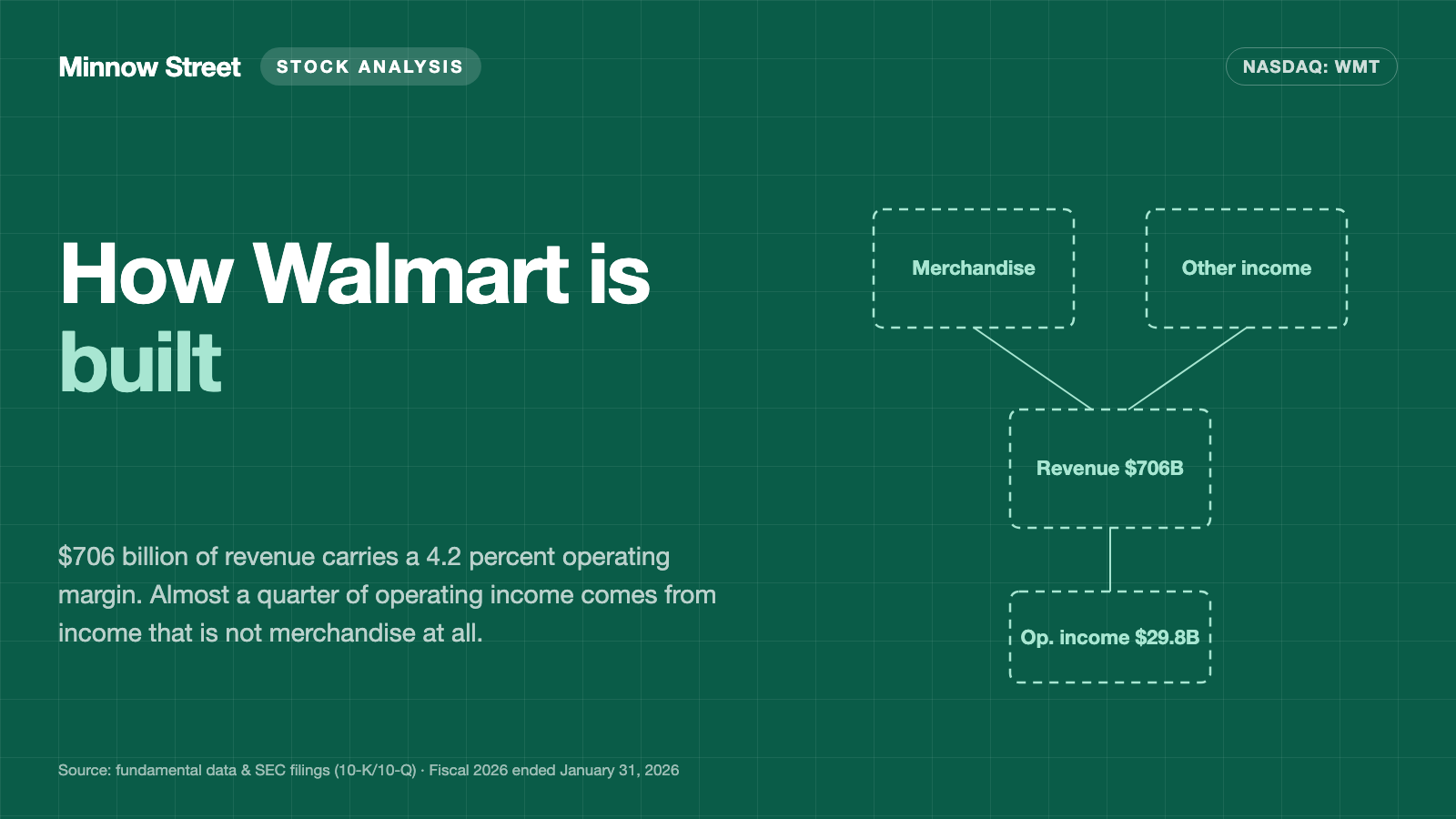
At Walmart the headline for fiscal 2026 reads: $706,413 million of revenue. That is more than any other company on earth books in a year. Operating income was $29,825 million — 4.2 percent. Of every dollar a customer leaves at the register, a little over four cents is operating profit.
And now the counter in the lobby. Of those $29,825 million, $6,750 million did not come from selling merchandise at all, but from membership fees and other income. That is 22.6 percent of operating income — from a line that is less than one percent of revenue.
Hold on to this tension, because it runs through every chapter: Walmart earns remarkably little on merchandise, and the part of the profit that is not merchandise keeps getting more important. Let us read it together, line by line.
Contents
- What Walmart actually does — and why the fiscal year is shifted
- How this stock landed on our desk
- The numbers over the years — honestly credited
- What the filings say — the uncomfortable truths
- Valuation: what you pay for this retailer
- Opportunities and risks at a glance
- A human conclusion
- Sources
What Walmart actually does — and why the fiscal year is shifted
Let us start with the trap that catches every second Walmart write-up. Walmart's fiscal year ends on January 31. "Fiscal 2026" ran from February 1, 2025 through January 31, 2026 and therefore covers essentially calendar year 2025.
The reason is mundane and typical of retail: after Christmas and the January clearance the shelves are empty and taking inventory is cheap. For you it means this: when you read "fiscal 2026" here, think 2025. Otherwise you will compare Walmart against everyone else a full year too early.
The company reports in three segments. In order, with fiscal 2026 figures:
- Walmart U.S.: $482,975 million of net sales, 68 percent of the group. 4,611 stores across all 50 states, Washington D.C. and Puerto Rico. Operating income $25,158 million, a margin of 5.2 percent.
- Walmart International: $130,423 million, 19 percent. 5,743 stores in 18 countries — Mexico and Central America, China, Canada, Chile, India and southern Africa. Operating income $5,103 million, a margin of 3.9 percent.
- Sam's Club U.S.: $93,015 million, 13 percent. 601 clubs you can only enter with a membership card. Operating income $2,442 million, a margin of 2.6 percent.
What Walmart sells is less colourful than the store looks. At Walmart U.S., fiscal 2026 grocery sales were $285,482 million — 59.1 percent of segment net sales. At Sam's Club the figure is 69.6 percent. Walmart is primarily a supermarket that happens to sell televisions, not the other way round.
And then there is what the company calls its "ecosystem": advertising for brands and marketplace sellers, fulfillment services for third-party sellers, data insights for suppliers, memberships (Walmart+ and Sam's Club) and financial services. These businesses are tiny in revenue and large in profit. They are the reason this article exists.
One thing that is easy to get wrong: Walmart Inc. is not Walmex. Walmart de México y Centroamérica is a majority-owned subsidiary with its own listing in Mexico City. And if you are looking for older time series: until January 31, 2018 the company was called Wal-Mart Stores Inc.
One more detail many databases still get wrong: the shares have traded on the Nasdaq Global Select Market since late 2025, no longer on the New York Stock Exchange. The fiscal 2025 annual report still named the NYSE, the fiscal 2026 report names Nasdaq; the delisting was filed as a Form 25 on December 8, 2025. The ticker WMT stayed put.
How this stock landed on our desk
This time it was not a hit from our in-house stock scanners. Those filter on metrics — cheap valuation, high balance-sheet quality scores, momentum — and that is precisely why the best-known heavyweights fall through: they are rarely cheap. When we counted on July 28, 2026 how many of the 100 largest U.S. stocks by market value already had a deep-dive analysis here, 88 did not. Walmart was the largest retailer among them, at number 13 with roughly $900 billion of market value (data as of July 29, 2026).
That is an honest statement about our own method: a scanner hunting for bargains will not find blue chips. So we are working the list from the top down.
Walmart is worth the look because two worlds meet here that we have already examined separately. On one side sits online retail: Amazon demonstrated how to earn more from advertising and marketplace fees than from the goods themselves — Walmart is now building that same second storey on top of a store network. On the other side sits the technology that is changing how people shop: when software works through the shopping list, it changes who ever sees the customer at all. How much money flows into that software we worked out at Microsoft. Walmart now names exactly this development as a risk — more on that below.
The numbers over the years — honestly credited
Start with what genuinely impresses. A company this size normally stops growing. Walmart has not — and it has grown remarkably evenly. All figures in millions of U.S. dollars, all from the fiscal 2026 annual report:
| Fiscal year (ends Jan 31) | Net sales | Gross profit | Operating expenses | Operating income | Margin | EPS |
|---|---|---|---|---|---|---|
| 2024 (= calendar 2023) | 642,637 | 152,495 | 130,971 | 27,012 | 4.2% | $1.91 |
| 2025 (= calendar 2024) | 674,538 | 162,785 | 139,884 | 29,348 | 4.4% | $2.41 |
| 2026 (= calendar 2025) | 706,413 | 171,018 | 147,943 | 29,825 | 4.2% | $2.73 |
Three things deserve a second look. First: net sales grew by $63.8 billion in two years. That is like founding a company the size of Lockheed Martin on the side. Second: gross margin climbed from 23.7 to 24.2 percent — in retail, half a percentage point is a great deal of work. Third: earnings per share rose 43 percent while operating income rose only 10 percent.
That gap is the first clue that the earnings series is not as smooth as it looks. It has three causes: buybacks shrink the share count, investment valuations swing, and the tax rate moves. More on each in a moment.
What Walmart achieves operationally shows up best in cash, not in earnings. Operating cash flow rose from $35,726 million (fiscal 2024) through $36,443 million to $41,565 million. After $26,642 million of capital expenditure, $14,923 million of free cash flow remained. And the return on investment the company discloses itself stood at 15.1 percent, after 15.5 percent a year earlier.
Now the question this article is about: where exactly does that operating income come from?
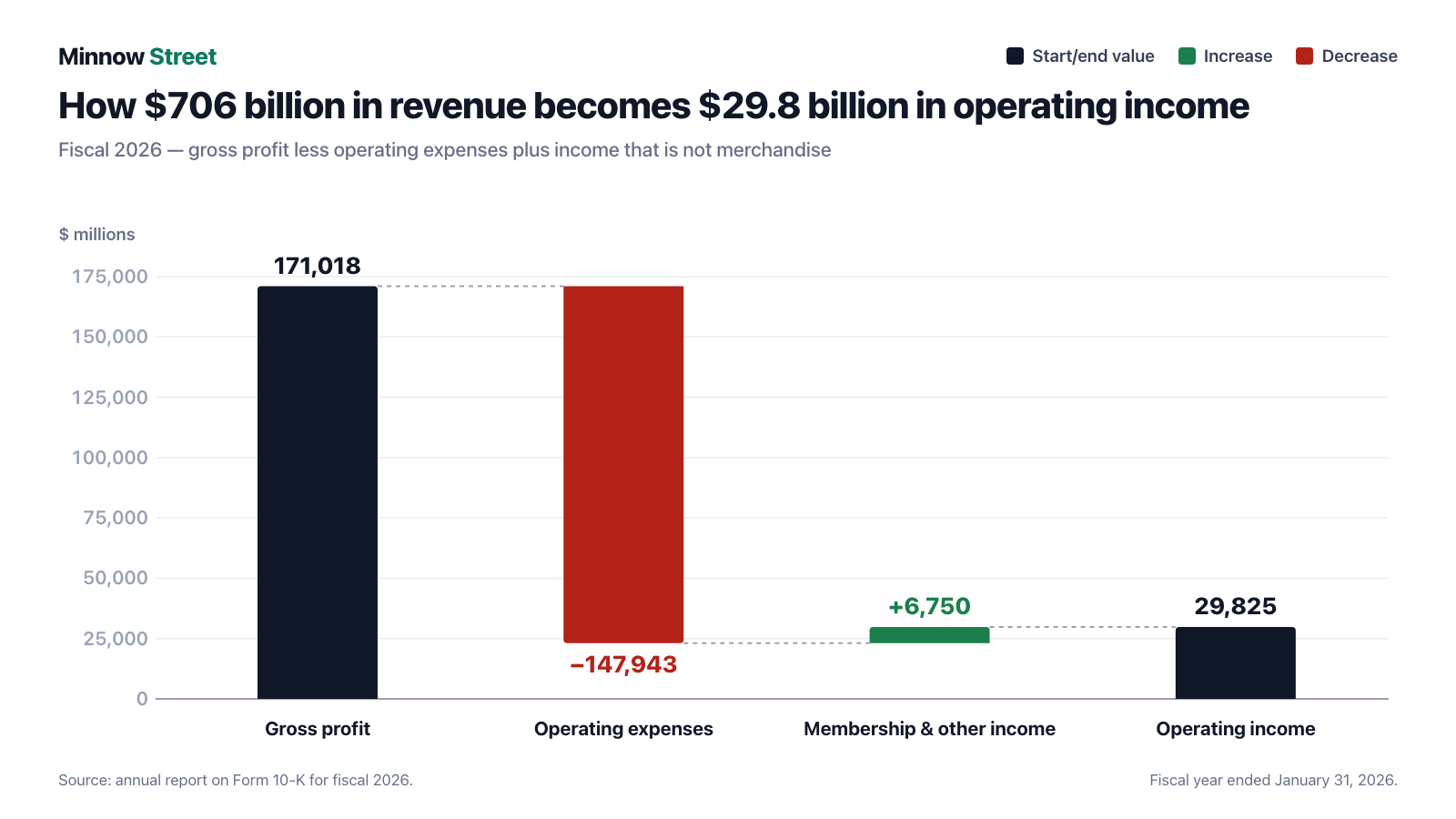
The green bar is small and decisive all the same. Without it, operating income would be $23,075 million rather than $29,825 million — and the operating margin 3.3 percent rather than 4.2 percent.
What the filings say — the uncomfortable truths
Uncomfortable truth no. 1: almost a quarter of operating profit is not a merchandise margin
In the filings the line is called "Membership and other income". It covers membership fees for Walmart+ and Sam's Club, rental and tenant income, recycling income and the value of gift cards that are never redeemed. What it does not cover is the margin on goods sold.
The series: $5,488 million (fiscal 2024), $6,447 million (fiscal 2025), $6,750 million (fiscal 2026). Against revenue that is not even one percent in any of those years. Against operating income it is 20.3, 22.0 and 22.6 percent — and the share rises every year.
The hardest part of it is membership fees alone. The notes to the annual report name the figure:
"Membership fee revenue was $4.4 billion, $3.8 billion and $3.1 billion for fiscal 2026, 2025 and 2024, respectively."
— Walmart Inc., annual report on Form 10-K for fiscal 2026, Note 1

That is growth from $3.1 billion to $4.4 billion in two years — up 42 percent. For comparison, operating income grew 10 percent over the same period. And membership fees are almost pure margin; an extra fee carries almost no extra cost.
On top of that sits a business that never appears as its own line item, because depending on the contract it is booked either in net sales or as a reduction of cost of sales: advertising. In the proxy statement dated April 23, 2026, the board cites growth of 46 percent in the global advertising business as a fiscal 2026 achievement. In the quarter ended April 30, 2026 the earnings release put it at 37 percent globally and 36 percent at Walmart U.S.
How differently the three segments depend on this ancillary income shows up in the second chart:
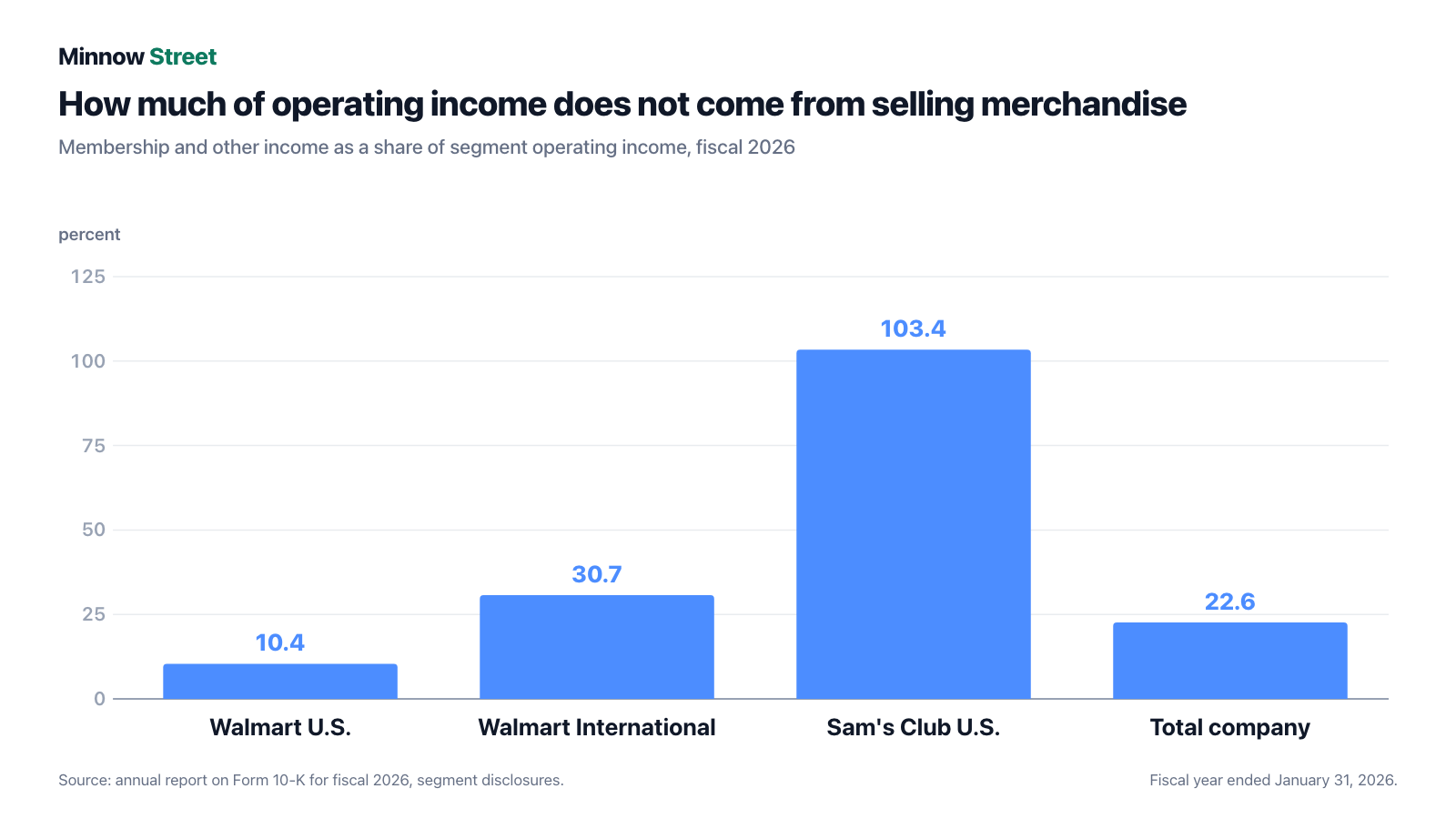
Uncomfortable truth no. 2: at Sam's Club, selling merchandise now earns exactly nothing
The third bar above is not a rounding error. Work through the segment table in the annual report: Sam's Club U.S. produced gross profit of $10,556 million in fiscal 2026. Segment operating expenses came to $10,639 million. That is minus $83 million from selling goods.
The reported segment operating income of $2,442 million therefore comes entirely from membership and other income of $2,525 million. Two years earlier it was different: in fiscal 2024 merchandise contributed a positive $141 million, in fiscal 2025 a positive $81 million. That change of sign vanishes behind "segment operating income up slightly".
Walmart makes no secret of it. In the business section of the annual report the sentence is as plain as it can be:
"As a membership-only club, membership income is a significant component of the segment's operating income."
— Walmart Inc., annual report on Form 10-K for fiscal 2026, Item 1

In the most recent quarterly report, for the quarter ended April 30, 2026, the arithmetic gets sharper. Sam's Club booked $23,405 million of net sales against cost of sales of $20,731 million — gross profit of $2,674 million. Segment operating expenses: $2,674 million as well. Segment operating income of $674 million matches membership and other income for the same quarter to the dollar.
A rule of thumb for your model: at Sam's Club, the merchandise is the argument that sells the membership — the money is made on the membership. That is a perfectly legitimate business model; Costco has run it for decades. You just should not mistake it for the business model of a retailer.
Uncomfortable truth no. 3: the fiscal 2026 earnings jump largely came from securities prices
Consolidated net income rose in fiscal 2026 from $20,157 million to $22,270 million — up $2,113 million. Operating income in the same year rose by only $477 million. Where does the rest come from?
From a line that sits below operating income and has nothing to do with retailing: valuation changes on equity investments and securities. The notes put a number on it:
"Other gains and losses included a gain of $2.1 billion and losses of $0.8 billion and $3.0 billion for fiscal 2026, 2025, and 2024, respectively, driven primarily by fair value changes on these investments, as well as other immaterial activity."
— Walmart Inc., annual report on Form 10-K for fiscal 2026, Note 7

For the model that means: of the $2,113 million of extra profit, roughly $2,869 million comes from the swing on this line alone — from minus $794 million to plus $2,075 million. Without it, earnings would have fallen rather than risen.
Fairness requires the other direction, because it is just as much a one-off: fiscal 2026 operating expenses include $0.7 billion of non-cash charges from modified share-based payment arrangements at the Indian payments subsidiary PhonePe — per the filing, "in contemplation of a potential initial public offering". Because that charge carried no tax benefit, the effective tax rate rose from 23.4 to 24.4 percent. On top of that came roughly $0.9 billion of higher self-insured general liability claims expense.
And one more figure from the same disclosure worth remembering: as of January 31, 2026 roughly $3 billion of unrecognized compensation cost sat in subsidiary plans, partly conditional on an initial public offering. If it lands, it lands in a single reporting period.
Uncomfortable truth no. 4: Walmart itself now names software as a traffic risk
This is where it gets interesting. We laid the fiscal 2026 annual report next to the prior-year report and searched for a single word: agentic — software that shops on its own. In the fiscal 2025 report it appears not once. In the fiscal 2026 report it appears five times.
The most important of those sentences sits in the risk factors and names a very specific mechanism:
"In addition, a greater concentration of eCommerce sales, including increasing online grocery sales and the increasing role of AI-enabled platforms in product search, discovery, advertising and purchasing, could result in a reduction in the amount of traffic in our stores and clubs, which would, in turn, reduce the opportunities for cross-store or cross-club sales of merchandise that such traffic creates and could reduce our sales within our stores and clubs and materially adversely affect our financial performance."
— Walmart Inc., annual report on Form 10-K for fiscal 2026, Item 1A (Risk Factors)

The point is subtler than it first sounds. Walmart is not afraid of selling online — global eCommerce sales rose 24 percent in fiscal 2026 to more than $150 billion, and to $99.6 billion at Walmart U.S. alone. The worry is about the add-on sale: someone driving to the store for milk leaves with detergent and a T-shirt as well. Someone who lets software order the milk leaves with nothing else.
In the same section the report lists "emerging agentic shopping tools and platforms" explicitly among its competitors and warns that "more rapid development of AI capabilities and agentic tools by these competitors" may increase competitive pressure. For a company running 4,611 U.S. stores and 1,057 million square feet of retail space, that sentence carries weight.
Uncomfortable truth no. 5: shareholder returns exceeded free cash flow for the first time
Walmart has paid a dividend for more than fifty years and raises it every year. Fiscal 2026 brought $0.94 per share; $0.99 has been approved for fiscal 2027. Nothing unusual there.
The sum next to it is unusual. In fiscal 2026 Walmart paid $7,507 million in dividends and repurchased $8,088 million of its own shares — $15,595 million together. Free cash flow the same year was $14,923 million. Compare the two prior years:
| Fiscal year | Free cash flow | Dividends | Buybacks | Coverage |
|---|---|---|---|---|
| 2024 | 15,120 | 6,140 | 2,779 | +6,201 |
| 2025 | 12,660 | 6,688 | 4,494 | +1,478 |
| 2026 | 14,923 | 7,507 | 8,088 | −672 |
All figures in millions of U.S. dollars. A $672 million shortfall is no emergency for a company this size — Walmart took on net new borrowings the same year and raised a further $4.25 billion in the bond market in April 2026. But it shows that buybacks are now partly funded from the balance sheet rather than purely from the running business. And it explains why the share count is falling faster than it used to: 85.0 million shares retired in fiscal 2026, after 61.9 million and 54.6 million in the prior years, at an average price of $95.13.
Valuation: what you pay for this retailer
Here it gets uncomfortable, in a direction that has nothing to do with the quality of the business. As of July 29, 2026 Walmart was worth roughly $900 billion. Against reported earnings that is a trailing price/earnings ratio of roughly 39 and a forward multiple of roughly 38. The shares trade at 9.2 times book value.
For context: those are multiples you see on software and growth names. Walmart grows 4 to 5 percent a year and earns a 4.2 percent operating margin. Historically, a retailer with that margin was valued somewhere between 15 and 25 times earnings.
Two ratios look harmless and are not. Price/sales of roughly 1.23 seems low — but for a business on a 4 percent margin, sales is the wrong denominator; a software firm on a 30 percent margin at the same ratio would be something else entirely. And return on equity of roughly 24 percent sounds superb, yet a good part of it comes from Walmart keeping little equity on the balance sheet through buybacks.
The analyst consensus at the same date was a mean price target of roughly $138. That is the professionals' view, not a law of nature — and it assumes the high-margin ancillary businesses keep growing as they have.
The company itself reiterated its fiscal 2027 guidance on May 21, 2026: net sales up 3.5 to 4.5 percent in constant currency, measured against fiscal 2026 net sales of $706.4 billion, adjusted operating income of $31.0 billion and adjusted EPS of $2.64. For the second quarter it guided to net sales growth of 4.0 to 5.0 percent and adjusted EPS of $0.72 to $0.74.
Opportunities and risks at a glance
Opportunities
- The ancillary businesses are growing at double digits. Membership fee revenue from $3.1 billion to $4.4 billion in two years, global advertising up 46 percent in fiscal 2026 and 37 percent in the quarter ended April 30, 2026. This income is high-margin and it binds customers.
- Grocery as an anchor. 59.1 percent of U.S. segment sales are groceries — the corner of retail that suffers least in downturns and brings customers back regularly.
- Online is working. More than $150 billion globally, up 24 percent in fiscal 2026 and 26 percent in the quarter ended April 30, 2026, carried by store-fulfilled pickup and delivery — that is, using assets that already exist.
- Balance sheet and cash flow are solid. $41,565 million of operating cash flow, $99,617 million of shareholders' equity and $34,624 million of long-term debt as of January 31, 2026; operating income covers interest paid more than ten times over.
- Price leadership in a strained environment. Walmart U.S. comparable sales rose 4.3 percent in fiscal 2026 and 4.1 percent in the quarter ended April 30, 2026, driven by more customer transactions rather than by price alone.
- Buybacks with room to run. A new $30,000 million authorization since February 2026, of which $28.2 billion remains.
Risks
- The merchandise margin is wafer thin. 3.3 percent of net sales without the ancillary income. One extra percentage point of cost of sales or labour would eat roughly a quarter of operating income.
- Dependence on ancillary income. 22.6 percent of group operating income and 103.4 percent at Sam's Club. Advertising budgets and memberships are more cyclical than groceries.
- Quality of earnings. The swing in investment valuations from minus $794 million to plus $2,075 million contributed more to the increase in earnings than the operating business did.
- Channel shift driven by software. The company's own annual report names AI-enabled platforms and agentic shopping tools as a risk to store traffic and the add-on sales it generates.
- Inventories growing faster than sales. At April 30, 2026 they stood at $62,570 million, up 8.9 percent year over year against 7.3 percent revenue growth; at Sam's Club they rose 14.9 percent.
- Shareholder returns above free cash flow. Dividends and buybacks came to $15,595 million in fiscal 2026 against free cash flow of $14,923 million.
- Open litigation without accrual. The opioid cases outside the settlement are not accrued; the Florida Health Sciences Center retrial begins on August 27, 2026 and the Department of Justice case is set for November 2027.
- Controlling shareholder. Walton Enterprises held 44.11 percent of the votes as of April 10, 2026. In a conflict of interest, the family decides in practice.
- Valuation. Roughly 39 times trailing earnings and 9.2 times book value leave little room for disappointment.
A human conclusion
Back to the cinema. The film is good, the ticket is priced to the bone, and the money sits at the counter. That is how Walmart worked in fiscal 2026: $706 billion of revenue, a 4.2 percent margin — and almost a quarter of operating income from memberships, advertising, rents and fees.
That is not an accusation; it is a compliment to the merchants. Anyone moving $285 billion of groceries a year has earned the right to make money from those customers' attention a second time. And Walmart says so itself: "growth in higher margin businesses, such as digital advertising" is a stated objective in its own annual report.
What is equally true: at Sam's Club merchandise now contributes a loss. The fiscal 2026 earnings jump came mostly from a line below operating income. Dividends and buybacks exceeded free cash flow for the first time. And the risk section now carries a sentence that was not there before — about software that shops without anyone walking past the candy aisle.
Both sit in the same filings, signed by the same people. There is no secret version. There is only the question of which part of the business you consider the core — the merchandise, or the counter in the lobby.
What you make of that is your decision. And that is exactly as it should be.
Sources
- Walmart Inc., annual report on Form 10-K for fiscal 2026, period ended January 31, 2026, filed March 13, 2026 (CIK 0000104169)
- Walmart Inc., quarterly report on Form 10-Q for the period ended April 30, 2026, filed May 29, 2026
- Walmart Inc., first quarter fiscal 2027 earnings release (Form 8-K, Item 2.02, Exhibit 99.1) dated May 21, 2026
- Walmart Inc., proxy statement (Form DEF 14A) dated April 23, 2026 — founding family ownership, chief executive succession
- Walmart Inc., annual report on Form 10-K for fiscal 2025, filed March 14, 2025 — comparison basis for the risk factors and the listing venue
- SEC EDGAR filing index for Walmart Inc. (CIK 0000104169) — review of every filing from March 13, 2026 onward
- Fundamental data (market value, valuation multiples, analyst consensus), data as of July 29, 2026
This analysis is journalistic commentary on publicly available corporate filings. It is not investment advice, not a recommendation to buy or sell, and not a solicitation to buy or sell securities. Shares can lose substantial value, up to total loss. All figures come from the sources named above and carry the reporting date stated there; they may have changed since. The author holds no position in Walmart Inc. at the time of publication.
Our Bottom Line at a Glance
- Market position and business model positive
- The largest retailer in the world: $706,413 million of revenue in fiscal 2026, 10,955 locations across 19 countries, roughly 2.1 million associates. All three segments are growing and profitable; Walmart U.S. comparable sales rose 4.3 percent after 4.8 percent a year earlier, and global eCommerce sales passed $150 billion (Form 10-K fiscal 2026, DEF 14A dated April 23, 2026).
- Earnings mix neutral
- Of fiscal 2026 operating income of $29,825 million, $6,750 million — 22.6 percent — came from membership and other income. At Sam's Club the share is 103.4 percent, with merchandise contributing minus $83 million. That is commercially smart and high-margin, but it ties the result to member counts, advertising budgets and marketplace fees rather than to selling goods (Form 10-K fiscal 2026, segment disclosures).
- Quality of earnings negative
- Consolidated net income of $22,270 million includes a $2,075 million valuation gain on equity investments, whereas the prior years carried losses of $794 million and $3,027 million. That $2.9 billion swing in a single year has nothing to do with retailing. Working the other way, a $0.7 billion non-cash PhonePe charge and roughly $0.9 billion of higher self-insured claims expense weighed on the result (Form 10-K fiscal 2026, Note 7 and Item 7).
- Balance sheet and capital discipline neutral
- The balance sheet is solid: $99,617 million of shareholders' equity, $34,624 million of long-term debt and $41,565 million of operating cash flow as of January 31, 2026. But in fiscal 2026 the dividend ($7,507 million) and buybacks ($8,088 million) together came to $15,595 million, exceeding free cash flow of $14,923 million for the first time in three years, while capital expenditures rose to $26,642 million (Form 10-K fiscal 2026, statement of cash flows).
- Competition and channel shift negative
- The fiscal 2026 annual report names AI-enabled search and purchasing platforms and "agentic" shopping tools as a risk to traffic in stores and clubs for the first time — and therefore to the add-on sales that traffic creates. The word "agentic" does not appear in the prior-year report. A company operating 4,611 U.S. stores has more to lose from a shift online than a pure online retailer does (Form 10-K fiscal 2026, Item 1A).
- Ownership and leadership neutral
- Walton Enterprises held 44.11 percent of the votes as of April 10, 2026 — in practice a controlling stake, even though the board is majority independent. Effective February 2026, John Furner succeeded Doug McMillon, who had led the company since 2014, as president and chief executive; Furner is the sixth CEO in company history and previously ran Walmart U.S. (DEF 14A dated April 23, 2026).
Walmart is the largest retailer in the world and runs a remarkably stable operating margin of 4.2 to 4.4 percent: $706,413 million of revenue, $29,825 million of operating income and $41,565 million of operating cash flow in fiscal 2026. What stands out is where the profit comes from: 22.6 percent of operating income is membership and other income, and at Sam's Club the figure is 103.4 percent. Add a $2,075 million valuation gain on equity investments, shareholder returns that exceeded free cash flow, and an annual report that names agentic shopping tools as a traffic risk for the first time. Not investment advice.
What Our Rating Means
Quality confirmed
Business model, numbers and balance sheet hold up to our review. Whether the current price supports an entry is a separate question — it hangs on the price, not on the company.
The substance is documented and it is not thin: $99,617 million of shareholders' equity against $34,624 million of long-term debt, $41,565 million of operating cash flow, $14,923 million of free cash flow, and operating income that covers the $2,793 million of interest paid more than ten times over. The operating margin has held between 4.2 and 4.4 percent for three years, operating income rose in every one of them, all three segments make money, and the 59.1 percent grocery share at Walmart U.S. is the least cyclical corner of retail. There is no going-concern language here, no negative equity, no accounting or governance breach — hence green. That is expressly not a claim that everything runs smoothly: almost a quarter of operating income does not come from selling merchandise, merchandise at Sam's Club now contributes a loss, dividends and buybacks exceeded free cash flow for the first time, and the company's own annual report names agentic shopping tools as a traffic risk. On top of that the stock is decidedly expensive for a retailer earning a 4.2 percent margin, at roughly 39 times trailing earnings and 9.2 times book value — that is a price argument, and it does not set this rating. The decision is yours.
A journalistic assessment by our editorial team at the time of the deep dive, based on public sources — not investment advice and not a solicitation to buy or sell. Your personal circumstances (investment goals, risk capacity, taxes) cannot be taken into account. What our levels mean, how verdicts are formed, and what conflicts of interest exist →
Worth Noting
- Hook: ranking of the 100 largest U.S. stocks by market value (as of July 28, 2026); Walmart sat at number 13 and had no analysis yet.
- Fiscal year: Walmart's fiscal year ends on January 31. Fiscal 2026 ran from February 1, 2025 to January 31, 2026 and covers essentially calendar year 2025. Every annual figure in this analysis follows that convention.
- Data as of: annual figures from the Form 10-K for fiscal 2026 (filed March 13, 2026), quarterly figures from the Form 10-Q for the period ended April 30, 2026 (filed May 29, 2026) and the earnings release on Form 8-K dated May 21, 2026 (Item 2.02, Exhibit 99.1). Every filing from March 13, 2026 onward was reviewed. Valuation multiples as of July 29, 2026.
- One-off note: fiscal 2026 earnings include a $2,075 million valuation gain on equity investments and are weighed down by a $0.7 billion non-cash PhonePe charge. Neither item is suitable for extrapolation, which is why fiscal 2024 through 2026 appear in full in the article.
- Listing venue: the shares trade on the Nasdaq Global Select Market. Older sources and databases still show the New York Stock Exchange — the change was filed as a Form 25 on December 8, 2025.
- Easily confused: Walmart Inc. (WMT) is not Walmart de México y Centroamérica (Walmex), the majority-owned subsidiary separately listed in Mexico City. Older time series run under "Wal-Mart Stores Inc."
- Analyses are evergreen; a daily quote is not a buy argument.
Frequently Asked Questions
Walmart's fiscal year ends on January 31. Fiscal 2026 ran from February 1, 2025 through January 31, 2026 and therefore covers essentially calendar year 2025. Anyone comparing the $706,413 million revenue figure from "fiscal 2026" against calendar 2026 at other companies is comparing a year too late. The current fiscal year, 2027, ends on January 31, 2027.
Through three segments. In fiscal 2026 Walmart U.S. booked $482,975 million of net sales (68 percent of the group), Walmart International $130,423 million (19 percent) and Sam's Club U.S. $93,015 million (13 percent). The largest single category is grocery: at Walmart U.S. it accounted for $285,482 million, or 59.1 percent of segment net sales. On top of that sit advertising, marketplace fees, memberships and data services.
Gross margin was 24.2 percent in fiscal 2026 and the operating margin 4.2 percent — $29,825 million out of $706,413 million. Of that operating income, $6,750 million came from membership and other income, which is not a merchandise margin. Strip it out and merchandise alone produced $23,075 million, or 3.3 percent of net sales.
According to the proxy statement dated April 23, 2026, Walton Enterprises, LLC held 3,516,197,849 shares as of April 10, 2026, or 44.11 percent of shares outstanding. That figure includes 513,524,456 shares held by the Walton Family Holdings Trust, over which Walton Enterprises exercises voting power under an irrevocable proxy. Two members of the family sit on the board.
The fiscal 2025 annual report still named the New York Stock Exchange; the fiscal 2026 report names the Nasdaq Global Select Market. The delisting from the prior venue was filed as a Form 25 with the U.S. securities regulator, the SEC, on December 8, 2025. The ticker WMT did not change, and nine Walmart notes have moved to Nasdaq as well.
In its earnings release dated May 21, 2026 the company reiterated full-year guidance: net sales growth of 4.0 to 5.0 percent in constant currency for the second quarter and 3.5 to 4.5 percent for the year, measured against fiscal 2026 net sales of $706.4 billion, adjusted operating income of $31.0 billion and adjusted EPS of $2.64. Second-quarter adjusted EPS is guided to $0.72 to $0.74.
Measured against earnings, yes. As of July 29, 2026 the trailing price/earnings ratio stood at roughly 39.4 and the forward multiple at roughly 37.6, with the shares at 9.2 times book value. Those are multiples usually attached to growth companies, not to a retailer running a 4.2 percent operating margin. Price/sales looks low at roughly 1.23, but with this business model that ratio says very little.
The opioid settlement of roughly $3.3 billion had been paid in full as of January 31, 2025. No liability is accrued for the cases outside that settlement; the retrial in the Florida Health Sciences Center case begins on August 27, 2026, and the Department of Justice civil case is set for trial in November 2027. In addition, the Asda equal value claims brought by roughly 73,000 employees in the United Kingdom enter their third phase on November 23, 2026.
Found an error?
Did you spot a factual error, an outdated number, or a typo in this deep dive? Let us know briefly — your report goes straight to the editorial team.