SEALSQ: The quantum-resistant chip has shipped, the revenue has not — and 100 million shares became 223 million
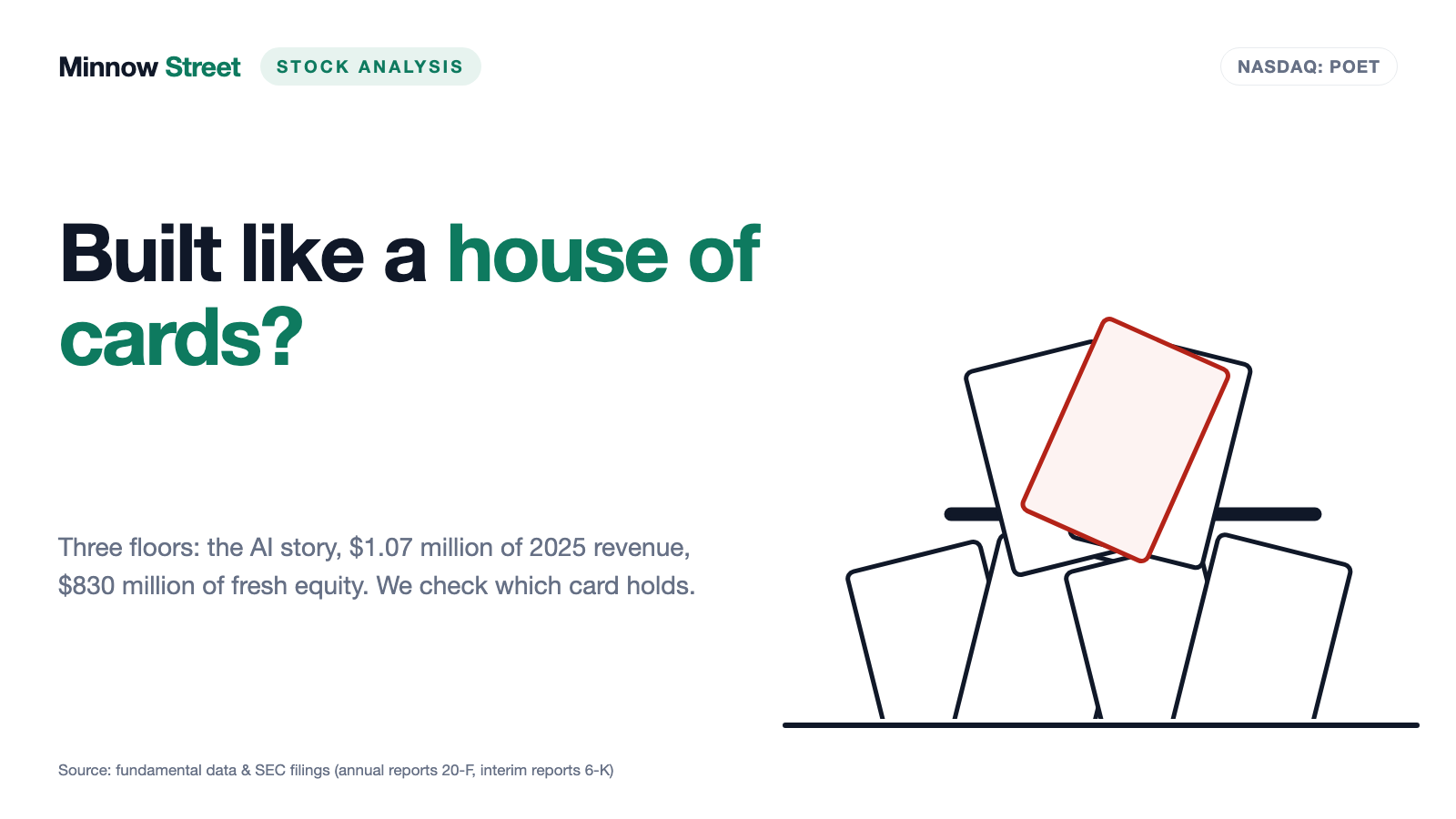
In November 2025 SEALSQ did something nobody had done before: it shipped a chip that carries the post-quantum algorithms standardized by the U.S. standards body NIST directly in hardware. The annual report filed with the U.S. securities regulator, the SEC, tells a soberer story alongside it: $18.3 million of revenue in 2025, a $34.2 million net loss — and the celebrated chip contributed exactly nothing, with the company itself expecting no revenue from it before the fourth quarter of 2026. The build-out is paid for with new shares: 100.0 million outstanding on December 31, 2024 became 191.5 million a year later, and warrants for another 153.4 million are outstanding as of March 27, 2026. What is left standing is a $417.7 million cash pile. Read the ingredient list before you believe the front of the box.
 Thomas Mücke
Founder & Publisher
Thomas Mücke
Founder & Publisher
Chart
Interactive price chart (TradingView).
Note: pure fact-based analysis, not investment advice and not a solicitation to buy or sell. All figures without guarantee.
The trap: we buy the front of the box
You know this from the supermarket. The front of the package shouts “high protein”, an athlete leaps across the picture, everything glows. On the back, in small print, sits the ingredient list. And there, in second place, is sugar.
The stock market works the same way, only more expensively. At SEALSQ the front of the box reads: the world’s first quantum-resistant chip. That is not marketing fiction — it happens to be true. The ingredient list sits in the annual report filed with the U.S. securities regulator, the SEC, and almost nobody reads it. We are going to read it together.
The weakness at work here has a name: we buy stories, not numbers. A good story feels right before we have checked anything at all — and the bigger the word (quantum computing, artificial intelligence, world first), the less we look. The same trap has snapped shut on other small technology names before; what that looks like is laid out in our analysis of Ouster.
The deal for this article: we turn the box around. Every figure gets its as-of date and its source. You decide at the end.

What SEALSQ actually does
SEALSQ Corp designs secure microcontrollers. These are tiny chips that give a device a tamper-resistant identity — much the way a passport gives one to a person. Put such a chip in an electricity meter and the utility can be confident the readings really come from that meter and not from an attacker. The same holds for public-safety radios, smart-home devices and card readers.
SEALSQ owns no factories. It is a fabless company: it designs the chips and has them made by third-party foundries — the annual report names TSMC, X-FAB, ams-OSRAM, Intel Foundry and GlobalFoundries among them. Two further legs round out the business: certificate services (PKI), essentially a digital passport office for devices, and, since August 2025, custom chip design through the French subsidiary IC’Alps.
The registered office is in Cointrin near Geneva, the company is incorporated in the British Virgin Islands, and the shares trade on Nasdaq. As of December 31, 2025 the group employed 185 people, 160 of them in France. A year earlier it was 67 — the jump comes almost entirely from the IC’Alps acquisition, which brought roughly 100 chip engineers with it.
The equity story: “harvest now, decrypt later”
The story that made SEALSQ big on the stock market goes like this. At some point quantum computers will exist that can break today’s encryption in seconds. Intelligence services and criminals are therefore already collecting encrypted data now, to decrypt it later — the industry shorthand is harvest now, decrypt later. Anyone building devices that will sit in the field for twenty years has to build in quantum-resistant methods today.
That is exactly what SEALSQ brought to market at the end of November 2025 with the Quantum Shield QS7001 — in the company’s own description the industry’s first quantum-resistant hardware platform embedding the algorithms standardized by the U.S. standards body NIST, ML-KEM (Kyber) and ML-DSA (Dilithium), directly at hardware level. The regulatory pressure is real: the EU Cyber Resilience Act sets deadlines in September 2026, and the U.S. CNSA 2.0 requirement expects all new acquisitions to be compliant from January 2027.
That is the front of the box. It is good. Hold on to it; we will come back.
How the stock reached our desk
Not through a valuation filter, not through a quality screen. SEALSQ reached our desk through the mention counts in U.S. retail investor forums, as of July 29, 2026. Such lists say nothing about whether a company is any good. They only say where a lot of people are looking right now.
That is precisely why we read them: where many people look, price moves appear that have little to do with the business. And where a big word is involved, opening the mandatory filings pays double. Incidentally, our in-house stock scanner lists are recomputed daily — what appears today can be missing tomorrow.
The numbers across the years — given their due
Start with what genuinely impressed in 2025. Revenue rose from $11.0 million to $18.3 million, a gain of 66 percent. Gross profit grew from $3.7 million to $8.6 million and the gross margin jumped from 34 to 47 percent. And that was not only the acquisition: the SCR200 card reader chip gained 51 percent, while the VIC405 and VIC408 secure elements benefited from projects at smart-meter makers such as Landis+Gyr and among users of the P25 public-safety radio standard. That is real, recurring business with long-standing customers.
Now the three-year picture — and this is where it gets uncomfortable.
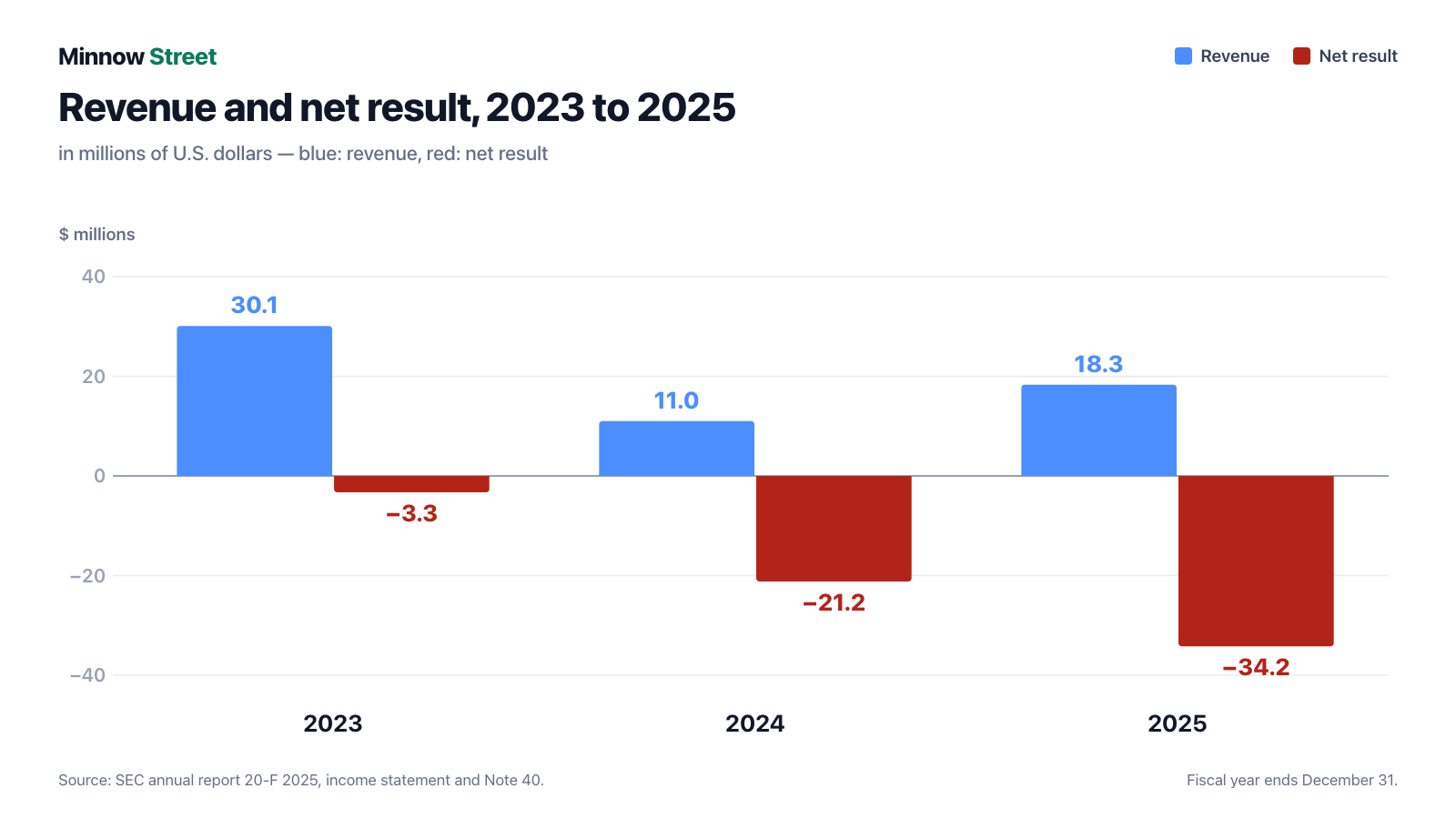
In 2023 SEALSQ booked $30.1 million of revenue and lost $3.3 million. In 2024 revenue collapsed to $11.0 million and the loss grew to $21.2 million. In 2025 revenue recovered to $18.3 million — and the loss reached $34.2 million. Put differently: the company sells roughly 40 percent less than it did two years ago and loses ten times as much doing it.
The 2024 collapse is explained in the annual report by the product transition itself: because SEALSQ announced its new quantum-resistant generation (project QUASAR, launched in 2022), customers prepared for the switch, held back orders and worked down inventory first. That is a plausible explanation — but it is also an explanation for revenue that was gone.
And the cost base? Operating expenses rose on a net basis to $48.4 million in 2025 from $20.9 million the year before: research and development $12.5 million, selling and marketing $12.8 million, general and administrative $25.8 million — $51.1 million in total, against which the report nets $2.6 million of other operating income. A large share of the increase comes from stock-based compensation — the company granted options to its entire workforce in 2025. No cash out the door, but dilution all the same.
One detail that is easy to skim past: of the $2.6 million of other operating income in 2025, $2.5 million came from services SEALSQ rendered to its own parent, WISeKey. The year before it was $0.2 million. That income is not customer business; it is an intragroup recharge.
How 2026 continued
On July 6, 2026 SEALSQ reported preliminary, unaudited half-year figures: approximately $11 million of revenue in the first half of 2026 against about $5 million in the prior-year period, a gain of roughly 120 percent. The second quarter came in at about $7 million after about $4 million in the first. According to the release, growth was driven by demand for the Vault-IC secure element family, by six rather than five months of IC’Alps, and by initial revenue from the Quantix Edge Security design center in Murcia, Spain. That is a clear improvement — but these are preliminary figures, and they still sit below the 2023 level.
Uncomfortable truth no. 1: the star on the shelf sells nothing yet
The QS7001 is the product everyone talks about. It has been on the shelf since the end of November 2025. And in the very annual report that celebrates it stands this sentence:
“The QS7001 currently does not generate revenue, and revenue generation is not expected until Q4 2026.”
— SEALSQ Corp, SEC annual report 20-F for 2025, Item 5.A Operating Results
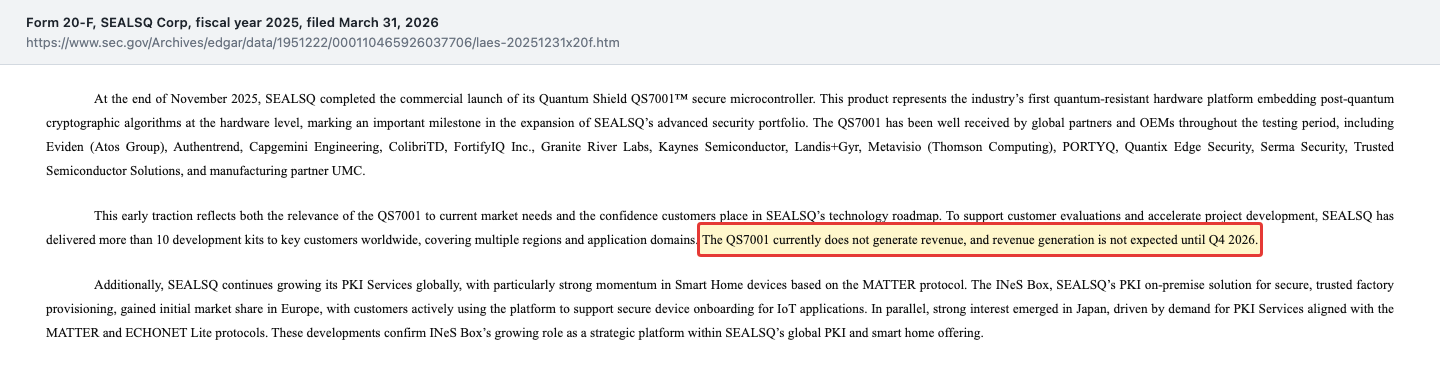
This is not a catastrophe; it is ordinary semiconductor reality. Many months, often years, pass between a launch and volume production at the customer. But it moves the question. Whoever buys SEALSQ today is not buying a product that earns money. They are buying the expectation that it will from late 2026 — and that the customers testing development kits today will order tomorrow.
What earns money today is the older generation: the SCR200 card reader chip, the VIC405/VIC408 secure elements, the certificate services. Those certificate services grew 586 percent in 2025 — and still contributed only 2 percent of revenue. On small numbers, percentage jumps always look spectacular; that is one of the oldest traps in reading financial reports.
And the dependence on a handful of customers is considerable:
“In the year ended December 31, 2025, the SEALSQ Group’s ten largest customers accounted for 63% of its revenue.”
— SEALSQ Corp, SEC annual report 20-F for 2025, Item 3.D Risk Factors
A single customer — described in the filing only as an “international computer and hardware manufacturer” — accounted for 36 percent of revenue in 2024 and still 12 percent in 2025. The largest customer named outright is Cisco Systems International, under a master purchase agreement dated August 14, 2014. A master agreement is not a purchase commitment: what the report says this contract governs is pricing, the forecasting process, buffer stock, allocation in a shortage and liability — it names no purchase volume. Elsewhere the same report even warns that where customers do not take delivery of parts made specifically for them, SEALSQ may not be able to charge so much as a cancellation fee.
Uncomfortable truth no. 2: 100 million shares became 223 million
Dilution sounds harmless. What it means is that your slice of the cake gets smaller without you doing anything. The cake can grow too — then it is a good trade. Or it can stay the same size while being cut into more slices. At SEALSQ, the slicing machine has been running for two years.
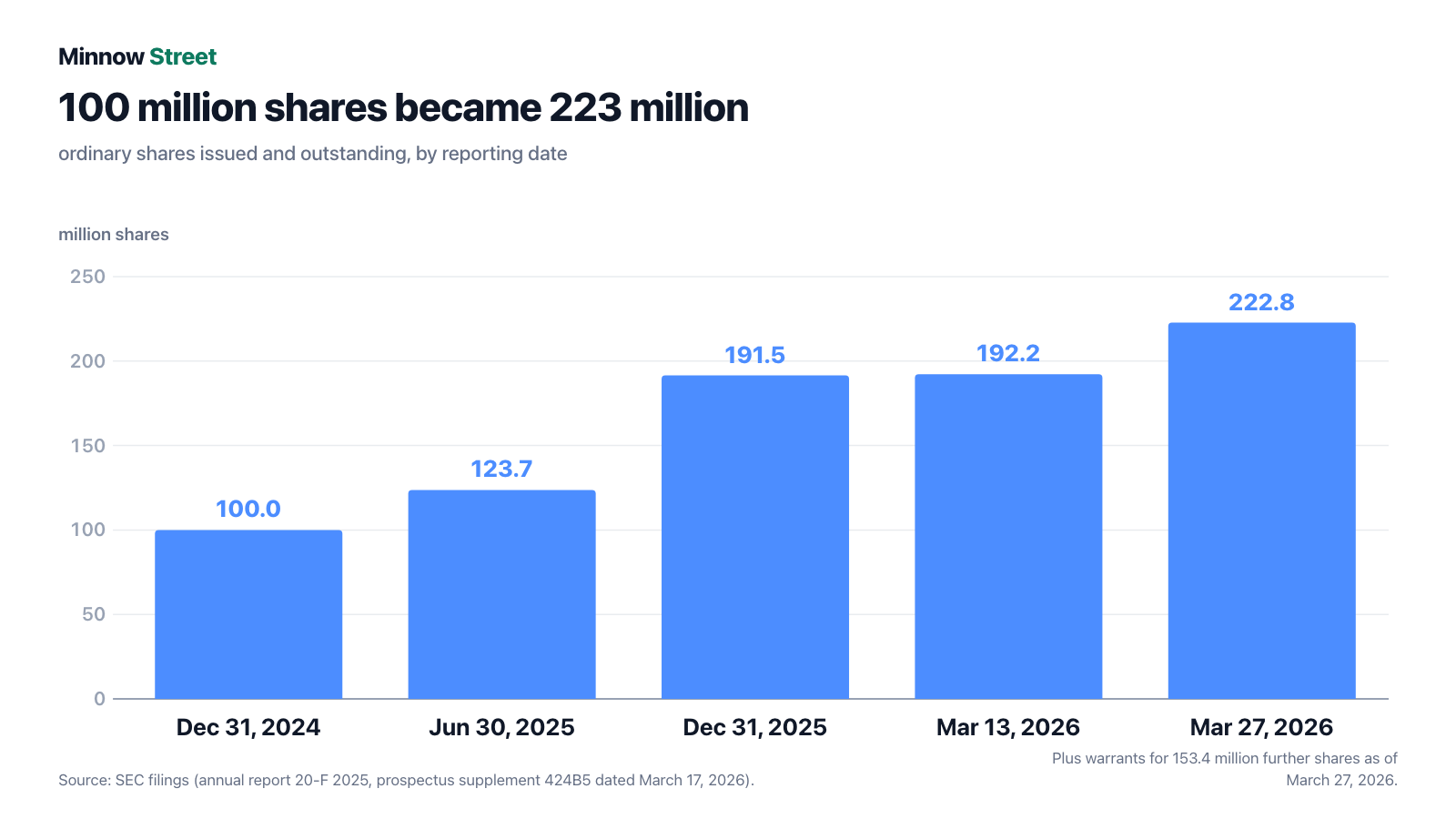
The figures one by one, each from a mandatory filing: 100,039,519 ordinary shares on December 31, 2024. 123,731,729 on June 30, 2025. 191,525,129 on December 31, 2025. 192,210,129 on March 13, 2026. Two days later SEALSQ sold another 22,913,630 shares plus pre-funded warrants for 7,500,000 shares at an exercise price of $0.0001 — gross proceeds of roughly $125 million, delivered on March 17, 2026. As of March 27, 2026 the annual report then states 222,773,999 fully-paid and outstanding ordinary shares. In fifteen months the share count has more than doubled.
And that is not all. The same offering issued 60,827,260 Class E warrants, each exercisable for one share at $5.50 and running for seven years. In total the annual report carries this sentence:
“As of March 27, 2026, SEALSQ has outstanding warrants to purchase an aggregate of 153,410,592 Ordinary Shares.”
— SEALSQ Corp, SEC annual report 20-F for 2025, Item 3.D Risk Factors
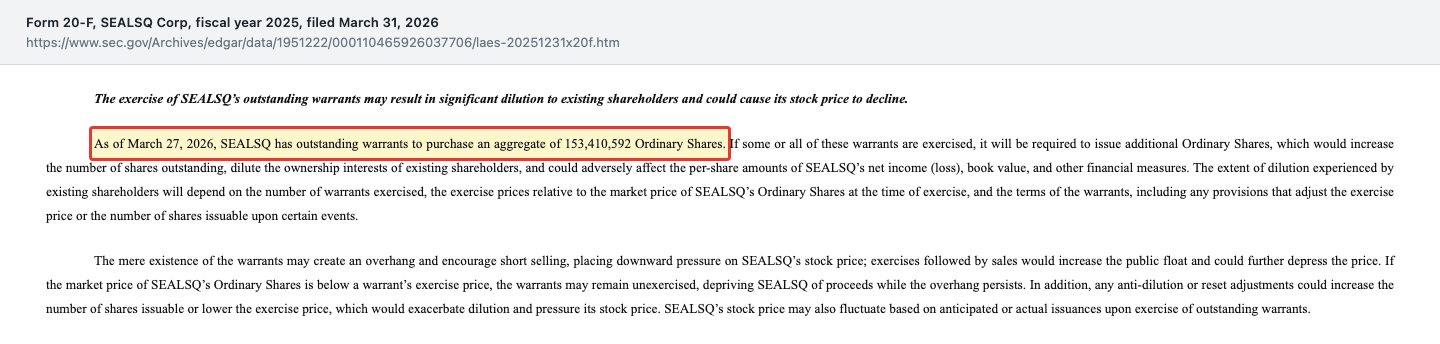
Do the arithmetic: on top of the 222.8 million shares outstanding on March 27, 2026, up to 153.4 million more could arrive over the years. Authorized capital was raised from 200 million to 500 million shares in 2025 — there is plenty of room. And since May 19, 2025 an at-the-market program has been running under which SEALSQ may sell up to $100 million of stock straight into the market — 15,450,000 shares had already been sold under it as of March 31, 2026, per the annual report.
There is one consolation for today’s shareholders, and it sits in the exercise price: the 60.8 million Class E warrants only become interesting at $5.50. At the $2.34 closing price as of July 28, 2026 they are far out of the money, so the dilution from that tranche only arrives if the share price more than doubles. The flip side: as long as it does not, SEALSQ receives no money from them either.
What is it all for? The report says so itself — and it also says what made the inflow possible in the first place:
“As a result of SEALSQ’s strengthened market capitalization, boosted by the market’s recognition of the risks posed by quantum computers and the need for new secure microcontrollers to protect against these, SEALSQ was able to raise over $575 million in cash since November 2024 in order to accelerate development and execute strategic investments that strengthen its growth pipeline.”
— SEALSQ Corp, SEC annual report 20-F for 2025, Item 5.A Operating Results
The sentence is remarkably candid: the high share price was the precondition for raising the money, not the consequence of a good business. That is exactly how this loop works — story lifts the price, price funds the cash, cash funds the story. As long as the price plays along, it holds. When it does not, it gets expensive. What it looks like when a small technology company loses that loop is described in our analysis of Laser Photonics.
Uncomfortable truth no. 3: 2.69 percent of the shares, 51.33 percent of the votes
SEALSQ is not a standalone company in the usual sense. It was formed in 2022 by Switzerland’s WISeKey International Holding AG as a subsidiary and taken public in 2023, with WISeKey distributing 20 percent of the shares to its own shareholders. Since then the parent’s economic stake has been thinned to a sliver by the many capital raises. Its power has not.
“As of March 27, 2026, WISeKey owns 2.69% of SEALSQ’s Ordinary Shares and 99.99% of its Class F Shares, thereby holding 51.33% of the voting power of all SEALSQ shares.”
— SEALSQ Corp, SEC annual report 20-F for 2025, Item 7.B Related Party Transactions
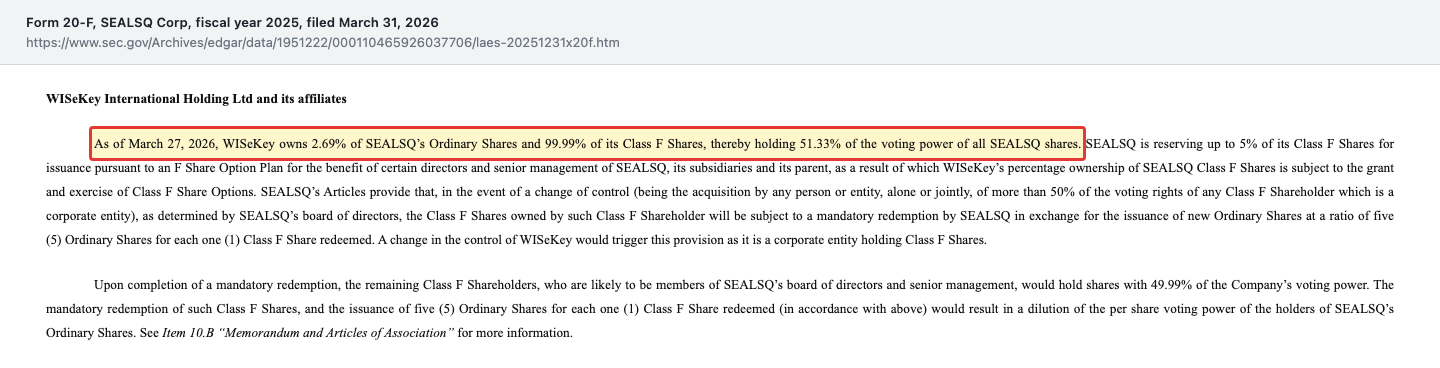
The trick sits in the articles of association. There are 1,499,800 so-called Class F shares, and their vote count is not fixed but calculated: each Class F share carries as many votes as needed for the class as a whole to always reach 49.99 percent of the total voting power. No matter how many new ordinary shares are issued, the F class keeps its share. Add the 2.69 percent of ordinary shares and you have the majority.
The practical consequence is in the filing as well: because WISeKey holds more than half the votes, SEALSQ qualifies as a controlled company under Nasdaq rules and is entitled to exemptions from the corporate governance requirements — expressly including the rule that a majority of the board must be independent.
This is where the detail matters, because that particular exemption is one SEALSQ does not currently take: four of the seven directors are considered independent per the 2025 annual report, so the majority rule is met. The report itself adds, though, that British Virgin Islands law does not require an independent majority and that SEALSQ may not have one in future. Two other exemptions it does already use: there are no regularly scheduled meetings attended only by independent directors, and on the audit committee the report concedes that its role may not fully comply with the Nasdaq requirement. As a foreign private issuer SEALSQ may additionally follow home country practice. Buying ordinary shares buys economic participation, not a say.
Then there are the dealings between parent and subsidiary. As of December 31, 2025 SEALSQ carried a receivable of $8,656,171 from WISeKey and its affiliates for management fees and advances. That is close to half of the entire year’s revenue. In the other direction SEALSQ owed the parent $2,180,054. And in November 2025 SEALSQ invested $10.0 million in WISeSat.Space, a company whose remaining shares are held by WISeKey.
Uncomfortable truth no. 4: the money is there — it just does not flow into revenue
Now the good news, and it is genuinely good. SEALSQ sits on a pile of cash:

$417.7 million as of December 31, 2025 — after $84.6 million a year earlier and $6.9 million at the end of 2023. Equity stood at $461.5 million, total assets at $504.2 million, notes payable at $1,678,281. As of June 30, 2026 SEALSQ reports roughly $495 million of cash and short-term investments on a preliminary basis. Against $31.3 million of cash used in operations during 2025, the question of runway is not a question for the foreseeable future.
Where the money came from is in the same sentence: from selling shares and warrants. Cash provided by financing activities came to $399.5 million in 2025, against $88.4 million in 2024 and only $8.6 million in 2023. So the cash is not earned money. It is sold ownership.
Where the money goes
Not into revenue — at least not directly. Cash used in investing rose to $35.3 million in 2025 from $0.6 million the year before. SEALSQ has set up its own investment pot, which it calls the “SEALQuantum Fund”: a target allocation of $200 million, of which more than $60 million had been deployed according to its own statement of July 6, 2026. The list includes ASIC design house IC’Alps, quantum photonics firm Miraex, French quantum computing developer Quobly (roughly EUR 15 million), the Spanish joint venture Quantix Edge Security, ColibriTD, EeroQ, WISeSat and Switzerland’s WeCan Group.
That may work out. But it is something other than selling semiconductors. A company with $18.3 million of annual revenue that is simultaneously assembling a portfolio of eight holdings spreads its attention across a lot of construction sites. It also makes the balance sheet harder to read: of the $504.2 million of total assets, only a fraction belongs to the operating business.
Another side stage: on September 3, 2025 the board adopted an investment policy allowing up to $30 million of company funds or future issuance proceeds to be invested in Bitcoin, Ethereum, HBAR and the WECAN token. As of the balance sheet date the actual holdings were still immaterial according to the report — the custody account was still being set up.
And finally the newest chapter: on June 25, 2026 SEALSQ announced that Quantisimo Corp — a special purpose vehicle jointly established with parent WISeKey — had signed a non-binding letter of intent with listed shell company GigCapital8. Expected pre-money enterprise value: roughly $575 million. Closing no earlier than the first quarter of 2027. Selected SEALSQ holdings are to be contributed to the new entity. Nothing about it is binding so far — the announcement itself stresses that definitive agreements, financing and approvals are all still outstanding.
Valuation: the market now pays for little more than the cash
Start with the denominator, and it is documented: the annual report states 222,773,999 fully-paid and outstanding ordinary shares as of March 27, 2026 — the figure sits in the major shareholders section and is the same basis three May 2026 ownership filings use to compute their percentages. At the $2.34 closing price as of July 28, 2026 that produces a market capitalization of roughly $521 million.
Against it stands $18.3 million of 2025 revenue. That is roughly 29 times one year of sales. For context: an established, profitable semiconductor company usually trades at three to eight times annual revenue. A price-to-earnings ratio cannot be formed at all in the absence of earnings.
Now the number this article hangs on. Take the market capitalization and subtract the money already sitting in the bank — what remains is what the market credits the actual business with:
- Market capitalization roughly $521 million (data as of July 28, 2026).
- Cash and short-term investments roughly $495 million (June 30, 2026, preliminary and unaudited).
- Left for everything else: roughly $26 million.
The two figures come from different weeks — four weeks apart, and the half-year numbers are preliminary. The order of magnitude survives that, and it is striking: the market values the technology, the patents, the customer base, the manufacturing partners and the entire portfolio of holdings at a little more than one year of revenue. Take the audited December 31, 2025 cash balance of $417.7 million as the more conservative basis and roughly $104 million remains — still modest for a company traded as a quantum hope.
This is the point where the story turns over. A year ago the narrative was the expensive part of this stock. Today the market essentially pays the bank balance and adds barely anything for the technology.
The historical anchors
For comparison, the documented prices from the prospectus supplement of March 17, 2026: the last share price named there was $3.86 on March 13, 2026, and the offering price per unit of one share plus one warrant was $4.11. Against the price as of July 28, 2026 that is roughly 39 percent lower. Anyone who subscribed in March is under water, and the Class E warrants with their $5.50 exercise price are currently far out of the money.
The second yardstick is asset value. Equity of $461.5 million as of December 31, 2025 spread over 191.5 million shares works out to roughly $2.41 of book value per share. The prospectus itself uses the stricter net tangible book value (tangible assets minus liabilities): $0.95 per share as of June 30, 2025, or $2.77 pro forma after the March offering. Buyers of the new shares paid $4.11 and therefore absorbed immediate dilution of $1.34 per share — the prospectus lays that out openly.
A note on the share counts
One stumbling block that is easy to trip over when checking the arithmetic: the common metrics databases carry a share count of 135,029,729 for SEALSQ in 2025. That is not the number of shares outstanding but the weighted annual average used to compute earnings per share (Note 40 of the annual report). Shares actually outstanding on December 31, 2025 numbered 191,525,129. Anyone working from the average understates the dilution by roughly a third.
The professional view — there is hardly one
Our fundamental data records exactly one analyst opinion as of July 28, 2026, with a price target of $5.88. That is not a meaningful consensus; it is the view of a single firm. The annual report itself lists thin analyst coverage as a distinct risk factor — when almost nobody follows a company, it can quietly drop out of view, or fall disproportionately on a single downgrade.
Opportunities and risks at a glance
Opportunities
- Regulatory tailwind with dates on it. The EU Cyber Resilience Act sets obligations from September 11, 2026; the U.S. CNSA 2.0 requirement expects all new acquisitions to be compliant from January 2027 and full adoption by 2031. Whoever can ship quantum-resistant hardware has a market created by regulation.
- A very narrow competitive field. According to the annual report, fewer than twelve companies worldwide can design and certify secure chips at Common Criteria EAL5+ or higher.
- Technical progress is documented, not merely claimed. In the first half of 2026 the QS7001 obtained a NIST entropy source validation (ESV certificate E333) and passed fault-injection and side-channel resistance testing.
- Financial room to move. With roughly $495 million of cash and short-term investments as of June 30, 2026, SEALSQ can invest for years without depending on a friendly capital market.
- The IC’Alps acquisition contributes. The ASIC business added $3.6 million in five months — at an 88 percent gross margin, because it is pure design service work.
Risks
- The flagship product earns nothing. The company itself expects no QS7001 revenue before the fourth quarter of 2026. If the transition slips further, revenue stays tied to the old generation.
- Dilution with no visible end. Warrants for 153.4 million shares (as of March 27, 2026), authorized capital of 500 million shares and a running at-the-market program of $100 million under which 15,450,000 shares had already been sold as of March 31, 2026.
- Customer concentration. Ten customers account for 63 percent of 2025 revenue, and the report also warns that where customers fail to take delivery of parts made specifically for them, SEALSQ may not be able to enforce a cancellation fee. Revenue planning therefore hangs on the order books of a handful of customers.
- Control sits with the parent. 51.33 percent of the votes on a 2.69 percent economic stake, “controlled company” status with the right to governance exemptions, and ongoing transactions and receivables between parent and subsidiary.
- A tax trap for U.S. investors. The filing states explicitly that there is substantial uncertainty about whether SEALSQ was a passive foreign investment company (PFIC) for 2025 and sees a significant risk for 2026 — a classification with unpleasant consequences for U.S. taxpayers.
- Side stages. A portfolio of eight holdings, a cryptocurrency investment policy of up to $30 million and a planned listing of a joint special purpose vehicle with the parent all absorb attention the core business could use right now.
A human conclusion
Back to the box. The front says: world’s first quantum-resistant chip. That is true — and an achievement barely a dozen companies worldwide could have pulled off. The back says: $18.3 million of revenue, a $34.2 million loss, zero dollars from the celebrated product, and roughly 91 percent more shares in 2025 alone.
Both are true. That is what makes this stock uncomfortable: it is neither a fraud nor a sure thing. SEALSQ has built something real with its shareholders’ money — a technology, close to half a billion dollars of cash, a web of holdings. None of it was paid for out of profits; all of it was paid for by selling ever more slices of this very company. And the bill only comes good once the technology turns into revenue.
What is remarkable is where the market now stands on that question. At a market capitalization of roughly $521 million (data as of July 28, 2026) and roughly $495 million of cash and short-term investments (June 30, 2026, preliminary), about $26 million is left for everything else. The market pays little more than the bank balance. You can read that two ways: as a warning that almost nobody still believes in the revenue turn — or as a sign that very little is priced in for one that succeeds. Both readings are legitimate, and neither is proven.
So the question to ask yourself is not “will quantum computers arrive?” That is the question the front of the box asks, and it is easy to answer with yes. The harder question is on the back: will the revenue SEALSQ makes from it ever be enough to justify the number of shares issued to fund it — and how many more shares will there be by then?
Honestly: nobody can answer that today, the company included. What you do with it is your call. And that is exactly as it should be.
Sources
- SEALSQ Corp, annual report 20-F for fiscal year 2025 (filed March 31, 2026) — revenue, result and balance sheet figures, risk factors, voting rights, related party transactions, Note 40 (earnings per share), Note 43 (subsequent events)
- SEALSQ Corp, annual report 20-F for fiscal year 2024 (filed March 20, 2025)
- Prospectus supplement 424B5 dated March 17, 2026 — offering terms, share count as of March 13, 2026, last documented share price, dilution table
- Interim report 6-K of July 8, 2026 — preliminary, unaudited H1 2026 figures, cash as of June 30, 2026, status of the investment pot
- Interim report 6-K of June 30, 2026 — Quantisimo/GigCapital8 letter of intent
- Interim report 6-K of June 11, 2026 — investment in Quobly SAS
- Interim report 6-K of June 4, 2026 — majority stake in WeCan Group, completion of the Miraex acquisition
- Interim report 6-K of March 17, 2026 — securities purchase agreement for the March 15, 2026 offering
- Source: fundamental data & SEC filings (annual reports 20-F, interim reports 6-K) — sector classification, headcount cross-check, analyst coverage; data as of July 28, 2026
A note on our own account
This text is journalistic analysis. It is not investment advice and not a solicitation to buy or sell securities. Shares of small technology companies can swing violently; a total loss is possible. All figures come from publicly available mandatory filings and carry the as-of date stated with them; they may have changed since. The author holds no position in SEALSQ Corp or WISeKey International Holding AG at the time of publication. Please never base an investment decision on a single article — check the primary sources and your own circumstances.
Our Bottom Line at a Glance
- Balance sheet and funding capacity positive
- As of December 31, 2025 the company held $417.7 million in cash (a year earlier: $84.6 million), equity stood at $461.5 million against total assets of $504.2 million, and notes payable amounted to $1,678,281. Against that, operations consumed $31.3 million of cash in 2025. As of June 30, 2026 SEALSQ reports roughly $495 million of cash and short-term investments on a preliminary basis — against a market capitalization of roughly $521 million (data as of July 28, 2026), the market therefore pays for little more than the bank balance. There is no solvency risk visible in this balance sheet.
- Technology and market position positive
- The 2025 annual report states that fewer than twelve companies worldwide can design and certify secure chips at Common Criteria EAL5+ or higher — SEALSQ is one of them. The QS7001, launched at the end of November 2025, is the first chip to embed the NIST algorithms ML-KEM (Kyber) and ML-DSA (Dilithium) directly in hardware; in the first half of 2026 it added a NIST entropy source validation (ESV certificate E333) and passed fault-injection and side-channel testing.
- Earnings and product transition negative
- Revenue fell from $30.1 million (2023) to $11.0 million (2024) and recovered to $18.3 million in 2025 — roughly $3.6 million of which came from the IC’Alps acquisition. Over the same period the net loss grew from $3.3 million to $34.2 million. The flagship product generates no revenue according to the 2025 annual report, and the company itself expects none before the fourth quarter of 2026. The transition from the old product generation to the new one is therefore still unproven.
- Dilution negative
- 100,039,519 ordinary shares (31.12.2024) became 191,525,129 (31.12.2025) and, after the offering that closed on March 17, 2026, the 222,773,999 the annual report states for 27.03.2026 — more than a doubling in fifteen months. Warrants for 153,410,592 shares remain outstanding as of March 27, 2026, including 60,827,260 Class E warrants at $5.50 with a seven-year life. Since November 2024 SEALSQ says it has raised more than $575 million — the cash on the balance sheet is largely sold ownership.
- Control and governance negative
- Parent WISeKey owns 2.69 percent of the ordinary shares but holds 51.33 percent of the votes through the Class F shares (as of March 27, 2026). As a Nasdaq “controlled company” SEALSQ is entitled to governance exemptions — it still meets the majority-independent-board rule today per the 2025 annual report (four of seven), but expressly reserves the exemption, and it already forgoes regularly scheduled independent-director-only meetings. As of December 31, 2025 the books also carried a receivable of $8,656,171 from WISeKey and its affiliates — close to half a year of revenue.
- Use of capital neutral
- A substantial part of the money raised flows into minority holdings: $10.0 million into WISeKey subsidiary WISeSat.Space (8.08 percent), close to EUR 15 million into quantum computing developer Quobly, plus IC’Alps, WeCan, Miraex, EeroQ, ColibriTD and Quantix Edge Security. Cash used in investing rose to $35.3 million in 2025 from $0.6 million the year before. No filing shows what revenue this is expected to produce — it is a bet on an ecosystem that does not exist yet.
SEALSQ is the label trap in its purest form: the front of the box says world’s first quantum-resistant chip, while the ingredient list on the back reads $18.3 million of revenue, a $34.2 million net loss and a flagship product that, by the company’s own annual report, will not earn a cent before the fourth quarter of 2026 at the earliest. Shareholders pay for the build-out: the share count nearly doubled in 2025, and warrants for 153.4 million further shares are ready to go. What has been built is real, though — $417.7 million of cash on December 31, 2025, roughly $495 million on June 30, 2026, and a technical lead barely a dozen companies worldwide could match. By now the market pays for little more than that bank balance: at a market capitalization of roughly $521 million (data as of July 28, 2026), about $26 million is left for technology, customers and holdings combined. The question is not whether the company survives, but whether the technology ever produces enough revenue to justify the number of shares issued to fund it. Not investment advice.
What Our Rating Means
Open questions
The business works in principle, but one material question is open. As long as it stays open, our findings do not carry a quality verdict.
Yellow rather than red: the December 31, 2025 balance sheet shows $417.7 million of cash, $461.5 million of equity and notes payable of $1,678,281 — no going-concern qualification, no funding squeeze, no solvency risk. Yellow rather than green: the business is not proven. Revenue of $18.3 million comes nowhere near covering $48.4 million of operating expenses, the flagship QS7001 generates no revenue before the fourth quarter of 2026 on the company’s own account, and the ten largest customers account for 63 percent of sales. The heavy dilution — from 100.0 million to 191.5 million shares in 2025, plus warrants for another 153.4 million — is a price argument and does not by itself set the color; it belongs on the table anyway, because it explains where the cash came from. The decision is yours.
A journalistic assessment by our editorial team at the time of the deep dive, based on public sources — not investment advice and not a solicitation to buy or sell. Your personal circumstances (investment goals, risk capacity, taxes) cannot be taken into account. What our levels mean, how verdicts are formed, and what conflicts of interest exist →
Worth Noting
- SEALSQ reached our desk through the mention counts in U.S. retail investor forums (as of July 29, 2026) — not through a valuation or quality filter. Such lists say nothing about the merit of a business; they only say where a lot of people are looking. Our in-house stock scanner lists are recomputed daily.
- Timeliness gate: SEALSQ is registered with the SEC as a foreign private issuer and therefore files annual reports (20-F) and interim reports (6-K) rather than quarterly reports (10-Q). The most recent annual report is the 20-F for 2025 (filed March 31, 2026). Every filing submitted afterwards was reviewed individually: the interim reports of March 31, April 2, 9 and 21, May 8, June 4 and 11, June 30 and July 8, 2026, plus the prospectus supplement 424B5 of March 17, 2026. None of those filings states a newer share count, so the most recent documented figure is the one in the annual report itself (222,773,999 ordinary shares as of March 27, 2026).
- Market-cap cross-check: passed — what was checked is the share count, not the multiplication. The market capitalization of $521.3 million (data as of July 28, 2026) arithmetically equals 222,773,999 shares times the $2.34 closing price of the same day; that those two figures agree is an identity and proves nothing on its own. What does hold up is the share count: it is not a data-feed figure but is disclosed in the annual report 20-F, Item 7.A, as "fully-paid and outstanding" as of March 27, 2026, and three Schedule 13G ownership filings of May 15, 2026 compute their percentages on exactly that number — they take it from the annual report, so they are not an independent confirmation, but they show the market works from the same denominator. The last share price stated in a mandatory filing is $3.86 on March 13, 2026 (prospectus supplement 424B5); the gap to $2.34 is the documented price decline over four and a half months, not an error in the share count. Market capitalization, price-to-sales and the comparison against cash are therefore used — each with its as-of date.
- A data trap that easily misleads anyone checking the arithmetic: the share-count series in the common metrics databases carry 135,029,729 shares for SEALSQ in 2025. That is the weighted annual average from the earnings-per-share calculation (Note 40 of the annual report), not the number of shares outstanding — 191,525,129 were outstanding on December 31, 2025. This analysis works throughout with the outstanding counts from the filings: 100,039,519 (31.12.2024), 123,731,729 (30.06.2025), 191,525,129 (31.12.2025), 192,210,129 (13.03.2026) and 222,773,999 (27.03.2026).
- Accounting basis and currency were verified against the annual report: SEALSQ reports under U.S. GAAP, not IFRS, and in U.S. dollars. The 2023 and 2024 revenue and result figures are taken from the 2025 annual report and may differ from earlier publications because the segment presentation was recast in 2025. Separately, SEALSQ corrected its prior-period balance sheet (a “little r” restatement under ASC 250): Swiss stamp duties on its own share issuances had not been accrued since inception. As of December 31, 2024 this reduces additional paid-in capital by $1.376 million to $116.568 million and raises other current liabilities by the same amount; total assets and the reported net result are unaffected, and cumulative late-payment interest of $86,474 was expensed in 2025.
Frequently Asked Questions
SEALSQ designs secure microcontrollers — tiny chips that give a device a tamper-resistant identity, for example a smart meter, a radio or a smart-home device. Manufacturing is outsourced to foundries such as TSMC and GlobalFoundries. On top of that come certificate services (PKI) and, since August 2025, custom chip design through its French subsidiary IC’Alps.
The 2025 annual report attributes it to the product transition: because SEALSQ announced its next-generation quantum-resistant chips (project QUASAR), customers prepared for the switch, held back orders and worked down existing inventory. Revenue recovered to $18.3 million in 2025, of which roughly $3.6 million came from the IC’Alps acquisition.
No. The 2025 annual report says verbatim that the QS7001 currently does not generate revenue and that revenue generation is not expected until the fourth quarter of 2026. The chip launched at the end of November 2025; SEALSQ says it has shipped more than ten development kits to customers. Everything the company earns today comes from the older product line.
Severely. There were 100,039,519 ordinary shares outstanding on December 31, 2024 and 191,525,129 a year later — roughly 91 percent more. On March 13, 2026 the count was 192,210,129, and after the offering that closed on March 17, 2026 the annual report states 222,773,999 as of March 27, 2026 — more than a doubling in fifteen months. Warrants for a further 153,410,592 shares were outstanding as of March 27, 2026.
The two come apart. Parent company WISeKey International Holding AG (NASDAQ: WKEY) owns only 2.69 percent of the ordinary shares but 99.99 percent of the 1,499,800 Class F shares. That class carries 49.99 percent of all votes by design; together WISeKey holds 51.33 percent of the voting power as of March 27, 2026. SEALSQ is therefore a Nasdaq “controlled company” entitled to governance exemptions — although per the annual report it still meets the majority-independent-board rule today.
Because the SEC treats SEALSQ as a foreign private issuer. Such companies file an annual report on Form 20-F and report interim developments on Form 6-K rather than filing quarterly reports on Form 10-Q. The fiscal year matches the calendar year, and the accounts are prepared under U.S. GAAP in U.S. dollars.
On the cash position, that is not currently an open question: $417.7 million on December 31, 2025 against $31.3 million of cash used in operations during 2025. As of June 30, 2026 SEALSQ reports roughly $495 million of cash and short-term investments on a preliminary basis. The company itself describes its liquidity as sufficient on the basis of its own cash projections through March 31, 2027.
Quantisimo Corp is a special purpose vehicle jointly established by SEALSQ and its parent WISeKey. On June 25, 2026 SEALSQ announced a non-binding letter of intent to combine Quantisimo with the listed shell company GigCapital8, at an expected pre-money enterprise value of roughly $575 million and a closing no earlier than the first quarter of 2027. Nothing about it is binding so far.
Found an error?
Did you spot a factual error, an outdated number, or a typo in this deep dive? Let us know briefly — your report goes straight to the editorial team.