Ironwood Stock: A Single Drug, a Debt Wall — and a Cliff Dated March 2029
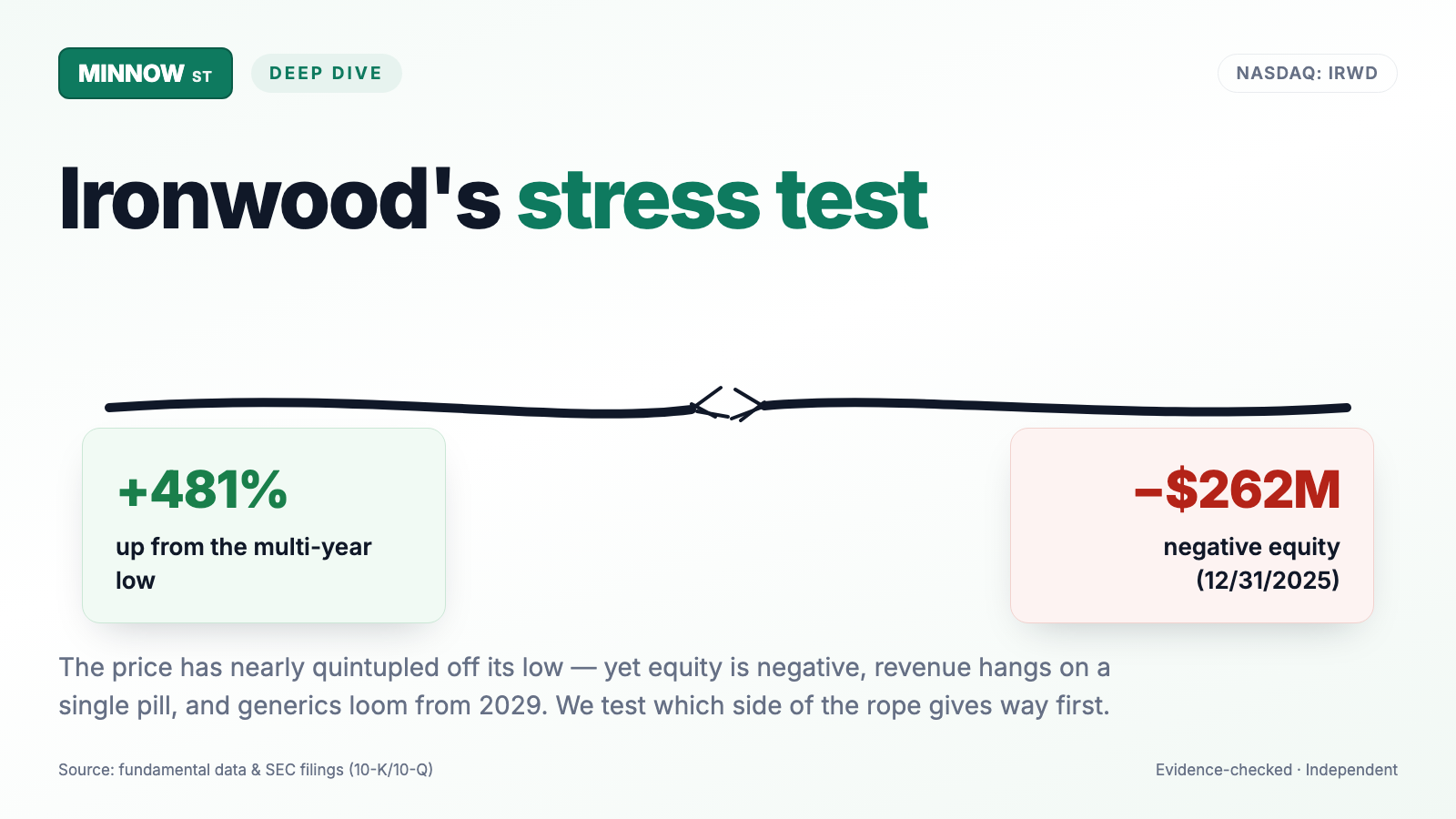
Ironwood Pharmaceuticals (Nasdaq: IRWD) looks optically cheap: a trailing price-to-earnings ratio around 7, up roughly 480 percent from its low, a scanner that fires 14 times. But the one bright number dazzles. We read five SEC filings: substantially all revenue hangs on a single product (LINZESS, for irritable bowel syndrome), and the generics for it may launch as early as March 2029. Add a $385 million debt wall from the VectivBio acquisition, negative equity of $262 million — and a billion-dollar bet (apraglutide) the FDA just pushed back by an entire extra trial. Not investment advice — a sober look at why a narrow window of time hides behind the cheap price tag.
 Thomas Mücke
Founder & Publisher
Thomas Mücke
Founder & Publisher
Chart
Interactive price chart (TradingView).
Note: pure fact-based analysis, not investment advice and not a solicitation to buy or sell. All figures without guarantee.
There is a reflex that fools us whenever a stock carries a single, seductively bright number. Picture a dark stage with one spotlight burning. It lights up the star — and because it shines so brightly, in that moment the star is the whole show for you. The rest of the stage, the set, the props lurking in the dark: you do not see them. The psychologist Daniel Kahneman gave this bias a name — the focusing illusion: "Nothing in life is as important as you think it is, while you are thinking about it." Let us call it the spotlight reflex here. At Ironwood Pharmaceuticals (Nasdaq: IRWD), a pharma company for gastrointestinal ailments, the spotlight is a trailing price-to-earnings ratio around 7, a share price that has nearly quintupled off its low, and our in-house stock scanner firing 14 times. Sounds like a bargain. So let's make a deal: before you follow the bright spot, we turn up the house lights together and look at what else is standing on the stage. The evidence comes from Ironwood itself — in its mandatory filings to the U.S. securities regulator, the SEC, which must be honest under penalty of law. Remember this image — the spotlight and the dark stage are the running thread of this analysis. In the end, you decide for yourself.
What Ironwood actually does
At its core, Ironwood is a one-product company with a toll contract. The product is called LINZESS (active ingredient linaclotide) — a pill for irritable bowel syndrome with constipation (IBS-C in the medical shorthand) and chronic constipation (CIC). Put simply: a drug that gently gets a sluggish bowel moving again. LINZESS was the first drug of its class approved by the U.S. Food and Drug Administration (FDA) and is today one of the most-prescribed branded treatments for these conditions in the United States.
For an investor, though, the decisive point is not the drug but the construction behind it. Ironwood does not sell LINZESS in the U.S. itself; it markets the drug jointly with pharma giant AbbVie. AbbVie handles sales and billing; Ironwood and AbbVie split the profit. The income statement therefore shows not the full drug revenue but only Ironwood's share of LINZESS's U.S. net profit — think of it as a toll Ironwood collects on its patent while someone else operates the road. Outside the U.S. the same compound is called CONSTELLA and is sold by partners such as AstraZeneca (China) and Astellas (Japan); that, however, is a sideshow. In 2025, 97.7 percent of revenue came from the United States.
So that the firm does not depend on this one pill forever, Ironwood paid roughly $1 billion in 2023 for the Swiss biotech VectivBio — and with it the drug candidate apraglutide for the rare, severe short bowel syndrome (patients whose intestine is too short to absorb food and who depend on permanent intravenous nutrition). That is the second bet — and the whole tension of this stock in one sentence: a highly profitable but shrinking and expiring core business, financing a risky bet on the future with expensive debt. First, though, let's see where the stock shows up in the scanner.
Where the stock shows up in our scanner
Every day we run thousands of stocks through our in-house stock scanner. Ironwood fires in 14 filters (data as of July 9, 2026) — and the remarkable part is the mix: plenty of momentum and plenty of cheap optics. On the trend and momentum side stand "RS-Leader (≥90)", "Above the 50- & 200-Day SMA", "21-EMA Trend", "Power Trend", "Stan Weinstein: Stage 2", "Gary Antonacci: Dual Momentum" and "High ADR (≥5%)". On the valuation side, the rankings by price-to-earnings, price-to-cash-flow and price-to-free-cash-flow — plus "Quality Growth", "Institutional Accumulation" and "Professionals 80%". To replicate it yourself: open a filter from the "Scanner" menu on minnowstreet.com and look for the IRWD row.
And this is exactly where translating beats counting. That the stock appears in the P/E and cash-flow rankings means: measured against the most recently reported earnings and cash flow, it is optically cheap. That it fires in the momentum filters means: it has run hard lately — roughly 480 percent above its multi-year low, roughly 32 percent in six months. Both together are the full spotlight: cheap and in an uptrend. But a scanner measures the past — the price that has already run and the profit already booked. It does not see that this profit hangs on a single product whose clock is ticking. Fourteen hits are a reason to look closer, not a reason to buy. So let's do the math.
The numbers over the years — honestly appraised
Let's start with what feeds the spotlight — the earnings power. Ironwood genuinely is profitable at the operating level: the LINZESS profit share left an operating profit of roughly $98 million in 2025, net income of $24.0 million (after $0.9 million in 2024), and the company generated $127.0 million of operating cash flow. The first quarter of 2026 added forcefully: $40.8 million of net income ($0.24 per share) on $106.5 million of revenue. On trailing-twelve-month figures that works out to a price-to-earnings ratio around 7 — that is the cheap spot in the light. Except this profit swings hard, and the revenue beneath it points the wrong way.
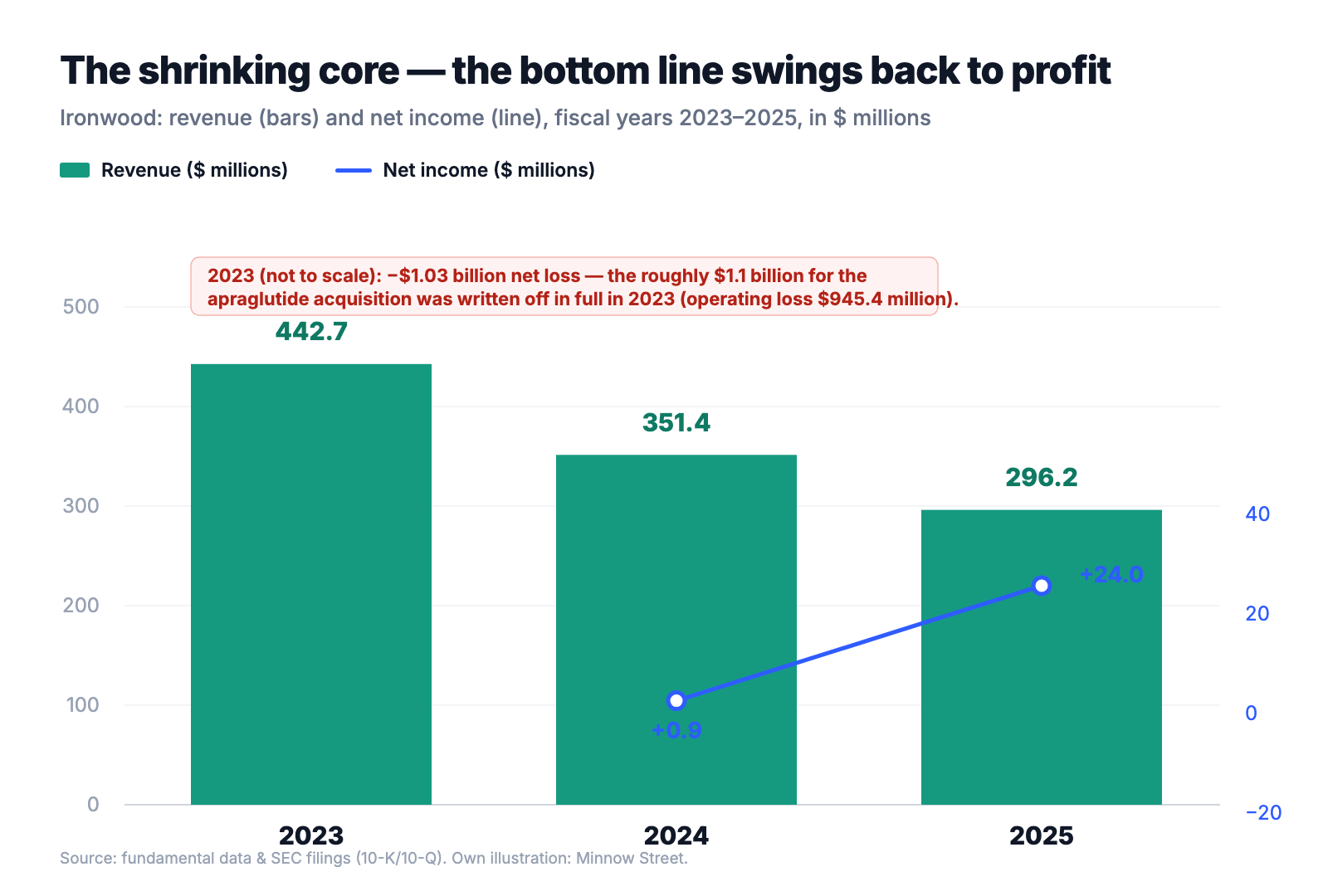
The decline is not a stumble but a trend: $442.7 million (2023), $351.4 million (2024), $296.2 million (2025). In 2025 alone, Ironwood's LINZESS profit share fell by $51.1 million — mainly because the realized net price is under pressure (rebates to payers) and because channel inventories swing. Profit holds up only because Ironwood is simultaneously cutting costs and reshaping its operations. That is one half of the story — a core business that still throws off cash but is growing quieter. The other half is the balance sheet, and it carries the scars of the big acquisition.
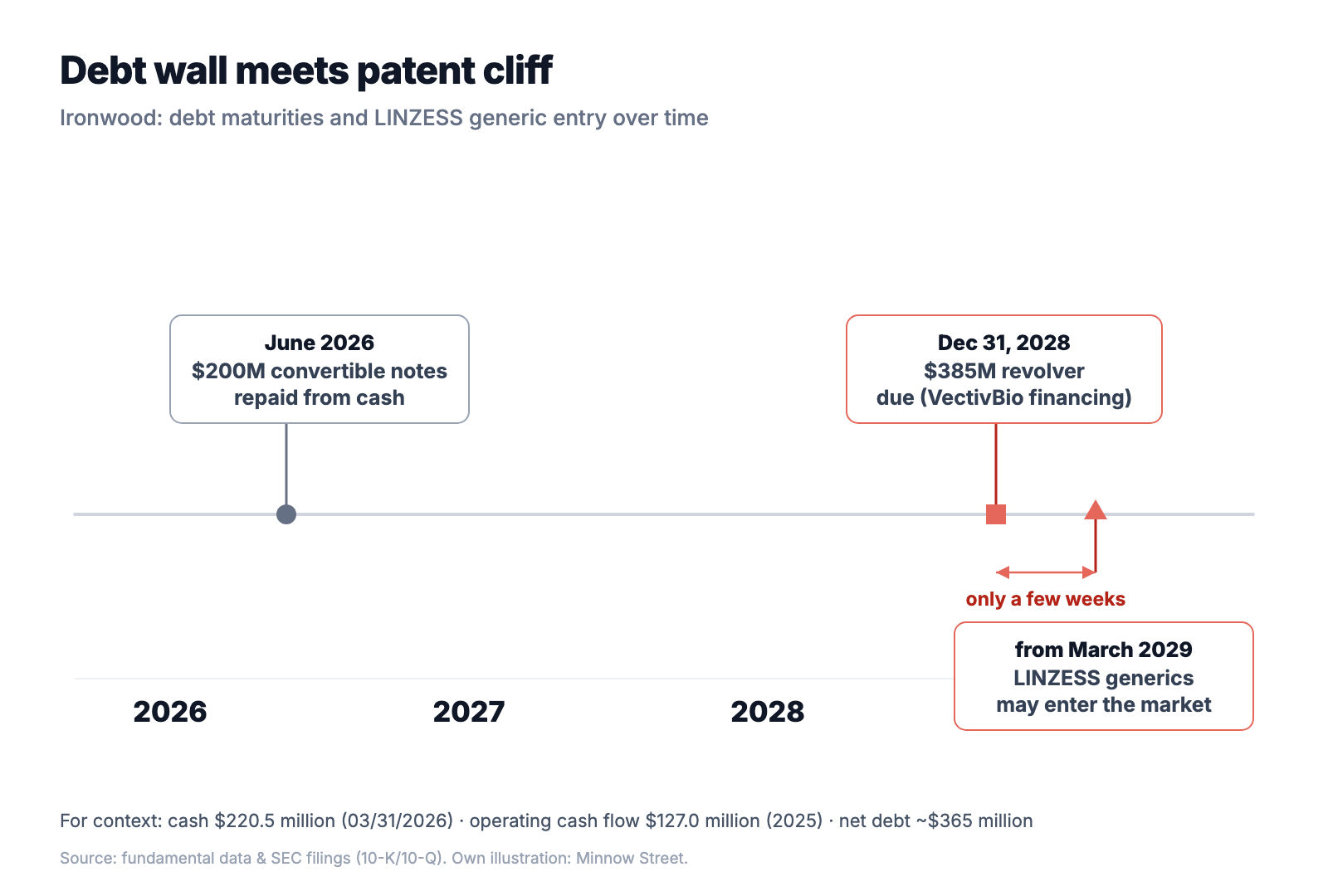
A profitable earnings machine that carries its debt — that is the friendly reading. Now to the three uncomfortable truths standing in the dark beside the spotlight.
What the filings say — the uncomfortable truths
Uncomfortable truth no. 1: Everything hangs on one pill — and its clock is ticking
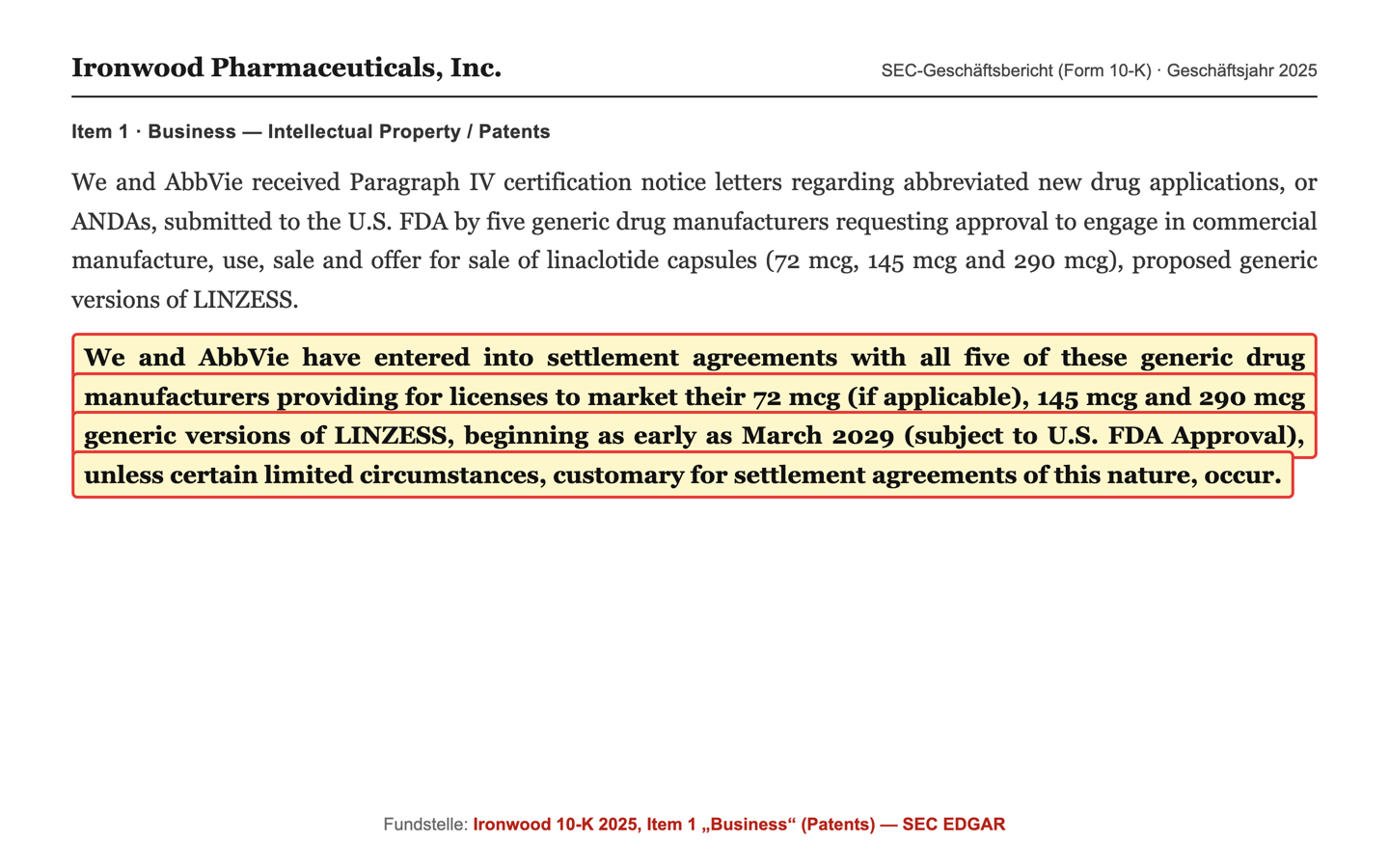
If someone told you their company was perfectly healthy but practically all of its revenue came from a single product — would you swallow for a moment? At Ironwood, that is exactly the case. The annual report (10-K) says it itself: LINZESS is not the main product, it is as good as the only one. And for this one product, Ironwood has already put a contractual date on the generic cliff. The 10-K names the day the copycats may come:
"We and AbbVie have entered into settlement agreements with all five of these generic drug manufacturers providing for licenses to market their 72 mcg (if applicable), 145 mcg and 290 mcg generic versions of LINZESS, beginning as early as March 2029 (subject to U.S. FDA Approval), unless certain limited circumstances, customary for settlement agreements of this nature, occur."
— Ironwood Pharmaceuticals, Inc., SEC annual report 10-K for fiscal year 2025, Item 1 "Business" (Patents)
For perspective on how tightly this is built: elsewhere the 10-K writes that revenue from the linaclotide partnerships makes up "substantially all" of total revenue. So there is no second leg to cushion the cliff — not yet. To be fair: March 2029 is roughly three years out, the LINZESS cash keeps flowing until then, and a pediatric exclusivity extended a core patent to February 2027. But unlike a company with a whole shelf of products — at Exelixis we dissected what it means when $2.1 billion of revenue hangs on a single molecule — Ironwood has one product with one hard date. When the spotlight points at today's profit, this cliff sits in the shadow right behind it.
Uncomfortable truth no. 2: The price of the big acquisition — a debt wall with negative equity
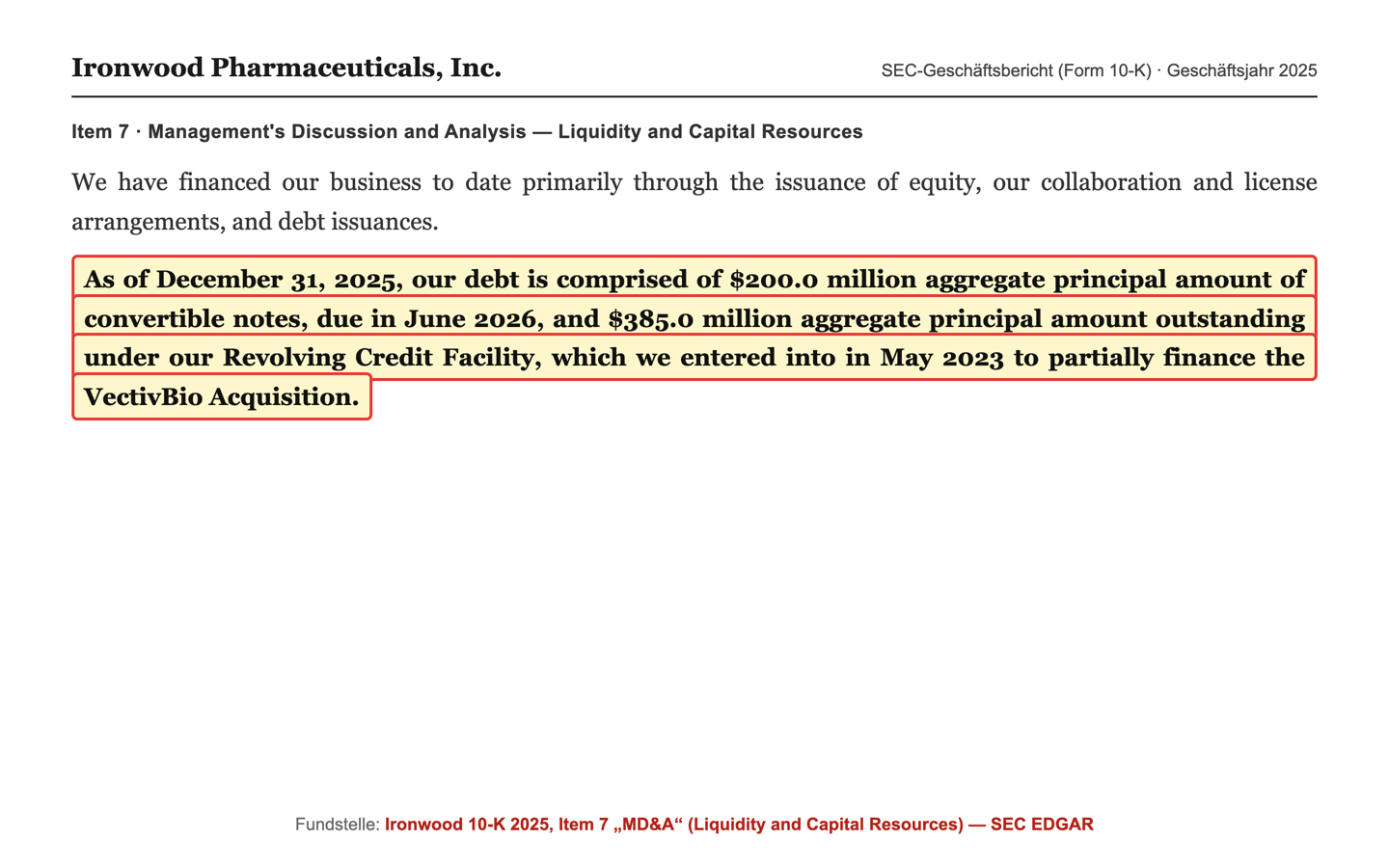
To buy itself that second leg, Ironwood had to reach deep into the credit line. The annual report (10-K) lays the debt position open and names the reason explicitly:
"As of December 31, 2025, our debt is comprised of $200.0 million aggregate principal amount of convertible notes, due in June 2026, and $385.0 million aggregate principal amount outstanding under our Revolving Credit Facility, which we entered into in May 2023 to partially finance the VectivBio Acquisition."
— Ironwood Pharmaceuticals, Inc., SEC annual report 10-K for fiscal year 2025, Item 7 "Management's Discussion and Analysis" (Liquidity)
Let's add it up. The $200 million convertible notes (issued back in 2019, so older than the acquisition) were repaid by Ironwood from cash on schedule in June 2026 — a punctual but expensive exercise that visibly drained the cash balance. That leaves the revolving credit facility of $385.0 million, due December 31, 2028, floating-rate and laden with covenants (including a leverage ceiling and restrictions on dividends and acquisitions). The treacherous part is not the amount alone — interest of roughly $33 million is covered about three times by operating profit — but the timing: the loan comes due only weeks before the generic cliff of March 2029. Ironwood must refinance or repay at precisely the moment its only cash engine begins to lose power.
On top of that comes a number that surprises many: Ironwood's equity is negative — minus $261.8 million as of December 31, 2025. That means debt and other obligations exceed the entire balance-sheet assets; the accumulated deficit since founding is roughly $1.7 billion. Negative equity at a company with stable cash flow is no immediate death sentence (which is why there is no going-concern warning in the report), but it is a thin cushion: there is no balance-sheet buffer to absorb a misstep. Remember: a cheap price-to-earnings ratio often gets cheap precisely when the market is pricing in risks like these.
Uncomfortable truth no. 3: The billion-dollar bet apraglutide — expensed immediately, now postponed
That leaves the bet on the future that is supposed to justify the whole acquisition: apraglutide. Here lies the real tragedy of the timeline. Ironwood had reported positive topline results from the pivotal STARS trial in February 2024 — and then came the setback. The annual report (10-K) recounts it dryly:
"Based on discussions with the U.S. FDA, it became clear that a confirmatory Phase III clinical trial of apraglutide is needed to seek approval of an NDA for apraglutide for patients with SBS-IF who are dependent on PS. In the fourth quarter of 2025, we met with the U.S. FDA and aligned on key design elements of a confirmatory Phase III clinical trial, STARS-2, of apraglutide."
— Ironwood Pharmaceuticals, Inc., SEC annual report 10-K for fiscal year 2025, Item 7 "Management's Discussion and Analysis" (Advancing Apraglutide)
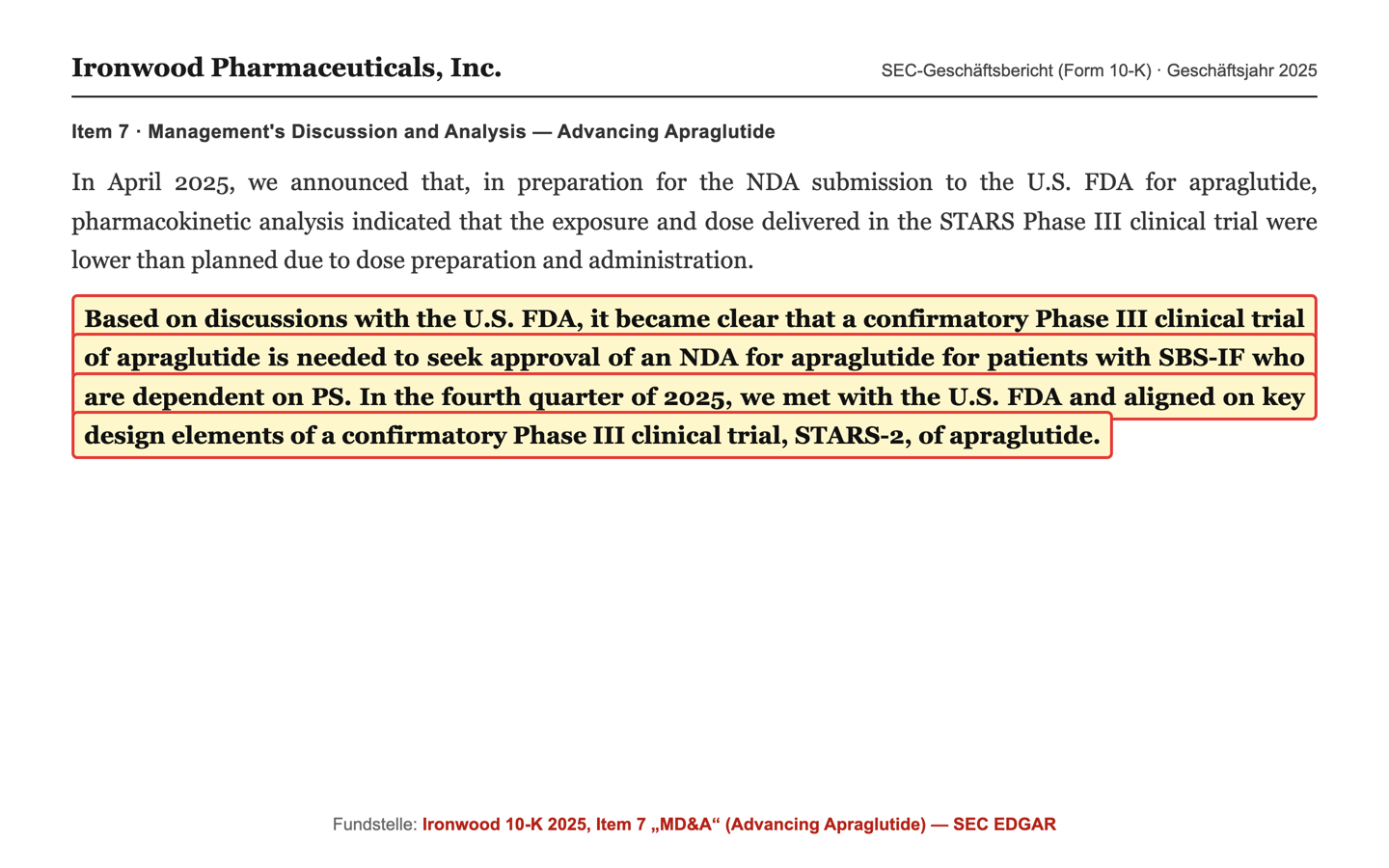
Translated, this means: the reason for the second trial was not an efficacy problem but an underdosed first study (the drug amount actually administered fell short of what was planned). The consequence is the same all the same — years of additional time and cost before an approval application is even possible; the STARS-2 sites are set to activate only from the second quarter of 2026. And now comes the part the spotlight hides most thoroughly: the roughly $1.1 billion Ironwood paid for VectivBio was not capitalized as a long-lived asset — it was expensed immediately and in full as research cost in 2023 (in-process R&D). That is why the balance sheet today shows neither meaningful goodwill nor large intangibles — and why 2023 recorded an operating loss of $945.4 million and a net loss of roughly $1.03 billion. For you as an investor this cuts two ways: the purchase price is history (no future impairment risk), but the countervalue so far exists only as hope — a drug that still has the decisive approval hurdle ahead of it. How quickly a celebrated biotech centerpiece can turn into an open question is something we watched most recently at the cell-therapy developer Iovance.
Valuation — what the cheap price really says
Now back to the spotlight reflex from the opening. Yes, Ironwood is optically cheap: a trailing price-to-earnings ratio around 7, a price-to-cash-flow ratio around 6, a market value of roughly $0.6 billion (orders of magnitude, as of mid-2026, deliberately without a daily price). But compute the full price: to the market value you must add net debt of roughly $365 million — the enterprise value (market value plus debt minus cash) thus sits at about $1.0 billion, roughly eight times operating cash flow. The company is not as cheap as the bare P/E suggests — the debt shifts the picture. We saw the same pattern at Aurinia: a profitable one-drug biotech at a single-digit P/E, where the low multiple was less a gift than a message.
And the professionals' view? The few covering analysts are cautiously split; price targets sit broadly around the current level. Two things belong on the table in fairness. First, the real earnings power: as long as LINZESS runs, Ironwood throws off decent cash ($127 million of operating cash flow in 2025), and the company uses it to pay down debt — the punctual repayment of the $200 million convertible notes in June 2026 is the proof. Second, a well-known activist investor sits on board with Sarissa Capital: its chief, Dr. Alexander Denner, has been a director since 2020 and chairs the nominating committee; Sarissa holds roughly 5.6 percent. Activists tend to push for disciplined capital allocation or strategic steps — that can be a catalyst. Still, remember: a cheap price-to-earnings ratio is not a discount, it is a price tag on which the market has written down its doubts. Whether that price is too harsh or too generous hangs on exactly the three things in the shadow — the cliff, the debt wall and apraglutide.
Opportunities and risks at a glance
What speaks for Ironwood:
- Real, ongoing earnings power: $24.0 million of net income (2025), $40.8 million in the first quarter of 2026, $127.0 million of operating cash flow (2025) and $220.5 million of cash (Q1 2026) — a capital-light toll on an established drug.
- Optically inexpensive valuation: trailing price-to-earnings around 7, price-to-cash-flow around 6; the stock fires in several valuation and momentum rankings of our in-house stock scanner (14 hits, data as of July 9, 2026).
- A clear roadmap for the bet on the future: for apraglutide, Ironwood has aligned the key design elements of the confirmatory STARS-2 trial with the FDA; success would create a second, rare-disease leg beside LINZESS. The $1.1 billion purchase price is already expensed — no further impairment risk.
- Disciplined debt management and an activist co-owner: the $200 million convertible notes were repaid from cash on schedule in June 2026; Sarissa Capital (Dr. Alexander Denner) holds roughly 5.6 percent and provides a board member.
What speaks against it:
- Extreme single-product dependence: per the annual report (10-K), LINZESS accounts for "substantially all" revenue; 97.7 percent of revenue comes from the United States. There is no second load-bearing leg.
- A dated patent cliff: generic versions of LINZESS may enter the market as early as March 2029 — after that, the only meaningful revenue source erodes.
- A debt wall with explosive timing and negative equity: a $385 million revolver due December 31, 2028 (weeks before the cliff), equity of minus $261.8 million, an accumulated deficit of roughly $1.7 billion — no balance-sheet buffer.
- Shrinking revenue: down roughly a third in two years ($442.7 million to $296.2 million), driven by price pressure on the LINZESS profit share.
- Binary pipeline risk: apraglutide needs a second Phase III trial; if STARS-2 fails or slips further, the billion-dollar bet remains without a payoff.
A human conclusion
Remember the spotlight reflex from the opening — the impulse to take the one bright number for the whole show? After the walk through the filings, you can now see the entire stage. In the light stands something real: Ironwood earns money, throws off cash flow, is optically cheap and dutifully pays down its debt. That is no castle in the air — it is a working, if quieting, earnings machine.
In the dark beside it, though, stand three things that belong together: revenue that hangs entirely on one pill; a hard date on which the generics for that pill arrive (March 2029); and a debt wall that comes due, of all times, a few weeks before — while the one bet on the future that was meant to offset all this has just been handed an entire extra trial. The cheap price is not an invitation; it is the market's note about exactly this narrow window of time.
What you make of it is your decision. And that is exactly as it should be. What matters is only that you do not follow the bright spot alone but know the whole stage — the real earnings power and the cliff, the debt wall and the still-open bet behind it. Three things are worth watching: whether LINZESS revenue stabilizes or keeps falling, whether Ironwood refinances the $385 million facility in time and on decent terms — and whether STARS-2 turns into a second leg before the cliff arrives in 2029. Nothing in our findings supports treating the optically cheap price as a safety net; the window is too narrow to follow the spotlight blindly.
Sources
All original documents used in this analysis — to read for yourself:
- Ironwood Pharmaceuticals, Inc. — SEC annual report 10-K for fiscal year 2025 (as of December 31, 2025; filed February 26, 2026)
- Ironwood Pharmaceuticals, Inc. — SEC quarterly report 10-Q as of March 31, 2026 (filed May 7, 2026)
- Ironwood Pharmaceuticals, Inc. — SEC annual report 10-K for fiscal year 2024 (as of December 31, 2024) as comparison basis (revenue series, 2023 VectivBio write-off).
- Ironwood Pharmaceuticals, Inc. — SEC proxy statement (DEF 14A, filed April 28, 2026): beneficial ownership (Sarissa 5.6%) and board (Dr. Alexander Denner).
- Ironwood Pharmaceuticals, Inc. — SEC current report (8-K, June 15, 2026): scheduled repayment of the $200 million convertible notes at maturity.
- Fundamental data (metrics, valuation, annual and quarterly series); in-house stock scanner, data as of July 9, 2026 (14 hits).
Transparency & disclaimer: This analysis is a journalistic contextualization of publicly available information and is not investment advice, not a financial analysis in the regulatory sense, and not a solicitation to buy or sell securities. Stock investments carry substantial risks up to total loss. All information without guarantee; the data cut-off is noted in the text in each case. The author holds no position in Ironwood stock at the time of publication.
Our Bottom Line at a Glance
- Earnings power & cash flow positive
- Real and ongoing: net income of $24.0 million (2025), $40.8 million in the first quarter of 2026, operating cash flow of $127.0 million (2025), cash of $220.5 million (Q1 2026). A capital-light toll model on an established drug that throws off decent cash and is used to pay down debt.
- Single-product dependence & patent cliff negative
- Per the annual report (10-K), LINZESS accounts for "substantially all" revenue (97.7 percent from the U.S.). For this one product, generics may enter the market as early as March 2029 — a hard, dated end of the only meaningful revenue source, with no load-bearing second leg so far.
- Debt & balance sheet negative
- A debt wall from the VectivBio acquisition: a $385.0 million revolver due December 31, 2028 — only weeks before the generic cliff. Equity is negative (minus $261.8 million), the accumulated deficit roughly $1.7 billion, no balance-sheet buffer. On the plus side: interest covered roughly three times, and the $200 million convertible notes were repaid on schedule in June 2026.
- Apraglutide (the bet on the future) neutral
- The roughly $1.1 billion purchase price was expensed immediately in 2023 (no further impairment risk), but the countervalue is still open: the FDA requires a confirmatory Phase III trial (STARS-2), starting from Q2 2026. A binary pipeline risk — success creates a second leg, failure leaves the billion-dollar bet without a payoff.
- Valuation & special situation neutral
- Optically cheap (trailing P/E around 7, price-to-cash-flow around 6), but including debt an enterprise value of roughly $1.0 billion (~8× operating cash flow). Revenue is shrinking ($442.7 million to $296.2 million in two years). Activist Sarissa Capital (Dr. Alexander Denner, board member since 2020) holds roughly 5.6 percent — a possible catalyst, but no guarantee.
Ironwood Pharmaceuticals looks optically cheap — a trailing price-to-earnings ratio around 7, up roughly 480 percent from the low, 14 hits in our in-house stock scanner. But the one bright number dazzles. Substantially all revenue hangs on a single product (LINZESS, for irritable bowel syndrome), and generics for it may enter the market from March 2029. Add a debt wall from the $1 billion VectivBio acquisition (a $385 million revolver due at the end of 2028, only weeks before the cliff), negative equity of $261.8 million — and a bet on the future (apraglutide) that the FDA has pushed back by an entire extra trial. The ongoing earnings power ($127 million of operating cash flow) is real, but it stands on a narrow window of time. Not investment advice.
What Our Rating Means
- If you don't own the stock
- In our view, the documented risks clearly outweigh — we see no basis for an entry.
- If you hold it in your portfolio
- In our view, the findings carry enough weight to warrant a critical look at your own position.
A journalistic assessment by our editorial team at the time of the deep dive, based on public sources — not investment advice and not a solicitation to buy or sell. Your personal circumstances (investment goals, risk capacity, taxes) cannot be taken into account. What our categories mean, how verdicts are formed, and what conflicts of interest exist →
Worth Noting
- Materiality gate (finding by finding): (1) single-product dependence + patent cliff — LINZESS is "substantially all" of revenue, generics as early as March 2029; trigger case = erosion of the only revenue source from 2029. A structural finding with heavy weight (touches nearly all revenue) but roughly three years of lead time. (2) VectivBio debt + negative equity — $385 million revolver due 12/31/2028, net debt ~$365 million, equity minus $261.8 million; trigger case = forced refinancing right ahead of the cliff, covenant risk if EBITDA falls. A structural finding, weighted as existence-adjacent because of the timing collision with the cliff, but currently no going concern (interest covered ~3×, $127 million operating cash flow). (3) Apraglutide — binary pipeline risk; purchase price already expensed (no further balance-sheet damage), but no payoff without approval. A structural finding. No acute existential finding (profitable, cash-generative, no going-concern warning), but several clustered, heavy structural findings that bunch into a narrow 2028–2029 window and stand on negative equity → classification "vorsicht" (caution) as a descriptive editorial finding, not "halten"/"beobachten" (hold/watch — that would play down the cluster of structural risks) and not sell (the ongoing earnings power is too real for that).
- Valuation metrics are orders of magnitude as of mid-2026 (trailing P/E ~7, price-to-cash-flow ~6, enterprise value ~$1.0 billion or ~8× operating cash flow, market value ~$0.6 billion). Reported earnings swing hard: net income of $24.0 million (2025), but $40.8 million in Q1 2026 alone. Annual figures refer to fiscal year 2025 (as of 12/31/2025), quarterly figures to Q1 2026 (as of 03/31/2026). Analyses are evergreen; daily prices are not a buy argument.
- Revenue, earnings, cash-flow, debt and concentration series come from the annual report (10-K) 2025, the 10-K 2024 and the quarterly report (10-Q) Q1 2026. The VectivBio acquisition (June 2023, roughly $1 billion) was treated as an asset acquisition: roughly $1.1 billion was expensed immediately as in-process R&D in 2023 (operating loss $945.4 million, net loss roughly $1.03 billion) — hence no goodwill/large intangibles on the balance sheet and no future impairment risk. Special-situations screening: activist investor Sarissa Capital (Schedule 13D since 2019, board seat Dr. Alexander Denner since 2020, 5.6%); further 5-percent holders Vanguard (9.8%), Armistice (9.7%), Bank of America (7.3%), BlackRock (6.9%). No rights plan, no formal strategic review, no takeover announced. EDGAR re-checked on July 17, 2026: no new material filings since the research cut-off.
- AI dossier: category "neutral" (rated July 10, 2026) — the evaluated SEC filings (10-K 2025 and 10-Q) contain no material AI angle: no AI revenue source, no documented operational AI use, no concrete AI business risk to its own model. Ironwood is a classic GI/rare-disease pharma business built around LINZESS and apraglutide.
Frequently Asked Questions
Ironwood Pharmaceuticals (Nasdaq: IRWD) is a Boston-based pharma company for gastrointestinal and rare diseases. Its core product is LINZESS (linaclotide) for irritable bowel syndrome with constipation and chronic constipation, marketed in the U.S. jointly with AbbVie. Ironwood books only its share of U.S. net profit. The 2023 acquisition of VectivBio added the short bowel syndrome drug candidate apraglutide.
Very. Per the annual report (10-K), revenue from the linaclotide partnerships makes up "substantially all" of total revenue, and in 2025, 97.7 percent of revenue came from the United States. There is no second load-bearing leg yet — the future candidate apraglutide is not approved. If LINZESS goes, practically the entire revenue source goes with it.
Ironwood and AbbVie settled with all five generic drugmakers that had applied for copycat approval. Per the annual report (10-K), generic versions of LINZESS may enter the market "as early as March 2029" (subject to FDA approval). A pediatric exclusivity had previously extended a core patent to February 2027. Until 2029 the LINZESS cash keeps flowing; after that, the main revenue source erodes.
As of March 31, 2026, $385.0 million was drawn under the revolving credit facility (due December 31, 2028), taken on to finance the VectivBio acquisition. An additional $200 million of convertible notes was repaid from cash on schedule in June 2026. Equity is negative (minus $261.8 million as of December 31, 2025) and the accumulated deficit is roughly $1.7 billion — there is no balance-sheet buffer.
Apraglutide is Ironwood's drug candidate for short bowel syndrome. The Phase III STARS trial delivered positive topline results in February 2024, but in April 2025 the FDA required a confirmatory second trial because the dose actually administered fell short of plan. That STARS-2 trial only activates sites from the second quarter of 2026. The roughly $1.1 billion purchase price was already fully expensed in 2023; the payoff shifts out by years.
Optically, yes: on trailing-twelve-month figures the price-to-earnings ratio sits around 7 and price-to-cash-flow around 6. But add the roughly $365 million of net debt and the enterprise value reaches about $1.0 billion — roughly eight times operating cash flow. The cheap price mainly reflects the risks: single-product dependence, the 2029 patent cliff and the debt wall.
Yes. Sarissa Capital Management, led by Dr. Alexander Denner, holds roughly 5.6 percent of Ironwood per the proxy statement (DEF 14A); Denner has sat on the board since 2020 and chairs the nominating committee. Sarissa has been engaged with an activist ownership filing (Schedule 13D) since 2019. Activists often push for disciplined capital allocation or strategic steps — a possible catalyst, but no guarantee.
No. The SEC filings we evaluated (annual and quarterly reports) contain no material AI angle — no AI products as a revenue source, no documented operational AI use, and no AI named as a concrete business risk to its own model. Ironwood is a classic pharma business built around LINZESS and apraglutide. In our AI dossier, Ironwood is therefore classified as "neutral" (rated July 10, 2026).
Found an error?
Did you spot a factual error, an outdated number, or a typo in this deep dive? Let us know briefly — your report goes straight to the editorial team.