Iovance Stock: The Cancer Therapy Works — and the Company Cut Its Own 2025 Forecast Almost in Half
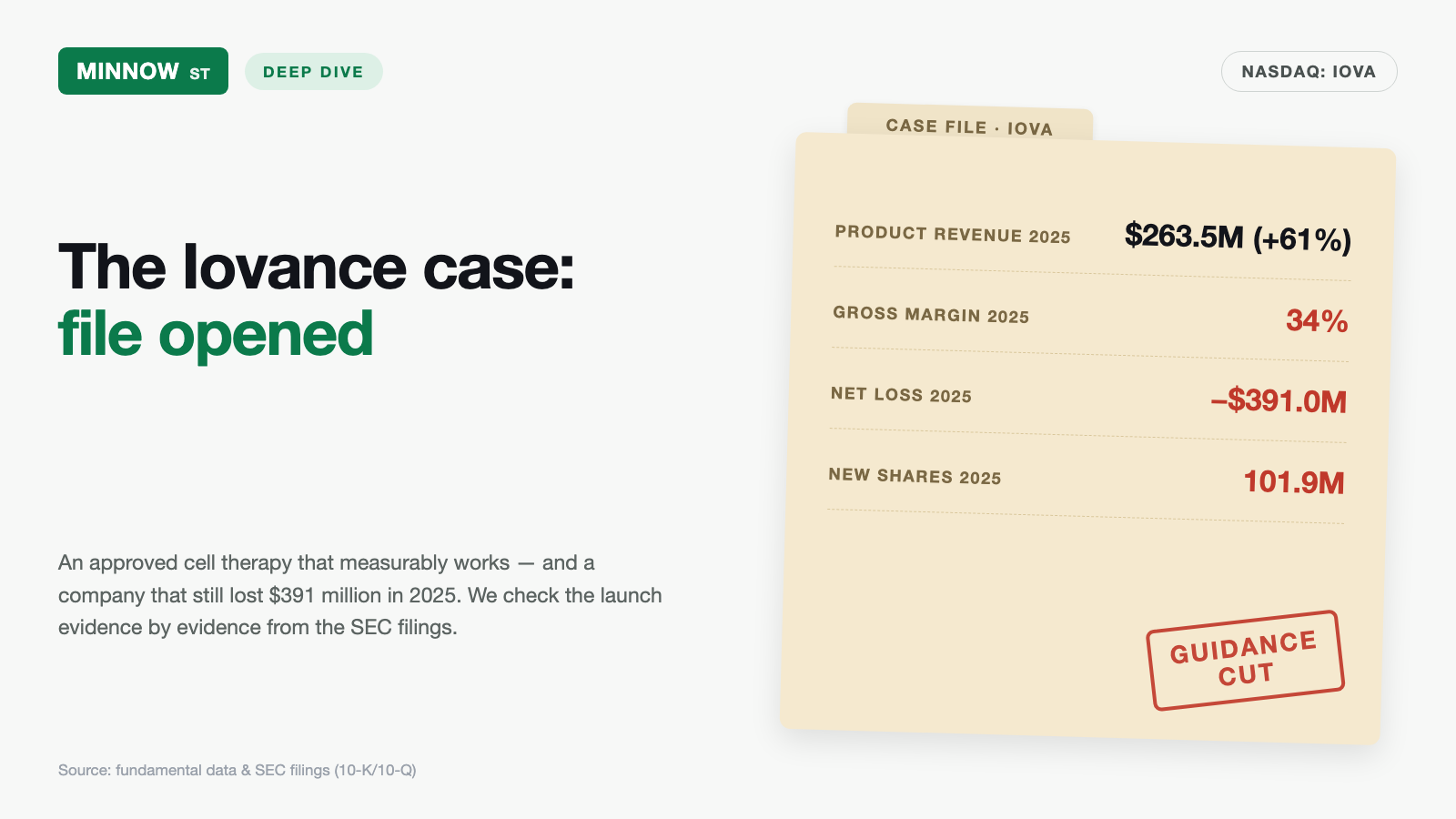
Amtagvi is real medicine: doctors take a piece of your tumor, harvest the immune cells that already found the cancer, grow them into the billions and infuse them back — and in the real world, more than every second patient in earlier treatment lines responds. That is exactly what makes Iovance (Nasdaq: IOVA) the cleanest test of an uncomfortable question: does a therapy that works automatically make a company that works? We read the annual report (10-K) for 2025 and the quarterly report (10-Q) as of March 31, 2026: revenue grew 61 percent to $263.5 million — but the company reaffirmed $450 to $475 million for that same year and cut it to $250 to $300 million ten weeks later, the gross margin fell to 34 percent against its own 70 percent promise, and 101.9 million new shares paid for the year. Not investment advice — just an honest look at what a cure costs to manufacture.
 Thomas Mücke
Founder & Publisher
Thomas Mücke
Founder & Publisher
Chart
Interactive price chart (TradingView).
Note: pure fact-based analysis, not investment advice and not a solicitation to buy or sell. All figures without guarantee.
Ask yourself an easy question: does this therapy work? For Amtagvi the answer is documented — in patients with two or fewer prior lines of treatment, real-world data show an objective response rate of 52 percent, and five-year follow-up reports a median duration of response of about three years in heavily pretreated people who had run out of options. Now ask the hard question: does the company that makes it work? Most of us never get there, because the mind quietly swaps the questions. Psychologists call it attribution substitution: confronted with a difficult question, we answer an easier one that feels adjacent and report the answer with the confidence the hard question deserved. Call it the efficacy trap: it heals, therefore it must pay. Hardly any stock tests that reflex as cleanly as Iovance Biotherapeutics (Nasdaq: IOVA). This is not one of the clinical-stage hopefuls we usually take apart — ATAI, for instance, has no approved product at all. Iovance sells a real, approved medicine to real patients and booked $263.5 million for it in 2025. And it still lost $391.0 million. Reddit, incidentally, is barely watching: our Reddit hype scanner counted 3 mentions in 24 hours (ApeWisdom, as of July 16, 2026). So let's make a deal: we drop the miracle headlines and read only what Iovance reported, under penalty of law, to the U.S. securities regulator, the SEC — the annual report (10-K) for 2025, the quarterly report (10-Q) as of March 31, 2026, and the guidance the company filed along the way. At the end you will not get a verdict on the medicine from us. You will get the bill.
What Iovance actually does — a factory that builds one product for one person
Start with the science, because it is genuinely remarkable and it explains everything that follows. Inside a tumor there are already immune cells that found the cancer — tumor-infiltrating lymphocytes, TILs. They found it; they were simply outnumbered and switched off. Iovance's idea: cut out a piece of the tumor surgically, fish out those TILs, and grow them in a factory into the billions over a 22-day process — a slow phase to day 11, a rapid expansion phase to day 22 — then freeze them, ship them back, and infuse the patient with an army of their own cells that already know the target. Amtagvi (lifileucel) received FDA approval in February 2024 for previously treated advanced melanoma: the first TIL therapy ever approved for a solid tumor. Alongside it, Iovance sells Proleukin, an older immune-system drug whose worldwide rights it bought in 2023 and which is part of the Amtagvi regimen — roughly 15 vials per infusion. Now hold the business model up to the light, because this is where it stops resembling pharma as you know it. A normal drugmaker mixes one compound and stamps a million identical pills; the second pill costs almost nothing, which is why pharma gross margins are famously enormous. Iovance cannot do that. Every dose is a one-off manufacturing run for one named human being, from that person's own tumor, and it cannot be sold to anyone else. Picture a tailor who does not sell suits but sews exactly one, from cloth the customer brings in, with a 22-day stitching time — and if the customer's measurements change or the seam fails inspection, the suit goes in the bin and nobody pays. That image is the central tension of this analysis, and it runs through every chapter: Amtagvi's medical case is proven; its industrial case is not — and the margin, the forecast and the cash keep breaking at exactly the point where the bespoke-ness bites. The manufacturing runs through one building, the Iovance Cell Therapy Center (iCTC) near Philadelphia, which the company says has "the potential capacity to supply TIL cell therapies for more than 5,000 cancer patients annually", with a turnaround time of 32 days or less. The finished cells go to authorized treatment centers (ATCs) — specialized hospitals trained to infuse them; more than 90 in the U.S. and Canada as of May 2026, with at least 110 targeted by year-end 2026. As of December 31, 2025, Iovance had 975 employees, 775 of them in research, development and commercial manufacturing.
Where the stock shows up in our scanner — 13 hits, and not one of them is about the business
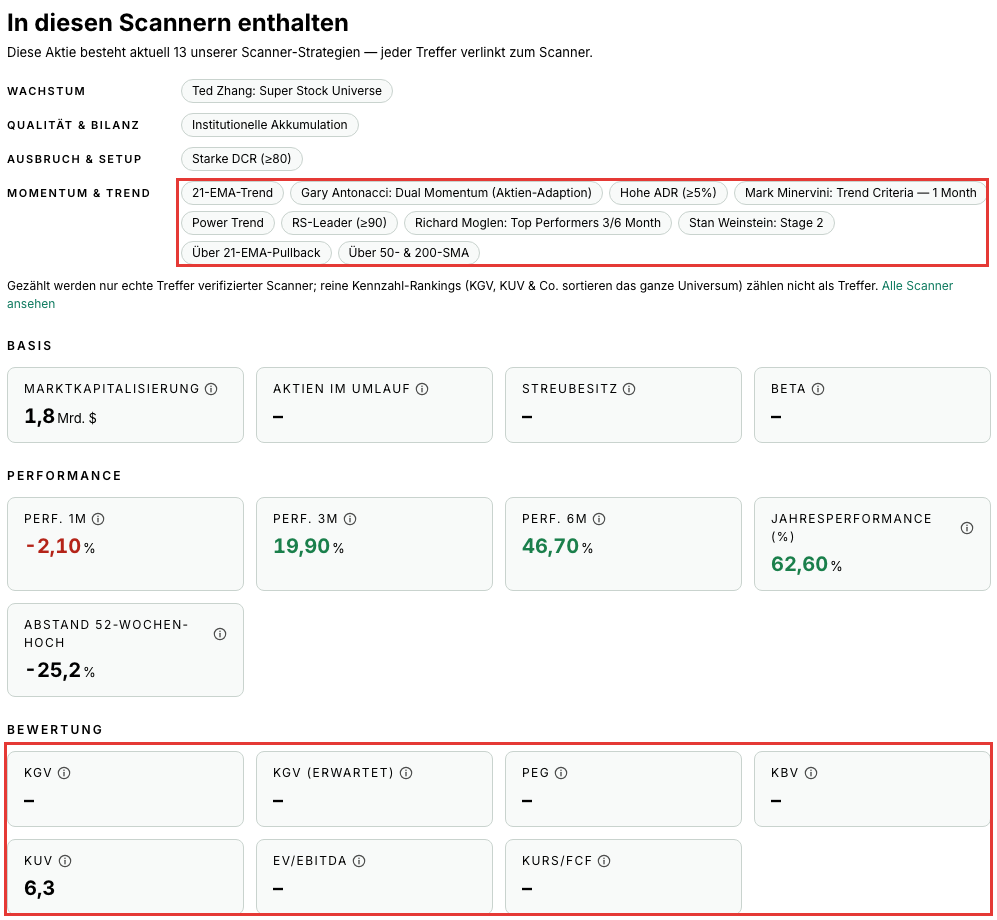
Every day we run about 3,500 stocks through our scanners. Iovance has a row in our database — its company profile sits in the stocks section — and as of the July 8, 2026 data cut-off it lit up in 13 filters. Read the list and you will notice something before you read a single number: Stan Weinstein: Stage 2, RS-Leader (≥90), Power Trend, Mark Minervini: Trend Criteria, Gary Antonacci: Dual Momentum, Richard Moglen: Top Performers, above the 50- and 200-day averages, 21-EMA trend, high ADR, strong DCR, institutional accumulation, Ted Zhang: Super Stock Universe. Every single one is a momentum or trend filter. Not one value list, not one quality list, not one earnings list. That is not a coincidence and not a compliment — it is a diagnosis. The lists Iovance is missing from are missing it because the numbers they need do not exist: on the company profile the price-to-earnings ratio, the forward P/E, the PEG, the price-to-book, EV/EBITDA and price-to-free-cash-flow all show a dash, and so do gross margin, EBIT margin and net margin. A company with no profit cannot be ranked by profit. What remains is the price — and the price has been magnificent: RS-Rating 90 (a relative-strength score; 90 means the stock outran 90 percent of the market), Stage 2 in Weinstein's framework (the advancing phase), about plus 130 percent over twelve months and plus 62.6 percent year to date. Now the other side of the same sheet: the Altman-Z of minus 3.27 sits in our warning zone (the Altman Z-score is a decades-old early-warning thermometer for financial distress; below 1.8 is classically the danger zone), the Piotroski F-Score is 5 of 9 (a nine-point test of balance-sheet quality; healthy companies score 8 or 9), return on equity is minus 47.5 percent, and our fundamental rating is C — "+1 of 100". The only valuation figure the scanner can compute at all is the price-to-sales ratio: 6.3. Remember what you are looking at: a scanner that finds this stock thirteen times and cannot say one word about the business. The stock is 25.2 percent below its 52-week high and roughly 97 percent below its all-time high from the 2021 cell-therapy euphoria (all data as of July 8, 2026).
The numbers over the years — honestly appraised
First, what genuinely impresses, and it is not a courtesy. Three years ago this company sold essentially nothing: product revenue of $1.2 million in 2023. Then Amtagvi was approved, and the curve went $164.1 million (2024) and $263.5 million (2025) — plus 61 percent — with the first quarter of 2026 adding another 44.8 percent to $71.4 million. Building a commercial cell-therapy business from zero to a quarter of a billion dollars in two years, with a product that has to be manufactured individually for every patient, is not a small thing; nobody had done it before. And the recent operating discipline is real: after the August 2025 restructuring, research and development fell to $62.5 million in the first quarter of 2026 (prior-year quarter: $76.0 million) and selling, general and administrative costs to $38.9 million ($43.8 million) — so the operating loss shrank from $121.2 million to $81.0 million and the net loss from $116.2 million to $79.0 million, or $0.19 per share. Cash stood at $319.4 million on March 31, 2026, and the company expects that to fund operations "well into 2028". Most importantly for the argument of this piece: in the first quarter of 2026, cost of sales was flat at $42.5 million while revenue grew 45 percent — which is exactly the operating leverage the model needs, and the first quarter in which it visibly appeared. Hold on to that, because it is the strongest fact in the bull case. Now turn the invoice over.
What the filings say — the uncomfortable truths
Uncomfortable truth no. 1: the company missed its own forecast by nearly half — in ten weeks
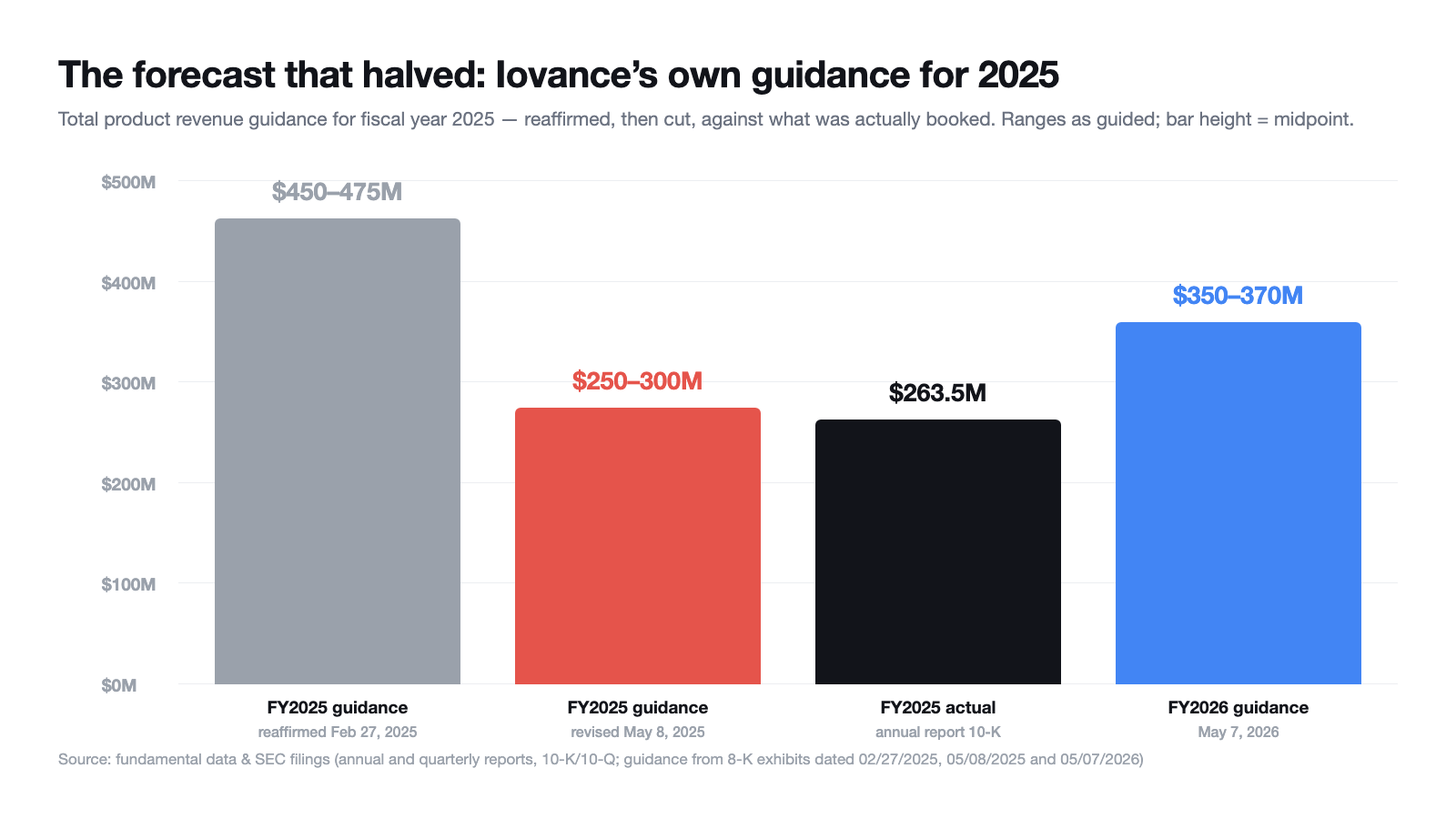
A launch forecast is management's most public statement about how well it understands its own business. On February 27, 2025, with the 2024 results in hand and two months of the year gone, Iovance told the market what 2025 would bring: "Iovance is reaffirming total product revenue guidance within the range of $450 to $475 million for 2025, the first full calendar year of Amtagvi sales." Not issuing — reaffirming. Ten weeks later, on May 8, 2025, came this:
"Iovance is revising total product revenue guidance within the range of $250 to $300 million in the first full calendar year of Amtagvi sales. The updated forecast considers experience with ATC growth trajectories and treatment timelines for new ATCs."
— Iovance Biotherapeutics, Inc., SEC Form 8-K, exhibit 99.1 dated May 8, 2025, "Full Year 2025 Total Product Revenue Guidance"

The midpoint fell from about $462 million to about $275 million — a cut of roughly 40 percent, decided a quarter of the way into the year being forecast. The year ended at $263.5 million: inside the revised range, near its lower half, and about 43 percent below what the company had confirmed in February. To be fair, two things belong here. First, the stated reason is not a demand collapse but a pacing error — "experience with ATC growth trajectories and treatment timelines for new ATCs", meaning newly opened centers took longer to actually infuse patients than assumed. Demand is not the problem; the ramp is. Second, the same release reported genuine progress: more than 275 Amtagvi patients treated and more than $210 million of revenue in the launch's first twelve months. But remember the yardstick: a company that misses its own launch forecast by 43 percent from a standing start in February is telling you something about how predictable this business is — and the 2026 guidance of $350 to $370 million is made of the same material.
Uncomfortable truth no. 2: 34 percent gross margin — against the company's own 70 percent promise
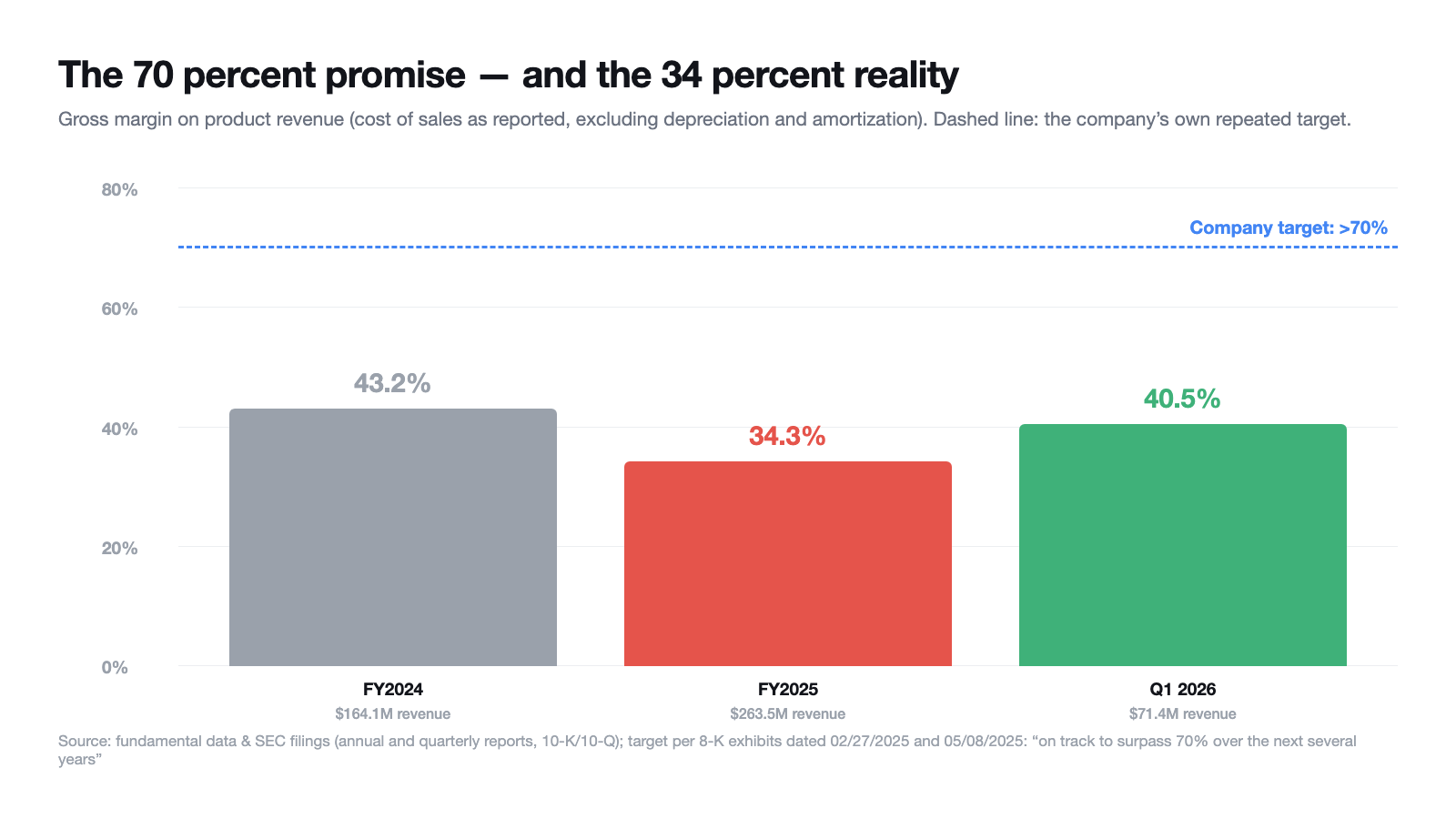
This is the number the entire investment case turns on, and it is the one that gets the least airtime. In 2025, revenue grew 61 percent — and cost of sales grew 86 percent, from $93.2 million to $173.2 million. Run the division: of every $100 of product revenue, $65.70 went straight back out to make the product, leaving a gross margin of 34.3 percent — down from 43.2 percent in 2024. Growth made the margin worse, which is the exact opposite of what scale is supposed to do. And it happened while the company kept repeating, in those very same guidance releases: "Gross margins are expected to increase over time and remain on track to surpass 70% over the next several years." For context: a normal approved drug earns a gross margin in the eighties or nineties. Iovance earns roughly a third — and the structural reason is in the 10-K, stated with unusual candor:
"In the event that the manufactured product does not meet specifications, or a patient is unable to receive the infusion, the Amtagvi® product is generally destroyed and the costs associated with manufacturing and inventory associated with the product is generally required to be expensed as cost of sales."
— Iovance Biotherapeutics, Inc., SEC annual report 10-K for 2025, Item 7 MD&A "Cost of sales"

Read that once more, slowly. The patients Amtagvi treats are gravely ill; between the tumor resection and the infusion lie weeks in which a person can deteriorate beyond the point of receiving the cells. When that happens — or when the batch simply fails its release criteria — the product built for that one person is destroyed, and the full manufacturing cost is booked as cost of sales with no revenue against it. This is not a hypothetical footnote: the 10-K attributes to it "a $18.1 million increase in period costs primarily related to patient drop-off driven by patient health as well as manufacturing results that did not meet required specifications" in 2025 alone, on top of $26.3 million of similar costs in 2024. In plain terms: a share of this factory's output is paid for by the company and consumed by nobody. Now the honest counterweight, because it is substantial. The 34.3 percent is a full-year figure struck while the company still paid an outside contract manufacturer; that contract ended in the first quarter of 2026 and all production moved into the iCTC, which the company says will "improve gross margin and reduce operating expenses". The first quarter of 2026 is the first evidence: cost of sales flat at $42.5 million on 45 percent more revenue, lifting the gross margin to 40.5 percent. The direction has turned. But the gap to the promise is a canyon, not a step: from 40.5 percent to "surpass 70%" is not an improvement, it is a different business — and every point of it has to be won against a process that builds one product for one person and sometimes throws it away.
Uncomfortable truth no. 3: the shareholders paid for the year — 101.9 million new shares
In 2025 Iovance's operations consumed $302.4 million of cash. Here is where that money came from:
"During the year ended December 31, 2025, we received $306.3 million in net proceeds, net of offering costs, through the sale of 101,899,334 shares of common stock cumulatively through the 2023 and 2025 Sale Agreements."
— Iovance Biotherapeutics, Inc., SEC annual report 10-K for 2025, Item 7 "Liquidity and Capital Resources"

Put the two figures side by side: $306.3 million raised, $302.4 million burned. The 2025 shareholders did not fund a factory or a trial — they funded the year. That is what the share count records: 305,252,194 shares outstanding on December 31, 2024, 411,938,061 on December 31, 2025 — up 35 percent in twelve months — and 446,502,396 by April 15, 2026. If you held this stock through 2025, your slice of the company shrank by about a quarter while you did nothing wrong; every future profit is now divided among nearly half again as many shares. This is the quiet cost that never appears in a headline, and it is why we look at it as carefully as at debt — where perpetual issuance leads in the extreme is something our look at AMC Entertainment shows. Fairness demands the other side: dilution is the honest way to finance a business like this. Iovance carries no meaningful debt, pays no 13 percent interest, has no maturity wall and no covenants — the equity market is its bank, and shares are what it pays with. Given the choice between selling stock and going bankrupt, selling stock is the right answer. But remember the mechanism: as long as the operations consume roughly what the share sales bring in, the company is not financing growth — it is financing the gap. And the year's growth was paid for at a share price roughly 97 percent below the all-time high, which is the expensive way to do it.
Uncomfortable truth no. 4: $2.8 billion gone, and the losses are structural
The accumulated deficit is the company's autobiography in one number, and Iovance's reads like this:
"As of December 31, 2025, we had an accumulated deficit of $2.8 billion. In addition, during the year ended December 31, 2025, we incurred a net loss of $391.0 million."
— Iovance Biotherapeutics, Inc., SEC annual report 10-K for 2025, Item 1A "Risk Factors"

Notice that the 2025 loss was larger than 2024's, by $18.8 million — in the year revenue grew 61 percent. Do the arithmetic and you can see why the gross margin matters so much. In 2025 the gross profit was about $90.3 million. Against that stood research and development of $300.3 million, selling, general and administrative costs of $152.3 million, depreciation and amortization of $35.9 million and $5.1 million of restructuring charges — $666.9 million of total costs against $263.5 million of revenue, for an operating loss of $403.4 million. Put it in the everyday image: the gross profit from an entire year of selling a breakthrough cancer therapy does not cover one third of the research budget. Do the sum the other way round: to cover just today's research and administrative costs ($300.3 million plus $152.3 million = $452.6 million) at the 40 percent gross margin of the latest quarter, Iovance would need roughly $1.1 billion of revenue — four times what it sold in 2025, and three times its own 2026 guidance. At the promised 70 percent margin the requirement drops to about $650 million, which is why that promise is not marketing: it is the whole plan. Management has begun attacking the other side of the equation too: the August 2025 restructuring cut "approximately 19 percent" of the workforce, and R&D has now fallen for three consecutive quarters. And credit where due — there is no "going concern" warning in these filings, and the auditors raised none. The company holds $319.4 million and says it is funded "well into 2028". This is not a company on the edge. It is a company that has to change the shape of its own cost curve before the money runs out — and remember the deadline: the plan needs the margin, and the margin needs a factory to behave in a way this factory has never yet behaved.
Valuation: roughly $1.8 billion for a bet on the margin
In early July 2026 Iovance stock cost about $4.20, for a market value of roughly $1.8 billion (data as of July 8, 2026). A price-to-earnings ratio does not exist — there is no profit to divide by, this year or any year. So the market is priced on revenue: about 6.3 times trailing twelve-month revenue, roughly 7 times 2025 revenue, and about 5 times the midpoint of the company's own 2026 guidance. Because Iovance holds $319.4 million of cash and effectively no debt, the enterprise value — what a buyer of the whole business would pay — is lower than the market value, at roughly $1.5 billion, or about 5 times trailing revenue. Whether that is cheap has exactly one answer, and it is not about revenue at all: it depends on the gross margin. At 34 percent this company is a manufacturer with a research habit it cannot afford; at 70 percent it is a pharma business with a monopoly on a therapy class, and $1.8 billion would look small. You are not buying the sales line — you are buying the difference between those two futures. The professionals lean toward the optimistic one: twelve analysts cover the stock, with five strong-buy and three buy ratings against four holds and not a single sell, and a consensus price target of about $8.80 — roughly double the July price (data as of July 8, 2026). Put that in its place, though: an analyst target on a pre-profit company is a model of the margin promise, not an observation of it, and the same profession had no visible problem with $450 to $475 million of 2025 revenue in February 2025. The complete price disclosure belongs here too: the stock is up about 130 percent over twelve months and still down roughly 97 percent from its 2021 all-time high — both facts describe the same stock. You can find more metrics and ratings in the Iovance company profile of our scanner.
Opportunities and risks at a glance
What speaks for Iovance:
- A genuine first: Amtagvi is the first TIL cell therapy approved for a solid tumor (February 2024), with real-world objective response rates of 52 percent in patients with two or fewer prior lines and a median duration of response of about three years in five-year follow-up — a therapy class where Iovance has no direct approved competitor.
- Revenue is real and compounding: $1.2 million (2023) to $164.1 million (2024) to $263.5 million (2025, +61 percent), and $71.4 million in the first quarter of 2026 (+44.8 percent); guidance for 2026 is $350 to $370 million (as of May 7, 2026).
- The margin turn has begun: cost of sales was flat at $42.5 million in the first quarter of 2026 while revenue grew 45 percent, lifting the gross margin to 40.5 percent; the outside contract manufacturer was terminated in the first quarter of 2026 and all production centralized into the iCTC, which the company says has capacity for more than 5,000 patients a year.
- Cost discipline is visible and documented: the August 2025 restructuring cut about 19 percent of the workforce; R&D fell to $62.5 million in the first quarter of 2026 (from $76.0 million) and has now declined for three straight quarters; the operating loss shrank from $121.2 million to $81.0 million year over year.
- A clean balance sheet for a loss-maker: $319.4 million of cash and no meaningful debt as of March 31, 2026 — no interest burden, no maturity wall, no covenants, no going-concern warning; the company expects funding "well into 2028", and the treatment network is growing (more than 90 ATCs, at least 110 targeted by year-end 2026).
What speaks against it:
- Management missed its own launch forecast by about 43 percent: $450 to $475 million reaffirmed on February 27, 2025, cut to $250 to $300 million on May 8, 2025, actual $263.5 million — which makes the 2026 guidance of $350 to $370 million a forecast from the same workshop.
- The gross margin is the business model's open wound: 34.3 percent in 2025, down from 43.2 percent in 2024 because cost of sales grew 86 percent against 61 percent revenue growth — against the company's own repeated target to "surpass 70%". A normal approved drug earns 80 to 90 percent.
- Bespoke manufacturing has a built-in leak: if a dose misses specification or the patient cannot be infused, the product is destroyed and expensed as cost of sales anyway — $18.1 million of additional such period costs in 2025 on top of $26.3 million in 2024.
- Dilution funds the operations: 101,899,334 new shares for $306.3 million net in 2025 against $302.4 million of operating cash burn; the share count rose 35 percent to 411,938,061 (December 31, 2025) and reached 446,502,396 by April 15, 2026 — of 500,000,000 authorized.
- The losses are structural, not transitional: a $391.0 million net loss in 2025 (larger than 2024's) on a $2.8 billion accumulated deficit; $666.9 million of costs against $263.5 million of revenue. Our scanner finds the stock 13 times — every hit a momentum list, none a fundamental one — with an Altman-Z of minus 3.27 in the warning zone and a fundamental rating of C (+1 of 100) (data as of July 8, 2026).
A human conclusion
Back to the efficacy trap from the opening. The easy question — does it work? — has an answer that ought to move you: people with metastatic melanoma who had run out of options are alive years later because a laboratory took their own immune cells and gave them reinforcements. That is not marketing; it is in five-year follow-up data, and it is why this company deserves to exist. But the hard question is a different one, and the filings answer it just as clearly. Finding one: the revenue is real — from $1.2 million to $263.5 million in two years, growing 45 percent again in the latest quarter. Finding two: the forecast is not reliable — reaffirmed at $450 to $475 million in February 2025 and cut to $250 to $300 million in May, a business whose own management could not see one quarter ahead. Finding three: the margin is the whole company. At 34.3 percent, the gross profit of an entire year of a breakthrough cancer therapy did not cover a third of the research bill; the plan requires more than 70 percent, and the first genuine evidence in that direction is exactly one quarter old. Finding four: until then, you pay. Not through interest — the balance sheet is clean — but through 101.9 million new shares that funded the year and diluted your slice by a quarter. If Amtagvi were a suit, it would be the finest bespoke tailoring on the market, cut for one person, sewn in 22 days — and sometimes finished for a customer who can no longer wear it, with the workshop paying for the cloth. Whether you want to own the workshop at roughly 5 times next year's guided revenue, betting that centralized manufacturing turns a 40 percent margin into a 70 percent one before the authorized shares run low — or whether you would rather wait for two or three quarters of margin proof and pay more for certainty: that is no longer a question about the medicine. It is a question about the factory. What you make of it is your decision. And that is exactly as it should be.
Sources
All original documents used in this analysis — to read for yourself:
- Iovance Biotherapeutics, Inc. — SEC annual report 10-K for 2025 (filed February 24, 2026)
- Iovance Biotherapeutics, Inc. — SEC quarterly report 10-Q as of March 31, 2026 (filed May 7, 2026)
- Iovance Biotherapeutics, Inc. — SEC Form 8-K, exhibit 99.1 dated February 27, 2025 (2024 results; 2025 guidance of $450 to $475 million reaffirmed)
- Iovance Biotherapeutics, Inc. — SEC Form 8-K, exhibit 99.1 dated May 8, 2025 (Q1 2025 results; 2025 guidance revised to $250 to $300 million)
- Iovance Biotherapeutics, Inc. — SEC Form 8-K, exhibit 99.1 dated May 7, 2026 (Q1 2026 results; 2026 guidance of $350 to $370 million)
- Iovance Biotherapeutics, Inc.'s complete SEC filing history: EDGAR overview, CIK 0001425205 (sec.gov)
- Fundamental data (metrics, quarterly series, valuation; data as of July 8, 2026), reconciled with the SEC filings.
- Screener and rating data: in-house stock scanner (data as of July 8, 2026); Reddit mentions: ApeWisdom (as of July 16, 2026).
Transparency & disclaimer: This analysis is a journalistic contextualization of publicly available information and is not investment advice, not a financial analysis in the regulatory sense, and not a solicitation to buy or sell securities. Stock investments carry substantial risks up to total loss. All information without guarantee; the data cut-off is noted in the text in each case. The author holds no position in Iovance stock at the time of publication.
Our Bottom Line at a Glance
- Product & market position positive
- Amtagvi is the first TIL cell therapy approved for a solid tumor (February 2024) and has no directly approved competitor in its class: real-world objective response rates of 52 percent in patients with two or fewer prior lines, a median duration of response of about three years in five-year follow-up, and a treatment network of more than 90 ATCs (as of May 7, 2026). Revenue grew from $1.2 million (2023) to $263.5 million (2025).
- Forecast reliability negative
- On February 27, 2025 the company reaffirmed 2025 revenue guidance of $450 to $475 million; on May 8, 2025 it cut the range to $250 to $300 million, citing slower ATC ramp-up. The year ended at $263.5 million — roughly 43 percent below the February figure, decided a quarter into the year being forecast. Guidance for 2026 ($350 to $370 million) comes from the same process.
- Gross margin & manufacturing economics negative
- Gross margin fell from 43.2 percent (2024) to 34.3 percent (2025) as cost of sales grew 86 percent against 61 percent revenue growth — against the company's own repeated target to "surpass 70%". Bespoke doses that miss specification or cannot be infused are destroyed and expensed as cost of sales anyway ($18.1 million of additional period costs in 2025, after $26.3 million in 2024). The first quarter of 2026 shows the first real turn: cost of sales flat at $42.5 million on 45 percent more revenue, margin 40.5 percent.
- Balance sheet & financing neutral
- Clean for a loss-maker: $319.4 million of cash and no meaningful debt (March 31, 2026), no interest burden, no covenants, no going-concern warning, funded "well into 2028". The price is dilution: 101,899,334 new shares for $306.3 million net in 2025 against $302.4 million of operating cash burn; the share count rose 35 percent to 411,938,061 (December 31, 2025) and stood at 446,502,396 on April 15, 2026 — of 500,000,000 authorized.
- Earnings power & valuation negative
- A $391.0 million net loss in 2025 — larger than 2024's — on a $2.8 billion accumulated deficit; the year's gross profit of about $90.3 million did not cover a third of the $300.3 million research budget. At roughly $1.8 billion of market value the stock trades at about 6.3 times trailing revenue and 5 times the 2026 guidance midpoint, with no P/E possible; our scanner finds it 13 times, every hit a momentum list, with an Altman-Z of minus 3.27 and a fundamental rating of C (+1 of 100) (data as of July 8, 2026).
Iovance is the cleanest test of a question investors rarely separate: the therapy works, but does the company? Amtagvi is a genuine first — an approved TIL cell therapy for a solid tumor, with documented multi-year responses — and revenue grew from $1.2 million to $263.5 million in two years. But every dose is a bespoke manufacturing run for one named patient, and that is where the economics break: a 34.3 percent gross margin in 2025 against the company's own 70 percent promise, a 2025 forecast reaffirmed at $450 to $475 million in February and cut to $250 to $300 million in May, a $391.0 million net loss on a $2.8 billion accumulated deficit, and 101.9 million new shares that funded the year. The first quarter of 2026 delivered the first genuine margin evidence — flat cost of sales on 45 percent more revenue. Not investment advice.
What Our Rating Means
- If you don't own the stock
- As long as the question raised in the bottom line stays open, we see no basis for an entry.
- If you hold it in your portfolio
- Our findings offer no acute reason to sell — the checkpoints named remain decisive.
A journalistic assessment by our editorial team at the time of the deep dive, based on public sources — not investment advice and not a solicitation to buy or sell. Your personal circumstances (investment goals, risk capacity, taxes) cannot be taken into account. What our categories mean, how verdicts are formed, and what conflicts of interest exist →
Worth Noting
- IOVA reached our research list via the Reddit hype scanner (ApeWisdom, 3 mentions in 24 hours, as of July 16, 2026) — the silence is itself notable: a stock up about 130 percent in twelve months with almost no forum traffic. The 13 hits in our in-house stock scanner carry the July 8, 2026 data cut-off and rotate daily.
- All 13 scanner hits are momentum or trend filters; Iovance appears in no fundamental or valuation list, because a company without earnings supplies no P/E, PEG, EV/EBITDA or margin figures to rank. The Altman-Z of minus 3.27 and the fundamental rating of C (+1 of 100) are computed from trailing twelve-month figures and reflect the young margin turn only with a lag.
- Gross margins in this analysis are calculated from product revenue and cost of sales exactly as reported; cost of sales excludes depreciation and amortization, which the company reports on a separate line ($35.9 million in 2025). Including it, the margins would be lower still.
- Price and valuation figures are dated to July 8, 2026 (about $4.20, market value roughly $1.8 billion); analyses are evergreen, daily prices are not a buy argument.
Frequently Asked Questions
Iovance (Nasdaq: IOVA) sells two cancer products. Amtagvi (lifileucel) is a TIL cell therapy approved in February 2024 for previously treated advanced melanoma: cells are taken from the patient's own tumor, grown into the billions over 22 days and infused back. Proleukin, whose worldwide rights Iovance bought in 2023, is part of that regimen (about 15 vials per infusion). Together they produced $263.5 million of product revenue in 2025 (+61 percent) and $71.4 million in the first quarter of 2026.
No. Iovance lost $391.0 million in 2025 — more than in 2024 — and carries an accumulated deficit of $2.8 billion as of December 31, 2025. Against $263.5 million of revenue stood $666.9 million of costs, including $300.3 million of research and development. The loss is shrinking at the quarterly level: $79.0 million in the first quarter of 2026 after $116.2 million a year earlier.
On February 27, 2025, Iovance reaffirmed 2025 revenue guidance of $450 to $475 million. On May 8, 2025 it revised the range to $250 to $300 million, citing "experience with ATC growth trajectories and treatment timelines for new ATCs" — newly opened treatment centers took longer to actually infuse patients than assumed. The year ended at $263.5 million, about 43 percent below the February figure. Guidance for 2026 is $350 to $370 million.
Iovance's gross margin was 34.3 percent in 2025, down from 43.2 percent in 2024, and 40.5 percent in the first quarter of 2026 — against the company's own target to "surpass 70% over the next several years". A normal approved drug earns 80 to 90 percent. The reason is bespoke manufacturing: every dose is made from one patient's own tumor and cannot be sold to anyone else. If it misses specification or the patient cannot be infused, it is destroyed and expensed as cost of sales anyway.
A lot. Shares outstanding rose 35 percent in one year, from 305,252,194 (December 31, 2024) to 411,938,061 (December 31, 2025), and reached 446,502,396 by April 15, 2026 — of 500,000,000 authorized. In 2025 alone Iovance sold 101,899,334 shares for $306.3 million net, almost exactly the $302.4 million its operations consumed. Iovance carries no meaningful debt, so equity is how it funds itself.
Iovance held $319.4 million in cash, equivalents, short-term investments and restricted cash as of March 31, 2026, and stated on May 7, 2026 that this is expected to fund operations "well into 2028". The quarter consumed $72.1 million of operating cash (2025 full year: $302.4 million). There is no going-concern warning in the filings. An August 2025 restructuring cut about 19 percent of the workforce to extend the runway.
There is no price-to-earnings ratio, because there are no earnings. At roughly $1.8 billion of market value (about $4.20 per share, data as of July 8, 2026), the stock trades at about 6.3 times trailing revenue and roughly 5 times the midpoint of 2026 guidance; the enterprise value is around $1.5 billion because of the cash and absent debt. Whether that is cheap depends entirely on the gross margin reaching the promised 70 percent. Twelve analysts have a consensus target of about $8.80.
Found an error?
Did you spot a factual error, an outdated number, or a typo in this deep dive? Let us know briefly — your report goes straight to the editorial team.