Hour Loop: $142 Million of Amazon Revenue — and in April the CEO Had to Lend the Company Money
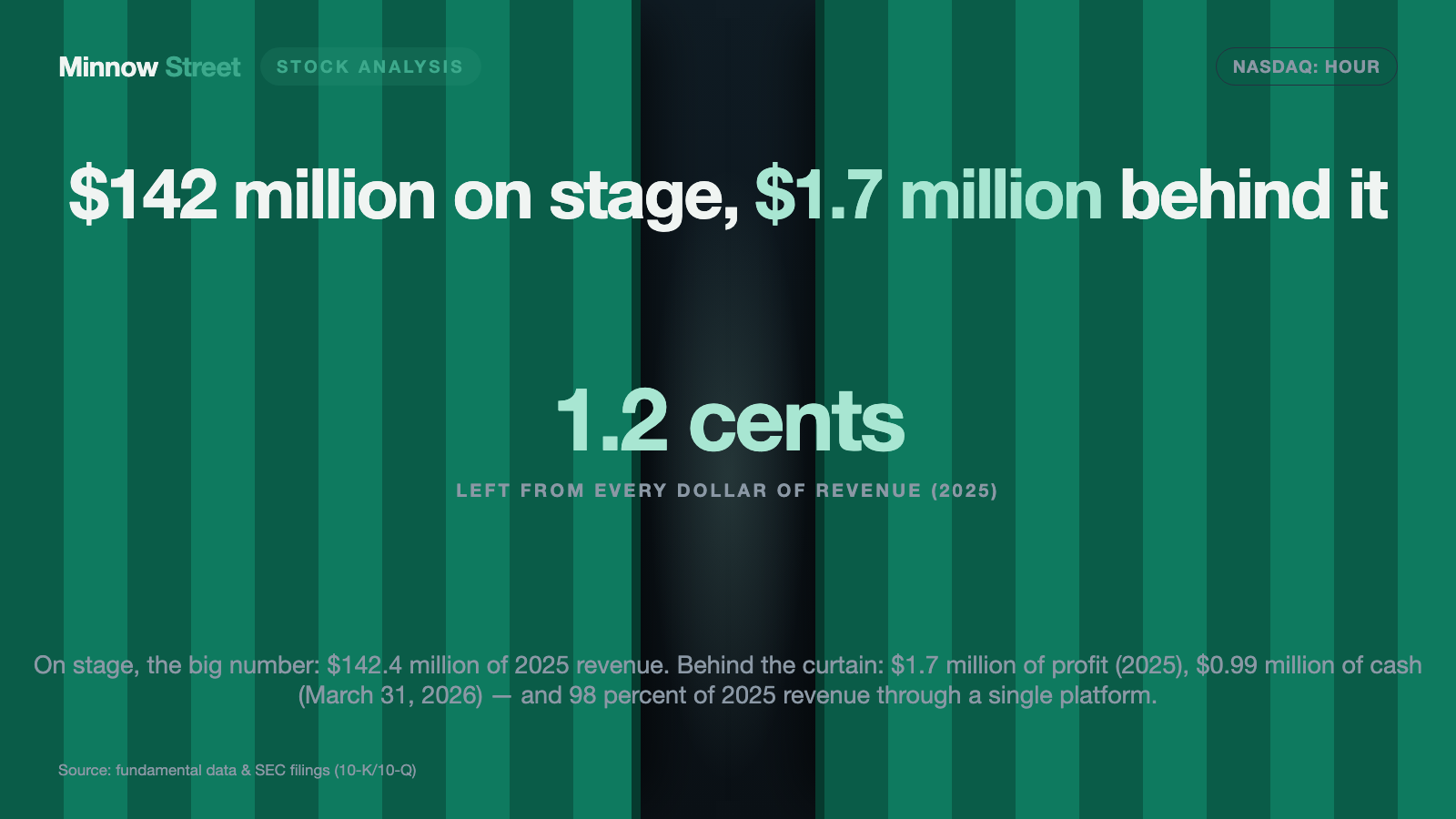
Hour Loop sells home décor, toys and kitchenware on Amazon. In 2025 that came to $142.4 million of revenue across 6.59 million orders. The big number is real. Behind it sit $1.7 million of profit — 1.2 cents on every dollar of revenue — and just $992,886 of cash at March 31, 2026. In April 2026 the founding couple advanced $1,601,000 to the company because Amazon now pays out seven days later, and the quarterly report notes that no formal contract has been signed for it. That same couple controls 94.8 percent of the votes and was paid more in 2025 than the company earned. Not investment advice, just the arithmetic: how much of $142 million actually stays inside the company?
 Thomas Mücke
Founder & Publisher
Thomas Mücke
Founder & Publisher
Chart
Interactive price chart (TradingView).
Note: pure fact-based analysis, not investment advice and not a solicitation to buy or sell. All figures without guarantee.
There is an investing trap that needs no bad intent, only a big number: the revenue anchor. It works like this. You read "$142 million in revenue" (fiscal 2025) next to "$64 million market value" (as of July 30, 2026), and in half a second your brain concludes that the whole company costs less than half of what it sells in a year, so it must be cheap. The number feels solid because it is large. And that is exactly where it goes wrong, because revenue is not money that belongs to anyone — revenue is money that flows through a company. At Hour Loop (Nasdaq: HOUR), a merchant that sells home décor, toys and kitchenware on Amazon, $142.4 million flows through — and $1.7 million stays. So let us make a deal: we will read together what Hour Loop itself told the U.S. securities regulator, the SEC — the annual report (10-K) for 2025, the quarterly report (10-Q) as of March 31, 2026, the current reports (8-K) of May 12 and May 18, 2026, and the proxy statement (DEF 14A) for the 2026 annual meeting. An SEC filing is honest under penalty of law. And this one describes a real business with 6.59 million orders, a profit of 1.2 cents on every dollar of revenue, a cash balance below $1 million — and the fact that in April 2026 the CEO had to lend money to his own company because Amazon started paying later. What you make of it is up to you.
What Hour Loop actually does — a shop inside Amazon's shop
Hour Loop is a reseller. It buys finished branded goods at wholesale directly from manufacturers, lists them on Amazon, and lets Amazon store, pack and ship them. In plain terms: Hour Loop is neither a manufacturer nor a brand, but a merchant who has rented a stall in the world's largest shopping arcade — and the arcade also supplies the shelf, the register, the warehouse and the delivery van. The assortment covers more than 100,000 stock-keeping units, according to the annual report, across home and garden décor, toys, kitchenware, apparel and electronics. The company has sold on amazon.com since 2013 and on walmart.com since 2020, and has since added eBay, Etsy, Amazon Canada and Amazon Mexico. Practically all of the money, though, comes from one address: 98 percent of 2025 revenue ran through Amazon, and 99 percent in 2024.
The company was founded in 2013 by the married couple Sam Lai (chairman, chief executive officer and, at the same time, interim chief financial officer) and Maggie Yu (senior vice president and director). Lai was himself a software development engineer at Amazon between 2009 and 2017, which explains why the core of the business is built in-house. In Note 1 of its filings, Hour Loop describes itself verbatim as a "technology-enabled consumer products company that uses machine learning and data analytics." In practice that means proprietary software spots gaps in the assortment, forecasts demand and resets prices automatically — the more urgently an item needs to move, the sharper the adjustment. As of December 31, 2025, 159 people worked for the company across Redmond, Taiwan and the Philippines; management plans for roughly 165 in 2026. And because it would otherwise go unnoticed: the corporate headquarters in Redmond is a virtual office renting for $59 a month. This is not a company with a marble lobby — and that is not a criticism, it is the heart of the model.
One small contradiction inside the same document belongs here, because it shows how differently one business can describe itself. Note 1 speaks of "design, develop, market and sell" products, while the business section of the very same report states plainly that the model is "wholesale, also known as reselling" — buying in branded goods and passing them on. Both sentences are in the 10-K for 2025. Note the tension of this analysis right at the start, because it runs through every chapter: on stage there is a large, genuine revenue number; behind the curtain sit a razor-thin margin, a nearly empty till and a founding couple that owns almost everything.
How the stock reached our desk
Through the daily sweep of small caps that are heavily discussed in U.S. retail investor forums (as of July 30, 2026). That is an attention signal, not a quality verdict, which is why the work only starts afterwards. And the metrics from the fundamental data (as of July 30, 2026) are a good lesson in how much a number depends on context. The price-to-sales ratio of 0.43 — market value against trailing-four-quarter revenue of $146.5 million — looks spectacularly cheap; against a net margin of 1.2 percent it is the opposite of a bargain, and we will get to that. The Piotroski score is 6 out of 9: that measure runs nine yes/no questions about balance sheet health, and 6 is okay, not good — a genuinely healthy company sits at 8 or 9. The Altman Z-score of 8.97 looks reassuring at first because it is far above the distress threshold, but here it mostly rewards one peculiarity: Hour Loop turns $142.4 million of revenue on a balance sheet of just $23.8 million (December 31, 2025). It says nothing about the cash balance — which is the real question at this company. And the return on equity of 27.5 percent sounds like a gem. It is calculated on the trailing four quarters; take fiscal 2025 on its own and it is roughly 24 percent — $1,704,849 of profit on $6,993,859 of equity at December 31, 2025. Both figures are high only because the equity base is so small. Note the finding: with a merchant you read the margin and the cash first, and the return ratios second. Off we go.
The numbers over the years — given their due
First the genuinely impressive part, and there is more of it than the conclusion suggests. A real trading business has been built from nothing: revenue rose from $26,564,693 in 2019 through $38,655,264 (2020), $62,792,981 (2021), $95,930,091 (2022) and $132,124,202 (2023) to $138,252,861 (2024) and $142,440,236 in 2025. Behind that sit 6,588,014 orders in 2025, up 4.0 percent from 6,337,492. This is not a story stock; it is a business with millions of actual customers. The earnings side turned as well: after losses in 2022 and 2023, Hour Loop returned to profit with $657,447 in 2024 and earned $1,704,849 in 2025, more than two and a half times as much. Retained earnings therefore flipped from minus $595,175 at the end of 2024 to plus $1,109,674 at the end of 2025, and stood at $1,933,156 on March 31, 2026. And 2026 began strongly: $29,930,342 of revenue in the first quarter (up 15.8 percent from $25,837,090) and $823,482 of net income (up 25.8 percent from $654,517), with operating expenses falling from 51.2 to 49.7 percent of revenue. Management is working on efficiency, and it shows.
But profit has never become a reliable quantity here. It jumps.
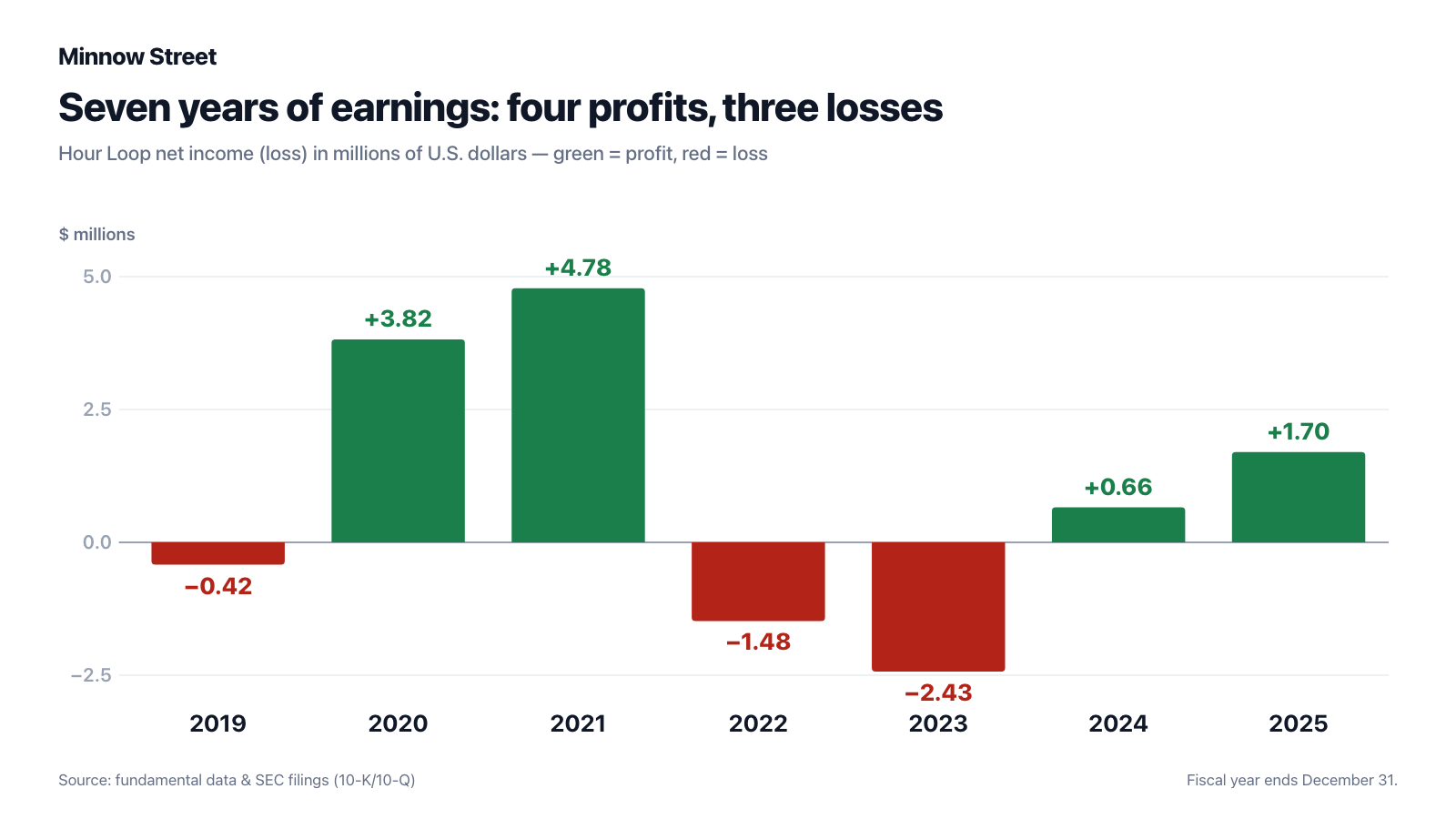
Two things stand out. First, the best year is five years back: in 2021 Hour Loop earned $4,783,773 on revenue of $62.8 million. Revenue has more than doubled since, and profit has never returned to that level. Second, growth has run out. Revenue rose 38 percent from 2022 to 2023, then 5 percent in 2024 and 3 percent in 2025. Decelerating growth is not a disaster — but it strips the valuation of its growth premium. Which brings us to the uncomfortable truths.
What the filings say — the uncomfortable truths
Uncomfortable truth No. 1: 1.2 cents are left from every dollar of revenue
This is where the revenue anchor falls apart. Of the $142,440,236 of 2025 revenue, $67,806,565 went to the merchandise itself, leaving gross profit of $74,633,671, a gross margin of 52.4 percent. For a merchant that looks surprisingly good, and the reason is a matter of where things are booked: the Amazon fees do not sit in the cost of revenues but one line lower. There, under selling and marketing, $62,400,787 disappears — platform fees, storage fees, advertising, shipping. That is 43.8 percent of revenue, almost as much as the goods themselves. Add $9,771,954 of general and administrative expenses (G&A), and operating income comes to $2,460,930; after roughly $0.8 million of interest, other items and taxes, net income lands at $1,704,849.
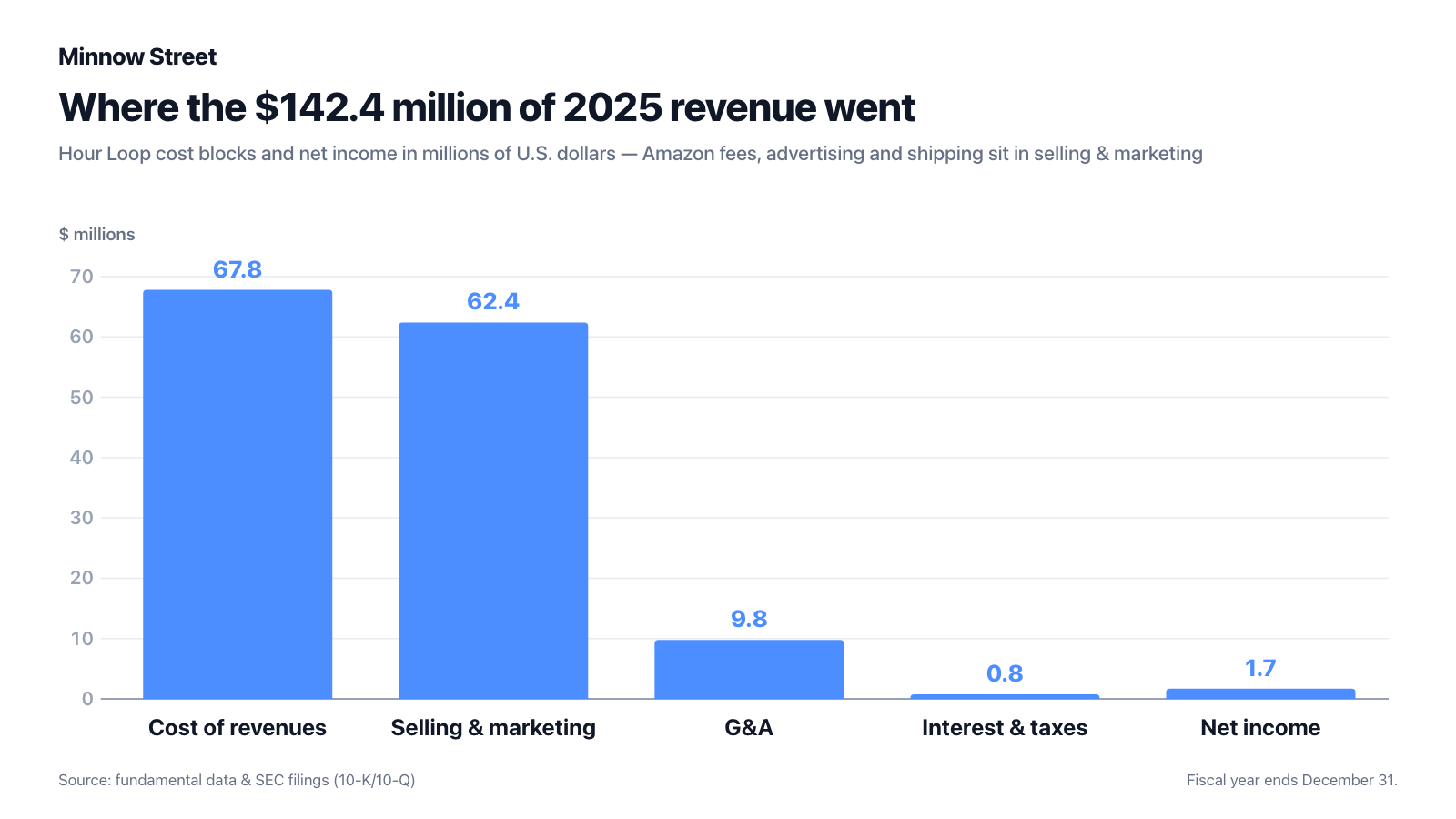
Bring it down to a single dollar: 1.2 cents are left. Picture a market stall that sells $390,000 of goods a day and has $4,700 in the till at closing. As long as everything runs smoothly, that is a good business; it simply needs enormous throughput. But every disruption bites disproportionately: raise platform fees by two percent of revenue, and the entire profit is gone twice over. The filing itself warns of exactly that when, under "Growth Objectives" for 2026, it names "higher inbound placement fees" and the discontinuation of Amazon's labeling service, which it expects to raise logistics costs materially. Note the sentence: at a 1.2 cent margin, every fee increase is an existential question, not a footnote.
Uncomfortable truth No. 2: 98 percent on one platform — which is also landlord, warehouse, cashier and competitor
Customer concentration is a familiar worry: if a neighbor tells you his company is thriving but one client accounts for a fifth of revenue, you wince. At Hour Loop it is not a fifth but nearly everything — and the notes to the annual report say it in a sentence that beats any summary:
"The Company's business is reliant on one key vendor which currently provides the Company with its sales platform, logistics and fulfillment operations, including certain warehousing for the Company's net goods, and invoicing and collection of its revenue from the Company's end customers. During the years ended December 31, 2025 and 2024, approximately 98% and 99%, respectively, of the Company's revenue was through or with the Amazon sales platform."
— Hour Loop, Inc., SEC annual report 10-K for 2025, Note 1, "Concentration of Credit Risks" section

Read that sentence again and count what Amazon is to Hour Loop: the marketplace, the warehouse, the shipper, the invoicer and the collector. Hour Loop's receivables are therefore owed almost entirely by Amazon — $235,959 at December 31, 2025 and $865,136 at March 31, 2026. Amazon is also the largest competitor: the filing names "Amazon Retail" explicitly as a "key competitor" that frequently buys the same brands and sells them at a loss. A landlord who runs the same shop next door and writes the rules is not a partner of equal standing. Fairness requires the other side, though: this same dependency is why Hour Loop can push $142 million of revenue through 159 people without building a single warehouse of its own. And diversification is starting: international revenue rose from $951,439 to $1,560,528 in the first quarter of 2026. That is still a very long way from 98 percent dependency. How hard concentration on a handful of large customers hits a valuation is something we worked through in our TaskUs analysis — there it was clients, here it is the platform itself.
Uncomfortable truth No. 3: below $1 million of cash — and an advance from the CEO with no contract
Now the number this analysis hangs on. At December 31, 2025 Hour Loop had $3,792,033 in the bank. Three months later it had $992,886. Operations consumed $2,201,403 in the first quarter of 2026 against $23,891 a year earlier, and a further $600,000 went back to the founding couple as a repayment. The reason is stated and reasonable: Hour Loop bought merchandise forward because Amazon is discontinuing its labeling service and trade policy is unsettled. Inventory rose from $18,298,935 to $21,087,764. Inventories are assets, not losses. But inventories do not pay bills. For scale: cost of revenues of $67.8 million a year works out to roughly $186,000 per calendar day — so the cash balance at March 31, 2026 covered a little over five days of merchandise buying.
The annual report carries its own risk factor on this point, and it is unusually candid:
"Our primary source of liquidity is available cash and cash equivalents, which is limited. Therefore, our ability to meet our liabilities and to continue as a going concern is dependent on, among other things, improved profitability, the continued implementation of its business strategy, the availability of future funding, implementation of one or more corporate initiatives to reduce costs at the parent company level and other strategic alternatives, including selling all or part of our remaining business or assets."
— Hour Loop, Inc., SEC annual report 10-K for 2025, Item 1A "Risk Factors"

For the record, so nobody overstates this: that is a risk factor written by the company, not a going-concern qualification from the auditor. HTL International, LLC of Houston signed off on the 2025 financial statements on March 24, 2026 without any such emphasis. And then comes the passage that turns a theoretical risk into a very practical piece of news. From the notes to the quarterly report, under "Subsequent Events":
"Due to changes in Amazon's Disbursement Policy, daily remittances are now delayed by seven days. In April 2026, Sam Lai, the Company's Chairman of the Board, Chief Executive Officer and Interim Chief Financial Officer and a significant stockholder of the Company, and Maggie Yu, the Company's Senior Vice President, a member of the Company's Board of Directors and a significant stockholder of the Company, advanced a total of $1,601,000 to the Company to provide support. At present, no formal contract has been entered into."
— Hour Loop, Inc., SEC quarterly report 10-Q as of March 31, 2026, Note 15 "Subsequent Events"

Three things live in that paragraph. First the scale: $1,601,000 is 20 percent of shareholders' equity of $7,814,724 and 1.6 times the entire cash balance. Second the cause: a policy change at Amazon — not at Hour Loop — tore a hole in working capital. That is the dependency from truth No. 2, translated into cash. Third the form: no contract, no interest rate, no maturity. You can read that generously — the owners stepped in rather than selling stock. You can also read it strictly: a listed company whose liquidity depends in a pinch on the executives' personal accounts has no financing buffer, it has a relationship of trust. Both are true. Also in the filings: the credit line with Taiwan's Taishin International Bank (a $6,940,063 facility, $626,076 drawn, at 3.42 percent) was stated in the quarterly report of May 12, 2026 to mature on May 18, 2026 — whether and on what terms it was extended is not documented in any SEC filing submitted since (as of July 30, 2026). And one more number belongs here, because it is easily read as too large: a loan agreement of July 27, 2021 with the two founders created a subordinated shareholder loan with a principal amount of $4,170,418 at 4.75 percent, maturing December 31, 2026. What was actually outstanding at March 31, 2026 was not that principal but $2,060,418 — the entire amount due to related parties on that date, down from $3,810,418 at December 31, 2025 after a $600,000 repayment in the first quarter. We have also logged this finding as a trade idea in our side finds.
Uncomfortable truth No. 4: the founding couple costs more than the company earns — and holds 94.8 percent of the votes
Sam Lai and Maggie Yu are married, and they are Hour Loop. As of May 15, 2026 they together held 33,360,142 of the 35,191,890 shares outstanding, roughly 94.8 percent of the voting power. The proxy statement (DEF 14A) of June 25, 2026 confirms that position unchanged at 94.80 percent as of June 4, 2026; it counts 33,410,142 shares because each of them also holds an exercisable option on 25,000 shares. That leaves about 1.8 million shares in free float — measured against the last closing price documented in a filing, $1.89 on March 23, 2026, a free float worth roughly $3.5 million. The annual report also counts only about five holders of record; everything else sits in street name. In plain terms: you are buying into a family business in which the family holds 95 of 100 votes. Votes at the annual meeting — the next one is scheduled as a virtual event for August 3, 2026 according to the proxy statement — are a formality under those conditions. Incidentally, the same document notes that exactly one board member attended the 2025 annual meeting.
Then the pay. The proxy statement of June 25, 2026 discloses for 2025: Sam Lai $1,118,218 ($500,000 salary, $600,000 bonus, $18,218 other) and Maggie Yu $1,019,774 ($450,000, $550,000, $19,774). Together $2,137,992 — against company net income of $1,704,849. The couple therefore cost a quarter more than the business earned. For 2026 the bonus mechanics were rewritten on May 15, 2026: at profits "excluding taxes and executives' bonuses" of $1,000,000, each receives 50 percent of base salary; at $2,000,000, 100 percent. The measure is thus a figure the company does not publish — and one that excludes the bonuses themselves. On top of that, each is guaranteed $100,000 on December 22, 2026, regardless of results. In fairness: whoever owns 94.8 percent takes every price decline hardest, and the couple did put their own money in during April. But the conflict of interest is structural — effectively nobody but the two of them decides on their own contracts.
Uncomfortable truth No. 5: the company's own 2026 guidance points down
The last uncomfortable truth is not ours. It comes from the current report with which Hour Loop announced its quarterly results on May 12, 2026 — the same day it filed the quarterly report itself:
"Hour Loop reaffirms its guidance for the full year, anticipating 2026 net revenue to be in the range of $143.0 million to $163.0 million, representing flat to 15% year-over-year growth. The Company continues to expect 2026 net income to be in the range of $0.75 million to $1.5 million."
— Hour Loop, Inc., SEC current report 8-K of May 12, 2026, Item 2.02 with Exhibit 99.1

Hold the numbers side by side: Hour Loop earned $1,704,849 in 2025. For 2026 the company itself points to $0.75 million to $1.5 million — the top of that range is 12 percent below the prior year, the bottom 56 percent below. What makes it notable is that the guidance was reaffirmed even though the first quarter came in far better than the year-ago period, up 15.8 percent on revenue and 25.8 percent on profit. Management is therefore expecting the year to tighten later on, and it names the reasons: higher storage fees, trade policy, and the discontinued labeling service. Gross margin already slipped in the first quarter, from 54.7 to 53.5 percent. Anyone wondering how quickly thin consumer margins can tip over will find material in our Utz Brands analysis. At Hour Loop the version of that question reads: the fourth quarter, the holiday season, has to carry the year — and it has to refill the till.
Valuation: a price-to-sales ratio of 0.45 sounds cheap — until you know the margin
Hour Loop's market value was roughly $64 million as of July 30, 2026. The cross-check from the filings: 35,191,890 shares (cover page of the quarterly report, May 12, 2026) times $1.89 — the last closing price documented in an SEC filing, from March 23, 2026 — gives $66.5 million. The two figures are 4 percent apart, so the order of magnitude holds. From that follows a price-to-sales ratio of about 0.45 on fiscal 2025 revenue of $142.4 million — or 0.43 on trailing-four-quarter revenue, which at $146.5 million is higher ($142,440,236 from 2025 plus $29,930,342 from the first quarter of 2026 minus $25,837,090 from the year-ago quarter). Alongside it, a price-to-earnings ratio of about 37 on the 2025 result. Run it against the company's own 2026 guidance and the multiple sits between 43 (at $1.5 million of profit) and 85 (at $0.75 million). Measured against book value, it is roughly 8 times the $7.81 million of equity reported at March 31, 2026.
That settles the revenue anchor from the opening. A price-to-sales ratio of 0.45 at a merchant with a 1.2 percent net margin is no signal of cheapness; it is simply what happens when a lot of revenue runs through a small company — and on the trailing four quarters the same ratio reads 0.43, a shade "cheaper" without anything changing in the business. The reverse is also true: anyone who sees the earnings leverage has a point — if Hour Loop kept three cents on the dollar instead of 1.2, profit would be four times higher and the multiple would drop below 10. That hope is the actual investment case. It costs trust that a margin set partly by Amazon's fee schedule will move upward. The professional view offers little help here: the fundamental data show exactly one analyst as of July 30, 2026, rating hold, with a price target of $1.75. A stock followed by one analyst, with roughly 1.8 million shares actually tradable, is a very narrow market — small orders move the price. Note the closing finding of this chapter: with a 5 percent free float, the liquidity of the shares is a risk of its own, separate from the business.
Opportunities and risks at a glance
What speaks for Hour Loop:
- A real, grown business: $142,440,236 of revenue and 6,588,014 orders in 2025, more than 100,000 stock-keeping units, and rank 25 among U.S. Amazon sellers by positive customer reviews (Marketplace Pulse, as of March 18, 2026).
- Profitable again and trending up: $657,447 of net income in 2024, $1,704,849 in 2025 and a 25.8 percent gain to $823,482 in the first quarter of 2026, with operating expenses down from 51.2 to 49.7 percent of revenue.
- A very capital-light model: $142.4 million of revenue on a $23.8 million balance sheet, with no warehouse of its own and 159 employees; interest expense of $184,274 against $2,460,930 of operating income is almost immaterial (interest coverage roughly 13 times).
- The owners put their own money in: a $1,601,000 advance in April 2026 plus a subordinated shareholder loan, rather than a dilutive share issue.
- Diversification is beginning to show: international revenue rose from $951,439 to $1,560,528 in the first quarter of 2026, with Walmart, eBay, Etsy, Amazon Canada and Amazon Mexico connected. One open extra: following the U.S. Supreme Court ruling of February 20, 2026, the company is assessing refunds of duties paid in 2025.
What speaks against it:
- Existential dependence on a single counterparty: 98 percent of revenue runs through Amazon, which simultaneously provides the platform, logistics, warehousing, invoicing and collection — and which the filing names as its most important competitor. One policy change was enough in April 2026 to open a liquidity hole.
- A razor-thin margin: 1.2 cents of profit on every dollar of revenue, with 43.8 percent of revenue going into selling and marketing where the Amazon fees sit. For 2026 the company itself names higher storage fees and the discontinued labeling service as cost drivers.
- Tight liquidity: $992,886 of cash at March 31, 2026 (roughly five days of merchandise buying, measured against fiscal 2025 cost of revenues) after a $2,201,403 operating outflow in the quarter; the credit line was stated in the latest report to mature on May 18, 2026, no extension is documented in any later SEC filing (as of July 30, 2026), and the subordinated shareholder loan ($4,170,418 principal, $2,060,418 outstanding at March 31, 2026) runs out on December 31, 2026.
- Ownership and compensation risk: 94.8 percent of the votes with the founding couple, roughly 1.8 million shares in free float and about five holders of record — against 2025 compensation of $2,137,992 that exceeded annual net income by a quarter, plus a guaranteed $100,000 each on December 22, 2026.
- Dilution reserve and guidance: 9,152,213 shares were still available for issuance under the equity plan as of March 24, 2026 — 26 percent of the shares outstanding, with an automatic annual increase of up to 3 percent. And the company's own 2026 guidance of $0.75 million to $1.5 million of profit sits below the 2025 result.
A human conclusion
Back to the revenue anchor from the opening. It is not a lie — the $142.4 million is real, so are the 6.59 million orders, and behind them are 159 people who evidently know what they are doing. The anchor simply does something specific to your brain: it makes you feel a size where you should be checking a margin. Look behind Hour Loop's curtain and you find three very concrete things. First, a merchant who keeps 1.2 cents on the dollar, which works until somebody adjusts the fees. Second, a cash balance that was below $1 million on March 31, 2026 and was propped up in April by $1,601,000 from the CEO's personal account, for which no contract yet exists. Third, a married couple that holds 94.8 percent of the votes and was paid more in 2025 than the company earned. None of this is hidden and none of it is unlawful — it is all in the filings, some of it stated with remarkable candor.
So the honest question is not "is a price-to-sales ratio of 0.45 cheap?" but: would you become a part-owner of a business that rents its most important resource — access to customers — from a single landlord who is also its competitor, and whose emergency reserve is the founding family's personal account? If your answer is yes, because you trust the couple for the years ahead and can live with how thinly the stock trades, you have a thesis. If not, you had a big number. What you make of it is your decision. And that is exactly as it should be.
Sources
Every original document used in this analysis, for you to read yourself:
- Hour Loop, Inc. — SEC annual report 10-K for 2025 (filed March 24, 2026)
- Hour Loop, Inc. — SEC quarterly report 10-Q as of March 31, 2026 (filed May 12, 2026)
- Hour Loop, Inc. — SEC current report 8-K of May 12, 2026, Item 2.02 with Exhibit 99.1 (first-quarter results and reaffirmed 2026 guidance)
- Hour Loop, Inc. — SEC current report 8-K of March 24, 2026, Item 2.02 with Exhibit 99.1 (fiscal 2025 results and first 2026 guidance)
- Hour Loop, Inc. — SEC current report 8-K of May 18, 2026, Item 5.02 (2026 bonus targets for Sam Lai and Maggie Yu)
- Hour Loop, Inc. — SEC proxy statement DEF 14A for the 2026 annual meeting (filed June 25, 2026)
- Hour Loop, Inc. — SEC annual report 10-K for 2024 (filed March 27, 2025)
- Complete SEC filing history of Hour Loop, Inc. (CIK 0001874875): EDGAR overview (sec.gov), including the five insider filings (Form 4) dated July 2, 2026.
- Fundamental data (metrics, market value, free float, analyst coverage; data as of July 30, 2026), reconciled against the SEC filings.
Transparency & disclaimer: This analysis is journalistic commentary on publicly available information. It is not investment advice, not a regulated financial analysis and not a solicitation to buy or sell securities. Equity investments carry substantial risks up to the total loss of capital. All information is provided without warranty; the as-of date for each figure is stated in the text. The author holds no position in Hour Loop shares at the time of publication.
Our Bottom Line at a Glance
- Business model and dependency negative
- 98 percent of 2025 revenue ran through Amazon, down from 99 percent in 2024 — and according to the annual report Amazon is simultaneously the sales platform, the logistics provider, the warehouse, the invoicer, the collector and the most important competitor. In April 2026 a single change to the disbursement policy (seven days later) was enough to open a liquidity hole of more than $1.6 million.
- Profitability neutral
- Profitable again since 2024 ($657,447), more than two and a half times that in 2025 at $1,704,849, and up 25.8 percent to $823,482 in the first quarter of 2026 — but the net margin is 1.2 percent, and 43.8 percent of revenue goes into selling and marketing including the Amazon fees. The 2021 profit of $4,783,773 has not been matched on more than double the revenue.
- Balance sheet and liquidity negative
- Cash fell from $3,792,033 (December 31, 2025) to $992,886 (March 31, 2026) — roughly five days of merchandise buying, measured against fiscal 2025 cost of revenues — after a $2,201,403 operating outflow in the quarter. The credit line was stated in the latest report to mature on May 18, 2026 and no extension is documented in any later SEC filing (as of July 30, 2026); the subordinated shareholder loan ($4,170,418 principal, $2,060,418 outstanding at March 31, 2026) runs out on December 31, 2026. The founders' $1,601,000 advance still has no contract. Against that: operating cash flow was positive in fiscal 2025 at $2,581,256.
- Ownership and governance negative
- The Lai/Yu couple held roughly 94.8 percent of the voting power as of May 15, 2026 (33,360,142 of 35,191,890 shares); about 1.8 million shares trade freely, with roughly five holders of record. Their 2025 compensation of $2,137,992 exceeded annual net income by a quarter, and each is guaranteed $100,000 on December 22, 2026. On top of that, 9,152,213 shares were available under the equity plan as of March 24, 2026.
- Growth and guidance neutral
- The first quarter of 2026 grew 15.8 percent to $29,930,342, and international revenue rose from $951,439 to $1,560,528. At the same time, on May 12, 2026 the company reaffirmed full-year guidance of $0.75 million to $1.5 million of net income — the top of that range is 12 percent below 2025. After 38 percent revenue growth in 2023 came 5 percent in 2024 and 3 percent in 2025.
- Valuation neutral
- At roughly $64 million of market value (as of July 30, 2026) the price-to-sales ratio is 0.45 on fiscal 2025 revenue (0.43 on the trailing four quarters), which says nothing about cheapness at a 1.2 percent net margin; on earnings it is about 37 times the 2025 result and 43 to 85 times the company's own 2026 guidance, plus about 8 times book value. One analyst covers the stock, rating hold, with a price target of $1.75.
Hour Loop is the revenue anchor in its purest form: a genuine merchant with $142,440,236 of revenue and 6,588,014 orders in 2025 — of which $1,704,849 was left at the end, 1.2 cents on every dollar. Behind that margin sits near-total dependence on Amazon (98 percent of revenue), which turned concrete in April 2026: because Amazon now pays seven days later, the founding couple advanced $1,601,000, with no formal contract according to the quarterly report, against a cash balance of $992,886. That same couple holds 94.8 percent of the votes and was paid more in 2025 than the company earned. The company's own 2026 guidance of $0.75 million to $1.5 million of profit points down. Not investment advice.
What Our Rating Means
Substance risk
We found at least one documented issue that threatens the company itself — regardless of how the stock is currently valued.
This red is not about the price of the stock — not the share price, not the multiple, not the narrow free float — but about the one finding that can strike the business itself: existential dependence on a single counterparty. The annual report itself calls Amazon a "key vendor" through which 98 percent of revenue runs and which simultaneously supplies platform, logistics, warehousing, invoicing and collection; Hour Loop's receivables are owed almost entirely by Amazon, which the filing also names as its most important competitor. The report says the company depends entirely on that relationship for growth — and a change to the payout schedule was enough in April 2026 to hit working capital. On top of that comes the company's own risk factor, which explicitly ties its ability to continue as a going concern to improved profitability, future funding and cost cuts, against a cash balance of $992,886 at March 31, 2026. Against that stands genuine positive evidence, and more of it than the color suggests: the company has been profitable since 2024, operating cash flow was positive in fiscal 2025 at $2,581,256 (2024: $313,140) — so there is no sustained cash burn, and the $2,201,403 outflow in the first quarter of 2026 went mainly into inventory ($3,198,284) and the unwind of accrued liabilities ($2,612,327). Interest coverage is roughly 13 times, equity is positive, the 2025 audit carried no going-concern qualification, and the owners put in their own money. Without the Amazon dependence this would be yellow; with it, the more cautious grade applies. The decision is yours.
A journalistic assessment by our editorial team at the time of the deep dive, based on public sources — not investment advice and not a solicitation to buy or sell. Your personal circumstances (investment goals, risk capacity, taxes) cannot be taken into account. What our levels mean, how verdicts are formed, and what conflicts of interest exist →
Worth Noting
- Hour Loop reached our research desk through the daily sweep of small caps heavily discussed in U.S. retail investor forums (as of July 30, 2026) — an attention signal, not a quality verdict. The scanner result lists on Minnow Street are recalculated every day; this analysis rests exclusively on SEC filings and fundamental data.
- Currency of the record: we worked through the annual report 10-K for 2025 (March 24, 2026) and every document filed from that day onward — the current report 8-K of March 24, 2026 (fiscal 2025 results and first 2026 guidance), five insider filings (Form 4) of April 7, 2026 (grants of 1,600 shares each on April 6, 2026), the quarterly report 10-Q as of March 31, 2026 (May 12, 2026), the 8-K of May 12, 2026 (quarterly results and reaffirmed 2026 guidance), the 8-K of May 18, 2026 (2026 bonus targets), the proxy statement (DEF 14A) of June 25, 2026 together with the additional proxy material (DEFA14A) of the same day, and five further insider filings (Form 4) of July 2, 2026 covering routine grants of 1,586 shares each.
- Two cautionary notes on metrics: the Altman Z-score of 8.97 (as of July 30, 2026) looks reassuring but mainly rewards the extremely high asset turnover ($142.4 million of 2025 revenue on a $23.8 million balance sheet at December 31, 2025) and says nothing about the cash balance. And the 27.5 percent return on equity is calculated on the trailing four quarters; for fiscal 2025 alone it is roughly 24 percent ($1,704,849 of profit on $6,993,859 of equity at December 31, 2025). Both are high only because of the small equity base, not because of a high margin.
Frequently Asked Questions
Hour Loop, Inc. (Nasdaq: HOUR) of Redmond, Washington, is an online retailer that buys branded goods at wholesale and resells them on Amazon — more than 100,000 stock-keeping units across home and garden décor, toys, kitchenware, apparel and electronics. Amazon handles storage and shipping. The company was founded in 2013 by the married couple Sam Lai and Maggie Yu, has been public since January 7, 2022, and employed 159 people as of December 31, 2025.
Very little: net income of $1,704,849 on revenue of $142,440,236 in 2025 — 1.2 cents on every dollar of revenue. The merchandise itself cost $67,806,565, another $62,400,787 went to selling and marketing, the line that carries Amazon fees, advertising and shipping (43.8 percent of revenue), and $9,771,954 to general and administrative expenses. In the first quarter of 2026, $29,930,342 of revenue left $823,482 of profit.
Almost entirely. The annual report for 2025 describes Amazon as a single "key vendor" providing the sales platform, logistics, fulfillment, part of the warehousing, invoicing and collection; 98 percent of 2025 revenue ran through Amazon, down from 99 percent in 2024. April 2026 showed how directly that bites: because Amazon delayed its daily remittances by seven days, the founders had to advance $1,601,000 to the company.
Liquidity is tight, but the company is not over-indebted. At March 31, 2026 it held $992,886 of cash, down from $3,792,033 at December 31, 2025, after operations consumed $2,201,403 in the quarter and inventory was built up to $21,087,764. Shareholders' equity stood at $7,814,724 and bank debt at only $626,076. Amounts due to the founding couple stood at $2,060,418 — part of a subordinated 2021 loan agreement with a principal amount of $4,170,418 at 4.75 percent, maturing December 31, 2026. On top of that sits the founders' $1,601,000 advance from April 2026.
Almost entirely the founding couple. As of May 15, 2026, Sam Lai and Maggie Yu together held 33,360,142 of the 35,191,890 shares outstanding, roughly 94.8 percent of the voting power, leaving about 1.8 million shares in free float. The annual report counts only about five holders of record. Minority shareholders carry effectively no weight in votes — the 2026 annual meeting is scheduled as a virtual event for August 3, 2026 according to the proxy statement.
Revenue of $143.0 million to $163.0 million and net income of $0.75 million to $1.5 million. The company first issued that guidance on March 24, 2026 and reaffirmed it on May 12, 2026. What stands out: the top of the profit range is 12 percent below the 2025 result of $1,704,849, even though the first quarter of 2026 came in better than the year-ago period, up 15.8 percent on revenue and 25.8 percent on profit.
The price-to-sales ratio of about 0.45 (as of July 30, 2026) looks cheap but says little at a net margin of 1.2 percent. Measured on earnings the stock is not cheap: roughly 37 times the 2025 result and 43 to 85 times the company's own 2026 guidance, plus about 8 times book value. The market value of roughly $64 million was cross-checked against 35,191,890 shares times $1.89, the March 23, 2026 closing price cited in the annual report.
Found an error?
Did you spot a factual error, an outdated number, or a typo in this deep dive? Let us know briefly — your report goes straight to the editorial team.