Utz Brands: A 91 Percent Premium for Public Shareholders — the Founding Family Stays Aboard
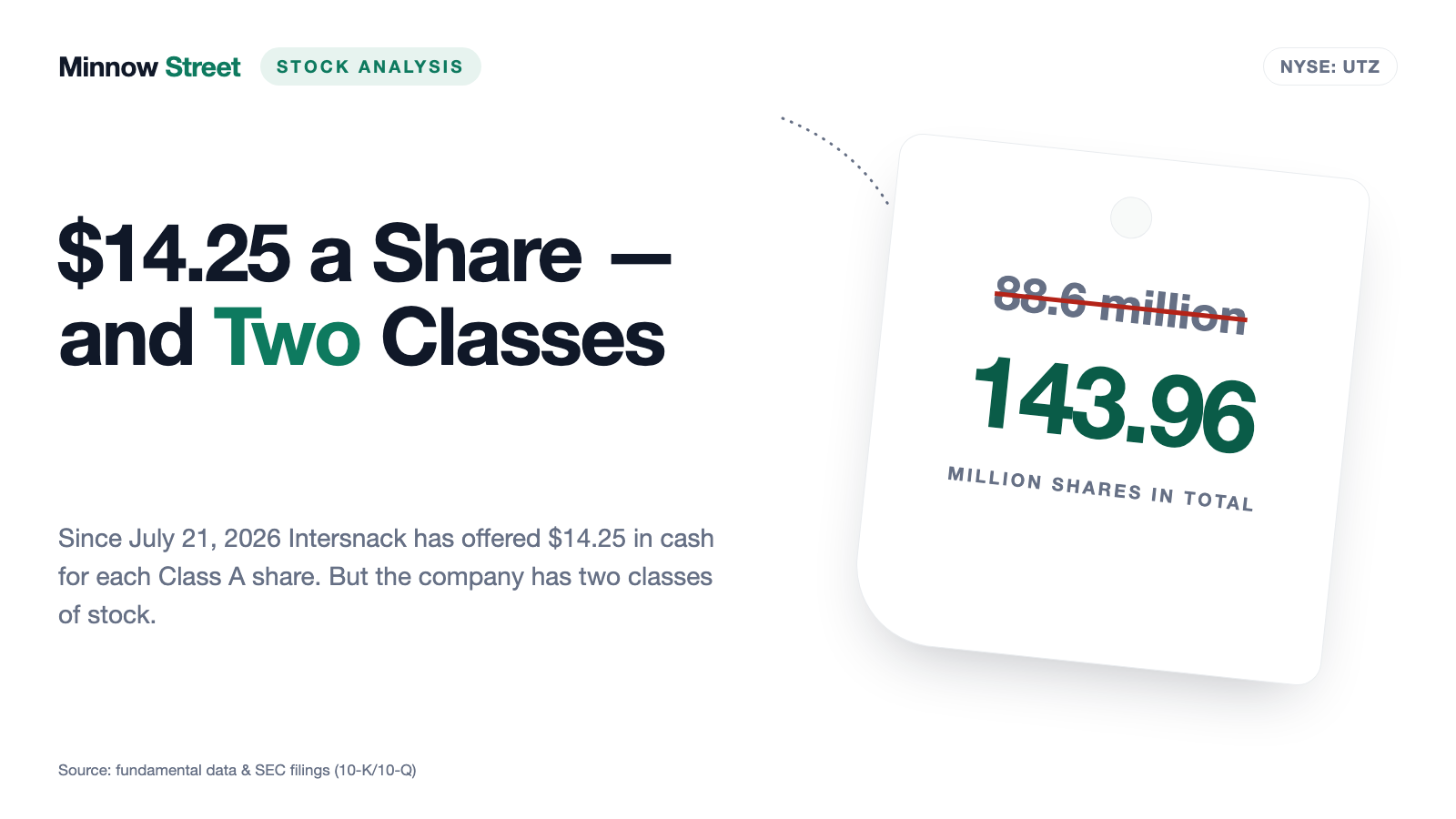
On July 21, 2026 Utz Brands announced that the Pennsylvania snack maker had agreed to be acquired by Germany's Intersnack Group: $14.25 per Class A share in cash, roughly 91 percent above the July 20, 2026 closing price, an enterprise value of about $2.9 billion. What the headline does not say: Utz has two classes of stock, and only one of them gets cashed out — the founding family rolls its stake forward and would own 50 percent afterwards. Behind it sits a company whose revenue has been flat at about $1.44 billion for three years, whose adjusted earnings rose to $216.5 million in 2025, and which still reported a $7.7 million net loss. And the vote that decides everything has not happened yet. Not a buy tip — a look at the contract shareholders are being asked to sign.
 Thomas Mücke
Founder & Publisher
Thomas Mücke
Founder & Publisher
Chart
Interactive price chart (TradingView).
Note: pure fact-based analysis, not investment advice and not a solicitation to buy or sell. All figures without guarantee.
There is an investor trap that feels like a gift, which is exactly why it works so well: the premium reflex. It goes like this. A company gets bought, the announcement contains a percentage, and the bigger that percentage is, the faster the thinking stops. "91 percent above the closing price" reads like a verdict someone else has already delivered. Read that way, you are no longer reading the company — only the number. At Utz Brands (NYSE: UTZ) — potato chips, pretzels and tortilla chips out of Hanover, Pennsylvania, founded in 1921 — that is precisely what happened on July 21, 2026: Germany's Intersnack Group intends to acquire all Class A shares for $14.25 in cash, at an enterprise value of about $2.9 billion according to the announcement. So let us make a deal: before you buy the percentage, we will read together what Utz itself told the U.S. securities regulator, the SEC — the annual report (10-K) for fiscal 2025, the quarterly report (10-Q) as of March 29, 2026, and the two 8-K filings of July 21 and July 22, 2026 that contain the merger agreement. An SEC filing is honest under penalty of law. And this one describes two classes of stock of which only one gets cashed out, an adjusted result that rises while the real one falls, and a vote that has not taken place yet. What you make of it is up to you.
What Utz Brands actually does — chips, pretzels and 2,500 delivery trucks
Utz Brands makes salty snacks, and that is meant literally: potato chips, tortilla chips, pretzels, cheese balls, pork skins, party mixes, popcorn. The annual report names four core brands the company calls its "Power Four": Utz, On The Border, Zapp's and Boulder Canyon, alongside older regional labels such as Golden Flake, Bachman, Tim's Cascade, Dirty Potato Chips, Hawaiian and Miguelito's. The flagship Utz brand alone generated more than $870 million in retail sales in 2025, at a compound annual growth rate of about 5.7 percent since 2021. Production runs through eight plants in the United States, selling into supermarkets, mass merchants, club stores, convenience stores and drug stores. The products reach roughly 50 percent of all U.S. households (as of December 28, 2025). Headcount was about 3,100 full-time and 200 part-time associates.
The genuinely distinctive thing about Utz is how the goods travel. A large share moves through about 2,500 direct-store-delivery routes — straight onto the shelf rather than into the retailer's warehouse. Almost none of those routes are run by employees any more; they belong to independent operators who bought the rights to their route from the company. The annual report describes the shift:
"Over the last several years, we have converted from a predominately company-owned route sales professionals ("RSP") model toward the use of IOs."
— Utz Brands, Inc., SEC annual report 10-K for fiscal 2025, Item 1 "Supply Chain — Distribution"
In everyday terms: drivers on the payroll became franchisees with their own trucks. That lowers fixed costs, but it also moves part of the revenue into a discount line — so-called IO discounts came to $179.4 million in 2025 (2024: $183.6 million).
One detail you have to know before reading any of the numbers: Utz's fiscal year does not end on December 31, but on the Sunday closest to it. That means a year sometimes has 52 weeks and sometimes 53 — and a 53-week year automatically looks stronger without a single extra bag being sold. For the three years in this analysis that distortion does not apply, and the report says so verbatim:
"Our fiscal year end is the Sunday closest to December 31. Our fiscal year 2023 ended December 31, 2023 and was a fifty-two-week fiscal year, our fiscal year 2024 ended December 29, 2024 and was a fifty-two-week fiscal year and our fiscal year 2025 ended December 28, 2025 and was a fifty-two-week fiscal year."
— Utz Brands, Inc., SEC annual report 10-K for fiscal 2025, Item 1 "Business"
So 2023, 2024 and 2025 are directly comparable — no calendar trick distorts the series. And that names the central tension of this analysis, which runs through every chapter: a company whose revenue has stood still for three years and whose bottom line shows a loss is being bought at a 91 percent premium — by a buyer who will share it half and half with the founding family, while public shareholders are cashed out and leave.
How the stock landed on our desk
Utz did not reach our research list through one of our metric screens but through the Reddit mentions in our hype scanner (as of July 30, 2026). That is logical enough: a 91 percent takeover premium pulls any stock into the spotlight, however dull the underlying business. We also checked whether Utz shows up in any of our stock scanners — and the answer is a clear no. As of the July 30, 2026 query date the stock appears in none of our screens, neither momentum nor quality nor valuation. Those lists are recalculated daily, so the finding can change; it is a snapshot, not a permanent state.
Why does no screen catch it? Because Utz is a poor candidate for standard metrics. A price-to-earnings ratio cannot be formed meaningfully because the company reported a loss for fiscal 2025. A price-to-sales ratio misleads as long as you count the shares wrong — and at Utz that happens almost automatically, as the next section shows. Keep the finding for later: at Utz you do not measure with the standard ruler; you first have to count how many units the company actually has.
The numbers over the years — honestly credited
First what genuinely speaks for Utz. The business is stable and cash-generating: revenue was $1,438.2 million in fiscal 2023, $1,409.2 million in 2024 and $1,438.8 million in 2025. No growth, but no collapse either — for a product people have been buying for more than a century, that is a property, not only a shortcoming. The branded core is even growing: branded salty snacks — the four core brands together with the smaller house labels — added 4.7 percent in 2025 and account for 88 percent of revenue, a gain the annual report says was led by the four core brands. The rest of the business — partner brands, dips and non-salty items — fell 14.0 percent. Cash from operations rose three years running: $76.6 million (2023), $106.2 million (2024), $112.2 million (2025). And the first quarter of 2026 (thirteen weeks ended March 29, 2026) looked operationally better than the prior-year quarter: revenue $361.3 million after $352.1 million (up 2.6 percent), gross profit $91.9 million after $82.4 million, operating income $7.8 million after $5.7 million.
Now the view that explains everything — the three earnings measures Utz reports for the same two years:
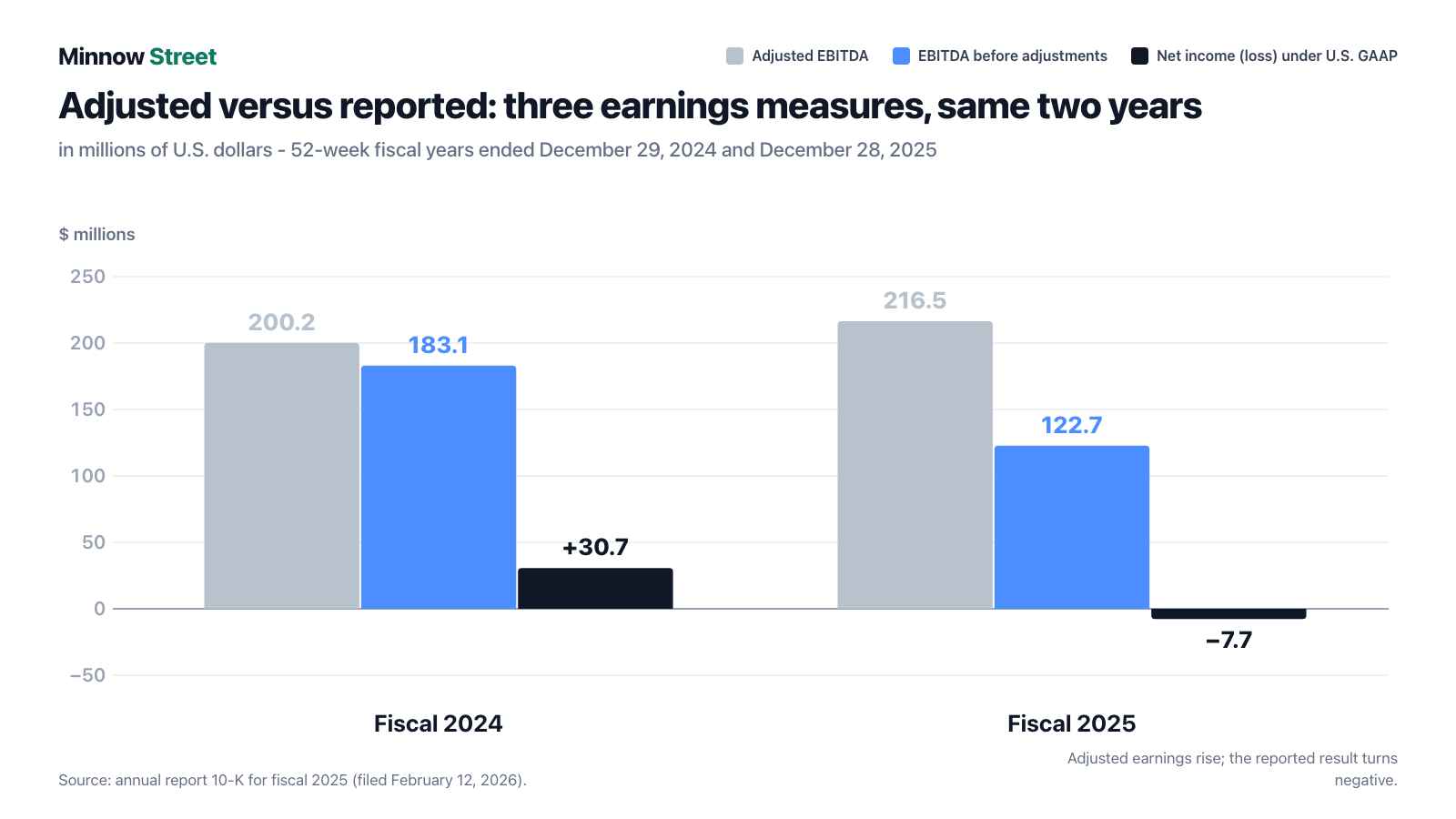
That chart is the real message of the numbers: on the measure management emphasizes, Utz earns more and more; on the measure the law prescribes, less and less. How the gap arises is set out in the reconciliation in the annual report, and we get to that shortly. First, though, the number people get wrong at Utz.
What the filings say — the uncomfortable truths
Uncomfortable truth No. 1: the market value counts only half the company
Utz has two classes of stock. Only the Class A trades on the New York Stock Exchange — 88,613,213 shares (as of July 15, 2026 per the merger agreement). Alongside them sit 55,349,000 Class V shares, which are not listed and belong entirely to the founding family. Those Class V shares carry votes but virtually no economic value of their own; the value sits in an equal number of "Common Units" of the subsidiary Utz Brands Holdings, LLC, held by the same family. The quarterly report states it plainly:
"… the Noncontrolling Interest Holders held all 55,349,000 shares of Class V Common Stock issued and outstanding and also held an equal number of units of UBH, which comprise the noncontrolling interest."
— Utz Brands, Inc., SEC quarterly report 10-Q as of March 29, 2026, note on earnings per share
In everyday terms: picture a bakery with two owners. One holds shares that trade on an exchange, the other holds his stake directly in the bakehouse — legally packaged differently, economically the same cake. Count only the listed shares and you mistake half the bakery for all of it. That is exactly what happens with Utz: our own price-data pull showed a market value of about $1.2 billion on July 30, 2026 — that is the 88.6 million Class A shares and nothing else. Measured against all 143,962,213 units, 38 percent is missing. We therefore do not use that market value anywhere in this analysis, nor any metric derived from it. What counts instead are the figures from the contract:
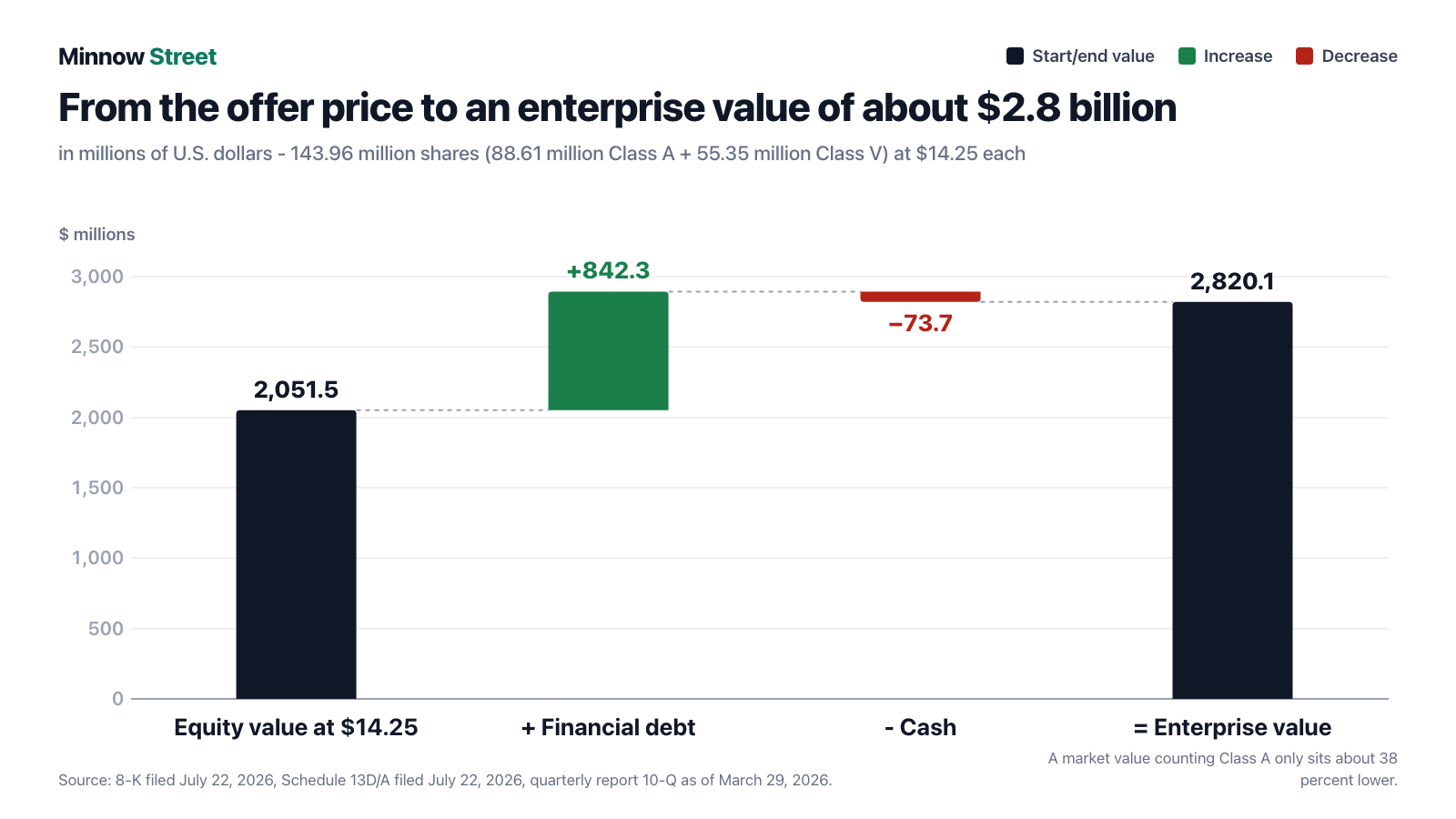
And what happens to the Class V shares at closing? They are simply cancelled. That sounds dramatic, but it concerns only the packaging — and it emphatically does not mean the family gets cashed out. This is the part the headline makes it easy to get backwards: the founding family receives no $14.25 per unit. It keeps its units. The joint press release calls this "rollover equity," and the implementation agreement in the 8-K filed July 22, 2026 spells out the mechanics: the family buys an additional 2,315,790 LLC units at $14.25 each — about $33 million it pays in — while the LLC redeems roughly 31 million units from the company at the same price (about $441 million, funded by new borrowings at the operating company), until each side holds exactly 50 percent. The only holders cashed out and shown the door are the Class A shareholders. The $14.25 still works as a yardstick for every unit, because the contract sets that price per LLC unit. The cancellation of the Class V shares reads as follows:
"… issued and outstanding immediately prior to the Effective Time (all of which are held by the Continuing Stockholders) will be automatically canceled for no consideration."
— Utz Brands, Inc., SEC filing 8-K dated July 22, 2026, Item 1.01 "Merger Consideration and Treatment of Equity Awards"
Uncomfortable truth No. 2: adjusted earnings rise because a "transformation" comes back every year
Alongside its result under U.S. accounting rules, Utz reports an "Adjusted EBITDA" — earnings before interest, taxes, depreciation and amortization, further adjusted. Such measures are permitted and common; what matters is what gets stripped out. At Utz the path from one to the other became very long in 2025: a $7.7 million net loss becomes $216.5 million of adjusted earnings across nine steps. The largest items: $82.4 million of depreciation and amortization, $43.1 million of interest expense, $26.8 million of non-cash items, $22.8 million for acquisitions and divestitures — and the most striking single line, $65.4 million of "Business Transformation Initiatives" after $28.1 million the year before. Here is the original table:
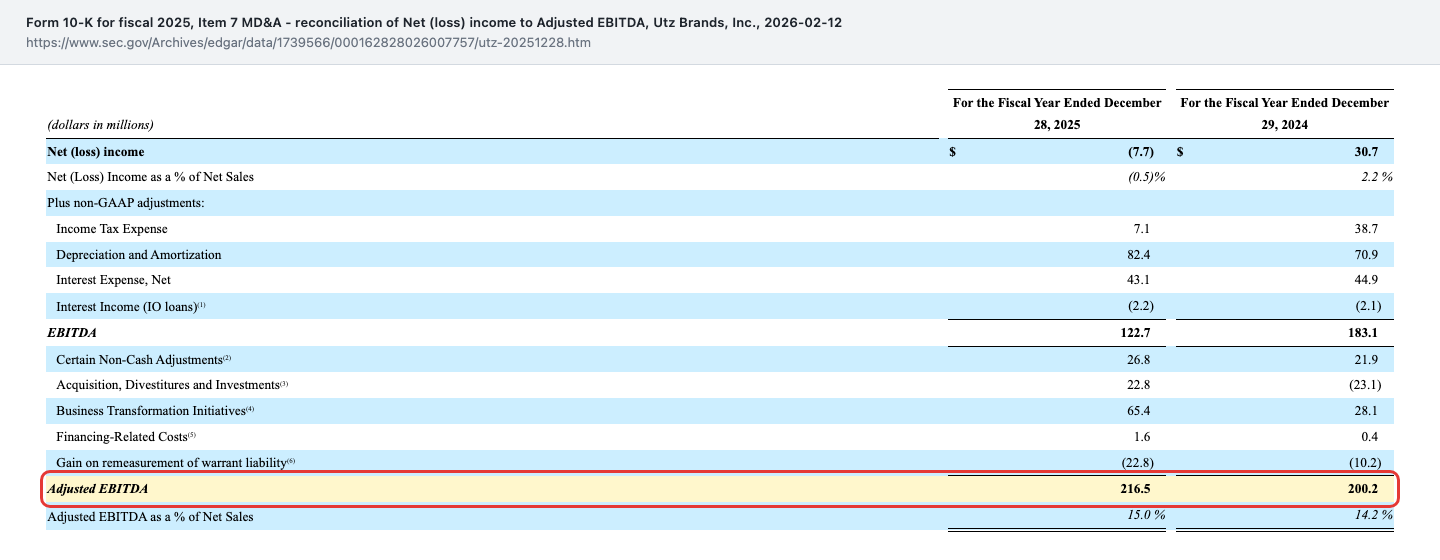
The footnote explains what those $65.4 million contain: start-up costs, consulting, professional and legal fees for restructurings, severance for eliminated driver positions, sales of distribution rights along with the disposal of trucks, and the transition to a new enterprise planning system. None of it is invented — it is real money that really went out the door. The point is the repetition: a "transformation" that recurs in a second consecutive year and more than doubles while doing so is not an exception, it is a cost category. And it continued in the first quarter of 2026 — $7.9 million of "Supply Chain Transformation" plus $5.9 million of "Corporate Transformation" in thirteen weeks, after $9.0 million plus $6.0 million in the prior-year quarter. Two things belong with that comparison: Utz recut these categories in the first quarter of 2026, so they now also absorb what used to sit under "acquisitions and divestitures" and "financing-related costs" — and on that broader basis the line is edging down rather than climbing further. It has not gone away. And the person running that transformation changed along the way: the executive in charge of the supply chain resigned on May 26, 2026 effective June 19, 2026, and per the 8-K filed May 28, 2026 chief executive Howard Friedman took on that role as well — in the middle of the largest restructuring in the company's history and barely eight weeks before the merger agreement was signed. Remember the pattern: value the company off the adjusted number and you are paying for a business that has not existed in that form for at least two years.
Uncomfortable truth No. 3: debt, interest — and a dividend the business does not earn
Utz is a debt-financed consumer business. As of March 29, 2026 it carried $842.3 million of financial debt against $73.7 million of cash — net about $769 million, roughly three and a half times a year of adjusted earnings. Interest expense was $43.1 million in 2025. Adjusted earnings cover that about five times over; operating income of $19.5 million covers only 45 percent of it, the difference being mainly the $82.4 million of depreciation and amortization plus those transformation costs. The company is nevertheless able to act: the main loan (the "Term Loan B") was refinanced in January 2025, now bears the SOFR benchmark rate plus 2.50 percent instead of 2.75 percent, and runs to January 29, 2032; the average rate was 5.6 percent in 2025 (2024: 5.9 percent). Of the $225 million asset-based revolver, $119.7 million was still available on December 28, 2025. And because rate swings get expensive with that much floating debt, $577.6 million is hedged through interest rate swaps:
"As of December 28, 2025, we had $687.5 million in variable rate indebtedness, down from $690.1 million as of December 29, 2024. … Our weighted average interest rate for the fiscal year ended December 28, 2025 was 5.6%, down from 5.9% during the fiscal year ended December 29, 2024."
— Utz Brands, Inc., SEC annual report 10-K for fiscal 2025, Item 7 MD&A "Financing Costs and Exposure to Interest Rate Changes"
The payout is what stands out. In 2025 Utz paid $22.3 million of dividends plus $15.4 million of distributions to noncontrolling interest holders — $37.7 million together. Yet the business generated only $9.4 million of free cash flow that year ($112.2 million from operations less $102.8 million of capital expenditure). The same held in 2024 ($40.0 million paid out against $7.6 million) and 2023 ($32.0 million against $20.9 million). For three straight years more has gone to owners than the business leaves after investment; the gap is filled by borrowings and asset sales. In everyday terms: a household that transfers more each month than is left at month end can fund that from its credit line for a while — as long as the bank plays along. The merger agreement now draws a line and permits only quarterly dividends of no more than $0.063 per share during the pendency (in 2025 a total of $0.257 per share was paid, of which $0.011 was a special dividend).
One more concentration risk belongs here, because it shapes bargaining power:
"In fiscal year 2025, our top 10 customers, all of which are retailers, represented approximately 40% of our invoiced sales, and one customer provided in excess of 10% of our net sales in fiscal year 2025."
— Utz Brands, Inc., SEC annual report 10-K for fiscal 2025, Item 1 "Customers"
Uncomfortable truth No. 4: the vote has not happened — and the minority votes separately
Now to the heart of the premium reflex. An announced acquisition is not a completed one. The agreement is dated July 20, 2026, it was announced on July 21, 2026, and closing is expected in the fourth quarter of 2026 per the press release — subject to clearances and approvals. The price itself is unambiguous in the original:
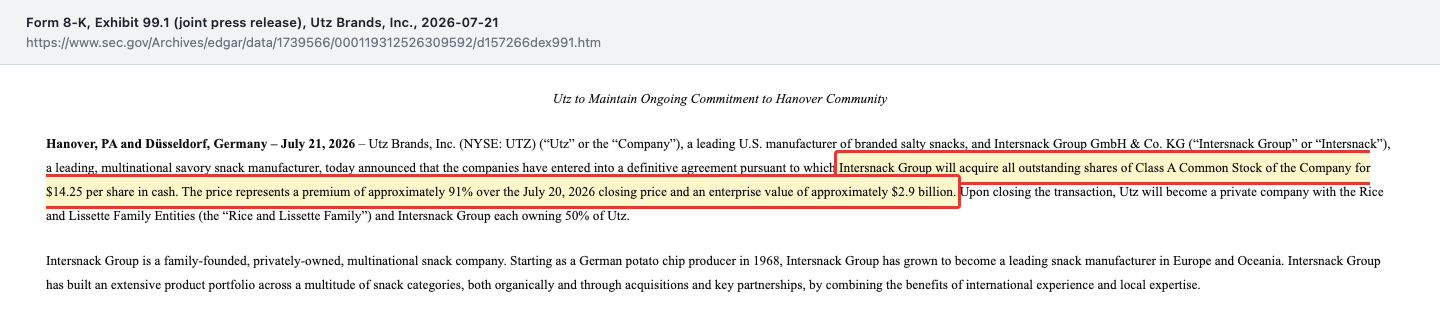
Work backwards once and you have the only clean price anchor in this analysis: $14.25 with "approximately 91 percent" of premium implies a July 20, 2026 closing price of about $7.46. Nearly half the offered price is therefore premium — and that premium exists only if the deal closes. Which is why the conditions deserve a look. There are two voting hurdles, not one:
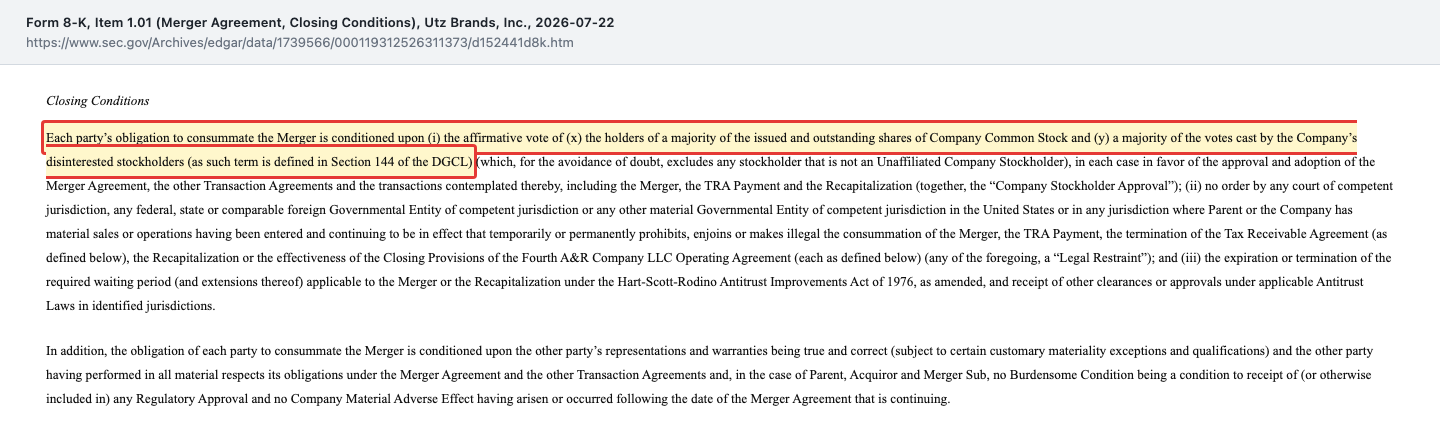
The first hurdle is effectively settled: the family vehicles Series U and Series R of UM Partners, LLC, together with Dylan B. Lissette, Timothy P. Brown and the Rice Family Foundation, have committed roughly 42 percent of the common stock in favor and expressly waived appraisal rights. The second hurdle is open — because those 42 percent are excluded from the pool of "disinterested stockholders." Arithmetically the decision therefore sits with the roughly 83.3 million Class A shares outside the locked-up votes. Add the antitrust clearances under U.S. merger control (Hart-Scott-Rodino) and other jurisdictions. If the whole thing fails, a $50 million termination fee applies in specified circumstances, and the outside date runs to April 20, 2027. A better offer remains possible: the agreement bars active solicitation but lets the special committee evaluate an unsolicited, bona fide proposal and change its recommendation — against payment of the same $50 million.
One more number belongs in this chapter, because it shows who sits on which side. The acquisition ends a contract dating back to the initial listing, the Tax Receivable Agreement, under which the family is paid the group's tax benefits in cash. On the balance sheet as of December 28, 2025 that obligation stood at $24.0 million ($4.4 million current, $19.6 million non-current). It is being terminated for $44 million:
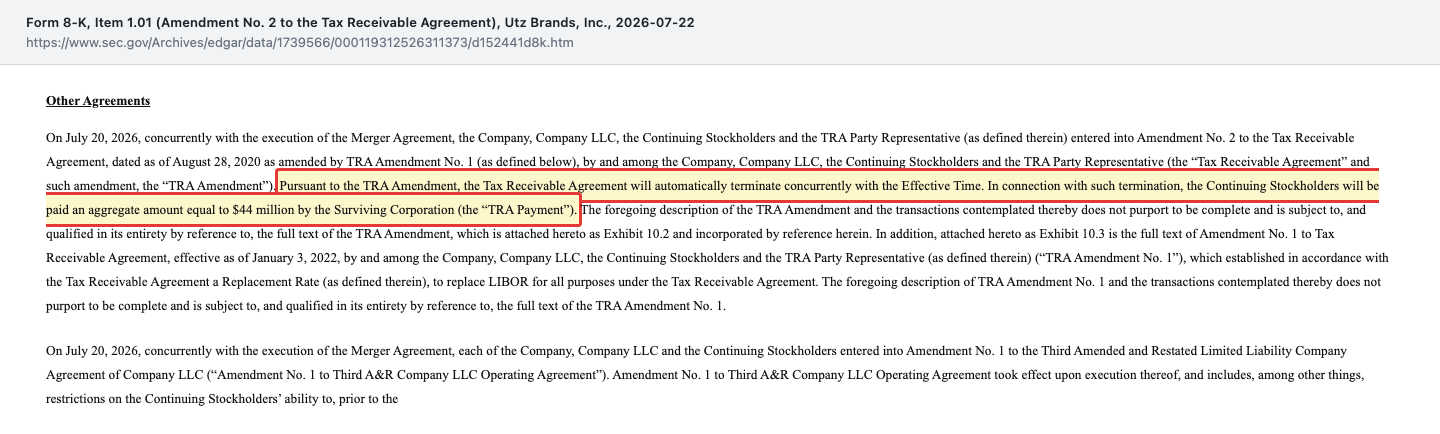
Before that turns into an accusation, the other half of the footnote belongs here — and it sits in the same annual report: $24.0 million is what the balance sheet carries, but Utz projects a total obligation of $56.2 million under this contract. The $32.2 million difference is deliberately not booked, because the related tax benefit is not probable enough under U.S. accounting rules to create a liability. Measured against that projection, $44 million is a discount of a good $12 million; measured against the carried amount, it is a premium of about $20 million. Both figures are in the report — and quoting only one of them tells half the story.
That payment comes out of the acquired company's own account, and part of it flows straight back as a reinvestment into the family's future 50 percent stake, per the press release. It is disclosed, and an independent special committee chaired by Craig D. Steeneck recommended the transaction unanimously; Citi advised the committee, RBC the company. But the point that has to be checked in every going-private deal remains: here the seller also sits on the buyer's side. How similarly structured, family-controlled companies treat their minority shareholders is something we worked through in detail in another dual-class case — our analysis of Biglari Holdings.
Valuation: about 13 times adjusted earnings — for a business without growth
How expensive is $14.25? A price-to-earnings ratio cannot be formed, because Utz reported a loss for fiscal 2025. The usable yardstick is therefore enterprise value against the business. At $2,820.1 million of enterprise value (the press release says "approximately $2.9 billion") that works out to:
- about 2.0 times annual revenue ($1,438.8 million in fiscal 2025)
- about 13 times adjusted earnings (Adjusted EBITDA of $216.5 million) — about 13.4 times on the announced $2.9 billion figure
- about 23 times unadjusted EBITDA ($122.7 million) — same company, different denominator
- no meaningful price-to-earnings ratio (a $7.7 million net loss in fiscal 2025)
For a branded food maker with century-old labels, roughly 13 times adjusted earnings is not an outlier on the high side — listed snack and packaged-food companies have often traded in that range in recent years. Nor is it a bargain for the buyer, measured against revenue that has stood still for three years. Two things pull the picture in opposite directions. First: Intersnack is not a financial investor but a competitor with no U.S. presence — for it, Utz is market entry, and market entry usually costs more than a spreadsheet would allow. Second: the substance behind the price is thin. Of $2,786.1 million in total assets (March 29, 2026), $1,821.7 million is goodwill plus other intangible assets — brand values and customer relationships from earlier acquisitions. Strip them out and tangible equity is clearly negative. If you want a margin of safety in hard assets, it is not here; the safety lies in the brands and in shelf space. That a well-known name alone does not produce a rising margin is something we saw at potato neighbour Lamb Weston.
Opportunities and risks at a glance
What speaks for Utz Brands:
- A binding merger agreement dated July 20, 2026 at $14.25 per Class A share in cash, recommended unanimously by an independent special committee — with roughly 42 percent of the votes already contractually committed.
- A stable, old business: revenue $1,438.8 million in fiscal 2025, branded salty snacks up 4.7 percent (88 percent of revenue, led by the four core brands), the Utz brand alone above $870 million in retail sales, products in roughly 50 percent of U.S. households.
- Adjusted earnings and cash flow are rising: Adjusted EBITDA $216.5 million (15.0 percent of revenue) after $200.2 million; cash from operations $112.2 million after $106.2 million and $76.6 million in the two prior years.
- Financing in order: the main loan runs to January 29, 2032, the average rate was 5.6 percent, $577.6 million is hedged with interest rate swaps, and $119.7 million of the revolver was available on December 28, 2025.
- The first quarter of 2026 was operationally better than the prior-year quarter: revenue up 2.6 percent to $361.3 million, gross margin 25.4 percent instead of 23.4 percent, adjusted earnings $47.9 million instead of $45.1 million.
What speaks against it:
- Closing is pending: it needs two separate voting hurdles — a majority of all common stock and a majority of the votes cast by unaffiliated holders — plus antitrust clearances; the outside date is April 20, 2027 and the termination fee is $50 million. Nearly half the offer price is premium and exists only on closing.
- The business is not growing: revenue of $1,438.2 million, $1,409.2 million and $1,438.8 million across three 52-week fiscal years; the business outside the core brands fell 14.0 percent in 2025.
- Earnings quality: a $7.7 million net loss in 2025 and a $40.0 million loss in 2023, with only one positive year in between; unadjusted EBITDA fell to $122.7 million in 2025 while the adjusted figure rose to $216.5 million — partly because of $65.4 million of transformation costs incurred for a second consecutive year.
- Payouts above what the business earns: $22.3 million of dividends plus $15.4 million to noncontrolling interest holders against $9.4 million of free cash flow in 2025 — the third year in a row; the agreement now caps the quarterly dividend at $0.063 per share.
- Thin substance and customer concentration: $1,821.7 million of the $2,786.1 million balance sheet is goodwill and intangibles (tangible equity negative); the ten largest customers account for roughly 40 percent of invoiced sales, and a single one for more than 10 percent.
A human conclusion
Back to the premium reflex from the start. Its core is not that 91 percent is a small number — it is a large one, and for long-standing Class A holders this contract is without doubt the best news since the listing. Its core is that the percentage covers three questions worth asking first. One: what is being paid for — a business whose revenue has stood still for three years and whose reported result for 2025 was negative. Two: who comes along — the founding family stays aboard with 50 percent, collects $44 million beforehand for a contract carried at $24 million (projected total $56.2 million), and therefore sits on both sides of the table; the public shareholders are cashed out and shown the door. Three: whether at all — closing hangs on a vote in which exactly the 42 percent that already said yes do not count. So the honest question for you is not "Is $14.25 enough?" but: would you pay this price for the company if the takeover did not exist — and if not, what happens to you should it fail to close? If you have both answers, you have a thesis. If you only have the percentage, you have a headline. What you make of it is your decision. And that is exactly as it should be.
Sources
All original documents used in this analysis — to read for yourself:
- Utz Brands, Inc. — SEC annual report 10-K for fiscal 2025 (52 weeks ended December 28, 2025, filed February 12, 2026)
- Utz Brands, Inc. — SEC quarterly report 10-Q as of March 29, 2026 (filed May 6, 2026)
- Utz Brands, Inc. and Intersnack Group GmbH & Co. KG — joint press release dated July 21, 2026 (SEC filing 8-K, Item 8.01, Exhibit 99.1)
- Utz Brands, Inc. — SEC filing 8-K dated July 22, 2026 (Items 1.01 and 5.03: merger agreement, implementation agreement, voting agreement, Tax Receivable Agreement amendment, by-law amendment)
- Full SEC filing history of Utz Brands, Inc. (including the Schedule 13D/A filed July 22, 2026 and the 8-K filings of May 6 and May 28, 2026): EDGAR overview (sec.gov)
- Fundamental data (metrics, valuation; data as of July 30, 2026), reconciled with the SEC filings and the SEC XBRL financial series.
- Reddit mentions (as of July 30, 2026); surfaced via our in-house stock scanner.
Transparency & disclaimer: This analysis is a journalistic contextualization of publicly available information and is not investment advice, not a financial analysis in the regulatory sense, and not a solicitation to buy or sell securities. Stock investments carry substantial risks up to total loss. All information without warranty; the data cut-off is noted in the text. The author holds no position in Utz Brands shares at the time of publication.
Our Bottom Line at a Glance
- Business model & brands positive
- A branded food maker more than a hundred years old with documented reach: products in roughly 50 percent of U.S. households, eight plants, about 2,500 direct-store-delivery routes (as of December 28, 2025). The Utz brand alone produced more than $870 million of retail sales in 2025; branded salty snacks grew 4.7 percent and account for 88 percent of revenue, a gain the annual report attributes to the four core brands.
- Growth & earnings quality negative
- Revenue has been essentially flat across three 52-week fiscal years ($1,438.2 million, $1,409.2 million, $1,438.8 million), and the reported result was negative in two of the three ($7.7 million loss in 2025, $40.0 million loss in 2023). While adjusted earnings rose to $216.5 million in 2025, unadjusted EBITDA fell to $122.7 million — partly because of $65.4 million of transformation costs in a second consecutive year.
- Balance sheet & payouts negative
- Of $2,786.1 million in total assets (March 29, 2026), $1,821.7 million is goodwill and other intangible assets; nothing tangible is left over. Net financial debt is $768.6 million against $43.1 million of interest expense (2025). And in 2025 the company paid $22.3 million of dividends plus $15.4 million to noncontrolling interest holders on just $9.4 million of free cash flow — the third year in a row.
- Capital structure & transparency neutral
- The dual structure of 88,613,213 Class A and 55,349,000 Class V shares (July 15, 2026) is fully disclosed but systematically misleads the metrics: a market value built on Class A alone omits 38 percent of the company. The merger agreement simultaneously terminates a tax contract dating from the listing for $44 million; $24.0 million was carried on the balance sheet and the annual report projects a total obligation of $56.2 million (December 28, 2025).
- Financing & room to act positive
- No going-concern warning and no reported covenant breach: the main loan was refinanced in January 2025 and runs to January 29, 2032, the average rate fell to 5.6 percent in 2025, $577.6 million is hedged with interest rate swaps, and $119.7 million of the $225 million revolver was available on December 28, 2025. Cash from operations rose three years running to $112.2 million.
Utz Brands is the premium reflex in pure form: a headline about a 91 percent premium covers a snack maker whose revenue has been flat at about $1.44 billion for three years, which reported a $7.7 million net loss in 2025, and whose $216.5 million of adjusted earnings only exists because $65.4 million of transformation costs were stripped out for a second consecutive year. The price on the table is $14.25 per Class A share — across all 143,962,213 units that is $2,051.5 million of equity value and, with debt, about $2.8 billion of enterprise value, or roughly 13 times adjusted earnings. Nothing is done: two stockholder votes and the antitrust clearances are still outstanding, with an outside date of April 20, 2027. Not investment advice.
What Our Rating Means
Open questions
The business works in principle, but one material question is open. As long as it stays open, our findings do not carry a quality verdict.
Yellow here stands for an open operating question, not for a substance risk — and expressly not for the pending takeover, which as such is no quality argument in either direction. The business works: century-old brands, products in roughly 50 percent of U.S. households, cash from operations rising three years running to $112.2 million, the main loan refinanced to 2032, $119.7 million of revolver available and no going-concern warning. What is open is whether that turns back into a profit: revenue has stood still across three 52-week years, the reported result was negative in two of three, the "transformation costs" recur for a second consecutive year and have more than doubled to $65.4 million, and the $37.7 million of payouts clearly exceeds the $9.4 million of free cash flow. The hardest number is interest coverage: operating income covered interest expense only 45 percent of the way in 2025 ($19.5 million against $43.1 million) and also fell below one times in 2023 — on its own a red criterion. It does not turn red here because cash from operations covers interest 2.6 times over, the main loan does not mature until 2032, $119.7 million of the revolver is free, and neither a going-concern warning nor a covenant breach is reported (fiscal 2025 annual report). If any of those tips over, the light belongs on red. On price: roughly 13 times adjusted earnings is not expensive for a branded food maker of this size, but nearly half of the $14.25 is takeover premium and exists only if two votes and the regulators cooperate — betting on that alone is a bet on a date, not on a business. The decision is yours.
A journalistic assessment by our editorial team at the time of the deep dive, based on public sources — not investment advice and not a solicitation to buy or sell. Your personal circumstances (investment goals, risk capacity, taxes) cannot be taken into account. What our levels mean, how verdicts are formed, and what conflicts of interest exist →
Worth Noting
- Utz Brands reached the research list through the Reddit mentions in our in-house hype scanner (as of July 30, 2026). A live query on July 30, 2026 shows that the stock appears in none of our metric scanners — neither momentum nor quality nor valuation. Those lists are recalculated daily, so the finding is a snapshot.
- Market-value warning: price databases often compute Utz's market value from the 88.6 million Class A shares alone (about $1.2 billion on July 30, 2026) and leave out the founding family's 55.3 million Class V shares — 38 percent of the company. This analysis therefore does not use that figure and works only with the documented deal values: $2,051.5 million of equity value, $768.6 million of net financial debt, $2,820.1 million of enterprise value.
- Status of the takeover: merger agreement dated July 20, 2026, announced July 21, 2026, terms detailed in the 8-K filed July 22, 2026. None of it is completed; every statement about the outcome is in the conditional. The most recent period report is the quarterly report (10-Q) as of March 29, 2026; Utz announced second-quarter 2026 results for August 5, 2026, without a conference call.
- Not to be confused: Utz Brands, Inc. was called Collier Creek Holdings until the 2020 business combination and was a SPAC shell. The buyer, Intersnack Group GmbH & Co. KG of Düsseldorf, Germany, is a private, family-owned company and is not listed; per the press release it had no presence in the U.S. snack market before this transaction.
Frequently Asked Questions
That is the plan, but it has not happened yet. On July 20, 2026 Utz Brands signed a merger agreement with Germany's Intersnack Group GmbH & Co. KG; after closing, the stock would no longer be listed on the New York Stock Exchange according to the joint press release of July 21, 2026. Closing is expected in the fourth quarter of 2026 and depends on two stockholder votes, antitrust clearances and an outside date of April 20, 2027.
Each Class A share is to receive $14.25 in cash, without interest and net of applicable withholding taxes. According to the press release of July 21, 2026 that is a premium of roughly 91 percent over the July 20, 2026 closing price. The founding family's 55,349,000 Class V shares would be cancelled for no consideration — but the family is not cashed out: it keeps its units in the subsidiary Utz Brands Holdings, LLC and, per the 8-K filed July 22, 2026, buys a further 2,315,790 units at $14.25 each.
Utz runs a 52/53-week fiscal year ending on the Sunday closest to December 31. That is why fiscal 2025 ended on December 28, 2025, fiscal 2024 on December 29, 2024 and fiscal 2023 on December 31, 2023. All three were 52-week years according to the annual report and are therefore directly comparable. In a 53-week year the fourth quarter has 14 weeks instead of 13 — such years look stronger without a single extra sale.
Because Utz has two classes of stock and only the Class A trades. As of July 15, 2026 there were 88,613,213 Class A and 55,349,000 Class V shares. Price databases often compute market value from the Class A alone — about $1.2 billion on July 30, 2026 — which leaves out 38 percent of the company. All 143,962,213 units at $14.25 equal $2,051.5 million of equity value, and with net financial debt an enterprise value of $2,820.1 million.
On a cash basis yes, on a reported-profit basis not always. Fiscal 2025 showed a net loss of $7.7 million (2024: plus $30.7 million, 2023: minus $40.0 million), while cash from operations rose to $112.2 million. Adjusted EBITDA came to $216.5 million in 2025, or 15.0 percent of revenue — that figure strips out, among other items, $65.4 million of transformation costs.
As of March 29, 2026 Utz reported $842.3 million of financial debt ($812.0 million non-current, $30.3 million current) against $73.7 million of cash — net about $769 million, roughly three and a half times a year of adjusted earnings. Interest expense was $43.1 million in 2025 at an average rate of 5.6 percent. The main loan runs to January 29, 2032, $577.6 million is hedged with swaps, and $119.7 million of the revolver was free at the end of 2025.
Then either side can terminate the agreement. Closing requires a majority of all outstanding common stock plus a majority of the votes cast by unaffiliated holders; the roughly 42 percent that is contractually locked up does not count towards that second hurdle. A $50 million termination fee becomes payable in specified circumstances. The outside date runs to April 20, 2027, and without closing the roughly 91 percent premium disappears.
The four core brands are Utz, On The Border, Zapp's and Boulder Canyon; together with other labels they accounted for 88 percent of fiscal 2025 revenue and grew 4.7 percent. The Utz brand alone generated more than $870 million in retail sales in 2025. Others include Golden Flake, Bachman, Tim's Cascade, Dirty Potato Chips, Hawaiian, Miguelito's, Vitner's and TGI Fridays. Good Health and R.W. Garcia were sold in February 2024.
Found an error?
Did you spot a factual error, an outdated number, or a typo in this deep dive? Let us know briefly — your report goes straight to the editorial team.